






Rare Earth Elements - Seltene Erden : Infos, Fakten, Unternehmen - 500 Beiträge pro Seite (Seite 2)
eröffnet am 23.04.07 15:20:36 von
neuester Beitrag 05.01.15 19:48:35 von
neuester Beitrag 05.01.15 19:48:35 von
Beiträge: 691
ID: 1.126.354
ID: 1.126.354
Aufrufe heute: 31
Gesamt: 84.822
Gesamt: 84.822
Aktive User: 0
Top-Diskussionen
| Titel | letzter Beitrag | Aufrufe |
|---|---|---|
| vor 49 Minuten | 4381 | |
| vor 33 Minuten | 3258 | |
| vor 1 Stunde | 2384 | |
| vor 30 Minuten | 2359 | |
| vor 1 Stunde | 1792 | |
| vor 39 Minuten | 1566 | |
| heute 13:33 | 1201 | |
| heute 13:38 | 1145 |
Meistdiskutierte Wertpapiere
| Platz | vorher | Wertpapier | Kurs | Perf. % | Anzahl | ||
|---|---|---|---|---|---|---|---|
| 1. | 1. | 17.752,10 | -0,01 | 201 | |||
| 2. | 2. | 150,10 | +0,11 | 96 | |||
| 3. | 7. | 6,7000 | -0,42 | 78 | |||
| 4. | 5. | 0,1735 | -5,96 | 70 | |||
| 5. | 8. | 3,7850 | +1,20 | 65 | |||
| 6. | 4. | 2.394,73 | +0,65 | 53 | |||
| 7. | 17. | 7,3550 | +0,68 | 42 | |||
| 8. | 3. | 7,2500 | +3,57 | 34 |

 Feedback
http://www.criticalmetals.de/midasresearch/pdf/seltene_metal…
... Seite 24
Lynas Corporation
Der nächste Seltene-Erden-
Produzent
Unternehmen und Strategie
Das australische Rohstoff-Unternehmen Lynas
Corporation besitzt das am weitesten
fortgeschrittene Seltene Erden-Projekt
außerhalb Chinas. Das im australischen Sydney
ansässige Unternehmen baut aktuell an einer
Mine auf seinem westaustralischen Mount Weld-
Projekt. Trotzdem die Produktion noch nicht
gestartet wurde, gehört Lynas Corporation mit
einer Marktkapitalisierung von mehr als drei
Milliarden AUD schon jetzt zu den 100 größten
an der australischen ASX notierten
Unternehmen.
Das Mount Weld-Projekt inWestaustralien
Das Mount Weld-Projekt besitzt aktuell bekannte
Vorkommen von etwa 1,4 Millionen Tonnen an
Seltene Erden-Oxid. Der durchschnittliche
Seltene Erden-Gehalt am gesamten Gestein
beträgt dabei rund 8%, die Cut-Off-Rate liegt
bei 2,5%. Die Anlage zur Herstellung eines
Seltene-Erden-Konzentrats befindet sich noch im
Bau und soll Ende März 2011 fertiggestellt sein.
Ab diesem Zeitpunkt soll auch eine erste
Produktionsphase gestartet werden. Das auf
Mount Weld produzierte Konzentrat wird dann zum etwa 1.000 Kilometer entfernten Hafen
Fremantle transportiert und von dort zur unternehmenseigenen Endverarbeitungsanlage ins
malaysische Gebeng verschifft. Die Transportkosten machen dabei etwa 9% der gesamten
Produktionskosten aus.
Seite 25
Eigene Anlage zur Endverarbeitung garantiert hohe Marge
In Gebeng/Malaysia entsteht aktuell die so genannte „Advanced Materials Plant“. Diese soll
spätestens im dritten Quartal 2011 die Produktion aufnehmen und in einer ersten Phase etwa
11.000 Tonnen Seltene Erden jährlich produzieren. In einer zweiten Phase soll diese
Produktionsrate auf bis zu 22.000 Tonnen jährlich erhöht werden. Die recht hohen Grade machen
es Lynas Corporation bereits im Vorfeld möglich, die Infrastruktur der gesamten Anlage auf die
doppelte Verarbeitungskapazität auszulegen. Das Ziel soll bis zum Jahr 2014 erreicht werden. Die
Anlage in Gebeng kommt Lynas gleich doppelt zugute: Erstens lässt sich das in Westaustralien
hergestellte Konzentrat so effektiv in einem Niedriglohnland weiterverarbeiten; zweitens kann
durch die Trennung in die einzelnen Elemente den Kunden ein hochwertiges Einzelprodukt
angeboten und verkauft werden kann. Denn die Preise für die einzelnen Elemente liegen
verständlicherweise weit höher als für ein Konzentrat aus mehreren Seltene Erden–Elementen.
Abnahmeverträge und strategische Allianz garantieren hohe Renditen
Parallel zum Bau der Mine und der Konzentrationsanlage auf Mount Weld sowie der
Weiterverarbeitungsanlage in Malaysia hat sich die Lynas Corporation im Vorfeld auch lukrative
Abnahmeverträge gesichert. Lynas konnte dabei bereits sechs feste Abnahmeverträge sowie zwei
Absichtserklärungen zur Abnahme von Seltenen Erden abschließen. Diese sind zum Großteil
langfristig ausgelegt und besitzen ein Volumen von mehr als einer Milliarde USD. Zudem
konnte die Lynas Corporation eine strategische Allianz mit der Sojitz Corporation, einem
japanischen Großhandelsunternehmen, eingehen. Die Sojitz Corporation zählt zu den 100 größten
Unternehmen Japans und wird innerhalb von 10 Jahren zwischen 80.000 und 90.000 Tonnen an
Seltenen Erden von Lynas abnehmen und auf dem japanischen Markt weiterverkaufen. Die
strategische Allianz bedeutet dabei für beide Seiten eine Win-Win-Situation. Das stark vom
ehemaligen Erzfeind China abhängige Japan erhält somit einen direkten Zugang zu den
wichtigen Seltenen Erden. Die Lynas Corporation sichert sich die Abnahme von mindestens 40%
der Gesamtproduktion (bei Erreichung der vollen Produktionskapazität von 22.000 Tonnen
jährlich) und könnte damit innerhalb von nur 10 Jahren bei den aktuellen Seltene Erden-Preisen
einen Umsatz von knapp 10 Milliarden USD generieren - und das allein durch den Deal mit der
Sojitz Corporation.
Fazit und Ausblick
Die Lynas Corporation ist lediglich einen Schritt vom Produktionsstart auf seinem Mount Weld-
Projekt entfernt. Dieses besitzt sehr gute Grade und eine exzellente Verarbeitungsstrategie. Sofern
die aktuelle Planung bis 2014 eins-zu-eins umgesetzt werden kann, sollte es mit einer
Produktionskapazität von 22.000 Tonnen Seltene Erden pro Jahr zum drittgrößten Seltene Erden
Projekt weltweit und zum größten außerhalb Chinas ausgebaut werden. Damit dürften auf Mount
Weld ab 2014 rund 11% aller Seltenen Erden weltweit gefördert werden. Das Mount Weld-Projekt
ist schon jetzt zu einem Projekt von nationaler und internationaler Wichtigkeit geworden,
Australien bezeichnet es als „strategische Ressource“. Beide Produktionsphasen sind bereits voll
durch finanziert, Abnahmeverträge über mehrere Jahre im Milliarden-USD-Bereich konnten
gesichert werden. Ein hoher Cashflow ist von Anfang an garantiert. Das führende australische
Brokerhaus Patersons Securities sieht den Wert von Lynas Corporation bei den aktuellen
Preisen für Seltene Erden bei bis zu 11 AUD je Aktie. Trotz der aktuellen Krisensituation in
Japan, Heimatland des strategischen Kooperationspartners Sojitz, gehört die Lynas Corporation
angesichts der langfristigen Planungen des Unternehmens u.E. in jedes Rohstoff-Portfolio.
...
http://www.lynascorp.com/page.asp?category_id=1&page_id=25
What are their prices?The first point to note about Rare Earths prices is that there is significant variance in the relative market value for selected Rare Earths oxides. Secondly, the price of Rare Earths depends on the purity level, which is largely set by the specifications for each application.
The table below shows the average annual price for a 'standard' 99% purity of individual elements and for the generic composite of Rare Earths equivalent to the Rare Earths distribution at Mt Weld. Prices are quoted in US$/kg on an FOB China basis. Note that higher purity oxides and other value added properties will attract higher prices than those shown.
http://www.metal-pages.com/metalprices/rareearths/
http://www.asianmetal.com/price/initPriceListEn.am?priceFlag…
@ eine erfolgreiche Woche
Grüsse JoJo
... Seite 24
Lynas Corporation
Der nächste Seltene-Erden-
Produzent
Unternehmen und Strategie
Das australische Rohstoff-Unternehmen Lynas
Corporation besitzt das am weitesten
fortgeschrittene Seltene Erden-Projekt
außerhalb Chinas. Das im australischen Sydney
ansässige Unternehmen baut aktuell an einer
Mine auf seinem westaustralischen Mount Weld-
Projekt. Trotzdem die Produktion noch nicht
gestartet wurde, gehört Lynas Corporation mit
einer Marktkapitalisierung von mehr als drei
Milliarden AUD schon jetzt zu den 100 größten
an der australischen ASX notierten
Unternehmen.
Das Mount Weld-Projekt inWestaustralien
Das Mount Weld-Projekt besitzt aktuell bekannte
Vorkommen von etwa 1,4 Millionen Tonnen an
Seltene Erden-Oxid. Der durchschnittliche
Seltene Erden-Gehalt am gesamten Gestein
beträgt dabei rund 8%, die Cut-Off-Rate liegt
bei 2,5%. Die Anlage zur Herstellung eines
Seltene-Erden-Konzentrats befindet sich noch im
Bau und soll Ende März 2011 fertiggestellt sein.
Ab diesem Zeitpunkt soll auch eine erste
Produktionsphase gestartet werden. Das auf
Mount Weld produzierte Konzentrat wird dann zum etwa 1.000 Kilometer entfernten Hafen
Fremantle transportiert und von dort zur unternehmenseigenen Endverarbeitungsanlage ins
malaysische Gebeng verschifft. Die Transportkosten machen dabei etwa 9% der gesamten
Produktionskosten aus.
Seite 25
Eigene Anlage zur Endverarbeitung garantiert hohe Marge
In Gebeng/Malaysia entsteht aktuell die so genannte „Advanced Materials Plant“. Diese soll
spätestens im dritten Quartal 2011 die Produktion aufnehmen und in einer ersten Phase etwa
11.000 Tonnen Seltene Erden jährlich produzieren. In einer zweiten Phase soll diese
Produktionsrate auf bis zu 22.000 Tonnen jährlich erhöht werden. Die recht hohen Grade machen
es Lynas Corporation bereits im Vorfeld möglich, die Infrastruktur der gesamten Anlage auf die
doppelte Verarbeitungskapazität auszulegen. Das Ziel soll bis zum Jahr 2014 erreicht werden. Die
Anlage in Gebeng kommt Lynas gleich doppelt zugute: Erstens lässt sich das in Westaustralien
hergestellte Konzentrat so effektiv in einem Niedriglohnland weiterverarbeiten; zweitens kann
durch die Trennung in die einzelnen Elemente den Kunden ein hochwertiges Einzelprodukt
angeboten und verkauft werden kann. Denn die Preise für die einzelnen Elemente liegen
verständlicherweise weit höher als für ein Konzentrat aus mehreren Seltene Erden–Elementen.
Abnahmeverträge und strategische Allianz garantieren hohe Renditen
Parallel zum Bau der Mine und der Konzentrationsanlage auf Mount Weld sowie der
Weiterverarbeitungsanlage in Malaysia hat sich die Lynas Corporation im Vorfeld auch lukrative
Abnahmeverträge gesichert. Lynas konnte dabei bereits sechs feste Abnahmeverträge sowie zwei
Absichtserklärungen zur Abnahme von Seltenen Erden abschließen. Diese sind zum Großteil
langfristig ausgelegt und besitzen ein Volumen von mehr als einer Milliarde USD. Zudem
konnte die Lynas Corporation eine strategische Allianz mit der Sojitz Corporation, einem
japanischen Großhandelsunternehmen, eingehen. Die Sojitz Corporation zählt zu den 100 größten
Unternehmen Japans und wird innerhalb von 10 Jahren zwischen 80.000 und 90.000 Tonnen an
Seltenen Erden von Lynas abnehmen und auf dem japanischen Markt weiterverkaufen. Die
strategische Allianz bedeutet dabei für beide Seiten eine Win-Win-Situation. Das stark vom
ehemaligen Erzfeind China abhängige Japan erhält somit einen direkten Zugang zu den
wichtigen Seltenen Erden. Die Lynas Corporation sichert sich die Abnahme von mindestens 40%
der Gesamtproduktion (bei Erreichung der vollen Produktionskapazität von 22.000 Tonnen
jährlich) und könnte damit innerhalb von nur 10 Jahren bei den aktuellen Seltene Erden-Preisen
einen Umsatz von knapp 10 Milliarden USD generieren - und das allein durch den Deal mit der
Sojitz Corporation.
Fazit und Ausblick
Die Lynas Corporation ist lediglich einen Schritt vom Produktionsstart auf seinem Mount Weld-
Projekt entfernt. Dieses besitzt sehr gute Grade und eine exzellente Verarbeitungsstrategie. Sofern
die aktuelle Planung bis 2014 eins-zu-eins umgesetzt werden kann, sollte es mit einer
Produktionskapazität von 22.000 Tonnen Seltene Erden pro Jahr zum drittgrößten Seltene Erden
Projekt weltweit und zum größten außerhalb Chinas ausgebaut werden. Damit dürften auf Mount
Weld ab 2014 rund 11% aller Seltenen Erden weltweit gefördert werden. Das Mount Weld-Projekt
ist schon jetzt zu einem Projekt von nationaler und internationaler Wichtigkeit geworden,
Australien bezeichnet es als „strategische Ressource“. Beide Produktionsphasen sind bereits voll
durch finanziert, Abnahmeverträge über mehrere Jahre im Milliarden-USD-Bereich konnten
gesichert werden. Ein hoher Cashflow ist von Anfang an garantiert. Das führende australische
Brokerhaus Patersons Securities sieht den Wert von Lynas Corporation bei den aktuellen
Preisen für Seltene Erden bei bis zu 11 AUD je Aktie. Trotz der aktuellen Krisensituation in
Japan, Heimatland des strategischen Kooperationspartners Sojitz, gehört die Lynas Corporation
angesichts der langfristigen Planungen des Unternehmens u.E. in jedes Rohstoff-Portfolio.
...
http://www.lynascorp.com/page.asp?category_id=1&page_id=25
What are their prices?The first point to note about Rare Earths prices is that there is significant variance in the relative market value for selected Rare Earths oxides. Secondly, the price of Rare Earths depends on the purity level, which is largely set by the specifications for each application.
The table below shows the average annual price for a 'standard' 99% purity of individual elements and for the generic composite of Rare Earths equivalent to the Rare Earths distribution at Mt Weld. Prices are quoted in US$/kg on an FOB China basis. Note that higher purity oxides and other value added properties will attract higher prices than those shown.
http://www.metal-pages.com/metalprices/rareearths/
http://www.asianmetal.com/price/initPriceListEn.am?priceFlag…
@ eine erfolgreiche Woche
Grüsse JoJo

http://www.thetradercentral.com/featuredstocks" target="_blank" rel="nofollow ugc noopener">http://www.thetradercentral.com/featuredstocks
...
Lynas Corporation
Lynas are a rare earth resource company based in Western Australia. Lynas’ most advanced operation is the Mount Weld Rare Earths project. Mount weld involves the development of a mine, concentration plant, and an advanced materials plant. Mount Weld currently has a REO of 1.4 million tonnes. Lynas plan to truck ore produced from Mount weld to the Fremantle Port where it will then be shipped to their Malaysian processing hub. Lynas aim to produce 11,000 tones of rare earth resource in 2011 and double that figure to 22,000 in 2012. Mount Weld is a world-class project, the size and quality of the resource can be compared against most rare earth metal mines in the world.
The current status of the project is the following:
• Concentration plant completed, awaiting government approval to start plant
• Advanced materials plant under construction with first feed scheduled for late 2011
• 8 buyers have signed an agreement to purchase RER from lynas
Back in 2010 the Foreign Investment Review board rejected an offer by Chinese Non-ferrous Metals Mining Company to acquire more than 50% of Lyans. As a result Lynas’ share price languished for some time with investors unsure where the required capital to fund their projects would come from, however The Foreign Investment Review Board has now approved of significant investment by Japanese Oil Gas and Metals National Corporation. Under the deal JOGMEC will invest $325 million into lynas in the form of a loan and the placement of shares.
Last Month, Lynas agreed to sub-lease several areas within Mount Weld (Crown) to Forge Resources. The transaction involved Lynas receiving $20.7 million in cash and the option to purchase 7 million shares in Forge as well as the right to purchase resource produced in the leases. Lynas will also receive royalties as part of the transaction. The deal looks likely to be met by strong opposition from shareholders who argue the value of the leases are being significantly undervalued. An independent expert backed the transaction citing the deal was “fair and reasonable”. Shareholders will vote on may 18th.
Analysing the deal we see the following:
Investor presentation in March 2010 states that the crown polymetallic deposit is “ a world class niobium asset and contains 475,000t REO”. To put it simply, world class assets are not sold for 20 million and a couple of options. Calculations of the resource have put it well in to the tens of billions, the decision to sell these “world class assets” so cheaply is interesting to say the least. The following image is a slide taken from a lynas presentation in 2007:

Lynas say the Crown resource has “over $50 billion metal content”. Prices have increased since 2007 which would value the resource significantly higher today. So a resource that the company itself has valued at over $50 billion is now being sold for $20.7 million plus options? Investors are very interested in what has changed for Crown to be considered a non-core asset and to be valued at so little when the company previously valued the resource at tens of billions more than it is being sold for. Either the company over-valued Crown by 49.8 billion dollars or there is another reason unknown to everyone.
Despite the controversy surrounding the deal with Forge, Lynas have one of, if not the largest rare earth resources project in the world. With the restricted supply from China, the demand for their resource will be significant; this is already shown by a total of 8 customers entering into agreements with Lynas. The ever increasing demand for rare metals and the limited supply is most likely to drive the price of rare earths in the long term resulting in greater Margins for Lynas.
Googleübersetzt: http://translate.google.de/translate?js=n&prev=_t&hl=de&ie=U…
Grüsse JoJo
...
Lynas Corporation
Lynas are a rare earth resource company based in Western Australia. Lynas’ most advanced operation is the Mount Weld Rare Earths project. Mount weld involves the development of a mine, concentration plant, and an advanced materials plant. Mount Weld currently has a REO of 1.4 million tonnes. Lynas plan to truck ore produced from Mount weld to the Fremantle Port where it will then be shipped to their Malaysian processing hub. Lynas aim to produce 11,000 tones of rare earth resource in 2011 and double that figure to 22,000 in 2012. Mount Weld is a world-class project, the size and quality of the resource can be compared against most rare earth metal mines in the world.
The current status of the project is the following:
• Concentration plant completed, awaiting government approval to start plant
• Advanced materials plant under construction with first feed scheduled for late 2011
• 8 buyers have signed an agreement to purchase RER from lynas
Back in 2010 the Foreign Investment Review board rejected an offer by Chinese Non-ferrous Metals Mining Company to acquire more than 50% of Lyans. As a result Lynas’ share price languished for some time with investors unsure where the required capital to fund their projects would come from, however The Foreign Investment Review Board has now approved of significant investment by Japanese Oil Gas and Metals National Corporation. Under the deal JOGMEC will invest $325 million into lynas in the form of a loan and the placement of shares.
Last Month, Lynas agreed to sub-lease several areas within Mount Weld (Crown) to Forge Resources. The transaction involved Lynas receiving $20.7 million in cash and the option to purchase 7 million shares in Forge as well as the right to purchase resource produced in the leases. Lynas will also receive royalties as part of the transaction. The deal looks likely to be met by strong opposition from shareholders who argue the value of the leases are being significantly undervalued. An independent expert backed the transaction citing the deal was “fair and reasonable”. Shareholders will vote on may 18th.
Analysing the deal we see the following:
Investor presentation in March 2010 states that the crown polymetallic deposit is “ a world class niobium asset and contains 475,000t REO”. To put it simply, world class assets are not sold for 20 million and a couple of options. Calculations of the resource have put it well in to the tens of billions, the decision to sell these “world class assets” so cheaply is interesting to say the least. The following image is a slide taken from a lynas presentation in 2007:
Lynas say the Crown resource has “over $50 billion metal content”. Prices have increased since 2007 which would value the resource significantly higher today. So a resource that the company itself has valued at over $50 billion is now being sold for $20.7 million plus options? Investors are very interested in what has changed for Crown to be considered a non-core asset and to be valued at so little when the company previously valued the resource at tens of billions more than it is being sold for. Either the company over-valued Crown by 49.8 billion dollars or there is another reason unknown to everyone.
Despite the controversy surrounding the deal with Forge, Lynas have one of, if not the largest rare earth resources project in the world. With the restricted supply from China, the demand for their resource will be significant; this is already shown by a total of 8 customers entering into agreements with Lynas. The ever increasing demand for rare metals and the limited supply is most likely to drive the price of rare earths in the long term resulting in greater Margins for Lynas.
Googleübersetzt: http://translate.google.de/translate?js=n&prev=_t&hl=de&ie=U…
Grüsse JoJo
http://www.themalaysianinsider.com/malaysia/article/rare-ear…
Rare earths refinery benefits Kuantan, says Lynas
By Shannon TeohApril 12, 2011
 A Geiger counter and rare earth samples displayed outside a town hall meeting to discuss the Lynas plant in Kuantan, April 5, 2011. — Picture by Jack Ooi
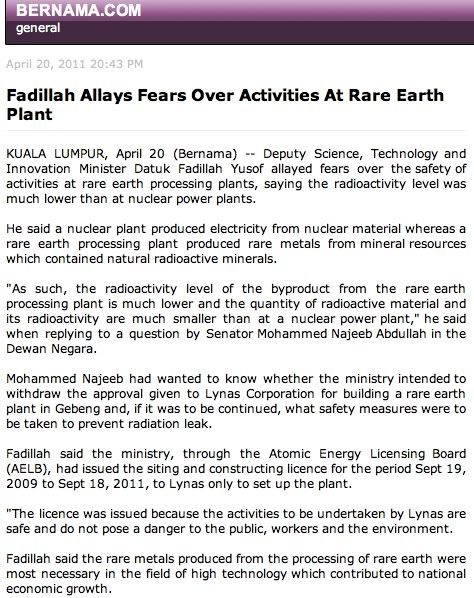
KUALA LUMPUR, April 12 — Lynas Corp has told residents living near its rare earth plant in Kuantan that its RM1 billion investment into the Gebeng industrial zone will be a boon, not bane, for their future despite fears of its radioactive effects.
The Australian miner says its RM700 million refinery and other investments will be “the foundation industry for other high-technology industries that use rare earth.”
“This will be of benefit to the next generation of Malaysians,” executive chairman Nicholas Curtis told The Malaysian Insider in an interview yesterday, adding that the multiplier effect could result in double or triple the money flow from its initial investment.
“The whole momentum, the workshops we use, the equipment that needs to be built, maintenance contracts. The economic impact is far in excess of our own investment,” he said.
Curtis also insisted that the amount of thorium - the radioactive element found in virtually all rare earth deposits - that will be released from the factory would result in “zero public exposure” due to specialised storage dams it is constructing onsite. Studies say radiation is linked to diseases such as to cancer and congenital birth defects, fears of which has led environmentalists and local residents to protest against the project.
 Kuantan residents examine the government's point of view before a town hall meeting to discuss the Lynas plant in Kuantan, April 5, 2011. — Picture by Jack Ooi
They have compared the plant being built by Lynas to the Asian Rare Earth (ARE) plant in Bukit Merah that eventually closed down in 1992 after sustained public protests.
Nearly two decades later, the plant is still undergoing a RM303 million cleanup exercise and has been linked to at least eight cases of leukemia, with seven resulting in death.
Although reports say that the plant may generate revenues amounting up to one per cent of the Malaysian GDP, critics have questioned the real economic benefit of the project, pointing to the 12-year tax holiday Lynas will receive after being accorded pioneer status.
However, the government has estimated RM2.3 billion in investments spinning off from the plant that will be ready for operations in September after over two years of construction.
Science, Technology and Innovation Minister Datuk Seri Maximus Johnity Ongkili told Parliament last month that RM300 million has already been poured in for two factories in Gebeng that will produce the hydrochloric and sulphuric acid needed to extract the rare earth metals.
Curtis said yesterday that the plant would position Malaysia as a prime hub for high-technology industry as rare earth metals are crucial in applications ranging from the automotive, energy and electronics sectors.
Lynas plans for its Gebeng plant to supply one-third of global rare earth demand outside of China by 2013, with California being the only other site outside of the Asian giant with a similar kind of deposit the company says has low enough thorium levels to be processed safely.
 curtis reassuring Gebeng residents about the benefits of the plant. — Picture by Jack Ooi
“Electronics is a big end user but Malaysia is principally an assembler. But this is an opportunity to move from assembler to manufacturer.
“When the full value chain is here, that’s 2020, that’s knowledge society,” Curtis said, referencing Malaysia’s plan to be a developed, high-income nation in nine years.
He said that the Gebeng industrial zone could grow into a hub for research and development (R&D), resulting in “distinctive Malaysian intellectual property” as rare earth metals was making cutting-edge products like smartphones, hybrid cars and laptops possible.
Curtis said that of the 350 skilled workers the plant would hire, only a handful of R&D staff would be non-Malaysian, who will be given “the best knowledge in the world on the processing of rare earths and the potential to modify those processes to meet special application needs.”
Asked if there was the right skills in Malaysia to fill those positions, he replied, “We advertised for 30 positions last week and received 10 Malaysian applicants per position.”
“I firmly believe that the best people to run a plant in Malaysia are Malaysians. It’s their home, they will look after it as though it is their home and they will actually be proud of it,” Curtis said.
Googleübersetzt: http://translate.google.de/translate?js=n&prev=_t&hl=de&ie=U…
Grüsse JoJo
Rare earths refinery benefits Kuantan, says Lynas
By Shannon TeohApril 12, 2011
A Geiger counter and rare earth samples displayed outside a town hall meeting to discuss the Lynas plant in Kuantan, April 5, 2011. — Picture by Jack OoiKUALA LUMPUR, April 12 — Lynas Corp has told residents living near its rare earth plant in Kuantan that its RM1 billion investment into the Gebeng industrial zone will be a boon, not bane, for their future despite fears of its radioactive effects.
The Australian miner says its RM700 million refinery and other investments will be “the foundation industry for other high-technology industries that use rare earth.”
“This will be of benefit to the next generation of Malaysians,” executive chairman Nicholas Curtis told The Malaysian Insider in an interview yesterday, adding that the multiplier effect could result in double or triple the money flow from its initial investment.
“The whole momentum, the workshops we use, the equipment that needs to be built, maintenance contracts. The economic impact is far in excess of our own investment,” he said.
Curtis also insisted that the amount of thorium - the radioactive element found in virtually all rare earth deposits - that will be released from the factory would result in “zero public exposure” due to specialised storage dams it is constructing onsite. Studies say radiation is linked to diseases such as to cancer and congenital birth defects, fears of which has led environmentalists and local residents to protest against the project.
Kuantan residents examine the government's point of view before a town hall meeting to discuss the Lynas plant in Kuantan, April 5, 2011. — Picture by Jack OoiThey have compared the plant being built by Lynas to the Asian Rare Earth (ARE) plant in Bukit Merah that eventually closed down in 1992 after sustained public protests.
Nearly two decades later, the plant is still undergoing a RM303 million cleanup exercise and has been linked to at least eight cases of leukemia, with seven resulting in death.
Although reports say that the plant may generate revenues amounting up to one per cent of the Malaysian GDP, critics have questioned the real economic benefit of the project, pointing to the 12-year tax holiday Lynas will receive after being accorded pioneer status.
However, the government has estimated RM2.3 billion in investments spinning off from the plant that will be ready for operations in September after over two years of construction.
Science, Technology and Innovation Minister Datuk Seri Maximus Johnity Ongkili told Parliament last month that RM300 million has already been poured in for two factories in Gebeng that will produce the hydrochloric and sulphuric acid needed to extract the rare earth metals.
Curtis said yesterday that the plant would position Malaysia as a prime hub for high-technology industry as rare earth metals are crucial in applications ranging from the automotive, energy and electronics sectors.
Lynas plans for its Gebeng plant to supply one-third of global rare earth demand outside of China by 2013, with California being the only other site outside of the Asian giant with a similar kind of deposit the company says has low enough thorium levels to be processed safely.
curtis reassuring Gebeng residents about the benefits of the plant. — Picture by Jack Ooi“Electronics is a big end user but Malaysia is principally an assembler. But this is an opportunity to move from assembler to manufacturer.
“When the full value chain is here, that’s 2020, that’s knowledge society,” Curtis said, referencing Malaysia’s plan to be a developed, high-income nation in nine years.
He said that the Gebeng industrial zone could grow into a hub for research and development (R&D), resulting in “distinctive Malaysian intellectual property” as rare earth metals was making cutting-edge products like smartphones, hybrid cars and laptops possible.
Curtis said that of the 350 skilled workers the plant would hire, only a handful of R&D staff would be non-Malaysian, who will be given “the best knowledge in the world on the processing of rare earths and the potential to modify those processes to meet special application needs.”
Asked if there was the right skills in Malaysia to fill those positions, he replied, “We advertised for 30 positions last week and received 10 Malaysian applicants per position.”
“I firmly believe that the best people to run a plant in Malaysia are Malaysians. It’s their home, they will look after it as though it is their home and they will actually be proud of it,” Curtis said.
Googleübersetzt: http://translate.google.de/translate?js=n&prev=_t&hl=de&ie=U…
Grüsse JoJo
Diese, auf Grund der aktuelle Ereignissen in Japan sowie durch negative Vorfälle aus der Vergangenheit, entstandene Verunsicherung bei der kritischen Bevölkerung vor Ort wird nicht nur ernst genommen sondern u.a. durch die unterschiedlichen Medien/Behörden öffentlich unter Einbezug aller mit NC-Lynas zur Diskussion gestellt um alle Verunsicherungen in Bezug auf den gerinden Thoriumanteil im Deposit von Lynas und deren Gefahrenpotential auszuräumen.
Grüsse JoJo
http://www.themalaysianinsider.com/malaysia/article/lynas-wi…
Lynas will start Kuantan plant, radioactive waste onsite
By Shannon TeohApril 12, 2011
...
...
“The waste is a sitting time bomb,” Environmental Protection Society of Malaysia (EPSM) president Nithi Nesadurai had said.
Curtis however, said that special storage dams that can hold six years of waste have been built that will cause “zero exposure” to the public.
“Two thirds or more is gypsum. There is no issue with respect to it being used as plasterboard and other markets. Malaysia is a net importer of gypsum so we will use it in commercial quantities for sure. This increases our storage (for the radioactie waste) to 24 years,” he explained.
Lynas plans to process the iron-bound thorium into a concrete with a thorium concentration of less than 500 parts per million (ppm) for further industrial use but admitted to not having a commercial application yet.
“It’s not that Lynas does not have the solution. The solution (storage dams) has been agreed. Now Lynas is going beyond the standards,” he said in the interview, where he stressed repeatedly that Malaysia’s last rare earth project, in Bukit Merah, should never have gone ahead.
The Asian Rare Earth plant has been linked to at least eight leukemia cases with seven deaths after being shut down in 1992.
Alarm in Japan over potential radiation leaks from nuclear plant explosions caused by the recent earthquake and tsunami, coupled with a recent New York Times report highlighting the radioactive waste produced in the rare earth refining process, has revived fears and debate on the issue.
Environmentalists and residents living near the factory site in the Gebeng industrial zone have raised questions over the potential environmental hazards arising from radioactive waste being produced and stored at the plant.
But Curtis said today that the radioactive levels were now enough that “to get the equivalent exposure to one x-ray, you need to be buried in our material for 70 hours.”
He also said that workers at the RM700 million plant will receive added radiation per year of less than one x-ray scan and nearly five times less than people who worked on commercial planes.
“You don’t want them misled into fear,” he said of residents in Kuantan.
Curtis also said that the ratio of thorium to rare earth metals found in its concentrated raw material was 55 to 10,000 while the Bukit Merah operation had 12,000 parts thorium to every 10,000 parts of rare earth.
As it plans to ramp up production to 22,000 tonnes per year of the material that is crucial to high-technology applications such as smartphones, hybrid cars and even bombs, it will mean producing about 120 tonnes of thorium per year.
He said that the Mount Weld ore, along with the Mountain Pass site in California and deposits in China, was one of only three known places where rare earth ore was found with such low levels of thorium.
“Our material is of a different nature, a completely different geological genesis from the material in tin slag (used ib Bukit Merah). That comment that rare earths occur in monazite with high levels of thorium is correct. The comment that is not correct is that that’s the only place that rare earths could occur.
“By law in Australia, you’re not allowed to use that monazite and Bukit Merah should never have been allowed on the same basis,” he said.
Curtis added that the concentrated material shipped to Malaysia had 1,600 ppm of thorium and was not considered by Australia “under is transportation guidelines to require even notification as being radioactive. It is not considered radioactive material.” He also dismissed fears of a similar mishap as Japan’s nuclear plants the Gebeng plant’s material had too low a level of radiation.
“The levels are so absolutely different with Japan, there is no comparison. Even after 70 hours, all you get is an x-ray,” he said of a potential leak of its waste product.
Lynas expects to receive a preliminary operating licence from the Atomic Energy Licensing Board (AELB) before September which will be renewed as a full license after three years should the plant comply to agreed standards.
The company hopes RM8 billion annual revenues from 2013 based on the refined metals’ current prices, when it will produce one-third of the world’s demand outside of China.
Googleübersetzt: http://translate.google.de/translate?js=n&prev=_t&hl=de&ie=U…
Grüsse JoJo
http://www.themalaysianinsider.com/malaysia/article/lynas-wi…
Lynas will start Kuantan plant, radioactive waste onsite
By Shannon TeohApril 12, 2011
...
...
“The waste is a sitting time bomb,” Environmental Protection Society of Malaysia (EPSM) president Nithi Nesadurai had said.
Curtis however, said that special storage dams that can hold six years of waste have been built that will cause “zero exposure” to the public.
“Two thirds or more is gypsum. There is no issue with respect to it being used as plasterboard and other markets. Malaysia is a net importer of gypsum so we will use it in commercial quantities for sure. This increases our storage (for the radioactie waste) to 24 years,” he explained.
Lynas plans to process the iron-bound thorium into a concrete with a thorium concentration of less than 500 parts per million (ppm) for further industrial use but admitted to not having a commercial application yet.
“It’s not that Lynas does not have the solution. The solution (storage dams) has been agreed. Now Lynas is going beyond the standards,” he said in the interview, where he stressed repeatedly that Malaysia’s last rare earth project, in Bukit Merah, should never have gone ahead.
The Asian Rare Earth plant has been linked to at least eight leukemia cases with seven deaths after being shut down in 1992.
Alarm in Japan over potential radiation leaks from nuclear plant explosions caused by the recent earthquake and tsunami, coupled with a recent New York Times report highlighting the radioactive waste produced in the rare earth refining process, has revived fears and debate on the issue.
Environmentalists and residents living near the factory site in the Gebeng industrial zone have raised questions over the potential environmental hazards arising from radioactive waste being produced and stored at the plant.
But Curtis said today that the radioactive levels were now enough that “to get the equivalent exposure to one x-ray, you need to be buried in our material for 70 hours.”
He also said that workers at the RM700 million plant will receive added radiation per year of less than one x-ray scan and nearly five times less than people who worked on commercial planes.
“You don’t want them misled into fear,” he said of residents in Kuantan.
Curtis also said that the ratio of thorium to rare earth metals found in its concentrated raw material was 55 to 10,000 while the Bukit Merah operation had 12,000 parts thorium to every 10,000 parts of rare earth.
As it plans to ramp up production to 22,000 tonnes per year of the material that is crucial to high-technology applications such as smartphones, hybrid cars and even bombs, it will mean producing about 120 tonnes of thorium per year.
He said that the Mount Weld ore, along with the Mountain Pass site in California and deposits in China, was one of only three known places where rare earth ore was found with such low levels of thorium.
“Our material is of a different nature, a completely different geological genesis from the material in tin slag (used ib Bukit Merah). That comment that rare earths occur in monazite with high levels of thorium is correct. The comment that is not correct is that that’s the only place that rare earths could occur.
“By law in Australia, you’re not allowed to use that monazite and Bukit Merah should never have been allowed on the same basis,” he said.
Curtis added that the concentrated material shipped to Malaysia had 1,600 ppm of thorium and was not considered by Australia “under is transportation guidelines to require even notification as being radioactive. It is not considered radioactive material.” He also dismissed fears of a similar mishap as Japan’s nuclear plants the Gebeng plant’s material had too low a level of radiation.
“The levels are so absolutely different with Japan, there is no comparison. Even after 70 hours, all you get is an x-ray,” he said of a potential leak of its waste product.
Lynas expects to receive a preliminary operating licence from the Atomic Energy Licensing Board (AELB) before September which will be renewed as a full license after three years should the plant comply to agreed standards.
The company hopes RM8 billion annual revenues from 2013 based on the refined metals’ current prices, when it will produce one-third of the world’s demand outside of China.
Googleübersetzt: http://translate.google.de/translate?js=n&prev=_t&hl=de&ie=U…
!
Dieser Beitrag wurde moderiert. Grund: SpammpostingTrading Spotlight
Den Originalartikel und weitere Infos im Faktenthread: http://www.wallstreet-online.de/diskussion/1126458-1421-1430…
Wünsche @ erholsame, schöne und besinnliche Feiertage
Grüsse JoJo

Wünsche @ erholsame, schöne und besinnliche Feiertage
Grüsse JoJo
http://www.nytimes.com/2011/05/03/business/03rare.html
Supplies Squeezed, Rare Earth Prices Surge
By KEITH BRADSHER
Published: May 2, 2011
HONG KONG — Rare earth prices are reaching rarefied heights.
World prices have doubled in the last four months for rare earths — metallic elements needed for many of the most sophisticated civilian and military technologies, whether smartphones or smart bombs.
And this year’s increases come atop price gains of as much as fourfold during 2010.
The reason is basic economics: demand continues to outstrip efforts to expand supplies and break China’s chokehold on the market.
Neodymium, a rare earth necessary for a range of products including headphones and hybrid electric cars, now fetches more than $283 a kilogram ($129 a pound) on the spot market. A year ago it sold for about $42 a kilogram ($19 a pound).
Samarium, crucial to the manufacture of missiles, has climbed to more than $146 a kilogram, up from $18.50 a year earlier.
While the price inflation is a concern to manufacturers, consumers in many cases will barely notice the soaring cost of rare earths. Even though the materials are crucial to the performance of everyday equipment like automotive catalytic converters and laptop computer display screens, rare earths are typically are used only in trace quantities.
One exception is the Toyota Prius hybrid car, whose manufacture uses a kilogram of neodymium.
Toyota has been raising prices for the Prius, but has cited demand for the car and economic conditions. While acknowledging that rising prices for raw materials in general have affected the company’s overall financial results, Toyota has declined to provide a breakdown of the role of rare earths. (Production problems stemming from the Japanese earthquake and tsunami have also crimped supplies of Prius cars, which are made only in Japan.)
The high prices for rare earths reflect turmoil in the global industry that mines and refines them. China, which controls more than 95 percent of the market, has further restricted exports so as to conserve supplies for its own high-tech and green energy industries. That is despite the World Trade Organization’s ban on most export restrictions.
Meanwhile, an ambitious effort to open the world’s largest rare earth refinery in Malaysia, which had seemed certain to begin operating by this autumn, is tied up over regulatory reviews of the disposal plans for thousands of tons of low-level radioactive waste the plant would produce annually. Public opposition to the refinery is evident in the weekly protest demonstrations now being held.
At the same time, Japanese companies are finding it harder than originally hoped to recycle rare earths from electronics and to begin rare earth mining and refining in Vietnam.
Although rare earths are crucial to the supply chains of some of the world’s biggest manufacturers, the industry that mines and refines them has long been characterized by small, entrepreneurial companies. Lately, though, soaring prices have contributed to industry consolidation.
Last month, for example, Solvay, a big Belgian chemical-industrial corporation announced that it would pay $4.8 billion to acquire Rhodia of France, a technological leader in making complex chemicals based on rare earths.
That same day, April 4, Molycorp, the only American company currently producing rare earths, said it had paid $89 million for a more than 90 percent stake in Silmet of Estonia, a much smaller company that is Rhodia’s only European rival in rare earth processing.
In Malaysia, where the giant rare earth refinery is under construction near the eastern port of Kuantan, regulators are delaying approval for an operating permit amid public concern about naturally occurring low-level radioactive contamination of the rare earth ore, which will be mined in Australia.
Raja Dato Abdul Aziz bin Raja Adnan, the director general of the Malaysian Atomic Energy Licensing Board, said the board had asked the Lynas Corporation of Australia, which is building the refinery, to provide additional documentation before accepting its application for an initial operating permit. It will take up to six months to review the application, Raja Adnan said, and Lynas will not be allowed to bring any raw material to the plant until a permit is issued.
But Nicholas Curtis, Lynas’s executive chairman, said that he believed the company could obtain the necessary approvals before September and that his company was sticking to its plan to begin feeding Australian ore into the Malaysian refinery’s kilns by the end of that month.
The Malaysian government also announced last week that it would appoint a panel of international experts to review the safety of Lynas’s plans. The company said it welcomed the move.
But Fuziah Salleh, an opposition legislator who represents downtown Kuantan and has been leading weekly protests, is mistrustful.
“The people’s concerns are that the independent panel will be formed by the government to prove that they are right,” she wrote in an e-mail message.
Toyota Tsusho, a materials purchasing unit of the Toyota Group, has separately encountered complex local regulations as it seeks to open rare earth mining and processing operations in Vietnam. The project was announced last October during a Chinese embargo on rare earth shipments to Japan. Takeshi Mutsuura, a spokesman, said that Toyota Tsusho now hoped to reach a contract in Vietnam this summer and start production in early 2013.
1 2 Next Page »
Grüsse JoJo
Supplies Squeezed, Rare Earth Prices Surge
By KEITH BRADSHER
Published: May 2, 2011
HONG KONG — Rare earth prices are reaching rarefied heights.
World prices have doubled in the last four months for rare earths — metallic elements needed for many of the most sophisticated civilian and military technologies, whether smartphones or smart bombs.
And this year’s increases come atop price gains of as much as fourfold during 2010.
The reason is basic economics: demand continues to outstrip efforts to expand supplies and break China’s chokehold on the market.
Neodymium, a rare earth necessary for a range of products including headphones and hybrid electric cars, now fetches more than $283 a kilogram ($129 a pound) on the spot market. A year ago it sold for about $42 a kilogram ($19 a pound).
Samarium, crucial to the manufacture of missiles, has climbed to more than $146 a kilogram, up from $18.50 a year earlier.
While the price inflation is a concern to manufacturers, consumers in many cases will barely notice the soaring cost of rare earths. Even though the materials are crucial to the performance of everyday equipment like automotive catalytic converters and laptop computer display screens, rare earths are typically are used only in trace quantities.
One exception is the Toyota Prius hybrid car, whose manufacture uses a kilogram of neodymium.
Toyota has been raising prices for the Prius, but has cited demand for the car and economic conditions. While acknowledging that rising prices for raw materials in general have affected the company’s overall financial results, Toyota has declined to provide a breakdown of the role of rare earths. (Production problems stemming from the Japanese earthquake and tsunami have also crimped supplies of Prius cars, which are made only in Japan.)
The high prices for rare earths reflect turmoil in the global industry that mines and refines them. China, which controls more than 95 percent of the market, has further restricted exports so as to conserve supplies for its own high-tech and green energy industries. That is despite the World Trade Organization’s ban on most export restrictions.
Meanwhile, an ambitious effort to open the world’s largest rare earth refinery in Malaysia, which had seemed certain to begin operating by this autumn, is tied up over regulatory reviews of the disposal plans for thousands of tons of low-level radioactive waste the plant would produce annually. Public opposition to the refinery is evident in the weekly protest demonstrations now being held.
At the same time, Japanese companies are finding it harder than originally hoped to recycle rare earths from electronics and to begin rare earth mining and refining in Vietnam.
Although rare earths are crucial to the supply chains of some of the world’s biggest manufacturers, the industry that mines and refines them has long been characterized by small, entrepreneurial companies. Lately, though, soaring prices have contributed to industry consolidation.
Last month, for example, Solvay, a big Belgian chemical-industrial corporation announced that it would pay $4.8 billion to acquire Rhodia of France, a technological leader in making complex chemicals based on rare earths.
That same day, April 4, Molycorp, the only American company currently producing rare earths, said it had paid $89 million for a more than 90 percent stake in Silmet of Estonia, a much smaller company that is Rhodia’s only European rival in rare earth processing.
In Malaysia, where the giant rare earth refinery is under construction near the eastern port of Kuantan, regulators are delaying approval for an operating permit amid public concern about naturally occurring low-level radioactive contamination of the rare earth ore, which will be mined in Australia.
Raja Dato Abdul Aziz bin Raja Adnan, the director general of the Malaysian Atomic Energy Licensing Board, said the board had asked the Lynas Corporation of Australia, which is building the refinery, to provide additional documentation before accepting its application for an initial operating permit. It will take up to six months to review the application, Raja Adnan said, and Lynas will not be allowed to bring any raw material to the plant until a permit is issued.
But Nicholas Curtis, Lynas’s executive chairman, said that he believed the company could obtain the necessary approvals before September and that his company was sticking to its plan to begin feeding Australian ore into the Malaysian refinery’s kilns by the end of that month.
The Malaysian government also announced last week that it would appoint a panel of international experts to review the safety of Lynas’s plans. The company said it welcomed the move.
But Fuziah Salleh, an opposition legislator who represents downtown Kuantan and has been leading weekly protests, is mistrustful.
“The people’s concerns are that the independent panel will be formed by the government to prove that they are right,” she wrote in an e-mail message.
Toyota Tsusho, a materials purchasing unit of the Toyota Group, has separately encountered complex local regulations as it seeks to open rare earth mining and processing operations in Vietnam. The project was announced last October during a Chinese embargo on rare earth shipments to Japan. Takeshi Mutsuura, a spokesman, said that Toyota Tsusho now hoped to reach a contract in Vietnam this summer and start production in early 2013.
1 2 Next Page »
Grüsse JoJo
Für @ die immer aktuell über Lynas und die LAMP in Malysia informiert sein möchten: http://www.themalaysianinsider.com/search/tag/lynas
Daraus der neuste Bericht: http://www.themalaysianinsider.com/bahasa/article/isu-lynas-…
Isu Lynas: IAEA tubuh panel pakar nasihat Malaysia
May 04, 2011
VIENNA, 4 Mei — Agensi nuklear Pertubuhan Bangsa-Bangsa Bersatu (PBB) akan membentuk panel bebas bagi menasihat kerajaan Malaysia berhubung potensi risiko yang akan diterima kesan daripada projek loji pemprosesan nadir bumi oleh syarikat perlombongan Australia, Lynas Corporation, kata agensi itu.
Pendirian itu dibuat selepas Malaysia meminta Agensi Tenaga Atom Antarabangsa (IAEA) di Vienna untuk membantu mengesan kesan yang akan diterima penduduk setempat terutamanya membentuk panel bebas bagi mengkaji tahap kesihatan dan keselamatan sekiranya projek itu diteruskan.
Ekoran projek loji pemprosesan nadir bumi itu, ia mendapat bantahan keras daripada aktivis yang mengatakan Malaysia akan menjadi lokasi pembuangan sisa radioaktif selain akan menyebabkan tahap kesihatan terjejas.
“Melalui program kerjasama teknikal IAEA, agensi akan menyokong usaha misi pakar antabangsa untuk mengkaji projek Lynas agar ia mematuhi piawaian keselamatan antarabangsa dan keperluan yang baik akan memberikan faedah terhadap aspek keselamatan projek Lynas,” katanya dalam satu kenyataan.
“Misi itu dijadualkan bermula pada 29 Mei 2011,” katanya.
Bulan lalu, Lynas berkata Malaysia hanya memerlukan kajian selama satu bulan berhubung kesan radioaktif dan tidak akan menangguhkan pembinaan loji pemprosesan itu.
Bernama sebelum ini melaporkan Menteri Perdagangan Antarabangsa dan Industri Datuk Seri Mustapa Mohamed berkata satu panel bebas akan ditubuhkan secepat yang mungkin bagi menjalankan kajian terhadap aspek kesihatan dan keselamatan loji itu bagi menolak kebimbangan bahawa ia menimbulkan ancaman radioaktif, yang berpotensi menyekat bekalan dari China.
Kajian itu dijangka siap dalam tempoh sebulan.
Lynas Malaysia berkata loji pemprosesan itu menerima bahan mentah dari firma Mount Weld di Barat Australia.
Pemprosesan nadir bumi digunakan untuk mencipta alat berteknologi tinggi termasuk telefon pinta dan kenderaan hidbrid.
Pembeli termasuk dari China, Amerika Syarikat dan negara-negara Eropah bergantung kepada bahan mentah yang mana kini mereka bergantung sehingga 95 peratus bekalan dari China.
Cadangan pembinaan loji pemprosesan nadir bumi di Gebeng dekat Kuantan akan mejadikan ia sebagai pengeluar terbesar selepas China.
Pegawai syarikat berkenaan berkata keuntungan yang akan diperoleh dari projek loji pemprosesan nadir bumi Malaysia akan mencecah sehingga 22,000 tan, dan ia akan memenuhi keperluan selain China menjelang 2013.
Googleübersetzt: http://translate.google.de/translate?hl=de&sl=ms&tl=de&u=htt…
Goldman Sachs rechnet mit weiteren Exportbeschränkungen von REO durch China auf Grund des stark steigenden Bedarfs im eigenen Land was für uns eigendlich nichts neues darstellt.
http://www.bloomberg.com/news/2011-05-05/china-may-further-r…
China May Further Reduce Rare Earth Quotas, Goldman Sachs Says
By Rebecca Keenan - May 5, 2011 2:22 AM GMT+0200
...
...
Googleübersetzt: http://translate.google.de/translate?js=n&prev=_t&hl=de&ie=U…
Wohl auch aus diesen Gründen hat Goldman Sachs ein neues kursfristiges Kursziel auf 3,75 $ hochgeschraubt.
Wer den kpl. Bericht einsehen möchte kann sich auf dem folgenden Link anmelden: http://afr.com/p/markets/market_wrap/lynas_corporation_07nkt…
Lynas Corporation
PUBLISHED : -1 hours -54 minutes ago | UPDATED: -7 hours -25 minutes ago PUBLISHED: 05 May 2011
Goldman Sachs has initiated coverage of rare earths company Lynas Corporation with a “buy” recommendation and a price target of $3.75, but says the stock represents “above-average” risk.
Grüsse JoJo
Daraus der neuste Bericht: http://www.themalaysianinsider.com/bahasa/article/isu-lynas-…
Isu Lynas: IAEA tubuh panel pakar nasihat Malaysia
May 04, 2011
VIENNA, 4 Mei — Agensi nuklear Pertubuhan Bangsa-Bangsa Bersatu (PBB) akan membentuk panel bebas bagi menasihat kerajaan Malaysia berhubung potensi risiko yang akan diterima kesan daripada projek loji pemprosesan nadir bumi oleh syarikat perlombongan Australia, Lynas Corporation, kata agensi itu.
Pendirian itu dibuat selepas Malaysia meminta Agensi Tenaga Atom Antarabangsa (IAEA) di Vienna untuk membantu mengesan kesan yang akan diterima penduduk setempat terutamanya membentuk panel bebas bagi mengkaji tahap kesihatan dan keselamatan sekiranya projek itu diteruskan.
Ekoran projek loji pemprosesan nadir bumi itu, ia mendapat bantahan keras daripada aktivis yang mengatakan Malaysia akan menjadi lokasi pembuangan sisa radioaktif selain akan menyebabkan tahap kesihatan terjejas.
“Melalui program kerjasama teknikal IAEA, agensi akan menyokong usaha misi pakar antabangsa untuk mengkaji projek Lynas agar ia mematuhi piawaian keselamatan antarabangsa dan keperluan yang baik akan memberikan faedah terhadap aspek keselamatan projek Lynas,” katanya dalam satu kenyataan.
“Misi itu dijadualkan bermula pada 29 Mei 2011,” katanya.
Bulan lalu, Lynas berkata Malaysia hanya memerlukan kajian selama satu bulan berhubung kesan radioaktif dan tidak akan menangguhkan pembinaan loji pemprosesan itu.
Bernama sebelum ini melaporkan Menteri Perdagangan Antarabangsa dan Industri Datuk Seri Mustapa Mohamed berkata satu panel bebas akan ditubuhkan secepat yang mungkin bagi menjalankan kajian terhadap aspek kesihatan dan keselamatan loji itu bagi menolak kebimbangan bahawa ia menimbulkan ancaman radioaktif, yang berpotensi menyekat bekalan dari China.
Kajian itu dijangka siap dalam tempoh sebulan.
Lynas Malaysia berkata loji pemprosesan itu menerima bahan mentah dari firma Mount Weld di Barat Australia.
Pemprosesan nadir bumi digunakan untuk mencipta alat berteknologi tinggi termasuk telefon pinta dan kenderaan hidbrid.
Pembeli termasuk dari China, Amerika Syarikat dan negara-negara Eropah bergantung kepada bahan mentah yang mana kini mereka bergantung sehingga 95 peratus bekalan dari China.
Cadangan pembinaan loji pemprosesan nadir bumi di Gebeng dekat Kuantan akan mejadikan ia sebagai pengeluar terbesar selepas China.
Pegawai syarikat berkenaan berkata keuntungan yang akan diperoleh dari projek loji pemprosesan nadir bumi Malaysia akan mencecah sehingga 22,000 tan, dan ia akan memenuhi keperluan selain China menjelang 2013.
Googleübersetzt: http://translate.google.de/translate?hl=de&sl=ms&tl=de&u=htt…
Goldman Sachs rechnet mit weiteren Exportbeschränkungen von REO durch China auf Grund des stark steigenden Bedarfs im eigenen Land was für uns eigendlich nichts neues darstellt.
http://www.bloomberg.com/news/2011-05-05/china-may-further-r…
China May Further Reduce Rare Earth Quotas, Goldman Sachs Says
By Rebecca Keenan - May 5, 2011 2:22 AM GMT+0200
...
...
Googleübersetzt: http://translate.google.de/translate?js=n&prev=_t&hl=de&ie=U…
Wohl auch aus diesen Gründen hat Goldman Sachs ein neues kursfristiges Kursziel auf 3,75 $ hochgeschraubt.
Wer den kpl. Bericht einsehen möchte kann sich auf dem folgenden Link anmelden: http://afr.com/p/markets/market_wrap/lynas_corporation_07nkt…
Lynas Corporation
PUBLISHED : -1 hours -54 minutes ago | UPDATED: -7 hours -25 minutes ago PUBLISHED: 05 May 2011
Goldman Sachs has initiated coverage of rare earths company Lynas Corporation with a “buy” recommendation and a price target of $3.75, but says the stock represents “above-average” risk.
Grüsse JoJo
Der erste Artikel beschreibt ein IMHO interssantes Thema (Recycling) und zeichnet damit auf wie brisant die Versorgungslage weltweit mit REO imzwischen ist und sich wohl die nächsten Jahre weiterhin noch steigern wird, nur wenn man zum Ende kommt zeigt sich auch wiederum wie weit viele der sogenannten Experten sich immer noch nicht von der aktuellen Lage von Lynas überzeugt haben.
@ ein schönes WE
Grüsse JoJo
http://www.resourceinvestor.com/News/2011/4/Pages/Recycling-…
Recycling of Rare Earth Minerals Picks Up
Roman Baudzus
Published 4/27/2011
...
Googleübersetzt: http://translate.google.de/translate?js=n&prev=_t&hl=de&ie=U…
http://online.wsj.com/article/SB1000142405274870399270457630…
ASIA TECHNOLOGY* MAY 5, 2011, 12:55 P.M. ET
A Warning on Rare Earth Elements
By DAVID FICKLING
SYDNEY—Demand for rare earth elements that has driven up prices more than tenfold since 2009 is likely to be met by a surplus of supply by 2013, as Western companies start up new mines to compete with the Chinese firms that now dominate the market, Goldman Sachs analysts predicted Thursday.
...
Prices of rare earths hovered between $5 a kilogram and $20 a kilo from the early 1990s until 2010. But a 40% cut in export quotas by China, which accounts for 90% of global rare earth production, sent prices soaring. The basket price of rare earths held in Lynas Corp. Ltd.'s Mount Weld deposit in western Australia—the largest non-Chinese mine, due to come to production in the next few years—has jumped to an average of $162.66 kilos from just $10.32 kilos in 2009.
Goldman's view differs from that of miners. In a presentation last month, Lynas forecast that global demand for rare earths, which include neodymium, cerium and lanthanum, will outstrip supply this year by 35,000 tons this year and in 2012. Annual supply shortfalls of around 20,000 tons are expected in 2013 and 2014, it added. It predicted long-term prices in the $120/kg-to-$180/kg range.
Lynas Chief Executive Nicholas Curtis says China is on the verge of becoming a net importer of the elements, a transformation that would be similar to those that drove major shifts in global markets for coal in 2009 and oil in the mid-1990s, and could accentuate the current price spike.
"China will become a net importer because its consumption for its own domestic value-added industry is going to drive very high [demand] growth for these resources. They've explored every inch of China for what's available and if they had more rare earths deposits of any size, it would be being developed now," he said in a recent interview.
Lynas shares have risen fourfold since China announced the quota cuts in July 2010.
Goldman Sachs analyst Malcolm Southwood, however, said the price boom is nearing its peak. The supply deficit will peak at 18,734 tons this year, equivalent to 13.2% of a forecast 141,524 tons of demand, before the market slips into a slight surplus in 2013, he said in the report published Thursday. The surplus will rise to 5,860 tons or 3.2% of projected demand in the following year, the report said.
Initially, at least, prices will likely continue to rise, he said. The basket price for the Mount Weld rare earths should climb to $227 a kilogram next year, a gain of about 40%. Prices may eventually moderate to an average of $82 a kilogram, but that will happen only in 2015, the third consecutive year of a global surplus, the report said.
....
"Lynas has said their production costs are $10 per kilogram. If they think they can sell their material at $150 a kilogram, a markup of 15 times, I don't know customers are going to be prepared to pay for it," said Dudley Kingsnorth, executive director of Industrial Minerals Company of Australia, a rare earths analysis house.
"Once these new mines come onstream, there will be a fall in price, and if miners insist on multiples of 15-20, they're going to face more competitors. They're going to have to face a little bit of reality."
@ ein schönes WE
Grüsse JoJo
http://www.resourceinvestor.com/News/2011/4/Pages/Recycling-…
Recycling of Rare Earth Minerals Picks Up
Roman Baudzus
Published 4/27/2011
...
Googleübersetzt: http://translate.google.de/translate?js=n&prev=_t&hl=de&ie=U…
http://online.wsj.com/article/SB1000142405274870399270457630…
ASIA TECHNOLOGY* MAY 5, 2011, 12:55 P.M. ET
A Warning on Rare Earth Elements
By DAVID FICKLING
SYDNEY—Demand for rare earth elements that has driven up prices more than tenfold since 2009 is likely to be met by a surplus of supply by 2013, as Western companies start up new mines to compete with the Chinese firms that now dominate the market, Goldman Sachs analysts predicted Thursday.
...
Prices of rare earths hovered between $5 a kilogram and $20 a kilo from the early 1990s until 2010. But a 40% cut in export quotas by China, which accounts for 90% of global rare earth production, sent prices soaring. The basket price of rare earths held in Lynas Corp. Ltd.'s Mount Weld deposit in western Australia—the largest non-Chinese mine, due to come to production in the next few years—has jumped to an average of $162.66 kilos from just $10.32 kilos in 2009.
Goldman's view differs from that of miners. In a presentation last month, Lynas forecast that global demand for rare earths, which include neodymium, cerium and lanthanum, will outstrip supply this year by 35,000 tons this year and in 2012. Annual supply shortfalls of around 20,000 tons are expected in 2013 and 2014, it added. It predicted long-term prices in the $120/kg-to-$180/kg range.
Lynas Chief Executive Nicholas Curtis says China is on the verge of becoming a net importer of the elements, a transformation that would be similar to those that drove major shifts in global markets for coal in 2009 and oil in the mid-1990s, and could accentuate the current price spike.
"China will become a net importer because its consumption for its own domestic value-added industry is going to drive very high [demand] growth for these resources. They've explored every inch of China for what's available and if they had more rare earths deposits of any size, it would be being developed now," he said in a recent interview.
Lynas shares have risen fourfold since China announced the quota cuts in July 2010.
Goldman Sachs analyst Malcolm Southwood, however, said the price boom is nearing its peak. The supply deficit will peak at 18,734 tons this year, equivalent to 13.2% of a forecast 141,524 tons of demand, before the market slips into a slight surplus in 2013, he said in the report published Thursday. The surplus will rise to 5,860 tons or 3.2% of projected demand in the following year, the report said.
Initially, at least, prices will likely continue to rise, he said. The basket price for the Mount Weld rare earths should climb to $227 a kilogram next year, a gain of about 40%. Prices may eventually moderate to an average of $82 a kilogram, but that will happen only in 2015, the third consecutive year of a global surplus, the report said.
....
"Lynas has said their production costs are $10 per kilogram. If they think they can sell their material at $150 a kilogram, a markup of 15 times, I don't know customers are going to be prepared to pay for it," said Dudley Kingsnorth, executive director of Industrial Minerals Company of Australia, a rare earths analysis house.
"Once these new mines come onstream, there will be a fall in price, and if miners insist on multiples of 15-20, they're going to face more competitors. They're going to have to face a little bit of reality."
http://www.theaustralian.com.au/business/news/lynas-shares-s…
Lynas shares soar as rare earths continue to shine
Michael Bennet From: The Australian May 06, 2011 12:00AM
RARE earths prices are expected to continue their extraordinary rise in the next 18 months before "some softening" from 2013, sending shares in leading producer Lynas Corporation soaring.
...
...
Googleübersetzt: http://translate.google.de/translate?js=n&prev=_t&hl=de&ie=U…
@ eine erfolgreiche Woche
Grüsse JoJo
Lynas shares soar as rare earths continue to shine
Michael Bennet From: The Australian May 06, 2011 12:00AM
RARE earths prices are expected to continue their extraordinary rise in the next 18 months before "some softening" from 2013, sending shares in leading producer Lynas Corporation soaring.
...
...
Googleübersetzt: http://translate.google.de/translate?js=n&prev=_t&hl=de&ie=U…
@ eine erfolgreiche Woche
Grüsse JoJo
http://www.aktiencheck.de/analysen/Artikel-Lynas_steht_unmit…
Lynas steht unmittelbar vor dem Erreichen des Produzentenstatus
09.05.11 12:55
Hot Stocks Investor
Endingen (aktiencheck.de AG) - Die Experten von "Hot Stocks Investor" stufen die Aktie von Lynas als ausgezeichnete strategische Position im Bereich Seltene Erden ein.
Die Gesellschaft stehe unmittelbar vor dem Erreichen des Produzentenstatus und verfüge außerhalb Chinas über eines der am weitesten fortgeschrittensten Projekte.
Die Vorkommen des Mount Weld-Projekts würden auf rund 1,4 Mio. Tonnen geschätzt und ab dem dritten Quartal solle die Produktion aufgenommen werden. Diese solle sich zunächst auf rund 11.000 Tonnen pro Jahr belaufen und später auf 22.000 Tonnen p.a. ausgeweitet werden.
Schon in den letzten Monaten habe Lynas langfristige Abnahmeverträge im Volumen von über 1 Mrd. USD vereinbaren können und darüber hinaus sei eine strategische Zusammenarbeit mit dem japanischen Großkonzern Sojitz (ISIN JP3663900003 / WKN 255124) verkündet worden.
Einzelne Analysten seien von Lynas begeistert. So hätten zum Beispiel die Analysten von Goldman Sachs den Titel in ihrer Ersteinschätzung ein Kursziel von 3,75 Australische Dollar (AUD) zugesprochen. Auf Basis derer Gewinnschätzungen betrage das KGV 2012e nur 6,9 und das für 2013e lediglich 1,5.
Die Experten von "Hot Stocks Investor" stufen die Aktie von Lynas als ausgezeichnete strategische Position im Bereich Seltene Erden ein. (Ausgabe 09 vom 09.05.2011) (09.05.2011/ac/a/a)
Offenlegung von möglichen Interessenskonflikten:
Mögliche Interessenskonflikte können Sie auf der Site des Erstellers/ der Quelle der Analyse einsehen.
http://www.aktiencheck.de/871899-Lynas-Aktie-Profil
Grüsse JoJo
Lynas steht unmittelbar vor dem Erreichen des Produzentenstatus
09.05.11 12:55
Hot Stocks Investor
Endingen (aktiencheck.de AG) - Die Experten von "Hot Stocks Investor" stufen die Aktie von Lynas als ausgezeichnete strategische Position im Bereich Seltene Erden ein.
Die Gesellschaft stehe unmittelbar vor dem Erreichen des Produzentenstatus und verfüge außerhalb Chinas über eines der am weitesten fortgeschrittensten Projekte.
Die Vorkommen des Mount Weld-Projekts würden auf rund 1,4 Mio. Tonnen geschätzt und ab dem dritten Quartal solle die Produktion aufgenommen werden. Diese solle sich zunächst auf rund 11.000 Tonnen pro Jahr belaufen und später auf 22.000 Tonnen p.a. ausgeweitet werden.
Schon in den letzten Monaten habe Lynas langfristige Abnahmeverträge im Volumen von über 1 Mrd. USD vereinbaren können und darüber hinaus sei eine strategische Zusammenarbeit mit dem japanischen Großkonzern Sojitz (ISIN JP3663900003 / WKN 255124) verkündet worden.
Einzelne Analysten seien von Lynas begeistert. So hätten zum Beispiel die Analysten von Goldman Sachs den Titel in ihrer Ersteinschätzung ein Kursziel von 3,75 Australische Dollar (AUD) zugesprochen. Auf Basis derer Gewinnschätzungen betrage das KGV 2012e nur 6,9 und das für 2013e lediglich 1,5.
Die Experten von "Hot Stocks Investor" stufen die Aktie von Lynas als ausgezeichnete strategische Position im Bereich Seltene Erden ein. (Ausgabe 09 vom 09.05.2011) (09.05.2011/ac/a/a)
Offenlegung von möglichen Interessenskonflikten:
Mögliche Interessenskonflikte können Sie auf der Site des Erstellers/ der Quelle der Analyse einsehen.
http://www.aktiencheck.de/871899-Lynas-Aktie-Profil
Grüsse JoJo
http://www.spiegel.de/thema/seltene_erden/
Seltene Erden
Alle Artikel, Hintergründe und Fakten

Hightech-Metalle
Lanthan, Europium, Neodym und 14 weitere Metalle umfasst die Gruppe der Seltenen Erden. Zur Herstellung zahlreicher Elektro-Produkte sind sie unverzichtbar, darunter Akkus, Turbinen und Motoren. China, der wichtigste Lieferant, hortet die begehrten Bodenschätze. Bedrohen Versorgungsengpässe wichtige Zukunftsindustrien?
Seltene Erden
Die Seltenen Erden sind eine Gruppe von 17 Metallen, darunter Lanthan, Europium und Neodym. Meist kommen sie am selben Standort, im selben Gestein, vor. Sie werden in kleinen Mengen verwendet, sind aber unverzichtbar unter anderem für die Herstellung von Computern und Computer-Monitoren, DVD-Spielern, leistungsstarken Akkus, Hybrid-Autos, Halbleitern, Handys, Rüstungsgütern und Windturbinen. Autozulieferer nutzen Seltene Erden bei der Herstellung von Elektromotoren. Die größten Verbraucher Seltener Erden sind China, Japan und die USA, die eine starke Technologiebranche haben. Wegen der zunehmenden Bedeutung der Umwelttechnologien wird mit einem steigenden Bedarf gerechnet. Der mit Abstand größte Produzent ist China. Im Jahr 2008 wurden dort 120.000 Tonnen gefördert, das waren 97 Prozent der weltweiten Menge. China exportierte gut 30.000 Tonnen. Das Land senkt seine Exporte Seltener Erden seit 2005.
...
...
Grüsse JoJo
Seltene Erden
Alle Artikel, Hintergründe und Fakten
Hightech-Metalle
Lanthan, Europium, Neodym und 14 weitere Metalle umfasst die Gruppe der Seltenen Erden. Zur Herstellung zahlreicher Elektro-Produkte sind sie unverzichtbar, darunter Akkus, Turbinen und Motoren. China, der wichtigste Lieferant, hortet die begehrten Bodenschätze. Bedrohen Versorgungsengpässe wichtige Zukunftsindustrien?
Seltene Erden
Die Seltenen Erden sind eine Gruppe von 17 Metallen, darunter Lanthan, Europium und Neodym. Meist kommen sie am selben Standort, im selben Gestein, vor. Sie werden in kleinen Mengen verwendet, sind aber unverzichtbar unter anderem für die Herstellung von Computern und Computer-Monitoren, DVD-Spielern, leistungsstarken Akkus, Hybrid-Autos, Halbleitern, Handys, Rüstungsgütern und Windturbinen. Autozulieferer nutzen Seltene Erden bei der Herstellung von Elektromotoren. Die größten Verbraucher Seltener Erden sind China, Japan und die USA, die eine starke Technologiebranche haben. Wegen der zunehmenden Bedeutung der Umwelttechnologien wird mit einem steigenden Bedarf gerechnet. Der mit Abstand größte Produzent ist China. Im Jahr 2008 wurden dort 120.000 Tonnen gefördert, das waren 97 Prozent der weltweiten Menge. China exportierte gut 30.000 Tonnen. Das Land senkt seine Exporte Seltener Erden seit 2005.
...
...
Grüsse JoJo
Uns Hermann Kutzer und sein Bauchgefühl: http://www.finanznachrichten.de/nachrichten-2011-05/20217201…
12.05.2011 13:50
Marktstimmung: Anlagealternativen (II) - Seltene Erden sind die heimlichen Rohstoff-Stars (Kutzers Bauchgefühl)
Guten Tag, liebe Leserinnen und Leser,
"Rare Earth" hieß nicht nur eine Insidern wohlbekannte Rockgruppe in den späten 60er/frühen 70er Jahren. Seltene Erden und Sondermetalle sind seit einiger Zeit die geheimnisvollen und heimlichen Stars der Metallmärkte. Es gibt gute Gründe, dass dies noch lange so bleiben wird. Deshalb sollte sich der fortgeschrittene und an Rohstoffen interessierte Anleger auch damit auseinandersetzen. Internationale Banken haben in den vergangenen Monaten hierzulande diverse Zertifikate aufgelegt, die auf Aktien entsprechender Minengesellschaften basieren. Es gibt inzwischen aber auch die – wie ich finde – höchst attraktive Gelegenheit, diese Metalle (bzw. ihre Oxide) in physischer Form zu erwerben und beim Händler zu lagern.
Seltene Erden kommen zumeist nur jeweils in kleinen Mengen, in sehr vielen, weit verstreut lagernden Mineralien sowie als Beimischungen in anderen Mineralien vor. Ein Großteil der industriellen Gewinnung geschieht daher vorwiegend als Nebenprodukt durch die chemische Aufbereitung bei der Gewinnung anderer, stärker konzentriert vorliegender Metalle aus deren Erzen. Die großen Umweltprobleme, die dabei entstehen, wurden erst kürzlich in einer TV-Dokumentation gezeigt – das bedeutet enorme Kosten und lange Genehmigungsverfahren.
Daher zählen sie zu den begehrtesten Rohstoffen der Welt. Doch sind so selten gar nicht, wie es ihr Name sagt, aber ziemlich rar und knapp. China steuert bis auf Weiteres die Verfügbarkeit des Weltmarkts. Seltene Erden, strategische und Sondermetalle gehören zu unserem modernen Leben wie der Punkt auf das i: kein iPod, kein Handy, kein PC, kein Hybridfahrzeug, kein Flachbildschirm und kein Windrad kann ohne Seltene Erden hergestellt werden. Allein in einem Hybridauto sind 20 Kilogramm Seltene Erden verbaut. Es gibt kaum ein IT-Produkt, das ohne Seltene Erden hergestellt werden kann. Seltene Erden sind ein Treibstoff der Moderne. Nicht immer war die Welt bei Seltenen Erden so abhängig von China wie heute. Noch vor zehn Jahren deckten die USA sämtliche Stufen in der Produktion ab. Aber 2002 war es dann soweit. Die bis dahin weltweit größte Fördermine von Molycorp Minerals stellte die Produktion ein. Sie hatte im Vergleich zu ihrer chinesischen Konkurrenz deutlich höhere Kosten. Der Grund: steigende, immer kostspieligere Umweltauflagen. Jetzt diktiert China die Spielregeln, kontrolliert die Mengen und damit die Preise. China besitzt rund 30 % der Weltreserven, beliefert den Weltmarkt mit rund 95 % der Seltenen Erden, hat aber seine Exporte stark gedrosselt. Ein weiterer deutlicher Preisanstieg ist nach Meinung führender Händler bei nahezu allen Hightech-Produkten programmiert. So äußerte Commerzbank-Rohstoffexperte Eugen Weinberg kürzlich: "China drosselt die Ausfuhr in die westlichen Industrieländer zugunsten der eigenen Industrie zunehmend." Von den rund 100 000 Tonnen, die China produziert, gehen schon jetzt nur noch 40 000 in den Export. Diese Menge benötigen allein Japans Autohersteller. Gleichzeitig steigt die Nachfrage. So führt die Politik Chinas zu einer künstlichen Verknappung auf dem Weltmarkt. Gerade bei den Seltenen Erden ist dieser Effekt gut zu beobachten. Denn die 17 Elemente mit so exotischen Namen wie Praseodym oder Dysprosium sind gar nicht so selten. Thulium zum Beispiel, das seltenste Element der Seltenen Erden, kommt im Erdreich häufiger vor als Gold oder Platin. Und es gibt mehr Neodym, Cer und Yttrium als Blei. "Doch China hat als erstes Land die Chancen für diese Grundstoffe erkannt und entsprechend gehandelt", beschreibt Weinberg die aktuellen Probleme der Industrieländer und deren Produzenten. So kontrolliert China nicht nur die chinesischen Minen, sondern auch eine Reihe von Minen im Ausland. Deshalb fließen die internationalen Rohstoff-Warenströme immer mehr in eine Richtung: nach China.
Als Investment sind derzeit die Seltenerdmetalle Dysprosium, Europium, Neodym, Terbium und Yttrium besonders geeignet, schreibt die zu Europas führenden Händlern gehörende Tradium GmbH mit Sitz in Frankfurt. Sie gelten für viele Zukunftstechnologien als unverzichtbar.
Wie gesagt, die Möglichkeit, in Seltenerdmetalle anlegen zu können, ist relativ neu. Dabei investiert man nicht in die reinen Metalle, sondern in ihre Oxide. Mich haben Firmen- und Lagerbesichtigungen sowie Gespräche mit Händlern und nordamerikanischen Minenvertretern auf der Deutschen Anlegermesse überzeugt: Wegen der Besonderheiten ihrer Gewinnung und Weltmarktverfügbarkeit handelt es sich beim zum Teil extrem steilen Preisanstieg der Seltenen Metalle nicht um eine typisch zyklische Erscheinung. Wer sich selbst ein Bild machen möchte: www.selteneerden.de.
Machen Sie weiter mit – und machen Sie’s gut!
Ihr
Hermann Kutzer
Grüsse JoJo
12.05.2011 13:50
Marktstimmung: Anlagealternativen (II) - Seltene Erden sind die heimlichen Rohstoff-Stars (Kutzers Bauchgefühl)
Guten Tag, liebe Leserinnen und Leser,
"Rare Earth" hieß nicht nur eine Insidern wohlbekannte Rockgruppe in den späten 60er/frühen 70er Jahren. Seltene Erden und Sondermetalle sind seit einiger Zeit die geheimnisvollen und heimlichen Stars der Metallmärkte. Es gibt gute Gründe, dass dies noch lange so bleiben wird. Deshalb sollte sich der fortgeschrittene und an Rohstoffen interessierte Anleger auch damit auseinandersetzen. Internationale Banken haben in den vergangenen Monaten hierzulande diverse Zertifikate aufgelegt, die auf Aktien entsprechender Minengesellschaften basieren. Es gibt inzwischen aber auch die – wie ich finde – höchst attraktive Gelegenheit, diese Metalle (bzw. ihre Oxide) in physischer Form zu erwerben und beim Händler zu lagern.
Seltene Erden kommen zumeist nur jeweils in kleinen Mengen, in sehr vielen, weit verstreut lagernden Mineralien sowie als Beimischungen in anderen Mineralien vor. Ein Großteil der industriellen Gewinnung geschieht daher vorwiegend als Nebenprodukt durch die chemische Aufbereitung bei der Gewinnung anderer, stärker konzentriert vorliegender Metalle aus deren Erzen. Die großen Umweltprobleme, die dabei entstehen, wurden erst kürzlich in einer TV-Dokumentation gezeigt – das bedeutet enorme Kosten und lange Genehmigungsverfahren.
Daher zählen sie zu den begehrtesten Rohstoffen der Welt. Doch sind so selten gar nicht, wie es ihr Name sagt, aber ziemlich rar und knapp. China steuert bis auf Weiteres die Verfügbarkeit des Weltmarkts. Seltene Erden, strategische und Sondermetalle gehören zu unserem modernen Leben wie der Punkt auf das i: kein iPod, kein Handy, kein PC, kein Hybridfahrzeug, kein Flachbildschirm und kein Windrad kann ohne Seltene Erden hergestellt werden. Allein in einem Hybridauto sind 20 Kilogramm Seltene Erden verbaut. Es gibt kaum ein IT-Produkt, das ohne Seltene Erden hergestellt werden kann. Seltene Erden sind ein Treibstoff der Moderne. Nicht immer war die Welt bei Seltenen Erden so abhängig von China wie heute. Noch vor zehn Jahren deckten die USA sämtliche Stufen in der Produktion ab. Aber 2002 war es dann soweit. Die bis dahin weltweit größte Fördermine von Molycorp Minerals stellte die Produktion ein. Sie hatte im Vergleich zu ihrer chinesischen Konkurrenz deutlich höhere Kosten. Der Grund: steigende, immer kostspieligere Umweltauflagen. Jetzt diktiert China die Spielregeln, kontrolliert die Mengen und damit die Preise. China besitzt rund 30 % der Weltreserven, beliefert den Weltmarkt mit rund 95 % der Seltenen Erden, hat aber seine Exporte stark gedrosselt. Ein weiterer deutlicher Preisanstieg ist nach Meinung führender Händler bei nahezu allen Hightech-Produkten programmiert. So äußerte Commerzbank-Rohstoffexperte Eugen Weinberg kürzlich: "China drosselt die Ausfuhr in die westlichen Industrieländer zugunsten der eigenen Industrie zunehmend." Von den rund 100 000 Tonnen, die China produziert, gehen schon jetzt nur noch 40 000 in den Export. Diese Menge benötigen allein Japans Autohersteller. Gleichzeitig steigt die Nachfrage. So führt die Politik Chinas zu einer künstlichen Verknappung auf dem Weltmarkt. Gerade bei den Seltenen Erden ist dieser Effekt gut zu beobachten. Denn die 17 Elemente mit so exotischen Namen wie Praseodym oder Dysprosium sind gar nicht so selten. Thulium zum Beispiel, das seltenste Element der Seltenen Erden, kommt im Erdreich häufiger vor als Gold oder Platin. Und es gibt mehr Neodym, Cer und Yttrium als Blei. "Doch China hat als erstes Land die Chancen für diese Grundstoffe erkannt und entsprechend gehandelt", beschreibt Weinberg die aktuellen Probleme der Industrieländer und deren Produzenten. So kontrolliert China nicht nur die chinesischen Minen, sondern auch eine Reihe von Minen im Ausland. Deshalb fließen die internationalen Rohstoff-Warenströme immer mehr in eine Richtung: nach China.
Als Investment sind derzeit die Seltenerdmetalle Dysprosium, Europium, Neodym, Terbium und Yttrium besonders geeignet, schreibt die zu Europas führenden Händlern gehörende Tradium GmbH mit Sitz in Frankfurt. Sie gelten für viele Zukunftstechnologien als unverzichtbar.
Wie gesagt, die Möglichkeit, in Seltenerdmetalle anlegen zu können, ist relativ neu. Dabei investiert man nicht in die reinen Metalle, sondern in ihre Oxide. Mich haben Firmen- und Lagerbesichtigungen sowie Gespräche mit Händlern und nordamerikanischen Minenvertretern auf der Deutschen Anlegermesse überzeugt: Wegen der Besonderheiten ihrer Gewinnung und Weltmarktverfügbarkeit handelt es sich beim zum Teil extrem steilen Preisanstieg der Seltenen Metalle nicht um eine typisch zyklische Erscheinung. Wer sich selbst ein Bild machen möchte: www.selteneerden.de.
Machen Sie weiter mit – und machen Sie’s gut!
Ihr
Hermann Kutzer
Grüsse JoJo
http://www.lynascorp.com/page.asp?category_id=1&page_id=25
23/05/11
Av. Mt Weld Composition 168.30 US$/kg on an FOB China basis.
http://seekingalpha.com/article/270969-rare-earth-stocks-not…
Rare Earth Stocks Not Reflecting Supply Demand Constraints
by: Jeb Handwerger May 20, 2011
The prices of rare earth oxides are blasting through the stratosphere. Manufacturers are driving prices in their haste to involve the materials in production of hybrid vehicles, wind turbines, and the most high tech applications of which many sophisticated investors are unaware. These producers need the rare earth ore and are willing to pay for it on the world markets.
China (FXI) has the right stuff, but are claiming -- perhaps rightfully -- that they need the materials for themselves. In fact, they are in the forefront of venturing abroad to take over promising heavy rare earth mines all over the world. Do not forget China’s bid to control Lynas (LYSCF.PK) in 2009. America once commandeered this mining area, but over the years, China co-opted it and became the world leaders, supplying over 97% of the world’s rare earth supply. North America and Europe need to move fast to develop their own supplies.
One of the great demands for rare earths is coming from manufacturers of hybrid cars. Toyota (TM) and Honda (HMC), in order to produce these fuel efficient vehicles, require a large amount of rare earths in each automobile. Toyota has raised the price of the Prius, which is no surprise as each one uses at least 1kg of neodymium which has recently soared in value. These new hybrid models are driving sales and one can be sure that the major manufacturers will gain supplies for several years to come.
Never has there been such a divergence between the price of the rare earth ores and the developing rare earth miners as there is now. The current commodity correction has caused the high flying rare earth sector (REMX) to plunge. I believe we are currently seeing a transition of ownership from weak holders on margin to strong holders with cash who are buying these world class heavy rare assets for pennies on the dollar. Many of the rare earth stocks such as Avalon (AVL), Rare Earth Elements (REE), and Molycorp (MCP) are down more than 30% from their highs. This is quite normal for highly speculative mining investments.
We may begin to see a race to control these heavy rare earth assets in mining friendly jurisdictions while this divergence exists between the price of ore and the mining shares. These manufacturers -- through the support of their governments -- will find available supply by strategic acquisitions and agreements. Personally, I am looking for the critical heavy rare earths outlined by the US Department Of Energy -- such as dysprosium, terbium, and europium -- which are seeing critical supply constraints.
The West is struggling to gain supply for the next few years and some of the undiscovered gems with the crucial heavy rare earths will not last long at these price levels. Molycorp had better move fast to gain assets before people realize that their Mountain Pass deposit does not contain the critical heavy rare earths, just the light rare earths which Goldman Sachs recently revealed there may be a surplus of. Not all mines are created equal.
It is important for investors to realize that companies in the rare earth sector are advancing rapidly in developing projects all over the world. Prominent among them is Lynas Corporation -- an Australian entity in which Japanese interests have taken large positions. They announced the establishment of a proposed production plant in Malaysia and insist they are still on target for commencing production by September 2011. Malaysian environmentalists are protesting this as they remember being badly burned by Mitsubishi, which left Malaysia holding a radioactive bag after producing rare earths.
Lynas management is assembling a panel of experts from all over the world to calm Malaysian fears and at the same time prevent any unfortunate reoccurrence. Lynas welcomes the one month review to ensure the project is safe and presents no danger to the workers. Lynas also hopes to have its Australia Mt. Weld project up and running. Japan (EWJ) is so desperate to obtain product for their high tech industries on which their economic survival is based, it has bankrolled the building of this project. Lynas is hoping to transport the ore from Australia to Malaysia for processing. This contract was signed by both sides in September 2008.
Little noticed is the acquisition by Lynas of a large rare earth deposit in Malawi, Africa. They have the approval of the Malawi government to commence development of this major project. Interestingly, the deposit has extremely low natural radiation levels, unusual for a rare earth deposit.
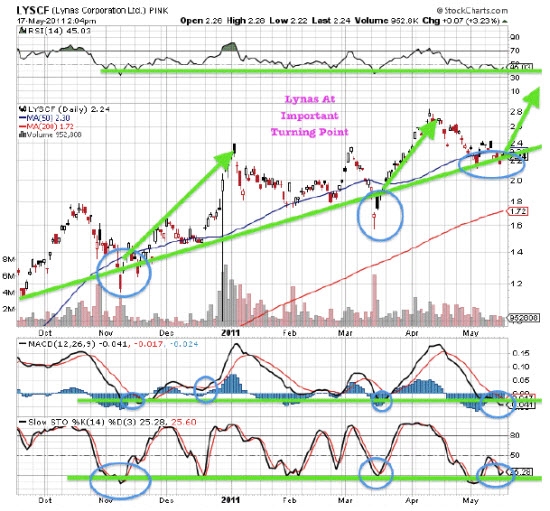
Lynas appears to be reaching extremely oversold levels and long term support. This is an area in which we have seen major reversals higher. I am confident about the progress of the facility in Malaysia and believe Lynas will truly be the first miner to the market outside of China. It is on sale and should hit our short term targets shortly.
The rare earth supply constraint continues to elevate prices sharply both inside and outside of China. Investors will not be asking much longer why rare earth mining stocks aren't moving in tandem. I believe we will see major gains in the second half of 2011 in these stocks and a large amount of strategic acquisitions by end users.
Googleübersetzt: http://translate.google.de/translate?js=n&prev=_t&hl=de&ie=U…
@ eine erfolgreiche Woche
Grüsse JoJo
23/05/11
Av. Mt Weld Composition 168.30 US$/kg on an FOB China basis.
http://seekingalpha.com/article/270969-rare-earth-stocks-not…
Rare Earth Stocks Not Reflecting Supply Demand Constraints
by: Jeb Handwerger May 20, 2011
The prices of rare earth oxides are blasting through the stratosphere. Manufacturers are driving prices in their haste to involve the materials in production of hybrid vehicles, wind turbines, and the most high tech applications of which many sophisticated investors are unaware. These producers need the rare earth ore and are willing to pay for it on the world markets.
China (FXI) has the right stuff, but are claiming -- perhaps rightfully -- that they need the materials for themselves. In fact, they are in the forefront of venturing abroad to take over promising heavy rare earth mines all over the world. Do not forget China’s bid to control Lynas (LYSCF.PK) in 2009. America once commandeered this mining area, but over the years, China co-opted it and became the world leaders, supplying over 97% of the world’s rare earth supply. North America and Europe need to move fast to develop their own supplies.
One of the great demands for rare earths is coming from manufacturers of hybrid cars. Toyota (TM) and Honda (HMC), in order to produce these fuel efficient vehicles, require a large amount of rare earths in each automobile. Toyota has raised the price of the Prius, which is no surprise as each one uses at least 1kg of neodymium which has recently soared in value. These new hybrid models are driving sales and one can be sure that the major manufacturers will gain supplies for several years to come.
Never has there been such a divergence between the price of the rare earth ores and the developing rare earth miners as there is now. The current commodity correction has caused the high flying rare earth sector (REMX) to plunge. I believe we are currently seeing a transition of ownership from weak holders on margin to strong holders with cash who are buying these world class heavy rare assets for pennies on the dollar. Many of the rare earth stocks such as Avalon (AVL), Rare Earth Elements (REE), and Molycorp (MCP) are down more than 30% from their highs. This is quite normal for highly speculative mining investments.
We may begin to see a race to control these heavy rare earth assets in mining friendly jurisdictions while this divergence exists between the price of ore and the mining shares. These manufacturers -- through the support of their governments -- will find available supply by strategic acquisitions and agreements. Personally, I am looking for the critical heavy rare earths outlined by the US Department Of Energy -- such as dysprosium, terbium, and europium -- which are seeing critical supply constraints.
The West is struggling to gain supply for the next few years and some of the undiscovered gems with the crucial heavy rare earths will not last long at these price levels. Molycorp had better move fast to gain assets before people realize that their Mountain Pass deposit does not contain the critical heavy rare earths, just the light rare earths which Goldman Sachs recently revealed there may be a surplus of. Not all mines are created equal.
It is important for investors to realize that companies in the rare earth sector are advancing rapidly in developing projects all over the world. Prominent among them is Lynas Corporation -- an Australian entity in which Japanese interests have taken large positions. They announced the establishment of a proposed production plant in Malaysia and insist they are still on target for commencing production by September 2011. Malaysian environmentalists are protesting this as they remember being badly burned by Mitsubishi, which left Malaysia holding a radioactive bag after producing rare earths.
Lynas management is assembling a panel of experts from all over the world to calm Malaysian fears and at the same time prevent any unfortunate reoccurrence. Lynas welcomes the one month review to ensure the project is safe and presents no danger to the workers. Lynas also hopes to have its Australia Mt. Weld project up and running. Japan (EWJ) is so desperate to obtain product for their high tech industries on which their economic survival is based, it has bankrolled the building of this project. Lynas is hoping to transport the ore from Australia to Malaysia for processing. This contract was signed by both sides in September 2008.
Little noticed is the acquisition by Lynas of a large rare earth deposit in Malawi, Africa. They have the approval of the Malawi government to commence development of this major project. Interestingly, the deposit has extremely low natural radiation levels, unusual for a rare earth deposit.
Lynas appears to be reaching extremely oversold levels and long term support. This is an area in which we have seen major reversals higher. I am confident about the progress of the facility in Malaysia and believe Lynas will truly be the first miner to the market outside of China. It is on sale and should hit our short term targets shortly.
The rare earth supply constraint continues to elevate prices sharply both inside and outside of China. Investors will not be asking much longer why rare earth mining stocks aren't moving in tandem. I believe we will see major gains in the second half of 2011 in these stocks and a large amount of strategic acquisitions by end users.
Googleübersetzt: http://translate.google.de/translate?js=n&prev=_t&hl=de&ie=U…
@ eine erfolgreiche Woche
Grüsse JoJo
http://www.rohstoff-welt.de/news/artikel.php?sid=26649&seite…
Individuelle Einschätzung von Angebot und Nachfrage für die verschiedenen Selten-Erd-Metalle
21.05.2011 | 7:51 Uhr |
Seit Anfang des Jahres 2006 äußere ich mich zu dem Thema Seltene Erden; anfangs war man halt sozusagen fast konkurrenzlos mit diesem Thema beschäftigt, denn die meisten Teilnehmer in den Metallmärkten beachteten zu dieser Zeit die Metalle der Seltenen Erden noch nicht. Meine damalige Warnung vor der chinesischen Strategie (das erste Mal im Oktober 2004 veröffentlicht) wurde nur von wenigen ernst genommen. Das hat sich inzwischen sehr geändert.
...
Auszug von Seite 3:
...
Selbst die attraktivsten REO-Körbe haben keinen Wert, wenn der Gehalt an Seltenen Erden in der gesamten explorierten Erzmenge so niedrig liegt, dass ein ökonomisch sinnvoller Abbau und eine ebenso sinnvolle Separation der einzelnen Seltenen Erden stattfinden können. Wenn man sieht, welches Kapital Lynas aufwenden musste, um seine Konzentratproduktion nahe Mount Weld und seinen Separationskomplex in Malaysia zu finanzieren und wenn man berücksichtigt, dass die Lynas-Lagerstätte so ca. 10% REO-Bestandteile im Roherz aufweist, dann weiß man, dass Lagerstätten mit weitaus geringerer REO-Konzentration bei den heutigen Preisen kaum eine wirtschaftliche Existenzberechtigung haben.
Die ebenso wichtige vierte Frage ist, ob die Explorationsunternehmen sowohl finanziell, als auch technologisch in der Lage sind, die Trennung der immer "im Bündel" auftretenden sich sehr ähnlich darstellenden Seltenen Erden zu schaffen. Das hierzu erforderliche Know-How ist seit Jahrzehnten durch die chinesische Marktstrangulationspolitik außerhalb Chinas nicht mehr auf dem notwendigen Stand. Und so –da die ökonomisch vertretbare Separation der Seltenen Erden voneinander unbedingt für die Marktversorgung erforderlich ist - muss jede Firma, die als potentieller Produzent in die Zukunftsbetrachtung einbezogen werden will, einen Nachweis erbringen, dass sie unter diesen Gesichtspunkten in der Lage ist, diese Auflagen überhaupt zu erfüllen, bevor man das von den betreffenden Firmen bereits jetzt vollständige oder nur vermutete Metallexplorationspotential überhaupt in die Marktversorgungskalkulation ab dem Jahre 2012 einbezieht.
Dudley Kingsnorth hat im Jahre 2008 hierzu eine Darstellung eines 10-Schritte-Programms veröffentlicht. Lassen Sie mich zusammenfassend feststellen, dass von den damals von ihm untersuchten Firmen zu deren damaligen Lagebeschreibung mit Ausnahme von Molycorp und Lynas kaum wesentliche Fortschritte erzielt wurden, die die Hoffnung stützen könnten, dass eines oder mehrere der dort untersuchten Unternehmen in der Lage sein wird, vor 2015 nachhaltig in die Marktversorgung einbezogen werden zu können.
Eine ergänzende Kommentierung von mir: Kingsnorth hatte damals als Schritt neun die Auflage "Bank Feasibility Study und Funding", also die bankorientierte Machbarkeitsstudie und die daraus resultierende Finanzierungssicherheit aufgeführt. Selbst weit fortgeschrittene Firmen wie Lynas und MOlycorp sind danach beinahe an der Erfüllung dieser wesentlichen Auflage gescheitert, dank der Finanzkrise, die meiner Meinung nach noch lange nicht ausgestanden ist.
...
Grüsse JoJo
Individuelle Einschätzung von Angebot und Nachfrage für die verschiedenen Selten-Erd-Metalle
21.05.2011 | 7:51 Uhr |
Seit Anfang des Jahres 2006 äußere ich mich zu dem Thema Seltene Erden; anfangs war man halt sozusagen fast konkurrenzlos mit diesem Thema beschäftigt, denn die meisten Teilnehmer in den Metallmärkten beachteten zu dieser Zeit die Metalle der Seltenen Erden noch nicht. Meine damalige Warnung vor der chinesischen Strategie (das erste Mal im Oktober 2004 veröffentlicht) wurde nur von wenigen ernst genommen. Das hat sich inzwischen sehr geändert.
...
Auszug von Seite 3:
...
Selbst die attraktivsten REO-Körbe haben keinen Wert, wenn der Gehalt an Seltenen Erden in der gesamten explorierten Erzmenge so niedrig liegt, dass ein ökonomisch sinnvoller Abbau und eine ebenso sinnvolle Separation der einzelnen Seltenen Erden stattfinden können. Wenn man sieht, welches Kapital Lynas aufwenden musste, um seine Konzentratproduktion nahe Mount Weld und seinen Separationskomplex in Malaysia zu finanzieren und wenn man berücksichtigt, dass die Lynas-Lagerstätte so ca. 10% REO-Bestandteile im Roherz aufweist, dann weiß man, dass Lagerstätten mit weitaus geringerer REO-Konzentration bei den heutigen Preisen kaum eine wirtschaftliche Existenzberechtigung haben.
Die ebenso wichtige vierte Frage ist, ob die Explorationsunternehmen sowohl finanziell, als auch technologisch in der Lage sind, die Trennung der immer "im Bündel" auftretenden sich sehr ähnlich darstellenden Seltenen Erden zu schaffen. Das hierzu erforderliche Know-How ist seit Jahrzehnten durch die chinesische Marktstrangulationspolitik außerhalb Chinas nicht mehr auf dem notwendigen Stand. Und so –da die ökonomisch vertretbare Separation der Seltenen Erden voneinander unbedingt für die Marktversorgung erforderlich ist - muss jede Firma, die als potentieller Produzent in die Zukunftsbetrachtung einbezogen werden will, einen Nachweis erbringen, dass sie unter diesen Gesichtspunkten in der Lage ist, diese Auflagen überhaupt zu erfüllen, bevor man das von den betreffenden Firmen bereits jetzt vollständige oder nur vermutete Metallexplorationspotential überhaupt in die Marktversorgungskalkulation ab dem Jahre 2012 einbezieht.
Dudley Kingsnorth hat im Jahre 2008 hierzu eine Darstellung eines 10-Schritte-Programms veröffentlicht. Lassen Sie mich zusammenfassend feststellen, dass von den damals von ihm untersuchten Firmen zu deren damaligen Lagebeschreibung mit Ausnahme von Molycorp und Lynas kaum wesentliche Fortschritte erzielt wurden, die die Hoffnung stützen könnten, dass eines oder mehrere der dort untersuchten Unternehmen in der Lage sein wird, vor 2015 nachhaltig in die Marktversorgung einbezogen werden zu können.
Eine ergänzende Kommentierung von mir: Kingsnorth hatte damals als Schritt neun die Auflage "Bank Feasibility Study und Funding", also die bankorientierte Machbarkeitsstudie und die daraus resultierende Finanzierungssicherheit aufgeführt. Selbst weit fortgeschrittene Firmen wie Lynas und MOlycorp sind danach beinahe an der Erfüllung dieser wesentlichen Auflage gescheitert, dank der Finanzkrise, die meiner Meinung nach noch lange nicht ausgestanden ist.
...
Grüsse JoJo
... ein paar Infos, Buchempfehlungen usw. zum aktuellen Thema SeltenenErden und Thorium:
1. ein Auszug aus dem Lehrbuch der anorganischen Chemie
Die Übersetzung ist zwar nicht ganz Fehlerfrei allerdings IMHO dennoch sehr informativ.
http://www.ebooksread.com/authors-eng/karl-andreas-hofmann/l…
2. Eine Übersicht: Die Vorräte der Welt -
Wo Seltene Erdoxide vorkommen (in Millionen Tonnen)
http://www.greenpeace-magazin.de/fileadmin/user_upload/Wieso…
3. Ein Artikel aus Finanz und Wirtschaft aus der Samstagsausgabe vom Nov. 2010
http://www.ree-fund.com/2010_11.20_F_W___Artikel_L.Krull_2.p…
...
Auszug: Umwelt berücksichtigen
Die grösste Herausforderung für Bergbau und Metallurgiekonzerne heute ist, ausserhalb
Chinas wirtschaftlich ausbeutbare Lagerstätten an schweren seltenen Erden
zu finden. Damit sich ein Vorkommen wirtschaftlich nutzen lässt, müssen zum
einen günstige mineralogische Rahmenbedingungen gegeben sein. Zum anderen
muss es realistische Werte für Gehalt und Menge an ausbeutbaren REE aufweisen.
Eine Voraussetzung sind zudem kosteneffiziente Abbau- und Aufbereitungsverfahren.
Und nicht zuletzt darf der Gehalt an Thorium, Uran und anderen Verunreinigungen
gewisse Schwellenwerte nicht überschreiten, damit die Belastung für die Umwelt tragbar bleibt.
In Mineralien gefangen
Für Diamantvorkommen hilft die Grössen-Häufigkeitsverteilung, für den Goldabbau
der Erzgrad verbunden mit einer konventionellen mineralogischen Analyse
sowie den Erfahrungen aus standardisierten Aufbereitungsverfahren, das wirtschaftliche
Potenzial eines Projekts abzuschätzen.
Die im Bereich seltene Erden verwendete Kennziffer TREO (Total Rare Earth Oxydes) hingegen – sie gibt den Gehalt sämtlicher in einer Gesteinsprobe enthaltener Seltene-Erden-Oxide an – bezieht sich auf einen ganzen Korb von Elementen und gibt allein deshalb
keinen Aufschluss über das wirtschaftliche Potenzial des Vorkommens.
Zudem kann der TREO-Wert vielfältige gesteinsbildende Mineralien und Nebengesteine umfassen; die REE sind also nicht in einem bestimmten Mineral konzentriert, sondern in einer Vielzahl davon eingebettet. Allfällige Aussagen zur Wirtschaftlichkeit eines Projekts setzen angesichts dieser Komplexität deshalb eine gründliche vorangehende Mikroanalyse voraus.
Die Wirtschaftlichkeit des Abbaus hängt in hohem Mass von den mineralogischen Gegebenheiten der Lagerstätte ab. usw.
...
4. Ein Bericht zum Thema:
Umweltbedenken führt zu eingeschränkter Gewinnung von Seltenen Erden
2011-03-01 10:45:52 cri
...
...
übersetzt und Gesprochen von Xi Jing
http://german.cri.cn/1833/2011/03/01/1s152849.htm
Grüsse JoJo
1. ein Auszug aus dem Lehrbuch der anorganischen Chemie
Die Übersetzung ist zwar nicht ganz Fehlerfrei allerdings IMHO dennoch sehr informativ.
http://www.ebooksread.com/authors-eng/karl-andreas-hofmann/l…
2. Eine Übersicht: Die Vorräte der Welt -
Wo Seltene Erdoxide vorkommen (in Millionen Tonnen)
http://www.greenpeace-magazin.de/fileadmin/user_upload/Wieso…
3. Ein Artikel aus Finanz und Wirtschaft aus der Samstagsausgabe vom Nov. 2010
http://www.ree-fund.com/2010_11.20_F_W___Artikel_L.Krull_2.p…
...
Auszug: Umwelt berücksichtigen
Die grösste Herausforderung für Bergbau und Metallurgiekonzerne heute ist, ausserhalb
Chinas wirtschaftlich ausbeutbare Lagerstätten an schweren seltenen Erden
zu finden. Damit sich ein Vorkommen wirtschaftlich nutzen lässt, müssen zum
einen günstige mineralogische Rahmenbedingungen gegeben sein. Zum anderen
muss es realistische Werte für Gehalt und Menge an ausbeutbaren REE aufweisen.
Eine Voraussetzung sind zudem kosteneffiziente Abbau- und Aufbereitungsverfahren.
Und nicht zuletzt darf der Gehalt an Thorium, Uran und anderen Verunreinigungen
gewisse Schwellenwerte nicht überschreiten, damit die Belastung für die Umwelt tragbar bleibt.
In Mineralien gefangen
Für Diamantvorkommen hilft die Grössen-Häufigkeitsverteilung, für den Goldabbau
der Erzgrad verbunden mit einer konventionellen mineralogischen Analyse
sowie den Erfahrungen aus standardisierten Aufbereitungsverfahren, das wirtschaftliche
Potenzial eines Projekts abzuschätzen.
Die im Bereich seltene Erden verwendete Kennziffer TREO (Total Rare Earth Oxydes) hingegen – sie gibt den Gehalt sämtlicher in einer Gesteinsprobe enthaltener Seltene-Erden-Oxide an – bezieht sich auf einen ganzen Korb von Elementen und gibt allein deshalb
keinen Aufschluss über das wirtschaftliche Potenzial des Vorkommens.
Zudem kann der TREO-Wert vielfältige gesteinsbildende Mineralien und Nebengesteine umfassen; die REE sind also nicht in einem bestimmten Mineral konzentriert, sondern in einer Vielzahl davon eingebettet. Allfällige Aussagen zur Wirtschaftlichkeit eines Projekts setzen angesichts dieser Komplexität deshalb eine gründliche vorangehende Mikroanalyse voraus.
Die Wirtschaftlichkeit des Abbaus hängt in hohem Mass von den mineralogischen Gegebenheiten der Lagerstätte ab. usw.
...
4. Ein Bericht zum Thema:
Umweltbedenken führt zu eingeschränkter Gewinnung von Seltenen Erden
2011-03-01 10:45:52 cri
...
...
übersetzt und Gesprochen von Xi Jing
http://german.cri.cn/1833/2011/03/01/1s152849.htm
Grüsse JoJo
Auf weitere REO-Preissteigerungen kann gewartet werden:
http://www.metal-pages.com/metalprices/rareearths/#
Grüsse JoJo
http://www.metal-pages.com/metalprices/rareearths/#
Grüsse JoJo
http://www.events-actually.com/wreic2011.html

...
...
Rare earths market is potentially a growing industry with some 15% annual growth over the next five years…..Get latest update on the impact of rare earths industry policy, the growing challenge of procuring rare earths elements, update on rare earths processing plants as well as latest prospect in investing in rare earths supply chain across Asia Pacific, Middle East, Europe and the region.
The demand for rare earths has grown enormously in recent times as they have become essential for many new technologies. Rare earths have recently moved to the top of the EU’s list of critical raw materials as European companies have focused on supply security for their industries. Rare earths industries in countries such as Australia and the United States have begun to increase production and to develop alternative rare earths supply chains. There is large amount of reserves of rare earths minerals in the world. China holds the leading position among producers of the rare earths elements, or lanthanide elements. Rare earths are also produced in India, Russia, Kazakhstan, Kyrgyzstan, Thailand, Malaysia, Russian Federation, Brazil, Canada and India, Vietnam, South Africa, Indonesia, Sri Lanka, Mongolia, North Korea, Saudi Arabia, Turkey, Norway, Greece, Nigeria, Kenya, Tanzania, Burundi, Madagascar, Mozambique and Egypt. Most recently, it was discovered that Afghanistan may have large deposits of rare earth metals, estimated to be worth US$89 billion. The rare earth deposits are on the south bank of the Helmand River in southern Afghanistan. Against this development, World Rare Earths Industry Conference 2011 is designed as an alternative a platform for business dialogue as well as for sharing of perspective, idea and discussion on rare earths resources, production, environment, protection, application, market and trade so as to further enhance market visibility of rare earths industry worldwide. In addition, this conference will focus on the impact of rare earths industry policy, overview of the world rare earths resources, the relation between new energy industry and the rare earth industry, the status and the trends of rare earths new materials, the influence of rare earths industry on the environment as well as other key issues to be discussed including:
• Exploration methods for identifying rare earths deposits
• Determining if you have an economically viable material
• Overcoming the hurdles: gaining access to capital and equity
• Dealing with environmental challenges of processing rare earths
• Methods and strategies for the processing and extraction of rare earths
• Improving the supply chain
• A focus on the metallurgical side of rare earths
...
Googleübersetzt: http://translate.google.de/translate?js=n&prev=_t&hl=de&ie=U…
Grüsse JoJo
...
...
Rare earths market is potentially a growing industry with some 15% annual growth over the next five years…..Get latest update on the impact of rare earths industry policy, the growing challenge of procuring rare earths elements, update on rare earths processing plants as well as latest prospect in investing in rare earths supply chain across Asia Pacific, Middle East, Europe and the region.
The demand for rare earths has grown enormously in recent times as they have become essential for many new technologies. Rare earths have recently moved to the top of the EU’s list of critical raw materials as European companies have focused on supply security for their industries. Rare earths industries in countries such as Australia and the United States have begun to increase production and to develop alternative rare earths supply chains. There is large amount of reserves of rare earths minerals in the world. China holds the leading position among producers of the rare earths elements, or lanthanide elements. Rare earths are also produced in India, Russia, Kazakhstan, Kyrgyzstan, Thailand, Malaysia, Russian Federation, Brazil, Canada and India, Vietnam, South Africa, Indonesia, Sri Lanka, Mongolia, North Korea, Saudi Arabia, Turkey, Norway, Greece, Nigeria, Kenya, Tanzania, Burundi, Madagascar, Mozambique and Egypt. Most recently, it was discovered that Afghanistan may have large deposits of rare earth metals, estimated to be worth US$89 billion. The rare earth deposits are on the south bank of the Helmand River in southern Afghanistan. Against this development, World Rare Earths Industry Conference 2011 is designed as an alternative a platform for business dialogue as well as for sharing of perspective, idea and discussion on rare earths resources, production, environment, protection, application, market and trade so as to further enhance market visibility of rare earths industry worldwide. In addition, this conference will focus on the impact of rare earths industry policy, overview of the world rare earths resources, the relation between new energy industry and the rare earth industry, the status and the trends of rare earths new materials, the influence of rare earths industry on the environment as well as other key issues to be discussed including:
• Exploration methods for identifying rare earths deposits
• Determining if you have an economically viable material
• Overcoming the hurdles: gaining access to capital and equity
• Dealing with environmental challenges of processing rare earths
• Methods and strategies for the processing and extraction of rare earths
• Improving the supply chain
• A focus on the metallurgical side of rare earths
...
Googleübersetzt: http://translate.google.de/translate?js=n&prev=_t&hl=de&ie=U…
Grüsse JoJo
http://asx.com.au/asxpdf/20110601/pdf/41yz61qbp7bdrg.pdf
11. Juni 2011
ASX/Media Announcement
Rare Earth Market and Price Update
...
Googlrübersetzt: http://translate.google.de/translate?js=n&prev=_t&hl=de&ie=U…
Grsse JoJo
11. Juni 2011
ASX/Media Announcement
Rare Earth Market and Price Update
...
Googlrübersetzt: http://translate.google.de/translate?js=n&prev=_t&hl=de&ie=U…
Grsse JoJo
http://www.ftd.de/finanzen/maerkte/rohstoffe/:rohstoffhandel…
29.05.2011, 19:
Rohstoffhandel
China heizt Preise für seltene Erden an
Seltene Erden sind zwar gar nicht so selten, wie der Name vermuten lässt. Die Preise sind in den vergangenen Monaten aber kräftig gestiegen. Mithilfe einer Börse in der Inneren Mongolei soll das so weitergehen. von Michelle Röttger, Hamburg
Chinas größter Produzent von seltenen Erden, Baotou Steel Rare Earth, will eine Börse für die begehrten Hightech-Rohstoffe eröffnen. Die Regierung des autonomen Gebiets Innere Mongolei hat dem Konzern Berichten in Staatsmedien zufolge schon grünes Licht für eine Handelsplattform mit Sitz in Baotou gegeben.
Seltene Erden sind etwa in der Autoproduktion oder für industrielle Katalysatoren unverzichtbar. Mit einer Handelsplattform könnte China die Preise der wertvollen Rohstoffe noch stärker kontrollieren. Das Land verfügt über die weltweit größten Vorkommen an seltenen Erden und kontrolliert 97 Prozent der Produktion.
...
...
@ eine erfolgreiche Woche
Grüsse JoJo
29.05.2011, 19:
Rohstoffhandel
China heizt Preise für seltene Erden an
Seltene Erden sind zwar gar nicht so selten, wie der Name vermuten lässt. Die Preise sind in den vergangenen Monaten aber kräftig gestiegen. Mithilfe einer Börse in der Inneren Mongolei soll das so weitergehen. von Michelle Röttger, Hamburg
Chinas größter Produzent von seltenen Erden, Baotou Steel Rare Earth, will eine Börse für die begehrten Hightech-Rohstoffe eröffnen. Die Regierung des autonomen Gebiets Innere Mongolei hat dem Konzern Berichten in Staatsmedien zufolge schon grünes Licht für eine Handelsplattform mit Sitz in Baotou gegeben.
Seltene Erden sind etwa in der Autoproduktion oder für industrielle Katalysatoren unverzichtbar. Mit einer Handelsplattform könnte China die Preise der wertvollen Rohstoffe noch stärker kontrollieren. Das Land verfügt über die weltweit größten Vorkommen an seltenen Erden und kontrolliert 97 Prozent der Produktion.
...
...
@ eine erfolgreiche Woche
Grüsse JoJo
$203.73 per kg - http://https//sites.google.com/site/4lynasheads/
http://www.asianmetal.com/partner/pelemountain.html
http://www.metal-pages.com/metalprices/rareearths/
---------------------------------------------------------------------------------------------
Video zum Thema Japan und die Versorgung mit REO = http://www.youtube.com/watch?v=q-M0SUQE0Y4&feature=feedu
---------------------------------------------------------------------------------------------
Wohl IMHO eines der Gründe warum die REO-Preise weiterhin steigen werden:
http://business.globaltimes.cn/industries/2011-06/662758.htm…
Baotou Steel Rare Earth replaces rival processors in Inner Mongolia
Source: Globaltimes.cn [17:58 June 07 2011] Comments
Inner Mongolia Baotou Steel Rare-Earth (Group) Hi-Tech Co.,Ltd, the largest rare earth production and processing enterprise in the world, will replace its competitors in Inner Mongolia to become the only firm running upstream operations of rare earth in northern China, the Inner Mongolia Autonomous Region Government Office said recently, according to People.com.cn on Thursday.
The other 35 upstream companies in the rare earth industry in Hohhot, Baotou and Bayan Nur -- cities in Inner Mongolia -- will face restructuring or closure. The restructuring work will be finished by the end of June.
Through the integration of upstream rare earth companies, a unified system will be formed under Baotou Steel Rare Earth and will comprise all operations including mining, mineral separation, smelting and trading, according to Ya Saning, director of the Inner Mongolia Autonomous Region Economic and Information Technology Commission.
"At the current scale of production, only Baotou Steel Rare Earth can satisfy the control index of total mining for the Ministry of Land and Resources, the mandatory production plan of the Ministry of Industry and Information Technology and the export quota of the Ministry of Commerce ," said Liu Jingchun, a researcher at the same commission as Ya.
Googleübersetzt: http://translate.google.de/translate?js=n&prev=_t&hl=de&ie=U…
Grüsse JoJo
http://www.asianmetal.com/partner/pelemountain.html
http://www.metal-pages.com/metalprices/rareearths/
---------------------------------------------------------------------------------------------
Video zum Thema Japan und die Versorgung mit REO = http://www.youtube.com/watch?v=q-M0SUQE0Y4&feature=feedu
---------------------------------------------------------------------------------------------
Wohl IMHO eines der Gründe warum die REO-Preise weiterhin steigen werden:
http://business.globaltimes.cn/industries/2011-06/662758.htm…
Baotou Steel Rare Earth replaces rival processors in Inner Mongolia
Source: Globaltimes.cn [17:58 June 07 2011] Comments
Inner Mongolia Baotou Steel Rare-Earth (Group) Hi-Tech Co.,Ltd, the largest rare earth production and processing enterprise in the world, will replace its competitors in Inner Mongolia to become the only firm running upstream operations of rare earth in northern China, the Inner Mongolia Autonomous Region Government Office said recently, according to People.com.cn on Thursday.
The other 35 upstream companies in the rare earth industry in Hohhot, Baotou and Bayan Nur -- cities in Inner Mongolia -- will face restructuring or closure. The restructuring work will be finished by the end of June.
Through the integration of upstream rare earth companies, a unified system will be formed under Baotou Steel Rare Earth and will comprise all operations including mining, mineral separation, smelting and trading, according to Ya Saning, director of the Inner Mongolia Autonomous Region Economic and Information Technology Commission.
"At the current scale of production, only Baotou Steel Rare Earth can satisfy the control index of total mining for the Ministry of Land and Resources, the mandatory production plan of the Ministry of Industry and Information Technology and the export quota of the Ministry of Commerce ," said Liu Jingchun, a researcher at the same commission as Ya.
Googleübersetzt: http://translate.google.de/translate?js=n&prev=_t&hl=de&ie=U…
Grüsse JoJo
U.a. zeigen die folgenden Berichte der Deutschen Rohstoff AG IMHO deutlich die Bemühungen der Industrieländer einschließlich China auf sich weltweit den weiterhin steigenden Rohstoffbedarf zu sichern hier wie u.a. auch in Bezug auf Brasilien:
http://www.geopowers.com/energie/neue-allianzen-gegen-chinas…
Auszug:
Karbonatite als wichtige Lieferanten für Nb und Seltene Erden
Als wirtschaftlich interessantester Lagerstättentyp für Nb-Vorstoffe hatten sich in der Vergangenheit vor allem Karbonatitkomplexe und damit assoziierte residuale Anreicherungen erwiesen. Letztere bilden die produktive Lagerstätte Araxá im Bundesstaat Minas Gerais in Brasilien, die einen Cluster aus mehreren Einzelvorkommen mit einem Gesamtdurchmesser von 4,5 Kilometern im Bereich des Barreiro Karbonatit-Komplexes repräsentiert. Dieser Lagerstättenkomplex weist zurzeit Reserven und Ressourcen von über 460 Mio. Tonnen Roherz mit einem Durchschnittsgehalt von 2,5 Prozent Nb2O5 und 4,4 Prozent SEO und sowie lateritische Erze mit bis zu 2 Prozent Nb2O5 und 13,5 Prozent SEO auf. Damit gilt diese Lagerstätte als das zurzeit zweitgrößte Vorkommen dieser Art weltweit. Die Nb-haltigen Minerale, die in diesen Vorkommen an karbonatitische Gesteine gebunden sind, gehören der Pyrochlor-Gruppe (chem. (Na, Ca)2(Nb, Ti, Ta)2O6(OH, F, O)) an, einer Serie verschiedener kubisch-würfelförmig kristallisierender Oxide, die zumeist größere Mengen von Nb, Ta und Ti enthalten. Karbonatite bestehen zu mehr als 50 Prozent aus Karbonatmineralen wie Kalzit, Dolomit, Ankerit sowie Siderit und enthalten silikatische Minerale wie Forsterit, Melilith, Diopsid, Ägirin, Wollastonit, Alkali-Amphibole, Phlogopit, Titanit, Zirkon, Alkalifeldspäte sowie weitere Oxidminerale wie Magnetit, Ilmenit, Rutil, Perowskit sowie Phosphate.
...
http://www.geopowers.com/energie/problematische-versorgungsl…
geschrieben von sn am 22. Mai 2011
Seit einigen Jahren steht die Versorgung mit mineralischen Rohstoffen wieder verstärkt im Blickfeld der Wirtschaft, der Politik und auch der Öffentlichkeit. Besonders intensiv wurde im vergangenen Jahr seitens der deutschen Medien über Elektronikmetalle und über die Gruppe der Seltenen Erden oder Seltenen Erdoxide (SEO) berichtet.
Zu beiden Rohstoffgruppen liegen neuere Einschätzungen in der Reihe "Commodity Top News" vor von LIEDTKE & ELSNER (2009) und ELSNER et al. (2010), die von der Deutschen Rohstoffagentur (DERA) in der Bundesanstalt für Geowissenschaften & Rohstoffe (BGR) publiziert wurden.
Vor dem Hntergrund von befürchteten Versorgungsengpässen bei SEO stellt der Autor der nunmehr am 20. April 2011 veröffentlichten Einschätzung in der Reihe "Commodity Top News", Ausgabe Nr. 36 (siehe PDF-Dokument) heraus, dass die Problematik der Versorgung der deutschen Wirtschaft mit SEO weiterhin anhält. Für die gesamte Untergruppe der so genannten leichten SEO wie Cer und Lanthan sei jedoch ab Anfang/Mitte 2012 eine deutliche Entspannung der Marktlage abzusehen. Dagegen würde sich nach Ansicht des Autors der Kurzstudie, Harald Elsner, die Versorgung mit schweren SEO (etwa Dysprosium und Europium), die in vielen „Grünen Technologien“ Verwendung finden, weiter verschärfen. Die Einschätzung in den Commodity Top News weist auf die kritische Versorgungslage bei schweren SEO hin und diskutiert mögliche Auswirkungen auf die Entwicklung „Grüner Technologien“.
http://www.geopowers.com/energie/sites/default/files/images/…
Kritische Versorgungslage mit schweren Seltenen Erden –
Entwicklung „Grüner Technologien“ gefährdet?
Harald Elsner
da ich erst nach Pfingsten wieder online sein kann wünsche allen jetzt schon schöne, erholsame Feiertage
Grüsse JoJo
http://www.geopowers.com/energie/neue-allianzen-gegen-chinas…
Auszug:
Karbonatite als wichtige Lieferanten für Nb und Seltene Erden
Als wirtschaftlich interessantester Lagerstättentyp für Nb-Vorstoffe hatten sich in der Vergangenheit vor allem Karbonatitkomplexe und damit assoziierte residuale Anreicherungen erwiesen. Letztere bilden die produktive Lagerstätte Araxá im Bundesstaat Minas Gerais in Brasilien, die einen Cluster aus mehreren Einzelvorkommen mit einem Gesamtdurchmesser von 4,5 Kilometern im Bereich des Barreiro Karbonatit-Komplexes repräsentiert. Dieser Lagerstättenkomplex weist zurzeit Reserven und Ressourcen von über 460 Mio. Tonnen Roherz mit einem Durchschnittsgehalt von 2,5 Prozent Nb2O5 und 4,4 Prozent SEO und sowie lateritische Erze mit bis zu 2 Prozent Nb2O5 und 13,5 Prozent SEO auf. Damit gilt diese Lagerstätte als das zurzeit zweitgrößte Vorkommen dieser Art weltweit. Die Nb-haltigen Minerale, die in diesen Vorkommen an karbonatitische Gesteine gebunden sind, gehören der Pyrochlor-Gruppe (chem. (Na, Ca)2(Nb, Ti, Ta)2O6(OH, F, O)) an, einer Serie verschiedener kubisch-würfelförmig kristallisierender Oxide, die zumeist größere Mengen von Nb, Ta und Ti enthalten. Karbonatite bestehen zu mehr als 50 Prozent aus Karbonatmineralen wie Kalzit, Dolomit, Ankerit sowie Siderit und enthalten silikatische Minerale wie Forsterit, Melilith, Diopsid, Ägirin, Wollastonit, Alkali-Amphibole, Phlogopit, Titanit, Zirkon, Alkalifeldspäte sowie weitere Oxidminerale wie Magnetit, Ilmenit, Rutil, Perowskit sowie Phosphate.
...
http://www.geopowers.com/energie/problematische-versorgungsl…
geschrieben von sn am 22. Mai 2011
Seit einigen Jahren steht die Versorgung mit mineralischen Rohstoffen wieder verstärkt im Blickfeld der Wirtschaft, der Politik und auch der Öffentlichkeit. Besonders intensiv wurde im vergangenen Jahr seitens der deutschen Medien über Elektronikmetalle und über die Gruppe der Seltenen Erden oder Seltenen Erdoxide (SEO) berichtet.
Zu beiden Rohstoffgruppen liegen neuere Einschätzungen in der Reihe "Commodity Top News" vor von LIEDTKE & ELSNER (2009) und ELSNER et al. (2010), die von der Deutschen Rohstoffagentur (DERA) in der Bundesanstalt für Geowissenschaften & Rohstoffe (BGR) publiziert wurden.
Vor dem Hntergrund von befürchteten Versorgungsengpässen bei SEO stellt der Autor der nunmehr am 20. April 2011 veröffentlichten Einschätzung in der Reihe "Commodity Top News", Ausgabe Nr. 36 (siehe PDF-Dokument) heraus, dass die Problematik der Versorgung der deutschen Wirtschaft mit SEO weiterhin anhält. Für die gesamte Untergruppe der so genannten leichten SEO wie Cer und Lanthan sei jedoch ab Anfang/Mitte 2012 eine deutliche Entspannung der Marktlage abzusehen. Dagegen würde sich nach Ansicht des Autors der Kurzstudie, Harald Elsner, die Versorgung mit schweren SEO (etwa Dysprosium und Europium), die in vielen „Grünen Technologien“ Verwendung finden, weiter verschärfen. Die Einschätzung in den Commodity Top News weist auf die kritische Versorgungslage bei schweren SEO hin und diskutiert mögliche Auswirkungen auf die Entwicklung „Grüner Technologien“.
http://www.geopowers.com/energie/sites/default/files/images/…
Kritische Versorgungslage mit schweren Seltenen Erden –
Entwicklung „Grüner Technologien“ gefährdet?
Harald Elsner
da ich erst nach Pfingsten wieder online sein kann wünsche allen jetzt schon schöne, erholsame Feiertage
Grüsse JoJo
Gerade auch die Kommentare am Ende zum folgenden Artikel sind IMHO beachtenswert.
Lynas Malaysia and the rare earth controversy
http://www.asiasentinel.com/index.php?option=com_content&tas…
...
...
Googleübersetzt: http://translate.google.de/translate?js=n&prev=_t&hl=de&ie=U…
Der neue Mix-Preis http://www.lynascorp.com/page.asp?category_id=1&page_id=25
http://translate.google.de/translate?js=n&prev=_t&hl=de&ie=U…
13/06/11 Av. Mt Weld Composition Mt Weld Zusammensetzung 203.60 US$/kg auf FOB Chinabasis.
... ein preisvergleich zu 2007 siehe Link.
World Rare Earths Industry Conference 2011
http://www.events-actually.com/wreic2011.html
...
...
Googleübersetzt: http://translate.google.de/translate?js=n&prev=_t&hl=de&ie=U…
Grüsse JoJo
Lynas Malaysia and the rare earth controversy
http://www.asiasentinel.com/index.php?option=com_content&tas…
...
...
Googleübersetzt: http://translate.google.de/translate?js=n&prev=_t&hl=de&ie=U…
Der neue Mix-Preis http://www.lynascorp.com/page.asp?category_id=1&page_id=25
http://translate.google.de/translate?js=n&prev=_t&hl=de&ie=U…
13/06/11 Av. Mt Weld Composition Mt Weld Zusammensetzung 203.60 US$/kg auf FOB Chinabasis.
... ein preisvergleich zu 2007 siehe Link.
World Rare Earths Industry Conference 2011
http://www.events-actually.com/wreic2011.html
...
...
Googleübersetzt: http://translate.google.de/translate?js=n&prev=_t&hl=de&ie=U…
Grüsse JoJo
http://www.businessinsider.com/richard-karn-50-specialty-met…
No Less Than 50 Specialty Metals Face A Supply Threat
The Gold Report|Jun. 14, 2011, 9:37 AM
The Critical Metals Report: Let's start with the basics. In general terms, what exactly are "specialty" metals?
...
Googleübersetzt: http://translate.google.de/translate?js=n&prev=_t&hl=de&ie=U…
Grüsse JoJo
No Less Than 50 Specialty Metals Face A Supply Threat
The Gold Report|Jun. 14, 2011, 9:37 AM
The Critical Metals Report: Let's start with the basics. In general terms, what exactly are "specialty" metals?
...
Googleübersetzt: http://translate.google.de/translate?js=n&prev=_t&hl=de&ie=U…
Grüsse JoJo
http://www.techmetalsresearch.com/2011/06/implications-for-i…
Implications For Investors Of The Dramatically Increasing Chinese Virtual Demand For Rare Earths
by Jack Lifton on June 15, 2011 · 20 comments
in China,News Analysis,Rare Earths
...
...
Googleübersetzt: http://translate.google.de/translate?js=n&prev=_t&hl=de&ie=U…
http://online.wsj.com/article/BT-CO-20110615-703713.html
JUNE 15, 2011, 6:06 A.M. ET.
China To Set Up Strategic Reserve For Heavy Rare Earths -Sources
...
...
Googleübersetzt: http://translate.googleusercontent.com/translate_c?hl=de&ie=…
Grüsse JoJo
Implications For Investors Of The Dramatically Increasing Chinese Virtual Demand For Rare Earths
by Jack Lifton on June 15, 2011 · 20 comments
in China,News Analysis,Rare Earths
...
...
Googleübersetzt: http://translate.google.de/translate?js=n&prev=_t&hl=de&ie=U…
http://online.wsj.com/article/BT-CO-20110615-703713.html
JUNE 15, 2011, 6:06 A.M. ET.
China To Set Up Strategic Reserve For Heavy Rare Earths -Sources
...
...
Googleübersetzt: http://translate.googleusercontent.com/translate_c?hl=de&ie=…
Grüsse JoJo
http://www.bloomberg.com/news/2011-06-17/rare-earth-prices-d…" target="_blank" rel="nofollow ugc noopener">http://www.bloomberg.com/news/2011-06-17/rare-earth-prices-d…
Rare Earth Prices Double in Two Weeks as China Seeks to Increase Control
By Jason Scott - Jun 17, 2011 7:47 AM GMT+0200
...
...
Googleübersetzt: http://translate.google.de/translate?js=n&prev=_t&hl=de&ie=U…
@ ein schönes WE
Grüsse JoJo
Rare Earth Prices Double in Two Weeks as China Seeks to Increase Control
By Jason Scott - Jun 17, 2011 7:47 AM GMT+0200
...
...
Googleübersetzt: http://translate.google.de/translate?js=n&prev=_t&hl=de&ie=U…
@ ein schönes WE
Grüsse JoJo
http://boersenradar.t-online.de/Aktuell/Boerse/Preis-fuer-se…" target="_blank" rel="nofollow ugc noopener">http://boersenradar.t-online.de/Aktuell/Boerse/Preis-fuer-se…
Hightech-Metalle
Preis für seltene Erden steigt deutlich
Erschienen am 20.06.2011 | Financial Times Deutschland
Die Preise für einige seltene Erden haben sich binnen drei Wochen verdoppelt. Grund sind Exportbeschränkungen in China, die Sorgen geschürt haben, das weltweite Angebot könnte knapp werden.
...
Grüsse JoJo
Hightech-Metalle
Preis für seltene Erden steigt deutlich
Erschienen am 20.06.2011 | Financial Times Deutschland
Die Preise für einige seltene Erden haben sich binnen drei Wochen verdoppelt. Grund sind Exportbeschränkungen in China, die Sorgen geschürt haben, das weltweite Angebot könnte knapp werden.
...
Grüsse JoJo
http://boersenradar.t-online.de/Aktuell/Boerse/Preis-fuer-se…" target="_blank" rel="nofollow ugc noopener">http://boersenradar.t-online.de/Aktuell/Boerse/Preis-fuer-se…
Hightech-Metalle
Preis für seltene Erden steigt deutlich
Erschienen am 20.06.2011 | Financial Times Deutschland
Die Preise für einige seltene Erden haben sich binnen drei Wochen verdoppelt. Grund sind Exportbeschränkungen in China, die Sorgen geschürt haben, das weltweite Angebot könnte knapp werden.
...
...
Grüsse JoJo
Hightech-Metalle
Preis für seltene Erden steigt deutlich
Erschienen am 20.06.2011 | Financial Times Deutschland
Die Preise für einige seltene Erden haben sich binnen drei Wochen verdoppelt. Grund sind Exportbeschränkungen in China, die Sorgen geschürt haben, das weltweite Angebot könnte knapp werden.
...
...
Grüsse JoJo
http://www.bernama.com/bernama/v5/newsgeneral.php?id=596332
Radiation in the Daily Life of Man
...
Googleübersetzt: http://translate.google.de/translate?js=n&prev=_t&hl=de&ie=U…
http://www.ariva.de/Seltene_Erden_Das_Monopol_Chinas_wird_in…
Seltene Erden: Das Monopol Chinas wird innerhalb von zwei Jahren fallen
...
@ ein schönes WE
Grüsse JoJo
Radiation in the Daily Life of Man
...
Googleübersetzt: http://translate.google.de/translate?js=n&prev=_t&hl=de&ie=U…
http://www.ariva.de/Seltene_Erden_Das_Monopol_Chinas_wird_in…
Seltene Erden: Das Monopol Chinas wird innerhalb von zwei Jahren fallen
...
@ ein schönes WE
Grüsse JoJo
http://www.nordbayern.de/nuernberger-zeitung/nz-wirtschaft/e…
Ein rarer Hort an seltenen Erden
Australische Firma baut riesige Raffinerie in Malaysia - 10.06. 16:13 Uhr
KUALA LUMPUR - In Gebeng an der malaysischen Ostküste ist ein riesiges Bauprojekt im Gange. Auf der 20 Hektar großen Baustelle entsteht eine der größten Raffinerien der Welt für seltene Erden.
...
...
http://www.rohstoff-welt.de/news/artikel.php?sid=27666
Lynas Corp: Tag der Entscheidung naht
23.06.2011 | 8:25 Uhr | Hahn, Rainer
...
...
http://www.rohstoff-welt.de/news/artikel.php?sid=27750
Seltene Erden: China-Ausfuhren fallen weiter
27.06.2011 | 6:45 Uhr | Hahn, Rainer
Grüsse JoJo
Ein rarer Hort an seltenen Erden
Australische Firma baut riesige Raffinerie in Malaysia - 10.06. 16:13 Uhr
KUALA LUMPUR - In Gebeng an der malaysischen Ostküste ist ein riesiges Bauprojekt im Gange. Auf der 20 Hektar großen Baustelle entsteht eine der größten Raffinerien der Welt für seltene Erden.
...
...
http://www.rohstoff-welt.de/news/artikel.php?sid=27666
Lynas Corp: Tag der Entscheidung naht
23.06.2011 | 8:25 Uhr | Hahn, Rainer
...
...
http://www.rohstoff-welt.de/news/artikel.php?sid=27750
Seltene Erden: China-Ausfuhren fallen weiter
27.06.2011 | 6:45 Uhr | Hahn, Rainer
Grüsse JoJo
http://rareearthdigest.com/ree-news/news-asia.html
Asian Rare Earth News
Restrictions, reductions, more of same
Wednesday, 22 June 2011 06:44
...
...
Googleübersetzt: http://translate.google.de/translate?js=n&prev=_t&hl=de&ie=U…
http://english.ruvr.ru/2011/06/28/52516576.html
Russia to foray into rare earth metals market
Tags: exports, natural resources, Business, China, Russia, Commentary, World
Chernitsa Polina Jun 28, 2011 18:48 Moscow Time
...
...
Googleübersetzt: http://translate.google.de/translate?js=n&prev=_t&hl=de&ie=U…
http://properties.btimes.com.my/Current_News/BTIMES/articles…
Lynas review to be announced tomorrow
The Malaysian government will make an announcement tomorrow on Lynas Corp.’s planned rare-earth refinery in Kuantan state following a health and safety review by a panel of experts appointed by the International Atomic Energy Agency.
A briefing will be held at 11 a.m. local time in Kuala Lumpur, the government said in a statement.- Bloomberg
Googleübersetzt: http://translate.google.de/translate?js=n&prev=_t&hl=de&ie=U…
Grüsse JoJo
Asian Rare Earth News
Restrictions, reductions, more of same
Wednesday, 22 June 2011 06:44
...
...
Googleübersetzt: http://translate.google.de/translate?js=n&prev=_t&hl=de&ie=U…
http://english.ruvr.ru/2011/06/28/52516576.html
Russia to foray into rare earth metals market
Tags: exports, natural resources, Business, China, Russia, Commentary, World
Chernitsa Polina Jun 28, 2011 18:48 Moscow Time
...
...
Googleübersetzt: http://translate.google.de/translate?js=n&prev=_t&hl=de&ie=U…
http://properties.btimes.com.my/Current_News/BTIMES/articles…
Lynas review to be announced tomorrow
The Malaysian government will make an announcement tomorrow on Lynas Corp.’s planned rare-earth refinery in Kuantan state following a health and safety review by a panel of experts appointed by the International Atomic Energy Agency.
A briefing will be held at 11 a.m. local time in Kuala Lumpur, the government said in a statement.- Bloomberg
Googleübersetzt: http://translate.google.de/translate?js=n&prev=_t&hl=de&ie=U…
Grüsse JoJo
http://www.shareribs.com/rohstoffe/metalle-und-minen/news/ar…
Südkorea meldet bedeutene Seltene Erden-Vorkommen
(shareribs.com) Seoul 05.07.2011 - Südkorea hat bedeutende Vorkommen an Seltenen Erden festgestellt.
...
http://www.bloomberg.com/news/2011-07-05/underwater-rare-ear…
Underwater Rare-Earths Mining Economically Unviable, CFR Says
By Jason Scott - Jul 5, 2011 4:38 AM GMT+0200
...
Googleübersetzt: http://translate.google.de/translate?js=n&prev=_t&hl=de&ie=U…
http://www.dowjones.de/site/2011/06/-lynas-h%C3%A4lt-an-zeit…
Lynas hält an Zeitplan für Selten-Erd-Anlage fest
http://www.theaustralian.com.au/business/mining-energy/japan…
Japan's Mitsubishi UFJ Financial Group buys $324m stake in Lynas Corp
David Fickling
From: Dow Jones Newswires
July 05, 20119:06AM
JAPANESE bank Mitsubishi UFJ Financial Group has taken a 9.99 per cent stake in rare earths developer Lynas Corp.
Grüsse JoJo
Südkorea meldet bedeutene Seltene Erden-Vorkommen
(shareribs.com) Seoul 05.07.2011 - Südkorea hat bedeutende Vorkommen an Seltenen Erden festgestellt.
...
http://www.bloomberg.com/news/2011-07-05/underwater-rare-ear…
Underwater Rare-Earths Mining Economically Unviable, CFR Says
By Jason Scott - Jul 5, 2011 4:38 AM GMT+0200
...
Googleübersetzt: http://translate.google.de/translate?js=n&prev=_t&hl=de&ie=U…
http://www.dowjones.de/site/2011/06/-lynas-h%C3%A4lt-an-zeit…
Lynas hält an Zeitplan für Selten-Erd-Anlage fest
http://www.theaustralian.com.au/business/mining-energy/japan…
Japan's Mitsubishi UFJ Financial Group buys $324m stake in Lynas Corp
David Fickling
From: Dow Jones Newswires
July 05, 20119:06AM
JAPANESE bank Mitsubishi UFJ Financial Group has taken a 9.99 per cent stake in rare earths developer Lynas Corp.
Grüsse JoJo
Hier eine aktueller Chart zur Situation bei seltenen Erden.
Mit einem Zertifikat hat man eine bessere Diversifikation.
Deutlich kann man das höhere Kurspotential und das Risiko (Volatilität)
gegenüber dem DAX erkennen.

Mit einem Zertifikat hat man eine bessere Diversifikation.
Deutlich kann man das höhere Kurspotential und das Risiko (Volatilität)
gegenüber dem DAX erkennen.

!
Dieser Beitrag wurde von CaveModem moderiert. Grund: themenfremder Inhalt
http://www.themalaysianinsider.com/business/article/gebeng-r…
Gebeng raw material headed for Lynas joint venture
July 08, 2011
KUALA LUMPUR, July 8 — Raw material from Lynas Corporation’s proposed Gebeng rare earth plant in Kuantan are to be used in a joint venture that the Australian company signed with a component unit of Siemens.
Lynas yesterday signed a letter of intent to form a joint-venture company with the German Siemens Drive Technologies Division to produce magnet.
...
...
Googleübersetzt: http://translate.google.de/translate?js=n&prev=_t&hl=de&ie=U…
Gebeng raw material headed for Lynas joint venture
July 08, 2011
KUALA LUMPUR, July 8 — Raw material from Lynas Corporation’s proposed Gebeng rare earth plant in Kuantan are to be used in a joint venture that the Australian company signed with a component unit of Siemens.
Lynas yesterday signed a letter of intent to form a joint-venture company with the German Siemens Drive Technologies Division to produce magnet.
...
...
Googleübersetzt: http://translate.google.de/translate?js=n&prev=_t&hl=de&ie=U…
http://www.mineweb.com/mineweb/view/mineweb/en/page72103?oid…
Three reports define Critical Minerals and Materials
An analysis of three reports which identify those metals and minerals seen as critical to the technology and industries of the major Western economies
Author: Richard (Rick) Mills
Posted: Friday , 15 Jul 2011
...
...
CONCLUSION
The REEs, PGEs, Lithium and Cobalt are all truly critical to the functioning of our modern society. It's easy to see why they are classified as critical or strategic. Scandium will increasingly find its way into our everyday lives and undoubtedly take its place on the various critical metal lists.
Access to raw materials at competitive prices has become essential to the functioning of all industrialized economies. Cobalt is one of those raw materials, so too will be Scandium.
Googleübersetzt: http://translate.google.de/translate?js=n&prev=_t&hl=de&ie=U…
http://www.spiegel.de/wirtschaft/unternehmen/0,1518,774507,0…
14.07.2011
Rohstoffe
China hebt Export-Grenze für Hightech-Metalle an
http://stocknessmonster.com/news-item?S=LYC&E=ASX&N=640657
13 July 2011
Lynas and Toyo-Thai sign Letter of Award for Phase 2 Expansion of the Lynas Advanced Materials Plant
...
Googleübersetzt: http://translate.google.de/translate?js=n&prev=_t&hl=de&ie=U…
Die Video: http://www.finnewsnetwork.com.au/archives/finance_news_netwo…
http://thelynasperspective.com/
http://thestar.com.my/news/story.asp?file=/2011/7/11/nation/…
Monday July 11, 2011
Lynas to fix minor problem
By ONG HAN SEAN
...
Googleübersetzt: http://translate.googleusercontent.com/translate_c?hl=de&pre…
http://www.bernama.com.my/bernama/v5/newsindex.php?id=600355
Published: Sunday July 10, 2011 MYT 5:17:00 PM
Lynas will install special equipment to monitor radiation
...
Googleübersetzt: http://translate.googleusercontent.com/translate_c?hl=de&pre…
http://www.techmetalsresearch.com/2011/07/chinese-rare-earth…
Chinese Rare-Earth Export Quotas for H2-2011
by Gareth Hatch on July 14, 2011 · in China,News Analysis,Rare Earths
...
Googleübersetzt: http://translate.google.de/translate?js=n&prev=_t&hl=de&ie=U…
http://www.chinadaily.com.cn/cndy/2011-07/15/content_1290714…
Rare earths export quota unchanged
Updated: 2011-07-15 07:36
By Zhang Qi, Ding Qingfen and Fu Jing (China Daily)
...
Googleübersetzt: http://translate.googleusercontent.com/translate_c?hl=de&ie=…
@ ein schönes WE
Grüsse JoJo
Three reports define Critical Minerals and Materials
An analysis of three reports which identify those metals and minerals seen as critical to the technology and industries of the major Western economies
Author: Richard (Rick) Mills
Posted: Friday , 15 Jul 2011
...
...
CONCLUSION
The REEs, PGEs, Lithium and Cobalt are all truly critical to the functioning of our modern society. It's easy to see why they are classified as critical or strategic. Scandium will increasingly find its way into our everyday lives and undoubtedly take its place on the various critical metal lists.
Access to raw materials at competitive prices has become essential to the functioning of all industrialized economies. Cobalt is one of those raw materials, so too will be Scandium.
Googleübersetzt: http://translate.google.de/translate?js=n&prev=_t&hl=de&ie=U…
http://www.spiegel.de/wirtschaft/unternehmen/0,1518,774507,0…
14.07.2011
Rohstoffe
China hebt Export-Grenze für Hightech-Metalle an
http://stocknessmonster.com/news-item?S=LYC&E=ASX&N=640657
13 July 2011
Lynas and Toyo-Thai sign Letter of Award for Phase 2 Expansion of the Lynas Advanced Materials Plant
...
Googleübersetzt: http://translate.google.de/translate?js=n&prev=_t&hl=de&ie=U…
Die Video: http://www.finnewsnetwork.com.au/archives/finance_news_netwo…
http://thelynasperspective.com/
http://thestar.com.my/news/story.asp?file=/2011/7/11/nation/…
Monday July 11, 2011
Lynas to fix minor problem
By ONG HAN SEAN
...
Googleübersetzt: http://translate.googleusercontent.com/translate_c?hl=de&pre…
http://www.bernama.com.my/bernama/v5/newsindex.php?id=600355
Published: Sunday July 10, 2011 MYT 5:17:00 PM
Lynas will install special equipment to monitor radiation
...
Googleübersetzt: http://translate.googleusercontent.com/translate_c?hl=de&pre…
http://www.techmetalsresearch.com/2011/07/chinese-rare-earth…
Chinese Rare-Earth Export Quotas for H2-2011
by Gareth Hatch on July 14, 2011 · in China,News Analysis,Rare Earths
...
Googleübersetzt: http://translate.google.de/translate?js=n&prev=_t&hl=de&ie=U…
http://www.chinadaily.com.cn/cndy/2011-07/15/content_1290714…
Rare earths export quota unchanged
Updated: 2011-07-15 07:36
By Zhang Qi, Ding Qingfen and Fu Jing (China Daily)
...
Googleübersetzt: http://translate.googleusercontent.com/translate_c?hl=de&ie=…
@ ein schönes WE
Grüsse JoJo
http://www.wealthdaily.com/articles/historic-rare-earth-disc…
Historic Rare Earth Discovery
Bet On the Giant Squid Instead
By Ian Cooper
Thursday, July 14th, 2011
...
Googleübersetzt: http://translate.google.de/translate?js=n&prev=_t&hl=de&ie=U…
http://www.youtube.com/watch?v=4Su6jUafoGA&feature=player_em…
Video: PM Najib CNN UK Interview
CNN's John Defterios talks with Malaysia's prime minister Najib about financial concerns regarding the Eurozone and the U.S.
In this interview, he gives his comments talks about the US debt and the recent Bersih rally.
At the 2:05 point of the interview, CNN's John Defteriosto asks Najib why there was 'such a high level of protests'
Gogleübersetzt: http://translate.google.de/translate?js=n&prev=_t&hl=de&ie=U…
http://english.kyodonews.jp/news/2011/07/103550.html
China eyes curbing rare earth price surges amid inflation fears
...
Chinese Commerce Minister Chen Deming indicated Monday that Beijing will study measures to address sharp price increases in rare earth minerals.
''Surges in rare earth prices are not desirable for the Chinese economy as they will induce import inflation,'' Chen was quoted by Japanese trade minister Banri Kaieda as telling him in a meeting in Beijing. ''China would like to address speculative price movements.''
It is unusual that a senior Chinese official expresses concern about rises in rare earth prices.
Kaieda told reporters after the meeting that he and Chen shared a view that a surge in rare earth prices would lead to higher prices in parts using rare earths that China imports from Japan and that could negatively affect the Chinese economy whose biggest risk is inflation.
Kaieda, minister of economy, trade and industry, asked that China ensure a stable supply of rare earths to Japan without reducing export quotas.
...
Updatetseite: http://wotnews.com.au/news/Lynas_Corporation/
Recent Highlights
•Signed a Letter of Award with Toyo-Thai for the construction of its ...
•Team with Siemens in a joint venture that will help the German ...
•The International Atomic Energy Agency (IAEA) has confirmed that the Lynas Advanced ...
Grüsse JoJo
Historic Rare Earth Discovery
Bet On the Giant Squid Instead
By Ian Cooper
Thursday, July 14th, 2011
...
Googleübersetzt: http://translate.google.de/translate?js=n&prev=_t&hl=de&ie=U…
http://www.youtube.com/watch?v=4Su6jUafoGA&feature=player_em…
Video: PM Najib CNN UK Interview
CNN's John Defterios talks with Malaysia's prime minister Najib about financial concerns regarding the Eurozone and the U.S.
In this interview, he gives his comments talks about the US debt and the recent Bersih rally.
At the 2:05 point of the interview, CNN's John Defteriosto asks Najib why there was 'such a high level of protests'
Gogleübersetzt: http://translate.google.de/translate?js=n&prev=_t&hl=de&ie=U…
http://english.kyodonews.jp/news/2011/07/103550.html
China eyes curbing rare earth price surges amid inflation fears
...
Chinese Commerce Minister Chen Deming indicated Monday that Beijing will study measures to address sharp price increases in rare earth minerals.
''Surges in rare earth prices are not desirable for the Chinese economy as they will induce import inflation,'' Chen was quoted by Japanese trade minister Banri Kaieda as telling him in a meeting in Beijing. ''China would like to address speculative price movements.''
It is unusual that a senior Chinese official expresses concern about rises in rare earth prices.
Kaieda told reporters after the meeting that he and Chen shared a view that a surge in rare earth prices would lead to higher prices in parts using rare earths that China imports from Japan and that could negatively affect the Chinese economy whose biggest risk is inflation.
Kaieda, minister of economy, trade and industry, asked that China ensure a stable supply of rare earths to Japan without reducing export quotas.
...
Updatetseite: http://wotnews.com.au/news/Lynas_Corporation/
Recent Highlights
•Signed a Letter of Award with Toyo-Thai for the construction of its ...
•Team with Siemens in a joint venture that will help the German ...
•The International Atomic Energy Agency (IAEA) has confirmed that the Lynas Advanced ...
Grüsse JoJo
http://www.boersennews.de/markt/aktien/lynas-corp-ltd-au0000…
u.a.: http://www.emfis.de/global/global/nachrichten/beitrag/id/Lyn…
Wirtschaftsnews - 18.07.11
Lynas Corp: Unterstützung für malaysische Raffinerie wächst
Sydney 18.07.2011 (www.emfis.com) Das australische Seltenen-Erden-Unternehmen Lynas Corp hat kürzlich einen Werbefeldzug zu die geplante Verarbeitungsanlage für Rare Elements in Malaysia geführt und war diesbezüglich nicht unerfolgreich.
Die Australier haben eine Gesprächsrunde mit Vertretern der zuständigen Bezirks-Regierung und Bürgern geführt und scheinbar ist es Lynas Corp gelungen, den Nutzen der Anlage für die Region zu verdeutlichen. Auch konnten Sicherheitsbedenken weitgehend zerstreut oder aber zumindest reduziert werden. Ob dadurch der Widerstand einiger Bürgergruppen vollständig abebbt, ist zwar fraglich, aber für den Bau dieser Anlage ohnehin eher sekundär.
Bau eigentlich fast sicher
Sehr viel entscheidender ist, dass die Internationale Atom-Energiebehörde die Anlage für sicher erachtet, wenn noch einige bauliche Maßnahmen erfolgen, die für Lynas Corp kein allzu großes Problem darstellen. Insgesamt kann daher mit einer fast schon an Sicherheit grenzender Wahrscheinlichkeit davon ausgegangen werden, dass die Genehmigung der zuständigen malaysischen Behörde nicht mehr lange auf sich warten lässt.
Nach den jüngsten Entwicklung in Bezug auf die Seltenen-Erden-Raffinerie im malaysischen Gebeng und dem Phase-2-Vertrag, den Lynas bereits unterzeichnet hat, darf man guter Dinge sein, dass die Verarbeitungsanlage, die sich positiv auf die Geschäftszahlen der Lynas Corp in einigen Jahren auswirken sollte, wie geplant gebaut werden kann.
Grüsse JoJo
u.a.: http://www.emfis.de/global/global/nachrichten/beitrag/id/Lyn…
Wirtschaftsnews - 18.07.11
Lynas Corp: Unterstützung für malaysische Raffinerie wächst
Sydney 18.07.2011 (www.emfis.com) Das australische Seltenen-Erden-Unternehmen Lynas Corp hat kürzlich einen Werbefeldzug zu die geplante Verarbeitungsanlage für Rare Elements in Malaysia geführt und war diesbezüglich nicht unerfolgreich.
Die Australier haben eine Gesprächsrunde mit Vertretern der zuständigen Bezirks-Regierung und Bürgern geführt und scheinbar ist es Lynas Corp gelungen, den Nutzen der Anlage für die Region zu verdeutlichen. Auch konnten Sicherheitsbedenken weitgehend zerstreut oder aber zumindest reduziert werden. Ob dadurch der Widerstand einiger Bürgergruppen vollständig abebbt, ist zwar fraglich, aber für den Bau dieser Anlage ohnehin eher sekundär.
Bau eigentlich fast sicher
Sehr viel entscheidender ist, dass die Internationale Atom-Energiebehörde die Anlage für sicher erachtet, wenn noch einige bauliche Maßnahmen erfolgen, die für Lynas Corp kein allzu großes Problem darstellen. Insgesamt kann daher mit einer fast schon an Sicherheit grenzender Wahrscheinlichkeit davon ausgegangen werden, dass die Genehmigung der zuständigen malaysischen Behörde nicht mehr lange auf sich warten lässt.
Nach den jüngsten Entwicklung in Bezug auf die Seltenen-Erden-Raffinerie im malaysischen Gebeng und dem Phase-2-Vertrag, den Lynas bereits unterzeichnet hat, darf man guter Dinge sein, dass die Verarbeitungsanlage, die sich positiv auf die Geschäftszahlen der Lynas Corp in einigen Jahren auswirken sollte, wie geplant gebaut werden kann.
Grüsse JoJo
(Faßt) alle Infos zu "Seltene Erden" Explorer/Firmen deren Kursentwicklung sowie die Preisentwicklungen zu den einzelnen REO und wo wieviel Ressoucen in welchem Land exploriert wurden/werden usw. findet ihr gebündelt als Charts und in Diagrammen aufgeschlüsselt auf dem folgenden Link:
http://www.kaiserbottomfish.com/s/Education.asp?ReportID=362…
http://www.pahang.gov.my/index.php/en/Kamar-Korporat/majlis-…
Majlis Taklimat Projek Lynas Malaysia Sdn Bhd Kepada Pegawai dan Kakitangan Agensi Kerajaan Di Negeri Pahang
Bagi meredakan kebimbangan masyarakat terutama penduduk di negeri Pahang berhubung pembinaan kilang Lynas yang memproses bahan tanah jarang atau rare earth, satu taklimat diadakan kepada pegawai dan kakitangan agensi kerajaan negeri Pahang.
...
Grüsse JoJo
http://www.kaiserbottomfish.com/s/Education.asp?ReportID=362…
http://www.pahang.gov.my/index.php/en/Kamar-Korporat/majlis-…
Majlis Taklimat Projek Lynas Malaysia Sdn Bhd Kepada Pegawai dan Kakitangan Agensi Kerajaan Di Negeri Pahang
Bagi meredakan kebimbangan masyarakat terutama penduduk di negeri Pahang berhubung pembinaan kilang Lynas yang memproses bahan tanah jarang atau rare earth, satu taklimat diadakan kepada pegawai dan kakitangan agensi kerajaan negeri Pahang.
...
Grüsse JoJo
Bin zwar kein Anhänger von JL aber der Bericht zeichnet bezogen auf die "Seltenen Erden" IMHO auf das auf Grund des weiterhin stark ansteigenden Bedarfs/Nachfrage neben LYC , MCP und ARU zukünftig noch für weiter Produzenten ausreichend Platz ist:
http://www.resourcestockdigest.com/archives/articles/rare_ea…
Jack Lifton: A Global Perspective on Critical Metals
by Jack Lifton - The Critical Metals Report
July 20, 2011
...
...
Googleübersetzt: http://translate.google.de/translate?js=n&prev=_t&hl=de&ie=U…
http://www.raremetalblog.com/2011/07/q-a-japans-rare-earth-m…
Friday, July 15, 2011
Q & A Japan's rare earth market
July 14, 2011 (Source: Reuters) -- Higher prices of rare earths from China, which controls 97 percent of global supply of the material used in batteries and high-powered magnets, have hit Japan hard, driving users to hunt for alternatives and reduce usage.
...
Googleübersetzt: http://translate.google.de/translate?js=n&prev=_t&hl=de&ie=U…
http://www.reitaglobal.org/
Rare Earth Minerals' Scarcity Worrisome for Growing Tech Sector
PBS Newshour broadcast. June 14, 2010
...
Googleübersetzt: http://translate.google.de/translate?js=n&prev=_t&hl=de&ie=U…
http://www.metalevents.com/events/7th-international-rare-ear…
7th International Rare Earths Conference
Kowloon Shangri-La Hotel, Hong Kong
November 15-17 2011
natürlich mit dabei:
Session 2 – Outlook for future supply
11:15 “New sources of supply – Lynas”, by Nicholas Curtis, Executive Chairman, Lynas Corporation Ltd., Australia;
Googleübersetzt: http://translate.google.de/translate?js=n&prev=_t&hl=de&ie=U…
http://translate.google.de/translate?js=n&prev=_t&hl=de&ie=U…

@ ein schönes WE
Grüsse JoJo
http://www.resourcestockdigest.com/archives/articles/rare_ea…
Jack Lifton: A Global Perspective on Critical Metals
by Jack Lifton - The Critical Metals Report
July 20, 2011
...
...
Googleübersetzt: http://translate.google.de/translate?js=n&prev=_t&hl=de&ie=U…
http://www.raremetalblog.com/2011/07/q-a-japans-rare-earth-m…
Friday, July 15, 2011
Q & A Japan's rare earth market
July 14, 2011 (Source: Reuters) -- Higher prices of rare earths from China, which controls 97 percent of global supply of the material used in batteries and high-powered magnets, have hit Japan hard, driving users to hunt for alternatives and reduce usage.
...
Googleübersetzt: http://translate.google.de/translate?js=n&prev=_t&hl=de&ie=U…
http://www.reitaglobal.org/
Rare Earth Minerals' Scarcity Worrisome for Growing Tech Sector
PBS Newshour broadcast. June 14, 2010
...
Googleübersetzt: http://translate.google.de/translate?js=n&prev=_t&hl=de&ie=U…
http://www.metalevents.com/events/7th-international-rare-ear…
7th International Rare Earths Conference
Kowloon Shangri-La Hotel, Hong Kong
November 15-17 2011
natürlich mit dabei:
Session 2 – Outlook for future supply
11:15 “New sources of supply – Lynas”, by Nicholas Curtis, Executive Chairman, Lynas Corporation Ltd., Australia;
Googleübersetzt: http://translate.google.de/translate?js=n&prev=_t&hl=de&ie=U…
http://translate.google.de/translate?js=n&prev=_t&hl=de&ie=U…
@ ein schönes WE
Grüsse JoJo
Damit das hier keine Ein-Mann-Show bleibt, stelle ich mal einen Chart ein, der die Chancen der
Seltenen Erden etwas verdeulicht. In letzter Zeit geht es nicht mehr so fullminanat nach oben.

Seltenen Erden etwas verdeulicht. In letzter Zeit geht es nicht mehr so fullminanat nach oben.

Antwort auf Beitrag Nr.: 41.831.764 von qayxswe am 22.07.11 17:27:16Das gibt wenigstens einen Daumen.
http://www.seismicresearch.com.au/research/seis-matters-blog…
Rare-Earth-Elements-Part-V: Lynas Corporation

To conclude this week's focus on rare earth metals Seismic Research spoke with Lynas Corporation's Dr Mathew James on the future of the rare earths industry and Lynas' position as a first mover.
...
Googleübersetzt: http://translate.google.de/translate?js=n&prev=_t&hl=de&ie=U…
What are their prices?
http://www.lynascorp.com/page.asp?category_id=1&page_id=25
@ eine erfolgreiche Woche
Grüsse JoJo
http://www.seismicresearch.com.au/research/seis-matters-blog…
Rare-Earth-Elements-Part-V: Lynas Corporation
To conclude this week's focus on rare earth metals Seismic Research spoke with Lynas Corporation's Dr Mathew James on the future of the rare earths industry and Lynas' position as a first mover.
...
Googleübersetzt: http://translate.google.de/translate?js=n&prev=_t&hl=de&ie=U…
What are their prices?
http://www.lynascorp.com/page.asp?category_id=1&page_id=25
@ eine erfolgreiche Woche
Grüsse JoJo
http://www.thebull.com.au/articles/a/21463-stocks-to-watch:-…
26.07.2011 12:02 AM
Top Gainer: Lynas Rare Earths (LYC)
...
...
the latest half-year report by clicking here
http://www.lynascorp.com/content/upload/files/Reports/Lynas_…
Chart: Share price over the year to 26/07/2011 versus ASX200 (XJO)
Stock code: LYC
Charts: Lynas Rare Earths Limited
More news: Lynas Rare Earths Limited
Investor Centre: Lynas Rare Earths Limited
Googleübersetzt: http://translate.google.de/translate?js=n&prev=_t&hl=de&ie=U…
----------------------------------------------------------------------------------------------------------------------------------
http://www.austrade.gov.au/Invest/Investor-Updates/2011/0725…
Lynas Corporation and Siemens join forces on rare earths production
25 July 2011
Australia’s Lynas Corporation and Germany’s Siemens have signed a letter of intent to establish a joint venture for the production of rare earth magnets.
...
Googleübersetzt: http://translate.google.de/translate?js=n&prev=_t&hl=de&ie=U…
----------------------------------------------------------------------------------------------------------------------------------
http://ictsd.org/i/news/biores/111203/
25th July 2011
Tensions Build over Chinese Rare Earth Quotas
...
Googleübersetzt: http://translate.google.de/translate?js=n&prev=_t&hl=de&ie=U…
----------------------------------------------------------------------------------------------------------------------------------
Bezugnehmen auf die Ankündigung von MCP bin ich jetzt schon auf die Art und Höhe der Dividende bei Lynas gespannt.
http://finance.yahoo.com/news/Molycorp-Declares-Preferred-bw…
Molycorp Declares Preferred Dividends
Press Release Source: Molycorp, Inc. On Monday July 25, 2011, 7:30 am EDT
...
Googleübersetzt: http://translate.google.de/translate?js=n&prev=_t&hl=de&ie=U…
Grüsse JoJo
26.07.2011 12:02 AM
Top Gainer: Lynas Rare Earths (LYC)
...
...
the latest half-year report by clicking here
http://www.lynascorp.com/content/upload/files/Reports/Lynas_…
Chart: Share price over the year to 26/07/2011 versus ASX200 (XJO)
Stock code: LYC
Charts: Lynas Rare Earths Limited
More news: Lynas Rare Earths Limited
Investor Centre: Lynas Rare Earths Limited
Googleübersetzt: http://translate.google.de/translate?js=n&prev=_t&hl=de&ie=U…
----------------------------------------------------------------------------------------------------------------------------------
http://www.austrade.gov.au/Invest/Investor-Updates/2011/0725…
Lynas Corporation and Siemens join forces on rare earths production
25 July 2011
Australia’s Lynas Corporation and Germany’s Siemens have signed a letter of intent to establish a joint venture for the production of rare earth magnets.
...
Googleübersetzt: http://translate.google.de/translate?js=n&prev=_t&hl=de&ie=U…
----------------------------------------------------------------------------------------------------------------------------------
http://ictsd.org/i/news/biores/111203/
25th July 2011
Tensions Build over Chinese Rare Earth Quotas
...
Googleübersetzt: http://translate.google.de/translate?js=n&prev=_t&hl=de&ie=U…
----------------------------------------------------------------------------------------------------------------------------------
Bezugnehmen auf die Ankündigung von MCP bin ich jetzt schon auf die Art und Höhe der Dividende bei Lynas gespannt.
http://finance.yahoo.com/news/Molycorp-Declares-Preferred-bw…
Molycorp Declares Preferred Dividends
Press Release Source: Molycorp, Inc. On Monday July 25, 2011, 7:30 am EDT
...
Googleübersetzt: http://translate.google.de/translate?js=n&prev=_t&hl=de&ie=U…
Grüsse JoJo
LYC Lynas Corporation Limited
July 2011
28th Quarterly Cashflow Report
http://www.stocknessmonster.com/news-item?S=LYC&E=ASX&N=6421…
28th Quarterly Activities Report
http://www.stocknessmonster.com/news-item?S=LYC&E=ASX&N=6421…
QUARTERLY REPORT
FOR THE PERIOD ENDING 30 JUNE 2011
HIGHLIGHTS
• Commencement of Concentration Plant operations with commissioning and ramp-up progressing well. REO grade of concentrate in line with, and percentage REO recovery significantly above, ramp-up schedule targets.
• Confirmation by the independent panel of international experts from the IAEA that the Lynas Advanced Materials Plant (“LAMP”) in Kuantan, Malaysia, once completed later this year, is expected to be safe and fully compliant with international standards.
• Announcement by the Malaysian Government to implement recommendations within the IAEA report, providing a conclusive path towards regulatory approvals for the pre-operational licence.
• Issuance of Letter of Award for Engineering, Procurement, Construction and Commissioning Assistance of the Phase 2 expansion to 22,000t REO of the LAMP.
• Signing of a Letter of Intent with Siemens to establish a joint venture company for the sustainable production of neodymium based Rare Earths magnets.
• Completion of Mount Weld latest drilling campaign with encouraging initial assay results.
• Release of the second half 2011 China export quota, resulting in 30,184 tonnes for 2011. The total export quota remains well below the demand for Rare Earths outside of China.
• Increasing average quarterly price for the Mount Weld Rare Earths distribution, on Free On Board (FOB) China basis, to US$173.20/kg REO, an increase of 86%. The domestic Rare Earths Chinese price increased by 200% across the quarter to US$69.38/kg REO.
• Increasing prices continue post quarter end. As at 25 July 2011, the average price for the Mount Weld Rare Earths composition was US$227.52/kg on a FOB China basis and US$98.16/kg REO on a domestic Chinese price basis.
...
Googleübersertzt: http://translate.google.de/translate?js=n&prev=_t&hl=de&ie=U…
Damit ist IMHO die Kuh vom Eis bezogen auf die Berichte und Artikel, wie u.a. von der NYT, die Behauptungen/Spekulationen aufstellen auf Grund der Anti-Lynas Bewgung und auf Grund der Forderung der AELB die Erfüllungen der Punkte aus dem Bericht der IAEA würde eine Produktionsverzögerung von 1 - 2 Jahre bedeuten, war wohl mehr Wunschdenken auf Grund nationaler und wirtschaftlicher Eigeninteressen.
Grüsse JoJo
July 2011
28th Quarterly Cashflow Report
http://www.stocknessmonster.com/news-item?S=LYC&E=ASX&N=6421…
28th Quarterly Activities Report
http://www.stocknessmonster.com/news-item?S=LYC&E=ASX&N=6421…
QUARTERLY REPORT
FOR THE PERIOD ENDING 30 JUNE 2011
HIGHLIGHTS
• Commencement of Concentration Plant operations with commissioning and ramp-up progressing well. REO grade of concentrate in line with, and percentage REO recovery significantly above, ramp-up schedule targets.
• Confirmation by the independent panel of international experts from the IAEA that the Lynas Advanced Materials Plant (“LAMP”) in Kuantan, Malaysia, once completed later this year, is expected to be safe and fully compliant with international standards.
• Announcement by the Malaysian Government to implement recommendations within the IAEA report, providing a conclusive path towards regulatory approvals for the pre-operational licence.
• Issuance of Letter of Award for Engineering, Procurement, Construction and Commissioning Assistance of the Phase 2 expansion to 22,000t REO of the LAMP.
• Signing of a Letter of Intent with Siemens to establish a joint venture company for the sustainable production of neodymium based Rare Earths magnets.
• Completion of Mount Weld latest drilling campaign with encouraging initial assay results.
• Release of the second half 2011 China export quota, resulting in 30,184 tonnes for 2011. The total export quota remains well below the demand for Rare Earths outside of China.
• Increasing average quarterly price for the Mount Weld Rare Earths distribution, on Free On Board (FOB) China basis, to US$173.20/kg REO, an increase of 86%. The domestic Rare Earths Chinese price increased by 200% across the quarter to US$69.38/kg REO.
• Increasing prices continue post quarter end. As at 25 July 2011, the average price for the Mount Weld Rare Earths composition was US$227.52/kg on a FOB China basis and US$98.16/kg REO on a domestic Chinese price basis.
...
Googleübersertzt: http://translate.google.de/translate?js=n&prev=_t&hl=de&ie=U…
Damit ist IMHO die Kuh vom Eis bezogen auf die Berichte und Artikel, wie u.a. von der NYT, die Behauptungen/Spekulationen aufstellen auf Grund der Anti-Lynas Bewgung und auf Grund der Forderung der AELB die Erfüllungen der Punkte aus dem Bericht der IAEA würde eine Produktionsverzögerung von 1 - 2 Jahre bedeuten, war wohl mehr Wunschdenken auf Grund nationaler und wirtschaftlicher Eigeninteressen.
Grüsse JoJo
IMHO eine zwar relativ kurze aber gute Arbeit zum Thema, insbesonder beachtenswert die Seiten 23/24 mit der Übersicht der einzelnen Unternehmen mit u.a. Einschätzungen/Angaben über Ressorcen/Reserven so wie deren Entwicklungsstand hin zum Produzenten.
Grüsse JoJo
http://www.ey.com/Publication/vwLUAssets/The-rare-earths-rac…
Technology minerals
The rare earths race is on!
April 2011
Introduction
This paper builds on our analysis of the
technology minerals1 sector contained in
our previous paper, “Material risk: Access
to technology minerals.” In that paper we
considered the critical minerals supply risk
issue for the high-tech industry. We concluded
that there is an urgency for projects to
be brought into production if they are to
participate in the period of elevated prices.
...
Grüsse JoJo
http://www.ey.com/Publication/vwLUAssets/The-rare-earths-rac…
Technology minerals
The rare earths race is on!
April 2011
Introduction
This paper builds on our analysis of the
technology minerals1 sector contained in
our previous paper, “Material risk: Access
to technology minerals.” In that paper we
considered the critical minerals supply risk
issue for the high-tech industry. We concluded
that there is an urgency for projects to
be brought into production if they are to
participate in the period of elevated prices.
...
http://au.news.yahoo.com/thewest/business/a/-/business/99672…
Lynas 'comfortable' with Malaysian plant
KATE EMERY, The West AustralianAugust 3, 2011, 12:23 pm
...
Googleübersetzt: http://translate.google.de/translate?js=n&prev=_t&hl=de&ie=U…
http://www.benzinga.com/11/08/1827284/rare-earths-separating…
Rare Earths: Separating Fact From Fiction
By Jeb Handwerger
August 02, 2011 2:35 PM
...
Googleübersetzt: http://translate.google.de/translate?js=n&prev=_t&hl=de&ie=U…
http://online.wsj.com/article/SB1000142405311190334140457648…
AUGUST 2, 2011, 3:09 P.M. ET.
China Considers Tightening Rare-Earth Quotas
...
Googleübersetzt: http://translate.google.de/translate?js=n&prev=_t&hl=de&ie=U…
Grüsse JoJo
Lynas 'comfortable' with Malaysian plant
KATE EMERY, The West AustralianAugust 3, 2011, 12:23 pm
...
Googleübersetzt: http://translate.google.de/translate?js=n&prev=_t&hl=de&ie=U…
http://www.benzinga.com/11/08/1827284/rare-earths-separating…
Rare Earths: Separating Fact From Fiction
By Jeb Handwerger
August 02, 2011 2:35 PM
...
Googleübersetzt: http://translate.google.de/translate?js=n&prev=_t&hl=de&ie=U…
http://online.wsj.com/article/SB1000142405311190334140457648…
AUGUST 2, 2011, 3:09 P.M. ET.
China Considers Tightening Rare-Earth Quotas
...
Googleübersetzt: http://translate.google.de/translate?js=n&prev=_t&hl=de&ie=U…
Grüsse JoJo
http://www.lynascorp.com/page.asp?category_id=1&page_id=25
What are their prices?
29/08/11 - 199.43US$/kg auf FOB Chinabasis
http://www.lynascorp.com/category.asp?category_id=2
Googleübersetzt: http://translate.google.de/translate?js=n&prev=_t&hl=de&ie=U…
http://www.bbc.co.uk/news/business-14455224
28 August 2011 Last updated at 16:00 GMT
Has China missed a 'rare' opportunity with rare earths?
By Puneet Pal Singh
Business reporter, BBC News, Singapore
Rare earth will do for China what oil did for Saudi Arabia.

Rare earth oxides are becoming increasingly important in modern day manufacturing
...
Googleübersetzt: http://translate.google.de/translate?js=n&prev=_t&hl=de&ie=U…
@ eine erfolgreiche Woche
Grüsse JoJo
What are their prices?
29/08/11 - 199.43US$/kg auf FOB Chinabasis
http://www.lynascorp.com/category.asp?category_id=2
Googleübersetzt: http://translate.google.de/translate?js=n&prev=_t&hl=de&ie=U…
http://www.bbc.co.uk/news/business-14455224
28 August 2011 Last updated at 16:00 GMT
Has China missed a 'rare' opportunity with rare earths?
By Puneet Pal Singh
Business reporter, BBC News, Singapore
Rare earth will do for China what oil did for Saudi Arabia.
Rare earth oxides are becoming increasingly important in modern day manufacturing
...
Googleübersetzt: http://translate.google.de/translate?js=n&prev=_t&hl=de&ie=U…
@ eine erfolgreiche Woche
Grüsse JoJo
http://www.mineweb.com/mineweb/view/mineweb/en/page56?oid=12…
From mine to magnet: Rare earths A to Z
A detailed look at the rare earth elements (REEs)and the pitfalls facing the junior miners trying to get REE projects off the ground, and for investors.
Author: Richard (Rick) Mills
Posted: Friday , 17 Jun 2011
...
Demand for Rare Earths is forecast to grow at 8-11% per year between 2011 and 2014. Many experts are predicting that the Chinese, and those end users who moved to China for security of supply, will be internally consuming most of the country's rare earth production by about 2014.

Forecast demand, source: IMCOA presentation
Rare earth demand is driven by several global macroeconomic trends:
· Miniaturization
· Environmental protection
· Increasing demand for energy, power and fuel efficiency
The highest demand growth is expected for magnets and metal alloys - hybrid and electric vehicles along with wind turbines (also High Speed Rail) will compete for the essential materials and there are no substitutions for the REEs used in these applications. An increased use of energy efficient fluorescent lights and growing demand for LCDs, PDPs will increase the use of phosphors.
The French Bureau de Recherches Géologiques et Minières rates high tech metals as critical, or not, based on three criteria:
· Possibility (or not) of substitution
· Irreplaceable functionality
· Potential supply risks
It's very obvious REEs are critical metals and that the west is going to need a secure, long term supply of Rare Earth Elements completely independent of Chinese control.
There are a lot of junior companies in this space competing for investor attention.
Wilderness of mirrors
"Wilderness of Mirrors" is a phrase coined by the 1950s era counter-intelligence chief John Foster Dulles to describe the intelligence game. In particular, the phrase refers to the difficulty of separating disinformation from truth.
One of the world's foremost REE geologists and mineralogists Anthony "Tony" Marianno says each REE deposit, assuming a favorable political climate and good logistics, will need certain conditions present:
· Favorable mineralogy and lanthanide distribution
· Necessary grade and tonnage
· Mining and mineral processing at low costs
· Successful chemical cracking of the individual lanthanides for their
isolation and eventual recovery
· Low values of thorium, uranium and other deleterious impurities
· Minimum environmental impact
Dudley Kingsnorth of Industrial Minerals Company of Australia (IMCOA) outlines the necessary steps to take a REE deposit all the way to production:
· Prove resource: grade, distribution and understand mineralogy
· Define process and bench scale - each ore-body is unique. Because of this uniqueness a new separation process has to be developed for each individual deposit
· Conduct pre-feasibility study
· Demonstrate technical and commercial viability of the process
· Obtain environmental approval
· *Publish Letters of Intent - marketing is customer specific. The main value added from Rare Earths is not in the mining and extraction, so it is necessary to either develop your own supply chain or gain access to an existing supply chain
· Complete a bankable feasibility study
· Effect construction and start-up
There are significant barriers to entry into the Rare Earths market:
· Developing a rare earth mine and processing plant is capital intensive. Capacity costs are high - plus US$30,000 per tonne of annual separated capacity versus less than US$3,500.00 for an open pit mine in the US. History shows that the development time can be very long at 10-15 years
· Operational expertise is very limited outside of China - limited technical expertise on mining, cracking and separating
· Major mining companies, and institutions, are put off by investment in such a tightly focused market - this leaves juniors with potential development issues
...
Googleübersetzt: http://translate.google.de/translate?js=n&prev=_t&hl=de&ie=U…
Grüsse JoJo
From mine to magnet: Rare earths A to Z
A detailed look at the rare earth elements (REEs)and the pitfalls facing the junior miners trying to get REE projects off the ground, and for investors.
Author: Richard (Rick) Mills
Posted: Friday , 17 Jun 2011
...
Demand for Rare Earths is forecast to grow at 8-11% per year between 2011 and 2014. Many experts are predicting that the Chinese, and those end users who moved to China for security of supply, will be internally consuming most of the country's rare earth production by about 2014.
Forecast demand, source: IMCOA presentation
Rare earth demand is driven by several global macroeconomic trends:
· Miniaturization
· Environmental protection
· Increasing demand for energy, power and fuel efficiency
The highest demand growth is expected for magnets and metal alloys - hybrid and electric vehicles along with wind turbines (also High Speed Rail) will compete for the essential materials and there are no substitutions for the REEs used in these applications. An increased use of energy efficient fluorescent lights and growing demand for LCDs, PDPs will increase the use of phosphors.
The French Bureau de Recherches Géologiques et Minières rates high tech metals as critical, or not, based on three criteria:
· Possibility (or not) of substitution
· Irreplaceable functionality
· Potential supply risks
It's very obvious REEs are critical metals and that the west is going to need a secure, long term supply of Rare Earth Elements completely independent of Chinese control.
There are a lot of junior companies in this space competing for investor attention.
Wilderness of mirrors
"Wilderness of Mirrors" is a phrase coined by the 1950s era counter-intelligence chief John Foster Dulles to describe the intelligence game. In particular, the phrase refers to the difficulty of separating disinformation from truth.
One of the world's foremost REE geologists and mineralogists Anthony "Tony" Marianno says each REE deposit, assuming a favorable political climate and good logistics, will need certain conditions present:
· Favorable mineralogy and lanthanide distribution
· Necessary grade and tonnage
· Mining and mineral processing at low costs
· Successful chemical cracking of the individual lanthanides for their
isolation and eventual recovery
· Low values of thorium, uranium and other deleterious impurities
· Minimum environmental impact
Dudley Kingsnorth of Industrial Minerals Company of Australia (IMCOA) outlines the necessary steps to take a REE deposit all the way to production:
· Prove resource: grade, distribution and understand mineralogy
· Define process and bench scale - each ore-body is unique. Because of this uniqueness a new separation process has to be developed for each individual deposit
· Conduct pre-feasibility study
· Demonstrate technical and commercial viability of the process
· Obtain environmental approval
· *Publish Letters of Intent - marketing is customer specific. The main value added from Rare Earths is not in the mining and extraction, so it is necessary to either develop your own supply chain or gain access to an existing supply chain
· Complete a bankable feasibility study
· Effect construction and start-up
There are significant barriers to entry into the Rare Earths market:
· Developing a rare earth mine and processing plant is capital intensive. Capacity costs are high - plus US$30,000 per tonne of annual separated capacity versus less than US$3,500.00 for an open pit mine in the US. History shows that the development time can be very long at 10-15 years
· Operational expertise is very limited outside of China - limited technical expertise on mining, cracking and separating
· Major mining companies, and institutions, are put off by investment in such a tightly focused market - this leaves juniors with potential development issues
...
Googleübersetzt: http://translate.google.de/translate?js=n&prev=_t&hl=de&ie=U…
Grüsse JoJo
http://www.metal-pages.com/metals/neodymium/metal-prices-new…
Neodymium metal prices, news and information
...
...
Googlebersetzt: http://translate.google.de/translate?sl=en&tl=de&js=n&prev=_…
http://www.investor-sms.de/Boersenbriefe/CashBulls.net/Selte…
Seltene Erden: China könnte alten Fehler wiederholen
Donnerstag, 01. September 2011 | 17:30
...
...
http://www.catalysts.basf.com/p02/USWeb-Internet/catalysts/e…
BASF and Lynas Corporation establish long-term Rare Earth supply agreement
ISELIN, NJ, September 1, 2011–BASF Corporation today announced that it has signed a long-term supply agreement with Lynas Corporation, a fully integrated provider of Rare Earth materials based in Sydney, Australia.
...
...
Googleübersetzt: http://translate.google.de/translate?sl=en&tl=de&js=n&prev=_…
http://www.theaustralian.com.au/business/mining-energy/lynas…
http://www.asx.net.au/asxpdf/20110902/pdf/420v56gfl260q8.pdf
Grüsse JoJo
Neodymium metal prices, news and information
...
...
Googlebersetzt: http://translate.google.de/translate?sl=en&tl=de&js=n&prev=_…
http://www.investor-sms.de/Boersenbriefe/CashBulls.net/Selte…
Seltene Erden: China könnte alten Fehler wiederholen
Donnerstag, 01. September 2011 | 17:30
...
...
http://www.catalysts.basf.com/p02/USWeb-Internet/catalysts/e…
BASF and Lynas Corporation establish long-term Rare Earth supply agreement
ISELIN, NJ, September 1, 2011–BASF Corporation today announced that it has signed a long-term supply agreement with Lynas Corporation, a fully integrated provider of Rare Earth materials based in Sydney, Australia.
...
...
Googleübersetzt: http://translate.google.de/translate?sl=en&tl=de&js=n&prev=_…
http://www.theaustralian.com.au/business/mining-energy/lynas…
http://www.asx.net.au/asxpdf/20110902/pdf/420v56gfl260q8.pdf
Grüsse JoJo
http://www.raremetalblog.com/2011/06/niobium-market-update.h…
Wednesday, June 08, 2011
Niobium Market Update
...
...
Googleünbersetzt: http://translate.google.de/translate?sl=en&tl=de&js=n&prev=_…
http://www.lynascorp.com/page.asp?category_id=8&page_id=27
Reports
Latest Quarterly Report
Announcements
http://www.metal-pages.com/metals/ferroniobium/metal-prices-…
Ferro-niobium metal prices, news and information
...
...
Googleübersetzt: http://translate.google.de/translate?sl=en&tl=de&js=n&prev=_…
@ ein schönes WE
Grüsse JoJo
Wednesday, June 08, 2011
Niobium Market Update
...
...
Googleünbersetzt: http://translate.google.de/translate?sl=en&tl=de&js=n&prev=_…
http://www.lynascorp.com/page.asp?category_id=8&page_id=27
Reports
Latest Quarterly Report
Announcements
http://www.metal-pages.com/metals/ferroniobium/metal-prices-…
Ferro-niobium metal prices, news and information
...
...
Googleübersetzt: http://translate.google.de/translate?sl=en&tl=de&js=n&prev=_…
@ ein schönes WE
Grüsse JoJo
http://german.china.org.cn/business/txt/2011-09/05/content_2…
05. 09. 2011
Jiangxi: Produktion von Seltenen Erden wird gestoppt
Die Stadt Ganzhou in der Provinz Jiangxi ist in China ein wichtiger Produktionsort für Seltene Erden und Buntmetalle. Vor kurzem hat die Stadtregierung mitgeteilt, dass in drei wichtigen Minen die Produktion für diese seltenen Metalle gestoppt werden soll.
...
http://www.mmnews.de/index.php/wirtschaft/8486-seltene-erden…
Seltene Erden immer teurer
06.09.2011
Seltene Erden verteuern zunehmend Endprodukte. Seltene Erden wie Neodym werden zu 97 Prozent aus China in die Welt exportiert. Sie haben sich innerhalb von wenigen Jahren um 1000 bis 3000 Prozent verteuert. China wird vorgeworfen, das Angebot künstlich zu verknappen.
...
http://www.handelsblatt.com/politik/international/eu-baut-la…
Handelsstreit mit ChinaEU baut Lager für Seltene Erden auf
06.09.2011, 14:15 Uhr
Als Reaktion auf die Exportbeschränkungen Chinas baut die Europäische Union (EU) eigene Reserven für die in der Technologiebranche unersetzbaren Seltenen Erden auf.
...
...
Grüsse JoJo
05. 09. 2011
Jiangxi: Produktion von Seltenen Erden wird gestoppt
Die Stadt Ganzhou in der Provinz Jiangxi ist in China ein wichtiger Produktionsort für Seltene Erden und Buntmetalle. Vor kurzem hat die Stadtregierung mitgeteilt, dass in drei wichtigen Minen die Produktion für diese seltenen Metalle gestoppt werden soll.
...
http://www.mmnews.de/index.php/wirtschaft/8486-seltene-erden…
Seltene Erden immer teurer
06.09.2011
Seltene Erden verteuern zunehmend Endprodukte. Seltene Erden wie Neodym werden zu 97 Prozent aus China in die Welt exportiert. Sie haben sich innerhalb von wenigen Jahren um 1000 bis 3000 Prozent verteuert. China wird vorgeworfen, das Angebot künstlich zu verknappen.
...
http://www.handelsblatt.com/politik/international/eu-baut-la…
Handelsstreit mit ChinaEU baut Lager für Seltene Erden auf
06.09.2011, 14:15 Uhr
Als Reaktion auf die Exportbeschränkungen Chinas baut die Europäische Union (EU) eigene Reserven für die in der Technologiebranche unersetzbaren Seltenen Erden auf.
...
...
Grüsse JoJo
http://german.china.org.cn/business/txt/2011-09/05/content_2…
05. 09. 2011
Jiangxi: Produktion von Seltenen Erden wird gestoppt
Die Stadt Ganzhou in der Provinz Jiangxi ist in China ein wichtiger Produktionsort für Seltene Erden und Buntmetalle. Vor kurzem hat die Stadtregierung mitgeteilt, dass in drei wichtigen Minen die Produktion für diese seltenen Metalle gestoppt werden soll.
...
http://www.mmnews.de/index.php/wirtschaft/8486-seltene-erden…
Seltene Erden immer teurer
06.09.2011
Seltene Erden verteuern zunehmend Endprodukte. Seltene Erden wie Neodym werden zu 97 Prozent aus China in die Welt exportiert. Sie haben sich innerhalb von wenigen Jahren um 1000 bis 3000 Prozent verteuert. China wird vorgeworfen, das Angebot künstlich zu verknappen.
...
http://www.handelsblatt.com/politik/international/eu-baut-la…
Handelsstreit mit ChinaEU baut Lager für Seltene Erden auf
06.09.2011, 14:15 Uhr
Als Reaktion auf die Exportbeschränkungen Chinas baut die Europäische Union (EU) eigene Reserven für die in der Technologiebranche unersetzbaren Seltenen Erden auf.
...
Grüsse JoJo
05. 09. 2011
Jiangxi: Produktion von Seltenen Erden wird gestoppt
Die Stadt Ganzhou in der Provinz Jiangxi ist in China ein wichtiger Produktionsort für Seltene Erden und Buntmetalle. Vor kurzem hat die Stadtregierung mitgeteilt, dass in drei wichtigen Minen die Produktion für diese seltenen Metalle gestoppt werden soll.
...
http://www.mmnews.de/index.php/wirtschaft/8486-seltene-erden…
Seltene Erden immer teurer
06.09.2011
Seltene Erden verteuern zunehmend Endprodukte. Seltene Erden wie Neodym werden zu 97 Prozent aus China in die Welt exportiert. Sie haben sich innerhalb von wenigen Jahren um 1000 bis 3000 Prozent verteuert. China wird vorgeworfen, das Angebot künstlich zu verknappen.
...
http://www.handelsblatt.com/politik/international/eu-baut-la…
Handelsstreit mit ChinaEU baut Lager für Seltene Erden auf
06.09.2011, 14:15 Uhr
Als Reaktion auf die Exportbeschränkungen Chinas baut die Europäische Union (EU) eigene Reserven für die in der Technologiebranche unersetzbaren Seltenen Erden auf.
...
Grüsse JoJo
Wie kann man am besten in Seltene Erden investieren ?
Mir wurde vorgeschlagen einen Korb mit einer Mischung veschiedener Seltene-Erde-Elemente zu kaufen und in einem zollfreien Lager in der Schweiz zu lagern. ist das sinnvoll ?
Mir wurde vorgeschlagen einen Korb mit einer Mischung veschiedener Seltene-Erde-Elemente zu kaufen und in einem zollfreien Lager in der Schweiz zu lagern. ist das sinnvoll ?
http://www.tagesschau.de/wirtschaft/selteneerden106.html
Aufbau einer eigenen Reserve
EU legt Lager für Seltene Erden an
...
Grüsse JoJo
Aufbau einer eigenen Reserve
EU legt Lager für Seltene Erden an
...
Grüsse JoJo
http://www.miningweekly.com/article/this-is-not-1637-2011-09…
Rare earths price jump no tulip mania, say experts, but correction likely for some elements
By: Irma Venter
9th September 2011
...
Googleübersetzt: http://translate.google.de/translate?sl=en&tl=de&js=n&prev=_…
@ ein schönes WE
Grüsse JoJo
Rare earths price jump no tulip mania, say experts, but correction likely for some elements
By: Irma Venter
9th September 2011
...
Googleübersetzt: http://translate.google.de/translate?sl=en&tl=de&js=n&prev=_…
@ ein schönes WE
Grüsse JoJo
http://www.finanzen.net/nachricht/rohstoffe/Lynas-Corp-Mehr-…
Lynas Corp: Mehr Seltene Erden als gedacht
EMFIS.COM - Sydney 12.09.2011 (www.emfis.com) Obwohl die Mount-Weld-Mine die Produktion kürzlich bereits aufgenommen hat, gibt sich das australische Seltenen-Erden-Unternehmen Lynas Cop offensichtlich nicht mit den bislang identifizierten Vorkommen an Rare Elements zufrieden.
...
...
@ eine erfolgreiche Woche
Grüsse JoJo
Lynas Corp: Mehr Seltene Erden als gedacht
EMFIS.COM - Sydney 12.09.2011 (www.emfis.com) Obwohl die Mount-Weld-Mine die Produktion kürzlich bereits aufgenommen hat, gibt sich das australische Seltenen-Erden-Unternehmen Lynas Cop offensichtlich nicht mit den bislang identifizierten Vorkommen an Rare Elements zufrieden.
...
...
@ eine erfolgreiche Woche
Grüsse JoJo
http://www.bernama.com/bernama/v5/newsindex.php?id=612811
Lynas Fulfils All Requuirements, Says Moore
...
Googleübersetzt: http://translate.google.de/translate?sl=en&tl=de&js=n&prev=_…
Grüsse JoJo
Lynas Fulfils All Requuirements, Says Moore
...
Googleübersetzt: http://translate.google.de/translate?sl=en&tl=de&js=n&prev=_…
Grüsse JoJo
Mit weiteren Links zum Thema auf den folgenden Seiten.
Grüsse JoJo
http://www.bbc.co.uk/news/science-environment-14903904
Earth’s rarest metals ranked in a new 'risk list'
By Leila Battison
Science reporter, Bradford
The relative risks to the supply of some of Earth's rarest elements have been detailed in a new list published by the British Geological Survey (BGS).
...
Googleübersetzt: http://translate.google.de/translate?sl=en&tl=de&js=n&prev=_…
http://www.focus.de/finanzen/news/unternehmen/seltene-erden-…
Autobauer wollen Rohstoffpakt schmieden
Donnerstag, 15.09.2011, 08:59
Den deutschen Autoherstellern gehen zusehends wichtige Rohstoffe für Forschung und Produktion aus. Zusammen mit Zulieferern prüfen sie nun, ob eine Einkaufsgemeinschaft helfen könnte, sich Zugang etwa zu den begehrten Seltenen Erden zu sichern.
Grüsse JoJo
http://www.bbc.co.uk/news/science-environment-14903904
Earth’s rarest metals ranked in a new 'risk list'
By Leila Battison
Science reporter, Bradford
The relative risks to the supply of some of Earth's rarest elements have been detailed in a new list published by the British Geological Survey (BGS).
...
Googleübersetzt: http://translate.google.de/translate?sl=en&tl=de&js=n&prev=_…
http://www.focus.de/finanzen/news/unternehmen/seltene-erden-…
Autobauer wollen Rohstoffpakt schmieden
Donnerstag, 15.09.2011, 08:59
Den deutschen Autoherstellern gehen zusehends wichtige Rohstoffe für Forschung und Produktion aus. Zusammen mit Zulieferern prüfen sie nun, ob eine Einkaufsgemeinschaft helfen könnte, sich Zugang etwa zu den begehrten Seltenen Erden zu sichern.
Zum WE ein Rückblick mit der Frage was hat sich in Bezug auf die Entwicklung von Lynas in diesen gut 10 Monaten geändert: http://m.faz.net/Rub58BA8E456DE64F1890E34F4803239F4D/Doc~E82…
Seltene Erden
Cerium - den Namen muss man sich merken
Von Christian Siedenbiedel
...
...
... dazu ein IHMO immer noch aktueller Hinweis mit dem Zitat des Tages:
http://www.investor-verlag.de/zitat-des-tages-20110914/11210…
...
...
"Die Seltenen Erden werden noch zum Preis von Salz verkauft. Doch eigentlich verdienen sie den Preis von Gold."
- Wen Jiabao, chinesischer Premierminister
... und zum Schluss eine aktuelle Empfehlung zu Lynas:
http://www.onvista.de/analysen/empfehlungen/artikel/16.09.20…
Empfehlungen
heute, 09:59 PRIOR GOLD
Lynas Probleme in Malaysia sorgen für Nachkaufchance
...
...
@ ein schönes WE
Grüsse JoJo
Seltene Erden
Cerium - den Namen muss man sich merken
Von Christian Siedenbiedel
...
...
... dazu ein IHMO immer noch aktueller Hinweis mit dem Zitat des Tages:
http://www.investor-verlag.de/zitat-des-tages-20110914/11210…
...
...
"Die Seltenen Erden werden noch zum Preis von Salz verkauft. Doch eigentlich verdienen sie den Preis von Gold."
- Wen Jiabao, chinesischer Premierminister
... und zum Schluss eine aktuelle Empfehlung zu Lynas:
http://www.onvista.de/analysen/empfehlungen/artikel/16.09.20…
Empfehlungen
heute, 09:59 PRIOR GOLD
Lynas Probleme in Malaysia sorgen für Nachkaufchance
...
...
@ ein schönes WE
Grüsse JoJo
Eindruck das die Medien dort seit den nachweislich falschen Negativberichten der NYT über Lynas die weitere Berichterstattung zu diesem Thema auf hier MCP/GWG usw. beschränken und Lynas weitgehenst ignorieren.
Ich weiss dass dies auch bei allen anderen Werten außerhalb Nordamerikas durchaus üblich ist nur das bestätigt bei mir den Verdacht das der Ursprung mit der ganzen profisionellen Unterstützung für u.a. die "Stop Lynas" Bewegung, aus Noramerika kommt und nicht, wie hier einige vermuten, in China zu suchen ist.
http://www.raremetalblog.com/2011/09/where-to-start-lets-tak…
Friday, September 16, 2011
Molycorp, the art of spin and why investors should look under the hood before buying
...
...
Googleübersetzt: http://translate.google.de/translate?sl=en&tl=de&js=n&prev=_…
http://biz.thestar.com.my/news/story.asp?file=/2011/9/12/bus…
Published: Monday September 12, 2011 MYT 3:18:00 PM
Lynas fulfils all requirements, says Aussie minister
...
...
Googleübersetzt: http://translate.google.de/translate?hl=de&sl=en&u=http://bi…
@ noch ein schönes WE
Grüsse JoJo
Ich weiss dass dies auch bei allen anderen Werten außerhalb Nordamerikas durchaus üblich ist nur das bestätigt bei mir den Verdacht das der Ursprung mit der ganzen profisionellen Unterstützung für u.a. die "Stop Lynas" Bewegung, aus Noramerika kommt und nicht, wie hier einige vermuten, in China zu suchen ist.
http://www.raremetalblog.com/2011/09/where-to-start-lets-tak…
Friday, September 16, 2011
Molycorp, the art of spin and why investors should look under the hood before buying
...
...
Googleübersetzt: http://translate.google.de/translate?sl=en&tl=de&js=n&prev=_…
http://biz.thestar.com.my/news/story.asp?file=/2011/9/12/bus…
Published: Monday September 12, 2011 MYT 3:18:00 PM
Lynas fulfils all requirements, says Aussie minister
...
...
Googleübersetzt: http://translate.google.de/translate?hl=de&sl=en&u=http://bi…
@ noch ein schönes WE
Grüsse JoJo
unter anderen: - http://www.institutselteneerden.com/Dienstleistung/AGs/Lynas…

Beschreibung
Die Lynas Corp. ist seit 1986 in Australien börsennotiert. Laut eigenen Angaben besitzt Lynas in Mount Weld (West-Australien) die weltweit größte Lagerstätte " seltener Erden"
LYNAS CORP. LTD. REGISTERED SHARES O.N. (871899) AU000000LYC6
...
...
Eine nicht mehr ganz aktuelle Beschreibung jedoch mit aktuellen Links zu News/Berichten usw.
Grüsse JoJo
Beschreibung
Die Lynas Corp. ist seit 1986 in Australien börsennotiert. Laut eigenen Angaben besitzt Lynas in Mount Weld (West-Australien) die weltweit größte Lagerstätte " seltener Erden"
LYNAS CORP. LTD. REGISTERED SHARES O.N. (871899) AU000000LYC6
...
...
Eine nicht mehr ganz aktuelle Beschreibung jedoch mit aktuellen Links zu News/Berichten usw.
Grüsse JoJo
http://miningscout.de/Kolumnen/Seltene_Erden_Die_Ersten_werd…
Chrisoph Brüning, Value Relations GmbH 25 / 09 / 2011
Seltene Erden - Die Ersten werden die Ersten sein
Warum sind Seltene Erden so wichtig?
Die Seltenen Erden sind Synonym für den technischen Fortschritt. Drei Beispiele: Ohne diese Elemente hätte es kein Farbfernsehen gegeben, die Elektrifizierung der Autos wäre nicht möglich und Windräder würden wesentlich ineffizienter arbeiten. Die Seltenen Erden haben längst Einzug in den technischen Alltag gefunden. Die Produktion von z.B. Halbleitern für Handys kann nicht einfach umgestellt werden. Viele technische Neuerungen und Weiterentwicklungen bleiben derzeit noch in den Schubladen der Ingenieure von Siemens, GE oder Sumitomo, da die dauerhafte Versorgung mit Seltenen Erden nicht gesichert ist.
...
...
Grüsse JoJo
Chrisoph Brüning, Value Relations GmbH 25 / 09 / 2011
Seltene Erden - Die Ersten werden die Ersten sein
Warum sind Seltene Erden so wichtig?
Die Seltenen Erden sind Synonym für den technischen Fortschritt. Drei Beispiele: Ohne diese Elemente hätte es kein Farbfernsehen gegeben, die Elektrifizierung der Autos wäre nicht möglich und Windräder würden wesentlich ineffizienter arbeiten. Die Seltenen Erden haben längst Einzug in den technischen Alltag gefunden. Die Produktion von z.B. Halbleitern für Handys kann nicht einfach umgestellt werden. Viele technische Neuerungen und Weiterentwicklungen bleiben derzeit noch in den Schubladen der Ingenieure von Siemens, GE oder Sumitomo, da die dauerhafte Versorgung mit Seltenen Erden nicht gesichert ist.
...
...
Grüsse JoJo
http://seekingalpha.com/article/296373-3-major-trends-and-st…
3 Major Trends And Stock Picks To Go With Them
2 comments | by: Dr. Stephen Leeb September 28, 2011 | includes: COH, DLTR, FCX, INTC, LYSCF.PK, NG, TIF, TJX, WMT
...
...
Googleübersetztz: http://translate.google.de/translate?sl=en&tl=de&js=n&prev=_…
---------------------------------------------------------------------------------------------------------------------------
http://www.bloomberg.com/news/2011-09-28/rare-earths-fall-as…
Rare Earths Fall as Toyota Uses Alternatives
By Sonja Elmquist - Sep 29, 2011 1:15 PM GMT+0200
...
...
Googleübersetzt: http://translate.google.de/translate?sl=en&tl=de&js=n&prev=_…
http://www.topstocks.com.au/stock_discussion_forum.php?actio…
---------------------------------------------------------------------------------------------------------------------------
http://m.smh.com.au/business/markets/rare-earths-set-to-beco…
Rare earths set to become less so as users hunt alternatives
September 29, 2011
...
...
Googleübersetzt: http://translate.google.de/translate?hl=de&sl=en&u=http://m.…
Grüsse JoJo
3 Major Trends And Stock Picks To Go With Them
2 comments | by: Dr. Stephen Leeb September 28, 2011 | includes: COH, DLTR, FCX, INTC, LYSCF.PK, NG, TIF, TJX, WMT
...
...
Googleübersetztz: http://translate.google.de/translate?sl=en&tl=de&js=n&prev=_…
---------------------------------------------------------------------------------------------------------------------------
http://www.bloomberg.com/news/2011-09-28/rare-earths-fall-as…
Rare Earths Fall as Toyota Uses Alternatives
By Sonja Elmquist - Sep 29, 2011 1:15 PM GMT+0200
...
...
Googleübersetzt: http://translate.google.de/translate?sl=en&tl=de&js=n&prev=_…
http://www.topstocks.com.au/stock_discussion_forum.php?actio…
---------------------------------------------------------------------------------------------------------------------------
http://m.smh.com.au/business/markets/rare-earths-set-to-beco…
Rare earths set to become less so as users hunt alternatives
September 29, 2011
...
...
Googleübersetzt: http://translate.google.de/translate?hl=de&sl=en&u=http://m.…
Grüsse JoJo
LYC Lynas Corporation Limited
September 2011
30th 5 Million Hours LTI Free
http://www.stocknessmonster.com/news-item?S=LYC&E=ASX&N=6509…
1 of 1
30 September 2011
5 Million Hours LTI Free Achieved at Lynas Advanced Materials Plant
Lynas Corporation Limited (“Lynas”) (ASX:LYC, OTC:LYSDY) is pleased to announce a major milestone in achieving 5 million hours Lost Time Injury (“LTI”) free in the development and continuing construction of the Lynas Advanced Materials Plant (LAMP) in the Gebeng Industrial Estate, near Kuantan, Malaysia.
The Concentration Plant in Western Australia commenced feed of ore on 14 May 2011 and is performing well. First feed of concentrate at the LAMP is scheduled to be achieved in the fourth quarter of 2011. Lynas has received all required approvals to construct the LAMP, and is in the process of applying for all pre-operation and operation approvals.
Executive Chairman, Nicholas Curtis stated “Achieving this LTI free milestone is reflective of the company’s strong safety, health, environmental and community values and highlights our determination in achieving our goal of Zero Harm. Lynas will continually protect and contribute to the health and safety of our employees, business partners, the community and our environment. I congratulate all involved in achieving this major milestone.”
For further information please contact Alistair Reid or Liz Whiteway on +61 2 8259 7100 or
visit www.lynascorp.com
For all media enquires please contact Michael Vaughan from FD on +61 2 8298 6100
Googleübersetzt: http://translate.google.de/translate?sl=en&tl=de&js=n&prev=_…
Grüsse JoJo
September 2011
30th 5 Million Hours LTI Free
http://www.stocknessmonster.com/news-item?S=LYC&E=ASX&N=6509…
1 of 1
30 September 2011
5 Million Hours LTI Free Achieved at Lynas Advanced Materials Plant
Lynas Corporation Limited (“Lynas”) (ASX:LYC, OTC:LYSDY) is pleased to announce a major milestone in achieving 5 million hours Lost Time Injury (“LTI”) free in the development and continuing construction of the Lynas Advanced Materials Plant (LAMP) in the Gebeng Industrial Estate, near Kuantan, Malaysia.
The Concentration Plant in Western Australia commenced feed of ore on 14 May 2011 and is performing well. First feed of concentrate at the LAMP is scheduled to be achieved in the fourth quarter of 2011. Lynas has received all required approvals to construct the LAMP, and is in the process of applying for all pre-operation and operation approvals.
Executive Chairman, Nicholas Curtis stated “Achieving this LTI free milestone is reflective of the company’s strong safety, health, environmental and community values and highlights our determination in achieving our goal of Zero Harm. Lynas will continually protect and contribute to the health and safety of our employees, business partners, the community and our environment. I congratulate all involved in achieving this major milestone.”
For further information please contact Alistair Reid or Liz Whiteway on +61 2 8259 7100 or
visit www.lynascorp.com
For all media enquires please contact Michael Vaughan from FD on +61 2 8298 6100
Googleübersetzt: http://translate.google.de/translate?sl=en&tl=de&js=n&prev=_…
Grüsse JoJo
http://www.finanzen100.de/dossier/Seltene+Erden/
Seltene Erden Dossier
Begriffserklärung
Seltene Erden ist ein Oberbegriff für eine Gruppe von Metallen beziehungsweise chemischen Elementen. Der Markt für diese Seltenen Erden hat sich in den vergangenen Jahren enorm entwickelt und ist stark angewachsen. Zur Verwendung kommen die Seltenen Erden vor allem in zahlreichen Schlüsseltechnologien. Die mit Abstand größten Vorkommen befinden sich in China, genauer gesagt im Bereich der Inneren Mongolei, wo etwa 95 Prozent der weltweit vorhandenen Seltenen Erden gefördert werden. Immer wieder gibt es allerdings Befürchtungen, dass es aufgrund der chinesischen Exportpolitik zu Engpässen kommen könnte. Allerdings haben in den vergangenen Jahren zahlreiche Bergbauunternehmen neue Förderungen von Seltenen Erden angekündigt und dafür teilweise bereits stillgelegte Minen wieder reaktiviert, sodass sich die Knappheit an Seltenen Erden wieder legen sollte.
Nachrichten:
"Seltene Erden" werden jetzt in der Industrie tatsächlich rar
Rohstoffe: Bislang war die Industrie auf ,,Seltene Erden" angewiesen. China hat hier fast eine Monopolstellung und diktierte die...
heute 05:25 • Wirtschaftsblatt
Seltene Erden – Warum ist der Sektor plötzlich unter Druck und Wie geht es weiter?
Seltene Erden – Warum ist der Sektor plötzlich unter Druck und Wie geht es weiter? Drei Gründe und ein Ausblick Die heftige...
01.10.2011 • Wallstreet Online
...
Lynas Sets New Benchmark In Rare Earth Industry
http://www.bernama.com/bernama/v5/newsbusiness.php?id=617144
Googleübersetzt: http://translate.google.de/translate?sl=en&tl=de&js=n&prev=_…
@ noch einen schönen Feiertag
Grrüsse JoJo
Seltene Erden Dossier
Begriffserklärung
Seltene Erden ist ein Oberbegriff für eine Gruppe von Metallen beziehungsweise chemischen Elementen. Der Markt für diese Seltenen Erden hat sich in den vergangenen Jahren enorm entwickelt und ist stark angewachsen. Zur Verwendung kommen die Seltenen Erden vor allem in zahlreichen Schlüsseltechnologien. Die mit Abstand größten Vorkommen befinden sich in China, genauer gesagt im Bereich der Inneren Mongolei, wo etwa 95 Prozent der weltweit vorhandenen Seltenen Erden gefördert werden. Immer wieder gibt es allerdings Befürchtungen, dass es aufgrund der chinesischen Exportpolitik zu Engpässen kommen könnte. Allerdings haben in den vergangenen Jahren zahlreiche Bergbauunternehmen neue Förderungen von Seltenen Erden angekündigt und dafür teilweise bereits stillgelegte Minen wieder reaktiviert, sodass sich die Knappheit an Seltenen Erden wieder legen sollte.
Nachrichten:
"Seltene Erden" werden jetzt in der Industrie tatsächlich rar
Rohstoffe: Bislang war die Industrie auf ,,Seltene Erden" angewiesen. China hat hier fast eine Monopolstellung und diktierte die...
heute 05:25 • Wirtschaftsblatt
Seltene Erden – Warum ist der Sektor plötzlich unter Druck und Wie geht es weiter?
Seltene Erden – Warum ist der Sektor plötzlich unter Druck und Wie geht es weiter? Drei Gründe und ein Ausblick Die heftige...
01.10.2011 • Wallstreet Online
...
Lynas Sets New Benchmark In Rare Earth Industry
http://www.bernama.com/bernama/v5/newsbusiness.php?id=617144
Googleübersetzt: http://translate.google.de/translate?sl=en&tl=de&js=n&prev=_…
@ noch einen schönen Feiertag
Grrüsse JoJo
Aktuell zum MCP:
http://seekingalpha.com/article/298046-molycorp-s-heavy-rare…
Molycorp's Heavy Rare Earths Reveal Is Conveniently Timed
5 comments | by: MetalMiner October 6, 2011 | about: MCP
By Lisa Reisman
...
What About the Timing?
According to Technology Metals Research, some of the comments it has received from readers follow this line of thought: “It’s no secret that Molycorp recently has its investment rating cut from overweight to neutral by J.P. Morgan, and that the company’s share price is at a fraction of its 52-week high.” In fact, Technology Metals Research co-founder Jack Lifton had this to say about the announcement:
“…Let me get this straight: in a solvent exchange plant not yet built, not yet proven in, or run up to capacity after the proving-in bugs are worked out, Molycorp is going to run process leach solution (PLS) from an ore concentrate that it has not yet determined can be produced, with an extraction efficiency that it has not yet determined to be economical – this additional HREE-containing PLS will be run simultaneously or on top of the PLS derived from the Mountain Pass bastnaesite concentrate – which has not yet been run in the new plant. All this in a year…This is complete and utter engineering and chemical nonsense. Other than that – it’s a great story.”
In addition, TMR suggested:
“It’s something of an understatement to say that these communications from Molycorp contain some pretty bold claims. To be able to process the materials at the new HREE prospect in little over a year, as claimed by Mr. Smith, likely assumes that there are no modifications to either the budget, schedule or construction plans for the company’s new processing facility. Does this mean that Molycorp knew all along that it would potentially be including materials from this prospect, in its overall processing capabilities?”
...
...
Googleübersetzt: http://translate.google.de/translate?sl=en&tl=de&js=n&prev=_…
@ ein schönes WE
Grüsse JoJo
http://seekingalpha.com/article/298046-molycorp-s-heavy-rare…
Molycorp's Heavy Rare Earths Reveal Is Conveniently Timed
5 comments | by: MetalMiner October 6, 2011 | about: MCP
By Lisa Reisman
...
What About the Timing?
According to Technology Metals Research, some of the comments it has received from readers follow this line of thought: “It’s no secret that Molycorp recently has its investment rating cut from overweight to neutral by J.P. Morgan, and that the company’s share price is at a fraction of its 52-week high.” In fact, Technology Metals Research co-founder Jack Lifton had this to say about the announcement:
“…Let me get this straight: in a solvent exchange plant not yet built, not yet proven in, or run up to capacity after the proving-in bugs are worked out, Molycorp is going to run process leach solution (PLS) from an ore concentrate that it has not yet determined can be produced, with an extraction efficiency that it has not yet determined to be economical – this additional HREE-containing PLS will be run simultaneously or on top of the PLS derived from the Mountain Pass bastnaesite concentrate – which has not yet been run in the new plant. All this in a year…This is complete and utter engineering and chemical nonsense. Other than that – it’s a great story.”
In addition, TMR suggested:
“It’s something of an understatement to say that these communications from Molycorp contain some pretty bold claims. To be able to process the materials at the new HREE prospect in little over a year, as claimed by Mr. Smith, likely assumes that there are no modifications to either the budget, schedule or construction plans for the company’s new processing facility. Does this mean that Molycorp knew all along that it would potentially be including materials from this prospect, in its overall processing capabilities?”
...
...
Googleübersetzt: http://translate.google.de/translate?sl=en&tl=de&js=n&prev=_…
@ ein schönes WE
Grüsse JoJo
http://www.morgenpost.de/politik/ausland/article1790171/Kanz…
Kanzlerin fliegt für Mobiltelefone ans Ende der Welt
Dienstag, 11. Oktober 2011 15:00 - Von Robin Alexander
Mitten in der Euro-Krise reist Bundeskanzlerin Merkel ans Ende der Welt: In Vietnam will sie den Handel ankurbeln, in der Mongolei umkämpfte Rohstoffe sichern.
...
http://www.deraktionaer.de/aktien-weltweit/asien--die-bullen…
11.10.2011 10:00 Uhr
Asien: Die Bullen kehren zurück
Michael Herrmann
Wie der DAX haben auch Asiens Börsen die Talfahrt der vergangenen Wochen gestoppt. Hang Seng und Nikkei legen deutlich zu. Die Chartbilder haben sich dadurch deutlich aufgehellt. Auch Silber meldet sich zurück. Der börsentägliche Index-, Devisen-, Edelmetall- und Rohstoffcheck von DER AKTIONÄR.
...
http://www.deraktionaer.de/aktien-usa/alcoa-eroeffnet-berich…
11.10.2011 14:22 Uhr
Alcoa eröffnet Berichtssaison
Der weltweit größte Aluminiumhersteller Alcoa wird am heutigen Dienstag seine Zahlen vorlegen und damit den Startschuss für die Berichtsaison für das abgelaufene dritte Quartal geben. Analysten gehen von einem deutlich höheren Gewinn als noch im Vorjahr aus.
...
Grüsse JoJo
Kanzlerin fliegt für Mobiltelefone ans Ende der Welt
Dienstag, 11. Oktober 2011 15:00 - Von Robin Alexander
Mitten in der Euro-Krise reist Bundeskanzlerin Merkel ans Ende der Welt: In Vietnam will sie den Handel ankurbeln, in der Mongolei umkämpfte Rohstoffe sichern.
...
http://www.deraktionaer.de/aktien-weltweit/asien--die-bullen…
11.10.2011 10:00 Uhr
Asien: Die Bullen kehren zurück
Michael Herrmann
Wie der DAX haben auch Asiens Börsen die Talfahrt der vergangenen Wochen gestoppt. Hang Seng und Nikkei legen deutlich zu. Die Chartbilder haben sich dadurch deutlich aufgehellt. Auch Silber meldet sich zurück. Der börsentägliche Index-, Devisen-, Edelmetall- und Rohstoffcheck von DER AKTIONÄR.
...
http://www.deraktionaer.de/aktien-usa/alcoa-eroeffnet-berich…
11.10.2011 14:22 Uhr
Alcoa eröffnet Berichtssaison
Der weltweit größte Aluminiumhersteller Alcoa wird am heutigen Dienstag seine Zahlen vorlegen und damit den Startschuss für die Berichtsaison für das abgelaufene dritte Quartal geben. Analysten gehen von einem deutlich höheren Gewinn als noch im Vorjahr aus.
...
Grüsse JoJo
http://www.eco-business.com/news/board-confirms-receiving-re…
Die AELB bestätigt den Erhalt für den langfristige Abfallwirtschaftsplan von der australischen Minengesellschaft Lynas für seine seltenen Erden Raffinerie in Gebeng.
Googleübersetzt: http://translate.google.de/translate?sl=en&tl=de&js=n&prev=_…
http://www.ftd.de/unternehmen/industrie/:seltene-erden-autob…
Seltene Erden
Autobauer schmieden Rohstoffpakt
Exklusiv Der Schritt soll Vorsorge für den Fall sein, dass seltene Erden noch seltener werden - und nicht dem Kartellrecht widersprechen: Um sich den Zugriff auf strategisch wichtige Rohstoffe zu sichern, tun sich Deutschlands Autohersteller und ihre Zulieferer zusammen.
von Heimo Fischer und Margret Hucko Frankfurt
http://www.finanzen100.de/dossier/Seltene+Erden/
http://www.wiwo.de/politik-weltwirtschaft/china-fuehrt-steue…
Ab November
China führt Steuern auf Rohstoffe ein
dapd | Quelle: Handelsblatt Online
11.10.2011
Der Abbau von Erdöl, Erdgas, Salz, Metallen und den Seltene Erden wird in China mit einer neuen Steuer belegt. Die Einnahmen sollen in die oftmals ärmlichen Abbau-Regionen fließen.
...
http://www.deraktionaer.de/aktien-usa/alcoa--enttaeuschender…
12.10.2011 09:23 Uhr
Alcoa: Enttäuschender Saisonauftakt
Marion Schlegel
Als erster Großkonzern hat am Dienstagabend Alcoa die Zahlen für das dritte Quartal veröffentlicht. Der US-Aluminiumkonzern konnte die Erwartungen allerdings nicht erfüllen. Insbesondere die schwache Nachfrage aus Europa belastete das Ergebnis.
...
http://www.finanzen.net/nachricht/aktien/EANS-News-Tantalus-…
EANS-News: Tantalus Rare Earths AG
...
...
Grüsse JoJo
Die AELB bestätigt den Erhalt für den langfristige Abfallwirtschaftsplan von der australischen Minengesellschaft Lynas für seine seltenen Erden Raffinerie in Gebeng.
Googleübersetzt: http://translate.google.de/translate?sl=en&tl=de&js=n&prev=_…
http://www.ftd.de/unternehmen/industrie/:seltene-erden-autob…
Seltene Erden
Autobauer schmieden Rohstoffpakt
Exklusiv Der Schritt soll Vorsorge für den Fall sein, dass seltene Erden noch seltener werden - und nicht dem Kartellrecht widersprechen: Um sich den Zugriff auf strategisch wichtige Rohstoffe zu sichern, tun sich Deutschlands Autohersteller und ihre Zulieferer zusammen.
von Heimo Fischer und Margret Hucko Frankfurt
http://www.finanzen100.de/dossier/Seltene+Erden/
http://www.wiwo.de/politik-weltwirtschaft/china-fuehrt-steue…
Ab November
China führt Steuern auf Rohstoffe ein
dapd | Quelle: Handelsblatt Online
11.10.2011
Der Abbau von Erdöl, Erdgas, Salz, Metallen und den Seltene Erden wird in China mit einer neuen Steuer belegt. Die Einnahmen sollen in die oftmals ärmlichen Abbau-Regionen fließen.
...
http://www.deraktionaer.de/aktien-usa/alcoa--enttaeuschender…
12.10.2011 09:23 Uhr
Alcoa: Enttäuschender Saisonauftakt
Marion Schlegel
Als erster Großkonzern hat am Dienstagabend Alcoa die Zahlen für das dritte Quartal veröffentlicht. Der US-Aluminiumkonzern konnte die Erwartungen allerdings nicht erfüllen. Insbesondere die schwache Nachfrage aus Europa belastete das Ergebnis.
...
http://www.finanzen.net/nachricht/aktien/EANS-News-Tantalus-…
EANS-News: Tantalus Rare Earths AG
...
...
Grüsse JoJo
!
Dieser Beitrag wurde von MODernist moderiert. Grund: Spam, Werbung
Hoffe das wird nicht auch wieder gelöscht und mir als Spam, Werbung ausgelegt.
Ansonsten muss ich das posten hier einstellen und für alle die sich weiterhin für diese Thema interessieren auf folgenden Thread verweisen:
http://www.wallstreet-online.de/diskussion/1126458-1-10/lyna…
Nachrichten
China will Preise für Seltene Erden hochtreiben
Seltene Erden sind metallische Grundstoffe. Im Periodensystem sind es 17 Elemente, darunter Scandium, Yttrium und Lanthan....
heute 15:38 • finanzen.net
Seltene Erden: In Abhängigkeit, Amen?
China dreht den Hahn zu und die Welt schaut zu. Was will sie auch machen? Abwarten und schließlich mehr bezahlen und noch...
heute 12:51 • marktundmittelstand
Produzent stoppt Förderung von Seltenen Erden
...age wieder in Einklang bringen, nachdem der Preis für Seltene Erden wegen Unsicherheit über die weitere wirtschaftliche E...
heute 12:30 • Wirtschaftswoche
China kappt Produktion von Hightech-Metallen
Ob Flachbildschirme, Handys, Energiesparlampen oder Küchenherde: Die sogenannten Seltene Erden werden immer stärker für die...
heute 11:52 • SPIEGEL ONLINE
China treibt Preis für Seltene Erden nach oben
Seltene Erden werden beispielsweise für Mobilfunkgeräte und andere Hightech-Geräte gebraucht. Bei den Seltenen Erden handelt es...
heute 11:35 • Österreichischer Rundfunk
Dow Jones: Festgefahren
Crashkurs Rohstoffe Gold, Öl und nicht zuletzt Seltene Erden – mit Rohstoffen ließen sich in den vergangenen Jahren exorbitante...
heute 10:31 • Der Aktionär
Kampf um seltene Erden: China stoppt Förderung
Auch die Rüstungsindustrie greift auf seltene Erden zurück. Deutschland wiederum versucht über ein Abkommen mit der Mongolei, den...
heute 10:30 • ntv
Seltene Erden: China größter Produzent setzt Förderung aus
Chinas größter Produzent von sogenannten Seltenen Erden hat die Förderung für einen Monat ausgesetzt. Damit will das Unternehmen...
heute 09:52 • FOCUS Online
Commerce Resources Corp. erbohrt signifikante Vererzung von schweren Seltenerdelementen auf Ashram, Eldor-Projekt, Quebec
Commerce Resources Corp. erbohrt signifikante Vererzung von schweren Seltenerdelementen auf Ashram Eldor-Projekt Quebec Vancouver...
gestern 01:34 • GoldSeiten
Rohstoffe : Schatzsuche in Zentralasien
Premium Kasachstan hat, was die deutsche Industrie braucht: seltene Erden. Die Kasachen bieten ein Tauschgeschäft Rohstoffe gegen...
gestern 21:31 • Financial Times Deutschland
Seltene Erden: Größter Erzeuger legt Pause ein
China will Preise stützen — China will Preise stützen Schanghai - Der weltgrößte Produzent sogenannter seltener Erden hat die...
gestern 21:25 • Der Standard
EANS-News: Tantalus Rare Earths AG / Konkrete Joint .
Corporate News xFCbermittelt durch euro adhoc. FxFCr den Inhalt ist der Emittent/Meldungsgeber verantwortlich....
gestern 20:48 • Stock World
Kampf um Rohstoff: China hält Seltene Erden künstlich knapp
Die Welt braucht sie, China hat sie: Seltene Erden, benötigt für den Bau von Smartphones, Elektromotoren oder Windrädern. Nun...
gestern 20:07 • Frankfurter Rundschau
Mongolischer Rohstoffreichtum
...Millionen Tonnen Kupfer mehrere tausend Tonnen Gold sowie seltene Erden und Uran vermutet. Damit zählt die Mongolei zu den zehn...
gestern 18:22 • Die Börsenblogger
Seltene Erden werden noch seltener
Der weltgrößte Produzent so genannter Seltener Erden hat die Produktion für einen Monat eingestellt. Dieser Schritt solle die...
gestern 12:19 • Tagesschau (ARD)
...
...
siehe: http://www.finanzen100.de/dossier/Seltene+Erden/
Grüsse JoJo
Ansonsten muss ich das posten hier einstellen und für alle die sich weiterhin für diese Thema interessieren auf folgenden Thread verweisen:
http://www.wallstreet-online.de/diskussion/1126458-1-10/lyna…
Nachrichten
China will Preise für Seltene Erden hochtreiben
Seltene Erden sind metallische Grundstoffe. Im Periodensystem sind es 17 Elemente, darunter Scandium, Yttrium und Lanthan....
heute 15:38 • finanzen.net
Seltene Erden: In Abhängigkeit, Amen?
China dreht den Hahn zu und die Welt schaut zu. Was will sie auch machen? Abwarten und schließlich mehr bezahlen und noch...
heute 12:51 • marktundmittelstand
Produzent stoppt Förderung von Seltenen Erden
...age wieder in Einklang bringen, nachdem der Preis für Seltene Erden wegen Unsicherheit über die weitere wirtschaftliche E...
heute 12:30 • Wirtschaftswoche
China kappt Produktion von Hightech-Metallen
Ob Flachbildschirme, Handys, Energiesparlampen oder Küchenherde: Die sogenannten Seltene Erden werden immer stärker für die...
heute 11:52 • SPIEGEL ONLINE
China treibt Preis für Seltene Erden nach oben
Seltene Erden werden beispielsweise für Mobilfunkgeräte und andere Hightech-Geräte gebraucht. Bei den Seltenen Erden handelt es...
heute 11:35 • Österreichischer Rundfunk
Dow Jones: Festgefahren
Crashkurs Rohstoffe Gold, Öl und nicht zuletzt Seltene Erden – mit Rohstoffen ließen sich in den vergangenen Jahren exorbitante...
heute 10:31 • Der Aktionär
Kampf um seltene Erden: China stoppt Förderung
Auch die Rüstungsindustrie greift auf seltene Erden zurück. Deutschland wiederum versucht über ein Abkommen mit der Mongolei, den...
heute 10:30 • ntv
Seltene Erden: China größter Produzent setzt Förderung aus
Chinas größter Produzent von sogenannten Seltenen Erden hat die Förderung für einen Monat ausgesetzt. Damit will das Unternehmen...
heute 09:52 • FOCUS Online
Commerce Resources Corp. erbohrt signifikante Vererzung von schweren Seltenerdelementen auf Ashram, Eldor-Projekt, Quebec
Commerce Resources Corp. erbohrt signifikante Vererzung von schweren Seltenerdelementen auf Ashram Eldor-Projekt Quebec Vancouver...
gestern 01:34 • GoldSeiten
Rohstoffe : Schatzsuche in Zentralasien
Premium Kasachstan hat, was die deutsche Industrie braucht: seltene Erden. Die Kasachen bieten ein Tauschgeschäft Rohstoffe gegen...
gestern 21:31 • Financial Times Deutschland
Seltene Erden: Größter Erzeuger legt Pause ein
China will Preise stützen — China will Preise stützen Schanghai - Der weltgrößte Produzent sogenannter seltener Erden hat die...
gestern 21:25 • Der Standard
EANS-News: Tantalus Rare Earths AG / Konkrete Joint .
Corporate News xFCbermittelt durch euro adhoc. FxFCr den Inhalt ist der Emittent/Meldungsgeber verantwortlich....
gestern 20:48 • Stock World
Kampf um Rohstoff: China hält Seltene Erden künstlich knapp
Die Welt braucht sie, China hat sie: Seltene Erden, benötigt für den Bau von Smartphones, Elektromotoren oder Windrädern. Nun...
gestern 20:07 • Frankfurter Rundschau
Mongolischer Rohstoffreichtum
...Millionen Tonnen Kupfer mehrere tausend Tonnen Gold sowie seltene Erden und Uran vermutet. Damit zählt die Mongolei zu den zehn...
gestern 18:22 • Die Börsenblogger
Seltene Erden werden noch seltener
Der weltgrößte Produzent so genannter Seltener Erden hat die Produktion für einen Monat eingestellt. Dieser Schritt solle die...
gestern 12:19 • Tagesschau (ARD)
...
...
siehe: http://www.finanzen100.de/dossier/Seltene+Erden/
Grüsse JoJo
http://www.metalevents.com/events/7th-international-rare-ear…
7th International Rare Earths Conference
Kowloon Shangri-La Hotel, Hong Kong
November 15-17 2011
This event is now sold out with over 350 delegates registered. Please contact sales$metalevents.com (please replace the $ with @ if it is a genuine e-mail) to join the waiting list or to check for cancellations.
Metal Events Ltd and Roskill Information Services Ltd are once again returning to Hong Kong to hold their 7th International Rare Earths Conference.
This has become the international event for the global rare earths industry and last year attracted a record number of participants representing all the major global producers, end-users, traders, investors and funds.
This year’s programme will focus chiefly on end-use markets for rare earths and consumption trends, while reviewing supply-side developments.
New for 2011 – Exhibition Space – SOLD OUT
We are pleased to announce that space has been made at this year’s event to enable companies to promote their projects on a one to one basis to other delegates for the duration of the conference.
PLEASE NOTE THAT THIS CONFERENCE WILL BE CONDUCTED IN ENGLISH ONLY
Programme
Tuesday 15 November
16:00 – 19:00 Registration
18:00 – 20:00 Welcome Reception kindly sponsored by Great Western Minerals Group
Wednesday 16 November
08:00 – 09:00 Registration desk re-opens
Session 1 – Rare earths sector overview
09:00 Opening by Judith Chegwidden, Director, Roskill Information Services Ltd., United Kingdom;
09:15 “Rare earth markets and supply/demand dynamics: Stormy seas, fog and shoals”. Constantine Karayannopoulos, President & CEO, Neo Material Technologies Inc., Canada;
09:45 ”China’s rare earth market”, by Zhang Zhong, General Manager, Inner Mongolia Baotou Steel Rare Earth Hi-Tech Co., Ltd
10:15 Coffee break
Session 2 – Outlook for future supply
11:15 “New sources of supply – Lynas”, by Nick Curtis, Executive Chairman, Lynas Corporation Ltd., Australia;
11:40 “The next rare earth era: Global diversity in
rare earth manufacturing”, by Mark Smith, CEO, Molycorp Inc., USA;
12:05 “Rare earths resources in Russia”, by Pavel Detkov, Managing Director, Polyfer Handels/Solikamsk Works, Austria;
12:30 “The outlook for Jiangxi rare earths production”, by Zhong Xiao Yun, General Manager, Jiangxi Rare Earth & Rare Metals Tungsten Group, China;
12:55 Q & A
13:00 – 14:30 Luncheon kindly sponsored by Avalon Rare Metals Inc
Session 3- Efficient processing for rare earths
14:30 ”What rare earth producers and processors have to do to manage their waste products”, by Horst Monken-Fernandes, Division of Nuclear Fuel Cycle & Waste Technology, IAEA, Austria;
14:55 “Processing options for rare earths: from ore to mixed rare earth product”, by Karin Soldenhoff, Manager – Process Development Research, ANSTO – Minerals, Australia;
15:20 “Processing and utilisation of rare earth solid wastes”, by Tao Xu, VP Baotou Research Institute of Rare Earths, PR China;
15:45 Q&A
16:00 Tea
Thursday 17 November
Session 4 – Rare earths consumption
09.30 “Rare earths for the phosphors market”, by Jean-Guy Le Helloco, Electronics BU Director, Rhodia, France;
09:55 “Trends in the use of rare earths in polishing powders and dielectric ceramics”, by Jai Subramanian, Global Business Manager, Ferro Corp., USA;
10:20 “Latest research and development trends in magnetic functional materials,” by Dr. Yu Dunbo, Grirem Advanced Materials Co., Ltd., China;
10:45 Q&A
11:00 Coffee
Session 5 – Recycling and challenges for rare earths
11:45 “Downstream developments in Sichuan’s rare earths industry”, by Prof. Liu Zifu, Senior Consultant, Sichuan Province Engineering Consultancy & Reserach Institute, China;
12:10 “Rare earths recycling”, by Allan Walton, Research Fellow Metallurgy & Materials, Birmingham University, United Kingdom;
12:35 “Opportunities & challenges for rare earths in green technologies”, by Suzanne Shaw, Senior Analyst, Roskill Information Services, United Kingdom;
13:00 Q&A
13:15 Close and luncheon kindly sponsored by Avalon Rare Metals Inc
...
Googleübersetzt: http://translate.google.de/translate?hl=de&sl=en&u=http://ww…
http://www.theaureport.com/pub/na/11550
John Kaiser: Rare Earth Companies Poised for Comeback
Source: JT Long of The Critical Metals Report (11/8/11)
The companies in a race to produce critical heavy rare earth elements by 2016 are already way ahead of their smaller competitors. In this exclusive interview with The Critical Metals Report, Kaiser Research Online editor John Kaiser handicaps the players on the end-user, producer and investor side—believe it or not, China may have the largest stake in developing sources outside its borders.
Companies Mentioned: Avalon Rare Metals Inc. - Commerce Resources Corp.- Lynas Corp. - Molycorp Minerals - Quest Rare Minerals Ltd.- Rare Element Resources Ltd.- Tasman Metals Ltd.
...
...
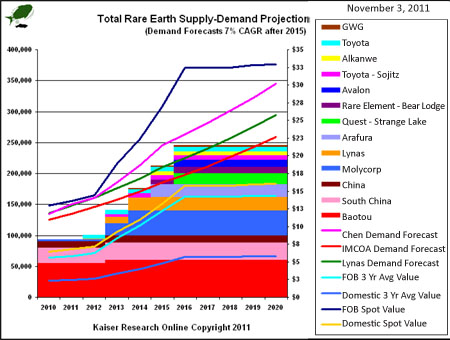
...
...
Googleübersetzt: http://translate.google.de/translate?sl=en&tl=de&js=n&prev=_…
Grüsse JoJo
7th International Rare Earths Conference
Kowloon Shangri-La Hotel, Hong Kong
November 15-17 2011
This event is now sold out with over 350 delegates registered. Please contact sales$metalevents.com (please replace the $ with @ if it is a genuine e-mail) to join the waiting list or to check for cancellations.
Metal Events Ltd and Roskill Information Services Ltd are once again returning to Hong Kong to hold their 7th International Rare Earths Conference.
This has become the international event for the global rare earths industry and last year attracted a record number of participants representing all the major global producers, end-users, traders, investors and funds.
This year’s programme will focus chiefly on end-use markets for rare earths and consumption trends, while reviewing supply-side developments.
New for 2011 – Exhibition Space – SOLD OUT
We are pleased to announce that space has been made at this year’s event to enable companies to promote their projects on a one to one basis to other delegates for the duration of the conference.
PLEASE NOTE THAT THIS CONFERENCE WILL BE CONDUCTED IN ENGLISH ONLY
Programme
Tuesday 15 November
16:00 – 19:00 Registration
18:00 – 20:00 Welcome Reception kindly sponsored by Great Western Minerals Group
Wednesday 16 November
08:00 – 09:00 Registration desk re-opens
Session 1 – Rare earths sector overview
09:00 Opening by Judith Chegwidden, Director, Roskill Information Services Ltd., United Kingdom;
09:15 “Rare earth markets and supply/demand dynamics: Stormy seas, fog and shoals”. Constantine Karayannopoulos, President & CEO, Neo Material Technologies Inc., Canada;
09:45 ”China’s rare earth market”, by Zhang Zhong, General Manager, Inner Mongolia Baotou Steel Rare Earth Hi-Tech Co., Ltd
10:15 Coffee break
Session 2 – Outlook for future supply
11:15 “New sources of supply – Lynas”, by Nick Curtis, Executive Chairman, Lynas Corporation Ltd., Australia;
11:40 “The next rare earth era: Global diversity in
rare earth manufacturing”, by Mark Smith, CEO, Molycorp Inc., USA;
12:05 “Rare earths resources in Russia”, by Pavel Detkov, Managing Director, Polyfer Handels/Solikamsk Works, Austria;
12:30 “The outlook for Jiangxi rare earths production”, by Zhong Xiao Yun, General Manager, Jiangxi Rare Earth & Rare Metals Tungsten Group, China;
12:55 Q & A
13:00 – 14:30 Luncheon kindly sponsored by Avalon Rare Metals Inc
Session 3- Efficient processing for rare earths
14:30 ”What rare earth producers and processors have to do to manage their waste products”, by Horst Monken-Fernandes, Division of Nuclear Fuel Cycle & Waste Technology, IAEA, Austria;
14:55 “Processing options for rare earths: from ore to mixed rare earth product”, by Karin Soldenhoff, Manager – Process Development Research, ANSTO – Minerals, Australia;
15:20 “Processing and utilisation of rare earth solid wastes”, by Tao Xu, VP Baotou Research Institute of Rare Earths, PR China;
15:45 Q&A
16:00 Tea
Thursday 17 November
Session 4 – Rare earths consumption
09.30 “Rare earths for the phosphors market”, by Jean-Guy Le Helloco, Electronics BU Director, Rhodia, France;
09:55 “Trends in the use of rare earths in polishing powders and dielectric ceramics”, by Jai Subramanian, Global Business Manager, Ferro Corp., USA;
10:20 “Latest research and development trends in magnetic functional materials,” by Dr. Yu Dunbo, Grirem Advanced Materials Co., Ltd., China;
10:45 Q&A
11:00 Coffee
Session 5 – Recycling and challenges for rare earths
11:45 “Downstream developments in Sichuan’s rare earths industry”, by Prof. Liu Zifu, Senior Consultant, Sichuan Province Engineering Consultancy & Reserach Institute, China;
12:10 “Rare earths recycling”, by Allan Walton, Research Fellow Metallurgy & Materials, Birmingham University, United Kingdom;
12:35 “Opportunities & challenges for rare earths in green technologies”, by Suzanne Shaw, Senior Analyst, Roskill Information Services, United Kingdom;
13:00 Q&A
13:15 Close and luncheon kindly sponsored by Avalon Rare Metals Inc
...
Googleübersetzt: http://translate.google.de/translate?hl=de&sl=en&u=http://ww…
http://www.theaureport.com/pub/na/11550
John Kaiser: Rare Earth Companies Poised for Comeback
Source: JT Long of The Critical Metals Report (11/8/11)
The companies in a race to produce critical heavy rare earth elements by 2016 are already way ahead of their smaller competitors. In this exclusive interview with The Critical Metals Report, Kaiser Research Online editor John Kaiser handicaps the players on the end-user, producer and investor side—believe it or not, China may have the largest stake in developing sources outside its borders.
Companies Mentioned: Avalon Rare Metals Inc. - Commerce Resources Corp.- Lynas Corp. - Molycorp Minerals - Quest Rare Minerals Ltd.- Rare Element Resources Ltd.- Tasman Metals Ltd.
...
...
...
...
Googleübersetzt: http://translate.google.de/translate?sl=en&tl=de&js=n&prev=_…
Grüsse JoJo
IMHO sehr hören- und lesenswert.
Grüsse JoJo
http://www.institutselteneerden.com/Newsletter/NLnovember201…
Institut für Seltene Erden und Metalle e.V.
Newsletter November 2011
Prof. Dr. Hans-Jürgen Bocker auf der Internationalen Edelmetall- und Rohstoffmesse in München.
In einen sehr offenen Interview nimmt unser Institutusmitglied, Herr Prof. Dr. H.-J. Bocker, Stellung zu den aktuellen Geschehnissen in Europa.
Wie es mit Deutschland weitergeht, was passiert wenn Griechenland zurück zum Drachmen geht, wann die Mega-Krise kommen wird und wie sie uns treffen wird, erfahren sie in diesem Interview.
Seltene Erden Aktien - Marktüberblick
...

Grüsse JoJo
http://www.institutselteneerden.com/Newsletter/NLnovember201…
Institut für Seltene Erden und Metalle e.V.
Newsletter November 2011
Prof. Dr. Hans-Jürgen Bocker auf der Internationalen Edelmetall- und Rohstoffmesse in München.
In einen sehr offenen Interview nimmt unser Institutusmitglied, Herr Prof. Dr. H.-J. Bocker, Stellung zu den aktuellen Geschehnissen in Europa.
Wie es mit Deutschland weitergeht, was passiert wenn Griechenland zurück zum Drachmen geht, wann die Mega-Krise kommen wird und wie sie uns treffen wird, erfahren sie in diesem Interview.
Seltene Erden Aktien - Marktüberblick
...
http://www.wallstreet-online.de/nachricht/3736322-rare-earth…
Rare Earths - Will New Supply Ease Availability Concerns?
Autor: PR Newswire (engl.) | 16.11.2011, 19:28
The rare earths industry is at a turning point, new sources of supply from mines outside China are coming on stream, the industry in China is coming under more effective control with increased corporate consolidation led by state controlled enterprises, and a re-evaluation of the way in which rare earths are used is taking place, following a year of unprecedented high prices.
...
...
Googleübersetzt: http://translate.google.de/translate?sl=en&tl=de&js=n&prev=_…
Grüsse JoJo
Rare Earths - Will New Supply Ease Availability Concerns?
Autor: PR Newswire (engl.) | 16.11.2011, 19:28
The rare earths industry is at a turning point, new sources of supply from mines outside China are coming on stream, the industry in China is coming under more effective control with increased corporate consolidation led by state controlled enterprises, and a re-evaluation of the way in which rare earths are used is taking place, following a year of unprecedented high prices.
...
...
Googleübersetzt: http://translate.google.de/translate?sl=en&tl=de&js=n&prev=_…
Grüsse JoJo
http://www.steelguru.com/chinese_news/Chinese_rare_earth_exp…
Chinese rare earth exports mired in doldrums
Sunday, 27 Nov 2011
...
...
Googleübersetzt: http://translate.google.de/translate?sl=en&tl=de&js=n&prev=_…
http://www.scmp.com/portal/site/SCMP/menuitem.2af62ecb329d3d…
Rare earth prices to stay high for years
Eric Ng, Nov 28, 2011
...
Mainland prices surged between 20 and 125 per cent and continued to rise by a further 1.5- to 9-fold between January and July, before diving by between 25 and 75 per cent in the past four months as traders and users made fewer purchases and ran down their inventories.
"There is serious concern that demand for some rare earth elements might exceed present supply within a few years," the Institute for Applied Ecology (IAE), a German sustainable development research centre, said in a report last January.
"Even if China imposes no export restrictions it is to be expected that the increasing demand up to 2014 can only be met if further mines, in addition to the two planned mines in Australia and the US, are opened."
Overall, the demand-supply dynamics have not changed since the report's release. Demand for rare earth minerals outpaced supply last year and the imbalance is expected to remain until 2014, according to Mark Smith, chief executive of Molycorp Minerals, at a recent rare earths conference in Hong Kong.
...
Mit Video: http://www.finnewsnetwork.com.au/archives/finance_news_netwo…
Nick Curtis confident of Lynas H1 production
November 29, 2011 03:30 PM
Transcription of Finance News Network Interview with Lynas Corporation Limited (ASX:LYC) Executive Director, Nicholas Curtis.
...
...
Googleübersetzt: http://www.finnewsnetwork.com.au/archives/finance_news_netwo…
Grüsse JoJo
Chinese rare earth exports mired in doldrums
Sunday, 27 Nov 2011
...
...
Googleübersetzt: http://translate.google.de/translate?sl=en&tl=de&js=n&prev=_…
http://www.scmp.com/portal/site/SCMP/menuitem.2af62ecb329d3d…
Rare earth prices to stay high for years
Eric Ng, Nov 28, 2011
...
Mainland prices surged between 20 and 125 per cent and continued to rise by a further 1.5- to 9-fold between January and July, before diving by between 25 and 75 per cent in the past four months as traders and users made fewer purchases and ran down their inventories.
"There is serious concern that demand for some rare earth elements might exceed present supply within a few years," the Institute for Applied Ecology (IAE), a German sustainable development research centre, said in a report last January.
"Even if China imposes no export restrictions it is to be expected that the increasing demand up to 2014 can only be met if further mines, in addition to the two planned mines in Australia and the US, are opened."
Overall, the demand-supply dynamics have not changed since the report's release. Demand for rare earth minerals outpaced supply last year and the imbalance is expected to remain until 2014, according to Mark Smith, chief executive of Molycorp Minerals, at a recent rare earths conference in Hong Kong.
...
Mit Video: http://www.finnewsnetwork.com.au/archives/finance_news_netwo…
Nick Curtis confident of Lynas H1 production
November 29, 2011 03:30 PM
Transcription of Finance News Network Interview with Lynas Corporation Limited (ASX:LYC) Executive Director, Nicholas Curtis.
...
...
Googleübersetzt: http://www.finnewsnetwork.com.au/archives/finance_news_netwo…
Grüsse JoJo
http://uk.advfn.com/news_US-Stock-Futures-Soar-After-Central…
US Stock Futures Soar After Central Banks Announce Coordinated Plan
Date : 30/11/2011 @ 13:45
Source : Dow Jones News
US Stock Futures Soar After Central Banks Announce Coordinated Plan
...
...
Googleübersetzt: http://translate.googleusercontent.com/translate_c?hl=de&ie=…
http://www.wallstreet-online.de/nachricht/3867864-start-lyna…
Vor dem Start Lynas – Erfolgreich in Malaysia
Autor: Björn Junker | 30.11.2011, 15:08 |
...
...
http://www.nzz.ch/finanzen/strukturierte_produkte/feine_unte…
1. Dezember 2011, 10:25, NZZ Online
Feine Unterschiede zwischen Basket und Index
Wer in Tracker-Zertifikate investieren will, muss auf Basiswert und Dividenden achten
...
...
http://idw-online.de/pages/de/news454012
Siemens- Forschungsbereich“ an der RWTH Aachen startet
Thomas von Salzen Pressestelle
Rheinisch-Westfälische Technische Hochschule Aachen
01.12.2011 09:59
Kooperation im Themenbereich „Nachhaltige Gewinnung seltener Rohstoffe“ wird mit sechs Millionen Euro gefördert
...
...
http://www.wirtschaft.ch/Braucht+es+das+Age+of+Less/518439/d…
Braucht es das «Age of Less»?
publiziert: Donnerstag, 1. Dez 2011 / 00:00 Uhr / aktualisiert: Donnerstag, 1. Dez 2011 / 09:27 Uhr
Wussten Sie, dass in Handys neben Kupfer, Erdöl, Zinn und Gold auch seltene Erden wie Coltan stecken? Oder dass zur Herstellung einer Puppe mehr als 4 kg Rohstoffe benötigt werden? Heute stellen wir ein Buch vor, das den boomenden Rohstoffmarkt und die Rohstoffdrehscheibe Schweiz durchleuchtet. Und wir gehen der Frage nach, wie Weihnachten im «Age of Less» aussehen könnten.
...
...
Grüsse JoJo
US Stock Futures Soar After Central Banks Announce Coordinated Plan
Date : 30/11/2011 @ 13:45
Source : Dow Jones News
US Stock Futures Soar After Central Banks Announce Coordinated Plan
...
...
Googleübersetzt: http://translate.googleusercontent.com/translate_c?hl=de&ie=…
http://www.wallstreet-online.de/nachricht/3867864-start-lyna…
Vor dem Start Lynas – Erfolgreich in Malaysia
Autor: Björn Junker | 30.11.2011, 15:08 |
...
...
http://www.nzz.ch/finanzen/strukturierte_produkte/feine_unte…
1. Dezember 2011, 10:25, NZZ Online
Feine Unterschiede zwischen Basket und Index
Wer in Tracker-Zertifikate investieren will, muss auf Basiswert und Dividenden achten
...
...
http://idw-online.de/pages/de/news454012
Siemens- Forschungsbereich“ an der RWTH Aachen startet
Thomas von Salzen Pressestelle
Rheinisch-Westfälische Technische Hochschule Aachen
01.12.2011 09:59
Kooperation im Themenbereich „Nachhaltige Gewinnung seltener Rohstoffe“ wird mit sechs Millionen Euro gefördert
...
...
http://www.wirtschaft.ch/Braucht+es+das+Age+of+Less/518439/d…
Braucht es das «Age of Less»?
publiziert: Donnerstag, 1. Dez 2011 / 00:00 Uhr / aktualisiert: Donnerstag, 1. Dez 2011 / 09:27 Uhr
Wussten Sie, dass in Handys neben Kupfer, Erdöl, Zinn und Gold auch seltene Erden wie Coltan stecken? Oder dass zur Herstellung einer Puppe mehr als 4 kg Rohstoffe benötigt werden? Heute stellen wir ein Buch vor, das den boomenden Rohstoffmarkt und die Rohstoffdrehscheibe Schweiz durchleuchtet. Und wir gehen der Frage nach, wie Weihnachten im «Age of Less» aussehen könnten.
...
...
Grüsse JoJo
http://www.investorium.tv/viewevent.asp?lang=&eid=9
Investorium.tv | Rare Earth and Specialty Metals
Monday, December 12, 2011
Event Details | Investorium.tv | Rare Earth and Specialty Metals
--------------------------------------------------------------------------------
Go To Event Calendar
--------------------------------------------------------------------------------
Minerals rich in Rare Earth elements are key for the development and manufacture of key components in clean energy technologies, automobiles and electronics. They are essential to almost every environmental friendly technology like wind turbines, photovoltaic panels and hybrid motors. It is estimated that all these Rare Earth Dependant Technologies are reliant on Rare Earth materials from China and a limited number of deposits outside of China for their production.
...
...
Googleübersetzt: http://translate.google.de/translate?sl=en&tl=de&js=n&prev=_…
@ ein schönes WE
Grüsse JoJo
Investorium.tv | Rare Earth and Specialty Metals
Monday, December 12, 2011
Event Details | Investorium.tv | Rare Earth and Specialty Metals
--------------------------------------------------------------------------------
Go To Event Calendar
--------------------------------------------------------------------------------
Minerals rich in Rare Earth elements are key for the development and manufacture of key components in clean energy technologies, automobiles and electronics. They are essential to almost every environmental friendly technology like wind turbines, photovoltaic panels and hybrid motors. It is estimated that all these Rare Earth Dependant Technologies are reliant on Rare Earth materials from China and a limited number of deposits outside of China for their production.
...
...
Googleübersetzt: http://translate.google.de/translate?sl=en&tl=de&js=n&prev=_…
@ ein schönes WE
Grüsse JoJo
http://www.deraktionaer.de/xist4c/web/Der-Countdown-laeuft_i…
Tipp des Tages
10:00 Uhr
Der Countdown läuft
Mehr als 5.000 Kilometer Luftlinie liegen zwischen Malaysia und Japan. Und dennoch: Die Reaktorkatastrophe in Fukushima hat auch die Menschen in Malaysia sensibilisiert für die Gefahren, die durch Radioaktivität ausgehen. Sehr zum Leidwesen des australischen Seltene-Erden-Produzenten Lynas (WKN 871 899). Der Konzern wollte eigentlich schon im laufenden Jahr mit der Produktion von Seltenen Erden auf Malaysia beginnen. Doch die Menschen liefen Sturm. Der Grund: Bei der Produktion von Seltenen Erden fallen radioaktive Abfallprodukte an. Und die Menschen fürchteten um ihre Gesundheit.
Die Proteste zeigten Wirkung: Die endgültige Genehmigung für die Anlage blieb aus. Der Produktionsstart verschob sich - die Aktie von Lynas begab sich auf Talfahrt. Doch jetzt scheint sich das Blatt zu wenden. Die Regierung der Provinz Pahang sieht keine ernsthaften Gefahren für Menschen und Umwelt. Damit steht einem Produktionsbeginn im ersten Quartal 2012 wohl nichts mehr im Wege.
Konsolidierung - auf hohem Niveau
Gegenwind gab es für den Kurs von Lynas zuletzt auch durch die Preisentwicklung bei den Seltenen Erden. Die Preise gaben seit Sommer getrieben durch Rezessionssorgen nach. Allerdings dürfte dies nach der Entwicklung der vergangenen Monate keine wirkliche Überraschung sein. Immerhin hatten sich die Preise für einige der begehrten Elemente binnen eines Jahres mehr als versiebenfacht. An einen wirklichen Einbruch glaubt niemand. Zu wichtig sind die Metalle für Zukunftstechnologien wie Elektromotoren, Windkraft oder auch Handys. Noch immer ist die Wirtschaft abhängig von China. Das Reich der Mitte ist für rund 95 Prozent der weltweiten Seltene-Erden-Produktion verantwortlich. In den vergangenen Jahren hat China die Exportquoten sukzessive gesenkt. Nicht zuletzt deshalb hat der Technologiekonzern Siemens bereits im Sommer ein Joint Venture mit Lynas zum Bau von Spezial-Magneten, wie sie in Windrädern benötigt werden, geschlossen.
Die Preise dürften schon bald wieder nach oben drehen, schließlich hat der weltgrößte Produzent von Seltenen Erden, die staatliche chinesische Gesellschaft Inner Mongolia Baotou Rare-Earth Hi-Tech, zuletzt die Produktion gestoppt. Mit dem Produktionsbeginn zu Beginn des kommenden Jahres könnte Lynas demzufolge einen Markt vorfinden, der von Knappheit geprägt ist. Ein weiterer Vorteil der Australier: Außerhalb Chinas werden meist höhere Preise für Seltene Erden gezahlt als in China selbst.
Selten günstige Chance
Die Aktie von Lynas ist mittlerweile mehr als nur günstig bewertet. Auf Basis der geschätzten Gewinne für das Geschäftsjahr 2012/13 weist das Papier lediglich ein KGV von knapp 5 aus. Angesichts der bereits bestehenden Engpässe bei einigen Seltenen Erden dürften auch die Preise wieder steigen.
Grüsse JoJo
Tipp des Tages
10:00 Uhr
Der Countdown läuft
Mehr als 5.000 Kilometer Luftlinie liegen zwischen Malaysia und Japan. Und dennoch: Die Reaktorkatastrophe in Fukushima hat auch die Menschen in Malaysia sensibilisiert für die Gefahren, die durch Radioaktivität ausgehen. Sehr zum Leidwesen des australischen Seltene-Erden-Produzenten Lynas (WKN 871 899). Der Konzern wollte eigentlich schon im laufenden Jahr mit der Produktion von Seltenen Erden auf Malaysia beginnen. Doch die Menschen liefen Sturm. Der Grund: Bei der Produktion von Seltenen Erden fallen radioaktive Abfallprodukte an. Und die Menschen fürchteten um ihre Gesundheit.
Die Proteste zeigten Wirkung: Die endgültige Genehmigung für die Anlage blieb aus. Der Produktionsstart verschob sich - die Aktie von Lynas begab sich auf Talfahrt. Doch jetzt scheint sich das Blatt zu wenden. Die Regierung der Provinz Pahang sieht keine ernsthaften Gefahren für Menschen und Umwelt. Damit steht einem Produktionsbeginn im ersten Quartal 2012 wohl nichts mehr im Wege.
Konsolidierung - auf hohem Niveau
Gegenwind gab es für den Kurs von Lynas zuletzt auch durch die Preisentwicklung bei den Seltenen Erden. Die Preise gaben seit Sommer getrieben durch Rezessionssorgen nach. Allerdings dürfte dies nach der Entwicklung der vergangenen Monate keine wirkliche Überraschung sein. Immerhin hatten sich die Preise für einige der begehrten Elemente binnen eines Jahres mehr als versiebenfacht. An einen wirklichen Einbruch glaubt niemand. Zu wichtig sind die Metalle für Zukunftstechnologien wie Elektromotoren, Windkraft oder auch Handys. Noch immer ist die Wirtschaft abhängig von China. Das Reich der Mitte ist für rund 95 Prozent der weltweiten Seltene-Erden-Produktion verantwortlich. In den vergangenen Jahren hat China die Exportquoten sukzessive gesenkt. Nicht zuletzt deshalb hat der Technologiekonzern Siemens bereits im Sommer ein Joint Venture mit Lynas zum Bau von Spezial-Magneten, wie sie in Windrädern benötigt werden, geschlossen.
Die Preise dürften schon bald wieder nach oben drehen, schließlich hat der weltgrößte Produzent von Seltenen Erden, die staatliche chinesische Gesellschaft Inner Mongolia Baotou Rare-Earth Hi-Tech, zuletzt die Produktion gestoppt. Mit dem Produktionsbeginn zu Beginn des kommenden Jahres könnte Lynas demzufolge einen Markt vorfinden, der von Knappheit geprägt ist. Ein weiterer Vorteil der Australier: Außerhalb Chinas werden meist höhere Preise für Seltene Erden gezahlt als in China selbst.
Selten günstige Chance
Die Aktie von Lynas ist mittlerweile mehr als nur günstig bewertet. Auf Basis der geschätzten Gewinne für das Geschäftsjahr 2012/13 weist das Papier lediglich ein KGV von knapp 5 aus. Angesichts der bereits bestehenden Engpässe bei einigen Seltenen Erden dürften auch die Preise wieder steigen.
Grüsse JoJo
http://www.businessday.com.au/business/china-blocks-rare-ear…
China blocks rare earth exporter
Peter Cai and Philip Wen
December 19, 2011
CHINESE authorities have barred the world's largest rare earths producer from exporting due to ''environmental concerns'', in a move likely to significantly affect global supply. Baotou Steel, which accounts for nearly half of the world's rare earth production, has been excluded from the Chinese Ministry of Commerce's list of 11 approved exporters for next year, released last week.

Lynas' Mount Weld mine in WA could benefit from a ban on China's major rare earth producer.
China accounts for more than 95 per cent of world production and tightly controls the export of the strategic elements through a quota system.
Baotou also failed to make a recent list of companies that had passed environmental assessment standards maintained by the Ministry of Environmental Protection in China. It must now rectify its faults to be considered for a second round of approvals, according to a ministry official.
''Baotou is the world's largest producer and has the highest quota for export and production. It is unimaginable for the industry if it loses its quota because of environmental concerns,'' a Chinese industry insider said on Friday, according to Shanghai Securities News.
The lost exports from Baotou could lead to acute supply constraints and potentially prompt a surge in rare earth prices, mirroring a similar spike when China banned exports to Japan last year over a diplomatic row.
This would benefit rare earth miners racing to be among the first non-Chinese producers, including Australian miners Lynas, Arafura Resources and Alkane Resources, and other international majors including California-based Molycorp.
''If the [rare earths] price reacts, it will be pretty positive for those companies,'' one analyst said.
Rare earths are coveted for the crucial role they play in the manufacture of many cutting-edge technologies, including mobile phones, iPads, wide-screen televisions and hybrid car batteries.
Baotou had halted its production for more than a month in October, in response to rapidly falling rare earth prices.
At the time, it said it was trying to provide price support in the market by regulating the amount of supply, but it was widely speculated that environmental concerns were at the root of the production halt.
Googleübersetzt: http://translate.google.de/translate?sl=en&tl=de&js=n&prev=_…
Grüsse JoJo
China blocks rare earth exporter
Peter Cai and Philip Wen
December 19, 2011
CHINESE authorities have barred the world's largest rare earths producer from exporting due to ''environmental concerns'', in a move likely to significantly affect global supply. Baotou Steel, which accounts for nearly half of the world's rare earth production, has been excluded from the Chinese Ministry of Commerce's list of 11 approved exporters for next year, released last week.
Lynas' Mount Weld mine in WA could benefit from a ban on China's major rare earth producer.
China accounts for more than 95 per cent of world production and tightly controls the export of the strategic elements through a quota system.
Baotou also failed to make a recent list of companies that had passed environmental assessment standards maintained by the Ministry of Environmental Protection in China. It must now rectify its faults to be considered for a second round of approvals, according to a ministry official.
''Baotou is the world's largest producer and has the highest quota for export and production. It is unimaginable for the industry if it loses its quota because of environmental concerns,'' a Chinese industry insider said on Friday, according to Shanghai Securities News.
The lost exports from Baotou could lead to acute supply constraints and potentially prompt a surge in rare earth prices, mirroring a similar spike when China banned exports to Japan last year over a diplomatic row.
This would benefit rare earth miners racing to be among the first non-Chinese producers, including Australian miners Lynas, Arafura Resources and Alkane Resources, and other international majors including California-based Molycorp.
''If the [rare earths] price reacts, it will be pretty positive for those companies,'' one analyst said.
Rare earths are coveted for the crucial role they play in the manufacture of many cutting-edge technologies, including mobile phones, iPads, wide-screen televisions and hybrid car batteries.
Baotou had halted its production for more than a month in October, in response to rapidly falling rare earth prices.
At the time, it said it was trying to provide price support in the market by regulating the amount of supply, but it was widely speculated that environmental concerns were at the root of the production halt.
Googleübersetzt: http://translate.google.de/translate?sl=en&tl=de&js=n&prev=_…
Grüsse JoJo
!
Dieser Beitrag wurde von CloudMOD moderiert. Grund: Spam, themenfremd
... möchte allen Usern und ihren Familien zum Ende des Jahres alles Liebe und Gute sowie besinnliche Feiertage wünschen und für das neue Jahr einen guten Rutsch und vor allen Dingen Gesundheit.
Grüsse JoJo
Kann Heute nur kurz online sein und möchte mich auf diesem Weg bei allen die sich hier beteiligen, ganz herzlich bedanken und für das neue Jahr Erfolg aber vor allen Dingen Gesundheit für Euch und eure Famlinien wünschen.
Grüsse JoJo
http://www.ftd.de/finanzen/maerkte/:ausblick-2012-rohstoffe-…
06.01.2012, 08:00
Ausblick 2012Rohstoffe - tiefer geht es kaum noch
Für Anleger war es im vergangenen Jahr keine gute Idee, in Rohstoffe zu investieren. Doch für 2012 gibt es Hoffnungsschimmer: Besonders aus China erwarten Experten positive Signale - und setzen auf einen Aufschwung bei Industriemetallen. von Christian Kirchner Frankfurt
...
Im folgendem Link: http://www.techmetalsresearch.com/metrics-indices/tmr-advanc…
kann man zum Vergleich die Werte von 28-REE-Eplorer in %-Angaben der einzelnen REE-Matrialgrade sowie am Ende die TREO in % bezogen auf das Deposit der Explorer einsehen und vergleichen wenn man am Anfang der Tabelle unter Project die Links anklickt.
... dazu eine priv.erstellte Excel Datei zu Lynas, veröffentlicht von einem User aus dem HC-Forum zu Lynas:
http://defaultgateway.net/hotcopper/LynasBasket.xls
Eine deutsche Seite zum Thema "Selten Erden":
http://www.finanzen100.de/dossier/Seltene+Erden/
...sowie weitere aktuelle Nachrichten zum Thema:
http://www.reuters.com/article/2012/01/05/australia-lynas-ma…
http://www.lynascorp.com/page.asp?category_id=8&page_id=27
http://www.finnewsnetwork.com.au/archives/finance_news_netwo…
...
Company news
Lynas Corporation Limited (ASX:LYC) says it has completed all requirements for the application to Malaysian regulatory authorities for a temporary licence for its Advanced Materials Plant in Malaysia. A decision on the application, which also includes a detailed waste management plan and safety case, is expected from the Malaysian Atomic Energy Licensing Board at the end of this month. Lynas Executive Director, Nicholas Curtis, told the Finance News Network at the end of last year he is confident the rare earths developer will ramp up production at the rare earths refinery in the first half of this year. Shares in Lynas Corporation are trading 4.04 per cent lower at $1.07.
...
Googleübersetzt: http://translate.google.de/translate?sl=en&tl=de&js=n&prev=_…
Grüsse JoJo
http://www.ftd.de/finanzen/maerkte/:ausblick-2012-rohstoffe-…
06.01.2012, 08:00
Ausblick 2012Rohstoffe - tiefer geht es kaum noch
Für Anleger war es im vergangenen Jahr keine gute Idee, in Rohstoffe zu investieren. Doch für 2012 gibt es Hoffnungsschimmer: Besonders aus China erwarten Experten positive Signale - und setzen auf einen Aufschwung bei Industriemetallen. von Christian Kirchner Frankfurt
...
Im folgendem Link: http://www.techmetalsresearch.com/metrics-indices/tmr-advanc…
kann man zum Vergleich die Werte von 28-REE-Eplorer in %-Angaben der einzelnen REE-Matrialgrade sowie am Ende die TREO in % bezogen auf das Deposit der Explorer einsehen und vergleichen wenn man am Anfang der Tabelle unter Project die Links anklickt.
... dazu eine priv.erstellte Excel Datei zu Lynas, veröffentlicht von einem User aus dem HC-Forum zu Lynas:
http://defaultgateway.net/hotcopper/LynasBasket.xls
Eine deutsche Seite zum Thema "Selten Erden":
http://www.finanzen100.de/dossier/Seltene+Erden/
...sowie weitere aktuelle Nachrichten zum Thema:
http://www.reuters.com/article/2012/01/05/australia-lynas-ma…
http://www.lynascorp.com/page.asp?category_id=8&page_id=27
http://www.finnewsnetwork.com.au/archives/finance_news_netwo…
...
Company news
Lynas Corporation Limited (ASX:LYC) says it has completed all requirements for the application to Malaysian regulatory authorities for a temporary licence for its Advanced Materials Plant in Malaysia. A decision on the application, which also includes a detailed waste management plan and safety case, is expected from the Malaysian Atomic Energy Licensing Board at the end of this month. Lynas Executive Director, Nicholas Curtis, told the Finance News Network at the end of last year he is confident the rare earths developer will ramp up production at the rare earths refinery in the first half of this year. Shares in Lynas Corporation are trading 4.04 per cent lower at $1.07.
...
Googleübersetzt: http://translate.google.de/translate?sl=en&tl=de&js=n&prev=_…
http://wirtschaft.t-online.de/strategische-rohstoffe-das-neu…
Strategische Rohstoffe: Das neue Gold, das kaum einer kennt
12.01.2012, 15:35 Uhr | Der Aktionär
Der Siegeszug von Zukunftstechnologien lässt neue Rohstoffe in den Fokus der Investoren treten. Anleger sollten sich früh positionieren.
Strategische Rohstoffe sind nicht nur für Unternehmen Gold wert. (Quelle: Thinkstock by Getty-Images)
...
@ ein schönes WE
Grüsse JoJo
Strategische Rohstoffe: Das neue Gold, das kaum einer kennt
12.01.2012, 15:35 Uhr | Der Aktionär
Der Siegeszug von Zukunftstechnologien lässt neue Rohstoffe in den Fokus der Investoren treten. Anleger sollten sich früh positionieren.
Strategische Rohstoffe sind nicht nur für Unternehmen Gold wert. (Quelle: Thinkstock by Getty-Images)
...
@ ein schönes WE
Grüsse JoJo
http://www.goldseiten.de/content/diverses/artikel.php?storyi…
Verfasst von Dr. Dietmar Siebholz am 23.11.2011 um 7:11 Uhr
Geht es jetzt abwärts mit den Preisen für Seltene Erden (SE)?
"Hosianna" und "kreuziget ihn" kennen wir aus der Leidensgeschichte unseres Religionsstifters. Nach dem gleichen Verfahren wird in der oberflächlichen Welt der Finanzszene gehandelt und sich vor allem geäußert. Nun hätte ich eigentlich nichts dagegen, wenn die Apologeten sich in der Vergangenheit schon einmal aufklärend über den Markt für Seltene Erden verdient gemacht hätten. Aber Tatsache ist, dass die von 2005 bis 2010 unisono schwiegen, dann nach dem Einsetzen der SE-Hype überschwänglich auf die SE und ihre Aktien setzen und nun alles, was SE angeht, verteufeln. Wie oben bereits gesagt "Hosianna" und …
...
http://www.themalaysianinsider.com/malaysia/article/lynas-sa…
Lynas says met requirements, can start in March
By Shannon Teoh, The Malaysian Insider
January 13, 2012
...
Googleübersetzt: http://translate.google.de/translate?sl=en&tl=de&js=n&prev=_…
http://www.lynascorp.com/page.asp?category_id=2&page_id=4
...
Mining Studies
Independent mining experts Australian Mine Design and Development Pty Ltd (AMDAD) prepared preliminary pit optimisations, pit designs and mine schedules over the central part of the CLD. The work confirmed the simplicity and low risk of a mining operation, and the low overall strip ratio for the pit (SR 4.6:1). Due to the high ore grades, the ore production level is forecast to be relatively small. For example, production of 11,000 tonnes REO in the first year of operation will require 121,000 tonnes of ore to be processed. Based on proposed ore treatment options, current reserves were calculated by AMDAD in 2003 as 2.1 million tonnes @ 15.5% REO containing 321,000 tonnes REO. Lynas confidently expects that further metallurgical test work and inclusion of lower grade ore will result in a mine life in excess of 20 years.
The current mining operation at Mount Weld is within the Central Lanthanide Deposit Pit. The map below shows the location of the Rare Earths Mineral Resources at Mount Weld.
Googleübersetzt: http://translate.google.de/translate?sl=en&tl=de&js=n&prev=_…
Grüsse JoJo
Verfasst von Dr. Dietmar Siebholz am 23.11.2011 um 7:11 Uhr
Geht es jetzt abwärts mit den Preisen für Seltene Erden (SE)?
"Hosianna" und "kreuziget ihn" kennen wir aus der Leidensgeschichte unseres Religionsstifters. Nach dem gleichen Verfahren wird in der oberflächlichen Welt der Finanzszene gehandelt und sich vor allem geäußert. Nun hätte ich eigentlich nichts dagegen, wenn die Apologeten sich in der Vergangenheit schon einmal aufklärend über den Markt für Seltene Erden verdient gemacht hätten. Aber Tatsache ist, dass die von 2005 bis 2010 unisono schwiegen, dann nach dem Einsetzen der SE-Hype überschwänglich auf die SE und ihre Aktien setzen und nun alles, was SE angeht, verteufeln. Wie oben bereits gesagt "Hosianna" und …
...
http://www.themalaysianinsider.com/malaysia/article/lynas-sa…
Lynas says met requirements, can start in March
By Shannon Teoh, The Malaysian Insider
January 13, 2012
...
Googleübersetzt: http://translate.google.de/translate?sl=en&tl=de&js=n&prev=_…
http://www.lynascorp.com/page.asp?category_id=2&page_id=4
...
Mining Studies
Independent mining experts Australian Mine Design and Development Pty Ltd (AMDAD) prepared preliminary pit optimisations, pit designs and mine schedules over the central part of the CLD. The work confirmed the simplicity and low risk of a mining operation, and the low overall strip ratio for the pit (SR 4.6:1). Due to the high ore grades, the ore production level is forecast to be relatively small. For example, production of 11,000 tonnes REO in the first year of operation will require 121,000 tonnes of ore to be processed. Based on proposed ore treatment options, current reserves were calculated by AMDAD in 2003 as 2.1 million tonnes @ 15.5% REO containing 321,000 tonnes REO. Lynas confidently expects that further metallurgical test work and inclusion of lower grade ore will result in a mine life in excess of 20 years.
The current mining operation at Mount Weld is within the Central Lanthanide Deposit Pit. The map below shows the location of the Rare Earths Mineral Resources at Mount Weld.
Googleübersetzt: http://translate.google.de/translate?sl=en&tl=de&js=n&prev=_…
Grüsse JoJo
http://www.lynascorp.com/content/upload/files/Announcements/…
18 January 2012
Increase in Mt Weld Resource Estimate for the Central Lanthanide Deposit and Duncan Deposit
Highlights
The Mineral Resource estimate for Mount Weld is now 23.9 million tonnes, at an average grade of 7.9% REO, for a total of 1.9 million tonnes REO. This represents a 37% increase versus the previous Resource estimate announced in September 2010 and a 34% increase in contained REO. This Resource is comprised of the Central Lanthanide Deposit and the Duncan Deposit.
The Resource estimate for the Central Lanthanide Deposit has increased by 51% to 14.9 million tonnes, at an average grade of 9.8% REO, for a total of 1.5 million tonnes REO. This represents a 38% increase in contained REO.
The Resource estimate for the Duncan Deposit has increased by 18% to 9.0 million tonnes, at an average grade of 4.8% REO, for a total of 431,600 tonnes REO. This also represents an increase of 18% in contained REO.
Preliminary process test work on the Duncan deposit continues.
...
...
Googleübersetzt: http://translate.google.de/translate?sl=en&tl=de&js=n&prev=_…
Mein persöhnliches Fazit:
Da u.a. das sogenannte HREE Yttrium weltweit nur schwer zu bekommen ist hat IMHO Lynas mit Duncan jetzt nicht nur eine weitere Ressource sondern damit auch eine Diversifizierung zur bisherigen Mt Weld Ressource.
Der Lynas Mix wurde von einigen immer wieder mal als Schwäche ausgelegt in Bezug auf die sogenannten HREE.
Mit einem stärkeren Fokus auf HREE hat LYC bisher nicht viel Yttrium aus seiner wichtigsten Ressource vorzuweisen gehabt.
Jetzt mit Duncan hat Lynas IMHO die komplette REE-Lösung.
http://au.finance.yahoo.com/video/fnn-company-news-21263310/…
Lynas increases estimates
18/01/12 - Lynas Corporation Limited (ASX:LYC, OTC:LYSDY) has increased its estimates at its Mount Weld Mineral Resource.
http://www.theage.com.au/business/rare-earths-less-so-as-lyn…
Rare earths less so as Lynas lifts resource size
January 18, 2012 - 10:13AM.
...
...
Googleübersetzt: http://translate.google.de/translate?hl=de&sl=en&u=http://ww…
Übersichten und aktuelle News zum Thema "Seltene Erden":
http://www.finanzen100.de/dossier/Seltene+Erden/
http://www.finanzen100.de/finanznachrichten/wirtschaft/selte…
http://www.finanzen100.de/dossier/Seltene+Erden+Aktien/
Grüsse JoJo
18 January 2012
Increase in Mt Weld Resource Estimate for the Central Lanthanide Deposit and Duncan Deposit
Highlights
The Mineral Resource estimate for Mount Weld is now 23.9 million tonnes, at an average grade of 7.9% REO, for a total of 1.9 million tonnes REO. This represents a 37% increase versus the previous Resource estimate announced in September 2010 and a 34% increase in contained REO. This Resource is comprised of the Central Lanthanide Deposit and the Duncan Deposit.
The Resource estimate for the Central Lanthanide Deposit has increased by 51% to 14.9 million tonnes, at an average grade of 9.8% REO, for a total of 1.5 million tonnes REO. This represents a 38% increase in contained REO.
The Resource estimate for the Duncan Deposit has increased by 18% to 9.0 million tonnes, at an average grade of 4.8% REO, for a total of 431,600 tonnes REO. This also represents an increase of 18% in contained REO.
Preliminary process test work on the Duncan deposit continues.
...
...
Googleübersetzt: http://translate.google.de/translate?sl=en&tl=de&js=n&prev=_…
Mein persöhnliches Fazit:
Da u.a. das sogenannte HREE Yttrium weltweit nur schwer zu bekommen ist hat IMHO Lynas mit Duncan jetzt nicht nur eine weitere Ressource sondern damit auch eine Diversifizierung zur bisherigen Mt Weld Ressource.
Der Lynas Mix wurde von einigen immer wieder mal als Schwäche ausgelegt in Bezug auf die sogenannten HREE.
Mit einem stärkeren Fokus auf HREE hat LYC bisher nicht viel Yttrium aus seiner wichtigsten Ressource vorzuweisen gehabt.
Jetzt mit Duncan hat Lynas IMHO die komplette REE-Lösung.
http://au.finance.yahoo.com/video/fnn-company-news-21263310/…
Lynas increases estimates
18/01/12 - Lynas Corporation Limited (ASX:LYC, OTC:LYSDY) has increased its estimates at its Mount Weld Mineral Resource.
http://www.theage.com.au/business/rare-earths-less-so-as-lyn…
Rare earths less so as Lynas lifts resource size
January 18, 2012 - 10:13AM.
...
...
Googleübersetzt: http://translate.google.de/translate?hl=de&sl=en&u=http://ww…
Übersichten und aktuelle News zum Thema "Seltene Erden":
http://www.finanzen100.de/dossier/Seltene+Erden/
http://www.finanzen100.de/finanznachrichten/wirtschaft/selte…
http://www.finanzen100.de/dossier/Seltene+Erden+Aktien/
Grüsse JoJo
http://news.ninemsn.com.au/article.aspx?id=8405449
Lynas surges on Malaysian hopes
11:49 AEDT Thu Jan 19 2012
Shares in Lynas Corporation have surged 3.8 per cent as investors speculated that the rare earths miner will be granted the go-ahead on its lucrative Malaysian facility.
...
Googleübersetzt: http://translate.google.de/translate?sl=en&tl=de&js=n&prev=_…
Grüsse JoJo
Lynas surges on Malaysian hopes
11:49 AEDT Thu Jan 19 2012
Shares in Lynas Corporation have surged 3.8 per cent as investors speculated that the rare earths miner will be granted the go-ahead on its lucrative Malaysian facility.
...
Googleübersetzt: http://translate.google.de/translate?sl=en&tl=de&js=n&prev=_…
Grüsse JoJo
Video vom 19.01.2012 12:00 zum Thema:
Seltene Erden-Experte: "Klares Signal - Bald steigende Preise" : http://www.daf.fm/video/seltene-erden-experte-klares-signal-…
"Die Preise werden, gerade was schwere und mittlere seltene Erden betrifft wieder anziehen," so die Meinung von Experte Thomas Grob von der Tradium GmbH. Dafür gab es gerade diese Woche Signale vom chinesischen Markt. Außerdem erwarten die Experten zu Jahresbeginn - in China beginnt das neue Jahr in 2 Wochen - einen Anstieg der Preise. Wo gerade in seltene Erden ein Investment lohnt - das erfahren Sie von Thomas Grob von Tradium GmbH.
Im letzten DAF-Interview erklärte Thomas Grob von der Tradium GmbH, dass die Anleger Anfang 2012 wieder steigende Kurse bei seltenen Erden sehen werden. In China - dort kommen die seltenen Erden her - beginnt das neue Jahr erst in 2 Wochen. "Und dann erwarten viele Insider, dass die Preise insbesondere für die schweren und mittleren seltenen Erden wieder anziehen werden," erklärt Grob.
Die Euro-Krise schwelt weiter. Daher sind seltene Erden für Anleger eine gute Versicherung. Doch der Anleger müsse aus 17 Elementen jene auswählen, die für ihn von Vorteil sein können. Denn nicht alle seltenen Erden sind knapp. Vor allem leichte seltene Erden "eignen sich sicherlich nicht für derartige Investitionen."
Wo ein Investment in seltene Erden gerade lohnt und wie sich die Preise von seltenen Erden weiter entwickeln werden - das erfahren Sie von seltene Erden-Experte Thomas Grob von der Tradium GmbH.
Redakteur: Brigitte Bauer
Video: http://www.tagesschau.de/wirtschaft/selteneerdendelitzsch100…
Probebohrungen geplant
Seltene Erden bald auch aus Sachsen?
Herrscht im nordsächsischen Delitzsch bald Goldgräberstimmung? Probebohrungen sollen Aufschluss geben, ob hier bald wertvolle Seltene Erden abgebaut werden. Die werden etwa für Sparlampen, Hybrid-Autos oder Tablet-Computer benötigt. Der Haken: Sie kommen bislang fast nur aus China.
Von Matthias Koch, MDR
:::
Immer sehr umfangreich und informativhttp://www.institutselteneerden.com/Newsletter/NLjanuar2012.…
Institut für Seltene Erden und Metalle e.V.
Newsletter Januar 2012
:::
Grüsse JoJo
Seltene Erden-Experte: "Klares Signal - Bald steigende Preise" : http://www.daf.fm/video/seltene-erden-experte-klares-signal-…
"Die Preise werden, gerade was schwere und mittlere seltene Erden betrifft wieder anziehen," so die Meinung von Experte Thomas Grob von der Tradium GmbH. Dafür gab es gerade diese Woche Signale vom chinesischen Markt. Außerdem erwarten die Experten zu Jahresbeginn - in China beginnt das neue Jahr in 2 Wochen - einen Anstieg der Preise. Wo gerade in seltene Erden ein Investment lohnt - das erfahren Sie von Thomas Grob von Tradium GmbH.
Im letzten DAF-Interview erklärte Thomas Grob von der Tradium GmbH, dass die Anleger Anfang 2012 wieder steigende Kurse bei seltenen Erden sehen werden. In China - dort kommen die seltenen Erden her - beginnt das neue Jahr erst in 2 Wochen. "Und dann erwarten viele Insider, dass die Preise insbesondere für die schweren und mittleren seltenen Erden wieder anziehen werden," erklärt Grob.
Die Euro-Krise schwelt weiter. Daher sind seltene Erden für Anleger eine gute Versicherung. Doch der Anleger müsse aus 17 Elementen jene auswählen, die für ihn von Vorteil sein können. Denn nicht alle seltenen Erden sind knapp. Vor allem leichte seltene Erden "eignen sich sicherlich nicht für derartige Investitionen."
Wo ein Investment in seltene Erden gerade lohnt und wie sich die Preise von seltenen Erden weiter entwickeln werden - das erfahren Sie von seltene Erden-Experte Thomas Grob von der Tradium GmbH.
Redakteur: Brigitte Bauer
Video: http://www.tagesschau.de/wirtschaft/selteneerdendelitzsch100…
Probebohrungen geplant
Seltene Erden bald auch aus Sachsen?
Herrscht im nordsächsischen Delitzsch bald Goldgräberstimmung? Probebohrungen sollen Aufschluss geben, ob hier bald wertvolle Seltene Erden abgebaut werden. Die werden etwa für Sparlampen, Hybrid-Autos oder Tablet-Computer benötigt. Der Haken: Sie kommen bislang fast nur aus China.
Von Matthias Koch, MDR
:::
Immer sehr umfangreich und informativhttp://www.institutselteneerden.com/Newsletter/NLjanuar2012.…
Institut für Seltene Erden und Metalle e.V.
Newsletter Januar 2012
:::
Grüsse JoJo
Der aktuell neu errechnete Basketpreis unter Einbezug vom Duncan-Deposit als Exel-Datei zum runterladen mit erechneten Angaben zur Aktienwertermittlung bis in 2014 zu Lynas WKN: 871899:
http://defaultgateway.net/hotcopper/LynasBasket.xls
Kopiert aus dem australischem HC-Forum zu Lynas:
http://hotcopper.com.au/post_single.asp?fid=1&tid=1641699&ms…
...
re: updated share price calculator (qiktrade)
...
Link to Updated Lynas Share Price Calculator (incorporating Duncan deposit)
Ok have updated spreadsheet calculator to:
- use the new proportions of REO from the latest Announcement (which are now different from the Lynas web site (which it needs to update) - hence the calculated price is now higher)
- allows you to alter the proportion of Central vs Duncan deposit ratio, which gives us a "blended" basket price
- as per previously you can plug in your own variables to do your own "what if" analysis
This calculator is NOT provided as investment advice of any kind and is my current view of the world and contains many of my current assumptions which may not agree with yours ..... disclaimer disclaimer blah blah
--------------------------------------------------------------------------------
Twitter qiktrade too
@ noch einen schönen Restsonntag
Grüsse JoJo
http://defaultgateway.net/hotcopper/LynasBasket.xls
Kopiert aus dem australischem HC-Forum zu Lynas:
http://hotcopper.com.au/post_single.asp?fid=1&tid=1641699&ms…
...
re: updated share price calculator (qiktrade)
...
Link to Updated Lynas Share Price Calculator (incorporating Duncan deposit)
Ok have updated spreadsheet calculator to:
- use the new proportions of REO from the latest Announcement (which are now different from the Lynas web site (which it needs to update) - hence the calculated price is now higher)
- allows you to alter the proportion of Central vs Duncan deposit ratio, which gives us a "blended" basket price
- as per previously you can plug in your own variables to do your own "what if" analysis
This calculator is NOT provided as investment advice of any kind and is my current view of the world and contains many of my current assumptions which may not agree with yours ..... disclaimer disclaimer blah blah
--------------------------------------------------------------------------------
Twitter qiktrade too
@ noch einen schönen Restsonntag
Grüsse JoJo
What are their prices?
http://www.lynascorp.com/page.asp?category_id=1&page_id=25
http://www.reuters.com/article/2012/01/30/australia-lynas-ma…
Malaysian opposition says would scrap rare earths plant
KUALA LUMPUR Jan 30 (Reuters) - Malaysia's political opposition has vowed to scrap a controversial $200 million rare-earths processing plant being built by Australia's Lynas Corp if it wins national elections expected to be called within months.
:::
Malaysia's Atomic Energy Licensing Board confirmed it was discussing the Lynas case, but its director general, Raja Abdul Aziz Raja Adnan, told Reuters it was not clear if a decision would be announced on Monday.
Government officials said the final decision would likely be made by Prime Minister Najib Razak and his cabinet next week.
:::
Googleübersetzt: http://translate.google.de/translate?sl=en&tl=de&js=n&prev=_…
http://www.ftd.de/unternehmen/industrie/:staerkung-der-wettb…
30.01.2012
Stärkung der Wettbewerbsfähigkeit
Industrie startet Rohstoffoffensive
:::
http://www.spiegel.de/wirtschaft/unternehmen/0,1518,812133,0…
30.01.2012
Furcht vor Engpässen
Industrie startet "Allianz zur Rohstoffsicherung"
:::
Im Mittelpunkt der Offensive stehen dem Bericht zufolge seltene Erden, Wolfram und Kokskohle.
:::
@ eine erfolgreiche Woche
Grüsse JoJo
http://www.lynascorp.com/page.asp?category_id=1&page_id=25
http://www.reuters.com/article/2012/01/30/australia-lynas-ma…
Malaysian opposition says would scrap rare earths plant
KUALA LUMPUR Jan 30 (Reuters) - Malaysia's political opposition has vowed to scrap a controversial $200 million rare-earths processing plant being built by Australia's Lynas Corp if it wins national elections expected to be called within months.
:::
Malaysia's Atomic Energy Licensing Board confirmed it was discussing the Lynas case, but its director general, Raja Abdul Aziz Raja Adnan, told Reuters it was not clear if a decision would be announced on Monday.
Government officials said the final decision would likely be made by Prime Minister Najib Razak and his cabinet next week.
:::
Googleübersetzt: http://translate.google.de/translate?sl=en&tl=de&js=n&prev=_…
http://www.ftd.de/unternehmen/industrie/:staerkung-der-wettb…
30.01.2012
Stärkung der Wettbewerbsfähigkeit
Industrie startet Rohstoffoffensive
:::
http://www.spiegel.de/wirtschaft/unternehmen/0,1518,812133,0…
30.01.2012
Furcht vor Engpässen
Industrie startet "Allianz zur Rohstoffsicherung"
:::
Im Mittelpunkt der Offensive stehen dem Bericht zufolge seltene Erden, Wolfram und Kokskohle.
:::
@ eine erfolgreiche Woche
Grüsse JoJo
http://www.nst.com.my/local/general/expert-rare-earth-proces…
31 January 2012 | Last updated at 09:14AM
Expert: Rare earth processing plant is safe
By M. HAMZAH JAMALUDIN
:::
Googleübersetzt: http://translate.google.de/translate?sl=en&tl=de&js=n&prev=_…
http://www.btimes.com.my/Current_News/BTIMES/articles/201201…
Lynas may get pre-operating licence
:::
:::
Googleübersetzt: http://translate.google.de/translate?sl=en&tl=de&js=n&prev=_…
Grüsse JoJo
31 January 2012 | Last updated at 09:14AM
Expert: Rare earth processing plant is safe
By M. HAMZAH JAMALUDIN
:::
Googleübersetzt: http://translate.google.de/translate?sl=en&tl=de&js=n&prev=_…
http://www.btimes.com.my/Current_News/BTIMES/articles/201201…
Lynas may get pre-operating licence
:::
:::
Googleübersetzt: http://translate.google.de/translate?sl=en&tl=de&js=n&prev=_…
Grüsse JoJo
Ein zweiseitiger Bericht den IMHO jeder, der sich für Rohstoffe und deren weitere Entwicklung interessiert, lesen sollte:
http://www.manager-magazin.de/politik/weltwirtschaft/0,2828,…
31.01.2012
WTO-Urteil zu Exportbeschränkungen
China kassiert Niederlage im Rohstoffstreit
Die EU und die USA jubeln: China muss nach einem Urteil der Welthandelsorganisation die Hürden für die Ausfuhren wichtiger Rohstoffe senken. Dazu zählen etwa Zink, Bauxit oder Koks. Experten hoffen auf eine Signalwirkung für einen besonders begehrten Rohstoff.
:::
http://www.nytimes.com/2012/02/01/business/global/rare-earth…
Rare Earth Metal Refinery Nears Approval

Rahman Roslan for The New York Times
The new refinery in Kuantan, Malaysia, is being built by the Lynas Corporation of Australia.
By KEITH BRADSHER
Published: January 31, 2012
:::
Grüsse JoJo
http://www.manager-magazin.de/politik/weltwirtschaft/0,2828,…
31.01.2012
WTO-Urteil zu Exportbeschränkungen
China kassiert Niederlage im Rohstoffstreit
Die EU und die USA jubeln: China muss nach einem Urteil der Welthandelsorganisation die Hürden für die Ausfuhren wichtiger Rohstoffe senken. Dazu zählen etwa Zink, Bauxit oder Koks. Experten hoffen auf eine Signalwirkung für einen besonders begehrten Rohstoff.
:::
http://www.nytimes.com/2012/02/01/business/global/rare-earth…
Rare Earth Metal Refinery Nears Approval
Rahman Roslan for The New York Times
The new refinery in Kuantan, Malaysia, is being built by the Lynas Corporation of Australia.
By KEITH BRADSHER
Published: January 31, 2012
:::
Grüsse JoJo
Fuziah Salleh stellt Verschwörungstheorien auf und spricht von einer unsichtbaren Macht dabei beharrt sie auf ihren seit langen wiederlegten Behauptungen zum Thema LAMP und deren jetzt erstellten vorläufigen Betriebsgenehmigung durch die AELB.
http://www.freemalaysiatoday.com/2012/02/01/fuziah-aelb-most…
Fuziah: AELB, Mosti caved in to ‘unknown pressure’
Stephanie Sta Maria | February 1, 2012
Granting Lynas Corp a license to operate is simply allowing them to treat people like lab rats, says Kuantan MP Fuziah Salleh.
:::
Googleübersetzt: http://translate.google.de/translate?sl=en&tl=de&js=n&prev=_…
Obwohl die Opposition unter der Leitung von Fuziah Salleh über die Erteilung der vorläufigen Betriebserlaubnis durch die AELB topt und das damit die stärkste Bestätigung der Meldung von Heute ist hier noch weitere Bestätigungen:
http://www.bloomberg.com/news/2012-02-01/lynas-granted-tempo…
Lynas Granted Temporary Rare-Earth Refining License From Malaysian Board
By Manirajan Ramasamy - Feb 1, 2012 2:43 PM GMT+0100
:::
Googleübersetzt: http://translate.google.de/translate?sl=en&tl=de&js=n&prev=_…
http://au.news.yahoo.com/world/a/-/world/12785435/malaysia-a…
Lynas Granted Temporary Rare-Earth Refining License From Malaysian Board
AFPFebruary 2, 2012, 12:21 am
:::
Googleübersetzt: http://translate.google.de/translate?sl=en&tl=de&js=n&prev=_…
http://www.freemalaysiatoday.com/2012/02/01/fuziah-aelb-most…
Fuziah: AELB, Mosti caved in to ‘unknown pressure’
Stephanie Sta Maria | February 1, 2012
Granting Lynas Corp a license to operate is simply allowing them to treat people like lab rats, says Kuantan MP Fuziah Salleh.
:::
Googleübersetzt: http://translate.google.de/translate?sl=en&tl=de&js=n&prev=_…
Obwohl die Opposition unter der Leitung von Fuziah Salleh über die Erteilung der vorläufigen Betriebserlaubnis durch die AELB topt und das damit die stärkste Bestätigung der Meldung von Heute ist hier noch weitere Bestätigungen:
http://www.bloomberg.com/news/2012-02-01/lynas-granted-tempo…
Lynas Granted Temporary Rare-Earth Refining License From Malaysian Board
By Manirajan Ramasamy - Feb 1, 2012 2:43 PM GMT+0100
:::
Googleübersetzt: http://translate.google.de/translate?sl=en&tl=de&js=n&prev=_…
http://au.news.yahoo.com/world/a/-/world/12785435/malaysia-a…
Lynas Granted Temporary Rare-Earth Refining License From Malaysian Board
AFPFebruary 2, 2012, 12:21 am
:::
Googleübersetzt: http://translate.google.de/translate?sl=en&tl=de&js=n&prev=_…
http://www.btimes.com.my/Current_News/BTIMES/articles/201202…
Lynas: AkzoNobel claims not true
:::
:::
Googleübersetzt: http://translate.google.de/translate?sl=en&tl=de&js=n&prev=_…
Auf drei Seiten IMHO durchaus wissenswertes, allerdings ist "GOLDSEITE.DE" nicht auf dem neusten Stand.
http://www.goldseiten.de/artikel/126740--Meine-Meinung-zur-a…
02.02.2012 07:09 Uhr | Dr. Dietmar Siebholz
Meine Meinung zur aktuellen Marktbeurteilung für Seltene Erden
:::
:::
:::
Grüsse JoJo
Lynas: AkzoNobel claims not true
:::
:::
Googleübersetzt: http://translate.google.de/translate?sl=en&tl=de&js=n&prev=_…
Auf drei Seiten IMHO durchaus wissenswertes, allerdings ist "GOLDSEITE.DE" nicht auf dem neusten Stand.
http://www.goldseiten.de/artikel/126740--Meine-Meinung-zur-a…
02.02.2012 07:09 Uhr | Dr. Dietmar Siebholz
Meine Meinung zur aktuellen Marktbeurteilung für Seltene Erden
:::
:::
:::
Grüsse JoJo
Dem folgendem Bericht entnehme ich, dass sich die AELB sowie die amtierende malaysische Regierung absolut sicher ist, die richtige Entscheidung mit der vorläufenden Betriebsgenehmigung für die LAMP getroffen zu haben.
http://www.thechoice.my/top-stories/16920-lynas-go-ahead-is-…
Lynas Go-Ahead is Politically and Commercially Astute
 An election is looming but the government isn't following the script. One of the golden rules for incumbent parties in the months before going to the polls is don't do anything controversial. The decision to go ahead with the Lynas rare earth processing plant in Kuantan is therefore a brave move by the government.
But it is a risk worth taking for Malaysia. The RM 714 million investment by Australian mining company Lynas has the potential to earn RM5 billion a year, creating hundreds of jobs directly and thousands of jobs indirectly. The process is controversial because a by-product of extracting rare earth elements is a small amount of low-level radioactive material. Given the emotions that surround this subject, opponents of the plant have seized on the word "radioactive" but forgotten the qualifying words "low level".
:::
Googleübersetzt: http://translate.google.de/translate?hl=de&sl=en&tl=de&u=htt…
Grüsse JoJo
http://www.thechoice.my/top-stories/16920-lynas-go-ahead-is-…
Lynas Go-Ahead is Politically and Commercially Astute
An election is looming but the government isn't following the script. One of the golden rules for incumbent parties in the months before going to the polls is don't do anything controversial. The decision to go ahead with the Lynas rare earth processing plant in Kuantan is therefore a brave move by the government.But it is a risk worth taking for Malaysia. The RM 714 million investment by Australian mining company Lynas has the potential to earn RM5 billion a year, creating hundreds of jobs directly and thousands of jobs indirectly. The process is controversial because a by-product of extracting rare earth elements is a small amount of low-level radioactive material. Given the emotions that surround this subject, opponents of the plant have seized on the word "radioactive" but forgotten the qualifying words "low level".
:::
Googleübersetzt: http://translate.google.de/translate?hl=de&sl=en&tl=de&u=htt…
Grüsse JoJo
Wie man aus dem folgenden Bericht ersehen kann stellen sich bei MCP im Vergleich zu Lynas noch ganz anderen Problematiken auf.
Es geht läuft IMHO in diesem Bereich nichts absolut glatt ab und das einfach weil es dort im Vergleich zu anderen Werten um den weltweiten Handel mit einem Rohstoffmix geht der zukünftig für unseren Globus und deren Entwicklung immer wichtiger wird und dem der zuerst mahlt Gewinne für Jahre im Milliardenbereich sicher kann.
http://www.mineweb.com/mineweb/view/mineweb/en/page67?oid=14…
Colorado class action complaint accuses Molycorp execs of fraud
Was Molycorp's promotion of the Mountain Pass mine-attracting the attention of U.S. lawmakers and the international business community to looming domestic rare earths shortages-little more than hype?
Author: Dorothy Kosich
Posted: Monday , 06 Feb 2012
:::
Googleübersetzt: http://translate.google.de/translate?sl=en&tl=de&js=n&prev=_…
@ eine erfolgreiche Woche
Grüsse JoJo
Es geht läuft IMHO in diesem Bereich nichts absolut glatt ab und das einfach weil es dort im Vergleich zu anderen Werten um den weltweiten Handel mit einem Rohstoffmix geht der zukünftig für unseren Globus und deren Entwicklung immer wichtiger wird und dem der zuerst mahlt Gewinne für Jahre im Milliardenbereich sicher kann.
http://www.mineweb.com/mineweb/view/mineweb/en/page67?oid=14…
Colorado class action complaint accuses Molycorp execs of fraud
Was Molycorp's promotion of the Mountain Pass mine-attracting the attention of U.S. lawmakers and the international business community to looming domestic rare earths shortages-little more than hype?
Author: Dorothy Kosich
Posted: Monday , 06 Feb 2012
:::
Googleübersetzt: http://translate.google.de/translate?sl=en&tl=de&js=n&prev=_…
@ eine erfolgreiche Woche
Grüsse JoJo
http://www.nst.com.my/opinion/columnist/clearing-air-over-ra…
Clearing air over rare earth project
By A Jalil Hamid
But public safety must come first

Malaysia could soon help break China’s monopoly on rare earth metals by opening the world’s largest refinery in Gebeng, Pahang, which will have the capacity to supply a fifth of the world’s demand.
:::
Googleübersetzt: http://translate.google.de/translate?sl=en&tl=de&js=n&prev=_…
LYC Lynas Corporation Limited
February 2012
7th Appendix 3B
http://www.stocknessmonster.com/news-item?S=LYC&E=ASX&N=6660…
What are their prices?
http://www.lynascorp.com/page.asp?category_id=1&page_id=25
http://www.berliner-zeitung.de/wirtschaft/der-goldpreis-stei…
Der Goldpreis steigt
Die riskante Gold-Versuchung
Von Sebastian Wolff
In Krisenzeiten sind Gold, Silber und andere Rohstoffe beliebt. Doch lohnt es sich trotz der hohen Preise noch immer, Gold zu kaufen? Es gibt Alternativen, die nicht weniger risikoreich sind.
:::
Während man bei Gold und Silber also die Wahl zwischen Münzen, Barren, Anteilen in Wertpapierform oder Aktien hat, gibt es für Anleger, die auf Öl, Gas oder etwa auf Seltene Erden setzen wollen, kaum eine Alternative zu Wertpapieren – denn wer kauft schon Ölfässer und lagert sie in der heimischen Garage?
Grüsse JoJo
Clearing air over rare earth project
By A Jalil Hamid
But public safety must come first
Malaysia could soon help break China’s monopoly on rare earth metals by opening the world’s largest refinery in Gebeng, Pahang, which will have the capacity to supply a fifth of the world’s demand.
:::
Googleübersetzt: http://translate.google.de/translate?sl=en&tl=de&js=n&prev=_…
LYC Lynas Corporation Limited
February 2012
7th Appendix 3B
http://www.stocknessmonster.com/news-item?S=LYC&E=ASX&N=6660…
What are their prices?
http://www.lynascorp.com/page.asp?category_id=1&page_id=25
http://www.berliner-zeitung.de/wirtschaft/der-goldpreis-stei…
Der Goldpreis steigt
Die riskante Gold-Versuchung
Von Sebastian Wolff
In Krisenzeiten sind Gold, Silber und andere Rohstoffe beliebt. Doch lohnt es sich trotz der hohen Preise noch immer, Gold zu kaufen? Es gibt Alternativen, die nicht weniger risikoreich sind.
:::
Während man bei Gold und Silber also die Wahl zwischen Münzen, Barren, Anteilen in Wertpapierform oder Aktien hat, gibt es für Anleger, die auf Öl, Gas oder etwa auf Seltene Erden setzen wollen, kaum eine Alternative zu Wertpapieren – denn wer kauft schon Ölfässer und lagert sie in der heimischen Garage?
Grüsse JoJo
!
Dieser Beitrag wurde vom System automatisch gesperrt. Bei Fragen wenden Sie sich bitte an feedback@wallstreet-online.de
http://thestar.com.my/news/story.asp?file=/2012/2/10/nation/…
Friday February 10, 2012
Lynas: Residue from rare earth plant will be safe
KUALA LUMPUR: Lynas Malaysia Sdn Bhd says residue from its rare earth plant in Kuantan will be “safe” and can be used to build roads.
Its managing director Datuk Mashal Ahmad said the firm had succeeded in lowering the radiation level of its residue to below 1 Becquerel per gramme (Bq/g), which is similar to the radiation level in fertiliser.
“We have also proven that the residue does not leach and is not toxic.
“Therefore, it (the residue) can be used for commercial application,” Mashal said yesterday.
He added that the water leach purification residue was classified as “very low level radioactive waste” by international standards.
However, Mashal said the company still needed approval from the Atomic Energy Licensing Board (AELB) and Department of Environment before the residue could be used for commercial purposes.
He added that such usage of the residue was “not new” and common in developed countries.
Mashal said if the residue could be used commercially, there would be no need to have a permanent disposal facility.
He said the rare earth refinery in Gebeng was expected to begin operations between April and June.
Googleübersetzt: http://translate.googleusercontent.com/translate_c?hl=de&ie=…
http://www.finanzen100.de/dossier/Seltene+Erden/
u.a.: Nachrichten
Kim Schmitz wird Minister
Das lag auch daran, dass alle Minenarbeiter Afrikas, die für Nokia-Handys seltene Erden schürfen , nach Deutschland eingeladen...
vor 34 Minuten • netzwelt.de
MOLYCORP - Findet keinen Boden
...$ Rückblick: Der Höhenflug des Bergbauunternehmens für Seltene Erden fand im Mai 2011 mit der Markierung des Allzeithochs bei...
gestern 18:44 • Wallstreet Online
Iamgold spürt Seltene Erden auf
...denn wie unlängst bekannt wurde, hat die Gesellschaft Seltene Erden aufgespürt. Die Niobec-Niob-Mine im kanadischen Quebec...
gestern 17:07 • finanzen.net
http://wotnews.com.au/news/Lynas_Corporation/
:::
Grüsse JoJo
Friday February 10, 2012
Lynas: Residue from rare earth plant will be safe
KUALA LUMPUR: Lynas Malaysia Sdn Bhd says residue from its rare earth plant in Kuantan will be “safe” and can be used to build roads.
Its managing director Datuk Mashal Ahmad said the firm had succeeded in lowering the radiation level of its residue to below 1 Becquerel per gramme (Bq/g), which is similar to the radiation level in fertiliser.
“We have also proven that the residue does not leach and is not toxic.
“Therefore, it (the residue) can be used for commercial application,” Mashal said yesterday.
He added that the water leach purification residue was classified as “very low level radioactive waste” by international standards.
However, Mashal said the company still needed approval from the Atomic Energy Licensing Board (AELB) and Department of Environment before the residue could be used for commercial purposes.
He added that such usage of the residue was “not new” and common in developed countries.
Mashal said if the residue could be used commercially, there would be no need to have a permanent disposal facility.
He said the rare earth refinery in Gebeng was expected to begin operations between April and June.
Googleübersetzt: http://translate.googleusercontent.com/translate_c?hl=de&ie=…
http://www.finanzen100.de/dossier/Seltene+Erden/
u.a.: Nachrichten
Kim Schmitz wird Minister
Das lag auch daran, dass alle Minenarbeiter Afrikas, die für Nokia-Handys seltene Erden schürfen , nach Deutschland eingeladen...
vor 34 Minuten • netzwelt.de
MOLYCORP - Findet keinen Boden
...$ Rückblick: Der Höhenflug des Bergbauunternehmens für Seltene Erden fand im Mai 2011 mit der Markierung des Allzeithochs bei...
gestern 18:44 • Wallstreet Online
Iamgold spürt Seltene Erden auf
...denn wie unlängst bekannt wurde, hat die Gesellschaft Seltene Erden aufgespürt. Die Niobec-Niob-Mine im kanadischen Quebec...
gestern 17:07 • finanzen.net
http://wotnews.com.au/news/Lynas_Corporation/
:::
Grüsse JoJo
http://www.wiwo.de/technologie/forschung/exotische-rohstoffe…
iphones-und-panzer-steckt/6203112.html" target="_blank" rel="nofollow ugc noopener">http://www.wiwo.de/technologie/forschung/exotische-rohstoffe…
iphones-und-panzer-steckt/6203112.html
Auf 22-Seiten (faßt) alles zu REO und ihre Verwendungen auf Grund des zukünftig immer mehr steigenden Bedarfs.
13.02.2012
Exotische Rohstoffe
Was in iPhones und Panzer steckt
Quelle: Handelsblatt Online
Egal ob Handy, Auto oder Kampfpanzer: Technologische Produkte funktionieren erst durch den Einsatz exotischer Metalle. Was wo drin steckt.
:::
http://www.derwesten.de/wirtschaft/rohstoff-markt-die-jagd-a…
Rohstoffe
Rohstoff-Markt - Die Jagd auf die Seltenen Erden
13.02.2012 | 21:11 Uhr
Essen. Industriekonzerne schmieden ein Bündnis zur Rohstoff-Sicherung. Das chinesische Monopol auf Seltene Erden zwingt auch Deutschland zum Handeln: Die Chinesen bestimmen 97 Prozent des Marktes und somit auch die Preise. Die Metalle werden für Elektrogeräte vom Handy bis zur Windkraftturbine gebraucht.
:::
Grüsse JoJo
iphones-und-panzer-steckt/6203112.html" target="_blank" rel="nofollow ugc noopener">http://www.wiwo.de/technologie/forschung/exotische-rohstoffe…
iphones-und-panzer-steckt/6203112.html
Auf 22-Seiten (faßt) alles zu REO und ihre Verwendungen auf Grund des zukünftig immer mehr steigenden Bedarfs.
13.02.2012
Exotische Rohstoffe
Was in iPhones und Panzer steckt
Quelle: Handelsblatt Online
Egal ob Handy, Auto oder Kampfpanzer: Technologische Produkte funktionieren erst durch den Einsatz exotischer Metalle. Was wo drin steckt.
:::
http://www.derwesten.de/wirtschaft/rohstoff-markt-die-jagd-a…
Rohstoffe
Rohstoff-Markt - Die Jagd auf die Seltenen Erden
13.02.2012 | 21:11 Uhr
Essen. Industriekonzerne schmieden ein Bündnis zur Rohstoff-Sicherung. Das chinesische Monopol auf Seltene Erden zwingt auch Deutschland zum Handeln: Die Chinesen bestimmen 97 Prozent des Marktes und somit auch die Preise. Die Metalle werden für Elektrogeräte vom Handy bis zur Windkraftturbine gebraucht.
:::
Grüsse JoJo
http://www.ibtimes.com/articles/298704/20120214/critical-met…
February 15, 2012 12:28 AM GMT
Rare Earth Metals Demand Is Unstoppable: Jeb Handwerger
:::
:::
Googleübersetzt: http://translate.googleusercontent.com/translate_c?hl=de&ie=…
http://translate.google.de/translate?sl=en&tl=de&js=n&prev=_…
http://www.lynascorp.com/page.asp?category_id=9&page_id=12
Lynas Corporation Rare Earths – we touch them everyday
February 2012
:::
1.SAFETY AND SUSTAINABILITY
2.WESTERN AUSTRALIA OPERATIONS
3.MALAYSIA OPERATIONS
4.SALES & MARKETING
5.FINANCIAL UPDATE
:::
Grüsse JoJo
February 15, 2012 12:28 AM GMT
Rare Earth Metals Demand Is Unstoppable: Jeb Handwerger
:::
:::
Googleübersetzt: http://translate.googleusercontent.com/translate_c?hl=de&ie=…
http://translate.google.de/translate?sl=en&tl=de&js=n&prev=_…
http://www.lynascorp.com/page.asp?category_id=9&page_id=12
Lynas Corporation Rare Earths – we touch them everyday
February 2012
:::
1.SAFETY AND SUSTAINABILITY
2.WESTERN AUSTRALIA OPERATIONS
3.MALAYSIA OPERATIONS
4.SALES & MARKETING
5.FINANCIAL UPDATE
:::
Grüsse JoJo
Mal wieder ein paar aktuelle News zum Thema "Seltene Erden"
http://www.finanzen100.de/dossier/Seltene+Erden/
u.a.:
Europa fordert China bei Seltenen Erden heraus
...angesichts wachsender Rohstoff-Knappheit künftig selber Seltene Erden und Mineralien in Europa fördern - und so das chinesische...
gestern 18:21 • sueddeutsche.de
EU will an verborgene Rohstoffschätze in Europa
Seltene Erden werden von China kontrolliert Zu den knappen Rohstoffen zählen die sogenannten seltenen Erden, auf die insbesondere...
gestern 15:08 • T-Online
http://www.freemalaysiatoday.com/2012/03/01/aelb-lamp-is-not…
AELB: Australia option open as Lynas waste won’t be radioactive
By Yow Hong Chieh
March 01, 2012
:::
Googleübersetzt: http://translate.google.de/translate?sl=en&tl=de&js=n&prev=_…
http://www.freemalaysiatoday.com/2012/03/01/public-committee…
Public committee backs Lynas’ TOL
Stephanie Sta Maria | March 1, 2012
A public consultative committee assures that the AELB hadn't blindly approved Lynas' TOL.
:::
Googleübersetzt: http://translate.google.de/translate?sl=en&tl=de&js=n&prev=_…
http://www.bgr.bund.de/DE/Gemeinsames/Produkte/Downloads/Com…
Commodity Top News Nr. 36
Fakten ■ Analysen ■ wirtschaftliche
Hintergrundinformationen
Kritische Versorgungslage mit schweren Seltenen Erden –
Entwicklung „Grüner Technologien“ gefährdet?
Harald Elsner
Seit einigen Jahren steht die Versorgung mit mineralischen Rohstoffen wieder verstärkt im Blickfeld der Wirtschaft,
der Politik und auch der Öffentlichkeit. Besonders intensiv wurde gerade im letzten Jahr auch seitens
der deutschen Presse über Seltene Metalle bzw. Elektronikmetalle und über die Gruppe der Seltenen Erden berichtet.
Zu beiden Rohstoffgruppen liegen gesonderte Beiträge in der Reihe Commodity Top News vor (LIEDTKE
& ELSNER 2009; ELSNER et al., 2010). Die Problematik der Versorgung der deutschen Wirtschaft mit Seltenen
Erden hält an, wobei aber für die gesamte Untergruppe der sogenannten leichten Seltenen Erden (Cer, Lanthan
u. a.) ab Anfang/Mitte 2012 eine deutliche Entspannung der Marktlage abzusehen ist. Dagegen wird sich die
Versorgung mit schweren Seltenen Erden (Dysprosium, Europium u. a.), die in vielen so genannten. „Grünen
Technologien“ Verwendung fi nden, weiter verschärfen. Dieser Beitrag in den Commodity Top News weist auf
die kritische Versorgungslage mit schweren Seltenen Erden hin, und diskutiert mögliche Auswirkungen auf die
Entwicklung „Grüner Technologien“.
Übersicht über die Seltenen Erden
:::
:::
usw.
Grüsse JoJo
http://www.finanzen100.de/dossier/Seltene+Erden/
u.a.:
Europa fordert China bei Seltenen Erden heraus
...angesichts wachsender Rohstoff-Knappheit künftig selber Seltene Erden und Mineralien in Europa fördern - und so das chinesische...
gestern 18:21 • sueddeutsche.de
EU will an verborgene Rohstoffschätze in Europa
Seltene Erden werden von China kontrolliert Zu den knappen Rohstoffen zählen die sogenannten seltenen Erden, auf die insbesondere...
gestern 15:08 • T-Online
http://www.freemalaysiatoday.com/2012/03/01/aelb-lamp-is-not…
AELB: Australia option open as Lynas waste won’t be radioactive
By Yow Hong Chieh
March 01, 2012
:::
Googleübersetzt: http://translate.google.de/translate?sl=en&tl=de&js=n&prev=_…
http://www.freemalaysiatoday.com/2012/03/01/public-committee…
Public committee backs Lynas’ TOL
Stephanie Sta Maria | March 1, 2012
A public consultative committee assures that the AELB hadn't blindly approved Lynas' TOL.
:::
Googleübersetzt: http://translate.google.de/translate?sl=en&tl=de&js=n&prev=_…
http://www.bgr.bund.de/DE/Gemeinsames/Produkte/Downloads/Com…
Commodity Top News Nr. 36
Fakten ■ Analysen ■ wirtschaftliche
Hintergrundinformationen
Kritische Versorgungslage mit schweren Seltenen Erden –
Entwicklung „Grüner Technologien“ gefährdet?
Harald Elsner
Seit einigen Jahren steht die Versorgung mit mineralischen Rohstoffen wieder verstärkt im Blickfeld der Wirtschaft,
der Politik und auch der Öffentlichkeit. Besonders intensiv wurde gerade im letzten Jahr auch seitens
der deutschen Presse über Seltene Metalle bzw. Elektronikmetalle und über die Gruppe der Seltenen Erden berichtet.
Zu beiden Rohstoffgruppen liegen gesonderte Beiträge in der Reihe Commodity Top News vor (LIEDTKE
& ELSNER 2009; ELSNER et al., 2010). Die Problematik der Versorgung der deutschen Wirtschaft mit Seltenen
Erden hält an, wobei aber für die gesamte Untergruppe der sogenannten leichten Seltenen Erden (Cer, Lanthan
u. a.) ab Anfang/Mitte 2012 eine deutliche Entspannung der Marktlage abzusehen ist. Dagegen wird sich die
Versorgung mit schweren Seltenen Erden (Dysprosium, Europium u. a.), die in vielen so genannten. „Grünen
Technologien“ Verwendung fi nden, weiter verschärfen. Dieser Beitrag in den Commodity Top News weist auf
die kritische Versorgungslage mit schweren Seltenen Erden hin, und diskutiert mögliche Auswirkungen auf die
Entwicklung „Grüner Technologien“.
Übersicht über die Seltenen Erden
:::
:::
usw.
Grüsse JoJo
BBY Rare Earths Conference Presentation - 13 March 2012
BBY Rare Earths Conference Presentation - 13 March 2012
Nicholas Curtis AM BBY Rare Earths Conference 13 March 2012
:::
1.SAFETY AND SUSTAINABILITY
2.WESTERN AUSTRALIA OPERATIONS
3.MALAYSIA OPERATIONS
4.SALES & MARKETING
5.FINANCIAL UPDATE
:::
VISION: Be the leader in Rare Earths for a sustainable future.
EXCHANGES: ASX (code LYC), OTCQX (code LYSDY)
INDICES: ASX 100, MSCI Australia SHARES: 1,714m on issue (1,885m fully diluted)
MARKET CAP: A$2.0bn as at 12 March 2012
CASH: A$215.5m (incl. restricted cash) as at 31 Dec 2011
DEBT: US$225.0m as at 31 Dec 2011 (excluding US$225m convertible bond)
:::
MOUNT WELD CONCENTRATION PLANT
u.a.:
Plant throughput rates will be synchronised with the ramp-up of the Lynas Advanced Materials Plant in Malaysia.
Over 9,000 tonnes of dry bagged Rare Earths concentrate stockpiled on site
:::
Seite 11
CENTRAL LANTHANIDE DEPOSIT AND DUNCAN DEPOSIT RESOURCES
:::
Seite 14
Current status of the LAMP
MAJOR MILESTONES TO DATE
LAMP construction: 96% complete (end of February)
Ready-for-Start-Up program (operational preparedness): >90% complete
Malaysia headcount: 249 (now at 90% of total expected workforce)
Pre-commissioning test packs: >60% complete
Temporary Operating Licence for the LAMP approved
Phase 2 funding secured in April 2011 and construction permits received in Sept 2011
Customer contracts signed in each market segment and for each type of product
Lynas is on track for first feed to kiln and first production in Q2 2012
Seite 15
LAMP Temporary Operating Licence
Licence approved in February
Lynas respects the regulatory approvals process in Malaysia.
Lynas has intensified its community consultation and engagement following the IAEA review. We intend to maintain this commitment to all stakeholders in the future.
Lynas recognises its responsibility to the community to operate the LAMP in a safe and sustainable manner.
Lynas expects to meet all the conditions associated with the Temporary Operating Licence.
:::
:::
usw. bis Seite 32
::::::::::::::::::::::::::::::::::::::::::::::::::::::::::::::::::::::::::::::::::::::::::::::::::::::::::::::::::::::
http://www.bloomberg.com/news/2012-03-13/u-s-will-ask-for-wt…
Obama Takes Aim at China With Plan for WTO Case on Rare-Earth Export Caps
By Eric Martin and Sonja Elmquist - Mar 13, 2012 9:25 AM GMT+0100
:::
:::
Grüsse JoJo
BBY Rare Earths Conference Presentation - 13 March 2012
Nicholas Curtis AM BBY Rare Earths Conference 13 March 2012
:::
1.SAFETY AND SUSTAINABILITY
2.WESTERN AUSTRALIA OPERATIONS
3.MALAYSIA OPERATIONS
4.SALES & MARKETING
5.FINANCIAL UPDATE
:::
VISION: Be the leader in Rare Earths for a sustainable future.
EXCHANGES: ASX (code LYC), OTCQX (code LYSDY)
INDICES: ASX 100, MSCI Australia SHARES: 1,714m on issue (1,885m fully diluted)
MARKET CAP: A$2.0bn as at 12 March 2012
CASH: A$215.5m (incl. restricted cash) as at 31 Dec 2011
DEBT: US$225.0m as at 31 Dec 2011 (excluding US$225m convertible bond)
:::
MOUNT WELD CONCENTRATION PLANT
u.a.:
Plant throughput rates will be synchronised with the ramp-up of the Lynas Advanced Materials Plant in Malaysia.
Over 9,000 tonnes of dry bagged Rare Earths concentrate stockpiled on site
:::
Seite 11
CENTRAL LANTHANIDE DEPOSIT AND DUNCAN DEPOSIT RESOURCES
:::
Seite 14
Current status of the LAMP
MAJOR MILESTONES TO DATE
LAMP construction: 96% complete (end of February)
Ready-for-Start-Up program (operational preparedness): >90% complete
Malaysia headcount: 249 (now at 90% of total expected workforce)
Pre-commissioning test packs: >60% complete
Temporary Operating Licence for the LAMP approved
Phase 2 funding secured in April 2011 and construction permits received in Sept 2011
Customer contracts signed in each market segment and for each type of product
Lynas is on track for first feed to kiln and first production in Q2 2012
Seite 15
LAMP Temporary Operating Licence
Licence approved in February
Lynas respects the regulatory approvals process in Malaysia.
Lynas has intensified its community consultation and engagement following the IAEA review. We intend to maintain this commitment to all stakeholders in the future.
Lynas recognises its responsibility to the community to operate the LAMP in a safe and sustainable manner.
Lynas expects to meet all the conditions associated with the Temporary Operating Licence.
:::
:::
usw. bis Seite 32
::::::::::::::::::::::::::::::::::::::::::::::::::::::::::::::::::::::::::::::::::::::::::::::::::::::::::::::::::::::
http://www.bloomberg.com/news/2012-03-13/u-s-will-ask-for-wt…
Obama Takes Aim at China With Plan for WTO Case on Rare-Earth Export Caps
By Eric Martin and Sonja Elmquist - Mar 13, 2012 9:25 AM GMT+0100
:::
:::
Grüsse JoJo
http://www.mysinchew.com/node/72367
Lynas has proposed to recycle waste: Ongkili
Controversial Lynas project News 2012-04-11 11:30
KUALA LUMPUR, April 10 (Bernama) -- Lynas Corporation Ltd (Lynas) has proposed to recycle waste from its rare earth factory in Pahang to enable such waste to be reused commercially.
:::
Googleübersetzt: http://translate.google.de/translate?sl=en&tl=de&js=n&prev=_…
http://www.tagesspiegel.de/meinung/was-wissen-schafft-das-oe…
Das Öl der Ära nach dem Öl
00:00 UhrVon Alexander S. Kekulé
Seltene Erden: Wir müssen von China unabhängig werden.
:::
http://weser-ems.business-on.de/seltene-erden-china-industri…
China will mit Industrieverband Gewinnung und Preispolitik regulieren
Shanghai. China will seine Kontrolle über einen der wichtigsten Rohstoffe für die Herstellung von Elektronikprodukten- die Seltenen Erden - weiter verstärken. Dazu gründete Peking einen Industrieverband, mit dem es Beschwerden anderer Länder wegen seiner restriktiven Exportpolitik abwehren und den Preis der Seltenen Erden noch besser in den Griff bekommen will.
:::
Grüsse JoJo
Lynas has proposed to recycle waste: Ongkili
Controversial Lynas project News 2012-04-11 11:30
KUALA LUMPUR, April 10 (Bernama) -- Lynas Corporation Ltd (Lynas) has proposed to recycle waste from its rare earth factory in Pahang to enable such waste to be reused commercially.
:::
Googleübersetzt: http://translate.google.de/translate?sl=en&tl=de&js=n&prev=_…
http://www.tagesspiegel.de/meinung/was-wissen-schafft-das-oe…
Das Öl der Ära nach dem Öl
00:00 UhrVon Alexander S. Kekulé
Seltene Erden: Wir müssen von China unabhängig werden.
:::
http://weser-ems.business-on.de/seltene-erden-china-industri…
China will mit Industrieverband Gewinnung und Preispolitik regulieren
Shanghai. China will seine Kontrolle über einen der wichtigsten Rohstoffe für die Herstellung von Elektronikprodukten- die Seltenen Erden - weiter verstärken. Dazu gründete Peking einen Industrieverband, mit dem es Beschwerden anderer Länder wegen seiner restriktiven Exportpolitik abwehren und den Preis der Seltenen Erden noch besser in den Griff bekommen will.
:::
Grüsse JoJo
http://www.thechoice.my/featured-articles/36746-lynas-mob-pr…
Lynas Mob Prove Bersih is a Weapon of Mass Distraction.
Newsdesk
If ever there were proof needed that the Bersih movement has attracted rent-a-crowd protesters then this is it. The Anti-Lynas group Himpunan Hijau says it will join the ever expanding list of causes trying to be heard on the streets at the Bersih 3.0 rally at the end of this month.
The group said in a statement that it is "logical and essential" that it join Bersih's rally. We at The Choice do not understand what Lynas has to do with Bersih 2.0.
:::
Googleübersetzt: http://translate.google.de/translate?hl=de&sl=en&u=http://ww…
http://www.finanzen100.de/dossier/Seltene+Erden/
Seltene Erden Dossier
http://www.freemalaysiatoday.com/category/nation/2012/04/13/…
‘LAMP will not increase cancer rate’
http://www.freemalaysiatoday.com/category/nation/2012/04/13/…
Lynas: We have nothing to hide
http://www.themalaysianinsider.com/malaysia/article/lynas-ca…
Lynas can export products during TOL test phase, says AELB
http://www.tagesschau.de/multimedia/video/video1097544.html
:::
@ noch ein schönes Rest-WE
Grüsse JoJo
Lynas Mob Prove Bersih is a Weapon of Mass Distraction.
Newsdesk
If ever there were proof needed that the Bersih movement has attracted rent-a-crowd protesters then this is it. The Anti-Lynas group Himpunan Hijau says it will join the ever expanding list of causes trying to be heard on the streets at the Bersih 3.0 rally at the end of this month.
The group said in a statement that it is "logical and essential" that it join Bersih's rally. We at The Choice do not understand what Lynas has to do with Bersih 2.0.
:::
Googleübersetzt: http://translate.google.de/translate?hl=de&sl=en&u=http://ww…
http://www.finanzen100.de/dossier/Seltene+Erden/
Seltene Erden Dossier
http://www.freemalaysiatoday.com/category/nation/2012/04/13/…
‘LAMP will not increase cancer rate’
http://www.freemalaysiatoday.com/category/nation/2012/04/13/…
Lynas: We have nothing to hide
http://www.themalaysianinsider.com/malaysia/article/lynas-ca…
Lynas can export products during TOL test phase, says AELB
http://www.tagesschau.de/multimedia/video/video1097544.html
:::
@ noch ein schönes Rest-WE
Grüsse JoJo
http://german.china.org.cn/business/txt/2012-04/17/content_2…
17. 04. 2012
Ansätze zur Beilegung des alten Streits um Seltene Erden
Auszug Seite 2:
Die Aufspaltung von Seltenerdelementen in ihre chemischen Bestandteile ist aufgrund ihrer Ähnlichkeit sehr schwierig. Der Prozess benötigt sowohl Zeit als auch Expertise. Am schwierigsten ist die Trennung von Praseodym und Neodym. Einige ausländische Firmen besaßen in diesen Technologien eine Monopolstellung, was China auf die Rolle des Exporteurs von Seltene-Erden-haltigem Roherz und Schlacke reduzierte.
China bemüht sich seit seinen ersten Versuchen im Jahr 1972 zur Trennung von Praseodym und Neodym, dieses Problem in den Griff zu bekommen. Angeführt von Xu Guangxian, einem Mitglied der Chinesischen Akademie der Wissenschaften, entwickelten chinesische Wissenschaftler erfolgreich die fortschrittlichste Kaskaden-Extraktionstechnologie der Welt, und beendeten so das Monopol der westlichen Länder auf diesem Gebiet.
Mit dieser fortschrittlichen Technologie hat China fast das Niveau der westlichen Bergbauunternehmen für Seltene Erden erreicht. Die hochreinen Seltenen Erden aus China haben den globalen Markt erobert. Dadurch wurden die Preise im internationalen Markt um dreißig bis vierzig Prozent gesenkt. Unter diesem "China-Einfluss" haben einige westliche Länder, welche den Weltmarkt für Seltene Erden lange monopolisiert hatten, die Produktion eingeschränkt oder ganz eingestellt, und einige haben die Kooperation mit chinesischen Unternehmen gesucht.
:::
Grüsse JoJo
17. 04. 2012
Ansätze zur Beilegung des alten Streits um Seltene Erden
Auszug Seite 2:
Die Aufspaltung von Seltenerdelementen in ihre chemischen Bestandteile ist aufgrund ihrer Ähnlichkeit sehr schwierig. Der Prozess benötigt sowohl Zeit als auch Expertise. Am schwierigsten ist die Trennung von Praseodym und Neodym. Einige ausländische Firmen besaßen in diesen Technologien eine Monopolstellung, was China auf die Rolle des Exporteurs von Seltene-Erden-haltigem Roherz und Schlacke reduzierte.
China bemüht sich seit seinen ersten Versuchen im Jahr 1972 zur Trennung von Praseodym und Neodym, dieses Problem in den Griff zu bekommen. Angeführt von Xu Guangxian, einem Mitglied der Chinesischen Akademie der Wissenschaften, entwickelten chinesische Wissenschaftler erfolgreich die fortschrittlichste Kaskaden-Extraktionstechnologie der Welt, und beendeten so das Monopol der westlichen Länder auf diesem Gebiet.
Mit dieser fortschrittlichen Technologie hat China fast das Niveau der westlichen Bergbauunternehmen für Seltene Erden erreicht. Die hochreinen Seltenen Erden aus China haben den globalen Markt erobert. Dadurch wurden die Preise im internationalen Markt um dreißig bis vierzig Prozent gesenkt. Unter diesem "China-Einfluss" haben einige westliche Länder, welche den Weltmarkt für Seltene Erden lange monopolisiert hatten, die Produktion eingeschränkt oder ganz eingestellt, und einige haben die Kooperation mit chinesischen Unternehmen gesucht.
:::
Grüsse JoJo
http://www.lynascorp.com/page.asp?category_id=2&page_id=62
Lynas Corporate Brochure

Learn more about:
Rare Earths
http://www.lynascorp.com/content/upload/files/Rare_Earths.pd…
Rare Earth Applications
http://www.lynascorp.com/content/upload/files/Rare_Earth_App…
Products Beyond Rare Earths
http://www.lynascorp.com/content/upload/files/Products_Beyon…
Lynas Concentration Plant
http://www.lynascorp.com/content/upload/files/Concentration_…
Lynas Advanced Materials Plant
http://www.lynascorp.com/content/upload/files/Lynas_Advanced…
Grüsse JoJo
Lynas Corporate Brochure
Learn more about:
Rare Earths
http://www.lynascorp.com/content/upload/files/Rare_Earths.pd…
Rare Earth Applications
http://www.lynascorp.com/content/upload/files/Rare_Earth_App…
Products Beyond Rare Earths
http://www.lynascorp.com/content/upload/files/Products_Beyon…
Lynas Concentration Plant
http://www.lynascorp.com/content/upload/files/Concentration_…
Lynas Advanced Materials Plant
http://www.lynascorp.com/content/upload/files/Lynas_Advanced…
Grüsse JoJo
http://www.themalaysianinsider.com/print/malaysia/dap-wants-…
DAP wants AELB to report false solar plant radiation claims to MCMC
By Anisah Shukry
Mar 31, 2012
:::
Allegations that Robert Bosch GmbH’s multi-million ringgit solar panel plant will produce radioactive waste emerged earlier this month soon after the government’s plan for a Parliamentary Select Committee on Lynas Corp’s rare earths plant was announced.
:::
Googleübersetzt: http://translate.google.de/translate?hl=de&sl=en&u=http://ww…
http://www.malaysia-today.net/mtcolumns/newscommentaries/487…
Lynas sues FMT, two others for ‘defamation’
NEWS/COMMENTARIES
Friday, 20 April 2012 Super Admin
:::
Googleübersetzt: http://translate.googleusercontent.com/translate_c?hl=de&ie=…
http://www.malaysiakini.com/news/195556

Lynas: Only 0.1 fatal cancer cases per million caused
Koh Jun Lin
3:01PM Apr 20, 2012
:::
Googleübersetzt: http://translate.google.de/translate?sl=en&tl=de&js=n&prev=_…
@ ein schönes WE
Grüsse JoJo
DAP wants AELB to report false solar plant radiation claims to MCMC
By Anisah Shukry
Mar 31, 2012
:::
Allegations that Robert Bosch GmbH’s multi-million ringgit solar panel plant will produce radioactive waste emerged earlier this month soon after the government’s plan for a Parliamentary Select Committee on Lynas Corp’s rare earths plant was announced.
:::
Googleübersetzt: http://translate.google.de/translate?hl=de&sl=en&u=http://ww…
http://www.malaysia-today.net/mtcolumns/newscommentaries/487…
Lynas sues FMT, two others for ‘defamation’
NEWS/COMMENTARIES
Friday, 20 April 2012 Super Admin
:::
Googleübersetzt: http://translate.googleusercontent.com/translate_c?hl=de&ie=…
http://www.malaysiakini.com/news/195556
Lynas: Only 0.1 fatal cancer cases per million caused
Koh Jun Lin
3:01PM Apr 20, 2012
:::
Googleübersetzt: http://translate.google.de/translate?sl=en&tl=de&js=n&prev=_…
@ ein schönes WE
Grüsse JoJo
http://au.news.yahoo.com/thewest/business/a/-/wa/13487968/ra…
Rare earth taps Europe's investors
Kate Emery, The West AustralianApril 21, 2012, 9:29 am
WA's leading mining lobby group will head a delegation of the State's rare earths and lithium players to Europe next month in the hope of securing German and French investment for the next wave of mines.
The Chamber of Minerals and Energy-headed delegation, to include representatives from Lynas Corp, Galaxy Resources, Hastings Rare Metals and Reed Resources, among others, will meet car makers such as BMW, Volkswagen and Renault, whose next generation of hybrid and electric cars rely on technology powered by rare earths and lithium.
:::
Googleübersetzt: http://translate.google.de/translate?sl=en&tl=de&js=n&prev=_…
http://factsaboutlynas.wordpress.com/facts-about-lynas/
FACTS ABOUT LYNAS
1 Opposition invoked “emotion and anger” to exploit the fear and phobia of nuclear radioactive after Japan’s Fukushima whereby the incident involves a nuclear reactor unlike Lynas that involves a rare earth processing plant of allowable radioactive level.
2 Opposition leader in the State Assembly, Leong Ngah Ngah from DAP, when attending the briefings on the project for elected representatives in 2009, had also agreed to the construction of the project, and was reported by a Chinese daily as saying that the state government had managed to secure a huge investment from abroad.
3 PAS Hulu Langat Member of Parliament, Dr. Che Rusli who is also an expert on radioactivity had also confirmed that the project is not hazardous and within international management standards.
4 New York Times also wrote that the Lynas plant, which is being built in Gebeng, will house radiation sensors and the latest equipment in pollution control, besides featuring 12 acres of temporary storage pools that will be lined with dense plastic and sit atop nearly impermeable clay, to hold the slightly radioactive by-products until they can be carted away.
:::
:::
Googleübersetzt: http://translate.google.de/translate?sl=en&tl=de&js=n&prev=_…
...und der Lynas Chef der LAMP verliert so langsam die Geduld: mit Video vom Werk, der Pressekonferenz, der Werksberichtigung für die internationale Presse sowie von der Massendemonstration vor der LAMP von Lynas.
http://www.channelnewsasia.com/stories/southeastasia/view/11…
Lynas on impact of rare earth plant delay in Malaysia
By Malaysia Bureau Chief Melissa Goh | Posted: 20 April 2012
GEBENG, Pahang: Australian miner Lynas Corporation has said the delay at its controversial rare earth refinery in Malaysia is taking a heavy toll on the company.
Lynas Malaysia's managing director Mashal Ahmad insists the plant is safe and appears confident it will get the go-ahead to operate, despite widespread public protests.
After having seen its share price fall by 50 per cent in the past year, Lynas Corporation desperately needs to fire up its Malaysian rare earth refinery.
Originally scheduled to begin operations late last year, the refinery would have been the world's largest.
But the setback has cost Lynas dearly, and it is now in danger of losing out to its competitor, American mining company Molycorp.
Costing over US$800 million, the rare earth refinery - which consists of two phases - will now be fully completed in two weeks but staunch opposition by concerned Malaysians has prevented the plant from firing up, resulting in costly delays to the Australian miner.
Mr Mashal voiced his frustration to the media.
:::
Googleübersetzt: http://translate.google.de/translate?sl=en&tl=de&js=n&prev=_…
trotz allem @ noch ein schönes Restwochenende
Grüsse JoJo
Rare earth taps Europe's investors
Kate Emery, The West AustralianApril 21, 2012, 9:29 am
WA's leading mining lobby group will head a delegation of the State's rare earths and lithium players to Europe next month in the hope of securing German and French investment for the next wave of mines.
The Chamber of Minerals and Energy-headed delegation, to include representatives from Lynas Corp, Galaxy Resources, Hastings Rare Metals and Reed Resources, among others, will meet car makers such as BMW, Volkswagen and Renault, whose next generation of hybrid and electric cars rely on technology powered by rare earths and lithium.
:::
Googleübersetzt: http://translate.google.de/translate?sl=en&tl=de&js=n&prev=_…
http://factsaboutlynas.wordpress.com/facts-about-lynas/
FACTS ABOUT LYNAS
1 Opposition invoked “emotion and anger” to exploit the fear and phobia of nuclear radioactive after Japan’s Fukushima whereby the incident involves a nuclear reactor unlike Lynas that involves a rare earth processing plant of allowable radioactive level.
2 Opposition leader in the State Assembly, Leong Ngah Ngah from DAP, when attending the briefings on the project for elected representatives in 2009, had also agreed to the construction of the project, and was reported by a Chinese daily as saying that the state government had managed to secure a huge investment from abroad.
3 PAS Hulu Langat Member of Parliament, Dr. Che Rusli who is also an expert on radioactivity had also confirmed that the project is not hazardous and within international management standards.
4 New York Times also wrote that the Lynas plant, which is being built in Gebeng, will house radiation sensors and the latest equipment in pollution control, besides featuring 12 acres of temporary storage pools that will be lined with dense plastic and sit atop nearly impermeable clay, to hold the slightly radioactive by-products until they can be carted away.
:::
:::
Googleübersetzt: http://translate.google.de/translate?sl=en&tl=de&js=n&prev=_…
...und der Lynas Chef der LAMP verliert so langsam die Geduld: mit Video vom Werk, der Pressekonferenz, der Werksberichtigung für die internationale Presse sowie von der Massendemonstration vor der LAMP von Lynas.
http://www.channelnewsasia.com/stories/southeastasia/view/11…
Lynas on impact of rare earth plant delay in Malaysia
By Malaysia Bureau Chief Melissa Goh | Posted: 20 April 2012
GEBENG, Pahang: Australian miner Lynas Corporation has said the delay at its controversial rare earth refinery in Malaysia is taking a heavy toll on the company.
Lynas Malaysia's managing director Mashal Ahmad insists the plant is safe and appears confident it will get the go-ahead to operate, despite widespread public protests.
After having seen its share price fall by 50 per cent in the past year, Lynas Corporation desperately needs to fire up its Malaysian rare earth refinery.
Originally scheduled to begin operations late last year, the refinery would have been the world's largest.
But the setback has cost Lynas dearly, and it is now in danger of losing out to its competitor, American mining company Molycorp.
Costing over US$800 million, the rare earth refinery - which consists of two phases - will now be fully completed in two weeks but staunch opposition by concerned Malaysians has prevented the plant from firing up, resulting in costly delays to the Australian miner.
Mr Mashal voiced his frustration to the media.
:::
Googleübersetzt: http://translate.google.de/translate?sl=en&tl=de&js=n&prev=_…
trotz allem @ noch ein schönes Restwochenende
Grüsse JoJo
http://www.waste-management-world.com/index/display/article-…
Recycling: Rarely so Critical

Image courtesy of Vesta Wind Systems A/S
As renewable energy finally takes off, China, which controls 97% of the global supply of rare earth elements, vital to much renewable technology, has tightened supply. As industry and governments around the world scramble for solutions, the complex process of recycling rare earths has moved into the spotlight. Ben Messenger investigates.
Over recent years there has been much discussion across the world of declining fossil fuel supplies, 'peak oil' and the increasingly urgent need for sustainable energy production. And that talk has not gone unanswered. According to the Renewable Energy Policy Network for the 21st Century (REN21) in 2009 over $160 billion was invested globally in renewable energy capacity and manufacturing facilities, a figure that in the face of severe economic conditions rose to $211 billion in 2010.
:::
Googleübersetzt: http://translate.google.de/translate?hl=de&sl=en&tl=de&u=htt…
http://www.lynascorp.com/page.asp?category_id=1&page_id=25
What are their prices?
The first point to note about Rare Earths prices is that there is significant variance in the relative market value for selected Rare Earths oxides. Secondly, the price of Rare Earths depends on the purity level, which is largely set by the specifications for each application.
The table below shows the average annual price for a 'standard 99% purity of individual elements and for the generic composite of Rare earths equivalent to the Rare Earths distribution at Mt Weld. Prices are quoted in US$/kg on an FOB China basis. Note that higher purity oxides and other value added properties will attract higher prices than those shown.
:::
FOB China Prices
:::
China Domestic Prices
:::
Googleübersetzt: http://translate.google.de/translate?sl=en&tl=de&js=n&prev=_…
Der pol. Oposition, die gestern noch großspurig verkündet haben sie werden die LAMP von Lynas verschrotten fnden es jetzt ungehörig das die mächtige Firma Lynas ihre kleinen Gruppen, die seit Jahren mit Falschdarstellungen, Unwarheiten usw. geglänzt haben jetzt auf Richtigstellung zu verlagen.
Das gehört sich einfach nicht für so ein großes ausländisches Unternehmen.
Ein IMHO seltsames Rechtsverständnis.
(oder geht ihnen jetzt der so berühmte Arsch auf Grundeis?)
http://www.freemalaysiatoday.com/category/nation/2012/04/23/…
NGO cautions Lynas over lawsuit
Stephanie Sta Maria | April 23, 2012
Suit by a large corporation against a small NGO would not cast it in a favourable light, says Save Malaysia Stop Lynas.
:::
Googleübersetzt: http://translate.google.de/translate?hl=de&sl=en&tl=de&u=htt…
LYC Lynas Corporation Limited
April 2012
23rd Letter to Shareholders - Quarterly Report Call
http://www.stocknessmonster.com/news-item?S=LYC&E=ASX&N=6758…
@ eine erfolgreiche Woche
Grüsse JoJo
Recycling: Rarely so Critical
Image courtesy of Vesta Wind Systems A/S
As renewable energy finally takes off, China, which controls 97% of the global supply of rare earth elements, vital to much renewable technology, has tightened supply. As industry and governments around the world scramble for solutions, the complex process of recycling rare earths has moved into the spotlight. Ben Messenger investigates.
Over recent years there has been much discussion across the world of declining fossil fuel supplies, 'peak oil' and the increasingly urgent need for sustainable energy production. And that talk has not gone unanswered. According to the Renewable Energy Policy Network for the 21st Century (REN21) in 2009 over $160 billion was invested globally in renewable energy capacity and manufacturing facilities, a figure that in the face of severe economic conditions rose to $211 billion in 2010.
:::
Googleübersetzt: http://translate.google.de/translate?hl=de&sl=en&tl=de&u=htt…
http://www.lynascorp.com/page.asp?category_id=1&page_id=25
What are their prices?
The first point to note about Rare Earths prices is that there is significant variance in the relative market value for selected Rare Earths oxides. Secondly, the price of Rare Earths depends on the purity level, which is largely set by the specifications for each application.
The table below shows the average annual price for a 'standard 99% purity of individual elements and for the generic composite of Rare earths equivalent to the Rare Earths distribution at Mt Weld. Prices are quoted in US$/kg on an FOB China basis. Note that higher purity oxides and other value added properties will attract higher prices than those shown.
:::
FOB China Prices
:::
China Domestic Prices
:::
Googleübersetzt: http://translate.google.de/translate?sl=en&tl=de&js=n&prev=_…
Der pol. Oposition, die gestern noch großspurig verkündet haben sie werden die LAMP von Lynas verschrotten fnden es jetzt ungehörig das die mächtige Firma Lynas ihre kleinen Gruppen, die seit Jahren mit Falschdarstellungen, Unwarheiten usw. geglänzt haben jetzt auf Richtigstellung zu verlagen.
Das gehört sich einfach nicht für so ein großes ausländisches Unternehmen.
Ein IMHO seltsames Rechtsverständnis.
(oder geht ihnen jetzt der so berühmte Arsch auf Grundeis?)
http://www.freemalaysiatoday.com/category/nation/2012/04/23/…
NGO cautions Lynas over lawsuit
Stephanie Sta Maria | April 23, 2012
Suit by a large corporation against a small NGO would not cast it in a favourable light, says Save Malaysia Stop Lynas.
:::
Googleübersetzt: http://translate.google.de/translate?hl=de&sl=en&tl=de&u=htt…
LYC Lynas Corporation Limited
April 2012
23rd Letter to Shareholders - Quarterly Report Call
http://www.stocknessmonster.com/news-item?S=LYC&E=ASX&N=6758…
@ eine erfolgreiche Woche
Grüsse JoJo
Was die Chinesen nicht so alles planen.
http://www.theregister.co.uk/2012/04/26/china_green_wto_rare…
China goes green with rare earth plea
We're trying to save the planet, man...
By Phil Muncaster
Posted in Business, 26th April 2012 06:10 GMT
China played the green card yesterday in an apparent bid to settle the on-going dispute over its throttling of rare earth exports, offering foreign firms the chance to co-develop the industry there in a more environmentally-friendly manner.
:::
Googleübersetzt: http://translate.google.de/translate?sl=en&tl=de&js=n&prev=_…
Grüsse JoJo
http://www.theregister.co.uk/2012/04/26/china_green_wto_rare…
China goes green with rare earth plea
We're trying to save the planet, man...
By Phil Muncaster
Posted in Business, 26th April 2012 06:10 GMT
China played the green card yesterday in an apparent bid to settle the on-going dispute over its throttling of rare earth exports, offering foreign firms the chance to co-develop the industry there in a more environmentally-friendly manner.
:::
Googleübersetzt: http://translate.google.de/translate?sl=en&tl=de&js=n&prev=_…
Grüsse JoJo
http://www.handelsblatt.com/finanzen/rohstoffe-devisen/rohst…
Chinas gefährliches Rohstoff-Monopol
21.03.2012, 12:57 Uhr
China hat sich zum Vorreiter bei der Förderung Seltener Erden entwickelt, die in High-Tech-Geräten zum Einsatz kommen. Der Westen ist stark abhängig von den Exporten, ist daran aber selbst Schuld.
:::
http://www.stocknessmonster.com/news-item?S=LYC&E=ASX&N=6770…
2 May 2012
Lynas Corporation
Rare Earths – we touch them everyday
:::
Agenda
1. SAFETY AND SUSTAINABILITY
2. THE RARE EARTHS MARKET
3. WESTERN AUSTRALIA OPERATIONS
4. MALAYSIA OPERATIONS
5. FINANCIAL UPDATE
:::
S. 33
Lynas – online in 2012, delivering Rare Earths globally
• Our vision is to be the leader in Rare Earths for a sustainable future.
• We are close to realising this vision.
• Our supply of Rare Earths will be based on environmentally sustainable practices.
• Lynas will be online in 2012, delivering Rare Earths globally.
• The LAMP is scheduled to come online with a Phase 1 production capacity of 11,000tpa REO.
• Work for Phase 2 is underway for an additional 11,000tpa REO.
:::
http://www.lynascorp.com/content/upload/files/Q1_2012_Quarte…
QUARTERLY REPORT
FOR THE PERIOD ENDING 31 MARCH 2012
HIGHLIGHTS
• The Lynas Advanced Materials Plant (LAMP) construction project in Malaysia achieved 8,160,000 hours Lost Time Injury (LTI) free as at the end of March 2012. Subsequent to the end of the reporting period the project remains LTI free.
• On 1 February, Malaysia’s Atomic Energy Licensing Board (AELB) announced its approval of the Temporary Operating Licence (TOL) for the LAMP in Gebeng, Malaysia. The AELB’s approval decision came after a thorough and extensive review of the project by the Malaysian Government regulatory authorities. An appeal in respect of the AELB’s decision has been lodged with the Minister of Science, Technology and Innovation. The Minister’s decision is expected shortly.
• During the period, Lynas secured long-term funding through a US$225m unsecured convertible bond facility with funds managed by Mount Kellett Capital Management. The proceeds of the issue will be used for construction and commissioning of Phase 1 of the LAMP and working capital. The 18-month working capital facility announced on 22 September 2011 was not utilised and has been retired.
• Following the results of the extension drilling program, the Company reported a significant upgrade to Resources at Mount Weld. The mineral Resource estimate for Mount Weld is now 23.9 million tonnes, at an average grade of 7.9% REO for a total of 1.9 million tonnes REO. This represents a 37% increase versus the previous Resource estimate announced in September 2010 and a 34% increase in contained REO.
• The Mount Weld Concentration Plant in Western Australia continues to perform well with Final Concentrate Grade in line with, and REO recovery ahead of, targets for this point in the ramp-up schedule.
• As at the end of the period, construction of Phase 1 of the LAMP was 98% complete and pre-commissioning test-packs were more than 85% complete. Lynas is on track for first feed to kiln in Q2, subject to the issuance of the TOL.
:::
Googleübersetzt: http://translate.google.de/translate?sl=en&tl=de&js=n&prev=_…
Grüsse JoJo
Chinas gefährliches Rohstoff-Monopol
21.03.2012, 12:57 Uhr
China hat sich zum Vorreiter bei der Förderung Seltener Erden entwickelt, die in High-Tech-Geräten zum Einsatz kommen. Der Westen ist stark abhängig von den Exporten, ist daran aber selbst Schuld.
:::
http://www.stocknessmonster.com/news-item?S=LYC&E=ASX&N=6770…
2 May 2012
Lynas Corporation
Rare Earths – we touch them everyday
:::
Agenda
1. SAFETY AND SUSTAINABILITY
2. THE RARE EARTHS MARKET
3. WESTERN AUSTRALIA OPERATIONS
4. MALAYSIA OPERATIONS
5. FINANCIAL UPDATE
:::
S. 33
Lynas – online in 2012, delivering Rare Earths globally
• Our vision is to be the leader in Rare Earths for a sustainable future.
• We are close to realising this vision.
• Our supply of Rare Earths will be based on environmentally sustainable practices.
• Lynas will be online in 2012, delivering Rare Earths globally.
• The LAMP is scheduled to come online with a Phase 1 production capacity of 11,000tpa REO.
• Work for Phase 2 is underway for an additional 11,000tpa REO.
:::
http://www.lynascorp.com/content/upload/files/Q1_2012_Quarte…
QUARTERLY REPORT
FOR THE PERIOD ENDING 31 MARCH 2012
HIGHLIGHTS
• The Lynas Advanced Materials Plant (LAMP) construction project in Malaysia achieved 8,160,000 hours Lost Time Injury (LTI) free as at the end of March 2012. Subsequent to the end of the reporting period the project remains LTI free.
• On 1 February, Malaysia’s Atomic Energy Licensing Board (AELB) announced its approval of the Temporary Operating Licence (TOL) for the LAMP in Gebeng, Malaysia. The AELB’s approval decision came after a thorough and extensive review of the project by the Malaysian Government regulatory authorities. An appeal in respect of the AELB’s decision has been lodged with the Minister of Science, Technology and Innovation. The Minister’s decision is expected shortly.
• During the period, Lynas secured long-term funding through a US$225m unsecured convertible bond facility with funds managed by Mount Kellett Capital Management. The proceeds of the issue will be used for construction and commissioning of Phase 1 of the LAMP and working capital. The 18-month working capital facility announced on 22 September 2011 was not utilised and has been retired.
• Following the results of the extension drilling program, the Company reported a significant upgrade to Resources at Mount Weld. The mineral Resource estimate for Mount Weld is now 23.9 million tonnes, at an average grade of 7.9% REO for a total of 1.9 million tonnes REO. This represents a 37% increase versus the previous Resource estimate announced in September 2010 and a 34% increase in contained REO.
• The Mount Weld Concentration Plant in Western Australia continues to perform well with Final Concentrate Grade in line with, and REO recovery ahead of, targets for this point in the ramp-up schedule.
• As at the end of the period, construction of Phase 1 of the LAMP was 98% complete and pre-commissioning test-packs were more than 85% complete. Lynas is on track for first feed to kiln in Q2, subject to the issuance of the TOL.
:::
Googleübersetzt: http://translate.google.de/translate?sl=en&tl=de&js=n&prev=_…
Grüsse JoJo
http://www.freemalaysiatoday.com/category/nation/2012/05/08/…
Experts soothe fears over Lynas plant
Stephanie Sta Maria | May 8, 2012
International experts think the rare earth facility in Gebeng is safe to operate as long as things are done right.
:::
Googleübersetzt: http://translate.google.de/translate?sl=en&tl=de&js=n&prev=_…
http://thestar.com.my/news/story.asp?file=/2012/5/8/nation/1…
Tuesday May 8, 2012
Expert vouches for rare earth plants in bid to dispel public fear
By REGINA LEE
regina@thestar.com.my
KUALA LUMPUR: It is safer in a rare earth plant than trying to cross the street, says a leading authority in strategic rare metals.
Technology Metals Research founding principal Jack Lifton the man who coined the term technology metals said safety in chemical engineering plants, specifically rare earth plants, had improved tremendously over the years.
:::
Googleübersetzt: http://translate.googleusercontent.com/translate_c?hl=de&ie=…
http://www.automobil-industrie.vogel.de/zulieferer/articles/…
Geschäftszahlen
Continental meldet Rekordergebnisse
07.05.12 | Autor / Redakteur: ampnet/jri / Thomas Günnel
:::
http://www.rohstoff-welt.de/news/artikel.php?sid=36009
Pekings Seltene-Erden-Politik treibt Kurs von Chalco
07.05.2012 | 12:58 Uhr | EMFIS
:::
Grüsse JoJo
Experts soothe fears over Lynas plant
Stephanie Sta Maria | May 8, 2012
International experts think the rare earth facility in Gebeng is safe to operate as long as things are done right.
:::
Googleübersetzt: http://translate.google.de/translate?sl=en&tl=de&js=n&prev=_…
http://thestar.com.my/news/story.asp?file=/2012/5/8/nation/1…
Tuesday May 8, 2012
Expert vouches for rare earth plants in bid to dispel public fear
By REGINA LEE
regina@thestar.com.my
KUALA LUMPUR: It is safer in a rare earth plant than trying to cross the street, says a leading authority in strategic rare metals.
Technology Metals Research founding principal Jack Lifton the man who coined the term technology metals said safety in chemical engineering plants, specifically rare earth plants, had improved tremendously over the years.
:::
Googleübersetzt: http://translate.googleusercontent.com/translate_c?hl=de&ie=…
http://www.automobil-industrie.vogel.de/zulieferer/articles/…
Geschäftszahlen
Continental meldet Rekordergebnisse
07.05.12 | Autor / Redakteur: ampnet/jri / Thomas Günnel
:::
http://www.rohstoff-welt.de/news/artikel.php?sid=36009
Pekings Seltene-Erden-Politik treibt Kurs von Chalco
07.05.2012 | 12:58 Uhr | EMFIS
:::
Grüsse JoJo
FOB China Prices
China Domestic Prices
http://www.lynascorp.com/page.asp?category_id=1&page_id=25
http://www.bernama.com/bernama/v6/newsindex.php?id=665956
UMP To Set Up Rare Earth Reseach Centre
KUALA LUMPUR, May 14 (Bernama) -- The growing public interest in rare earth has prompted Universiti Malaysia Pahang (UMP) to set up a Rare Earth Research Centre to enable more research to be done on rare earth unique elements.
:::
Googleübersetzt: http://translate.google.de/translate?sl=auto&tl=de&js=n&prev…
........................................................................................................................................................
http://www.wirtschaftsblatt.at/aktuell/518242/index.do?from=…
von Manfred Haider | 14.05.2012 | 03:33
"An Seltenen Erden hängen Millionen Arbeitsplätze"
Interview. Über die Gefahren der Exportbeschränkung Seltener Erden und die Folgen der deutschen Energiewende für die Nachbarländer sprachen wir mit dem Experten Frank Umbach.
:::
:::
@ eine erfolgreiche Woche
Grüsse JoJo
China Domestic Prices
http://www.lynascorp.com/page.asp?category_id=1&page_id=25
http://www.bernama.com/bernama/v6/newsindex.php?id=665956
UMP To Set Up Rare Earth Reseach Centre
KUALA LUMPUR, May 14 (Bernama) -- The growing public interest in rare earth has prompted Universiti Malaysia Pahang (UMP) to set up a Rare Earth Research Centre to enable more research to be done on rare earth unique elements.
:::
Googleübersetzt: http://translate.google.de/translate?sl=auto&tl=de&js=n&prev…
........................................................................................................................................................
http://www.wirtschaftsblatt.at/aktuell/518242/index.do?from=…
von Manfred Haider | 14.05.2012 | 03:33
"An Seltenen Erden hängen Millionen Arbeitsplätze"
Interview. Über die Gefahren der Exportbeschränkung Seltener Erden und die Folgen der deutschen Energiewende für die Nachbarländer sprachen wir mit dem Experten Frank Umbach.
:::
:::
@ eine erfolgreiche Woche
Grüsse JoJo
http://au.ibtimes.com/articles/341494/20120516/rare-earths-l…
Operating Licence on Lynas Rare Earths Plant in Malaysia Still Hangs
By Esther Tanquintic-Misa | May 16, 2012 1:15 PM EST
And so it goes. The issuance of the controversial temporary operating licence (TOL) for the Malaysian rare earths processing plant of Lynas Corp. continues to hang.
On Tuesday night, the Atomic Energy Licencing Board (AELB), the agency that granted the highly controversial TOL to the Australian rare earths producer, said it had received instructions from the Ministry of Science, Technology and Innovation (MoSTI) to defer the actual release of the licence pending its decision on an appeal filed before the ministry.
:::
:::
Googleübersetzt: http://translate.google.de/translate?sl=auto&tl=de&js=n&prev…
@ Morgen einen schönen Feiertag
Grüsse JoJo
Operating Licence on Lynas Rare Earths Plant in Malaysia Still Hangs
By Esther Tanquintic-Misa | May 16, 2012 1:15 PM EST
And so it goes. The issuance of the controversial temporary operating licence (TOL) for the Malaysian rare earths processing plant of Lynas Corp. continues to hang.
On Tuesday night, the Atomic Energy Licencing Board (AELB), the agency that granted the highly controversial TOL to the Australian rare earths producer, said it had received instructions from the Ministry of Science, Technology and Innovation (MoSTI) to defer the actual release of the licence pending its decision on an appeal filed before the ministry.
:::
:::
Googleübersetzt: http://translate.google.de/translate?sl=auto&tl=de&js=n&prev…
@ Morgen einen schönen Feiertag
Grüsse JoJo
http://www.eco-business.com/news/fate-of-lynas-rare-earths-p…
Fate of Lynas Rare Earths plant to be taken up during Malaysia, Australia free trade pact signing
Published : Friday, May 18th, 2012
By : International Business Times
:::
Googleübersetzt: http://derstandard.at/1336697147621/China-Hoehere-Exportquot…
http://derstandard.at/1336697147621/China-Hoehere-Exportquot…
Höhere Exportquote für seltene Erden
17. Mai 2012, 17:14
Firmen dürfen mehr als 10.000 Tonnen zusätzlich ausführen
:::
http://www.dradio.de/dlf/sendungen/forschak/1760647/
Grenzen des Imports
Welche Rohstoffe sind "kritisch" und warum?
Von Jan Lublinski
Geologie. - Seit etwa zwei Jahren wird in der deutschen Hightech-Industrie intensiv über die Versorgung mit speziellen Rohstoffe diskutiert. Seit China die sogenannten Metalle der Seltenen Erden nicht mehr in beliebigen Mengen exportiert. Die Industrie ist verunsichert, denn ihr wird bewusst, dass eine große Zahl von Rohstoffen, nicht nur die Seltenen Erden, knapp sind oder es werden könnten. Experten sprechen insgesamt von "kritischen Rohstoffen" - und das aus sehr unterschiedlichen Gründen.
:::
@ noch ein schönes WE
Grüsse JoJo
Fate of Lynas Rare Earths plant to be taken up during Malaysia, Australia free trade pact signing
Published : Friday, May 18th, 2012
By : International Business Times
:::
Googleübersetzt: http://derstandard.at/1336697147621/China-Hoehere-Exportquot…
http://derstandard.at/1336697147621/China-Hoehere-Exportquot…
Höhere Exportquote für seltene Erden
17. Mai 2012, 17:14
Firmen dürfen mehr als 10.000 Tonnen zusätzlich ausführen
:::
http://www.dradio.de/dlf/sendungen/forschak/1760647/
Grenzen des Imports
Welche Rohstoffe sind "kritisch" und warum?
Von Jan Lublinski
Geologie. - Seit etwa zwei Jahren wird in der deutschen Hightech-Industrie intensiv über die Versorgung mit speziellen Rohstoffe diskutiert. Seit China die sogenannten Metalle der Seltenen Erden nicht mehr in beliebigen Mengen exportiert. Die Industrie ist verunsichert, denn ihr wird bewusst, dass eine große Zahl von Rohstoffen, nicht nur die Seltenen Erden, knapp sind oder es werden könnten. Experten sprechen insgesamt von "kritischen Rohstoffen" - und das aus sehr unterschiedlichen Gründen.
:::
@ noch ein schönes WE
Grüsse JoJo
!
Dieser Beitrag wurde von CloudMOD moderiert. Grund: Spam
http://www.freemalaysiakini2.com/?p=31179
Will Ongkili give Lynas the green light in two weeks?
The BN government, apparently emboldened by a belief that the ruling coalition is comfortably ahead in polls for elections to be called soon, is leaning towards okaying a controversial rare earth processing plant in Kuantan state, an Umno source told Asia Sentinel.
:::
Googleübersetzt: http://translate.google.de/translate?sl=auto&tl=de&js=n&prev…
Wünsche @ schöne Feiertage
Grüsse JoJo
Will Ongkili give Lynas the green light in two weeks?
The BN government, apparently emboldened by a belief that the ruling coalition is comfortably ahead in polls for elections to be called soon, is leaning towards okaying a controversial rare earth processing plant in Kuantan state, an Umno source told Asia Sentinel.
:::
Googleübersetzt: http://translate.google.de/translate?sl=auto&tl=de&js=n&prev…
Wünsche @ schöne Feiertage
Grüsse JoJo
http://www.raremetalblog.com/2012/06/raremetalblog-month-in-…" target="_blank" rel="nofollow ugc noopener">http://www.raremetalblog.com/2012/06/raremetalblog-month-in-…
Wednesday, June 06, 2012
RMB May Month-in-Review: Rare Earth Market Averages Down 15.45%, Buying Opportunities Abound
I just finished the Vancouver Cambridge House Show and I have to say - I loved it. Many were complaining of 'dismal' attendance from the retail audience, but here's what I found -- opportunity plus numerous exceptionally high net worth investors (aka "vultures") seeking deals...some people were complaining and using terms like 'hunkering down', but those that bury themselves in the sand, will not be seen...
Many of us saw our portfolio values dwindle, so I thought I would compare share prices from start of month to end (May 1, 2012 with share prices on May 31, 2012) and quantify the damages. We got a downward average of 15.45% for RareMetalBlog sponsors. Molycorp declined 29.96% from USD$28.10 at month open and closed at USD$19.68 versus LYNAS whose decline was only 5% -- from AUD$1.10, closing at $1.045...clearly shareholders anticipate the Malaysian processing facility will open soon?
En route to Vegas for another rare earth investment conference in an hour, I will let you know what the consensus is. So here's my highlights for May, with the last Annual General Meeting (AGM) of Neo Material Technologies Inc. (TSX: NEM) standing out as one of the most memorable events of the month. Held in Toronto on May 30, 2012, it was really a walk down memory lane for the rare earth industry. On the same day we posted a piece called, “The Best Rare Earth Company in the World” -- it gives a summary of the AGM and an overview of the evolution of Neo Material Technologies.
News about Lynas Corporation Ltd. (ASX: LYC) also continued to permeate the headlines in May. All three of the public hearings held by Malaysia’s Parliamentary Select Committee (PSC) took place in May and now rare earth industry followers are looking ahead to mid-June for the PSC’s report to be tabled and debated in the Malaysian Parliament. We published a timeline of events to keep readers updated on the latest developments in Lynas’ Advanced Materials Processing (LAMP) facility in a piece called, Lynas Shares Move Upward Gaining 17.88%.
:::

:::
Googleübersetzt: http://translate.google.de/translate?sl=auto&tl=de&js=n&prev…
:::
@ eine erfolgreiche Woche
Grüsse JoJo
Wednesday, June 06, 2012
RMB May Month-in-Review: Rare Earth Market Averages Down 15.45%, Buying Opportunities Abound
I just finished the Vancouver Cambridge House Show and I have to say - I loved it. Many were complaining of 'dismal' attendance from the retail audience, but here's what I found -- opportunity plus numerous exceptionally high net worth investors (aka "vultures") seeking deals...some people were complaining and using terms like 'hunkering down', but those that bury themselves in the sand, will not be seen...
Many of us saw our portfolio values dwindle, so I thought I would compare share prices from start of month to end (May 1, 2012 with share prices on May 31, 2012) and quantify the damages. We got a downward average of 15.45% for RareMetalBlog sponsors. Molycorp declined 29.96% from USD$28.10 at month open and closed at USD$19.68 versus LYNAS whose decline was only 5% -- from AUD$1.10, closing at $1.045...clearly shareholders anticipate the Malaysian processing facility will open soon?
En route to Vegas for another rare earth investment conference in an hour, I will let you know what the consensus is. So here's my highlights for May, with the last Annual General Meeting (AGM) of Neo Material Technologies Inc. (TSX: NEM) standing out as one of the most memorable events of the month. Held in Toronto on May 30, 2012, it was really a walk down memory lane for the rare earth industry. On the same day we posted a piece called, “The Best Rare Earth Company in the World” -- it gives a summary of the AGM and an overview of the evolution of Neo Material Technologies.
News about Lynas Corporation Ltd. (ASX: LYC) also continued to permeate the headlines in May. All three of the public hearings held by Malaysia’s Parliamentary Select Committee (PSC) took place in May and now rare earth industry followers are looking ahead to mid-June for the PSC’s report to be tabled and debated in the Malaysian Parliament. We published a timeline of events to keep readers updated on the latest developments in Lynas’ Advanced Materials Processing (LAMP) facility in a piece called, Lynas Shares Move Upward Gaining 17.88%.
:::
:::
Googleübersetzt: http://translate.google.de/translate?sl=auto&tl=de&js=n&prev…
:::
@ eine erfolgreiche Woche
Grüsse JoJo
http://celahgelegar.blogspot.com/2012/06/truth-about-lynas-i…
Thursday, June 14, 2012
The Truth About Lynas In Kuantan

:::
Googleübersetzt:http://translate.google.de/translate?sl=en&tl=de&js=n&prev=_…
Grüsse JoJo
Thursday, June 14, 2012
The Truth About Lynas In Kuantan
:::
Googleübersetzt:http://translate.google.de/translate?sl=en&tl=de&js=n&prev=_…
Grüsse JoJo
http://rareearthfuture.com/2012/06/15/lynas-green-light-prot…
Lynas Green Light! Protestors appeal rejected
adminon 15/06/2012—Leave a Comment
The Lynas rare-earth plant is finally approved to commence operations!
Next steps:
1. Importation of RE concentrate, first feed to kiln
2. First product completed (~45-60 days later)
3. Customer trials, and cashflow
Lynas’s long track from explorer to producer is now largely de-risked and becoming reality.
Lynas has the following upcoming, and expected announcements also:
1. Siemens Magnet plant joint venture
2. Duncan deposit DFS
The Duncan deposit contains significant heavy rare earths, and with planning currently underway will lead to a phase 3 of an additional 13,000 tonnes/year of REO.
http://money.msn.com/business-news/article.aspx?feed=AP&date…
http://www.businessweek.com/ap/2012-06-15/malaysia-sets-2-ne…
Googleübersetzt: http://translate.google.de/translate?sl=en&tl=de&js=n&prev=_…____________________________________________________________________________
http://www.nst.com.my/latest/lynas-psc-report-to-be-tabled-t…
http://www.finnewsnetwork.com.au/archives/finance_news_netwo…
Lynas wins Malaysian appeal
June 18, 2012 10:31 AM
Lynas Corporation Limited (ASX:LYC) has received approval by Malaysian authorities for a temporary operating licence for its advanced minerals plant.
Lynas says the decision reflects it has complied with Malaysian and international standards.
With the temporary licence now granted, the rare earths developer should be track for first feed to kiln in the second quarter.
Lynas Corporation booked a net loss of $38.5 million in the first half of its 2012 financial year.
____________________________________________________________________________
http://thestar.com.my/news/story.asp?file=/2012/6/19/nation/…
Published: Tuesday June 19, 2012 MYT 10:35:00 AM
Court sets July 19 to hear Lynas' suit against SMSL
By M. MAGESWARI
:::
@ eine erfolgreiche Woche
Grüsse JoJo
Lynas Green Light! Protestors appeal rejected
adminon 15/06/2012—Leave a Comment
The Lynas rare-earth plant is finally approved to commence operations!
Next steps:
1. Importation of RE concentrate, first feed to kiln
2. First product completed (~45-60 days later)
3. Customer trials, and cashflow
Lynas’s long track from explorer to producer is now largely de-risked and becoming reality.
Lynas has the following upcoming, and expected announcements also:
1. Siemens Magnet plant joint venture
2. Duncan deposit DFS
The Duncan deposit contains significant heavy rare earths, and with planning currently underway will lead to a phase 3 of an additional 13,000 tonnes/year of REO.
http://money.msn.com/business-news/article.aspx?feed=AP&date…
http://www.businessweek.com/ap/2012-06-15/malaysia-sets-2-ne…
Googleübersetzt: http://translate.google.de/translate?sl=en&tl=de&js=n&prev=_…____________________________________________________________________________
http://www.nst.com.my/latest/lynas-psc-report-to-be-tabled-t…
http://www.finnewsnetwork.com.au/archives/finance_news_netwo…
Lynas wins Malaysian appeal
June 18, 2012 10:31 AM
Lynas Corporation Limited (ASX:LYC) has received approval by Malaysian authorities for a temporary operating licence for its advanced minerals plant.
Lynas says the decision reflects it has complied with Malaysian and international standards.
With the temporary licence now granted, the rare earths developer should be track for first feed to kiln in the second quarter.
Lynas Corporation booked a net loss of $38.5 million in the first half of its 2012 financial year.
____________________________________________________________________________
http://thestar.com.my/news/story.asp?file=/2012/6/19/nation/…
Published: Tuesday June 19, 2012 MYT 10:35:00 AM
Court sets July 19 to hear Lynas' suit against SMSL
By M. MAGESWARI
:::
@ eine erfolgreiche Woche
Grüsse JoJo
http://www.lynascorp.com/content/upload/files/PSC_Draft_anno…
20 June 2012
PARLIAMENTARY SELECT COMMITTEE IN MALAYSIA
UPDATE
Lynas Corporation (ASX:LYC, OTC:LYSDY) advises that the report of the Parliamentary Select Committee (PSC) established in relation to the Lynas Advanced Materials Plant (LAMP) was debated in the Malaysian Parliament on 19 June 2012.
:::
:::
Googleübersetzt: http://translate.google.de/translate?sl=en&tl=de&js=n&prev=_…
http://www.pressemeldungen.at/202554/vermogenssicherung-und-…
Vermögenssicherung und Wertbeständigkeit stehen nach Dr. Horst Siegfried Werner bei Anlegern an vorderster Stelle
:::
Auszug: Rohstoff-Fonds und Gold-Fonds als Kapitalanlage sind in vielfältigen Produktvariationen auf den Kapitalmarkt gekommen. Auch andere Rohstoffe und Edelmetalle bzw. Edelsteine ( Silber, Platin, Kupfer bzw. Diamanten, Rubine etc. ) sowie seltene Erden ziehen Investorengelder an. Unternehmen mit den Geschäftsfeldern der Rohstoff-Rückgewinnung und Recyclingbetriebe erleben hohe Zuwachsraten.
:::
Immer auf dem laufenden in Sachen Lynas:
http://www.google.co.th/search?hl=en&gl=us&tbm=nws&btnmeta_n…
Grüsse JoJo
20 June 2012
PARLIAMENTARY SELECT COMMITTEE IN MALAYSIA
UPDATE
Lynas Corporation (ASX:LYC, OTC:LYSDY) advises that the report of the Parliamentary Select Committee (PSC) established in relation to the Lynas Advanced Materials Plant (LAMP) was debated in the Malaysian Parliament on 19 June 2012.
:::
:::
Googleübersetzt: http://translate.google.de/translate?sl=en&tl=de&js=n&prev=_…
http://www.pressemeldungen.at/202554/vermogenssicherung-und-…
Vermögenssicherung und Wertbeständigkeit stehen nach Dr. Horst Siegfried Werner bei Anlegern an vorderster Stelle
:::
Auszug: Rohstoff-Fonds und Gold-Fonds als Kapitalanlage sind in vielfältigen Produktvariationen auf den Kapitalmarkt gekommen. Auch andere Rohstoffe und Edelmetalle bzw. Edelsteine ( Silber, Platin, Kupfer bzw. Diamanten, Rubine etc. ) sowie seltene Erden ziehen Investorengelder an. Unternehmen mit den Geschäftsfeldern der Rohstoff-Rückgewinnung und Recyclingbetriebe erleben hohe Zuwachsraten.
:::
Immer auf dem laufenden in Sachen Lynas:
http://www.google.co.th/search?hl=en&gl=us&tbm=nws&btnmeta_n…
Grüsse JoJo
Was sich so im Haupthread zu Lynas abspielt ist IMHO eigentlich unglaublich.
Da meldet sich bei Kurseinbrüchen zu Lynas User wie 4now, ein GWG-Gläubiger und zitiert Artikel mit den unsinnigsten Kommentaren.
Wenn man diese auf GWG anwendet, wundert man sich nicht, dass sich GWG langsam aber sicher zum Pennystock entwickelt, obwohl GWG laut Aussagen von 4now, die er in dieser Form schon vor Jahren angekündigt hat, längst und weit vor Lynas die volle Produktion von REO aufgenommen haben müßte.
Dazu kommt dann noch die "Moly-Mines-Longinvestierte-Gerechtigkeit" mit ihren nullaussagenden Kommentaren zum Thema.
Wie erklären sich die beiden eigentlich gegenüber den Investierten, die ihren lauthalsen Empfehlungen auf GWG und Moly-Mines gefolgt sind??
Leider verkommt damit der Hauptthead mit solchen Usern und ihren nichtsagenden Kommentaren die IMHO nur auf Angstgier ausgerichtet scheinen, immer mehr.
Werde mich daher vermehrt hier einbringen mit der Faktenlage zu und um Lynas so wie es der Titel zu diesem Thread aussagt.
http://www.mysinchew.com/taxonomy/term/162
My Sinchew/ Controversial Lynas project
MCA to take action against Fuziah on Lynas
Controversial Lynas project
News
2012-06-27 12:54
Kuantan MCA will not hesitate to take legal action against Kuantan Member of Parliament Fuziah Saleh from PKR if she continues to slander its assemblymen over the Lynas issue.
Anti-Lynas gathering did not follow rules - police
Controversial Lynas project
News
2012-06-25 10:27
The police are disappointed with the organisers of the anti-Lynas gathering here today, for not abiding to stipulated rules, which included the prohibition of children at the gathering.
Rely on scientific facts, not assumptions: Najib
Controversial Lynas project
News
2012-06-23 10:52
Whatever fears over the safety aspect of the Lynas Advanced Materials Plant (Lamp) should be based on scientific facts, and not assumptions, said Datuk Seri Najib Tun Razak.
Listening to the experts?
Controversial Lynas project
Opinion
2012-06-21 18:41
The experts claim the rare earth plant is going to be safe.
Rare earth and politics
Controversial Lynas project
Opinion
2012-06-21 15:04
Short-term economic benefits might not be able to cover a permanent waste management cost.
PSC recommends Lynas monitoring committee
Controversial Lynas project
News
2012-06-19 16:04
The Parliamentary Select Committee (PSC) On Lynas Advanced Materials Plant (LAMP) has recommended that a monitoring committee be formed to monitor the project in Gebeng, Kuantan, Pahang.
Court to hear Lynas' injunction application July 19
Controversial Lynas project
News
2012-06-19 14:28
The High Court postponed to July 19 the inter-partes injunction hearing by Lynas Corporation Limited and Lynas Malaysia Sdn Bhd to restrain 'Save Malaysia, Stop Lynas' (SMSL), an anti-Lynas group and its two directors from further publishing defamatory article on Lynas.
Lynas committee proposes TOL issuance to start operation
Controversial Lynas project
News
2012-06-19 14:08
The Parliamentary Select Committee (PSC) on a rare earth processing plant in Gebeng, Kuantan concluded that the factory is not a nuclear plant and proposed a temporary operating licence (TOL) be issued for the plant to commence operation.
Lynas PSC report to be tabled tomorrow
Controversial Lynas project
News
2012-06-18 17:04
The Parliamentary Select Committee (PSC) on the Lynas Advanced Materials Project will table its report to the Dewan Rakyat tomorrow.
500 Daun members gather in Kuantan to support Lynas project
Controversial Lynas project
News
2012-06-18 11:09
The Pahang federation of non-governmental organizations in support of the national agenda (Daun) today staged a peaceful gathering here to express their support for the government-backed Lynas project.
12345678›
Googleübersetzt: http://translate.google.de/translate?sl=en&tl=de&js=n&prev=_…
http://www.stocknessmonster.com/chart/stockness/intra/delaye…
http://www.boerse-go.de/nachricht/Seltene-Erden-China-plant-…
Seltene Erden: China plant strategisches Reservesystem
Kategorie: Asien-News | News Warenterminbörsen | Sektor Rohstoffe | Uhrzeit: 09:41
Peking (BoerseGo.de) – Die Industrienationen in Europa, die USA und Japan drängen einem Bericht von „heise.de“ zufolge darauf, dass China wieder mehr Exporte der Seltenen Erden vornimmt. Die Rohstoffe sind zur Fertigung von Mikrochips, Flachbildschirmen oder Festplatten unverzichtbar, wobei China etwa 90 Prozent der Weltproduktion stellt.
Einem Bericht der chinesischen Nachrichtenagentur Xinhua zufolge will die Regierung in Peking in 8 bis 10 Jahren ein strategisches Reservesystem für wichtige Mineralien schaffen. Dazu könnten auch die Seltenen Erden gehören. Damit erhöht sich die Gefahr, dass das Angebot an Seltenen Erden aus China langfristig knapp bleibt.
Informationen der Commerzbank (TagesInfo Rohstoffe) zufolge werden Japan, die USA und die EU in dieser Woche eine neue Klage gegen China vor der Welthandelsorganisation (WTO) einreichen. Darin wird China beschuldigt, nur einen begrenzten Zugang zu den Seltenen Erden zu gewähren. Die Experten beriefen sich dabei auf die japanischen Medien.
Die USA, Europa und Japan hatten im März bereits eine Beschwerde bei der WTO gegen die Exportbeschränkungen eingelegt. Laut Peking liegen die derzeit für den Export bestehenden Grenzwerte jedoch im Rahmen der Vereinbarungen mit der WTO.
____________________________________________________________________________
http://www.brisbanetimes.com.au/business/markets-live/market…
:::
u.a.:
•Rare earths miner Lynas Corp sank as much as 17 per cent to nearly a two-year low of 73.5 cents, which Octa Phillip dealer Will Cleland says is probably due to selling after Goldman Sachs lowered its price target on the stock and end-of-financial-year stop-loss selling. A spokesperson for Lynas said there was no new information from the company that would be causing the selling. The shares closed down 7.3 per cent.
:::
Googleüberstzt: http://translate.google.de/translate?sl=en&tl=de&js=n&prev=_…
____________________________________________________________________________
http://www.theborneopost.com/2012/06/27/mca-to-take-action-a…
MCA to take action against Fuziah on Lynas
Posted on June 27, 2012, Wednesday
:::
Googleübersetzt: http://translate.google.de/translate?sl=en&tl=de&js=n&prev=_…
____________________________________________________________________________
Übersicht: http://www.google.co.th/search?hl=en&gl=us&tbm=nws&btnmeta_n…
____________________________________________________________________________
http://www.rohstoff-welt.de/news/artikel.php?sid=37198
:::
u.a.:
Seltene Erden
Seltenerden Storkwitz AG (61%)
Derzeit läuft auf dem Lizenzgebiet der Gesellschaft nahe Delitzsch in Sachsen eine Bestätigungsbohrung. Sie dient, ähnlich wie bei Tin International, der Überführung der historischen Ressourcenschätzung in den modernen, weltweit akzeptierten JORC-Standard. Sie soll bis auf eine Tiefe von 700 m den zu DDR-Zeiten definierten Erzkörper bestätigen und möglichst auch einige neue Informationen zur Lage des Körpers bringen. Neben dieser Bohrung hat die Gesellschaft mehrere Technologiepartnerschaften mit Universitäten und Unternehmen vereinbart, die zum Ziel haben, neue Verfahren zur Aufbereitung und Trennung der Seltenen Erden zu entwickeln.
:::
____________________________________________________________________________
http://www.lynascorp.com/page.asp?category_id=1&page_id=25
What are their prices?
The first point to note about Rare Earths prices is that there is significant variance in the relative market value for selected Rare Earths oxides. Secondly, the price of Rare Earths depends on the purity level, which is largely set by the specifications for each application.
The table below shows the average annual price for a 'standard 99% purity of individual elements and for the generic composite of Rare earths equivalent to the Rare Earths distribution at Mt Weld. Prices are quoted in US$/kg on an FOB China basis. Note that higher purity oxides and other value added properties will attract higher prices than those shown.
:::
Googleübersetzt: http://translate.google.de/translate?sl=en&tl=de&js=n&prev=_…
____________________________________________________________________________
Lynas Unternehmensbroschüre
http://translate.googleusercontent.com/translate_c?hl=de&ie=…
:::
Grüsse JoJo
Da meldet sich bei Kurseinbrüchen zu Lynas User wie 4now, ein GWG-Gläubiger und zitiert Artikel mit den unsinnigsten Kommentaren.
Wenn man diese auf GWG anwendet, wundert man sich nicht, dass sich GWG langsam aber sicher zum Pennystock entwickelt, obwohl GWG laut Aussagen von 4now, die er in dieser Form schon vor Jahren angekündigt hat, längst und weit vor Lynas die volle Produktion von REO aufgenommen haben müßte.
Dazu kommt dann noch die "Moly-Mines-Longinvestierte-Gerechtigkeit" mit ihren nullaussagenden Kommentaren zum Thema.
Wie erklären sich die beiden eigentlich gegenüber den Investierten, die ihren lauthalsen Empfehlungen auf GWG und Moly-Mines gefolgt sind??
Leider verkommt damit der Hauptthead mit solchen Usern und ihren nichtsagenden Kommentaren die IMHO nur auf Angstgier ausgerichtet scheinen, immer mehr.
Werde mich daher vermehrt hier einbringen mit der Faktenlage zu und um Lynas so wie es der Titel zu diesem Thread aussagt.
http://www.mysinchew.com/taxonomy/term/162
My Sinchew/ Controversial Lynas project
MCA to take action against Fuziah on Lynas
Controversial Lynas project
News
2012-06-27 12:54
Kuantan MCA will not hesitate to take legal action against Kuantan Member of Parliament Fuziah Saleh from PKR if she continues to slander its assemblymen over the Lynas issue.
Anti-Lynas gathering did not follow rules - police
Controversial Lynas project
News
2012-06-25 10:27
The police are disappointed with the organisers of the anti-Lynas gathering here today, for not abiding to stipulated rules, which included the prohibition of children at the gathering.
Rely on scientific facts, not assumptions: Najib
Controversial Lynas project
News
2012-06-23 10:52
Whatever fears over the safety aspect of the Lynas Advanced Materials Plant (Lamp) should be based on scientific facts, and not assumptions, said Datuk Seri Najib Tun Razak.
Listening to the experts?
Controversial Lynas project
Opinion
2012-06-21 18:41
The experts claim the rare earth plant is going to be safe.
Rare earth and politics
Controversial Lynas project
Opinion
2012-06-21 15:04
Short-term economic benefits might not be able to cover a permanent waste management cost.
PSC recommends Lynas monitoring committee
Controversial Lynas project
News
2012-06-19 16:04
The Parliamentary Select Committee (PSC) On Lynas Advanced Materials Plant (LAMP) has recommended that a monitoring committee be formed to monitor the project in Gebeng, Kuantan, Pahang.
Court to hear Lynas' injunction application July 19
Controversial Lynas project
News
2012-06-19 14:28
The High Court postponed to July 19 the inter-partes injunction hearing by Lynas Corporation Limited and Lynas Malaysia Sdn Bhd to restrain 'Save Malaysia, Stop Lynas' (SMSL), an anti-Lynas group and its two directors from further publishing defamatory article on Lynas.
Lynas committee proposes TOL issuance to start operation
Controversial Lynas project
News
2012-06-19 14:08
The Parliamentary Select Committee (PSC) on a rare earth processing plant in Gebeng, Kuantan concluded that the factory is not a nuclear plant and proposed a temporary operating licence (TOL) be issued for the plant to commence operation.
Lynas PSC report to be tabled tomorrow
Controversial Lynas project
News
2012-06-18 17:04
The Parliamentary Select Committee (PSC) on the Lynas Advanced Materials Project will table its report to the Dewan Rakyat tomorrow.
500 Daun members gather in Kuantan to support Lynas project
Controversial Lynas project
News
2012-06-18 11:09
The Pahang federation of non-governmental organizations in support of the national agenda (Daun) today staged a peaceful gathering here to express their support for the government-backed Lynas project.
12345678›
Googleübersetzt: http://translate.google.de/translate?sl=en&tl=de&js=n&prev=_…
http://www.stocknessmonster.com/chart/stockness/intra/delaye…
http://www.boerse-go.de/nachricht/Seltene-Erden-China-plant-…
Seltene Erden: China plant strategisches Reservesystem
Kategorie: Asien-News | News Warenterminbörsen | Sektor Rohstoffe | Uhrzeit: 09:41
Peking (BoerseGo.de) – Die Industrienationen in Europa, die USA und Japan drängen einem Bericht von „heise.de“ zufolge darauf, dass China wieder mehr Exporte der Seltenen Erden vornimmt. Die Rohstoffe sind zur Fertigung von Mikrochips, Flachbildschirmen oder Festplatten unverzichtbar, wobei China etwa 90 Prozent der Weltproduktion stellt.
Einem Bericht der chinesischen Nachrichtenagentur Xinhua zufolge will die Regierung in Peking in 8 bis 10 Jahren ein strategisches Reservesystem für wichtige Mineralien schaffen. Dazu könnten auch die Seltenen Erden gehören. Damit erhöht sich die Gefahr, dass das Angebot an Seltenen Erden aus China langfristig knapp bleibt.
Informationen der Commerzbank (TagesInfo Rohstoffe) zufolge werden Japan, die USA und die EU in dieser Woche eine neue Klage gegen China vor der Welthandelsorganisation (WTO) einreichen. Darin wird China beschuldigt, nur einen begrenzten Zugang zu den Seltenen Erden zu gewähren. Die Experten beriefen sich dabei auf die japanischen Medien.
Die USA, Europa und Japan hatten im März bereits eine Beschwerde bei der WTO gegen die Exportbeschränkungen eingelegt. Laut Peking liegen die derzeit für den Export bestehenden Grenzwerte jedoch im Rahmen der Vereinbarungen mit der WTO.
____________________________________________________________________________
http://www.brisbanetimes.com.au/business/markets-live/market…
:::
u.a.:
•Rare earths miner Lynas Corp sank as much as 17 per cent to nearly a two-year low of 73.5 cents, which Octa Phillip dealer Will Cleland says is probably due to selling after Goldman Sachs lowered its price target on the stock and end-of-financial-year stop-loss selling. A spokesperson for Lynas said there was no new information from the company that would be causing the selling. The shares closed down 7.3 per cent.
:::
Googleüberstzt: http://translate.google.de/translate?sl=en&tl=de&js=n&prev=_…
____________________________________________________________________________
http://www.theborneopost.com/2012/06/27/mca-to-take-action-a…
MCA to take action against Fuziah on Lynas
Posted on June 27, 2012, Wednesday
:::
Googleübersetzt: http://translate.google.de/translate?sl=en&tl=de&js=n&prev=_…
____________________________________________________________________________
Übersicht: http://www.google.co.th/search?hl=en&gl=us&tbm=nws&btnmeta_n…
____________________________________________________________________________
http://www.rohstoff-welt.de/news/artikel.php?sid=37198
:::
u.a.:
Seltene Erden
Seltenerden Storkwitz AG (61%)
Derzeit läuft auf dem Lizenzgebiet der Gesellschaft nahe Delitzsch in Sachsen eine Bestätigungsbohrung. Sie dient, ähnlich wie bei Tin International, der Überführung der historischen Ressourcenschätzung in den modernen, weltweit akzeptierten JORC-Standard. Sie soll bis auf eine Tiefe von 700 m den zu DDR-Zeiten definierten Erzkörper bestätigen und möglichst auch einige neue Informationen zur Lage des Körpers bringen. Neben dieser Bohrung hat die Gesellschaft mehrere Technologiepartnerschaften mit Universitäten und Unternehmen vereinbart, die zum Ziel haben, neue Verfahren zur Aufbereitung und Trennung der Seltenen Erden zu entwickeln.
:::
____________________________________________________________________________
http://www.lynascorp.com/page.asp?category_id=1&page_id=25
What are their prices?
The first point to note about Rare Earths prices is that there is significant variance in the relative market value for selected Rare Earths oxides. Secondly, the price of Rare Earths depends on the purity level, which is largely set by the specifications for each application.
The table below shows the average annual price for a 'standard 99% purity of individual elements and for the generic composite of Rare earths equivalent to the Rare Earths distribution at Mt Weld. Prices are quoted in US$/kg on an FOB China basis. Note that higher purity oxides and other value added properties will attract higher prices than those shown.
:::
Googleübersetzt: http://translate.google.de/translate?sl=en&tl=de&js=n&prev=_…
____________________________________________________________________________
Lynas Unternehmensbroschüre
http://translate.googleusercontent.com/translate_c?hl=de&ie=…
:::
Grüsse JoJo
[http://daun01.blogspot.com.au/2012/06/provokasi-himpunan-hij…
Thursday, June 28, 2012
Provokasi Himpunan Hijau Anti Lynas Disifatkan Tidak Sihat
KUANTAN – Rancangan kumpulan Himpunan Hijau untuk menghalang kemasukan bahan mentah projek Lynas dianggap satu agenda kurang sihat yang bertujuan untuk menimbulkan kekecohan di Pelabuhan Kuantan.
Penyelaras Bersama, Gabungan Pertubuhan Bukan Kerajaan (NGO) Pahang Mendukung Agenda Untuk Nasional (Daun), Ezad Zainal berkata, tindakan nekad itu tidak akan membantu mengubah keputusan sebaliknya hanya mengundang rasa kurang
senang rakyat negara ini khususnya penduduk Kuantan.
:::
Googleübersetzt: http://translate.google.de/translate?hl=de&sl=ms&tl=de&u=htt…
http://www.mstar.com.my/berita/cerita.asp?file=/2012/6/24/ms…
Ahad Jun 24, 2012
10,000 Berhimpun Sokong Lynas
KUANTAN: Gabungan Pertubuhan Bukan Kerajaan Pahang Mendukung Agenda Untuk Nasional (DAUN) berjaya menarik kira-kira 10,000 orang untuk berhimpun di Teluk Cempedak di sini Sabtu bagi menyokong usaha dan dasar kerajaan berhubung kilang memproses nadir bumi Lynas di Gebeng di sini.
:::
Googleübersetzt: http://translate.googleusercontent.com/translate_c?hl=de&rur…
http://daun01.blogspot.de/2012/06/rare-earth-and-its-usage.h…
Thursday, June 28, 2012
Rare Earth And Its Usage
:::
Googleüberstzt: http://translate.google.de/translate?hl=de&sl=en&tl=de&u=htt…
usw.
Aus ... http://www.facebook.com/DAUN1.0 ... Anmeldung notwendig.
Grüsse JoJo
Thursday, June 28, 2012
Provokasi Himpunan Hijau Anti Lynas Disifatkan Tidak Sihat
KUANTAN – Rancangan kumpulan Himpunan Hijau untuk menghalang kemasukan bahan mentah projek Lynas dianggap satu agenda kurang sihat yang bertujuan untuk menimbulkan kekecohan di Pelabuhan Kuantan.
Penyelaras Bersama, Gabungan Pertubuhan Bukan Kerajaan (NGO) Pahang Mendukung Agenda Untuk Nasional (Daun), Ezad Zainal berkata, tindakan nekad itu tidak akan membantu mengubah keputusan sebaliknya hanya mengundang rasa kurang
senang rakyat negara ini khususnya penduduk Kuantan.
:::
Googleübersetzt: http://translate.google.de/translate?hl=de&sl=ms&tl=de&u=htt…
http://www.mstar.com.my/berita/cerita.asp?file=/2012/6/24/ms…
Ahad Jun 24, 2012
10,000 Berhimpun Sokong Lynas
KUANTAN: Gabungan Pertubuhan Bukan Kerajaan Pahang Mendukung Agenda Untuk Nasional (DAUN) berjaya menarik kira-kira 10,000 orang untuk berhimpun di Teluk Cempedak di sini Sabtu bagi menyokong usaha dan dasar kerajaan berhubung kilang memproses nadir bumi Lynas di Gebeng di sini.
:::
Googleübersetzt: http://translate.googleusercontent.com/translate_c?hl=de&rur…
http://daun01.blogspot.de/2012/06/rare-earth-and-its-usage.h…
Thursday, June 28, 2012
Rare Earth And Its Usage
:::
Googleüberstzt: http://translate.google.de/translate?hl=de&sl=en&tl=de&u=htt…
usw.
Aus ... http://www.facebook.com/DAUN1.0 ... Anmeldung notwendig.
Grüsse JoJo
http://www.sinchew.com.my/node/253020?tid=1
馬澳商業理事會也說好話‧“稀土廠符大馬標準”
國內 2012-07-04 09:54
:::
Googleübersetzt: http://translate.google.de/translate?hl=de&sl=zh-CN&tl=de&u=…
http://jutiagroup.com/20120703-the-us-and-eu-are-desperately…
The US and EU Are Desperately Seeking Heavy Rare Earths: Jeb Handwerger
By The Gold Report, on July 3rd, 2012 in Expert Interviews
:::
Googleübersetzt: http://translate.googleusercontent.com/translate_c?hl=de&ie=…
http://www.bernama.com/bernama/v6/newsgeneral.php?id=677961
No Technical Problems For Lynas To Operate In Malaysia
By Azwan Mohd Ashhari
:::
Googleübersetzt: http://translate.google.de/translate?sl=en&tl=de&js=n&prev=_…
Na dann dürfte IMHO der TOL nichts mehr im Wege stehen und Lynas kann die LAMP hochfahren - oder?
Grüsse JoJo
馬澳商業理事會也說好話‧“稀土廠符大馬標準”
國內 2012-07-04 09:54
:::
Googleübersetzt: http://translate.google.de/translate?hl=de&sl=zh-CN&tl=de&u=…
http://jutiagroup.com/20120703-the-us-and-eu-are-desperately…
The US and EU Are Desperately Seeking Heavy Rare Earths: Jeb Handwerger
By The Gold Report, on July 3rd, 2012 in Expert Interviews
:::
Googleübersetzt: http://translate.googleusercontent.com/translate_c?hl=de&ie=…
http://www.bernama.com/bernama/v6/newsgeneral.php?id=677961
No Technical Problems For Lynas To Operate In Malaysia
By Azwan Mohd Ashhari
:::
Googleübersetzt: http://translate.google.de/translate?sl=en&tl=de&js=n&prev=_…
Na dann dürfte IMHO der TOL nichts mehr im Wege stehen und Lynas kann die LAMP hochfahren - oder?
Grüsse JoJo
Lynas Corporation: Duncan Deposit-Update
http://www.raremetalblog.com/2012/06/lynas-corporation-dunca…
Googleübersetzt: http://translate.google.de/translate?sl=en&tl=de&js=n&prev=_…
http://finance.yahoo.com/news/ucore-comments-announcement-ch…
Ucore Comments on the Announcement of a Chinese Rare Earth Stockpile
:::
Googleübersetzt: http://translate.google.de/translate?sl=en&tl=de&js=n&prev=_…
http://www.climatespectator.com.au/commentary/chinas-massive…
China's massive solar PV target to reinvigorate industry
:::
http://translate.google.de/translate?sl=en&tl=de&js=n&prev=_…
Wer macht sich da um die Zukunft von Lynas noch größere Sorgen?
Grüsse JoJo
http://www.raremetalblog.com/2012/06/lynas-corporation-dunca…
Googleübersetzt: http://translate.google.de/translate?sl=en&tl=de&js=n&prev=_…
http://finance.yahoo.com/news/ucore-comments-announcement-ch…
Ucore Comments on the Announcement of a Chinese Rare Earth Stockpile
:::
Googleübersetzt: http://translate.google.de/translate?sl=en&tl=de&js=n&prev=_…
http://www.climatespectator.com.au/commentary/chinas-massive…
China's massive solar PV target to reinvigorate industry
:::
http://translate.google.de/translate?sl=en&tl=de&js=n&prev=_…
Wer macht sich da um die Zukunft von Lynas noch größere Sorgen?
Grüsse JoJo
Die aktuell positiven Berichte zu Lynas wiederholen und ergänzen sich in ihrer Aussage das die LAMP sicher ist und damit der Betriebsgenehmigung (TOL) nichts mehr im Wege steht.
http://www.thechoice.my/featured-articles/48946-academy-of-s…
Academy of Science Gives Show of Support for Lynas
Thursday, 05 July 2012 Newsdesk
:::
Googleübersetzt: http://translate.google.de/translate?sl=en&tl=de&js=n&prev=_…
Grüsse JoJo
http://www.thechoice.my/featured-articles/48946-academy-of-s…
Academy of Science Gives Show of Support for Lynas
Thursday, 05 July 2012 Newsdesk
:::
Googleübersetzt: http://translate.google.de/translate?sl=en&tl=de&js=n&prev=_…
Grüsse JoJo
http://www.aelb.gov.my/aelb/malay/dokumen/lynas/faq/FAQ%20Ly…
FAQ LYNAS
(latest updated: 4th July 2012)
:::
5. Lynas has lodged plans with the AELB to satisfy two new conditions so that the temporary operating license can be issued.
The LAMP will make a significant and ongoing contribution to Malaysia in a safe and sustainable manner.
Did AELB already make a decision on this matter?
If AELB agreed with both the new conditions, is it saying that MOSTI will officially issue TOL to Lynas to let them start their operation in Malaysia?
:::
Googleübersetzt: http://translate.google.de/translate?sl=en&tl=de&js=n&prev=_…
http://www.resourceinvestor.com/2012/07/05/us-eu-desperately…
US, EU Desperately Seek Heavy REEs: Jeb Handwerger
By Sally Lowder July 5, 2012 • Reprints
:::
Googleübersetzt: http://translate.google.de/translate?sl=en&tl=de&js=n&prev=_…
http://derstandard.at/1339639839414/Strategischer-Polster-Ch…
China legt Reserve für Seltene Erden an
5. Juli 2012, 09:05
Der Staat soll laut Medienberichten begonnen haben, die für viele Schlüsseltechnologien wichtigen Rohstoffe zu kaufen und einzulagern
@ noch ein schönes WE
Grüsse JoJo
FAQ LYNAS
(latest updated: 4th July 2012)
:::
5. Lynas has lodged plans with the AELB to satisfy two new conditions so that the temporary operating license can be issued.
The LAMP will make a significant and ongoing contribution to Malaysia in a safe and sustainable manner.
Did AELB already make a decision on this matter?
If AELB agreed with both the new conditions, is it saying that MOSTI will officially issue TOL to Lynas to let them start their operation in Malaysia?
:::
Googleübersetzt: http://translate.google.de/translate?sl=en&tl=de&js=n&prev=_…
http://www.resourceinvestor.com/2012/07/05/us-eu-desperately…
US, EU Desperately Seek Heavy REEs: Jeb Handwerger
By Sally Lowder July 5, 2012 • Reprints
:::
Googleübersetzt: http://translate.google.de/translate?sl=en&tl=de&js=n&prev=_…
http://derstandard.at/1339639839414/Strategischer-Polster-Ch…
China legt Reserve für Seltene Erden an
5. Juli 2012, 09:05
Der Staat soll laut Medienberichten begonnen haben, die für viele Schlüsseltechnologien wichtigen Rohstoffe zu kaufen und einzulagern
@ noch ein schönes WE
Grüsse JoJo
http://www.nkkhoo.com/2012/07/07/stupidity-in-the-higher-lev…" target="_blank" rel="nofollow ugc noopener">http://www.nkkhoo.com/2012/07/07/stupidity-in-the-higher-lev…
Lynas Issue by Dr.HW Looi >>>
Stupidity at the higher level
Posted by nkkhoo on 7th July, 2012
--------------------------------------------------------------------------------
15 comments
:::
Googleübersetzt: http://translate.google.de/translate?sl=en&tl=de&js=n&prev=_…
What are their prices?
http://www.lynascorp.com/page.asp?category_id=1&page_id=25
http://www.mining.com/2012/07/08/rarest-element-in-ree-debat…
Rarest element in REE debate is rationality
:::
Googleübersetzt: http://translate.google.de/translate?sl=en&tl=de&js=n&prev=_…
http://www.dailymarkets.com/stock/2012/07/09/which-heavy-rar…
Which Heavy Rare Earth Juniors Will Win The Race To Production?
By Jeb Handwerger updated July 9, 2012 | More Posts By Jeb Handwerger | Author's Website
:::
Googleübersetzt: http://translate.google.de/translate?sl=en&tl=de&js=n&prev=_…
@ eine erfolgreiche Woche
Grüsse JoJo
Lynas Issue by Dr.HW Looi >>>
Stupidity at the higher level
Posted by nkkhoo on 7th July, 2012
--------------------------------------------------------------------------------
15 comments
:::
Googleübersetzt: http://translate.google.de/translate?sl=en&tl=de&js=n&prev=_…
What are their prices?
http://www.lynascorp.com/page.asp?category_id=1&page_id=25
http://www.mining.com/2012/07/08/rarest-element-in-ree-debat…
Rarest element in REE debate is rationality
:::
Googleübersetzt: http://translate.google.de/translate?sl=en&tl=de&js=n&prev=_…
http://www.dailymarkets.com/stock/2012/07/09/which-heavy-rar…
Which Heavy Rare Earth Juniors Will Win The Race To Production?
By Jeb Handwerger updated July 9, 2012 | More Posts By Jeb Handwerger | Author's Website
:::
Googleübersetzt: http://translate.google.de/translate?sl=en&tl=de&js=n&prev=_…
@ eine erfolgreiche Woche
Grüsse JoJo
 - Hamburg, dass Tor zur Welt, weiß die Börse dort auch mehr oder wie ist der Kurssprung zu erklären bzw. wer ist dort bereit für den Kurs zu ordern?
http://finance.yahoo.com/q?s=LYI.HM&ql=0
____________________________________________________________________________
http://www.proactiveinvestors.com.au/companies/news/31178/ch…
China looks to become importer of rare earths rather than exporter
Wednesday, July 11, 2012
:::
Googleübersetzt: http://translate.google.de/translate?hl=de&sl=en&u=http://ww…
Grüsse JoJo
http://online.wsj.com/article/SB1000142405270230374070457752…
ASIA BUSINESSJuly 12, 2012, 9:06 a.m. ET.
China Plans Rare-Earth Trading Platform
:::
Googleübersetzt: http://translate.google.de/translate?sl=en&tl=de&js=n&prev=_…
http://www.rohstoff-welt.de/news/artikel.php?sid=37613
Wandelt sich China zum Nachfrager von Seltenen Erden?
12.07.2012 | 17:35 Uhr | EMFIS
:::
http://dieboersenblogger.de/24430/2012/07/kleine-presseschau…
http://bjoernjunker.wordpress.com/2012/07/11/im-wandel-selte…
11. Juli 2012 · 2:25 nachmittags
Im Wandel: Seltene Erden – China wird zum Importeur
Noch ist China der weltgrößte Exporteur von Seltenen Erden. Beobachter gehen jedoch davon aus, dass sich dieser Zustand wandeln wird. China könnte schon bald zum Importeur werden. Seltene Erden werden unter anderem für Tablets und Smartphones benötigt
:::
@ ein schönes WE
Grüsse JoJo
ASIA BUSINESSJuly 12, 2012, 9:06 a.m. ET.
China Plans Rare-Earth Trading Platform
:::
Googleübersetzt: http://translate.google.de/translate?sl=en&tl=de&js=n&prev=_…
http://www.rohstoff-welt.de/news/artikel.php?sid=37613
Wandelt sich China zum Nachfrager von Seltenen Erden?
12.07.2012 | 17:35 Uhr | EMFIS
:::
http://dieboersenblogger.de/24430/2012/07/kleine-presseschau…
http://bjoernjunker.wordpress.com/2012/07/11/im-wandel-selte…
11. Juli 2012 · 2:25 nachmittags
Im Wandel: Seltene Erden – China wird zum Importeur
Noch ist China der weltgrößte Exporteur von Seltenen Erden. Beobachter gehen jedoch davon aus, dass sich dieser Zustand wandeln wird. China könnte schon bald zum Importeur werden.
Seltene Erden werden unter anderem für Tablets und Smartphones benötigt:::
@ ein schönes WE
Grüsse JoJo
http://au.news.yahoo.com/thewest/a/-/breaking/14230930/battl…
Battle over rare earths
Kate Emery, The West AustralianUpdated July 14, 2012, 3:56 am

Battle over rare earths
They make your iPod work, your hybrid car run and keep the X-ray machine at the hospital humming. But few outside the mining industry know much about the group of metals collectively known as rare earths.
That may be about to change thanks to a hole in the ground 1000km north-east of Perth at the centre of a simmering environmental row.
In one corner is the Sydney mining company, Lynas Corp, whose Mt Weld rare earths mine near Laverton has been cleared by the WA Government's environmental and health watchdogs.
In the other are a handful of activist groups and Fremantle MP Adele Carles, who have raised concerns about radiation and whether rare earths are safe to be exported out of Fremantle. This weekend one of those groups, Save Malaysia, Stop Lynas, hopes to rally supporters at meetings in Perth, Sydney, Melbourne and Malaysia, where Lynas' rare earths concentrate will be sent for further processing.
:::
Googleübersdetzt: http://translate.google.de/translate?sl=en&tl=de&js=n&prev=_…
http://www.tagesanzeiger.ch/wirtschaft/agenturen-ticker/Asia…
Asiatische Allianz gegen Chinas Dominanz bei Seltenen Erden
Aktualisiert am 14.07.2012
Hanoi Japan und Vietnam wollen Chinas Dominanz bei den begehrten Seltenen Erden brechen.
:::
Dazu: http://www.tagesspiegel.de/wirtschaft/nachrichten-nachrichte…
@ noch ein schönes Rest-WE
Grüsse JoJo
Battle over rare earths
Kate Emery, The West AustralianUpdated July 14, 2012, 3:56 am
Battle over rare earths
They make your iPod work, your hybrid car run and keep the X-ray machine at the hospital humming. But few outside the mining industry know much about the group of metals collectively known as rare earths.
That may be about to change thanks to a hole in the ground 1000km north-east of Perth at the centre of a simmering environmental row.
In one corner is the Sydney mining company, Lynas Corp, whose Mt Weld rare earths mine near Laverton has been cleared by the WA Government's environmental and health watchdogs.
In the other are a handful of activist groups and Fremantle MP Adele Carles, who have raised concerns about radiation and whether rare earths are safe to be exported out of Fremantle. This weekend one of those groups, Save Malaysia, Stop Lynas, hopes to rally supporters at meetings in Perth, Sydney, Melbourne and Malaysia, where Lynas' rare earths concentrate will be sent for further processing.
:::
Googleübersdetzt: http://translate.google.de/translate?sl=en&tl=de&js=n&prev=_…
http://www.tagesanzeiger.ch/wirtschaft/agenturen-ticker/Asia…
Asiatische Allianz gegen Chinas Dominanz bei Seltenen Erden
Aktualisiert am 14.07.2012
Hanoi Japan und Vietnam wollen Chinas Dominanz bei den begehrten Seltenen Erden brechen.
:::
Dazu: http://www.tagesspiegel.de/wirtschaft/nachrichten-nachrichte…
@ noch ein schönes Rest-WE
Grüsse JoJo
Solche Berichte über die öffentliche Rücknahme mit Entschuldigungen von Wenn Lynas nicht klagen würde wäre es IMHO mit solchen Falschmeldungen, Verleumdungen usw. sicher weitergegangen.
Da stellt sich bei mir immer wieder die Frage wer steckt gegen besseren Wissens hinter diesen ganzen Falschmeldungen usw. und warum mit welchem Ziel wird das von wem betrieben??
http://www.freemalaysiatoday.com/category/nation/2012/07/17/…
An apology to Lynas Corp Ltd
July 17, 2012
Re: Lynas Corporation Ltd & Anor v Mtoday News Sdn Bhd
Kuala Lumpur High Court Civil Suit No 23 NCVC-52-04-2012
We refer to the articles previously published by us which claim that the Lynas plant may be unsafe. We apologise for these publications as such claims do not have a scientific basis. The regulatory review of the Lynas plant has been thorough and diligent.
Also read:
July 19 hearing for Lynas injunction
Read more: http://www.freemalaysiatoday.com/category/nation/2012/07/17/…
Googleübersetzt: http://translate.google.de/translate?sl=en&tl=de&js=n&prev=_…
http://au.ibtimes.com/articles/363755/20120717/malaysia-rare…
Malaysian Anti-Lynas Group Issues Public Apology
By Esther Tanquintic-Misa | July 17, 2012 5:30 PM EST
Australian rare earths mining firm Lynas Corp. has scored another win, this time against the Malaysian group which has been spreading false claims against the safety of the miner's rare earths processing plant in Malaysia.
:::
Googleübersetzt: http://translate.google.de/translate?sl=en&tl=de&js=n&prev=_…
http://www.wallstreet-online.de/nachricht/4963321-vorrat-auf…
Vorrat wird aufgebaut
Seltene Erden - China legt fast eine Milliarde Dollar auf die Halde
Autor: Björn Junker | 16.07.2012, 13:33
:::
Grüsse JoJo
Da stellt sich bei mir immer wieder die Frage wer steckt gegen besseren Wissens hinter diesen ganzen Falschmeldungen usw. und warum mit welchem Ziel wird das von wem betrieben??
http://www.freemalaysiatoday.com/category/nation/2012/07/17/…
An apology to Lynas Corp Ltd
July 17, 2012
Re: Lynas Corporation Ltd & Anor v Mtoday News Sdn Bhd
Kuala Lumpur High Court Civil Suit No 23 NCVC-52-04-2012
We refer to the articles previously published by us which claim that the Lynas plant may be unsafe. We apologise for these publications as such claims do not have a scientific basis. The regulatory review of the Lynas plant has been thorough and diligent.
Also read:
July 19 hearing for Lynas injunction
Read more: http://www.freemalaysiatoday.com/category/nation/2012/07/17/…
Googleübersetzt: http://translate.google.de/translate?sl=en&tl=de&js=n&prev=_…
http://au.ibtimes.com/articles/363755/20120717/malaysia-rare…
Malaysian Anti-Lynas Group Issues Public Apology
By Esther Tanquintic-Misa | July 17, 2012 5:30 PM EST
Australian rare earths mining firm Lynas Corp. has scored another win, this time against the Malaysian group which has been spreading false claims against the safety of the miner's rare earths processing plant in Malaysia.
:::
Googleübersetzt: http://translate.google.de/translate?sl=en&tl=de&js=n&prev=_…
http://www.wallstreet-online.de/nachricht/4963321-vorrat-auf…
Vorrat wird aufgebaut
Seltene Erden - China legt fast eine Milliarde Dollar auf die Halde
Autor: Björn Junker | 16.07.2012, 13:33
:::
Grüsse JoJo
SMSL behauptet jetzt sie haben sich im Ggegensatz zu vielen anderen nicht entschuldigt.
http://savemalaysia-stoplynas.blogspot.com.au/
SMSL Will FIGHT Lynas Till The End
Press statement of Save Malaysia Stop Lynas (SMSL)
SMSL Will FIGHT Lynas Till The End
July 18, 2012
In a recent International Business Times (IBT) article, it was misreported that SMSL has apologised to the Lynas Corporation and has retracted a statement made about its rare earth refinery plant. Accessed at:
:::
Googleübersetzt: http://translate.google.de/translate?sl=en&tl=de&js=n&prev=_…
http://www.malaysia-chronicle.com/index.php?option=com_k2&vi…
Wednesday, 18 July 2012 06:55
News portal apologises for calling Lynas plant unsafe
:::
Googleübersetzt: http://translate.google.de/translate?hl=de&sl=en&tl=de&u=htt…
http://www.nst.com.my/opinion/columnist/leapfrogging-include…
Wednesday July 18, 2012
FMT says sorry over Lynas articles
:::
Googleübersetzt: http://translate.googleusercontent.com/translate_c?hl=de&ie=…
http://www.nst.com.my/opinion/columnist/leapfrogging-include…
18 July 2012 | last updated at 08:02AM
Leapfrogging includes some trade-offs
:::
Googleübersetzt: http://translate.google.de/translate?sl=en&tl=de&js=n&prev=_…
________________________________________________________________________________
http://www.ibtimes.com/articles/364187/20120718/rare-earths-…
Australian, Western, African Rare Earths Miners to Scramble Meeting China’s Supply Import Demand Needs
China has a US$949 million budget to spend on purchasing rare earths
By Esther Tanquintic-Misa: Subscribe to Esther's RSS feed
July 18, 2012 6:11 AM GMT
That rare earths mining firms operating in Australia as well as in the U.S., Canada and other African nations will scramble to meet the impending supply import demand of China for the precious elements is no remote possibility.
:::
Googleübersetzt: http://translate.google.de/translate?sl=en&tl=de&js=n&prev=_…
Grüsse JoJo
http://savemalaysia-stoplynas.blogspot.com.au/
SMSL Will FIGHT Lynas Till The End
Press statement of Save Malaysia Stop Lynas (SMSL)
SMSL Will FIGHT Lynas Till The End
July 18, 2012
In a recent International Business Times (IBT) article, it was misreported that SMSL has apologised to the Lynas Corporation and has retracted a statement made about its rare earth refinery plant. Accessed at:
:::
Googleübersetzt: http://translate.google.de/translate?sl=en&tl=de&js=n&prev=_…
http://www.malaysia-chronicle.com/index.php?option=com_k2&vi…
Wednesday, 18 July 2012 06:55
News portal apologises for calling Lynas plant unsafe
:::
Googleübersetzt: http://translate.google.de/translate?hl=de&sl=en&tl=de&u=htt…
http://www.nst.com.my/opinion/columnist/leapfrogging-include…
Wednesday July 18, 2012
FMT says sorry over Lynas articles
:::
Googleübersetzt: http://translate.googleusercontent.com/translate_c?hl=de&ie=…
http://www.nst.com.my/opinion/columnist/leapfrogging-include…
18 July 2012 | last updated at 08:02AM
Leapfrogging includes some trade-offs
:::
Googleübersetzt: http://translate.google.de/translate?sl=en&tl=de&js=n&prev=_…
________________________________________________________________________________
http://www.ibtimes.com/articles/364187/20120718/rare-earths-…
Australian, Western, African Rare Earths Miners to Scramble Meeting China’s Supply Import Demand Needs
China has a US$949 million budget to spend on purchasing rare earths
By Esther Tanquintic-Misa: Subscribe to Esther's RSS feed
July 18, 2012 6:11 AM GMT
That rare earths mining firms operating in Australia as well as in the U.S., Canada and other African nations will scramble to meet the impending supply import demand of China for the precious elements is no remote possibility.
:::
Googleübersetzt: http://translate.google.de/translate?sl=en&tl=de&js=n&prev=_…
Grüsse JoJo
:http://www.australianrareearths.com/rare-earths-news.html
aktuell u.a.:
Why Western countries press China to export rare earth - People's Daily Online
Why Western countries press China to export rare earth
People's Daily Online
At the request of the European Union (EU), the United States and Japan, the World Trade Organization (WTO) organized a special group on July 23, investigating, discussing and settling about China's export control measures on rare earth elements ...
China to tighten regulation of rare earths despite WTO probeSteelGuru
all 23 news articles »
:::
:::
Googleübersetzt: http://translate.google.de/translate?hl=de&sl=en&u=http://ww…
http://translate.google.de/translate?hl=de&sl=en&u=http://ww…
u.a.: Welche Aussichten haben die vielen REE-Exploren die z.Z. sich im Rohstoffsektor tummeln (Marktbereinigung):
http://www.theaustralian.com.au/business/opinion/boom-in-som…
Boom in some rare earths may be ending as a shakeout looms
by: Robin Bromby From:The Australian July 30, 201212:00AM
ITS offices are on New York's Madison Avenue and it takes the Austrian economic school as its guide, so what's not to like about investment banking firm Hallgarten & Co?
:::
@ eine erfolgreiche Woche
Grüsse JoJo
aktuell u.a.:
Why Western countries press China to export rare earth - People's Daily Online
Why Western countries press China to export rare earth
People's Daily Online
At the request of the European Union (EU), the United States and Japan, the World Trade Organization (WTO) organized a special group on July 23, investigating, discussing and settling about China's export control measures on rare earth elements ...
China to tighten regulation of rare earths despite WTO probeSteelGuru
all 23 news articles »
:::
:::
Googleübersetzt: http://translate.google.de/translate?hl=de&sl=en&u=http://ww…
http://translate.google.de/translate?hl=de&sl=en&u=http://ww…
u.a.: Welche Aussichten haben die vielen REE-Exploren die z.Z. sich im Rohstoffsektor tummeln (Marktbereinigung):
http://www.theaustralian.com.au/business/opinion/boom-in-som…
Boom in some rare earths may be ending as a shakeout looms
by: Robin Bromby From:The Australian July 30, 201212:00AM
ITS offices are on New York's Madison Avenue and it takes the Austrian economic school as its guide, so what's not to like about investment banking firm Hallgarten & Co?
:::
@ eine erfolgreiche Woche
Grüsse JoJo
http://www.lynascorp.com/content/upload/files/Lynas_Receives…
5 September 2012
LYNAS RECEIVES TEMPORARY OPERATING LICENCE
:::
:::
Googleübersetzt: http://translate.google.de/translate?sl=en&tl=de&js=n&prev=_…
Faktenthread: http://www.wallstreet-online.de/diskussion/1126458-2451-2460…
Grüsse JoJo
5 September 2012
LYNAS RECEIVES TEMPORARY OPERATING LICENCE
:::
:::
Googleübersetzt: http://translate.google.de/translate?sl=en&tl=de&js=n&prev=_…
Faktenthread: http://www.wallstreet-online.de/diskussion/1126458-2451-2460…
Grüsse JoJo
http://www.thechoice.my/top-stories/56700-reason-prevails-ly…
Reason Prevails, Lynas Granted License
Wednesday, 05 September 2012
:::
:::
The time has come for this issue to be put behind us. It is in the national interest that this strategically important facility is no longer made into a political football in the lead up to GE13.
Googleübersetzt: http://translate.google.de/translate?sl=en&tl=de&js=n&prev=_…
Grüsse JoJo
Reason Prevails, Lynas Granted License
Wednesday, 05 September 2012
:::
:::
The time has come for this issue to be put behind us. It is in the national interest that this strategically important facility is no longer made into a political football in the lead up to GE13.
Googleübersetzt: http://translate.google.de/translate?sl=en&tl=de&js=n&prev=_…
Grüsse JoJo
http://www.businessinsider.com/the-astounding-rise-of-wester…
The Astounding Rise of Western Rare Earth Extraction: Jack Lifton
The Gold Report|Sep. 18, 2012, 4:00 AM
:::
In Malaysia, Lynas Corp. (LYC:ASX) separates the thorium early in the separation preprocessing and distributes it in the overall residue. At that point, the company processes that residue into a form where the thorium is not water soluble. Then it will legally dispose of it in assigned pits or underground. The company has been under vigorous scrutiny from the Malaysian government for some time now and finally has its temporary operating permits.
Twelve years ago, Mitsubishi left Malaysia with a $100 million ($100M) mess the government had to clean it up. So when Lynas came along, Malaysian leadership knew more than any other government in the world about this problem. It put the company through an extremely rigorous vetting and the Lynas plant has passed that testit's got its temporary operating permit. I visited that plant as a guest at the behest of the Malaysian government in May and went through it completely with Lynas management and all questions were answered. In our group was a representative from Germany's Karlsruhe Institute of Technology, and he is the man in charge of decommissioning Germany's nuclear plants. He was there to look at radiation safety. And he remarked to me, "I would move my wife and young children to live in that plant because the background radiation is lower than where I live in Germany."
:::
Googebersetzt: http://translate.google.de/translate?sl=en&tl=de&js=n&prev=_…
Read more: http://feedproxy.google.com/~r/TheGoldReport-StreetwiseExclu…
Grüsse JoJo
The Astounding Rise of Western Rare Earth Extraction: Jack Lifton
The Gold Report|Sep. 18, 2012, 4:00 AM
:::
In Malaysia, Lynas Corp. (LYC:ASX) separates the thorium early in the separation preprocessing and distributes it in the overall residue. At that point, the company processes that residue into a form where the thorium is not water soluble. Then it will legally dispose of it in assigned pits or underground. The company has been under vigorous scrutiny from the Malaysian government for some time now and finally has its temporary operating permits.
Twelve years ago, Mitsubishi left Malaysia with a $100 million ($100M) mess the government had to clean it up. So when Lynas came along, Malaysian leadership knew more than any other government in the world about this problem. It put the company through an extremely rigorous vetting and the Lynas plant has passed that testit's got its temporary operating permit. I visited that plant as a guest at the behest of the Malaysian government in May and went through it completely with Lynas management and all questions were answered. In our group was a representative from Germany's Karlsruhe Institute of Technology, and he is the man in charge of decommissioning Germany's nuclear plants. He was there to look at radiation safety. And he remarked to me, "I would move my wife and young children to live in that plant because the background radiation is lower than where I live in Germany."
:::
Googebersetzt: http://translate.google.de/translate?sl=en&tl=de&js=n&prev=_…
Read more: http://feedproxy.google.com/~r/TheGoldReport-StreetwiseExclu…
Grüsse JoJo
Der folgende Bericht ist IMHO einer der sachlich am informativsten über die Faktenlage aufklärt.
http://proedgewire.com/rare-earth-intel/the-counter-argument…
The Counter-Argument to the Anti Lynas Shrills
Posted on September 25, 2012 by Alessandro Bruno
:::
Googeübestzt: http://translate.google.de/translate?sl=en&tl=de&js=n&prev=_…
http://www.miningweekly.com/article/lynas-expects-no-delays-…
Lynas expects no delays as court puts Malaysia licence on hold
By: Esmarie Swanepoel
26th September 2012
Updated 42 minutes ago

:::
Googleübersetzt: http://translate.google.de/translate?sl=en&tl=de&js=n&prev=_…
Grüsse JoJo
http://proedgewire.com/rare-earth-intel/the-counter-argument…
The Counter-Argument to the Anti Lynas Shrills
Posted on September 25, 2012 by Alessandro Bruno
:::
Googeübestzt: http://translate.google.de/translate?sl=en&tl=de&js=n&prev=_…
http://www.miningweekly.com/article/lynas-expects-no-delays-…
Lynas expects no delays as court puts Malaysia licence on hold
By: Esmarie Swanepoel
26th September 2012
Updated 42 minutes ago
:::
Googleübersetzt: http://translate.google.de/translate?sl=en&tl=de&js=n&prev=_…
Grüsse JoJo
http://www.malaysia-chronicle.com/index.php?option=com_k2&vi…
Thursday, 27 September 2012 07:41
Lynas to Defend Malaysia Plant After Court Freezes License
:::
Googleübersetzt: http://translate.google.de/translate?sl=en&tl=de&js=n&prev=_…
http://www.elektroniknet.de/e-fertigung/news/article/91694/
26. September 2012
Seltene Erden in der Elektronik

Die Elemente der Seltenen Erden. Bild: www.seltenerdmetalle24.de
Welche Seltenen Erden werden in der Elektronik verwendet? Und was sind überhaupt Seltene Erden. Wir haben alle uns bekannten Anwendungen zusammengetragen und die Ergebnisse in einer Übersicht zusammengefasst.
:::
Grüsse JoJo
Thursday, 27 September 2012 07:41
Lynas to Defend Malaysia Plant After Court Freezes License
:::
Googleübersetzt: http://translate.google.de/translate?sl=en&tl=de&js=n&prev=_…
http://www.elektroniknet.de/e-fertigung/news/article/91694/
26. September 2012
Seltene Erden in der Elektronik
Die Elemente der Seltenen Erden. Bild: www.seltenerdmetalle24.de
Welche Seltenen Erden werden in der Elektronik verwendet? Und was sind überhaupt Seltene Erden. Wir haben alle uns bekannten Anwendungen zusammengetragen und die Ergebnisse in einer Übersicht zusammengefasst.
:::
Grüsse JoJo
http://www.berliner-zeitung.de/wirtschaft/vogtland-rohstoffr…
Vogtland
Rohstoffreiches Deutschland
Von Stefan Sauer
Weil die Preise für Zinn und Seltene Erden weltweit aufgrund zunehmend erschöpfter Ressourcen steigen, werden auch heimische Vorkommen interessant. Auf Spurensuche im Vogtland.
:::
http://www.wiwo.de/unternehmen/industrie/rohstoffe-wo-deutsc…
Rohstoffe
Wo Deutschlands heimlicher Reichtum lagert
von Sebastian Ertinger | Quelle: Handelsblatt Online
Deutschland hängt am Tropf von Rohstoffeinfuhren. Dabei stecken reiche Schätze in der Tiefe. Der Autor Christoph Seidler hat aufgespürt, wo Firmen hierzulande nach Kupfer, Öl und sogar Gold und Seltenen Erden suchen.
:::
http://www.pressetext.com/news/20120929003
pte20120929003 Forschung/Technologie, Umwelt/Energie
Öko-Druck auf Abbau Seltener Erden steigt
Neue Verfahren sollen Umweltbelastung durch große Nachfrage bremsen
:::
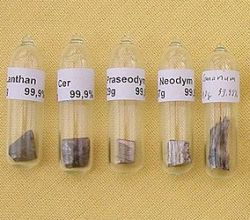
Seltene Erden: ökologisch bedenklicher Abbau (Foto: pixelio.de, Tomihahndorf)
:::
http://www.rohstoffeinkaufaktuell.de/prognose/selteneerden.h…
Preisprognose für Seltene Erden
- Profitieren Sie von Expertenwissen und sparen Sie Kosten
:::

:::
http://www.lynascorp.com/page.asp?category_id=2&page_id=44
Lynas Corporation strives for excellence in safety and health. We are committed to providing and maintaining a safe work environment and preventing injury, illness and impairment to the health of our employees, business partners and the community.
More information is available on our Lynas Malaysia Facebook page: http://www.facebook.com/lynasmalaysia.
Our goal is Zero Harm
To learn more about Lynas' commitment to Zero Harm click here
:::
Googleübersetzt: http://translate.google.de/translate?sl=en&tl=de&js=n&prev=_…
http://www.lynascorp.com/content/upload/files/Zero_Harm_flye…
ZERO HARM
:::
Googleübersetzt: http://translate.google.de/translate?sl=en&tl=de&js=n&prev=_…
@ eine erfolgreiche Woche
Grüsse JoJo
Vogtland
Rohstoffreiches Deutschland
Von Stefan Sauer
Weil die Preise für Zinn und Seltene Erden weltweit aufgrund zunehmend erschöpfter Ressourcen steigen, werden auch heimische Vorkommen interessant. Auf Spurensuche im Vogtland.
:::
http://www.wiwo.de/unternehmen/industrie/rohstoffe-wo-deutsc…
Rohstoffe
Wo Deutschlands heimlicher Reichtum lagert
von Sebastian Ertinger | Quelle: Handelsblatt Online
Deutschland hängt am Tropf von Rohstoffeinfuhren. Dabei stecken reiche Schätze in der Tiefe. Der Autor Christoph Seidler hat aufgespürt, wo Firmen hierzulande nach Kupfer, Öl und sogar Gold und Seltenen Erden suchen.
:::
http://www.pressetext.com/news/20120929003
pte20120929003 Forschung/Technologie, Umwelt/Energie
Öko-Druck auf Abbau Seltener Erden steigt
Neue Verfahren sollen Umweltbelastung durch große Nachfrage bremsen
:::
Seltene Erden: ökologisch bedenklicher Abbau (Foto: pixelio.de, Tomihahndorf)
:::
http://www.rohstoffeinkaufaktuell.de/prognose/selteneerden.h…
Preisprognose für Seltene Erden
- Profitieren Sie von Expertenwissen und sparen Sie Kosten
:::
:::
http://www.lynascorp.com/page.asp?category_id=2&page_id=44
Lynas Corporation strives for excellence in safety and health. We are committed to providing and maintaining a safe work environment and preventing injury, illness and impairment to the health of our employees, business partners and the community.
More information is available on our Lynas Malaysia Facebook page: http://www.facebook.com/lynasmalaysia.
Our goal is Zero Harm
To learn more about Lynas' commitment to Zero Harm click here
:::
Googleübersetzt: http://translate.google.de/translate?sl=en&tl=de&js=n&prev=_…
http://www.lynascorp.com/content/upload/files/Zero_Harm_flye…
ZERO HARM
:::
Googleübersetzt: http://translate.google.de/translate?sl=en&tl=de&js=n&prev=_…
@ eine erfolgreiche Woche
Grüsse JoJo
http://proedgewire.com/rare-earth-intel/the-anti-lynas-movem…" target="_blank" rel="nofollow ugc noopener">http://proedgewire.com/rare-earth-intel/the-anti-lynas-movem…
The Anti-Lynas Movement and the Rise of Enviro-Populism
The Kuantan High Court has granted the ‘Save Malaysia Stop Lynas’ (SMSL, an “NGO”), an interim stay for its request to repeal the Temporary Operating License (TOL) that Lynas was granted last August. Indeed, Judge Mariana Yahya has temporarily suspended the TOL until today, October 4. The High Court has agreed to SMSL’s requests to be given more time to study Lynas’s affidavits such that a final decision will have to wait until next October 10. In July, it should be noted, a Court found the same SMSL to be guilty of defamation and its alarmism lacking in any scientific basis and at the end of last August the Malaysian government granted Lynas the TOL. On 26 September, the High Court in Kuala Lumpur will hear from SMSL, who are defendants in the Lynas defamation case. The SMSL protests have drawn interest from the political opposition, which has exploited the public’s fear and misunderstanding of Lynas’s activities into an election issue.
:::
Googleübersetzt: http://translate.google.de/translate?sl=en&tl=de&js=n&prev=_…
http://www.thechoice.my/featured-articles/60430-high-court-d…
High Court Delays Lynas Decision by One Week .
Friday, 05 October 2012 Newsdesk
:::
Googleübersetzt: http://translate.google.de/translate?sl=en&tl=de&js=n&prev=_…
@ ein schönes WE
Grüsse JoJo
The Anti-Lynas Movement and the Rise of Enviro-Populism
The Kuantan High Court has granted the ‘Save Malaysia Stop Lynas’ (SMSL, an “NGO”), an interim stay for its request to repeal the Temporary Operating License (TOL) that Lynas was granted last August. Indeed, Judge Mariana Yahya has temporarily suspended the TOL until today, October 4. The High Court has agreed to SMSL’s requests to be given more time to study Lynas’s affidavits such that a final decision will have to wait until next October 10. In July, it should be noted, a Court found the same SMSL to be guilty of defamation and its alarmism lacking in any scientific basis and at the end of last August the Malaysian government granted Lynas the TOL. On 26 September, the High Court in Kuala Lumpur will hear from SMSL, who are defendants in the Lynas defamation case. The SMSL protests have drawn interest from the political opposition, which has exploited the public’s fear and misunderstanding of Lynas’s activities into an election issue.
:::
Googleübersetzt: http://translate.google.de/translate?sl=en&tl=de&js=n&prev=_…
http://www.thechoice.my/featured-articles/60430-high-court-d…
High Court Delays Lynas Decision by One Week .
Friday, 05 October 2012 Newsdesk
:::
Googleübersetzt: http://translate.google.de/translate?sl=en&tl=de&js=n&prev=_…
@ ein schönes WE
Grüsse JoJo
http://rareearthfuture.com/
26/10/2012 | Author: 1murf
LYNAS WORKERS “EXPOSED”

My first day working for Lynas Corporation some years ago began with a massive feeling of interest and anticipation.
Here was a company starting out, doing what few had done before in an industry that was hugely important to the future world. Its vision was to produce a product that was vital but still relatively unknown to all of us and certainly a mystery to me despite my mining and manufacturing background.
I did my research. Wow, Rare Earths. The modern world is addicted to them but almost totally unaware of their origin and capabilities.
What’s not to like about a company that is producing a product to enhance the environment, provide digital technology smaller and more technically advanced, and improve the efficiency of our energy reserves? If I wanted a “green” company to work for, I could not have done better! Sure, they dig stuff out of the ground to produce these marvelous products but the world is full of companies that mine and make products that contribute to the world’s pollution.
:::
Googleübersetzt: http://translate.google.de/translate?sl=en&tl=de&js=n&prev=_…
http://www.washingtonpost.com/business/economy/as-candidates…
China’s advantage erodes in a key area: rare earth minerals

Stringer Shanghai/Reuters - A man works at the site of a rare earth metals mine at Nancheng county, Jiangxi province on October 20, 2010.
By Howard Schneider,
Oct 26, 2012 10:23 PM EDT
The Washington Post
Two years after China limited its exports of “rare earth minerals,” unnerving developed countries that depended on them for industrial uses, production is expanding at sites outside China.
:::
:::
Googleübersetzt: http://translate.googleusercontent.com/translate_c?depth=1&h…
Grüsse JoJo
26/10/2012 | Author: 1murf
LYNAS WORKERS “EXPOSED”
My first day working for Lynas Corporation some years ago began with a massive feeling of interest and anticipation.
Here was a company starting out, doing what few had done before in an industry that was hugely important to the future world. Its vision was to produce a product that was vital but still relatively unknown to all of us and certainly a mystery to me despite my mining and manufacturing background.
I did my research. Wow, Rare Earths. The modern world is addicted to them but almost totally unaware of their origin and capabilities.
What’s not to like about a company that is producing a product to enhance the environment, provide digital technology smaller and more technically advanced, and improve the efficiency of our energy reserves? If I wanted a “green” company to work for, I could not have done better! Sure, they dig stuff out of the ground to produce these marvelous products but the world is full of companies that mine and make products that contribute to the world’s pollution.
:::
Googleübersetzt: http://translate.google.de/translate?sl=en&tl=de&js=n&prev=_…
http://www.washingtonpost.com/business/economy/as-candidates…
China’s advantage erodes in a key area: rare earth minerals
Stringer Shanghai/Reuters - A man works at the site of a rare earth metals mine at Nancheng county, Jiangxi province on October 20, 2010.
By Howard Schneider,
Oct 26, 2012 10:23 PM EDT
The Washington Post
Two years after China limited its exports of “rare earth minerals,” unnerving developed countries that depended on them for industrial uses, production is expanding at sites outside China.
:::
:::
Googleübersetzt: http://translate.googleusercontent.com/translate_c?depth=1&h…
Grüsse JoJo
url]http://ohmybusiness.blogspot.de/2012/11/roadblocks-to-lynas-…[/url]
Monday, 5 November 2012
ROADBLOCKS TO LYNAS PLANT MAY SEE FOREIGN INVESTORS LOSE APPETITE IN MALAYSIA
Further roadblocks to the operation of the Australia-owned Lynas Advanced Materials Plant (LAMP) in Gebeng, Pahang, will trigger lowering of investor confidence and slow the inflow of foreign direct investment (FDI) into Malaysia to levels seen during the Global Financial Crisis of 2008-2009.
Malaysia’s FDI inflow fell from RM23.4 billion in 2008 to a mere RM4.43 billion in 2009 as a result of the financial crisis which also placed the country in the red for the first time in 15-years.
:::
:::
Googleübersetzt: http://translate.google.de/translate?hl=de&sl=en&u=http://oh…
siehe aktuell auch: http://www.wallstreet-online.de/diskussion/1126458-1-10/lyna…
Für die Wartezeit bis zum 8.Nov.Blitz-Comeback der Rolling Stones
http://www.heute.de/ZDF/zdfportal/web/heute-Nachrichten/4672…
@ eine erfolgreiche Woche
Grüsse JoJo
Monday, 5 November 2012
ROADBLOCKS TO LYNAS PLANT MAY SEE FOREIGN INVESTORS LOSE APPETITE IN MALAYSIA
Further roadblocks to the operation of the Australia-owned Lynas Advanced Materials Plant (LAMP) in Gebeng, Pahang, will trigger lowering of investor confidence and slow the inflow of foreign direct investment (FDI) into Malaysia to levels seen during the Global Financial Crisis of 2008-2009.
Malaysia’s FDI inflow fell from RM23.4 billion in 2008 to a mere RM4.43 billion in 2009 as a result of the financial crisis which also placed the country in the red for the first time in 15-years.
:::
:::
Googleübersetzt: http://translate.google.de/translate?hl=de&sl=en&u=http://oh…
siehe aktuell auch: http://www.wallstreet-online.de/diskussion/1126458-1-10/lyna…
Für die Wartezeit bis zum 8.Nov.Blitz-Comeback der Rolling Stones
http://www.heute.de/ZDF/zdfportal/web/heute-Nachrichten/4672…
@ eine erfolgreiche Woche
Grüsse JoJo
LYC Lynas Corporation Limited
November 2012
8th Malaysian Court Update
http://www.stocknessmonster.com/news-item?S=LYC&E=ASX&N=7054…
Lynas Corporation (ASX:LYC, OTC:LYSDY) is pleased to announce that the Kuantan High Court has denied an application by parties associated with the Save Malaysia Stop Lynas (SMSL) group (Applicants) for an injunction against Lynas’ Temporary Operating Licence (TOL). The injunction application was referred to in Lynas’ ASX announcement dated October 10, 2012.
Lynas is also pleased to announce that the Kuantan High Court has ordered that Lynas be added as a party to the application by the Applicants for a judicial review of the decision of the Minister of Science, Technology and Innovation to dismiss an appeal under the Atomic Energy Licensing Act against the Atomic Energy Licensing Board’s decision to approve the TOL. The judicial review application was referred to in Lynas’ ASX announcement dated October 4, 2012.
The hearing of the judicial review application is expected in a few months time. Both the Malaysian government and Lynas intend to strongly defend the process undertaken by the Minister of Science, Technology and Innovation in dismissing the appeal under the Atomic Energy Licensing Act. There is no injunction or stay preventing Lynas from carrying out its operations at its Malaysian plant.
:::
Googleübersetzt: http://translate.google.de/translate?sl=en&tl=de&js=n&prev=_…
8th Trading Halt
http://www.stocknessmonster.com/news-item?S=LYC&E=ASX&N=7053…
Alles weitere siehe: http://www.wallstreet-online.de/diskussion/1126458-2571-2580…
Grüsse JoJo
November 2012
8th Malaysian Court Update
http://www.stocknessmonster.com/news-item?S=LYC&E=ASX&N=7054…
Lynas Corporation (ASX:LYC, OTC:LYSDY) is pleased to announce that the Kuantan High Court has denied an application by parties associated with the Save Malaysia Stop Lynas (SMSL) group (Applicants) for an injunction against Lynas’ Temporary Operating Licence (TOL). The injunction application was referred to in Lynas’ ASX announcement dated October 10, 2012.
Lynas is also pleased to announce that the Kuantan High Court has ordered that Lynas be added as a party to the application by the Applicants for a judicial review of the decision of the Minister of Science, Technology and Innovation to dismiss an appeal under the Atomic Energy Licensing Act against the Atomic Energy Licensing Board’s decision to approve the TOL. The judicial review application was referred to in Lynas’ ASX announcement dated October 4, 2012.
The hearing of the judicial review application is expected in a few months time. Both the Malaysian government and Lynas intend to strongly defend the process undertaken by the Minister of Science, Technology and Innovation in dismissing the appeal under the Atomic Energy Licensing Act. There is no injunction or stay preventing Lynas from carrying out its operations at its Malaysian plant.
:::
Googleübersetzt: http://translate.google.de/translate?sl=en&tl=de&js=n&prev=_…
8th Trading Halt
http://www.stocknessmonster.com/news-item?S=LYC&E=ASX&N=7053…
Alles weitere siehe: http://www.wallstreet-online.de/diskussion/1126458-2571-2580…
Grüsse JoJo
http://thestar.com.my/news/story.asp?file=/2012/11/9/courts/…
Friday November 9, 2012
Lynas can begin operations, rules court
By ONG HAN SEAN
hansean@thestar.com.my
KUANTAN: Lynas Corp can finally fire up its long-completed rare earth refinery after the High Court here lifted the interim stay on its Temporary Operating Licence (TOL).
Judge Justice Mariana Yahya said it was still premature to argue at this stage on the status of the TOL granted by the Atomic Energy Licensing Board (AELB) and it was only proper to do so during the judicial review cases challenging the Government’s decision to grant the licence.
She dismissed with costs the Kuantan residents’ application for a stay on the TOL pending the judicial reviews.
The court refused to put a temporary stay on the licence until the judicial reviews start at a date to be determined later.
She had earlier allowed Lynas to amend its application to be an intervener with costs and also be a party in the upcoming judicial reviews.
“The proposed intervener has satisfied the court that it is a proper party which has direct interests and is directly affected by the application for a stay on its TOL.
“Therefore, there is no plausible reason to exclude Lynas from becoming a party,” she said in her judgment yesterday.
Counsel for the residents Datuk Bastian Vendargon then stood up to file an oral application for an appeal against Justice Mariana’s decisions.
Justice Mariana asked Vendargon to file a formal application so that all parties could be heard in court.
She also dismissed the lawyer’s request for another interim injunction on the TOL until the application is filed and heard.
Vendargon told reporters outside court that he would file the appeal application today.
“We may appeal against more than one decision but the most important is the stay on the TOL,” he said.
Meanwhile, Lynas Malaysia Sdn Bhd managing director Datuk Mashal Ahmad said the plant would begin operations as soon as possible.
“This judgment reflects what we have been saying all along – that our plant is safe for the people and the environment,” he said.
Hundreds of anti-Lynas protesters as well as the company’s employees had gathered at the court complex since 7.30am to await the decision.
They engaged in a shouting match under the watchful eyes of the police.
Kuantan OCPD ACP Mohd Jasmani Yusoff said no untoward incident happened and ordered the two groups to disperse immediately after the judgment was delivered.
Googleübersetzt: http://translate.googleusercontent.com/translate_c?depth=1&h…
Grüsse JoJo
Friday November 9, 2012
Lynas can begin operations, rules court
By ONG HAN SEAN
hansean@thestar.com.my
KUANTAN: Lynas Corp can finally fire up its long-completed rare earth refinery after the High Court here lifted the interim stay on its Temporary Operating Licence (TOL).
Judge Justice Mariana Yahya said it was still premature to argue at this stage on the status of the TOL granted by the Atomic Energy Licensing Board (AELB) and it was only proper to do so during the judicial review cases challenging the Government’s decision to grant the licence.
She dismissed with costs the Kuantan residents’ application for a stay on the TOL pending the judicial reviews.
The court refused to put a temporary stay on the licence until the judicial reviews start at a date to be determined later.
She had earlier allowed Lynas to amend its application to be an intervener with costs and also be a party in the upcoming judicial reviews.
“The proposed intervener has satisfied the court that it is a proper party which has direct interests and is directly affected by the application for a stay on its TOL.
“Therefore, there is no plausible reason to exclude Lynas from becoming a party,” she said in her judgment yesterday.
Counsel for the residents Datuk Bastian Vendargon then stood up to file an oral application for an appeal against Justice Mariana’s decisions.
Justice Mariana asked Vendargon to file a formal application so that all parties could be heard in court.
She also dismissed the lawyer’s request for another interim injunction on the TOL until the application is filed and heard.
Vendargon told reporters outside court that he would file the appeal application today.
“We may appeal against more than one decision but the most important is the stay on the TOL,” he said.
Meanwhile, Lynas Malaysia Sdn Bhd managing director Datuk Mashal Ahmad said the plant would begin operations as soon as possible.
“This judgment reflects what we have been saying all along – that our plant is safe for the people and the environment,” he said.
Hundreds of anti-Lynas protesters as well as the company’s employees had gathered at the court complex since 7.30am to await the decision.
They engaged in a shouting match under the watchful eyes of the police.
Kuantan OCPD ACP Mohd Jasmani Yusoff said no untoward incident happened and ordered the two groups to disperse immediately after the judgment was delivered.
Googleübersetzt: http://translate.googleusercontent.com/translate_c?depth=1&h…
Grüsse JoJo
Start up!
LYC Lynas Corporation Limited
November 2012
22nd Operations Update
http://www.stocknessmonster.com/news-item?S=LYC&E=ASX&N=7079…
22 November 2012
OPERATIONS UPDATE
Lynas Corporation (ASX:LYC, OTC:LYSDY) announces that approximately 100 containers of rare earths concentrate have now arrived in Kuantan, and that a significant portion of those containers are now at the Lynas Advanced Materials Plant (“LAMP”). Lynas expects that first feed to kiln and commencement of operations at the LAMP will occur over the coming days.
For further information please contact Alistair Reid or Liz Whiteway on +61 2 8259 7100 or visit www.lynascorp.com
For all media enquiries please contact Michael Vaughan or Alan Jury from FTI Consulting on +61 2 8298 6100.
Googleübersetzt: http://translate.google.de/translate?sl=en&tl=de&js=n&prev=_…
Grüsse JoJo
LYC Lynas Corporation Limited
November 2012
22nd Operations Update
http://www.stocknessmonster.com/news-item?S=LYC&E=ASX&N=7079…
22 November 2012
OPERATIONS UPDATE
Lynas Corporation (ASX:LYC, OTC:LYSDY) announces that approximately 100 containers of rare earths concentrate have now arrived in Kuantan, and that a significant portion of those containers are now at the Lynas Advanced Materials Plant (“LAMP”). Lynas expects that first feed to kiln and commencement of operations at the LAMP will occur over the coming days.
For further information please contact Alistair Reid or Liz Whiteway on +61 2 8259 7100 or visit www.lynascorp.com
For all media enquiries please contact Michael Vaughan or Alan Jury from FTI Consulting on +61 2 8298 6100.
Googleübersetzt: http://translate.google.de/translate?sl=en&tl=de&js=n&prev=_…
Grüsse JoJo
Der kpl. Vorgang vom Transport der Container beladen mit REE-Kontzentrat bis ins Werk (LAMP)auf Video:
LYNAS Malaysia terima Rare Earth Concentrate [/b
http://www.youtube.com/watch?feature=player_embedded&v=_nX1n…
@ ein schönes WE
Grüsse JoJo
LYNAS Malaysia terima Rare Earth Concentrate [/b
http://www.youtube.com/watch?feature=player_embedded&v=_nX1n…
@ ein schönes WE
Grüsse JoJo
http://www.badische-zeitung.de/nachrichten/wirtschaft/je-kna…
Je knapper, desto teurer
Die Menschheit wird in den kommenden Jahrzehnten lernen müssen, sich auf steigende Preise für Rohstoffe einzustellen / Das gilt in erster Linie für Nahrungsmittel.
:::
@ eine erfolgreiche Woche
Grüse JoJo
Je knapper, desto teurer
Die Menschheit wird in den kommenden Jahrzehnten lernen müssen, sich auf steigende Preise für Rohstoffe einzustellen / Das gilt in erster Linie für Nahrungsmittel.
:::
@ eine erfolgreiche Woche
Grüse JoJo
http://www.azomining.com/news.aspx?newsID=7467
Global Demand for Rare Earths to Grow to 185,000 Tons by 2015
Published on November 28, 2012 at 3:33 AM
Rare earth elements are a set of seventeen chemical elements crucial in the manufacturing of popular products such as mobile phones and hybrid cars.
According to the U.S. Congressional Research Service the current global demand for rare earths is approximately 136,000 metric tons a year. That number is expected to grow to 185,000 tons by 2015 and top 200,000 tons by 2020. Five Star Equities examines the outlook for companies in the Rare Earth Industry and provides equity research on Lynas Corp. and Quest Rare Minerals Ltd.
Global reserves of rare earths are estimated to be at 110 million metric tons, with approximately 50 percent of reserves in China. It has recently been reported that China will begin providing subsidies to state-owned rare earth producers in an attempt to revive the struggling industry. Falling rare earth prices have recently caused some of China's largest producers to suspend production.
"In the long run, the policy can promote resource protection and effective utilization of rare earths," said Chen Zhanheng, deputy secretary-general of the China Rare Earths Industry Association. "[The subsidy] is aimed at supporting technological upgrades, energy conservation and environmental protection."
Five Star Equities releases regular market updates on the Rare Earth Industry so investors can stay ahead of the crowd and make the best investment decisions to maximize their returns. Take a few minutes to register with us free at www.FiveStarEquities.com and get exclusive access to our numerous stock reports and industry newsletters.
After many delays, Lynas now expects to start production at their Malaysian processing plant in December. "One to two tough years to bring the business to life need to be put in the context of the long-term vision we are realizing. By the second half of calendar 2013, we expect to be moving towards full production capacity and have a business that has the potential to deliver sustainable and predictable earnings," said Lynas' CEO, Nicholas Curtis, at an annual general meeting.
Quest is currently advancing several high-potential rare earth projects in Canada's premier rare earth exploration areas: the Strange Lake and Misery Lake areas of northeastern Québec. The company has reported that a revised resource estimate for the Strange Lake B-Zone REE deposit has shown a doubling of tonnage.
Source: http://www.fivestarequities.com/
Googleübersetzt: http://translate.google.de/translate?sl=en&tl=de&js=n&prev=_…
Grüsse JoJo
Global Demand for Rare Earths to Grow to 185,000 Tons by 2015
Published on November 28, 2012 at 3:33 AM
Rare earth elements are a set of seventeen chemical elements crucial in the manufacturing of popular products such as mobile phones and hybrid cars.
According to the U.S. Congressional Research Service the current global demand for rare earths is approximately 136,000 metric tons a year. That number is expected to grow to 185,000 tons by 2015 and top 200,000 tons by 2020. Five Star Equities examines the outlook for companies in the Rare Earth Industry and provides equity research on Lynas Corp. and Quest Rare Minerals Ltd.
Global reserves of rare earths are estimated to be at 110 million metric tons, with approximately 50 percent of reserves in China. It has recently been reported that China will begin providing subsidies to state-owned rare earth producers in an attempt to revive the struggling industry. Falling rare earth prices have recently caused some of China's largest producers to suspend production.
"In the long run, the policy can promote resource protection and effective utilization of rare earths," said Chen Zhanheng, deputy secretary-general of the China Rare Earths Industry Association. "[The subsidy] is aimed at supporting technological upgrades, energy conservation and environmental protection."
Five Star Equities releases regular market updates on the Rare Earth Industry so investors can stay ahead of the crowd and make the best investment decisions to maximize their returns. Take a few minutes to register with us free at www.FiveStarEquities.com and get exclusive access to our numerous stock reports and industry newsletters.
After many delays, Lynas now expects to start production at their Malaysian processing plant in December. "One to two tough years to bring the business to life need to be put in the context of the long-term vision we are realizing. By the second half of calendar 2013, we expect to be moving towards full production capacity and have a business that has the potential to deliver sustainable and predictable earnings," said Lynas' CEO, Nicholas Curtis, at an annual general meeting.
Quest is currently advancing several high-potential rare earth projects in Canada's premier rare earth exploration areas: the Strange Lake and Misery Lake areas of northeastern Québec. The company has reported that a revised resource estimate for the Strange Lake B-Zone REE deposit has shown a doubling of tonnage.
Source: http://www.fivestarequities.com/
Googleübersetzt: http://translate.google.de/translate?sl=en&tl=de&js=n&prev=_…
Grüsse JoJo
an @
die sich für eine aktuelle Zusammenfassung in Sachen "Seltene Eden" interessieren.
Habe im folgenden Thread, auf Grund einer Diskussion in einem anderen Thread, Infos und Übersichten gepostet die hier alle Ketten sprengen würde, allerdings noch mit dem Hinweis auf Unvollständigkeit.
Querverweis: http://www.wallstreet-online.de/diskussion/1126458-2671-2680…
Grüsse JoJo
die sich für eine aktuelle Zusammenfassung in Sachen "Seltene Eden" interessieren.
Habe im folgenden Thread, auf Grund einer Diskussion in einem anderen Thread, Infos und Übersichten gepostet die hier alle Ketten sprengen würde, allerdings noch mit dem Hinweis auf Unvollständigkeit.
Querverweis: http://www.wallstreet-online.de/diskussion/1126458-2671-2680…
Grüsse JoJo
http://www.nst.com.my/nation/general/lynas-plant-starts-oper…
01 December 2012 | last updated at 12:45AM
Lynas plant starts operations
IT'S SAFE: Atomic Energy Licensing Board specialists monitoring factory
KUANTAN: THE Lynas Advanced Materials Plant (LAMP) in Gebeng, here, began operations yesterday after being delayed for more than one year.
Lynas Corp, in a statement quoting its executive chairman, Nicholas Curtis, said this was a significant milestone as the operation of LAMP was now a reality.
"The plant (LAMP) will provide data that will assure people that it is safe for local communities and the environment.
"We are excited to start creating value at LAMP and we look forward to sharing that value with all of our key stakeholders, including the communities in which we operate."
The statement said the first feed of rare earth concentrate into the kiln was now underway at LAMP.
It also said Lynas expected a ramp-up period of between three and four months until first commercial sales and subsequent cash generation.
Lynas Malaysia public relations and communications general manager Amin Abdullah, in confirming the start of operations, said it came after they received the permission from the Atomic Energy Licensing Board (AELB) to start feeding rare earth concentrate to kiln, adding that two teams of specialists from AELB were monitoring the operations.
"Everything is proceeding smoothly and the process of creating our first product will take about 45 days.
"The specialists are satisfied with the safety measures and radiation readings are regularly recorded to ensure it is safe and that operations do not pose any problem to our workers and nearby residents."
Amin said they would also be inviting media representatives and nearby residents to the plant to explain to them the plant's standard operating procedures and to provide the opportunity to observe the operations.
The High Court here fixed Feb 5 next year to hear the judicial review against the decision to grant a temporary operating licence (TOL) to LAMP.
Judge Datuk Mariana Yahya set the date during case management in chambers, yesterday.
The High Court had on Nov 14 rejected an application made by Kuantan residents for an interim injunction on the TOL given to LAMP.
On Nov 8, Mariana also rejected a similar application filed by Tan Bun Tet, Syed Talib Syed Sulaiman and Hasimah Ramli, hence allowing LAMP in Gebeng to begin operations.
Googleübersetz: http://translate.google.de/translate?sl=en&tl=de&js=n&prev=_…
Grüsse JoJo
01 December 2012 | last updated at 12:45AM
Lynas plant starts operations
IT'S SAFE: Atomic Energy Licensing Board specialists monitoring factory
KUANTAN: THE Lynas Advanced Materials Plant (LAMP) in Gebeng, here, began operations yesterday after being delayed for more than one year.
Lynas Corp, in a statement quoting its executive chairman, Nicholas Curtis, said this was a significant milestone as the operation of LAMP was now a reality.
"The plant (LAMP) will provide data that will assure people that it is safe for local communities and the environment.
"We are excited to start creating value at LAMP and we look forward to sharing that value with all of our key stakeholders, including the communities in which we operate."
The statement said the first feed of rare earth concentrate into the kiln was now underway at LAMP.
It also said Lynas expected a ramp-up period of between three and four months until first commercial sales and subsequent cash generation.
Lynas Malaysia public relations and communications general manager Amin Abdullah, in confirming the start of operations, said it came after they received the permission from the Atomic Energy Licensing Board (AELB) to start feeding rare earth concentrate to kiln, adding that two teams of specialists from AELB were monitoring the operations.
"Everything is proceeding smoothly and the process of creating our first product will take about 45 days.
"The specialists are satisfied with the safety measures and radiation readings are regularly recorded to ensure it is safe and that operations do not pose any problem to our workers and nearby residents."
Amin said they would also be inviting media representatives and nearby residents to the plant to explain to them the plant's standard operating procedures and to provide the opportunity to observe the operations.
The High Court here fixed Feb 5 next year to hear the judicial review against the decision to grant a temporary operating licence (TOL) to LAMP.
Judge Datuk Mariana Yahya set the date during case management in chambers, yesterday.
The High Court had on Nov 14 rejected an application made by Kuantan residents for an interim injunction on the TOL given to LAMP.
On Nov 8, Mariana also rejected a similar application filed by Tan Bun Tet, Syed Talib Syed Sulaiman and Hasimah Ramli, hence allowing LAMP in Gebeng to begin operations.
Googleübersetz: http://translate.google.de/translate?sl=en&tl=de&js=n&prev=_…
Grüsse JoJo
http://www.malaysia-chronicle.com/index.php?option=com_k2&vi…
Friday, 07 December 2012 17:01
MCA: Chinese community begins to accept Lynas
Written by -
KUANTAN - By the time the green light was given to the Lynas Advanced Materials Plant (LAMP) to operate the rare earth plant at the industrial zone in Gebeng, Pahang, in early November, much of the community had positively accepted the project.
Many of those who had initially objected to the project, particularly the non-Malays, appeared to have softened their stance.
LAMP had not breached any regulation, hence it was allowed to start operating on Nov 8 after the High Court here rejected the interim injunction application by three Kuantan residents on the temporary operating licence (TOL).
According to Teruntum state assemblyman Datuk Chang Hong Seong, only a few among the Chinese community were still confused about the project after being influenced by the opposition.
"Nevertheless, although the majority of the Chinese are no longer against the project, they still hope that the government would set up a special committee to monitor operations at the plant," he told Bernama here.
The community hopes that the monitoring committee would ensure that the operators adhered to the guidelines and safe procedures while the experts must really be well-versed with the disposal of the effluents from the plant.
"Effluents from the plant must be disposed far away from residential areas," Chang stressed. Kuantan MCA chairman Datuk Ti Lian Ker said objections by non-governmental organisations, consisting mainly of people not from the locality, and political manipulation by the opposition parties had initially misled the Chinese community.
"The people, particularly the Chinese here, have now accepted the decision. The opposition parties are therefore urged not to continue politicising the Lynas issue to erode the government's image for their electoral gain," he said.
Based on the feedback, the community is now more assured that the project would not adversely affect their well-being, rather it would generate the economy.
The community is becoming more aware that the rare earth industry is a potential development sector for the country to spur Malaysia towards high-income status by 2020.
The factory will also be a hub for rare earth downstream activities such as the manufacture of televisions, computer screens, mobile phones and energy-saving lamps, magnetic scan machines and vehicle components, he said.
Pahang Menteri Besar Datuk Seri Adnan Yaakob, in his comments following the decision by the Kuantan High Court, said the rare earth processing company must be given a chance to invest in a major field to help boost the national economy.
He said the local population would also benefit from Lynas through employment opportunities. Incidentally, the project had attracted numerous buyers and business partners, including one from Germany which had pledged an investment of more than RM1.5 billion to manage a plant that would require around 1,200 workers.
Apart from that, supplier companies have also built their factories near the LAMP site, among them two acid suppliers which invested RM300 million and provided jobs for 100 people.
The plant in Gebeng is capable of processing 22,000 tonnes of rare earth annually or one fifth of the global demand and would generate an annual revenue of around RM4 billion for the country.
Meanwhile, consultant Dudley Kingsnorth of Industrial Minerals Co of Australia (IMCOA) expected the demand for rare earth to reach 160,000 tonnes by 2016 compared to 105,000 tonnes in 2011.
At present, producers from China are monopolising the industry but by 2016, around 60,000 tonnes of the supply would be from countries outside China, including Malaysia.
Pahang opposition chief Leong Ngah Ngah of the DAP had, at one time, commented through a Chinese language daily that the state government had succeeded in drawing foreign investment as a result of the proposed project.
With the start of the LAMP project without any more obstacles, Pahang is poised to see major economic returns which will be beneficial for all the people. Lynas chose to operate in Malaysia because of its cheaper production costs compared to Australia while China had tightened export of the product. Lynas too had obtained licences to build the factory in the two countries.
– Bernama
Google übersetzt: http://translate.google.de/translate?sl=en&tl=de&js=n&prev=_…
Grüsse JoJo
Friday, 07 December 2012 17:01
MCA: Chinese community begins to accept Lynas
Written by -
KUANTAN - By the time the green light was given to the Lynas Advanced Materials Plant (LAMP) to operate the rare earth plant at the industrial zone in Gebeng, Pahang, in early November, much of the community had positively accepted the project.
Many of those who had initially objected to the project, particularly the non-Malays, appeared to have softened their stance.
LAMP had not breached any regulation, hence it was allowed to start operating on Nov 8 after the High Court here rejected the interim injunction application by three Kuantan residents on the temporary operating licence (TOL).
According to Teruntum state assemblyman Datuk Chang Hong Seong, only a few among the Chinese community were still confused about the project after being influenced by the opposition.
"Nevertheless, although the majority of the Chinese are no longer against the project, they still hope that the government would set up a special committee to monitor operations at the plant," he told Bernama here.
The community hopes that the monitoring committee would ensure that the operators adhered to the guidelines and safe procedures while the experts must really be well-versed with the disposal of the effluents from the plant.
"Effluents from the plant must be disposed far away from residential areas," Chang stressed. Kuantan MCA chairman Datuk Ti Lian Ker said objections by non-governmental organisations, consisting mainly of people not from the locality, and political manipulation by the opposition parties had initially misled the Chinese community.
"The people, particularly the Chinese here, have now accepted the decision. The opposition parties are therefore urged not to continue politicising the Lynas issue to erode the government's image for their electoral gain," he said.
Based on the feedback, the community is now more assured that the project would not adversely affect their well-being, rather it would generate the economy.
The community is becoming more aware that the rare earth industry is a potential development sector for the country to spur Malaysia towards high-income status by 2020.
The factory will also be a hub for rare earth downstream activities such as the manufacture of televisions, computer screens, mobile phones and energy-saving lamps, magnetic scan machines and vehicle components, he said.
Pahang Menteri Besar Datuk Seri Adnan Yaakob, in his comments following the decision by the Kuantan High Court, said the rare earth processing company must be given a chance to invest in a major field to help boost the national economy.
He said the local population would also benefit from Lynas through employment opportunities. Incidentally, the project had attracted numerous buyers and business partners, including one from Germany which had pledged an investment of more than RM1.5 billion to manage a plant that would require around 1,200 workers.
Apart from that, supplier companies have also built their factories near the LAMP site, among them two acid suppliers which invested RM300 million and provided jobs for 100 people.
The plant in Gebeng is capable of processing 22,000 tonnes of rare earth annually or one fifth of the global demand and would generate an annual revenue of around RM4 billion for the country.
Meanwhile, consultant Dudley Kingsnorth of Industrial Minerals Co of Australia (IMCOA) expected the demand for rare earth to reach 160,000 tonnes by 2016 compared to 105,000 tonnes in 2011.
At present, producers from China are monopolising the industry but by 2016, around 60,000 tonnes of the supply would be from countries outside China, including Malaysia.
Pahang opposition chief Leong Ngah Ngah of the DAP had, at one time, commented through a Chinese language daily that the state government had succeeded in drawing foreign investment as a result of the proposed project.
With the start of the LAMP project without any more obstacles, Pahang is poised to see major economic returns which will be beneficial for all the people. Lynas chose to operate in Malaysia because of its cheaper production costs compared to Australia while China had tightened export of the product. Lynas too had obtained licences to build the factory in the two countries.
– Bernama
Google übersetzt: http://translate.google.de/translate?sl=en&tl=de&js=n&prev=_…
Grüsse JoJo
http://www.marktundmittelstand.de/nachrichten/produktion-tec…
Produktion & Technologie
08.12.12 10:00.
Rohstoffe
Rohstoffe: "Wir sind erpressbar"
Von Axel Rose
Der Superzyklus der Rohstoffe geht zu Ende, sagen Marktbeobachter. Doch Deutschland hat den Anschluss verpasst. Unternehmen müssen neue Strategien entwickeln.

:::
:::
http://news.asiaone.com/News/AsiaOne%2BNews/Malaysia/Story/A…
ASIAONE NEWS MALAYSIA
Residents confident rare earth plant safe

New Straits Times Saturday, Dec 08, 2012
KUANTAN - HOLDING samples of rare earth in their hands, residents from several villages here displayed smiles of confidence on their safety.
This took place during a briefing of rare earth refining operations at the Lynas Advanced Materials Plant in Gebeng here yesterday.
For Siti Aminah Talib, 58, from Balok Baru, Gebeng, there were no more doubts.
"All the representatives from nearby villages here are full of confidence on the safety aspects of the Lamp operation," she said, as other representatives nodded at the briefing site which was near the place where containers of rare earth are kept.
"We are fully satisfied with the briefing on the nature of the Lynas operations and the explanation on the negligible amount of radioactivity contained in the lanthanide samples."
She described the briefing given by Lynas officials as "clear and concise".
"We were given a clear picture of what goes on inside Lamp," she said and added she had no more doubts on how safe the rare earth elements were.
Dismissing the talk by the opposition on the dangers of rare earth, she said that it was hard to understand why they insisted on harping on something that clearly poses no danger to the surrounding community.
Abdullah Umar, 78, who used to work at the Kuantan Port, felt the opposition was making an unnecessarily big issue out of Lamp's rare earth operation.
"This whole matter is really a non-issue. It has been blown out of proportion by certain political parties," said the resident of Kg Balok Sejahtera here while holding in his right hand a sample of lanthanide given to him during the demonstration on the safety of the rare earth samples.
Former Kuantan district office technician Abdul Mukhtar Ngah, 56, said that he had always known that the rare earth operation at Lamp would not pose a threat to residents and the environment in Gebeng or anywhere else.
Page 1 2
Google übersetzt: http://translate.google.de/translate?sl=en&tl=de&js=n&prev=_…
http://www.themalaysianinsider.com/malaysia/article/chinese-…
:::
Google übersetzt: http://translate.google.de/translate?sl=en&tl=de&js=n&prev=_…
http://newswatch.nationalgeographic.com/2012/12/07/rare-eart…
:::
Google übersetzt: http://translate.google.de/translate?sl=en&tl=de&js=n&prev=_…
http://thestar.com.my/news/story.asp?file=/2012/12/8/nation/…
:::
Google übersetzt: http://translate.googleusercontent.com/translate_c?depth=1&h…
@ eine erfolgreiche Woche
Grüsse JoJo
Produktion & Technologie
08.12.12 10:00.
Rohstoffe
Rohstoffe: "Wir sind erpressbar"
Von Axel Rose
Der Superzyklus der Rohstoffe geht zu Ende, sagen Marktbeobachter. Doch Deutschland hat den Anschluss verpasst. Unternehmen müssen neue Strategien entwickeln.
:::
:::
http://news.asiaone.com/News/AsiaOne%2BNews/Malaysia/Story/A…
ASIAONE NEWS MALAYSIA
Residents confident rare earth plant safe
New Straits Times Saturday, Dec 08, 2012
KUANTAN - HOLDING samples of rare earth in their hands, residents from several villages here displayed smiles of confidence on their safety.
This took place during a briefing of rare earth refining operations at the Lynas Advanced Materials Plant in Gebeng here yesterday.
For Siti Aminah Talib, 58, from Balok Baru, Gebeng, there were no more doubts.
"All the representatives from nearby villages here are full of confidence on the safety aspects of the Lamp operation," she said, as other representatives nodded at the briefing site which was near the place where containers of rare earth are kept.
"We are fully satisfied with the briefing on the nature of the Lynas operations and the explanation on the negligible amount of radioactivity contained in the lanthanide samples."
She described the briefing given by Lynas officials as "clear and concise".
"We were given a clear picture of what goes on inside Lamp," she said and added she had no more doubts on how safe the rare earth elements were.
Dismissing the talk by the opposition on the dangers of rare earth, she said that it was hard to understand why they insisted on harping on something that clearly poses no danger to the surrounding community.
Abdullah Umar, 78, who used to work at the Kuantan Port, felt the opposition was making an unnecessarily big issue out of Lamp's rare earth operation.
"This whole matter is really a non-issue. It has been blown out of proportion by certain political parties," said the resident of Kg Balok Sejahtera here while holding in his right hand a sample of lanthanide given to him during the demonstration on the safety of the rare earth samples.
Former Kuantan district office technician Abdul Mukhtar Ngah, 56, said that he had always known that the rare earth operation at Lamp would not pose a threat to residents and the environment in Gebeng or anywhere else.
Page 1 2
Google übersetzt: http://translate.google.de/translate?sl=en&tl=de&js=n&prev=_…
http://www.themalaysianinsider.com/malaysia/article/chinese-…
:::
Google übersetzt: http://translate.google.de/translate?sl=en&tl=de&js=n&prev=_…
http://newswatch.nationalgeographic.com/2012/12/07/rare-eart…
:::
Google übersetzt: http://translate.google.de/translate?sl=en&tl=de&js=n&prev=_…
http://thestar.com.my/news/story.asp?file=/2012/12/8/nation/…
:::
Google übersetzt: http://translate.googleusercontent.com/translate_c?depth=1&h…
@ eine erfolgreiche Woche
Grüsse JoJo
http://www.malaysia-chronicle.com/index.php?option=com_k2&vi…
Saturday, 15 December 2012 23:19
Lynas Chief Confident Of Kuantan Rare Earth Project
Written by -
 MELBOURNE- Lynas Chief Nick Curtis is confident the Kuantan rare earth plant will overcome obstacles it now faces, saying his "stubborn nature had kept him focused as the hurdles keep rising".
:::
:::
Google übersetzt: http://translate.google.de/translate?sl=en&tl=de&js=n&prev=_…
@ eine erfolgreiche Woche
Grüss JoJo
Saturday, 15 December 2012 23:19
Lynas Chief Confident Of Kuantan Rare Earth Project
Written by -
MELBOURNE- Lynas Chief Nick Curtis is confident the Kuantan rare earth plant will overcome obstacles it now faces, saying his "stubborn nature had kept him focused as the hurdles keep rising".:::
:::
Google übersetzt: http://translate.google.de/translate?sl=en&tl=de&js=n&prev=_…
@ eine erfolgreiche Woche
Grüss JoJo
Fett unterlegte Texte führen im Original zu weiteren Links.
@ ein erfolgreiches 2013
Grüsse JoJo
http://www.miningaustralia.com.au/news/lynas-ramps-up-rare-e…
Lynas ramps up rare earth processing in Malaysia
8 January, 2013 Alex Heber
Australia’s Lynas Corporation yesterday commissioned its controversial rare earth plant in Malaysia.
The first delivery of commercial rare earth product is expected in the next few weeks.
In a statement released yesterday Lynas said they have successfully begun cracking and leaching rare earth extraction units and production will continue to ramp up over the next three to four months.
 Lynas Corporation's Malaysian plant.
This is another significant milestone for Lynas,” said Lynas executive chairman Nicholas Curtis.
Following the announcement the company’s shares rose 14 per cent.
It was a good day for rare earth companies around the world yesterday with Molycorp and Great Western Minerals also seeing their share prices rise by 9.8 per cent and 4 per cent respectively.
At full production Molycorp, Lynas and Great Western are expected to end China's grip on the rare earth market of which China currently controls more than 95 per cent of the global supply, mining.com reported.
In November Australian Mining reported Lynas had received its first shipment of about 100 containers of rare earth concentrate at the Malaysian plant. At the time the company expected the first kiln feed to take place just a couple of days later.
However, the company has been embroiled in legal action launched by the Save Malaysia, Stop Lynas group which aimed to block Lynas from acquiring a temporary operating licence for the new facility.
“The safe and efficient operation of the LAMP is now a reality, and we are providing real-time data that assures people the LAMP is entirely safe for our local communities and the environment,” Curtis said.
Protests took place outside the company’s Sydney head office in November last year amid concerns from the Greens that radio active waste produced at the Malayasian plant would be shipped back to Australia.
Read more about:
Lynas Corporation, Malaysia, rare earth concentrate « Previous | Next »
Related articles
Google übersetzt: http://translate.google.de/translate?sl=en&tl=de&js=n&prev=_…
@ ein erfolgreiches 2013
Grüsse JoJo
http://www.miningaustralia.com.au/news/lynas-ramps-up-rare-e…
Lynas ramps up rare earth processing in Malaysia
8 January, 2013 Alex Heber
Australia’s Lynas Corporation yesterday commissioned its controversial rare earth plant in Malaysia.
The first delivery of commercial rare earth product is expected in the next few weeks.
In a statement released yesterday Lynas said they have successfully begun cracking and leaching rare earth extraction units and production will continue to ramp up over the next three to four months.
Lynas Corporation's Malaysian plant.This is another significant milestone for Lynas,” said Lynas executive chairman Nicholas Curtis.
Following the announcement the company’s shares rose 14 per cent.
It was a good day for rare earth companies around the world yesterday with Molycorp and Great Western Minerals also seeing their share prices rise by 9.8 per cent and 4 per cent respectively.
At full production Molycorp, Lynas and Great Western are expected to end China's grip on the rare earth market of which China currently controls more than 95 per cent of the global supply, mining.com reported.
In November Australian Mining reported Lynas had received its first shipment of about 100 containers of rare earth concentrate at the Malaysian plant. At the time the company expected the first kiln feed to take place just a couple of days later.
However, the company has been embroiled in legal action launched by the Save Malaysia, Stop Lynas group which aimed to block Lynas from acquiring a temporary operating licence for the new facility.
“The safe and efficient operation of the LAMP is now a reality, and we are providing real-time data that assures people the LAMP is entirely safe for our local communities and the environment,” Curtis said.
Protests took place outside the company’s Sydney head office in November last year amid concerns from the Greens that radio active waste produced at the Malayasian plant would be shipped back to Australia.
Read more about:
Lynas Corporation, Malaysia, rare earth concentrate « Previous | Next »
Related articles
Google übersetzt: http://translate.google.de/translate?sl=en&tl=de&js=n&prev=_…
http://www.dailyliberal.com.au/story/1233767/rare-earth-a-ra…
Rare earth a rare chance for Australia
Jan. 15, 2013, 4 a.m.
AUSTRALIA is poised to cash in on worldwide demand for rare earth elements in the wake of China's reported export restrictions on the highly prized commodities.
The nation's largest current processor of rare earths is the Lynas Corporation, which has just received a green light from the Malaysian government to begin cracking and leaching rare earths, said progress was being stalled by regulatory red tape.
"This is another significant milestone for Lynas," Lynas executive chairman Nicholas Curtis said of the breakthrough in Malaysia.
:::
Google übersetzt: http://translate.google.de/translate?hl=de&sl=en&u=http://ww…
Grüsse JoJo
Rare earth a rare chance for Australia
Jan. 15, 2013, 4 a.m.
AUSTRALIA is poised to cash in on worldwide demand for rare earth elements in the wake of China's reported export restrictions on the highly prized commodities.
The nation's largest current processor of rare earths is the Lynas Corporation, which has just received a green light from the Malaysian government to begin cracking and leaching rare earths, said progress was being stalled by regulatory red tape.
"This is another significant milestone for Lynas," Lynas executive chairman Nicholas Curtis said of the breakthrough in Malaysia.
:::
Google übersetzt: http://translate.google.de/translate?hl=de&sl=en&u=http://ww…
Grüsse JoJo
Der folgende Bericht bezieht sich zwar in der Hauptsache auf Silber gibt aber IMHO einen umfassende Übersicht über die zukünftige Rohstoffentwicklung weiterer Rohstoffe wie die der "Seltenen Erden" in Bezug auf den weiter steigenden Bedarf und ihrer Preisentwicklung.
Bei allem gehe ich davon aus, dass China kein Interesse hat REO-Produzenten außerhalb Chinas durch Maßnahmen wie Dumpingpreise zu verhindern.
1.- würde das ihnen nicht gelingen!
2.- fordert China genau das Gegenteil!
3.- belegen alle internationale Studien, dass China bei der technischen Entwicklung, der Energie- und Umweltproblematik in der sich China immer mehr befinden wird, in ein paar Jahren auf Importe von REO angewiesen sind.
Was würde beim Gegenteil passieren was ja immer wieder IMHO unsinniger Weise behauptet wird?
Den Weltmarkt mit Dumpingpreise zu fluten würde vor allen Dingen dazu führen das die 23% Reserven die China nur noch besitzt noch schneller verbraucht sein werden, keine REO abhängige Produkte ins Land locken kann, ihre REO-Produzenten mit Milliarden subventionieren muss und dazu
billige ausländische Produkte importieren muss die China durch Dumpingpreise subventioniert hat was in China zusätzlich noch viele Arbeitsplätze kosten würde einhergehend mit Knoff hoff Verlust durch wegbleiben auswärtiger Globalplayer die ansonsten in China produzieren würden.
Kurz gesagt, China würde damit einen Teufelskreislauf in eigener Regie auslösen.
Zusätzlich würden alle auswärtigen REO-Produzenten und die es mal werden wollen pleite gehen die Gläubiger und Aktionäre wären damit faktisch enteignet und die Insolvenzverwalter würden billigst an clevere Großinvestoren verkaufen müssen die dann mit den Bereits erschlossenen Minen und Produktionsanlagen billigst REO produzieren können und so auch für den Rest der chinesischen REO-Produzenten konkurrieren können bis China die letzten Reserven ausgebeutet hat und was dann?
Kann das im Interesse von China sein?
http://www.goldseiten.de/artikel/159647--Grosses-technisches…
:::
Der amerikanische Autor Stephen Leeb bestätigt in seinem Buch "Die gelbe Gefahr" meine seit Jahren publizierte energetische Betrachtungsweise, dass die Mineralien sicherlich nicht geologisch zur Neige gehen werden, sondern es energetisch nicht mehr möglich sein wird, die beständig schlechter werdenden Erze noch zu fördern. Metalle werden unter Schwankungen immer teuerer werden müssen, solange, bis eine neue nachhaltige Energiewirtschaft es ermöglichen wird, auch die magersten Erze noch umweltverträglich zu fördern. Derzeit verlässt sich die globale Wirtschaft noch immer zu ca. 90% auf die klarer Weise zur Neige gehenden fossilen Energien.
Der Aufbau einer solchen nachhaltigen Energiewirtschaft selbst wird jedoch Unmengen an Rohstoffen verschlingen: Kupfer und Silber für die Smartgrids, Stahl, Seltene Erden für die Windturbinen, Indium für Solarmodule, und so weiter und so weiter … China hat sich zum Ziel gesetzt, bis 2030 20% seiner Energieversorgung aus nachhaltigen Quellen zu decken und kauft daher weltweit die hierfür benötigten Rohstoffe auf, wo es sie bekommt. Es fördert im eigenen Land so schnell und so viel Gold wie es nur kann, um sich diese Quellen auch zukünftig erschliessen zu können (Chinas Jahresförderung ist mit großem Abstand weltweit die prozentual größte bezogen auf die ausgewiesenen Reserven). Während hier also eine klare Strategie zu erkennen ist, verwaltet die alte Welt nur ihr zunehmendes Siechtum von Wahl zu Wahl, ohne langfristige Strategie oder Richtung.
:::
Grüsse JoJo
Bei allem gehe ich davon aus, dass China kein Interesse hat REO-Produzenten außerhalb Chinas durch Maßnahmen wie Dumpingpreise zu verhindern.
1.- würde das ihnen nicht gelingen!
2.- fordert China genau das Gegenteil!
3.- belegen alle internationale Studien, dass China bei der technischen Entwicklung, der Energie- und Umweltproblematik in der sich China immer mehr befinden wird, in ein paar Jahren auf Importe von REO angewiesen sind.
Was würde beim Gegenteil passieren was ja immer wieder IMHO unsinniger Weise behauptet wird?
Den Weltmarkt mit Dumpingpreise zu fluten würde vor allen Dingen dazu führen das die 23% Reserven die China nur noch besitzt noch schneller verbraucht sein werden, keine REO abhängige Produkte ins Land locken kann, ihre REO-Produzenten mit Milliarden subventionieren muss und dazu
billige ausländische Produkte importieren muss die China durch Dumpingpreise subventioniert hat was in China zusätzlich noch viele Arbeitsplätze kosten würde einhergehend mit Knoff hoff Verlust durch wegbleiben auswärtiger Globalplayer die ansonsten in China produzieren würden.
Kurz gesagt, China würde damit einen Teufelskreislauf in eigener Regie auslösen.
Zusätzlich würden alle auswärtigen REO-Produzenten und die es mal werden wollen pleite gehen die Gläubiger und Aktionäre wären damit faktisch enteignet und die Insolvenzverwalter würden billigst an clevere Großinvestoren verkaufen müssen die dann mit den Bereits erschlossenen Minen und Produktionsanlagen billigst REO produzieren können und so auch für den Rest der chinesischen REO-Produzenten konkurrieren können bis China die letzten Reserven ausgebeutet hat und was dann?
Kann das im Interesse von China sein?
http://www.goldseiten.de/artikel/159647--Grosses-technisches…
:::
Der amerikanische Autor Stephen Leeb bestätigt in seinem Buch "Die gelbe Gefahr" meine seit Jahren publizierte energetische Betrachtungsweise, dass die Mineralien sicherlich nicht geologisch zur Neige gehen werden, sondern es energetisch nicht mehr möglich sein wird, die beständig schlechter werdenden Erze noch zu fördern. Metalle werden unter Schwankungen immer teuerer werden müssen, solange, bis eine neue nachhaltige Energiewirtschaft es ermöglichen wird, auch die magersten Erze noch umweltverträglich zu fördern. Derzeit verlässt sich die globale Wirtschaft noch immer zu ca. 90% auf die klarer Weise zur Neige gehenden fossilen Energien.
Der Aufbau einer solchen nachhaltigen Energiewirtschaft selbst wird jedoch Unmengen an Rohstoffen verschlingen: Kupfer und Silber für die Smartgrids, Stahl, Seltene Erden für die Windturbinen, Indium für Solarmodule, und so weiter und so weiter … China hat sich zum Ziel gesetzt, bis 2030 20% seiner Energieversorgung aus nachhaltigen Quellen zu decken und kauft daher weltweit die hierfür benötigten Rohstoffe auf, wo es sie bekommt. Es fördert im eigenen Land so schnell und so viel Gold wie es nur kann, um sich diese Quellen auch zukünftig erschliessen zu können (Chinas Jahresförderung ist mit großem Abstand weltweit die prozentual größte bezogen auf die ausgewiesenen Reserven). Während hier also eine klare Strategie zu erkennen ist, verwaltet die alte Welt nur ihr zunehmendes Siechtum von Wahl zu Wahl, ohne langfristige Strategie oder Richtung.
:::
Grüsse JoJo
http://www.mining.com/search-results/?q=rare+Earths&submit=S…
Search results for rare Earths
:::
http://translate.google.de/translate?sl=en&tl=de&js=n&prev=_…
http://www.miningscout.de/Rohstoffblog/Seltene_Erden_Jamaika…
Seltene Erden, Miningscout 21 / 01 / 2013
Seltene Erden: Jamaika springt auf den Zug auf
:::
http://www.miningscout.de/sitesearch/?q=seltene+Erden
Suchergebnisse
51 Treffer für "seltene Erden"
:::
http://www.n-tv.de/wissen/Spezialrohstoff-immer-gefragter-ar…

Seltene Erden sind auch unter Extrembedingungen wasserabweisend.(Foto: picture alliance / dpa)
Sonntag, 20. Januar 2013
Seltene Erden
Spezialrohstoff immer gefragter
Selbst unter extremen Bedingungen bleiben die Seltenen Erden wasserabweisend. Das könnte die ohnehin gefragten Rohstoffe in Zukunft noch wertvoller machen. Indessen steigt die Angst vor einer Ausfuhr-Drosselung des Hauptlieferanten China.
:::
@ eine erfolgreiche Woche
Grüsse JoJo
Search results for rare Earths
:::
http://translate.google.de/translate?sl=en&tl=de&js=n&prev=_…
http://www.miningscout.de/Rohstoffblog/Seltene_Erden_Jamaika…
Seltene Erden, Miningscout 21 / 01 / 2013
Seltene Erden: Jamaika springt auf den Zug auf
:::
http://www.miningscout.de/sitesearch/?q=seltene+Erden
Suchergebnisse
51 Treffer für "seltene Erden"
:::
http://www.n-tv.de/wissen/Spezialrohstoff-immer-gefragter-ar…
Seltene Erden sind auch unter Extrembedingungen wasserabweisend.(Foto: picture alliance / dpa)
Sonntag, 20. Januar 2013
Seltene Erden
Spezialrohstoff immer gefragter
Selbst unter extremen Bedingungen bleiben die Seltenen Erden wasserabweisend. Das könnte die ohnehin gefragten Rohstoffe in Zukunft noch wertvoller machen. Indessen steigt die Angst vor einer Ausfuhr-Drosselung des Hauptlieferanten China.
:::
@ eine erfolgreiche Woche
Grüsse JoJo
http://proedgewire.com/rare-earth-intel/rare-earths-and-crit…
Waterproof
Geschrieben am 21. Januar 2013 von Alessandro Bruno
Rare Earths and Critical Minerals Weekly Review: More than highly magnetic, REE’s are Waterproof

:::

Googleübersetzt: http://translate.google.de/translate?sl=en&tl=de&js=n&prev=_…
@ ein schönes WE
Grüsse JoJo
Waterproof
Geschrieben am 21. Januar 2013 von Alessandro Bruno
Rare Earths and Critical Minerals Weekly Review: More than highly magnetic, REE’s are Waterproof
:::
Googleübersetzt: http://translate.google.de/translate?sl=en&tl=de&js=n&prev=_…
@ ein schönes WE
Grüsse JoJo
http://au.ibtimes.com/articles/432426/20130207/what-final-si…
Lynas Rare Earths Processing Plant in Malaysia At Risk of Being Burned Down, Local Police Start InvestigationArticle
By Esther Tanquintic-Misa | February 7, 2013 4:03 PM EST
In what could be a final sign of desperation to remove the presence of the rare earths processing plant of Lynas in Kuantan, Malaysia, Wong Tack, one of its strong opponents and president of the Himpunan Hijau, has allegedly threatened to burn it down.

(Photo: www.lynascorp.com / )
Overview of the Concentration Plant at Lynas Corp.'s Mt Weld Rare Earths Mine in Laverton, Western Australia.
:::
Google übersetzt: http://translate.google.de/translate?sl=en&tl=de&js=n&prev=_…
http://www.topstocks.com.au/stock_discussion_forum.php?actio…
Nick's briefing to analysts - a must read
2013-02-07 10:01:31 Forum: LYC
Interesting read. If any reader wants the pdf version of this send me an email.
Note Patersons still very bullish with a twelve month price of $2.33 per share
Lynas presentation to Analysts
5-Feb-13, Nick Curtis, Exec Chairman, Eric Noyrez, President COO, Luisa
Catanzaro, CFO
:::
:::
Phase1 is complete and producing. Ramping up to design capacity of
11ktpa of REO products. First deliveries to clients this month. Revenues
next quarter with, shipping times, customer qualification, and invoice
Phase2 is more than 90% complete and will be ramped up in parallel but
behind Phase1 during 2013. The remaining capex to complete everything
is $37m. There is no more capex after this, it is all completed in this fiscal
year ending June-13.
:::
:::
There is no condition requiring LYC to export waste. The licence condition
requires that a permanent disposal facility (PDF) be identified this year for
storing all of the solid wastes. The company has already made the first of
5 $10m payments for the expected cost of the PDF. Alongside this, LYC
has made a voluntary undertaking to reprocess the waste and sell the
material as roadbase/construction material. The original plan was for long
term storage at site which would have lasted several decades but because
of the sensitivity from local community LYC has made its undertaking to
reprocess and export and is actively discussing with potential customers.
Why LYC chose to set up in Malaysia:
The key reasons are 1)lower cost of construction and labour, 2)the
government actively lobbied to have the plant located there and granted
LYC a 12 year tax holiday as an incentive, and 3) the location has many
existing chemical and petrochemical plant that can supply cheap energy,
water, and consumables for the rare earth process.
:::
:::
The FY13 result will show a loss. That is as we expect. Costs will be high
and revenues low. This is normal for an operation in ramp-up phase. WE
have used very high $24/kg cost in the ramp-up phase, which them
gradually decline to $10/kg. We will be watching closely to see how the
operating costs stack-up once the plant is in steady-state mode.
The Phase1 production is 90% contracted. Prices will be on a “China plus”
basis which will be roughly in line with the published China FOB prices that
are roughly 50% more than the Chinese domestic price. LYC readily
admits though, that it is a new supplier and it will be a price taker for its
products. Even though it does not sell only individual Oxides, market
pricing is based on the oxide equivalent of the finished product from the
LAMP. We calculate using the published individual REO pricing and multiply
by the individual REO proportions in the LYC resource to achieve the average pricing for the basket per kilo.
:::
Google übersetzt: http://translate.google.de/translate?sl=en&tl=de&js=n&prev=_…
http://hfgapps.hubb.com/asxtools/Charts.aspx?asxCode=LYC&cha…
Detailed search - prices, announcements and charts
:::

:::
Google übersetzt: http://translate.google.de/translate?sl=en&tl=de&js=n&prev=_…
Grüsse JoJo
Lynas Rare Earths Processing Plant in Malaysia At Risk of Being Burned Down, Local Police Start InvestigationArticle
By Esther Tanquintic-Misa | February 7, 2013 4:03 PM EST
In what could be a final sign of desperation to remove the presence of the rare earths processing plant of Lynas in Kuantan, Malaysia, Wong Tack, one of its strong opponents and president of the Himpunan Hijau, has allegedly threatened to burn it down.
(Photo: www.lynascorp.com / )
Overview of the Concentration Plant at Lynas Corp.'s Mt Weld Rare Earths Mine in Laverton, Western Australia.
:::
Google übersetzt: http://translate.google.de/translate?sl=en&tl=de&js=n&prev=_…
http://www.topstocks.com.au/stock_discussion_forum.php?actio…
Nick's briefing to analysts - a must read
2013-02-07 10:01:31 Forum: LYC
Interesting read. If any reader wants the pdf version of this send me an email.
Note Patersons still very bullish with a twelve month price of $2.33 per share
Lynas presentation to Analysts
5-Feb-13, Nick Curtis, Exec Chairman, Eric Noyrez, President COO, Luisa
Catanzaro, CFO
:::
:::
Phase1 is complete and producing. Ramping up to design capacity of
11ktpa of REO products. First deliveries to clients this month. Revenues
next quarter with, shipping times, customer qualification, and invoice
Phase2 is more than 90% complete and will be ramped up in parallel but
behind Phase1 during 2013. The remaining capex to complete everything
is $37m. There is no more capex after this, it is all completed in this fiscal
year ending June-13.
:::
:::
There is no condition requiring LYC to export waste. The licence condition
requires that a permanent disposal facility (PDF) be identified this year for
storing all of the solid wastes. The company has already made the first of
5 $10m payments for the expected cost of the PDF. Alongside this, LYC
has made a voluntary undertaking to reprocess the waste and sell the
material as roadbase/construction material. The original plan was for long
term storage at site which would have lasted several decades but because
of the sensitivity from local community LYC has made its undertaking to
reprocess and export and is actively discussing with potential customers.
Why LYC chose to set up in Malaysia:
The key reasons are 1)lower cost of construction and labour, 2)the
government actively lobbied to have the plant located there and granted
LYC a 12 year tax holiday as an incentive, and 3) the location has many
existing chemical and petrochemical plant that can supply cheap energy,
water, and consumables for the rare earth process.
:::
:::
The FY13 result will show a loss. That is as we expect. Costs will be high
and revenues low. This is normal for an operation in ramp-up phase. WE
have used very high $24/kg cost in the ramp-up phase, which them
gradually decline to $10/kg. We will be watching closely to see how the
operating costs stack-up once the plant is in steady-state mode.
The Phase1 production is 90% contracted. Prices will be on a “China plus”
basis which will be roughly in line with the published China FOB prices that
are roughly 50% more than the Chinese domestic price. LYC readily
admits though, that it is a new supplier and it will be a price taker for its
products. Even though it does not sell only individual Oxides, market
pricing is based on the oxide equivalent of the finished product from the
LAMP. We calculate using the published individual REO pricing and multiply
by the individual REO proportions in the LYC resource to achieve the average pricing for the basket per kilo.
:::
Google übersetzt: http://translate.google.de/translate?sl=en&tl=de&js=n&prev=_…
http://hfgapps.hubb.com/asxtools/Charts.aspx?asxCode=LYC&cha…
Detailed search - prices, announcements and charts
:::
:::
Google übersetzt: http://translate.google.de/translate?sl=en&tl=de&js=n&prev=_…
Grüsse JoJo
LYC Lynas Corporation Limited
February 2013
22nd Half Year Accounts
http://www.stocknessmonster.com/news-item?S=LYC&E=ASX&N=7220…
auf 26-Seiten:
Contents
Directors’ report 4
Directors’ declaration 9
Independent auditor’s independence declaration 10
Interim unaudited condensed consolidated statement of comprehensive income11
Interim unaudited condensed consolidated statement of financial position 12
Interim unaudited condensed consolidated statement of changes in equity 13
Interim unaudited condensed consolidated statement of cash flows 14
Notes to the interim unaudited condensed consolidated financial statements16
Independent auditor’s review report 25
:::
22nd R&D Payment to Lynas
http://www.stocknessmonster.com/news-item?S=LYC&E=ASX&N=7220…
22 February 2013
$15.2 million Payment for Eligible Research and Development Expenditure
Lynas Corporation (ASX:LYC, OTC:LYSDY) has been informed by the Australian Taxation Office (ATO) that it has approved an A$15.2 million payment to Lynas for eligible research and development (R&D) expenditure incurred during the year ended 30 June 2012, principally on the development of the Lynas Mt Weld Rare Earths Project. Lynas expects to receive the payment by 1 March 2013.
The payment will be made under the Australian R&D Tax Incentive Program which helps businesses to offset a portion of costs related to eligible R&D activities and innovation. The program is administered jointly by AusIndustry and the ATO.
For further information please contact Alistair Reid on +61 2 8259 7100 or visit www.lynascorp.com
For all media enquiries please contact Alan Jury or Cameron Morse from FTI Consulting on +61 2 8298 6100.
Schmunzel: http://www.mz-web.de/wirtschaft/rohstoffe-in-sachsen-anhalt-…
Rohstoffe in Sachsen-Anhalt
Steinreich, aber fast ohne Gold
21.01.2013 09:10 Uhr | Aktualisiert 22.01.2013 08:31 Uhr
:::
Interessant! allerdings wird der Kostenfaktor außen vor gelassen:
http://idw-online.de/pages/de/news520364
Hocheffizienter Recycling-Prozess für seltene Erden aus Magnetwerkstoffen entwickelt
Fraunhofer IFAM Dresden Presse und Öffentlichkeitsarbeit
Fraunhofer-Gesellschaft
21.02.2013 18:24
:::
Beim folgendem Artikel mußte ich am meisten schmunzeln und das vor allen Dingen wenn man dazu einen Vergelich mit Lynas macht.
http://www.stock-world.de/analysen/nc4873581-Commerce_Resour…
Commerce Resources stellt Konzentrat mit 40% Gesamtgehalt an Seltene Erden-Oxiden her
18:10 20.02.13
Erfolgreiche Metallurgietests
:::
http://www.lynascorp.com/Pages/concentration-plant-mt-weld-w…
Concentration Plant
At the end of the December 2012 quarter, 15,200 dry tonnes of concentrate containing 5,410 tonnes of REO were bagged ready for export. The first parcel of concentrate was shipped to Kuantan, Malaysia from Fremantle Port during November 2012.
Since commissioning in May 2011 the Concentration Plant has performed ahead of management’s expectations with Final Concentrate Grade in line with, and REO recovery ahead of, internal targets. The Plant was temporarily shut down on 1 May 2012 due to sufficient stocks of REO concentrate having been produced. Activities during the shutdown include Phase 2 construction and tie-ins, maintenance, system development and training. A number of short production trials were conducted during October and November to commission the equipment and process modifications made during the shutdown.

http://www.lynascorp.com/Pages/advanced-materials-plant-kuan…
Lynas Advanced Materials Plant
During the December 2012 quarter, Lynas announced the first arrival of Rare Earths concentrate at the Lynas Advanced Materials Plant (LAMP) and subsequent first feed to kiln. The commencement of operations at the LAMP represented a significant milestone in our progress to becoming a major supplier of Rare Earths outside China. Lynas is now able to provide real data showing that the LAMP is entirely safe for our local communities and the environment.
On 7 January, we announced the successful commissioning of the cracking and leaching units of the LAMP. This involves the cracking of the concentrate through the kilns followed by the leaching circuit to produce a mixed Rare Earths sulphate. The process has achieved recovery rates of more than 90% of contained Rare Earths oxides through the cracking units. The mixed Rare Earths sulphate is now being fed into the solvent extraction units for ultimate production of individual Rare Earths products.
Consistent with starting up a new greenfield plant, we identified a number of minor procurement and equipment-related matters during commissioning. These issues have not materially impacted the overall expected production ramp-up schedule and it is expected that initial commercial Rare Earths product samples will be available in February.
As a consequence of successful commissioning of the cracking and leaching process, Lynas is now producing sufficient quantities of solids residues to start the production of synthetic gypsum and aggregate co-products. This will provide co-product samples for testing and market trials that are a necessary precursor for commercial off-take contracts.
Between September and December 2012, Lynas hosted nine site visits for universities, government agencies and neighbouring companies including the Universiti Malaysia Kelantan, Kuantan Municipal Council, Universiti Malaysia Pahang, Universiti Teknologi MARA and Universiti Malaysia Terengganu. Lynas is engaged in a large public consultation program and has communicated directly with more than 15,000 local residents, community leaders, villagers and their families since July 2011. Lynas’ engagement with the Malaysian community will continue for the life of the plant.
:::
http://www.lynascorp.com/Pages/rare-earths-project.aspx
Reserve Estimates
In September 2012 Lynas announced an upgrade to the Mount Weld Ore Reserves based on a mining study that re-optimised the pit design using the updated Mineral Resources estimate that was announced to the ASX on 18 January 2012.
The revised Ore Reserves at the Central Lanthanide Deposit (CLD), applying cut-off grades ranging from 4 to 7% - depending on the type of ore - are estimated at 9.7 million tonnes at an average grade of 11.7% REO for a total of 1.14 million tonnes of contained REO. The Ore Reserves estimate for the CLD is 362% higher compared with the 2005 Feasibility Study and the contained REO in the Ore Reserves is 260% higher than the 2005 Estimate.
:::
:::
Mining Studies
Independent mining experts Australian Mine Design and Development Pty Ltd (AMDAD) prepared preliminary pit optimisations, pit designs and mine schedules over the central part of the CLD. The work confirmed the simplicity and low risk of a mining operation, and the low overall strip ratio for the pit (SR 4.6:1). Due to the high ore grades, the ore production level is forecast to be relatively small. For example, production of 11,000 tonnes REO in the first year of operation will require 121,000 tonnes of ore to be processed. Based on proposed ore treatment options, current reserves were calculated by AMDAD in 2003 as 2.1 million tonnes @ 15.5% REO containing 321,000 tonnes REO. Lynas confidently expects that further metallurgical test work and inclusion of lower grade ore will result in a mine life in excess of 20 years. The current mining operation at Mount Weld is within the Central Lanthanide Deposit Pit. The map below shows the location of the Rare Earths Mineral Resources at Mount Weld.
_____________________________________________________________________________________________________
Ein Bericht der sich kritisch, aber IMHO im Gegensatz zun ÖKO-Institut neutral, mit dem Produktionswerken in Australien und Malaysia auseinander setzt.
Herr Schmidt vom ÖKO-Institut bezeichnet sich selber als Experte auf diesem Gebiet hat aber zugeben müssen, dass er selber noch kein REO-Produktionswerk untersucht bzw. nicht mal besucht hat und nicht mal die Produktionswerke in China kennt, sondern sich bei seinem Bericht hauptsächlich von und mit seinem Auftraggeber der SMSL beraten und informiert hat unter Hinzunahmen von wissentschaftlichen, theorerischen Untersuchungen die sich aber selber nicht auf das Lynas-Werk beziehen.
Seine Aussagen bezieht sich IMHO daher auf theoretische Annahmen ohne das Werk je untersucht oder besucht zu haben obwohl Lynas es jedem Institut, Experten und Wissenschaftler angeboten hat und noch tut und damit steht er mit seinen Aussagen im Gegensatz zu allen Experten, Wissenschaftlern und internationalen Instituten die selber das Werk vor Ort untersucht und als das modernste, größte und sichertste REO-Produktionsanlage eingestuft haben.
http://www.vdi-nachrichten.com/artikel/Die-umstrittene-Verar…
Die umstrittene Verarbeitung Seltener Erden
Rohstoffe: Das australische Unternehmen Lynas möchte den Markt für Seltene Erden erobern. Doch seine Fabrik zur Verarbeitung der Rohstoffe in Malaysia hat Proteste der Bevölkerung ausgelöst.
VDI nachrichten, Düsseldorf, 22. 2. 13, cb
:::
http://www.lynasandmalaysia.com/
Frequently asked questions
Back to top Why rare earths? Who is Lynas? FAQ
Everyone is entitled to ask questions on our Lynas Corporation Facebook page. We're committed to giving answers.
We welcome the community asking questions about the Lynas Advanced Materials Plant (LAMP) in Gebeng. It's important to us that the communities we live and work with understand we care about them and their environment. We know that people want to know more so we're happy to answer more questions.
What are rare earths?
Rare earth elements are found in many parts of the world. What's rare is to find them in large, accessible quantities. Mount Weld in Western Australia is the richest known deposit of Rare Earths in the world. Rare earths are often difficult to extract and a project can take many years to develop – sometimes decades. Rare earths are vital to efficient, green technology such as hybrid vehicles, wind power generation, low-energy lighting and energy efficient flat-screen displays.
What standards are being applied to the LAMP?
International standards are being applied to the Lynas Advanced Materials Plant (LAMP), and we have fully endorsed and applied these standards from the start.
An independent report by the International Atomic Energy Agency, the world's pre-eminent authority on radiation safety, confirmed the LAMP as safe and posing no threat or impact on the health and safety of the local population.
Prior to commencing construction, Lynas also completed a detailed year-long Environmental Impact Assessment and Radiological Impact Assessment. Both assessments and regulatory approvals are on the public record showing the LAMP to be safe.
A Temporary Operating License for the LAMP was approved by Malaysia's Atomic Energy Licensing Board in February 2012.
Why build a processing plant in Malaysia and not Australia?
Lynas came to Malaysia for economic reasons and its proximity to customers. Gebeng has a well-established, designated industrial park with access to good port facilities, high-grade chemicals, a well-educated and skilled workforce, reliable power and utility supplies and very good infrastructure.
Malaysia has a clear legal framework, strict and clear regulations and a government with a vision for value added industry. Lynas met all the regulations and approvals to build a processing plant in Australia, but chose Malaysia because it makes better business sense to be close to global customers.
Is the Lynas rare earth concentrate radioactive?
Rare earth elements are not radioactive themselves. The mineral concentrate contains low levels of naturally occurring radioactive material. Mineral concentrates with naturally occurring radioactive material are regularly transported around the world for processing.
The levels of naturally occurring radioactivity are so low that the Lynas rare earths concentrate is not classified as radioactive by the International Atomic Energy Agency transport regulations. It is classed as non-hazardous according to criteria of the Australian Safety and Compensation Council.
A person who spent several hours on a long-haul commercial flight or having an x-ray taken will receive a higher dose of radiation than he or she would from the Lynas Rare Earths concentrate.
What about the waste?
Lynas is absolutely confident that by-products of the LAMP will be recycled and reused in commercial applications, and will not require long-term storage.
Acid cracking and leaching of the rare earths concentrate at the LAMP will produce three solid residues, or Synthetic Mineral Products, each of which has commercial application.
One of the plant residues from the water leach process contains very low levels of naturally occurring radioactive material (NORM). When mixed with hydrated lime and other additives it is transformed into Iron PhysphoGypsum and has commercial application as a component in synthetic road base. Commodities containing NORM are also regularly used as construction materials and in building products such as plasterboard.
Is LAMP the same as the rare earths plant in Bukit Merah?
No. The LAMP is completely different to the Bukit Merah rare earths plant. The Asian Rare Earth plant used the waste from tin mining as its raw material. This contained high levels of thorium, which was the source of high levels of radiation, and which ultimately led to this plant's closure.
By contrast, the Lynas raw material contains naturally occurring low levels of thorium which are 30-40 times lower than tin mine tailings and 45-100 times lower than the residue created by processing of the tin mine tailings.
What about radiation?
The levels of naturally occurring radioactivity are so low that the Lynas rare earths concentrate is not classified as radioactive by the International Atomic Energy Agency transport regulations. However we understand the concern and have rigorous processes in place to keep exposures as low as possible in accordance with the established international guidelines. Exposure to our rare earths poses no more risk than everyday occurrences such as having an x-ray or taking a long-haul commercial flight.
Is Lynas meeting the highest regulations and standards?
Lynas complies with Australian, International and Malaysian standards – and that's the way it should be. It should also be known that many Malaysian standards are equivalent to, or exceed international standards. The LAMP has consistently met the highest safety standards from the world's pre-eminent authority on radiation safety, the International Atomic Energy Agency, and Malaysia's Atomic Energy Licensing Board. Lynas will continue to comply with the requirements of the Malaysian Government regulatory authorities in relation to the LAMP.
What environmental protection will the LAMP facility have?
The LAMP is a simple chemical processing plant operating at atmospheric pressure. The plant meets rigorous regulations in water treatment, emissions and storage and handling of waste, which are some of the toughest in the world.
How will local soil and groundwater be protected?
Lynas places hydrated residues in a safe, reliably engineered, elevated Residue Storage Facility that is designed so that there is no possibility of any leakage of material into the environment. This facility is monitored and regulated by both Lynas and the Atomic Energy Licensing Board to ensure full compliance within the approved conditions. This includes continuous air and water monitoring.
What about emissions to air?
Lynas handles material with very low levels of radiation. There is no significant exposure or health risk from emissions to air. To demonstrate this, Lynas has installed specialised air monitoring equipment onsite and in the township of Kuantan.
How will you handle the waste?
Lynas stores and handles materials safely on site. This has been verified by independent, expert review. Lynas places hydrated residues in a safe, reliably engineered, elevated Residue Storage Facility that is designed so that there is no possibility of any leakage of material into the environment. This facility is monitored and regulated by both Lynas and the Atomic Energy Licensing Board (AELB) to ensure full compliance within the approved conditions. This includes continuous air and water monitoring.
Lynas is subject to strict conditions by the AELB. One of these conditions refers to the end of life of the plant – Lynas must obtain a decommissioning licence, which includes the permanent, safe storage of any of the remaining residues that cannot be recycled or reused. Lynas has agreed to place funds with the Malaysian government to ensure safe management of any remaining residues as required by the AELB.
Lynas is absolutely confident that by-products of the LAMP will be recycled and re-used in commercial applications, and will not require long-term storage.
Do Australian regulations prevent rare earths processing plants from being within 35 kilometres of residential areas or is that just a myth?
There is no such regulation in Australian law or even international law. The nearest town to Lynas' Mount Weld mine is Laverton, which is 35 kilometres away. This distance has not been mandated and has nothing to do with regulations.
Would Lynas ever consider importing rare earths concentrate without a licence?
Lynas is a highly respected and law-abiding publicly listed company. It respects and complies with all Malaysian Government conditions, regulations and limitations. Lynas has fulfilled the conditions set by the Atomic Energy Licensing Board for the Temporary Operating License and are waiting for it to be issued. Lynas has no plans to import rare earths concentrate until a licence is issued. Lynas imports equipment and construction materials on a regular basis.
Did Lynas leave Terengganu for environmental reasons?
Lynas received approval from the Malaysian authorities – the Atomic Energy Licensing Board and the Department of Environment – for its original proposed site in Terengganu. Lynas met all the environmental and regulatory requirements so environmental reasons were not behind the decision to leave Terengganu.
Are there any similarities between the Lynas Advanced Materials Plant (LAMP) and a nuclear plant?
No. The LAMP is a simple chemical processing plant and there is no comparison between it and a nuclear plant. Lynas' processes and operations are not unusual in the chemical industry, and the facility is similar to other plants in the Gebeng industrial park.
How will Lynas protect the surrounding swampland and water table?
The site preparation work has been extensive. Two metres of top soil were removed and replenished. Piling and reinforcement of the construction exceeds requirements. Lynas places hydrated residues in a safe, reliably engineered, elevated Residue Storage Facility that is designed so that there is no possibility of any leakage of material into the environment. Monitoring equipment has been installed to detect any risk of leakage and is monitored 24 hours a day.
I heard the LAMP might cause radioactive rain. Could that happen?
The LAMP will not cause radioactive rain. There is no significant exposure or health and safety risks from emissions. But Lynas has installed European air monitoring equipment onsite and in the township of Kuantan to measure and clearly demonstrate that the facility will cause no harm.
What measures are being taken to prevent the river from being polluted?
Thorium has a very low level of radiation and is extracted from processed water. The extraction method is a well-known and proven chemical process. Once extracted, thorium is contained in a specially designed Residue Storage Facility that meets all international standards for safe storage and handling.
Has Lynas carried out all the proper studies on radiation exposure?
Lynas included a radiation exposure study (for external and internal radiation exposure) in all its Radiation Impact Assessments, as per Atomic Energy Licensing Board and international requirements.
Will the Pahang tourism and fishing industries and small- and medium-sized businesses be affected by the Lynas operation?
A Radiological Impact Assessment has been carried out and submitted to all the regulating authorities. The assessment confirms that the LAMP will pose no radiological risk to the public or the environment. The assessment estimates exposures of 0.002mSv/year. To put that into perspective, international and Malaysian laws allow public exposure of 1.0 mSv/year. Exposure during a diagnostic medical examination in Malaysia is 0.28 mSv per exam. The LAMP will have around 500 times less exposure than what is considered safe by international standards.
Can radon and thoron easily travel long distances and cause health problems?
The International Atomic Energy Agency conducted an independent review of the LAMP's assessed emissions to air, water and land. The review concluded that the LAMP does not present a public health exposure risk.
Due to the very low content of uranium in concentrate it is not expected that radon will be generated in any significant measurable amounts. In addition it is important to note that thoron is a gas with a very short half-lifes, and cannot travel thousands of miles and cause health problems.
However, to address public concerns, Lynas has installed two Aerosol Monitoring Systems onsite and in Kuantan to continuously monitor, measure and clearly demonstrate to the community that the facility will cause no harm.
What benefits does Lynas bring to Malaysia and Kuantan?
The LAMP will bring substantial benefits that will be felt by all Malaysians and the entire Malaysian economy.
For example, the facility will create nearly 350 skilled jobs at the LAMP, plus a multiplier of 5-8 times that in secondary jobs through the economic ecosystem created by the plant.
The capital investment to build the LAMP is substantial at RM 2.2 billion and operating expenditure will total RM 600 million per year.
The export revenue generated for Malaysia will be an additional RM 3 billion per year, which will filter right through the Malaysian economy and benefit all Malaysians.
Is thorium concentrated during the production process?
There is no concentration of thorium in the production process and Lynas neither extracts nor concentrates thorium content. The concentration of thorium remains the same, as does the low-level radiation.
Does Australia require waste to be returned to the mine?
There is no such law in Australia. There are many examples of mineral concentrates containing naturally occurring radioactive material that are transported the world. Waste residue is not required to be returned to the point of origin when it can be safely stored, reused or recycled onsite.
Will Lynas be managed by Malaysians?
Lynas Malaysia is staffed and managed by Malaysians. The team comprises Malaysian and international technical experts, including five staff members with specific experience in the rare earths industry.
How will LAMP support Malaysia's stated '2020 Vision'?
Pemandu's Economic Transformation Programme outlines 12 national key economic areas where Malaysia seeks to grow to achieve high-income nation status in a way that is inclusive, sustainable and safe.
The LAMP will make Malaysia the go-to destination for nearly 33% of the world's rare earth element requirements. The LAMP will bring knowledge transfer and technology transfer, empowering Malaysian's with 21st century skills and experience in this emerging field.
LAMP will reap huge financial benefits to Malaysia, including:
• Foreign Direct Investment (FDI) of capital cost of RM 2.2 billion
• Operating expenditure of RM 600 million per year
• Export revenue RM 3 billion per year
• Creation of over 350 skilled jobs at LAMP, plus a multipler of 5-8 times that in secondary jobs through the economic ecosystem created by the plant
Google übersetzt: http://translate.google.com/translate?hl=de&sl=en&u=http://w…
Bei allen könnte man in Hinsicht auf die Zustimmung bzw. Angst der Bürgern in Bezug auf die Gefahren, wie sie von der SMSL immer wieder beschworen wird, auch mal fragen warum die Immobilien rund um das Werk immer mehr steigen?
Wäre das bei einem AKW und/oder bei einer gefährlichen Raffenerie auch so - oder?
@ ein schönes WE
Grüsse JoJo
February 2013
22nd Half Year Accounts
http://www.stocknessmonster.com/news-item?S=LYC&E=ASX&N=7220…
auf 26-Seiten:
Contents
Directors’ report 4
Directors’ declaration 9
Independent auditor’s independence declaration 10
Interim unaudited condensed consolidated statement of comprehensive income11
Interim unaudited condensed consolidated statement of financial position 12
Interim unaudited condensed consolidated statement of changes in equity 13
Interim unaudited condensed consolidated statement of cash flows 14
Notes to the interim unaudited condensed consolidated financial statements16
Independent auditor’s review report 25
:::
22nd R&D Payment to Lynas
http://www.stocknessmonster.com/news-item?S=LYC&E=ASX&N=7220…
22 February 2013
$15.2 million Payment for Eligible Research and Development Expenditure
Lynas Corporation (ASX:LYC, OTC:LYSDY) has been informed by the Australian Taxation Office (ATO) that it has approved an A$15.2 million payment to Lynas for eligible research and development (R&D) expenditure incurred during the year ended 30 June 2012, principally on the development of the Lynas Mt Weld Rare Earths Project. Lynas expects to receive the payment by 1 March 2013.
The payment will be made under the Australian R&D Tax Incentive Program which helps businesses to offset a portion of costs related to eligible R&D activities and innovation. The program is administered jointly by AusIndustry and the ATO.
For further information please contact Alistair Reid on +61 2 8259 7100 or visit www.lynascorp.com
For all media enquiries please contact Alan Jury or Cameron Morse from FTI Consulting on +61 2 8298 6100.
Schmunzel: http://www.mz-web.de/wirtschaft/rohstoffe-in-sachsen-anhalt-…
Rohstoffe in Sachsen-Anhalt
Steinreich, aber fast ohne Gold
21.01.2013 09:10 Uhr | Aktualisiert 22.01.2013 08:31 Uhr
:::
Interessant! allerdings wird der Kostenfaktor außen vor gelassen:
http://idw-online.de/pages/de/news520364
Hocheffizienter Recycling-Prozess für seltene Erden aus Magnetwerkstoffen entwickelt
Fraunhofer IFAM Dresden Presse und Öffentlichkeitsarbeit
Fraunhofer-Gesellschaft
21.02.2013 18:24
:::
Beim folgendem Artikel mußte ich am meisten schmunzeln und das vor allen Dingen wenn man dazu einen Vergelich mit Lynas macht.
http://www.stock-world.de/analysen/nc4873581-Commerce_Resour…
Commerce Resources stellt Konzentrat mit 40% Gesamtgehalt an Seltene Erden-Oxiden her
18:10 20.02.13
Erfolgreiche Metallurgietests
:::
http://www.lynascorp.com/Pages/concentration-plant-mt-weld-w…
Concentration Plant
At the end of the December 2012 quarter, 15,200 dry tonnes of concentrate containing 5,410 tonnes of REO were bagged ready for export. The first parcel of concentrate was shipped to Kuantan, Malaysia from Fremantle Port during November 2012.
Since commissioning in May 2011 the Concentration Plant has performed ahead of management’s expectations with Final Concentrate Grade in line with, and REO recovery ahead of, internal targets. The Plant was temporarily shut down on 1 May 2012 due to sufficient stocks of REO concentrate having been produced. Activities during the shutdown include Phase 2 construction and tie-ins, maintenance, system development and training. A number of short production trials were conducted during October and November to commission the equipment and process modifications made during the shutdown.
http://www.lynascorp.com/Pages/advanced-materials-plant-kuan…
Lynas Advanced Materials Plant
During the December 2012 quarter, Lynas announced the first arrival of Rare Earths concentrate at the Lynas Advanced Materials Plant (LAMP) and subsequent first feed to kiln. The commencement of operations at the LAMP represented a significant milestone in our progress to becoming a major supplier of Rare Earths outside China. Lynas is now able to provide real data showing that the LAMP is entirely safe for our local communities and the environment.
On 7 January, we announced the successful commissioning of the cracking and leaching units of the LAMP. This involves the cracking of the concentrate through the kilns followed by the leaching circuit to produce a mixed Rare Earths sulphate. The process has achieved recovery rates of more than 90% of contained Rare Earths oxides through the cracking units. The mixed Rare Earths sulphate is now being fed into the solvent extraction units for ultimate production of individual Rare Earths products.
Consistent with starting up a new greenfield plant, we identified a number of minor procurement and equipment-related matters during commissioning. These issues have not materially impacted the overall expected production ramp-up schedule and it is expected that initial commercial Rare Earths product samples will be available in February.
As a consequence of successful commissioning of the cracking and leaching process, Lynas is now producing sufficient quantities of solids residues to start the production of synthetic gypsum and aggregate co-products. This will provide co-product samples for testing and market trials that are a necessary precursor for commercial off-take contracts.
Between September and December 2012, Lynas hosted nine site visits for universities, government agencies and neighbouring companies including the Universiti Malaysia Kelantan, Kuantan Municipal Council, Universiti Malaysia Pahang, Universiti Teknologi MARA and Universiti Malaysia Terengganu. Lynas is engaged in a large public consultation program and has communicated directly with more than 15,000 local residents, community leaders, villagers and their families since July 2011. Lynas’ engagement with the Malaysian community will continue for the life of the plant.
:::
http://www.lynascorp.com/Pages/rare-earths-project.aspx
Reserve Estimates
In September 2012 Lynas announced an upgrade to the Mount Weld Ore Reserves based on a mining study that re-optimised the pit design using the updated Mineral Resources estimate that was announced to the ASX on 18 January 2012.
The revised Ore Reserves at the Central Lanthanide Deposit (CLD), applying cut-off grades ranging from 4 to 7% - depending on the type of ore - are estimated at 9.7 million tonnes at an average grade of 11.7% REO for a total of 1.14 million tonnes of contained REO. The Ore Reserves estimate for the CLD is 362% higher compared with the 2005 Feasibility Study and the contained REO in the Ore Reserves is 260% higher than the 2005 Estimate.
:::
:::
Mining Studies
Independent mining experts Australian Mine Design and Development Pty Ltd (AMDAD) prepared preliminary pit optimisations, pit designs and mine schedules over the central part of the CLD. The work confirmed the simplicity and low risk of a mining operation, and the low overall strip ratio for the pit (SR 4.6:1). Due to the high ore grades, the ore production level is forecast to be relatively small. For example, production of 11,000 tonnes REO in the first year of operation will require 121,000 tonnes of ore to be processed. Based on proposed ore treatment options, current reserves were calculated by AMDAD in 2003 as 2.1 million tonnes @ 15.5% REO containing 321,000 tonnes REO. Lynas confidently expects that further metallurgical test work and inclusion of lower grade ore will result in a mine life in excess of 20 years. The current mining operation at Mount Weld is within the Central Lanthanide Deposit Pit. The map below shows the location of the Rare Earths Mineral Resources at Mount Weld.
_____________________________________________________________________________________________________
Ein Bericht der sich kritisch, aber IMHO im Gegensatz zun ÖKO-Institut neutral, mit dem Produktionswerken in Australien und Malaysia auseinander setzt.
Herr Schmidt vom ÖKO-Institut bezeichnet sich selber als Experte auf diesem Gebiet hat aber zugeben müssen, dass er selber noch kein REO-Produktionswerk untersucht bzw. nicht mal besucht hat und nicht mal die Produktionswerke in China kennt, sondern sich bei seinem Bericht hauptsächlich von und mit seinem Auftraggeber der SMSL beraten und informiert hat unter Hinzunahmen von wissentschaftlichen, theorerischen Untersuchungen die sich aber selber nicht auf das Lynas-Werk beziehen.
Seine Aussagen bezieht sich IMHO daher auf theoretische Annahmen ohne das Werk je untersucht oder besucht zu haben obwohl Lynas es jedem Institut, Experten und Wissenschaftler angeboten hat und noch tut und damit steht er mit seinen Aussagen im Gegensatz zu allen Experten, Wissenschaftlern und internationalen Instituten die selber das Werk vor Ort untersucht und als das modernste, größte und sichertste REO-Produktionsanlage eingestuft haben.
http://www.vdi-nachrichten.com/artikel/Die-umstrittene-Verar…
Die umstrittene Verarbeitung Seltener Erden
Rohstoffe: Das australische Unternehmen Lynas möchte den Markt für Seltene Erden erobern. Doch seine Fabrik zur Verarbeitung der Rohstoffe in Malaysia hat Proteste der Bevölkerung ausgelöst.
VDI nachrichten, Düsseldorf, 22. 2. 13, cb
:::
http://www.lynasandmalaysia.com/
Frequently asked questions
Back to top Why rare earths? Who is Lynas? FAQ
Everyone is entitled to ask questions on our Lynas Corporation Facebook page. We're committed to giving answers.
We welcome the community asking questions about the Lynas Advanced Materials Plant (LAMP) in Gebeng. It's important to us that the communities we live and work with understand we care about them and their environment. We know that people want to know more so we're happy to answer more questions.
What are rare earths?
Rare earth elements are found in many parts of the world. What's rare is to find them in large, accessible quantities. Mount Weld in Western Australia is the richest known deposit of Rare Earths in the world. Rare earths are often difficult to extract and a project can take many years to develop – sometimes decades. Rare earths are vital to efficient, green technology such as hybrid vehicles, wind power generation, low-energy lighting and energy efficient flat-screen displays.
What standards are being applied to the LAMP?
International standards are being applied to the Lynas Advanced Materials Plant (LAMP), and we have fully endorsed and applied these standards from the start.
An independent report by the International Atomic Energy Agency, the world's pre-eminent authority on radiation safety, confirmed the LAMP as safe and posing no threat or impact on the health and safety of the local population.
Prior to commencing construction, Lynas also completed a detailed year-long Environmental Impact Assessment and Radiological Impact Assessment. Both assessments and regulatory approvals are on the public record showing the LAMP to be safe.
A Temporary Operating License for the LAMP was approved by Malaysia's Atomic Energy Licensing Board in February 2012.
Why build a processing plant in Malaysia and not Australia?
Lynas came to Malaysia for economic reasons and its proximity to customers. Gebeng has a well-established, designated industrial park with access to good port facilities, high-grade chemicals, a well-educated and skilled workforce, reliable power and utility supplies and very good infrastructure.
Malaysia has a clear legal framework, strict and clear regulations and a government with a vision for value added industry. Lynas met all the regulations and approvals to build a processing plant in Australia, but chose Malaysia because it makes better business sense to be close to global customers.
Is the Lynas rare earth concentrate radioactive?
Rare earth elements are not radioactive themselves. The mineral concentrate contains low levels of naturally occurring radioactive material. Mineral concentrates with naturally occurring radioactive material are regularly transported around the world for processing.
The levels of naturally occurring radioactivity are so low that the Lynas rare earths concentrate is not classified as radioactive by the International Atomic Energy Agency transport regulations. It is classed as non-hazardous according to criteria of the Australian Safety and Compensation Council.
A person who spent several hours on a long-haul commercial flight or having an x-ray taken will receive a higher dose of radiation than he or she would from the Lynas Rare Earths concentrate.
What about the waste?
Lynas is absolutely confident that by-products of the LAMP will be recycled and reused in commercial applications, and will not require long-term storage.
Acid cracking and leaching of the rare earths concentrate at the LAMP will produce three solid residues, or Synthetic Mineral Products, each of which has commercial application.
One of the plant residues from the water leach process contains very low levels of naturally occurring radioactive material (NORM). When mixed with hydrated lime and other additives it is transformed into Iron PhysphoGypsum and has commercial application as a component in synthetic road base. Commodities containing NORM are also regularly used as construction materials and in building products such as plasterboard.
Is LAMP the same as the rare earths plant in Bukit Merah?
No. The LAMP is completely different to the Bukit Merah rare earths plant. The Asian Rare Earth plant used the waste from tin mining as its raw material. This contained high levels of thorium, which was the source of high levels of radiation, and which ultimately led to this plant's closure.
By contrast, the Lynas raw material contains naturally occurring low levels of thorium which are 30-40 times lower than tin mine tailings and 45-100 times lower than the residue created by processing of the tin mine tailings.
What about radiation?
The levels of naturally occurring radioactivity are so low that the Lynas rare earths concentrate is not classified as radioactive by the International Atomic Energy Agency transport regulations. However we understand the concern and have rigorous processes in place to keep exposures as low as possible in accordance with the established international guidelines. Exposure to our rare earths poses no more risk than everyday occurrences such as having an x-ray or taking a long-haul commercial flight.
Is Lynas meeting the highest regulations and standards?
Lynas complies with Australian, International and Malaysian standards – and that's the way it should be. It should also be known that many Malaysian standards are equivalent to, or exceed international standards. The LAMP has consistently met the highest safety standards from the world's pre-eminent authority on radiation safety, the International Atomic Energy Agency, and Malaysia's Atomic Energy Licensing Board. Lynas will continue to comply with the requirements of the Malaysian Government regulatory authorities in relation to the LAMP.
What environmental protection will the LAMP facility have?
The LAMP is a simple chemical processing plant operating at atmospheric pressure. The plant meets rigorous regulations in water treatment, emissions and storage and handling of waste, which are some of the toughest in the world.
How will local soil and groundwater be protected?
Lynas places hydrated residues in a safe, reliably engineered, elevated Residue Storage Facility that is designed so that there is no possibility of any leakage of material into the environment. This facility is monitored and regulated by both Lynas and the Atomic Energy Licensing Board to ensure full compliance within the approved conditions. This includes continuous air and water monitoring.
What about emissions to air?
Lynas handles material with very low levels of radiation. There is no significant exposure or health risk from emissions to air. To demonstrate this, Lynas has installed specialised air monitoring equipment onsite and in the township of Kuantan.
How will you handle the waste?
Lynas stores and handles materials safely on site. This has been verified by independent, expert review. Lynas places hydrated residues in a safe, reliably engineered, elevated Residue Storage Facility that is designed so that there is no possibility of any leakage of material into the environment. This facility is monitored and regulated by both Lynas and the Atomic Energy Licensing Board (AELB) to ensure full compliance within the approved conditions. This includes continuous air and water monitoring.
Lynas is subject to strict conditions by the AELB. One of these conditions refers to the end of life of the plant – Lynas must obtain a decommissioning licence, which includes the permanent, safe storage of any of the remaining residues that cannot be recycled or reused. Lynas has agreed to place funds with the Malaysian government to ensure safe management of any remaining residues as required by the AELB.
Lynas is absolutely confident that by-products of the LAMP will be recycled and re-used in commercial applications, and will not require long-term storage.
Do Australian regulations prevent rare earths processing plants from being within 35 kilometres of residential areas or is that just a myth?
There is no such regulation in Australian law or even international law. The nearest town to Lynas' Mount Weld mine is Laverton, which is 35 kilometres away. This distance has not been mandated and has nothing to do with regulations.
Would Lynas ever consider importing rare earths concentrate without a licence?
Lynas is a highly respected and law-abiding publicly listed company. It respects and complies with all Malaysian Government conditions, regulations and limitations. Lynas has fulfilled the conditions set by the Atomic Energy Licensing Board for the Temporary Operating License and are waiting for it to be issued. Lynas has no plans to import rare earths concentrate until a licence is issued. Lynas imports equipment and construction materials on a regular basis.
Did Lynas leave Terengganu for environmental reasons?
Lynas received approval from the Malaysian authorities – the Atomic Energy Licensing Board and the Department of Environment – for its original proposed site in Terengganu. Lynas met all the environmental and regulatory requirements so environmental reasons were not behind the decision to leave Terengganu.
Are there any similarities between the Lynas Advanced Materials Plant (LAMP) and a nuclear plant?
No. The LAMP is a simple chemical processing plant and there is no comparison between it and a nuclear plant. Lynas' processes and operations are not unusual in the chemical industry, and the facility is similar to other plants in the Gebeng industrial park.
How will Lynas protect the surrounding swampland and water table?
The site preparation work has been extensive. Two metres of top soil were removed and replenished. Piling and reinforcement of the construction exceeds requirements. Lynas places hydrated residues in a safe, reliably engineered, elevated Residue Storage Facility that is designed so that there is no possibility of any leakage of material into the environment. Monitoring equipment has been installed to detect any risk of leakage and is monitored 24 hours a day.
I heard the LAMP might cause radioactive rain. Could that happen?
The LAMP will not cause radioactive rain. There is no significant exposure or health and safety risks from emissions. But Lynas has installed European air monitoring equipment onsite and in the township of Kuantan to measure and clearly demonstrate that the facility will cause no harm.
What measures are being taken to prevent the river from being polluted?
Thorium has a very low level of radiation and is extracted from processed water. The extraction method is a well-known and proven chemical process. Once extracted, thorium is contained in a specially designed Residue Storage Facility that meets all international standards for safe storage and handling.
Has Lynas carried out all the proper studies on radiation exposure?
Lynas included a radiation exposure study (for external and internal radiation exposure) in all its Radiation Impact Assessments, as per Atomic Energy Licensing Board and international requirements.
Will the Pahang tourism and fishing industries and small- and medium-sized businesses be affected by the Lynas operation?
A Radiological Impact Assessment has been carried out and submitted to all the regulating authorities. The assessment confirms that the LAMP will pose no radiological risk to the public or the environment. The assessment estimates exposures of 0.002mSv/year. To put that into perspective, international and Malaysian laws allow public exposure of 1.0 mSv/year. Exposure during a diagnostic medical examination in Malaysia is 0.28 mSv per exam. The LAMP will have around 500 times less exposure than what is considered safe by international standards.
Can radon and thoron easily travel long distances and cause health problems?
The International Atomic Energy Agency conducted an independent review of the LAMP's assessed emissions to air, water and land. The review concluded that the LAMP does not present a public health exposure risk.
Due to the very low content of uranium in concentrate it is not expected that radon will be generated in any significant measurable amounts. In addition it is important to note that thoron is a gas with a very short half-lifes, and cannot travel thousands of miles and cause health problems.
However, to address public concerns, Lynas has installed two Aerosol Monitoring Systems onsite and in Kuantan to continuously monitor, measure and clearly demonstrate to the community that the facility will cause no harm.
What benefits does Lynas bring to Malaysia and Kuantan?
The LAMP will bring substantial benefits that will be felt by all Malaysians and the entire Malaysian economy.
For example, the facility will create nearly 350 skilled jobs at the LAMP, plus a multiplier of 5-8 times that in secondary jobs through the economic ecosystem created by the plant.
The capital investment to build the LAMP is substantial at RM 2.2 billion and operating expenditure will total RM 600 million per year.
The export revenue generated for Malaysia will be an additional RM 3 billion per year, which will filter right through the Malaysian economy and benefit all Malaysians.
Is thorium concentrated during the production process?
There is no concentration of thorium in the production process and Lynas neither extracts nor concentrates thorium content. The concentration of thorium remains the same, as does the low-level radiation.
Does Australia require waste to be returned to the mine?
There is no such law in Australia. There are many examples of mineral concentrates containing naturally occurring radioactive material that are transported the world. Waste residue is not required to be returned to the point of origin when it can be safely stored, reused or recycled onsite.
Will Lynas be managed by Malaysians?
Lynas Malaysia is staffed and managed by Malaysians. The team comprises Malaysian and international technical experts, including five staff members with specific experience in the rare earths industry.
How will LAMP support Malaysia's stated '2020 Vision'?
Pemandu's Economic Transformation Programme outlines 12 national key economic areas where Malaysia seeks to grow to achieve high-income nation status in a way that is inclusive, sustainable and safe.
The LAMP will make Malaysia the go-to destination for nearly 33% of the world's rare earth element requirements. The LAMP will bring knowledge transfer and technology transfer, empowering Malaysian's with 21st century skills and experience in this emerging field.
LAMP will reap huge financial benefits to Malaysia, including:
• Foreign Direct Investment (FDI) of capital cost of RM 2.2 billion
• Operating expenditure of RM 600 million per year
• Export revenue RM 3 billion per year
• Creation of over 350 skilled jobs at LAMP, plus a multipler of 5-8 times that in secondary jobs through the economic ecosystem created by the plant
Google übersetzt: http://translate.google.com/translate?hl=de&sl=en&u=http://w…
Bei allen könnte man in Hinsicht auf die Zustimmung bzw. Angst der Bürgern in Bezug auf die Gefahren, wie sie von der SMSL immer wieder beschworen wird, auch mal fragen warum die Immobilien rund um das Werk immer mehr steigen?
Wäre das bei einem AKW und/oder bei einer gefährlichen Raffenerie auch so - oder?
@ ein schönes WE
Grüsse JoJo
http://www.vdi-nachrichten.com/artikel/Wir-wollen-bis-zu-20-…
22.02.2013
"Wir wollen bis zu 20 % vom Markt"
Rohstoffe: Seit gut 30 Jahren dominieren die Chinesen den Markt für Seltene Erden, jetzt bekommen sie Konkurrenz. Der australische Rohstoffförderer Lynas ist auf dem Weg, einer der Big Player in dem Geschäft zu werden. Eric Noyrez, Präsident von Lynas, spricht über seine Strategie und welche Herausforderungen sich Lynas stellen muss.
VDI nachrichten, Düsseldorf, 22. 2. 13, cb
VDI NACHRICHTEN: Vor 13 Jahren hat Lynas-Gründer Nick Curtis in einem Interview von seinem Traum gesprochen, einen Anbieter Seltener Erden außerhalb Chinas aufzubauen. Warum hat es so lange gedauert?
Noyrez: Von der Entdeckung eines Rohstofflagers bis zur Förderung und Aufbereitung Seltener Erden brauchen Sie mindestens zehn Jahre. Das ist der Zeitrahmen, um ein solches Projekt betriebsbereit zu bekommen. Gerade haben wir in Malaysia mit der Aufbereitung Seltener Erden begonnen.
Warum haben sie die Förderung in Westaustralien im Mai 2012 gestoppt?
Die Fördermenge der Mine Mount Weld war größer als erwartet, nämlich 5000 t, das entspricht einer halben Jahresproduktion. Da wir mit der Verarbeitung in Malaysia erst später als geplant beginnen konnten, gab es keinen Grund, mit dem Rohstoffabbau in Mount Weld fortzufahren.
Warum verarbeiten Sie Seltene Erden denn in Malaysia? Bekommen Sie keine Genehmigung in Australien?
Lynas hat eine Genehmigung zur Errichtung eines Werks in Australien. Doch Bau-, Betriebs- und Transportkosten einer solchen Anlage wären hier schlicht zu hoch gewesen. Ein weiteres Projekt in China haben wir nach Senkung der chinesischen Exportquote für Seltene Erden verworfen. Schließlich haben wir Malaysia als bevorzugten Standort ausgemacht. Dort gibt es Häfen und weitere Infrastruktur für Gewerbebetriebe in gutem Zustand, einen umfangreichen Chemikalienhandel, eine verlässliche Energieversorgung, strikte und klare rechtliche Rahmenbedingungen, ein gutes Bildungssystem sowie eine Regierung, die den Wertzuwachs, den eine neue Industrie mit sich bringt, zu schätzen weiß.
In Malaysia war Lynas kürzlich aber auch Protestaktionen und Gerichts-verfahren ausgesetzt.
Die malaysische Regierung hat die Anlage zu jedem Zeitpunkt unterstützt. Im laufenden Wahljahr 2013 wärmt die malaysische Opposition das Thema Betriebserlaubnis allerdings wieder auf. Indes, die gesetzlichen Vorschriften für die Anlage sind eindeutig – die malaysischen stimmen mit europäischen Standards überein. Ich sehe da wirklich keine großen Unterschiede.
Bestehen Gefahren bei der Aufbereitung Seltener Erden für die Umwelt und die Gesundheit der Anwohner?
Lynas musste sich vielen Diskussionen mit malaysischen Bevölkerung stellen, um die Abläufe im Werk zu erklären. Wir konnten den Leuten aber versichern, dass kein betriebliches Risiko besteht.
Gibt es denn eine technisch einwandfrei saubere Art, Seltene Erden zu verarbeiten?
Erdölprodukte werden durch Destillation raffiniert, Seltene Erden werden auf die gleiche Art verarbeitet. Die Mineralöl- und die Seltenerdenindustrie tun also grundsätzlich dasselbe. Wir versuchen jeglichen Schaden, den Menschen erleiden könnten, abzuwenden, indem wir etwa entstehende Gase wie auch Abwässer in den Verarbeitungsprozess zurückführen.
Wie wird sich die Nachfrage nach Seltenen Erden in den nächsten Monaten entwickeln?
Es wird eine hohe Nachfrage sowohl für leichte als auch für schwere Seltene Erden geben. Volkswirtschaften weltweit können auf sie bei der Herstellung wichtiger technischer Produkte – elektronische Komponenten für Fahrzeuge, Fernsehbildschirme, Telefone oder Windenenergieanlagen – nicht verzichten.
Wie sieht es mit dem Angebot aus?
Es ist offenkundig, dass die von China in den letzten 20 Jahren erreichten Produktionsmengen nicht aufrecht zu erhalten sind. Es gab ja in China fast 1000 Kleinstanbieter Seltener Erden. Nun wollen die Chinesen diesen Wirtschaftszweig restrukturieren. Offenbar verfolgt die Staatsführung das Ziel, künftig mit drei bis sechs großen Anbietern Seltener Erden auf dem Weltmarkt agieren.
Wie schätzen Sie die Marktposition Chinas und ihrer Wettbewerber wie Australien oder den USA ein?
Anbieter außerhalb Chinas müssen auf dem Weltmarkt zunächst auf sich aufmerksam machen. Um das zu erreichen, müssen sie in der Lage sein, große Mengen Seltener Erden aufzubereiten. Aber China braucht zugleich selbst einen dauerhaften Nachschub Seltener Erden. Allein deshalb wird es mit Sicherheit ein Global Player bleiben. Die Chinesen brauchen den Nachschub Seltener Erden, um ihr eigenes Wirtschaftswachstum nicht zu gefährden – zur Herstellung jedes einzelnen Fahrzeugs, jedes einzelnen Fernsehbildschirms, jedes einzelnen Handys. China versucht gerade, die Zukunftsfähigkeit seiner Seltenerdenindustrie sicherzustellen. Es ist auf der Suche nach mehr Kosteneffizienz, nach einem besseren Return on Investment und nach einem umweltverträglichen Bergbau.
Welchen Marktanteil strebt Ihr Unternehmen an?
Wir wollen 2014 zwischen 10 % und 20 % vom Markt.
Ist Lynas vorbereitet auf einen Preiskampf mit chinesischen Anbietern?
Lynas Corp strebt langfristige Geschäftsbeziehungen an. Wir wollen kein kurzfristiges, sondern ein nachhaltiges Angebot Seltener Erden sicherstellen. Das ist der Grund, weshalb Lynas meiner Meinung nach in keinen Preiskampf mit den Chinesen eintreten muss.
Haben Sie schon Kunden?
Seit 2005 haben wir im Rahmen unseres Geschäftsmodells weltweit strategische Allianzen geschlossen. Lynas Corp setzt auf langfristige Vertragsabschlüsse, einige davon beinhalten technologische Kooperationen. So haben wir zum Beispiel einen Abnahmevertrag mit der deutschen BASF, dem nach Umsatz und Marktkapitalisierung weltgrößten Chemiekonzern, geschlossen.
Gibt es schon neue Projekte zum Abbau Seltener Erden in Australien oder anderswo?
Lynas verfügt über eine weitere Lizenz zum Abbau Seltener Erden im ostafrikanischen Malawi. Wir haben dort Probebohrungen durchgeführt. Malawi ist allerdings ein langfristiges Projekt. JÖRG SCHMILEWSKI
--------------------------------------------------------------------------------
@ eine erfolgreiche Woche
Grüsse JoJo
22.02.2013
"Wir wollen bis zu 20 % vom Markt"
Rohstoffe: Seit gut 30 Jahren dominieren die Chinesen den Markt für Seltene Erden, jetzt bekommen sie Konkurrenz. Der australische Rohstoffförderer Lynas ist auf dem Weg, einer der Big Player in dem Geschäft zu werden. Eric Noyrez, Präsident von Lynas, spricht über seine Strategie und welche Herausforderungen sich Lynas stellen muss.
VDI nachrichten, Düsseldorf, 22. 2. 13, cb
VDI NACHRICHTEN: Vor 13 Jahren hat Lynas-Gründer Nick Curtis in einem Interview von seinem Traum gesprochen, einen Anbieter Seltener Erden außerhalb Chinas aufzubauen. Warum hat es so lange gedauert?
Noyrez: Von der Entdeckung eines Rohstofflagers bis zur Förderung und Aufbereitung Seltener Erden brauchen Sie mindestens zehn Jahre. Das ist der Zeitrahmen, um ein solches Projekt betriebsbereit zu bekommen. Gerade haben wir in Malaysia mit der Aufbereitung Seltener Erden begonnen.
Warum haben sie die Förderung in Westaustralien im Mai 2012 gestoppt?
Die Fördermenge der Mine Mount Weld war größer als erwartet, nämlich 5000 t, das entspricht einer halben Jahresproduktion. Da wir mit der Verarbeitung in Malaysia erst später als geplant beginnen konnten, gab es keinen Grund, mit dem Rohstoffabbau in Mount Weld fortzufahren.
Warum verarbeiten Sie Seltene Erden denn in Malaysia? Bekommen Sie keine Genehmigung in Australien?
Lynas hat eine Genehmigung zur Errichtung eines Werks in Australien. Doch Bau-, Betriebs- und Transportkosten einer solchen Anlage wären hier schlicht zu hoch gewesen. Ein weiteres Projekt in China haben wir nach Senkung der chinesischen Exportquote für Seltene Erden verworfen. Schließlich haben wir Malaysia als bevorzugten Standort ausgemacht. Dort gibt es Häfen und weitere Infrastruktur für Gewerbebetriebe in gutem Zustand, einen umfangreichen Chemikalienhandel, eine verlässliche Energieversorgung, strikte und klare rechtliche Rahmenbedingungen, ein gutes Bildungssystem sowie eine Regierung, die den Wertzuwachs, den eine neue Industrie mit sich bringt, zu schätzen weiß.
In Malaysia war Lynas kürzlich aber auch Protestaktionen und Gerichts-verfahren ausgesetzt.
Die malaysische Regierung hat die Anlage zu jedem Zeitpunkt unterstützt. Im laufenden Wahljahr 2013 wärmt die malaysische Opposition das Thema Betriebserlaubnis allerdings wieder auf. Indes, die gesetzlichen Vorschriften für die Anlage sind eindeutig – die malaysischen stimmen mit europäischen Standards überein. Ich sehe da wirklich keine großen Unterschiede.
Bestehen Gefahren bei der Aufbereitung Seltener Erden für die Umwelt und die Gesundheit der Anwohner?
Lynas musste sich vielen Diskussionen mit malaysischen Bevölkerung stellen, um die Abläufe im Werk zu erklären. Wir konnten den Leuten aber versichern, dass kein betriebliches Risiko besteht.
Gibt es denn eine technisch einwandfrei saubere Art, Seltene Erden zu verarbeiten?
Erdölprodukte werden durch Destillation raffiniert, Seltene Erden werden auf die gleiche Art verarbeitet. Die Mineralöl- und die Seltenerdenindustrie tun also grundsätzlich dasselbe. Wir versuchen jeglichen Schaden, den Menschen erleiden könnten, abzuwenden, indem wir etwa entstehende Gase wie auch Abwässer in den Verarbeitungsprozess zurückführen.
Wie wird sich die Nachfrage nach Seltenen Erden in den nächsten Monaten entwickeln?
Es wird eine hohe Nachfrage sowohl für leichte als auch für schwere Seltene Erden geben. Volkswirtschaften weltweit können auf sie bei der Herstellung wichtiger technischer Produkte – elektronische Komponenten für Fahrzeuge, Fernsehbildschirme, Telefone oder Windenenergieanlagen – nicht verzichten.
Wie sieht es mit dem Angebot aus?
Es ist offenkundig, dass die von China in den letzten 20 Jahren erreichten Produktionsmengen nicht aufrecht zu erhalten sind. Es gab ja in China fast 1000 Kleinstanbieter Seltener Erden. Nun wollen die Chinesen diesen Wirtschaftszweig restrukturieren. Offenbar verfolgt die Staatsführung das Ziel, künftig mit drei bis sechs großen Anbietern Seltener Erden auf dem Weltmarkt agieren.
Wie schätzen Sie die Marktposition Chinas und ihrer Wettbewerber wie Australien oder den USA ein?
Anbieter außerhalb Chinas müssen auf dem Weltmarkt zunächst auf sich aufmerksam machen. Um das zu erreichen, müssen sie in der Lage sein, große Mengen Seltener Erden aufzubereiten. Aber China braucht zugleich selbst einen dauerhaften Nachschub Seltener Erden. Allein deshalb wird es mit Sicherheit ein Global Player bleiben. Die Chinesen brauchen den Nachschub Seltener Erden, um ihr eigenes Wirtschaftswachstum nicht zu gefährden – zur Herstellung jedes einzelnen Fahrzeugs, jedes einzelnen Fernsehbildschirms, jedes einzelnen Handys. China versucht gerade, die Zukunftsfähigkeit seiner Seltenerdenindustrie sicherzustellen. Es ist auf der Suche nach mehr Kosteneffizienz, nach einem besseren Return on Investment und nach einem umweltverträglichen Bergbau.
Welchen Marktanteil strebt Ihr Unternehmen an?
Wir wollen 2014 zwischen 10 % und 20 % vom Markt.
Ist Lynas vorbereitet auf einen Preiskampf mit chinesischen Anbietern?
Lynas Corp strebt langfristige Geschäftsbeziehungen an. Wir wollen kein kurzfristiges, sondern ein nachhaltiges Angebot Seltener Erden sicherstellen. Das ist der Grund, weshalb Lynas meiner Meinung nach in keinen Preiskampf mit den Chinesen eintreten muss.
Haben Sie schon Kunden?
Seit 2005 haben wir im Rahmen unseres Geschäftsmodells weltweit strategische Allianzen geschlossen. Lynas Corp setzt auf langfristige Vertragsabschlüsse, einige davon beinhalten technologische Kooperationen. So haben wir zum Beispiel einen Abnahmevertrag mit der deutschen BASF, dem nach Umsatz und Marktkapitalisierung weltgrößten Chemiekonzern, geschlossen.
Gibt es schon neue Projekte zum Abbau Seltener Erden in Australien oder anderswo?
Lynas verfügt über eine weitere Lizenz zum Abbau Seltener Erden im ostafrikanischen Malawi. Wir haben dort Probebohrungen durchgeführt. Malawi ist allerdings ein langfristiges Projekt. JÖRG SCHMILEWSKI
--------------------------------------------------------------------------------
@ eine erfolgreiche Woche
Grüsse JoJo
http://www.finanznachrichten.de/nachrichten-2013-02/26093416…
Lynas Corp. meldete Fertigstellung erster Seltene Erden-Produkte in Malaysia
Erfolgsmeldung von der australischen Lynas Corp. (WKN 871889). Das Unternehmen hat nach zahlreichen juristischen Streitigkeiten, vor allem angezettelt von Umweltaktivisten, nun die ersten Seltene Erden-Produkte auf seiner Verarbeitungsanlage in Malaysia hergestellt.
 Flotationsanlagen der Lynas Corp
die Produktion bis zum zweiten Quartal dieses Jahres auf eine Rate von 11.000 Tonnen pro Jahr hochzufahren.
Die Aufnahme der kommerziellen Produktion auf der Anlage in Malaysia stellt einen wichtigen Meilenstein für das Unternehmen dar, dass sich lange mit Umweltaktivisten vor Gericht über den Einfluss des Projekts auf die Umwelt und die ...
http://www.goldinvest.de/index.php/lynas-corp-meldete-fertig…
http://www.stocknessmonster.com/stock-quote?S=LYC&E=ASX
http://www.stocknessmonster.com/news-item?S=LYC&E=ASX&N=7230…
Operations Update
:::
:::
Grüsse JoJo
Lynas Corp. meldete Fertigstellung erster Seltene Erden-Produkte in Malaysia
Erfolgsmeldung von der australischen Lynas Corp. (WKN 871889). Das Unternehmen hat nach zahlreichen juristischen Streitigkeiten, vor allem angezettelt von Umweltaktivisten, nun die ersten Seltene Erden-Produkte auf seiner Verarbeitungsanlage in Malaysia hergestellt.
Flotationsanlagen der Lynas Corpdie Produktion bis zum zweiten Quartal dieses Jahres auf eine Rate von 11.000 Tonnen pro Jahr hochzufahren.
Die Aufnahme der kommerziellen Produktion auf der Anlage in Malaysia stellt einen wichtigen Meilenstein für das Unternehmen dar, dass sich lange mit Umweltaktivisten vor Gericht über den Einfluss des Projekts auf die Umwelt und die ...
http://www.goldinvest.de/index.php/lynas-corp-meldete-fertig…
http://www.stocknessmonster.com/stock-quote?S=LYC&E=ASX
http://www.stocknessmonster.com/news-item?S=LYC&E=ASX&N=7230…
Operations Update
:::
:::
Grüsse JoJo
Zum WE vom REE_Experten und US-Regierungsberater Jack Lifton:
http://www.shareribs.com/rohstoffe/metalle-und-minen/news/ar…
Schützenhilfe für Lynas
(shareribs.com) Kuala Lumpur 01.03.13 - Der australische Seltenerd-Produzent Lynas Corp hat Lob für seine umstrittene Verarbeitungsanlage in Malaysia erhalten. Ein US-Regierungsberater zeigte sich beeindruckt von der Anlage.
:::
http://www.proedgewire.com/uncategorized/the-pulse-upsetting…
The Pulse: Upsetting the rare earths apple-cart; Lynas report card; Potash leagues table
:::
Google übersetzt: http://translate.google.de/translate?sl=en&tl=de&js=n&prev=_…
http://www.n-tv.de/wirtschaft/marktberichte/Dow-haelt-die-14…
Donnerstag, 28. Februar 2013
Leichte Verluste, kein Allzeithoch
Dow hält die 14.000
Die Wall Street geht es nach einer zweitägigen Rally ruhig an. Der US-Haushaltsstreit ist zwar ein Thema, aber die Anleger bleiben dennoch gelassen. Die Verluste sind gering - was vor allem dem Leitindex zugute kommt.
:::
http://www.faz.net/aktuell/finanzen/aktien/marktbericht-deut…
Marktbericht
Deutsche Aktien erholt
28.02.2013 · Der Schock der Italien-Wahl scheint überwunden. Die deutschen Aktien setzten am Donnerstag ihre Aufwärtsbewegung wieder fort.
:::
http://www.deraktionaer.de/newsticker/maerkte-usa-dow-verlie…
28.02.2013
MÄRKTE USA/Dow verliert vor Rekordhoch an Kraft
:::
http://www.gevestor.de/news/lynas-jetzt-laeuft-endlich-die-p…
Lynas: Jetzt läuft endlich die Produktion
:::
http://www.goldinvest.de/index.php/tasman-metals-legt-erste-…
Hoher Anteil schwerer Seltener Erden
Tasman Metals legt erste Ressource zum schwedischen Seltene Erden-Projekt Olserum vor
:::
@ ein schönes WE
Grüsse JoJo
http://www.shareribs.com/rohstoffe/metalle-und-minen/news/ar…
Schützenhilfe für Lynas
(shareribs.com) Kuala Lumpur 01.03.13 - Der australische Seltenerd-Produzent Lynas Corp hat Lob für seine umstrittene Verarbeitungsanlage in Malaysia erhalten. Ein US-Regierungsberater zeigte sich beeindruckt von der Anlage.
:::
http://www.proedgewire.com/uncategorized/the-pulse-upsetting…
The Pulse: Upsetting the rare earths apple-cart; Lynas report card; Potash leagues table
:::
Google übersetzt: http://translate.google.de/translate?sl=en&tl=de&js=n&prev=_…
http://www.n-tv.de/wirtschaft/marktberichte/Dow-haelt-die-14…
Donnerstag, 28. Februar 2013
Leichte Verluste, kein Allzeithoch
Dow hält die 14.000
Die Wall Street geht es nach einer zweitägigen Rally ruhig an. Der US-Haushaltsstreit ist zwar ein Thema, aber die Anleger bleiben dennoch gelassen. Die Verluste sind gering - was vor allem dem Leitindex zugute kommt.
:::
http://www.faz.net/aktuell/finanzen/aktien/marktbericht-deut…
Marktbericht
Deutsche Aktien erholt
28.02.2013 · Der Schock der Italien-Wahl scheint überwunden. Die deutschen Aktien setzten am Donnerstag ihre Aufwärtsbewegung wieder fort.
:::
http://www.deraktionaer.de/newsticker/maerkte-usa-dow-verlie…
28.02.2013
MÄRKTE USA/Dow verliert vor Rekordhoch an Kraft
:::
http://www.gevestor.de/news/lynas-jetzt-laeuft-endlich-die-p…
Lynas: Jetzt läuft endlich die Produktion
:::
http://www.goldinvest.de/index.php/tasman-metals-legt-erste-…
Hoher Anteil schwerer Seltener Erden
Tasman Metals legt erste Ressource zum schwedischen Seltene Erden-Projekt Olserum vor
:::
@ ein schönes WE
Grüsse JoJo
Aktuell: Interview with Lynas Corp CEO – Analysis of the rare earth industry
http://www.directorstalk.com/interview-with-lynas-corp-ceo-a…
Nick Curtis, CEO and Executive Chairman of Lynas Corporation Ltd. shares his perceptions and analysis of the rare earth industry with Tracy Weslosky, Publisher of ProEdgeWire. “The past has nothing to do with the future in rare earths.” From pricing to integrated supply chains as the model for the future, Nick offers his insights and analysis of where the rare earths industry is heading.
http://www.techmetalsresearch.com/2013/03/a-visit-to-the-lyn…
A Visit To The Lynas Advanced Materials Plant
by Jack Lifton on March 7, 2013 · 8 comments
in Rare Earths, Site Visits
A milestone was reached by Lynas Corporation last Wednesday, February 27, 2013, at the company’s Lynas Advanced Materials’ Plant, known as the LAMP, when the plant’s solvent-extraction (SX) system produced the first results of its initial run, 200 kg of SEG (samarium-europium-gadolinium) carbonate. The next day La-Ce (lanthanum-cerium) mixed carbonates were delivered by the system. Finally the system will deliver – and may have already delivered – mixed neodymium-praseodymium carbonate, also known as didymium in the rare-earth trade. The system is designed to produce 30 tonnes a day of products when operating at full capacity. It was announced that the system will be capable of running at full capacity by June 30, 2013; it was also announced that Phase II of the system, an additional 11,000 metric tons per year of capacity, will be in operation by Sep 30, 2013.
The campaign (the length of time from loading the plant with a mixed concentrate to the delivery of the designed product(s)) was 90 days, I was told. The sequence in which the product(s) come out is due to a process-flow design that maximizes the separation and minimizes the time required to carry it out. LAMP takes mechanically beneficiated ore concentrates from Australia, roasts them and then extracts the rare-earth elements (REEs). It then converts them to a chemical salts solution, which is then fed into the solvent-extraction (SX) system to separate the individual rare earths into chosen combinations or individual elements according to customer specifications.
:::
Google übersetzt: http://translate.google.de/translate?sl=en&tl=de&js=n&prev=_…
http://www.proedgewire.com/rare-earth-press/space-next-front…
Space Next Frontier for Rare Earth Search: Scientists
:::
Google übersetzt: http://translate.google.de/translate?sl=en&tl=de&js=n&prev=_…
@ ein schönes WE
Grüsse JoJo
http://www.directorstalk.com/interview-with-lynas-corp-ceo-a…
Nick Curtis, CEO and Executive Chairman of Lynas Corporation Ltd. shares his perceptions and analysis of the rare earth industry with Tracy Weslosky, Publisher of ProEdgeWire. “The past has nothing to do with the future in rare earths.” From pricing to integrated supply chains as the model for the future, Nick offers his insights and analysis of where the rare earths industry is heading.
http://www.techmetalsresearch.com/2013/03/a-visit-to-the-lyn…
A Visit To The Lynas Advanced Materials Plant
by Jack Lifton on March 7, 2013 · 8 comments
in Rare Earths, Site Visits
A milestone was reached by Lynas Corporation last Wednesday, February 27, 2013, at the company’s Lynas Advanced Materials’ Plant, known as the LAMP, when the plant’s solvent-extraction (SX) system produced the first results of its initial run, 200 kg of SEG (samarium-europium-gadolinium) carbonate. The next day La-Ce (lanthanum-cerium) mixed carbonates were delivered by the system. Finally the system will deliver – and may have already delivered – mixed neodymium-praseodymium carbonate, also known as didymium in the rare-earth trade. The system is designed to produce 30 tonnes a day of products when operating at full capacity. It was announced that the system will be capable of running at full capacity by June 30, 2013; it was also announced that Phase II of the system, an additional 11,000 metric tons per year of capacity, will be in operation by Sep 30, 2013.
The campaign (the length of time from loading the plant with a mixed concentrate to the delivery of the designed product(s)) was 90 days, I was told. The sequence in which the product(s) come out is due to a process-flow design that maximizes the separation and minimizes the time required to carry it out. LAMP takes mechanically beneficiated ore concentrates from Australia, roasts them and then extracts the rare-earth elements (REEs). It then converts them to a chemical salts solution, which is then fed into the solvent-extraction (SX) system to separate the individual rare earths into chosen combinations or individual elements according to customer specifications.
:::
Google übersetzt: http://translate.google.de/translate?sl=en&tl=de&js=n&prev=_…
http://www.proedgewire.com/rare-earth-press/space-next-front…
Space Next Frontier for Rare Earth Search: Scientists
:::
Google übersetzt: http://translate.google.de/translate?sl=en&tl=de&js=n&prev=_…
@ ein schönes WE
Grüsse JoJo
http://www.tagesspiegel.de/wirtschaft/elektromobilitaet-in-b…
Mit 100 000 Volt durch die Stadt
:::
http://www.marktundmittelstand.de/nachrichten/kunden-maerkte…
Brasilien erschließt seine Rohstoffe
:::
ähnliche Artikel:
Exportweltmeister China
Hightech aus Abfällen
Chinesen in Einkaufslaune
:::
Auch Seltene Erden sollen gefördert werden.
:::
Warum blos wenn der Markt mit REO überschwmmt wird, keiner das Zeug braucht und daher laut einiger Uswer hier nur Verluste eingefahren werden können?
http://www.nst.com.my/nation/politics/shock-over-anwar-s-u-t…
09 March 2013| last updated at 11:40PM
Shock over Anwar's U-turn on Lynas
:::
Google übersetzt: http://translate.google.de/translate?hl=de&sl=en&tl=de&u=htt…
http://www.theborneopost.com/2013/03/09/lynas-defamation-sui…
Lynas defamation suit against smsl remains in kuantan high court
Posted on March 9, 2013, Saturday
:::
Google übersetzt: http://translate.google.de/translate?sl=en&tl=de&js=n&prev=_…
http://www.4-traders.com/NORTHERN-MINERALS-LTD-10354732/news…
Northern Minerals Ltd : Shareholder Briefings - Bris, Syd, Melb, Perth 19-25 March
03/06/2013| 11:50pm US/Eastern
7 March 2013
Dear Shareholder
Shareholder Briefings with Australia Conglin Investment Group
:::
@ eine erfolgreiche Woche
Grüsse JoJo
Mit 100 000 Volt durch die Stadt
:::
http://www.marktundmittelstand.de/nachrichten/kunden-maerkte…
Brasilien erschließt seine Rohstoffe
:::
ähnliche Artikel:
Exportweltmeister China
Hightech aus Abfällen
Chinesen in Einkaufslaune
:::
Auch Seltene Erden sollen gefördert werden.
:::
Warum blos wenn der Markt mit REO überschwmmt wird, keiner das Zeug braucht und daher laut einiger Uswer hier nur Verluste eingefahren werden können?
http://www.nst.com.my/nation/politics/shock-over-anwar-s-u-t…
09 March 2013| last updated at 11:40PM
Shock over Anwar's U-turn on Lynas
:::
Google übersetzt: http://translate.google.de/translate?hl=de&sl=en&tl=de&u=htt…
http://www.theborneopost.com/2013/03/09/lynas-defamation-sui…
Lynas defamation suit against smsl remains in kuantan high court
Posted on March 9, 2013, Saturday
:::
Google übersetzt: http://translate.google.de/translate?sl=en&tl=de&js=n&prev=_…
http://www.4-traders.com/NORTHERN-MINERALS-LTD-10354732/news…
Northern Minerals Ltd : Shareholder Briefings - Bris, Syd, Melb, Perth 19-25 March
03/06/2013| 11:50pm US/Eastern
7 March 2013
Dear Shareholder
Shareholder Briefings with Australia Conglin Investment Group
:::
@ eine erfolgreiche Woche
Grüsse JoJo
Die folgenden Berichte im PDF-Format befassen sich in der Hauptsache mit Graphit und Lithium überschneidet sich IMHO auch eindeutig mit Seltenen Erden.
http://resourceclips.com/wp-content/remote/resource-express/…
:::
http://www.proactiveinvestors.co.uk/genera/files/companies/s…
_________________________________________________________________________________________________
Zu Lynas:
http://www.google.com/news?ncl=dx7_W9yZANR8ClMRomYq3AmFtK4VM…
Shares of Rare Earths Miner Lynas Up on Latest Win Against Malaysian Protesters
NASDAQ - 3 hours ago
On Monday, the Malaysian Federal Court decided to uphold the decisions made by the nation's lower courts which called for the dismissal of the Save Malaysia Stop Lynas (SMSL) protest group's challenging the temporary operating licence ( TOL ) awarded ...
Shares in Australia's Lynas jump after Malaysian court win
Reuters - 10 hours ago
The $800 million rare earth plant - the world's biggest outside China - finally began production in November after lengthy environmental and safety disputes with local residents and the Save Malaysia Stop Lynas (SMSL) protest group since construction began ...
10 fail to get leave to appeal over Lynas licence
New Straits Times - 10 hours ago
PUTRAJAYA: It is the end of the road for 10 Balok residents in challenging the decision of the Atomic Energy Licensing Board (AELB) to grant a temporary operating licence to rare earth company Lynas Malaysia Bhd in Gebeng, Pahang. The group of ...
Door shuts on Kuantan residents' challenge of Lynas TOL
The Malaysian Insider - 22 hours ago
A general view of the Lynas rare earth refinery in Gebeng, Kuantan. — Reuters picPUTRAJAYA, March 18 — It is the end of the road for 10 Balok residents in challenging the decision of the Atomic Energy Licensing Board (AELB) to grant a temporary ...
Lynas shares surge on Malaysian Federal Court ruling
Business Spectator - 7 hours ago
Shares in Lynas Corporation Ltd surged after the Federal Court of Malaysia upheld decisions in the nation's lower courts to dismiss an environmental protest group's challenge of the rare earths miner's temporary operating licence. At 1315 AEDT, Lynas ...
Malaysian court rebuffs Lynas protesters
Ninemsn - Mar 18, 2013
The Federal Court of Malaysia has backed earlier lower-court decisions that dismissed a challenge by environmentalists opposing Lynas's rare earths refinery. Lynas said on Monday that the federal court had dismissed a challenge by persons associated with ...
Lynas wins final legal battle in Malaysia
Industrial Minerals (registration) - 20 minutes ago
Rare earths developer Lynas Corp. yesterday cleared the final legal hurdle in bringing its processing plant in Malaysia into permanent operation, when the country's Federal Court dismissed protestors' requests for judicial review of the decision to grant the ...
Google übersetzt: http://translate.google.de/translate?sl=en&tl=de&js=n&prev=_…
Grüsse JoJo
http://resourceclips.com/wp-content/remote/resource-express/…
:::
http://www.proactiveinvestors.co.uk/genera/files/companies/s…
_________________________________________________________________________________________________
Zu Lynas:
http://www.google.com/news?ncl=dx7_W9yZANR8ClMRomYq3AmFtK4VM…
Shares of Rare Earths Miner Lynas Up on Latest Win Against Malaysian Protesters
NASDAQ - 3 hours ago
On Monday, the Malaysian Federal Court decided to uphold the decisions made by the nation's lower courts which called for the dismissal of the Save Malaysia Stop Lynas (SMSL) protest group's challenging the temporary operating licence ( TOL ) awarded ...
Shares in Australia's Lynas jump after Malaysian court win
Reuters - 10 hours ago
The $800 million rare earth plant - the world's biggest outside China - finally began production in November after lengthy environmental and safety disputes with local residents and the Save Malaysia Stop Lynas (SMSL) protest group since construction began ...
10 fail to get leave to appeal over Lynas licence
New Straits Times - 10 hours ago
PUTRAJAYA: It is the end of the road for 10 Balok residents in challenging the decision of the Atomic Energy Licensing Board (AELB) to grant a temporary operating licence to rare earth company Lynas Malaysia Bhd in Gebeng, Pahang. The group of ...
Door shuts on Kuantan residents' challenge of Lynas TOL
The Malaysian Insider - 22 hours ago
A general view of the Lynas rare earth refinery in Gebeng, Kuantan. — Reuters picPUTRAJAYA, March 18 — It is the end of the road for 10 Balok residents in challenging the decision of the Atomic Energy Licensing Board (AELB) to grant a temporary ...
Lynas shares surge on Malaysian Federal Court ruling
Business Spectator - 7 hours ago
Shares in Lynas Corporation Ltd surged after the Federal Court of Malaysia upheld decisions in the nation's lower courts to dismiss an environmental protest group's challenge of the rare earths miner's temporary operating licence. At 1315 AEDT, Lynas ...
Malaysian court rebuffs Lynas protesters
Ninemsn - Mar 18, 2013
The Federal Court of Malaysia has backed earlier lower-court decisions that dismissed a challenge by environmentalists opposing Lynas's rare earths refinery. Lynas said on Monday that the federal court had dismissed a challenge by persons associated with ...
Lynas wins final legal battle in Malaysia
Industrial Minerals (registration) - 20 minutes ago
Rare earths developer Lynas Corp. yesterday cleared the final legal hurdle in bringing its processing plant in Malaysia into permanent operation, when the country's Federal Court dismissed protestors' requests for judicial review of the decision to grant the ...
Google übersetzt: http://translate.google.de/translate?sl=en&tl=de&js=n&prev=_…
Grüsse JoJo
http://www.prnewswire.co.uk/news-releases/global-rare-earth-…
Global Rare Earth Metals Market Is Expected To Reach USD 8.19 Billion By 2018: Transparency Market Research
ALBANY, New York, March 19, 2013 /PRNewswire/ --
Transparency Market Research (http://www.transparencymarketresearch.com) has released a new market report titled "Rare Earth Metals (Lanthanum, Cerium, Neodymium, Europium, Yttrium, Scandium, Terbium & Other Key Elements) Market - Global Industry Analysis, Applications (Magnets, Catalysts, Metallurgy, Phosphors, Ceramics & Others), Size, Share, Growth, Trends and Forecast, 2012 - 2018," which observes that the rare earth metals demand was worth USD 3.93 billion in 2012 and is expected to reach USD 8.19 billion by 2018, growing at a CAGR of 13.0% from 2012 to 2018. In terms of volumes, global rare earth metals demand is expected to cross 290 kilo tons by 2018.
:::
:::
Google übersetzt: http://translate.google.de/translate?sl=en&tl=de&js=n&prev=_…
Grüsse JoJo
Global Rare Earth Metals Market Is Expected To Reach USD 8.19 Billion By 2018: Transparency Market Research
ALBANY, New York, March 19, 2013 /PRNewswire/ --
Transparency Market Research (http://www.transparencymarketresearch.com) has released a new market report titled "Rare Earth Metals (Lanthanum, Cerium, Neodymium, Europium, Yttrium, Scandium, Terbium & Other Key Elements) Market - Global Industry Analysis, Applications (Magnets, Catalysts, Metallurgy, Phosphors, Ceramics & Others), Size, Share, Growth, Trends and Forecast, 2012 - 2018," which observes that the rare earth metals demand was worth USD 3.93 billion in 2012 and is expected to reach USD 8.19 billion by 2018, growing at a CAGR of 13.0% from 2012 to 2018. In terms of volumes, global rare earth metals demand is expected to cross 290 kilo tons by 2018.
:::
:::
Google übersetzt: http://translate.google.de/translate?sl=en&tl=de&js=n&prev=_…
Grüsse JoJo
LYC Lynas Corporation Limited
March 2013
27th Adjustment to Conversion Price under Convertible Bond Deed
http://www.stocknessmonster.com/news-item?S=LYC&E=ASX&N=7278…
27 March 2013
Adjustment to Conversion Price under Convertible Bond Deed Poll
As Lynas announced to the market on 15 November 2012, Lynas and Mount Kellett have had discussions regarding whether the institutional placement and share purchase plan that Lynas completed in late 2012 triggered the adjustment mechanism under the Convertible Bond Deed Poll released to the market on 24 January 2012.
Lynas now announces that the Conversion Price under the Convertible Bond Deed Poll has been adjusted to A$1.15
.
For further information please contact Alistair Reid on +61 (0)2 8259 7100 or visit www.lynascorp.com
For all media enquiries please contact Alan Jury or Cameron Morse from FTI Consulting on +61 2 8298 6100
Google übersetzt: http://translate.google.de/translate?sl=en&tl=de&js=n&prev=_…
______________________________________________________________________________________________________
Was sagt und das wenn schon das Unternehmen solches veröffentlicht bzw. wundert uns das wirklich?
http://www.goldinvest.de/index.php/greenland-minerals-macht-…
Neue Kostenkalkulation
Greenland Minerals macht es eine Nummer kleiner
Geschrieben von Redaktion • 26. März 2013 •
Vor allem die Unsicherheiten am Finanzmarkt veranlassen das Unternehmen, ein Projekt zum Abbau von Seltenen Erden und Uran zunächst mit kleineren Kapazitäten zu starten.
:::
Etwas zum schmunzel aber mit IMHO weiteren interessanten Links.
http://www.zeit.de/wirtschaft/2013-03/porsche-subventionen-v…
Subventionen
Regierung bezuschusst Porschefahrten für Hotelgäste
Damit sich Elektroautos in der Luxusklasse durchsetzen, werden Porsche-Testfahrten für Hotelgäste subventioniert. Der Steuerzahlerbund fordert, das zu beenden.
:::
Alte Kamellen neu aufgewärmt und schaltet man dabei den gesunden Menschenverstand ein müsste man IMHO darauf kommen das sich ein Abbau, wenn er den technisch möglich gemacht werden soll, erst lohnen wird wenn sich IMHO der ROE-Preis gen 500$/Kg, nach dem Mix-Preis von Lynas, lohnen würde.
http://www.lynascorp.com/Pages/what-are-their-prices.aspx
http://www.nzz.ch/aktuell/wirtschaft/wirtschaftsnachrichten/…
Auf dem Meeresgrund
Japan entdeckt Lagerbestände an seltenen Erden
Wirtschaftsnachrichten Gestern, 06:00
Carsten Germis, Tokio
:::
http://www.reuters.com/article/2013/03/27/markets-australia-…
Australian shares edge up, miners lead, Euro worries cap gains
:::
http://www.shareribs.com/rohstoffe/metalle-und-minen/news/ar…
Börse Australien dank Wall Street fester
:::
http://www.afr.com/f/free/markets/capital/cfo/remedying_lyna…
Remedying Lynas’ toxic relationships
:::
http://www.maerkischeallgemeine.de/cms/beitrag/12492739/5934…
IRW-PRESS: Tasman Metals Ltd.: Tasman beauftragt -2-
DJ IRW-PRESS: Tasman Metals Ltd.: Tasman beauftragt Ansto Minerals mit der Erweiterung der metallurgischen Tests beim Seltenerdmetallprojekt Norra Karr
:::
http://www.nasdaq.com/article/australian-market-trades-highe…
Australian Market Trades Higher
By RTT News, March 26, 2013, 09:40:00 PM EDT
:::
Grüsse JoJo
March 2013
27th Adjustment to Conversion Price under Convertible Bond Deed
http://www.stocknessmonster.com/news-item?S=LYC&E=ASX&N=7278…
27 March 2013
Adjustment to Conversion Price under Convertible Bond Deed Poll
As Lynas announced to the market on 15 November 2012, Lynas and Mount Kellett have had discussions regarding whether the institutional placement and share purchase plan that Lynas completed in late 2012 triggered the adjustment mechanism under the Convertible Bond Deed Poll released to the market on 24 January 2012.
Lynas now announces that the Conversion Price under the Convertible Bond Deed Poll has been adjusted to A$1.15
.
For further information please contact Alistair Reid on +61 (0)2 8259 7100 or visit www.lynascorp.com
For all media enquiries please contact Alan Jury or Cameron Morse from FTI Consulting on +61 2 8298 6100
Google übersetzt: http://translate.google.de/translate?sl=en&tl=de&js=n&prev=_…
______________________________________________________________________________________________________
Was sagt und das wenn schon das Unternehmen solches veröffentlicht bzw. wundert uns das wirklich?
http://www.goldinvest.de/index.php/greenland-minerals-macht-…
Neue Kostenkalkulation
Greenland Minerals macht es eine Nummer kleiner
Geschrieben von Redaktion • 26. März 2013 •
Vor allem die Unsicherheiten am Finanzmarkt veranlassen das Unternehmen, ein Projekt zum Abbau von Seltenen Erden und Uran zunächst mit kleineren Kapazitäten zu starten.
:::
Etwas zum schmunzel aber mit IMHO weiteren interessanten Links.
http://www.zeit.de/wirtschaft/2013-03/porsche-subventionen-v…
Subventionen
Regierung bezuschusst Porschefahrten für Hotelgäste
Damit sich Elektroautos in der Luxusklasse durchsetzen, werden Porsche-Testfahrten für Hotelgäste subventioniert. Der Steuerzahlerbund fordert, das zu beenden.
:::
Alte Kamellen neu aufgewärmt und schaltet man dabei den gesunden Menschenverstand ein müsste man IMHO darauf kommen das sich ein Abbau, wenn er den technisch möglich gemacht werden soll, erst lohnen wird wenn sich IMHO der ROE-Preis gen 500$/Kg, nach dem Mix-Preis von Lynas, lohnen würde.
http://www.lynascorp.com/Pages/what-are-their-prices.aspx
http://www.nzz.ch/aktuell/wirtschaft/wirtschaftsnachrichten/…
Auf dem Meeresgrund
Japan entdeckt Lagerbestände an seltenen Erden
Wirtschaftsnachrichten Gestern, 06:00
Carsten Germis, Tokio
:::
http://www.reuters.com/article/2013/03/27/markets-australia-…
Australian shares edge up, miners lead, Euro worries cap gains
:::
http://www.shareribs.com/rohstoffe/metalle-und-minen/news/ar…
Börse Australien dank Wall Street fester
:::
http://www.afr.com/f/free/markets/capital/cfo/remedying_lyna…
Remedying Lynas’ toxic relationships
:::
http://www.maerkischeallgemeine.de/cms/beitrag/12492739/5934…
IRW-PRESS: Tasman Metals Ltd.: Tasman beauftragt -2-
DJ IRW-PRESS: Tasman Metals Ltd.: Tasman beauftragt Ansto Minerals mit der Erweiterung der metallurgischen Tests beim Seltenerdmetallprojekt Norra Karr
:::
http://www.nasdaq.com/article/australian-market-trades-highe…
Australian Market Trades Higher
By RTT News, March 26, 2013, 09:40:00 PM EDT
:::
Grüsse JoJo
Bei allem geht es sicher auch darum, dass man von seinen Investments profitiert aber noch wichtiger ist IMHO das man sein Geld dort einsetzt wo es für alle und gerade auch in Bezug auf zukünftige Generationen, einen Nutzen hat.
Leider handeln immer noch viele nach dem Motto und das erleben wir hier IMHO auch täglich in diesem Forum durch dementsprechende Kommentare, "Nach mir die Sintflut"
Daher möchte ich diesen Bericht (Sendung) allen die sie auch versäumt haben ans Herz legen bzw. diesen Link zum nachhaltigen anschauen zurücklegen.
alpha-Forum Wissenschaft Rohstoffhunger
Ein Beitrag von: BR-alphaStand: 27.03.2013
http://www.br.de/fernsehen/br-alpha/sendungen/alpha-forum/ro…
________________________________________________________________________________________________
Ist zwar Zukunftsmusik aber IMHO dringend notwendig.
http://www.heise.de/newsticker/meldung/Ersatz-fuer-seltene-E…
Ersatz für seltene Erden
:::
Auf unsern Nachbarplaneten, auf Asteroiden in den Meerestiefen brauchen wir vielleicht im kommenden Jahrhundert.
Für die nächsten 30-Jahre haben wir Lynas.
http://www.goldinvest.de/index.php/die-seltenen-erden-und-di…
Die Seltenen Erden und die Asteroiden
http://wirtschaftsblatt.at/home/boerse/rohstoffe_waehrungen/…
27.03.2013, 11:07
Seltene Erden bleiben weiter von Rekordpreisen fern
:::
http://www.miningscout.de/Rohstoffblog/Seltene_Erden_Positiv…
Seltene Erden: Positiver Ausblick für Antizykliker! - Teil 1
:::
Allgemein gefasst aber für alle die in Explorer investieren wollen IMHO auf allen 4-Seiten höchst interessant.
http://www.goldseiten.de/artikel/166575--John-Kaiser~-Kann-d…
27.03.2013 07:07 Uhr | The Gold Report
John Kaiser: Kann die TSX Venture noch gerettet werden? (Teil 1/2)
TICKER: XRC; XRA; EXB, FIS; FSSIF, IEC; IEXCF; I6E, NRE, ORN
:::
IMHO nicht uninteressant auch in Bezug auf Lynas.
http://www.bloomberg.com/news/2013-03-28/missing-billionaire…
Missing Billionaire Casts Pall on China’s Private Business Push
:::
No Word
Nelson Chen, Liu’s most senior Sydney-based executive and a director of Marenica, General Moly and Hong Kong units of Hanlong, had left for Beijing to seek clarification on Liu’s status, Chris Yang, an executive also in Sydney, said two days ago. Efforts to reach Hanlong officials in China were unsuccessful. A spokeswoman at Sundance who declined to give her name citing company policy said yesterday that the company had no new information on Liu.
At the time of Hanlong’s 2009 international debut, public opposition to resources acquisitions by Chinese state-owned companies was mounting. Australia blocked China Nonferrous Metal Mining Group’s bid for Lynas Corp., a miner of rare-earth minerals over which China has a global stranglehold. Yanzhou Coal Mining Co. won approval for its $3 billion takeover of Felix Resources Ltd. only on condition it remained an Australian-operated company with locally based top executives.
Hanlong, as well as its targets, were keen to play up the group’s independence from state control.
:::
Google übersetzt: http://translate.google.de/translate?sl=en&tl=de&js=n&prev=_…
Möchte mich hiermit für die kommende Osterwoche ausklinken und
wünsche @ entspannte und schöne Feiertage.
bis zum 8.April
Grüsse JoJo
Leider handeln immer noch viele nach dem Motto und das erleben wir hier IMHO auch täglich in diesem Forum durch dementsprechende Kommentare, "Nach mir die Sintflut"
Daher möchte ich diesen Bericht (Sendung) allen die sie auch versäumt haben ans Herz legen bzw. diesen Link zum nachhaltigen anschauen zurücklegen.
alpha-Forum Wissenschaft Rohstoffhunger
Ein Beitrag von: BR-alphaStand: 27.03.2013
http://www.br.de/fernsehen/br-alpha/sendungen/alpha-forum/ro…
________________________________________________________________________________________________
Ist zwar Zukunftsmusik aber IMHO dringend notwendig.
http://www.heise.de/newsticker/meldung/Ersatz-fuer-seltene-E…
Ersatz für seltene Erden
:::
Auf unsern Nachbarplaneten, auf Asteroiden in den Meerestiefen brauchen wir vielleicht im kommenden Jahrhundert.
Für die nächsten 30-Jahre haben wir Lynas.
http://www.goldinvest.de/index.php/die-seltenen-erden-und-di…
Die Seltenen Erden und die Asteroiden
http://wirtschaftsblatt.at/home/boerse/rohstoffe_waehrungen/…
27.03.2013, 11:07
Seltene Erden bleiben weiter von Rekordpreisen fern
:::
http://www.miningscout.de/Rohstoffblog/Seltene_Erden_Positiv…
Seltene Erden: Positiver Ausblick für Antizykliker! - Teil 1
:::
Allgemein gefasst aber für alle die in Explorer investieren wollen IMHO auf allen 4-Seiten höchst interessant.
http://www.goldseiten.de/artikel/166575--John-Kaiser~-Kann-d…
27.03.2013 07:07 Uhr | The Gold Report
John Kaiser: Kann die TSX Venture noch gerettet werden? (Teil 1/2)
TICKER: XRC; XRA; EXB, FIS; FSSIF, IEC; IEXCF; I6E, NRE, ORN
:::
IMHO nicht uninteressant auch in Bezug auf Lynas.
http://www.bloomberg.com/news/2013-03-28/missing-billionaire…
Missing Billionaire Casts Pall on China’s Private Business Push
:::
No Word
Nelson Chen, Liu’s most senior Sydney-based executive and a director of Marenica, General Moly and Hong Kong units of Hanlong, had left for Beijing to seek clarification on Liu’s status, Chris Yang, an executive also in Sydney, said two days ago. Efforts to reach Hanlong officials in China were unsuccessful. A spokeswoman at Sundance who declined to give her name citing company policy said yesterday that the company had no new information on Liu.
At the time of Hanlong’s 2009 international debut, public opposition to resources acquisitions by Chinese state-owned companies was mounting. Australia blocked China Nonferrous Metal Mining Group’s bid for Lynas Corp., a miner of rare-earth minerals over which China has a global stranglehold. Yanzhou Coal Mining Co. won approval for its $3 billion takeover of Felix Resources Ltd. only on condition it remained an Australian-operated company with locally based top executives.
Hanlong, as well as its targets, were keen to play up the group’s independence from state control.
:::
Google übersetzt: http://translate.google.de/translate?sl=en&tl=de&js=n&prev=_…
Möchte mich hiermit für die kommende Osterwoche ausklinken und
wünsche @ entspannte und schöne Feiertage.
bis zum 8.April
Grüsse JoJo
http://www.gevestor.de/details/lynas-aktie-seltene-erden-als…
Lynas Aktie: Seltene Erden als Rohstoff der Zukunft
Die Lynas Corporation Ltd. ist ein australisches Bergbau-Unternehmen, das sich auf den Abbau von Seltenen Erden konzentriert hat.
Der Unternehmenshauptsitz befindet sich in der australischen Metropole Sydney.
Bei der Gewinnung und Weiterverarbeitung konzentriert sich das 1983 gegründete Unternehmen auf zwei zentrale Gebiete: Westaustralien und Malaysia.
In Mount Weld (Westaustralien) und in Kuantan (Malaysia) hält die Gesellschaft je einen Förderstandort.
Beide Anlagen decken vom Abbau über die Weiterverarbeitung bis zur Lieferung den gesamten Produktionsablauf zur Förderung Seltener Erden ab.
Ziel der Lynas Corporation Ltd. ist die Erreichung eines voll integrierten Produktionsablaufs.
Seltene Erden: Ein Geschäft für den Fortschritt
Seltene Erden werden insbesondere für digitale Technologien und im Bereich Energieeffizienz sowie Nachhaltigkeit eingesetzt.
Die Metalle finden sich in Katalysatoren, Hybridfahrzeugen, Windturbinen sowie in Digitalkameras.
Bislang werden Seltene Erden zum größten Teil in China gefördert.
Die Lynas Aktie an der Börse
Lynas ist in der australischen Wertpapierbörse Australian Securities Exchange vertreten und wird in dem Leitindex S&P/ASX 200 gelistet.
Die Erstnotierung der Lynas Aktie erfolgte im Jahr 1986.
Mehr dazu: Seltene Erden: Aktien mit viel Potential
http://www.gevestor.de/news/seltene-erden-aktien-die-noch-vi…
:::
In Deutschland wird die Aktie an den Börsen Berlin, Stuttgart, Düsseldorf, Frankfurt, Hamburg und München gehandelt.
Darüber hinaus erfolgt der Handel über die elektronische Plattform XETRA.
Die ISIN-Nummer lautet US5510732085.
Mount Weld: Hochwertige Lagerstätte und Abbaugebiet mit Vorteilen
Der Abbau des Metalls erfolgt in der Bergbau-und Aufbereitungsanlage des Lynas Konzerns in Mount Weld im Westen von Australien.
Die Inbetriebnahme der Bergbauanlage erfolgte im Mai 2011, nachdem die Lynas Corporation im November 2010 einen Vertrag mit der japanischen Seltene Erden Handelsgesellschaft Sojitz über 350 Mio. $ unterzeichnete.
Mehr dazu: Die Lynas Corporation als nächster australischer Seltene-Erden Produzent auf dem Vormarsch
http://www.gevestor.de/news/lynas-der-naechste-australische-…
:::
Der Standort in Mount Weld zeichnet sich außerdem als besonders günstig aus, da er über ein sehr niedriges Vorkommen von Thorium verfügt.
Dies ist eine radioaktive Verunreinigung, welche häufig im Zusammenhang mit Seltenen Erden auftritt.
Kuantan (Malaysia): Domäne der Lynas Advance-Materials Plant
Darüber hinaus besitzt die Abteilung Lynas Advance-Materials Plant (LAMP) des Unternehmens eine Raffinerie in Kuantan in Malaysia, wo der Rohstoff gereinigt und zur weiteren Verarbeitung aufbereitet wird.
LAMP profitiert von seinem Standort in der Nähe von Kuantan in Pahang vor allen Dingen aufgrund der gut ausgebauten industriellen Infrastruktur mit Gas, Wasser, Strom sowie von dem Hafen, der für Container-, Chemie- und Massensgutverschiffung ausgelegt ist.
Die erste Lieferung Seltener Erden erfolgte vom Fremantle Hafen in Malaysia im November 2012.
Lynas Aktie: Die Unternehmensgeschichte
Das Unternehmen wurde im Jahr 1983 als Yilgangi Gold-NL von Nicholas Curtis gegründet.
2 Jahre später erfolgte die Unternehmensumbenennung zur Lynas Corporation Ltd.
Im Jahr 1986 erfolgte die Erstnotierung der Lynas Aktie im ASX des Australian Securities Exchange.
2001 verkaufte der Bergbaukonzern seinen Unternehmensbereich zum Abbau von Gold und konzentrierte sich auf die Förderung Seltener Erden.
11. April 2013
von David Gerginov
http://cn.wsj.com/gb/20130411/eoe073340.asp
2013年 04月 11日 07:30
挑战中国的稀土市场支配地位

:::
Google übersetzt: http://translate.google.de/translate?hl=de&sl=zh-CN&tl=de&u=…
11. April 2013 07.30 Uhr
Herausforderung Chinas Seltenen Erden Marktdominanz
:::
Grüsse JoJo
Lynas Aktie: Seltene Erden als Rohstoff der Zukunft
Die Lynas Corporation Ltd. ist ein australisches Bergbau-Unternehmen, das sich auf den Abbau von Seltenen Erden konzentriert hat.
Der Unternehmenshauptsitz befindet sich in der australischen Metropole Sydney.
Bei der Gewinnung und Weiterverarbeitung konzentriert sich das 1983 gegründete Unternehmen auf zwei zentrale Gebiete: Westaustralien und Malaysia.
In Mount Weld (Westaustralien) und in Kuantan (Malaysia) hält die Gesellschaft je einen Förderstandort.
Beide Anlagen decken vom Abbau über die Weiterverarbeitung bis zur Lieferung den gesamten Produktionsablauf zur Förderung Seltener Erden ab.
Ziel der Lynas Corporation Ltd. ist die Erreichung eines voll integrierten Produktionsablaufs.
Seltene Erden: Ein Geschäft für den Fortschritt
Seltene Erden werden insbesondere für digitale Technologien und im Bereich Energieeffizienz sowie Nachhaltigkeit eingesetzt.
Die Metalle finden sich in Katalysatoren, Hybridfahrzeugen, Windturbinen sowie in Digitalkameras.
Bislang werden Seltene Erden zum größten Teil in China gefördert.
Die Lynas Aktie an der Börse
Lynas ist in der australischen Wertpapierbörse Australian Securities Exchange vertreten und wird in dem Leitindex S&P/ASX 200 gelistet.
Die Erstnotierung der Lynas Aktie erfolgte im Jahr 1986.
Mehr dazu: Seltene Erden: Aktien mit viel Potential
http://www.gevestor.de/news/seltene-erden-aktien-die-noch-vi…
:::
In Deutschland wird die Aktie an den Börsen Berlin, Stuttgart, Düsseldorf, Frankfurt, Hamburg und München gehandelt.
Darüber hinaus erfolgt der Handel über die elektronische Plattform XETRA.
Die ISIN-Nummer lautet US5510732085.
Mount Weld: Hochwertige Lagerstätte und Abbaugebiet mit Vorteilen
Der Abbau des Metalls erfolgt in der Bergbau-und Aufbereitungsanlage des Lynas Konzerns in Mount Weld im Westen von Australien.
Die Inbetriebnahme der Bergbauanlage erfolgte im Mai 2011, nachdem die Lynas Corporation im November 2010 einen Vertrag mit der japanischen Seltene Erden Handelsgesellschaft Sojitz über 350 Mio. $ unterzeichnete.
Mehr dazu: Die Lynas Corporation als nächster australischer Seltene-Erden Produzent auf dem Vormarsch
http://www.gevestor.de/news/lynas-der-naechste-australische-…
:::
Der Standort in Mount Weld zeichnet sich außerdem als besonders günstig aus, da er über ein sehr niedriges Vorkommen von Thorium verfügt.
Dies ist eine radioaktive Verunreinigung, welche häufig im Zusammenhang mit Seltenen Erden auftritt.
Kuantan (Malaysia): Domäne der Lynas Advance-Materials Plant
Darüber hinaus besitzt die Abteilung Lynas Advance-Materials Plant (LAMP) des Unternehmens eine Raffinerie in Kuantan in Malaysia, wo der Rohstoff gereinigt und zur weiteren Verarbeitung aufbereitet wird.
LAMP profitiert von seinem Standort in der Nähe von Kuantan in Pahang vor allen Dingen aufgrund der gut ausgebauten industriellen Infrastruktur mit Gas, Wasser, Strom sowie von dem Hafen, der für Container-, Chemie- und Massensgutverschiffung ausgelegt ist.
Die erste Lieferung Seltener Erden erfolgte vom Fremantle Hafen in Malaysia im November 2012.
Lynas Aktie: Die Unternehmensgeschichte
Das Unternehmen wurde im Jahr 1983 als Yilgangi Gold-NL von Nicholas Curtis gegründet.
2 Jahre später erfolgte die Unternehmensumbenennung zur Lynas Corporation Ltd.
Im Jahr 1986 erfolgte die Erstnotierung der Lynas Aktie im ASX des Australian Securities Exchange.
2001 verkaufte der Bergbaukonzern seinen Unternehmensbereich zum Abbau von Gold und konzentrierte sich auf die Förderung Seltener Erden.
11. April 2013
von David Gerginov
http://cn.wsj.com/gb/20130411/eoe073340.asp
2013年 04月 11日 07:30
挑战中国的稀土市场支配地位
:::
Google übersetzt: http://translate.google.de/translate?hl=de&sl=zh-CN&tl=de&u=…
11. April 2013 07.30 Uhr
Herausforderung Chinas Seltenen Erden Marktdominanz
:::
Grüsse JoJo
http://www.dw.de/b%C3%BCtikofer-china-wird-zum-importeur-sel…
Interview
Bütikofer: China wird zum Importeur Seltener Erden
Es sind 17 chemische Elemente. Kein Handy kommt ohne sie aus. Über die Seltenen Erden geriet China mit Europa in Streit. Die DW sprach darüber mit Reinhard Bütikofer, der im EU-Parlament für Energiefragen zuständig ist.
:::
http://www.marktundmittelstand.de/nachrichten/kunden-maerkte…
Rohstoffe
Seltene Erden: Abhängigkeit von China wird zum Problem
Von Katrin Schmermund
Die chinesische Exportquote für Seltene Erden sinkt. Für deutsche Unternehmer ein Problem: Sie sind auf die Metallimporte aus China angewiesen.
:::
http://web.ev-akademie-tutzing.de/cms/index.php?id=576&part=…
STRATEGISCHE METALLE FÜR DIE ENERGIEWENDE
25. - 26.2.2013, Tagungsleitung: Dr. Martin Held
:::
http://www.diplomatisches-magazin.de/international-relations…
Globaler Kampf um mineralische Rohstoffe
Experten erklären die Knappheit Seltener Erden mit politischen und markttechnischen Faktoren
:::
http://www.gevestor.de/details/lynas-aktie-seltene-erden-als…
Lynas Aktie: Seltene Erden als Rohstoff der Zukunft
Abgelegt unter: Lynas, Unternehmen
:::
http://www.n-tv.de/wissen/Spezialrohstoff-immer-gefragter-ar…
Sonntag, 20. Januar 2013
Seltene ErdenSpezialrohstoff immer gefragter
Selbst unter extremen Bedingungen bleiben die Seltenen Erden wasserabweisend. Das könnte die ohnehin gefragten Rohstoffe in Zukunft noch wertvoller machen. Indessen steigt die Angst vor einer Ausfuhr-Drosselung des Hauptlieferanten China.
:::
Bei allem sollte man auch mal bedenken, dass der REE-Mix von Lynas, als wir das Thema vor gut 7-Jahren aufgegriffen haben bei unter 10$/Kg war und wir damals davon ausgingen, das auf Grund des wirtschaftlichen Wachstum und der erhöhten Nachfrage der Preis bis 2010 auf 25$/Kg steigen könnte.
Damit lagen wir voll daneben!
Nur wie würden wir die Sachlage beschreiben wenn der Preis bis heute aktuell auf 35$/Kg gestiegen wäre?
Das Management von Lynas agierte IMHO sehr weitsichtig als sie vor gut 10-Jahren sich entschlossen haben als Explorer von Gold auf „Seltene Erden“ umzusteigen was sich auch auf die Studien von NC abhing der gut 10-Jahre in China tätig war das Potential der Mt. Weld Lagerstätten mit (ca 25 % Lanthanoxide, cac. 45 % Ceroxide sowie 20 % Neodymoxide) erkannte die sich damit als weltweit größte Fundstätte von "Seltenen Elementen" herausstellte, die damit in der Lage ist über einen Zeitraum von 30 Jahren 20 % der weltweiten Nachfrage zu decken und das war erst der Anfang.
Wer sich ausführlicher rund um Lynas und das Thema informieren möchte dem möchte ich nochmal auf den Faktenthread hinweisen.
http://www.wallstreet-online.de/diskussion/1126458-1-10/lyna…
@ ein schönes Wochenende
Grüsse JoJo
Interview
Bütikofer: China wird zum Importeur Seltener Erden
Es sind 17 chemische Elemente. Kein Handy kommt ohne sie aus. Über die Seltenen Erden geriet China mit Europa in Streit. Die DW sprach darüber mit Reinhard Bütikofer, der im EU-Parlament für Energiefragen zuständig ist.
:::
http://www.marktundmittelstand.de/nachrichten/kunden-maerkte…
Rohstoffe
Seltene Erden: Abhängigkeit von China wird zum Problem
Von Katrin Schmermund
Die chinesische Exportquote für Seltene Erden sinkt. Für deutsche Unternehmer ein Problem: Sie sind auf die Metallimporte aus China angewiesen.
:::
http://web.ev-akademie-tutzing.de/cms/index.php?id=576&part=…
STRATEGISCHE METALLE FÜR DIE ENERGIEWENDE
25. - 26.2.2013, Tagungsleitung: Dr. Martin Held
:::
http://www.diplomatisches-magazin.de/international-relations…
Globaler Kampf um mineralische Rohstoffe
Experten erklären die Knappheit Seltener Erden mit politischen und markttechnischen Faktoren
:::
http://www.gevestor.de/details/lynas-aktie-seltene-erden-als…
Lynas Aktie: Seltene Erden als Rohstoff der Zukunft
Abgelegt unter: Lynas, Unternehmen
:::
http://www.n-tv.de/wissen/Spezialrohstoff-immer-gefragter-ar…
Sonntag, 20. Januar 2013
Seltene ErdenSpezialrohstoff immer gefragter
Selbst unter extremen Bedingungen bleiben die Seltenen Erden wasserabweisend. Das könnte die ohnehin gefragten Rohstoffe in Zukunft noch wertvoller machen. Indessen steigt die Angst vor einer Ausfuhr-Drosselung des Hauptlieferanten China.
:::
Bei allem sollte man auch mal bedenken, dass der REE-Mix von Lynas, als wir das Thema vor gut 7-Jahren aufgegriffen haben bei unter 10$/Kg war und wir damals davon ausgingen, das auf Grund des wirtschaftlichen Wachstum und der erhöhten Nachfrage der Preis bis 2010 auf 25$/Kg steigen könnte.
Damit lagen wir voll daneben!
Nur wie würden wir die Sachlage beschreiben wenn der Preis bis heute aktuell auf 35$/Kg gestiegen wäre?
Das Management von Lynas agierte IMHO sehr weitsichtig als sie vor gut 10-Jahren sich entschlossen haben als Explorer von Gold auf „Seltene Erden“ umzusteigen was sich auch auf die Studien von NC abhing der gut 10-Jahre in China tätig war das Potential der Mt. Weld Lagerstätten mit (ca 25 % Lanthanoxide, cac. 45 % Ceroxide sowie 20 % Neodymoxide) erkannte die sich damit als weltweit größte Fundstätte von "Seltenen Elementen" herausstellte, die damit in der Lage ist über einen Zeitraum von 30 Jahren 20 % der weltweiten Nachfrage zu decken und das war erst der Anfang.
Wer sich ausführlicher rund um Lynas und das Thema informieren möchte dem möchte ich nochmal auf den Faktenthread hinweisen.
http://www.wallstreet-online.de/diskussion/1126458-1-10/lyna…
@ ein schönes Wochenende
Grüsse JoJo
b]LYC Lynas Corporation Limited
April 2013
19th Quarterly Cashflow Report [/b]
http://www.stocknessmonster.com/news-item?S=LYC&E=ASX&N=7313…
19th Quarterly Activities Report
http://www.stocknessmonster.com/news-item?S=LYC&E=ASX&N=7313…
QUARTERLY REPORT
FOR THE PERIOD ENDING 31 MARCH 2013
HIGHLIGHTS
• During the quarter, Lynas achieved first production of separated Rare Earths products for customers and commenced a process of customer product qualification. The Lynas Advanced Materials Plant (LAMP) has now produced the full suite of Rare Earths products and the plant is ramping up towards achieving targeted Phase 1 nominal capacity of 11,000 tonnes per annum REO by the end of Q2 2013.
• In line with the Company’s transition from developer to producer, the Lynas Board agreed that it was appropriate to implement their planned CEO succession. Effective 31 March 2013, Mr Eric Noyrez was appointed to the Board as an executive director and as Chief Executive Officer. Mr Nicholas Curtis remains on the Board as non-executive Chairman and in that capacity will continue to focus on strategy development and remain integrally involved in the development and implementation of Lynas’ Shared Value program. The Board also determined that Mr Liam Forde be appointed Deputy Chairman.
• The Company remains well funded into the generation of sustainable operating cashflow. Following the capital raising in late 2012 the Company had $172m of unrestricted available cash on hand as at 31 March 2013. During the period, Lynas received a $15.2 million payment from the Australian Taxation Office for eligible research and development expenditure in the prior financial year, principally on the development of the Lynas Mt Weld Rare Earths Project.
• Construction of the Phase 2 expansion of the production capacity of the LAMP to 22,000 tonnes per annum REO was near completion at the end of the quarter. The Phase 2 project remains Lost Time Injury free after more than 5.5 million hours worked. Construction of the Phase 2 expansion of the production capacity in Western Australia was completed during the quarter.
• The 12-month rolling Lost Time Injury Frequency Rate for Lynas’ global operations in Australia, Malaysia and Malawi (employees and contractors) as at the end of March 2013 was 0.7.
:::
Google übersetzt: http://translate.google.de/translate?sl=en&tl=de&js=n&prev=_…
http://www.lynascorp.com/Pages/about-lynas.aspx
Foundations for the Future
THE LYNAS APPROACH
:::
Google übersetzt: http://translate.google.de/translate?sl=en&tl=de&js=n&prev=_…
http://www.lynascorp.com/Pages/concentration-plant-mt-weld-w…
Concentration Plant
:::
http://www.lynascorp.com/Pages/advanced-materials-plant-kuan…
Lynas Advanced Materials Plant
:::
@ ein schönes WE
Grüsse JoJo
April 2013
19th Quarterly Cashflow Report [/b]
http://www.stocknessmonster.com/news-item?S=LYC&E=ASX&N=7313…
19th Quarterly Activities Report
http://www.stocknessmonster.com/news-item?S=LYC&E=ASX&N=7313…
QUARTERLY REPORT
FOR THE PERIOD ENDING 31 MARCH 2013
HIGHLIGHTS
• During the quarter, Lynas achieved first production of separated Rare Earths products for customers and commenced a process of customer product qualification. The Lynas Advanced Materials Plant (LAMP) has now produced the full suite of Rare Earths products and the plant is ramping up towards achieving targeted Phase 1 nominal capacity of 11,000 tonnes per annum REO by the end of Q2 2013.
• In line with the Company’s transition from developer to producer, the Lynas Board agreed that it was appropriate to implement their planned CEO succession. Effective 31 March 2013, Mr Eric Noyrez was appointed to the Board as an executive director and as Chief Executive Officer. Mr Nicholas Curtis remains on the Board as non-executive Chairman and in that capacity will continue to focus on strategy development and remain integrally involved in the development and implementation of Lynas’ Shared Value program. The Board also determined that Mr Liam Forde be appointed Deputy Chairman.
• The Company remains well funded into the generation of sustainable operating cashflow. Following the capital raising in late 2012 the Company had $172m of unrestricted available cash on hand as at 31 March 2013. During the period, Lynas received a $15.2 million payment from the Australian Taxation Office for eligible research and development expenditure in the prior financial year, principally on the development of the Lynas Mt Weld Rare Earths Project.
• Construction of the Phase 2 expansion of the production capacity of the LAMP to 22,000 tonnes per annum REO was near completion at the end of the quarter. The Phase 2 project remains Lost Time Injury free after more than 5.5 million hours worked. Construction of the Phase 2 expansion of the production capacity in Western Australia was completed during the quarter.
• The 12-month rolling Lost Time Injury Frequency Rate for Lynas’ global operations in Australia, Malaysia and Malawi (employees and contractors) as at the end of March 2013 was 0.7.
:::
Google übersetzt: http://translate.google.de/translate?sl=en&tl=de&js=n&prev=_…
http://www.lynascorp.com/Pages/about-lynas.aspx
Foundations for the Future
THE LYNAS APPROACH
:::
Google übersetzt: http://translate.google.de/translate?sl=en&tl=de&js=n&prev=_…
http://www.lynascorp.com/Pages/concentration-plant-mt-weld-w…
Concentration Plant
:::
http://www.lynascorp.com/Pages/advanced-materials-plant-kuan…
Lynas Advanced Materials Plant
:::
@ ein schönes WE
Grüsse JoJo
http://www.goldinvest.de/index.php/russland-springt-auf-den-…
Gegen die chinesische Dominanz
Russland springt auf den Zug der Seltenen Erden auf
Geschrieben von Redaktion • 29. April 2013
Sie sind heiß begehrt, eigentlich gar nicht so selten, aber nicht immer wirtschaftlich abbaubar. Jetzt macht sich ein neues Konsortium daran, bei den Seltenen Erden die Vormacht von China zu brechen.

Seltene Erden werden unter anderem für Tablets und Smartphones benötigt
Noch immer liegt der Handel mit Seltenen Erden vor allem in der Hand der Chinesen. Sowohl die EU als auch die USA haben einige Initiativen unternommen, um diese Monopolstellung zu brechen, bisher bleibt der große Erfolg jedoch aus. Auch die kommerziellen Anbieter Lynas (WKN: 871899) und Molycorp (WKN: A1C2G7), auf die viele Industriekonzerne große Hoffnungen gesetzt haben, können die chinesische Vormachtstellung noch nicht beenden.
Ein russisches Konsortium will in die Phalanx des östlichen Nachbarn eindringen und die möglicherweise größte, bisher unerschlossene Liegenschaft von Seltenen Erden erschließen. Dies könnte eine ernste Bedrohung für die chinesische Dominanz bei den Seltenen Erden werden. Allerdings sind die Planungen noch in einem früheren Stadium. Erst im laufenden Jahr sollen die Aufbauarbeiten beginnen. Eine Förderung steht nicht vor 2017 auf dem Plan.
Die ICT-Gruppe des russischen Milliardärs Alexander Nesis will dem Markt der Seltenen Erden neuen Schwung geben. Unterstützung findet die Gruppe dabei von Rostec, einem russischen Staatsunternehmen. Zusammen mit einem weiteren Partner wollen die Gesellschaften eine Milliarde Dollar in den Aufbau einer Produktionsstätte von Seltenen Erden investieren. Der dritte Partner wird noch gesucht. Voraussichtlich wird der Zuschlag an einen Investmentfonds gehen.
http://www.4investors.de/php_fe/indexgoldinvest.php?sektion=…
http://oilprice.com/Latest-Energy-News/World-News/Russia-Att…
Zu den anstehenden Wahlen am 5.Mai:
http://thestar.com.my/columnists/story.asp?file=/2013/4/30/c…
Tuesday April 30, 2013
GE13: Felda scheme with a potent voice
On the GE13 Beat
By WONG CHUN WAI
Google übersetzt: http://translate.googleusercontent.com/translate_c?depth=1&h…
http://www.malaysiakini.com/news/228387
http://www.theborneopost.com/2013/04/30/malayan-parties-shou…
http://www.mmail.com.my/story/history-creating-moment-penang…
News zum Thema: http://rareearthinvestingnews.com/9481-tasman-metals-norra-k…
http://www.shareribs.com/rohstoffe/metalle-und-minen/news/ar…
Grüsse JoJo
Gegen die chinesische Dominanz
Russland springt auf den Zug der Seltenen Erden auf
Geschrieben von Redaktion • 29. April 2013
Sie sind heiß begehrt, eigentlich gar nicht so selten, aber nicht immer wirtschaftlich abbaubar. Jetzt macht sich ein neues Konsortium daran, bei den Seltenen Erden die Vormacht von China zu brechen.
Seltene Erden werden unter anderem für Tablets und Smartphones benötigt
Noch immer liegt der Handel mit Seltenen Erden vor allem in der Hand der Chinesen. Sowohl die EU als auch die USA haben einige Initiativen unternommen, um diese Monopolstellung zu brechen, bisher bleibt der große Erfolg jedoch aus. Auch die kommerziellen Anbieter Lynas (WKN: 871899) und Molycorp (WKN: A1C2G7), auf die viele Industriekonzerne große Hoffnungen gesetzt haben, können die chinesische Vormachtstellung noch nicht beenden.
Ein russisches Konsortium will in die Phalanx des östlichen Nachbarn eindringen und die möglicherweise größte, bisher unerschlossene Liegenschaft von Seltenen Erden erschließen. Dies könnte eine ernste Bedrohung für die chinesische Dominanz bei den Seltenen Erden werden. Allerdings sind die Planungen noch in einem früheren Stadium. Erst im laufenden Jahr sollen die Aufbauarbeiten beginnen. Eine Förderung steht nicht vor 2017 auf dem Plan.
Die ICT-Gruppe des russischen Milliardärs Alexander Nesis will dem Markt der Seltenen Erden neuen Schwung geben. Unterstützung findet die Gruppe dabei von Rostec, einem russischen Staatsunternehmen. Zusammen mit einem weiteren Partner wollen die Gesellschaften eine Milliarde Dollar in den Aufbau einer Produktionsstätte von Seltenen Erden investieren. Der dritte Partner wird noch gesucht. Voraussichtlich wird der Zuschlag an einen Investmentfonds gehen.
http://www.4investors.de/php_fe/indexgoldinvest.php?sektion=…
http://oilprice.com/Latest-Energy-News/World-News/Russia-Att…
Zu den anstehenden Wahlen am 5.Mai:
http://thestar.com.my/columnists/story.asp?file=/2013/4/30/c…
Tuesday April 30, 2013
GE13: Felda scheme with a potent voice
On the GE13 Beat
By WONG CHUN WAI
Google übersetzt: http://translate.googleusercontent.com/translate_c?depth=1&h…
http://www.malaysiakini.com/news/228387
http://www.theborneopost.com/2013/04/30/malayan-parties-shou…
http://www.mmail.com.my/story/history-creating-moment-penang…
News zum Thema: http://rareearthinvestingnews.com/9481-tasman-metals-norra-k…
http://www.shareribs.com/rohstoffe/metalle-und-minen/news/ar…
Grüsse JoJo
Was Herr Markus Bußler in der Vergangenheit so alles von sich gegeben hat geht IMHO auf keine Kuhhaut mehr:
http://www.deraktionaer.de/aktien-weltweit/lynas--aufatmen-n…
Lynas: Aufatmen nach Wahlsieg
06.05.2013 08:55 Uhr Markus Bußler
Die Aktie des Seltenen-Erden-Produzenten Lynas kann heute deutlich zulegen. Der Grund dürfte der Wahlsieg der Regierungspartei auf Malaysia sein. Dort produziert das australische Unternehmen seine Seltenen Erden. Die Opposition hat mehrfach gegen die Anlage von Lynas mobil gemacht.
:::
Warum weltweit Experten/Institute usw. wohl in diese Richtung immer intensiver forschen obwohl das nicht für nen Apfel und ein Ei machbar ist bleibt wohl für viele Analysten weiterhin ein Geheimnis:
http://idw-online.de/pages/de/news531871
06.05.2013 09:53
Forscher tüfteln an der Rückgewinnung von Wertstoffen/Erste Ergebnisse der r³-Forschung präsentiert
Dr. Christine Bohnet Öffentlichkeitsarbeit
Helmholtz-Zentrum Dresden-Rossendorf
Mehr als 200 Experten diskutierten auf der Kickoff-Veranstaltung der Fördermaßnahme „r³ - Innovative Technologien für Ressourceneffizienz - Strategische Metalle und Mineralien“ des Bundesministeriums für Bildung und Forschung (BMBF) am 17. und 18. April in Freiberg über Möglichkeiten der Rückgewinnung, Einsparung und des Ersatzes von wirtschaftsstrategischen metallischen Rohstoffen. Neue Technologie- und Produktionsverfahren sollen zukünftig die Versorgung mit solchen Rohstoffen sichern.
:::
@ eine erfolgreiche Woche
Grüsse JoJo
http://www.deraktionaer.de/aktien-weltweit/lynas--aufatmen-n…
Lynas: Aufatmen nach Wahlsieg
06.05.2013 08:55 Uhr Markus Bußler
Die Aktie des Seltenen-Erden-Produzenten Lynas kann heute deutlich zulegen. Der Grund dürfte der Wahlsieg der Regierungspartei auf Malaysia sein. Dort produziert das australische Unternehmen seine Seltenen Erden. Die Opposition hat mehrfach gegen die Anlage von Lynas mobil gemacht.
:::
Warum weltweit Experten/Institute usw. wohl in diese Richtung immer intensiver forschen obwohl das nicht für nen Apfel und ein Ei machbar ist bleibt wohl für viele Analysten weiterhin ein Geheimnis:
http://idw-online.de/pages/de/news531871
06.05.2013 09:53
Forscher tüfteln an der Rückgewinnung von Wertstoffen/Erste Ergebnisse der r³-Forschung präsentiert
Dr. Christine Bohnet Öffentlichkeitsarbeit
Helmholtz-Zentrum Dresden-Rossendorf
Mehr als 200 Experten diskutierten auf der Kickoff-Veranstaltung der Fördermaßnahme „r³ - Innovative Technologien für Ressourceneffizienz - Strategische Metalle und Mineralien“ des Bundesministeriums für Bildung und Forschung (BMBF) am 17. und 18. April in Freiberg über Möglichkeiten der Rückgewinnung, Einsparung und des Ersatzes von wirtschaftsstrategischen metallischen Rohstoffen. Neue Technologie- und Produktionsverfahren sollen zukünftig die Versorgung mit solchen Rohstoffen sichern.
:::
@ eine erfolgreiche Woche
Grüsse JoJo
Antwort auf Beitrag Nr.: 44.573.719 von JoJo49 am 06.05.13 12:14:06...und einfach bei den Fakten bleiben wo es doch bei Lynas im Vergleich zu allen anderen möchte gern REO-Produzenten immer einfacher wird.
http://www.lynascorp.com/Pages/advanced-materials-plant-kuan…
Lynas Advanced Materials Plant
In February 2013, Lynas achieved first production of separated Rare Earths products for customers and commenced a process of customer product qualification. The Lynas Advanced Materials Plant (LAMP) has now produced the full suite of Rare Earths products and the plant is ramping up towards achieving targeted Phase 1 nominal capacity of 11,000 tonnes per annum REO by the end of Q2 2013.
Consistent with the ramp up of Rare Earths production at the LAMP, Lynas has now commenced production of synthetic gypsum and aggregate co-products on site. The Company has produced co-product samples for testing and market trials, which are a necessary precursor for commercial off-take contracts.
During the period, Lynas hosted 19 separate site visits for 596 visitors from universities, government agencies, local community groups and neighbouring companies including the Universiti Malaya, Universiti Teknologi MARA, Academy of Sciences Malaysia and the Pahang Skills Development Centre. Lynas is engaged in a large public consultation program involving local residents, community leaders, villagers and their families. Lynas’ engagement with the Malaysian community will continue for the life of the plant.
Concentrate loading and gas treatment

Leaching, Extraction and Product Finishing Areas First production of Rare Earths products
 Main control room
 Product Testing in the Laboratory
Updated 30/04/2013
Google übersetzt: http://translate.google.de/translate?sl=en&tl=de&js=n&prev=_…
http://translate.google.de/translate?sl=en&tl=de&js=n&prev=_…
http://translate.google.de/translate?sl=en&tl=de&js=n&prev=_…
http://translate.google.de/translate?sl=en&tl=de&js=n&prev=_…
http://translate.google.de/translate?sl=en&tl=de&js=n&prev=_…
usw. usw.
http://au.finance.yahoo.com/news/asx-hot-stocks-lynas-karoon…
http://www.nasdaq.com/article/believe-it-malaysia-election-r…
http://www.themalaysianinsider.com/malaysia/article/as-resul…
http://www.fool.com.au/2013/05/07/crying-into-your-term-depo…
Grüsse JoJo
http://www.lynascorp.com/Pages/advanced-materials-plant-kuan…
Lynas Advanced Materials Plant
In February 2013, Lynas achieved first production of separated Rare Earths products for customers and commenced a process of customer product qualification. The Lynas Advanced Materials Plant (LAMP) has now produced the full suite of Rare Earths products and the plant is ramping up towards achieving targeted Phase 1 nominal capacity of 11,000 tonnes per annum REO by the end of Q2 2013.
Consistent with the ramp up of Rare Earths production at the LAMP, Lynas has now commenced production of synthetic gypsum and aggregate co-products on site. The Company has produced co-product samples for testing and market trials, which are a necessary precursor for commercial off-take contracts.
During the period, Lynas hosted 19 separate site visits for 596 visitors from universities, government agencies, local community groups and neighbouring companies including the Universiti Malaya, Universiti Teknologi MARA, Academy of Sciences Malaysia and the Pahang Skills Development Centre. Lynas is engaged in a large public consultation program involving local residents, community leaders, villagers and their families. Lynas’ engagement with the Malaysian community will continue for the life of the plant.
Concentrate loading and gas treatment
Leaching, Extraction and Product Finishing Areas
First production of Rare Earths productsMain control roomProduct Testing in the LaboratoryUpdated 30/04/2013
Google übersetzt: http://translate.google.de/translate?sl=en&tl=de&js=n&prev=_…
http://translate.google.de/translate?sl=en&tl=de&js=n&prev=_…
http://translate.google.de/translate?sl=en&tl=de&js=n&prev=_…
http://translate.google.de/translate?sl=en&tl=de&js=n&prev=_…
http://translate.google.de/translate?sl=en&tl=de&js=n&prev=_…
usw. usw.
http://au.finance.yahoo.com/news/asx-hot-stocks-lynas-karoon…
http://www.nasdaq.com/article/believe-it-malaysia-election-r…
http://www.themalaysianinsider.com/malaysia/article/as-resul…
http://www.fool.com.au/2013/05/07/crying-into-your-term-depo…
Grüsse JoJo
url]http://www.marktundmittelstand.de/nachrichten/produktion-tec…[/url]
Seltene Erden
China soll mehr seltene Erden importieren
Von Christian Schlumpberger
Chinesische Funktionäre fordern einen gesteigerten Import seltener Erden nach China. Die Nachfrage sei so deutlich gestiegen, dass eine Verknappung drohe. Für den deutschen Mittelstand könnte dies weitere Engpässe bedeuten.
:::
http://www.alumni.tu-berlin.de/fileadmin/Redaktion/ABZ/PDF/T…
Neue Herausforderungen
für die Wettbewerbsfähigkeit
der Wirtschaft
Siegfried Behrendt // Lorenz Erdmann / Berlin
Eine vom IZT (Institut für Zukunftsstudien und Technologiebewertung) im Auftrag der Kreditanstalt für Wiederaufbau erstellte
Studie mit dem Titel „Kritische Rohstoffe für Deutschland“ untersuchte erstmalig umfassend die Risiken der Versorgung
Deutschlands mit mineralischen Rohstoffen (Metalle, Industriemineralien, Steine und Erden) unter Berücksichtigung
der weltweit steigenden Nachfrage durch Zukunftstechnologien. Die Studie stuft die künftige Versorgungslage von
13 mineralischen Rohstoffen als „kritisch“ bzw. „sehr kritisch“ ein. Die identifizierten kritischen Rohstoffe, die überwiegend
den seltenen Metallen zugeordnet werden, sind für viele Produktionszweige der deutschen Wirtschaft, für viele
Zukunftstechnologien (z. B. Elektromobilität, Informations- und Kommunikationstechnik) sowie für den nachhaltigen
Umbau der Energieversorgung von herausragender Bedeutung.
:::
http://www.wirtschaftsdienst.eu/archiv/jahr/2011/3/2540/?PHP…
Analysen und Berichte
Vorratslager für Seltene Erden: Eine Aufgabe für die Wirtschaftspolitik?
David Bencek, Henning Klodt, Wilfried Rickels
Im Zentrum der aktuellen Debatte um die chinesische Exportverknappung bei den Metallen der Seltenen Erden steht die Sorge einer strategischen Abhängigkeit mit daraus entstehenden Wettbewerbsnachteilen für die europäische Wirtschaft. Entsprechend werden Forderungen nach einer industriepolitischen Antwort laut. Die dabei diskutierten Rohstoffvorratslager können dazu beitragen, extreme Preissteigerungen abzufedern und Zeit für eine Reaktion des Angebots außerhalb Chinas zu gewinnen. Allerdings sollte sich die Wirtschaftspolitik auf die Koordination bei der Einrichtung solcher Vorratslager konzentrieren und die Finanzierung der Industrie überlassen.
David Bencek ist wissenschaftlicher Mitarbeiter am Institut für Weltwirtschaft in Kiel.
Prof. Dr. Henning Klodt leitet das Zentrum Wirtschaftspolitik am Institut für Weltwirtschaft in Kiel.
Wilfried Rickels ist wissenschaftlicher Mitarbeiter am Institut für Weltwirtschaft in Kiel.
:::
http://www.goldinvest.de/index.php/lynas-seltene-erden-preis…
Steigende Nachfrage erwartet
Lynas - Seltene Erden-Preis im ersten Quartal um 13% gefallen
Geschrieben von Björn Junker • 19. April 2013 • Druckversion
:::
http://www.lynascorp.com/Pages/what-are-their-prices.aspx
What are their prices?
The first point to note about Rare Earths prices is that there is significant variance in the relative market value for selected Rare Earths oxides. Secondly, the price of Rare Earths depends on the purity level, which is largely set by the specifications for each application.
The table below shows the average prices for a 'standard 99% purity of individual elements.
Prices are quoted in US$/kg on an FOB China and domestic China (the price inside China) basis. The domestic price is related to the FOB price and can be calculated by taking FOB price less VAT, less export taxes (which range for 15% to 25%), the export quota cost; there may be some timing differences between the movements of internal and external China prices.
Note that higher purity oxides and other value added properties will attract higher prices than those shown.
:::
Google übersetzt: http://translate.google.de/translate?sl=en&tl=de&js=n&prev=_…
Grüsse JoJo
Seltene Erden
China soll mehr seltene Erden importieren
Von Christian Schlumpberger
Chinesische Funktionäre fordern einen gesteigerten Import seltener Erden nach China. Die Nachfrage sei so deutlich gestiegen, dass eine Verknappung drohe. Für den deutschen Mittelstand könnte dies weitere Engpässe bedeuten.
:::
http://www.alumni.tu-berlin.de/fileadmin/Redaktion/ABZ/PDF/T…
Neue Herausforderungen
für die Wettbewerbsfähigkeit
der Wirtschaft
Siegfried Behrendt // Lorenz Erdmann / Berlin
Eine vom IZT (Institut für Zukunftsstudien und Technologiebewertung) im Auftrag der Kreditanstalt für Wiederaufbau erstellte
Studie mit dem Titel „Kritische Rohstoffe für Deutschland“ untersuchte erstmalig umfassend die Risiken der Versorgung
Deutschlands mit mineralischen Rohstoffen (Metalle, Industriemineralien, Steine und Erden) unter Berücksichtigung
der weltweit steigenden Nachfrage durch Zukunftstechnologien. Die Studie stuft die künftige Versorgungslage von
13 mineralischen Rohstoffen als „kritisch“ bzw. „sehr kritisch“ ein. Die identifizierten kritischen Rohstoffe, die überwiegend
den seltenen Metallen zugeordnet werden, sind für viele Produktionszweige der deutschen Wirtschaft, für viele
Zukunftstechnologien (z. B. Elektromobilität, Informations- und Kommunikationstechnik) sowie für den nachhaltigen
Umbau der Energieversorgung von herausragender Bedeutung.
:::
http://www.wirtschaftsdienst.eu/archiv/jahr/2011/3/2540/?PHP…
Analysen und Berichte
Vorratslager für Seltene Erden: Eine Aufgabe für die Wirtschaftspolitik?
David Bencek, Henning Klodt, Wilfried Rickels
Im Zentrum der aktuellen Debatte um die chinesische Exportverknappung bei den Metallen der Seltenen Erden steht die Sorge einer strategischen Abhängigkeit mit daraus entstehenden Wettbewerbsnachteilen für die europäische Wirtschaft. Entsprechend werden Forderungen nach einer industriepolitischen Antwort laut. Die dabei diskutierten Rohstoffvorratslager können dazu beitragen, extreme Preissteigerungen abzufedern und Zeit für eine Reaktion des Angebots außerhalb Chinas zu gewinnen. Allerdings sollte sich die Wirtschaftspolitik auf die Koordination bei der Einrichtung solcher Vorratslager konzentrieren und die Finanzierung der Industrie überlassen.
David Bencek ist wissenschaftlicher Mitarbeiter am Institut für Weltwirtschaft in Kiel.
Prof. Dr. Henning Klodt leitet das Zentrum Wirtschaftspolitik am Institut für Weltwirtschaft in Kiel.
Wilfried Rickels ist wissenschaftlicher Mitarbeiter am Institut für Weltwirtschaft in Kiel.
:::
http://www.goldinvest.de/index.php/lynas-seltene-erden-preis…
Steigende Nachfrage erwartet
Lynas - Seltene Erden-Preis im ersten Quartal um 13% gefallen
Geschrieben von Björn Junker • 19. April 2013 • Druckversion
:::
http://www.lynascorp.com/Pages/what-are-their-prices.aspx
What are their prices?
The first point to note about Rare Earths prices is that there is significant variance in the relative market value for selected Rare Earths oxides. Secondly, the price of Rare Earths depends on the purity level, which is largely set by the specifications for each application.
The table below shows the average prices for a 'standard 99% purity of individual elements.
Prices are quoted in US$/kg on an FOB China and domestic China (the price inside China) basis. The domestic price is related to the FOB price and can be calculated by taking FOB price less VAT, less export taxes (which range for 15% to 25%), the export quota cost; there may be some timing differences between the movements of internal and external China prices.
Note that higher purity oxides and other value added properties will attract higher prices than those shown.
:::
Google übersetzt: http://translate.google.de/translate?sl=en&tl=de&js=n&prev=_…
Grüsse JoJo
Zum WE auch ein paar Ausblicke über den Tellerrad.
http://www.aktiencheck.de/news/Artikel-DJ_MORNING_BRIEFING_U…
DJ MORNING BRIEFING - USA/Asien
10.05.13 05:30
:::
Auch der Minenbetreiber Molycorp gefiel nachbörslich mit besser als erwartet ausgefallenen Geschäftszahlen. Das im Bereich Seltene Erden tätige Unternehmen schrieb in seinem ersten Quartal zwar weiter rote Zahlen, allerdings fiel der Verlust nur halb so hoch aus wie befürchtet. Zudem übertraf Molycorp mit 146,4 Millionen Dollar die Umsatzerwartung von 135,6 Millionen deutlich. Der Kurs stieg um 8,8 Prozent.
:::
http://www.handelszeitung.ch/konjunktur/wachstumsmotor-afrik…
Wachstumsmotor Afrika
Weltwirtschaft Gross ist der Optimismus auf dem Weltwirtschaftsforum Afrika. Wachstumszahlen signalisieren eine Fortsetzung des afrikanischen Booms. Experten warnen aber auch.
09.05.2013
:::
http://au.finance.yahoo.com/news/asx-hot-stocks-lynas-virgin…
ASX Hot Stocks: Lynas, Virgin and Karoon
:::
Zukunftsmusik aus Russland verbreitet von Emfis - schaun mir mal!http://www.de.sharewise.com/finanznachrichten/69514-_
Seltene Erden – Knackt Russland Chinas Vormacht-Stellung?
:::
http://www.smh.com.au/business/markets-live/markets-live-ral…
Markets Live: Rally runs out of puff
:::
http://www.irrawaddy.org/archives/34158
After Disputed Election, Tensions Rise in Malaysia
:::
http://www.rttnews.com/2114821/asian-markets-mostly-trade-su…
Asian Markets Mostly Trade Subdued
:::
@ ein schönes WE
Grüsse JoJo
http://www.aktiencheck.de/news/Artikel-DJ_MORNING_BRIEFING_U…
DJ MORNING BRIEFING - USA/Asien
10.05.13 05:30
:::
Auch der Minenbetreiber Molycorp gefiel nachbörslich mit besser als erwartet ausgefallenen Geschäftszahlen. Das im Bereich Seltene Erden tätige Unternehmen schrieb in seinem ersten Quartal zwar weiter rote Zahlen, allerdings fiel der Verlust nur halb so hoch aus wie befürchtet. Zudem übertraf Molycorp mit 146,4 Millionen Dollar die Umsatzerwartung von 135,6 Millionen deutlich. Der Kurs stieg um 8,8 Prozent.
:::
http://www.handelszeitung.ch/konjunktur/wachstumsmotor-afrik…
Wachstumsmotor Afrika
Weltwirtschaft Gross ist der Optimismus auf dem Weltwirtschaftsforum Afrika. Wachstumszahlen signalisieren eine Fortsetzung des afrikanischen Booms. Experten warnen aber auch.
09.05.2013
:::
http://au.finance.yahoo.com/news/asx-hot-stocks-lynas-virgin…
ASX Hot Stocks: Lynas, Virgin and Karoon
:::
Zukunftsmusik aus Russland verbreitet von Emfis - schaun mir mal!http://www.de.sharewise.com/finanznachrichten/69514-_
Seltene Erden – Knackt Russland Chinas Vormacht-Stellung?
:::
http://www.smh.com.au/business/markets-live/markets-live-ral…
Markets Live: Rally runs out of puff
:::
http://www.irrawaddy.org/archives/34158
After Disputed Election, Tensions Rise in Malaysia
:::
http://www.rttnews.com/2114821/asian-markets-mostly-trade-su…
Asian Markets Mostly Trade Subdued
:::
@ ein schönes WE
Grüsse JoJo
http://green.wiwo.de/infografik-warum-seltene-erden-nicht-kn…
infografik-warum-seltene-erden-nicht-knapp-werden
Von Redaktion in Umwelt — 13.05.2013 um 14:45
Seltene Erden stecken in fast allem, was heute unser Leben bestimmt: In Handys und Computern, in modernen Batterien, Lampen, in Autos und Flugzeugen. Sie sind unverzichtbar in der Ausrüstung von Feuerwehr und Rettungsdienst, wir brauchen sie zur Landesverteidigung, in unseren Krankenhäusern und für die Energiewende. Eine Schlüsselrolle hat China: Rund 95 Prozent der Weltproduktion an Seltenerdmetallen stammen von dort. Nicht nur das ist wegen Exportbeschränkungen und steigenden Preisen ein Problem – China selbst geht davon aus, dass zwei Drittel seiner Vorkommen schon abgebaut sein könnten.
Was hilft? Besseres Recycling und alternative Materialien. Doch erst einmal gehen uns die Metalle wohl nicht aus. Diese Infografik gibt einen Überblick zur aktuellen Situation:

http://www.rttnews.com/2116624/australian-market-trades-marg…
Australian Market Trades Marginally Higher
:::
http://www.etftrends.com/2013/05/rare-earth-etf-rallying-in-…
Rare Earth ETF Rallying in May
:::
http://www.fool.com.au/2013/05/14/asx-hot-stocks-lynas-macma…
ASX Hot Stocks: Lynas, MacMahon and Chandler Macleod
By Mike King - May 14, 2013
:::
http://www.resourceinvestor.com/2013/05/13/why-buy-platinum-…
Why buy platinum, palladium and rare earth miners?
:::
http://www.smh.com.au/business/markets-live/markets-live-end…
Markets Live: End quiet day higher
:::
Grüsse JoJo
infografik-warum-seltene-erden-nicht-knapp-werden
Von Redaktion in Umwelt — 13.05.2013 um 14:45
Seltene Erden stecken in fast allem, was heute unser Leben bestimmt: In Handys und Computern, in modernen Batterien, Lampen, in Autos und Flugzeugen. Sie sind unverzichtbar in der Ausrüstung von Feuerwehr und Rettungsdienst, wir brauchen sie zur Landesverteidigung, in unseren Krankenhäusern und für die Energiewende. Eine Schlüsselrolle hat China: Rund 95 Prozent der Weltproduktion an Seltenerdmetallen stammen von dort. Nicht nur das ist wegen Exportbeschränkungen und steigenden Preisen ein Problem – China selbst geht davon aus, dass zwei Drittel seiner Vorkommen schon abgebaut sein könnten.
Was hilft? Besseres Recycling und alternative Materialien. Doch erst einmal gehen uns die Metalle wohl nicht aus. Diese Infografik gibt einen Überblick zur aktuellen Situation:
http://www.rttnews.com/2116624/australian-market-trades-marg…
Australian Market Trades Marginally Higher
:::
http://www.etftrends.com/2013/05/rare-earth-etf-rallying-in-…
Rare Earth ETF Rallying in May
:::
http://www.fool.com.au/2013/05/14/asx-hot-stocks-lynas-macma…
ASX Hot Stocks: Lynas, MacMahon and Chandler Macleod
By Mike King - May 14, 2013
:::
http://www.resourceinvestor.com/2013/05/13/why-buy-platinum-…
Why buy platinum, palladium and rare earth miners?
:::
http://www.smh.com.au/business/markets-live/markets-live-end…
Markets Live: End quiet day higher
:::
Grüsse JoJo
http://mining.about.com/od/MiningCommodities/a/Rare-Metals-A…
Rare Metals And Rare Earth: Some Facts And Figures About a Potential Shortage
:::
Google übersetzt: http://translate.google.de/translate?sl=en&tl=de&js=n&prev=_…
Grüsse JoJo
Rare Metals And Rare Earth: Some Facts And Figures About a Potential Shortage
:::
Google übersetzt: http://translate.google.de/translate?sl=en&tl=de&js=n&prev=_…
Grüsse JoJo
http://www.zeit.de/2013/23/rohstoffe-arktis/komplettansicht
Rohstoffe
Rettet die Arktis!
Die Rohstoffausbeutung muss ein Ende haben.
:::
Öl, Gas und Erze, Edelmetalle und seltene Erden – alles soll gefördert und weggebracht werden. Pipelines und Straßen werden da geplant, Lärm entsteht durch Bohrungen und Bodenerkundungen, der Schiffsverkehr samt Eisbrechern schwillt an.
Dadurch entstehen dann wieder erhebliche und größtenteils noch unerforschte Risiken. Es reicht eine Reise in diese Landschaft mit ihrer Stille und ihrem Fischreichtum, um zu erkennen: Es dürfen keine Kosten und Mühen gescheut werden, um dieses Bioreservat zu erhalten.
Die Unwägbarkeiten am Polarkreis und die unwirtlichen Umwelt- und Klimabedingungen machen es auch für Unternehmen sehr schwer, dort sicher und verantwortlich zu handeln.
Außerdem ist die Welt aus Gründen eines dringend gebotenen Klimaschutzes auf Ersatz von Erdgas und Rohöl durch erneuerbare Energien angewiesen. Das zusammen zeigt: Es ist Zeit, einen internationalen Verständigungsprozess einzuleiten mit dem großen Ziel, die Erde nördlich des 66. Breitengrads weitgehend unberührt zu lassen.
Wären die Klimaschutzverhandlungen nicht schon heute eingemauert in kurzsichtige nationale Interessenlagen – das wäre vielleicht der erste Ort, um zu Schutzvereinbarungen für die Arktis zu gelangen. Geschieht nichts, ist es mit der einzigartigen Natur im äußersten Norden schnell vorbei.
Die Folgen würden unsere Enkel und deren Nachkommen tragen müssen, ohne den Hauch einer Chance, einen jetzt noch steuerbaren Prozess je wieder rückgängig machen zu können.
http://institut-seltene-erden.org/preise-fur-die-gebrauchlic…
http://institut-seltene-erden.org/aktuelle-und-historische-m…
Aktuelle und historische Marktpreise der gängigsten Seltenen Erden
:::
http://www.br.de/themen/wissen/seltene-erden-seltenerdmetall…
:::
Monopol in China - noch
Wirklich selten sind die Seltenerdmetalle nicht - eigentlich kommen sie überall vor, allerdings in kleinen Mengen. Größere, wirtschaftlich rentable Lagerstätten sind tatsächlich spärlich gesät. Bis zu 97 Prozent der Seltenerdmetalle kommen derzeit aus China.
Da sie billig aus China zu bekommen waren, hatten andere Länder seit den 1990er-Jahren die nicht so einfache und häufig umweltschädliche Förderung zurückgefahren. Auflagen wurden häufig missachtet, beim Abbau mit Säuren, die die Metalle aus den Bohrlöchern waschen, entstanden Abfallprodukte und giftige Abwässer, die das Grundwasser verschmutzten. Nach Jahren der Ausbeutung trat China 2010 auf die Bremse und schränkte den Export ein: Das Land will Umweltschäden verringern und eine exzessive Förderung verhindern - das treibt die Preise nach oben. So günstig wie früher werden die Spezialrohstoffe nicht mehr zu bekommen sein.
http://www.tradingroom.com.au/apps/view_breaking_news_articl…
Lynas to set own prices
MELBOURNE, June 12 AAP
June 12 2013, 4:01PM
Lynas is worried that it is giving away its rare earths products and has decided to draw a line in the sand for its own prices.
:::
Da stellen sich doch IMHO u.a. folgende Fragen:
Warum wird weltweit nach weiteren Ressourcen und Reserven von der Rohstoffgruppe der "Seltenen Erden" gesucht und das zum Teil ohne Rücksichten zu nehmen?
Warum wenn es sich doch überhaupt nicht rechnet soll?
Wollen diese Investoren nur ihr Geld verbrennen?
Wollen diese Investoren, Anleger usw. mit ihren finanziellen Mitteln nur ihren eigenen Untergang und der unserer Erde betreiben?
Will z.B. China und die westlichen Industrieländer ihre Wirtschaft runterfahren mit all den Folgen die das mit sich bringen würde?
Wer nimmt das ernsthaft an?
Grüsse JoJo
Rohstoffe
Rettet die Arktis!
Die Rohstoffausbeutung muss ein Ende haben.
:::
Öl, Gas und Erze, Edelmetalle und seltene Erden – alles soll gefördert und weggebracht werden. Pipelines und Straßen werden da geplant, Lärm entsteht durch Bohrungen und Bodenerkundungen, der Schiffsverkehr samt Eisbrechern schwillt an.
Dadurch entstehen dann wieder erhebliche und größtenteils noch unerforschte Risiken. Es reicht eine Reise in diese Landschaft mit ihrer Stille und ihrem Fischreichtum, um zu erkennen: Es dürfen keine Kosten und Mühen gescheut werden, um dieses Bioreservat zu erhalten.
Die Unwägbarkeiten am Polarkreis und die unwirtlichen Umwelt- und Klimabedingungen machen es auch für Unternehmen sehr schwer, dort sicher und verantwortlich zu handeln.
Außerdem ist die Welt aus Gründen eines dringend gebotenen Klimaschutzes auf Ersatz von Erdgas und Rohöl durch erneuerbare Energien angewiesen. Das zusammen zeigt: Es ist Zeit, einen internationalen Verständigungsprozess einzuleiten mit dem großen Ziel, die Erde nördlich des 66. Breitengrads weitgehend unberührt zu lassen.
Wären die Klimaschutzverhandlungen nicht schon heute eingemauert in kurzsichtige nationale Interessenlagen – das wäre vielleicht der erste Ort, um zu Schutzvereinbarungen für die Arktis zu gelangen. Geschieht nichts, ist es mit der einzigartigen Natur im äußersten Norden schnell vorbei.
Die Folgen würden unsere Enkel und deren Nachkommen tragen müssen, ohne den Hauch einer Chance, einen jetzt noch steuerbaren Prozess je wieder rückgängig machen zu können.
http://institut-seltene-erden.org/preise-fur-die-gebrauchlic…
http://institut-seltene-erden.org/aktuelle-und-historische-m…
Aktuelle und historische Marktpreise der gängigsten Seltenen Erden
:::
http://www.br.de/themen/wissen/seltene-erden-seltenerdmetall…
:::
Monopol in China - noch
Wirklich selten sind die Seltenerdmetalle nicht - eigentlich kommen sie überall vor, allerdings in kleinen Mengen. Größere, wirtschaftlich rentable Lagerstätten sind tatsächlich spärlich gesät. Bis zu 97 Prozent der Seltenerdmetalle kommen derzeit aus China.
Da sie billig aus China zu bekommen waren, hatten andere Länder seit den 1990er-Jahren die nicht so einfache und häufig umweltschädliche Förderung zurückgefahren. Auflagen wurden häufig missachtet, beim Abbau mit Säuren, die die Metalle aus den Bohrlöchern waschen, entstanden Abfallprodukte und giftige Abwässer, die das Grundwasser verschmutzten. Nach Jahren der Ausbeutung trat China 2010 auf die Bremse und schränkte den Export ein: Das Land will Umweltschäden verringern und eine exzessive Förderung verhindern - das treibt die Preise nach oben. So günstig wie früher werden die Spezialrohstoffe nicht mehr zu bekommen sein.
http://www.tradingroom.com.au/apps/view_breaking_news_articl…
Lynas to set own prices
MELBOURNE, June 12 AAP
June 12 2013, 4:01PM
Lynas is worried that it is giving away its rare earths products and has decided to draw a line in the sand for its own prices.
:::
Da stellen sich doch IMHO u.a. folgende Fragen:
Warum wird weltweit nach weiteren Ressourcen und Reserven von der Rohstoffgruppe der "Seltenen Erden" gesucht und das zum Teil ohne Rücksichten zu nehmen?
Warum wenn es sich doch überhaupt nicht rechnet soll?
Wollen diese Investoren nur ihr Geld verbrennen?
Wollen diese Investoren, Anleger usw. mit ihren finanziellen Mitteln nur ihren eigenen Untergang und der unserer Erde betreiben?
Will z.B. China und die westlichen Industrieländer ihre Wirtschaft runterfahren mit all den Folgen die das mit sich bringen würde?
Wer nimmt das ernsthaft an?
Grüsse JoJo
http://www.logistik-heute.de/Logistik-News-Logistik-Nachrich…
. Juni 2013, 10:36 Uhr von Anja Kiewitt (akw)
Wertlogistik: Seltene Erden im Bunker
Metlock eröffnet Hochsicherheits-Zollfreilager in Frankfurt.

:::
http://www.agitano.com/eu-baut-reservelager-fuer-hightech-me…
EU baut Reservelager für Hightech-Metalle Seltene Erden auf (Zusammenfassung)
Sep 7 2011 • Wirtschaft • 32 Views • Keine Kommentare
:::
IMHO wird Wertlogistik nicht betrieben um Verluste zu generieren.
@ ein schönes WE
Grüsse JoJo
. Juni 2013, 10:36 Uhr von Anja Kiewitt (akw)
Wertlogistik: Seltene Erden im Bunker
Metlock eröffnet Hochsicherheits-Zollfreilager in Frankfurt.
:::
http://www.agitano.com/eu-baut-reservelager-fuer-hightech-me…
EU baut Reservelager für Hightech-Metalle Seltene Erden auf (Zusammenfassung)
Sep 7 2011 • Wirtschaft • 32 Views • Keine Kommentare
:::
IMHO wird Wertlogistik nicht betrieben um Verluste zu generieren.
@ ein schönes WE
Grüsse JoJo
http://www.stocknessmonster.com/news-history?S=LYC&E=ASX
LYC Lynas Corporation Limited
June 2013
18th Litigation Update
http://www.stocknessmonster.com/news-item?S=LYC&E=ASX&N=7405…
STATEMENT FROM CEO
Lynas Corporation (ASX:LYC, OTC:LYSDY) CEO Eric Noyrez said: “Since the commencement of operations at the Lynas Advanced Materials Plant (LAMP) in November 2012, the measured emissions on site have consistently been significantly lower than the limits specified in the Environmental Impact Assessment (EIA) and Radiological Impact Assessment (RIA).
“Prior to the start-up of LAMP, there were many statements and claims about LAMP which caused anxiety for the community. Now that facts are available, it is time to recognise the opportunities from this project and focus on creating value for all of our stakeholders, including in particular the communities we are living in.
“There is no value in continuing disputes with members of our local community and therefore Lynas intends to instruct its solicitors to discontinue its defamation claim against the Save Malaysia Stop Lynas group (“SMSL”).
“The actual emission monitoring results, which are displayed at our site, are also available from the websites of the Malaysian Department of Environment (DoE) and the Atomic Energy Licensing Board (AELB). They prove to everyone that our products and processes are safe for people and safe for the environment.”
For further information please contact Alan Jury or Alistair Reid on +61 2 8259 7100 or visit www.lynascorp.com
For all media enquiries please contact Cameron Morse from FTI Consulting on +61 8 9485 8888.
Google übersetzt: http://translate.google.de/translate?sl=en&tl=de&js=n&prev=_…
http://www.heise.de/newsticker/meldung/Recycling-fuer-Selten…
17.06.2013 10:00
Recycling für Seltene Erden
:::
http://www.shareribs.com/rohstoffe/metalle-und-minen/news/ar…
Börse Australien sackt wieder ab - Lynas auf 4-Jahrestief
(shareribs.com) Sydney 13.06.13 - Die australische Börse hat auch am Donnerstag deutliche Kursverluste erlitten, die bisherigen Jahresgewinne sind dahin. Besonders die schwachen Vorgaben aus den USA und Asien belasteten die Stimmung. Die Rohstofftitel leiden unter schlechten Nachrichten aus China.
:::
http://www.smh.com.au/business/mining-and-resources/lynas-dr…
Lynas drops defamation case against environment group
DateJune 18, 2013 - 3:12PM
:::
http://www.news.com.au/business/breaking-news/lynas-drops-ca…
Lynas drops case against Malaysia greens
:::
http://www.mining.com/lynas-to-implement-new-rare-earths-pri…
Lynas says rare earths prices 25% below sustainable level
:::
Grüsse JoJo
LYC Lynas Corporation Limited
June 2013
18th Litigation Update
http://www.stocknessmonster.com/news-item?S=LYC&E=ASX&N=7405…
STATEMENT FROM CEO
Lynas Corporation (ASX:LYC, OTC:LYSDY) CEO Eric Noyrez said: “Since the commencement of operations at the Lynas Advanced Materials Plant (LAMP) in November 2012, the measured emissions on site have consistently been significantly lower than the limits specified in the Environmental Impact Assessment (EIA) and Radiological Impact Assessment (RIA).
“Prior to the start-up of LAMP, there were many statements and claims about LAMP which caused anxiety for the community. Now that facts are available, it is time to recognise the opportunities from this project and focus on creating value for all of our stakeholders, including in particular the communities we are living in.
“There is no value in continuing disputes with members of our local community and therefore Lynas intends to instruct its solicitors to discontinue its defamation claim against the Save Malaysia Stop Lynas group (“SMSL”).
“The actual emission monitoring results, which are displayed at our site, are also available from the websites of the Malaysian Department of Environment (DoE) and the Atomic Energy Licensing Board (AELB). They prove to everyone that our products and processes are safe for people and safe for the environment.”
For further information please contact Alan Jury or Alistair Reid on +61 2 8259 7100 or visit www.lynascorp.com
For all media enquiries please contact Cameron Morse from FTI Consulting on +61 8 9485 8888.
Google übersetzt: http://translate.google.de/translate?sl=en&tl=de&js=n&prev=_…
http://www.heise.de/newsticker/meldung/Recycling-fuer-Selten…
17.06.2013 10:00
Recycling für Seltene Erden
:::
http://www.shareribs.com/rohstoffe/metalle-und-minen/news/ar…
Börse Australien sackt wieder ab - Lynas auf 4-Jahrestief
(shareribs.com) Sydney 13.06.13 - Die australische Börse hat auch am Donnerstag deutliche Kursverluste erlitten, die bisherigen Jahresgewinne sind dahin. Besonders die schwachen Vorgaben aus den USA und Asien belasteten die Stimmung. Die Rohstofftitel leiden unter schlechten Nachrichten aus China.
:::
http://www.smh.com.au/business/mining-and-resources/lynas-dr…
Lynas drops defamation case against environment group
DateJune 18, 2013 - 3:12PM
:::
http://www.news.com.au/business/breaking-news/lynas-drops-ca…
Lynas drops case against Malaysia greens
:::
http://www.mining.com/lynas-to-implement-new-rare-earths-pri…
Lynas says rare earths prices 25% below sustainable level
:::
Grüsse JoJo
http://rareearthinvestingnews.com/11802-rare-earth-prices-ri…
Rare Earth Prices Rise on Chinese Crackdown
Monday June 24, 2013, 4:30am PDT
By Andrew Topf - Exclusive to Rare Earth Investing News
Rare Earth Prices Rise on Chinese CrackdownThe broad commodities sell-off last week did not claim victims in all the metals sub-sectors, with some glimmers of hope in rare earths.
:::
Company news
Low rare earth prices are impacting Lynas Corporation (ASX:LYC), which recently began refining rare earths in Malaysia shipped from its Mount Weld mine in Australia. The Australian reported that Lynas has “set a minimum price schedule” to come into effect July 1. Current prices of US$16 to $20 per kilogram are 25 percent below the minimum level for producers and are not sustainable, Lynas said. The company will try to convince its mostly Chinese customers that they should lock into long-term contract to guarantee supply, even though that would mean paying above-market prices, The Australian said.
:::
Google übersetzt: http://translate.google.de/translate?sl=en&tl=de&js=n&prev=_…
http://rareearthinvestingnews.com/12167-rare-earth-pp3s-seen…
Rare Earth P3s Seen as Beneficial for Brazil
Monday July 1, 2013, 4:30am PDT
By Andrew Topf - Exclusive to Rare Earth Investing News
PRare Earth PP3s Seen as Beneficial for Brazilartnerships between the public and private sectors (P3s) in Brazil were suggested last week as a way to develop the country’s rare earths sector.
:::
REE prices keep rising
A crackdown on illegal rare earth production in China, reported by Rare Earth Investing News last week, is continuing to buoy the prices of certain rare earth oxides (REOs). Mineweb’s Shivom Seth quoted a report by the Shanghai Securities Journal saying that Chinese prices for praseodymium-neodymium oxide stood at around $43,000 (270,000 yuan) per tonne on June 25, about $3,237 (20,000 yuan) higher than two weeks ago. Dysprosium and terbium oxides were also up, each by $3,237 per tonne compared to a fortnight ago, with dysprosium quoted at $218,571 a tonne and terbium at $420,989/t.
According to Mineweb, since March of this year, authorities have closed 23 illegal mines and 57 processing ponds. The drop in supply has helped push up the prices of REOs, even though Chinese exports have increased recently due to higher manufacturing demand from Japan.
However the price of cerium carbonate, used mostly in auto catalysts and glass, is reportedly down currently due to abundant supply in China and lack of overseas buying. Metal-Pages said offer prices have moved down to $5 a kilogram or lower, about a 17 percent drop from the prices being offered at the beginning of June.
:::
Google übersetzt: http://translate.google.de/translate?sl=en&tl=de&js=n&prev=_…
http://www.cash.ch/news/alle/rss/tagesueberblick_wirtschaft-…
:::
EXPORTQUOTE SELTENE ERDEN: China hat die von seinen internationalen Handelspartnern viel beachteten Exportquoten für Seltene Erden bekanntgegeben. Die Volksrepublik werde im zweiten Halbjahr 15'500 Tonnen dieser Metalle exportieren, erklärte das Handelsministerium in Peking. Damit bleibt die Exportquote nahezu auf gleicher Höhe wie im ersten Halbjahr, als 15'501 Tonnen ausgeführt wurden. Die Ausfuhren im Gesamtjahr belaufen sich damit auf rund 31'000 Tonnen. Als Seltene Erden werden 17 chemische Elemente bezeichnet, die für die Industrie wertvolle Eigenschaften besitzen. Bisher entfallen mehr als 95 Prozent der weltweiten Förderung auf China, das damit ein Quasimonopol besitzt.
:::
http://www.goldinvest.de/index.php/china-zeigt-kontinuitaet-…
Neue Quoten für begehrte Rohstoffe
China zeigt Kontinuität bei Seltenen Erden
Geschrieben von Redaktion • 2. Juli 2013
:::
http://www.bernerzeitung.ch/wirtschaft/konjunktur/China-gibt…
China gibt der Welt nur 15'000 Tonnen Seltene Erden
Aktualisiert am 02.07.2013
Für die Herstellung von Handys und Computern sind sie essenziell: Seltene Erden. Doch China schränkt ihre Ausfuhrmenge seit Jahren ein. Nun hat Peking die Exportquote für die zweite Jahreshälfte bekanntgeben.
Begehrte Metalle: Im chinesischen Damao giesst ein Arbeiter Lanthanum in Barren.
Bild: Reuters
:::
Grüsse JoJo
Rare Earth Prices Rise on Chinese Crackdown
Monday June 24, 2013, 4:30am PDT
By Andrew Topf - Exclusive to Rare Earth Investing News
Rare Earth Prices Rise on Chinese CrackdownThe broad commodities sell-off last week did not claim victims in all the metals sub-sectors, with some glimmers of hope in rare earths.
:::
Company news
Low rare earth prices are impacting Lynas Corporation (ASX:LYC), which recently began refining rare earths in Malaysia shipped from its Mount Weld mine in Australia. The Australian reported that Lynas has “set a minimum price schedule” to come into effect July 1. Current prices of US$16 to $20 per kilogram are 25 percent below the minimum level for producers and are not sustainable, Lynas said. The company will try to convince its mostly Chinese customers that they should lock into long-term contract to guarantee supply, even though that would mean paying above-market prices, The Australian said.
:::
Google übersetzt: http://translate.google.de/translate?sl=en&tl=de&js=n&prev=_…
http://rareearthinvestingnews.com/12167-rare-earth-pp3s-seen…
Rare Earth P3s Seen as Beneficial for Brazil
Monday July 1, 2013, 4:30am PDT
By Andrew Topf - Exclusive to Rare Earth Investing News
PRare Earth PP3s Seen as Beneficial for Brazilartnerships between the public and private sectors (P3s) in Brazil were suggested last week as a way to develop the country’s rare earths sector.
:::
REE prices keep rising
A crackdown on illegal rare earth production in China, reported by Rare Earth Investing News last week, is continuing to buoy the prices of certain rare earth oxides (REOs). Mineweb’s Shivom Seth quoted a report by the Shanghai Securities Journal saying that Chinese prices for praseodymium-neodymium oxide stood at around $43,000 (270,000 yuan) per tonne on June 25, about $3,237 (20,000 yuan) higher than two weeks ago. Dysprosium and terbium oxides were also up, each by $3,237 per tonne compared to a fortnight ago, with dysprosium quoted at $218,571 a tonne and terbium at $420,989/t.
According to Mineweb, since March of this year, authorities have closed 23 illegal mines and 57 processing ponds. The drop in supply has helped push up the prices of REOs, even though Chinese exports have increased recently due to higher manufacturing demand from Japan.
However the price of cerium carbonate, used mostly in auto catalysts and glass, is reportedly down currently due to abundant supply in China and lack of overseas buying. Metal-Pages said offer prices have moved down to $5 a kilogram or lower, about a 17 percent drop from the prices being offered at the beginning of June.
:::
Google übersetzt: http://translate.google.de/translate?sl=en&tl=de&js=n&prev=_…
http://www.cash.ch/news/alle/rss/tagesueberblick_wirtschaft-…
:::
EXPORTQUOTE SELTENE ERDEN: China hat die von seinen internationalen Handelspartnern viel beachteten Exportquoten für Seltene Erden bekanntgegeben. Die Volksrepublik werde im zweiten Halbjahr 15'500 Tonnen dieser Metalle exportieren, erklärte das Handelsministerium in Peking. Damit bleibt die Exportquote nahezu auf gleicher Höhe wie im ersten Halbjahr, als 15'501 Tonnen ausgeführt wurden. Die Ausfuhren im Gesamtjahr belaufen sich damit auf rund 31'000 Tonnen. Als Seltene Erden werden 17 chemische Elemente bezeichnet, die für die Industrie wertvolle Eigenschaften besitzen. Bisher entfallen mehr als 95 Prozent der weltweiten Förderung auf China, das damit ein Quasimonopol besitzt.
:::
http://www.goldinvest.de/index.php/china-zeigt-kontinuitaet-…
Neue Quoten für begehrte Rohstoffe
China zeigt Kontinuität bei Seltenen Erden
Geschrieben von Redaktion • 2. Juli 2013
:::
http://www.bernerzeitung.ch/wirtschaft/konjunktur/China-gibt…
China gibt der Welt nur 15'000 Tonnen Seltene Erden
Aktualisiert am 02.07.2013
Für die Herstellung von Handys und Computern sind sie essenziell: Seltene Erden. Doch China schränkt ihre Ausfuhrmenge seit Jahren ein. Nun hat Peking die Exportquote für die zweite Jahreshälfte bekanntgeben.
Begehrte Metalle: Im chinesischen Damao giesst ein Arbeiter Lanthanum in Barren.
Bild: Reuters
:::
Grüsse JoJo
Eine interessanter Diskussionsrückblick ab 2010 zum Thema Zukunft der "Seltene Erden" eingeleitet damals von der NYT im Eigen- bzw. Landesinteresse und daher IMHO differenziert zu analysieren.
http://www.nytimes.com/roomfordebate/2010/11/08/can-the-us-c…
November 8, 2010
Can the U.S. Compete on Rare Earths?
:::
Google übersetzt: http://translate.google.de/translate?sl=en&tl=de&js=n&prev=_…
mit u.a. folgenden Bericht:
http://www.nytimes.com/roomfordebate/2010/11/08/can-the-us-c…
A Glut of Rare Earths?
:::
aktuelle Übersichten und berichte/Artikel zum Thema:
http://investorintel.com/rare-earth/
http://topics.nytimes.com/top/reference/timestopics/subjects…
http://rareearthinvestingnews.com/
http://article.wn.com/view/2013/09/05/Rare_Earths_Prices_For…
http://newswatch.nationalgeographic.com/2013/09/05/rare-eart…
Australian Research Consortium Engages on Critical Minerals
Posted by Saleem Ali of University of Queensland (Australia) on September 5, 2013
:::
Google übersetzt: http://translate.google.de/translate?sl=en&tl=de&js=n&prev=_…
@ ein schönes WE
Grüsse JoJo
http://www.nytimes.com/roomfordebate/2010/11/08/can-the-us-c…
November 8, 2010
Can the U.S. Compete on Rare Earths?
:::
Google übersetzt: http://translate.google.de/translate?sl=en&tl=de&js=n&prev=_…
mit u.a. folgenden Bericht:
http://www.nytimes.com/roomfordebate/2010/11/08/can-the-us-c…
A Glut of Rare Earths?
:::
aktuelle Übersichten und berichte/Artikel zum Thema:
http://investorintel.com/rare-earth/
http://topics.nytimes.com/top/reference/timestopics/subjects…
http://rareearthinvestingnews.com/
http://article.wn.com/view/2013/09/05/Rare_Earths_Prices_For…
http://newswatch.nationalgeographic.com/2013/09/05/rare-eart…
Australian Research Consortium Engages on Critical Minerals
Posted by Saleem Ali of University of Queensland (Australia) on September 5, 2013
:::
Google übersetzt: http://translate.google.de/translate?sl=en&tl=de&js=n&prev=_…
@ ein schönes WE
Grüsse JoJo
http://stocknessmonster.com/news-history?S=LYC&E=ASX
LYC Lynas Corporation Limited
September 2013
12th Lynas Presentation 12 September 2013
http://stocknessmonster.com/news-item?S=LYC&E=ASX&N=755308
Lynas Corporation
Rare Earths – we touch them everyday
Rare Earths: Famine or Feast?
12 September 2013
:::
Seite 9
RE market outlook – key demand side trends
A number of key trends will drive the future growth of the global RE market
:::
Google übersetzt: http://translate.google.de/translate?sl=en&tl=de&js=n&prev=_…
http://www.marktundmittelstand.de/nachrichten/produktion-tec…
Mega-Trends: Zukunft findet heute statt
Von Doris Hülsbömer
Wer sich an das Thema Mega-Trends wagt, hat Großes vor. Die Autoren Sven Marlinghaus und Christian Rast stellen elf solche Trends vor mit Blick auf die Lieferkette. Im Interview erklärt Sven Marlinghaus, was Unternehmen droht.
:::
http://www.spiegel.de/wirtschaft/soziales/venezuelas-ureinwo…
Rohstoffjagd in Venezuela: Indio-Aufstand gegen Chinas Eisenarmee
Aus Puerto Ayacucho berichtet David Böcking
Es geht um Gold, Diamanten, Seltene Erden: Eine Gruppe chinesischer Geologen, genannt die "Eisenarmee", soll sämtliche Bodenschätze Venezuelas erfassen. Tief im Süden des Landes fürchten Ureinwohner die Folgen - und organisieren Widerstand.
:::
http://www.abendblatt.de/politik/ausland/article119933288/Eu…
:::
http://www.goldseiten.de/artikel/182217--Oel-und-Gold-geben-…
Öl und Gold geben deutlich nach
:::
http://www.foonds.com/article/27890
Seltene Erden: Russland will unabhängiger von China werden
:::
http://www.elektroniknet.de/elektronikfertigung/fertigungste…
Forschungsförderung: Deutschland macht Millionen für Seltene-Erden-Forschung locker
:::
http://www.metal-pages.com/metalprices/rareearths/
http://www.lynascorp.com/Pages/what-are-their-prices.aspx
http://www.lynascorp.com/Pages/rare-earths-project.aspx
u.a.: Resource Estimates
@ ein schönes WE
Grüsse JoJo
LYC Lynas Corporation Limited
September 2013
12th Lynas Presentation 12 September 2013
http://stocknessmonster.com/news-item?S=LYC&E=ASX&N=755308
Lynas Corporation
Rare Earths – we touch them everyday
Rare Earths: Famine or Feast?
12 September 2013
:::
Seite 9
RE market outlook – key demand side trends
A number of key trends will drive the future growth of the global RE market
:::
Google übersetzt: http://translate.google.de/translate?sl=en&tl=de&js=n&prev=_…
http://www.marktundmittelstand.de/nachrichten/produktion-tec…
Mega-Trends: Zukunft findet heute statt
Von Doris Hülsbömer
Wer sich an das Thema Mega-Trends wagt, hat Großes vor. Die Autoren Sven Marlinghaus und Christian Rast stellen elf solche Trends vor mit Blick auf die Lieferkette. Im Interview erklärt Sven Marlinghaus, was Unternehmen droht.
:::
http://www.spiegel.de/wirtschaft/soziales/venezuelas-ureinwo…
Rohstoffjagd in Venezuela: Indio-Aufstand gegen Chinas Eisenarmee
Aus Puerto Ayacucho berichtet David Böcking
Es geht um Gold, Diamanten, Seltene Erden: Eine Gruppe chinesischer Geologen, genannt die "Eisenarmee", soll sämtliche Bodenschätze Venezuelas erfassen. Tief im Süden des Landes fürchten Ureinwohner die Folgen - und organisieren Widerstand.
:::
http://www.abendblatt.de/politik/ausland/article119933288/Eu…
:::
http://www.goldseiten.de/artikel/182217--Oel-und-Gold-geben-…
Öl und Gold geben deutlich nach
:::
http://www.foonds.com/article/27890
Seltene Erden: Russland will unabhängiger von China werden
:::
http://www.elektroniknet.de/elektronikfertigung/fertigungste…
Forschungsförderung: Deutschland macht Millionen für Seltene-Erden-Forschung locker
:::
http://www.metal-pages.com/metalprices/rareearths/
http://www.lynascorp.com/Pages/what-are-their-prices.aspx
http://www.lynascorp.com/Pages/rare-earths-project.aspx
u.a.: Resource Estimates
@ ein schönes WE
Grüsse JoJo
LYC Lynas Corporation Limited
September 2013
16th Full Year Statutory Accounts and Sojitz / JOGMEC Facility
http://stocknessmonster.com/news-item?S=LYC&E=ASX&N=755785
:::
http://abcnews.go.com/International/wireStory/asia-stocks-ri…
Asia Stocks Rise as Summers Exits Fed Contention
:::
http://www.theage.com.au/business/mining-and-resources/lynas…
Lynas soars on loan extension
:::
Google übersetzt: http://translate.google.de/translate?sl=en&tl=de&js=n&prev=_…
http://www.afr.com/p/business/resources/lynas_loss_widens_to…
Lynas loss widens to $107.4m on Malaysian project
:::
http://www.smh.com.au/business/markets-live/markets-live-sum…
Markets Live: Summers' exit cheered
:::
http://www.rttnews.com/2188734/asian-markets-trade-higher.as…
Asian Markets Trade Higher
:::
http://media.brisbanetimes.com.au/business/market-reports/mi…
http://plasticker.de/Kunststoff_News_19999_Kolloquium_Zukunf…
Kolloquium Zukunft Kunststoff-Verwertung 2013: „Ressourcen richtig managen“
:::
http://www.marktundmittelstand.de/nachrichten/produktion-tec…
Einkauf muss Rohstoffmanagement absichern
:::
http://plasticker.de/Kunststoff_News_19985_AdduXi_+_BARLOG_p…
AdduXi + BARLOG plastics + BILLION: Anwendung für magnetisierte Kunststoffteile auf der Hybrid Expo 2013 in Stuttgart
:::
@ eine erfolgreiche Woche
Grüsse JoJo
September 2013
16th Full Year Statutory Accounts and Sojitz / JOGMEC Facility
http://stocknessmonster.com/news-item?S=LYC&E=ASX&N=755785
:::
http://abcnews.go.com/International/wireStory/asia-stocks-ri…
Asia Stocks Rise as Summers Exits Fed Contention
:::
http://www.theage.com.au/business/mining-and-resources/lynas…
Lynas soars on loan extension
:::
Google übersetzt: http://translate.google.de/translate?sl=en&tl=de&js=n&prev=_…
http://www.afr.com/p/business/resources/lynas_loss_widens_to…
Lynas loss widens to $107.4m on Malaysian project
:::
http://www.smh.com.au/business/markets-live/markets-live-sum…
Markets Live: Summers' exit cheered
:::
http://www.rttnews.com/2188734/asian-markets-trade-higher.as…
Asian Markets Trade Higher
:::
http://media.brisbanetimes.com.au/business/market-reports/mi…
http://plasticker.de/Kunststoff_News_19999_Kolloquium_Zukunf…
Kolloquium Zukunft Kunststoff-Verwertung 2013: „Ressourcen richtig managen“
:::
http://www.marktundmittelstand.de/nachrichten/produktion-tec…
Einkauf muss Rohstoffmanagement absichern
:::
http://plasticker.de/Kunststoff_News_19985_AdduXi_+_BARLOG_p…
AdduXi + BARLOG plastics + BILLION: Anwendung für magnetisierte Kunststoffteile auf der Hybrid Expo 2013 in Stuttgart
:::
@ eine erfolgreiche Woche
Grüsse JoJo
Übersicht:
http://www.finanznachrichten.de/suche/uebersicht.htm?suche=s…
:::
http://www.environmental-expert.com/news/rare-earth-metals-m…
Rare Earth Metals Market 2012 to 2016 Global Report
Source: ReportsnReports Sep. 19, 2013
Global Rare Earth Metals Market 2012-2016 research report forecasts the industry growth at a CAGR of 13.06% over the period 2012-2016. One of the key factors contributing to this market growth is the increasing demand from the wind energy sector. The global rare earth metals market has also been witnessing an increase in the production capacities of the major manufacturers in the market. However, the gap in the demand and supply of rare earth metals could pose a challenge to the growth of this market.
:::
Google übersetzt: http://translate.google.de/translate?hl=de&sl=en&u=http://ww…
http://www.miningscout.de/seltene-erden/
@ ein schönes WE
Grüsse JoJo
http://www.finanznachrichten.de/suche/uebersicht.htm?suche=s…
:::
http://www.environmental-expert.com/news/rare-earth-metals-m…
Rare Earth Metals Market 2012 to 2016 Global Report
Source: ReportsnReports Sep. 19, 2013
Global Rare Earth Metals Market 2012-2016 research report forecasts the industry growth at a CAGR of 13.06% over the period 2012-2016. One of the key factors contributing to this market growth is the increasing demand from the wind energy sector. The global rare earth metals market has also been witnessing an increase in the production capacities of the major manufacturers in the market. However, the gap in the demand and supply of rare earth metals could pose a challenge to the growth of this market.
:::
Google übersetzt: http://translate.google.de/translate?hl=de&sl=en&u=http://ww…
http://www.miningscout.de/seltene-erden/
@ ein schönes WE
Grüsse JoJo
http://online.wsj.com/article/SB1000142405270230471370457909…
Rare-Earths Sector Gets Boost in China
:::
Google übersetzt: http://translate.google.de/translate?hl=de&sl=auto&tl=de&u=h…
http://www.mad-mongolia.com/news/mongolia-news/in-china-rare…
In China, Rare Earths Resurface
:::
Google übersetzt: http://translate.google.de/translate?sl=en&tl=de&js=n&prev=_…
http://www.xaluan.com/modules.php?name=News&file=article&sid…
Giá đất hiếm Trung Quốc tăng trở lại
:::
Google übersetzt: http://translate.google.de/translate?sl=zh-CN&tl=de&js=n&pre…
Grüsse JoJo
Rare-Earths Sector Gets Boost in China
:::
Google übersetzt: http://translate.google.de/translate?hl=de&sl=auto&tl=de&u=h…
http://www.mad-mongolia.com/news/mongolia-news/in-china-rare…
In China, Rare Earths Resurface
:::
Google übersetzt: http://translate.google.de/translate?sl=en&tl=de&js=n&prev=_…
http://www.xaluan.com/modules.php?name=News&file=article&sid…
Giá đất hiếm Trung Quốc tăng trở lại
:::
Google übersetzt: http://translate.google.de/translate?sl=zh-CN&tl=de&js=n&pre…
Grüsse JoJo
http://investorintel.com/rare-earth-intel/dudley-kingsnorth-…
Professor Dudley Kingsnorth weighs in on Molycorp, Lynas and his latest rare earth market forecast
I would like to start this piece with a special thanks to Professor Dudley J. Kingsnorth of the Curtin Graduate School of Business, Curtin University; and through the Industrial Minerals Company of Australia Pty Ltd (“IMCOA”) who has graciously written our audience with an update on the rare earth market after just returning home from two weeks in China in time to see his Fremantle Dockers in the AFL Grand Final yesterday…
He starts with an important disclaimer that the rare earth market is complex and one that cannot be concluded in a simple statement. Due to the volume of relevant information and data, the following is quoted verbatim and below his letter you may access his most recent presentation China’s Industrial Minerals and Markets Conference. Professor Kingsnorth writes: “…I do firmly believe that, with Mountain Pass (Molycorp) and Mt Weld (Lynas) coming on-line, that there is renewed confidence in the market on the part of consumers which is leading to a rejuvenation of the market. In essence, my position has not changed much over the past 6 months or so, but in identifying the difficulties that the suppliers face it is beholden upon me to identify the upside that is possible, but not a certainty…taken in context, as I believe your readers do, it should be seen as laying out the broad landscape that is the future.”
:::
Google übersetzt: http://translate.google.de/translate?sl=en&tl=de&js=n&prev=_…
Professor Dudley Kingsnorth weighs in on Molycorp, Lynas and his latest rare earth market forecast
I would like to start this piece with a special thanks to Professor Dudley J. Kingsnorth of the Curtin Graduate School of Business, Curtin University; and through the Industrial Minerals Company of Australia Pty Ltd (“IMCOA”) who has graciously written our audience with an update on the rare earth market after just returning home from two weeks in China in time to see his Fremantle Dockers in the AFL Grand Final yesterday…
He starts with an important disclaimer that the rare earth market is complex and one that cannot be concluded in a simple statement. Due to the volume of relevant information and data, the following is quoted verbatim and below his letter you may access his most recent presentation China’s Industrial Minerals and Markets Conference. Professor Kingsnorth writes: “…I do firmly believe that, with Mountain Pass (Molycorp) and Mt Weld (Lynas) coming on-line, that there is renewed confidence in the market on the part of consumers which is leading to a rejuvenation of the market. In essence, my position has not changed much over the past 6 months or so, but in identifying the difficulties that the suppliers face it is beholden upon me to identify the upside that is possible, but not a certainty…taken in context, as I believe your readers do, it should be seen as laying out the broad landscape that is the future.”
:::
Google übersetzt: http://translate.google.de/translate?sl=en&tl=de&js=n&prev=_…
Übersicht Rohstoffe:
http://www.stockwatch.de/special-Rohstoffe-XX1000000012.html…
http://www.finanztrends-newsletter.de/2013/10/seltene-erden-…
Seltene Erden: Ein spannender Rohstoff-Trend
Publiziert am 7. Oktober 2013 von admin
:::
http://www.rohstoff-welt.de/basiswissen/seltene-erden_rare-e…
Seltene Erden
:::
http://www.rohstoff-welt.de/aktien/kursliste.php?klid=19
Seltene Erden-Aktien
:::
http://finance.yahoo.com/mb/LYSCF/
Google übersetzt: http://translate.google.de/translate?hl=de&sl=en&u=http://fi…
http://www.abc.net.au/news/2013-10-09/an-lynas-corporation-s…
Australian rare earths miner Lynas Corporation sparks fresh anger in Malaysia
Kate Arnott for Newsline
:::
Google übersetzt: http://translate.google.de/translate?sl=en&tl=de&js=n&prev=_…
http://translate.google.de/translate?hl=de&sl=en&tl=de&u=htt…
Grüsse JoJo
http://www.stockwatch.de/special-Rohstoffe-XX1000000012.html…
http://www.finanztrends-newsletter.de/2013/10/seltene-erden-…
Seltene Erden: Ein spannender Rohstoff-Trend
Publiziert am 7. Oktober 2013 von admin
:::
http://www.rohstoff-welt.de/basiswissen/seltene-erden_rare-e…
Seltene Erden
:::
http://www.rohstoff-welt.de/aktien/kursliste.php?klid=19
Seltene Erden-Aktien
:::
http://finance.yahoo.com/mb/LYSCF/
Google übersetzt: http://translate.google.de/translate?hl=de&sl=en&u=http://fi…
http://www.abc.net.au/news/2013-10-09/an-lynas-corporation-s…
Australian rare earths miner Lynas Corporation sparks fresh anger in Malaysia
Kate Arnott for Newsline
:::
Google übersetzt: http://translate.google.de/translate?sl=en&tl=de&js=n&prev=_…
http://translate.google.de/translate?hl=de&sl=en&tl=de&u=htt…
Grüsse JoJo
China schafft Exportbeschränkungen für Seltene Erden ab
Nach einem jahrelangen Streit vor einem WTO-Schiedsgericht gibt China nun nach: Die Beschränkungen für den Export Seltener Erden werden aufgehoben...http://www.heise.de/newsticker/meldung/China-schafft-Exportb…

 Durchsuchen
Beitrag zu dieser Diskussion schreiben
Zu dieser Diskussion können keine Beiträge mehr verfasst werden, da der letzte Beitrag vor mehr als zwei Jahren verfasst wurde und die Diskussion daraufhin archiviert wurde.
Bitte wenden Sie sich an feedback@wallstreet-online.de und erfragen Sie die Reaktivierung der Diskussion oder starten Sie eine neue Diskussion.
Meistdiskutiert
| Wertpapier | Beiträge | |
|---|---|---|
| 202 | ||
| 98 | ||
| 89 | ||
| 71 | ||
| 64 | ||
| 57 | ||
| 38 | ||
| 37 | ||
| 35 | ||
| 31 |
| Wertpapier | Beiträge | |
|---|---|---|
| 29 | ||
| 28 | ||
| 25 | ||
| 25 | ||
| 21 | ||
| 20 | ||
| 19 | ||
| 19 | ||
| 19 | ||
| 18 |


