






Diskussion zu Range Resources Oil und Gas Produzent - 500 Beiträge pro Seite (Seite 10)
eröffnet am 22.07.07 16:01:25 von
neuester Beitrag 08.08.21 22:45:30 von
neuester Beitrag 08.08.21 22:45:30 von
Beiträge: 4.916
ID: 1.130.660
ID: 1.130.660
Aufrufe heute: 1
Gesamt: 516.355
Gesamt: 516.355
Aktive User: 0
ISIN: AU0000067084 · WKN: A2PWGS
0,0010
EUR
0,00 %
0,0000 EUR
Letzter Kurs 16.10.18 Lang & Schwarz
Werte aus der Branche Öl/Gas
| Wertpapier | Kurs | Perf. % |
|---|---|---|
| 12,990 | +38,93 | |
| 62,82 | +20,00 | |
| 11,82 | +19,51 | |
| 1.075,60 | +15,93 | |
| 1,030 | +10,75 |
| Wertpapier | Kurs | Perf. % |
|---|---|---|
| 11,610 | -6,71 | |
| 20,030 | -7,61 | |
| 6,7200 | -8,82 | |
| 4,7400 | -15,36 | |
| 20,000 | -33,33 |

 Feedback
Antwort auf Beitrag Nr.: 47.070.252 von TecDax am 29.05.14 18:01:15ja auf jeden Fall, das positive Volumen hatte schon Ende Januar, Anfang Februar begonnen. Die neuen Tiefs danach wurden auch von diversen Indiatoren nicht mehr angezeigt. Mit dem heutigen Tag haben wir schon den 9. Handelstag in diesem Jahr mit überdurchschnittlichen Handelsvolumen bei steigenden Kursen. Optisch hat sich der Kurs ja erst gestern nach oben befreien können. Diese Trägheit ist halt oft bei besonders negativen Sentiment, davon hatten wir genug, dafür ist dann auch gewerleistet, daß die Aktie dann relativ "sauber" ist jetzt, wer jetzt noch nicht kapituliert hat, wird auch auf diesen Niveaus nicht mehr verkaufen. Wenn in der Vergangenheit die 55 Tagelinie geknackt wurde , dann ging es immer direkt zur 200 TL und die ist jetzt über 1,4 Pence. Also gute Chancen daß es jetzt relativ zügig in Richtung 1,4X Pence geht
Heute werden wir nach langer Zeit wohl wieder mal über 1,00 GBp schließen.
(In der Spitze waren wir schon bis 1,15 gelaufen)
Ein kleiner Lichtblick im Ozean der Tränen...
(In der Spitze waren wir schon bis 1,15 gelaufen)
Ein kleiner Lichtblick im Ozean der Tränen...
Antwort auf Beitrag Nr.: 47.075.642 von TecDax am 30.05.14 16:19:21jetzt brauch ich ja nur noch einen Verdoppler, um aus dem Schneider zu sein. Das hätte ich lange nicht geglaubt
nur weiter so, dann kommt da noch Freude auf!
sf

nur weiter so, dann kommt da noch Freude auf!
sf
Antwort auf Beitrag Nr.: 47.078.730 von silbenfischen am 31.05.14 08:50:42Tja, das reicht wohl bei Vielen nicht! Aber ein gutes Zeichen, noch dazu PL nicht mehr das Sagen hat.
Was haltet ihr von einem split? 10:1
Gruß Jespere
Was haltet ihr von einem split? 10:1
Gruß Jespere
Ich blicke hier zwar noch nicht ganz durch,aber im "iii-Board" wird das schon heftig diskutiert:
LandOcean Energy Services Co Ltd Says signs services contract with Australia's Range Resources for $400 million in Trinidad
http://www.smallcapnetwork.com/LandOcean-Energy-Services-Co-…
Die Frage ist nur,warum das noch nicht als Meldung veröffentlicht wurde???
LandOcean Energy Services Co Ltd Says signs services contract with Australia's Range Resources for $400 million in Trinidad
http://www.smallcapnetwork.com/LandOcean-Energy-Services-Co-…
Die Frage ist nur,warum das noch nicht als Meldung veröffentlicht wurde???
Trading Spotlight
2 June 2014
ASX Code: RRS and AIM Code: RRL Range Resources Limited (“Range” or “the Company”)
Range enters into Integrated Master Services Agreement with LandOcean Range is pleased to announce that, further to the announcement on 22 April 2014, the Company has entered into an Integrated Master Services Agreement with LandOcean Energy Services Co Ltd (“LandOcean”) (SHE:300157).
The agreement provides Range with an extremely capable and technicallysophisticated preferred
services provider. In addition, Range and LandOcean have agreed a financing package of up to US$50 million. Integrated Master Services Agreement According to the Integrated Master Services Agreement (“IMSA”),LandOcean will act as the preferred services contractor (subject to all tendering and procurement rules) for Range for oilfield services including geoscience, engineering, procurement and construction. Services provided under the IMSA will be agreed in individual purchase orders as the need for services arises. LandOcean will work for Range as a contractor on a "net cost plus" basis to be agreed in each Purchase Order. In addition, where services under a purchase order have been provided and have directly resulted in increased production for Range, LandOcean will be entitled to an incremental production bonus share of Range's after costs and capital expenditure.
This incremental production bonus structure ensures LandOcean are incentivised to maximise production and cash flows for Range. The IMSA will last up to eight years and could cover a total contract value of up to US$400 million over this period.
Optional Financing Package
In addition to the services agreement LandOcean will also provide Range an option to take up to US$50 million of financing. The financing is available primarily to pay for LandOcean's services but can be used for other purposes if the two companies agree. The US$50 million will be made available in tranches.
The first US$20 million
tranche will be subject to interest at 10% per annum, with first interest payment due on the first anniversary of drawdown. Capital repayments will start after two years and will be paid equally over the next 36 months. The terms of additional tranches will be the subject of further agreements between the respective companies.
First Purchase Order
Under the IMSA, Range and LandOcean have entered into the first purchase order to draw down US$5
million of services from LandOcean. These services include a wide ranging geological and engineering study of secondary recovery projects (including waterflooding) in the Beach Marcelle, Morne Diablo and South Quarry fields in Trinidad.
ASX Code: RRS and AIM Code: RRL Range Resources Limited (“Range” or “the Company”)
Range enters into Integrated Master Services Agreement with LandOcean Range is pleased to announce that, further to the announcement on 22 April 2014, the Company has entered into an Integrated Master Services Agreement with LandOcean Energy Services Co Ltd (“LandOcean”) (SHE:300157).
The agreement provides Range with an extremely capable and technicallysophisticated preferred
services provider. In addition, Range and LandOcean have agreed a financing package of up to US$50 million. Integrated Master Services Agreement According to the Integrated Master Services Agreement (“IMSA”),LandOcean will act as the preferred services contractor (subject to all tendering and procurement rules) for Range for oilfield services including geoscience, engineering, procurement and construction. Services provided under the IMSA will be agreed in individual purchase orders as the need for services arises. LandOcean will work for Range as a contractor on a "net cost plus" basis to be agreed in each Purchase Order. In addition, where services under a purchase order have been provided and have directly resulted in increased production for Range, LandOcean will be entitled to an incremental production bonus share of Range's after costs and capital expenditure.
This incremental production bonus structure ensures LandOcean are incentivised to maximise production and cash flows for Range. The IMSA will last up to eight years and could cover a total contract value of up to US$400 million over this period.
Optional Financing Package
In addition to the services agreement LandOcean will also provide Range an option to take up to US$50 million of financing. The financing is available primarily to pay for LandOcean's services but can be used for other purposes if the two companies agree. The US$50 million will be made available in tranches.
The first US$20 million
tranche will be subject to interest at 10% per annum, with first interest payment due on the first anniversary of drawdown. Capital repayments will start after two years and will be paid equally over the next 36 months. The terms of additional tranches will be the subject of further agreements between the respective companies.
First Purchase Order
Under the IMSA, Range and LandOcean have entered into the first purchase order to draw down US$5
million of services from LandOcean. These services include a wide ranging geological and engineering study of secondary recovery projects (including waterflooding) in the Beach Marcelle, Morne Diablo and South Quarry fields in Trinidad.
Leni Gas&Oil (LON:LGO),legt heute auch über 30% zu,da sie über Erfolge in Trinidad berichten.RRS hatte mit LGO eine Zusammenarbeit vertraglich vereinbart!
Ich weiß nicht,ob diese noch Gültigkeit hat!?
http://www.bloomberg.com/article/2012-01-25/awJ27dKha4Es.htm…" target="_blank" rel="nofollow ugc noopener">http://www.bloomberg.com/article/2012-01-25/awJ27dKha4Es.htm…
Aber wenn,dann sollten das doch auch für uns gute Nachrichten sein...
Weiß jemand was?
Ich weiß nicht,ob diese noch Gültigkeit hat!?
http://www.bloomberg.com/article/2012-01-25/awJ27dKha4Es.htm…" target="_blank" rel="nofollow ugc noopener">http://www.bloomberg.com/article/2012-01-25/awJ27dKha4Es.htm…
Aber wenn,dann sollten das doch auch für uns gute Nachrichten sein...
Weiß jemand was?

Vielleicht kann ja Sdrasdwutje mal was zur Charttechnik, b.z.w weiteren Kursentwicklung sagen...
Antwort auf Beitrag Nr.: 47.086.052 von TecDax am 02.06.14 14:07:12mehrere gute Tage in Folge und dabei täglich steigendes Volumen ist wohl das beste was man sich wünschen kann, auch daß es mehrere Tage in Folge außerhalb vom Bollingerband läuft, zeugt von außergewöhnlichen Kaufdruck, so die 200TL sollte wohl erstmal das Ziel sein, mal sehen was um die 1,40-50 passieren wird
Antwort auf Beitrag Nr.: 47.083.518 von TecDax am 02.06.14 01:03:35
Aus PROACTIVINVESTOR UK
maschinenübersetzt, passend zum beitrag.
Mit Jamie Ashcroft 2. Juni 2014, 11.31 Uhr 'Dies ist ein wichtiger Meilenstein auf der Lieferung des neuen Anfang für Range. ""Das ist ein wichtiger Meilenstein auf der Lieferung des neuen Anfang für Range."
Range Resources ( LON: RRL , ASX: RRS) Aktien schossen um 20% höher als am Montag Morgen vereinbart, einen Dienstleistungsvertrag mit chinesischen Firma LandOcean, das sieht auch die AIM-Junior sichern 50mln US $ für die Projektfinanzierung.
LandOcean liefert die US $ 50mln und wird der bevorzugte geworden Dienste -Anbieter - mit Dienstleistungen über incentivierten "net cost plus"-Verträge zur Verfügung gestellt.
Der erste Vertrag, der von einem US $ 5mln Finanzierung Niederzugeffekt erleichtert wird, ist für die geologischen und technischen Arbeiten für eine zweite Wiederherstellungsprojekt für den Strand Marcelle, Morne Diablo und Süd-und Steinbruchfelder in Trinidad.
"Wir freuen uns auf die Zusammenarbeit mit LandOcean als unsere bevorzugte Ölfeld-Dienstleister.
"LandOcean ist einer von Chinas größten privaten börsennotierten Ölfelddienstleistungen Unternehmen und bringt umfangreiche technische Know-how sowohl von einer unterirdischen und Engineering-Perspektive.
Er fügt hinzu: "sie werden gemeinsam in dieser zukünftigen Erfolg über einen inkrementellen Produktion Bonus-Struktur, wo beide Vertragspartner und Betreiber erhalten Anreize zur Zusammenarbeit, um die Produktion zu maximieren.
"Das Finanzierungs Paket von LandOcean bereitgestellt zeigt auch ihr Engagement für unsere Projekte, Management-Team als auch den künftigen Erfolg der Partnerschaft. Dies ist ein wichtiger Meilenstein auf der Lieferung des neuen Anfang für Range.
etwas Hoffnung?
Gruß J.
Aus PROACTIVINVESTOR UK
maschinenübersetzt, passend zum beitrag.
Mit Jamie Ashcroft 2. Juni 2014, 11.31 Uhr 'Dies ist ein wichtiger Meilenstein auf der Lieferung des neuen Anfang für Range. ""Das ist ein wichtiger Meilenstein auf der Lieferung des neuen Anfang für Range."
Range Resources ( LON: RRL , ASX: RRS) Aktien schossen um 20% höher als am Montag Morgen vereinbart, einen Dienstleistungsvertrag mit chinesischen Firma LandOcean, das sieht auch die AIM-Junior sichern 50mln US $ für die Projektfinanzierung.
LandOcean liefert die US $ 50mln und wird der bevorzugte geworden Dienste -Anbieter - mit Dienstleistungen über incentivierten "net cost plus"-Verträge zur Verfügung gestellt.
Der erste Vertrag, der von einem US $ 5mln Finanzierung Niederzugeffekt erleichtert wird, ist für die geologischen und technischen Arbeiten für eine zweite Wiederherstellungsprojekt für den Strand Marcelle, Morne Diablo und Süd-und Steinbruchfelder in Trinidad.
"Wir freuen uns auf die Zusammenarbeit mit LandOcean als unsere bevorzugte Ölfeld-Dienstleister.
"LandOcean ist einer von Chinas größten privaten börsennotierten Ölfelddienstleistungen Unternehmen und bringt umfangreiche technische Know-how sowohl von einer unterirdischen und Engineering-Perspektive.
Er fügt hinzu: "sie werden gemeinsam in dieser zukünftigen Erfolg über einen inkrementellen Produktion Bonus-Struktur, wo beide Vertragspartner und Betreiber erhalten Anreize zur Zusammenarbeit, um die Produktion zu maximieren.
"Das Finanzierungs Paket von LandOcean bereitgestellt zeigt auch ihr Engagement für unsere Projekte, Management-Team als auch den künftigen Erfolg der Partnerschaft. Dies ist ein wichtiger Meilenstein auf der Lieferung des neuen Anfang für Range.
etwas Hoffnung?
Gruß J.
Antwort auf Beitrag Nr.: 47.095.358 von Jespere am 03.06.14 17:58:08was außerordenlich bemerkenswert ist bei diesem Anstieg der letzten Tage, daß diese "Intraday Ausreißer" also diese Verkaufsblöcke oder Gewinnmitnahmen, wie man sie nennen will garnicht in Erscheinung getreten sind bis jetzt, wie man sie fast immer gesehen hat in den Erholungen der Vergangenheit. Auch wenn heute nicht viel plus rausgekommen ist, sind doch alle Kursrückgänge sofort aufgekauft worden
Antwort auf Beitrag Nr.: 47.095.538 von Sdrasdwutje am 03.06.14 18:20:58
das ist von heute Morgen in Sydney, da stehen also noch einige vor der Tür die noch rein wollen
das ist von heute Morgen in Sydney, da stehen also noch einige vor der Tür die noch rein wollen
Bild scheinbar wieder verschwunden...........
so wie Range die letzten 2 Tage gelaufen ist, wird die 1,40 noch diese Woche erreicht werden
so wie Range die letzten 2 Tage gelaufen ist, wird die 1,40 noch diese Woche erreicht werden

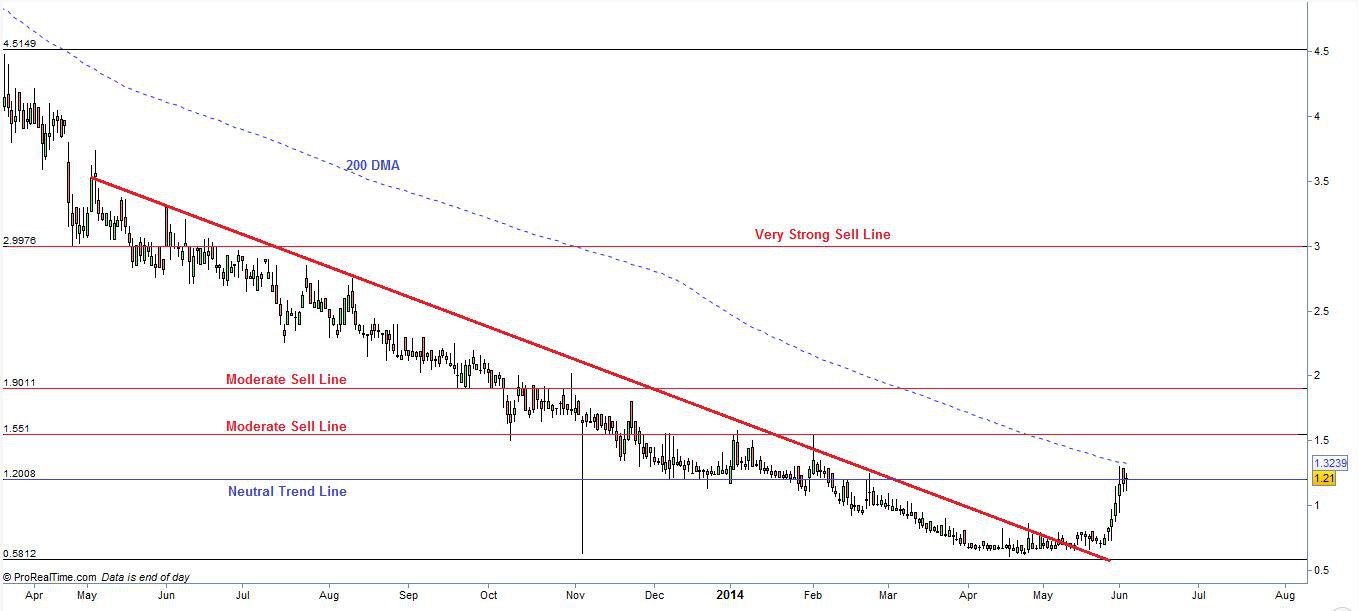
Als nächstes sollte mal die 200er Linie genommen werden...
die 200 TL ist nun durch, mal sehen ob es hier zu Reaktionen kommt
Antwort auf Beitrag Nr.: 47.107.176 von Sdrasdwutje am 05.06.14 11:33:27jede Intraday Kursrückgänge werden sofort aufgekauft, das ist ja unglaublich wie gut das aussieht 

Antwort auf Beitrag Nr.: 47.085.542 von TecDax am 02.06.14 12:59:03Aus der Sache (vorläufe Vereinbarung war Anfang 2012) ist damals nichts geworden.
LGO hat dann später 2012 eine Kapitalerhöhung durchgeführt, um Geld zu beschaffen.
http://www.lenigasandoil.com/rns-detail?id=11387061
6 November 2012
Termination of discussions on Goudron partnership
Leni Gas & Oil Plc today announces that it has formally advised Range Resources Limited that LGO is no longer seeking a partner for its Goudron Field in Trinidad.
Neil Ritson, LGO's Chief Executive, commented:
"LGO has successfully funded the acquisition of Goudron and raised working capital by disposing of its Gulf of Mexico assets this week and we now feel that selling up to 50% of Goudron for US$8m would seriously undervalue the asset. LGO has the skills within the Company to develop the proven and probable reserves of 7.2 million barrels and are currently focussing on that work."
LGO hat dann später 2012 eine Kapitalerhöhung durchgeführt, um Geld zu beschaffen.
http://www.lenigasandoil.com/rns-detail?id=11387061
6 November 2012
Termination of discussions on Goudron partnership
Leni Gas & Oil Plc today announces that it has formally advised Range Resources Limited that LGO is no longer seeking a partner for its Goudron Field in Trinidad.
Neil Ritson, LGO's Chief Executive, commented:
"LGO has successfully funded the acquisition of Goudron and raised working capital by disposing of its Gulf of Mexico assets this week and we now feel that selling up to 50% of Goudron for US$8m would seriously undervalue the asset. LGO has the skills within the Company to develop the proven and probable reserves of 7.2 million barrels and are currently focussing on that work."
partner niko resources ist gestern unter hohem volumen(1,4 mio shares) 33,5% in die höhe geschossen, und das ganz ohne meldung, da kommt was!
hi, in welcher Beziehung steht Niko zu Range?
Danke für Antwort
Danke für Antwort
heute noch die 2 p?
ich bin bald durch, wer hätte das gedacht, dass RRS so viel Freude macht, go for gold!
sf
ich bin bald durch, wer hätte das gedacht, dass RRS so viel Freude macht, go for gold!
sf
Börse London Stock Exchange
Aktuell 1,901 GBp
Zeit 09.06.14 10:10
Diff. Vortag +11,82%
Tages-Vol. 102,18 Mio.
Gehandelte Stück 52,88 Mio.
Geld 1,85
Brief 1,95
Zeit 09.06.14 10:05
Spread 5,13%
Geld Stk. 700.000
Brief Stk. 280.000
Schluss Vortag 1,70
Eröffnung 1,799
Hoch 2,038
Tief 1,655
52W Hoch 3,209
52W Tief 0,61
Split --
Aktuell 1,901 GBp
Zeit 09.06.14 10:10
Diff. Vortag +11,82%
Tages-Vol. 102,18 Mio.
Gehandelte Stück 52,88 Mio.
Geld 1,85
Brief 1,95
Zeit 09.06.14 10:05
Spread 5,13%
Geld Stk. 700.000
Brief Stk. 280.000
Schluss Vortag 1,70
Eröffnung 1,799
Hoch 2,038

Tief 1,655
52W Hoch 3,209
52W Tief 0,61
Split --
Antwort auf Beitrag Nr.: 47.124.940 von silbenfischen am 09.06.14 10:31:17am Freitag war das zweit größte Handelsvolumen jemals, sonst war nach solchen Tagen meist erstmal Schicht im Schacht, heute ist schonwieder plus, das macht extrem zuversichtlich, wer jetzt zu früh "Gewinne" mitnimmt, der könnte sich später ärgern
Nachdem eine drohende Zahlungsunfähigkeit und der damit verbundene Stillstand an allen Fronten beseitigt wurde, konzentriert sich die Börse wieder auf die real vorhandenen Chancen der Assets.
Die 1,90 allerdings scheint sich erst mal zu einer heute nicht mehr zu knackenden Widerstandslinie zu entwickeln...
Hier ist Geduld für zwei Jahre gefragt und egal wie hoch der Kurs sein wird, vor den Bohrungen in Puntland verkaufe ich hier kein Stück...
Die 1,90 allerdings scheint sich erst mal zu einer heute nicht mehr zu knackenden Widerstandslinie zu entwickeln...
Hier ist Geduld für zwei Jahre gefragt und egal wie hoch der Kurs sein wird, vor den Bohrungen in Puntland verkaufe ich hier kein Stück...
http://www.iii.co.uk/investment/detail/?showthreads=0&code=c…" target="_blank" rel="nofollow ugc noopener">http://www.iii.co.uk/investment/detail/?showthreads=0&code=c…
Hi Neilio,
I'm not sure if you are new to Range or not so just wanted to clear up a few points for you.
Firstly
Ranges main asset is Trinidad and with the new LandOcean deal said to be worth $400 million over the next 8 years it looks like this could be a real gem.
Range has struggled to increase production in Trinidad and its teams/rigs haven't performed how they should. LandOceans skill set should help this (go read up)
Secondly
When you talk about trust and you relate to this article this is all to do with old management (who is said to be heading out the doors) ie Peter Landau. We have had new management for a while now and back in March it was clear that we where all told about the Citation shares
Page 14 of the half yearly report
"During the period, as per agreement, Range received shares in Citation Resources Limited (ASX: CTR) as settlement for loans
advance by Range with respect to the Guatemalan project. 100m CTR shares are held in trust as security against borrowings."
Thirdly
Range has risen someway but it was way overvalued, my only suggestion is work out the value of the company from its assets and what it owns as well as its current deals with LandOcean and how much it wants to get to divest other assets.
Once you have worked out the value work out the MCap....!
Four
AIM and both the FCA have had a lot more detail than the letter from Ben and have chosen to either not investigate or already closed investigations.
Five
The person/s writing these articles and from this site have stated range is a sell from 0.6p so judge by that. As well as the sell they currently have on Mothercare (ooops)
Good on you if you have taken profit, thats why we are all on AIM to take profits. I believe you have taken them way to early but we shall see.
In my view the company is valued around 3 to 3.5p without some of the big news that needs to flow
BOPD rates in trini
Georgia divestment
Texas divestment
any new deal with a OSP that may meanwe get new rigs
works to start on Niko/St Marys
Herrara drilling?
rig 8 has mobilised?
new directors (soon)
then we have Atzam #5.
If you invested purely on Atzam #5 why not just invest in CTR?
Hi Neilio,
I'm not sure if you are new to Range or not so just wanted to clear up a few points for you.
Firstly
Ranges main asset is Trinidad and with the new LandOcean deal said to be worth $400 million over the next 8 years it looks like this could be a real gem.
Range has struggled to increase production in Trinidad and its teams/rigs haven't performed how they should. LandOceans skill set should help this (go read up)
Secondly
When you talk about trust and you relate to this article this is all to do with old management (who is said to be heading out the doors) ie Peter Landau. We have had new management for a while now and back in March it was clear that we where all told about the Citation shares
Page 14 of the half yearly report
"During the period, as per agreement, Range received shares in Citation Resources Limited (ASX: CTR) as settlement for loans
advance by Range with respect to the Guatemalan project. 100m CTR shares are held in trust as security against borrowings."
Thirdly
Range has risen someway but it was way overvalued, my only suggestion is work out the value of the company from its assets and what it owns as well as its current deals with LandOcean and how much it wants to get to divest other assets.
Once you have worked out the value work out the MCap....!
Four
AIM and both the FCA have had a lot more detail than the letter from Ben and have chosen to either not investigate or already closed investigations.
Five
The person/s writing these articles and from this site have stated range is a sell from 0.6p so judge by that. As well as the sell they currently have on Mothercare (ooops)
Good on you if you have taken profit, thats why we are all on AIM to take profits. I believe you have taken them way to early but we shall see.
In my view the company is valued around 3 to 3.5p without some of the big news that needs to flow
BOPD rates in trini
Georgia divestment
Texas divestment
any new deal with a OSP that may meanwe get new rigs
works to start on Niko/St Marys
Herrara drilling?
rig 8 has mobilised?
new directors (soon)
then we have Atzam #5.
If you invested purely on Atzam #5 why not just invest in CTR?
Antwort auf Beitrag Nr.: 47.125.688 von TecDax am 09.06.14 14:16:23heute gabs wohl erstmal paar Gewinnmitnahmen, aber immerhin noch im plus. Heute ist auch der 8. Tag in Folge, wo der Kurs außerhalb vom Bollingerband läuft, sowas gabs bisher auch nie, auch nicht im Frühjahr 2011. Anhand des Verkaufsmomentum & Volumen steht auch die 3,85 von 2012 immernoch als die "negatiefste Stelle" im Chart (in verschiedenen Indikatoren) Diese Extremwerte sind danach nie mehr unterboten worden. So kann man auch den "wahren Boden" mit der 3,85 beziffern, abzüglich der Verwässerung danach. So müsste sich der Kurs eigenlich zwischen 3-4 Pence einpegeln, bevor es wieder eine Weile seitwärts geht.
Antwort auf Beitrag Nr.: 47.124.688 von silbenfischen am 09.06.14 09:29:42partner in trinidad!
wow, wow, wow: 30% up in Australia, wo zielt das hin?! up to the moon
1,50 war heute nochmal eine Kaufgelegenheit
Antwort auf Beitrag Nr.: 47.129.918 von Sdrasdwutje am 10.06.14 12:51:17wohl dem, der Mut und Reserven hatte.
sf
sf
 heute wohl bereits wieder 2 p, Mann o Mann, warum hab ich nur kein Kleingeld mehr
Antwort auf Beitrag Nr.: 47.133.954 von silbenfischen am 11.06.14 06:46:28man o man!
AU: 0,043!!!!!!!!!
AU: 0,043!!!!!!!!!
Antwort auf Beitrag Nr.: 47.134.048 von silbenfischen am 11.06.14 07:40:29Ihr erlaubt bitte alle, dass ich noch einmal kurz juble, ich werde heute noch mit einer Aktie im Plus stehen, bei der ich vor ca. 1 Monat noch 96% im Minus war und die so gut, wie abgeschrieben schien, ein Traum seit PL weg ist- na ja, verziehen, alles war auch nicht schlecht.
sf
sf
Antwort auf Beitrag Nr.: 47.134.098 von silbenfischen am 11.06.14 07:57:54das ist und wird die Mutter aller Erholungen, hört sich zwar erstmal bekloppt an, aber nach wie vor und jetzt besonders ist 23,5 Pence immernoch mein Ziel. 

Antwort auf Beitrag Nr.: 47.134.212 von Sdrasdwutje am 11.06.14 08:27:26wäre genial! ich für mein Teil habe leider zu früh gejubelt, boingggg, autsch- war mal wieder das mit dem zerlegten Fell des nicht geschossenen Bären aber wir sind ja tierlieb und Bären gibt es auch immer weniger insbesondere bei RRS!
Antwort auf Beitrag Nr.: 47.134.666 von silbenfischen am 11.06.14 09:43:58besonders wenn der Jäger nichtmal im Wald war 
in Sindney war es vom Tief immerhin vervierfacht heute Morgen, da kann es auch mal wieder runter gehen, aber wenn die Kammeraden das Öl in Trinidad aus der Erde bekommen, wird sich die 23 Pence wohl kaum vermeiden lassen, wenn nicht wieder eine Katastrophe dazwischen kommt

in Sindney war es vom Tief immerhin vervierfacht heute Morgen, da kann es auch mal wieder runter gehen, aber wenn die Kammeraden das Öl in Trinidad aus der Erde bekommen, wird sich die 23 Pence wohl kaum vermeiden lassen, wenn nicht wieder eine Katastrophe dazwischen kommt
Antwort auf Beitrag Nr.: 47.135.696 von Sdrasdwutje am 11.06.14 11:50:29Landau hatte den Wert von TT mal mit 15 GBp beziffert.
Da hatten wir allerdings auch nur die Hälfte der Aktien im Umlauf...
TT&Puntland zusammen,bei optimalem Verlauf,könnten die Aktie da wieder hinbringen!
Da hatten wir allerdings auch nur die Hälfte der Aktien im Umlauf...
TT&Puntland zusammen,bei optimalem Verlauf,könnten die Aktie da wieder hinbringen!
Antwort auf Beitrag Nr.: 47.135.878 von TecDax am 11.06.14 12:15:42ein statement von Trabucon im iii-Board zur erneut geplanten Verwässerung stimmt mich etwas nachdenklich,
was meinen Tec* Stras* and others?
sf
was meinen Tec* Stras* and others?
sf
Antwort auf Beitrag Nr.: 47.137.538 von silbenfischen am 11.06.14 16:10:21möglich wäre es natürlich, aber solchen Kommentaren gegenüber würde ich erstmal skeptisch sein, nicht selten werden solche Boards von "insidern" missbraucht, um andere Leute dazu zu bringen ihre Aktien zu verkaufen. Was das minus heute betrifft , dürfte absolut normal sein, nach Verdreifachung wird erstmal reingeschlagen. Dieses Kaufmomentum wird mit Sicherheit nicht wieder in sich zusammenfallen, nach paar Tagen Pause sollte die 3,xx Pence auf der Agenda stehen und von dort aus muss man sehen was dann ansteht
Antwort auf Beitrag Nr.: 47.140.024 von Sdrasdwutje am 11.06.14 22:24:38ja, natürlich gut möglich, dass Du Recht hast und ich hoffe so. Allerdings scheint mir der erwähnte Poster für die von Dir beschriebenen taktischen Manöver eher unverdächtig- ich hab da so ein psychologisches Näschen für die Papp-Kameraden aber schaun wer mal.

Antwort auf Beitrag Nr.: 47.141.224 von silbenfischen am 12.06.14 09:25:21ob das so einer ist, habe ich mir nicht so genau angesehen, bei anderen die ich schonmal beobachtet hatte, erscheinen die auf jeden Fall etwas fundiert zu sein, aber mit der Penetranz der Verkaufsempfehlung machen die sich dann meist verdächtig. Dort sind auch ab und zu paar "Pusher" für andere Aktien aufgetaucht und diese Aktien haben ich dann immer beobachtet, meist sind sie dann immer gefallen, also der Grund des auftauchens war dann wohl offensichtlich.
habe ebend in London nochmal für 1,43 paar gekauft, für mich ist das klar Kursziel erstmal 3,xx.....kann höchstens sein, daß es 4-6 Wochen dauert
habe ebend in London nochmal für 1,43 paar gekauft, für mich ist das klar Kursziel erstmal 3,xx.....kann höchstens sein, daß es 4-6 Wochen dauert
Antwort auf Beitrag Nr.: 47.141.902 von Sdrasdwutje am 12.06.14 10:54:28hab auch nochmal nachgelegt bei 1,46, Du bist vorne, gratuliere,
luck for both of us!
luck for both of us!
Antwort auf Beitrag Nr.: 47.142.792 von silbenfischen am 12.06.14 13:08:30gratuliern können wir uns erst wenn wir verkauft haben , so wie mit dem Fell
Antwort auf Beitrag Nr.: 47.143.316 von Sdrasdwutje am 12.06.14 14:45:32so isses isn't it aber gelebt, gelacht und geliebt wird immer nur im Augenblick, selbst der Erfolg ist auf die lange Sicht eher langweilig, also carpe diem und heute haben wir zumindest mal wieder verbilligt, falls....

Antwort auf Beitrag Nr.: 47.144.118 von silbenfischen am 12.06.14 16:52:56
1,30 ist die 50% Retracement, absolut üblich und gesund bei AIM Aktien
die 50% und die 200er TL sollten die Basis bilden für den nächsten Aufwärtsschub
1,30 ist die 50% Retracement, absolut üblich und gesund bei AIM Aktien
die 50% und die 200er TL sollten die Basis bilden für den nächsten Aufwärtsschub
Tschüß Peter Landau. ..
ein rasanter Paradigmenwechsel, Respekt, Respekt, jetzt noch ein paar facts, dass die neue Richtung stimmt aber dann, aber dann!
Trinidad Operations Update and Increase in Reserves
http://www.asx.com.au/asxpdf/20140616/pdf/42q6xrxh7vm9cv.pdf
http://www.asx.com.au/asxpdf/20140616/pdf/42q6xrxh7vm9cv.pdf
http://www.asx.com.au/asxpdf/20140619/pdf/42q9kybdmyq4pg.pdf" target="_blank" rel="nofollow ugc noopener">http://www.asx.com.au/asxpdf/20140619/pdf/42q9kybdmyq4pg.pdf
Antwort auf Beitrag Nr.: 47.173.972 von silbenfischen am 19.06.14 07:55:24schön zu sehen wie an der 200er TL immer wieder gekauft wird, spätestens wenn die anderen Durschschnitte etwas hoch gekommen sind, dürfte der nächste Schub kommen
Antwort auf Beitrag Nr.: 47.186.030 von Sdrasdwutje am 20.06.14 19:32:53im ii-Board wird neuerdings diskutiert, dass Shell bzgl. Puntland wieder in's Spiel kommen könnte. Das würde sicher der Angelegenheit wieder auf die Sprünge helfen
Puntland besteht hier auf seine Eigenständigkeit und läßt sich nicht von der somalischen Regierung reinreden...
http://www.garoweonline.com/artman2/publish/Somalia_27/Somal…
http://www.garoweonline.com/artman2/publish/Somalia_27/Somal…
bei Range geht die Konsolidierungsformation sogar noch schräg nach oben, das sind völlig ungewohnte Vorgehensweisen, ist aber fast das bullischste was es überhaupt gibt, mal sehen wie lange es noch dauert bis zum Ausbruch
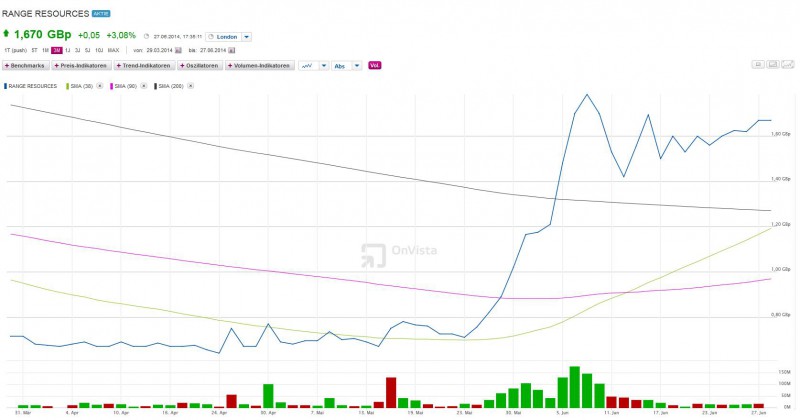
@Sdrasdwutje:
Bahnt sich hier das "Golden Cross" an???
Antwort auf Beitrag Nr.: 47.227.680 von TecDax am 29.06.14 02:51:27bis jetzt sieht es so aus, auf jeden Fall ist es eine sehr starke Konsolidierungsformation, normalerweise gehen solche Flaggen immer schräg nach unten, wenn solche Flaggen schräg nach oben gehen, ist das extrem bullisch
Antwort auf Beitrag Nr.: 47.229.890 von Sdrasdwutje am 29.06.14 23:35:13sieht so aus, daß die den Deckel nicht mehr lange halten können
Antwort auf Beitrag Nr.: 47.234.466 von Sdrasdwutje am 30.06.14 17:10:24http://www.malcysblog.com/2014/06/tip-tv-highlight-3-june-20…
bei 3,40 fängt RRL an
bei 3,40 fängt RRL an
Antwort auf Beitrag Nr.: 47.239.896 von Sdrasdwutje am 01.07.14 13:43:22es steigt zwar nicht dramatisch, aber jeden Tag wird ein neues Tageshoch gemacht seit den letzten 3 Wochen, im Moment läuft es genau umgekehrt als die ganzen Monate vorher
Antwort auf Beitrag Nr.: 47.245.534 von Sdrasdwutje am 02.07.14 10:46:33sieht ja geradezu wie eine cup and handle-Formation aus, wenn die 2 p sich nicht als Angstschwelle erweisen,
hoffen wir mal
sf
hoffen wir mal
sf
Jetzt noch das "Golden - Cross" und dann kommt auch wieder Volumen in das Teil
Antwort auf Beitrag Nr.: 47.251.120 von TecDax am 03.07.14 03:10:33Gerüchte, weiss jemand mehr?
Anbeglich soll Georgia für $55m verkauft werden, lt. discussthemarket
Jespere
Anbeglich soll Georgia für $55m verkauft werden, lt. discussthemarket
Jespere
Antwort auf Beitrag Nr.: 47.253.346 von Jespere am 03.07.14 12:00:20wäre schön. derzeitige MK $150m...
Der SMA 38 durchbricht von unten nach oben den SMA 200
Das könnte vielleicht den heutigen Anstieg mit erklären.
Vielleicht kann uns Sdrasdwutje dazu was sagen.
Kurs gerade auf 2.25 GBp gesprungen,10% höher,nicht schlecht die Performance der letzten Tage...
Das könnte vielleicht den heutigen Anstieg mit erklären.
Vielleicht kann uns Sdrasdwutje dazu was sagen.
Kurs gerade auf 2.25 GBp gesprungen,10% höher,nicht schlecht die Performance der letzten Tage...
Antwort auf Beitrag Nr.: 47.254.362 von TecDax am 03.07.14 13:55:07wie gesagt, eine Konsolidierungsformation, wo es sonst meist leicht schräg nach unten geht, dagegen dafür schräg hoch geht ist fast immer ein Anzeichen von enormen Kaufdruck
zum ersten Mal stehe ich mit diesem Wert im Plus und das nachdem ich zeitweise einen 25-Facher benötigt hätte, also ich bin einfach nur sprachlos
http://www.rangeresources.co.uk/framework/documents/displayd…
leider weitere Verwässerung, mal sehen, ob's das schon verträgt
leider weitere Verwässerung, mal sehen, ob's das schon verträgt

Antwort auf Beitrag Nr.: 47.261.098 von silbenfischen am 04.07.14 12:43:03langsam kommt die 3 P in greifbare Nähe
"Repsol has discovered hydrocarbons in its TB14 well in the TSP block offshore Trinidad and Tobago, east of the Island of Trinidad."sf
bei der 1,61 ist eine "Positivlinie", diese sollte eigenlich halten, von hier wird der nächste Aufwärtsschub vorbereitet, wenn er denn kommen sollte
Politisch gibt es momentan nur "Negativlinien", dies wird uns wohl noch eine Weile beschäftigen.
Allerdings ist jetzt hier auch mal wieder gut mit abwärts.Wir sind unter hohem Volumen bis auf über 2,60 gelaufen und haben jetzt unter niedrigem Volumen bis auf 1,60 korrigiert.Nachdem jetzt einige ihre 100% - 300% realisiert haben,
müßte ja mal wieder der eigentliche Wert an Assets gehandelt werden.
Was fehlt ist der klare Anstieg von BOPD...
Allerdings ist jetzt hier auch mal wieder gut mit abwärts.Wir sind unter hohem Volumen bis auf über 2,60 gelaufen und haben jetzt unter niedrigem Volumen bis auf 1,60 korrigiert.Nachdem jetzt einige ihre 100% - 300% realisiert haben,
müßte ja mal wieder der eigentliche Wert an Assets gehandelt werden.
Was fehlt ist der klare Anstieg von BOPD...
wenn die heute bei oder über 1,61 schließen, dann sind das gute Vorzeichen
Ich denke, alles ist abhängig von den nächsten Produktionszahlen.
Erst wenn die sich Richtung 1000BOPD bewegen, müssen wir nicht um jeden halben Cent bangen.
Schönes WE
Erst wenn die sich Richtung 1000BOPD bewegen, müssen wir nicht um jeden halben Cent bangen.
Schönes WE
Irgendwie setze ich auf den jetzigen CEO. Wenn einer den Kurs bewegen kann, dann...nur die Frage wann. Seit 2007 bin ich investiert in Range. Der Artikel stammt von proactiveinvestor. Es wird gefördert, aber n.n.die 1000bopd wie silbenfischen richtig erwähnt/fordert.
Durchhalten, Jespere.
UPDATE - Range Resources eingestellt Linie unter IOP Darlehen zeichnen
Durch Giles Gwinnett 4. August 2014, 10.54 Uhr Nach diesem Verkauf wird IOP machen ein Cash-Rückzahlung von 500.000 US-Dollar, um Reichweite und alle anderen ausstehenden Gelder werden in Stammaktien der IOP konvertierenNach diesem Verkauf wird IOP eine Geldrückzahlung 500.000 US-Dollar machen, um Reichweite und alle anderen ausstehenden Gelder werden in Stammaktien der IOP konvertieren
- Fügt Broker Kommentar -
Range Resources (LON: RRL, ASX: RRS ) auf eine Linie unter seinem US $ 8mln Darlehensvertrag mit ziehen International Petroleum (IOP).
Im Rahmen ihrer gescheiterten Fusion im letzten Jahr, Bereich verliehen das Geld nach Australien notierten IOP mit dem Darlehen zur Rückzahlung fällig mit Interesse am 30. April dieses Jahres.
Jetzt, Reichweite hat beschlossen, den Zahlungstermin bis zum 30. November zu verlängern, damit IOP, um den Verkauf ihrer russischen Aktiva abzuschließen.
Nach diesem Verkauf wird IOP machen ein Cash-Rückzahlung von 500.000 US-Dollar, um Reichweite und alle anderen ausstehenden Gelder werden in Stammaktien der IOP konvertieren.
Bereich hält dann rund 9% der IOP mit zusätzlichen 5 Millionen IOP Optionen ausübbar zu 0,06 $ in 24 Monaten ab Ausgabedatum.
Bereich Chief Executive Rory Scott Russell sagte: "Unser Ziel bei den Verhandlungen mit IOP war eindeutig, so viel Wert aus dieser schwierigen Situation wie möglich zu erholen.
"Ich glaube, unser Ziel, mit dieser erfolgreichen wirtschaftlichen Erfolg erfüllt.
IOP hält ein internationales Portfolio von Explorations-und Produktionslizenzen, darunter eine große Fläche Position in Niger, einem sehr aussichtsreichen und untersucht Land mit erheblichen Onshore-Ölpotenzial.
"Ich freue mich, dass das neue Team im Bereich kann einen Schlussstrich unter das, was war ein schwieriges Geschäft zu ziehen und konzentrieren unsere ganze Aufmerksamkeit auf unsere Aktivitäten in Trinidad."
In London frühen Angebote, Schuppen Bereich Aktien 0,65% auf 1.54p.
Broker Cantor Fitzgerald fügte hinzu, dass Bereich Management-Team weiterhin auf Aufklärung bis alle noch offenen Fragen von ihren Vorgängern links und, dass diese Lösung für IOP wieder so viel Wert aus dieser Situation wie möglich zu konzentrieren.
"Mit IOP Marktkapitalisierung bei A $ 71 Mio. (vor der Aussetzung des Handels), ist 9% des Aktienkapitals im Wert von A $ 6,4 Mio. sein, aber es gibt immer noch wichtige Meilensteine zu passieren (einschließlich dem Verkauf von Vermögenswerten), bis das sein kann realisiert. "
Kaufen mit einem Kursziel von 3.7p schlägt der Broker.
Durchhalten, Jespere.
UPDATE - Range Resources eingestellt Linie unter IOP Darlehen zeichnen
Durch Giles Gwinnett 4. August 2014, 10.54 Uhr Nach diesem Verkauf wird IOP machen ein Cash-Rückzahlung von 500.000 US-Dollar, um Reichweite und alle anderen ausstehenden Gelder werden in Stammaktien der IOP konvertierenNach diesem Verkauf wird IOP eine Geldrückzahlung 500.000 US-Dollar machen, um Reichweite und alle anderen ausstehenden Gelder werden in Stammaktien der IOP konvertieren
- Fügt Broker Kommentar -
Range Resources (LON: RRL, ASX: RRS ) auf eine Linie unter seinem US $ 8mln Darlehensvertrag mit ziehen International Petroleum (IOP).
Im Rahmen ihrer gescheiterten Fusion im letzten Jahr, Bereich verliehen das Geld nach Australien notierten IOP mit dem Darlehen zur Rückzahlung fällig mit Interesse am 30. April dieses Jahres.
Jetzt, Reichweite hat beschlossen, den Zahlungstermin bis zum 30. November zu verlängern, damit IOP, um den Verkauf ihrer russischen Aktiva abzuschließen.
Nach diesem Verkauf wird IOP machen ein Cash-Rückzahlung von 500.000 US-Dollar, um Reichweite und alle anderen ausstehenden Gelder werden in Stammaktien der IOP konvertieren.
Bereich hält dann rund 9% der IOP mit zusätzlichen 5 Millionen IOP Optionen ausübbar zu 0,06 $ in 24 Monaten ab Ausgabedatum.
Bereich Chief Executive Rory Scott Russell sagte: "Unser Ziel bei den Verhandlungen mit IOP war eindeutig, so viel Wert aus dieser schwierigen Situation wie möglich zu erholen.
"Ich glaube, unser Ziel, mit dieser erfolgreichen wirtschaftlichen Erfolg erfüllt.
IOP hält ein internationales Portfolio von Explorations-und Produktionslizenzen, darunter eine große Fläche Position in Niger, einem sehr aussichtsreichen und untersucht Land mit erheblichen Onshore-Ölpotenzial.
"Ich freue mich, dass das neue Team im Bereich kann einen Schlussstrich unter das, was war ein schwieriges Geschäft zu ziehen und konzentrieren unsere ganze Aufmerksamkeit auf unsere Aktivitäten in Trinidad."
In London frühen Angebote, Schuppen Bereich Aktien 0,65% auf 1.54p.
Broker Cantor Fitzgerald fügte hinzu, dass Bereich Management-Team weiterhin auf Aufklärung bis alle noch offenen Fragen von ihren Vorgängern links und, dass diese Lösung für IOP wieder so viel Wert aus dieser Situation wie möglich zu konzentrieren.
"Mit IOP Marktkapitalisierung bei A $ 71 Mio. (vor der Aussetzung des Handels), ist 9% des Aktienkapitals im Wert von A $ 6,4 Mio. sein, aber es gibt immer noch wichtige Meilensteine zu passieren (einschließlich dem Verkauf von Vermögenswerten), bis das sein kann realisiert. "
Kaufen mit einem Kursziel von 3.7p schlägt der Broker.
Antwort auf Beitrag Nr.: 47.432.674 von Jespere am 05.08.14 12:05:53Sorry, ich meinte pokercreek.
Jespere
Jespere
Antwort auf Beitrag Nr.: 47.432.713 von Jespere am 05.08.14 12:08:29Hier sieht´s aber momentan zappenduster aus. Keinerlei Lebenszeichen, weder vom Kurs noch von den "Rangern".
Antwort auf Beitrag Nr.: 47.643.345 von OpaUnger am 29.08.14 12:27:58warten auf Godot, oder vielmehr essential news
sf

sf
Antwort auf Beitrag Nr.: 47.643.345 von OpaUnger am 29.08.14 12:27:58sieht jetzt extrem nach Boden aus, anders gesagt, es wird das nächse "leg up" vorbereitet
Antwort auf Beitrag Nr.: 47.664.777 von Sdrasdwutje am 01.09.14 18:38:29Ja, erstaunlich was da so passiert. Das engl.Forum eher ein gegeneinander. Ein witziger Kommentar:
Thecheggy
11:05
Re: Well... Our time will come - Just need a little more time... I'm giving it 5 years from here...
Momentan ist es mehr ein "Bein ab" als up. Momentan sieht es nur in Trini vernünftig aus 569 bopd mit Verdopplungsaussichten lt. Kommentar
Gruß Jespere
Thecheggy
11:05
Re: Well... Our time will come - Just need a little more time... I'm giving it 5 years from here...
Momentan ist es mehr ein "Bein ab" als up. Momentan sieht es nur in Trini vernünftig aus 569 bopd mit Verdopplungsaussichten lt. Kommentar
Gruß Jespere
Antwort auf Beitrag Nr.: 47.764.650 von Jespere am 12.09.14 12:35:56ja, im Moment eher Bein ab, im Abwärtstrend haben sie halt mehr Erfahrung als im steigen 

Notice of Annual Financial Report & Audiocast
Range announces that its Annual Financial Report for the year ended 30 June 2014 will be published on Tuesday, 30 September 2014.
The Company will be providing an audiocast which can be accessed on its website (www.rangeresources.co.uk) from 07:00 BST on Tuesday, 30 September 2014.
Within the audiocast, the senior management team will provide a summary and overview of the Company’s activities and operations.
Range announces that its Annual Financial Report for the year ended 30 June 2014 will be published on Tuesday, 30 September 2014.
The Company will be providing an audiocast which can be accessed on its website (www.rangeresources.co.uk) from 07:00 BST on Tuesday, 30 September 2014.
Within the audiocast, the senior management team will provide a summary and overview of the Company’s activities and operations.
Antwort auf Beitrag Nr.: 47.884.985 von sailor888 am 26.09.14 14:44:27what is'n dat?
0.8000
Today's low: 1.2200
Sell RRL
4.0300
Today's high: 1.5165
Buy RRL
Last trade:
1.4750
Change:
0.2200 (17.52%)
Volume:
18,590,834
Delayed price:
14:25:12
checkt da einer durch?
sf
0.8000
Today's low: 1.2200
Sell RRL
4.0300
Today's high: 1.5165
Buy RRL
Last trade:
1.4750
Change:
0.2200 (17.52%)
Volume:
18,590,834
Delayed price:
14:25:12
checkt da einer durch?
sf
Mittlerweile korrigiert. Lapsus
Gruß Jespere
Börse London Stock Exchange
Aktuell 1,5332 GBp
Zeit 26.09.14 16:34
Diff. Vortag +22,17%
Tages-Vol. 39,26 Mio.
Gehandelte Stück 28,18 Mio.
Geld 1,41
Brief 1,55
Zeit 26.09.14 16:33
Spread 9,03%
Geld Stk. 182.000
Brief Stk. 800.000
Schluss Vortag 1,255
Eröffnung 1,25
Hoch 1,5168
Tief 1,22
52W Hoch 2,70
52W Tief 0,61
Split
Gruß Jespere
Börse London Stock Exchange
Aktuell 1,5332 GBp
Zeit 26.09.14 16:34
Diff. Vortag +22,17%
Tages-Vol. 39,26 Mio.
Gehandelte Stück 28,18 Mio.
Geld 1,41
Brief 1,55
Zeit 26.09.14 16:33
Spread 9,03%
Geld Stk. 182.000
Brief Stk. 800.000
Schluss Vortag 1,255
Eröffnung 1,25
Hoch 1,5168
Tief 1,22
52W Hoch 2,70
52W Tief 0,61
Split
Antwort auf Beitrag Nr.: 47.886.635 von Jespere am 26.09.14 16:53:00nichts für schwache Nerven, da spart man dann auch noch gleich seinen "Tatort"!
sf
sf
Trading Halt!
(Zumindest an der ASX)
(Zumindest an der ASX)
Antwort auf Beitrag Nr.: 47.895.335 von TecDax am 29.09.14 04:26:14In London wird wohl gehandelt:
http://de.advfn.com/p.php?pid=staticchart&s=L^RRL&p=0&t=32&v…
http://de.advfn.com/p.php?pid=staticchart&s=L^RRL&p=0&t=32&v…
Antwort auf Beitrag Nr.: 47.896.088 von sailor888 am 29.09.14 09:04:49na bravo, das war's wohl

Antwort auf Beitrag Nr.: 47.907.692 von silbenfischen am 30.09.14 13:19:07in Frankfurt geht es jedenfalls aufwärts
Antwort auf Beitrag Nr.: 47.910.206 von Sdrasdwutje am 30.09.14 16:52:24heute einer der 5 stärksten Volumentage überhaupt, und das bei fetten minus, das sieht nicht besonders gut aus
Das sieht ehrlich gesagt beschi..en aus.
Wo ist nur das ganze Geld von Range hin??
Die 1000 bopd bis Ende 2014 können wir auch vergessen.
Also keine gute Zukunft für unser Investment, leider auch mit den neuen Köpfen nicht.
Solange allerdings noch jemand Geld gibt,besteht Hoffnung.
Oder jemand übernimmt den Laden für 1Dollar.
Wo ist nur das ganze Geld von Range hin??
Die 1000 bopd bis Ende 2014 können wir auch vergessen.
Also keine gute Zukunft für unser Investment, leider auch mit den neuen Köpfen nicht.
Solange allerdings noch jemand Geld gibt,besteht Hoffnung.
Oder jemand übernimmt den Laden für 1Dollar.
Kann Jemand mal die News posten? Danke...
Antwort auf Beitrag Nr.: 47.922.809 von ooy am 01.10.14 18:18:57

Antwort auf Beitrag Nr.: 48.031.186 von OpaUnger am 14.10.14 14:02:46Rangers, ca va?
natürlich bin ich auch entsetzt was da abläuft. Aber, der neue CEO SR wills richten. Ich bleib drin, was auch sonst. PL hat nur investiert aber wohin, Somalia war ja der Hammer!
October 01 2014, 3:27pm 'With the financing secured our first priority is to get rigs working to full capacity, and we’ll start improving production.'"With the financing secured our first priority is to get rigs working to full capacity, and we’ll start improving production."
The US$15mln financing deal unveiled by Range Resources (LON:RRL) will start to put right years of under investment in the company’s Trinidad operations, according to chief executive Rory Scott Russell.
Speaking with Proactive Investors Scott Russell said Tuesday’s results and the financing represents a final line in the sand between Range and what he hopes will be viewed as legacy problems.
“We’re drawing the line here. We had to get everything out there warts and all (the annual results). There’s no more talk of a new beginning after this.”
Scott Russell says steering the company in the months since taking over, in February, has been quite a challenge but now he is confident that the group’s difficulties can be overcome and the business will be able to move forward on a more cost efficient basis.
“Really the problem has simply been years of under investment, something which the secured financing addresses. It is not like we’re trying to drill something that might not exist or having to downgrade reserves or lost a licence or something like that.
“The production target is a few months delayed, mainly because it took longer to find the appropriate financing.
“But, despite the disappointment, the encouraging thing is we’ve got a profitable business here.
“Our Trinidad business was profitable on an EBITDA basis generated positive net operating cash flow, which highlights the underlying strength of our Trinidad business and the potential that exists to grow.
“There are a few profitable AIM businesses out there, and I hope we’ll soon be recognised as being one of them.”
New York based investment group Lind Asset Management is lending Range up to US$15mln, starting with US$10mln which can be added to in about six months’ time. Range will have the option to either repay Lind in either cash or shares, and the repayment amount for full US$15mln loan will total US$18.375mln.
Range also reported a US$65mln loss from continuing operations - it made non-cash write-offs totalling US$24.5mln and revealed US$22mln of finance costs.
The gross loss for the year was US$3.2mln.
Scott Russell expects Range’s rigs will soon be turning around the clock in Trinidad, following the investment into the fleet, and as a result he expects production to ramp up to the 1,000 barrel a day target in the first half of 2015.
Once there, the operation will be approaching something close to optimal performance with improved cost management enhancing cash-flows further.
“Our costs are going to be much slimmer. It is a case of building a strong business. So now, with the financing secured our first priority is to get rigs working to full capacity, and we’ll start improving production.
“What this financing will enable us to do is really kick start production growth now.
“We could’ve gone for bigger numbers [in the financing] and all kinds of different structures, but after we undertook a detailed review of all available options, we firmly believe that this facility is the most appropriate and attractive option for us at this moment in terms.
“It provides the company with flexible, medium-term financing can be repaid at any time and has limited security most importantly with Trinidad remaining unencumbered.
“Our problem was not about oil, we have plenty of oil. It has just been a question of financing. Without enough money we couldn’t really do anything.
“Now it’s all down to the delivery.”
Jespere
natürlich bin ich auch entsetzt was da abläuft. Aber, der neue CEO SR wills richten. Ich bleib drin, was auch sonst. PL hat nur investiert aber wohin, Somalia war ja der Hammer!
October 01 2014, 3:27pm 'With the financing secured our first priority is to get rigs working to full capacity, and we’ll start improving production.'"With the financing secured our first priority is to get rigs working to full capacity, and we’ll start improving production."
The US$15mln financing deal unveiled by Range Resources (LON:RRL) will start to put right years of under investment in the company’s Trinidad operations, according to chief executive Rory Scott Russell.
Speaking with Proactive Investors Scott Russell said Tuesday’s results and the financing represents a final line in the sand between Range and what he hopes will be viewed as legacy problems.
“We’re drawing the line here. We had to get everything out there warts and all (the annual results). There’s no more talk of a new beginning after this.”
Scott Russell says steering the company in the months since taking over, in February, has been quite a challenge but now he is confident that the group’s difficulties can be overcome and the business will be able to move forward on a more cost efficient basis.
“Really the problem has simply been years of under investment, something which the secured financing addresses. It is not like we’re trying to drill something that might not exist or having to downgrade reserves or lost a licence or something like that.
“The production target is a few months delayed, mainly because it took longer to find the appropriate financing.
“But, despite the disappointment, the encouraging thing is we’ve got a profitable business here.
“Our Trinidad business was profitable on an EBITDA basis generated positive net operating cash flow, which highlights the underlying strength of our Trinidad business and the potential that exists to grow.
“There are a few profitable AIM businesses out there, and I hope we’ll soon be recognised as being one of them.”
New York based investment group Lind Asset Management is lending Range up to US$15mln, starting with US$10mln which can be added to in about six months’ time. Range will have the option to either repay Lind in either cash or shares, and the repayment amount for full US$15mln loan will total US$18.375mln.
Range also reported a US$65mln loss from continuing operations - it made non-cash write-offs totalling US$24.5mln and revealed US$22mln of finance costs.
The gross loss for the year was US$3.2mln.
Scott Russell expects Range’s rigs will soon be turning around the clock in Trinidad, following the investment into the fleet, and as a result he expects production to ramp up to the 1,000 barrel a day target in the first half of 2015.
Once there, the operation will be approaching something close to optimal performance with improved cost management enhancing cash-flows further.
“Our costs are going to be much slimmer. It is a case of building a strong business. So now, with the financing secured our first priority is to get rigs working to full capacity, and we’ll start improving production.
“What this financing will enable us to do is really kick start production growth now.
“We could’ve gone for bigger numbers [in the financing] and all kinds of different structures, but after we undertook a detailed review of all available options, we firmly believe that this facility is the most appropriate and attractive option for us at this moment in terms.
“It provides the company with flexible, medium-term financing can be repaid at any time and has limited security most importantly with Trinidad remaining unencumbered.
“Our problem was not about oil, we have plenty of oil. It has just been a question of financing. Without enough money we couldn’t really do anything.
“Now it’s all down to the delivery.”
Jespere
wow range heute 1000% in Frankfurt, sowas habe ich mir schon immer gewünscht im Depot zu haben
Antwort auf Beitrag Nr.: 48.066.859 von Sdrasdwutje am 17.10.14 14:39:54Nur haettest Du Nix zu 0,001 bekommen, das waere dein Problem, unter vielen Anderen...
Antwort auf Beitrag Nr.: 48.069.676 von ooy am 17.10.14 18:48:21Spielverderber , must einem ja nicht immer aus Träumen rausreißen
die 0,85 wird scheinbar seit Tagen gehalten, könnte sich hier ein großer Doppelboden abzeichnen, dafür war es wichtig, daß die nicht wieder bei 0,75 rumgeeiert sind. Jetzt muss nur ein Katalysator her und dann kann es relativ schnell wieder auf 2,6X
Hallo Sdrasdwutje,
ich denke, bei der Aktie kannst Du mit charttechnischen Betrachtungen gegenwärtig keine Vorhersagen mehr machen. RRL ist außer Rand und Band, den Rest zerreden die III-Kommentatoren.PL hat sich regelrecht "kriminell" verhalten. Das neue Management ist mit der Prognose von 1000BOPD bis Jahresende angetreten und hat dies bereits wegen fehlender Ausrüstung auf 2015 verschoben. Kein vertrauensbildender Schritt. Ansonsten denke ich die sind auf einem besseren Weg als vorher, mit der Entsorgung der personellen und sonstigen Altlasten.
Was bleibt uns also, außer auf bessere Zeiten zu warten. Ist auch egal, ob 98% Verlust, oder 100%, oder als Langzeitinvestment eine schwarze Null.
An Gewinn kann ich z.Z. nicht denken.
Schönes WE
ich denke, bei der Aktie kannst Du mit charttechnischen Betrachtungen gegenwärtig keine Vorhersagen mehr machen. RRL ist außer Rand und Band, den Rest zerreden die III-Kommentatoren.PL hat sich regelrecht "kriminell" verhalten. Das neue Management ist mit der Prognose von 1000BOPD bis Jahresende angetreten und hat dies bereits wegen fehlender Ausrüstung auf 2015 verschoben. Kein vertrauensbildender Schritt. Ansonsten denke ich die sind auf einem besseren Weg als vorher, mit der Entsorgung der personellen und sonstigen Altlasten.
Was bleibt uns also, außer auf bessere Zeiten zu warten. Ist auch egal, ob 98% Verlust, oder 100%, oder als Langzeitinvestment eine schwarze Null.
An Gewinn kann ich z.Z. nicht denken.
Schönes WE
So ist es Pokercreek.Hier ist über die Jahre das Vertrauen der Anleger vollständig zerstört worden und auch das neue Management muß nach einer kurzen guten Anfangsphase schon wieder Rückschläge hinnehmen.Es hört nicht auf mit weiterer Verwässerung durch immer neue Ausgabe von Aktien und die versprochenen
kurzfristigen Ziele wurden auch schon wieder kassiert.
Wie man es in Trinidad macht,zeigt uns momentan eindrücklich LGO.
Wir sitzen auf riesigen Reserven und sind unfähig sie aus dem Boden zu kriegen.
Wir haben uns auf der ganzen Welt verzettelt und Kohle investiert die wir nie wieder sehen werden.
Bin hier seit 2007 investiert,es wird wohl mein längstes Engagement ever werden.
Anlagehorizont mindestens Ende 2017...wie traurig ist das denn...
kurzfristigen Ziele wurden auch schon wieder kassiert.
Wie man es in Trinidad macht,zeigt uns momentan eindrücklich LGO.
Wir sitzen auf riesigen Reserven und sind unfähig sie aus dem Boden zu kriegen.
Wir haben uns auf der ganzen Welt verzettelt und Kohle investiert die wir nie wieder sehen werden.
Bin hier seit 2007 investiert,es wird wohl mein längstes Engagement ever werden.
Anlagehorizont mindestens Ende 2017...wie traurig ist das denn...
Antwort auf Beitrag Nr.: 48.161.806 von TecDax am 29.10.14 14:10:29Jungs, hier sind im management die Aasgeier an Bord, die den Kadaver munter unter sich verteilen, wir werden in die Röhre gucken, meine bescheidene Prognose,
sorry for all,
ich könnte mich ohrfeigen, ich hätte noch mit Gewinn hier raus können aber was soll's, der Herr hat's gegeben...
sorry for all,
ich könnte mich ohrfeigen, ich hätte noch mit Gewinn hier raus können aber was soll's, der Herr hat's gegeben...
Hallo Ranger,
einige Dinge sind absolut unbegreiflich für mich, z.B. der Deal mit IOP.
PL gibt denen 8Mio US$ und wir ( RRL) erhalten nach NULL-Einnahmen durch IOP, jetzt 500.000 US$ und ca.147.803.270 Aktien, von einem Unternehmen, dass seit geraumer Zeit vom Handel ausgesetzt ist. RRL hält damit ca.9% von IOP, die jetzt hoffen im letzten Quartal 2014 wieder zum Handel zugelassen zu werden. Zusätzlich erhält RRL 5Mio.Optionen zu 0,06 AU$, ausübbar bis 02.10.2016. Ich begreife das alles nicht.
Dachte eigentlich, dass sich RSR, der von Shell kommt, als neuer Manager bei RRL einen Namen in der Branche machen will, indem er die Qullen von RRL sprudeln lässt.
Gegenwärtig sieht das allerdings anders aus.
Trotzdem, da ich auch seit 2007 dabei bin, haben wir ja selbst Schuld.
Ausstiegsmöglichkeiten gab es bereits ( 0,29EUR )
Allerdings läuft der Handel in London noch
( Durchschnit der letzten Tage ca.25 Mio.)
Wir sind im verflixten 7.Jahr, haben noch 3 Jahre bis zum 10jährigen.
Die halten wir auch noch durch.
:O

einige Dinge sind absolut unbegreiflich für mich, z.B. der Deal mit IOP.
PL gibt denen 8Mio US$ und wir ( RRL) erhalten nach NULL-Einnahmen durch IOP, jetzt 500.000 US$ und ca.147.803.270 Aktien, von einem Unternehmen, dass seit geraumer Zeit vom Handel ausgesetzt ist. RRL hält damit ca.9% von IOP, die jetzt hoffen im letzten Quartal 2014 wieder zum Handel zugelassen zu werden. Zusätzlich erhält RRL 5Mio.Optionen zu 0,06 AU$, ausübbar bis 02.10.2016. Ich begreife das alles nicht.
Dachte eigentlich, dass sich RSR, der von Shell kommt, als neuer Manager bei RRL einen Namen in der Branche machen will, indem er die Qullen von RRL sprudeln lässt.
Gegenwärtig sieht das allerdings anders aus.
Trotzdem, da ich auch seit 2007 dabei bin, haben wir ja selbst Schuld.
Ausstiegsmöglichkeiten gab es bereits ( 0,29EUR )
Allerdings läuft der Handel in London noch
( Durchschnit der letzten Tage ca.25 Mio.)
Wir sind im verflixten 7.Jahr, haben noch 3 Jahre bis zum 10jährigen.
Die halten wir auch noch durch.
:O

Antwort auf Beitrag Nr.: 48.162.562 von Pokercreek am 29.10.14 15:07:30
"Had a look at the Annual Report and especially page 48 onwards. The package is a cummulative pool to then be dispenced to various NEDS. Shared out. If you wall read further, you will see that Landau took most of it. Interestinly, if you add up all the various payments to Landau, it goes over a million dollars in the last accounting year. He also sold his 14 millions range shares and 1.5million prefernece shares(whatever the he that means) and is possibly being paid a salary for 6months after severance...if in fact he was forced out (p55)"
das ist leider die mehr und mehr sich abzeichnende Wahrheit, wir wurden abgezockt!
wenn man den folgenden Beitrag aus dem ii liest, kann man fast nur zu dem Schluß kommen und mein ursprügliches Misstrauen gegenüber PL hat sich leider bestätigt, es wäre mir lieber gewesen, ich hätte nicht Recht behalten und ein paar Kröten mehr, er ist halt wohl doch ein Schlitzohr, ob man ihn wohl juristisch fassen kann?"Had a look at the Annual Report and especially page 48 onwards. The package is a cummulative pool to then be dispenced to various NEDS. Shared out. If you wall read further, you will see that Landau took most of it. Interestinly, if you add up all the various payments to Landau, it goes over a million dollars in the last accounting year. He also sold his 14 millions range shares and 1.5million prefernece shares(whatever the he that means) and is possibly being paid a salary for 6months after severance...if in fact he was forced out (p55)"

Antwort auf Beitrag Nr.: 48.164.350 von silbenfischen am 29.10.14 17:28:02
non‐executive Directors that ensures the Company is able to attract and retain appropriate
persons as non‐executive Directors. The current aggregate level of fees payable to nonexecutive Directors of $350,000 is not considered to be adequate given the recent restructure of the Company and Board, addressing the need for better corporate governance with a Board comprising of a majority of independent non‐executive directors. Accordingly, it is proposed that the aggregate level of fees available for payment to non‐executive Directors be increased by $300,000 to $650,000 per annum."
alles klar, greift ruhig zu, wir haben's ja, tz...tz...tz
süß! nicht?
"It is considered both appropriate and necessary to set an aggregate level of fees payable tonon‐executive Directors that ensures the Company is able to attract and retain appropriate
persons as non‐executive Directors. The current aggregate level of fees payable to nonexecutive Directors of $350,000 is not considered to be adequate given the recent restructure of the Company and Board, addressing the need for better corporate governance with a Board comprising of a majority of independent non‐executive directors. Accordingly, it is proposed that the aggregate level of fees available for payment to non‐executive Directors be increased by $300,000 to $650,000 per annum."
alles klar, greift ruhig zu, wir haben's ja, tz...tz...tz
Antwort auf Beitrag Nr.: 48.164.629 von silbenfischen am 29.10.14 17:43:52
That fact is irrelevant to Range as they don't produce any oil!
How many bopd are range currently producing, how many leaches on the bod, how many shares in issue? The company is not sustainable in the current form, they are bleeding the shareholders for every penny they can before it goes belly up.
The long con continues but the end is nigh!
Joste"
:O
so isses leider!
"CH07,That fact is irrelevant to Range as they don't produce any oil!
How many bopd are range currently producing, how many leaches on the bod, how many shares in issue? The company is not sustainable in the current form, they are bleeding the shareholders for every penny they can before it goes belly up.
The long con continues but the end is nigh!
Joste"
:O
Antwort auf Beitrag Nr.: 48.164.650 von silbenfischen am 29.10.14 17:45:37
das ist wohl war, so müsste man es machen:
"Fully agree with your analysis, BF. I would further suggest that we do not require a renumeration committee as such but a simple formulae that all executive directors are paid 70% equivalent current salary in shares and non-execs 100% in shares. That would instantly align their interests and ours."
Antwort auf Beitrag Nr.: 48.164.698 von silbenfischen am 29.10.14 17:50:22wenn dann endlich nach jahren mal Öl aus dem Boden kommen sollte, dann wird der Ölpreis wieder bei 10 Dollar sein
Antwort auf Beitrag Nr.: 48.165.394 von Sdrasdwutje am 29.10.14 18:50:25... und Shell hat RRS-Fördergebiet in TT schon längst für en Appel un en Ei gekauft,
Tja, nehmt Abschied Brüder und keep on smiling!
Tja, nehmt Abschied Brüder und keep on smiling!

Antwort auf Beitrag Nr.: 48.165.469 von silbenfischen am 29.10.14 18:55:19
Woher hast du diese Info?
Zitat von silbenfischen: ... und Shell hat RRS-Fördergebiet in TT schon längst für en Appel un en Ei gekauft,
Tja, nehmt Abschied Brüder und keep on smiling!
Woher hast du diese Info?
Vielleicht gibt es ja genügend Gegenstimmen und die Zahlungen an die ehemaligen Vorstände werden abgelehnt von den Aktionären!
Einfach mal vier Quartale in Folge gute Nachrichten...was ein Traum
Eventuell haben sie ja jetzt wirklich jeden Mist in das noch laufende Jahr gepackt und oben erwähntes kommt doch noch...
(Mache mir hier nur selber Mut :-))
Einfach mal vier Quartale in Folge gute Nachrichten...was ein Traum
Eventuell haben sie ja jetzt wirklich jeden Mist in das noch laufende Jahr gepackt und oben erwähntes kommt doch noch...
(Mache mir hier nur selber Mut :-))
Antwort auf Beitrag Nr.: 48.168.247 von TecDax am 30.10.14 01:38:33lieber Tec,
ist nur eine spekulative Hypothese und selbst diese traurige geht immerhin von der wünschenswerten Annahme aus, dass es sich für Shell lohnen würde, was auch noch nicht feststeht.
Dafür sprechen könnte, dass ehemalige Shell-Mitarbeiter inzwischen bei den Rangern mitmischen, wenn ich das richtig sehe, und dass deren Agieren das nahe Ende ahnen lässt.
Wie erlebst Du das Ganze?
sf
ist nur eine spekulative Hypothese und selbst diese traurige geht immerhin von der wünschenswerten Annahme aus, dass es sich für Shell lohnen würde, was auch noch nicht feststeht.
Dafür sprechen könnte, dass ehemalige Shell-Mitarbeiter inzwischen bei den Rangern mitmischen, wenn ich das richtig sehe, und dass deren Agieren das nahe Ende ahnen lässt.
Wie erlebst Du das Ganze?
sf
Antwort auf Beitrag Nr.: 48.168.253 von TecDax am 30.10.14 01:42:59wir sollten jedenfalls unsere Stimmen in diesem Sinne über die Wahlplattform einbringen, finde ich.
Antwort auf Beitrag Nr.: 48.168.367 von silbenfischen am 30.10.14 05:22:35
51 work-over operations completed using production rigs
2 rigs awaiting sign off from petro-trin
Production up
Higher revenues
Costs down
Admin related spending down
Dead-wood directors out
The main negative I can see is that following writing off cash related to Colombia we were down to the last few shillings in the pigi bank ($1.4m). There are some investors on here who's currrent accounts have more than that. So it looks like Lind (as much as they Sc***ed us with the deal) quite literally saved our bacon!
The other slight negative is that it looks like Texas and Georgia are back to "being marketed" rather than discussions etc...
2015 looks like its going to be a good year with Explo drilling in trinidad set to"
Öl scheint zumindest da zu sein, schon mal beruhigend
"2 rigs drilling.51 work-over operations completed using production rigs
2 rigs awaiting sign off from petro-trin
Production up
Higher revenues
Costs down
Admin related spending down
Dead-wood directors out
The main negative I can see is that following writing off cash related to Colombia we were down to the last few shillings in the pigi bank ($1.4m). There are some investors on here who's currrent accounts have more than that. So it looks like Lind (as much as they Sc***ed us with the deal) quite literally saved our bacon!
The other slight negative is that it looks like Texas and Georgia are back to "being marketed" rather than discussions etc...
2015 looks like its going to be a good year with Explo drilling in trinidad set to"
Antwort auf Beitrag Nr.: 48.182.608 von silbenfischen am 31.10.14 09:32:59Rangers, alles richtig was geschrieben wurde, aber "wir" arbeiten mit RED und Horn in Somalia + Georgien und die Kurse habe sich in letzter Zeit für DIESE gut entwickelt.
Im ii board guckt man jetzt auf 2015 um die 1000 bopd zu erreichen. Diese Ankündigungen hatten wir aber auch in den letzten Jahren permanant und nix ist passiert außer dilution um fast 2Mrd Papiere. Und Texas ist auch n.n. verkauft. Merkwürdig, angesicht des Ölbooms in USA.
Trotzdem, ich bleibe unvestiert
Silbenfischen hat ja schon einige markante Punkte genannt und weitere sind nachzulesen:
https://www.discussthemarket.com/rrl-stream
Gruß Jespere
Im ii board guckt man jetzt auf 2015 um die 1000 bopd zu erreichen. Diese Ankündigungen hatten wir aber auch in den letzten Jahren permanant und nix ist passiert außer dilution um fast 2Mrd Papiere. Und Texas ist auch n.n. verkauft. Merkwürdig, angesicht des Ölbooms in USA.
Trotzdem, ich bleibe unvestiert
Silbenfischen hat ja schon einige markante Punkte genannt und weitere sind nachzulesen:
https://www.discussthemarket.com/rrl-stream
Gruß Jespere
Antwort auf Beitrag Nr.: 48.183.994 von Jespere am 31.10.14 10:56:52schlechter kanns auch nicht mehr kommen, außer eine Totalpleite, soooo schlecht sieht jetzt im Chart auch garnicht aus, die 0,85 ist jedenfalls erstmal wie ein Magnet, wenn da ein Hauch von Verbesserung irgendwo her kommt, kanns ja nur noch hoch gehen
Antwort auf Beitrag Nr.: 48.183.994 von Jespere am 31.10.14 10:56:52
It is hard to find fault in the fact that we have reduced our costs this quarter. It is verging on criminal how much money (shareholder value) the old team happily spent / wasted. I just wish PIs had been a lot harder on Landau 2 or 3 years ago when some of his dreadful decisions could have been stopped.
On that note - I hope all PIs have had a chance to study the resolutions very closely for the upcoming AGM. There are some very important decisions to be made and, as I always say, we will have nobody to blame but ourselves if we apathetically shrug our shoulders and don't spend 5 minutes to register our votes.
Do I believe that we can defeat any of these resolutions? yes, collectively, we really could - if you look at last year's resolutions - just 250M votes would have been enough to not re-elect MEJ. That is about 5% of all shares - if that happened perhaps we would have been looking at a very different landscape today.... 250M votes is not much! Over the weekend the collective number of holders reading this post (if we added all their RRL shares up) would easily surpass this number IMO. And that is just this one board - we can make a real difference if we unite and vote.
Will RSR and co be desperate to pass all the resolutions? Most (I personally think that the board wouldn't lose much sleep if MEJ was nor re-elected or the Aus directors don't get any options), I am sure most of these BBs are being watched. RSR needs the financing resolutions ratified and, with 19 and 20, wants the rights to raise 10% and 6M respectively. We, as the owners of the company, need to assess if it is prudent for our investments to grant RSR and the board this power. The 10% is quite a standard resolution and it does give us some flexibility. However, the extra 6M - when you consider we have the 10% available, Lind money and 'supposedly' two big asset sales coming in - is much harder to justify. Unless the board make a case for why they need this extra money - then that will be another NO from me. So that's NO to 7, 13, 17, 18 and 19 for me as things stand and I am still mulling over the other resolutions.
I will be voting early next week with my shares (just shy of 5M) - just 0.1% of the company - in itself, just a drop in the ocean, but, alongside other PIs votes, it is very possible to get enough votes to make a very clear statement about who runs this company and want we will and will not stand for. We don't want much, just an exploration company that efficiently drills for oil and reports regularly to it's owners.
Have a good weekend all...."
wir sollten da wirklich präsent sein!
"Hey Shareshopper,It is hard to find fault in the fact that we have reduced our costs this quarter. It is verging on criminal how much money (shareholder value) the old team happily spent / wasted. I just wish PIs had been a lot harder on Landau 2 or 3 years ago when some of his dreadful decisions could have been stopped.
On that note - I hope all PIs have had a chance to study the resolutions very closely for the upcoming AGM. There are some very important decisions to be made and, as I always say, we will have nobody to blame but ourselves if we apathetically shrug our shoulders and don't spend 5 minutes to register our votes.
Do I believe that we can defeat any of these resolutions? yes, collectively, we really could - if you look at last year's resolutions - just 250M votes would have been enough to not re-elect MEJ. That is about 5% of all shares - if that happened perhaps we would have been looking at a very different landscape today.... 250M votes is not much! Over the weekend the collective number of holders reading this post (if we added all their RRL shares up) would easily surpass this number IMO. And that is just this one board - we can make a real difference if we unite and vote.
Will RSR and co be desperate to pass all the resolutions? Most (I personally think that the board wouldn't lose much sleep if MEJ was nor re-elected or the Aus directors don't get any options), I am sure most of these BBs are being watched. RSR needs the financing resolutions ratified and, with 19 and 20, wants the rights to raise 10% and 6M respectively. We, as the owners of the company, need to assess if it is prudent for our investments to grant RSR and the board this power. The 10% is quite a standard resolution and it does give us some flexibility. However, the extra 6M - when you consider we have the 10% available, Lind money and 'supposedly' two big asset sales coming in - is much harder to justify. Unless the board make a case for why they need this extra money - then that will be another NO from me. So that's NO to 7, 13, 17, 18 and 19 for me as things stand and I am still mulling over the other resolutions.
I will be voting early next week with my shares (just shy of 5M) - just 0.1% of the company - in itself, just a drop in the ocean, but, alongside other PIs votes, it is very possible to get enough votes to make a very clear statement about who runs this company and want we will and will not stand for. We don't want much, just an exploration company that efficiently drills for oil and reports regularly to it's owners.
Have a good weekend all...."
Antwort auf Beitrag Nr.: 48.190.126 von silbenfischen am 31.10.14 18:20:11Der englischsprachige Text ist sicherlich sehr wichtig. Mit der Vorlage des Artikels ist es aber nicht getan. Ein Text sollte vom Schreiber auch kommentiert werden. Wo ist die Zusammenfassung? Worin liegt die Intention der Mitteilung? Wie ist die Stellungnahme des Autors? Im Deutsch-Unterricht würde Silbenfischen hierfür keine Punkte bekommen.
Antwort auf Beitrag Nr.: 48.195.340 von ThomasZuern am 01.11.14 19:57:47
aus dem Notenalter bin ich Gott sei Dank raus und für eine nachhaltige Kommentierung bin ich leider zu wenig kompetent, also bevor ich Mist schreibe, halte ich mich lieber zurück,
jedenfalls schien mir der Artikel wichtig und mitteilungswert, zumal im ii einige Kommentatoren unterwegs scheinen, die wesentlich tiefer schürfen, als ich in der Lage bin aber eins scheint mir festzustehen: ohne unseren moderierenden Blick und Einfluß auf die Angelegenheit würde das aktuelle Management vielleicht nicht immer nur shareholders value im Auge haben, wie PL bewies und wie die neue Informationspolitik seit RIG zeigt, das war mein statement, siehe auch unten:
http://www.rangeresources.co.uk/framework/documents/displayd…
http://www.rangeresources.co.uk/framework/documents/displayd…
wen Ihr die Beiträge lästig findet, kann ich's gerne auch lassen, kein Problem aber pure Durchhalteparolen und Hoffnungsbekundungen helfen hier IMO nicht weiter, leider
sorry, dass ich die Erwartungen nicht erfüllt habe
lieber Zorn,aus dem Notenalter bin ich Gott sei Dank raus und für eine nachhaltige Kommentierung bin ich leider zu wenig kompetent, also bevor ich Mist schreibe, halte ich mich lieber zurück,
jedenfalls schien mir der Artikel wichtig und mitteilungswert, zumal im ii einige Kommentatoren unterwegs scheinen, die wesentlich tiefer schürfen, als ich in der Lage bin aber eins scheint mir festzustehen: ohne unseren moderierenden Blick und Einfluß auf die Angelegenheit würde das aktuelle Management vielleicht nicht immer nur shareholders value im Auge haben, wie PL bewies und wie die neue Informationspolitik seit RIG zeigt, das war mein statement, siehe auch unten:
http://www.rangeresources.co.uk/framework/documents/displayd…
http://www.rangeresources.co.uk/framework/documents/displayd…
wen Ihr die Beiträge lästig findet, kann ich's gerne auch lassen, kein Problem aber pure Durchhalteparolen und Hoffnungsbekundungen helfen hier IMO nicht weiter, leider
Antwort auf Beitrag Nr.: 48.195.340 von ThomasZuern am 01.11.14 19:57:47Da kommt plötzlich der in diesem RRL-Board unbekannte Herr Zuern völlig frustriert aus der Werkskantine von Cremer&Breuer hier reingeplatzt und kritisiert alteingesessene "Ranger" in einer dilettantischen Art und Weise die auf schlechte Erziehung schließen läßt.
Stell´dich erst mal vor, sag uns mal wie lange du schon hier investiert bist und was du hier so alles an Wissen über die Aktie uns mitzuteilen imstande bist!
Betragen:ungenügend!
Stell´dich erst mal vor, sag uns mal wie lange du schon hier investiert bist und was du hier so alles an Wissen über die Aktie uns mitzuteilen imstande bist!
Betragen:ungenügend!
Hallo "Silberfischen"
hallo "TecDax"
im III-Board gibt`s auch einige, die ständig belehrend daher kommen.
Vielleicht ist der Herr Zuern auch so einer.
Sein Beitrag war allerdings eine absolute Nullnummer. Ich tippe auf Lehrer.
Bei der bisherigen Informationslage seitens RRL ist es ausgesprochen schwer vernünftige Aussagen zu treffen.
Im Augenblick kommt allerdings Bewegung in das Unternehmen, siehe den Beitrag im "Guardien" vom 01.11.2014
http://www.guardian.co.tt/news/2014-11-01/energy-minister-tt…und heute in den New`s.
Ich hoffe ja jetzt schwer auf H.Zuern und auf qualifizierte Kommentare, Zusammenfassung,Intentionen und Stellungnahmen.
hallo "TecDax"
im III-Board gibt`s auch einige, die ständig belehrend daher kommen.
Vielleicht ist der Herr Zuern auch so einer.
Sein Beitrag war allerdings eine absolute Nullnummer. Ich tippe auf Lehrer.
Bei der bisherigen Informationslage seitens RRL ist es ausgesprochen schwer vernünftige Aussagen zu treffen.
Im Augenblick kommt allerdings Bewegung in das Unternehmen, siehe den Beitrag im "Guardien" vom 01.11.2014
http://www.guardian.co.tt/news/2014-11-01/energy-minister-tt…und heute in den New`s.
Ich hoffe ja jetzt schwer auf H.Zuern und auf qualifizierte Kommentare, Zusammenfassung,Intentionen und Stellungnahmen.
Antwort auf Beitrag Nr.: 48.206.572 von Pokercreek am 03.11.14 16:56:30
Hallo Pokercreek,
Danke für die emotionale Unterstützung, die mir deswegen besonders wertvoll ist, da Eure Beiträge stets gehaltvoll und deswegen hilfreich waren,
in diesem Sinne will ich mich nicht demotivieren lassen, wenn ich den Eindruck habe, etwas Informatives beitragen zu können,
herzliche Grüße,
sf
Danke
Hallo Tecdax,Hallo Pokercreek,
Danke für die emotionale Unterstützung, die mir deswegen besonders wertvoll ist, da Eure Beiträge stets gehaltvoll und deswegen hilfreich waren,
in diesem Sinne will ich mich nicht demotivieren lassen, wenn ich den Eindruck habe, etwas Informatives beitragen zu können,
herzliche Grüße,
sf
Antwort auf Beitrag Nr.: 48.200.320 von silbenfischen am 03.11.14 06:05:34Ich wollte nur um eine kurze Zusammenfassung haben. Ich habe Dir doch selbst zugestanden, daß Du einen wichtigen Artikel gefunden hast. Ich habe lediglich eine Stellungnahme von Dir nicht gefunden. Ich habe Range Resources Ltd. - Aktien schon seit 2007. --- Mir fehlt die Ausdauer, diese langwierigen englischen Texte ausgiebig zu lesen. Eine Diskussion lebt von der Frage: was bedeutet das alles? Wie steht es nun um Range, ohne daß ich zwanzig Seiten an Kopien studieren muß? Gibt es noch eine Chance für die Aktie? Ja oder Nein? --- Es geht mir nicht um Schulnoten, wohl aber um deutliche Schlagzeilen! --- Fazit: Der Aktienkurs von Range ist schlecht.
Antwort auf Beitrag Nr.: 48.211.270 von ThomasZuern am 03.11.14 23:32:57
so hört sich das schon fairer an, wir sitzen ja schließlich in einem Boot und etwaiger Frust hat sicher nichts mit den shareholdern persönlich zu tun, sondern mit dem Management und da gehört er hin! Du darfst mir glauben, dass ich in diesem Verwirrspiel genausowenig klar sehe, wie Du, sonst würde ich nicht hier mühsam Artikel zusammentragen, die nach meinem Eindruck über die übliche Gesundbeterei hinausgehen. Dass ich sie einbringe, heißt natürlich implizit, dass ich sie für beachtenswert halte. Für eine nachhaltigere Bewertung fehlen mir einfach die Insider-Kenntnisse, sonst würde ich sie selbstverständlich beisteuern, Sorry.
Zeit habe ich genau so wenig wie Du, vermutlich sogar etwas weniger Lebenszeit aber keiner verlangt von Dir, die Kommentare zu lesen, wie z.B. aktuell den folgenden aus dem ii, den ich absolut nachvollziehbar finde:
" I am afraid, as ever with Range, too many questions left unanswered, insufficient clarity in the RNS to allow investors to make fully informed decisions, hence no market response to what some are calling good news.
I realise Range needed funding, thanks to (possibly criminal) negligence of the last BOD, but the possibility that this latest round of funding being a first (major) step to a low-ball take over is not insignificant, and even if it is not that, results in further significant dilution of long suffering long term holders who once get pushed further under water.
Some may say this was the only option to save the company, and that having our holding diluted by 20% will at least result in us having a share in a company that can now make progress.
Time for the current BOD to layout in words of one syllable exactly how these funds are going to be spent, what their goals are for the next 4 quarters, and start turning our hypothetical "world class asset" into a proven oil producer.
Where is the update of QUN 135, why have we apparently got 5 wells drilled to TD but not brought to completion, what have LO been doing for the last 3 months, what have our 300 employes been doing for the last year....etc etc etc.
Personally, if I don't see some positive signs before the voting deadline that all these very experienced oilmen that we are now employing are actually earning their non-too-small salaries, fees and way under-priced options, they wont be getting my support for any re-election, any increase in salaries or award of any free shares.
YM"
Rauchschwaden und Spiegeleien
lieber Zürn,so hört sich das schon fairer an, wir sitzen ja schließlich in einem Boot und etwaiger Frust hat sicher nichts mit den shareholdern persönlich zu tun, sondern mit dem Management und da gehört er hin! Du darfst mir glauben, dass ich in diesem Verwirrspiel genausowenig klar sehe, wie Du, sonst würde ich nicht hier mühsam Artikel zusammentragen, die nach meinem Eindruck über die übliche Gesundbeterei hinausgehen. Dass ich sie einbringe, heißt natürlich implizit, dass ich sie für beachtenswert halte. Für eine nachhaltigere Bewertung fehlen mir einfach die Insider-Kenntnisse, sonst würde ich sie selbstverständlich beisteuern, Sorry.
Zeit habe ich genau so wenig wie Du, vermutlich sogar etwas weniger Lebenszeit aber keiner verlangt von Dir, die Kommentare zu lesen, wie z.B. aktuell den folgenden aus dem ii, den ich absolut nachvollziehbar finde:
" I am afraid, as ever with Range, too many questions left unanswered, insufficient clarity in the RNS to allow investors to make fully informed decisions, hence no market response to what some are calling good news.
I realise Range needed funding, thanks to (possibly criminal) negligence of the last BOD, but the possibility that this latest round of funding being a first (major) step to a low-ball take over is not insignificant, and even if it is not that, results in further significant dilution of long suffering long term holders who once get pushed further under water.
Some may say this was the only option to save the company, and that having our holding diluted by 20% will at least result in us having a share in a company that can now make progress.
Time for the current BOD to layout in words of one syllable exactly how these funds are going to be spent, what their goals are for the next 4 quarters, and start turning our hypothetical "world class asset" into a proven oil producer.
Where is the update of QUN 135, why have we apparently got 5 wells drilled to TD but not brought to completion, what have LO been doing for the last 3 months, what have our 300 employes been doing for the last year....etc etc etc.
Personally, if I don't see some positive signs before the voting deadline that all these very experienced oilmen that we are now employing are actually earning their non-too-small salaries, fees and way under-priced options, they wont be getting my support for any re-election, any increase in salaries or award of any free shares.
YM"
Für mich ergibt sich die Frage, warum investiert ein chinesische Privat Equity Unternehmen in RRL? Die wollen Geld verdienen (wie alle) und investieren 50Mio.$ doch sicherlich nur deshalb,
1. Weil sie sicher sind das die vorhandenen Aktiva ( Trinidad usw.) mit hohem Gewinn ausgebeutet werden können, d.h. RRL durch Instandsetzung der vorhandenen Bohrgeräte oder zusätzliche neue Bohrgeräte die Produktion nachhaltig verbessern wird. Das bedeutet gleichzeitig Vertrauen des Investors in das neue Management.
2. Falls RRL innerhalb absehbarer Zeit ( z.B.1 Jahr ) die Produktion nicht in den Griff bekommt, der Kurs der Aktie nicht steigt, übernimmt der Investor die vorhandenen Aktiva komplett und verkauft sie, bei den nachgewiesenen Ölvorkommen gewinnbringend an z.B. Shell. RSR der von Shell kommt, könnte dann die ganze Sache bei seinem alten, dann neuen Arbeitgeber weiterführen und würde für diese „Sahnestückchen“ gut kassieren.
Hoffen wir auf Variante 1
Auf jeden Fall ist der Investor mit RRL besser abgesichert als mit einer neuen z.B " Internetbude"
1. Weil sie sicher sind das die vorhandenen Aktiva ( Trinidad usw.) mit hohem Gewinn ausgebeutet werden können, d.h. RRL durch Instandsetzung der vorhandenen Bohrgeräte oder zusätzliche neue Bohrgeräte die Produktion nachhaltig verbessern wird. Das bedeutet gleichzeitig Vertrauen des Investors in das neue Management.
2. Falls RRL innerhalb absehbarer Zeit ( z.B.1 Jahr ) die Produktion nicht in den Griff bekommt, der Kurs der Aktie nicht steigt, übernimmt der Investor die vorhandenen Aktiva komplett und verkauft sie, bei den nachgewiesenen Ölvorkommen gewinnbringend an z.B. Shell. RSR der von Shell kommt, könnte dann die ganze Sache bei seinem alten, dann neuen Arbeitgeber weiterführen und würde für diese „Sahnestückchen“ gut kassieren.
Hoffen wir auf Variante 1
Auf jeden Fall ist der Investor mit RRL besser abgesichert als mit einer neuen z.B " Internetbude"
Antwort auf Beitrag Nr.: 48.221.302 von Pokercreek am 04.11.14 20:05:47
Oder sie steigen hier bei 0,01 GBp ein,warten auf ein,zwei Volltreffer in "TT"
der Kurs steigt auf 0,02-0,03 und verschwinden mit sattem Gewinn wieder in der Versenkung...
Oder sie steigen hier bei 0,01 GBp ein,warten auf ein,zwei Volltreffer in "TT"
der Kurs steigt auf 0,02-0,03 und verschwinden mit sattem Gewinn wieder in der Versenkung...
Antwort auf Beitrag Nr.: 48.223.510 von TecDax am 05.11.14 01:20:41lieber Tecdax,
Deine Überlegungen decken sich 1:1 mit meinen, wobei ich v.a. auf Variante 2 wette, mal sehen,
muß leider an Peter Alexanders Lied denken: "die süßesten Früchte fressen nur die großen Tiere..."
einen schönen Tag,
sf
Deine Überlegungen decken sich 1:1 mit meinen, wobei ich v.a. auf Variante 2 wette, mal sehen,
muß leider an Peter Alexanders Lied denken: "die süßesten Früchte fressen nur die großen Tiere..."
einen schönen Tag,
sf
Hallo Ranger,
wenn die Chinesen bei 0,01GBp einsteigen und bei 0,03GBp wieder aussteigen, würde das bedeuten, dass die Maßnahmen mit Instandhaltung und neuem Bohrgerät gegriffen haben und die Produktion z.B auf 1000-1500 BOpD gesteigert wurde.
Das könnte uns nur Recht sein.
wenn die Chinesen bei 0,01GBp einsteigen und bei 0,03GBp wieder aussteigen, würde das bedeuten, dass die Maßnahmen mit Instandhaltung und neuem Bohrgerät gegriffen haben und die Produktion z.B auf 1000-1500 BOpD gesteigert wurde.
Das könnte uns nur Recht sein.
Antwort auf Beitrag Nr.: 48.228.853 von Pokercreek am 05.11.14 13:31:57das wäre eine für uns günstige Option!
Hier noch der Link zu den Abstimmungsfragen der Jahres-generalversammlung am 28.11. für diejenigen, die sie noch nicht kennen und sich online beteiligen wollen:
http://www.rangeresources.co.uk/framework/documents/displayd…
Hier noch der Link zu den Abstimmungsfragen der Jahres-generalversammlung am 28.11. für diejenigen, die sie noch nicht kennen und sich online beteiligen wollen:
http://www.rangeresources.co.uk/framework/documents/displayd…
Chance zu wählen, wie von RIG empfohlen
http://www.rangeresources.co.uk/framework/documents/displayd… I'm sorry to agree
My thoughts in layman's terms from a simple girl. Looking forward not backwards."Why would the Chinese invest in Range? Because of the oil. They know what is going on and what the company is capable of to have invested such a large amount, They would not be flippant with that size of investment. The oil is there and thay can get it out other wise why would they be interested.
My point is simple. Why would Chinese investor Core Capital Management, invest $50m and want our shares if they didn't think this is a good play"
-------------------------------------------------------------------
Susy
Not wishing to sound controversial or be accused of deramping but as a holder I have got to say that it is the past that has lead us to where we are today and simply ignoring it is not a solution.... A company with 2 billion shares 18 months ago and producing 1000 BOPD with aspirations to be pumping 4000 BOPD by end of 2014! That's why I invested....
Fast-forward 2 years and the shares are about to quadruple to 8 Billion and production has halved! Our past is what makes us who we are and that also goes for range.
Susy I am happy for you if you managed to get in at 0.7p or lower but please show some respect for the long term investors who have been here since the early Range days, who have taken part in Rights issues and funded the company with their hard earned only to see pirate Pete rinse them dry and run away with the cash!!! Most of these guys will never break-even!!! I feel sorry for them....
You ask: "Why would Chinese investor Core Capital Management, invest $50m and want our shares if they didn't think this is a good play"
Well it certainly wasn't to help us out! Make no mistake about it, the Chinese think this is a great opportunity and they will make significant money out of it. They may even buy us out. After all, they will own circa 40% between them and appoint 4 members of the BOD... Will we get fair value from the Chinese I doubt it! Luckily my average is now lower than the Chinese investors' buy-in price so I'm comfortable with my holding. Unfortunately there is nothing to stop the Chinese investors from offering 1.6p/ share for the entire company and taking it private!!!! That's the hard cold facts!
I'll repeat what I said before : spare a thought for the poor investors who have funded the company over the past 6 years before dismissing their pain and mental anguish !!!!
Antwort auf Beitrag Nr.: 48.265.747 von silbenfischen am 09.11.14 10:02:27
Just a complete mess in terms of letting investors know what is going on and it is almost deliberately vague to allow, what they think, is an apathetic bunch of investors to procrastinate a little and then, ultimately, not vote. Thus the board get multiple funding options, far beyond what they need and we lose a huge percentage of our company at a price that 99.9% of us find insulting and hugely damaging to our long term SP targets.
That said, I have now decided to vote against resolutions 19 and 20. I am not willing to blindly give them the benefit of the doubt. If they don't explain why they want this additional money (particularly the 6M GBP), on top of the $50M from Core (which in itself hasn't been clearly explained), then I am not willing to approve this.
Also, out of frustration with the board I also now intend to vote no to ratifying some historical payments (resolutions 8, 9 10 + 11), as this appears to be a way of allowing the company to remove these debts from it's 15% raising capacity under rule 7.1. Again, more financial options. We seem to be looking to build up a massive war chest, but we are being given NO idea how it will be spent.
So, I have had many private messages (on various BBs) asking me how I am going to vote, so I will publish here rather than in personal responses. Please note this is not the RIG line, but my personal views. The RIG line is very clear and is that all PIs must engage and vote as they feel.
Res 1 - NO - I don't trust the board to sort out their own remuneration package independently.
Res 2,3 + 4 - YES - I am willing to give RSR, GL and CB time (just not all their financing wishes)
Res 5+6 - reluctantly YES - if the two Aussie directors go, two more will just replace them.
Res 7 - NO - time for MEJ to move on - linked to the past and everything that is wrong about RRL.
Res 8,9, 10 = 11 - NO - just the board trying to make these payments separate from their 15% spending pot.
Res 12 - YES - seems logical to keep and extend.
Res 13 - NO - the NEDs need to earn any increase in salary, it must be performance related.
Res 14, 15 + 16 - YES - on the basis that if we are keeping these 3 going forwards, they may as well be aligned to holders and have a decent interest in the SP and BOPD rewards.
Res 17 + 18 - NO - these Aussie directors do nothing and deserve no options. Insulting!
Res 19,20, 21 + 22 - NO - Just frustration about the company not explaining to PIs in any detail what is going on with our finances. How will they be spent? Why do we need an extra 6M when we have $50M lined up and what are the terms / factors deciding of Core's $30M convertible bonds. A slight protest vote here maybe, but that's the level of frustration that i currently feel....
Whatever you decide - VOTE VOTE VOTE - No excuses guys....
: )
eine Wahlempfehlung, die ich hilfreich erlebe und an der ich mich orientieren werde!
Ok, so many of the resolutions have not been explained clearly and it is increasingly looking like this will not change prior to the AGM - with Buchanan and Rory seemingly unwilling to explain their long term financing plans, either in terms of resolutions 19 + 20, or how this links with the Core investment and what terms the $30M of convertible bonds will be issued at.Just a complete mess in terms of letting investors know what is going on and it is almost deliberately vague to allow, what they think, is an apathetic bunch of investors to procrastinate a little and then, ultimately, not vote. Thus the board get multiple funding options, far beyond what they need and we lose a huge percentage of our company at a price that 99.9% of us find insulting and hugely damaging to our long term SP targets.
That said, I have now decided to vote against resolutions 19 and 20. I am not willing to blindly give them the benefit of the doubt. If they don't explain why they want this additional money (particularly the 6M GBP), on top of the $50M from Core (which in itself hasn't been clearly explained), then I am not willing to approve this.
Also, out of frustration with the board I also now intend to vote no to ratifying some historical payments (resolutions 8, 9 10 + 11), as this appears to be a way of allowing the company to remove these debts from it's 15% raising capacity under rule 7.1. Again, more financial options. We seem to be looking to build up a massive war chest, but we are being given NO idea how it will be spent.
So, I have had many private messages (on various BBs) asking me how I am going to vote, so I will publish here rather than in personal responses. Please note this is not the RIG line, but my personal views. The RIG line is very clear and is that all PIs must engage and vote as they feel.
Res 1 - NO - I don't trust the board to sort out their own remuneration package independently.
Res 2,3 + 4 - YES - I am willing to give RSR, GL and CB time (just not all their financing wishes)
Res 5+6 - reluctantly YES - if the two Aussie directors go, two more will just replace them.
Res 7 - NO - time for MEJ to move on - linked to the past and everything that is wrong about RRL.
Res 8,9, 10 = 11 - NO - just the board trying to make these payments separate from their 15% spending pot.
Res 12 - YES - seems logical to keep and extend.
Res 13 - NO - the NEDs need to earn any increase in salary, it must be performance related.
Res 14, 15 + 16 - YES - on the basis that if we are keeping these 3 going forwards, they may as well be aligned to holders and have a decent interest in the SP and BOPD rewards.
Res 17 + 18 - NO - these Aussie directors do nothing and deserve no options. Insulting!
Res 19,20, 21 + 22 - NO - Just frustration about the company not explaining to PIs in any detail what is going on with our finances. How will they be spent? Why do we need an extra 6M when we have $50M lined up and what are the terms / factors deciding of Core's $30M convertible bonds. A slight protest vote here maybe, but that's the level of frustration that i currently feel....
Whatever you decide - VOTE VOTE VOTE - No excuses guys....
: )
Trinidad Update
Immerhin ein kleiner Fortschritt,man wird ja bescheiden...
Immerhin ein kleiner Fortschritt,man wird ja bescheiden...
Antwort auf Beitrag Nr.: 48.303.991 von TecDax am 13.11.14 01:19:03
Was mir auffällt..
..ist, dass immer bei anstehenden wegweisenden Entscheidungen, wie z.B. der jetzt anstehenden Generalversammlung updates bzw. Antwortbriefe an die Shareholder-Gemeinschaft RIG kommen. Ich deute das so, dass auf diese Weise positiv Einfluß auf Wahlergebnisse genommen werden soll und das wiederum bedeutet für mich, dass wir unbedingt wählen sollten, um den Druck aufrecht zu halten! deren Wort in Gottes Ohr...
http://www.proactiveinvestors.co.uk/companies/news/74297/upd…
Antwort auf Beitrag Nr.: 48.318.745 von silbenfischen am 14.11.14 10:45:1215% Steigerung haben sie gemeldtet, der Ölpreis ist in der selben Zeit um 30% gefallen, irgendwie kommt man sich da vor wie in einem Hamsterrad
Antwort auf Beitrag Nr.: 48.319.018 von Sdrasdwutje am 14.11.14 11:05:38ja, da hast Du Recht, Beinamputierter Hamster,
sf
sf
..und sie bewegt sich doch...
... wenn die Muffe geht: http://www.rangeresources.co.uk/framework/documents/displayd… hier scheint Land unter
..wenn man die Stimmung und Kommentare im ii verfolgt, vote, vote, vote...
VOTE VOTE VOTE - there will be nobody to blame but ourselves if we sit on our hands as key resolutions are decided at the AGM. Use your voice and use it wisely. Below is RIG's letter sent to members last night.Dear RIG member,
If you have already voted via your broker - thank you!
If you have not yet voted, PLEASE DO SO WITHOUT DELAY!
With a little over a week to go before the AGM, brokers will already be looking to shut up shop. Meanwhile others are only just getting papers out - for example shareholders who hold their shares through Lloyds and Halifax will only have received their voting papers today. However, given the tight timescales of those brokers you should complete and return them immediately.
The general feedback from members is that the voting process is pretty straightforward with most brokers, despite the large number of resolutions (22).
Please ensure you vote during this AGM voting process - if you were concerned enough to join RIG, then please be concerned enough to vote as this is your opportunity to voice your view on the company's resolutions that it is putting to you. RIG reps and your fellow members cannot vote for you - it is your responsibility and yours alone. As reps who put an awful lot of our own time into RIG, we would at least appreciate your support in this. If you really don't know which way to vote, you might want to consider abstaining rather than not voting at all.
Here are the resolutions, for ease of reference:
http://www.rangeresources.co.uk/framework/documents/displayd…
As we mentioned in our last email on voting, we are keeping a note of which way and through which brokers members are voting should they wish to disclose this information to us on a voluntary basis, which will help track the turnout among RIG members.
Finally, tucked away on the "General Range discussion" section of the RIG website is a poll on voting, should you wish to participate in that little bit of fun.
Kind regards - and please vote!
The RIG Representatives
Antwort auf Beitrag Nr.: 48.359.050 von silbenfischen am 19.11.14 12:58:36
hier ist endgültig Land unter! Tiefstpreise bei Höchstvolumen in Aussi-Land Auauau!
RRS 0.011 -15.38% 0.011 0.012 0.012 0.012 0.011 10,058,000
Antwort auf Beitrag Nr.: 48.359.050 von silbenfischen am 19.11.14 12:58:36Hallo Rangers, ich wage es trotzdem diesen Artikel zu zeigen. Maschinenübersetzt!
http://www.proactiveinvestors.co.uk/
UPDATE - Range Resources macht stetige Fortschritte in Trinidad
Mit Ian Lyall
13. November 2014, 15.00 Uhr Das Unternehmen erklärte, einer seiner Plattformen ist nun für die nächste Position auf dem Feld Morne Diablo geleitet.Die Firma sagte, einer seiner Plattformen ist nun für die nächste Position auf dem Feld Morne Diablo geleitet.
13. November 2014, 15.00 Uhr Das Unternehmen erklärte, einer seiner Plattformen ist nun für die nächste Position auf dem Feld Morne Diablo geleitet.Die Firma sagte, einer seiner Plattformen ist nun für die nächste Position auf dem Feld Morne Diablo geleitet.
--adds Broker Kommentar und Ziel Preis--
Range Resources ( LON: RRL ) sagte, es ist nun zu sehen, die Ergebnisse seiner jüngsten Investition, wie es berichtet eine 15% ige Erhöhung Ausgabe im bisherigen Jahresverlauf.
Der Trinidad konzentriert Onshore Öl Gruppe sagte, es produziert derzeit 592 Barrel pro Tag, was auch einen Anstieg von 5% gegenüber, wenn es letzte Änderung am 30. September.
Bereich, sagte der Anstieg ist eine Folge der Weiterentwicklung Bohrungen (zwei Brunnen sind seit jenem letzten Bericht gebohrt) und erfolgreiche Wiederherstellungsarbeiten.
Der Abschluss einer kürzlich angekündigten US $ 50mln Finanzierungspaket wird dazu beitragen, erweitern die operative Tätigkeit und auch finanzieren ihre Dampfflut Programm, das Unternehmen aufgenommen.
Dampffluten wird erwartet, dass Rückforderungen aus Reichweite der Felder zu erhöhen und die Arbeit geht weiter mit LandOcean auf technische Studien voraus geplanten Wassereinspritzung im nächsten Jahr.
Das Unternehmen erklärte, einer seiner Plattformen ist nun für die nächste Position auf dem Feld Morne Diablo geleitet, drei andere werden neu starten Arbeit, sobald sie endgültig behördlichen Genehmigungen erhalten haben, und eine wird zum Tiefbohren aktualisiert. Eine andere bleibt auf langfristige Wartung.
"Wir sehen jetzt den Beginn der Ergebnisse unserer Investitionen in unsere Produktions Trinidad Projekte, Mitarbeiter und Rigs", sagte Vorstandschef Rory Scott Russell.
"Wir freuen uns auf stetige Fortschritte mit der Produktion weiterhin in den kommenden Monaten hochfahren.
"Wir erwarten eine Reihe von zusätzlichen flachen Entwicklungsbohrungen bis Ende des Jahres abzuschließen, mit der Zeit werden wir mehrere Bohrinseln Bohren parallel, als auch die weitere Zusammenarbeit mit unseren Workover-Programm Fortschritte zu haben."
Broker Cantor Fitzgerald behält seine Kaufempfehlung auf Reichweite und setzen ein Kursziel von 3.3p.
"Wenn die US $ 50 Mio.-Fonds-Paket von Kernkapital abgeschlossen ist, wird Bereich in der Lage, deutlich erweitern ihre operative Tätigkeit, einschließlich der Wasserflutungsprogramm", sagte Cantor.
"Bis dahin ist es beruhigend zu positive Fortschritte bei Produktionsmengen zu sehen. Wir halten an unserer Kaufempfehlung und TP von 3.3p. "
Gruß Jespere
http://www.proactiveinvestors.co.uk/
UPDATE - Range Resources macht stetige Fortschritte in Trinidad
Mit Ian Lyall
13. November 2014, 15.00 Uhr Das Unternehmen erklärte, einer seiner Plattformen ist nun für die nächste Position auf dem Feld Morne Diablo geleitet.Die Firma sagte, einer seiner Plattformen ist nun für die nächste Position auf dem Feld Morne Diablo geleitet.
13. November 2014, 15.00 Uhr Das Unternehmen erklärte, einer seiner Plattformen ist nun für die nächste Position auf dem Feld Morne Diablo geleitet.Die Firma sagte, einer seiner Plattformen ist nun für die nächste Position auf dem Feld Morne Diablo geleitet.
--adds Broker Kommentar und Ziel Preis--
Range Resources ( LON: RRL ) sagte, es ist nun zu sehen, die Ergebnisse seiner jüngsten Investition, wie es berichtet eine 15% ige Erhöhung Ausgabe im bisherigen Jahresverlauf.
Der Trinidad konzentriert Onshore Öl Gruppe sagte, es produziert derzeit 592 Barrel pro Tag, was auch einen Anstieg von 5% gegenüber, wenn es letzte Änderung am 30. September.
Bereich, sagte der Anstieg ist eine Folge der Weiterentwicklung Bohrungen (zwei Brunnen sind seit jenem letzten Bericht gebohrt) und erfolgreiche Wiederherstellungsarbeiten.
Der Abschluss einer kürzlich angekündigten US $ 50mln Finanzierungspaket wird dazu beitragen, erweitern die operative Tätigkeit und auch finanzieren ihre Dampfflut Programm, das Unternehmen aufgenommen.
Dampffluten wird erwartet, dass Rückforderungen aus Reichweite der Felder zu erhöhen und die Arbeit geht weiter mit LandOcean auf technische Studien voraus geplanten Wassereinspritzung im nächsten Jahr.
Das Unternehmen erklärte, einer seiner Plattformen ist nun für die nächste Position auf dem Feld Morne Diablo geleitet, drei andere werden neu starten Arbeit, sobald sie endgültig behördlichen Genehmigungen erhalten haben, und eine wird zum Tiefbohren aktualisiert. Eine andere bleibt auf langfristige Wartung.
"Wir sehen jetzt den Beginn der Ergebnisse unserer Investitionen in unsere Produktions Trinidad Projekte, Mitarbeiter und Rigs", sagte Vorstandschef Rory Scott Russell.
"Wir freuen uns auf stetige Fortschritte mit der Produktion weiterhin in den kommenden Monaten hochfahren.
"Wir erwarten eine Reihe von zusätzlichen flachen Entwicklungsbohrungen bis Ende des Jahres abzuschließen, mit der Zeit werden wir mehrere Bohrinseln Bohren parallel, als auch die weitere Zusammenarbeit mit unseren Workover-Programm Fortschritte zu haben."
Broker Cantor Fitzgerald behält seine Kaufempfehlung auf Reichweite und setzen ein Kursziel von 3.3p.
"Wenn die US $ 50 Mio.-Fonds-Paket von Kernkapital abgeschlossen ist, wird Bereich in der Lage, deutlich erweitern ihre operative Tätigkeit, einschließlich der Wasserflutungsprogramm", sagte Cantor.
"Bis dahin ist es beruhigend zu positive Fortschritte bei Produktionsmengen zu sehen. Wir halten an unserer Kaufempfehlung und TP von 3.3p. "
Gruß Jespere
Antwort auf Beitrag Nr.: 48.366.242 von Jespere am 20.11.14 08:22:03
Die Botschaft hör ich wohl, allein mir fehlt...
Danke dennoch
Die Botschaft hör ich wohl, allein mir fehlt der Glaube;
Das Wunder ( RangeRS ) ist des Glaubens liebstes Kind.
Der heutige Start in Aus, war ja eine Katastrophe. Ich/Wir können ja gar nicht raus Schadensbegrenzung! Ev. durch ein Wunder?
Gr. Jespere
Das Wunder ( RangeRS ) ist des Glaubens liebstes Kind.
Der heutige Start in Aus, war ja eine Katastrophe. Ich/Wir können ja gar nicht raus Schadensbegrenzung! Ev. durch ein Wunder?
Gr. Jespere
Antwort auf Beitrag Nr.: 48.369.071 von Jespere am 20.11.14 12:50:32
liebe Grüße,
Wunder gibt es immer wieder
heute oder morgen, können sie geschehn...liebe Grüße,
zur Info und Hoffnung auf "Übermorgen"
http://www.oilbarrel.com/2014/11/24/range-resources-starts-t…
http://www.oilbarrel.com/2014/11/24/range-resources-starts-t…
wenn der Ölpreis zusammengefaltet wird und Range macht noch plus, dann gibts scheinbar niemand mehr der noch verkaufen kann oder will
Antwort auf Beitrag Nr.: 48.437.202 von Sdrasdwutje am 27.11.14 20:53:57
Today's low: 0.6800
Sell RRL
1.9800
Today's high: 0.7302
jetzt wird's richtig schräg im Rahmen der AGM heute
0.0700Today's low: 0.6800
Sell RRL
1.9800
Today's high: 0.7302
Antwort auf Beitrag Nr.: 48.441.141 von silbenfischen am 28.11.14 11:13:21
sorry, aber ich glaub, hier ist wirklich der Ofen aus!
Meeting closed BoD walked out ... Nothing further?
Antwort auf Beitrag Nr.: 48.441.249 von silbenfischen am 28.11.14 11:19:22
NOTICE
28/11/2014 9:52am
TEMPORARY SUSPENSION OF TRADING ON AIM
RANGE RESOURCES LIMITED
At the request of the company trading on AIM for the under-mentioned securities has been temporarily suspended from 28/11/2014 9:52am, pending an announcement.
Ordinary shares of no par value, fully paid (DI) (B28QX48) (AU000000RRS3)
If you have any queries relating to the above, please contact the company's nominated adviser on 020 7894 7000.
und die Lichter geh'n gleich mit aus!
RNS out. For those at AGM -NOTICE
28/11/2014 9:52am
TEMPORARY SUSPENSION OF TRADING ON AIM
RANGE RESOURCES LIMITED
At the request of the company trading on AIM for the under-mentioned securities has been temporarily suspended from 28/11/2014 9:52am, pending an announcement.
Ordinary shares of no par value, fully paid (DI) (B28QX48) (AU000000RRS3)
If you have any queries relating to the above, please contact the company's nominated adviser on 020 7894 7000.
Antwort auf Beitrag Nr.: 48.441.318 von silbenfischen am 28.11.14 11:24:54wenn es so ist wie sonst immer, dann eröffenen sie den Handel gleich mit 30% weniger
Antwort auf Beitrag Nr.: 48.441.489 von Sdrasdwutje am 28.11.14 11:38:36lieber Sdras,
ich glaube, hier droht Schlimmeres, siehe Bid-Preis 0,07!!!!!
Du kannst die Teile unbesorgt zum Verbrennen in Deinem Kachelofen nutzen und damit dem Öl-Preis den Rest geben
ich glaube, hier droht Schlimmeres, siehe Bid-Preis 0,07!!!!!
Du kannst die Teile unbesorgt zum Verbrennen in Deinem Kachelofen nutzen und damit dem Öl-Preis den Rest geben
Antwort auf Beitrag Nr.: 48.441.795 von silbenfischen am 28.11.14 12:05:49ich frage meine Bank, ob sie mir die Aktien auch real ausliefern können, dann kann ich die Wohnung damit tapizieren, so teure Tapete auch auch nicht jeder
Antwort auf Beitrag Nr.: 48.441.867 von silbenfischen am 28.11.14 12:13:30
ich könnte mich echt in den A.... beissen
,wenn ich bedenke, dass ich vor wenigen Wochen mit dem Teil noch im Plus lag und nun alles passe, sch....
Antwort auf Beitrag Nr.: 48.441.834 von Sdrasdwutje am 28.11.14 12:09:45"hat auch" da geht einem die Koordination beim schreiben schon flöten
Antwort auf Beitrag Nr.: 48.445.035 von Sdrasdwutje am 28.11.14 16:48:34ich glaub, wir beiden können uns hier langsam allein herumärgern und langweilen,
da geht einem schließlich auch noch der Galgenhumor flöten von posaunen ganz zu schweigen
da geht einem schließlich auch noch der Galgenhumor flöten von posaunen ganz zu schweigen
Antwort auf Beitrag Nr.: 48.445.107 von silbenfischen am 28.11.14 16:52:59man muss auch nicht immer das negative rauspicken, der Ask Preis war immerhin 1,98 Pence........aber lieber eine Aktie als Tapete benutzen, als Ebola zu bekommen, man muss alles immer posiv sehen
Antwort auf Beitrag Nr.: 48.445.920 von Sdrasdwutje am 28.11.14 17:45:38In summary a really good day for Range shareholders. Worrying for some I know, the share suspension, especially if you have not experience it before. Be encouraged ,a necessary evil to effect what had to be done. Look forward to the appointment of some quality BOD members and the lift that will bring to the share price. A much better Christmas and New Year in prospect today than was possible yesterday.
GLA
BF
wollen wir mal hoffen daß Billfish recht behält
GLA
BF
wollen wir mal hoffen daß Billfish recht behält
Antwort auf Beitrag Nr.: 48.447.411 von Sdrasdwutje am 28.11.14 19:58:53
Abrahams Brief (immerhin ein gottesfürchtiger Mann)!
http://www.worldstocks.co.uk/forum/viewtopic.php?f=3&t=12891…
Antwort auf Beitrag Nr.: 48.448.953 von silbenfischen am 29.11.14 06:41:26
Dear RIG members,
We have been inundated with members asking if we have been in contact with Abraham.
We have indeed established a line of contact with Abraham and both parties are actively looking to build a relationship and dialogue to keep all shareholders updated. We are encouraged by their responses to us so far and their open letter which some will have seen on the BB’s, we are happy to confirm that the letter is genuine and Abraham are happy for us to share with members as attached. We are optimistic that we can work together with Abraham to improve shareholder value.
Also please be aware that RIG have been contacted by a national broadsheet newspaper for its position on yesterday’s AGM, and RIG have issued a response to them. We will advise you further on this and whether any publication will be made, once we receive feedback from the paper.
Prior to yesterday’s AGM RIG were advised by Buchanan’s that there was a presentation to be made at yesterday’s meeting. RIG are contacting Buchanan’s to request release to shareholders.
Please rest assured that we are working very hard behind the scenes and will update our members in more detail as soon as we are able.
Regards,
The RIG Representatives
RIG arbeitet hart für unsere Interessen...
noch scheint Polen nicht ganz verloren:Dear RIG members,
We have been inundated with members asking if we have been in contact with Abraham.
We have indeed established a line of contact with Abraham and both parties are actively looking to build a relationship and dialogue to keep all shareholders updated. We are encouraged by their responses to us so far and their open letter which some will have seen on the BB’s, we are happy to confirm that the letter is genuine and Abraham are happy for us to share with members as attached. We are optimistic that we can work together with Abraham to improve shareholder value.
Also please be aware that RIG have been contacted by a national broadsheet newspaper for its position on yesterday’s AGM, and RIG have issued a response to them. We will advise you further on this and whether any publication will be made, once we receive feedback from the paper.
Prior to yesterday’s AGM RIG were advised by Buchanan’s that there was a presentation to be made at yesterday’s meeting. RIG are contacting Buchanan’s to request release to shareholders.
Please rest assured that we are working very hard behind the scenes and will update our members in more detail as soon as we are able.
Regards,
The RIG Representatives
Ich kann nur alles unterschreiben, was "Abraham" da geschrieben hat.
Sie sind der größte Anteilseigner mit 14% und sind sicherlich wie wir alle sehr enttäuscht.Und die haben jetzt die Notbremse gezogen.
Das ist meiner Meinung nach die letzte Chance die "Range" noch hat.
Selbst das neue Management hat es nicht verstanden die Kosten zu senken.
Ganz im Gegenteil, da wollte man sich wieder gegenseitig die Taschen mit Optionen voll machen.
Die Personalkosten steigen in´s unendliche und Öl bekommen sie keins aus dem Boden, während "LGO" im gleichen Gebiet tätig ist und jede Menge fördert.
Und das alles bei stark sinkenden Preisen.
Vielleicht zerlegt es den Preis in der kommenden Woche noch weiter,
vielleicht ist das aber auch dann wirklich ein neuer Anfang...
Die Hoffnung stirbt ja bekanntlich zuletzt...
Sie sind der größte Anteilseigner mit 14% und sind sicherlich wie wir alle sehr enttäuscht.Und die haben jetzt die Notbremse gezogen.
Das ist meiner Meinung nach die letzte Chance die "Range" noch hat.
Selbst das neue Management hat es nicht verstanden die Kosten zu senken.
Ganz im Gegenteil, da wollte man sich wieder gegenseitig die Taschen mit Optionen voll machen.
Die Personalkosten steigen in´s unendliche und Öl bekommen sie keins aus dem Boden, während "LGO" im gleichen Gebiet tätig ist und jede Menge fördert.
Und das alles bei stark sinkenden Preisen.
Vielleicht zerlegt es den Preis in der kommenden Woche noch weiter,
vielleicht ist das aber auch dann wirklich ein neuer Anfang...
Die Hoffnung stirbt ja bekanntlich zuletzt...
Antwort auf Beitrag Nr.: 48.452.811 von TecDax am 30.11.14 04:42:54
We really need to muster the best show of shareholder strength in order to aid dialogue with those that can determine Range's future.
If you want to see a positive return on your investment then what have you got to lose?!
zumindest sollten wir uns solidarisieren bevor die Aaasgeier ihr Werk beginnen..
PLEASE if you have not yet registered your support for RIG ..then do so.We really need to muster the best show of shareholder strength in order to aid dialogue with those that can determine Range's future.
If you want to see a positive return on your investment then what have you got to lose?!
Antwort auf Beitrag Nr.: 48.455.930 von silbenfischen am 30.11.14 18:28:17
Mittwoch..
...geht's wohl weiter, man darf wohl gespannt sein bei diesem Poker
Das "alte" Management scheint noch von seiner Leistungsfähigkeit überzeugt zu sein.
http://www.lse.co.uk/AllNews.asp?code=mibw0kck&headline=Rang…
http://www.lse.co.uk/AllNews.asp?code=mibw0kck&headline=Rang…
Es gibt Neuigkeiten!Morgen wird wieder gehandelt und eine Frau ist mit an Bord!
Director Appointments
Further to the Company's announcement dated 1 December 2014 and following the changes to the composition of the Company's Board of Directors that were affected at the Annual General Meeting of the Company held 28 November 2014, the Board has resolved to appoint Mr. David Yu Chen and Ms. Juan (Kiki) Wang, the two nominees of Abraham Ltd, to the Board with immediate effect.
These appointments are made pursuant to Abraham's contractual right to appoint up to two Non-Executive Directors to the Board of the Company, arising from the Subscription Agreement entered into with the Company as part of their investment of US$12 million in Range earlier this year (see 15 May 2014 ASX release).
The Company's Board of Directors is now comprised of David Riekie, Ian Olson, David Yu Chen and Juan (Kiki) Wang.
Mr. Chen, 46, is currently the Vice Chairman and President of Hengxing Gold, a Hong Kong Stock Exchange listed gold mining company. He has over 15 years of corporate experience, having served as Chief Executive and Board member for companies listed both on US and Chinese stock markets. He founded Huashan Capital in 2009 to specialise in cross border investment transactions in the resources sector. His investment experience includes the establishment of a listed special purpose acquisition fund and venture capital investments. He has served as an independent director at Zhonglu Group, a Shanghai Stock Exchange listed diversified investment holding company, and serves as a director at SmartLink Ltd, a leading mobile payment service provider in China of which he is a lead investor.
Ms. Wang, 32, is currently an investment manager at Anterra Energy Inc. where she is responsible for Chinese investor liaisons. Prior to joining Anterra she was manager of corporate mergers and acquisitions at Land Ocean Energy Services Co. Ltd. Ms. Wang has a commercial banking background, having previously worked for Deutsche Bank and Bank of East Asia.
See appendix for further information in accordance with Schedule Two (g) of the AIM Rules for Companies.
Director Appointments
Further to the Company's announcement dated 1 December 2014 and following the changes to the composition of the Company's Board of Directors that were affected at the Annual General Meeting of the Company held 28 November 2014, the Board has resolved to appoint Mr. David Yu Chen and Ms. Juan (Kiki) Wang, the two nominees of Abraham Ltd, to the Board with immediate effect.
These appointments are made pursuant to Abraham's contractual right to appoint up to two Non-Executive Directors to the Board of the Company, arising from the Subscription Agreement entered into with the Company as part of their investment of US$12 million in Range earlier this year (see 15 May 2014 ASX release).
The Company's Board of Directors is now comprised of David Riekie, Ian Olson, David Yu Chen and Juan (Kiki) Wang.
Mr. Chen, 46, is currently the Vice Chairman and President of Hengxing Gold, a Hong Kong Stock Exchange listed gold mining company. He has over 15 years of corporate experience, having served as Chief Executive and Board member for companies listed both on US and Chinese stock markets. He founded Huashan Capital in 2009 to specialise in cross border investment transactions in the resources sector. His investment experience includes the establishment of a listed special purpose acquisition fund and venture capital investments. He has served as an independent director at Zhonglu Group, a Shanghai Stock Exchange listed diversified investment holding company, and serves as a director at SmartLink Ltd, a leading mobile payment service provider in China of which he is a lead investor.
Ms. Wang, 32, is currently an investment manager at Anterra Energy Inc. where she is responsible for Chinese investor liaisons. Prior to joining Anterra she was manager of corporate mergers and acquisitions at Land Ocean Energy Services Co. Ltd. Ms. Wang has a commercial banking background, having previously worked for Deutsche Bank and Bank of East Asia.
See appendix for further information in accordance with Schedule Two (g) of the AIM Rules for Companies.
In London wird bereits gehandelt.
Die Richtung zeigt ( vorerst ) abwärts.
Die Richtung zeigt ( vorerst ) abwärts.
bis sich dann rausstellt, daß die Neuen genauso unfähig sind, steht der Kurs dann vielleicht bei 0,03 . kann man nur hoffen, daß sie in der Skala der Unfähigsten schon die schlechtesten hatten und jetzt mal was besseres kommt
Ich denke, die ganze Sache war eine Notbremse seitens der Chinesen.
Die beiden „Neuen“ und der klägliche Rest vom RRL Management werden gegenwärtig nichts Besonderes ausrichten können. Die werden jetzt einen Plan erstellen müssen, wie und mit wem es weitergeht. Positiv erscheint mir, dass sich „Core Capital“ mit der 50 Mio. Finanzierung nicht sofort zurückgezogen hat, sondern als Langzeitinvestor erhalten bleiben will, obwohl sich die ganze Sache jetzt zeitlich wieder verschieben wir.
RRL hat hervorragende Assets, eine marode technische Ausstattung und leider niemanden, der das blickt und kurzfristig beseitigen kann.
Die beiden „Neuen“ und der klägliche Rest vom RRL Management werden gegenwärtig nichts Besonderes ausrichten können. Die werden jetzt einen Plan erstellen müssen, wie und mit wem es weitergeht. Positiv erscheint mir, dass sich „Core Capital“ mit der 50 Mio. Finanzierung nicht sofort zurückgezogen hat, sondern als Langzeitinvestor erhalten bleiben will, obwohl sich die ganze Sache jetzt zeitlich wieder verschieben wir.
RRL hat hervorragende Assets, eine marode technische Ausstattung und leider niemanden, der das blickt und kurzfristig beseitigen kann.
Antwort auf Beitrag Nr.: 48.489.077 von Pokercreek am 04.12.14 14:41:56das tragische ist auch noch (zumidestens für die Aktie) daß der Ölpreis weiter in den Keller gehen wird
Antwort auf Beitrag Nr.: 48.499.529 von Sdrasdwutje am 05.12.14 14:52:54
Ja, hier kommt wirklich alles zusammen...
Jetzt müßten sie schnell fast das doppelte fördern,um das Gleiche zu verdienen...
Ja, hier kommt wirklich alles zusammen...
Jetzt müßten sie schnell fast das doppelte fördern,um das Gleiche zu verdienen...
Antwort auf Beitrag Nr.: 48.501.647 von TecDax am 05.12.14 17:40:30nun zum 4. mal heute seit einer Woche, daß zum Feierabend etwas hochgezogen wird, erstmal eher untypische Merkmale, wenn eine Aktie kurz vor der Pleite stehen sollte
Mal wieder ein Trading Halt, bis spätestens Freitag.
Es geht um "...release of an announcement to market regarding material funding
and operational developments..."
Oh weia,mal sehen,was da wieder kommt...
Es geht um "...release of an announcement to market regarding material funding
and operational developments..."
Oh weia,mal sehen,was da wieder kommt...
Die Produktionszahlen aus T&T, für Oktober sind raus.
Eine einzige Katastrophe.
Wenn ich mich richtig entsinne, haben die 250 Arbeiter vor Ort.
Entweder haben die die gesamte Zeit gestreikt oder das RSR-Management hat denen Urlaub verordnet.
Hier ist total der Wurm drin.
Da allerdings noch gehandelt wird scheint die Hoffnung noch nicht gestorben zu sein.
Eine einzige Katastrophe.
Wenn ich mich richtig entsinne, haben die 250 Arbeiter vor Ort.
Entweder haben die die gesamte Zeit gestreikt oder das RSR-Management hat denen Urlaub verordnet.
Hier ist total der Wurm drin.
Da allerdings noch gehandelt wird scheint die Hoffnung noch nicht gestorben zu sein.
China, wohin führst Du uns?
Yes, agreed. The Chinese are putting up $110m, so they know the real value of Range. They have disposed of all the directors, and replaced with their own, they will undoubtedly sort out all the other issues, but the most important thing for us is that they have let us stay for the ride, and that deserves respect. They could easily have disposed of us too and just kept the assets. Lind is not really an issue as they can just be paid off, a small price in the bigger picture. Dilution is not an issue for me, as there is no way the sp will languish here once the new money is put to work rather than to pay directors. I'd rather have dilution than capitulation!
Die Basis für Range hat Landau mit den ganzen Assets gelegt.
Als Manager war er allerdings unfähig aus den "Perlen" etwas zu machen und hat mehr an seine eigenen Vorteile gedacht
RSR war eigentlich von der beruflichen Entwicklung her ein Spezialist nur unfähig das in die Praxis umzusetzen.
Die Chinesen kennen den Wert von Range, sonst würden die nicht investieren.
Mit Range komme sie ganz schnell nach Somalia ( Puntland), wo lt. Vertrag 2015 einiges laufen muss.
T&T würde bei straffer Produktion die laufenden Kosten decken und Gewinne machen.
Außerdem werden sich die Chineseneinen einen Gesichtsverlust nicht leisten wollen.
Ich habe neu Hoffnung!!
http://www.oilvoice.com/n/Range-Resources-to-fully-exploit-a…
Als Manager war er allerdings unfähig aus den "Perlen" etwas zu machen und hat mehr an seine eigenen Vorteile gedacht
RSR war eigentlich von der beruflichen Entwicklung her ein Spezialist nur unfähig das in die Praxis umzusetzen.
Die Chinesen kennen den Wert von Range, sonst würden die nicht investieren.
Mit Range komme sie ganz schnell nach Somalia ( Puntland), wo lt. Vertrag 2015 einiges laufen muss.
T&T würde bei straffer Produktion die laufenden Kosten decken und Gewinne machen.
Außerdem werden sich die Chineseneinen einen Gesichtsverlust nicht leisten wollen.
Ich habe neu Hoffnung!!
http://www.oilvoice.com/n/Range-Resources-to-fully-exploit-a…
Antwort auf Beitrag Nr.: 48.554.699 von Pokercreek am 12.12.14 11:00:18
Hi shareshopper
Found it on another bb
Oi85
-------------
Shareholders in Range Resources (RRL) have less than three months to save their investments. If it wasn’t clear already, Friday’s announcement was little more than a low-ball takeover offer. Dressed up as a $110million pair of funding packages, in fact all the company’s Chinese suitors did was drop the pretence of the last six months.
By the looks of things, the Abraham and Land Ocean deals, arranged by Peter Landau and his cronies, have always been part of a wider plan to snatch Range from its British shareholders, at the lowest price possible. After the years of misery heaped on this group, this is the final insult added to all the injuries. Even so, there is a faint glimmer of hope.
The Range Investor Group (Rig) has been a vocal advocate of change at Range. Rig has tried its best to work proactively with Range’s executives. Rig has shown a great deal of integrity, which has been grossly unreciprocated. Despite all its efforts, Rig has been met with silence, obfuscation and, of course, thosedirty tricks.
Rig claims its members hold over one billion shares (roughly 20% of the issued share capital). The recently departed Rory Scott Russell claimed that 70% of Range’s shareholders are British private investors.
I’ve said before that coordinating small shareholders to vote in a block is like herding cats, but if RIG and Range’s small army of private investors want to rescue their investments they need to organise themselves and vote down the proposed investment from Core Capital.
Here’s why.
If Range’s shareholders need an illustration of how predatory takeover bids happen on AIM, they need look no further than what happened at Vatukoula Gold Mines (VGM). The parallels are eerily similar and the end result almost certain to be exactly the same.
If the Core investment goes through, it will surely only be a matter of time before Range issues an RNS that after a “review” the new directors of the company will have decided that it is not in the best interests of the company to remain listed on AIM. At that point Range’s shareholders will be toast.
Core and Abraham would have de facto control of the company. We haven’t been told precisely how many shares Core would receive for its subscription or in the event of conversion of its loan. Range didn’t include a £/$ conversion rate in Friday’s RNS, but it did say that Core would hold “approximately 47.4% of the enlarged share capital of the company”, fully diluted. Assuming this happens, this would leave Abraham holding just over 7%.
If you are a shareholder in Range and this doesn’t bother you or you think this is a good thing, then please do vote for the proposed fundraising. But before you commit investment hara-kiri, remember the following facts;
Next to nothing is known about the mysterious Abraham. The company was only formed on February 27th this year and listed only one director.
The $12million investment from Abraham was used to pay off the “expensive corporate debt”, which massively diluted shareholders, and was all arranged by Peter Landau. This included the $6.5million Platinum Partners loans, which Mr Landau failed to declare to the market and shareholders. In other words, all Mr Landau’s dealings were paid off in full. Given how opaque many of these were, shareholders would do well to consider what happened to their money.
The original description of the LandOcean deal left many unanswered questions about the financial terms. This is particularly troubling for two reasons. 1) Thanks to Abraham’s nomination of LandOcean executive Ms Juan Wang to the board, it appears these two parties are directly connected, which was never disclosed. 2) In Friday’s announcement, Range announced the payment of a $7.5million security deposit to LandOcean for procurement of its services, which was also not previously disclosed.
At the AGM only the British directors were booted off the board (
oh,oh, oh...
so also sieht's aus:Hi shareshopper
Found it on another bb
Oi85
-------------
Shareholders in Range Resources (RRL) have less than three months to save their investments. If it wasn’t clear already, Friday’s announcement was little more than a low-ball takeover offer. Dressed up as a $110million pair of funding packages, in fact all the company’s Chinese suitors did was drop the pretence of the last six months.
By the looks of things, the Abraham and Land Ocean deals, arranged by Peter Landau and his cronies, have always been part of a wider plan to snatch Range from its British shareholders, at the lowest price possible. After the years of misery heaped on this group, this is the final insult added to all the injuries. Even so, there is a faint glimmer of hope.
The Range Investor Group (Rig) has been a vocal advocate of change at Range. Rig has tried its best to work proactively with Range’s executives. Rig has shown a great deal of integrity, which has been grossly unreciprocated. Despite all its efforts, Rig has been met with silence, obfuscation and, of course, thosedirty tricks.
Rig claims its members hold over one billion shares (roughly 20% of the issued share capital). The recently departed Rory Scott Russell claimed that 70% of Range’s shareholders are British private investors.
I’ve said before that coordinating small shareholders to vote in a block is like herding cats, but if RIG and Range’s small army of private investors want to rescue their investments they need to organise themselves and vote down the proposed investment from Core Capital.
Here’s why.
If Range’s shareholders need an illustration of how predatory takeover bids happen on AIM, they need look no further than what happened at Vatukoula Gold Mines (VGM). The parallels are eerily similar and the end result almost certain to be exactly the same.
If the Core investment goes through, it will surely only be a matter of time before Range issues an RNS that after a “review” the new directors of the company will have decided that it is not in the best interests of the company to remain listed on AIM. At that point Range’s shareholders will be toast.
Core and Abraham would have de facto control of the company. We haven’t been told precisely how many shares Core would receive for its subscription or in the event of conversion of its loan. Range didn’t include a £/$ conversion rate in Friday’s RNS, but it did say that Core would hold “approximately 47.4% of the enlarged share capital of the company”, fully diluted. Assuming this happens, this would leave Abraham holding just over 7%.
If you are a shareholder in Range and this doesn’t bother you or you think this is a good thing, then please do vote for the proposed fundraising. But before you commit investment hara-kiri, remember the following facts;
Next to nothing is known about the mysterious Abraham. The company was only formed on February 27th this year and listed only one director.
The $12million investment from Abraham was used to pay off the “expensive corporate debt”, which massively diluted shareholders, and was all arranged by Peter Landau. This included the $6.5million Platinum Partners loans, which Mr Landau failed to declare to the market and shareholders. In other words, all Mr Landau’s dealings were paid off in full. Given how opaque many of these were, shareholders would do well to consider what happened to their money.
The original description of the LandOcean deal left many unanswered questions about the financial terms. This is particularly troubling for two reasons. 1) Thanks to Abraham’s nomination of LandOcean executive Ms Juan Wang to the board, it appears these two parties are directly connected, which was never disclosed. 2) In Friday’s announcement, Range announced the payment of a $7.5million security deposit to LandOcean for procurement of its services, which was also not previously disclosed.
At the AGM only the British directors were booted off the board (
Hier ist der Rest vom Text, aber das machts auch nicht besser!!
..... board (technically not voted back in). Abraham orchestrated the coup. The two directors who survived were Australian. This might be considered circumstantial, but given that Messrs Rieke and Olson jumped ship on Friday, leaving Range in suspension, there are valid concerns about their roles in this.
The concerns about Messrs Rieke and Olson’s role are heightened by the apparent pending default on the Lind financing, which looks entirely avoidable. In two recent RNSs Range has declared “In the event the Company's shares are suspended in excess of 5 days Lind may have a right to call the loan in accordance with the default clauses of the loan facility agreement.” Range has now been suspended for four days, thanks to Messrs Rieke’s and Olson’s resignations. If Range defaults on the $5.5million it has drawn down from Lind, this will leave the company with a liability of $7.25million. Range cannot afford this and it will leave the company in a dire financial position. At absolute best, Rieke and Olson have behaved recklessly. Let’s see what happens, but I expect to return to this point in the event Range defaults.
On 5th December, Empire Equity, directly connected to Mr Landau’s extremely close business associate Paul D’Sylva, received a $300,000 “termination payment” for a contract, which was never previously declared. This was the icing on the cake of this sorry episode and stinks to high heaven.
If you own shares in Range and blaring sirens aren’t ringing at you by this point, then mark my words. Your company is being snatched from right underneath you.
What is most galling about this is that Range has sucked in tens of millions of pounds of British savings over the years. There does appear to be some genuine potential in the company, but to watch it so cruelly seized in such an underhand manner is infuriating.
Tragically it might already be too late to do anything.
If Range defaults on the Lind loan, the company’s financial position will be desperate. As much as it appears this situation has been engineered, only bold and immediate action by Rig offers Range’s British private shareholders any hope of benefitting from the potential they original bought and paid for.
..... board (technically not voted back in). Abraham orchestrated the coup. The two directors who survived were Australian. This might be considered circumstantial, but given that Messrs Rieke and Olson jumped ship on Friday, leaving Range in suspension, there are valid concerns about their roles in this.
The concerns about Messrs Rieke and Olson’s role are heightened by the apparent pending default on the Lind financing, which looks entirely avoidable. In two recent RNSs Range has declared “In the event the Company's shares are suspended in excess of 5 days Lind may have a right to call the loan in accordance with the default clauses of the loan facility agreement.” Range has now been suspended for four days, thanks to Messrs Rieke’s and Olson’s resignations. If Range defaults on the $5.5million it has drawn down from Lind, this will leave the company with a liability of $7.25million. Range cannot afford this and it will leave the company in a dire financial position. At absolute best, Rieke and Olson have behaved recklessly. Let’s see what happens, but I expect to return to this point in the event Range defaults.
On 5th December, Empire Equity, directly connected to Mr Landau’s extremely close business associate Paul D’Sylva, received a $300,000 “termination payment” for a contract, which was never previously declared. This was the icing on the cake of this sorry episode and stinks to high heaven.
If you own shares in Range and blaring sirens aren’t ringing at you by this point, then mark my words. Your company is being snatched from right underneath you.
What is most galling about this is that Range has sucked in tens of millions of pounds of British savings over the years. There does appear to be some genuine potential in the company, but to watch it so cruelly seized in such an underhand manner is infuriating.
Tragically it might already be too late to do anything.
If Range defaults on the Lind loan, the company’s financial position will be desperate. As much as it appears this situation has been engineered, only bold and immediate action by Rig offers Range’s British private shareholders any hope of benefitting from the potential they original bought and paid for.
Ich verstehe die ganzen Diskussionen um die Finanzierungen nicht.
Die haben doch nichts mit der " Suspendierung " zu tun oder??
Entsprechend der australischen Regeln, fehlt der 3.Mann in der Führungsspitze, deshalb geht's hier gegenwärtig nicht weiter.
Ich denke alle selbsternannten Propheten schreiben nur in ihrem eigenen Interesse. Wissen tut z.Z. niemand etwas genaues.
Abwarten, Tee trinken und nächstes Jahr wieder reinschauen, sonst versaut man sich das Weihnachtsfest total.
Im Grunde genommen hat jeder das Ding schon abgeschrieben, also kann es im "dümmsten" Fall nur besser kommen.
Die haben doch nichts mit der " Suspendierung " zu tun oder??
Entsprechend der australischen Regeln, fehlt der 3.Mann in der Führungsspitze, deshalb geht's hier gegenwärtig nicht weiter.
Ich denke alle selbsternannten Propheten schreiben nur in ihrem eigenen Interesse. Wissen tut z.Z. niemand etwas genaues.
Abwarten, Tee trinken und nächstes Jahr wieder reinschauen, sonst versaut man sich das Weihnachtsfest total.
Im Grunde genommen hat jeder das Ding schon abgeschrieben, also kann es im "dümmsten" Fall nur besser kommen.
Antwort auf Beitrag Nr.: 48.598.532 von Pokercreek am 17.12.14 19:37:34
don't worry
Du hast vollkommen Recht!
gibts also doch neue Tepeten ?
Antwort auf Beitrag Nr.: 48.606.116 von Sdrasdwutje am 18.12.14 15:29:19
· Citation will pay Range AU$500,000 cash at completion;
· Citation will, on behalf of Range, pay Range's remaining finance carried obligations in relation to the Guatemala Assets which are approximately AU$830,000;
· Citation will waive the current amount owing from Range of AU$189,263, which Range owed as part of the previous expenditure in Guatemala;
· Citation will issue to Range 200 million ordinary Citation shares. Range will receive100 million Citation shares at completion, and a further 100 million Citation shares within eight weeks of completion. Range shall not be permitted to sell any of the first tranche of Citation Shares issued pursuant to the Sale Agreement until 7 February 2015;
· Following the transaction, Range will hold approximately 13% equity in Citation, which in turn provides a 28% direct and indirect interest in the Guatemalan project;
· Range has the right to appoint one Director to the Board of Citation, provided that Range holds a minimum of 100 million Citation shares; and
· Completion under the sale agreement is due to occur within three business days after the signing. The Company will release a separate announcement upon completion.
the beat goes on, shali, shali doo..
Terms of the sale agreement:· Citation will pay Range AU$500,000 cash at completion;
· Citation will, on behalf of Range, pay Range's remaining finance carried obligations in relation to the Guatemala Assets which are approximately AU$830,000;
· Citation will waive the current amount owing from Range of AU$189,263, which Range owed as part of the previous expenditure in Guatemala;
· Citation will issue to Range 200 million ordinary Citation shares. Range will receive100 million Citation shares at completion, and a further 100 million Citation shares within eight weeks of completion. Range shall not be permitted to sell any of the first tranche of Citation Shares issued pursuant to the Sale Agreement until 7 February 2015;
· Following the transaction, Range will hold approximately 13% equity in Citation, which in turn provides a 28% direct and indirect interest in the Guatemalan project;
· Range has the right to appoint one Director to the Board of Citation, provided that Range holds a minimum of 100 million Citation shares; and
· Completion under the sale agreement is due to occur within three business days after the signing. The Company will release a separate announcement upon completion.
ein Lebenszeichen und Hinweis, wie wichtig Kooperation sein kann!
Range Investor Group Fleet ServicesRoom 2, Top Floor Management Offices C/D Lock Complex 2/261 PO1 3NJ
24 December 2014
Dear Range Investor Group
We are writing this open letter to introduce ourselves as the new Directors and Management of the Company, and with a view to establishing a positive and constructive relationship between ourselves and Range’s private shareholder base. We sincerely hope we can develop a mutually beneficial relationship with all investors, and we ask for your support to ensure that we could all benefit from what will be a rebirth of Range.
It has been a very difficult time for the Company and its Shareholders recently, and we want to assure you that the Board and management team will spare no effort to bring the Company back on track.
Our main goal is to make solid profits for the benefits of all shareholders. We aim to achieve this by focusing on the core business in Trinidad. With our strategic partner LandOcean, we have the capabilities to conduct the incremental production plans, improve the working efficiency and increase production in a short term to achieve shareholders’ expectations. Our first priority is to complete a smooth transition process and to relieve the Company and the Shareholders of the current uncertainties.
We also believe that going forward more regular, standardised and transparent investor communications will be an important part of share price appreciation. To that end, we have reviewed and taken on board your previous requests to the Company with regards to improving communications and have a number of proposals:
• Meeting with Range and RIG Representatives. We would like to propose an informal introductory meeting between Range Directors and management team and nominated RIG representatives, to be held mid-January in London.
• Investor Q&A sessions. We propose that going forward Q&A sessions are to take place between Range and RIG on a monthly basis, commencing mid-January. For ease, we would appreciate if on each occasion you could kindly collate your members’ questions and send to our Investor Relations.
• Regular Operational Updates. We fully appreciate that shareholders require more frequent operational updates in order to be able to assess their investment. Commencing in January, we are looking to adopt more regular Trinidad updates on developments, exploration and most importantly waterflood programmes (on a monthly basis).
Australian Office
945 Wellington Street West Perth, WA 6005 Australia
t. +61 8 9322 7600 f. +61 8 9322 7602
UK Office
Suite 1A, Prince’s House 38 Jermyn Street London, SW1Y 6DN United Kingdom
t. +44 (0)20 7025 7040 f. +44 (0)20 7287 8028
e. admin@rangeresources.co.uk www.rangeresources.co.uk
• Ongoing communications. To ensure you have a direct link to the Company, all shareholder communications will be done in-house in the near term (and not through external advisors). Therefore, please email any future questions and correspondence to our Investor Relations representative, Eva Bezruchko (e.bezruchko@rangeresources.co.uk)
Again, we very much value your ongoing support and look forward to taking Range into its next phase of development. We look forward to your reply and any suggestions you may have in establishing a constructive relationship.
As we approach the holiday period, we also wanted to take the opportunity to wish you a happy festive season. Yours faithfully
RANGE RESOURCES LIMITED
David Chen, Chairman Yan Liu, CEO
Antwort auf Beitrag Nr.: 48.659.294 von silbenfischen am 29.12.14 12:38:39
SW1Y 6DN
cc: Juan (Kiki) Wang (Non-Executive Director, Range Resources) cc: Evgenia Bezruchko (Investor Relations, Range Resources)
Range Investor Group c/o Fleet Services Room 2, Top Floor Management Offices C/D Lock Complex 2/261
Portsmouth PO1 3NJ
29 December 2014
Dear Mr Chen and Mr Yiu,
We would like to welcome you and Ms Wang to Range Resources and hope that your time with Range will prove to be a successful period for you, the company and its shareholders. Thank you for your letter of 24 December which has been well received by RIG’s representatives and which we hope heralds the establishment of a new framework of more consensual and open communications between Range’s Board of Directors and the private investors who are the predominant shareholders in the company. We will publish the letter to our members simultaneously with this response and will provide their feedback in due course.
By way of introduction, Range Investor Group (RIG) is a collective of shareholders, set up in October 2013 in response to what many investors saw as being very poor operational and investor relations delivery by the company. Our principal aim is to help improve the communications between Range Resources and its investors whilst also seeking to increase the interaction between shareholders and the company e.g. by increasing voting turnout for the company’s general meetings. From our inception, voter turn-out has increased four-fold and we will continue to campaign for private investors to exercise their rights as shareholders.
RIG comprises c.900 members with collective shareholdings of well over 1 billion shares (over 20% of the company’s shares in issue). Our membership is growing rapidly and has increased by over 150m shares in the past month alone as many private investors are seeking answers on the future of Range and see RIG as the appropriate conduit to convey shareholder concerns. Although RIG is largely made up of UK-resident shareholders, many members live elsewhere in the world and three of RIG’s ten representatives are based outside the UK.
With regard to your proposals for improving communications with shareholders, namely:
i) Meeting with RIG representatives in January,
ii) Regular monthly Q&A with RIG,
iii) Monthly operational and production updates,
in summary we are delighted with these steps which we have been encouraging for some time with previous management. We believe these proposals will improve transparency and allow shareholders to make informed decisions on their investment as well as ensuring that the company is focused on issues that are important to investors. We will feedback on each of these in detail but would like to establish a point of principle that we are happy to act as a conduit in channelling questions put forward by our members but would prefer that responses are published to all shareholders, preferably in the form of regulatory announcements so that there is a level playing field for all investors.
There is little doubt that the period surrounding the recent Annual General Meeting has been one of the most turbulent times in Range’s history. Whilst we welcome the way the market has been updated during that period, given the significance of the news issued, our members and other
shareholders have many questions at the present time and are understandably concerned about the movements in the company’s share price prior to suspension. We have summarised below the key issues as raised by our members and trust that you will wherever possible provide an update to shareholders, either through regulatory news channels or via the Range website or other corporate communications (e.g. investor call) as appropriate.
The most prominent current questions from our members are as follows:
1. Range’s shares were suspended on 12th December 2014. It has been suggested that this is linked to the appointment of replacement Australia-based Non-Executive Directors. Please could you confirm if this is the primary reason for suspension and how long you envisage this suspension is likely to continue?
2. Most shareholders have expressed some degree of concern at the possible links between Abraham Ltd, Core Capital Management and LandOcean, particularly given the established connection between Abraham and LandOcean through Ms Wang’s Non-Executive Director nomination and past directorships and that all three organisations are China / Hong Kong based. Please can the relationships between these three organisations be clarified?
3. Further to question 2, there is understandable concern among shareholders about the company being bought ‘on the cheap’, first through the Abraham investment earlier this year and now the proposed Core deal at an even lower price, neither of which would have been likely to have been achievable on the open market. Private Investors therefore would like to see a guarantee from Abraham / Core that there will be no takeover below a price that is several multiples of the existing share price.
4. It was reported that at the end of the 28th November 2014 AGM, an Abraham representative attempted to read out a letter explaining the reasons for the proxy voting that removed four of the directors, but was prevented from doing so by officials in Perth. A copy of what was purported to be this letter was widely circulated on the internet over the following weekend and subsequently sent to RIG. Please could you arrange for this letter to be released via RNA or uploaded onto the Range website to add substance to reports of its legitimacy.
5. Please advise when an updated Field development Plan (FDP) will be published?
6. How does the company plan to increase production in Trinidad with the same equipment that has failed Range in the past? Or are there proposals for new / contracted-in rigs?
7. Please confirm how each set of funding streams proposed in the 12th December announcement will be used moving forward, if approved. Please also confirm the company’s plans for either servicing or removing the Lind debt, disclosing any restrictive terms.
8. Please could you confirm at least some General Meetings will be held in London or held jointly as we feel this was a successful format for the AGM despite being overtaken by events.
9. It was announced last week that the Texas assets have been sold to Citation Resources for little over $1m. Please explain how the value of the Texas assets could be impaired so greatly from previous carrying values and how this deal represents good value for Range’s shareholders. Please advise of the current status of the long-proposed sale of non-core assets in the Republic of Georgia.
10. Please could a full operations / production report be provided by the first week in January 2015 to include the current status and activity of each drilling rig in Trinidad as well as a report of historic 2014 operations (as shareholders do not believe these have been adequately explained e.g. the status of 5 wells reported as completed in 2014)?
There are also a large number of other questions which remain unanswered, many of which were raised in recent letters to Rory Scott Russell, others which would have been aired at the recent AGM had it not been so unexpectedly cut short, plus further unanswered questions dating back to the previous regime which we hope in due course can be satisfactorily addressed to achieve closure. We will look to raise these matters with you in future when appropriate.
Thank you for your pre-emptive introductory letter to RIG and for your time in reading our letter and questions – we look forward to a published response in the near future – and we welcome the new directors once again to our company. We hope the relationship will be a successful one for all stakeholders.
Yours sincerely,
On Behalf of Range Investor GroupDavid Chen & Yan Liu Range Resources Ltd Suite 1A, Prince’s House 38 Jermyn Street London
SW1Y 6DN
cc: Juan (Kiki) Wang (Non-Executive Director, Range Resources) cc: Evgenia Bezruchko (Investor Relations, Range Resources)
Range Investor Group c/o Fleet Services Room 2, Top Floor Management Offices C/D Lock Complex 2/261
Portsmouth PO1 3NJ
29 December 2014
Dear Mr Chen and Mr Yiu,
We would like to welcome you and Ms Wang to Range Resources and hope that your time with Range will prove to be a successful period for you, the company and its shareholders. Thank you for your letter of 24 December which has been well received by RIG’s representatives and which we hope heralds the establishment of a new framework of more consensual and open communications between Range’s Board of Directors and the private investors who are the predominant shareholders in the company. We will publish the letter to our members simultaneously with this response and will provide their feedback in due course.
By way of introduction, Range Investor Group (RIG) is a collective of shareholders, set up in October 2013 in response to what many investors saw as being very poor operational and investor relations delivery by the company. Our principal aim is to help improve the communications between Range Resources and its investors whilst also seeking to increase the interaction between shareholders and the company e.g. by increasing voting turnout for the company’s general meetings. From our inception, voter turn-out has increased four-fold and we will continue to campaign for private investors to exercise their rights as shareholders.
RIG comprises c.900 members with collective shareholdings of well over 1 billion shares (over 20% of the company’s shares in issue). Our membership is growing rapidly and has increased by over 150m shares in the past month alone as many private investors are seeking answers on the future of Range and see RIG as the appropriate conduit to convey shareholder concerns. Although RIG is largely made up of UK-resident shareholders, many members live elsewhere in the world and three of RIG’s ten representatives are based outside the UK.
With regard to your proposals for improving communications with shareholders, namely:
i) Meeting with RIG representatives in January,
ii) Regular monthly Q&A with RIG,
iii) Monthly operational and production updates,
in summary we are delighted with these steps which we have been encouraging for some time with previous management. We believe these proposals will improve transparency and allow shareholders to make informed decisions on their investment as well as ensuring that the company is focused on issues that are important to investors. We will feedback on each of these in detail but would like to establish a point of principle that we are happy to act as a conduit in channelling questions put forward by our members but would prefer that responses are published to all shareholders, preferably in the form of regulatory announcements so that there is a level playing field for all investors.
There is little doubt that the period surrounding the recent Annual General Meeting has been one of the most turbulent times in Range’s history. Whilst we welcome the way the market has been updated during that period, given the significance of the news issued, our members and other
shareholders have many questions at the present time and are understandably concerned about the movements in the company’s share price prior to suspension. We have summarised below the key issues as raised by our members and trust that you will wherever possible provide an update to shareholders, either through regulatory news channels or via the Range website or other corporate communications (e.g. investor call) as appropriate.
The most prominent current questions from our members are as follows:
1. Range’s shares were suspended on 12th December 2014. It has been suggested that this is linked to the appointment of replacement Australia-based Non-Executive Directors. Please could you confirm if this is the primary reason for suspension and how long you envisage this suspension is likely to continue?
2. Most shareholders have expressed some degree of concern at the possible links between Abraham Ltd, Core Capital Management and LandOcean, particularly given the established connection between Abraham and LandOcean through Ms Wang’s Non-Executive Director nomination and past directorships and that all three organisations are China / Hong Kong based. Please can the relationships between these three organisations be clarified?
3. Further to question 2, there is understandable concern among shareholders about the company being bought ‘on the cheap’, first through the Abraham investment earlier this year and now the proposed Core deal at an even lower price, neither of which would have been likely to have been achievable on the open market. Private Investors therefore would like to see a guarantee from Abraham / Core that there will be no takeover below a price that is several multiples of the existing share price.
4. It was reported that at the end of the 28th November 2014 AGM, an Abraham representative attempted to read out a letter explaining the reasons for the proxy voting that removed four of the directors, but was prevented from doing so by officials in Perth. A copy of what was purported to be this letter was widely circulated on the internet over the following weekend and subsequently sent to RIG. Please could you arrange for this letter to be released via RNA or uploaded onto the Range website to add substance to reports of its legitimacy.
5. Please advise when an updated Field development Plan (FDP) will be published?
6. How does the company plan to increase production in Trinidad with the same equipment that has failed Range in the past? Or are there proposals for new / contracted-in rigs?
7. Please confirm how each set of funding streams proposed in the 12th December announcement will be used moving forward, if approved. Please also confirm the company’s plans for either servicing or removing the Lind debt, disclosing any restrictive terms.
8. Please could you confirm at least some General Meetings will be held in London or held jointly as we feel this was a successful format for the AGM despite being overtaken by events.
9. It was announced last week that the Texas assets have been sold to Citation Resources for little over $1m. Please explain how the value of the Texas assets could be impaired so greatly from previous carrying values and how this deal represents good value for Range’s shareholders. Please advise of the current status of the long-proposed sale of non-core assets in the Republic of Georgia.
10. Please could a full operations / production report be provided by the first week in January 2015 to include the current status and activity of each drilling rig in Trinidad as well as a report of historic 2014 operations (as shareholders do not believe these have been adequately explained e.g. the status of 5 wells reported as completed in 2014)?
There are also a large number of other questions which remain unanswered, many of which were raised in recent letters to Rory Scott Russell, others which would have been aired at the recent AGM had it not been so unexpectedly cut short, plus further unanswered questions dating back to the previous regime which we hope in due course can be satisfactorily addressed to achieve closure. We will look to raise these matters with you in future when appropriate.
Thank you for your pre-emptive introductory letter to RIG and for your time in reading our letter and questions – we look forward to a published response in the near future – and we welcome the new directors once again to our company. We hope the relationship will be a successful one for all stakeholders.
Yours sincerely,
On Behalf of Range Investor Group
wenigstens ein Grashalm und letzter Hoffnungsschimmer
David Chen & Yan Liu Range Resources Ltd Suite 1A, Prince’s House 38 Jermyn Street LondonSW1Y 6DN
cc: Juan (Kiki) Wang (Non-Executive Director, Range Resources) cc: Evgenia Bezruchko (Investor Relations, Range Resources)
Range Investor Group c/o Fleet Services Room 2, Top Floor Management Offices C/D Lock Complex 2/261
Portsmouth PO1 3NJ
29 December 2014
Dear Mr Chen and Mr Yiu,
We would like to welcome you and Ms Wang to Range Resources and hope that your time with Range will prove to be a successful period for you, the company and its shareholders. Thank you for your letter of 24 December which has been well received by RIG’s representatives and which we hope heralds the establishment of a new framework of more consensual and open communications between Range’s Board of Directors and the private investors who are the predominant shareholders in the company. We will publish the letter to our members simultaneously with this response and will provide their feedback in due course.
By way of introduction, Range Investor Group (RIG) is a collective of shareholders, set up in October 2013 in response to what many investors saw as being very poor operational and investor relations delivery by the company. Our principal aim is to help improve the communications between Range Resources and its investors whilst also seeking to increase the interaction between shareholders and the company e.g. by increasing voting turnout for the company’s general meetings. From our inception, voter turn-out has increased four-fold and we will continue to campaign for private investors to exercise their rights as shareholders.
RIG comprises c.900 members with collective shareholdings of well over 1 billion shares (over 20% of the company’s shares in issue). Our membership is growing rapidly and has increased by over 150m shares in the past month alone as many private investors are seeking answers on the future of Range and see RIG as the appropriate conduit to convey shareholder concerns. Although RIG is largely made up of UK-resident shareholders, many members live elsewhere in the world and three of RIG’s ten representatives are based outside the UK.
With regard to your proposals for improving communications with shareholders, namely:
i) Meeting with RIG representatives in January,
ii) Regular monthly Q&A with RIG,
iii) Monthly operational and production updates,
in summary we are delighted with these steps which we have been encouraging for some time with previous management. We believe these proposals will improve transparency and allow shareholders to make informed decisions on their investment as well as ensuring that the company is focused on issues that are important to investors. We will feedback on each of these in detail but would like to establish a point of principle that we are happy to act as a conduit in channelling questions put forward by our members but would prefer that responses are published to all shareholders, preferably in the form of regulatory announcements so that there is a level playing field for all investors.
There is little doubt that the period surrounding the recent Annual General Meeting has been one of the most turbulent times in Range’s history. Whilst we welcome the way the market has been updated during that period, given the significance of the news issued, our members and other
shareholders have many questions at the present time and are understandably concerned about the movements in the company’s share price prior to suspension. We have summarised below the key issues as raised by our members and trust that you will wherever possible provide an update to shareholders, either through regulatory news channels or via the Range website or other corporate communications (e.g. investor call) as appropriate.
The most prominent current questions from our members are as follows:
1. Range’s shares were suspended on 12th December 2014. It has been suggested that this is linked to the appointment of replacement Australia-based Non-Executive Directors. Please could you confirm if this is the primary reason for suspension and how long you envisage this suspension is likely to continue?
2. Most shareholders have expressed some degree of concern at the possible links between Abraham Ltd, Core Capital Management and LandOcean, particularly given the established connection between Abraham and LandOcean through Ms Wang’s Non-Executive Director nomination and past directorships and that all three organisations are China / Hong Kong based. Please can the relationships between these three organisations be clarified?
3. Further to question 2, there is understandable concern among shareholders about the company being bought ‘on the cheap’, first through the Abraham investment earlier this year and now the proposed Core deal at an even lower price, neither of which would have been likely to have been achievable on the open market. Private Investors therefore would like to see a guarantee from Abraham / Core that there will be no takeover below a price that is several multiples of the existing share price.
4. It was reported that at the end of the 28th November 2014 AGM, an Abraham representative attempted to read out a letter explaining the reasons for the proxy voting that removed four of the directors, but was prevented from doing so by officials in Perth. A copy of what was purported to be this letter was widely circulated on the internet over the following weekend and subsequently sent to RIG. Please could you arrange for this letter to be released via RNA or uploaded onto the Range website to add substance to reports of its legitimacy.
5. Please advise when an updated Field development Plan (FDP) will be published?
6. How does the company plan to increase production in Trinidad with the same equipment that has failed Range in the past? Or are there proposals for new / contracted-in rigs?
7. Please confirm how each set of funding streams proposed in the 12th December announcement will be used moving forward, if approved. Please also confirm the company’s plans for either servicing or removing the Lind debt, disclosing any restrictive terms.
8. Please could you confirm at least some General Meetings will be held in London or held jointly as we feel this was a successful format for the AGM despite being overtaken by events.
9. It was announced last week that the Texas assets have been sold to Citation Resources for little over $1m. Please explain how the value of the Texas assets could be impaired so greatly from previous carrying values and how this deal represents good value for Range’s shareholders. Please advise of the current status of the long-proposed sale of non-core assets in the Republic of Georgia.
10. Please could a full operations / production report be provided by the first week in January 2015 to include the current status and activity of each drilling rig in Trinidad as well as a report of historic 2014 operations (as shareholders do not believe these have been adequately explained e.g. the status of 5 wells reported as completed in 2014)?
There are also a large number of other questions which remain unanswered, many of which were raised in recent letters to Rory Scott Russell, others which would have been aired at the recent AGM had it not been so unexpectedly cut short, plus further unanswered questions dating back to the previous regime which we hope in due course can be satisfactorily addressed to achieve closure. We will look to raise these matters with you in future when appropriate.
Thank you for your pre-emptive introductory letter to RIG and for your time in reading our letter and questions – we look forward to a published response in the near future – and we welcome the new directors once again to our company. We hope the relationship will be a successful one for all stakeholders.
Yours sincerely,
On Behalf of Range Investor GroupDavid Chen & Yan Liu Range Resources Ltd Suite 1A, Prince’s House 38 Jermyn Street London
SW1Y 6DN
cc: Juan (Kiki) Wang (Non-Executive Director, Range Resources) cc: Evgenia Bezruchko (Investor Relations, Range Resources)
Range Investor Group c/o Fleet Services Room 2, Top Floor Management Offices C/D Lock Complex 2/261
Portsmouth PO1 3NJ
29 December 2014
Dear Mr Chen and Mr Yiu,
We would like to welcome you and Ms Wang to Range Resources and hope that your time with Range will prove to be a successful period for you, the company and its shareholders. Thank you for your letter of 24 December which has been well received by RIG’s representatives and which we hope heralds the establishment of a new framework of more consensual and open communications between Range’s Board of Directors and the private investors who are the predominant shareholders in the company. We will publish the letter to our members simultaneously with this response and will provide their feedback in due course.
By way of introduction, Range Investor Group (RIG) is a collective of shareholders, set up in October 2013 in response to what many investors saw as being very poor operational and investor relations delivery by the company. Our principal aim is to help improve the communications between Range Resources and its investors whilst also seeking to increase the interaction between shareholders and the company e.g. by increasing voting turnout for the company’s general meetings. From our inception, voter turn-out has increased four-fold and we will continue to campaign for private investors to exercise their rights as shareholders.
RIG comprises c.900 members with collective shareholdings of well over 1 billion shares (over 20% of the company’s shares in issue). Our membership is growing rapidly and has increased by over 150m shares in the past month alone as many private investors are seeking answers on the future of Range and see RIG as the appropriate conduit to convey shareholder concerns. Although RIG is largely made up of UK-resident shareholders, many members live elsewhere in the world and three of RIG’s ten representatives are based outside the UK.
With regard to your proposals for improving communications with shareholders, namely:
i) Meeting with RIG representatives in January,
ii) Regular monthly Q&A with RIG,
iii) Monthly operational and production updates,
in summary we are delighted with these steps which we have been encouraging for some time with previous management. We believe these proposals will improve transparency and allow shareholders to make informed decisions on their investment as well as ensuring that the company is focused on issues that are important to investors. We will feedback on each of these in detail but would like to establish a point of principle that we are happy to act as a conduit in channelling questions put forward by our members but would prefer that responses are published to all shareholders, preferably in the form of regulatory announcements so that there is a level playing field for all investors.
There is little doubt that the period surrounding the recent Annual General Meeting has been one of the most turbulent times in Range’s history. Whilst we welcome the way the market has been updated during that period, given the significance of the news issued, our members and other
shareholders have many questions at the present time and are understandably concerned about the movements in the company’s share price prior to suspension. We have summarised below the key issues as raised by our members and trust that you will wherever possible provide an update to shareholders, either through regulatory news channels or via the Range website or other corporate communications (e.g. investor call) as appropriate.
The most prominent current questions from our members are as follows:
1. Range’s shares were suspended on 12th December 2014. It has been suggested that this is linked to the appointment of replacement Australia-based Non-Executive Directors. Please could you confirm if this is the primary reason for suspension and how long you envisage this suspension is likely to continue?
2. Most shareholders have expressed some degree of concern at the possible links between Abraham Ltd, Core Capital Management and LandOcean, particularly given the established connection between Abraham and LandOcean through Ms Wang’s Non-Executive Director nomination and past directorships and that all three organisations are China / Hong Kong based. Please can the relationships between these three organisations be clarified?
3. Further to question 2, there is understandable concern among shareholders about the company being bought ‘on the cheap’, first through the Abraham investment earlier this year and now the proposed Core deal at an even lower price, neither of which would have been likely to have been achievable on the open market. Private Investors therefore would like to see a guarantee from Abraham / Core that there will be no takeover below a price that is several multiples of the existing share price.
4. It was reported that at the end of the 28th November 2014 AGM, an Abraham representative attempted to read out a letter explaining the reasons for the proxy voting that removed four of the directors, but was prevented from doing so by officials in Perth. A copy of what was purported to be this letter was widely circulated on the internet over the following weekend and subsequently sent to RIG. Please could you arrange for this letter to be released via RNA or uploaded onto the Range website to add substance to reports of its legitimacy.
5. Please advise when an updated Field development Plan (FDP) will be published?
6. How does the company plan to increase production in Trinidad with the same equipment that has failed Range in the past? Or are there proposals for new / contracted-in rigs?
7. Please confirm how each set of funding streams proposed in the 12th December announcement will be used moving forward, if approved. Please also confirm the company’s plans for either servicing or removing the Lind debt, disclosing any restrictive terms.
8. Please could you confirm at least some General Meetings will be held in London or held jointly as we feel this was a successful format for the AGM despite being overtaken by events.
9. It was announced last week that the Texas assets have been sold to Citation Resources for little over $1m. Please explain how the value of the Texas assets could be impaired so greatly from previous carrying values and how this deal represents good value for Range’s shareholders. Please advise of the current status of the long-proposed sale of non-core assets in the Republic of Georgia.
10. Please could a full operations / production report be provided by the first week in January 2015 to include the current status and activity of each drilling rig in Trinidad as well as a report of historic 2014 operations (as shareholders do not believe these have been adequately explained e.g. the status of 5 wells reported as completed in 2014)?
There are also a large number of other questions which remain unanswered, many of which were raised in recent letters to Rory Scott Russell, others which would have been aired at the recent AGM had it not been so unexpectedly cut short, plus further unanswered questions dating back to the previous regime which we hope in due course can be satisfactorily addressed to achieve closure. We will look to raise these matters with you in future when appropriate.
Thank you for your pre-emptive introductory letter to RIG and for your time in reading our letter and questions – we look forward to a published response in the near future – and we welcome the new directors once again to our company. We hope the relationship will be a successful one for all stakeholders.
Yours sincerely,
On Behalf of Range Investor Group
Beteiligung erscheint wichtig!
Dear RIG Members,We are pleased to announce that only a month after passing 1 billion Range shares being held by RIG members, an influx of new members has increased ownership to 1.1 billion shares or 22% of the company's shares in issue. We would like to welcome and thank new members whilst also extending our gratitude to existing members for their ongoing support.
We have received a large number of emails from members over the past month and apologise if we have not been able to respond to them all. We value the feedback and it indeed has formed the core of our introductory letter sent to Range's new Chairman and CEO a week ago. We expect a response shortly and will update you as soon as anything is received.
"We are encouraged by the approach taken so far by new management but are mindful of significant uncertainties over current status and future plans for the company which we feel the company needs to address urgently, comprehensively and decisively if it is going to bring private investors onside. We commit to working with the new BoD to try to ensure that Range not only improves its communications in line with RIG's founding principles but also aligns its operational and corporate activities to the interests of all shareholders.
When this message is published on other boards, could anyone wishing to join RIG please do so by emailing us at rangeinvestorgroup@gmail.com.
Thanks again to all members - we wish you all a happy, and we trust prosperous, new year
Best regards,
The RIG Representatives"
wenn nicht jetzt, wann dann...
Hi Peally / Charlieeee,RIG are very aware of how important the meeting on the 23rd January is. However, we need to first wait to see their answers to ours (and other PIs) questions that the board will be publishing onto the Range Resources website on the 16th. This is something that we requested so that all PIs receive the same information at the same time - this is the foundation of what RIG is built on.
After we have all seen the answers on the 16th January, RIG will set up a poll on our website inviting members to inform us which areas / questions they wish the RIG reps to prioritise on the 23rd January.
In regards our (nearly) 23% - as you rightfully say, it does not necessarily mean we will get that high a turnout, but it does mean that the board have to take us very seriously (as they are) and that we will be in a situation to have a detailed discussion about what assurances / protection the board can offer to PIs prior to the vote on Core financing. And, as you rightfully say, we do need assurances or post Core (if it happens) PIs will no longer be in control of the company. I think Charlieeee described the situation quite well when he used the term sword of damocles, as that is the situation we will be in UNLESS we get firm assurances. All of the RIG reps are very aware of the seriousness of the situation and will be working very hard to prepare for this meeting with the board.
Any other holders wishing to join RIG, now is most certainly the time to get behind us - please email rangeinvestorgroup@gmail.com or go to our website - rangeinvestorgroup dot com
: )
Antwort auf Beitrag Nr.: 48.721.652 von TecDax am 08.01.15 00:04:19
No probs - this is the last few paragraphs of the article:
"And speaking of Mr Landau, his spectral form cast a long shadow over today’s announcement.
Sara Kelly has been reappointed as New Old Range’s Joint Company Secretary. Having previously been New Old Range’s Joint Company Secretary under Mr Landau, Ms Kelly has long-standing relationship with Okap Ventures.
Given that New Old Range is surely going to have to face a crucial shareholder vote over the proposed Core funding in the coming months, will British private shareholders feel confident in the voting process, with Ms Kelly in the position she is now?
This is no doubt a question the Range Investor Group is currently asking itself. "
wann wird man PL los, vermutlich nie!
"Hi jseven.No probs - this is the last few paragraphs of the article:
"And speaking of Mr Landau, his spectral form cast a long shadow over today’s announcement.
Sara Kelly has been reappointed as New Old Range’s Joint Company Secretary. Having previously been New Old Range’s Joint Company Secretary under Mr Landau, Ms Kelly has long-standing relationship with Okap Ventures.
Given that New Old Range is surely going to have to face a crucial shareholder vote over the proposed Core funding in the coming months, will British private shareholders feel confident in the voting process, with Ms Kelly in the position she is now?
This is no doubt a question the Range Investor Group is currently asking itself. "
Antwort auf Beitrag Nr.: 48.736.643 von silbenfischen am 09.01.15 16:18:14
We are pleased to announce that in the past week we have been inundated with requests to join RIG and that we now number 1,010 members, holding a collective 1.21 billion shares (over 24 % of the company's shares in issue). We would like to thank both new and existing members for their support.
We await the company's publishing of responses to the questions in our letter on Range Resources' website this Friday. In the meantime we invite members to put forward questions you would like raised at RIG's introductory meeting with the new Chairman and CEO of Range Resources the following Friday (23 January). Please send these questions to us by close of business this Friday (16 January). We will put the questions to a vote by membership and put forward those that are most popular. Please note that we have been advised that Nick Beattie, the CFO of Range will also be in attendance at the meeting.
If you are reading this message on an internet forum, please note that anyone wishing to join RIG and/or the RIG mailing list can do so by emailing us at rangeinvestorgroup@gmail.com
Best regards,
The RIG Representatives
darf ich mal fragen, wer hier schon teilnimmt,
Dear RIG Members,We are pleased to announce that in the past week we have been inundated with requests to join RIG and that we now number 1,010 members, holding a collective 1.21 billion shares (over 24 % of the company's shares in issue). We would like to thank both new and existing members for their support.
We await the company's publishing of responses to the questions in our letter on Range Resources' website this Friday. In the meantime we invite members to put forward questions you would like raised at RIG's introductory meeting with the new Chairman and CEO of Range Resources the following Friday (23 January). Please send these questions to us by close of business this Friday (16 January). We will put the questions to a vote by membership and put forward those that are most popular. Please note that we have been advised that Nick Beattie, the CFO of Range will also be in attendance at the meeting.
If you are reading this message on an internet forum, please note that anyone wishing to join RIG and/or the RIG mailing list can do so by emailing us at rangeinvestorgroup@gmail.com
Best regards,
The RIG Representatives
Antwort auf Beitrag Nr.: 48.751.757 von silbenfischen am 12.01.15 12:36:52Ich habe mich denen natürlich angeschlossen...
Allmählich kommt wohl auch niemand mehr an ihnen vorbei,
zumindest muss man sich mit ihnen (uns) auseinandersetzen,
was ganz offensichtlich auch schon passiert...
Den CEO-Posten werden wir aller Voraussicht nach allerdings nicht erobern können
Allmählich kommt wohl auch niemand mehr an ihnen vorbei,
zumindest muss man sich mit ihnen (uns) auseinandersetzen,
was ganz offensichtlich auch schon passiert...
Den CEO-Posten werden wir aller Voraussicht nach allerdings nicht erobern können
Bin auch schon lange dabei.
Habe bei einer Aktie noch nie so einen Vertreter für die große Masse gesehen.
RIG ist wenigstens eine Stimme für uns.
Eigentlich sollten alle hier angemeldet sein, dann würde sich unser Aktienanteil bestimmt wesentlich erhöhen und RIG damit stärken. In den Vorstand kommt RIG deshalb trotzdem nicht, aber der Kontakt zum BOD wird besser.
Habe bei einer Aktie noch nie so einen Vertreter für die große Masse gesehen.
RIG ist wenigstens eine Stimme für uns.
Eigentlich sollten alle hier angemeldet sein, dann würde sich unser Aktienanteil bestimmt wesentlich erhöhen und RIG damit stärken. In den Vorstand kommt RIG deshalb trotzdem nicht, aber der Kontakt zum BOD wird besser.
ist scheinbar nichts gutes zu erwarten bei Wiedereröffnung, wenn es überhaupt nochmal eröffnet wird
Maschinenübesetzt aus Proactivinvetors!!!! Nur zur Info.
Einfach mal lesen, ich hab da momentan kein Meinung mehr. Mein Restbestand sind immer noch 80K und warte auf neue Kurse, bleib aber drin.
Range Resources in Gesprächen mit Gläubiger als Aktienhandel weiterhin ausgesetzt
Mit Jamie Ashcroft 7. Januar 2015, 10.54 Uhr Reichweite-Aktien werden seit 11. Dezember verschoben worden haben die Aktien Bereich seit 11. Dezember verschoben worden
Range Resources ( LON: RRL , ASX: RRS) ist in Gesprächen mit Lind Asset Management, einem Gläubiger, wegen der Verletzung von Standardvorschriften.
Unter den Bedingungen einer Finanzierungsvereinbarung, trat in im September, hat Lind das Recht, die Rückzahlung der Mittel sollte die Aktien des Öljunioren entweder AIM oder der ASX mehr als fünf Handelstage ausgesetzt werden.
Reichweite-Aktien haben an beiden Märkten seit 11. Dezember nach dem Ausscheiden aus dem Stand der Management-Team und der Anordnung der alternativen Finanzierung von chinesischen Investor Kernkapital ausgesetzt.
Das Unternehmen hat heute bestätigt, dass derzeit US $ 5.5mln des Lind Darlehen (die bis zu US $ 15mln zur Verfügung gestellt) ausgearbeitet wurde.
Es ist noch nicht zu einer Rückzahlung von Lind erhielt jede Nachfrage Benachrichtigung, Bereich aufgenommen.
"Bereich befindet sich derzeit in Gesprächen mit Lind aber es bleibt die Unsicherheit über das Ergebnis dieser Diskussionen und derzeit das Board noch nicht ausreichend Komfort, dass Lind eine Rückforderung in der kurzen Frist nicht erteilen zu empfangen," Range sagte in einer Erklärung .
"Angesichts der Unsicherheit über die finanzielle Lage des Unternehmens sollte eine solche Rückforderung gestellt werden, wird das Unternehmen in der Schwebe bleiben, so lange, bis ein Abkommen mit Lind erreicht ist, oder das Unternehmen über ausreichende alternative Finanzierungs die Lind Anlage in voller Höhe zurückzuzahlen. "
Reichweite sagte auch, die Due Diligence über die US vorgeschlagenen $ 50mln Kernkapitalanlage weiterhin auf Kurs und es erwartet, um das Geschäft am oder vor dem 30. April abzuschließen, nach zuvor des angekündigten Zeitplans.
Die Frist für den Verkauf der nicht zum Kern Texas Vermögenswerte Citation Ressourcen , kündigte am 23. Dezember wurde erweitert, aber es wird erwartet, dass in den kommenden Tagen zu beenden.
Bereichs auch bestätigt heute die Ernennung mit sofortiger Wirkung von Yan Liu als Chief Executive Officer des Unternehmens und Zhiwei Gu als Non-Executive Director.
Der Range Pension umfasst nun David Yu Chen, Liu Yan, Juan (Kiki) Wang und Zhiwei Gu.
Pension heißt hier Board.
Grüße Jespere
Einfach mal lesen, ich hab da momentan kein Meinung mehr. Mein Restbestand sind immer noch 80K und warte auf neue Kurse, bleib aber drin.
Range Resources in Gesprächen mit Gläubiger als Aktienhandel weiterhin ausgesetzt
Mit Jamie Ashcroft 7. Januar 2015, 10.54 Uhr Reichweite-Aktien werden seit 11. Dezember verschoben worden haben die Aktien Bereich seit 11. Dezember verschoben worden
Range Resources ( LON: RRL , ASX: RRS) ist in Gesprächen mit Lind Asset Management, einem Gläubiger, wegen der Verletzung von Standardvorschriften.
Unter den Bedingungen einer Finanzierungsvereinbarung, trat in im September, hat Lind das Recht, die Rückzahlung der Mittel sollte die Aktien des Öljunioren entweder AIM oder der ASX mehr als fünf Handelstage ausgesetzt werden.
Reichweite-Aktien haben an beiden Märkten seit 11. Dezember nach dem Ausscheiden aus dem Stand der Management-Team und der Anordnung der alternativen Finanzierung von chinesischen Investor Kernkapital ausgesetzt.
Das Unternehmen hat heute bestätigt, dass derzeit US $ 5.5mln des Lind Darlehen (die bis zu US $ 15mln zur Verfügung gestellt) ausgearbeitet wurde.
Es ist noch nicht zu einer Rückzahlung von Lind erhielt jede Nachfrage Benachrichtigung, Bereich aufgenommen.
"Bereich befindet sich derzeit in Gesprächen mit Lind aber es bleibt die Unsicherheit über das Ergebnis dieser Diskussionen und derzeit das Board noch nicht ausreichend Komfort, dass Lind eine Rückforderung in der kurzen Frist nicht erteilen zu empfangen," Range sagte in einer Erklärung .
"Angesichts der Unsicherheit über die finanzielle Lage des Unternehmens sollte eine solche Rückforderung gestellt werden, wird das Unternehmen in der Schwebe bleiben, so lange, bis ein Abkommen mit Lind erreicht ist, oder das Unternehmen über ausreichende alternative Finanzierungs die Lind Anlage in voller Höhe zurückzuzahlen. "
Reichweite sagte auch, die Due Diligence über die US vorgeschlagenen $ 50mln Kernkapitalanlage weiterhin auf Kurs und es erwartet, um das Geschäft am oder vor dem 30. April abzuschließen, nach zuvor des angekündigten Zeitplans.
Die Frist für den Verkauf der nicht zum Kern Texas Vermögenswerte Citation Ressourcen , kündigte am 23. Dezember wurde erweitert, aber es wird erwartet, dass in den kommenden Tagen zu beenden.
Bereichs auch bestätigt heute die Ernennung mit sofortiger Wirkung von Yan Liu als Chief Executive Officer des Unternehmens und Zhiwei Gu als Non-Executive Director.
Der Range Pension umfasst nun David Yu Chen, Liu Yan, Juan (Kiki) Wang und Zhiwei Gu.
Pension heißt hier Board.
Grüße Jespere
Die neu Präsentation scheint mir inhaltlich i.O.
Wenn alles so umgesetzt würde, besteht noch Hoffnung,bei einem Planungshorizont für 3-5Jahre.
Aus eigener beruflicher Erfahrung habe ich gelernt, dass die Chinesen, wenn einmal angefangen, ein Projekt durchziehen. Niemand will aufgeben und so das " Gesicht verlieren"
http://www.rangeresources.co.uk/framework/documents/displayd…
Wenn alles so umgesetzt würde, besteht noch Hoffnung,bei einem Planungshorizont für 3-5Jahre.
Aus eigener beruflicher Erfahrung habe ich gelernt, dass die Chinesen, wenn einmal angefangen, ein Projekt durchziehen. Niemand will aufgeben und so das " Gesicht verlieren"
http://www.rangeresources.co.uk/framework/documents/displayd…
Antwort auf Beitrag Nr.: 48.855.026 von Pokercreek am 22.01.15 18:47:37der Ölpreis wird noch weiter fallen, hoffentlich ist das bei den guten Aussichten noch mit einkalkuliert
Dann sollten wir halt vorübergehend die Ersparnisse beim Benzinpreis mit den Verlusten bei Range verrechnen.
Der Ölpreis wird wieder steigen,
die Produktion von Öl in Trinidad wird erheblich gesteigert,
Texas wird verkauft,
Georgia wird verkauft,
in Puntland wird Öl gefunden,
dann wird RRL wieder gehandelt.
Danach sieht die RRL-Welt wieder besser aus.
In dem Sinne ein schönes Wochenende
Der Ölpreis wird wieder steigen,
die Produktion von Öl in Trinidad wird erheblich gesteigert,
Texas wird verkauft,
Georgia wird verkauft,
in Puntland wird Öl gefunden,
dann wird RRL wieder gehandelt.
Danach sieht die RRL-Welt wieder besser aus.
In dem Sinne ein schönes Wochenende
Antwort auf Beitrag Nr.: 48.867.851 von Pokercreek am 23.01.15 17:41:38poker,
für die 40.000 € die ich bei diesem sensationellen investment verloren habe (bzw. bei aktuellem Kurs bei Verkauf verlieren würde) kann ich 20 Jahre lang jedes Jahr 3500 Liter Öl oder 2000 Liter Diesel kaufen...
- aber da die Kurse wieder steigen sind es vielleicht nur 15 Jahre....
- und die Hoffnung stirbt zuletzt
(auch wenn ich die Hoffnung sehr ungerne in den Händen der Chinesen sehe)
Sehe RRL jetzt doch als sehr "langfristiges investment"....
Stay long rangers and up the irons!
Grüße
FLB
für die 40.000 € die ich bei diesem sensationellen investment verloren habe (bzw. bei aktuellem Kurs bei Verkauf verlieren würde) kann ich 20 Jahre lang jedes Jahr 3500 Liter Öl oder 2000 Liter Diesel kaufen...
- aber da die Kurse wieder steigen sind es vielleicht nur 15 Jahre....
- und die Hoffnung stirbt zuletzt
(auch wenn ich die Hoffnung sehr ungerne in den Händen der Chinesen sehe)
Sehe RRL jetzt doch als sehr "langfristiges investment"....
Stay long rangers and up the irons!
Grüße
FLB
Quarterly Activities Report, Appendix 5B
http://www.asx.com.au/asxpdf/20150202/pdf/42wbwyxw5wxbct.pdf
http://www.asx.com.au/asxpdf/20150202/pdf/42wbwyxw5wxbct.pdf
Antwort auf Beitrag Nr.: 48.949.412 von TecDax am 01.02.15 23:36:21http:///www.rangeresources.co.uk/_content/gallery/162.JPG.
ob da was drin is?
http://www.rangeresources.co.uk/_content/gallery/358.JPG
Bilder der Trinidad Energy Conf. 2015
Grüße Jespere
ob da was drin is?
http://www.rangeresources.co.uk/_content/gallery/358.JPG
Bilder der Trinidad Energy Conf. 2015
Grüße Jespere
http://stocknessmonster.com/news-history?S=RRS&E=ASX
RRS Range Resources Limited
16th Investor Q&A
http://stocknessmonster.com/news-item?S=RRS&E=ASX&N=709886
Google übersetzt: https://translate.google.de/translate?sl=en&tl=de&js=y&prev=…
Seite 1
Investor Fragen und Antworten
Als Reaktion auf eine Reihe von Aktionärsanfragen ist das Unternehmen erfreut seine laufenden monatlichen Anleger Fragen und Antworten auf Fragen aus liefern Aktionäre, die am zugegriffen werden kann: http://www.rangeresources.co.uk/framework/documents/displayd… Keine wesentlichen neuen finanziellen und operativen Informationen werden in diese aufgenommen werden Sitzungen
http://www.rangeresources.co.uk/framework/documents/displayd…
Google übersetzt: https://translate.google.de/translate?sl=en&tl=de&js=y&prev=…
RRS Range Resources Limited
16th Investor Q&A
http://stocknessmonster.com/news-item?S=RRS&E=ASX&N=709886
Google übersetzt: https://translate.google.de/translate?sl=en&tl=de&js=y&prev=…
Seite 1
Investor Fragen und Antworten
Als Reaktion auf eine Reihe von Aktionärsanfragen ist das Unternehmen erfreut seine laufenden monatlichen Anleger Fragen und Antworten auf Fragen aus liefern Aktionäre, die am zugegriffen werden kann: http://www.rangeresources.co.uk/framework/documents/displayd… Keine wesentlichen neuen finanziellen und operativen Informationen werden in diese aufgenommen werden Sitzungen
http://www.rangeresources.co.uk/framework/documents/displayd…
Google übersetzt: https://translate.google.de/translate?sl=en&tl=de&js=y&prev=…
Ein Artikel v. 24.2.15, maschinenübersetzt und unkommentiert.
Range Resources skizziert Fall für US $ 60mln Kernkapitalfinanzierung
Durch Giles Gwinnett 24. Februar 2015, 13.28 Range Resources '(LON: RRL) Board hat einen Brief an die Aktionäre versandt drängt sie zu Gunsten einer US $ 60mln Finanzierung mit Kernkapital abstimmenRange Resources '(LON: RRL) Board hat einen Brief an die Aktionäre versandt drängt sie zu Gunsten einer US $ 60mln Finanzierung mit Kernkapital abstimmen
Range Resources '( LON: RRL ) Board hat einen Brief an die Aktionäre versandt drängt sie zu Gunsten einer US $ 60mln Finanzierung mit Kernkapital zu stimmen.
Unter anderem heißt es, es wird die Firma mit einem zusätzlichen US $ 50mln Anlage liefern und damit sie ihre Verschuldung zu refinanzieren.
Aber durch einen unabhängigen Sachverständigen Bericht (IER) hat die geplante Transaktion als "nicht fair, aber angemessen" beschrieben.
Nach Abschluss der Finanzierung wird chinesischen Investor Kern besitzen 38,4% der Unternehmen, während die anschließende Umwandlung der Schulden würde diese Anteilserhöhung um 47,7% zu sehen.
Aufgrund dieser großen Anteil wird Bereich verpflichtet, eine dritte Partei beauftragen, eine unabhängige Ansicht zu Aktionären und es stellte RSM Vogel Cameron zur Erstellung des Berichts.
RSM sagte: "Unserer Meinung nach ist die Position der Aktionäre der Bereich, wenn die vorgeschlagene Transaktion genehmigt vorteilhafter als die Position, wenn es nicht zugelassen ist.
"Daher ist in Ermangelung einer anderen relevanten Informationen und / oder einem überlegenen Angebot sehen wir, dass das Vorhaben ist sinnvoll für die Aktionäre der Strecke."
Der Range Bord fügte hinzu: "Wir freuen uns über die Gründe für die Berechnung der Fairness Opinion von RSM, jedoch möchten wir an die Aktionäre hervorheben, dass die implizite Bewertung nach der DCF [Discounted-Cashflow-] Berechnung der Vermögenswerte davon aus, dass Range ist in der Lage, zu finanzieren die entwicklung.
"Die geplante Investition ist der Grundstein, um das Potenzial dieser Reserven zu entsperren.
"Als RSM unterstreicht die Stellung der Aktionäre wäre von Vorteil, wenn die Transaktion genehmigt, da sie die Unternehmen mit der erforderlichen Mittel für die Trinidad Vermögen zu entwickeln."
In Trinidad, sagte das Unternehmen die Erlöse würden die Arbeit an drei bestehenden Onshore-Blöcke ermöglichen - Morne Diablo, Süd-Steinbruch und Strand Marcelle, in dem Bereich verfügt über Reserven von 22,1 Millionen Barrel nachgewiesenen und wahrscheinlichen (2P) in bekannten Lagerstätten.
Bereich hat Zusagen auf den bestehenden Blöcken zu 34 Erweiterungsbohrungen in den nächsten zwei Jahren zu bohren.
Die außerordentliche Hauptversammlung ist am 27. März.
Wenn die Finanzierung mit dem chinesischen Investor nicht genehmigt wird, muss Öl Gruppe Bereich Alternative Capital, seine Vermögenswerte zu entwickeln und die Rückzahlung eines Darlehens von Asset Manager Lind zu finden, sagte sie Aktionäre.
Drill Firma LandOcean hat sich verpflichtet, eine Anlage von 50 Mio. USD, um das Wasser-Flut-Programm auf den Bereich Trinidad mit Vermögenswerten verpflichtet, doch diese sind somit nicht verfügbar ohne zusätzliche Bargeld gesichert, sagte die Firma.
Bereich hat ausstehenden Schulden mit Lind mit einem Nominalwert von US $ 7.25mln, für die es eine gesetzliche Zahlungsaufforderung erhalten hat.
Die Mittel ermöglichen würde Reichweite, diese Darlehen zurückzuzahlen.
Grüße Jespere
Range Resources skizziert Fall für US $ 60mln Kernkapitalfinanzierung
Durch Giles Gwinnett 24. Februar 2015, 13.28 Range Resources '(LON: RRL) Board hat einen Brief an die Aktionäre versandt drängt sie zu Gunsten einer US $ 60mln Finanzierung mit Kernkapital abstimmenRange Resources '(LON: RRL) Board hat einen Brief an die Aktionäre versandt drängt sie zu Gunsten einer US $ 60mln Finanzierung mit Kernkapital abstimmen
Range Resources '( LON: RRL ) Board hat einen Brief an die Aktionäre versandt drängt sie zu Gunsten einer US $ 60mln Finanzierung mit Kernkapital zu stimmen.
Unter anderem heißt es, es wird die Firma mit einem zusätzlichen US $ 50mln Anlage liefern und damit sie ihre Verschuldung zu refinanzieren.
Aber durch einen unabhängigen Sachverständigen Bericht (IER) hat die geplante Transaktion als "nicht fair, aber angemessen" beschrieben.
Nach Abschluss der Finanzierung wird chinesischen Investor Kern besitzen 38,4% der Unternehmen, während die anschließende Umwandlung der Schulden würde diese Anteilserhöhung um 47,7% zu sehen.
Aufgrund dieser großen Anteil wird Bereich verpflichtet, eine dritte Partei beauftragen, eine unabhängige Ansicht zu Aktionären und es stellte RSM Vogel Cameron zur Erstellung des Berichts.
RSM sagte: "Unserer Meinung nach ist die Position der Aktionäre der Bereich, wenn die vorgeschlagene Transaktion genehmigt vorteilhafter als die Position, wenn es nicht zugelassen ist.
"Daher ist in Ermangelung einer anderen relevanten Informationen und / oder einem überlegenen Angebot sehen wir, dass das Vorhaben ist sinnvoll für die Aktionäre der Strecke."
Der Range Bord fügte hinzu: "Wir freuen uns über die Gründe für die Berechnung der Fairness Opinion von RSM, jedoch möchten wir an die Aktionäre hervorheben, dass die implizite Bewertung nach der DCF [Discounted-Cashflow-] Berechnung der Vermögenswerte davon aus, dass Range ist in der Lage, zu finanzieren die entwicklung.
"Die geplante Investition ist der Grundstein, um das Potenzial dieser Reserven zu entsperren.
"Als RSM unterstreicht die Stellung der Aktionäre wäre von Vorteil, wenn die Transaktion genehmigt, da sie die Unternehmen mit der erforderlichen Mittel für die Trinidad Vermögen zu entwickeln."
In Trinidad, sagte das Unternehmen die Erlöse würden die Arbeit an drei bestehenden Onshore-Blöcke ermöglichen - Morne Diablo, Süd-Steinbruch und Strand Marcelle, in dem Bereich verfügt über Reserven von 22,1 Millionen Barrel nachgewiesenen und wahrscheinlichen (2P) in bekannten Lagerstätten.
Bereich hat Zusagen auf den bestehenden Blöcken zu 34 Erweiterungsbohrungen in den nächsten zwei Jahren zu bohren.
Die außerordentliche Hauptversammlung ist am 27. März.
Wenn die Finanzierung mit dem chinesischen Investor nicht genehmigt wird, muss Öl Gruppe Bereich Alternative Capital, seine Vermögenswerte zu entwickeln und die Rückzahlung eines Darlehens von Asset Manager Lind zu finden, sagte sie Aktionäre.
Drill Firma LandOcean hat sich verpflichtet, eine Anlage von 50 Mio. USD, um das Wasser-Flut-Programm auf den Bereich Trinidad mit Vermögenswerten verpflichtet, doch diese sind somit nicht verfügbar ohne zusätzliche Bargeld gesichert, sagte die Firma.
Bereich hat ausstehenden Schulden mit Lind mit einem Nominalwert von US $ 7.25mln, für die es eine gesetzliche Zahlungsaufforderung erhalten hat.
Die Mittel ermöglichen würde Reichweite, diese Darlehen zurückzuzahlen.
Grüße Jespere
March 2015
16th Half Yearly Report 31 December 2014
http://stocknessmonster.com/news-item?S=RRS&E=ASX&N=713029
16 March 2015
ASX Code: RRS
AIM Code: RRL
Half-Yearly Report
Range today releases the half-yearly report for the 6 months ending 31
December 2014, with the following key points:
Corporate:
x New Board and additional management appointed;
x US$60 million equity based financing secured from Core Capital.
The transaction is on track to complete on or before 30 April 2015, subject
to shareholder approval at the EGM on 27 March 2015;
x US$50 million credit facility arranged for Trinidad waterflood and
development programmes (subject to Range paying a security deposit of
US$7.5 million);
x Range will fully exploit and develop the potential of the Trinidad
assets with the US$110 million total financing package;
x In line with the Company’s strategic focus on Trinidad, the Company
is looking to rationalise non-core assets of the Company;
x Range agreed to sell its drilling services company in Trinidad which
will continue to provide full oilfield operations services to Range. Sale
completion is anticipated before the end of March 2015;
x Sale & Purchase Agreement signed for the disposal of non-core
Texas assets with completion anticipated before the end of March 2015;
and
x Range announced the loan financing agreement of up to US$15
million with Lind Asset Management, LLC (Lind). At present, a total of
US$5.5 million under the Lind facility has been drawn down. Subsequent to
period end, Range received a statutory demand from Lind demanding
repayment of approximately US$7.2 million that Lind alleges is due and
payable. Range submitted an application to the Supreme Court of Western
Australia to set aside the statutory demand.
Operational:
x The average oil production in Trinidad has decreased by 11% to 545
bopd from 615 bopd in the same period last year. The decrease was mainly
a result of lack of drilling activity and poor uptime of the rig fleet, resulting
from historical underinvestment, which prevented the Company from
running its drilling operations at full capacity;
x Seven development wells were spudded on the Company’s Morne
Diablo and South Quarry licences. At the date of this announcement, five of
those wells were put into production, and two wells to be tested;
x Range continued to make significant progress on the waterflood programmes in Trinidad with
LandOcean, with extended waterflooding studies successfully completed;
x Range entered into the second purchase order for the provision of technical services by LandOcean
to implement waterflooding plans in Trinidad; and
x Range is finalising proposed exploration programme plans on the Guayaguayare licence, with the
first shallow onshore well expected to spud in H1 2015.
Financial:
x Revenues decreased by 34% to US$7.8 million (2013: US$11.8 million), which was due to lower oil
production in Trinidad and lower overall oil price. The average realised oil price for the period has
decreased by 19% to US$79.2 per barrel (2013: US$97.4 per barrel);
x G&A costs decreased by 13% to US$7.5 million (2013: US$8.6 million), however the management
considers these costs to be still too high and is focused on reducing them substantially;
x Range has recognised an impairment charge of US$5 million against its Georgian assets. Range
continues to explore options to exit these non-core assets and given the current low oil price
environment and the challenging M&A conditions, the management believes that this represents fair
value that might be received on any potential disposal;
x The net loss from operations on the assets being sold (Texas and Range Resources Drilling Services
Limited) was US$2.5 million; and
x Net loss for the period, therefore, was US$19.9 million (2013: US$19.1 million)
:::
:::
16th Half Yearly Report 31 December 2014
http://stocknessmonster.com/news-item?S=RRS&E=ASX&N=713029
16 March 2015
ASX Code: RRS
AIM Code: RRL
Half-Yearly Report
Range today releases the half-yearly report for the 6 months ending 31
December 2014, with the following key points:
Corporate:
x New Board and additional management appointed;
x US$60 million equity based financing secured from Core Capital.
The transaction is on track to complete on or before 30 April 2015, subject
to shareholder approval at the EGM on 27 March 2015;
x US$50 million credit facility arranged for Trinidad waterflood and
development programmes (subject to Range paying a security deposit of
US$7.5 million);
x Range will fully exploit and develop the potential of the Trinidad
assets with the US$110 million total financing package;
x In line with the Company’s strategic focus on Trinidad, the Company
is looking to rationalise non-core assets of the Company;
x Range agreed to sell its drilling services company in Trinidad which
will continue to provide full oilfield operations services to Range. Sale
completion is anticipated before the end of March 2015;
x Sale & Purchase Agreement signed for the disposal of non-core
Texas assets with completion anticipated before the end of March 2015;
and
x Range announced the loan financing agreement of up to US$15
million with Lind Asset Management, LLC (Lind). At present, a total of
US$5.5 million under the Lind facility has been drawn down. Subsequent to
period end, Range received a statutory demand from Lind demanding
repayment of approximately US$7.2 million that Lind alleges is due and
payable. Range submitted an application to the Supreme Court of Western
Australia to set aside the statutory demand.
Operational:
x The average oil production in Trinidad has decreased by 11% to 545
bopd from 615 bopd in the same period last year. The decrease was mainly
a result of lack of drilling activity and poor uptime of the rig fleet, resulting
from historical underinvestment, which prevented the Company from
running its drilling operations at full capacity;
x Seven development wells were spudded on the Company’s Morne
Diablo and South Quarry licences. At the date of this announcement, five of
those wells were put into production, and two wells to be tested;
x Range continued to make significant progress on the waterflood programmes in Trinidad with
LandOcean, with extended waterflooding studies successfully completed;
x Range entered into the second purchase order for the provision of technical services by LandOcean
to implement waterflooding plans in Trinidad; and
x Range is finalising proposed exploration programme plans on the Guayaguayare licence, with the
first shallow onshore well expected to spud in H1 2015.
Financial:
x Revenues decreased by 34% to US$7.8 million (2013: US$11.8 million), which was due to lower oil
production in Trinidad and lower overall oil price. The average realised oil price for the period has
decreased by 19% to US$79.2 per barrel (2013: US$97.4 per barrel);
x G&A costs decreased by 13% to US$7.5 million (2013: US$8.6 million), however the management
considers these costs to be still too high and is focused on reducing them substantially;
x Range has recognised an impairment charge of US$5 million against its Georgian assets. Range
continues to explore options to exit these non-core assets and given the current low oil price
environment and the challenging M&A conditions, the management believes that this represents fair
value that might be received on any potential disposal;
x The net loss from operations on the assets being sold (Texas and Range Resources Drilling Services
Limited) was US$2.5 million; and
x Net loss for the period, therefore, was US$19.9 million (2013: US$19.1 million)
:::
:::
RRS Range Resources Limited
March 2015
24th Completion of Texas Sale
http://stocknessmonster.com/news-item?S=RRS&E=ASX&N=714050
:::
Google übersetzt: https://translate.google.de/translate?sl=en&tl=de&js=y&prev=…
24th CTR: Update -Acquisition completed on Texas Oil & Gas Assets
http://stocknessmonster.com/news-item?S=CTR&E=ASX&N=713952
:::
Google übersetzt: https://translate.google.de/translate?hl=de&sl=en&tl=de&u=ht…
19th Trinidad Operational Update
http://stocknessmonster.com/news-item?S=RRS&E=ASX&N=713626
:::
Google übersetzt: https://translate.google.de/translate?hl=de&sl=en&tl=de&u=ht…
March 2015
24th Completion of Texas Sale
http://stocknessmonster.com/news-item?S=RRS&E=ASX&N=714050
:::
Google übersetzt: https://translate.google.de/translate?sl=en&tl=de&js=y&prev=…
24th CTR: Update -Acquisition completed on Texas Oil & Gas Assets
http://stocknessmonster.com/news-item?S=CTR&E=ASX&N=713952
:::
Google übersetzt: https://translate.google.de/translate?hl=de&sl=en&tl=de&u=ht…
19th Trinidad Operational Update
http://stocknessmonster.com/news-item?S=RRS&E=ASX&N=713626
:::
Google übersetzt: https://translate.google.de/translate?hl=de&sl=en&tl=de&u=ht…
April 2015
9th Investor Q&A
http://stocknessmonster.com/news-item?S=RRS&E=ASX&N=715316
Google übersetzt: https://translate.google.de/translate?sl=en&tl=de&js=y&prev=…
Bereich Resources Limited ('Bereich' oder 'das Unternehmen') KONTAKT Cantor Fitzgerald Europe (Nominated Advisor und Broker) David Porter / Sarah Wharry (Corporate Finance) Richard Redmayne (Corporate Broking) t. +44 (0) 20 7894 7000 Bereich Resources Limited Australian Amt Erdgeschoss, BGC Zentrum 28 The Esplanade Perth WA 6000 Australien t. +618 6205 3012 UK Office Suite 1A, Fürstenhaus 38 Jermyn Street London, SW1Y 6DN Vereinigtes Königreich t. +44 (0) 20 7025 7040 f. +44 (0) 20 7287 8028 e. admin@rangeresources.co.uk www.rangeresources.co.uk 8. April 2015 ASX-Code: RRS AIM-Code: RRL Investor Fragen und Antworten Das Unternehmen freut sich die laufenden Investoren Fragen und Festlegung zu bieten Antworten auf die Fragen der Investoren. Es sollte angemerkt werden, dass die Formulierung der ähnliche Fragen hat sich zusammengeschlossen, um besser auf eine breitere Verbreitung von Anlegerinteressen.
:::
1st US$60M Financing Update and Expiry of Options
http://stocknessmonster.com/news-item?S=RRS&E=ASX&N=714904
9th Investor Q&A
http://stocknessmonster.com/news-item?S=RRS&E=ASX&N=715316
Google übersetzt: https://translate.google.de/translate?sl=en&tl=de&js=y&prev=…
Bereich Resources Limited ('Bereich' oder 'das Unternehmen') KONTAKT Cantor Fitzgerald Europe (Nominated Advisor und Broker) David Porter / Sarah Wharry (Corporate Finance) Richard Redmayne (Corporate Broking) t. +44 (0) 20 7894 7000 Bereich Resources Limited Australian Amt Erdgeschoss, BGC Zentrum 28 The Esplanade Perth WA 6000 Australien t. +618 6205 3012 UK Office Suite 1A, Fürstenhaus 38 Jermyn Street London, SW1Y 6DN Vereinigtes Königreich t. +44 (0) 20 7025 7040 f. +44 (0) 20 7287 8028 e. admin@rangeresources.co.uk www.rangeresources.co.uk 8. April 2015 ASX-Code: RRS AIM-Code: RRL Investor Fragen und Antworten Das Unternehmen freut sich die laufenden Investoren Fragen und Festlegung zu bieten Antworten auf die Fragen der Investoren. Es sollte angemerkt werden, dass die Formulierung der ähnliche Fragen hat sich zusammengeschlossen, um besser auf eine breitere Verbreitung von Anlegerinteressen.
:::
1st US$60M Financing Update and Expiry of Options
http://stocknessmonster.com/news-item?S=RRS&E=ASX&N=714904
Eine Katastrophe nach der Anderen...Nicht zu glauben...
Das wird wohl alles nichts mehr werden...
Siehe Veröffentlichung von heute...
Das wird wohl alles nichts mehr werden...
Siehe Veröffentlichung von heute...
Antwort auf Beitrag Nr.: 49.781.949 von TecDax am 15.05.15 05:46:25tja, was soll man sagen.
Die neuen Eigentümer, Chinesen sind knallhart, ständiger Wechsel im Team und dann noch PL. Die Garantie für Missmanagement. Wer konnte das sehen?zu spät. Die "Mitsharehoulder" aus UK sind glaube ich, mit wesentlich größeren Stückzahlen drin und schimpfen, hoffen usw. ich bin noch mit 90K dabei,aus 2007/8.
Trini könnte auf Dauer helfen.
Grüße an die Unverdrossenen,
Jespere
Die neuen Eigentümer, Chinesen sind knallhart, ständiger Wechsel im Team und dann noch PL. Die Garantie für Missmanagement. Wer konnte das sehen?zu spät. Die "Mitsharehoulder" aus UK sind glaube ich, mit wesentlich größeren Stückzahlen drin und schimpfen, hoffen usw. ich bin noch mit 90K dabei,aus 2007/8.
Trini könnte auf Dauer helfen.
Grüße an die Unverdrossenen,
Jespere
http://stocknessmonster.com/news-item?S=RRS&E=ASX&N=719905
:::
https://translate.googleusercontent.com/translate_c?depth=1&…
Seite 1
Bereich Resources Limited ('Range' oder 'das Unternehmen') 18. Mai 2015 Bereich Resources Limited Australian Amt UK Office e. admin@rangeresources.co.uk AIM: RRL Ground Floor, BGC Zentrum Suite 1A, Fürstenhaus ASX: RRS 28 The Esplanade 38 Jermyn Street www.rangeresources.co.uk Perth WA 6000 London, SW1Y 6DN Australien Vereinigtes Königreich t. +618 6205 3012 t. +44 (0) 20 7025 7040 Brief des Vorstandsvorsitzenden an die Aktionäre und Investor Q & A Brief des Vorstandsvorsitzenden an die Aktionäre Gedeihen in Angesicht von Widrigkeiten Sehr geehrte Aktionäre Ich schreibe diesen Brief an alle Aktionäre, meine Vision und Einblick in die Zukunft des Angebots Unternehmen, seine Ziele und Perspektiven, und in dem Bemühen um eine dauerhafte Partnerschaft zu festigen und Unterstützung von allen Eigentümern. Wie wir in der Geschichte der Reichweite und seine früheren erfolglosen Explorations gelernt Kampagnen in Puntland und Georgien führen nicht alle Hochrisiko-Investitionen in hohe Belohnung. Ebenso nicht Alle Business-Initiativen, die mit guten Absichten zu starten führen zu Erfolg aus verschiedenen Gründen und fraglos Reichweite hatte seinen fairen Anteil an Unglück in der Vergangenheit. Als ein bedeutender privater Aktionär in Reichweite mir, ich voll Mitleid mit jenen Investoren, Finanz gestoßen Verluste als Folge ihrer eigenen Anlageentscheidungen. Allerdings hält der neue Vorstand und Management zuständig für die Armen historischen Wertentwicklung der Gesellschaft, unabhängig von ihrer Bemühungen und Pläne, würde uns nicht helfen bei der Erreichung unserer Ziele setzen. Die gute Investition der Gesellschaft hat sich deutlich verändert, da der neue Vorstand hat ernannt worden und Range ist eine andere Firma heute. Bereich verfügt über eine solide, risikoarme Aussichten, rationalisierte Abläufe und eine große aufregende Explorationspotenzial aus wachsen. Wir Ausführung ein kühn und einfache Tagesordnung - zu erweitern Bohraktivitäten, wachsen Produktion und Cashflows. Da die vorliegende Board of Directors an Bord kam vor ein paar Monaten, trotz der entsetzlichen Notwendigkeit der frisches Kapital und Montageverluste gegenüber dem Unternehmen, hat die bisherigen Fortschritte hoch gewesen ermutigend. Wir haben die Effizienz und Kostenreduktion durch Optimierung des Umfangs und der geographischen angetrieben Fußabdruck unseres Geschäfts. In den vergangenen Monaten haben sich unsere G & A Kosten bereits bemerkenswerte gezeigt Reduktion um 43% und wir sind bestrebt, diese Kosten innerhalb des Unternehmens wesentlich zu verringern. Für Zum ersten Mal im Bereich der Geschichte, nach dem Verkauf des Geschäfts Bohren, haben wir positive Betriebs Cashflows konzernweit; haben wir erfolgreich auf Bohr- Kampagnen über unsere begann drei produzierenden Ölfeldern in Trinidad, die bereits in ein robustes Wachstum in der Produktion von geführt hat der Durchschnitt von 500 Barrel Öl pro Tag im Dezember 2014 bis 650 Barrel Öl pro Tag Mai 2015; und wir weiter wachsen und Ausbau unserer operativen Tätigkeiten. Die Produktion aus der kürzlich abgeschlossenen Vertiefungen gegeben hätte gezeigt, auch einen höheren Anstieg auf die Gesamtproduktionszahl, aber einige der neu hinzugefügten Produktion wurde durch Rückgänge in der Produktion von den alten Brunnen ausgeglichen.
weiter Seite 2 - 7
:::
https://translate.googleusercontent.com/translate_c?depth=1&…
Seite 1
Bereich Resources Limited ('Range' oder 'das Unternehmen') 18. Mai 2015 Bereich Resources Limited Australian Amt UK Office e. admin@rangeresources.co.uk AIM: RRL Ground Floor, BGC Zentrum Suite 1A, Fürstenhaus ASX: RRS 28 The Esplanade 38 Jermyn Street www.rangeresources.co.uk Perth WA 6000 London, SW1Y 6DN Australien Vereinigtes Königreich t. +618 6205 3012 t. +44 (0) 20 7025 7040 Brief des Vorstandsvorsitzenden an die Aktionäre und Investor Q & A Brief des Vorstandsvorsitzenden an die Aktionäre Gedeihen in Angesicht von Widrigkeiten Sehr geehrte Aktionäre Ich schreibe diesen Brief an alle Aktionäre, meine Vision und Einblick in die Zukunft des Angebots Unternehmen, seine Ziele und Perspektiven, und in dem Bemühen um eine dauerhafte Partnerschaft zu festigen und Unterstützung von allen Eigentümern. Wie wir in der Geschichte der Reichweite und seine früheren erfolglosen Explorations gelernt Kampagnen in Puntland und Georgien führen nicht alle Hochrisiko-Investitionen in hohe Belohnung. Ebenso nicht Alle Business-Initiativen, die mit guten Absichten zu starten führen zu Erfolg aus verschiedenen Gründen und fraglos Reichweite hatte seinen fairen Anteil an Unglück in der Vergangenheit. Als ein bedeutender privater Aktionär in Reichweite mir, ich voll Mitleid mit jenen Investoren, Finanz gestoßen Verluste als Folge ihrer eigenen Anlageentscheidungen. Allerdings hält der neue Vorstand und Management zuständig für die Armen historischen Wertentwicklung der Gesellschaft, unabhängig von ihrer Bemühungen und Pläne, würde uns nicht helfen bei der Erreichung unserer Ziele setzen. Die gute Investition der Gesellschaft hat sich deutlich verändert, da der neue Vorstand hat ernannt worden und Range ist eine andere Firma heute. Bereich verfügt über eine solide, risikoarme Aussichten, rationalisierte Abläufe und eine große aufregende Explorationspotenzial aus wachsen. Wir Ausführung ein kühn und einfache Tagesordnung - zu erweitern Bohraktivitäten, wachsen Produktion und Cashflows. Da die vorliegende Board of Directors an Bord kam vor ein paar Monaten, trotz der entsetzlichen Notwendigkeit der frisches Kapital und Montageverluste gegenüber dem Unternehmen, hat die bisherigen Fortschritte hoch gewesen ermutigend. Wir haben die Effizienz und Kostenreduktion durch Optimierung des Umfangs und der geographischen angetrieben Fußabdruck unseres Geschäfts. In den vergangenen Monaten haben sich unsere G & A Kosten bereits bemerkenswerte gezeigt Reduktion um 43% und wir sind bestrebt, diese Kosten innerhalb des Unternehmens wesentlich zu verringern. Für Zum ersten Mal im Bereich der Geschichte, nach dem Verkauf des Geschäfts Bohren, haben wir positive Betriebs Cashflows konzernweit; haben wir erfolgreich auf Bohr- Kampagnen über unsere begann drei produzierenden Ölfeldern in Trinidad, die bereits in ein robustes Wachstum in der Produktion von geführt hat der Durchschnitt von 500 Barrel Öl pro Tag im Dezember 2014 bis 650 Barrel Öl pro Tag Mai 2015; und wir weiter wachsen und Ausbau unserer operativen Tätigkeiten. Die Produktion aus der kürzlich abgeschlossenen Vertiefungen gegeben hätte gezeigt, auch einen höheren Anstieg auf die Gesamtproduktionszahl, aber einige der neu hinzugefügten Produktion wurde durch Rückgänge in der Produktion von den alten Brunnen ausgeglichen.
weiter Seite 2 - 7
RRS Range Resources Limited
May 2015
21st Range Finalises 2015 Work Programme and Budget on St Mary's
http://stocknessmonster.com/news-item?S=RRS&E=ASX&N=720254
:::
Google übersetzt: https://translate.google.de/translate?sl=en&tl=de&js=y&prev=…
May 2015
21st Range Finalises 2015 Work Programme and Budget on St Mary's
http://stocknessmonster.com/news-item?S=RRS&E=ASX&N=720254
:::
Google übersetzt: https://translate.google.de/translate?sl=en&tl=de&js=y&prev=…
RRS Range Resources Limited
June 2015
1st Execution of formal financing agreement
http://stocknessmonster.com/news-item?S=RRS&E=ASX&N=721255
:::
Google übersetzt: https://translate.google.de/translate?sl=en&tl=de&js=y&prev=…
1st Trinidad Development Update
http://stocknessmonster.com/news-item?S=RRS&E=ASX&N=721251
:::
Google übersetzt: https://translate.google.de/translate?sl=en&tl=de&js=y&prev=…
:::Auszug:
AIM Teilen Suspension Bereich möchte klarstellen, dass die Aussetzung des Handels in Aktien der Gesellschaft an der AIM ist das Wunsch der Gesellschaft, nach Rücksprache mit seinem Berater ernannt, und zunächst durch die war Rücktritt von zwei Verwaltungsratsmitgliedern (wie auf 12. Dezember 2014 bekannt gegeben). Nach der Ankündigung neuer Vorstand Directors am 7. Januar 2015 die Aussetzung fort, auf Antrag der Gesellschaft, nach Rücksprache mit seinem Berater ernannt, aufgrund der unsicheren Finanzlage der Gesellschaft. Bereich bemüht sich, die Wiederaufnahme des Handels ihrer Aktien zum frühestmöglichen Zeitpunkt suchen. Nach Absprache mit dessen benannten Berater, werden Wertpapiere des Unternehmens am AIM ausgesetzt, bis der Bereich hat die Erlöse aus Tranche 1 der Investition von Sibo oder anderen geeigneten erhalten alternative Finanzierung erhalten wird ausreichen, um den Unternehmen zu ermöglichen, die ausstehenden Schulden zurückzuzahlen Anlage mit Lind und Range hat eine Ankündigung, die der Gesellschaft Finanzlage klärt freigegeben. Wie am 18. Februar 2015 angekündigt, hat eine Reichweite gesetzlichen Nachfrage von Lind anspruchsvollen erhalten Rückzahlung von etwa US $ 7.200.000, die Lind behauptet ist fällig und zahlbar. Range ist eingedenk der Regel 41 der AIM Rules für Unternehmen, die die Zulassung zum Handel an besagt, AIM von Aktien eines Unternehmens wird abgebrochen, wo ihre Aktien vom Handel ausgesetzt worden zu sein 6 Monate und wird sich bemühen, die Wiederaufnahme in den Handel vor der danach zu suchen.
June 2015
1st Execution of formal financing agreement
http://stocknessmonster.com/news-item?S=RRS&E=ASX&N=721255
:::
Google übersetzt: https://translate.google.de/translate?sl=en&tl=de&js=y&prev=…
1st Trinidad Development Update
http://stocknessmonster.com/news-item?S=RRS&E=ASX&N=721251
:::
Google übersetzt: https://translate.google.de/translate?sl=en&tl=de&js=y&prev=…
:::Auszug:
AIM Teilen Suspension Bereich möchte klarstellen, dass die Aussetzung des Handels in Aktien der Gesellschaft an der AIM ist das Wunsch der Gesellschaft, nach Rücksprache mit seinem Berater ernannt, und zunächst durch die war Rücktritt von zwei Verwaltungsratsmitgliedern (wie auf 12. Dezember 2014 bekannt gegeben). Nach der Ankündigung neuer Vorstand Directors am 7. Januar 2015 die Aussetzung fort, auf Antrag der Gesellschaft, nach Rücksprache mit seinem Berater ernannt, aufgrund der unsicheren Finanzlage der Gesellschaft. Bereich bemüht sich, die Wiederaufnahme des Handels ihrer Aktien zum frühestmöglichen Zeitpunkt suchen. Nach Absprache mit dessen benannten Berater, werden Wertpapiere des Unternehmens am AIM ausgesetzt, bis der Bereich hat die Erlöse aus Tranche 1 der Investition von Sibo oder anderen geeigneten erhalten alternative Finanzierung erhalten wird ausreichen, um den Unternehmen zu ermöglichen, die ausstehenden Schulden zurückzuzahlen Anlage mit Lind und Range hat eine Ankündigung, die der Gesellschaft Finanzlage klärt freigegeben. Wie am 18. Februar 2015 angekündigt, hat eine Reichweite gesetzlichen Nachfrage von Lind anspruchsvollen erhalten Rückzahlung von etwa US $ 7.200.000, die Lind behauptet ist fällig und zahlbar. Range ist eingedenk der Regel 41 der AIM Rules für Unternehmen, die die Zulassung zum Handel an besagt, AIM von Aktien eines Unternehmens wird abgebrochen, wo ihre Aktien vom Handel ausgesetzt worden zu sein 6 Monate und wird sich bemühen, die Wiederaufnahme in den Handel vor der danach zu suchen.
Antwort auf Beitrag Nr.: 49.893.241 von JoJo49 am 02.06.15 09:06:06plus 70 % heute am erstan Tag, von mir aus kanns so weiter gehen
Antwort auf Beitrag Nr.: 49.931.088 von Sdrasdwutje am 08.06.15 11:58:00
Jetzt schon fast 100%,hoffentlich nicht morgen wieder in die andere Richtung.
In Frankfurt scheinbar noch kein Handel...?
Jetzt schon fast 100%,hoffentlich nicht morgen wieder in die andere Richtung.
In Frankfurt scheinbar noch kein Handel...?
Antwort auf Beitrag Nr.: 49.932.459 von TecDax am 08.06.15 14:45:48ja, Australien heute auch noch nicht, die Nebenschauplätze handeln vielleicht morgen
Minus 100 % . hab ich auch noch nie gesehen....wäre dann doch 0,00000000000...habs nur bei W.O gesehen..sieht lustig aus
09:07:31
0,009
€
-0,003 €
-100,00 %
09:07:31
0,009
€
-0,003 €
-100,00 %
Antwort auf Beitrag Nr.: 49.789.851 von Jespere am 16.05.15 12:48:02Hallo Jespere,
"Wer konnte das sehen?"
Die Zeichen, dass hier nichts mehr zu holen ist waren schon sehr früh
und eindeutig zu sehen. Man wurde für derartige Hinweise hier aber eher
belächelt.
Zum ersten Mal schrieb ich am 01.04.2008:
Alles tolle News!!
Aber was macht der Kurs?? Er fällt völlig
unbeeindruckt.
Es kann doch wohl nicht sein, dass in der ganzen
Welt, insbesondere an der Heimatbörse, nur Idioten
handeln und nur wir paar W:Oler haben den wahren
Wert der Aktie erkannt.
Ich gehe davon aus, dass ich hier einem Börsenbrief
durch meinem Kauf zu schöönen Gewinnen verholfen habe
----- und das wars.
Der Trend zeigt eindeutig in Richtung 1 Cent und nicht
Richtung 1 Euro.
Um zumindest den Spaßfaktor und das Fünkchen Resthoffnung zu
erhalten bleibt die geschrumpfte Position im Depot.
Neues Geld für weiter Aktien (oder für seinerzeit angebotene
O-Scheine) fließt hier von mir nicht mehr.
Am 18.11.2009 habe ich folgendes eingestellt:
So langsam könnte man uns auch mal wieder ein paar Optionsscheine
anbieten. Igendwann werden die Einnahmen aus der letzten Tranche
für die Gehälter wohl aufgebraucht sein.
Vermutlich können wir dann wieder das Recht erwerben in ca.
2 Jahren eine Range-Aktie für einen günstigen Euro zu kaufen.
Vor dem Angebot kommen dann aber erst ein paar
Unternehmesmeldungen, wir müssen ja glauben das es voran geht...
Warten wir es mal ab.....
Am 06.01.2010:
Ups, da habe ich mich im November aber verhauen, diesmal gibt es
keine Optionsscheine sondern Aktien.
Wie ihr wisst traue ich dem Laden schon lange nicht mehr.
Ich hoffe nur es werden keine Bezugsrechte eingebucht, die
dann gebührenpflichtig entsorgt (verkauft) werden müssen.
Am 11.02.2010 schrieb ich dann zur damals aktuellen
Kapitalerhöhung u.a. folgendes:
Fazit: Wer daran glaubt und noch Geld für solche Anlagen hat soll
zeichnen!
Ich zeichne nicht. Ich gehen davon aus, dass man die Aktie bald
wieder für unter 2 Cent bekommen kann.
Offensichtlich findet man auch nur schwer Investoren: Das Angebot
zum Überbezug war ein erster Hinweis darauf, dass die Frist nun verlängert wird ist der zweite
Zuletzt schrieb ich am 23.04.2014:
Ich hatte mich aus der Aktie verabschiedet und aus Neugier gerade
mal wieder reingeschaut.
Langfristige Prognose: Der Wert wird vom Kurszettel verschwinden!
"Wer konnte das sehen?"
Die Zeichen, dass hier nichts mehr zu holen ist waren schon sehr früh
und eindeutig zu sehen. Man wurde für derartige Hinweise hier aber eher
belächelt.
Zum ersten Mal schrieb ich am 01.04.2008:
Alles tolle News!!
Aber was macht der Kurs?? Er fällt völlig
unbeeindruckt.
Es kann doch wohl nicht sein, dass in der ganzen
Welt, insbesondere an der Heimatbörse, nur Idioten
handeln und nur wir paar W:Oler haben den wahren
Wert der Aktie erkannt.
Ich gehe davon aus, dass ich hier einem Börsenbrief
durch meinem Kauf zu schöönen Gewinnen verholfen habe
----- und das wars.
Der Trend zeigt eindeutig in Richtung 1 Cent und nicht
Richtung 1 Euro.
Um zumindest den Spaßfaktor und das Fünkchen Resthoffnung zu
erhalten bleibt die geschrumpfte Position im Depot.
Neues Geld für weiter Aktien (oder für seinerzeit angebotene
O-Scheine) fließt hier von mir nicht mehr.
Am 18.11.2009 habe ich folgendes eingestellt:
So langsam könnte man uns auch mal wieder ein paar Optionsscheine
anbieten. Igendwann werden die Einnahmen aus der letzten Tranche
für die Gehälter wohl aufgebraucht sein.
Vermutlich können wir dann wieder das Recht erwerben in ca.
2 Jahren eine Range-Aktie für einen günstigen Euro zu kaufen.
Vor dem Angebot kommen dann aber erst ein paar
Unternehmesmeldungen, wir müssen ja glauben das es voran geht...
Warten wir es mal ab.....
Am 06.01.2010:
Ups, da habe ich mich im November aber verhauen, diesmal gibt es
keine Optionsscheine sondern Aktien.
Wie ihr wisst traue ich dem Laden schon lange nicht mehr.
Ich hoffe nur es werden keine Bezugsrechte eingebucht, die
dann gebührenpflichtig entsorgt (verkauft) werden müssen.
Am 11.02.2010 schrieb ich dann zur damals aktuellen
Kapitalerhöhung u.a. folgendes:
Fazit: Wer daran glaubt und noch Geld für solche Anlagen hat soll
zeichnen!
Ich zeichne nicht. Ich gehen davon aus, dass man die Aktie bald
wieder für unter 2 Cent bekommen kann.
Offensichtlich findet man auch nur schwer Investoren: Das Angebot
zum Überbezug war ein erster Hinweis darauf, dass die Frist nun verlängert wird ist der zweite
Zuletzt schrieb ich am 23.04.2014:
Ich hatte mich aus der Aktie verabschiedet und aus Neugier gerade
mal wieder reingeschaut.
Langfristige Prognose: Der Wert wird vom Kurszettel verschwinden!
June 2015
30th New Drilling Rigs Update
http://stocknessmonster.com/news-item?S=RRS&E=ASX&N=724733
30 June 2015
New Drilling Rigs Update
Range is pleased to announce that its strategic partner and oilfield services provider, LandOcean
Energy Services Co., Ltd (LandOcean) has advised that the first new drilling rig to be added to the
drilling fleet has now been shipped from China and is expected to arrive in Trinidad in August. This
large rig with a drilling capability of 13,000 ft. (4,000 m) will be utilised to drill deeper, previously
inaccessible exploration targets on the Company’s licences in Trinidad.
The manufacturing and delivery of the other three new drilling rigs has also been expedited to provide
greater capabilities for Range. These rigs are now expected to be shipped from China to Trinidad
during July. These rigs have drilling capabilities of 6,500 ft. (2,000 m), 4,900 ft. (1,500 m) and 3,200 ft.
(1,000 m) and will be used to accelerate Range’s development and exploration campaigns in Trinidad
and grow production.
All four rigs are anticipated to be available for drilling from September 2015, subject to necessary
approvals.
The rigs will be operated by Range Resources Drilling Services Limited, which was acquired by
LandOcean earlier this year. The addition of the new rigs will be crucial to improving capabilities and
limiting the downtime of Range’s development and exploration operations.
:::
Google übersetzt: https://translate.google.de/translate?sl=en&tl=de&js=y&prev=…
30th Puntland Update
http://stocknessmonster.com/news-item?S=RRS&E=ASX&N=724729
:::
Google übersetzt: https://translate.google.de/translate?sl=en&tl=de&js=y&prev=…
30th New Drilling Rigs Update
http://stocknessmonster.com/news-item?S=RRS&E=ASX&N=724733
30 June 2015
New Drilling Rigs Update
Range is pleased to announce that its strategic partner and oilfield services provider, LandOcean
Energy Services Co., Ltd (LandOcean) has advised that the first new drilling rig to be added to the
drilling fleet has now been shipped from China and is expected to arrive in Trinidad in August. This
large rig with a drilling capability of 13,000 ft. (4,000 m) will be utilised to drill deeper, previously
inaccessible exploration targets on the Company’s licences in Trinidad.
The manufacturing and delivery of the other three new drilling rigs has also been expedited to provide
greater capabilities for Range. These rigs are now expected to be shipped from China to Trinidad
during July. These rigs have drilling capabilities of 6,500 ft. (2,000 m), 4,900 ft. (1,500 m) and 3,200 ft.
(1,000 m) and will be used to accelerate Range’s development and exploration campaigns in Trinidad
and grow production.
All four rigs are anticipated to be available for drilling from September 2015, subject to necessary
approvals.
The rigs will be operated by Range Resources Drilling Services Limited, which was acquired by
LandOcean earlier this year. The addition of the new rigs will be crucial to improving capabilities and
limiting the downtime of Range’s development and exploration operations.
:::
Google übersetzt: https://translate.google.de/translate?sl=en&tl=de&js=y&prev=…
30th Puntland Update
http://stocknessmonster.com/news-item?S=RRS&E=ASX&N=724729
:::
Google übersetzt: https://translate.google.de/translate?sl=en&tl=de&js=y&prev=…
Antwort auf Beitrag Nr.: 50.033.118 von taube510 am 23.06.15 15:46:33
Meine langfristige Prognose: Wir werden alles sterben...
Zitat von taube510: Langfristige Prognose: Der Wert wird vom Kurszettel verschwinden![/i]
Meine langfristige Prognose: Wir werden alles sterben...
RRS Range Resources Limited
July 2015
2nd Lind Financing Update
Range Resources Limited
(‘Range’ or ‘the Company’)
2 July 2015
Range Resources Limited Australian Office UK Office e. admin@rangeresources.co.uk
AIM: RRL Ground Floor, BGC Centre 10 Adam Street
ASX: RRS 28 The Esplanade The Strand
www.rangeresources.co.uk Perth WA 6000 London, WC2N 6AA
Australia United Kingdom
t. +618 6205 3012 t. +44 (0)20 7520 9486
Lind Financing Update
Following the Company’s announcement on 12 March 2015, Range advises that its application to the
Supreme Court of Western Australia to set aside the statutory demand from Lind Asset Management,
LLC has been unsuccessful. The Court has not yet made orders, including in respect of the deadline
for payment, and the matter was adjourned until 3 July for final orders. The statutory demand was for
an amount of US$7.225 million.
Range is considering the court decision with its legal advisers, including a proposed appeal of the
decision and will update the market upon further developments. In the event of an appeal Range will
also seek an extension of time to pay the amount of the demand until determination of the appeal.
At present, US$5.5 million under the Lind facility has been drawn down and Range has made
repayment of US$0.5 million. Under the facility the Company has issued 96,440,891 ordinary fully paid
shares (38,000,000 collateral shares issued on 17 October 2014 as security for the facility which Lind is
required to return on repayment and 58,440,891 first repayment shares on 18 November 2014).
Google übersetzt: https://translate.google.de/translate?hl=de&sl=en&tl=de&u=ht…
2nd Trading Halt
http://stocknessmonster.com/news-item?S=RRS&E=ASX&N=725151
1st Expiry of Options
http://stocknessmonster.com/news-item?S=RRS&E=ASX&N=725082
1st Investor Q&A
http://stocknessmonster.com/news-item?S=RRS&E=ASX&N=724910
https://translate.googleusercontent.com/translate_c?depth=1&…
Totgesagte leben bekanntlich länger!
July 2015
2nd Lind Financing Update
Range Resources Limited
(‘Range’ or ‘the Company’)
2 July 2015
Range Resources Limited Australian Office UK Office e. admin@rangeresources.co.uk
AIM: RRL Ground Floor, BGC Centre 10 Adam Street
ASX: RRS 28 The Esplanade The Strand
www.rangeresources.co.uk Perth WA 6000 London, WC2N 6AA
Australia United Kingdom
t. +618 6205 3012 t. +44 (0)20 7520 9486
Lind Financing Update
Following the Company’s announcement on 12 March 2015, Range advises that its application to the
Supreme Court of Western Australia to set aside the statutory demand from Lind Asset Management,
LLC has been unsuccessful. The Court has not yet made orders, including in respect of the deadline
for payment, and the matter was adjourned until 3 July for final orders. The statutory demand was for
an amount of US$7.225 million.
Range is considering the court decision with its legal advisers, including a proposed appeal of the
decision and will update the market upon further developments. In the event of an appeal Range will
also seek an extension of time to pay the amount of the demand until determination of the appeal.
At present, US$5.5 million under the Lind facility has been drawn down and Range has made
repayment of US$0.5 million. Under the facility the Company has issued 96,440,891 ordinary fully paid
shares (38,000,000 collateral shares issued on 17 October 2014 as security for the facility which Lind is
required to return on repayment and 58,440,891 first repayment shares on 18 November 2014).
Google übersetzt: https://translate.google.de/translate?hl=de&sl=en&tl=de&u=ht…
2nd Trading Halt
http://stocknessmonster.com/news-item?S=RRS&E=ASX&N=725151
1st Expiry of Options
http://stocknessmonster.com/news-item?S=RRS&E=ASX&N=725082
1st Investor Q&A
http://stocknessmonster.com/news-item?S=RRS&E=ASX&N=724910
https://translate.googleusercontent.com/translate_c?depth=1&…
Totgesagte leben bekanntlich länger!
Endlich `mal eine positive Nachricht.
(falls der Autor nicht bestochen wurde)
http://www.trinidadexpress.com/20150728/news/new-onshore-oil…
(falls der Autor nicht bestochen wurde)
http://www.trinidadexpress.com/20150728/news/new-onshore-oil…
http://stocknessmonster.com/news-item?S=RRS&E=ASX&N=729487
Range Resources Limited
(‘Range’ or ‘the Company’)
7 August 2015
Range Resources Limited Australian Office UK Office e. admin@rangeresources.co.uk
AIM: RRL Ground Floor, BGC Centre 10 Adam Street
ASX: RRS 28 The Esplanade The Strand
www.rangeresources.co.uk Perth WA 6000 London, WC2N 6AA
Australia United Kingdom
t. +618 6205 3012 t. +44 (0)20 7520 9486
Trinidad Update
Range provides the following update with respect to its Trinidad operations with the following highlights:
Four new development wells are scheduled to be drilled during Q3 2015. The drilling sites of the
first two wells have been prepared;
The Company continues to prepare for spudding of the Canari North exploration well on the
Guayaguayare block, now expected in October, subject to necessary approvals;
All four new drilling rigs have been manufactured and shipped from China to Trinidad, with the
first rig expected to arrive mid-August;
The overall production decreased by 8% in the last two months to 570 bopd (from 620 bopd in
May). The Company remains cashflow positive at current levels of production;
The Company is disappointed with production decline and operational delays during the last
quarter but is confident that the access to additional four brand new drilling rigs during 2H 2015
will be pivotal to improving operational performance and growing production;
The initial work programme on the highly prospective St Mary’s exploration block has
commenced with the audit of existing field infrastructure, facilities and wells currently underway.
The Company is planning to commence the tendering process for drilling rigs, equipment, and
other oilfield services during August;
Waterflooding preparations are underway. Range will be applying for necessary government
and regulatory approvals for Beach Marcelle and Morne Diablo waterflooding in August. Once
all approvals are obtained (expected to take approximately 1 month), implementation of water
injection is expected to commence within approximately five months on Beach Marcelle and
four months on Morne Diablo;
Range’s Health, Safety and Environmental (HSE) and gathering station teams won a number of
awards at Petrotrin’s annual HSE Leadership Forum in July 2015, including the top award for
best all round lease operator; and
Mr. Xiu has been appointed as the Company’s Trinidad Deputy General Manager and Chief
Geologist, to be based in Trinidad. Mr. Xiu has over 30 years of geological experience working
for a division of China National Petroleum Corporation.
:::
Google übersetzt: https://translate.google.de/translate?sl=en&tl=de&js=y&prev=…
Range Resources Limited
(‘Range’ or ‘the Company’)
7 August 2015
Range Resources Limited Australian Office UK Office e. admin@rangeresources.co.uk
AIM: RRL Ground Floor, BGC Centre 10 Adam Street
ASX: RRS 28 The Esplanade The Strand
www.rangeresources.co.uk Perth WA 6000 London, WC2N 6AA
Australia United Kingdom
t. +618 6205 3012 t. +44 (0)20 7520 9486
Trinidad Update
Range provides the following update with respect to its Trinidad operations with the following highlights:
Four new development wells are scheduled to be drilled during Q3 2015. The drilling sites of the
first two wells have been prepared;
The Company continues to prepare for spudding of the Canari North exploration well on the
Guayaguayare block, now expected in October, subject to necessary approvals;
All four new drilling rigs have been manufactured and shipped from China to Trinidad, with the
first rig expected to arrive mid-August;
The overall production decreased by 8% in the last two months to 570 bopd (from 620 bopd in
May). The Company remains cashflow positive at current levels of production;
The Company is disappointed with production decline and operational delays during the last
quarter but is confident that the access to additional four brand new drilling rigs during 2H 2015
will be pivotal to improving operational performance and growing production;
The initial work programme on the highly prospective St Mary’s exploration block has
commenced with the audit of existing field infrastructure, facilities and wells currently underway.
The Company is planning to commence the tendering process for drilling rigs, equipment, and
other oilfield services during August;
Waterflooding preparations are underway. Range will be applying for necessary government
and regulatory approvals for Beach Marcelle and Morne Diablo waterflooding in August. Once
all approvals are obtained (expected to take approximately 1 month), implementation of water
injection is expected to commence within approximately five months on Beach Marcelle and
four months on Morne Diablo;
Range’s Health, Safety and Environmental (HSE) and gathering station teams won a number of
awards at Petrotrin’s annual HSE Leadership Forum in July 2015, including the top award for
best all round lease operator; and
Mr. Xiu has been appointed as the Company’s Trinidad Deputy General Manager and Chief
Geologist, to be based in Trinidad. Mr. Xiu has over 30 years of geological experience working
for a division of China National Petroleum Corporation.
:::
Google übersetzt: https://translate.google.de/translate?sl=en&tl=de&js=y&prev=…
Antwort auf Beitrag Nr.: 50.033.118 von taube510 am 23.06.15 15:46:33Hallo taube,
sorry für Unhöflichkeit, aber, es gibt immer ein aber s.u., für verspätetes antworten.
Die Beobachtung von "Reichweite", wie das Translateprogramm so schön schreibt, kann,ich z.Zt. nur sporatisch vornehmen. Also die Herren JoJO poker wutje usw tun das ja vortrefflich.
Trini ist wohl wieder hoch im Kurs, allerdings ohne Auswirkungen, das nervt natürlich etwas noch dazu die chin. Regierung auch noch nix, rechtes vollbracht hat. Die RIGS werden jetzt gigantischer, der Erfolg auch? Ich beobachte weiterhin, kann aber wegen meiner angspannten Situation nicht mehr dazu beisteuern.
Gruß an die Rangers
sorry für Unhöflichkeit, aber, es gibt immer ein aber s.u., für verspätetes antworten.
Die Beobachtung von "Reichweite", wie das Translateprogramm so schön schreibt, kann,ich z.Zt. nur sporatisch vornehmen. Also die Herren JoJO poker wutje usw tun das ja vortrefflich.
Trini ist wohl wieder hoch im Kurs, allerdings ohne Auswirkungen, das nervt natürlich etwas noch dazu die chin. Regierung auch noch nix, rechtes vollbracht hat. Die RIGS werden jetzt gigantischer, der Erfolg auch? Ich beobachte weiterhin, kann aber wegen meiner angspannten Situation nicht mehr dazu beisteuern.
Gruß an die Rangers
Antwort auf Beitrag Nr.: 50.352.864 von Jespere am 07.08.15 12:38:43das erste mal seit Mooonaten, daß der Chart mal wieder interessant aussieht, mal sehen ob die Tage paar Anschlusskäufe kommen
Hallo Hallo
Was ist denn hier los,keine Post,s mehr von den Ur Rangern.
Ist hier wirklich alles den Bach runter oder wie seht Ihr das.
Was ist denn hier los,keine Post,s mehr von den Ur Rangern.
Ist hier wirklich alles den Bach runter oder wie seht Ihr das.
u.a.: Highlights, Trinidad Operationen aktualisie7
November 20152nd Trinidad Operations Update
http://stocknessmonster.com/news-item?S=RRS&E=ASX&N=741044
:::
Google übersetzt: https://translate.google.de/translate?sl=en&tl=de&js=y&prev=…
2nd Notice of Change of Interests of Substantial Holder
http://stocknessmonster.com/news-item?S=RRS&E=ASX&N=740797
2nd Becoming a substantial holder
http://stocknessmonster.com/news-item?S=RRS&E=ASX&N=740795
2nd Quarterly Activities Report, Appendix 5B
http://stocknessmonster.com/news-item?S=RRS&E=ASX&N=740791
30 October 2015
Range Resources Limited Australian Office UK Office e. admin@rangeresources.co.uk
Highlights
Average oil production of 575 bopd in Trinidad (previous quarter 602 bopd);
The Company published updated reserves statement to 30 June 2015: 1P of 19.4mmbbls, 2P of
22mmbbls, 3P of 27.6mmbbls and 2C of 3.2mmbbls. Also prospective resources of 91.3mmbbls
(estimates do not include St Mary's and Guayaguayare licences);
The Trinidad drilling programme commenced, with the first development well MD 42N drilled during
the quarter. The well was sucessfully put on production;
Four new drilling rigs are expected to be available for drilling during Q4 2015;
Applications for necessary government and regulatory approvals for Beach Marcelle and Morne
Diablo waterflooding were submitted and are expected to be received during Q4 2015;
The exploration work programme on the St Mary’s block commenced, with the audit of existing field
infrastructure, facilities and wells underway;
Range continued to finalise the necessary documents to acquire the full remaining interest of Niko
Resources Ltd in the Guayaguayare block. The Company also continued to prepare for spudding of
Canari North, the first exploration well on the block;
Equity funding package of US$30 million with Sibo completed at a premium to the share price. As
part of the investment, the Directors and management team of Range also invested personally;
Range continued to finalise US$50 million trade financing package with LandOcean and Sinosure.
The facility is subject to final approvals by Sinosure, and payment of a security deposit of US$7.5
million by Range;
Mr. Yu Wang, the nominee of Sibo, was appointed as a Non-Executive Director to the Board;
:::
Google übersetzt: https://translate.google.de/translate?hl=de&sl=en&tl=de&u=ht…
Hallochen,
ich habe diesen Wert bereits abgeschrieben, den Verlust von 99% allerdings noch nicht realisiert.
Jetzt kommt`s eh nicht mehr darauf an. Die neuen Bohrgeräte sind entweder bereits vor Ort, oder liegen noch im Hafen und warten auf die Entladung. Terminlich verzögert sich wieder alles, wie immer.
Die aktuelle Produktionszahl liegt bei575 Bopd, sollte bis Ende 2015 bei 1000 liegen, was zu bezweifeln wäre. Trotzdem denke ich, wenn die neuen Bohranlagen arbeiten, kann es nur aufwärts gehen.
Einfach noch abwarten, beobachten und überlegen, ob man schlechtem Geld noch gute hinterher werfen sollte.???
ich habe diesen Wert bereits abgeschrieben, den Verlust von 99% allerdings noch nicht realisiert.
Jetzt kommt`s eh nicht mehr darauf an. Die neuen Bohrgeräte sind entweder bereits vor Ort, oder liegen noch im Hafen und warten auf die Entladung. Terminlich verzögert sich wieder alles, wie immer.
Die aktuelle Produktionszahl liegt bei575 Bopd, sollte bis Ende 2015 bei 1000 liegen, was zu bezweifeln wäre. Trotzdem denke ich, wenn die neuen Bohranlagen arbeiten, kann es nur aufwärts gehen.
Einfach noch abwarten, beobachten und überlegen, ob man schlechtem Geld noch gute hinterher werfen sollte.???
Hallochen Ranger,
keiner mehr dabei?
Heute New's mit der ersten Meldung über eingehaltene und sogar unterbodene Termine bei den Bohrungen. Alle Achtung!!
http://www.asx.com.au/asxpdf/20151120/pdf/4334fxmn6qsgfv.pdf
Eventuell ist gar nicht alles so aussichtslos, vor allem unter dem Gesichtspunkt, dass sich einige Großinvestoren beteiligen und die wollen ja sicherlich nicht ihr Geld in den Sand setzen.
keiner mehr dabei?
Heute New's mit der ersten Meldung über eingehaltene und sogar unterbodene Termine bei den Bohrungen. Alle Achtung!!
http://www.asx.com.au/asxpdf/20151120/pdf/4334fxmn6qsgfv.pdf
Eventuell ist gar nicht alles so aussichtslos, vor allem unter dem Gesichtspunkt, dass sich einige Großinvestoren beteiligen und die wollen ja sicherlich nicht ihr Geld in den Sand setzen.
Doch doch,hier ist noch jemand dabei..seit acht Jahren nunmehr...Eine Enttäuschung nach der anderen...
Hatte sie wegen den großen Möglichkeiten in Puntland gekauft..spricht heute keiner mehr drüber...
Eine Landau-Lüge nach der anderen...eine KE nach der anderen...Bin selber Schuld,hätte ja bei 0,16 € verkaufen können mit sattem Gewinn...Alles auf Null und weiter drei Jahre halten...Ölpreis im Keller,
Verzögerungen sind Standard und man freut sich schon wenn irgendein Termin mal ein paar Tage unterboten wird,so weit sind wir schon...
Hatte sie wegen den großen Möglichkeiten in Puntland gekauft..spricht heute keiner mehr drüber...
Eine Landau-Lüge nach der anderen...eine KE nach der anderen...Bin selber Schuld,hätte ja bei 0,16 € verkaufen können mit sattem Gewinn...Alles auf Null und weiter drei Jahre halten...Ölpreis im Keller,
Verzögerungen sind Standard und man freut sich schon wenn irgendein Termin mal ein paar Tage unterboten wird,so weit sind wir schon...
Toll das wir noch zwei "Unverzagte" sind. Wenn man, wenn auch zwangsweise, mit dem Wert abgeschlossen hat, lebt es sich einfacher. Trotzdem muss ich sagen, habe ich das Gefühl,dass das neue Management eine klarere Struktur und Vorgehensweise hat. Wenn die 1000Bopd bald erreicht würden, käme auch wieder Vertrauen in den Wert und neue Phantasie. Bei Umsätzen um die 100 Mio Stück/Tag und mehr,wäre wieder Hoffnung auf einen Tournaround. Das erste Signal wäre ein Cent.
Schönes WE.
Schönes WE.
Antwort auf Beitrag Nr.: 51.145.806 von Pokercreek am 21.11.15 15:41:27Hallo an alle noch Investierten. (Es sind scheinbar doch noch mehr als "Zwei"!).
Bin ebenfalls seit Puntland dabei, als P. L. noch eine Landebahn für den damaligen obersten "Machthaber" in Puntland gespendet (aus der RRS-Kasse?) hat.
War damals eine tolle Storry, habe das Gefühl, daß man auch Öl gefunden hat, den Umfang aber nicht bekanntgeben durfte, aus politischen Gründen, und der Rechtmäßigkeit der Lizenzen. HRN hat sich ja auch ganz zurückgezogen.
Über politische Gründe können wir uns nun bei RRS in Trinidad nicht beklagen.
Denke auch, das die Zukunft für RRS aussichtsreich ist, zumal der chinesische Investor z. Z. gut 32 % hält und das vielversprechende Bohrprogramm offensichtlich gut anläuft.
Mit großen Kurssprüngen kann man wohl vorerst nicht rechnen. Doch RRS als ein kleiner Ölproduzent mit geringem Explorationsrisiko und moderaten Produktionskosten und Aussicht auf zunächst 1.000 bopd mit gutem Steigerungspotential, hat sicherlich schon deshalb Kurspotential!! Sollte dann noch der Ölpreis dauerhaft ansteigen, wird sich der Kurs (hoffentlich) überproportional nach oben entwickeln.
Deshalb bleibe ich dabei, auch noch für Jahre, (um meinen hohen "Buchverlust" zu reduzieren).
In dem Sinne viel Glück und Ausdauer an alle Investieren.
Emssonne
Bin ebenfalls seit Puntland dabei, als P. L. noch eine Landebahn für den damaligen obersten "Machthaber" in Puntland gespendet (aus der RRS-Kasse?) hat.
War damals eine tolle Storry, habe das Gefühl, daß man auch Öl gefunden hat, den Umfang aber nicht bekanntgeben durfte, aus politischen Gründen, und der Rechtmäßigkeit der Lizenzen. HRN hat sich ja auch ganz zurückgezogen.
Über politische Gründe können wir uns nun bei RRS in Trinidad nicht beklagen.
Denke auch, das die Zukunft für RRS aussichtsreich ist, zumal der chinesische Investor z. Z. gut 32 % hält und das vielversprechende Bohrprogramm offensichtlich gut anläuft.
Mit großen Kurssprüngen kann man wohl vorerst nicht rechnen. Doch RRS als ein kleiner Ölproduzent mit geringem Explorationsrisiko und moderaten Produktionskosten und Aussicht auf zunächst 1.000 bopd mit gutem Steigerungspotential, hat sicherlich schon deshalb Kurspotential!! Sollte dann noch der Ölpreis dauerhaft ansteigen, wird sich der Kurs (hoffentlich) überproportional nach oben entwickeln.
Deshalb bleibe ich dabei, auch noch für Jahre, (um meinen hohen "Buchverlust" zu reduzieren).
In dem Sinne viel Glück und Ausdauer an alle Investieren.
Emssonne
Antwort auf Beitrag Nr.: 51.200.673 von Emssonne am 29.11.15 19:17:46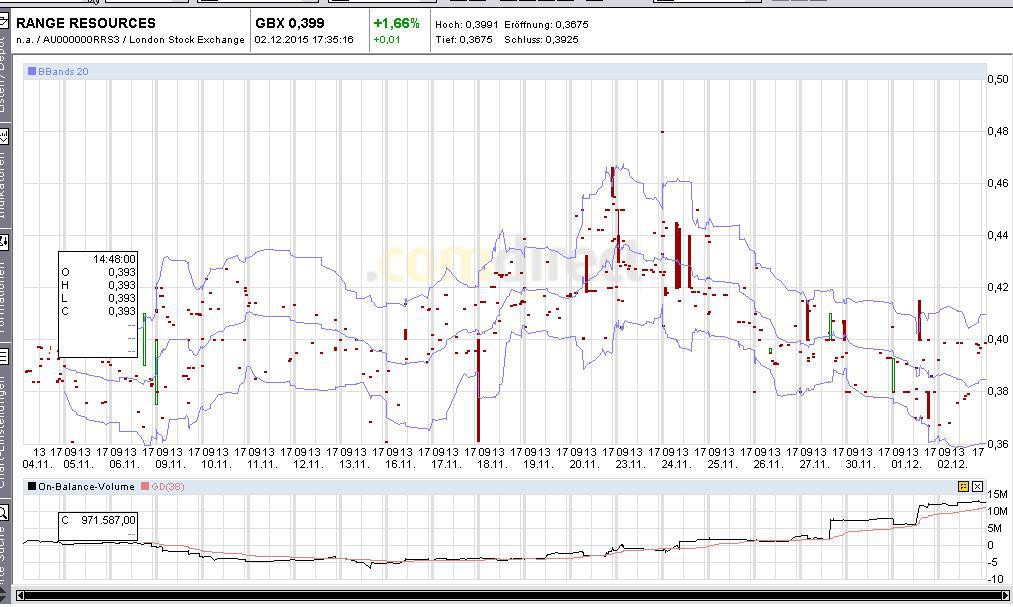
am onbalce volumen Indikator kann man sehen, daß die letzten Tage Geld in die Aktie geflossen ist, noch ist davon nichts zu sehen, wird auf eigenartige Weise erstmal flach gehalten, vielleicht gibts noch eine kleine Weihnachtsüberraschung

am onbalce volumen Indikator kann man sehen, daß die letzten Tage Geld in die Aktie geflossen ist, noch ist davon nichts zu sehen, wird auf eigenartige Weise erstmal flach gehalten, vielleicht gibts noch eine kleine Weihnachtsüberraschung
Die Weihnachtsüberraschung scheint sich langsam auf den Weg zu machen.
Siehe News!! Prozentual gesehen"hohe" Käufe die letzten Tage.
Siehe News!! Prozentual gesehen"hohe" Käufe die letzten Tage.
RRS Range Resources Limited
December 2015
3rd Trinidad Operations Update
http://stocknessmonster.com/news-item?S=RRS&E=ASX&N=745285
3 December 2015
Trinidad Operations Update
:::
Google übersetzt: https://translate.google.de/translate?sl=en&tl=de&js=y&prev=…
1st Expiry of Options
http://stocknessmonster.com/news-item?S=RRS&E=ASX&N=744883
:::
Google übersetzt: https://translate.google.de/translate?sl=en&tl=de&js=y&prev=…
So lange der IS Öl (Brent) für 30 $ in großen Mengen über die Türkei in die westlichen Staaten verkauft wird sich am Kurs für RRS wohl kaum etwas ändern.
http://ichthys-consulting.de/blog/?p=2761
December 2015
3rd Trinidad Operations Update
http://stocknessmonster.com/news-item?S=RRS&E=ASX&N=745285
3 December 2015
Trinidad Operations Update
:::
Google übersetzt: https://translate.google.de/translate?sl=en&tl=de&js=y&prev=…
1st Expiry of Options
http://stocknessmonster.com/news-item?S=RRS&E=ASX&N=744883
:::
Google übersetzt: https://translate.google.de/translate?sl=en&tl=de&js=y&prev=…
So lange der IS Öl (Brent) für 30 $ in großen Mengen über die Türkei in die westlichen Staaten verkauft wird sich am Kurs für RRS wohl kaum etwas ändern.
http://ichthys-consulting.de/blog/?p=2761
Antwort auf Beitrag Nr.: 51.229.236 von JoJo49 am 03.12.15 09:02:34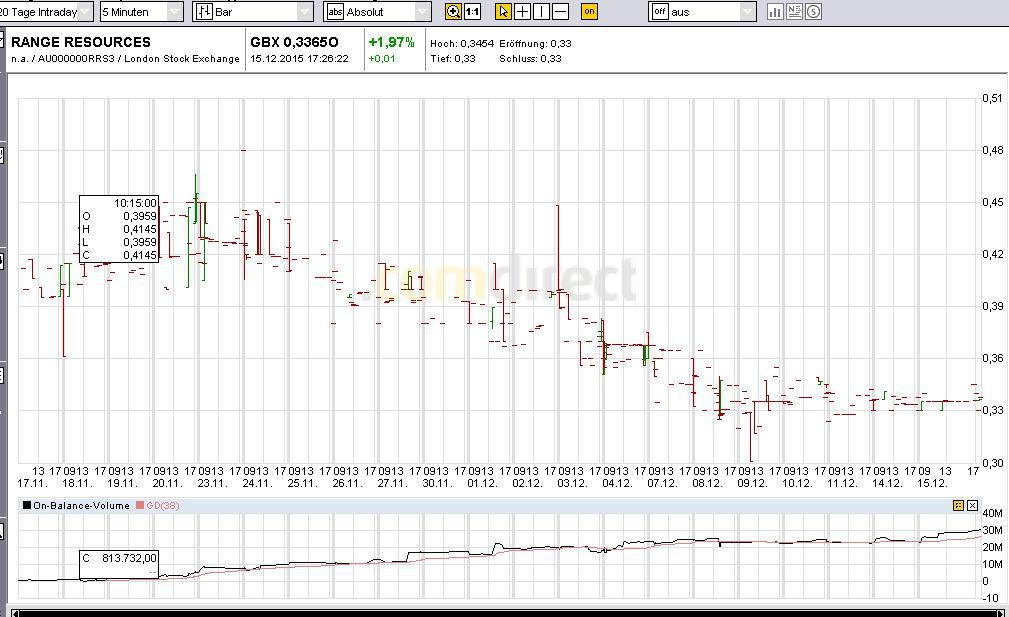
das On Balance Volumen ist weiter am steigen und heute das höchste Handelsvolumen der letzten 6 Tage, wenn es nun mal steigen sollte, dann können die das eigentlich nicht mehr lange unten halten.

das On Balance Volumen ist weiter am steigen und heute das höchste Handelsvolumen der letzten 6 Tage, wenn es nun mal steigen sollte, dann können die das eigentlich nicht mehr lange unten halten.
Antwort auf Beitrag Nr.: 51.311.106 von Sdrasdwutje am 15.12.15 18:39:32bis jetzt hat sich noch nichts geändert, die werden das in Sidney extra mit kleinen Stückzahlen nach unten gestellt haben, damit in London nochmal paar auf die Verkaufstaste drücken, da müsste eigenlich bald mal so ein Tag kommen wo es 30-40% nach oben flattert
Allen standhaften Rangern ein schönes und erholsames Weihnachtsfest und für das Jahr 2016 viel Gesundheit und Freude sowie Erfolg und Glück.
Das kommende Jahr wird Ranger-Jahr, wollen wir alle hoffen !!!!!!!
Das kommende Jahr wird Ranger-Jahr, wollen wir alle hoffen !!!!!!!
Antwort auf Beitrag Nr.: 51.365.040 von Pokercreek am 24.12.15 16:25:51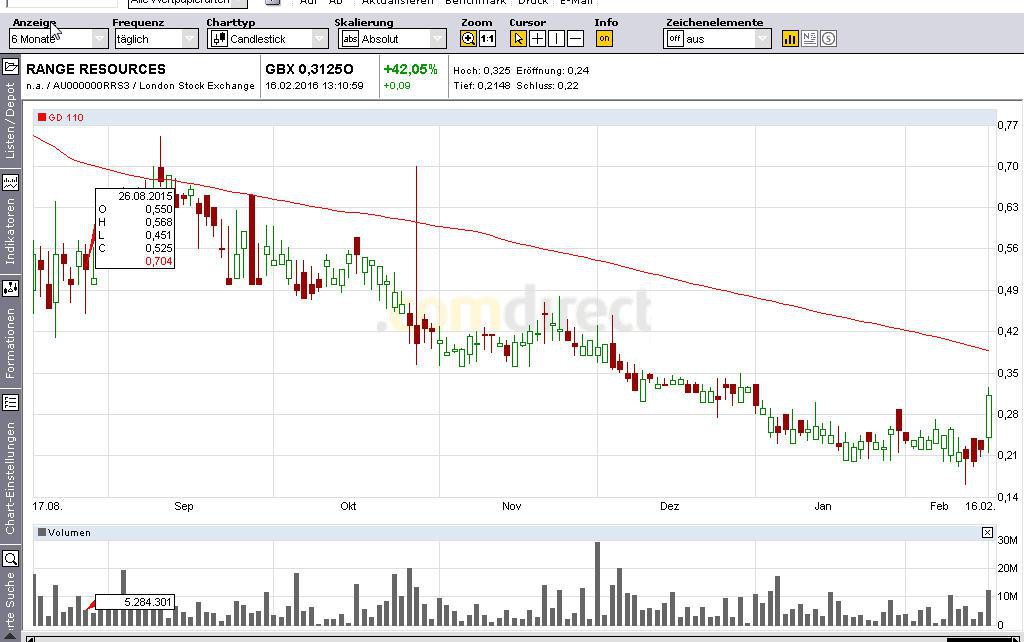
heute scheint mal ein kleiner Befreiungsschlag zu gelingen. Die Kerzenkörper der Tageskerzen sind trotz der letzten Abwärtsbewegung überwiegend weiß, das heißt der Schlusskurs war meist höher als der Eröffnungskurs , da wurde offensichtlich im Abwärtstrend eher akkumuliert als wirklich verkauft. Mit dem dramatischen Ölpreisverfall der letzten Wochen, dürften die letzten Verkaufswilligen rausgetrieben worden zu sein, wenn man nicht davon ausgeht daß Öl bald verschenkt wird, kann ja nochmal Hoffnung aufkommen

heute scheint mal ein kleiner Befreiungsschlag zu gelingen. Die Kerzenkörper der Tageskerzen sind trotz der letzten Abwärtsbewegung überwiegend weiß, das heißt der Schlusskurs war meist höher als der Eröffnungskurs , da wurde offensichtlich im Abwärtstrend eher akkumuliert als wirklich verkauft. Mit dem dramatischen Ölpreisverfall der letzten Wochen, dürften die letzten Verkaufswilligen rausgetrieben worden zu sein, wenn man nicht davon ausgeht daß Öl bald verschenkt wird, kann ja nochmal Hoffnung aufkommen
Antwort auf Beitrag Nr.: 51.758.158 von Sdrasdwutje am 16.02.16 13:52:23O.k. das ist alles ein Jammer? Keine Ahnung was die Chinesen vorhaben. Ab und zu lese ich noch auch bei discussthemarket, dort ist man eigentlich ratlos und schimpft über den Ölpreis, Bin immer noch drin allerdings sinkt mein Anteil bei 7,59 Mrd. shares erheblich. ( kleiner Scherz ).
Gruß an die Rangers.
Jespere
Gruß an die Rangers.
Jespere
Antwort auf Beitrag Nr.: 51.847.939 von Jespere am 26.02.16 17:54:39heute das erste mal seit 1,5 Jahren daß die wieder über dieser Durchschnittslinie (oben im Bild) geschlossen haben, wenn das jetzt nicht endlich ein Neubeginn ist, dann nie mehr
Antwort auf Beitrag Nr.: 51.885.147 von Sdrasdwutje am 02.03.16 18:16:13
Bin gespannt, was mit RRL in diesem Leben noch passiert
Good luck and all the best, Rangers
2016 bald vorbei....
..... und nichts wirklich neues hier...offensichtlich ist das Forum genauso tot wie der Kurs - der größte (noch nicht realisierte) Verlust meines Lebens lagert weiterhin hoffnungsvoll in Sydney.Bin gespannt, was mit RRL in diesem Leben noch passiert
Good luck and all the best, Rangers
Antwort auf Beitrag Nr.: 53.397.843 von flb am 03.10.16 14:58:472011 wär es gewesen, aber.....PL hat auf neue Standorte verwiesen u.a. Trini.usw. Ergo, stecken wir fast alle tief drin. Ich denke wir müssen das aussitzen. Wurde eigentlich Texas verkauft?
Gruß Jespere
Gruß Jespere
RRS Range Resources Limited
January 2017http://stocknessmonster.com/news-history?S=RRS&E=ASX
http://stocknessmonster.com/news-item?S=RRS&E=ASX&N=807549
Google übersetzt: https://translate.google.de/translate?hl=de&sl=en&tl=de&u=ht…
Seite 1/9
Bereich Ressourcen
26. Januar 2017
Quartalsbericht Für den Zeitraum bis zum 31. Dezember 2016
Die Gesellschaft stellt ihren vierteljährlichen Tätigkeitsbericht für den Zeitraum bis zum 31. Dezember 2016 zur Verfügung.
Trinidad Betriebe
Produktion
Das Unternehmen Öl-Produktion für den Zeitraum war 50.309 Barrel (Durchschnitt von 547 Barrel Öl pro Tag ("Bopd")) net nach Range, was eine Steigerung um 23% gegenüber dem Vorquartal bedeutet. Die Ausstiegsleistung für 2016 überstieg 800 Bopd, eine 40% ige Steigerung gegenüber der Ausstiegsrate für 2015. Die Englisch - Übersetzung - Morne Diablo Wasser-Flow-Projekt, sowie die Entwicklung Brunnen auf Produktion in der Zeit gesetzt.
Wasserförderprojekte
Das Unternehmen setzt seinen Schwerpunkt auf die vollständige Umsetzung der Wasserprojekte, die für die Eine große Mehrheit der Reserven und sind entscheidend für das Produktionswachstum von Range in Trinidad. Ungefähr 20% Des ursprünglichen Öls ("OIIP") auf die beiden laufenden Wasserförderung Projekte wurde durch primäre gewonnen Erschöpfung. Wasserflooding wird geschätzt, um eine zusätzliche 10% der OIIP zu erholen, wodurch insgesamt erhöht Auf über 30% in den nächsten 8 Jahren.
Morne Diablo Wasserflood: Im Laufe des Quartals begann die Produktion am Wasserfluss Morne Diablo Projekt im Einklang mit dem zuvor erwarteten Zeitplan. Zum Zeitpunkt dieses Berichts ist die Produktion Rund 60 bopd, die Produktion sowohl aus der Expansion und Pilot-Wasser-Flow-Systeme umfasst.
Hallo Range Leute
Es kommen endlich wieder Nachrichten.
Ich hoffe wir bekommen alle unser Geld wieder.
Es kommen endlich wieder Nachrichten.
Ich hoffe wir bekommen alle unser Geld wieder.
Antwort auf Beitrag Nr.: 55.503.468 von Renek1971 am 11.08.17 09:33:38Range sagt ab September ist wieder HandelDann bekommen wir unser Geld wieder
Dann bekommen wir unser Geld wieder
Antwort auf Beitrag Nr.: 55.511.847 von Renek1971 am 12.08.17 12:37:19Ja, Handel in Australien wieder seit dem 15. 09. 2017 mit geringem Umsatz von ca. 650.000 Stücken, heute offensichtlich kein Umsatz. In London wird der Handel vorerst wohl nicht fortgeführt, müssen noch einige Sachen geklärt werden.
In D auch kein Handel!! Sind überhaupt noch "einige" in D hier investiert??
Gruß an alle
Emssonne.
In D auch kein Handel!! Sind überhaupt noch "einige" in D hier investiert??
Gruß an alle
Emssonne.
Antwort auf Beitrag Nr.: 55.770.639 von Emssonne am 18.09.17 19:29:33Ja,doch bin noch 5-stellig drin und beobachte und lese: www.iii.co.uk
"Production testing is expected to commence shortly."
This is a development well not an exploration well so we know the hydrocarbons are there the testing is to determine how much we can produce from these too levels.
Gruß Jespere
"Production testing is expected to commence shortly."
This is a development well not an exploration well so we know the hydrocarbons are there the testing is to determine how much we can produce from these too levels.
Gruß Jespere
Antwort auf Beitrag Nr.: 55.818.858 von Jespere am 25.09.17 16:36:57Bin hier seit zehn Jahren siebenstellig vertreten und habe dieses größte Fehlinvest meiner Börsenaktivitäten völlständig abgeschrieben. Alles was jetzt demnächst kommt nehme ich gelassen. Habe damals an die Puntlandstory von Peter Landau in Somalia geglaubt, war mir des Risikos aber immer bewußt!
Entweder gehts auf Null...(da ist es ja eigentlich schon ) oder es gibt eine positive Überraschung, dann nehme ich es als Weihnachtsgeschenk 2018.
Entweder gehts auf Null...(da ist es ja eigentlich schon
) oder es gibt eine positive Überraschung, dann nehme ich es als Weihnachtsgeschenk 2018.
Antwort auf Beitrag Nr.: 55.900.387 von TecDax am 07.10.17 02:43:29Ja, der PL war nicht auf unserer Seite. Unter finanznachrichten.de gibt es ab und zu noch kleine Siberstreifen zu entdecken. Siebenstellig, ich denke dass noch eine minierholung in 2018 kommt, dann aber ?
Meine Beziehung zu Erdöl und Gas hat sich leider sechstellig auf Frontera ausgewirkt. Dilution, Dilution wie bei RRS.
Unsere Wissenden im RRS-Club haben sich leider alle vom Acker gemacht. Ich bleib dran.
Grüße Jespere
Meine Beziehung zu Erdöl und Gas hat sich leider sechstellig auf Frontera ausgewirkt. Dilution, Dilution wie bei RRS.
Unsere Wissenden im RRS-Club haben sich leider alle vom Acker gemacht. Ich bleib dran.
Grüße Jespere
Von Zeit zu Zeit schaue ich hier noch rein.
RRL wurde vor ca. 6 Monaten ins "Koma" versetzt. Lange haben die "Manager" herumgedoktert und jetzt laufen die ersten ernsthaften Versuche den "Patienten" langsam aus dem "Koma" zurückzuholen.
- 07.12.2017 "Proactive Investors One2One Investor Forum in London "
- Dezember 2017 eventuell relisting ????
- neue Bohrlöcher in Trinidad.
Auch nicht schlecht, wenn man sich, mit dem noch nicht realisierten Totalverlust, abgefunden hat und merkt, der Patient atmet noch.
RRL wurde vor ca. 6 Monaten ins "Koma" versetzt. Lange haben die "Manager" herumgedoktert und jetzt laufen die ersten ernsthaften Versuche den "Patienten" langsam aus dem "Koma" zurückzuholen.
- 07.12.2017 "Proactive Investors One2One Investor Forum in London "
- Dezember 2017 eventuell relisting ????
- neue Bohrlöcher in Trinidad.
Auch nicht schlecht, wenn man sich, mit dem noch nicht realisierten Totalverlust, abgefunden hat und merkt, der Patient atmet noch.
Antwort auf Beitrag Nr.: 56.171.487 von Pokercreek am 13.11.17 16:45:18
So sehe ich das auch.Seit nunmehr zehn Jahren habe ich diese Karteileiche im Depot und mich auf einen Totalverlust eingestellt.Um so besser, wenn der Patient langsam aus dem Wachkoma wieder ins Leben zurück geholt wird. Alles was jetzt kommt nehme ich als Überraschung und unverhofften Depotzuwachs.
So sehe ich das auch.Seit nunmehr zehn Jahren habe ich diese Karteileiche im Depot und mich auf einen Totalverlust eingestellt.Um so besser, wenn der Patient langsam aus dem Wachkoma wieder ins Leben zurück geholt wird. Alles was jetzt kommt nehme ich als Überraschung und unverhofften Depotzuwachs.
Hallo TecDax, da haben wir den gleichen Leidensweg. Ich bin im Juni 2007 durch Herrn Wilhelmie und durch meine Hoffnung ( Gier ?? ) zu RRL gekommen. Genau wie viele andere auf RRL, PL, Puntland usw. hereingefallen. Wir sind allerdings nicht allein, im III_Board beschimpfen sie sich seit Monaten gegenseitig. Dümmer gehts gar nicht mehr.
Frage? wieso wurden heute in Frankfurt 108330 Stück gehandelt.
ist RRL hier nicht ausgesetzt?
Frage? wieso wurden heute in Frankfurt 108330 Stück gehandelt.
ist RRL hier nicht ausgesetzt?
Antwort auf Beitrag Nr.: 56.175.018 von Pokercreek am 13.11.17 22:24:16Wundert mich zwar auch, aber in Frankfurt und an der ASX wird gehandelt, nur in London nicht.
Ich habe letzte Woche auch nochmal 650000 in Australien gekauft, zu 0,001 AUD
Ja ja, die Puntlandstory war auch mein Grund dort einzusteigen.Klang alles sehr vielversprechend und immerhin haben sie es ja auch bis zu einem Bohrturm dort gebracht. Wenn es dort damals geklappt hätte, sähe es heute anders auch. Allerdings war mir auch immer klar, dass das politisch hochbrisant ist.
Der Umgang im "iii-Board" ist wirklich der Hammer.Ich lese nur noch die Postings von Celticheart07.
Er ist der einzige glühende Optimist dort.
Im Dezember geht es wohl an der AIM weiter.
Ich habe letzte Woche auch nochmal 650000 in Australien gekauft, zu 0,001 AUD
Ja ja, die Puntlandstory war auch mein Grund dort einzusteigen.Klang alles sehr vielversprechend und immerhin haben sie es ja auch bis zu einem Bohrturm dort gebracht. Wenn es dort damals geklappt hätte, sähe es heute anders auch. Allerdings war mir auch immer klar, dass das politisch hochbrisant ist.
Der Umgang im "iii-Board" ist wirklich der Hammer.Ich lese nur noch die Postings von Celticheart07.
Er ist der einzige glühende Optimist dort.
Im Dezember geht es wohl an der AIM weiter.
RRS Range Resources Ltd, - November & December 2017 -
1st Completion of RRDSL acquisitionhttps://stocknessmonster.com/announcements/rrs.asx-6A863653
Google übersetzt:
ABSCHLUSS DER RRDSL-ERWERBUNG
Wir freuen uns, die Zustimmung der Aktionäre auf der Hauptversammlung der Gesellschaft bestätigen zu können hielt am 30. November 2017 alle Bedingungen für den Erwerb von Range Resources Drilling Services Limited ("RRDSL") wurde erfüllt.
RRDSL ist ein etablierter Ölfelddienstleister mit Erfolg seit fast 15 Jahren eine Erfolgsgeschichte.
RRDSL hat Palette mit vollen Ölfelddienstleistungen zur Verfügung gestellt
in Trinidad seit 2003, einschließlich Wasserflut, Bohr- und Aufbereitungsarbeiten.
Es wird erwartet, dass die Übernahme die mit Range's verbundenen Betriebskosten erheblich senkt
vorgelagerte Operationen in Trinidad und bieten erhebliche operative Flexibilität.
Ziel von Range ist es, das bestehende Geschäftsvolumen mit anderen Upstream-Unternehmen in Deutschland zu steigern Trinidad, um zusätzliche Einnahmequellen zu bieten.
Das längerfristige Ziel des Unternehmens ist es, zu etablieren RRDSL als ein profitables Ölfelddienstleistungsunternehmen, das Operationen für eine breite Palette von Kontrahenten anbietet
in der Karibik und in Lateinamerika.
Weitere Informationen zu RRDSL finden Sie auf der Website: www.rangebrilling.com.
Die wichtigsten Bedingungen für den Erwerb können in der am 13. März 2017 veröffentlichten Bekanntmachung und in der Bekanntmachung nachgelesen werden der Sitzung vom 30. Oktober 2017
30th Results of Meeting
https://stocknessmonster.com/announcements/rrs.asx-6A863310
29th Proposed Admission to AIM
https://stocknessmonster.com/announcements/rrs.asx-6A863163
Range Res :
Lange nichts mehr gehört von dieser Aktie :
heute Umsätze!
Weiß da jemand mehr dazu?
Danke
Lange nichts mehr gehört von dieser Aktie :
heute Umsätze!
Weiß da jemand mehr dazu?
Danke
Range Res :
Einer der interessantesten RES Nachzügler am Markt :
WL
Einer der interessantesten RES Nachzügler am Markt :
WL
Antwort auf Beitrag Nr.: 56.174.313 von TecDax am 13.11.17 21:16:36Hallo Tec
Hier ist auch noch ein Ur Ranger seit 2007 dabei, mir geht es genauso wie Dir
98% minus. schön dass es noch ein Paar Leidensgenossen gibt und wer weis vielleicht tut sich in Zukunft ja doch noch was. wünsche es uns allen jedenfalls von Herzen.
Gruss Teamspeak
Hier ist auch noch ein Ur Ranger seit 2007 dabei, mir geht es genauso wie Dir
98% minus. schön dass es noch ein Paar Leidensgenossen gibt und wer weis vielleicht tut sich in Zukunft ja doch noch was. wünsche es uns allen jedenfalls von Herzen.
Gruss Teamspeak
Hallochen, bin auch noch dabei. mit 98% Buchverlust und im Juli 11 Jahre begleitet mich Rang.
Dachte, nach dem Handelsstopp in London für ca. 9 Monate, es ist alles vorbei.
Jetzt keimt wieder etwas Hoffnung auf.
Die Umsätze in London sind ganz ordentlich, obwohl immer noch im untersten %-Bereich.
Schaun wir `mal.
Dachte, nach dem Handelsstopp in London für ca. 9 Monate, es ist alles vorbei.
Jetzt keimt wieder etwas Hoffnung auf.
Die Umsätze in London sind ganz ordentlich, obwohl immer noch im untersten %-Bereich.
Schaun wir `mal.
RANGE RES : mit plötzlichem Anstieg auf 0,004 +
weiß jemand da was?
RANGE RES, gestern in London mit starken Umsätzen und Anstieg auf 0,20
weiß jemand da was?
RANGE RES, gestern in London mit starken Umsätzen und Anstieg auf 0,20
Range Resources :
Seit gestern wieder höchst interessant :
gestern schon erste Käufe, die heute weitergehen!
Muss mich da mal einlesen
Seit gestern wieder höchst interessant :
gestern schon erste Käufe, die heute weitergehen!
Muss mich da mal einlesen
Range Resources :
Letzte News : http://www.ariva.de/news/colombia-update-5877138
Börsenplätze : Deutschland / FSE / Direkthandel / London / Australien
Wenige Stücke vorhanden!
Aktuelles ASK 0,004 / BIS 2Mio 0,002 / Interesse besteht also?!
WL und evtl. Einstieg
Letzte News : http://www.ariva.de/news/colombia-update-5877138
Börsenplätze : Deutschland / FSE / Direkthandel / London / Australien
Wenige Stücke vorhanden!
Aktuelles ASK 0,004 / BIS 2Mio 0,002 / Interesse besteht also?!
WL und evtl. Einstieg
Range Resources könnte der nächste Burner am Rohstoffmarkt werden!
BIS SIZE geht auch hoch
BIS SIZE geht auch hoch
RANGE RES :
****ASK 0,008 ****
Was ist da los?
****ASK 0,008 ****
Was ist da los?
Sehen wir heute noch die 0,008 im Kauf??
Das muss ich mir genauer ansehen
Das muss ich mir genauer ansehen
!
Dieser Beitrag wurde von CloudMOD moderiert. Grund: ohne Quellenangabe!
Dieser Beitrag wurde von CloudMOD moderiert. Grund: ohne Quellenangabe
Das ASK SIZE ist aktuell ein FAKE !
Habe versucht welche zu 0,004 zu kaufen, geht nicht
Habe versucht welche zu 0,004 zu kaufen, geht nicht
Range Resources = wird mein nächster TopBurner mit Ziel 0,015€
Im Moment noch im Schlafmodus :
Im Moment noch im Schlafmodus :
0,004 EUR
29.01.2018 18:34
heute noch bis 0,006 EUR ???
Warten wir es ab
29.01.2018 18:34
heute noch bis 0,006 EUR ???
Warten wir es ab
Range Resources :
37.000 EA Peanuts Stücke zu 0,004!!
Nun lasst sie endlich fliegen!
37.000 EA Peanuts Stücke zu 0,004!!
Nun lasst sie endlich fliegen!
Antwort auf Beitrag Nr.: 56.865.368 von Timepassengers am 29.01.18 19:01:50Danke, dass du so dran bleibst, ich bin gespannt!
0,0060
EUR
+0,0030 EUR
+100,00
EUR
+0,0030 EUR
+100,00
Range Res :
Ab morgen TopWert im AUD Depot
Ab morgen TopWert im AUD Depot
Range Res :
die 0,003 im Tradegate als Kauf sind gefakt !
Hatte ich gestern schon gesehen!
Für 0,004 kann man noch einsteigen, denke ich, bevor die Reise
über 0,01 starten?!!
die 0,003 im Tradegate als Kauf sind gefakt !
Hatte ich gestern schon gesehen!
Für 0,004 kann man noch einsteigen, denke ich, bevor die Reise
über 0,01 starten?!!
Range Fake Kurs aufgehoben und nach oben angepasst !
Bestes ASK 0,007
Bestes ASK 0,007
Bei Range komme ich nun tiefer als 0,007€ nicht mehr rein
Mann oh Mann
Mann oh Mann
Wenn da nichts im Busche ist, dann fresse ich einen "Besen"
kaufen kann man vielleicht noch zu 6 oder 7
drunter gehts nimmer!
Lange nichts von diesem Wert gehört und nun???
kaufen kann man vielleicht noch zu 6 oder 7
drunter gehts nimmer!
Lange nichts von diesem Wert gehört und nun???
Range Resources : AU000000RRS3
Vielleicht wissen wir es erst die kommende Nacht in Australien, wenn der Wert wie
aus dem Nichts nach oben explodiert?!
Irre, interessant und niemand hat diesen Wert bislang auf seinem Schirm!
Vielleicht wissen wir es erst die kommende Nacht in Australien, wenn der Wert wie
aus dem Nichts nach oben explodiert?!
Irre, interessant und niemand hat diesen Wert bislang auf seinem Schirm!
0,004 EUR
Performance +33,33 %
Handeln sie bitte nur über Tradegate, bester Preis, bester Kurs
Performance +33,33 %
Handeln sie bitte nur über Tradegate, bester Preis, bester Kurs
Bei Range traut sich noch niemand zu kaufen!
Sobald die ersten 1000k aus dem Ask gezogen werden, dürfte die Aktie losrennen?!
Sobald die ersten 1000k aus dem Ask gezogen werden, dürfte die Aktie losrennen?!
Antwort auf Beitrag Nr.: 56.876.273 von Timepassengers am 30.01.18 17:19:46Wie viel Aktien hat die Company ?
Range Resources : STG : 0,007€ 50k
Prima
Prima
Range : ASK auf Tradegate nun hoch auf 0,008€
Stuttgart gibt es noch welche zu 0,007€
Stuttgart gibt es noch welche zu 0,007€
Antwort auf Beitrag Nr.: 56.878.394 von Timepassengers am 30.01.18 20:05:53Beim Live-Trading 0,009!
Prima : so wie ich das auf Brokerbasis sehe, stehen da noch 200k zu 0,007 in Stuttgart
im ASK : Kann aber auch ein Fake ASK sein ?!
Vielleicht werden die ja gleich weggekauft?!
Ein äusserst interessanter Wert
im ASK : Kann aber auch ein Fake ASK sein ?!
Vielleicht werden die ja gleich weggekauft?!
Ein äusserst interessanter Wert
0,007 EUR
200.000 Stück
Aktuell bester Preis (ohne Zusatzkosten)
200.000 Stück
Aktuell bester Preis (ohne Zusatzkosten)
Antwort auf Beitrag Nr.: 56.877.083 von Dailocard am 30.01.18 18:19:4666 oder gar 67
Range Res : Ich denke, die Zeit ist reif, für den Einstieg
Antwort auf Beitrag Nr.: 56.881.211 von Timepassengers am 31.01.18 07:20:14die Quartalsergebnisse sind o.k., denke ich. Die Frage ist wohl, wie lange das Cash reicht. Shares sind ja bereits genügend da.
Prima, da hat der Einstieg nun funktioniert :
Zurücklehnen und genießen
Zurücklehnen und genießen
Antwort auf Beitrag Nr.: 56.882.294 von Timepassengers am 31.01.18 09:17:33wir genießen schon seit über 10 Jahren, wir können garnicht genug bekommen
Von dem übermäßigen Genuss ist mir schon ganz schlecht.😡
😡
Hotcopper-let‘s hope for the best!
„....and this is Malcy's perspective:Range Resources
Blogs at the moment by iPad as I am travelling but whilst on the move I noticed with interest an operational update on Trinidad operations from Range Resources. The most striking is the average net oil production for January of 777 b/d which is up 23% up on the last quarter of 2017. But this is likely to be just the start as the work programme for 2018 is very extensive.
This will include integration of the oilfield business and securing third party contracts and completing work to increase the water injection rate at the SE waterflood project to a rate of at least 1,500 barrels of water a day. In addition the company intends to drill a minimum of two new development wells at the Beach Marcelle and Morne Diablo fields and up to 30 heavy workovers whilst obtaining approvals for the next waterflood projects.
It is Range’s intention to achieve continued production growth ‘mainly through the waterflood programme which accounts for the majority of our reserves’. In addition the two waterflood projects brought on to date make Range see significant potential in expanding the programme to other areas of their fields.
It is also worth noting that the company has appointed Lubing Liu as COO and country General Manager as he has extensive international experience in Waterflood projects and shows the determination of the senior management to address the key areas for longer term.
Finally it must not be forgotten that with the acquisition of RRDSL last year the intention is to focus on securing third party work in order to bring in additional revenues. So far in addition to doing in-house work, RRDSL is currently providing oilfield services to one other operator in Trinidad which it hopes to expand.
I am visiting Trinidad shortly and hope to visit all the assets and meet with all the key local management so will report back in a couple of weeks but they do seem to be getting to grips with the situation so patient investors may eventually be rewarded.“
Am 16.03.2018 wieder neues von:
http://www.malcysblog.com/
http://www.malcysblog.com/
Er war direkt vor Ort in Trinidad:
" I visited Trinidad last week and was allowed full access to all its operations and met with CEO Yan Liu and the new COO, Lubing Liu,"
" I visited Trinidad last week and was allowed full access to all its operations and met with CEO Yan Liu and the new COO, Lubing Liu,"
Nach ewig langer Zeit mal eine positive Meldung.
Totgesagte leben länger.:
https://www.asx.com.au/asxpdf/20180321/pdf/43slrcqpgs99h5.pd…
Totgesagte leben länger.:
https://www.asx.com.au/asxpdf/20180321/pdf/43slrcqpgs99h5.pd…
Shell als Partner ist ja schon mal eine Hausnummer
In Aussi-Land beginnen die Teile teuer zu werden und manche träumen bereits vom big fish!
Antwort auf Beitrag Nr.: 57.349.094 von TecDax am 22.03.18 01:01:45
• Early production focused work programme agreed;
• Targeting first oil production in mid-2018;
• The planned work programme is expected to add up to 200 bopd of production (gross);
• Field work expected to commence in Q2 2018 principally comprising well reopenings and
workovers; and
• An experienced management team in place and two offices in Indonesia established“
Flyin‘ under Radar!
HC: „might also be helped by this....(rerate coming methinks)• Early production focused work programme agreed;
• Targeting first oil production in mid-2018;
• The planned work programme is expected to add up to 200 bopd of production (gross);
• Field work expected to commence in Q2 2018 principally comprising well reopenings and
workovers; and
• An experienced management team in place and two offices in Indonesia established“
Explorer wird zum Produzenten
Dieser Öl und Gas Explorer wird wie aus zahlreichen News ersichtlich gegen Mitte diesen Jahres zum erfolgreichen Ölproduzenten aufsteigen.An der Börse in London ist bei dieser Aktie bereits ein "run" auf diese Aktie ausgebrochen.
In Deutschland "noch" vollkommen unbekannt, bis diese Aktie auf zahlreichen Watchlisten aufgenommen wird.
Erste englischen Research Agenturen beginnen über RangeResources zu berichten.
1. http://www.livecharts.co.uk/share_prices/Range-Resources-dri…
2. https://www.investegate.co.uk/range-resources-ltd--rrl-/rns/…
Antwort auf Beitrag Nr.: 57.351.344 von RichtigeAktie am 22.03.18 09:52:47naja... Shell ist zwar ein grosser Name, aber das ist ja nur eine Auftragsarbeit...
soviel Substanz kann man da nicht reinrechnen ...
soviel Substanz kann man da nicht reinrechnen ...
Antwort auf Beitrag Nr.: 57.358.430 von freixenetter am 22.03.18 17:57:36
Wer die traurige Geschichte dieses Unternehmens kennt (wie ich seit mehr als zehn Jahren)ist schon froh,dass Range überlebt hat und zumindest bei dem einen oder anderen Projekt wieder einen Fuß in der Tür hat. Viel Geduld bringt uns vielleicht am Ende des Jahres auf einen Cent.
Wer die traurige Geschichte dieses Unternehmens kennt (wie ich seit mehr als zehn Jahren)ist schon froh,dass Range überlebt hat und zumindest bei dem einen oder anderen Projekt wieder einen Fuß in der Tür hat. Viel Geduld bringt uns vielleicht am Ende des Jahres auf einen Cent.
Antwort auf Beitrag Nr.: 57.360.920 von TecDax am 22.03.18 21:08:49oui, une katastrophe. Seit 11.04.18 gibt es auf www.iii.co.uk keine neuen beiträge. Das waren noch zei-
ten mit PL. Trini und Philippinen = hoffnungsträger. GLA
ten mit PL. Trini und Philippinen = hoffnungsträger. GLA
Langsam geht´s Vorwärts...
Antwort auf Beitrag Nr.: 57.611.559 von TecDax am 24.04.18 01:16:05langsam.... ist .... aber ... arg .... unter....trieben.........
New’s vom 24.05.2018
RANGE EXCEEDS PRODUCTION TARGET
Range, an international oil and gas company with assets in Trinidad and Indonesia, and an oilfield services business in Trinidad, is pleased to announce that it has reached production milestone of 800 barrels of oil per day (“bopd”). This target was achieved ahead of schedule, and exceeded the previous guidance with average production over the last week delivering approximately 820 bopd, a 43% increase in production in the last 12 months.
RANGE EXCEEDS PRODUCTION TARGET
Range, an international oil and gas company with assets in Trinidad and Indonesia, and an oilfield services business in Trinidad, is pleased to announce that it has reached production milestone of 800 barrels of oil per day (“bopd”). This target was achieved ahead of schedule, and exceeded the previous guidance with average production over the last week delivering approximately 820 bopd, a 43% increase in production in the last 12 months.
COMMENCEMENT OF OPERATIONS IN INDONESIA
https://www.asx.com.au/asxpdf/20180528/pdf/43vbdkx8sd6ny0.pd…
https://www.asx.com.au/asxpdf/20180528/pdf/43vbdkx8sd6ny0.pd…
Antwort auf Beitrag Nr.: 57.843.624 von TecDax am 28.05.18 01:52:54
Das erste reaktivierte Bohrloch, POG-D, wird weiterhin getestet, da die Förderraten optimiert werden. Wie bereits berichtet, hat das Bohrloch 145 Barrels hochwertiges Leichtöl aus einer der mehreren Produktionszonen über intermittierende Pumpphasen geleitet, insgesamt über 117 Stunden.
READ: Range startet Bohrarbeiten in Indonesien
POG-E, der zweite Brunnen, wird derzeit mit dem Feldteam, das derzeit daran arbeitet, eine unterirdische Obstruktion zu beseitigen, wiedereröffnet.
Bis zu zehn bestehende Bohrlöcher konnten durch das Programm wieder geöffnet und reaktiviert werden, was Perlak voraussichtlich 200 Barrel Öl pro Tag bescheren wird.
Gruß Jespere
Oh, Schreck
Range Resources Ltd ( LON: RRL ) hat Investoren über die Aktivitäten des Perlak-Projekts in Indonesien informiert, wo es ein Programm für "well workovers" vorantreibt.Das erste reaktivierte Bohrloch, POG-D, wird weiterhin getestet, da die Förderraten optimiert werden. Wie bereits berichtet, hat das Bohrloch 145 Barrels hochwertiges Leichtöl aus einer der mehreren Produktionszonen über intermittierende Pumpphasen geleitet, insgesamt über 117 Stunden.
READ: Range startet Bohrarbeiten in Indonesien
POG-E, der zweite Brunnen, wird derzeit mit dem Feldteam, das derzeit daran arbeitet, eine unterirdische Obstruktion zu beseitigen, wiedereröffnet.
Bis zu zehn bestehende Bohrlöcher konnten durch das Programm wieder geöffnet und reaktiviert werden, was Perlak voraussichtlich 200 Barrel Öl pro Tag bescheren wird.
Gruß Jespere
Antwort auf Beitrag Nr.: 58.154.873 von Jespere am 06.07.18 15:22:32Rangers,
der Wert sinkt, die Beiträge sinken. Verständlich. Bei discusthe......gibt es immer noch Verständnisträger und Optimisten, oder sind das Claqueure? Was tun, bin seit 2007 dabei und habe wie mancher 2011 falsch entschieden.
Gruß Jespere
der Wert sinkt, die Beiträge sinken. Verständlich. Bei discusthe......gibt es immer noch Verständnisträger und Optimisten, oder sind das Claqueure? Was tun, bin seit 2007 dabei und habe wie mancher 2011 falsch entschieden.
Gruß Jespere
Antwort auf Beitrag Nr.: 58.269.260 von Jespere am 21.07.18 15:01:19Bin auch schon so lange dabei und habe Landau die Puntlandstory abgekauft.
Wir haben so lange Geduld gehabt,da sollten wir jetzt nicht zu diesem Restwert verkaufen.
Das Ding wird gerade wieder flott gemacht, die Förderquoten steigen langsam, der Chinese ist mit im Boot und gibt ein wenig finanzielle Sicherheit. Vielleicht kommen mal zwei gute Quartale in Folge, dann gehts auch wieder ein wenig aufwärts. Vielleicht auf 1 Cent in einem Jahr...ich lasse meine drei Millionen im Depot und hoffe weiter.
Wir haben so lange Geduld gehabt,da sollten wir jetzt nicht zu diesem Restwert verkaufen.
Das Ding wird gerade wieder flott gemacht, die Förderquoten steigen langsam, der Chinese ist mit im Boot und gibt ein wenig finanzielle Sicherheit. Vielleicht kommen mal zwei gute Quartale in Folge, dann gehts auch wieder ein wenig aufwärts. Vielleicht auf 1 Cent in einem Jahr...ich lasse meine drei Millionen im Depot und hoffe weiter.
Ich verschiebe meine oben genannte Prognose von einem Cent in einem Jahr um ein weiteres Jahr nach hinten, nachdem heute, man kann es kaum glauben, eine weitere Verwässerung durch Neuausgabe weiterer Aktien erfolgt ist.
Nicht zu glauben...
https://www.asx.com.au/asxpdf/20180726/pdf/43wsb026rqcqg5.pd…
Nun sind schlappe 8,5 Milliarden Aktien im Umlauf
Nicht zu glauben...
https://www.asx.com.au/asxpdf/20180726/pdf/43wsb026rqcqg5.pd…
Nun sind schlappe 8,5 Milliarden Aktien im Umlauf
Antwort auf Beitrag Nr.: 58.309.076 von TecDax am 26.07.18 14:24:39Eher um ein weiteres Jahrzehnt.. also dass denen bei dem Kurs nichts besseres einfällt ist schon arm
Na immerhin etwas,man freut sich ja schon über Kleinigkeiten.:
https://www.asx.com.au/asxpdf/20180806/pdf/43x3102ym82drn.pd…
https://www.asx.com.au/asxpdf/20180806/pdf/43x3102ym82drn.pd…
Waterflood Programme Update
https://www.asx.com.au/asxpdf/20180920/pdf/43ygxzzr6qklk3.pd…
Und schon wieder enorme Verzögerungen...Es gelingt einfach nicht, mal eine Timeline einzuhalten und ein paar gute Nachrichten für Aktionäre zu erwirtschaften!Und das geht schon über eine Dekade so.
Diese Shares nehme ich mit in Rente
https://www.asx.com.au/asxpdf/20181025/pdf/43zlcxjm9cg57m.pd…" target="_blank" rel="nofollow ugc noopener">https://www.asx.com.au/asxpdf/20181025/pdf/43zlcxjm9cg57m.pd…
Diese Shares nehme ich mit in Rente
https://www.asx.com.au/asxpdf/20181025/pdf/43zlcxjm9cg57m.pd…" target="_blank" rel="nofollow ugc noopener">https://www.asx.com.au/asxpdf/20181025/pdf/43zlcxjm9cg57m.pd…
Antwort auf Beitrag Nr.: 59.049.022 von TecDax am 25.10.18 01:37:17Range Resources Ltd (LON: RRL) teilte in seinem Quartalsbericht den Anlegern mit, dass die tägliche Produktion in den drei Monaten bis zum 30. September durchschnittlich 594 Barrel Öl pro Tag produziert habe. Man rechnet mit/auf Ende 2019.
Selbst Herr Wutje und andere sind nicht mehr da, warum wohl!
PL hat alle geschafft auch Somalia?
joyeux noel et bonne année
Jespere
Selbst Herr Wutje und andere sind nicht mehr da, warum wohl!
PL hat alle geschafft auch Somalia?
joyeux noel et bonne année
Jespere
Fördermengen
New’s vom 24.05.2018 RANGE EXCEEDS PRODUCTION TARGET Range, an international oil and gas company with assets in Trinidad and Indonesia, and an oilfield services business in Trinidad, is pleased to announce that it has reached production milestone of 800 barrels of oil per day (“bopd”). This target was achieved ahead of schedule, and exceeded the previous guidance with average production over the last week delivering approximately 820 bopd, a 43% increase in production in the last 12 months.
Diskussion zu Range Resources Oil und Gas Produzent | wallstreet-online.de - Vollständige Diskussion unter:
https://www.wallstreet-online.de/diskussion/umgekehrte-sorti…
Bei den Fördermengen waren schon ganz andere Größen gesetzt.
Range hat sehr viele (zu viele??) gut bezahlte Häuptlinge und die Indianer bringen zu wenig aus dem Boden. Naja, für die Häuptlinge reicht es??
Das Wenige reicht aber nicht zur Verbesserung des shareholder value.
Director Appointment
http://www.rangeresources.co.uk/...und noch ein neuer, gut bezahlter Häuptling...
Wo bleiben die avisierten Fördermengen?
Die Indianer bringen zu wenig aus dem Boden.
Analyse durch Cantor-Fitzgerald -- GBX 0,17 Target Price
https://whatsonthorold.com/2019/01/31/cantor-fitzgerald-has-…....auf steigende Fördermengen
Proactive Investors hat eine andere Auffassung
https://www.proactiveinvestors.co.uk/columns/sp-angel/30551/…Google-Übersetzung:
Restrukturierung jetzt Schlüssel
Der Inhalt des Quartalsberichts des Unternehmens bietet den Eigentümern des Unternehmens keinen großen Komfort. Unabhängig von den operativen Fortschritten, die das Unternehmen erzielt hat, ist das Hauptaugenmerk aller Anleger das Ausmaß, in dem sie wahrscheinlich bei einer Bilanzumstrukturierung umgelenkt werden, die die Gläubiger des Unternehmens zulassen. Das heißt, wenn sie das Unternehmen nicht liquidieren.
Operativ hat das Management eine Studie über seine Vermögensbasis durchgeführt, die wir normalerweise voll unterstützen würden. In diesem Fall sind wir jedoch der Ansicht, dass angesichts der Studien, die bisher mit dem Großteil ihrer Vermögenswerte durchgeführt wurden, etwas nicht stimmt, oder das Management ist jetzt so scharf, dass es ihm an Vertrauen mangelt, um das Programm auszuführen, das die Studien durchführen bisher angegeben haben, ist erforderlich.
Trotz der operativen Probleme ist die Umstrukturierung, wie wir bereits betont haben, von entscheidender Bedeutung, nicht nur für die zukünftige Ausrichtung des Unternehmens, sondern auch für seine Existenz. Dies ist das einzige Problem, auf das sich die Aktionäre in naher Zukunft konzentrieren müssen.
PROPOSED DEBT RESTRUCTURING AND ACQUISITION
http://www.rangeresources.co.uk "Latest News"Google-Übersetzung der ersten Teile des Berichts:
Vorgeschlagene Umschuldung und Übernahme
Range, ein internationales Unternehmen mit Öl- und Gasprojekten und Ölfeldservice-Unternehmen in Trinidad und Indonesien, freut sich, eine umfassende Umstrukturierung der verschiedenen Zahlungsverpflichtungen mit LandOcean Energy Services Co., Ltd. ("LandOcean") bekannt zu geben (die "Vorgeschlagene Schuld" Umstrukturierung").
Schlüssel-Höhepunkte:
Mittelfristige Verlängerung der Rückzahlungsverpflichtungen ohne frühestens 2022 fällige Kapital- oder Zinszahlungen;
Wandelanleihe in Höhe von 20 Mio. USD für eine neue Laufzeit von drei Jahren, wobei Zinszahlungen erst im November 2022 zur Rückzahlung fällig werden. Überarbeiteter Wandlungspreis mit einem Aufschlag von 267% gegenüber dem aktuellen Aktienkurs;
Reduzierung der ausstehenden Gesamtschulden um mehr als 20% durch Rückzahlung des ausstehenden Betrags in Höhe von 19,7 Mio. USD durch Ausgabe neuer Aktien;
Die von Range im Dezember 2017 an LandOcean geleistete rückzahlbare Einlage in Höhe von 2,8 Mio. US-Dollar wird als permanente Zahlung für die ausstehende Gegenleistung für die RRDSL-Akquisition verwendet. Die verbleibende Gegenleistung wird um weitere drei Jahre verlängert.
Der Abschluss der Umschuldung der vorgeschlagenen Schulden unterliegt der Zustimmung der Range-Aktionäre, der Zustimmung der LandOcean-Aktionäre (falls erforderlich) und dem Abschluss einer geplanten neuen Akquisition;
Der Board hat eine transformative Übernahmemöglichkeit für den Erwerb einer 49% -Beteiligung an einem in China tätigen Vorschulunterrichtsgeschäft ausgemacht. Derzeit läuft ein Due Diligence-Prozess (der „geplante Erwerb“).
Der geplante Erwerb würde, falls er abgeschlossen ist, eine umgekehrte Übernahme nach Regel 14 der AIM-Regeln darstellen, die der Stimme der Aktionäre der Gesellschaft und den einschlägigen behördlichen Genehmigungen unterliegt. und
Die Gesellschaft hat mit sofortiger Wirkung die Aussetzung des Handels mit ihren Aktien an AIM und ASX beantragt, bis eine .....
Die sollten sich besser auf ihr Kerngeschäft besinnen!!
Antwort auf Beitrag Nr.: 60.127.938 von TZ350 am 18.03.19 11:07:59naja, die Aussetzung ist aber wohl etwas übertrieben oder?
Antwort auf Beitrag Nr.: 60.180.567 von freixenetter am 23.03.19 21:31:05
Für die Aussetzung gibt es Regeln.
aber:
Range plant den Erwerb einer 49% -Beteiligung an einem in China tätigen Vorschulunterrichtsgeschäft.
da sage ich:
"Schuster bleib bei deinen Leisten".
Regeln für die Aussetzung
https://de.wikipedia.org/wiki/Aussetzung_des_HandelsFür die Aussetzung gibt es Regeln.
aber:
Range plant den Erwerb einer 49% -Beteiligung an einem in China tätigen Vorschulunterrichtsgeschäft.
da sage ich:
"Schuster bleib bei deinen Leisten".
Voluntary Share Suspension on ASX
http://www.rangeresources.co.uk/FREIWILLIGE AKTIENAUSSETZUNG AUF ASX
Range Resources Limited (ASX: RRS) fordert ASX hiermit auf, eine Verlängerung der freiwilligen Aussetzung hinsichtlich seiner Wertpapiere zu gewähren, und stellt die folgenden Informationen gemäß der ASX-Auflistungsregel 17.2 bereit:
Das Unternehmen beantragt die Verlängerung der freiwilligen Aussetzung bis zur Veröffentlichung einer Ankündigung an ASX bezüglich einer wesentlichen Umschuldung und eines geplanten Neuerwerbs.
Die geplante Übernahme würde, wenn sie abgeschlossen ist, eine umgekehrte Übernahme nach Regel 14 der AIM-Regeln darstellen, die der Stimme der Aktionäre der Gesellschaft, den einschlägigen behördlichen Genehmigungen und der Vorlage eines Zulassungsdokuments unterliegt. Gemäß den AIM-Regeln beantragte die Gesellschaft am 18. März 2019 die Aussetzung des Handels mit ihren Wertpapieren, bis die Veröffentlichung eines AIM-Zulassungsdokuments oder die Bestätigung der Gesellschaft, dass die beabsichtigte Übernahme nicht beabsichtigt ist, ausstehen.
Die geplante Übernahme unterliegt auch der Einhaltung der einschlägigen ASX-Kotierungsregeln, die wahrscheinlich die Zustimmung der Aktionäre gemäß Kotierungsregel 11.1.2 sowie die erneute Einhaltung der ASX-Anforderungen für die Kotierung in den Kapiteln 1 und 2 der Kotierungsregeln beinhalten Kotierungsregel 11.1.3. Von ASX wurde noch keine Entscheidung getroffen, ob die geplante Übernahme die Einhaltung dieser Kotierungsregeln erfordert.
Das Unternehmen geht davon aus, dass die Aussetzung der Notierung an ASX bis zur Veröffentlichung einer Bekanntmachung in Bezug auf die oben genannten Sachverhalte andauern wird, oder wenn das Unternehmen die Anforderungen für die Erstnotierung von ASX in den Kapiteln 1 und 2 der Kotierungsregeln unter Kotierung erneut erfüllen muss Regel 11.1.3, wenn alle Voraussetzungen für die Nacherfüllung erfüllt sind und das AIM-Zulassungsdokument vorliegt, was voraussichtlich mehrere Monate dauern wird. Ein bestimmtes Datum ist noch nicht bekannt und die Gesellschaft wird den Markt über den voraussichtlichen Zeitpunkt auf dem Laufenden halten.
Der Gesellschaft ist weder ein Grund bekannt, warum die freiwillige Aussetzung nicht gewährt werden sollte, noch sonstige Informationen, die erforderlich sind, um den Markt über die freiwillige Aussetzung zu
https://www.sharesmagazine.co.uk/news/market/6350993/Range-R…
Google-Übersetzung:
Range Resources führt Unternehmensumstrukturierungen ein, nachdem ein schwerer Verlust eingetreten ist.
18. März 2019, 09:13
Quelle - SMW
Range Resources kündigte eine Unternehmensumstrukturierung an, nachdem im ersten Halbjahr ein schwerer Verlust zu verzeichnen war, der eine vollständige Abschreibung seiner indonesischen Vermögenswerte beinhaltete.
Die Verluste vor Steuern in den sechs Monaten bis Dezember beliefen sich auf 62,9 Mio. USD und erhöhten sich gegenüber dem Vorjahr um 8,5 Mio. USD.
Der Umsatz stieg dank höherer Ölpreise um 30% auf 7 Mio. USD, die Produktion ging jedoch aufgrund extremer Witterungsbedingungen um 4% zurück. Infrastrukturbeschränkungen und Streikaktionen.
Das Unternehmen verbuchte eine Wertminderung in Höhe von 30,2 Mio. USD für seine Vermögenswerte in Trinidad und Indonesien.
In Trinidad war dies auf eine Kombination aus niedrigeren langfristigen Ölpreisen und einem aufgeschobenen Arbeitsprogramm zurückzuführen.
In Indonesien war die Beeinträchtigung darauf zurückzuführen, dass die Ergebnisse des Arbeitsprogramms unter den Erwartungen lagen und anhaltende Schwierigkeiten bei den operativen Tätigkeiten.
"Wir haben die Notwendigkeit erkannt, die Effizienz und Kostenbasis unseres Geschäfts zu verbessern, und haben als Ergebnis eine Unternehmensumstrukturierung des Trinidad-Geschäfts eingeleitet", sagte der Vorstandsvorsitzende Kerry Gu.
"In Indonesien lagen die Ergebnisse des Arbeitsprogramms enttäuschend hinter unseren Erwartungen und der Betreiber hatte weiterhin Schwierigkeiten, eine nachhaltige und kontinuierliche Produktion vor Ort zu etablieren", fügte er hinzu
"Wir haben uns daher entschieden, keine weiteren Investitionen in dieses Projekt vorzunehmen, und prüfen Möglichkeiten, unser Interesse zu veräußern."
'Wir haben die Investition in Indonesien bisher vollständig beeinträchtigt. Darüber hinaus haben wir eine Wertminderung des Vermögenswerts von Trinidad vorgenommen, um einen niedrigeren Preis für Rohstoffe und ein aufgeschobenes Arbeitsprogramm widerzuspiegeln.
Das Unternehmen erklärte auch, dass es eine mittelfristige Verlängerung seiner Schuldentilgungsverpflichtungen vereinbart habe, wobei bis 2022 keine Kapital- oder Zinszahlungen fällig seien.
"Ich freue mich, Ihnen mitteilen zu können, dass es uns gelungen ist, eine bedingte Vereinbarung zur wesentlichen Umstrukturierung des zu zahlenden Saldos und zur Erweiterung des Rückzahlungsprofils zu unterzeichnen", sagte Gu.
"Dies ermöglicht es dem Unternehmen, das Wachstum des Unternehmens voranzutreiben, neue Möglichkeiten zu erschließen und die Rentabilität zu demonstrieren, ohne dass die Rückzahlungen frühestens 2022 fällig werden."
"Ich bin weiterhin optimistisch für die Zukunft des Unternehmens und bedanke mich nochmals bei allen Aktionären und Finanzpartnern für ihre anhaltende Unterstützung."
Google-Übersetzung:
Range Resources führt Unternehmensumstrukturierungen ein, nachdem ein schwerer Verlust eingetreten ist.
18. März 2019, 09:13
Quelle - SMW
Range Resources kündigte eine Unternehmensumstrukturierung an, nachdem im ersten Halbjahr ein schwerer Verlust zu verzeichnen war, der eine vollständige Abschreibung seiner indonesischen Vermögenswerte beinhaltete.
Die Verluste vor Steuern in den sechs Monaten bis Dezember beliefen sich auf 62,9 Mio. USD und erhöhten sich gegenüber dem Vorjahr um 8,5 Mio. USD.
Der Umsatz stieg dank höherer Ölpreise um 30% auf 7 Mio. USD, die Produktion ging jedoch aufgrund extremer Witterungsbedingungen um 4% zurück. Infrastrukturbeschränkungen und Streikaktionen.
Das Unternehmen verbuchte eine Wertminderung in Höhe von 30,2 Mio. USD für seine Vermögenswerte in Trinidad und Indonesien.
In Trinidad war dies auf eine Kombination aus niedrigeren langfristigen Ölpreisen und einem aufgeschobenen Arbeitsprogramm zurückzuführen.
In Indonesien war die Beeinträchtigung darauf zurückzuführen, dass die Ergebnisse des Arbeitsprogramms unter den Erwartungen lagen und anhaltende Schwierigkeiten bei den operativen Tätigkeiten.
"Wir haben die Notwendigkeit erkannt, die Effizienz und Kostenbasis unseres Geschäfts zu verbessern, und haben als Ergebnis eine Unternehmensumstrukturierung des Trinidad-Geschäfts eingeleitet", sagte der Vorstandsvorsitzende Kerry Gu.
"In Indonesien lagen die Ergebnisse des Arbeitsprogramms enttäuschend hinter unseren Erwartungen und der Betreiber hatte weiterhin Schwierigkeiten, eine nachhaltige und kontinuierliche Produktion vor Ort zu etablieren", fügte er hinzu
"Wir haben uns daher entschieden, keine weiteren Investitionen in dieses Projekt vorzunehmen, und prüfen Möglichkeiten, unser Interesse zu veräußern."
'Wir haben die Investition in Indonesien bisher vollständig beeinträchtigt. Darüber hinaus haben wir eine Wertminderung des Vermögenswerts von Trinidad vorgenommen, um einen niedrigeren Preis für Rohstoffe und ein aufgeschobenes Arbeitsprogramm widerzuspiegeln.
Das Unternehmen erklärte auch, dass es eine mittelfristige Verlängerung seiner Schuldentilgungsverpflichtungen vereinbart habe, wobei bis 2022 keine Kapital- oder Zinszahlungen fällig seien.
"Ich freue mich, Ihnen mitteilen zu können, dass es uns gelungen ist, eine bedingte Vereinbarung zur wesentlichen Umstrukturierung des zu zahlenden Saldos und zur Erweiterung des Rückzahlungsprofils zu unterzeichnen", sagte Gu.
"Dies ermöglicht es dem Unternehmen, das Wachstum des Unternehmens voranzutreiben, neue Möglichkeiten zu erschließen und die Rentabilität zu demonstrieren, ohne dass die Rückzahlungen frühestens 2022 fällig werden."
"Ich bin weiterhin optimistisch für die Zukunft des Unternehmens und bedanke mich nochmals bei allen Aktionären und Finanzpartnern für ihre anhaltende Unterstützung."
SUCCESSFUL CONCLUSION OF THE LEGACY MATTER IN COLOMBIA
Range, an international company with oil and gas projects and oilfield service businesses in Trinidad and Indonesia, is pleased to announce that the court in Colombia has approved the decision to settle all outstanding historic claims and disputes between Agencia Nacional de Hidrocarburos (“ANH”) and the consortium of Optima Oil Corporation and the Company (the "Consortium").
As previously announced, the key terms of the settlement arrangement are that ANH confirms that Range (and the Consortium) has no liability for any payments or debts, all proposed penalties have been lifted, the Consortium agrees to waive all potential claims against ANH and the Consortium agrees to the termination of the exploration licences.
Range acknowledges the constructive approach taken by all parties and is delighted with the outcome which brings an end to this legacy matter.
Best Regards
Your Range Team
Range, an international company with oil and gas projects and oilfield service businesses in Trinidad and Indonesia, is pleased to announce that the court in Colombia has approved the decision to settle all outstanding historic claims and disputes between Agencia Nacional de Hidrocarburos (“ANH”) and the consortium of Optima Oil Corporation and the Company (the "Consortium").
As previously announced, the key terms of the settlement arrangement are that ANH confirms that Range (and the Consortium) has no liability for any payments or debts, all proposed penalties have been lifted, the Consortium agrees to waive all potential claims against ANH and the Consortium agrees to the termination of the exploration licences.
Range acknowledges the constructive approach taken by all parties and is delighted with the outcome which brings an end to this legacy matter.
Best Regards
Your Range Team
Antwort auf Beitrag Nr.: 60.422.676 von Pokercreek am 25.04.19 15:24:52ist das nicht schon vor Ewigkeiten verkündet worden?
Ich habe heute diesbezüglich ein E-Mail erhalten.
Quarterly Activities Report 30.04.2019
http://www.rangeresources.co.uk/Google-Übersetzung der Eckpunkte des aktuellen Quartalberichts:
QUARTALSBERICHTERSTATTUNG
Range, ein internationales Unternehmen mit Aktivitäten in den Bereichen Öl und Gas und Ölfelddienstleistungen in Trinidad und Indonesien, berichtet vierteljährlich über den Geschäftsbericht zum 31. März 2019 (Q3 GJ19) mit folgenden Highlights:
· Durchschnittliche Produktion für ein Viertel von 487 Barrel Öl pro Tag ("Bopd");
· Die Produktion war im Vergleich zum vorherigen Quartal um 15% niedriger, hauptsächlich aufgrund des natürlichen Rückgangs einiger der Produktionsbohrungen, der geringeren Produktion der Wasserflutproduktionsbohrungen und der begrenzten Lagerkapazität.
· Explorationsstudien von unabhängigen Beratern zur Lizenz für St. Mary's abgeschlossen. Die Ergebnisse werden verwendet, um eine priorisierte Liste der durchbohrbaren Interessenten in der Lizenz zu identifizieren.
· Unabhängige Berater, die einen neuen Wasserflutentwicklungsplan für die Beach-Marcelle-Lizenz aufstellen müssen;
· 24 Workovers an den bestehenden Brunnen abgeschlossen;
· In Indonesien hat das Unternehmen die Entscheidung getroffen, den Wert seiner Investition abzuschreiben, und prüft derzeit die Möglichkeiten, seine Beteiligung zu veräußern.
· Kolumbiens Erbe erfolgreich abgeschlossen (nach Quartalsende);
· Mit LandOcean unterzeichnete Konditionalvereinbarung zur wesentlichen Restrukturierung der bestehenden Schulden und zur Verlängerung des Fälligkeitsprofils. Der Abschluss der umstrukturierten Vereinbarungen (unter anderem) bedarf der Zustimmung der Aktionäre auf einer Hauptversammlung und dem Abschluss eines geplanten Neuerwerbs. Eine neue transformative Erwerbsmöglichkeit wurde identifiziert, um ein Interesse an einem Vorschulunterrichtsgeschäft zu erwerben, wobei Due Diligence im Gange ist;
· Dr. Mu (Robin) Luo zum Non-Executive Director ernannt;
· Theo Eleftheriades übernahm die Rolle des stellvertretenden Finanzvorstandes und Frau Evgenia Bezruchko die Rolle des Unternehmenssekretärs. und
· Cash-Position in Höhe von 3,05 Mio. USD (ungeprüft).
GEORGIA UPDATE
http://www.rangeresources.co.uk/Google-Übersetzung
Range, ein internationales Unternehmen mit Öl- und Gasprojekten und Ölfeldservice-Geschäften, informiert über sein Interesse an dem georgischen Projekt.
Range weist darauf hin, dass seine Rechtsberater eine Schiedsklage gegen den Staat Georgia eingereicht haben. Der Schiedsbescheid wurde in Bezug auf die unrechtmäßige Kündigung des Produktionsbeteiligungsvertrags über Block VIA vom 29. März 2007 in Georgia (das "PSC") eingereicht, was zu Verlusten der Gesellschaft als "Investor" im Sinne des US - Bundesstaats Energiechartavertrag 1994 (der „ECT“) und / oder rechtswidrige Enteignung der Range-Investition als Verstoß gegen die Verpflichtungen des Staates Georgia gemäß dem ECT.
Das Unternehmen verlangt Schadensersatz in Höhe von derzeit geschätzten 21,9 Mio. USD sowie Zinsen auf diese Beträge in Höhe von geschätzten 1,7 Mio. USD.
Hintergrund
Range ist durch seine 65% -Beteiligung an Strait Oil and Gas Limited indirekt am PSC beteiligt. Range war seit 2009 an dem Projekt beteiligt und hatte seitdem beträchtliches Kapital mit Mitteln investiert, die zur Erfüllung des vom PSC festgelegten Mindestarbeitsprogramms verwendet wurden. Die Agentur hatte zuvor bestätigt, dass dieses Mindestarbeitsprogramm zufriedenstellend abgeschlossen wurde.
Wie bereits angekündigt, kündigte die georgische Regierung, vertreten durch die staatliche LEPL-Agentur für Öl und Gas des georgischen Energieministeriums (die "Agentur") im Jahr 2017 eine offene internationale Ausschreibung für Block VIA in Georgien an.
Range hatte zuvor erklärt, dass eine angebliche Neuzulassung von Block VIA durch die Agentur einen offensichtlichen Verstoß gegen die Bestimmungen des PSC darstellen würde, und hatte mit Rechtsberatern zusammengearbeitet, um relevante Wege zu finden, um den Wert seiner Investition in Georgien zu erhalten. Range hat versucht, eine einvernehmliche Lösung dieses Problems mit der Agentur zu erreichen, konnte dies jedoch nicht.
Zum 30. Juni 2018 hat Range den Wert seiner Investition in das Projekt vollständig abgeschrieben und in seiner Bilanz keinen Wert für seine Interessen ausgewiesen.
DIRECTOR RESIGNATION
The Company wishes to advise that Ms Juan (Kiki) Wang has tendered her resignation as Non-Executive Director of the Company, effective immediately. Ms Wang was appointed to the Board of the Company in 2014 as a nominee of Abraham Ltd (“Abraham”), pursuant to Abraham’s contractual right to appoint up to two Non-Executive Directors to the Board as part of its investment in Range in 2014, as long as it holds 8% or more of the Company’s shares on issue (as announced on 15 May 2014). As Abraham’s shareholding in the Company is currently below 8%, it no longer has the right to have any nominee Directors on the Board of the Company.
The Company wishes to thank Ms Wang for her contribution to the Company and wish her every success in her future endeavours.
7,500,000 Unlisted Options previously issued to Ms Wang exercisable on or before 30 March 2020 at £0.010 per Option have been cancelled.
Best Regards
Your Range Team
The Company wishes to advise that Ms Juan (Kiki) Wang has tendered her resignation as Non-Executive Director of the Company, effective immediately. Ms Wang was appointed to the Board of the Company in 2014 as a nominee of Abraham Ltd (“Abraham”), pursuant to Abraham’s contractual right to appoint up to two Non-Executive Directors to the Board as part of its investment in Range in 2014, as long as it holds 8% or more of the Company’s shares on issue (as announced on 15 May 2014). As Abraham’s shareholding in the Company is currently below 8%, it no longer has the right to have any nominee Directors on the Board of the Company.
The Company wishes to thank Ms Wang for her contribution to the Company and wish her every success in her future endeavours.
7,500,000 Unlisted Options previously issued to Ms Wang exercisable on or before 30 March 2020 at £0.010 per Option have been cancelled.
Best Regards
Your Range Team
Range heut bei comdirect mit 0,10 im Depot - na das wärs
Antwort auf Beitrag Nr.: 61.108.660 von TecDax am 26.07.19 03:20:32...und die Google-Übersetzung dazu:
FIRMEN-UPDATE
Range, ein internationales Unternehmen mit Öl- und Gasprojekten und Ölfeldservice-Geschäften in Trinidad und Indonesien, informiert über die Umstrukturierung und Akquisition.
Wie am 18. März 2019 angekündigt, hat das Unternehmen eine unverbindliche Vereinbarung zum Erwerb eines Anteils an einem in China tätigen Vorschulgeschäft geschlossen. Nach Abschluss der Due Diligence-Prüfung bemühte sich das Unternehmen, für die Akquisition einvernehmliche verbindliche Bedingungen zu vereinbaren. Trotz fortgesetzter Bemühungen waren die Parteien nicht in der Lage, Bedingungen zu vereinbaren, die nach Ansicht des Verwaltungsrats im besten Interesse der Aktionäre des Unternehmens liegen würden. Daher hat der Verwaltungsrat beschlossen, weitere Verhandlungen in Bezug auf die geplante Übernahme mit sofortiger Wirkung einzustellen.
Die geplanten Umschuldungsvereinbarungen mit LandOcean Energy Services Co., Ltd. ("LandOcean") waren (unter anderem) davon abhängig, dass das Unternehmen diese Akquisition abschloss. Infolgedessen wird die Umschuldung nicht zu den am 18. März 2019 angekündigten Konditionen fortgesetzt. Der derzeit an LandOcean zu zahlende Restbetrag beläuft sich auf rund 91 Mio. USD. In diesem Saldo ist eine Wandelanleihe in Höhe von 20 Mio. USD enthalten, die am 28. November 2019 (Stand 31. Oktober 2016) zur Rückzahlung fällig wird. Die Gesellschaft setzt ihre Verhandlungen mit LandOcean fort, um überarbeitete Bedingungen für den ausstehenden Restbetrag einschließlich der Wandelanleihe zu vereinbaren. Das Unternehmen prüft derzeit auch andere Transaktionsmöglichkeiten und wird den Markt gegebenenfalls benachrichtigen.
Da die zuvor vorgeschlagene Akquisition (die eine Rückübernahme gemäß Regel 14 der AIM-Regeln bedeutet hätte) nicht länger andauert, werden die Aktien des Unternehmens voraussichtlich in Kürze wieder an AIM und ASX gehandelt.
FIRMEN-UPDATE
Range, ein internationales Unternehmen mit Öl- und Gasprojekten und Ölfeldservice-Geschäften in Trinidad und Indonesien, informiert über die Umstrukturierung und Akquisition.
Wie am 18. März 2019 angekündigt, hat das Unternehmen eine unverbindliche Vereinbarung zum Erwerb eines Anteils an einem in China tätigen Vorschulgeschäft geschlossen. Nach Abschluss der Due Diligence-Prüfung bemühte sich das Unternehmen, für die Akquisition einvernehmliche verbindliche Bedingungen zu vereinbaren. Trotz fortgesetzter Bemühungen waren die Parteien nicht in der Lage, Bedingungen zu vereinbaren, die nach Ansicht des Verwaltungsrats im besten Interesse der Aktionäre des Unternehmens liegen würden. Daher hat der Verwaltungsrat beschlossen, weitere Verhandlungen in Bezug auf die geplante Übernahme mit sofortiger Wirkung einzustellen.
Die geplanten Umschuldungsvereinbarungen mit LandOcean Energy Services Co., Ltd. ("LandOcean") waren (unter anderem) davon abhängig, dass das Unternehmen diese Akquisition abschloss. Infolgedessen wird die Umschuldung nicht zu den am 18. März 2019 angekündigten Konditionen fortgesetzt. Der derzeit an LandOcean zu zahlende Restbetrag beläuft sich auf rund 91 Mio. USD. In diesem Saldo ist eine Wandelanleihe in Höhe von 20 Mio. USD enthalten, die am 28. November 2019 (Stand 31. Oktober 2016) zur Rückzahlung fällig wird. Die Gesellschaft setzt ihre Verhandlungen mit LandOcean fort, um überarbeitete Bedingungen für den ausstehenden Restbetrag einschließlich der Wandelanleihe zu vereinbaren. Das Unternehmen prüft derzeit auch andere Transaktionsmöglichkeiten und wird den Markt gegebenenfalls benachrichtigen.
Da die zuvor vorgeschlagene Akquisition (die eine Rückübernahme gemäß Regel 14 der AIM-Regeln bedeutet hätte) nicht länger andauert, werden die Aktien des Unternehmens voraussichtlich in Kürze wieder an AIM und ASX gehandelt.
QUARTERLY ACTIVITIES REPORT
Range provides its quarterly activities report for the period ended 30 June 2019 (Q4 FY19) with the following highlights:
Average production for the quarter of 501 barrels of oil per day (“bopd”);
Production was broadly unchanged from the previous quarter as the Company continued with low cost programme of well optimization, infrastructure upgrades and new studies;
A programme of infrastructure modernisation at the Beach Marcelle field completed to allow for greater resilience in the production infrastructure and more stabilised production growth in the future;
FDP on the Beach Marcelle field completed by independent consultants, with a view of expanding operations over larger areas of the field, and increasing future production rates and reserves. The study identified areas where there could be considerable volumes of oil that has not yet been appraised or produced by primary depletion;
Range submitted a Notice of Arbitration against the State of Georgia in respect of the wrongful termination of the production sharing contract over Block VIA, seeking damages currently estimated at US$21.9 million as well as interest on these amounts of US$1.7 million.
Colombia legacy matter successfully concluded;
Mr Theo Eleftheriades assumed the role of Acting CFO and Ms Evgenia Bezruchko the role of Joint Company Secretary. Ms Juan Wang, nominee of Abraham Ltd tendered her resignation as a Non-Executive Director, subsequent to the quarter end;
Subsequent to the quarter end, the Company announced that the previously proposed acquisition of an educational company in China and debt restructuring agreements announced on 18 March 2019 with LandOcean were terminated. The Company continues its negotiations with LandOcean to agree revised terms for the outstanding payable balance, including the convertible note. The Company is also actively reviewing other acquisition opportunities; and
Cash position of US$2.1 million (unaudited).
To view the full report, please click here.
Best Regards
Your Range Team
Range provides its quarterly activities report for the period ended 30 June 2019 (Q4 FY19) with the following highlights:
Average production for the quarter of 501 barrels of oil per day (“bopd”);
Production was broadly unchanged from the previous quarter as the Company continued with low cost programme of well optimization, infrastructure upgrades and new studies;
A programme of infrastructure modernisation at the Beach Marcelle field completed to allow for greater resilience in the production infrastructure and more stabilised production growth in the future;
FDP on the Beach Marcelle field completed by independent consultants, with a view of expanding operations over larger areas of the field, and increasing future production rates and reserves. The study identified areas where there could be considerable volumes of oil that has not yet been appraised or produced by primary depletion;
Range submitted a Notice of Arbitration against the State of Georgia in respect of the wrongful termination of the production sharing contract over Block VIA, seeking damages currently estimated at US$21.9 million as well as interest on these amounts of US$1.7 million.
Colombia legacy matter successfully concluded;
Mr Theo Eleftheriades assumed the role of Acting CFO and Ms Evgenia Bezruchko the role of Joint Company Secretary. Ms Juan Wang, nominee of Abraham Ltd tendered her resignation as a Non-Executive Director, subsequent to the quarter end;
Subsequent to the quarter end, the Company announced that the previously proposed acquisition of an educational company in China and debt restructuring agreements announced on 18 March 2019 with LandOcean were terminated. The Company continues its negotiations with LandOcean to agree revised terms for the outstanding payable balance, including the convertible note. The Company is also actively reviewing other acquisition opportunities; and
Cash position of US$2.1 million (unaudited).
To view the full report, please click here.
Best Regards
Your Range Team
London hat wieder einen Kurs 🙈
Antwort auf Beitrag Nr.: 61.131.275 von freixenetter am 30.07.19 08:57:02Google Übersetzung:
QUARTALSBERICHT
Range bietet seinen vierteljährlichen Tätigkeitsbericht für den Zeitraum bis zum 30. Juni 2019 (Q4 GJ19) mit den folgenden Highlights:
Durchschnittliche Produktion für das Quartal von 501 Barrel Öl pro Tag („BOPD“);
Die Produktion blieb im Vergleich zum Vorquartal weitgehend unverändert, da das Unternehmen sein kostengünstiges Programm zur Bohrlochoptimierung, zur Aufrüstung der Infrastruktur und für neue Studien fortsetzte.
Ein Programm zur Modernisierung der Infrastruktur auf dem Feld Beach Marcelle wurde abgeschlossen, um eine höhere Belastbarkeit der Produktionsinfrastruktur und ein künftig stabileres Produktionswachstum zu ermöglichen.
FDP auf dem Strand-Marcelle-Feld von unabhängigen Beratern durchgeführt, um die Aktivitäten auf größere Bereiche des Feldes auszuweiten und die künftigen Produktionsraten und -reserven zu erhöhen. Die Studie identifizierte Gebiete, in denen es erhebliche Ölmengen geben könnte, die noch nicht bewertet oder durch primäre Erschöpfung gefördert wurden.
Range reichte eine Schiedsklage gegen den US-Bundesstaat Georgia wegen der unrechtmäßigen Kündigung des Produktionsbeteiligungsvertrags über Block VIA ein, in der Schadensersatz in Höhe von derzeit schätzungsweise 21,9 Mio. USD sowie Zinsen auf diese Beträge in Höhe von 1,7 Mio. USD beantragt wurden.
Kolumbien Legacy Angelegenheit erfolgreich abgeschlossen;
Herr Theo Eleftheriades übernahm die Rolle des amtierenden CFO und Frau Evgenia Bezruchko die Rolle des Sekretärs der gemeinsamen Gesellschaft. Frau Juan Wang, Kandidatin von Abraham Ltd, reichte nach dem Quartalsende ihren Rücktritt als Non-Executive Director ein.
Nach dem Ende des Quartals gab das Unternehmen bekannt, dass der zuvor vorgeschlagene Erwerb eines Bildungsunternehmens in China und die am 18. März 2019 angekündigten Umschuldungsvereinbarungen mit LandOcean beendet wurden. Die Gesellschaft setzt ihre Verhandlungen mit LandOcean fort, um überarbeitete Bedingungen für den ausstehenden Restbetrag einschließlich der Wandelanleihe zu vereinbaren. Das Unternehmen prüft derzeit auch andere Akquisitionsmöglichkeiten. und
Kassenbestand von 2,1 Mio. USD (ungeprüft).
QUARTALSBERICHT
Range bietet seinen vierteljährlichen Tätigkeitsbericht für den Zeitraum bis zum 30. Juni 2019 (Q4 GJ19) mit den folgenden Highlights:
Durchschnittliche Produktion für das Quartal von 501 Barrel Öl pro Tag („BOPD“);
Die Produktion blieb im Vergleich zum Vorquartal weitgehend unverändert, da das Unternehmen sein kostengünstiges Programm zur Bohrlochoptimierung, zur Aufrüstung der Infrastruktur und für neue Studien fortsetzte.
Ein Programm zur Modernisierung der Infrastruktur auf dem Feld Beach Marcelle wurde abgeschlossen, um eine höhere Belastbarkeit der Produktionsinfrastruktur und ein künftig stabileres Produktionswachstum zu ermöglichen.
FDP auf dem Strand-Marcelle-Feld von unabhängigen Beratern durchgeführt, um die Aktivitäten auf größere Bereiche des Feldes auszuweiten und die künftigen Produktionsraten und -reserven zu erhöhen. Die Studie identifizierte Gebiete, in denen es erhebliche Ölmengen geben könnte, die noch nicht bewertet oder durch primäre Erschöpfung gefördert wurden.
Range reichte eine Schiedsklage gegen den US-Bundesstaat Georgia wegen der unrechtmäßigen Kündigung des Produktionsbeteiligungsvertrags über Block VIA ein, in der Schadensersatz in Höhe von derzeit schätzungsweise 21,9 Mio. USD sowie Zinsen auf diese Beträge in Höhe von 1,7 Mio. USD beantragt wurden.
Kolumbien Legacy Angelegenheit erfolgreich abgeschlossen;
Herr Theo Eleftheriades übernahm die Rolle des amtierenden CFO und Frau Evgenia Bezruchko die Rolle des Sekretärs der gemeinsamen Gesellschaft. Frau Juan Wang, Kandidatin von Abraham Ltd, reichte nach dem Quartalsende ihren Rücktritt als Non-Executive Director ein.
Nach dem Ende des Quartals gab das Unternehmen bekannt, dass der zuvor vorgeschlagene Erwerb eines Bildungsunternehmens in China und die am 18. März 2019 angekündigten Umschuldungsvereinbarungen mit LandOcean beendet wurden. Die Gesellschaft setzt ihre Verhandlungen mit LandOcean fort, um überarbeitete Bedingungen für den ausstehenden Restbetrag einschließlich der Wandelanleihe zu vereinbaren. Das Unternehmen prüft derzeit auch andere Akquisitionsmöglichkeiten. und
Kassenbestand von 2,1 Mio. USD (ungeprüft).
Na,ob das noch mal was wird? Jetzt wird der Handel an der ASX noch nicht mal zugelassen, bis sie nachweisen können, dass sie die Kohle auch irgendwie wieder an "Land Ocean" zurückzahlen können...
As announced on 26 July 2019, the previously proposed acquisition (which would have constituted a reverse takeover under Rule 14 of the AIM Rules) and debt restructuring on the previously proposedterms will no longer proceed. As a result, the Company requested ASX to restore share trading of its securities.Following this request, ASX informed the Company that it is not willing to reinstate Range’s securities to trading until ASX is satisfied that the Company’s financial condition is adequate, which primarily will require the Company to demonstrate to ASXhow it intends to repay the outstanding balance payable to LandOcean Energy Services Co., Ltd. ("LandOcean").As previously announced, the Company continues its negotiations with LandOcean to agree revised terms for the outstanding payable balance, albeit there can be no guarantee any such agreement will be reached. The Company is also actively reviewing other transaction opportunities and will notify the market as and when appropriate.Share trading of the Company’s securities on AIM resumed on 26 July 2019. Contact DetailsRange Resources LimitedEvgenia Bezruchko (Group Corporate Development Manager& Joint Company Secretary)e.admin@rangeresources.co.ukt.+44 (0)20 3865 8430Cantor Fitzgerald Europe (Nominated Adviser and Broker)David Porter / Rick Thompson (Corporate Finance)t.+44 (0)20 7894 7000For personal use on
As announced on 26 July 2019, the previously proposed acquisition (which would have constituted a reverse takeover under Rule 14 of the AIM Rules) and debt restructuring on the previously proposedterms will no longer proceed. As a result, the Company requested ASX to restore share trading of its securities.Following this request, ASX informed the Company that it is not willing to reinstate Range’s securities to trading until ASX is satisfied that the Company’s financial condition is adequate, which primarily will require the Company to demonstrate to ASXhow it intends to repay the outstanding balance payable to LandOcean Energy Services Co., Ltd. ("LandOcean").As previously announced, the Company continues its negotiations with LandOcean to agree revised terms for the outstanding payable balance, albeit there can be no guarantee any such agreement will be reached. The Company is also actively reviewing other transaction opportunities and will notify the market as and when appropriate.Share trading of the Company’s securities on AIM resumed on 26 July 2019. Contact DetailsRange Resources LimitedEvgenia Bezruchko (Group Corporate Development Manager& Joint Company Secretary)e.admin@rangeresources.co.ukt.+44 (0)20 3865 8430Cantor Fitzgerald Europe (Nominated Adviser and Broker)David Porter / Rick Thompson (Corporate Finance)t.+44 (0)20 7894 7000For personal use on
Antwort auf Beitrag Nr.: 61.148.333 von TecDax am 01.08.19 03:04:2591Mio usd können die niemals nachweisen
Antwort auf Beitrag Nr.: 61.149.158 von freixenetter am 01.08.19 08:59:47Wundert mich nur,dass in London gehandelt wird...
Vielleicht kommen sie ja mit ihrer Schiedsklage über 21,9 Millionen USD durch...
Das würde Luft verschaffen....(Lediglich ein Strohhalm...traurig traurig, was hier abgeht)
Vielleicht kommen sie ja mit ihrer Schiedsklage über 21,9 Millionen USD durch...
Das würde Luft verschaffen....(Lediglich ein Strohhalm...traurig traurig, was hier abgeht)
UNTERZEICHNETE SCHULDENUMSTRUKTURIERUNGS- UND TRINIDAD-VERKAUFSVEREINBARUNGEN
http://www.rangeresources.co.uk/Google-Übersetzung
UNTERZEICHNETE SCHULDENUMSTRUKTURIERUNGS- UND TRINIDAD-VERKAUFSVEREINBARUNGEN
Range, ein internationales Unternehmen mit Öl- und Gasprojekten und Ölfeldservicegeschäften in Trinidad und Indonesien, freut sich bekannt zu geben, dass die Parteien nach fortgesetzten Verhandlungen mit dem Schuldner des Unternehmens, LandOcean Energy Services Co., Ltd. ("LandOcean"), erfolgreich waren unterzeichnete einen verbindlichen bedingten Kauf- und Verkaufsvertrag für den Verkauf von Range Resources Trinidad Limited („RRTL“) an LandOcean (das „SPA“), um (i) alle ausstehenden Schulden und Verbindlichkeiten (einschließlich der Wandelanleihe) von Range auszugleichen und deren Tochtergesellschaften an LandOcean und deren Tochtergesellschaften sowie (ii) eine Barabfindung in Höhe von 2,5 Mio. USD (die „Transaktion“).
Schlüssel-Höhepunkte:
Verbindliche bedingte Vereinbarungen mit LandOcean über den Verkauf von RRTL als Gegenleistung für die Aufrechnung aller ausstehenden Forderungen von Range an LandOcean (derzeit auf ca. 91 Mio. USD geschätzt) und eine Barzahlung an Range in Höhe von 2,5 Mio. USD;
Ab dem Datum der Unterzeichnung des SPA werden alle Verbindlichkeiten von Range gegenüber LandOcean im Rahmen von Schuldenvereinbarungen bis zum Abschluss der Transaktion zurückgestellt.
Nach Abschluss der Transaktion erlischt die Verschuldung des Unternehmens vollständig und alle Schuldenvereinbarungen werden beendet.
Die erste Tranche der Barabfindung in Höhe von 0,5 Mio. USD wird im Voraus als Kaution fällig. Range wird als Sicherheit Hypotheken für die Überarbeitung und die Reinigung der Anlagen stellen. Diese Hypotheken müssen nach Fertigstellung oder Beendigung des SPA freigegeben werden.
Die Fertigstellung steht unter dem Vorbehalt der Zustimmung der Aktionäre und der Regierung.
Die Hauptversammlung von Range zur Prüfung der Transaktion ist für November 2019 geplant.
Im Rahmen einer umfassenderen Umstrukturierung prüft das Unternehmen weiterhin neue Möglichkeiten und überprüft seine Strategie in Bezug auf das Bohrgeschäft in Trinidad und die Beteiligungen am Öl- und Gasprojekt in Indonesien.
Antwort auf Beitrag Nr.: 61.396.262 von TZ350 am 03.09.19 08:42:16
Die Hoffnung stirbt zuletzt.
....und der Kurs in London steigt
Bin gespannt, wie es weitergeht. Nachdem eine Regelung mit LandOcean getroffen ist, müsste auch der Handel an den anderen Börsen wieder aufgenommen werden. Die Hoffnung stirbt zuletzt.
Schöne Nachrichten seit langer Zeit mal von Range (RRS).
Dachte schon, die verschwinden bald vom Kurszettel (in Australien ja schon ausgesetzt), wegen der hohen Schulden.
Habe die Aktie schon seit Puntland und Georgien. Leider viel, viel zu hoch eingestiegen und dann einfach liegengelassen.
Nach der Meldung von Heute und dem Kursanstieg in London, wollte ich in Frankfurt und Berlin verkaufen.
Die Order wurde jeweils abgewiesen. Wie geht das??
Kann mir jemand dazu helfen, etwas sagen??
Emssonne
Dachte schon, die verschwinden bald vom Kurszettel (in Australien ja schon ausgesetzt), wegen der hohen Schulden.
Habe die Aktie schon seit Puntland und Georgien. Leider viel, viel zu hoch eingestiegen und dann einfach liegengelassen.
Nach der Meldung von Heute und dem Kursanstieg in London, wollte ich in Frankfurt und Berlin verkaufen.
Die Order wurde jeweils abgewiesen. Wie geht das??
Kann mir jemand dazu helfen, etwas sagen??
Emssonne
Antwort auf Beitrag Nr.: 61.411.562 von Emssonne am 04.09.19 18:38:01Wenn der Handel an der ASX wieder aufgenommen wird, wird auch in Frankfurt wieder RRS gehandelt, dann kannst du verkaufen.
Ich bin auch seit den Puntland-Tagen dabei und dachte auch eher an ein Delisting als einen Kursanstieg.
Wie aus dem nichts plötzlich eine sehr gute Meldung und die Company hat plötzlich wieder Überlebenschancen...da ich im Kopf alles auf Null abgeschrieben habe, werde ich sicherlich jetzt nicht verkaufen. Vielleicht gelingt in den nächsten Jahre der Turnaround...📈
Ich bin auch seit den Puntland-Tagen dabei und dachte auch eher an ein Delisting als einen Kursanstieg.
Wie aus dem nichts plötzlich eine sehr gute Meldung und die Company hat plötzlich wieder Überlebenschancen...da ich im Kopf alles auf Null abgeschrieben habe, werde ich sicherlich jetzt nicht verkaufen. Vielleicht gelingt in den nächsten Jahre der Turnaround...📈
ASX lehnt Wiederaufnahme des Handels derzeit abgelehnt
https://www.proactiveinvestors.co.uk/companies/news/902106/f…The regulators said they were not willing to reinstate the shares on ASX until it was “satisfied that the company’s financial condition is adequate”.
Die Aufsichtsbehörden erklärten sich nicht bereit, die Aktien an ASX wieder aufzunehmen, bis sie „davon überzeugt waren, dass die Finanzlage des Unternehmens angemessen ist“.
Antwort auf Beitrag Nr.: 61.438.964 von TecDax am 09.09.19 02:49:10
Ich kann diese (leider) nicht öffnen.
Hat jemand Zugriff darauf und ggf. dann kurz in Inhalt in deutsch kommentieren?? Danke.
Emssonne
Meldung in London
Hallo, heute ist eine Meldung in London zu RRS (RRL) veröffentlicht worden.Ich kann diese (leider) nicht öffnen.
Hat jemand Zugriff darauf und ggf. dann kurz in Inhalt in deutsch kommentieren?? Danke.
Emssonne
Antwort auf Beitrag Nr.: 61.529.933 von Emssonne am 20.09.19 12:35:07Kannst mal einen link reinstellen, ich such für die Leiche nix mehr raus
Antwort auf Beitrag Nr.: 61.529.933 von Emssonne am 20.09.19 12:35:07Deine homöopathischen Anteile werden zwar noch weiter verwässert, aber so Gott will wieder gehandelt.. ein einstellen der Meldung lohnt sich nicht
Annual Report and Corporate Governance Statement
Range, an international company with oil and gas projects and oilfield service businesses in Trinidad and Indonesia, today releases its Annual Report for the 12 months ended 30 June 2019. A copy of the full Annual Report is available on the Company's website, www.rangeresources.co.uk and also here.
2019 Highlights:
In Trinidad, the focus continued on low cost production activities, as well as completion of infrastructure modernisation, FDP on the Beach Marcelle licence, and new exploration studies on the St Mary's licence;
Net proved and probable reserves (2P) of 15.0 MMbbl and net contingent resources 2C (P50) of 12.9 MMboe largely unchanged from FY2018;
Subsequent to the year end, the Company signed an SPA with LandOcean for the sale of Range Resources Trinidad Limited in exchange for offsetting all outstanding debt and payables (US$91.5 million as at 30 June 2019) and a cash consideration of US$2.5 million, subject to shareholders' approvals and Trinidad government approvals;
Revenues of US$12.4 million (FY2018: US$13.1 million) on production of 538 bopd (FY 2018: 650 bopd) and realised oil price of US$59.1 / barrel (FY 2018: US$54.4 / barrel);
Net impairment charge against Trinidad and Indonesia of US$30.2 million (as reported at half-year for the period ended 31 December 2018), with no further impairment recorded on these assets at year-end;
Net loss after tax of US$49.5 million mainly due to the impairment (FY2018: loss of US$17.5 million); and
Cash balance of US$1.8 million (FY2018: US$3.9 million). To improve the balance sheet and preserve the existing cash position, a £1 million equity placement was completed, as well as an agreement to pay the annual interest payment under the convertible note by way of issuance new ordinary shares. Subsequent to the year end, a £0.75 million subscription was completed and a VAT refund of US$1.03 million received.
Range's Chairman, Zhiwei Gu, commented:
"During the year, our main focus has been on securing debt restructuring agreements that would allow us to restore the Company's financial health, increase liquidity and improve shareholder sentiment. I am delighted that (subsequent to the year end) our efforts have been rewarded with the signing of a milestone agreement with LandOcean, which will allow the Company to be completely debt-free and have sufficient cash resources to progress with new opportunities. Our aim for the remainder of 2019 (calendar year) is to secure the necessary approvals to complete this transformative transaction. As part of a wider strategy, we are continuing to evaluate attractive acquisition targets and exploring options in respect of the drilling business in Trinidad. Having successfully delivered on our agenda with a positive outcome for all stakeholders, the Company's future looks very exciting. I look forward to reporting on our progress in the upcoming months."
The Company also published its corporate governance statement, which is available on the Company's website http://www.rangeresources.co.uk/corporate-governance/corpora…
Best Regards
Your Range Team
Range, an international company with oil and gas projects and oilfield service businesses in Trinidad and Indonesia, today releases its Annual Report for the 12 months ended 30 June 2019. A copy of the full Annual Report is available on the Company's website, www.rangeresources.co.uk and also here.
2019 Highlights:
In Trinidad, the focus continued on low cost production activities, as well as completion of infrastructure modernisation, FDP on the Beach Marcelle licence, and new exploration studies on the St Mary's licence;
Net proved and probable reserves (2P) of 15.0 MMbbl and net contingent resources 2C (P50) of 12.9 MMboe largely unchanged from FY2018;
Subsequent to the year end, the Company signed an SPA with LandOcean for the sale of Range Resources Trinidad Limited in exchange for offsetting all outstanding debt and payables (US$91.5 million as at 30 June 2019) and a cash consideration of US$2.5 million, subject to shareholders' approvals and Trinidad government approvals;
Revenues of US$12.4 million (FY2018: US$13.1 million) on production of 538 bopd (FY 2018: 650 bopd) and realised oil price of US$59.1 / barrel (FY 2018: US$54.4 / barrel);
Net impairment charge against Trinidad and Indonesia of US$30.2 million (as reported at half-year for the period ended 31 December 2018), with no further impairment recorded on these assets at year-end;
Net loss after tax of US$49.5 million mainly due to the impairment (FY2018: loss of US$17.5 million); and
Cash balance of US$1.8 million (FY2018: US$3.9 million). To improve the balance sheet and preserve the existing cash position, a £1 million equity placement was completed, as well as an agreement to pay the annual interest payment under the convertible note by way of issuance new ordinary shares. Subsequent to the year end, a £0.75 million subscription was completed and a VAT refund of US$1.03 million received.
Range's Chairman, Zhiwei Gu, commented:
"During the year, our main focus has been on securing debt restructuring agreements that would allow us to restore the Company's financial health, increase liquidity and improve shareholder sentiment. I am delighted that (subsequent to the year end) our efforts have been rewarded with the signing of a milestone agreement with LandOcean, which will allow the Company to be completely debt-free and have sufficient cash resources to progress with new opportunities. Our aim for the remainder of 2019 (calendar year) is to secure the necessary approvals to complete this transformative transaction. As part of a wider strategy, we are continuing to evaluate attractive acquisition targets and exploring options in respect of the drilling business in Trinidad. Having successfully delivered on our agenda with a positive outcome for all stakeholders, the Company's future looks very exciting. I look forward to reporting on our progress in the upcoming months."
The Company also published its corporate governance statement, which is available on the Company's website http://www.rangeresources.co.uk/corporate-governance/corpora…
Best Regards
Your Range Team
Umsatzrückgang und erhöhter Verlust wegen Wertminderung in Trinidad und Indonesien
https://www.lse.co.uk/news/range-resources-rocked-by-impairm…Google-Übersetzung:
Wertminderungskosten belasten die Range-Ressourcen mit steigenden jährlichen Verlusten
Freitag, den 27. September 2019 um 11:17 UhrAlliance News
(Alliance News) - Das Öl- und Gasunternehmen Range Resources Ltd meldete am Freitag einen Rückgang des Gesamtjahresumsatzes und einen erhöhten Verlust aufgrund einer Wertminderung in Trinidad und Indonesien.
Im Geschäftsjahr zum 30. Juni erhöhte sich der Vorsteuerverlust des Unternehmens von USD 17,5 Mio. auf USD 49,5 Mio., was einer Nettowertminderung von USD 30,2 Mio. zuzuschreiben war. Der Umsatz ging von 13,1 Mio. USD um 5,4% auf 12,4 Mio. USD zurück.
Range, die auch Ölfelddienste anbietet, gab an, dass 11,6 Mio. USD ihres Umsatzes aus aufgegebenen Geschäftsbereichen stammen und nur 759.975 USD aus der laufenden Arbeit stammen. Anfang September verkaufte das Unternehmen seinen Geschäftsbereich Range Resources Trinidad Ltd an LandOcean Energy Services Co Ltd, um die Schulden zurückzuzahlen.
Die Produktion ging im Berichtszeitraum gegenüber dem Vorjahr um 17% auf 538 Barrel Öl pro Tag von 650 Barrel Öl pro Tag zurück. Der realisierte Ölpreis stieg jedoch um 8,6% auf 59,1 USD pro Barrel von 54,4 USD.
In Indonesien beabsichtigt Range keine weiteren Investitionen "und prüft Möglichkeiten zur Veräußerung seiner Anteile".
Der Vorsitzende Zhiwei Gu sagte: "Während des Jahres lag unser Hauptaugenmerk auf der Sicherung von Umschuldungsvereinbarungen, die es uns ermöglichen würden, die finanzielle Gesundheit des Unternehmens wiederherzustellen. Ich freue mich, dass unsere Bemühungen mit der Unterzeichnung einer Meilensteinvereinbarung mit LandOcean belohnt wurden. Dadurch ist das Unternehmen völlig schuldenfrei und verfügt über ausreichende liquide Mittel, um neue Chancen zu nutzen.
"Unser Ziel für den Rest des Jahres 2019 (Kalenderjahr) ist es, die erforderlichen Genehmigungen für den Abschluss dieser transformativen Transaktion zu erhalten. Im Rahmen einer umfassenderen Strategie prüfen wir weiterhin attraktive Akquisitionsziele und prüfen Optionen für das Bohrgeschäft in Trinidad Nachdem wir unsere Agenda mit einem positiven Ergebnis für alle Stakeholder erfolgreich umgesetzt haben, sieht die Zukunft des Unternehmens sehr aufregend aus. Ich freue mich darauf, in den kommenden Monaten über unsere Fortschritte zu berichten. "
Die Anteile an Range Resources stiegen am Freitagmorgen in London um 2,4% auf jeweils 0,044 Pence.
Von Eric Cunha; ericcunha@alliancenews.com
Copyright 2019 Alliance News Limited. Alle Rechte vorbehalten.
Range, an international company with oil and gas projects and oilfield service businesses in Trinidad and Indonesia, provides an update with respect to its interest in the Georgian project.
Range previously advised that it had submitted a Notice of Arbitration against the State of Georgia in respect of the wrongful termination of the production sharing contract over Block VIA dated 29 March 2007 in Georgia (the "PSC"). After careful consideration, Range has withdrawn the Notice of Arbitration on a without prejudice basis.
Range previously advised that it had submitted a Notice of Arbitration against the State of Georgia in respect of the wrongful termination of the production sharing contract over Block VIA dated 29 March 2007 in Georgia (the "PSC"). After careful consideration, Range has withdrawn the Notice of Arbitration on a without prejudice basis.
SALE AGREEMENT FOR DRILLING RIGS SIGNED
Range, an international company with oil and gas projects and oilfield service businesses in Trinidad and Indonesia, is pleased to announce that it has signed a Sale and Purchase Agreement with Wilson Energy Services Inc., a private company incorporated in Canada (the “Buyer”) for the sale of four drilling rigs and related equipment (the “SPA”) for a total cash consideration of US$3.6 million (the “Transaction”).
Key terms of the SPA:
Range Resources Drilling Services Limited (“RRDSL”, the “Seller”), a wholly owned subsidiary of Range, registered in Trinidad and Tobago, has entered into the SPA with the Buyer for the sale of four onshore drilling rigs number 16, 17, 18, and 19 and related equipment;
The Buyer will pay Range the total cash consideration of US$3.6 million, payable in full on completion of the Transaction;
Completion of the Transaction is subject to satisfaction (or waiver) of the following key conditions:
Final inspection of the rigs and equipment to the satisfaction of the Buyer;
Delivery of various documentation related to the rigs by the Seller to the Buyer, including documentation required for the transfer of ownership of the rigs by the Trinidad Transport Board and the Licensing Authority;
The Buyer may purchase the rigs in its name or that of a nominee which will be an affiliate or subsidiary of the Buyer to be incorporated in Trinidad and Tobago prior to completion of the Transaction; and
The agreed long stop date for the Transaction is 8 November 2019.
The asset value of the four rigs as at 30 June 2019 is US$17,361,885 and the estimated loss before tax attributable to these rigs for the year ended 30 June 2019 is US$2,155,488.
If the Transaction completes, RRDSL's residual rigs would comprise 7 workover and swabbing rigs and 1 drilling rig. RRDSL will continue to provide oilfield services to Range and other operators in Trinidad. There can be no guarantee that the Transaction will complete.
Range's Chairman, Kerry Gu, commented:
“Given challenges experienced by RRDSL at winning new service contracts, as well as our proposed sale of Trinidad upstream assets (RRTL sale) announced in September, we have been actively looking at options to further reduce costs of our operations, selectively streamline our assets and increase our liquidity. I am, therefore, pleased with signing of the agreement for the sale of the drilling rigs and look forward to working with our colleagues and partners on bringing these important transactions to completion.”
Range, an international company with oil and gas projects and oilfield service businesses in Trinidad and Indonesia, is pleased to announce that it has signed a Sale and Purchase Agreement with Wilson Energy Services Inc., a private company incorporated in Canada (the “Buyer”) for the sale of four drilling rigs and related equipment (the “SPA”) for a total cash consideration of US$3.6 million (the “Transaction”).
Key terms of the SPA:
Range Resources Drilling Services Limited (“RRDSL”, the “Seller”), a wholly owned subsidiary of Range, registered in Trinidad and Tobago, has entered into the SPA with the Buyer for the sale of four onshore drilling rigs number 16, 17, 18, and 19 and related equipment;
The Buyer will pay Range the total cash consideration of US$3.6 million, payable in full on completion of the Transaction;
Completion of the Transaction is subject to satisfaction (or waiver) of the following key conditions:
Final inspection of the rigs and equipment to the satisfaction of the Buyer;
Delivery of various documentation related to the rigs by the Seller to the Buyer, including documentation required for the transfer of ownership of the rigs by the Trinidad Transport Board and the Licensing Authority;
The Buyer may purchase the rigs in its name or that of a nominee which will be an affiliate or subsidiary of the Buyer to be incorporated in Trinidad and Tobago prior to completion of the Transaction; and
The agreed long stop date for the Transaction is 8 November 2019.
The asset value of the four rigs as at 30 June 2019 is US$17,361,885 and the estimated loss before tax attributable to these rigs for the year ended 30 June 2019 is US$2,155,488.
If the Transaction completes, RRDSL's residual rigs would comprise 7 workover and swabbing rigs and 1 drilling rig. RRDSL will continue to provide oilfield services to Range and other operators in Trinidad. There can be no guarantee that the Transaction will complete.
Range's Chairman, Kerry Gu, commented:
“Given challenges experienced by RRDSL at winning new service contracts, as well as our proposed sale of Trinidad upstream assets (RRTL sale) announced in September, we have been actively looking at options to further reduce costs of our operations, selectively streamline our assets and increase our liquidity. I am, therefore, pleased with signing of the agreement for the sale of the drilling rigs and look forward to working with our colleagues and partners on bringing these important transactions to completion.”
VOLUNTARY DELISTING FROM ASX
http://www.rangeresources.co.uk/Google-Übersetzung:
Freiwillige Abmeldung von ASX
Das Unternehmen hat einen offiziellen Antrag bei ASX gestellt und ASX gebeten, das Unternehmen gemäß ASX Listing Rule 17.11 von der offiziellen Liste von ASX (Official List) zu streichen, und ASX hat seinen Antrag angenommen und beschlossen, das Unternehmen vorbehaltlich der Zufriedenheit von der offiziellen Liste zu streichen der Bedingungen, die in der vollständigen ASX-Entscheidung in Anhang A aufgeführt sind.
Zeitliche Koordinierung
Der ASX hat festgelegt, dass die Gesellschaft zum Handelsschluss am 25. November 2019 aus der amtlichen Liste gestrichen wird und der letzte Handelstag für Aktien der Gesellschaft an der ASX der 22. November 2019 ist. Die Gesellschaft stellt jedoch fest, dass sich ihre Wertpapiere derzeit im Bestand befinden Das Angebot für ASX ist ausgesetzt und wird vor diesem Datum nicht wiederhergestellt.
Vereinbarungen zum Verkauf von Aktien
Die Gesellschaft teilt den Aktionären, deren Wertpapiere im australischen Register der Gesellschaft geführt werden, in Kürze den Zeitpunkt und das Datum mit, an dem die Gesellschaft aus der amtlichen Liste gestrichen wird, und teilt diesen Aktionären mit, dass sie ihre Wertpapiere an der ASX verkaufen möchten, was sie tun müssen Wenn dies nicht der Fall ist, können sie ihre Wertpapiere nur auf dem AIM-Markt der London Stock Exchange (AIM) am Markt verkaufen. Die Gesellschaft wird diese Aktionäre auch allgemein darüber informieren, was sie tun müssen, wenn sie ihre Wertpapiere über AIM verkaufen möchten.
Die Notierung und der Handel der Wertpapiere der Gesellschaft an der AIM werden durch die Streichung aus der amtlichen Liste nicht geändert.
Verkauf über die AIM:
Bei der Hausbank muss ein Antrag auf eine Lagerstellenänderung der Aktien gestellt werden. Nach Durchführung der Maßnahme können Orders, auch im online-banking, an der AIM durchgeführt werden.
http://www.rangeresources.co.uk
NOTICE OF AGM AND INDEPENDENT EXPERT'S REPORT
QUARTERLY ACTIVITIES REPORT (Google-Übersetzung):
Range stellt seinen vierteljährlichen Tätigkeitsbericht für den Zeitraum zum 30. September 2019 (Q1 GJ20) mit den folgenden Highlights zur Verfügung:
· Durchschnittliche Produktion für das Quartal von 563 Barrel Öl pro Tag ("BOPD");
· Die Produktion ist im Vergleich zum Vorquartal um 12% gestiegen, nachdem modernisierte Lagereinrichtungen in Betrieb genommen und die Arbeiten abgeschlossen wurden.
· SPA unterzeichnete mit LandOcean einen Vertrag über den Verkauf von RRTL im Gegenzug zur Verrechnung aller ausstehenden Schulden und Verbindlichkeiten (91,5 Mio. USD per 30. Juni 2019) und einer Barabfindung von 2,5 Mio. USD, vorbehaltlich der Zustimmung der Aktionäre und der Zustimmung der Regierung von Trinidad.
· Zeichnung neuer Stammaktien zur Erhöhung von £ 750.000 abgeschlossen;
· Kassenbestand von 2,4 Mio. USD (ungeprüft);
· Nach dem Quartalsende:
o SPA hat den Verkauf von vier Bohrgeräten und der dazugehörigen Ausrüstung gegen einen Gesamtbetrag von 3,6 Mio. USD unterzeichnet. und
o Beantragt das freiwillige Delisting von ASX, das voraussichtlich zum Handelsschluss am 25. November 2019 erfolgen wird
NOTICE OF AGM AND INDEPENDENT EXPERT'S REPORT
QUARTERLY ACTIVITIES REPORT (Google-Übersetzung):
Range stellt seinen vierteljährlichen Tätigkeitsbericht für den Zeitraum zum 30. September 2019 (Q1 GJ20) mit den folgenden Highlights zur Verfügung:
· Durchschnittliche Produktion für das Quartal von 563 Barrel Öl pro Tag ("BOPD");
· Die Produktion ist im Vergleich zum Vorquartal um 12% gestiegen, nachdem modernisierte Lagereinrichtungen in Betrieb genommen und die Arbeiten abgeschlossen wurden.
· SPA unterzeichnete mit LandOcean einen Vertrag über den Verkauf von RRTL im Gegenzug zur Verrechnung aller ausstehenden Schulden und Verbindlichkeiten (91,5 Mio. USD per 30. Juni 2019) und einer Barabfindung von 2,5 Mio. USD, vorbehaltlich der Zustimmung der Aktionäre und der Zustimmung der Regierung von Trinidad.
· Zeichnung neuer Stammaktien zur Erhöhung von £ 750.000 abgeschlossen;
· Kassenbestand von 2,4 Mio. USD (ungeprüft);
· Nach dem Quartalsende:
o SPA hat den Verkauf von vier Bohrgeräten und der dazugehörigen Ausrüstung gegen einen Gesamtbetrag von 3,6 Mio. USD unterzeichnet. und
o Beantragt das freiwillige Delisting von ASX, das voraussichtlich zum Handelsschluss am 25. November 2019 erfolgen wird
Konsolidierung 100 : 1 und Umfirmierung in Star Phoenix Group
https://www.proactiveinvestors.co.uk/companies/news/905955/s…Der Teil des Artikels, welcher Range betrifft, wurde mit Google übersetzt:
Range Ressources
Range hat für das dritte Quartal eine durchschnittliche Produktion von 563 b / d angekündigt, was einem Anstieg von 12% gegenüber dem Vorquartal zu verdanken ist. Dies ist auf eine Kombination aus verbesserten Lagereinrichtungen und abgeschlossenen Arbeiten zurückzuführen.
Die wichtigste Erkenntnis aus den Ankündigungen ist jedoch die von der Gesellschaft vorgenommene Umstrukturierung und Unternehmensaufräumung. Sie verkaufen Trinidad Upstream-Assets, verkaufen einige der Rigs, tilgen Schulden, streichen die Notierung an der ASX, führen eine 100: 1-Aktienkonsolidierung durch und firmieren in Star Phoenix Group um. Die Hauptversammlung am 29. November in London wird von entscheidender Bedeutung sein, da einige dieser Angelegenheiten einer Genehmigung bedürfen. Trotzdem hat der Markt nach Veränderungen gefragt und das Unternehmen ist zuvorkommend.
Was muss ich denn jetzt unternehmen, wenn ich meine paar Range Aktien , gekauft in Australien, noch retten will? Bitte um sachkundige Hinweise...
Vielen Dank
Vielen Dank
Umlagern nach London, dann liegenlassen oder verkaufen
Antwort auf Beitrag Nr.: 61.846.182 von TecDax am 05.11.19 22:26:03
Bei der Depotbank muss ein Antrag auf eine Lagerstellenänderung der Aktien gestellt werden. Nach Durchführung der Maßnahme können Orders, auch im online-banking, in London durchgeführt werden.
Lagerstellenänderung
Verkauf über London: Bei der Depotbank muss ein Antrag auf eine Lagerstellenänderung der Aktien gestellt werden. Nach Durchführung der Maßnahme können Orders, auch im online-banking, in London durchgeführt werden.
Antwort auf Beitrag Nr.: 61.849.581 von TZ350 am 06.11.19 10:46:50Danke...gibt es da jetzt eine zeitliche Limitierung, bis wann das gemacht werden muß?
Antwort auf Beitrag Nr.: 61.852.914 von TecDax am 06.11.19 15:35:14
Voluntary Delisting from ASX
The Company has formally applied to ASX requesting that ASX remove the Company from the official list of ASX (Official List) pursuant to ASX Listing Rule 17.11 and ASX has accepted its application and resolved to remove the Company from the Official List, subject to the satisfaction of the conditions set out in the full ASX decision outlined in Annexure A (please click here to view the full announcement and Annexure A).
Timing
The ASX has determined that the Company will be removed from the Official List at close of trading on 25 November 2019 and the last day of trading of shares in the Company on ASX will be 22 November 2019. However, the Company notes its securities are currently suspended from quotation on ASX and will not be reinstated prior to this date.
Arrangements for sale of shares
The Company will notify shareholders whose securities are held on the Company’s Australian register of the time and date at which the Company will be removed from the Official List shortly and inform those shareholders that if they wish to sell their securities on ASX they will need to do so before that date and if they don’t they will only be able to sell their securities on-market on the AIM market of the London Stock Exchange (AIM). The Company will also inform those shareholders generally what they will need to do if they wish to sell their securities on AIM.
No change will occur to the quotation and trading of the Company’s securities on AIM as a result of the removal from the Official List.
Key Reasons
The key reasons for seeking to be removed from the Official List are:
Low levels of trading liquidity: Trading in the Company’s ordinary shares has had a low level of liquidity over a significant period on the ASX, which has led to low trading volumes, especially when compared to larger trading volumes on AIM. Also, a large number of shareholders on ASX (by number) hold ‘unmarketable parcels’, meaning there is a limited market for trading in the Company’s shares on ASX. In the period from 1 January 2019 to the commencement of the Company’s suspension from trading on ASX on 18 March 2019, the average number of the Company’s shares traded on AIM was 11,618,372 per day compared to 729,152 per day on ASX. The low level of liquidity has resulted in limited trading opportunities for shareholders who wish to exit their holdings.
Additional costs: The continued listing of the Company on ASX requires the Company to incur considerable corporate and administrative costs, including listing fees. The Company is seeking to minimise its expenditure and would cease incurring such costs if it is removed from the official list of ASX.
Consequences
The consequences for the Company and its shareholders if the Company is removed from the Official List are:
shareholders will no longer be able to trade their shares on ASX;
the Company’s shares will only be capable of being traded on AIM, which will require shareholders to transfer their shares to depository interests to trade on AIM and engage a suitably qualified Australia broker or a UK based broker who is able to trade on AIM, or by off-market, private transactions, which will require shareholders to identify and agree terms with potential purchasers of shares;
if, following removal of the Official List, the Company has 100 or more shareholders, it will be an “unlisted disclosing entity” under the Corporations Act;
as an unlisted disclosing entity, the Company will still be required to give continuous disclosure of material matters in accordance with the Corporations Act by filing notices with ASIC under section 675 of the Corporations Act and the Company will still be required to lodge annual audited and half-yearly financial statements in accordance with the requirements of the Corporations Act, however if the Company ceases to be an unlisted disclosing entity there will be no ongoing requirement for the Company to give continuous disclosure of material matters under section 675 or lodge half-yearly financial statements reviewed by an auditor but as a public company it will continue to be required to lodge annual audited financial statements. In addition, the Company notes that while its securities are admitted to trading on AIM, it will also be required to give continuous disclosure of material matters in accordance with the AIM Rules.
Remedies available to shareholders
If a shareholder of the Company considers the removal from the Official List to be contrary to the interests of the shareholders of the Company as a whole or oppressive to, unfairly prejudicial to, or unfairly discriminatory against a shareholder or shareholders, it may apply to the court for an order under Part 2F.1 of the Corporations Act. Under section 233 of the Corporations Act, the court can make any order that it considers appropriate in relation to the Company, including an order that the Company be wound up or an order regulating the conduct of the Company’s affairs in the future.
If a shareholder of the Company considers that the removal form the Official List involves “unacceptable circumstances”, it may apply to the Takeovers Panel for a declaration of unacceptable circumstances and other orders under Part 6.10 Division 2 Subdivision B of the Corporations Act (refer also to Guidance Note 1: Unacceptable Circumstances issued by the Takeovers Panel). Under section 657D of the Corporations Act, if the Takeovers Panel has declared circumstances to be unacceptable, it may make any order that it thinks appropriate to protect the rights or interests of any person or group of persons, where the Takeovers Panel is satisfied that those rights or interests are being affected, or will be or are likely to be affected, by the circumstances.
Best Regards
Your Range Team
Voluntary Delisting from ASX
The Company has formally applied to ASX requesting that ASX remove the Company from the official list of ASX (Official List) pursuant to ASX Listing Rule 17.11 and ASX has accepted its application and resolved to remove the Company from the Official List, subject to the satisfaction of the conditions set out in the full ASX decision outlined in Annexure A (please click here to view the full announcement and Annexure A).
Timing
The ASX has determined that the Company will be removed from the Official List at close of trading on 25 November 2019 and the last day of trading of shares in the Company on ASX will be 22 November 2019. However, the Company notes its securities are currently suspended from quotation on ASX and will not be reinstated prior to this date.
Arrangements for sale of shares
The Company will notify shareholders whose securities are held on the Company’s Australian register of the time and date at which the Company will be removed from the Official List shortly and inform those shareholders that if they wish to sell their securities on ASX they will need to do so before that date and if they don’t they will only be able to sell their securities on-market on the AIM market of the London Stock Exchange (AIM). The Company will also inform those shareholders generally what they will need to do if they wish to sell their securities on AIM.
No change will occur to the quotation and trading of the Company’s securities on AIM as a result of the removal from the Official List.
Key Reasons
The key reasons for seeking to be removed from the Official List are:
Low levels of trading liquidity: Trading in the Company’s ordinary shares has had a low level of liquidity over a significant period on the ASX, which has led to low trading volumes, especially when compared to larger trading volumes on AIM. Also, a large number of shareholders on ASX (by number) hold ‘unmarketable parcels’, meaning there is a limited market for trading in the Company’s shares on ASX. In the period from 1 January 2019 to the commencement of the Company’s suspension from trading on ASX on 18 March 2019, the average number of the Company’s shares traded on AIM was 11,618,372 per day compared to 729,152 per day on ASX. The low level of liquidity has resulted in limited trading opportunities for shareholders who wish to exit their holdings.
Additional costs: The continued listing of the Company on ASX requires the Company to incur considerable corporate and administrative costs, including listing fees. The Company is seeking to minimise its expenditure and would cease incurring such costs if it is removed from the official list of ASX.
Consequences
The consequences for the Company and its shareholders if the Company is removed from the Official List are:
shareholders will no longer be able to trade their shares on ASX;
the Company’s shares will only be capable of being traded on AIM, which will require shareholders to transfer their shares to depository interests to trade on AIM and engage a suitably qualified Australia broker or a UK based broker who is able to trade on AIM, or by off-market, private transactions, which will require shareholders to identify and agree terms with potential purchasers of shares;
if, following removal of the Official List, the Company has 100 or more shareholders, it will be an “unlisted disclosing entity” under the Corporations Act;
as an unlisted disclosing entity, the Company will still be required to give continuous disclosure of material matters in accordance with the Corporations Act by filing notices with ASIC under section 675 of the Corporations Act and the Company will still be required to lodge annual audited and half-yearly financial statements in accordance with the requirements of the Corporations Act, however if the Company ceases to be an unlisted disclosing entity there will be no ongoing requirement for the Company to give continuous disclosure of material matters under section 675 or lodge half-yearly financial statements reviewed by an auditor but as a public company it will continue to be required to lodge annual audited financial statements. In addition, the Company notes that while its securities are admitted to trading on AIM, it will also be required to give continuous disclosure of material matters in accordance with the AIM Rules.
Remedies available to shareholders
If a shareholder of the Company considers the removal from the Official List to be contrary to the interests of the shareholders of the Company as a whole or oppressive to, unfairly prejudicial to, or unfairly discriminatory against a shareholder or shareholders, it may apply to the court for an order under Part 2F.1 of the Corporations Act. Under section 233 of the Corporations Act, the court can make any order that it considers appropriate in relation to the Company, including an order that the Company be wound up or an order regulating the conduct of the Company’s affairs in the future.
If a shareholder of the Company considers that the removal form the Official List involves “unacceptable circumstances”, it may apply to the Takeovers Panel for a declaration of unacceptable circumstances and other orders under Part 6.10 Division 2 Subdivision B of the Corporations Act (refer also to Guidance Note 1: Unacceptable Circumstances issued by the Takeovers Panel). Under section 657D of the Corporations Act, if the Takeovers Panel has declared circumstances to be unacceptable, it may make any order that it thinks appropriate to protect the rights or interests of any person or group of persons, where the Takeovers Panel is satisfied that those rights or interests are being affected, or will be or are likely to be affected, by the circumstances.
Best Regards
Your Range Team
Antwort auf Beitrag Nr.: 61.852.914 von TecDax am 06.11.19 15:35:14Der Handel an der ASX ist derzeit ausgesetzt; die Streichung aus der Liste der ASX zum 25.11.2019 beantragt. Da wird sich auch nichts mehr tun. Eine Order ist nur in London möglich.
Von einer zeitlichen Befristung der Lagerstellenänderung habe ich nichts gelesen. Ich denke, dies ist auch nach dem 25.11.2019 möglich. Aber wozu warten. Ich bleibe lieber handlungsfähig.
Von einer zeitlichen Befristung der Lagerstellenänderung habe ich nichts gelesen. Ich denke, dies ist auch nach dem 25.11.2019 möglich. Aber wozu warten. Ich bleibe lieber handlungsfähig.
Antwort auf Beitrag Nr.: 61.853.148 von TZ350 am 06.11.19 15:59:57
naja, je nach Bestand ist abwarten schon eine Option, auf Tradegate gekaufte Aktien müssen nämlich gleich mal kostenpflichtig umgelagert werden. Der Handel in Berlin und in Frankfurt ist "nur ausgesetzt" und könnte mit der gleichen Verwahrart gehandelt werden, wenn dort wieder ein Kurs gestellt werden würde.
Zitat von TZ350: Der Handel an der ASX ist derzeit ausgesetzt; die Streichung aus der Liste der ASX zum 25.11.2019 beantragt. Da wird sich auch nichts mehr tun. Eine Order ist nur in London möglich.
Von einer zeitlichen Befristung der Lagerstellenänderung habe ich nichts gelesen. Ich denke, dies ist auch nach dem 25.11.2019 möglich. Aber wozu warten. Ich bleibe lieber handlungsfähig.
naja, je nach Bestand ist abwarten schon eine Option, auf Tradegate gekaufte Aktien müssen nämlich gleich mal kostenpflichtig umgelagert werden. Der Handel in Berlin und in Frankfurt ist "nur ausgesetzt" und könnte mit der gleichen Verwahrart gehandelt werden, wenn dort wieder ein Kurs gestellt werden würde.
Antwort auf Beitrag Nr.: 61.853.589 von freixenetter am 06.11.19 16:49:05
Die Wiederaufnahme des Handels an den deutschen Börsen bleibt die große Unbekannte. Es bleibt die persönliche Entscheidung, ob man jederzeit handlungsfähig sein möchte.
..."wenn dort wieder ein Kurs gestellt werden würde..."
Die Lagerstellenänderung wurde von der Sparkasse ohne Gebühren durchgeführt. Die Wiederaufnahme des Handels an den deutschen Börsen bleibt die große Unbekannte. Es bleibt die persönliche Entscheidung, ob man jederzeit handlungsfähig sein möchte.
Antwort auf Beitrag Nr.: 61.879.755 von TZ350 am 09.11.19 11:00:50
lt. Comdirect sind das "fremde" Kosten, die auf jeden Fall belastet werden.
Zitat von TZ350: Die Lagerstellenänderung wurde von der Sparkasse ohne Gebühren durchgeführt.
Die Wiederaufnahme des Handels an den deutschen Börsen bleibt die große Unbekannte. Es bleibt die persönliche Entscheidung, ob man jederzeit handlungsfähig sein möchte.
lt. Comdirect sind das "fremde" Kosten, die auf jeden Fall belastet werden.
Antwort auf Beitrag Nr.: 61.882.209 von freixenetter am 09.11.19 20:41:02
Zur Gebührensituation von Comdirect kann ich nichts sagen. In dieser Sache habe ich keine Erfahrung. Meine Aussage kann ich aber bestätigen.
Zitat von freixenetter:Zitat von TZ350: Die Lagerstellenänderung wurde von der Sparkasse ohne Gebühren durchgeführt.
Die Wiederaufnahme des Handels an den deutschen Börsen bleibt die große Unbekannte. Es bleibt die persönliche Entscheidung, ob man jederzeit handlungsfähig sein möchte.
lt. Comdirect sind das "fremde" Kosten, die auf jeden Fall belastet werden.
Zur Gebührensituation von Comdirect kann ich nichts sagen. In dieser Sache habe ich keine Erfahrung. Meine Aussage kann ich aber bestätigen.
Verzögerung beim BohrInselverkauf
Range, an international company with oil and gas projects and oilfield service businesses in Trinidad and Indonesia, provides an update in relation to the sale of four drilling rigs and related equipment of its subsidiary Range Resources Drilling Services Limited (“RRDSL”), as announced on 23 October 2019.The buyer has undertaken a final inspection of the rigs on 22 November 2019. The Company is now awaiting the payment of the agreed cash consideration from the buyer of US$3.6 million plus late fees calculated at US$3,600 per day imposed from 23 November until closing occurs. The closing date has been extended to 10 December 2019. The Company will provide a further update upon closing.
Best Regards
Your Range Team
THE INFORMATION CONTAINED WITHIN THIS ANNOUNCEMENT IS DEEMED BY THE COMPANY TO CONSTITUTE INSIDE INFORMATION AS STIPULATED UNDER THE MARKET ABUSE REGULATIONS (EU) NO. 596/2014 ("MAR"). UPON THE PUBLICATION OF THIS ANNOUNCEMENT VIA REGULATORY INFORMATION SERVICE ("RIS"), THIS INSIDE INFORMATION IS NOW CONSIDERED TO BE IN THE PUBLIC DOMAIN.
CONSOLIDATION OF CAPITAL AND ISIN CHANGE
Star Phoenix, an international company with oil and gas projects and oilfield service businesses in Trinidad and Indonesia, confirms that its previously announced share consolidation will become effective from 8.00 a.m. on Thursday, 5 December 2019. The Company's ISIN and SEDOL will change to AU0000067084 and BKMDWK0, respectively also with effect from 5 December 2019.
CONSOLIDATION OF CAPITAL AND ISIN CHANGE
Star Phoenix, an international company with oil and gas projects and oilfield service businesses in Trinidad and Indonesia, confirms that its previously announced share consolidation will become effective from 8.00 a.m. on Thursday, 5 December 2019. The Company's ISIN and SEDOL will change to AU0000067084 and BKMDWK0, respectively also with effect from 5 December 2019.
Star Phoenix Group Ltd
("Star Phoenix" or "the Company")
2 January 2020
THE INFORMATION CONTAINED WITHIN THIS ANNOUNCEMENT IS DEEMED BY THE COMPANY TO CONSTITUTE INSIDE INFORMATION AS STIPULATED UNDER THE MARKET ABUSE REGULATIONS (EU) NO. 596/2014 ("MAR"). UPON THE PUBLICATION OF THIS ANNOUNCEMENT VIA REGULATORY INFORMATION SERVICE ("RIS"), THIS INSIDE INFORMATION IS NOW CONSIDERED TO BE IN THE PUBLIC DOMAIN.
DRILLING RIGS SALE UPDATE
Following the announcement on 23 December 2019, Star Phoenix, an international company with oil and gas projects and oilfield service businesses in Trinidad and Indonesia, announces that following the buyer failing to provide the Company with the agreed cash consideration for the sale of four drilling rigs and related equipment, the Company has decided to terminate the transaction with the buyer and has commenced a new sale process for the drilling rigs and related equipment. Further updates will be provided as and when appropriate.
("Star Phoenix" or "the Company")
2 January 2020
THE INFORMATION CONTAINED WITHIN THIS ANNOUNCEMENT IS DEEMED BY THE COMPANY TO CONSTITUTE INSIDE INFORMATION AS STIPULATED UNDER THE MARKET ABUSE REGULATIONS (EU) NO. 596/2014 ("MAR"). UPON THE PUBLICATION OF THIS ANNOUNCEMENT VIA REGULATORY INFORMATION SERVICE ("RIS"), THIS INSIDE INFORMATION IS NOW CONSIDERED TO BE IN THE PUBLIC DOMAIN.
DRILLING RIGS SALE UPDATE
Following the announcement on 23 December 2019, Star Phoenix, an international company with oil and gas projects and oilfield service businesses in Trinidad and Indonesia, announces that following the buyer failing to provide the Company with the agreed cash consideration for the sale of four drilling rigs and related equipment, the Company has decided to terminate the transaction with the buyer and has commenced a new sale process for the drilling rigs and related equipment. Further updates will be provided as and when appropriate.
Star Phoenix Group Ltd
("Star Phoenix" or "the Company")
17 January 2020
THE INFORMATION CONTAINED WITHIN THIS ANNOUNCEMENT IS DEEMED BY THE COMPANY TO CONSTITUTE INSIDE INFORMATION AS STIPULATED UNDER THE MARKET ABUSE REGULATIONS (EU) NO. 596/2014 ("MAR"). UPON THE PUBLICATION OF THIS ANNOUNCEMENT VIA REGULATORY INFORMATION SERVICE ("RIS"), THIS INSIDE INFORMATION IS NOW CONSIDERED TO BE IN THE PUBLIC DOMAIN.
DEBT RESTRUCTURE AND LICENCE EXTENSION UPDATE
Star Phoenix (AIM: STA), an international company with oil and gas projects and oilfield service businesses in Trinidad and Indonesia, is pleased to advise that it has received required approvals from Heritage Petroleum Company Limited (“Heritage”), the state oil and gas company of Trinidad and Tobago for the sale of Range Resources Trinidad Limited (“RRTL”) to LandOcean Energy Services Co., Ltd. ("LandOcean") (the "Transaction"). The Transaction will be subject to a transaction fee payable to Heritage in accordance with change of control clause of the Morne Diablo and South Quarry Farm Out Agreements. The transaction fee will be no more than 20% of the cash value of the transaction attributable to the Morne Diablo and South Quarry licences. The exact amount will be agreed with Heritage in due course.
The Ministry of Energy and Energy Industries of Trinidad and Tobago (the “MEEI”) has also confirmed to the Company that no approvals will be required from the MEEI for the sale of RRTL.
Completion of the Transaction remains subject to approval by LandOcean shareholders at a General Meeting of LandOcean (the “GM”). LandOcean has advised the Company that it is planning to hold the GM on 20 January 2020.
As previously notified, on completion of the Transaction, all outstanding debt from Star Phoenix and its subsidiaries to LandOcean and its subsidiaries (including the US$20 million convertible note) will be fully repaid by offsetting against the consideration and all underlying debt agreements will be terminated. Further details on the Transaction can be found in the Company’s announcement on 3 September 2019.
The Company is also pleased to announce that Heritage has granted an extension to the Beach Marcelle Incremental Production Services Contract (the “IPSC”). The IPSC has been extended from 31 January 2020 to 31 March 2020. The Company has submitted a formal request to Heritage for a 10-year extension of the IPSC, and expects to receive a confirmation from Heritage before 31 March 2020.
("Star Phoenix" or "the Company")
17 January 2020
THE INFORMATION CONTAINED WITHIN THIS ANNOUNCEMENT IS DEEMED BY THE COMPANY TO CONSTITUTE INSIDE INFORMATION AS STIPULATED UNDER THE MARKET ABUSE REGULATIONS (EU) NO. 596/2014 ("MAR"). UPON THE PUBLICATION OF THIS ANNOUNCEMENT VIA REGULATORY INFORMATION SERVICE ("RIS"), THIS INSIDE INFORMATION IS NOW CONSIDERED TO BE IN THE PUBLIC DOMAIN.
DEBT RESTRUCTURE AND LICENCE EXTENSION UPDATE
Star Phoenix (AIM: STA), an international company with oil and gas projects and oilfield service businesses in Trinidad and Indonesia, is pleased to advise that it has received required approvals from Heritage Petroleum Company Limited (“Heritage”), the state oil and gas company of Trinidad and Tobago for the sale of Range Resources Trinidad Limited (“RRTL”) to LandOcean Energy Services Co., Ltd. ("LandOcean") (the "Transaction"). The Transaction will be subject to a transaction fee payable to Heritage in accordance with change of control clause of the Morne Diablo and South Quarry Farm Out Agreements. The transaction fee will be no more than 20% of the cash value of the transaction attributable to the Morne Diablo and South Quarry licences. The exact amount will be agreed with Heritage in due course.
The Ministry of Energy and Energy Industries of Trinidad and Tobago (the “MEEI”) has also confirmed to the Company that no approvals will be required from the MEEI for the sale of RRTL.
Completion of the Transaction remains subject to approval by LandOcean shareholders at a General Meeting of LandOcean (the “GM”). LandOcean has advised the Company that it is planning to hold the GM on 20 January 2020.
As previously notified, on completion of the Transaction, all outstanding debt from Star Phoenix and its subsidiaries to LandOcean and its subsidiaries (including the US$20 million convertible note) will be fully repaid by offsetting against the consideration and all underlying debt agreements will be terminated. Further details on the Transaction can be found in the Company’s announcement on 3 September 2019.
The Company is also pleased to announce that Heritage has granted an extension to the Beach Marcelle Incremental Production Services Contract (the “IPSC”). The IPSC has been extended from 31 January 2020 to 31 March 2020. The Company has submitted a formal request to Heritage for a 10-year extension of the IPSC, and expects to receive a confirmation from Heritage before 31 March 2020.
20 January 2020
THE INFORMATION CONTAINED WITHIN THIS ANNOUNCEMENT IS DEEMED BY THE COMPANY TO CONSTITUTE INSIDE INFORMATION AS STIPULATED UNDER THE MARKET ABUSE REGULATIONS (EU) NO. 596/2014 ("MAR"). UPON THE PUBLICATION OF THIS ANNOUNCEMENT VIA REGULATORY INFORMATION SERVICE ("RIS"), THIS INSIDE INFORMATION IS NOW CONSIDERED TO BE IN THE PUBLIC DOMAIN.
DEBT RESTRUCTURE AND RRTL SALE UPDATE
Star Phoenix (AIM: STA), an international company with oil and gas projects and oilfield service businesses in Trinidad and Indonesia, is pleased to advise that shareholders of LandOcean Energy Services Co., Ltd. ("LandOcean") have approved transaction relating to the sale of Range Resources Trinidad Limited ("RRTL") by the Company to LandOcean (the "Transaction"). As all key conditions for the Transaction have been successfully satisfied, the Company and LandOcean will now proceed with completion of the Transaction.
THE INFORMATION CONTAINED WITHIN THIS ANNOUNCEMENT IS DEEMED BY THE COMPANY TO CONSTITUTE INSIDE INFORMATION AS STIPULATED UNDER THE MARKET ABUSE REGULATIONS (EU) NO. 596/2014 ("MAR"). UPON THE PUBLICATION OF THIS ANNOUNCEMENT VIA REGULATORY INFORMATION SERVICE ("RIS"), THIS INSIDE INFORMATION IS NOW CONSIDERED TO BE IN THE PUBLIC DOMAIN.
DEBT RESTRUCTURE AND RRTL SALE UPDATE
Star Phoenix (AIM: STA), an international company with oil and gas projects and oilfield service businesses in Trinidad and Indonesia, is pleased to advise that shareholders of LandOcean Energy Services Co., Ltd. ("LandOcean") have approved transaction relating to the sale of Range Resources Trinidad Limited ("RRTL") by the Company to LandOcean (the "Transaction"). As all key conditions for the Transaction have been successfully satisfied, the Company and LandOcean will now proceed with completion of the Transaction.
SUBSCRIPTION AND TOTAL VOTING RIGHTS
Star Phoenix (AIM: STA), an international company with oil and gas projects and oilfield service businesses in Trinidad and Indonesia, is pleased to announce that is has signed a subscription agreement with a new investor Thesolia Ltd, for new ordinary shares to raise approximately £520,000 (the "Subscription"). Pursuant to the Subscription, the Company will issue 23,561,326 new ordinary shares (the "Subscription Shares") at a price of 2.21 pence per new ordinary share. The Subscription Shares represent 20% of the issued ordinary share capital of the Company prior to the Subscription. The proceeds of the Subscription will be used for general working capital purposes.
As part of the Subscription, the investor can nominate up to two non-executive directors to the Board of the Company and shall retain this ability for so long as it holds 10% or more of the Company's shares in issue. Any director appointment will be subject to the satisfactory completion of regulatory due diligence checks.
The Subscription Shares will rank pari passu with existing ordinary shares in the capital of the Company ("Ordinary Shares"). The Company will make a further announcement on receipt of proceeds from the Subscription, at which stage, an application to admit the Subscription Shares to trading on AIM will be made. Following Admission, the Company's issued share capital will comprise 141,367,955 Ordinary Shares with voting rights. The Company does not hold any Ordinary Shares in treasury. The figure of 141,367,955 Ordinary Shares may therefore be used by shareholders in the Company as the denominator for the calculations by which they will determine if they are required to notify their interest in, or a change in their interest in, the share capital of the Company under the FCA's Disclosure and Transparency Rules.
Star Phoenix (AIM: STA), an international company with oil and gas projects and oilfield service businesses in Trinidad and Indonesia, is pleased to announce that is has signed a subscription agreement with a new investor Thesolia Ltd, for new ordinary shares to raise approximately £520,000 (the "Subscription"). Pursuant to the Subscription, the Company will issue 23,561,326 new ordinary shares (the "Subscription Shares") at a price of 2.21 pence per new ordinary share. The Subscription Shares represent 20% of the issued ordinary share capital of the Company prior to the Subscription. The proceeds of the Subscription will be used for general working capital purposes.
As part of the Subscription, the investor can nominate up to two non-executive directors to the Board of the Company and shall retain this ability for so long as it holds 10% or more of the Company's shares in issue. Any director appointment will be subject to the satisfactory completion of regulatory due diligence checks.
The Subscription Shares will rank pari passu with existing ordinary shares in the capital of the Company ("Ordinary Shares"). The Company will make a further announcement on receipt of proceeds from the Subscription, at which stage, an application to admit the Subscription Shares to trading on AIM will be made. Following Admission, the Company's issued share capital will comprise 141,367,955 Ordinary Shares with voting rights. The Company does not hold any Ordinary Shares in treasury. The figure of 141,367,955 Ordinary Shares may therefore be used by shareholders in the Company as the denominator for the calculations by which they will determine if they are required to notify their interest in, or a change in their interest in, the share capital of the Company under the FCA's Disclosure and Transparency Rules.
SUBSCRIPTION AND TRINIDAD TAX APPEALS UPDATE
Star Phoenix (AIM: STA), an international company with oil and gas projects and oilfield service businesses in Trinidad and Indonesia, provides an update in relation to the subscription to raise approximately £520,000 announced on 20 January 2020.
The Company was advised by the investor that the proceeds from the subscription are expected to be provided to the Company by close of business on 7 February 2020. In the event that the proceeds are not received by this date, the interest shall accrue at a rate of 8% per annum, calculated daily until the date the proceeds (and any accrued interest) are received into the Company’s bank account, in any event by no later than 28 February 2020. The Company will make a further announcement on receipt of proceeds, at which stage, an application to admit the subscription shares to trading on AIM will be made.
The Company also advises that the ongoing tax appeal matters that it is involved in have been further adjourned by the court in Trinidad to a later date in 2020, with the date yet to be confirmed.
Star Phoenix (AIM: STA), an international company with oil and gas projects and oilfield service businesses in Trinidad and Indonesia, provides an update in relation to the subscription to raise approximately £520,000 announced on 20 January 2020.
The Company was advised by the investor that the proceeds from the subscription are expected to be provided to the Company by close of business on 7 February 2020. In the event that the proceeds are not received by this date, the interest shall accrue at a rate of 8% per annum, calculated daily until the date the proceeds (and any accrued interest) are received into the Company’s bank account, in any event by no later than 28 February 2020. The Company will make a further announcement on receipt of proceeds, at which stage, an application to admit the subscription shares to trading on AIM will be made.
The Company also advises that the ongoing tax appeal matters that it is involved in have been further adjourned by the court in Trinidad to a later date in 2020, with the date yet to be confirmed.
Star Phoenix Group Ltd
("Star Phoenix" or "the Company")
6 February 2019
THE INFORMATION CONTAINED WITHIN THIS ANNOUNCEMENT IS DEEMED BY THE COMPANY TO CONSTITUTE INSIDE INFORMATION AS STIPULATED UNDER THE MARKET ABUSE REGULATIONS (EU) NO. 596/2014 ("MAR"). UPON THE PUBLICATION OF THIS ANNOUNCEMENT VIA REGULATORY INFORMATION SERVICE ("RIS"), THIS INSIDE INFORMATION IS NOW CONSIDERED TO BE IN THE PUBLIC DOMAIN.
DEBT RESTRUCTURE AND RRTL SALE UPDATE
Star Phoenix (AIM: STA), an international company with oil and gas projects and oilfield service businesses in Trinidad and Indonesia, provides an update with regards to the sale of Range Resources Trinidad Limited ("RRTL") by the Company to LandOcean Energy Services Co., Ltd (“LandOcean").
As stipulated by the sale and purchase agreement announced on 3 September 2019, LandOcean will pay the Company the total cash consideration of US$2.5 million in traches, with US$0.5 million paid to date. The next payment of US$1 million is to be paid by LandOcean within five business days of the approval of the shareholders' meeting of LandOcean, which was held on 20 January 2020. Given the outbreak of coronavirus in China (where LandOcean is located), the China’s State Council extended the Lunar New Year / Spring Festival holiday across the country with banks and businesses remaining closed until 10 February 2020 at the earliest. The Company expects that LandOcean will make the payment once banks and businesses in China reopen.
Pursuant to the sale and purchase agreement, the remaining US$1 million is due to be paid within 5 business days of the completion date.
("Star Phoenix" or "the Company")
6 February 2019
THE INFORMATION CONTAINED WITHIN THIS ANNOUNCEMENT IS DEEMED BY THE COMPANY TO CONSTITUTE INSIDE INFORMATION AS STIPULATED UNDER THE MARKET ABUSE REGULATIONS (EU) NO. 596/2014 ("MAR"). UPON THE PUBLICATION OF THIS ANNOUNCEMENT VIA REGULATORY INFORMATION SERVICE ("RIS"), THIS INSIDE INFORMATION IS NOW CONSIDERED TO BE IN THE PUBLIC DOMAIN.
DEBT RESTRUCTURE AND RRTL SALE UPDATE
Star Phoenix (AIM: STA), an international company with oil and gas projects and oilfield service businesses in Trinidad and Indonesia, provides an update with regards to the sale of Range Resources Trinidad Limited ("RRTL") by the Company to LandOcean Energy Services Co., Ltd (“LandOcean").
As stipulated by the sale and purchase agreement announced on 3 September 2019, LandOcean will pay the Company the total cash consideration of US$2.5 million in traches, with US$0.5 million paid to date. The next payment of US$1 million is to be paid by LandOcean within five business days of the approval of the shareholders' meeting of LandOcean, which was held on 20 January 2020. Given the outbreak of coronavirus in China (where LandOcean is located), the China’s State Council extended the Lunar New Year / Spring Festival holiday across the country with banks and businesses remaining closed until 10 February 2020 at the earliest. The Company expects that LandOcean will make the payment once banks and businesses in China reopen.
Pursuant to the sale and purchase agreement, the remaining US$1 million is due to be paid within 5 business days of the completion date.
ISSUE OF EQUITY
Star Phoenix (AIM: STA), an international company with oil and gas projects and oilfield service businesses in Trinidad and Indonesia, is pleased to advise that it has completed a placing announced on 20 January 2020. The investor has provided the Company with total proceeds of approximately £565,000 comprising subscription proceeds plus late fee payment.
Pursuant to the subscription, the Company issued 23,561,326 new ordinary shares ("Subscription Shares") at a price of 2.21 pence per new ordinary share. The Subscription Shares represent 20% of the issued ordinary share capital of the Company prior to the Subscription. The proceeds of the subscription will be used for general working capital purposes.
Application has been made to the London Stock Exchange for the Subscription Shares to be admitted to trading on AIM which is expected to become effective, and dealings are expected to commence on or around 31 March 2020 ("Admission"). The Subscription Shares will rank pari passu with existing ordinary shares in the capital of the Company ("Ordinary Shares").
Following Admission, and in accordance with the Financial Conduct Authority's ("FCA") Disclosure and Transparency Rules, the Company hereby announces that it will have 141,367,955 Ordinary Shares in issue, each share carrying the right to one vote. The Company does not hold any Ordinary Shares in treasury.
Following Admission, the above figure of 141,367,955 Ordinary Shares may be used by shareholders in the Company as the denominator for the calculations by which they will determine if they are required to notify their interest in, or a change to their interest in, the Company under the FCA's Disclosure Guidance and Transparency Rules.
Star Phoenix (AIM: STA), an international company with oil and gas projects and oilfield service businesses in Trinidad and Indonesia, is pleased to advise that it has completed a placing announced on 20 January 2020. The investor has provided the Company with total proceeds of approximately £565,000 comprising subscription proceeds plus late fee payment.
Pursuant to the subscription, the Company issued 23,561,326 new ordinary shares ("Subscription Shares") at a price of 2.21 pence per new ordinary share. The Subscription Shares represent 20% of the issued ordinary share capital of the Company prior to the Subscription. The proceeds of the subscription will be used for general working capital purposes.
Application has been made to the London Stock Exchange for the Subscription Shares to be admitted to trading on AIM which is expected to become effective, and dealings are expected to commence on or around 31 March 2020 ("Admission"). The Subscription Shares will rank pari passu with existing ordinary shares in the capital of the Company ("Ordinary Shares").
Following Admission, and in accordance with the Financial Conduct Authority's ("FCA") Disclosure and Transparency Rules, the Company hereby announces that it will have 141,367,955 Ordinary Shares in issue, each share carrying the right to one vote. The Company does not hold any Ordinary Shares in treasury.
Following Admission, the above figure of 141,367,955 Ordinary Shares may be used by shareholders in the Company as the denominator for the calculations by which they will determine if they are required to notify their interest in, or a change to their interest in, the Company under the FCA's Disclosure Guidance and Transparency Rules.
Personalie
Personalie CHANGE OF JOINT COMPANY SECRETARY Star Phoenix (AIM: STA), an international company with oil and gas projects and oilfield service businesses in Trinidad and Indonesia, announces the appointment of Mr Lubing Liu (the Company’s Executive Director and Chief Operating Officer) as Joint Company Secretary, replacing Sara Kelly with effect from 1 April 2020. The Company would like to thank Ms Kelly for her services over the period she has been Company Secretary. Ms Evgenia Bezruchko will continue in her role of Joint Company Secretary without change.
Personalie CHANGE OF JOINT COMPANY SECRETARY Star Phoenix (AIM: STA), an international company with oil and gas projects and oilfield service businesses in Trinidad and Indonesia, announces the appointment of Mr Lubing Liu (the Company’s Executive Director and Chief Operating Officer) as Joint Company Secretary, replacing Sara Kelly with effect from 1 April 2020. The Company would like to thank Ms Kelly for her services over the period she has been Company Secretary. Ms Evgenia Bezruchko will continue in her role of Joint Company Secretary without change.
Hab auf der Homepage die Info gefunden...
2 April 2020
THE INFORMATION CONTAINED WITHIN THIS ANNOUNCEMENT IS DEEMED BY THE COMPANY TO CONSTITUTE INSIDE INFORMATION AS STIPULATED UNDER THE MARKET ABUSE REGULATIONS (EU) NO. 596/2014 ("MAR"). UPON THE PUBLICATION OF THIS ANNOUNCEMENT VIA REGULATORY INFORMATION SERVICE ("RIS"), THIS INSIDE INFORMATION IS NOW CONSIDERED TO BE IN THE PUBLIC DOMAIN.
COMPLETION OF DEBT RESTRUCTURE AND RRTL SALE
Star Phoenix (AIM: STA), an international company with oilfield services business in Trinidad and oil and gas interest in Indonesia, is pleased to announce that the sale of Range Resources Trinidad Limited ("RRTL") to LandOcean Energy Services Co., Ltd. ("LandOcean") has completed (the "Transaction").
Following completion of the Transaction, all of the Company's debt and payables (US$95.1 million as at 31 March 2020) to LandOcean have been offset and repaid, and all debt agreements with LandOcean have been terminated.
2 April 2020
THE INFORMATION CONTAINED WITHIN THIS ANNOUNCEMENT IS DEEMED BY THE COMPANY TO CONSTITUTE INSIDE INFORMATION AS STIPULATED UNDER THE MARKET ABUSE REGULATIONS (EU) NO. 596/2014 ("MAR"). UPON THE PUBLICATION OF THIS ANNOUNCEMENT VIA REGULATORY INFORMATION SERVICE ("RIS"), THIS INSIDE INFORMATION IS NOW CONSIDERED TO BE IN THE PUBLIC DOMAIN.
COMPLETION OF DEBT RESTRUCTURE AND RRTL SALE
Star Phoenix (AIM: STA), an international company with oilfield services business in Trinidad and oil and gas interest in Indonesia, is pleased to announce that the sale of Range Resources Trinidad Limited ("RRTL") to LandOcean Energy Services Co., Ltd. ("LandOcean") has completed (the "Transaction").
Following completion of the Transaction, all of the Company's debt and payables (US$95.1 million as at 31 March 2020) to LandOcean have been offset and repaid, and all debt agreements with LandOcean have been terminated.
heute in London über 800 000 Stk. gehandelt, @communitysupport , warum funktioniert hier der Chart nicht, warum aktualisiert sich der Kurs nicht?
sorry, 300 000
Antwort auf Beitrag Nr.: 63.293.716 von freixenetter am 09.04.20 21:27:44Vielleicht weil der Wert in Deutschland nicht mehr gehandelt wird...keine Ahnung
OUTSTANDING PAYMENT UPDATE
Star Phoenix (AIM: STA), an international company with oilfield services business in Trinidad and oil and gas interest in Indonesia, advises that it has agreed to provide a payment extension to LandOcean Energy Services Co., Ltd. pursuant to the sale of Range Resources Trinidad Limited. The remaining cash consideration of US$1,000,000 (subject to an interest rate of 8% per annum calculated from 31 March 2020 until the payment is received) is now expected to be received on or before 15 May 2020.
Star Phoenix (AIM: STA), an international company with oilfield services business in Trinidad and oil and gas interest in Indonesia, advises that it has agreed to provide a payment extension to LandOcean Energy Services Co., Ltd. pursuant to the sale of Range Resources Trinidad Limited. The remaining cash consideration of US$1,000,000 (subject to an interest rate of 8% per annum calculated from 31 March 2020 until the payment is received) is now expected to be received on or before 15 May 2020.
OUTSTANDING PAYMENT UPDATE
RNS Number : 0862NStar Phoenix Group Ltd
15 May 2020
Star Phoenix Group Ltd
("Star Phoenix" or "the Company")
15 May 2020
THE INFORMATION CONTAINED WITHIN THIS ANNOUNCEMENT IS DEEMED BY THE COMPANY TO CONSTITUTE INSIDE INFORMATION AS STIPULATED UNDER THE MARKET ABUSE REGULATIONS (EU) NO. 596/2014 ("MAR"). UPON THE PUBLICATION OF THIS ANNOUNCEMENT VIA REGULATORY INFORMATION SERVICE ("RIS"), THIS INSIDE INFORMATION IS NOW CONSIDERED TO BE IN THE PUBLIC DOMAIN.
OUTSTANDING PAYMENT UPDATE
Star Phoenix (AIM: STA), an international company with an oilfield services business in Trinidad and an oil and gas interest in Indonesia, advises that it has received a partial payment of US$424,000 out of the total outstanding amount of US$1,000,000 from LandOcean Energy Services Co., Ltd. ("LandOcean") pursuant to the sale of Range Resources Trinidad Limited. The remaining cash consideration (subject to an interest rate of 8% per annum calculated from 31 March 2020 until the payment is received) is now expected to be received on or before 20 May 2020.
This announcement has been approved by Chairman Kerry Gu on b
Das Geld kommt in Raten,aber es kommt!
https://www.starphoenixgroup.com/Star Phoenix Group Ltd
("Star Phoenix" or "the Company")
20 May 2020
THE INFORMATION CONTAINED WITHIN THIS ANNOUNCEMENT IS DEEMED BY THE COMPANY TO CONSTITUTE INSIDE INFORMATION AS STIPULATED UNDER THE MARKET ABUSE REGULATIONS (EU) NO. 596/2014 ("MAR"). UPON THE PUBLICATION OF THIS ANNOUNCEMENT VIA REGULATORY INFORMATION SERVICE ("RIS"), THIS INSIDE INFORMATION IS NOW CONSIDERED TO BE IN THE PUBLIC DOMAIN.
OUTSTANDING PAYMENT UPDATE
Star Phoenix (AIM: STA), an international company with an oilfield services business in Trinidad and an oil and gas interest in Indonesia, advises that it has received an additional partial payment of US$141,000 from LandOcean Energy Services Co., Ltd. ("LandOcean") pursuant to the sale of Range Resources Trinidad Limited. The remaining cash consideration of US$446,000 (which includes an interest rate of 8% per annum) is now expected to be received no later than 30 May 2020.
In addition, LandOcean will provide a cash payment of US$710,000 to the Company by no later than 30 May 2020 in settlement of the outstanding payable due from Range Resources Trinidad Limited to Range Resources Drilling Services Limited ("RRDSL") for the services provided by RRDSL from 31 March 2010 to 30 May 2020.
This announcement has been approved by Chairman Kerry Gu on behalf of the Company.
...und wieder eine Zahlungsverzögerung für den Restbetrag bis zum 08.06.2020
Star Phoenix Group Ltd("Star Phoenix" or "the Company")
1 June 2020
THE INFORMATION CONTAINED WITHIN THIS ANNOUNCEMENT IS DEEMED BY THE COMPANY TO CONSTITUTE INSIDE INFORMATION AS STIPULATED UNDER THE MARKET ABUSE REGULATIONS (EU) NO. 596/2014 ("MAR"). UPON THE PUBLICATION OF THIS ANNOUNCEMENT VIA REGULATORY INFORMATION SERVICE ("RIS"), THIS INSIDE INFORMATION IS NOW CONSIDERED TO BE IN THE PUBLIC DOMAIN.
OUTSTANDING PAYMENT UPDATE
Star Phoenix (AIM: STA), an international company with an oilfield services business in Trinidad and an oil and gas interest in Indonesia, advises that it has agreed to provide an extension to LandOcean Energy Services Co., Ltd. ("LandOcean") to provide the remaining cash consideration of US$459,970 (which includes an interest rate of 8% per annum) pursuant to the sale of Range Resources Trinidad Limited ("RRTL") to 8 June 2020.
In addition, LandOcean will provide a cash payment of US$810,000 to the Company by no later than 8 June 2020 in settlement of the outstanding payable due from RRTL to Range Resources Drilling Services Limited ("RRDSL") for the services provided by RRDSL from 31 March 2020 to 8 June 2020.
This announcement has been approved by Chairman Kerry Gu on behalf of the Company.
LandOcean zahlt nicht/kann nicht zahlen -- 1,5 Mio. US $ stehen aus
OUTSTANDING PAYMENT UPDATEStar Phoenix (AIM: STA), an international company with an oilfield services business in Trinidad and an oil and gas interest in Indonesia, advises that it has not received the outstanding payment from LandOcean Energy Services Co., Ltd. ("LandOcean"), pursuant to the sale of Range Resources Trinidad Limited ("RRTL") by the agreed deadline of 8 June 2020. The total outstanding amount is US$1,534,611.
The Company has made numerous attempts to finalise payment due from LandOcean including several extensions to the payment deadline. The Company is working with its legal advisers to seek resolution on this matter and will provide an update upon further developments.
This announcement has been approved by Chairman Kerry Gu on behalf of the Company
OUTSTANDING PAYMENT UPDATE
Star Phoenix (AIM: STA), an international company with an oilfield services business in Trinidad and an oil and gas interest in Indonesia, advises that it has received a further payment of US$283,000 from LandOcean Energy Services Co., Ltd. ("LandOcean") pursuant to the sale of Range Resources Trinidad Limited. The total outstanding amount that remains due to the Company from LandOcean is approximately US$1,251,611. The Company continues its discussions with LandOcean to expedite the payment of the outstanding amount and will provide an update on any further developments.
This announcement has been approved by Chairman Kerry Gu on behalf of the Company.
Star Phoenix (AIM: STA), an international company with an oilfield services business in Trinidad and an oil and gas interest in Indonesia, advises that it has received a further payment of US$283,000 from LandOcean Energy Services Co., Ltd. ("LandOcean") pursuant to the sale of Range Resources Trinidad Limited. The total outstanding amount that remains due to the Company from LandOcean is approximately US$1,251,611. The Company continues its discussions with LandOcean to expedite the payment of the outstanding amount and will provide an update on any further developments.
This announcement has been approved by Chairman Kerry Gu on behalf of the Company.
NOTICE UNDER SECTION 249D OF THE CORPORATIONS ACT
Star Phoenix (AIM: STA), an international company with an oilfield services business in Trinidad and an oil and gas interest in Indonesia, announces that on 23 July 2020, the Company received a notice under section 249D of the Australian Corporations Act 2001 (Cth) (Section 249D Notice) from Beijing Sibo Investment Management LP (Requisitioning Shareholder) requesting the directors to convene a meeting of the members of the Company (Meeting).
The Section 249D Notice states that the Requisitioning Shareholder holds approximately 17.3% of the votes that may be cast at a general meeting.
The Section 249D Notice requests that the Meeting considers the following resolutions:
1. Removal of Director – Mr. Zhiwei (Kerry) Gu;
2. Removal of Director – Mr. Lubing Liu;
3. Election of Director – Mr. Deng Lian Jun; and
4. Election of Director – Mr. Yang Chon Yi.
Under section 249D, the Directors must call and arrange to hold a general meeting on the request of members with at least 5% of the votes that may be cast at the general meeting. Directors must call the meeting within 21 days after the request is given to the Company and the meeting is to be held not later than 2 months after the notice of request has been received.
The Company will consider the validity of the Section 249D Notice and if valid undertake the necessary steps to convene a general meeting in compliance with these requirements.
This announcement has been approved by Chairman Kerry Gu on behalf of the Company.
Star Phoenix (AIM: STA), an international company with an oilfield services business in Trinidad and an oil and gas interest in Indonesia, announces that on 23 July 2020, the Company received a notice under section 249D of the Australian Corporations Act 2001 (Cth) (Section 249D Notice) from Beijing Sibo Investment Management LP (Requisitioning Shareholder) requesting the directors to convene a meeting of the members of the Company (Meeting).
The Section 249D Notice states that the Requisitioning Shareholder holds approximately 17.3% of the votes that may be cast at a general meeting.
The Section 249D Notice requests that the Meeting considers the following resolutions:
1. Removal of Director – Mr. Zhiwei (Kerry) Gu;
2. Removal of Director – Mr. Lubing Liu;
3. Election of Director – Mr. Deng Lian Jun; and
4. Election of Director – Mr. Yang Chon Yi.
Under section 249D, the Directors must call and arrange to hold a general meeting on the request of members with at least 5% of the votes that may be cast at the general meeting. Directors must call the meeting within 21 days after the request is given to the Company and the meeting is to be held not later than 2 months after the notice of request has been received.
The Company will consider the validity of the Section 249D Notice and if valid undertake the necessary steps to convene a general meeting in compliance with these requirements.
This announcement has been approved by Chairman Kerry Gu on behalf of the Company.
NOTICE UNDER SECTION 249D OF THE CORPORATIONS ACT
Following the announcement on 23 July 2020, the Company advises that the Directors of the Company have accepted the validity of the notice under section 249D of the Australian Corporations Act 2001 received from Beijing Sibo Investment Management LP. The Company will now commence the necessary preparations to call a general meeting within 21 days after the request is given to the Company. Further details will be provided in the notice of meeting to be published in due course.
This announcement has been approved by Chairman Kerry Gu on behalf of the Company.
Following the announcement on 23 July 2020, the Company advises that the Directors of the Company have accepted the validity of the notice under section 249D of the Australian Corporations Act 2001 received from Beijing Sibo Investment Management LP. The Company will now commence the necessary preparations to call a general meeting within 21 days after the request is given to the Company. Further details will be provided in the notice of meeting to be published in due course.
This announcement has been approved by Chairman Kerry Gu on behalf of the Company.
UPDATE ON THE PROPOSED EGM
Following announcements on 27 and 29 July 2020, the Company advises that the Directors of the Company have accepted the validity of the notices under section 249D of the Australian Corporations Act 2001 received from Thesolia Ltd and Beijing Sibo Investment Management LP.
The Company has commenced the necessary preparations to call a general meeting to consider the following resolutions:
Removal of Director - Dr. YuFeng Meng;
Election of Director - Dr. Yang Chong Yi;
Election of Director - Mr. Paul Norris;
Election of Director - Mr. Omar C.S. Stanford IV;
Election of Director - Mr. Li Jun;
Removal of Director - Zhiwei (Kerry) Gu; and
Removal of Director- Lubing Liu.
Further details will be provided in the notice of meeting to be published no later than 17 August 2020.
This announcement has been approved by Chairman Kerry Gu on behalf of the Company.
Following announcements on 27 and 29 July 2020, the Company advises that the Directors of the Company have accepted the validity of the notices under section 249D of the Australian Corporations Act 2001 received from Thesolia Ltd and Beijing Sibo Investment Management LP.
The Company has commenced the necessary preparations to call a general meeting to consider the following resolutions:
Removal of Director - Dr. YuFeng Meng;
Election of Director - Dr. Yang Chong Yi;
Election of Director - Mr. Paul Norris;
Election of Director - Mr. Omar C.S. Stanford IV;
Election of Director - Mr. Li Jun;
Removal of Director - Zhiwei (Kerry) Gu; and
Removal of Director- Lubing Liu.
Further details will be provided in the notice of meeting to be published no later than 17 August 2020.
This announcement has been approved by Chairman Kerry Gu on behalf of the Company.
UPDATE ON THE OILFIELD SERVICES BUSINESS
Star Phoenix (AIM: STA), an international company with an oilfield services business in Trinidad and an oil and gas interest in Indonesia, provides the following update in relation to its oilfield services business (RRDSL).
The Company has had to take the necessary steps to further cut the ongoing costs of RRDSL in light of the COVID-19 pandemic which continues to negatively impact businesses worldwide. As part of the cost reduction programme, the Company completed a comprehensive organization restructuring of RRDSL along with other cost cutting measures. It is expected that during the current financial year (FY2021) there will be a targeted 85% reduction in the annual operating costs compared with the prior financial year.
The Company also signed an agreement with a third-party operator to dry lease some of the equipment including mud tanks and a generator to derive additional revenue.
In addition, agreements were signed to sell four smaller production rigs for a total sum of US$0.2 million. The Company continues to evaluate sale opportunities of the remaining eight rigs including four modern drilling rigs and will provide an update upon any material developments.
This announcement has been approved by Chairman Kerry Gu on behalf of the Company.
Star Phoenix (AIM: STA), an international company with an oilfield services business in Trinidad and an oil and gas interest in Indonesia, provides the following update in relation to its oilfield services business (RRDSL).
The Company has had to take the necessary steps to further cut the ongoing costs of RRDSL in light of the COVID-19 pandemic which continues to negatively impact businesses worldwide. As part of the cost reduction programme, the Company completed a comprehensive organization restructuring of RRDSL along with other cost cutting measures. It is expected that during the current financial year (FY2021) there will be a targeted 85% reduction in the annual operating costs compared with the prior financial year.
The Company also signed an agreement with a third-party operator to dry lease some of the equipment including mud tanks and a generator to derive additional revenue.
In addition, agreements were signed to sell four smaller production rigs for a total sum of US$0.2 million. The Company continues to evaluate sale opportunities of the remaining eight rigs including four modern drilling rigs and will provide an update upon any material developments.
This announcement has been approved by Chairman Kerry Gu on behalf of the Company.
26 October 2020
THE INFORMATION CONTAINED WITHIN THIS ANNOUNCEMENT IS DEEMED BY THE COMPANY TO CONSTITUTE INSIDE INFORMATION AS STIPULATED UNDER THE MARKET ABUSE REGULATIONS (EU) NO. 596/2014 ("MAR"). UPON THE PUBLICATION OF THIS ANNOUNCEMENT VIA REGULATORY INFORMATION SERVICE ("RIS"), THIS INSIDE INFORMATION IS NOW CONSIDERED TO BE IN THE PUBLIC DOMAIN.
AUDITED ANNUAL RESULTS FOR THE 12 MONTHS ENDED 30 JUNE 2020
Star Phoenix (AIM: STA), an international company with an oilfield services business in Trinidad and an oil and gas interest in Indonesia, today releases its Annual Report for the 12 months ended 30 June 2020. A copy of the full Annual Report is available on the Company's website, www.starphoenixgroup.com
THE INFORMATION CONTAINED WITHIN THIS ANNOUNCEMENT IS DEEMED BY THE COMPANY TO CONSTITUTE INSIDE INFORMATION AS STIPULATED UNDER THE MARKET ABUSE REGULATIONS (EU) NO. 596/2014 ("MAR"). UPON THE PUBLICATION OF THIS ANNOUNCEMENT VIA REGULATORY INFORMATION SERVICE ("RIS"), THIS INSIDE INFORMATION IS NOW CONSIDERED TO BE IN THE PUBLIC DOMAIN.
AUDITED ANNUAL RESULTS FOR THE 12 MONTHS ENDED 30 JUNE 2020
Star Phoenix (AIM: STA), an international company with an oilfield services business in Trinidad and an oil and gas interest in Indonesia, today releases its Annual Report for the 12 months ended 30 June 2020. A copy of the full Annual Report is available on the Company's website, www.starphoenixgroup.com
THE INFORMATION CONTAINED WITHIN THIS ANNOUNCEMENT IS DEEMED BY THE COMPANY TO CONSTITUTE INSIDE INFORMATION AS STIPULATED UNDER THE MARKET ABUSE REGULATIONS (EU) NO. 596/2014 ("MAR"). UPON THE PUBLICATION OF THIS ANNOUNCEMENT VIA REGULATORY INFORMATION SERVICE ("RIS"), THIS INSIDE INFORMATION IS NOW CONSIDERED TO BE IN THE PUBLIC DOMAIN.
SHARE ISSUE TO EXECUTIVES
Star Phoenix (AIM: STA), an international company with an oilfield services business in Trinidad and an oil and gas interest in Indonesia, is pleased to announce that the Executive Directors and senior management of the Company have agreed to accept ordinary shares in the Company (“Shares”) in lieu of the accrued salaries in order to preserve cash resources of the Company during the current economic environment created by the impact of COVID-19 pandemic. This cash preservation initiative is expected to result in total cash saving of over US$215,000 to the Company, and will further align the interests of the Directors and key managers with the interests of shareholders.
The number of Shares to be issued will be calculated based on the:
volume weighted average price of Shares traded on AIM over the 30 trading days immediately preceding the date of issue; and
GBP/USD exchange rate as published by Bloomberg at 5pm immediately preceding the date of issue (where applicable).
The Shares will be subject to trading restrictions of 12 months from the date of issue.
The issue of Shares to the Executive Directors will be subject to shareholder approval at the upcoming Annual General Meeting. Further details will be published to shareholder in the Notice of Meeting expected to be published during November 2020.
The issue of Shares to management does not require prior shareholder approval and the Shares were issued today, which resulted in 1,893,939 Shares being issued. Application will be made for the admission to trading on AIM ("Admission") for the 1,893,939 Ordinary Shares. The Ordinary Shares will rank pari passu in all respects with the existing Ordinary Shares of the Company. Admission is expected at 8.00 a.m. on or around 6 November 2020.
Total Voting Rights
Following Admission, the Company's issued share capital will comprise 143,261,894 Ordinary Shares with one voting right each. As the Company does not hold any shares in Treasury, the total number of voting rights in the Company is also 143,261,894 and this figure of Ordinary Shares may be used by shareholders as the denominator for the calculations by which they will determine if they are required to notify their interest in, or a change to their interest in, the share capital of the Company under the FCA's Disclosure Guidance and Transparency Rules.
SHARE ISSUE TO EXECUTIVES
Star Phoenix (AIM: STA), an international company with an oilfield services business in Trinidad and an oil and gas interest in Indonesia, is pleased to announce that the Executive Directors and senior management of the Company have agreed to accept ordinary shares in the Company (“Shares”) in lieu of the accrued salaries in order to preserve cash resources of the Company during the current economic environment created by the impact of COVID-19 pandemic. This cash preservation initiative is expected to result in total cash saving of over US$215,000 to the Company, and will further align the interests of the Directors and key managers with the interests of shareholders.
The number of Shares to be issued will be calculated based on the:
volume weighted average price of Shares traded on AIM over the 30 trading days immediately preceding the date of issue; and
GBP/USD exchange rate as published by Bloomberg at 5pm immediately preceding the date of issue (where applicable).
The Shares will be subject to trading restrictions of 12 months from the date of issue.
The issue of Shares to the Executive Directors will be subject to shareholder approval at the upcoming Annual General Meeting. Further details will be published to shareholder in the Notice of Meeting expected to be published during November 2020.
The issue of Shares to management does not require prior shareholder approval and the Shares were issued today, which resulted in 1,893,939 Shares being issued. Application will be made for the admission to trading on AIM ("Admission") for the 1,893,939 Ordinary Shares. The Ordinary Shares will rank pari passu in all respects with the existing Ordinary Shares of the Company. Admission is expected at 8.00 a.m. on or around 6 November 2020.
Total Voting Rights
Following Admission, the Company's issued share capital will comprise 143,261,894 Ordinary Shares with one voting right each. As the Company does not hold any shares in Treasury, the total number of voting rights in the Company is also 143,261,894 and this figure of Ordinary Shares may be used by shareholders as the denominator for the calculations by which they will determine if they are required to notify their interest in, or a change to their interest in, the share capital of the Company under the FCA's Disclosure Guidance and Transparency Rules.
Beratungsvertrag ... vielleicht hilfreich?
CONSULTANCY AGREEMENTStar Phoenix (AIM: STA), an international company with an oilfield services business in Trinidad and an oil and gas interest in Indonesia, advises that it has entered into a consultancy agreement (the "Consultancy Agreement") with Fire Phoenix Ltd (the "Consultant").
Principal terms of the Consultancy Agreement:
· Under the terms of the Consultancy Agreement, the Consultant shall provide the Company with business development and M&A advisory services. The Consultant will identify, review, evaluate and inform the Board of opportunities in businesses which the Company would reasonably consider being of interest for investment or acquisition purposes;
· In return for its services, the Consultant shall receive a monthly fee of US$13,000 inclusive of tax, payable monthly in arrears, with no other financial payments nor reimbursement of expenses, unless agreed by the Company in advance; and
· The Consultancy Agreement is effective from 10 November 2020 and will continue for a period of 12 months, with termination at any time upon 30 days written notice
The Consultant is deemed to be a related party of Beijing Sibo Investment Management LP ("Sibo") which holds over 10% shareholding in the Company, for the purposes of the AIM Rules for Companies ("AIM Rules"). In view of this, the entry into the Consultancy Agreement comprises a related party transaction for the purposes of the AIM Rules. The Company's independent directors consider, having consulted with WH Ireland Limited, the Company's nominated adviser, that the terms of the Consultancy Agreement being entered into are fair and reasonable insofar as the Company's shareholders are concerned.
This announcement has been approved by Chairman Kerry Gu on behalf of the Company.
https://www.starphoenixgroup.com/
Small Cap Wrap .... Star Phoenix and more ...
https://www.proactiveinvestors.co.uk/companies/news/938625/s…Textauszug durch Google übersetzt:
Star Phoenix 1.7p £ 2.56m (LON: STA)
Das internationale Unternehmen mit einem Ölfelddienstleistungsgeschäft in Trinidad und einer Öl- und Gasbeteiligung in Indonesien wurde im Zusammenhang mit einem Rechtsstreit mit der Regierung der Republik Georgien über einen Produktionsbeteiligungsvertrag vom 29. März 2007 für Block VIA aktualisiert.
Das Unternehmen gab bekannt, dass es und Strait Oil and Gas Limited (SOG), ein in Gibraltar eingetragenes Privatunternehmen, an dem Star Phoenix zu 65% beteiligt ist und das in das PSC eingetreten ist, neue Rechtsberater Enyo Law LLP (Berater) und haben mit ihnen zusammengearbeitet, um eine Schiedsklage gegen die Regierung von Georgia voranzutreiben.
Während das Unternehmen und SOG weiterhin hoffen, dass eine einvernehmliche Lösung für den gegenwärtigen Streit gefunden werden kann, behalten sie sich alle ihre Rechte und Rechtsmittel vor, die sich aus dem ergeben, was sie nachdrücklich für ECT-Verstöße der georgischen Regierung halten, und stimmen formell der Vorlage zu ihren Anspruch aus dem Investmentvertrag im Rahmen des ECT auf internationale Schiedsgerichtsbarkeit.
...vielleicht kommt Geld in die Kasse?
Company update
https://polaris.brighterir.com/public/star_phoenix_group/new…in Google-Übersetzung:
UNTERNEHMENS-UPDATE
Stern Phönix, ein an der AIM gelistetes Unternehmen (AIM: STA), das sich auf Wachstum durch attraktive Gelegenheiten konzentriert, freut sich, das folgende Update in Bezug auf seine Aktivitäten mit den folgenden Highlights zu versehen:
· In Bezug auf neue Projekte sind fortgeschrittene Diskussionen im Gange.
· Ein spezialisierter Makler wurde ernannt, um den Verkauf des Rig-Geschäfts zu unterstützen.
· Der Mietvertrag für eine der Bohrinseln wurde unterzeichnet und weitere werden gesichert, um zusätzliche Einnahmen zu erzielen, während der Verkaufsprozess der Bohrinseln läuft.
· Die Vorbereitungen für ein Schiedsverfahren gegen LandOcean laufen derzeit mit geschätzten Ansprüchen von mehr als10 Millionen US-Dollar;;
· Es wird weiter daran gearbeitet, eine Schiedsklage gegen die Regierung vonGeorgiamit einem Investitionsstreit übersteigt 22 Millionen US-Dollar;; und
· Indonesien Öl- und Gaszinsen werden aufgegeben.
Neue Projekte
Das Hauptaugenmerk des Unternehmens liegt weiterhin auf der Sicherung neuer Möglichkeiten, um dem Unternehmen und seinen Aktionären zukünftiges Wachstum und Wert zu bieten. Im letzten Jahr hat das Unternehmen zahlreiche Projekte und Investitionsmöglichkeiten geprüft, geprüft und bewertet, um attraktive Ziele zu erreichen.
Das Unternehmen freut sich, mitteilen zu können, dass es sich derzeit in fortgeschrittenen Diskussionen über eine ausgewählte Anzahl von Investitions- und Joint-Venture-Möglichkeiten befindet und seine Bemühungen auf die nächste Stufe konzentriert. Der Verwaltungsrat ist der Ansicht, dass diese neuen Möglichkeiten den Aktionären ein Engagement in bedeutenden Bereichen des Energiesektors ermöglichen würden, und freut sich darauf, die Einzelheiten dieser potenziell wertsteigernden Möglichkeiten mitzuteilen, falls sie zu verbindlichen Geschäften gelangen sollten.
Ölfeld-Dienstleistungsgeschäft
Das Unternehmen teilt mit, dass es einen unabhängigen Spezialmakler beauftragt hat, um den Verkauf seines Rig-Geschäfts zu unterstützen, das aus acht Rigs und zugehöriger Ausrüstung besteht Trinidad.
Die Marketingkampagne ist derzeit im Gange und es gab vorläufig positive Hinweise von mehreren potenziellen Käufern. COVID-bezogene Reisebeschränkungen bleiben jedoch ein Hindernis für Besuche und Inspektionen vor Ort. Es ist daher möglich, dass der Verkaufsprozess länger dauert, als dies normalerweise von einem ähnlichen Verkaufsprozess erwartet wird.
Um während des Verkaufsprozesses zusätzliche Einnahmequellen für das Unternehmen zu generieren, hat das Unternehmen daran gearbeitet, Leasingverträge für seine Anlagen und Ausrüstungen abzuschließen. Ein Mietvertrag für eine der Anlagen wurde bereits abgeschlossen und weitere Verträge werden derzeit ausgehandelt.
LandOcean Rechtsstreitigkeiten
Wie bereits angekündigt, fordert das Unternehmen von LandOcean verschiedene Beträge ein, von denen es glaubt, dass sie darauf zurückzuführen sind Energy Services Co. Ltd. ("LandOcean") derzeit oben geschätzt 10 Millionen US-Dollar. Trotz seiner Bemühungen konnte das Unternehmen keine akzeptable Einigung mit LandOcean in Bezug auf die ausstehenden Beträge erzielen. Infolgedessen haben die Gesellschaft und ihre Rechtsberater mit der Vorbereitung eines Schiedsverfahrens gegen LandOcean in der USA begonnenLondoner Schiedsgericht die Summen zurückzugewinnen.
Georgia Rechtsstreitigkeiten
Wie bereits angekündigt, hatten die Rechtsberater des Unternehmens die Regierung offiziell darüber informiert Georgia des Bestehens eines Investitionsstreits nach dem Vertrag über die Energiecharta, der übersteigt 22 Millionen US-Dollar. Das Unternehmen undStrait Oil and Gas Limited ("SOG"), eine private Gesellschaft mit Sitz in Gibraltar, an denen die Gesellschaft mit 65% beteiligt ist, arbeiten weiterhin mit ihren Rechtsberatern zusammen, um eine Schiedsklage gegen die Regierung von zu erheben Georgia So schnell es geht.
Indonesien Interesse
Nach umfangreichen Bemühungen des Unternehmens, einen geeigneten Käufer für seine nicht betriebene 23% -Beteiligung an der zu finden Indonesien Im Rahmen des Projekts haben die Direktoren beschlossen, die Verkaufschancen nicht mehr zu nutzen, und werden sich nun darauf konzentrieren, alle Interessen an dem Projekt aufzugeben.
AUSSTEHENDE ZAHLUNGSAKTUALISIERUNG
https://polaris.brighterir.com/public/star_phoenix_group/new…....durch Google übersetzt:
Stern Phönix, ein an der AIM börsennotiertes Unternehmen (AIM: STA), das sich auf Wachstum durch attraktive Gelegenheiten konzentriert, bietet die folgende Aktualisierung in Bezug auf die ausstehenden Verbindlichkeiten gegenüber dem Unternehmen und seinen Tochtergesellschaften (die "Unternehmensgruppe") von LandOcean Energy Services Co., Ltd und seinen verbundenen Unternehmen (" LandOcean ").
Das Unternehmen freut sich, Ihnen mitteilen zu können, dass nach der Ankündigung am 9. April 2021, hat es jetzt mit Dentons eine bedingte Gebührenvereinbarung (das " CFA ") abgeschlossen Vereinigtes Königreich und Mittlerer Osten LLP(„ Denton “). Der CFA sieht vor, dass Dentons zugestimmt hat, diesen Fall ohne Gewinn zu übernehmen – ohne Gebühren , was eine äußerst ermutigende und günstige Regelung für die istUnternehmensgruppebei dem Versuch, die ausstehenden Beträge von LandOcean zurückzufordern. Dentons bereitet nun ein Schiedsverfahren gegen LandOcean imLondoner Internationaler Schiedsgerichtshof wird voraussichtlich in Kürze eingereicht.
Das Unternehmen wird die Aktionäre über weitere wesentliche Entwicklungen informieren.
Star Phoenix Group Ltd und Wasserstoff
https://www.marketscreener.com/quote/stock/STAR-PHOENIX-GROU…Star Phoenix Group Ltd unterzeichnet unverbindliche Vereinbarung mit einer Curtin University
Google-Übersetzung:
Star Phoenix gibt bekannt, dass es eine unverbindliche Vereinbarung mit einer nationalen Universität in Australien, der Curtin University, unterzeichnet hat, um gemeinsam Möglichkeiten für natürlichen Wasserstoff ("H2") in Westaustralien zu erforschen, zu bewerten und zu entwickeln. Das Term Sheet ist zu diesem Zeitpunkt noch unverbindlich, vorbehaltlich verschiedener Genehmigungen, einschließlich der Erstellung von Dokumentationen und Verhandlungen können jederzeit abgebrochen werden. Dementsprechend kann nicht garantiert werden, dass diese Vereinbarung fortgeführt wird, und eine weitere Aktualisierung wird zu gegebener Zeit bereitgestellt, wenn diese Vereinbarung formalisiert wird. Gemäß dem Term Sheet hat das Unternehmen zugestimmt, eine Vereinbarung zu treffen, gemäß der es mit der Universität zusammenarbeiten wird. Beide Parteien würden über einen Zeitraum von zwei Jahren ab Unterzeichnung einer Vereinbarung ein erstes kostengünstiges Arbeitsprogramm durchführen. Ziel wäre es, natürliche H2-Produktionspunkte in Westaustralien zu begutachten, insbesondere in Gebieten mit hohem Eisengehalt und kreisförmigen Vertiefungen. Alle Gebiete mit hoher Priorität, die das Potenzial haben, große Mengen an H2 zu produzieren, würden dann analysiert, um verschiedene Parameter für eine potenzielle zukünftige Produktion zu bestimmen.

 Durchsuchen
Beitrag zu dieser Diskussion schreiben
Zu dieser Diskussion können keine Beiträge mehr verfasst werden, da der letzte Beitrag vor mehr als zwei Jahren verfasst wurde und die Diskussion daraufhin archiviert wurde.
Bitte wenden Sie sich an feedback@wallstreet-online.de und erfragen Sie die Reaktivierung der Diskussion oder starten Sie eine neue Diskussion.
Investoren beobachten auch:
| Wertpapier | Perf. % |
|---|---|
| -0,48 | |
| -0,74 | |
| +1,69 | |
| -1,10 | |
| -0,30 | |
| -1,49 | |
| +8,11 | |
| -1,69 | |
| 0,00 | |
| -3,30 |
Meistdiskutiert
| Wertpapier | Beiträge | |
|---|---|---|
| 204 | ||
| 190 | ||
| 147 | ||
| 69 | ||
| 32 | ||
| 29 | ||
| 29 | ||
| 26 | ||
| 25 | ||
| 25 |


