






Eurobonds so gut wie beschlossen - Deutschland knickt ein - 500 Beiträge pro Seite
eröffnet am 14.08.11 23:58:39 von
neuester Beitrag 29.12.11 19:24:23 von
neuester Beitrag 29.12.11 19:24:23 von
Beiträge: 444
ID: 1.168.334
ID: 1.168.334
Aufrufe heute: 0
Gesamt: 60.281
Gesamt: 60.281
Aktive User: 0
Top-Diskussionen
| Titel | letzter Beitrag | Aufrufe |
|---|---|---|
| vor 8 Minuten | 1993 | |
| gestern 12:15 | 1101 | |
| vor 11 Minuten | 893 | |
| vor 12 Minuten | 890 | |
| vor 9 Minuten | 739 | |
| vor 41 Minuten | 716 | |
| gestern 19:30 | 625 | |
| heute 05:38 | 580 |
Meistdiskutierte Wertpapiere
| Platz | vorher | Wertpapier | Kurs | Perf. % | Anzahl | ||
|---|---|---|---|---|---|---|---|
| 1. | 1. | 18.059,19 | -0,16 | 200 | |||
| 2. | 2. | 9,6000 | -0,47 | 184 | |||
| 3. | 3. | 149,64 | -1,27 | 132 | |||
| 4. | 4. | 0,1900 | -2,06 | 70 | |||
| 5. | 6. | 0,0211 | -32,59 | 29 | |||
| 6. | 5. | 6,7360 | -0,12 | 29 | |||
| 7. | 7. | 1,3400 | -0,74 | 29 | |||
| 8. | 15. | 2,3180 | -1,61 | 26 |

 Feedback
ein Damm brach, als die USA ihr Triple A verlor,
jetzt ist ein weiterer Damm gebrochen: D schließt Eurobonds nicht mehr aus, d.h.:
die €urobonds sind beschlossene Sache!
Die Refinanzierung über €urobonds läuft jetzt zu Risikozinsen/Risikozuschlägen, die dem Mittel der Kreditwürdigkeit der €uroländer entspricht, das bedeutet durchschnittlich hohe Zinsen, auch und gerade für Deutschland. Das ist das Aus der nationalen Wirtschafts- und Finanzpolitik, das ist das endgültige Einschalten der Vereinigten Schuldenstaaten von Europa.
Das muss man sich auf der Zunge zergehen lassen. Das KANN man sich nicht ausreichend genug klar machen, was das für die Zukunft unseres Deutschlands bedeutet.
Es wird ein großer Markt an gemeinsamen €uro-Anleihen entstehen, an dem weltweit kein großer Investor mehr vorbei kommt.
Eigentlich helfen jetzt nur noch regelmäßige Massendemonstrationen auf den Strassen mit Tausenden von Menschen, die skandieren "RAUS AUS DEM €URO - RAUS AUS DEM €URO".
Da anscheinend noch nicht mal eine kleine politische Partei dies unterstützt, sehe ich solche Demos leider noch nicht.
Aber sie wären jetzt wirklich allerhöchste Zeit. Denn €urobonds bedeuten mittelfristig:
Deutschland ist tot! Es lebe Europa!
Aber Europa lebt nicht mehr lange, wahrscheinlich nur noch einige wenige Jahre, da könnt Ihr Euch sicher sein!
jetzt ist ein weiterer Damm gebrochen: D schließt Eurobonds nicht mehr aus, d.h.:
die €urobonds sind beschlossene Sache!
Die Refinanzierung über €urobonds läuft jetzt zu Risikozinsen/Risikozuschlägen, die dem Mittel der Kreditwürdigkeit der €uroländer entspricht, das bedeutet durchschnittlich hohe Zinsen, auch und gerade für Deutschland. Das ist das Aus der nationalen Wirtschafts- und Finanzpolitik, das ist das endgültige Einschalten der Vereinigten Schuldenstaaten von Europa.
Das muss man sich auf der Zunge zergehen lassen. Das KANN man sich nicht ausreichend genug klar machen, was das für die Zukunft unseres Deutschlands bedeutet.
Es wird ein großer Markt an gemeinsamen €uro-Anleihen entstehen, an dem weltweit kein großer Investor mehr vorbei kommt.
Eigentlich helfen jetzt nur noch regelmäßige Massendemonstrationen auf den Strassen mit Tausenden von Menschen, die skandieren "RAUS AUS DEM €URO - RAUS AUS DEM €URO".
Da anscheinend noch nicht mal eine kleine politische Partei dies unterstützt, sehe ich solche Demos leider noch nicht.
Aber sie wären jetzt wirklich allerhöchste Zeit. Denn €urobonds bedeuten mittelfristig:
Deutschland ist tot! Es lebe Europa!
Aber Europa lebt nicht mehr lange, wahrscheinlich nur noch einige wenige Jahre, da könnt Ihr Euch sicher sein!
Antwort auf Beitrag Nr.: 41.950.461 von 50667 am 14.08.11 23:58:39da könnt Ihr Euch sicher sein!
Was macht Dich da so sicher???
Was macht Dich da so sicher???
a. die Realisierung der ökonomisch-historischen Wahrheit der vergangenen wenigen Jahre seit Einführung des €uros, sprich die desolate, von allen verschwiegene und ignorierte Schuldenpolitik einer nicht unwesentlichen Anzahl von €urostaaten, die jetzt munter weiter machen werden, da sie sich über €urobonds deutlich billiger refinanzieren können als es ihrer eigenen Kreditwürdigkeit entsprechen würde.
b. meine Erfahrung
c. mein gesunder Menschenverstand
d. meine (berechtigte) Hoffnung, dass Europa an demokratischen Bewegungen zerbricht, bevor eine echte endgültige Europa-Diktatur entsteht
b. meine Erfahrung
c. mein gesunder Menschenverstand
d. meine (berechtigte) Hoffnung, dass Europa an demokratischen Bewegungen zerbricht, bevor eine echte endgültige Europa-Diktatur entsteht
Deutschland soll für 6 Billionen Euro haften.
Man wird dafür sorgen, daß der Haftungsfall eintritt und Deutschland dadurch Pleite geht.
Wir haben es mit einer Verschwörung gegen Deutschland zu tun.
Dann sind wir alle tot.
Redet mit euren Arbeitskollegen darüber !
Man wird dafür sorgen, daß der Haftungsfall eintritt und Deutschland dadurch Pleite geht.
Wir haben es mit einer Verschwörung gegen Deutschland zu tun.
Dann sind wir alle tot.
Redet mit euren Arbeitskollegen darüber !
Antwort auf Beitrag Nr.: 41.950.476 von 50667 am 15.08.11 00:20:06...die desolate, von allen verschwiegene und ignorierte Schuldenpolitik...
Das gilt aber auch fuer die USA!
Zerbrechen die auch?
Zu Punkt b): welche Erahrung? In was?
Danke!
Gruss aus China!
Das gilt aber auch fuer die USA!
Zerbrechen die auch?
Zu Punkt b): welche Erahrung? In was?
Danke!
Gruss aus China!
Trading Spotlight
noch eine abschließende Bemerkung:
wer in Brüssel denkt (oder träumt), dass so etwas wie der Länderfinanzausgleich der deutschen Bundesländer unter Regie der Bundesrepublik Deutschland auch unter Regie eines Europaparlamentes für ganz Europa realisierbar sei, hat die immer noch sehr ausgeprägten Nationalgefühle der einzelnen europäischen Staaten sträflich unterschätzt. Ein Bayer zahlt vielleich zähneknirschend für einen Berliner, aber sicher nicht dauerhaft ein Franzose für einen Griechen, ein Österreicher für einen Portugiesen, ein Niederländer für einen Spanier. Das geht nur so lange gut, wie man den allgemeinen Lebensstandard (die allgemeine Steuern-, Gebühren- und Abgabenbelastung der Bürger) beibehalten kann. Dies wird vielleicht günstigstenfalls einige wenige Jahre gelingen, aber sicher nicht mehrere Jahrzehnte. Es sei denn, die Demokratie stirbt und die Politiker müssen sich über ihre Wiederwahl keine Sorgen mehr machen. Aber das sehe ich nicht, nicht in Europa.
wer in Brüssel denkt (oder träumt), dass so etwas wie der Länderfinanzausgleich der deutschen Bundesländer unter Regie der Bundesrepublik Deutschland auch unter Regie eines Europaparlamentes für ganz Europa realisierbar sei, hat die immer noch sehr ausgeprägten Nationalgefühle der einzelnen europäischen Staaten sträflich unterschätzt. Ein Bayer zahlt vielleich zähneknirschend für einen Berliner, aber sicher nicht dauerhaft ein Franzose für einen Griechen, ein Österreicher für einen Portugiesen, ein Niederländer für einen Spanier. Das geht nur so lange gut, wie man den allgemeinen Lebensstandard (die allgemeine Steuern-, Gebühren- und Abgabenbelastung der Bürger) beibehalten kann. Dies wird vielleicht günstigstenfalls einige wenige Jahre gelingen, aber sicher nicht mehrere Jahrzehnte. Es sei denn, die Demokratie stirbt und die Politiker müssen sich über ihre Wiederwahl keine Sorgen mehr machen. Aber das sehe ich nicht, nicht in Europa.
Eurobonds......
aber dann gilt Artikel 20 Abs. 2 GG, das Recht auf Widerstand,
denn das Bundesverassungsgericht ist längst gestorben!
mfg
thefarmer
aber dann gilt Artikel 20 Abs. 2 GG, das Recht auf Widerstand,
denn das Bundesverassungsgericht ist längst gestorben!
mfg
thefarmer
Ich stehe auf europa, will mehr davon. Meinetwegen koennen die steuern dann auch auf 60%
@ Vivian: siehe BM
Antwort auf Beitrag Nr.: 41.950.503 von towlander am 15.08.11 00:50:15Und wo liegt Dein persönlicher Steuersatz??? 

Erst wenn das Einkommen die Grenze von 250.400 Euro übersteigt, wird der Höchststeuersatz von derzeit 45% fällig.
Zitat von Seuchenvogel: Deutschland soll für 6 Billionen Euro haften.
Man wird dafür sorgen, daß der Haftungsfall eintritt und Deutschland dadurch Pleite geht.
Wir haben es mit einer Verschwörung gegen Deutschland zu tun.
Dann sind wir alle tot.
Redet mit euren Arbeitskollegen darüber !
Ach herrje.
Schon wieder 'ne Verschwoerung!

Frank Meyer sinngemäß in n-tv:
Journalisten halten Eurobonds für das Thema des Tages, auch wenn vordergründig über Anderes mehr berichtet wird

Journalisten halten Eurobonds für das Thema des Tages, auch wenn vordergründig über Anderes mehr berichtet wird
Ein Bayer zahlt vielleich zähneknirschend für einen Berliner, aber sicher nicht dauerhaft ein Franzose für einen Griechen, ein Österreicher für einen Portugiesen, ein Niederländer für einen Spanier. Das geht nur so lange gut, wie man den allgemeinen Lebensstandard (die allgemeine Steuern-, Gebühren- und Abgabenbelastung der Bürger) beibehalten kann. Dies wird vielleicht günstigstenfalls einige wenige Jahre gelingen, aber sicher nicht mehrere Jahrzehnte. Es sei denn, die Demokratie stirbt und die Politiker müssen sich über ihre Wiederwahl keine Sorgen mehr machen. Aber das sehe ich nicht, nicht in Europa.
dazu lese ich gerade:
Eine Mehrheit der Niederländer will angesichts der Schuldenkrise Länder wie Griechenland lieber aus der Euro-Zone ausschließen statt ihnen zu helfen.
In den Niederlanden finden in dieser Woche Debatten im Parlament zur Schuldenkrise statt. Die ablehnende Haltung in der Bevölkerung könnte Abstimmungen über Rettungspakete beeinflussen, die frühestens im Oktober erwartet werden.
Schweizer Quelle:
http://www.cash.ch/news/boerse_ausland/hollaender_wollen_gri…
dazu lese ich gerade:
Eine Mehrheit der Niederländer will angesichts der Schuldenkrise Länder wie Griechenland lieber aus der Euro-Zone ausschließen statt ihnen zu helfen.
In den Niederlanden finden in dieser Woche Debatten im Parlament zur Schuldenkrise statt. Die ablehnende Haltung in der Bevölkerung könnte Abstimmungen über Rettungspakete beeinflussen, die frühestens im Oktober erwartet werden.
Schweizer Quelle:
http://www.cash.ch/news/boerse_ausland/hollaender_wollen_gri…
Durch die abgeltungssteuer nun knapp 30%, davor immer den hoechstsatz.
Antwort auf Beitrag Nr.: 41.951.056 von 50667 am 15.08.11 09:46:51ich finde die sprache unserer politiker und propaganda eine einzige frechheit.
"deutschland steht zum euro egal um welchen preis!"
eine solche aussage ist eine einzige frechheit und eine verhöhnung der deutschen bevölkerung.
hier wird gehirnwäsche betrieben.
die deutschen sind bei der einführung des euros nicht gefragt worden,genauso wie alle anderen europäischen bevölkerungen.
die volksabstimmung die durchgeführt wurden haben sich ohne ausnahme gegen den euro entschieden.
oh wunder!
all diese staaten haben den "dummen wahlvieh" zu verdanken nicht teilnehmer am ticket in den abgrund zu sein.
unzählige "finanzexperten",hochbezahlte politiker,die medien all dijenigen die ein diplom auf allwissenheit für sich beanspruchen.
all die haben weniger ahnung von wirtschaft,als hausmeister karl,schlosser gerd,oder die fleischereifachverkäuferin ums eck,die ohne ausnahme auf die dm stolz waren.
obwohl unseren volksbetrüger die tatsachen/fakten,wie ein fetter hintern auf deren visagen sitzen.
weben sie weiter die merkelsche irrsinnslegende,des "deutschland hat am meissten vom euro profitiert"
weiss merkel überhaupt welchen schaden sie mit solchen aussagen deutschland zufügt?
das ist ein freifahrtschein für all die schuldnerstaaten die durch ihre bereicherung auf pump unter der deutschen knute gelitten haben.
deshalb ein aufruf an merkel,schweinschen schlau gabriel und den rest der terroristen.
nehmt das wort deutschland,in bezug auf den michel nicht mehr in den mund.
den eure entscheidungen haben in keinster weise etwas mit volkeswille zu tun.
ihr verratet es.
"deutschland steht zum euro egal um welchen preis!"
eine solche aussage ist eine einzige frechheit und eine verhöhnung der deutschen bevölkerung.
hier wird gehirnwäsche betrieben.
die deutschen sind bei der einführung des euros nicht gefragt worden,genauso wie alle anderen europäischen bevölkerungen.
die volksabstimmung die durchgeführt wurden haben sich ohne ausnahme gegen den euro entschieden.
oh wunder!
all diese staaten haben den "dummen wahlvieh" zu verdanken nicht teilnehmer am ticket in den abgrund zu sein.
unzählige "finanzexperten",hochbezahlte politiker,die medien all dijenigen die ein diplom auf allwissenheit für sich beanspruchen.
all die haben weniger ahnung von wirtschaft,als hausmeister karl,schlosser gerd,oder die fleischereifachverkäuferin ums eck,die ohne ausnahme auf die dm stolz waren.
obwohl unseren volksbetrüger die tatsachen/fakten,wie ein fetter hintern auf deren visagen sitzen.
weben sie weiter die merkelsche irrsinnslegende,des "deutschland hat am meissten vom euro profitiert"
weiss merkel überhaupt welchen schaden sie mit solchen aussagen deutschland zufügt?
das ist ein freifahrtschein für all die schuldnerstaaten die durch ihre bereicherung auf pump unter der deutschen knute gelitten haben.
deshalb ein aufruf an merkel,schweinschen schlau gabriel und den rest der terroristen.
nehmt das wort deutschland,in bezug auf den michel nicht mehr in den mund.
den eure entscheidungen haben in keinster weise etwas mit volkeswille zu tun.
ihr verratet es.
Antwort auf Beitrag Nr.: 41.951.339 von atock am 15.08.11 10:43:10So ist es halt, wenn man alle Regeln über Bord wirft und die Demokratie (die diesen wenigen Leuten im Wege steht) opfert.
Wir sollten uns nicht mehr beschweren, weil wir es zuließen, als Horst Köhler seine letzte noch fehlende Unterschrift unter den Lissaboner Vertrag setzte. Das Bundesverfassungsgericht...was war das eigentlich? Sie wußten, daß sie die für "Deutschland" gültige Verfassung aushebeln würden, wenn sie das EU-Vertragswerk absegnen würden.
Hätten sie das überhaupt gedurft?!
NIEMALS!
Wir sollten uns nicht mehr beschweren, weil wir es zuließen, als Horst Köhler seine letzte noch fehlende Unterschrift unter den Lissaboner Vertrag setzte. Das Bundesverfassungsgericht...was war das eigentlich? Sie wußten, daß sie die für "Deutschland" gültige Verfassung aushebeln würden, wenn sie das EU-Vertragswerk absegnen würden.
Hätten sie das überhaupt gedurft?!
NIEMALS!
Eurobonds......
aber dann gilt Artikel 20 Abs. 2 GG, das Recht auf Widerstand,
das Wirtschaftsgesetz bist Du und dein eigener Wille
dich zu entscheiden
kauft Silbermünzen und Goldmünzen
kauft Silberbarren und Goldbarren
solange noch kein Goldverbot im GG (Grundgesetz verankert wird)
Wer will kann sich gerne am Italien-bailout beteiligen
gewisse Banken in Deutschland
halten da so 20% italienische Staatsanleihen
aber dann gilt Artikel 20 Abs. 2 GG, das Recht auf Widerstand,
das Wirtschaftsgesetz bist Du und dein eigener Wille
dich zu entscheiden
kauft Silbermünzen und Goldmünzen
kauft Silberbarren und Goldbarren
solange noch kein Goldverbot im GG (Grundgesetz verankert wird)
Wer will kann sich gerne am Italien-bailout beteiligen
gewisse Banken in Deutschland
halten da so 20% italienische Staatsanleihen
#7 (41.950.498) > aber dann gilt Artikel 20 Abs. 2 GG, das Recht auf Widerstand,
Artikel 20 GG gilt solange er im Grundgesetz steht, also schon seit Jahrzehnten.
Möglicherweise bis auf alle Ewigkeit sind damit aber in Deutschland keine Straftaten (gegen den Staat und das Allgemeinwohl) zu rechtfertigen, auch wenn sich das radikale Staatsfeinde noch so sehr wünschen mögen. Kleiner Hinweis: Deutschland ist noch lange kein Unrechtsregime und wird vermutlich nie eines werden.
Artikel 20 GG kann übrigens so interpretiert werden, dass er den Kampf gegen radikale Staatsfeinde rechtfertigt (praktisch derzeit auf Notwehr beschränkt aber bei größeren Unruhen können damit möglicherweise weitergehende Maßnahmen zum Schutz des Staates gerechtfertigt werden). Artikel 20 GG legalisiert also nicht Terroristen und radikale Unruhestifter, sondern deren Bekämpfung. (alles imho)
PS: wer irgendwas von Volkeswillen schwafelt, der kann ja mal eine Petition anstrengen und gucken, wie viele Unterstützer er findet.
Artikel 20 GG gilt solange er im Grundgesetz steht, also schon seit Jahrzehnten.
Möglicherweise bis auf alle Ewigkeit sind damit aber in Deutschland keine Straftaten (gegen den Staat und das Allgemeinwohl) zu rechtfertigen, auch wenn sich das radikale Staatsfeinde noch so sehr wünschen mögen. Kleiner Hinweis: Deutschland ist noch lange kein Unrechtsregime und wird vermutlich nie eines werden.
Artikel 20 GG kann übrigens so interpretiert werden, dass er den Kampf gegen radikale Staatsfeinde rechtfertigt (praktisch derzeit auf Notwehr beschränkt aber bei größeren Unruhen können damit möglicherweise weitergehende Maßnahmen zum Schutz des Staates gerechtfertigt werden). Artikel 20 GG legalisiert also nicht Terroristen und radikale Unruhestifter, sondern deren Bekämpfung. (alles imho)
PS: wer irgendwas von Volkeswillen schwafelt, der kann ja mal eine Petition anstrengen und gucken, wie viele Unterstützer er findet.
Antwort auf Beitrag Nr.: 41.951.432 von keepitshort am 15.08.11 10:59:23aber dann gilt Artikel 20 Abs. 2 GG, das Recht auf Widerstand
Wer soll denn "widerstehen"? Hat sich leider nichts formiert. Der VDK etwa?
Von den Parteien kommt da garnichts.
Wer sollte da den Widerstand organisieren? Etwa so wie in England?
Wer soll denn "widerstehen"? Hat sich leider nichts formiert. Der VDK etwa?
Von den Parteien kommt da garnichts.
Wer sollte da den Widerstand organisieren? Etwa so wie in England?
Wer sollte da den Widerstand organisieren? Etwa so wie in England?
Jemand sollte Demos für einen Austritt aus der EU und dem Euro organisieren.
Jemand sollte Demos für einen Austritt aus der EU und dem Euro organisieren.
Antwort auf Beitrag Nr.: 41.950.461 von 50667 am 14.08.11 23:58:39Das heisst, es muss weiter in Depopenland gespart werden, damit die anderen Das Geld mit vollen Haenden ausgeben duerfen. Lohnzurueckhaltung steht nun an bei gleichzeitiger Steuer- und Abgabenerhoehung. Der Deutsche verdient noch viel zu gut, jetzt muss der Guertel enger geschnallt werden, weniger Lohn bei mehr Arbeit. So ich leg mich gleich nochmal vor dem Mittag auf das Sofa 

trotz der Meldungen der letzten beiden Tage, dass Deutschland Eurobonds nicht mehr kategorisch ablehne, da der Rettungsschirm absehbar nicht ausreichen werde, hält man heute offenbar immer noch offiziell die Fahne hoch und bestreitet, Eurobonds zuzustimmen.
Doch die Presse bleibt (verständlicherweise!) skeptisch.
Gerade in n-tv:
"Koalition lehnt Eurobonds ab
Die Diskussion geht munter weiter: Kann mit Eurobonds die EU-Schuldenkrise bewältigt werden? Noch lehnen führende Politiker von Union und FDP offiziell Eurobonds ab. Allerdings hält sich der Parlamentarische Geschäftsführer der Unionsfraktion, Altmaier, bereits eine Hintertür offen. Und auch eine Arbeitsgruppe von Unionspolitikern schmiedet offenbar schon Notfallpläne."
http://www.n-tv.de/wirtschaft/Koalition-lehnt-Eurobonds-ab-a…
Doch die Presse bleibt (verständlicherweise!) skeptisch.
Gerade in n-tv:
"Koalition lehnt Eurobonds ab
Die Diskussion geht munter weiter: Kann mit Eurobonds die EU-Schuldenkrise bewältigt werden? Noch lehnen führende Politiker von Union und FDP offiziell Eurobonds ab. Allerdings hält sich der Parlamentarische Geschäftsführer der Unionsfraktion, Altmaier, bereits eine Hintertür offen. Und auch eine Arbeitsgruppe von Unionspolitikern schmiedet offenbar schon Notfallpläne."
http://www.n-tv.de/wirtschaft/Koalition-lehnt-Eurobonds-ab-a…
Antwort auf Beitrag Nr.: 41.950.482 von Seuchenvogel am 15.08.11 00:25:43reden ....
Der Karren soll richtig schoen im Dreck festsitzen. Reden bringt gar nichts mehr, man muss handeln. Am besten das land verlassen
Der Karren soll richtig schoen im Dreck festsitzen. Reden bringt gar nichts mehr, man muss handeln. Am besten das land verlassen

Antwort auf Beitrag Nr.: 41.951.535 von Seuchenvogel am 15.08.11 11:18:34"Jemand sollte Demos für einen Austritt aus der EU und dem Euro organisieren."
Es gibt eine Form des Widerstandes, die so effizient wäre, daß diese verbrecherische Politik ganz schnell am Ende angelangen würde. Stell Dir mal vor, alle Bürger würden ihre Lebensversicherungen aufkündigen und massiv in die metallischen Rohstoffe flüchten.
Die Folgen wären gravierend. Ein "Legitimationsentzug" der Politik mit ganz anderen Mitteln. Friedlich, überlegt und weitsichtig ohne Gewalt ohne Unruhen. Die kommen dann später ohnehin.
Es gibt eine Form des Widerstandes, die so effizient wäre, daß diese verbrecherische Politik ganz schnell am Ende angelangen würde. Stell Dir mal vor, alle Bürger würden ihre Lebensversicherungen aufkündigen und massiv in die metallischen Rohstoffe flüchten.
Die Folgen wären gravierend. Ein "Legitimationsentzug" der Politik mit ganz anderen Mitteln. Friedlich, überlegt und weitsichtig ohne Gewalt ohne Unruhen. Die kommen dann später ohnehin.
Am Ende heisst es wieder : ALTERNATIVLOS
Und der deutsche Seppel zahl munter und mehr. Da wird auch bald die Autobahngebuehr eingefuerht werden. Neue Geldquellen muessen her !
Und der deutsche Seppel zahl munter und mehr. Da wird auch bald die Autobahngebuehr eingefuerht werden. Neue Geldquellen muessen her !
!
Dieser Beitrag wurde von a.mueller moderiert.
Antwort auf Beitrag Nr.: 41.951.612 von Procera am 15.08.11 11:31:00das ist tatsächlich zu befürchten.
das problem liegt auch daran, dass die starken lobbygruppen banken, automobilindustrie und die exportbranche allgemein für die einführung der transferunion sind.
keiner dieser gruppen ist daran interessiert, dass der konsum in den südstaaten einbricht, denn das würde ihre exporterlöse treffen.
ich glaube, dass eine regierungsentscheidung pro eurobonds weniger eine gut gemeinte hilfe für die südstaaten ist, sondern vielmehr ein zugeständnis an die oben genannten lobbygruppen ist.
das problem liegt auch daran, dass die starken lobbygruppen banken, automobilindustrie und die exportbranche allgemein für die einführung der transferunion sind.
keiner dieser gruppen ist daran interessiert, dass der konsum in den südstaaten einbricht, denn das würde ihre exporterlöse treffen.
ich glaube, dass eine regierungsentscheidung pro eurobonds weniger eine gut gemeinte hilfe für die südstaaten ist, sondern vielmehr ein zugeständnis an die oben genannten lobbygruppen ist.
Die Einführung von Eurobonds wären die Bekämpfung von alten Fehlern mit neuen Fehlern, die für Deutschland extrem teuer werden dürften.
Erst wurden die Stabilitätskriterien nicht eingehalten. Es gan keine Sanktionen diese durchzusetzten. Mit den Eurobonds wrden die Staaten belohnt, unsolide wirtschaften, denn sie bekommen günstigere Zinsen als angemessen wären. Die Staaten, die ihre Hausarbeiten gemacht haben, werde bestraft. Sie müssen einen unangemssen hohen Zins zahlen. Damit werden massive Fehlanreize gesetzt. Nach einiger Zeit werden kaum noch Staaten solide wirtschaften, da sie nicht die Konsequenzen tragen müssen. Dann wird ganz Europa den Weg gehen, den die PIG-Staaten gegangen sind.
Deutschland wird den Lohn des Aufschwungs, den es durch Reformen und Lohnverzicht hart erarbeitet hat an andere Länder "verschenken". Das wäre Verrat an der eigenen Bevölkerung.
Die Eurobonds werden Deutschland massiv Wohlstand kosten. Deshalb sind sie zu verhindern.
Erst wurden die Stabilitätskriterien nicht eingehalten. Es gan keine Sanktionen diese durchzusetzten. Mit den Eurobonds wrden die Staaten belohnt, unsolide wirtschaften, denn sie bekommen günstigere Zinsen als angemessen wären. Die Staaten, die ihre Hausarbeiten gemacht haben, werde bestraft. Sie müssen einen unangemssen hohen Zins zahlen. Damit werden massive Fehlanreize gesetzt. Nach einiger Zeit werden kaum noch Staaten solide wirtschaften, da sie nicht die Konsequenzen tragen müssen. Dann wird ganz Europa den Weg gehen, den die PIG-Staaten gegangen sind.
Deutschland wird den Lohn des Aufschwungs, den es durch Reformen und Lohnverzicht hart erarbeitet hat an andere Länder "verschenken". Das wäre Verrat an der eigenen Bevölkerung.
Die Eurobonds werden Deutschland massiv Wohlstand kosten. Deshalb sind sie zu verhindern.
Jetzt hilft nur noch die Brutalo-Therapie!
Sie gelten vielen Deutschen als Teufelszeug. Doch gemeinsame europäische Staatsanleihen sind das brutalste und damit erfolgversprechendste Mittel im Kampf gegen die Dauer-Krise. Kurzfristig zahlt die Bundesrepublik zwar drauf - langfristig könnten Eurobonds aber die günstigere Alternative sein. ...
... Eurobonds sind das kleinere Übel ... http://www.spiegel.de/wirtschaft/soziales/0,1518,780221,00.h…
Sie gelten vielen Deutschen als Teufelszeug. Doch gemeinsame europäische Staatsanleihen sind das brutalste und damit erfolgversprechendste Mittel im Kampf gegen die Dauer-Krise. Kurzfristig zahlt die Bundesrepublik zwar drauf - langfristig könnten Eurobonds aber die günstigere Alternative sein. ...
... Eurobonds sind das kleinere Übel ... http://www.spiegel.de/wirtschaft/soziales/0,1518,780221,00.h…
Die Einführung der Eurobonds soll ja an Sparmaßnahmen gekoppelt werden.
Es kann sein, daß sich die Länder zu diesen Sparmaßnahmen verpflichten.
Aber ein Jahr später würden Unruhen in den betroffenen Ländern ausbrechen und die Sparmaßnahmen müßten gestoppt werden.
Aber Deutschland ist dann schon längst in der Euro-Bonds-Falle.
Außerdem würde durch die Sparmaßnahmen der Hass auf Deutschland fast ins Unbegrenzte steigen.
Es kann sein, daß sich die Länder zu diesen Sparmaßnahmen verpflichten.
Aber ein Jahr später würden Unruhen in den betroffenen Ländern ausbrechen und die Sparmaßnahmen müßten gestoppt werden.
Aber Deutschland ist dann schon längst in der Euro-Bonds-Falle.
Außerdem würde durch die Sparmaßnahmen der Hass auf Deutschland fast ins Unbegrenzte steigen.
Zitat von HeWhoEnjoysGravity: Jetzt hilft nur noch die Brutalo-Therapie!
Sie gelten vielen Deutschen als Teufelszeug. Doch gemeinsame europäische Staatsanleihen sind das brutalste und damit erfolgversprechendste Mittel im Kampf gegen die Dauer-Krise. Kurzfristig zahlt die Bundesrepublik zwar drauf - langfristig könnten Eurobonds aber die günstigere Alternative sein. ...
... Eurobonds sind das kleinere Übel ... http://www.spiegel.de/wirtschaft/soziales/0,1518,780221,00.h…
Genau umgekehrt würde es laufen. Zuerst würden wir von den Eurobonds (schwachen Euro) noch profitieren und später wären wir die Gelackmeierten. Soll doch keiner so etwas glauben, dass in all den anderen Länder die Menschen es hin nehmen würden auf Griechenland Niveau zu leben. Unruhen und Streiks wären an der Tagesordnung, wenn man den jetzt schon schächeren Länder weitere brutale Maßnahmen aufdrückt.
Antwort auf Beitrag Nr.: 41.951.735 von steven_trader am 15.08.11 11:51:03das problem liegt auch daran, dass die starken lobbygruppen banken, automobilindustrie und die exportbranche allgemein für die einführung der transferunion sind.
keiner dieser gruppen ist daran interessiert, dass der konsum in den südstaaten einbricht, denn das würde ihre exporterlöse treffen.
ich glaube, dass eine regierungsentscheidung pro eurobonds weniger eine gut gemeinte hilfe für die südstaaten ist, sondern vielmehr ein zugeständnis an die oben genannten lobbygruppen ist.
...wie ich schon öfter schrieb, wir haben Krieg und keiner merkt es
Leute wacht auf, wir müssen und gegen diesen Raubtierkapitalismus wehren, je eher desto besser. Denn eines steht fest, der deutsche Michl wird letztendlich diese Krise allein bewältigen müssen, auf diese Politik ist gesch....
keiner dieser gruppen ist daran interessiert, dass der konsum in den südstaaten einbricht, denn das würde ihre exporterlöse treffen.
ich glaube, dass eine regierungsentscheidung pro eurobonds weniger eine gut gemeinte hilfe für die südstaaten ist, sondern vielmehr ein zugeständnis an die oben genannten lobbygruppen ist.
...wie ich schon öfter schrieb, wir haben Krieg und keiner merkt es
Leute wacht auf, wir müssen und gegen diesen Raubtierkapitalismus wehren, je eher desto besser. Denn eines steht fest, der deutsche Michl wird letztendlich diese Krise allein bewältigen müssen, auf diese Politik ist gesch....
Es gibt nur noch eine Möglichkeit mit der alle irgenwie noch zurecht kommen würden, das wäre ein geteilter Euro. Die Südstaaten inklusiv Frankreich brauchen eine schwächere Währung, sonst wird das nichts mehr mit dem Euro.
Antwort auf Beitrag Nr.: 41.952.336 von AHEO am 15.08.11 13:20:55Das ist bei dem Stolz - wenn auch kein Mensch weiß, worauf dieser gründen mag - der französischen Ecole National - Absolventen doch gar nicht zu machen .
Die haben uns aus Neid auf die D-Mark seinerzeit bei der Wiedervereinigung zur Einführung des Euro gepresst.
Die fährt morgen zu diesem französischen Hampelmann, bekommt was zu essen und liefert Deutschland wieder ab - wie gehabt.
Die haben uns aus Neid auf die D-Mark seinerzeit bei der Wiedervereinigung zur Einführung des Euro gepresst.
Die fährt morgen zu diesem französischen Hampelmann, bekommt was zu essen und liefert Deutschland wieder ab - wie gehabt.
Antwort auf Beitrag Nr.: 41.952.297 von AHEO am 15.08.11 13:14:38AHEO es ist eigentlich ganz einfach:
Sie sagen EUROBONDS und das Volk entzieht dem €uro massivst das Vertrauen!
Wir kaufen FREMDWÄHRUNGEN, GOLD, Silber, Palladium, Platin.
Das entzieht dem €uro den Boden.
Sie sagen EUROBONDS und das Volk entzieht dem €uro massivst das Vertrauen!
Wir kaufen FREMDWÄHRUNGEN, GOLD, Silber, Palladium, Platin.
Das entzieht dem €uro den Boden.
Antwort auf Beitrag Nr.: 41.952.613 von Dorfrichter am 15.08.11 14:09:48"Das entzieht dem €uro den Boden"
Das nützt doch nichts. Darauf wird mit Devisenbeschränkungen, Goldbesitzverboten usw. reagiert.
Die aus meiner Sicht einzig wirksame Hilfe wäre die Gründung einer Raus-aus-dem-Euro-und-raus-aus-der-EU-Partei.
Dies hätte schon längst geschehen müssen, nur: Die Nachfrage ist nicht da. Vgl. vor über 10 Jahren Die "Initiative pro D-Mark": Die haben sich vehement gegen die D-Mark -Abschaffung gestemmt.
Haben alles vorausgesagt, was jetzt eingetreten ist/eintreten wird. Das Ergebnis: Die bekamen bei der Bundestagswahl 1098 gerade mal 0,9%. Ob die ganzen Euro-Bonds-Bejammerer hier im Board die gewählt hatten? Kann wohl nicht sein.
Der Bürger ist ganz überwiegend dumm. Keine der im BNundestag vertretenen Parteien hat sich gegen den Euro / die EU gestellt. Trotzdem werden sie weiterhin gewählt: Die CDU von den Kirchgängern, die SPD von den Gewerkschaftsmitgliedern, die Grünen von den Ausländern und die FDP überhaupt nicht mehr.
Der Wähler ist dumm und, vor allen Dingen: er vergisst.. . . Die Politik weiß das.
Was bleibt mir?
Höchstens die Gewissheit, dass sich diese CDU/SPD/Grünen-Wäghler ihr eigenes Grab schaufeln und dann da hineinspringen. Vielleicht gelingt es mir, da nicht mit hineinzufallen; und vielleicht bekomnme ich ja
Spaß an der Schadenfreude.
Schade für das Deutschland, das unsere Eltern aufgebaut haben und in dem unsere Kinder und Enkel werden leben müssen.
Das nützt doch nichts. Darauf wird mit Devisenbeschränkungen, Goldbesitzverboten usw. reagiert.
Die aus meiner Sicht einzig wirksame Hilfe wäre die Gründung einer Raus-aus-dem-Euro-und-raus-aus-der-EU-Partei.
Dies hätte schon längst geschehen müssen, nur: Die Nachfrage ist nicht da. Vgl. vor über 10 Jahren Die "Initiative pro D-Mark": Die haben sich vehement gegen die D-Mark -Abschaffung gestemmt.
Haben alles vorausgesagt, was jetzt eingetreten ist/eintreten wird. Das Ergebnis: Die bekamen bei der Bundestagswahl 1098 gerade mal 0,9%. Ob die ganzen Euro-Bonds-Bejammerer hier im Board die gewählt hatten? Kann wohl nicht sein.
Der Bürger ist ganz überwiegend dumm. Keine der im BNundestag vertretenen Parteien hat sich gegen den Euro / die EU gestellt. Trotzdem werden sie weiterhin gewählt: Die CDU von den Kirchgängern, die SPD von den Gewerkschaftsmitgliedern, die Grünen von den Ausländern und die FDP überhaupt nicht mehr.
Der Wähler ist dumm und, vor allen Dingen: er vergisst.. . . Die Politik weiß das.
Was bleibt mir?
Höchstens die Gewissheit, dass sich diese CDU/SPD/Grünen-Wäghler ihr eigenes Grab schaufeln und dann da hineinspringen. Vielleicht gelingt es mir, da nicht mit hineinzufallen; und vielleicht bekomnme ich ja
Spaß an der Schadenfreude.
Schade für das Deutschland, das unsere Eltern aufgebaut haben und in dem unsere Kinder und Enkel werden leben müssen.
Zitat von Realist5: Die Einführung von Eurobonds wären die Bekämpfung von alten Fehlern mit neuen Fehlern, die für Deutschland extrem teuer werden dürften.
Erst wurden die Stabilitätskriterien nicht eingehalten. Es gan keine Sanktionen diese durchzusetzten. Mit den Eurobonds wrden die Staaten belohnt, unsolide wirtschaften, denn sie bekommen günstigere Zinsen als angemessen wären. Die Staaten, die ihre Hausarbeiten gemacht haben, werde bestraft. Sie müssen einen unangemssen hohen Zins zahlen. Damit werden massive Fehlanreize gesetzt. Nach einiger Zeit werden kaum noch Staaten solide wirtschaften, da sie nicht die Konsequenzen tragen müssen. Dann wird ganz Europa den Weg gehen, den die PIG-Staaten gegangen sind.
Deutschland wird den Lohn des Aufschwungs, den es durch Reformen und Lohnverzicht hart erarbeitet hat an andere Länder "verschenken". Das wäre Verrat an der eigenen Bevölkerung.
Die Eurobonds werden Deutschland massiv Wohlstand kosten. Deshalb sind sie zu verhindern.
Du triffst den Nagel auf den Kopf !
Ich habe deinen Beitrag in den Thread: Umfassend vorsorgen in der Krise - Der Krisenscout kopiert, damit viele Leser aufgrüttelt
werden. Danke für deine Meinung - Daumen !!
Eurobonds heisst nicht anderes, als, wir sind eine große Familie beim Blaubeersammeln im Wald .1-2 sammeln sich einen Wolf, die anderen naschen, haben keine Lust, sind eventuell zu Hause geblieben oder sammeln langsam und wenig, manche sammeln gar nicht. Am Ende komme alles in einen großen Eimer und dann wird brüderlich unter allen Familienmitgliedern zu gleichen Teile aufgeteilt.
Und Deutschland sammelt sich schon seit Jahrzehnten einen Wolf, soll nun aber noch härter und effektiver sammeln....
LOHNZURÜCKHALTUNG- ich warte schon, wann es wieder in aller Politikermunde ist...
Politiker müssen nicht sammeln- das ist auf europäischer Ebene gleich
Und Deutschland sammelt sich schon seit Jahrzehnten einen Wolf, soll nun aber noch härter und effektiver sammeln....
LOHNZURÜCKHALTUNG- ich warte schon, wann es wieder in aller Politikermunde ist...
Politiker müssen nicht sammeln- das ist auf europäischer Ebene gleich

Zitat von raceglider: Der Bürger ist ganz überwiegend dumm. Keine der im BNundestag vertretenen Parteien hat sich gegen den Euro / die EU gestellt. Trotzdem werden sie weiterhin gewählt: Die CDU von den Kirchgängern, die SPD von den Gewerkschaftsmitgliedern, die Grünen von den Ausländern und die FDP überhaupt nicht mehr.
Wird Zeit, dass die wegkommen. Zu meiner Schande muss ich gestehen, dass ich die Versager auch schon gewählt habe...
NIE WIEDER
Zitat von Dorfrichter: "Jemand sollte Demos für einen Austritt aus der EU und dem Euro organisieren."
Es gibt eine Form des Widerstandes, die so effizient wäre, daß diese verbrecherische Politik ganz schnell am Ende angelangen würde. Stell Dir mal vor, alle Bürger würden ihre Lebensversicherungen aufkündigen und massiv in die metallischen Rohstoffe flüchten.
Die Folgen wären gravierend. Ein "Legitimationsentzug" der Politik mit ganz anderen Mitteln. Friedlich, überlegt und weitsichtig ohne Gewalt ohne Unruhen. Die kommen dann später ohnehin.
................................
................................ (Foto: fr-online.de)
Das ist auch meine Meinung - und wegen eines evtl. Gold-Verbotes, kann man auch in Silber
investieren. Ich habe deinen Beitrag auch in den Thread: Umfassend vorsorgen in der Krise - Der Krisenscout kopiert. Vielen Dank, Dorfrichter.
Es ist an der Zeit, sich wirklich auf harte Zeiten mit evtl. vorübergehenden Bankenschließungen und
geschlossene Läden vorzubereiten.
Es ist sicherlich kein Fehler, sich etwas Bargeldreserve, Lebensmittel und Edelmetalle
zuhause zuzulegen.
__________________________________
Antwort auf Beitrag Nr.: 41.953.574 von Beans01 am 15.08.11 16:49:14Bitte verbreite das Posting auch bei anderen Foren, da ich nur hier gemeldet bin.
Wir haben die Möglichkeit, den Politikern den Teppich unter den Füßen wegzuziehen, gänzlich ohne Randale- eben so wie es sich für anständige Menschen gehört.
Wir handeln! Und zwar smart und clever. Kauft Euch meinetwegen Schweizer Franken, wenn Ihr schon mit echtem Geld nichts anzufangen wißt. (Dich meine ich natürlich nicht)
Wir haben die Möglichkeit, den Politikern den Teppich unter den Füßen wegzuziehen, gänzlich ohne Randale- eben so wie es sich für anständige Menschen gehört.
Wir handeln! Und zwar smart und clever. Kauft Euch meinetwegen Schweizer Franken, wenn Ihr schon mit echtem Geld nichts anzufangen wißt. (Dich meine ich natürlich nicht)
Zitat von Dorfrichter: Bitte verbreite das Posting auch bei anderen Foren, da ich nur hier gemeldet bin.
Wir haben die Möglichkeit, den Politikern den Teppich unter den Füßen wegzuziehen, gänzlich ohne Randale- eben so wie es sich für anständige Menschen gehört.
Wir handeln! Und zwar smart und clever. Kauft Euch meinetwegen Schweizer Franken, wenn Ihr schon mit echtem Geld nichts anzufangen wißt. (Dich meine ich natürlich nicht)
Lieber Dorfrichter - du kannst in jedem Thread
schreiben ! Einfach auf diesen Link hier draufklicken - Thread: Umfassend vorsorgen in der Krise - Der Krisenscout
und schon bist du mitten drin -

Du kann als Mitglied bei w : o in jedem Thread, der dir gefällt, deine Beiträge
veröffentlichen.
Dies nur, falls du das noch nicht wusstest - danke, für deine ehrliche
Meinung.
__________________________________
Antwort auf Beitrag Nr.: 41.953.658 von Beans01 am 15.08.11 17:04:23Ich denke da eher an Twitter und andere Foren.
Antwort auf Beitrag Nr.: 41.953.688 von Beans01 am 15.08.11 17:09:29Wird das ganz breit diskutiert, werden auch die letzten "Trottel" in der Politik langsam begreifen, daß es ganz eng wird mit dem €uro. Es ist nämlich so, daß wenn das Vertrauen in die Gemeinschaftswährung auf breiter Front einbricht, es mit dieser EU dann unter Umständen komplett vorbei ist. Das muß in die Köpfe dieser "senilen Entscheiderfront".
Antwort auf Beitrag Nr.: 41.953.706 von Dorfrichter am 15.08.11 17:13:31______________________________
Du hast so was von recht - ich schmeiss mich wech -- 
______________________________
Du hast so was von recht - ich schmeiss mich wech -- 
______________________________
Antwort auf Beitrag Nr.: 41.953.718 von Beans01 am 15.08.11 17:15:23Wenns nicht so traurig wäre. Da wird ein ganzes Volk aus seiner Währung getrieben, das muß man sich mal vorstellen.
Wie wärs mit einer Petition gegen die Eurobonds ?
Oder alle Bundestagsabgeordneten mit Emails bombardieren ?
Oder T-Shirt drucken, mit der Aufschrift "Gegen Eurobonds" ?
Oder alle Bundestagsabgeordneten mit Emails bombardieren ?
Oder T-Shirt drucken, mit der Aufschrift "Gegen Eurobonds" ?
Mit den Eurobonds retten wir die Mafia in Italien und die Spekulanten.
Das ist der helle Wahnsinn !
Das ist der helle Wahnsinn !
Mal eine blöde Frage:
Wenn dieser Eurobond eingeführt wird,
steigen dann meine Griechen-Irland und
Portugalbonds die ich vor einiger zeit
zu Spottpreisen, teilweise unter 50%
eingesammelt habe, dann direktement auf
100 ? Dann hätte ich ja da mal nix dagegen.
Aber bei dieser Diskussion hier fühl ich mich
ja schon wie ein übler Schmarotzer.
Andererseits fließt ja dann mein Steuergeld wieder
direkt zu mir zurück.
Kann ja dann jeder machen.
Bestimmt besser als überteuerter Kluncker
oder CHF.
Wenn dieser Eurobond eingeführt wird,
steigen dann meine Griechen-Irland und
Portugalbonds die ich vor einiger zeit
zu Spottpreisen, teilweise unter 50%
eingesammelt habe, dann direktement auf
100 ? Dann hätte ich ja da mal nix dagegen.
Aber bei dieser Diskussion hier fühl ich mich
ja schon wie ein übler Schmarotzer.
Andererseits fließt ja dann mein Steuergeld wieder
direkt zu mir zurück.
Kann ja dann jeder machen.
Bestimmt besser als überteuerter Kluncker
oder CHF.
@52
da hatte ich auch schon dran gedacht, bei Einführung müßten doch auch die deutschen Anleihen ins bodenlose fallen, oder?
Gruß
peter
da hatte ich auch schon dran gedacht, bei Einführung müßten doch auch die deutschen Anleihen ins bodenlose fallen, oder?
Gruß
peter
Die deutschen Anleihen fallen nur moderat,weil dann ein Durchschnittszins aller teilnehmenden Länder ermittelt
wird, d.h. für D wird der Zins etwa 1% steigen.
Bei einer 10jährigen macht das dann aber schon 10Pkte aus.
Aber die Spekulation gegen die kleinen Länder verliert
dann, weil deren Bonität (zwar ungerechtfertigt, aber
trotzdem) steigt.
wird, d.h. für D wird der Zins etwa 1% steigen.
Bei einer 10jährigen macht das dann aber schon 10Pkte aus.
Aber die Spekulation gegen die kleinen Länder verliert
dann, weil deren Bonität (zwar ungerechtfertigt, aber
trotzdem) steigt.
1982 hatte ich eine Boden Luft Rakete in den Händen. Wie soll der Widerstand aussehen. Ich denke mir das einige vernunftbegabte bayrische Politiker, die als Eurogegner schon des öfteren aufgetreten sind, sich zu Wort melden werden und dann auch gewählt werden. Die heutigen Politiker können sich auf lange Haftstrafen gefaßt machen.
Deutschland ohne Euro wäre am Ende. Völliger Quatsch. Das pendelt sich ein und es ist für Deutschland tausendmal besser als jetzt noch ein paar Jahre Schulden zu bezahlen und dann geht gar nichts mehr.
Dachte, dass ich auf meine alten Tage in der Mitte angekommen wäre.
Deutschland ohne Euro wäre am Ende. Völliger Quatsch. Das pendelt sich ein und es ist für Deutschland tausendmal besser als jetzt noch ein paar Jahre Schulden zu bezahlen und dann geht gar nichts mehr.
Dachte, dass ich auf meine alten Tage in der Mitte angekommen wäre.
Antwort auf Beitrag Nr.: 41.953.970 von Seuchenvogel am 15.08.11 17:59:08Wie wärs mit einer Petition gegen die Eurobonds ?
Oder alle Bundestagsabgeordneten mit Emails bombardieren ?
Oder T-Shirt drucken, mit der Aufschrift "Gegen Eurobonds" ?
...klingt alles gut, bin dabei, nebenbei erreiche ich viele Menschen, die allesamt auf solche Aktionen warten. Am besten finde ich ein Petition, die aber einzig und alleine Sinn macht, wenn die geforderten 50 000 Mitzeichner schnell beisammen sind, ansonsten könnte der Schritt nach hinten losgehen...
Oder alle Bundestagsabgeordneten mit Emails bombardieren ?
Oder T-Shirt drucken, mit der Aufschrift "Gegen Eurobonds" ?
...klingt alles gut, bin dabei, nebenbei erreiche ich viele Menschen, die allesamt auf solche Aktionen warten. Am besten finde ich ein Petition, die aber einzig und alleine Sinn macht, wenn die geforderten 50 000 Mitzeichner schnell beisammen sind, ansonsten könnte der Schritt nach hinten losgehen...
M.E. wird es schon in naher Zukunft eine europaweite Kampagne geben, sozusagen eine Kampfansage die eigenen Regierungen, den Euro und die EU, da werden sich einige Herren noch gewaltig umsehen (und natürlich eine Frau)!!!
Zitat von Dorfrichter: Wird das ganz breit diskutiert, werden auch die letzten "Trottel" in der Politik langsam begreifen, daß es ganz eng wird mit dem €uro. Es ist nämlich so, daß wenn das Vertrauen in die Gemeinschaftswährung auf breiter Front einbricht, es mit dieser EU dann unter Umständen komplett vorbei ist. Das muß in die Köpfe dieser "senilen Entscheiderfront".
Das wäre zu schön um wahr zu werden, aber es ist stark zu befürchten, daß die "senilen Entscheiderfront" das nur zu genau weiß.
Antwort auf Beitrag Nr.: 41.954.333 von Timberone am 15.08.11 19:10:59Deutschland ohne Euro wäre am Ende. Völliger Quatsch. Das pendelt sich ein und es ist für Deutschland tausendmal besser als jetzt
Deutschland ist in der Falle. Wir kommen tatsächlich da nicht mehr raus. Würde Deutschland die EU zu Fall bringen, hätten wir ein Problem fast wie im 2 WK. Der Haß auf uns wäre Rießengroß. Wirtschaft ade. Viele würden die kurzfristig (wenige Monate) starke DM nutzen und in andere Währungen wechseln (Rohstoffländer). Die beste Variante wäre ein Nordeuro und ein Südeuro. Die Länder im Südeuro würden wieder Luft zum atmen bekommen und sich langsam erholen. Bei uns würde die Arbeitslosigkeit wegen der starken Währung nur moderat wachsen.
Deutschland ist in der Falle. Wir kommen tatsächlich da nicht mehr raus. Würde Deutschland die EU zu Fall bringen, hätten wir ein Problem fast wie im 2 WK. Der Haß auf uns wäre Rießengroß. Wirtschaft ade. Viele würden die kurzfristig (wenige Monate) starke DM nutzen und in andere Währungen wechseln (Rohstoffländer). Die beste Variante wäre ein Nordeuro und ein Südeuro. Die Länder im Südeuro würden wieder Luft zum atmen bekommen und sich langsam erholen. Bei uns würde die Arbeitslosigkeit wegen der starken Währung nur moderat wachsen.
durch Insolvenzverschleppung
erhöht sich nur die Fallhöhe
erhöht sich nur die Fallhöhe
Sagt es allen weiter, dokumentiert es, tragt es als T-Shirt-Spruch, klebt es auf's Auto, organisiert Demos, zeigt Rückgrat, redet mit Euren Kindern und mit Euren Eltern, mit Euren Bekannten, Verwandten, Freunden, Vorgesetzten, Mitarbeitern:
es ist noch nicht zu spät, aber bald!
RAUS AUS DEM €URO
es gibt keine andere Lösung mehr, die nachhaltig für Deutschland ist. Alles Andere ist mittelfristig verheerend.
Dafür haben unsere Eltern nicht gearbeitet. Dafür haben wir nicht gearbeitet. Dafür arbeiten unsere Kinder nicht,
dass alles, was nach dem Krieg wiederaufgebaut wurde, nun aus einem grundlegend falschen Europa-Verständnis verfrühstückt wird und zusätzlich mit Schuldverpflichtungen für unsere Kinder und Enkel belegt wird.
DAFÜR GAB UND GIBT ES KEINERLEI DEMOKRATISCHE LEGITIMATION !!!
DEMOKRATIE IST MACHT DES VOLKES, NICHT MACHT EINES VERWALTUNGSAPPARATES!
Wacht auf und wehrt Euch, jeder so gut wie er kann in seinem privaten Bereich und soweit wie möglich auch öffentlich.
RAUS AUS DEM €URO - es gibt keine andere vernünftige Lösung mehr!
es ist noch nicht zu spät, aber bald!
RAUS AUS DEM €URO
es gibt keine andere Lösung mehr, die nachhaltig für Deutschland ist. Alles Andere ist mittelfristig verheerend.
Dafür haben unsere Eltern nicht gearbeitet. Dafür haben wir nicht gearbeitet. Dafür arbeiten unsere Kinder nicht,
dass alles, was nach dem Krieg wiederaufgebaut wurde, nun aus einem grundlegend falschen Europa-Verständnis verfrühstückt wird und zusätzlich mit Schuldverpflichtungen für unsere Kinder und Enkel belegt wird.
DAFÜR GAB UND GIBT ES KEINERLEI DEMOKRATISCHE LEGITIMATION !!!
DEMOKRATIE IST MACHT DES VOLKES, NICHT MACHT EINES VERWALTUNGSAPPARATES!
Wacht auf und wehrt Euch, jeder so gut wie er kann in seinem privaten Bereich und soweit wie möglich auch öffentlich.
RAUS AUS DEM €URO - es gibt keine andere vernünftige Lösung mehr!
#1
Wenn diese Euro-Bonds so kommen, zahlen wir daran noch in 100 Jahren. im Vergleich dazu waren die Kosten für die Versailler Verträge nur "Peanuts".
Euro-Bonds bedeuten zudem das Ende jeder Sparanstrengung bei den Pleiteeuropäern.
Wenn diese Euro-Bonds so kommen, zahlen wir daran noch in 100 Jahren. im Vergleich dazu waren die Kosten für die Versailler Verträge nur "Peanuts".
Euro-Bonds bedeuten zudem das Ende jeder Sparanstrengung bei den Pleiteeuropäern.
Antwort auf Beitrag Nr.: 41.951.535 von Seuchenvogel am 15.08.11 11:18:34#22
"...
Jemand sollte Demos für einen Austritt aus der EU und dem Euro organisieren..."
Angesichts derzeit massiv steigenden Gold-Preise und dem massivem Anstieg des schweizer Franken findet bei vielen Menschen der private Austritt aus dem Euro bereits längst statt...
"...
Jemand sollte Demos für einen Austritt aus der EU und dem Euro organisieren..."
Angesichts derzeit massiv steigenden Gold-Preise und dem massivem Anstieg des schweizer Franken findet bei vielen Menschen der private Austritt aus dem Euro bereits längst statt...
CDU-Politiker sprechen sich für Euro-Bonds aus
http://www.spiegel.de/politik/deutschland/0,1518,780429,00.h…
http://www.spiegel.de/politik/deutschland/0,1518,780429,00.h…
Antwort auf Beitrag Nr.: 41.952.036 von HeWhoEnjoysGravity am 15.08.11 12:31:16#32
"...Jetzt hilft nur noch die Brutalo-Therapie!..."
Die richtige Therapie wäre den Pleiteeuropäern den Gerichtsvollzieher auf den Hals zu hetzen und dort alles pfänden zu lassen, was sich irgendwie versilbern lässt.
Aber das wäre dann ja nicht "politisch korrekt". Also zahlen wir lieber noch ein paar Milliarden, wir hams ja...
"...Jetzt hilft nur noch die Brutalo-Therapie!..."
Die richtige Therapie wäre den Pleiteeuropäern den Gerichtsvollzieher auf den Hals zu hetzen und dort alles pfänden zu lassen, was sich irgendwie versilbern lässt.
Aber das wäre dann ja nicht "politisch korrekt". Also zahlen wir lieber noch ein paar Milliarden, wir hams ja...
#65 (41.956.548) > Die richtige Therapie wäre den Pleiteeuropäern den Gerichtsvollzieher auf den Hals zu hetzen und dort alles pfänden zu lassen, was sich irgendwie versilbern lässt.
Das ist nur indirekt mit Steuererhöhungen machbar und da muss man vorsichtigs ein (d.h. nur Steuererhöhnungen, die angemessen und sinnvoll sind).
Es gibt aber etwas, das man machen kann und das EU und Euro stärkt:
Die EU-Staaten bringen ihr Gold (wenigstens einen Teil) in einen europäischen Währungsfonds ein. Das kann man sicher so drehen, dass die Staaten ihr Gold prinzipiell behalten (Vorrecht auf das eigene Gold) aber trotzdem der EU-Währungsfonds und die Eurobonds damit irgendwie gedeckt sind (eine Veräußerung des Goldes ist unnötig, weil die EU nicht pleite geht und die Anleihen mit Geld auszahlen kann).
Das supergeniale daran ist: mit dieser Aktion kann man eine Rückholung des deutschen Goldes aus den USA begründen, so nach dem Motto: "sorry, die EU ist in Not, wir brauchen jetzt unser Gold physisch in der EU", siehe auch Thread: Europäischer Währungsfonds-gedeckt durch deutsche Goldreserven?. (alles imho)
Das ist nur indirekt mit Steuererhöhungen machbar und da muss man vorsichtigs ein (d.h. nur Steuererhöhnungen, die angemessen und sinnvoll sind).
Es gibt aber etwas, das man machen kann und das EU und Euro stärkt:
Die EU-Staaten bringen ihr Gold (wenigstens einen Teil) in einen europäischen Währungsfonds ein. Das kann man sicher so drehen, dass die Staaten ihr Gold prinzipiell behalten (Vorrecht auf das eigene Gold) aber trotzdem der EU-Währungsfonds und die Eurobonds damit irgendwie gedeckt sind (eine Veräußerung des Goldes ist unnötig, weil die EU nicht pleite geht und die Anleihen mit Geld auszahlen kann).
Das supergeniale daran ist: mit dieser Aktion kann man eine Rückholung des deutschen Goldes aus den USA begründen, so nach dem Motto: "sorry, die EU ist in Not, wir brauchen jetzt unser Gold physisch in der EU", siehe auch Thread: Europäischer Währungsfonds-gedeckt durch deutsche Goldreserven?. (alles imho)
Der Niedergang der Europäischen Zentralbank
Die EZB hat in der vergangenen Woche für die Rekordsumme von 22 Milliarden Euro Staatsanleihen gekauft. Sie missachtet das Verbot der Staatsfinanzierung. Aus der Notenbank ist ein Büttel der Politik geworden.
Ein Kommentar von Holger Steltzner.
16. August 2011
Obwohl der Einsatz immer größer wird, stellt sich der Erfolg nicht ein. Je länger das falsche Rettungskonzept verfolgt wird, desto schlimmer wird die Euro-Staatsschuldenkrise. Seit anderthalb Jahren jagt ein Krisengipfel den nächsten, werden nach Belieben Verträge und Versprechen gebrochen, verunsichern Milliardenkredite und Billionenbürgschaften die Märkte und den Bürger. Zeit gab es also genug, so möchte man meinen, um auch in Spanien, Italien oder Frankreich mit Schuldenbremsen oder Sparpaketen die aus dem Ruder laufenden Staatsfinanzen glaubwürdig einzuhegen. Doch passiert ist nichts. Überall schnellen Staatsausgaben und Schulden weiter nach oben, nicht nur in Griechenland.
Unter den Rettungseuropäern und auch in dem vom Klein-Klein zusehends genervten Publikum wächst der Wunsch nach einem großen Wurf. Doch Vorsicht! Rettungshybris allein schafft kein Vertrauen, sondern kann Glaubwürdigkeit von Politikern und Vertrauen in Institutionen vernichten.
Wie schnell und nachhaltig ein ehemals guter Ruf verspielt ist, zeigt der Niedergang der Europäischen Zentralbank. Aus der EZB ist ein Büttel der Politik geworden, eine EBB, die Europäische Bad Bank. Weil im geldpolitischen Rat der Zentralbank der Süden den Norden dominiert, werden die Notenbankchefs aus Deutschland und den Niederlanden überstimmt. Da auch noch eine stabilitätsbewusste europäische Öffentlichkeit fehlt, gibt es keinen Schutz mehr gegen den Durchgriff der Politik.
Kaum hat der Kapitalmarkt begonnen, mit steigenden Zinsen von Italien härtere Reformen zu verlangen, eilt die EZB zur Hilfe, missachtet das Verbot der Staatsfinanzierung und kauft Staatsanleihen, um den Zins zu drücken, damit Italien seine Schatzwechsel günstiger verkaufen kann. In nur zwei Tagen hat die EZB für 22 Milliarden Euro Staatsanleihen gekauft.
Wenn die Käufe mit abnehmender Tendenz weitergehen bis Ende September – dann soll diese fragwürdige Aufgabe der Euro-Krisenfonds übernehmen –, dürfte die EZB etwa 300 Milliarden Euro zusätzliches Risiko zu Griechenland, Irland und Portugal auf ihre Bilanz nehmen. Hinzu kommen riesige Kreditersatzgeschäfte über mehr als 340 Milliarden Euro aus dem Target-Zahlungsverkehr des gestörten Euro-Bankensystems, die unbemerkt angehäuft wurden. Die gefährlich aufgeblasene Risikobilanz der EZB sollte Warnung genug sein vor dem angeblich großen Wurf der Eurobonds.
http://www.faz.net/artikel/C30106/schuldenkrise-der-niederga…
Die EZB hat in der vergangenen Woche für die Rekordsumme von 22 Milliarden Euro Staatsanleihen gekauft. Sie missachtet das Verbot der Staatsfinanzierung. Aus der Notenbank ist ein Büttel der Politik geworden.
Ein Kommentar von Holger Steltzner.
16. August 2011
Obwohl der Einsatz immer größer wird, stellt sich der Erfolg nicht ein. Je länger das falsche Rettungskonzept verfolgt wird, desto schlimmer wird die Euro-Staatsschuldenkrise. Seit anderthalb Jahren jagt ein Krisengipfel den nächsten, werden nach Belieben Verträge und Versprechen gebrochen, verunsichern Milliardenkredite und Billionenbürgschaften die Märkte und den Bürger. Zeit gab es also genug, so möchte man meinen, um auch in Spanien, Italien oder Frankreich mit Schuldenbremsen oder Sparpaketen die aus dem Ruder laufenden Staatsfinanzen glaubwürdig einzuhegen. Doch passiert ist nichts. Überall schnellen Staatsausgaben und Schulden weiter nach oben, nicht nur in Griechenland.
Unter den Rettungseuropäern und auch in dem vom Klein-Klein zusehends genervten Publikum wächst der Wunsch nach einem großen Wurf. Doch Vorsicht! Rettungshybris allein schafft kein Vertrauen, sondern kann Glaubwürdigkeit von Politikern und Vertrauen in Institutionen vernichten.
Wie schnell und nachhaltig ein ehemals guter Ruf verspielt ist, zeigt der Niedergang der Europäischen Zentralbank. Aus der EZB ist ein Büttel der Politik geworden, eine EBB, die Europäische Bad Bank. Weil im geldpolitischen Rat der Zentralbank der Süden den Norden dominiert, werden die Notenbankchefs aus Deutschland und den Niederlanden überstimmt. Da auch noch eine stabilitätsbewusste europäische Öffentlichkeit fehlt, gibt es keinen Schutz mehr gegen den Durchgriff der Politik.
Kaum hat der Kapitalmarkt begonnen, mit steigenden Zinsen von Italien härtere Reformen zu verlangen, eilt die EZB zur Hilfe, missachtet das Verbot der Staatsfinanzierung und kauft Staatsanleihen, um den Zins zu drücken, damit Italien seine Schatzwechsel günstiger verkaufen kann. In nur zwei Tagen hat die EZB für 22 Milliarden Euro Staatsanleihen gekauft.
Wenn die Käufe mit abnehmender Tendenz weitergehen bis Ende September – dann soll diese fragwürdige Aufgabe der Euro-Krisenfonds übernehmen –, dürfte die EZB etwa 300 Milliarden Euro zusätzliches Risiko zu Griechenland, Irland und Portugal auf ihre Bilanz nehmen. Hinzu kommen riesige Kreditersatzgeschäfte über mehr als 340 Milliarden Euro aus dem Target-Zahlungsverkehr des gestörten Euro-Bankensystems, die unbemerkt angehäuft wurden. Die gefährlich aufgeblasene Risikobilanz der EZB sollte Warnung genug sein vor dem angeblich großen Wurf der Eurobonds.
http://www.faz.net/artikel/C30106/schuldenkrise-der-niederga…
Antwort auf Beitrag Nr.: 41.956.620 von 50667 am 16.08.11 09:53:22http://www.focus.de/finanzen/news/staatsverschuldung/vor-dem…
16.08.2011
"...Eurobonds wären der demokratisch nicht legitimierte Eintritt in eine Haftungsgemeinschaft, sagte Deutsche-Bank-Chefvolkswirt Thomas Mayer der „Passauer Neuen Presse“ vom Dienstag. Die Märkte wären mit Eurobonds zwar sehr zufrieden, er fürchte jedoch: „Die Einführung der Eurobonds wäre eine Giftpille für die europäische Währungsunion“, so Mayer. Alles würde sich auf einem mittleren Zinsniveau einpendeln – zum Schaden der Deutschen, zum Nutzen der Krisenländer..."
16.08.2011
"...Eurobonds wären der demokratisch nicht legitimierte Eintritt in eine Haftungsgemeinschaft, sagte Deutsche-Bank-Chefvolkswirt Thomas Mayer der „Passauer Neuen Presse“ vom Dienstag. Die Märkte wären mit Eurobonds zwar sehr zufrieden, er fürchte jedoch: „Die Einführung der Eurobonds wäre eine Giftpille für die europäische Währungsunion“, so Mayer. Alles würde sich auf einem mittleren Zinsniveau einpendeln – zum Schaden der Deutschen, zum Nutzen der Krisenländer..."
Antwort auf Beitrag Nr.: 41.956.768 von Blue Max am 16.08.11 10:15:43Eurobonds- kommen sie- und ich rechne stark damit, sind nicht nur eine Haftungsgemeinschaft, sondern vor allem für uns Deutsche, die Finnen, die Holländer und noch so Kleinstaaten eine Extrembelasung für den Euro als Ganzes.
Eine massive Flucht in Fremdwährungen steht uns jetzt bevor, aber auch eine Flucht in die Edelmetalle. Der Vertrauensverlust in die uns aufgezwungene Währung ist doch ohnehin schon so groß, daß man es sehen kann auch hier in den Foren.
Was man bisher noch nicht ansprach- es werden jetzt die Weichen gestellt, für ein Wanken großer Industrienationen. Der Rettungsschirm wird weiter aufgebläht UND die EU wird spätestens dann eigene STEUERN, die sie ja dann benötigen, erheben.
Das ist die Zukunft! Auch wenn die Merkel heute Abend nachhause fährt und verkündet, Eurobonds sind mit Ihr nicht zu machen. Wir wissen es aber, daß es anders kommt!-NOCH HEUER!
Eine massive Flucht in Fremdwährungen steht uns jetzt bevor, aber auch eine Flucht in die Edelmetalle. Der Vertrauensverlust in die uns aufgezwungene Währung ist doch ohnehin schon so groß, daß man es sehen kann auch hier in den Foren.
Was man bisher noch nicht ansprach- es werden jetzt die Weichen gestellt, für ein Wanken großer Industrienationen. Der Rettungsschirm wird weiter aufgebläht UND die EU wird spätestens dann eigene STEUERN, die sie ja dann benötigen, erheben.
Das ist die Zukunft! Auch wenn die Merkel heute Abend nachhause fährt und verkündet, Eurobonds sind mit Ihr nicht zu machen. Wir wissen es aber, daß es anders kommt!-NOCH HEUER!
Die ersten Verräter aus der CDU melden sich
Dr.Johann Wadephul
http://www.abgeordnete.sh/wadephul/data/kontakt/kontaktformu…
Überprüft doch mal seine Doktorarbeit auf Plagiate.
Armin Laschet
Telefon: 0241/47071-14
Telefax: 0241/47071-15
E-Mail: info@armin-laschet.de
http://www.welt.de/politik/deutschland/article13547000/CDU-P…
Macht denen die Hölle heiß.
Dr.Johann Wadephul
http://www.abgeordnete.sh/wadephul/data/kontakt/kontaktformu…
Überprüft doch mal seine Doktorarbeit auf Plagiate.
Armin Laschet
Telefon: 0241/47071-14
Telefax: 0241/47071-15
E-Mail: info@armin-laschet.de
http://www.welt.de/politik/deutschland/article13547000/CDU-P…
Macht denen die Hölle heiß.
Antwort auf Beitrag Nr.: 41.956.608 von HeWhoEnjoysGravity am 16.08.11 09:51:26Was für Gold?!Griechisches?!

Antwort auf Beitrag Nr.: 41.957.155 von Seuchenvogel am 16.08.11 11:20:54"
Macht denen die Hölle heiß. "
Genau Die sind es doch, die eine Währung aufzogen ohne Land, ohne Legitimation, ohne Verfassung, ohne Unterdeckung! Und mit solchen Hanswurst´n sollen wir uns auseinandersetzen?!
Mit Leuten, die sämtliche Warnungen von Währungsexperten und Staatsrechtlern in den Wind schlugen?! Die haben ja nichtmal auf Fachleute gehört! Nein- da gibt es ganz andere Wege. (Weiter Vorne hab ich´s beschrieben).
Zieht einfach Euer Geld ab und legt es in Fremdwährungen um. Der Währungsgewinn sei Euer Zins. Und wenn die Fremdwährung platzt?! Dann ist garantiert der Euro auch tot! Hier kann man kein Geld verlieren, bzw. was falsch machen.
Nur so meine Meinung. Die ziehen das durch bis zum bitteren Ende, das isr absolut sicher!
Das heutige Treffen ist doch nur die Vorrunde, die Weichenstellung für diese "Eurobonds", denn da fehlen ja noch ganz wichtige Parameter!
-Einheitliche Steuersätze
-Steuereinnahmen für die EU
-Einsparbeschlüsse
Das wird Heute diskutiert. Da hat die Merkel nicht gelogen. Erst dann kann man über "Eurobonds" sprechen.
Macht denen die Hölle heiß. "
Genau Die sind es doch, die eine Währung aufzogen ohne Land, ohne Legitimation, ohne Verfassung, ohne Unterdeckung! Und mit solchen Hanswurst´n sollen wir uns auseinandersetzen?!
Mit Leuten, die sämtliche Warnungen von Währungsexperten und Staatsrechtlern in den Wind schlugen?! Die haben ja nichtmal auf Fachleute gehört! Nein- da gibt es ganz andere Wege. (Weiter Vorne hab ich´s beschrieben).
Zieht einfach Euer Geld ab und legt es in Fremdwährungen um. Der Währungsgewinn sei Euer Zins. Und wenn die Fremdwährung platzt?! Dann ist garantiert der Euro auch tot! Hier kann man kein Geld verlieren, bzw. was falsch machen.
Nur so meine Meinung. Die ziehen das durch bis zum bitteren Ende, das isr absolut sicher!
Das heutige Treffen ist doch nur die Vorrunde, die Weichenstellung für diese "Eurobonds", denn da fehlen ja noch ganz wichtige Parameter!
-Einheitliche Steuersätze
-Steuereinnahmen für die EU
-Einsparbeschlüsse
Das wird Heute diskutiert. Da hat die Merkel nicht gelogen. Erst dann kann man über "Eurobonds" sprechen.
Antwort auf Beitrag Nr.: 41.957.276 von Dorfrichter am 16.08.11 11:48:03Nein- da gibt es ganz andere Wege. (Weiter Vorne hab ich´s beschrieben).
Zieht einfach Euer Geld ab und legt es in Fremdwährungen um. Der Währungsgewinn sei Euer Zins. Und wenn die Fremdwährung platzt?! Dann ist garantiert der Euro auch tot! Hier kann man kein Geld verlieren, bzw. was falsch machen.
Tja, für die meisten ist das zu kompliziert.
Wir sollten da etwas anderes organisieren.
Wir sollten einen Thread eröffnen, worin aufgerufen wird, an alle Bundestagsabgeordneten zu mailen.
Was gemailt wird, sollte in diesem Thread besprochen werden.
Den Bundestagsabgeordneten soll klar gemacht werden, welche Konsequenzen es für sie persönlich hat, wenn sie pro Eurobond stimmen. Z.b. keine Wiederwahl
Zieht einfach Euer Geld ab und legt es in Fremdwährungen um. Der Währungsgewinn sei Euer Zins. Und wenn die Fremdwährung platzt?! Dann ist garantiert der Euro auch tot! Hier kann man kein Geld verlieren, bzw. was falsch machen.
Tja, für die meisten ist das zu kompliziert.
Wir sollten da etwas anderes organisieren.
Wir sollten einen Thread eröffnen, worin aufgerufen wird, an alle Bundestagsabgeordneten zu mailen.
Was gemailt wird, sollte in diesem Thread besprochen werden.
Den Bundestagsabgeordneten soll klar gemacht werden, welche Konsequenzen es für sie persönlich hat, wenn sie pro Eurobond stimmen. Z.b. keine Wiederwahl
Geschrei, Petitionen (Die lachen sich kaputt) und Demonstrationen nützen nichts.
Das einzig sinnvolle wäre nach meiner Überzeugung die Gründung einer entsprechenden Partei ("Partei für Stabilität und Wachstum" oder so ähnlich.
Das Problem ist dabei "nur", dass
1.) diese Partei wohl zu spät kommt,
2.) diese Partei charismatische Fachleute bräuchte, die sich
in dieser Partei aus eigener Überzeugung entsprechend engagierten
3.) derartige Leute wohl nicht zur Verfügung stehen, sonst hätten
die sich wohl schon entsprechend geoutet
4.) wenn eine solche Partei denn nun da wäre, der benötigte Zulauf
fraglich wäre. Die "Initiative pro D-Mark" bekam vor über 10 Jahren mal gerade 0,9 Prozent. Denn das Wahlvolk ist dumm. Die Mehrheit derer mit denen ich über die derzeitige Euro/EU-Lage spreche, ist der Meinung "das wird schon" oder "die machen doch, was sie wollen" oder "Europa ist gut für uns, weil wir ja Frieden haben" oder "ist doch schön, das wir in einem gemeinsamen Europa leben" usw. Solche Ignoranten gibt es hier im Board ja auch genug.Die Leute sind blind. Kein Wort von der ost/südosteuropäischen Bettlerplage mit und ohne Musikinstrumenten, der importierten Kriminalität, den exportierten Arbeitsplätzen, die bereits jetzt auf uns lastenden EU-bedingten Zahlungsverpflichtungen ganz abgesehen von denen, die jetzt noch anstehen. Und kein Wort von den gebrochenen Versprechungen der Euro/-EU-Politiker, wonach die Europäische Zentralbank wie die Bundesbank eine stabilitätsorientierte Politik betreibt. Kein Wort davon, dass 3/4 der EU-Länder, indbesondere die Süd- und Südostländer ihre Probleme auf Generationen beibehalten werden und auf Generationen EU-untauglich bleiben werden. Das ist doch eine Erziehungsfrage.
Das Wahlvolk ist dumm.
Es sei denn, dass selbst dem dummen Wahlvolk klar wird, was diesem mit dem Euro/derEU angetan wurde. Von einer solchen Erkenntnis ist aber weit und breit nichts zu sehen.
Das einzig sinnvolle wäre nach meiner Überzeugung die Gründung einer entsprechenden Partei ("Partei für Stabilität und Wachstum" oder so ähnlich.
Das Problem ist dabei "nur", dass
1.) diese Partei wohl zu spät kommt,
2.) diese Partei charismatische Fachleute bräuchte, die sich
in dieser Partei aus eigener Überzeugung entsprechend engagierten
3.) derartige Leute wohl nicht zur Verfügung stehen, sonst hätten
die sich wohl schon entsprechend geoutet
4.) wenn eine solche Partei denn nun da wäre, der benötigte Zulauf
fraglich wäre. Die "Initiative pro D-Mark" bekam vor über 10 Jahren mal gerade 0,9 Prozent. Denn das Wahlvolk ist dumm. Die Mehrheit derer mit denen ich über die derzeitige Euro/EU-Lage spreche, ist der Meinung "das wird schon" oder "die machen doch, was sie wollen" oder "Europa ist gut für uns, weil wir ja Frieden haben" oder "ist doch schön, das wir in einem gemeinsamen Europa leben" usw. Solche Ignoranten gibt es hier im Board ja auch genug.Die Leute sind blind. Kein Wort von der ost/südosteuropäischen Bettlerplage mit und ohne Musikinstrumenten, der importierten Kriminalität, den exportierten Arbeitsplätzen, die bereits jetzt auf uns lastenden EU-bedingten Zahlungsverpflichtungen ganz abgesehen von denen, die jetzt noch anstehen. Und kein Wort von den gebrochenen Versprechungen der Euro/-EU-Politiker, wonach die Europäische Zentralbank wie die Bundesbank eine stabilitätsorientierte Politik betreibt. Kein Wort davon, dass 3/4 der EU-Länder, indbesondere die Süd- und Südostländer ihre Probleme auf Generationen beibehalten werden und auf Generationen EU-untauglich bleiben werden. Das ist doch eine Erziehungsfrage.
Das Wahlvolk ist dumm.
Es sei denn, dass selbst dem dummen Wahlvolk klar wird, was diesem mit dem Euro/derEU angetan wurde. Von einer solchen Erkenntnis ist aber weit und breit nichts zu sehen.
http://www.buergerstimme.com/Design2/2011-08/systemkollaps-a…,Buergerstimme Zeit für Veränderungen ,Eurokrise, Weltwirtschaftskrise, Kriege in Afghanistan und Libyen, Bombenanschläge im Irak, soziale Proteste in Spanien, massive Krawalle in England, sämtliche europäische Mitgliedsstaaten im Schuldensumpf, kurz vor dem Zusammenbruch – egal wohin man blickt, die Welt brennt. Kein Wunder, denn viel zu lange lebten Völker in einer isolierten Ignoranz, schauten zu, wie Politiker sich fortlaufend von ihren eigentlichen Aufgaben entfernten und nicht mehr im Sinne des Volkes agierten. Schließlich lief alles irgendwie weiter, der Durchschnittseuropäer konnte sich durch gezielten Konsum auf Ratenkredite vergänglichen Spaß erkaufen....Auf Kosten der Völker
Um zu verhindern, dass Menschen jene Hierarchien hinterfragen, hält man diese gegenwärtig im Sinne des herrschenden, globalen Systems mit allen konspirativen Mitteln auf Volkskosten aufrecht. Eigentlich wäre dies nicht möglich, hätten die europäischen Länder an ihrer Souveränität festgehalten, sowie den damit verbundenen, realen Wirtschaftsstrukturen. Doch um einen Platz in einer globalen Welt zu erhalten, mussten die jeweiligen politischen Landesstrukturen ein Fremdverwaltungssystem akzeptieren, den Ausverkauf der Bürgerwirtschaft.
...
Um zu verhindern, dass Menschen jene Hierarchien hinterfragen, hält man diese gegenwärtig im Sinne des herrschenden, globalen Systems mit allen konspirativen Mitteln auf Volkskosten aufrecht. Eigentlich wäre dies nicht möglich, hätten die europäischen Länder an ihrer Souveränität festgehalten, sowie den damit verbundenen, realen Wirtschaftsstrukturen. Doch um einen Platz in einer globalen Welt zu erhalten, mussten die jeweiligen politischen Landesstrukturen ein Fremdverwaltungssystem akzeptieren, den Ausverkauf der Bürgerwirtschaft.
...
Antwort auf Beitrag Nr.: 41.957.155 von Seuchenvogel am 16.08.11 11:20:54#70
Parteiausschluss - und zwar für immer...
Parteiausschluss - und zwar für immer...
Antwort auf Beitrag Nr.: 41.957.351 von Seuchenvogel am 16.08.11 12:01:25Das Problem ...
Nachem die CDU und FDP einknicken werden und die SPD, Grünen und Linken eh schon dafür sind ... bleiben für die nächste Wahl noch die grauen Panther oder die bibeltreuen Christen.
grüsse
Nachem die CDU und FDP einknicken werden und die SPD, Grünen und Linken eh schon dafür sind ... bleiben für die nächste Wahl noch die grauen Panther oder die bibeltreuen Christen.

grüsse
Antwort auf Beitrag Nr.: 41.957.351 von Seuchenvogel am 16.08.11 12:01:25Diese Politiker müssen an den Pranger gestellt werden!!!Öffentlich!!!!!,zb.:Grüne
Die Grünen sind für die Einführung von Euro-Bonds. FraktionschefJürgen Trittin begrüßte nach dem Europäischen Gipfel am 21. Juli 2011, dass der Europäische Rettungsfonds berechtigt wird, Anleihen auf dem Sekundärmarkt zu kaufen. "Das heißt, Europa haftet heute mit seiner gesamten Kreditwürdigkeit für die Krisenländer. [...] Das ist ökonomisch ein Schritt in die Richtung der von uns geforderten Euro-Bonds, also europäischer Anleihen statt weiterer nationaler Anleihen", so Trittin im Interview mit dem Deutschlandfunk (EurActiv.de vom 22. Juli 2011). Der europapolitische Sprecher der Grünen-Fraktion im Bundestag, Manuel Sarrazin, begrüßt in einem Standpunkt auf EurActiv.de die Forderung nach neuen Kompetenzen oder neuen Institutionen, zum Beispiel einem Europäischen Finanzministerium.,...
SPD
Das SPD-Führungstrio von Sigmar Gabriel (Parteichef), Walter Steinmeier (Fraktionschef) und (Ex-Finanzminister)Peer Steinbrück kann sich den Einsatz von Euro-Bonds - unter bestimmten Bedingungen - durchaus vorstellen. (EurActiv.de vom vom 19. Juli 2011). Steinbrück sagte: "Die frühzeitige Tabusierung dieses Instruments durch die Bundesregierung war ein massiver Fehler." SPD-Chef Sigmar Gabriel hat am Sonntag im ARD-Sommerinterview dafür plädiert, Euro-Bonds unter bestimmten Bedingungen einzuführen....usw.http://www.euractiv.de/druck-version/artikel/euro-bonds-pro-…....
Die Grünen sind für die Einführung von Euro-Bonds. FraktionschefJürgen Trittin begrüßte nach dem Europäischen Gipfel am 21. Juli 2011, dass der Europäische Rettungsfonds berechtigt wird, Anleihen auf dem Sekundärmarkt zu kaufen. "Das heißt, Europa haftet heute mit seiner gesamten Kreditwürdigkeit für die Krisenländer. [...] Das ist ökonomisch ein Schritt in die Richtung der von uns geforderten Euro-Bonds, also europäischer Anleihen statt weiterer nationaler Anleihen", so Trittin im Interview mit dem Deutschlandfunk (EurActiv.de vom 22. Juli 2011). Der europapolitische Sprecher der Grünen-Fraktion im Bundestag, Manuel Sarrazin, begrüßt in einem Standpunkt auf EurActiv.de die Forderung nach neuen Kompetenzen oder neuen Institutionen, zum Beispiel einem Europäischen Finanzministerium.,...
SPD
Das SPD-Führungstrio von Sigmar Gabriel (Parteichef), Walter Steinmeier (Fraktionschef) und (Ex-Finanzminister)Peer Steinbrück kann sich den Einsatz von Euro-Bonds - unter bestimmten Bedingungen - durchaus vorstellen. (EurActiv.de vom vom 19. Juli 2011). Steinbrück sagte: "Die frühzeitige Tabusierung dieses Instruments durch die Bundesregierung war ein massiver Fehler." SPD-Chef Sigmar Gabriel hat am Sonntag im ARD-Sommerinterview dafür plädiert, Euro-Bonds unter bestimmten Bedingungen einzuführen....usw.http://www.euractiv.de/druck-version/artikel/euro-bonds-pro-…....
Antwort auf Beitrag Nr.: 41.957.402 von Blue Max am 16.08.11 12:10:58Bürgerausschluß....wegfall Altersbezüge und Eintritt in Harz 4 + Offenbarungseid...
Antwort auf Beitrag Nr.: 41.957.418 von Jockelsoy am 16.08.11 12:13:21....Partei der Vernuft!.....http://www.oliverjanich.de/,der hat so gar ein sehr gutes Buch geschrieben...dort steht alles drin was man wissen muß!!!!Lesenswert!!!Auch für unsere Zukunft....
http://www.teleboerse.de/mediathek/mediathek_videos/waltersw…,Die Eurobonds kommen
#71 (41.957.268) > Was für Gold?!Griechisches?
Griechenland hat immerhin ca. 111,5 Tonnen Gold.
Bei Italien ist mehr zu holen: ca. 2451,8 Tonnen Gold.
Frankreich ist auch nicht übel: ca. 2435,4 Tonnen Gold.
PS: World Gold Council veröffentlicht Übersicht der offiziellen Goldbestände weltweit http://www.goldseiten.de/content/diverses/artikel.php?storyi…
Griechenland hat immerhin ca. 111,5 Tonnen Gold.
Bei Italien ist mehr zu holen: ca. 2451,8 Tonnen Gold.
Frankreich ist auch nicht übel: ca. 2435,4 Tonnen Gold.
PS: World Gold Council veröffentlicht Übersicht der offiziellen Goldbestände weltweit http://www.goldseiten.de/content/diverses/artikel.php?storyi…
http://www.teleboerse.de/mediathek/mediathek_videos/waltersw…...Europa befindet sich nach Einschätzung des Finanzmarktexperten Norbert Walter längst in einer Transferunion. Eurobonds sind für Walter nun der konsequente nächste Schritt, da dies die Märkte nachhaltiger und günstiger beruhigen würde als immer neue Hilfszahlungen....So de Walter is bei mir jetzt auch auf meiner schwarzen Liste....mal schauen was die Zukunft so bringt!...Was macht überhaupt unser ESM-Rettungsschirm?! .....
.....
Es ist die Pflicht eines jeden Menschen immer gut informiert zu sein, damit man die richtigen Entscheidungen treffen kann....
.....Es ist die Pflicht eines jeden Menschen immer gut informiert zu sein, damit man die richtigen Entscheidungen treffen kann....
http://www.sein.de/gesellschaft/zusammenleben/2011/der-gross…....Wir sehen Aufstände in Afrika, Arabien und Griechenland, Massendemonstrationen in Spanien und Israel - und wer es will, der weiß, dass dies nur der Anfang ist. Die Spannung ist spürbar, die Ungerechtigkeit mittlerweile so groß, dass man es fast nicht aushält, wirklich darüber nachzudenken. Es mag sein, dass wir uns als Gesellschaft viele Jahre recht erfolgreich davon abgelenkt haben. Nur wird das in Zukunft nicht mehr so einfach möglich sein. Und die Politik irrt sich, wenn sie meint, dass alle einfach weiter shoppen gehen.
Wer es will, weiß, dass die Welt wie sie ist, so nicht bleiben kann und auch nicht bleiben wird. Es ist schlicht keine Option mehr. Es wird einen Wandel geben - die offene Frage ist nicht, ob er kommen wird, sondern wie und wann. Mein Gefühl ist, dass die Spannung nun begonnen hat, sich ihren Weg nach draußen zu bahnen und dass uns in den nächsten zwei Jahren einige große Umbrüche bevorstehen....
Wer es will, weiß, dass die Welt wie sie ist, so nicht bleiben kann und auch nicht bleiben wird. Es ist schlicht keine Option mehr. Es wird einen Wandel geben - die offene Frage ist nicht, ob er kommen wird, sondern wie und wann. Mein Gefühl ist, dass die Spannung nun begonnen hat, sich ihren Weg nach draußen zu bahnen und dass uns in den nächsten zwei Jahren einige große Umbrüche bevorstehen....
Antwort auf Beitrag Nr.: 41.957.559 von knipser10 am 16.08.11 12:35:45Walter ist ein Nachplapperer.
Er war jahrelang Chefvolkswirt der Deutschen Bank; jetzt ist er selbständig und wohl immer noch der Deutschen Bank sehr nahe. Der hat sich immer uneingeschränkt für den Euro und die EU ausgesprochen.
("Wes´Brot ich ess, des´Lind ich sing"). Die Deutsch Bank hat sich ja an diesem Europa ausreichend bedient.
Walter ist somit nichts anderes als Verfechter der Deutsche Bank - Interessen. Die sitzt voll bepackt mit Bonds der Südländer, wozu ich im übrigen natürlich auch Frankreich zähle.
Er war jahrelang Chefvolkswirt der Deutschen Bank; jetzt ist er selbständig und wohl immer noch der Deutschen Bank sehr nahe. Der hat sich immer uneingeschränkt für den Euro und die EU ausgesprochen.
("Wes´Brot ich ess, des´Lind ich sing"). Die Deutsch Bank hat sich ja an diesem Europa ausreichend bedient.
Walter ist somit nichts anderes als Verfechter der Deutsche Bank - Interessen. Die sitzt voll bepackt mit Bonds der Südländer, wozu ich im übrigen natürlich auch Frankreich zähle.
Antwort auf Beitrag Nr.: 41.957.351 von Seuchenvogel am 16.08.11 12:01:25Tja, für die meisten ist das zu kompliziert.
Wir sollten da etwas anderes organisieren.
Wir sollten einen Thread eröffnen, worin aufgerufen wird, an alle Bundestagsabgeordneten zu mailen.
Was gemailt wird, sollte in diesem Thread besprochen werden.
Den Bundestagsabgeordneten soll klar gemacht werden, welche Konsequenzen es für sie persönlich hat, wenn sie pro Eurobond stimmen. Z.b. keine Wiederwahl
Das ist nicht kompliziert, weil zwingend logisch.
Deine Forderungen sind nicht neu. Diesbezüglich habe ich auch meinen Abgeordneten bereits angemailt- aussichtslos, weil millionenfach praktiziert und nichts gebracht.
Nein- jetzt muß ganz einfach gehandelt werden, wie die Politiker es nicht erwarten. Smart, klug und geschliffen, aber auch hocheffizient! Die Ansparvermögen der Lebensversicherer sind doch ohnehin schon zum Großteil verpfändet. Diese Gelder wenn abgezogen werden, können die Bürger wenigstens selbst sichern.
Jeder Euro, der diesem Betrügersystem abgezogen wird, schmerzt ganz fürchterlich. Immerhin stehen unsere Ersparnisse vor dem Altar zur Weitergabe an Andere.
Von den Politikern jeglicher Coleur, auch von der CSU erwarte ich mir überhaupt nichts mehr. Sie lügen, trixen täuschen ihr eigenes Volk! Da gibt es keine Rettung mehr so oder so. Schadensbegrenzung ist jetzt angesagt.
Wir sollten da etwas anderes organisieren.
Wir sollten einen Thread eröffnen, worin aufgerufen wird, an alle Bundestagsabgeordneten zu mailen.
Was gemailt wird, sollte in diesem Thread besprochen werden.
Den Bundestagsabgeordneten soll klar gemacht werden, welche Konsequenzen es für sie persönlich hat, wenn sie pro Eurobond stimmen. Z.b. keine Wiederwahl
Das ist nicht kompliziert, weil zwingend logisch.
Deine Forderungen sind nicht neu. Diesbezüglich habe ich auch meinen Abgeordneten bereits angemailt- aussichtslos, weil millionenfach praktiziert und nichts gebracht.
Nein- jetzt muß ganz einfach gehandelt werden, wie die Politiker es nicht erwarten. Smart, klug und geschliffen, aber auch hocheffizient! Die Ansparvermögen der Lebensversicherer sind doch ohnehin schon zum Großteil verpfändet. Diese Gelder wenn abgezogen werden, können die Bürger wenigstens selbst sichern.
Jeder Euro, der diesem Betrügersystem abgezogen wird, schmerzt ganz fürchterlich. Immerhin stehen unsere Ersparnisse vor dem Altar zur Weitergabe an Andere.
Von den Politikern jeglicher Coleur, auch von der CSU erwarte ich mir überhaupt nichts mehr. Sie lügen, trixen täuschen ihr eigenes Volk! Da gibt es keine Rettung mehr so oder so. Schadensbegrenzung ist jetzt angesagt.
Sind ja nur weiter 50 Milliarden, die dem deutschen Seppel abgepresst werden
Und egal, was Deutschland bezahlt, der seppel ist immer schuld
Und egal, was Deutschland bezahlt, der seppel ist immer schuld
http://www.ftd.de/politik/deutschland/:bundestag-diaetenerho…,....Diätenerhöhung vor Feierabend
Weil sie die erbosten Reaktionen der Wähler fürchten,segnen die Parlamentarier die Erhöhung ihrer Bezüge nach zwei Nullrunden im Schnellverfahren ab. Doch die Diäten sind nicht die einzige Einnahmequelle: Es gibt viele Pauschalen, Entschädigungen und Vergünstigungen. von Fabian Löhe, Berlin .....
Weil sie die erbosten Reaktionen der Wähler fürchten,
segnen die Parlamentarier die Erhöhung ihrer Bezüge nach zwei Nullrunden im Schnellverfahren ab. Doch die Diäten sind nicht die einzige Einnahmequelle: Es gibt viele Pauschalen, Entschädigungen und Vergünstigungen. von Fabian Löhe, Berlin .....
Antwort auf Beitrag Nr.: 41.957.828 von knipser10 am 16.08.11 13:18:18Wer noch immer nicht verstanden hat,
wie es zum Zweiten Weltkrieg und zur totalen Katastrophe kommen konnte,
der erlebt die gleiche Entwicklung jetzt in Sachen Euro und Staatsverschuldung nochmals.
Wieder hatte niemand den Mut den Anfängen in Sachen Staatsverschuldung und Einhaltung der Maastricht-Kriterien zu wehren, wieder gingen die Probleme erst langsam los um dann ein immer größeres Rad zu drehen.....
mfg
thefarmer
wie es zum Zweiten Weltkrieg und zur totalen Katastrophe kommen konnte,
der erlebt die gleiche Entwicklung jetzt in Sachen Euro und Staatsverschuldung nochmals.
Wieder hatte niemand den Mut den Anfängen in Sachen Staatsverschuldung und Einhaltung der Maastricht-Kriterien zu wehren, wieder gingen die Probleme erst langsam los um dann ein immer größeres Rad zu drehen.....
mfg
thefarmer
Antwort auf Beitrag Nr.: 41.957.977 von thefarmer am 16.08.11 13:45:31Ja die Hochfinanz wird sich freuen!,die Lachen sich schon jetzt schlapp...
http://info.kopp-verlag.de/hintergruende/deutschland/michael…....Egal, was unsere Bundeskanzlerin verkündet: Die Eurobonds werden kommen, das ist so sicher wie das Amen in der Kirche. Sie als Steuerzahler kostet das zwischen 47 und 74 Milliarden Euro. Massive Steuererhöhungen und drastische Leistungskürzungen drohen... ...
...
.....
Das sehe ich genauso
Aber nicht vergessen, am Ende steht für Deutschland nicht nur höhere Zinsen, sondern Deutschland haftet für die gesamten Anleihen aller Eurostaaten.
Ich meine, daß dadurch eine Währungsreform nicht vermieden werden kann, denn Deutschland kann Europas Schulden nicht lange zahlen.

Aber nicht vergessen, am Ende steht für Deutschland nicht nur höhere Zinsen, sondern Deutschland haftet für die gesamten Anleihen aller Eurostaaten.
Ich meine, daß dadurch eine Währungsreform nicht vermieden werden kann, denn Deutschland kann Europas Schulden nicht lange zahlen.

74 Milliarden Euro durch Eurobonds
http://info.kopp-verlag.de/hintergruende/deutschland/michael…
und ca. 13 Milliarden Euro für die EU, das macht jährlich 87 Milliarden Euro für Europa.
Rechnet man noch ca. 50 Milliarden Euro für unsere Migranten, dann belaufen sich die jährlichen Transferzahlungen Deutschlands auf 137 Milliarden Euro.
Das bedeutet Hunger-Renten für Deutschland und gnadenlose Besteuerung unserer Renten.
Wer also tatsächlich eine gute Rente erhält, wird dann wohl 50 Prozent Einkommensteuer auf seine Rente zahlen müssen, denn irgendwie muß Europa und die Schulden Deutschlands ja finanziert werden.
http://info.kopp-verlag.de/hintergruende/deutschland/michael…
und ca. 13 Milliarden Euro für die EU, das macht jährlich 87 Milliarden Euro für Europa.
Rechnet man noch ca. 50 Milliarden Euro für unsere Migranten, dann belaufen sich die jährlichen Transferzahlungen Deutschlands auf 137 Milliarden Euro.
Das bedeutet Hunger-Renten für Deutschland und gnadenlose Besteuerung unserer Renten.
Wer also tatsächlich eine gute Rente erhält, wird dann wohl 50 Prozent Einkommensteuer auf seine Rente zahlen müssen, denn irgendwie muß Europa und die Schulden Deutschlands ja finanziert werden.
Antwort auf Beitrag Nr.: 41.951.735 von steven_trader am 15.08.11 11:51:03ch glaube, dass eine regierungsentscheidung pro eurobonds weniger eine gut gemeinte hilfe für die südstaaten ist, sondern vielmehr ein zugeständnis an die oben genannten lobbygruppen ist.
as ist bkeine glaubensfrage, sämtliche entscheidungen in der brd werden ausschließlich im interesse der lobbyisten getroffen
( hosenanzug damals: der pharmastandort deutschland muß gestärkt werden-- was passiert?...schweinegrippeimpfstoff teuer eingekauft, jetzt milli-onen oder ..-iarden vernichtet oder erscwerter zugang zu pflanzlichen arzneistoffen und und und)
der staat schützt nicht mehr seine bürger, wir müssen vor dem staat geschützt werden
as ist bkeine glaubensfrage, sämtliche entscheidungen in der brd werden ausschließlich im interesse der lobbyisten getroffen
( hosenanzug damals: der pharmastandort deutschland muß gestärkt werden-- was passiert?...schweinegrippeimpfstoff teuer eingekauft, jetzt milli-onen oder ..-iarden vernichtet oder erscwerter zugang zu pflanzlichen arzneistoffen und und und)
der staat schützt nicht mehr seine bürger, wir müssen vor dem staat geschützt werden
Antwort auf Beitrag Nr.: 41.952.333 von buchi1971 am 15.08.11 13:20:31wie denn wehren ?
Antwort auf Beitrag Nr.: 41.952.708 von raceglider am 15.08.11 14:31:39es gibt leider keine partei, die zu wählen wäre, gäbe es sie, würden die großen parteien sie schnellstmöglich als verfassungswidrig abstempeln
man wählt ds aus seiner sicht kleinste übel.so wie ich demnächst in berlin
nur eine systemändernde partei-die es nicht geben darf- könnte helfen
man wählt ds aus seiner sicht kleinste übel.so wie ich demnächst in berlin
nur eine systemändernde partei-die es nicht geben darf- könnte helfen
Deutschland geht es noch viel zu gut, da heisst es Solidarität ausüben für die Roten und christliche Nästenliebe für die Schwarzen
Ihr müsst auch euren Beitrag leisten, nun heisst es Lohnzurückhaltunge und Sparen. So wie ihr heute spart, werden die anderen morgen leben
Ihr müsst auch euren Beitrag leisten, nun heisst es Lohnzurückhaltunge und Sparen. So wie ihr heute spart, werden die anderen morgen leben
Antwort auf Beitrag Nr.: 41.958.306 von rotermohn am 16.08.11 14:41:41Doch, das geht noch Lange, die Deutschen haben 5 Billionen auf der hohen Kante. Da muss der Rahm erstmal abgeschöpft werden. Und dann muss das EIGENTUM HÖHER VERSTEUERT WERDEN . Autobahn und Strassenbenutzungsgebühr und die Mehrwertsteuer auf 25 -28 hoch, haben die Nordländer ja auch. Die Vermögenssteuer kann eingeführt werden und die Renten gekürzt werden. Denn das alles ist ja wie immer ALTERNATIVLOS, wie der Hosenanzug immer zu sagen pflegt
Nur, damit ihr schon mal alle wißt, wo es lang geht
By Matthew Lynn
LONDON (MarketWatch) — There has been no shortage of shocks for the market in the past few weeks. The U.S. has lost its triple-A rating. Italy is struggling to stay in the euro. The French banks are running into trouble because of the loans they have made to the continent’s peripheral countries.
But in fact none of those should have surprised anyone much. The U.S. had been running up too much debt for a couple of decades and the dollar was already on the way out as a reserve currency. The Italians struggled to stay in the lira — no one expected them to survive in the euro without a few problems. And it would hardly qualify as a financial crisis if the French banks weren’t losing money. Each of those events was about as unexpected as Andy Murray getting knocked out of Wimbledon in the semi-finals.
In truth, the really worrying news is coming out of Germany.
The signs right now are that the motor of the European economy is starting to slow down significantly. That was confirmed with the release of second-quarter figures that showed gross domestic product growth of a mere 0.1% at a quarterly rate in the second quarter of the year, significantly lower than the 0.5% most economists had been predicting. Read our full story: German growth nearly grinds to a halt.
What happens to the mighty German economy matters hugely to the rest of the world right now. Germany will have to bail out the rest of the euro zone, and it won’t want to do that if its own economy is struggling.
Click to Play Euroview: Calm before storm? The currency markets are becalmed Tuesday, but the increasingly familiar chaos could easily return as German Chancellor Angela Merkel and French President Nicolas Sarkozy talk about euro-zone issues.
Germany is one of the few viable sources of global growth. And because it is a huge exporter, Germany is a good leading indicator for what is happening to the rest of global demand. If the world economy is going to run into serious trouble this autumn, then it is Germany that will be pointing the way over the cliff.
The signs right now are hardly encouraging.
Tuesday’s GDP figures merely confirmed a trend that has been evident for the last few weeks. In June, German exports, adjusted for work days and seasonal changes, fell by 1.2%, compared with a rise of 4.4% in May, according to the country’s statistical office. The IFO business climate index for July fell sharply to its lowest level in nine months, and analysts predict it is likely to keep dropping. The ZEW investor sentiment index recorded its weakest results since back in January 2009.
Reuters
German Chancellor Angela Merkel and France's President Nicolas Sarkozy are meeting again to discuss Europe’s sovereign debt crisis.
And the Markit/BME purchasing managers’ index for the German manufacturing sector fell 2.6 points in July to 52 points, its lowest level since October 2009. German engineering orders — one of the most crucial sectors of an engineering-based economy — rose in June by just 1% year-on-year, after recording a 21% rise in May, according to the VDMA engineering industry association.
It all adds to the same picture. The German economy is still growing, but it is not booming the way it was for most of last year. It may still expand by 3% this year as the Bundesbank currently forecasts — first-quarter growth was very strong 1.3% — but it looks unlikely it will be able to sustain that into 2012.
There is no great mystery about why that is. The country’s big export markets are slowing down. China is unlikely to import as much high-quality German stuff as it has in the past two years. The Eastern European countries, which are huge customers for German industry, are cutting back: Czech and Hungarian growth is also slowing down. So of course are the countries in the euro. The Greek economy is currently contracting by almost 7% year — a 1930s-style depression. German firms can’t expect to win much new business there.
A German slowdown, however, is going to knock the world economy. Here’s why.
First, Germany is going to have to bail out the rest of the euro zone. It was hard enough to persuade German voters to do that when the economy was booming. The Germans believe in low inflation and balanced budgets, and if they can live within their means they don’t understand why other countries shouldn’t do so as well. When their economy was booming, it just might have been possible for the political class to persuade the voters it was worth digging into their pockets to salvage the currency /quotes/zigman/4867933/sampled EURUSD -0.24% . We all feel a bit more generous towards our neighbors when we are doing well. But if ordinary people are feeling squeezed and losing their jobs, it is going to be impossible. If the country slows significantly, the euro will fall apart a lot faster and with a lot more recriminations.
Next, Germany was one of the few potential sources of global growth. It was growing fast, and even if the Germans don’t import that much, they do take a lot of holidays — and that helps the countries they visit. German consumer spending has only risen very slowly even as the economy has been booming. If all those prosperous Germans could have been persuaded to start spending a bit more of their money, they could have boosted the world economy. That’s not going to happen now.
Lastly, the German economy is an export economy. Not only that, it is also a world leader in capital goods. It makes many of the machine tools that power factories around the world. It is good leading indicator of both global demand and investment, particularly in the emerging markets. If it is slowing down, it is a good bet that the rest of the world economy probably is as well.
Everything else that has happened in the markets in the last couple of weeks should have already been priced into the markets. None of it was a big surprise. But a slowing German economy is genuinely bad news — and a good reason for investors to start to sell off equities.
/quotes/zigman/4867933/sampled Add EURUSD to portfolio EURUSD USD/EUR 1.4409 -0.0035 -0.2417% Volume: 0.0000Aug. 16, 2011 2:19p
Matthew Lynn is a financial journalist based in London. He is the author of "Bust: Greece, the Euro and the Sovereign Debt Crisis," and he writes adventure thrillers under the name Matt Lynn.
Quelle: http://www.marketwatch.com/story/germany-will-lead-the-globa…
By Matthew Lynn
LONDON (MarketWatch) — There has been no shortage of shocks for the market in the past few weeks. The U.S. has lost its triple-A rating. Italy is struggling to stay in the euro. The French banks are running into trouble because of the loans they have made to the continent’s peripheral countries.
But in fact none of those should have surprised anyone much. The U.S. had been running up too much debt for a couple of decades and the dollar was already on the way out as a reserve currency. The Italians struggled to stay in the lira — no one expected them to survive in the euro without a few problems. And it would hardly qualify as a financial crisis if the French banks weren’t losing money. Each of those events was about as unexpected as Andy Murray getting knocked out of Wimbledon in the semi-finals.
In truth, the really worrying news is coming out of Germany.
The signs right now are that the motor of the European economy is starting to slow down significantly. That was confirmed with the release of second-quarter figures that showed gross domestic product growth of a mere 0.1% at a quarterly rate in the second quarter of the year, significantly lower than the 0.5% most economists had been predicting. Read our full story: German growth nearly grinds to a halt.
What happens to the mighty German economy matters hugely to the rest of the world right now. Germany will have to bail out the rest of the euro zone, and it won’t want to do that if its own economy is struggling.
Click to Play Euroview: Calm before storm? The currency markets are becalmed Tuesday, but the increasingly familiar chaos could easily return as German Chancellor Angela Merkel and French President Nicolas Sarkozy talk about euro-zone issues.
Germany is one of the few viable sources of global growth. And because it is a huge exporter, Germany is a good leading indicator for what is happening to the rest of global demand. If the world economy is going to run into serious trouble this autumn, then it is Germany that will be pointing the way over the cliff.
The signs right now are hardly encouraging.
Tuesday’s GDP figures merely confirmed a trend that has been evident for the last few weeks. In June, German exports, adjusted for work days and seasonal changes, fell by 1.2%, compared with a rise of 4.4% in May, according to the country’s statistical office. The IFO business climate index for July fell sharply to its lowest level in nine months, and analysts predict it is likely to keep dropping. The ZEW investor sentiment index recorded its weakest results since back in January 2009.
Reuters
German Chancellor Angela Merkel and France's President Nicolas Sarkozy are meeting again to discuss Europe’s sovereign debt crisis.
And the Markit/BME purchasing managers’ index for the German manufacturing sector fell 2.6 points in July to 52 points, its lowest level since October 2009. German engineering orders — one of the most crucial sectors of an engineering-based economy — rose in June by just 1% year-on-year, after recording a 21% rise in May, according to the VDMA engineering industry association.
It all adds to the same picture. The German economy is still growing, but it is not booming the way it was for most of last year. It may still expand by 3% this year as the Bundesbank currently forecasts — first-quarter growth was very strong 1.3% — but it looks unlikely it will be able to sustain that into 2012.
There is no great mystery about why that is. The country’s big export markets are slowing down. China is unlikely to import as much high-quality German stuff as it has in the past two years. The Eastern European countries, which are huge customers for German industry, are cutting back: Czech and Hungarian growth is also slowing down. So of course are the countries in the euro. The Greek economy is currently contracting by almost 7% year — a 1930s-style depression. German firms can’t expect to win much new business there.
A German slowdown, however, is going to knock the world economy. Here’s why.
First, Germany is going to have to bail out the rest of the euro zone. It was hard enough to persuade German voters to do that when the economy was booming. The Germans believe in low inflation and balanced budgets, and if they can live within their means they don’t understand why other countries shouldn’t do so as well. When their economy was booming, it just might have been possible for the political class to persuade the voters it was worth digging into their pockets to salvage the currency /quotes/zigman/4867933/sampled EURUSD -0.24% . We all feel a bit more generous towards our neighbors when we are doing well. But if ordinary people are feeling squeezed and losing their jobs, it is going to be impossible. If the country slows significantly, the euro will fall apart a lot faster and with a lot more recriminations.
Next, Germany was one of the few potential sources of global growth. It was growing fast, and even if the Germans don’t import that much, they do take a lot of holidays — and that helps the countries they visit. German consumer spending has only risen very slowly even as the economy has been booming. If all those prosperous Germans could have been persuaded to start spending a bit more of their money, they could have boosted the world economy. That’s not going to happen now.
Lastly, the German economy is an export economy. Not only that, it is also a world leader in capital goods. It makes many of the machine tools that power factories around the world. It is good leading indicator of both global demand and investment, particularly in the emerging markets. If it is slowing down, it is a good bet that the rest of the world economy probably is as well.
Everything else that has happened in the markets in the last couple of weeks should have already been priced into the markets. None of it was a big surprise. But a slowing German economy is genuinely bad news — and a good reason for investors to start to sell off equities.
/quotes/zigman/4867933/sampled Add EURUSD to portfolio EURUSD USD/EUR 1.4409 -0.0035 -0.2417% Volume: 0.0000Aug. 16, 2011 2:19p
Matthew Lynn is a financial journalist based in London. He is the author of "Bust: Greece, the Euro and the Sovereign Debt Crisis," and he writes adventure thrillers under the name Matt Lynn.
Quelle: http://www.marketwatch.com/story/germany-will-lead-the-globa…
http://www.mmnews.de/index.php/gold/8363-rote-gruene-grosska…,Über die Gefahren eines solchen Vorgehens schweigen sich die Volks- und Wirtschaftsvertreter gleichwohl aus. Und die sind unübersehbar: Enteignung des deutschen Sparers, Weichwährung, Staatsdirigismus aus Brüssel. Es ist ein historischer Skandal, dass die Deutschen freiwillig ihre wirtschaftliche Souveränität aufgeben und in die Hände einer nicht gewählten Truppe in Brüssel legen. Das war sicher nicht der Wahlauftrag...Eines dürfte klar sein: Selbst wenn das Geldsystem per Eurobonds noch eine Weile weiter läuft: das bittere Ende ist damit nur noch deutlicher programmiert. Brüssel kopiert Weimar. Wenn der Euro und damit auch die anderen Währungen am Ende in einer riesigen Inflations-Supernova verglühen wird in den Büchern stehen: Leider nichts aus Geschichte gelernt....
...
http://nachrichten.t-online.de/merkel-und-sarkozy-schlagen-e…Die Wirtschaftsregierung soll sich laut Sarkozy aus dem Rat der Staats- und Regierungschefs der 17 Euro-Länder zusammensetzen. Sie solle zweimal im Jahr tagen - notfalls auch öfter. Geführt werden solle sie von einem Präsidenten für zweieinhalb Jahre, zuerst von EU-Ratspräsident Herman Van Rompuy. Die Schuldenobergrenze solle helfen, die Staatsverschuldung zurückzudrängen...
nun ist sie also quasi auf den Weg gebracht, die eine europäische Wirtschaftsregierung. Steuereinnahmen wurden auch gleich schon beschlossen. Deutschland und die anderen Nationalstaaten im europäischen Verbund outsourcen ihre nationale Hoheit einer eigenen Wirtschaftspolitik.
mein Kommentar: mir bleibt die Luft weg, was da passiert, ohne uns zu fragen.
P.S.: was €urobonds betrifft: aufgeschoben ist nicht aufgehoben. Faktisch gibt es sie ohnehin schon, denn wenn die EZB Staatsanleihen der PIIGS aufkauft auf unser aller Rechnung, ist das das gleiche.
Deutschland hat sich bislang immer gesträubt und ist danach wieder eingeknickt. Eurobonds werden kommen, das ist so sicher wie das Amen in der Kirche.
Freuen wir uns auf eine gemeinsame Wirtschaftsregierung, der wir uns alle unterordnen dürfen.
Besonders euphemistisch ist das Wort "Schuldenobergrenze", wie flexibel diese gehandhabt werden wird, erleben wir seit vielen Jahren in den USA ...
Das Un-Wort des Jahres 2011 steht für mich schon heute fest: "ALTERNATIVLOS"
es gäbe da aber vielleicht doch noch eine kleine Alternative, aber dazu bedürfte es Protesten auf den Strassen
mein Kommentar: mir bleibt die Luft weg, was da passiert, ohne uns zu fragen.
P.S.: was €urobonds betrifft: aufgeschoben ist nicht aufgehoben. Faktisch gibt es sie ohnehin schon, denn wenn die EZB Staatsanleihen der PIIGS aufkauft auf unser aller Rechnung, ist das das gleiche.
Deutschland hat sich bislang immer gesträubt und ist danach wieder eingeknickt. Eurobonds werden kommen, das ist so sicher wie das Amen in der Kirche.
Freuen wir uns auf eine gemeinsame Wirtschaftsregierung, der wir uns alle unterordnen dürfen.
Besonders euphemistisch ist das Wort "Schuldenobergrenze", wie flexibel diese gehandhabt werden wird, erleben wir seit vielen Jahren in den USA ...
Das Un-Wort des Jahres 2011 steht für mich schon heute fest: "ALTERNATIVLOS"
es gäbe da aber vielleicht doch noch eine kleine Alternative, aber dazu bedürfte es Protesten auf den Strassen
Antwort auf Beitrag Nr.: 41.960.720 von 50667 am 16.08.11 20:45:25Ich freu mich auch schon auf die neue Wirtschaftsregierung.
Wie schon jetzt in der Europäischen Zentralbank werden dann in der Wirtschaftsregierung die Koryphäen
aus den Südländern Platz nehmen und so richtig loslegen.
Und das machen, was sie die ganze Zeit schon tun: Deren Wünsche mit unserem Geld erfüllen.
Wie schon jetzt in der Europäischen Zentralbank werden dann in der Wirtschaftsregierung die Koryphäen
aus den Südländern Platz nehmen und so richtig loslegen.
Und das machen, was sie die ganze Zeit schon tun: Deren Wünsche mit unserem Geld erfüllen.
Da haben die hochwohlgeborenen Banker lauthals den Eurobond gefordert
und Weltuntergangsstimmung verbreitet...und was bekommen sie ? Die Transaktionssteuer und weitere Einschränkungen in ihrem Handel ! Gacker ! Die Botschaft ist klar: die Politik ist fest entschlossen, die Macht
der Finanzinstitute zu beschneiden !
Nur meine persönliche Meinung !
und Weltuntergangsstimmung verbreitet...und was bekommen sie ? Die Transaktionssteuer und weitere Einschränkungen in ihrem Handel ! Gacker ! Die Botschaft ist klar: die Politik ist fest entschlossen, die Macht
der Finanzinstitute zu beschneiden !
Nur meine persönliche Meinung !
Antwort auf Beitrag Nr.: 41.960.938 von Whitesheep am 16.08.11 21:30:06Transaktionssteuer?
Sind die blöd.
Dann wird eben woanders gehandelt.
Hongkong und Singapur danken. Nur zum Beispiel.
Sind die blöd.
Dann wird eben woanders gehandelt.
Hongkong und Singapur danken. Nur zum Beispiel.
Antwort auf Beitrag Nr.: 41.960.954 von raceglider am 16.08.11 21:33:06Daran denken die Holzköpfe in der Politik nicht. Spekulationssteuer, Abgeltungssteuer, Transaktioinssteuer, Shortverbot.... immer die bösen Spekulanten
Deutschland hat fertig
Deutschland hat fertig
Das Lügenfinanzsystem, HFT, Derivatenzockerei, etc. schaden der Wirtschaft. Bankster, Hedgefonds und Spekulanten saugen ihre Gewinne aus der realen Wirtschaft ab, sie schaffen nichts. Wenn man also den Zockerirrsinn bekämpft, dann profitiert die Realwirtschaft und somit Staat und Volk. (imho)
Das schreib ich gestern Nachmittag vor Bekanntgabe der Maßnahmen in +72:
Das heutige Treffen ist doch nur die Vorrunde, die Weichenstellung für diese "Eurobonds", denn da fehlen ja noch ganz wichtige Parameter!
-Einheitliche Steuersätze
-Steuereinnahmen für die EU
-Einsparbeschlüsse
Das wird Heute diskutiert. Da hat die Merkel nicht gelogen. Erst dann kann man über "Eurobonds" sprechen.
Da lag ich wohl genau richtig!
-Die Finanzmarkttransaktionssteuer wird die erste EU-Steuer
-Einsparbeschlüsse (sie sagen Schuldenbegrenzung)
Die einheitlichen Steuern werden sie wohl nun auch langsam ins Auge fassen.
Auch als ausgewiesener EU-Gegener muß ich aber anerkennen, daß sie diesmal aus Sicht der Euro-Befürworter endlich die richtigen Schlüsse zogen.
Die Finanzmarkttransaktionssteuer hätte Hans Eichel schon machen müssen, als er (ich glaube so um 2002) die Hedge-Fonds erlaubte.
Die Einsparbeschlüsse hätte man letztes Jahre bereits ins Auge fassen müssen als Griechenland ins schwimmen kam.
Der faire Gegner muß aber diesmal gezwungenermassen der Angela Merkel LOB zollen.
Auch wenn es darauf hinausläuft, daß nun eine EUROPÄISCHE REGIERUNG immer sichtbarer wird.
Das heutige Treffen ist doch nur die Vorrunde, die Weichenstellung für diese "Eurobonds", denn da fehlen ja noch ganz wichtige Parameter!
-Einheitliche Steuersätze
-Steuereinnahmen für die EU
-Einsparbeschlüsse
Das wird Heute diskutiert. Da hat die Merkel nicht gelogen. Erst dann kann man über "Eurobonds" sprechen.
Da lag ich wohl genau richtig!
-Die Finanzmarkttransaktionssteuer wird die erste EU-Steuer
-Einsparbeschlüsse (sie sagen Schuldenbegrenzung)
Die einheitlichen Steuern werden sie wohl nun auch langsam ins Auge fassen.
Auch als ausgewiesener EU-Gegener muß ich aber anerkennen, daß sie diesmal aus Sicht der Euro-Befürworter endlich die richtigen Schlüsse zogen.
Die Finanzmarkttransaktionssteuer hätte Hans Eichel schon machen müssen, als er (ich glaube so um 2002) die Hedge-Fonds erlaubte.
Die Einsparbeschlüsse hätte man letztes Jahre bereits ins Auge fassen müssen als Griechenland ins schwimmen kam.
Der faire Gegner muß aber diesmal gezwungenermassen der Angela Merkel LOB zollen.
Auch wenn es darauf hinausläuft, daß nun eine EUROPÄISCHE REGIERUNG immer sichtbarer wird.
#108 (41.962.113) > Auch wenn es darauf hinausläuft, daß nun eine EUROPÄISCHE REGIERUNG immer sichtbarer wird.
So wie z.B. die USA? Das glaube ich nicht.
Zwar werden sich die EU-Staaten z.B. bei Steuern annähern aber es wird weiterhin auch Nationalstaaten mit eigener Sprache, Regierung und Armee geben. Sicher wird es eine EU-Ausßenpolitik, eine kleine EU-Eingreiftruppe und auch eine gemeinsame Verbrechensbekämpfung geben aber all das beeinträchtigt nicht (nennenswert) die Souveränität von Deutschland, denn die EU soll ja nur ein Ideal zum Wohle aller ermöglichen.
Man kann (eines Tages) die EU als Vorbild für eine Weltregierung nehmen, denn es wird weltweit weiterhin unterschiedliche Sprachen und Nationalstaaten geben. Alles zu vereinheitlichen (Sprache, Kultur, ...) ist nicht wünschenswert, man denke auch mal an die Zukunft im Weltraum.
Deutschland sollte die EU nicht ablehnen, sondern verbessern und mitbestimmen wollen. (alles imho)
So wie z.B. die USA? Das glaube ich nicht.
Zwar werden sich die EU-Staaten z.B. bei Steuern annähern aber es wird weiterhin auch Nationalstaaten mit eigener Sprache, Regierung und Armee geben. Sicher wird es eine EU-Ausßenpolitik, eine kleine EU-Eingreiftruppe und auch eine gemeinsame Verbrechensbekämpfung geben aber all das beeinträchtigt nicht (nennenswert) die Souveränität von Deutschland, denn die EU soll ja nur ein Ideal zum Wohle aller ermöglichen.
Man kann (eines Tages) die EU als Vorbild für eine Weltregierung nehmen, denn es wird weltweit weiterhin unterschiedliche Sprachen und Nationalstaaten geben. Alles zu vereinheitlichen (Sprache, Kultur, ...) ist nicht wünschenswert, man denke auch mal an die Zukunft im Weltraum.
Deutschland sollte die EU nicht ablehnen, sondern verbessern und mitbestimmen wollen. (alles imho)
Antwort auf Beitrag Nr.: 41.962.322 von HeWhoEnjoysGravity am 17.08.11 09:31:27"man denke auch mal an die Zukunft im Weltraum."
Noch sind wir auf der Erde. Und Diese haben wir auch im Jahr 15.000 nach Christus noich nicht verlassen.
Aber bei der Gelegenheit- Könnte man die Schulden nicht wegbeamen?! Wir könnten dann auch dableiben.
Noch sind wir auf der Erde. Und Diese haben wir auch im Jahr 15.000 nach Christus noich nicht verlassen.
Aber bei der Gelegenheit- Könnte man die Schulden nicht wegbeamen?! Wir könnten dann auch dableiben.


Antwort auf Beitrag Nr.: 41.963.365 von Doppelvize am 17.08.11 12:41:10Ja, so ist das. "Deutschland- der treue Vasall"! Treu und ergeben bis zum Untergang. Ohne Murren, ohne Aufstand, einfach nur treu. Wie man ihm befohlen hat.
Und die Ertrinkenden plärren geradezu nach den Euro-Bonds.
http://www.n-tv.de/wirtschaft/Madrid-plant-neue-Einschnitte-…
Heuer etwa noch.... vor den wichtigen Weichenstellungen gestern?!
http://www.n-tv.de/wirtschaft/Madrid-plant-neue-Einschnitte-…
Heuer etwa noch.... vor den wichtigen Weichenstellungen gestern?!
Eine Studie hat festgestellt, daß in den Ländern mit den höchsten Schulden, die Einkommensteuer am geringsten ist.
Um die Schuldenkrise zu bekämpfen wird aber, statt die Einkommensteuer zu erhöhen, bei den sozial Schwachen gespart.
Genau hier liegt das Verbrechen.
Ich sehe nicht ein, warum ich mit meinen Steuergeldern die Eurobonds finanzieren soll, während die Wohlhabenden in der EU, die die Schuldenkrise verursacht haben, nicht zur Kasse gebeten werden.
Die Linken sind zu dumm um dies zu begreifen, deshalb schreien sie nach den Eurobonds.
Um die Schuldenkrise zu bekämpfen wird aber, statt die Einkommensteuer zu erhöhen, bei den sozial Schwachen gespart.
Genau hier liegt das Verbrechen.
Ich sehe nicht ein, warum ich mit meinen Steuergeldern die Eurobonds finanzieren soll, während die Wohlhabenden in der EU, die die Schuldenkrise verursacht haben, nicht zur Kasse gebeten werden.
Die Linken sind zu dumm um dies zu begreifen, deshalb schreien sie nach den Eurobonds.
Demokratie - d.h. auch, dem Volk aufs Maul schauen (denn das sollte ja eigentlich die Entscheidungsbefugnis haben!)
Wie sieht's denn aktuell aus?
Eine Mehrheit von 53 Prozent der Bundesbürger sieht in der Gemeinschaftswährung eher Nachteile für Deutschland, wie aus dem am Freitag veröffentlichten ZDF-Politbarometer hervorgeht. 43 Prozent glauben, dass der Euro Deutschland eher Vorteile bringt. Vier Prozent sagten, sie wüssten dies nicht einzuschätzen.
http://de.nachrichten.yahoo.com/mehrheit-der-bundesb%C3%BCrg…
Wie sieht's denn aktuell aus?
Eine Mehrheit von 53 Prozent der Bundesbürger sieht in der Gemeinschaftswährung eher Nachteile für Deutschland, wie aus dem am Freitag veröffentlichten ZDF-Politbarometer hervorgeht. 43 Prozent glauben, dass der Euro Deutschland eher Vorteile bringt. Vier Prozent sagten, sie wüssten dies nicht einzuschätzen.
http://de.nachrichten.yahoo.com/mehrheit-der-bundesb%C3%BCrg…
Wenn 43 Prozent der Befragten für den Euro sind, dann ist angesichts der Lage und vieler Negativschlagzeilen eine recht große Zustimmung. Mit positiver (und natürlich auch wahrheitsgemäßer) Propaganda (Aufklärung) wäre da noch einiges mehr drin. (imho)
Antwort auf Beitrag Nr.: 41.966.805 von HeWhoEnjoysGravity am 18.08.11 06:41:17Wenn trotz der bereits erfolgten vielfältigen Aufklärung
(Warnungen vieler Volkswirtschaftsprofessoren vor der EUro-Einführung- u.a. die Kläger vor dem Verfassungsgericht; Euro -Beitrittserschleichung mit Betrug (Griechenland); Staaten, die sich einen Scheiß-Dreck um Stabilität kümmern, weil sie wohl zu Recht davon ausgehen, dass die dummen Deutschen am Ende alles bezahlen (Italien, Portugal, Spanien, Irland, Griechenland); nicht eingehaltene Versprechungen der Bundesregierung (wie auch der anderen Regierungen), dass die EZB wie die Bundesbank regierungsunabhängig und der Stabilität verpflichtet ist und bleibt; Bekenntnis zum "No bail out" durch die Bundesregierung; Dann doch "Griehenland-Rettungspaket(e): erst 80, dann 240, dann 440 Milliarden- jeder Betrag war bei dessen Nennung "das
letzte Wort"; Aufgabe der EZB-Stabilität im Mai 2010 mit dem Ankauf wertloser Griechenland-Anleihen = Gelddrucken = Inflation = Entwertung deutscher (der Rest interessiert nicht) Sparvermögen von Leuten, die den Geldwertversprechungen geglaubt haben;
Vorzug der Rettung des Eigenkapitals französischer Banken vor der Wertsicherung deutscher Sparvermögen; Einführung von Euro-Bonds - die kommen mit Sicherheit, weil nichts mehr unter Kontrolle ist); ud; und; und.
Wenn nun immer noch 43 % der Deutschen für den € sind, bleibt nur noch festzustellen:
Dumm geboren und nichts dazugelernt.
Die scheinen die Sichtweise des Affen im
Zo zu haben, welcher womöglich denkt "Die armen Menschen hinter dem Gitter, die sind alle eingesperrt".
Und weil es so viele Dumme in Deutschland gibt, wird der Euro erst mal bleiben. Hoffentlich trifft´s die von Dir so geschätzten 43 % härter als den Rest.
(Warnungen vieler Volkswirtschaftsprofessoren vor der EUro-Einführung- u.a. die Kläger vor dem Verfassungsgericht; Euro -Beitrittserschleichung mit Betrug (Griechenland); Staaten, die sich einen Scheiß-Dreck um Stabilität kümmern, weil sie wohl zu Recht davon ausgehen, dass die dummen Deutschen am Ende alles bezahlen (Italien, Portugal, Spanien, Irland, Griechenland); nicht eingehaltene Versprechungen der Bundesregierung (wie auch der anderen Regierungen), dass die EZB wie die Bundesbank regierungsunabhängig und der Stabilität verpflichtet ist und bleibt; Bekenntnis zum "No bail out" durch die Bundesregierung; Dann doch "Griehenland-Rettungspaket(e): erst 80, dann 240, dann 440 Milliarden- jeder Betrag war bei dessen Nennung "das
letzte Wort"; Aufgabe der EZB-Stabilität im Mai 2010 mit dem Ankauf wertloser Griechenland-Anleihen = Gelddrucken = Inflation = Entwertung deutscher (der Rest interessiert nicht) Sparvermögen von Leuten, die den Geldwertversprechungen geglaubt haben;
Vorzug der Rettung des Eigenkapitals französischer Banken vor der Wertsicherung deutscher Sparvermögen; Einführung von Euro-Bonds - die kommen mit Sicherheit, weil nichts mehr unter Kontrolle ist); ud; und; und.
Wenn nun immer noch 43 % der Deutschen für den € sind, bleibt nur noch festzustellen:
Dumm geboren und nichts dazugelernt.
Die scheinen die Sichtweise des Affen im
Zo zu haben, welcher womöglich denkt "Die armen Menschen hinter dem Gitter, die sind alle eingesperrt".
Und weil es so viele Dumme in Deutschland gibt, wird der Euro erst mal bleiben. Hoffentlich trifft´s die von Dir so geschätzten 43 % härter als den Rest.
Antwort auf Beitrag Nr.: 41.968.342 von raceglider am 18.08.11 11:45:20Du hast noch etwas vergessen
Helsinki (dapd). Finnland wird im Gegenzug für Kredite an Griechenland Sicherheiten aus Athen erhalten. Auf diese Vorbedingung der Regierung in Helsinki für weitere Griechenlandhilfen haben sich die beiden Länder am Dienstag geeinigt.
Griechenland werde eine Summe in einem finnischen Staatskonto hinterlegen, die dem Beitrag Finnlands am Hilfspaket der Euroländer entspreche, teilte das Finanzministerium in Helsinki mit. Einzelheiten über die Einigung sollen nach Auskunft von Finanzministerin Jutta Urpilainen erst veröffentlicht werden, wenn diese von den 17 Ländern der Eurozone abgesegnet worden sei. Die Euroländer hatten im Juli ein zweites Rettungspaket für Griechenland im Wert von 109 Milliarden Euro verabschiedet.
Finnland erhält Sicherheiten, falls Griechenland pleite geht.
Deutschland dagegen erhält keine Sicherheiten.
Helsinki (dapd). Finnland wird im Gegenzug für Kredite an Griechenland Sicherheiten aus Athen erhalten. Auf diese Vorbedingung der Regierung in Helsinki für weitere Griechenlandhilfen haben sich die beiden Länder am Dienstag geeinigt.
Griechenland werde eine Summe in einem finnischen Staatskonto hinterlegen, die dem Beitrag Finnlands am Hilfspaket der Euroländer entspreche, teilte das Finanzministerium in Helsinki mit. Einzelheiten über die Einigung sollen nach Auskunft von Finanzministerin Jutta Urpilainen erst veröffentlicht werden, wenn diese von den 17 Ländern der Eurozone abgesegnet worden sei. Die Euroländer hatten im Juli ein zweites Rettungspaket für Griechenland im Wert von 109 Milliarden Euro verabschiedet.
Finnland erhält Sicherheiten, falls Griechenland pleite geht.
Deutschland dagegen erhält keine Sicherheiten.
Antwort auf Beitrag Nr.: 41.968.426 von Seuchenvogel am 18.08.11 11:56:59Kann man mal wieder die Unfähigkeit der UNION/FDP Regierung sehen....
Antwort auf Beitrag Nr.: 41.968.426 von Seuchenvogel am 18.08.11 11:56:59Wir werden auch keine Sicherheiten erhalten, wenn wir für Frankreich bürgen werden.
Antwort auf Beitrag Nr.: 41.968.456 von Doppelvize am 18.08.11 12:00:22Kann man mal wieder die Unfähigkeit der UNION/FDP Regierung sehen....
Die Grünen und die Linken hätten uns alle enteignet und dieses Geld in ganz Europa verschenkt.
Die Grünen und die Linken hätten uns alle enteignet und dieses Geld in ganz Europa verschenkt.
Antwort auf Beitrag Nr.: 41.968.459 von raceglider am 18.08.11 12:00:39Wir werden auch keine Sicherheiten erhalten, wenn wir für Frankreich bürgen werden.
Je mehr Schulden der Staat hat, um so reicher sind seine Bürger. Denn der Staat verschuldet sich bei seinen Bürgern. Das ist eine Gesetzmäßigkeit.
Warum soll Deutschland für den armen Staat Frankreich bürgen, während seine Einwohner im Reichtum schwimmen ?
Wie bescheuert ist das denn ? Warum wird in der Öffentlichkeit verschwiegen, daß die Bewohner der Krisenländer exorbitant hohe Sparvermögen aufweisen ?
Je mehr Schulden der Staat hat, um so reicher sind seine Bürger. Denn der Staat verschuldet sich bei seinen Bürgern. Das ist eine Gesetzmäßigkeit.
Warum soll Deutschland für den armen Staat Frankreich bürgen, während seine Einwohner im Reichtum schwimmen ?
Wie bescheuert ist das denn ? Warum wird in der Öffentlichkeit verschwiegen, daß die Bewohner der Krisenländer exorbitant hohe Sparvermögen aufweisen ?
Antwort auf Beitrag Nr.: 41.968.426 von Seuchenvogel am 18.08.11 11:56:59Hi!Deutschland bekommt den Klimawandel!,http://www.godmode-trader.de/nachricht/2012-wird-die-Energie…...2012 wird die Energiesparverordnung verschärft...Das wird auch richtig teuer für den deutschen Steuerzahler!....Armut für alle!...
,http://www.godmode-trader.de/nachricht/2012-wird-die-Energie…...2012 wird die Energiesparverordnung verschärft...Das wird auch richtig teuer für den deutschen Steuerzahler!....Armut für alle!...
Antwort auf Beitrag Nr.: 41.968.456 von Doppelvize am 18.08.11 12:00:22http://alles-schallundrauch.blogspot.com/2011/06/der-bilderb…,ja unsere lieben Bilderberger planen schon was nach de Merkel kommt!!! ....
....
Manchmal treten Vorhersagen schneller ein als man sie erwartet. Die langjährige Beobachtung zeigt nämlich, Politiker die bei der Bilderberg-Konferenz teilnehmen machen sehr oft einen steilen Aufstieg und landen in Führungspositionen. So auch Peer Steinbrück, den wir bei seiner Wanderung vom Paradiso Bergrestaurant als Bilderberg-Teilnehmer fotografieren konnten. Kaum aus St. Moritz zurückgekehrt und von einer Tournee um für sein Buch "Unterm Strich" zu werben, sowie vielen Vorträgen um sich unters Volk zu mischen, will der ehemalige Bundesfinanzminister wieder in die Spitzenpolitik zurückkehren und hat sich als Kanzlerkandidat der SPD angeboten.........
...Das heisst, der Steuerzahler müsste nach dem Vorschlag Steinbrücks die deutschen Banken wieder retten, wie der "übliche Verdächtige" die HypoReal und gewisse Landesbanken, die grosse Kreditgeber Griechenlands sind. Somit geht das Geld entweder direkt zu den deutschen Pleitebanken oder über Griechenland zu ihnen. Der deutsche Michel wird so oder so zahlen müssen.
Die Propagandamaschine, um ihn als populär in der deutschen Bevölkerung darzustellen, ist bereits angelaufen...
...ja [A]SozialParteiDeutschland,s....Also bei den nächsten Wahlen kannst du dich entscheiden zwischen Pest oder Cholera....
....Manchmal treten Vorhersagen schneller ein als man sie erwartet. Die langjährige Beobachtung zeigt nämlich, Politiker die bei der Bilderberg-Konferenz teilnehmen machen sehr oft einen steilen Aufstieg und landen in Führungspositionen. So auch Peer Steinbrück, den wir bei seiner Wanderung vom Paradiso Bergrestaurant als Bilderberg-Teilnehmer fotografieren konnten. Kaum aus St. Moritz zurückgekehrt und von einer Tournee um für sein Buch "Unterm Strich" zu werben, sowie vielen Vorträgen um sich unters Volk zu mischen, will der ehemalige Bundesfinanzminister wieder in die Spitzenpolitik zurückkehren und hat sich als Kanzlerkandidat der SPD angeboten.....
.......Das heisst, der Steuerzahler müsste nach dem Vorschlag Steinbrücks die deutschen Banken wieder retten, wie der "übliche Verdächtige" die HypoReal und gewisse Landesbanken, die grosse Kreditgeber Griechenlands sind. Somit geht das Geld entweder direkt zu den deutschen Pleitebanken oder über Griechenland zu ihnen. Der deutsche Michel wird so oder so zahlen müssen.
Die Propagandamaschine, um ihn als populär in der deutschen Bevölkerung darzustellen, ist bereits angelaufen...
...ja [A]SozialParteiDeutschland,s....Also bei den nächsten Wahlen kannst du dich entscheiden zwischen Pest oder Cholera....
http://www.radio-utopie.de/2011/08/18/statusbericht-und-uber…....Zum Schluss gilt es noch darauf hinzuweisen, daß die Merkel-Schäuble-Regierung den Tribut der deutschen Steuerzahler für den regulären Teil des EFSF von 123 Milliarden Euro auf 211 Milliarden Euro erhöhen will. Offensichtlich braucht sie dafür, selbst nach eigener Erkenntnis, die Zustimmung des Bundestages. Ein Durchbruch für die Regierung gegen die Republik wäre es nun, wenn das Parlament allen Ernstes seine Zuständigkeit für den EFSF-Steuergeldfonds aufgibt, um diesem dann im gleichen Atemzug nochmal 88 Milliarden Euro Steuergelder mehr in den Rachen zu werfen....
Rechnet euch doch mal aus, wie viel die deutsche Staatsverschuldung das Volk über die Jahrzehnte so kostet und wie viel die Banken, Versicherungen und Investoren daran verdienen.
Ich gehe davon aus, dass die Staatsverschuldung ganz gezielt angestrebt wurde, um dem Staat zu schaden und um der Finanzmafia Geld zu verschaffen. Da muss man sich auch mal die Typen näher angucken, die einer hohen Staatsverschuldung das Wort geredet haben (einige waren nur dumm oder im Irrtum aber sicher nicht alle). (alles imho)
Ich gehe davon aus, dass die Staatsverschuldung ganz gezielt angestrebt wurde, um dem Staat zu schaden und um der Finanzmafia Geld zu verschaffen. Da muss man sich auch mal die Typen näher angucken, die einer hohen Staatsverschuldung das Wort geredet haben (einige waren nur dumm oder im Irrtum aber sicher nicht alle). (alles imho)
Zitat von Dorfrichter: Eurobonds- kommen sie- und ich rechne stark damit, sind nicht nur eine Haftungsgemeinschaft, sondern vor allem für uns Deutsche, die Finnen, die Holländer und noch so Kleinstaaten eine Extrembelasung für den Euro als Ganzes.
Eine massive Flucht in Fremdwährungen steht uns jetzt bevor, aber auch eine Flucht in die Edelmetalle. Der Vertrauensverlust in die uns aufgezwungene Währung ist doch ohnehin schon so groß, daß man es sehen kann auch hier in den Foren.
Was man bisher noch nicht ansprach- es werden jetzt die Weichen gestellt, für ein Wanken großer Industrienationen. Der Rettungsschirm wird weiter aufgebläht UND die EU wird spätestens dann eigene STEUERN, die sie ja dann benötigen, erheben.
Das ist die Zukunft! Auch wenn die Merkel heute Abend nachhause fährt und verkündet, Eurobonds sind mit Ihr nicht zu machen. Wir wissen es aber, daß es anders kommt!-NOCH HEUER!
Man hat den Eindruck, immer wenn Wahlen anstehen, lehnt sie öffentlichkeitswirksam für Deutschland nachteilige Dinge ab, um sie dann nach den Wahlen doch einzuführen. So war das im letzten Jahr beim Rettungsschirm für Griechenland (NRW-Wahl) und auch in diesem Frühjahr (Wahlen in Baden-Württemberg, Rheinland-Pfalz und Bremen) - Aufstockung von Rettungsschirmen bzw. Rettungsschirme für Portugal und Irland. Zum Glück hat ihr diese Taktik bei den Wahlen keinen Erfolg gebracht, denn:
"Man kann das ganze Volk eine Zeit lang täuschen und man kann einen Teil des Volkes die ganze Zeit täuschen, aber man kann nicht das ganze Volk die ganze Zeit täuschen."
Abraham Lincoln
Nun stehen Wahlen in Mecklenburg-Vorpommern und Berlin an, daher möglicherweise ihre angebliche Ablehnung der Euro-Bonds. Apropos Berlin, dort steht die FDP in den Umfragen bei zwei Prozent - damit macht die FDP ihrem Namen alle Ehre: Fast Drei Prozent.
Zitat von raceglider: Geschrei, Petitionen (Die lachen sich kaputt) und Demonstrationen nützen nichts.
Das einzig sinnvolle wäre nach meiner Überzeugung die Gründung einer entsprechenden Partei ("Partei für Stabilität und Wachstum" oder so ähnlich.
Das Problem ist dabei "nur", dass
1.) diese Partei wohl zu spät kommt,
2.) diese Partei charismatische Fachleute bräuchte, die sich
in dieser Partei aus eigener Überzeugung entsprechend engagierten
3.) derartige Leute wohl nicht zur Verfügung stehen, sonst hätten
die sich wohl schon entsprechend geoutet
4.) wenn eine solche Partei denn nun da wäre, der benötigte Zulauf
fraglich wäre. Die "Initiative pro D-Mark" bekam vor über 10 Jahren mal gerade 0,9 Prozent. Denn das Wahlvolk ist dumm. Die Mehrheit derer mit denen ich über die derzeitige Euro/EU-Lage spreche, ist der Meinung "das wird schon" oder "die machen doch, was sie wollen" oder "Europa ist gut für uns, weil wir ja Frieden haben" oder "ist doch schön, das wir in einem gemeinsamen Europa leben" usw. Solche Ignoranten gibt es hier im Board ja auch genug.Die Leute sind blind. Kein Wort von der ost/südosteuropäischen Bettlerplage mit und ohne Musikinstrumenten, der importierten Kriminalität, den exportierten Arbeitsplätzen, die bereits jetzt auf uns lastenden EU-bedingten Zahlungsverpflichtungen ganz abgesehen von denen, die jetzt noch anstehen. Und kein Wort von den gebrochenen Versprechungen der Euro/-EU-Politiker, wonach die Europäische Zentralbank wie die Bundesbank eine stabilitätsorientierte Politik betreibt. Kein Wort davon, dass 3/4 der EU-Länder, indbesondere die Süd- und Südostländer ihre Probleme auf Generationen beibehalten werden und auf Generationen EU-untauglich bleiben werden. Das ist doch eine Erziehungsfrage.
Das Wahlvolk ist dumm.
Es sei denn, dass selbst dem dummen Wahlvolk klar wird, was diesem mit dem Euro/derEU angetan wurde. Von einer solchen Erkenntnis ist aber weit und breit nichts zu sehen.
Volle Zustimmung! Ich denke auch, daß die Bundestagsabgeordneten über Petitionen nur müde lächeln. Die setzen auf die Naivität des Wahlvolkes und mit dieser Einschätzung liegen sie IMHO auch ganz richtig. Für einen unwichtigen Bahnhof gehen die Leute auf die Straßen, die Kosten dafür sind nur Peanuts im Vergleich zu den Summen, um die es bei der Problematik des Euros geht. Hier geht es um die Altersversorgung, Lebensversicherungen und Ersparnisse mit zusammengerechnet hohen Beträgen. Es geht um die Zukunft der nächsten Generation - aber niemand scheint sich dafür zu interessieren, niemand geht auf die Straße. Die "Wutbürger" setzen mit ihrem Protest gegen den Bahnhof, Stromtrassen und anderen eher unwichtige Dinge völlig falsche Prioritäten.
Nur eine neue Partei, die in die Länderparlamente und in den Bundestag einziehen und immer stärker würde, könnte die Bundestagsabgeordneten aufschrecken, weil sie dann nämlich Angst um ihre Mandate und damit Diäten und Pensionsansprüche haben müßten. Aber ein solches Szenario ist im Moment nicht absehbar. Nur ein Medienmogul - wie in Italien Belusconi - hätte in Deutschland eine Chance mit so einer Partei. Zum einen, weil er das nötige Kapital hat um einen teuren Wahlkampf zu finanzieren um das Land mit Wahlplakaten und Annoncen "zuzuplastern". Zum anderen braucht man die Kontrolle über einen Teil der Medien um bei Wahlen erfolgreich zu sein. Die von den etablierten Parteien kontrollierten öffentlich-rechtlichen Sender würden gegen eine neue Partei sicherlich eine Kampagne führen, und nur eine Medienmogul könnte mit seinen Medien dagegen halten - in Italien erfolgreich praktiziert.
http://www.finanznachrichten.de/nachrichten-2011-08/21120310…
Lafo: Reiche sollen Hälfte des Vermögens abgeben.
Ja lieber Lafo, für die Sanierung Deutschlands keine schlechter Vorschlag. Deutsches Geld eintreiben für andere, damit wir Franzosen Griechen weiter durchziehen, ist eine sehr sehr schlechte Idee.
Lafo: Reiche sollen Hälfte des Vermögens abgeben.
Ja lieber Lafo, für die Sanierung Deutschlands keine schlechter Vorschlag. Deutsches Geld eintreiben für andere, damit wir Franzosen Griechen weiter durchziehen, ist eine sehr sehr schlechte Idee.
Antwort auf Beitrag Nr.: 41.974.621 von AHEO am 19.08.11 11:05:39Solange wir im Euro Verbund sind ist diese Idee Herr Lafontaine reiner Bullsith.
Die Griechischen Millardäre würden sich zu Tode lachen.
Lafo: Reiche sollen Hälfte des Vermögens abgeben.
Geld ist flüchtig wie ein Reh
das vergessen die Verteilungsgerechtigkeits-Fanatiker gerne
Geld ist flüchtig wie ein Reh
das vergessen die Verteilungsgerechtigkeits-Fanatiker gerne
Antwort auf Beitrag Nr.: 41.973.694 von frank05 am 19.08.11 09:16:16Die von Dir geforderte Partei gibts doch schon. Und die kandidiert fürs Berliner Parlament am 18.9.2011
http://www.wir-lieben-DIeFreiheit.de Eurokritisch, konservativ-realliberal, usw.,
Die lehnen den Rettungsschirm ab, haben sich als einzige Partei hinter die Klage Schachtschneiders vorm Bundesverfassungsgericht gestellt.
http://www.wir-lieben-DIeFreiheit.de Eurokritisch, konservativ-realliberal, usw.,
Die lehnen den Rettungsschirm ab, haben sich als einzige Partei hinter die Klage Schachtschneiders vorm Bundesverfassungsgericht gestellt.
Besser weil bereits mehr als nur Berlin:
http://www.parteidervernunft.de/
Europa
Wir fordern eine Volksabstimmung über die "EU-Verfassung". Alles andere wäre grundgesetzwidrig, wie Professor Karl Albrecht Schachtschneider in seiner Klageschrift überzeugend darlegt. Die Verfassungsklagen gegen den Lissabon-Vertrag werden daher von uns ausdrücklich unterstützt, um damit u.a. die in der EU eingeführte Todesstrafe abzuschaffen. Das ist ein besonders eklatantes Beispiel dafür, dass den etablierten Politikern das Grundgesetz und die Meinung des Volkes vollkommen egal sind.
Das EU-Parlament muss entweder mehr Rechte bekommen oder abgeschafft werden. In diesem Fall soll sich die EU auf eine Zollunion beschränken. Freihandel benötigt keine gemeinsamen Institutionen.
Anmerkung zur aktuellen Lage: Wir fordern den Ausstieg aus dem Euro. Wir lehnen auch die Haftung Deutschlands für die Schulden der anderen Länder ab. Bei Regierungsbeteiligung werden wir nicht zahlen, da kein rechtsgültiger Vertrag zustande gekommen ist. Die Entscheidung des Bundestages ist grundgesetzwidrig und verstößt gegen den - ohnehin nicht vom Volk legitimierten - Lissabonvertrag. Wenn jemand eine Immobilie verkauft, die ihm nicht gehört, kommt auch kein rechtsgültiger Vertrag zustande. Als Folge unserer Weigerung zu zahlen, würden sich internationale Investoren nicht von uns ab- sondern zuwenden, weil klar ist, dass Deutschland nur rechtsgültige Verträge akzeptiert. Selbst wenn uns internationale Investoren meiden würden, wäre das nicht tragisch, weil wir ohnehin eine Verschuldung des Staates ablehnen. Staatsschulden sind nach Meinung vieler Ökonomen der österreichischen Schule ohnehin ein Vertrag zu Lasten Dritter. Der Anleihegläubiger schließt einen Vertrag mit der Regierung, aber der Steuerbürger muss haften, ohne gefragt zu werden. Ein gesunder Staat kommt ohne Verschuldung aus, weil er wie jeder Privathaushalt nur soviel ausgeben kann, wie er einnimmt. Das ist für den Staat sehr leicht umzusetzen, weil ihm im Gegensatz zu Privatunternehmen die "Kunden" nur schwer davon laufen können. Inwiefern dieser Programmpunkt realpolitisch durchzusetzen ist, muss sich zeigen. Aber wir werden alles dafür tun. Im Zuge der Finanzkrise werden ohnehin viele Staaten ihre Schulden nicht begleichen. Dass dann für diese Länder ausgerechnet das relativ solide Deutschland zahlen soll, ist unmoralisch und nicht einzusehen.
Verhinderung einer europäischen Eingreiftruppe auf Basis militärischer, geheimdienstlicher und polizeilicher Strukturen
Erklärung:
Eine europäische Verteidigungsarmee macht nur Sinn, wenn die Menschen Europas in freier Entscheidung über eine gemeinsame Verfassung entscheiden, daher: keine Armee, basierend auf dem Vertrag von Lissabon.
Stopp der Nettozahlungen Deutschlands
Zurückfahren der Subventionen
http://www.parteidervernunft.de/
Europa
Wir fordern eine Volksabstimmung über die "EU-Verfassung". Alles andere wäre grundgesetzwidrig, wie Professor Karl Albrecht Schachtschneider in seiner Klageschrift überzeugend darlegt. Die Verfassungsklagen gegen den Lissabon-Vertrag werden daher von uns ausdrücklich unterstützt, um damit u.a. die in der EU eingeführte Todesstrafe abzuschaffen. Das ist ein besonders eklatantes Beispiel dafür, dass den etablierten Politikern das Grundgesetz und die Meinung des Volkes vollkommen egal sind.
Das EU-Parlament muss entweder mehr Rechte bekommen oder abgeschafft werden. In diesem Fall soll sich die EU auf eine Zollunion beschränken. Freihandel benötigt keine gemeinsamen Institutionen.
Anmerkung zur aktuellen Lage: Wir fordern den Ausstieg aus dem Euro. Wir lehnen auch die Haftung Deutschlands für die Schulden der anderen Länder ab. Bei Regierungsbeteiligung werden wir nicht zahlen, da kein rechtsgültiger Vertrag zustande gekommen ist. Die Entscheidung des Bundestages ist grundgesetzwidrig und verstößt gegen den - ohnehin nicht vom Volk legitimierten - Lissabonvertrag. Wenn jemand eine Immobilie verkauft, die ihm nicht gehört, kommt auch kein rechtsgültiger Vertrag zustande. Als Folge unserer Weigerung zu zahlen, würden sich internationale Investoren nicht von uns ab- sondern zuwenden, weil klar ist, dass Deutschland nur rechtsgültige Verträge akzeptiert. Selbst wenn uns internationale Investoren meiden würden, wäre das nicht tragisch, weil wir ohnehin eine Verschuldung des Staates ablehnen. Staatsschulden sind nach Meinung vieler Ökonomen der österreichischen Schule ohnehin ein Vertrag zu Lasten Dritter. Der Anleihegläubiger schließt einen Vertrag mit der Regierung, aber der Steuerbürger muss haften, ohne gefragt zu werden. Ein gesunder Staat kommt ohne Verschuldung aus, weil er wie jeder Privathaushalt nur soviel ausgeben kann, wie er einnimmt. Das ist für den Staat sehr leicht umzusetzen, weil ihm im Gegensatz zu Privatunternehmen die "Kunden" nur schwer davon laufen können. Inwiefern dieser Programmpunkt realpolitisch durchzusetzen ist, muss sich zeigen. Aber wir werden alles dafür tun. Im Zuge der Finanzkrise werden ohnehin viele Staaten ihre Schulden nicht begleichen. Dass dann für diese Länder ausgerechnet das relativ solide Deutschland zahlen soll, ist unmoralisch und nicht einzusehen.
Verhinderung einer europäischen Eingreiftruppe auf Basis militärischer, geheimdienstlicher und polizeilicher Strukturen
Erklärung:
Eine europäische Verteidigungsarmee macht nur Sinn, wenn die Menschen Europas in freier Entscheidung über eine gemeinsame Verfassung entscheiden, daher: keine Armee, basierend auf dem Vertrag von Lissabon.
Stopp der Nettozahlungen Deutschlands
Zurückfahren der Subventionen
SO KLAPPT’S NICHT in der Jungen Freiheit
von Prof. Dr. Wilhelm Hankel, Freitag, 19. August 2011 um 06:45
Euro-Bonds: Transferunion schürt weitere Sozialkonflikte
In ihrer Panik lassen die sogenannten Euro-Retter nichts unversucht, der Gemeinschaftswährung die letzte Überlebenschance zu rauben. Mit der Währungsunion zwischen 17 die multikulturelle Vielfalt Europas wiederspiegelnden und zugleich auslebenden Teilnehmerländern haben die Euro-Politiker den Experimentalbeweis erbracht, daß es ein für alle EU-Staaten gleich gutes und stabiles Geld nicht geben kann. Jede der europäischen Gesellschaften und Kulturen verbindet mit dem Geldwesen andere Lebensvorstellungen und -träume, die jeweilige nationale Politik reflektiert diese Mentalität und hat ihr zu folgen.
Jeder Euro-Staat setzt daher mit seiner Geld- und Finanzpolitik andere Akzente. Das ist der eigentliche Grund für das Scheitern der 1999 geschaffenen und 2002 im Portemonaie des Bürgers angekommenen Europäischen Währungsunion (EWU). Von Beginn an war klar, daß es so etwas wie eine Stabilitätspolitik nach deutschem Muster und Vorbild in der Euro-Union niemals geben würde – und könne. Kluge Ökonomen haben dies der Politik von Beginn an zu bedenken gegeben – leider nicht alle, und am wenigsten jene, die es am besten hätten wissen müssen: die Experten in Regierungen, Finanz- und Großindustrie.
Das Modell der Deutschen Bundesbank (das nach der Währungsreform 1948 durch Freisetzung zuvor ungeahnter unternehmerischer Energien ein „Wirtschaftswunder“ bewirkt hat) war weder auf ganz noch halb Europa übertragbar. Nicht einmal auf unseren Nachbar Frankreich! Jetzt liegt das Kind im Brunnen. Und wieder haben die Euro-Retter alles vergessen und nichts dazu gelernt. Der Euro kann weder durch noch so viele und traute Tete à Tetes des deutschen Michel, vertreten durch Angela Merkel, mit Frankreichs Marianne, verkörpert durch Nicholas Sarkozy, noch durch eine neue Wunderwaffe namens „Euro-Bonds“ gerettet werden.
Dieser Begriff bezeichnet die seit Beginn der Griechenlandkrise im Frühjahr 2010 ernsthaft diskutierten Staatsanleihen eines „Staates“, den es nicht gibt und nie geben wird – nämlich des „eingetragenen Vereins“ EU. Die gemeinschaftlichen Euro-Bonds sollen garantiert werden von den Steuerzahlern seiner zahlungsfähigsten Mitgliedsländer, also allen voran Deutschland. Für Griechenland, Portugal und Irland war es auf Grund ihrer Schuldenlast unmöglich, sich zu bezahlbaren Konditionen am Kapitalmarkt zu refinanzieren – sie mußten unter den Euro-Rettungsschirm (für den theoretisch alle Euro-Länder bürgen) flüchten.
Da nun auch Spanien und Italien immer höhere Zinsen für ihre Anleihen bieten müssen und der 750-Milliarden-Rettungsschirm für sie (geschweige denn Frankreich) ausreichen würde, müssen neue Hilfskonstrukte her. Man weiß nicht, was hier überwiegt her: der schiere Unverstand oder die zynische Verantwortungslosigkeit? Wie können Politiker ernstlich glauben, Überschuldung ließe sich immer fort durch noch billigere Schulden kurieren? Wie können Experten nach den bösen Erfahrungen mit der Finanz- und Bankenkrise für ihre (Un-)Wertpapiere, hinter denen lediglich die Schrottanleihen der vom Konkurs bedrohten Euro-Staaten stehen, überhaupt einen zahlungswilligen und aufnahmefähigen Markt vermuten, der sich mit „deutschen“ Zinsen begnügt?
Wer immer diese Papiere kauft, kann sie gleich abschreiben. Ein deutscher Finanzminister, der für bereits gegebene – aber erfolglose – Hilfsversprechen an solche Euro-Staaten vier Fünftel seines Jahresetats verpfändet, verliert automatisch seine Kreditwürdigkeit, wenn er bei dann bei eine Staatsverschuldung von 100 Prozent des Bruttoinlandsprodukts (derzeit schon 80 Prozent) angekommen ist oder diese rote Linie gar überschreitet. US-Präsident Barack Obama wird es gerne bestätigen.
In der gesamten Nachkriegszeit ist kein deutscher Finanzminister jemals so leichtfertig mit seinem Haushalt und dem Geld des Steuerzahlers umgesprungen, wie Wolfgang Schäuble. Die gefährlichste Folge des wie auch immer finanzierten Finanzausgleichs unter den ungleichen Euro-Staaten aber wird tot geschwiegen: der für den Hauptretter Deutschland unausweichliche Zinsanstieg. Er stürzt das Land aus der gerade überwundenen Realkrise zurück in neue Wachstumsschwäche, in Investitionsrückgang und die fatale Zunahme der Arbeitslosigkeit.
Mit der Transferunion (in der Europa mit den Euro-Bonds definitiv angekommen ist) wird nicht nur das Lieblingskind aller deutschen EU-Politiker gemordet: der Euro. Europa öffnet sich selber das Tor für Sozialunruhen und Jugendrevolten à la London, Athen oder Madrid. Was schreckt bei dieser Art der Euro-Rettung mehr: der drohende Verlust der Kreditwürdigkeit à la USA oder die Übertragung der Sozialkonflikte auf die noch ruhigen Kapitalen der Euro-Zone wie Berlin? Das eine wie das andere! Europa muß sich entscheiden, ob es sich mit unfähigen Politikern in die Doppel-Gefahr instabilen Geldes und instabiler Verhältnisse stürzt – oder sich Politiker sucht, die beides vermeiden; es mit stabilem Geld vor diesen Gefahren bewahrt.
von Prof. Dr. Wilhelm Hankel, Freitag, 19. August 2011 um 06:45
Euro-Bonds: Transferunion schürt weitere Sozialkonflikte
In ihrer Panik lassen die sogenannten Euro-Retter nichts unversucht, der Gemeinschaftswährung die letzte Überlebenschance zu rauben. Mit der Währungsunion zwischen 17 die multikulturelle Vielfalt Europas wiederspiegelnden und zugleich auslebenden Teilnehmerländern haben die Euro-Politiker den Experimentalbeweis erbracht, daß es ein für alle EU-Staaten gleich gutes und stabiles Geld nicht geben kann. Jede der europäischen Gesellschaften und Kulturen verbindet mit dem Geldwesen andere Lebensvorstellungen und -träume, die jeweilige nationale Politik reflektiert diese Mentalität und hat ihr zu folgen.
Jeder Euro-Staat setzt daher mit seiner Geld- und Finanzpolitik andere Akzente. Das ist der eigentliche Grund für das Scheitern der 1999 geschaffenen und 2002 im Portemonaie des Bürgers angekommenen Europäischen Währungsunion (EWU). Von Beginn an war klar, daß es so etwas wie eine Stabilitätspolitik nach deutschem Muster und Vorbild in der Euro-Union niemals geben würde – und könne. Kluge Ökonomen haben dies der Politik von Beginn an zu bedenken gegeben – leider nicht alle, und am wenigsten jene, die es am besten hätten wissen müssen: die Experten in Regierungen, Finanz- und Großindustrie.
Das Modell der Deutschen Bundesbank (das nach der Währungsreform 1948 durch Freisetzung zuvor ungeahnter unternehmerischer Energien ein „Wirtschaftswunder“ bewirkt hat) war weder auf ganz noch halb Europa übertragbar. Nicht einmal auf unseren Nachbar Frankreich! Jetzt liegt das Kind im Brunnen. Und wieder haben die Euro-Retter alles vergessen und nichts dazu gelernt. Der Euro kann weder durch noch so viele und traute Tete à Tetes des deutschen Michel, vertreten durch Angela Merkel, mit Frankreichs Marianne, verkörpert durch Nicholas Sarkozy, noch durch eine neue Wunderwaffe namens „Euro-Bonds“ gerettet werden.
Dieser Begriff bezeichnet die seit Beginn der Griechenlandkrise im Frühjahr 2010 ernsthaft diskutierten Staatsanleihen eines „Staates“, den es nicht gibt und nie geben wird – nämlich des „eingetragenen Vereins“ EU. Die gemeinschaftlichen Euro-Bonds sollen garantiert werden von den Steuerzahlern seiner zahlungsfähigsten Mitgliedsländer, also allen voran Deutschland. Für Griechenland, Portugal und Irland war es auf Grund ihrer Schuldenlast unmöglich, sich zu bezahlbaren Konditionen am Kapitalmarkt zu refinanzieren – sie mußten unter den Euro-Rettungsschirm (für den theoretisch alle Euro-Länder bürgen) flüchten.
Da nun auch Spanien und Italien immer höhere Zinsen für ihre Anleihen bieten müssen und der 750-Milliarden-Rettungsschirm für sie (geschweige denn Frankreich) ausreichen würde, müssen neue Hilfskonstrukte her. Man weiß nicht, was hier überwiegt her: der schiere Unverstand oder die zynische Verantwortungslosigkeit? Wie können Politiker ernstlich glauben, Überschuldung ließe sich immer fort durch noch billigere Schulden kurieren? Wie können Experten nach den bösen Erfahrungen mit der Finanz- und Bankenkrise für ihre (Un-)Wertpapiere, hinter denen lediglich die Schrottanleihen der vom Konkurs bedrohten Euro-Staaten stehen, überhaupt einen zahlungswilligen und aufnahmefähigen Markt vermuten, der sich mit „deutschen“ Zinsen begnügt?
Wer immer diese Papiere kauft, kann sie gleich abschreiben. Ein deutscher Finanzminister, der für bereits gegebene – aber erfolglose – Hilfsversprechen an solche Euro-Staaten vier Fünftel seines Jahresetats verpfändet, verliert automatisch seine Kreditwürdigkeit, wenn er bei dann bei eine Staatsverschuldung von 100 Prozent des Bruttoinlandsprodukts (derzeit schon 80 Prozent) angekommen ist oder diese rote Linie gar überschreitet. US-Präsident Barack Obama wird es gerne bestätigen.
In der gesamten Nachkriegszeit ist kein deutscher Finanzminister jemals so leichtfertig mit seinem Haushalt und dem Geld des Steuerzahlers umgesprungen, wie Wolfgang Schäuble. Die gefährlichste Folge des wie auch immer finanzierten Finanzausgleichs unter den ungleichen Euro-Staaten aber wird tot geschwiegen: der für den Hauptretter Deutschland unausweichliche Zinsanstieg. Er stürzt das Land aus der gerade überwundenen Realkrise zurück in neue Wachstumsschwäche, in Investitionsrückgang und die fatale Zunahme der Arbeitslosigkeit.
Mit der Transferunion (in der Europa mit den Euro-Bonds definitiv angekommen ist) wird nicht nur das Lieblingskind aller deutschen EU-Politiker gemordet: der Euro. Europa öffnet sich selber das Tor für Sozialunruhen und Jugendrevolten à la London, Athen oder Madrid. Was schreckt bei dieser Art der Euro-Rettung mehr: der drohende Verlust der Kreditwürdigkeit à la USA oder die Übertragung der Sozialkonflikte auf die noch ruhigen Kapitalen der Euro-Zone wie Berlin? Das eine wie das andere! Europa muß sich entscheiden, ob es sich mit unfähigen Politikern in die Doppel-Gefahr instabilen Geldes und instabiler Verhältnisse stürzt – oder sich Politiker sucht, die beides vermeiden; es mit stabilem Geld vor diesen Gefahren bewahrt.
Die EU-Kommission ignoriert den erbitterten Widerstand Frankreichs und Deutschlands gegen die Einführung von Eurobonds. Währungskommissar Olli Rehn lässt ein solches Instrument auf Machbarkeit prüfen, bei dem alle Euro-Staaten gemeinsam Anleihen auf den Markt bringen würden. Dazu sollen auch gesetzliche Vorschläge gehören.
Brüssel bastelt an Eurobonds
http://www.ftd.de/politik/konjunktur/:schuldenkrise-bruessel…
Brüssel bastelt an Eurobonds
http://www.ftd.de/politik/konjunktur/:schuldenkrise-bruessel…
Antwort auf Beitrag Nr.: 41.979.730 von 50667 am 20.08.11 11:30:02Ein deutscher Finanzminister, der für bereits gegebene – aber erfolglose – Hilfsversprechen an solche Euro-Staaten vier Fünftel seines Jahresetats verpfändet, verliert automatisch seine Kreditwürdigkeit, wenn er dann bei einer Staatsverschuldung von 100 Prozent des Bruttoinlandsprodukts (derzeit schon 80 Prozent) angekommen ist oder diese rote Linie gar überschreitet. US-Präsident Barack Obama wird es gerne bestätigen.
In der gesamten Nachkriegszeit ist kein deutscher Finanzminister jemals so leichtfertig mit seinem Haushalt und dem Geld des Steuerzahlers umgesprungen, wie Wolfgang Schäuble.
Hört Hört!
In der gesamten Nachkriegszeit ist kein deutscher Finanzminister jemals so leichtfertig mit seinem Haushalt und dem Geld des Steuerzahlers umgesprungen, wie Wolfgang Schäuble.
Hört Hört!
http://www.markenpost.de/neuer-hilferuf-aus-athen-euro-krise…
21. August 2011 Neuer Hilferuf aus Athen: Euro-Krise lässt Staatseinnahmen einbrechen
(Athen) Der griechische Finanzminister Evangelos Venizelos schlägt Alarm und für die griechische Wirtschaft schlägt möglicherweise bald das letzte Stündlein. Die Pleite-Hellenen stehen erneut vor der Zahlungsunfähigkeit und bitten nun schriftlich um schnelle Hilfe der Eurostaaten.
Nach Finnland fordert auch Österreich, Slowenien, die Slowakei und die Niederlande ein Pfand für neue Rettungsmilliarden.
Die finnische Regierung teilte am Dienstag mit, dass man sich mit Griechenland geeinigt hätte. Im Gegenzug für neue Hilfen, soll Griechenland ein Pfand hinterlegen, der sicherstellt, dass – selbst im Falle eines Zahlungsausfalls – der finnische Steuerzahler sein Geld zurückerhält.
Die deutsche Bundesregierung sieht eine derartige Regelung bislang für nicht notwendig.
21. August 2011 Neuer Hilferuf aus Athen: Euro-Krise lässt Staatseinnahmen einbrechen
(Athen) Der griechische Finanzminister Evangelos Venizelos schlägt Alarm und für die griechische Wirtschaft schlägt möglicherweise bald das letzte Stündlein. Die Pleite-Hellenen stehen erneut vor der Zahlungsunfähigkeit und bitten nun schriftlich um schnelle Hilfe der Eurostaaten.
Nach Finnland fordert auch Österreich, Slowenien, die Slowakei und die Niederlande ein Pfand für neue Rettungsmilliarden.
Die finnische Regierung teilte am Dienstag mit, dass man sich mit Griechenland geeinigt hätte. Im Gegenzug für neue Hilfen, soll Griechenland ein Pfand hinterlegen, der sicherstellt, dass – selbst im Falle eines Zahlungsausfalls – der finnische Steuerzahler sein Geld zurückerhält.
Die deutsche Bundesregierung sieht eine derartige Regelung bislang für nicht notwendig.
Ich persönlich sehe Euro-Bonds mittlerweile recht positiv, wenn sie unter den richtigen Bedingungen eingeführt werden. So hat zB Trichet vorgeschlagen, maximal 60% des BIPs der Staatshaushalte (man erinnere sich: das war mal die angestrebte Höchstverschuldung aller EU Länder) mit Eurobonds zu finanzieren, den Rest sollen die anderen Länder dann selber aufnehmen.
Andererseits ist Trichet der Getriebene der Länder, so oft wie der schon selbstgeschriebene Regeln ausser Kraft gesetzt hat, kann man dem eh nicht mehr trauen.
Wann ist endlich Bundestagswahl und wann gibt es bei uns endlich eine Euro-Ausstiegs-Partei?
Andererseits ist Trichet der Getriebene der Länder, so oft wie der schon selbstgeschriebene Regeln ausser Kraft gesetzt hat, kann man dem eh nicht mehr trauen.
Wann ist endlich Bundestagswahl und wann gibt es bei uns endlich eine Euro-Ausstiegs-Partei?
Ja, und hinterher heisst es dann wieder der Deutsche hat über seine Verhältnisse gelebt und die FDP wird dann schon wissen bei welchen Sozialleistungen wieder gestrichen werden muss?
In was für einem Staat leben wir eigentlich in dem Typen wie Merkel und CO, das was wir erarbeitet haben einfach verschenken. Typen wie Rösler sich die Taschen vollstopfen und die Opposition nur am überlegen ist wie sie es Griechenland am Besten tun kann.
Ich verstehe die Welt nicht mehr. Als ich vor 2 Jahren arbeitslos war und beim Arbeitsamt um eine Fortbildung nachfragte, war kein Geld da.
Für die Staaten die Party gefeiert haben zu unterstützen ist die Regierung aber gerne bereit pro Bürger zusätzliche mögliche Verschuldung von Euro 5000.- in Kauf zu nehmen.
Erst die Kosten der Deutschen Einheit, dann die Kosten der europäischen Einheit und falls wir hier durchkommen sollten, gibt es bestimmt jemanden der uns einreden wird wir müssen auch noch die Schulden der Nato-Freunde übernehmen.
Armes Deutschland
In was für einem Staat leben wir eigentlich in dem Typen wie Merkel und CO, das was wir erarbeitet haben einfach verschenken. Typen wie Rösler sich die Taschen vollstopfen und die Opposition nur am überlegen ist wie sie es Griechenland am Besten tun kann.
Ich verstehe die Welt nicht mehr. Als ich vor 2 Jahren arbeitslos war und beim Arbeitsamt um eine Fortbildung nachfragte, war kein Geld da.
Für die Staaten die Party gefeiert haben zu unterstützen ist die Regierung aber gerne bereit pro Bürger zusätzliche mögliche Verschuldung von Euro 5000.- in Kauf zu nehmen.
Erst die Kosten der Deutschen Einheit, dann die Kosten der europäischen Einheit und falls wir hier durchkommen sollten, gibt es bestimmt jemanden der uns einreden wird wir müssen auch noch die Schulden der Nato-Freunde übernehmen.
Armes Deutschland

 ...
... Zitat von EcCo65HH: http://www.markenpost.de/neuer-hilferuf-aus-athen-euro-krise…
21. August 2011 Neuer Hilferuf aus Athen: Euro-Krise lässt Staatseinnahmen einbrechen
(Athen) Der griechische Finanzminister Evangelos Venizelos schlägt Alarm und für die griechische Wirtschaft schlägt möglicherweise bald das letzte Stündlein. Die Pleite-Hellenen stehen erneut vor der Zahlungsunfähigkeit und bitten nun schriftlich um schnelle Hilfe der Eurostaaten.
Nach Finnland fordert auch Österreich, Slowenien, die Slowakei und die Niederlande ein Pfand für neue Rettungsmilliarden.
Die finnische Regierung teilte am Dienstag mit, dass man sich mit Griechenland geeinigt hätte. Im Gegenzug für neue Hilfen, soll Griechenland ein Pfand hinterlegen, der sicherstellt, dass – selbst im Falle eines Zahlungsausfalls – der finnische Steuerzahler sein Geld zurückerhält.
Die deutsche Bundesregierung sieht eine derartige Regelung bislang für nicht notwendig.
In Finnland, Österreich und den Niederlanden sitzen starke Euro-kritische Parteien im Parlament (in Slowenien und der Slowakei?), daher machen deren Regierungen eine Politik zugunsten ihres Landes, indem Kredithilfen durch Sicherheiten hinterlegt werden. Die dortigen etablierten Parteien werde unter Druck gesetzt. Das zeigt wie wichtig eine solche Partei auch in Deutschland wäre. Die deutsche Bevölkerung wird vermutlich aber erst durch Schaden klug, z.B. durch eines Tages entwertete Kapitallebensversicherungen oder hohe Steuern oder durch einen Lastenausgleich auf ihr Vermögen/ Einfamilienhaus u.s.w.. Aber es soll sich später keiner beklagen - es gab genug Warnungen!
Ein Pfand hat zugegebenermaßen auch eine positive psychologische Wirkung: nämlich für den Schuldner, mehr zu sparen, um seinen Pfand nicht zu verlieren.
Man muss sich jedoch überlegen, was man pfänden kann und wie man das sinnvollerweise organisiert. Es wäre z.B. ziemlich schwierig/ungünstig, wenn ein Schuldenstaat jedem einzelnen Gläubigerstaat irgendwas gibt - da gibt es sofort Gier, Neid, ewig lange Verhandlungen und (geschürte) Aufstände in den Schuldnerstaaten.
Man muss sich also eine einfache Lösung überlegen. Mögliche Lösung:
Es wird ein Europäischer Währungsfonds (EWF) gegründet, der bei einem Zahlungsausfall (im Rahmen seiner Möglichkeiten und zum Wohle der Allgemeinheit) den Gläubigerstaaten ihre Ausfälle (ganz oder teilweise) ersetzt. Davon profitiert insbesondere auch Deutschland als Hauptgläubiger.
Schuldnerländer müssen ihre Goldreserven (und/oder geeignete andere Wertsachen) dem EWF verpfänden, wobei alles prinzipiell im Staatsbesitz bleibt und nicht veräußert werden soll, denn das Ziel ist ja, dass die Länder wieder gesunden und ganz normal ihre chulden zurückzahlen können. Wenn es der EU insgesamt wieder gut geht, kann es auch einen teilweisen Schuldenerlaß geben.
Das Supergeniale daran ist, dass man das als Vorwand nehmen kann, um das deutsche Gold aus den USA in die EU und den EWF zu holen - davon profitieren alle (bis auf die USA natürlich):
- der EWF und somit die EU und der Euro haben durch das deutsche Gold mehr Sicherheit,
- das deutsche Gold bleibt prinzipiell im Besitz von Deutschland und muss im Gutfall nicht veräußert werden.
Die maßgebliche Beteiligung von Deutschland mit viel Gold, obwohl Deutschland kein Schuldnerstaat ist, verhindert allzu große Widerstände (gegen den Plan) in der EU und ist zudem von großem Vorteil für Deutschland, weil so das deutsche Gold aus den USA wenigsten in die EU kommt und das ist ein Riesenfortschritt. (alles imho)
PS: Siehe auch Thread: Europäischer Währungsfonds-gedeckt durch deutsche Goldreserven?
Man muss sich jedoch überlegen, was man pfänden kann und wie man das sinnvollerweise organisiert. Es wäre z.B. ziemlich schwierig/ungünstig, wenn ein Schuldenstaat jedem einzelnen Gläubigerstaat irgendwas gibt - da gibt es sofort Gier, Neid, ewig lange Verhandlungen und (geschürte) Aufstände in den Schuldnerstaaten.
Man muss sich also eine einfache Lösung überlegen. Mögliche Lösung:
Es wird ein Europäischer Währungsfonds (EWF) gegründet, der bei einem Zahlungsausfall (im Rahmen seiner Möglichkeiten und zum Wohle der Allgemeinheit) den Gläubigerstaaten ihre Ausfälle (ganz oder teilweise) ersetzt. Davon profitiert insbesondere auch Deutschland als Hauptgläubiger.
Schuldnerländer müssen ihre Goldreserven (und/oder geeignete andere Wertsachen) dem EWF verpfänden, wobei alles prinzipiell im Staatsbesitz bleibt und nicht veräußert werden soll, denn das Ziel ist ja, dass die Länder wieder gesunden und ganz normal ihre chulden zurückzahlen können. Wenn es der EU insgesamt wieder gut geht, kann es auch einen teilweisen Schuldenerlaß geben.
Das Supergeniale daran ist, dass man das als Vorwand nehmen kann, um das deutsche Gold aus den USA in die EU und den EWF zu holen - davon profitieren alle (bis auf die USA natürlich):
- der EWF und somit die EU und der Euro haben durch das deutsche Gold mehr Sicherheit,
- das deutsche Gold bleibt prinzipiell im Besitz von Deutschland und muss im Gutfall nicht veräußert werden.
Die maßgebliche Beteiligung von Deutschland mit viel Gold, obwohl Deutschland kein Schuldnerstaat ist, verhindert allzu große Widerstände (gegen den Plan) in der EU und ist zudem von großem Vorteil für Deutschland, weil so das deutsche Gold aus den USA wenigsten in die EU kommt und das ist ein Riesenfortschritt. (alles imho)
PS: Siehe auch Thread: Europäischer Währungsfonds-gedeckt durch deutsche Goldreserven?
#144 (41.987.898) Korrektur: "obwohl Deutschland kein Schuldnerstaat ist" => "obwohl Deutschland kein von der Pleite bedrohter Schuldenstaat ist"
Man müßte an der EZB nur noch ein bisschen herumbasteln und schon wäre sie ein EWF. Hauptsitz ist Frankfurt, würde ja alles passen. Das Gold könnte man in den Tresorräumen der dortigen Bundesbank lagern.
EWF Hauptsitz Frankfurt ist psychologisch ungünstig, weil das Bedenken gegenüber einer zu großen Vormacht Deutschlands Vorschub leisten könnte. Außerdem kann man vermutlich die EZB nicht so ohne weiteres ersatzlos zum EWF machen und beides in Deutschland dürfte Widerstand hervorrufen.
Das Gold sollte man lieber in der neutralen Schweiz lagern - Deutschland scheidet (wiederum psychologisch gesehen) wegen der Rückführung des deutschen Goldes aus den USA aus. (alles imho)
Das Gold sollte man lieber in der neutralen Schweiz lagern - Deutschland scheidet (wiederum psychologisch gesehen) wegen der Rückführung des deutschen Goldes aus den USA aus. (alles imho)
Antwort auf Beitrag Nr.: 41.989.475 von HeWhoEnjoysGravity am 23.08.11 12:07:18genau ! am besten man gibt den sitz nach athen, damit dort gleich direkt vor ort subventioniert werden kann. dieses psychologiegedöns ist unsinn. das system muß funktionieren. basta. auf animositäten von versagern sollte man nun absolut keine rücksicht mehr nehmen.
Ihr werdet sehen, früher oder später kommt es zu einer Währungsreform. So ist das Geld nix mehr wert, und es gibt auch keine Schulden mehr. Prima Lösung
Von der Leyen will Gold als Sicherheit für Euro-Hilfe
Ministerin Ursula von der Leyen fährt die harte Linie: Finanzhilfe für Euro-Staaten soll es nur gegen Sicherheiten geben - zum Beispiel Goldreserven oder Industriebeteiligungen. Ihre Kollegen in der Regierung reagieren zurückhaltend. ... http://www.spiegel.de/wirtschaft/soziales/0,1518,781885,00.h…
Ministerin Ursula von der Leyen fährt die harte Linie: Finanzhilfe für Euro-Staaten soll es nur gegen Sicherheiten geben - zum Beispiel Goldreserven oder Industriebeteiligungen. Ihre Kollegen in der Regierung reagieren zurückhaltend. ... http://www.spiegel.de/wirtschaft/soziales/0,1518,781885,00.h…
Von der Leyen will Gold als Sicherheit für Euro-Hilfe
Na, da hat ihr abgebrochenes VWL-Studium tatsächlich Spuren hinterlassen.
Wenn ich nicht ein angeborenes Politikermisstrauen hätte, würde ich sogar von vernünftiger Basiskompetenz sprechen.
Lassen wir uns überraschen, was daraus wird. Letztendlich wird es wohl wieder nicht mehr als nur eine Profilierungs-Luftnummer sein.
Zum Thema:
Die Transferunion wird doch durch Eurobonds nur komplettiert. Bin gespannt, wann wir in Bayern eine Hungersnot bekommen.
Zitat Juncker aus dem Jahr 1998: „Transferleistungen sind so absurd wie eine Hungersnot in Bayern.“
Wer erinnert eigentlich die Dreckspolitiker mal richtig an ihr Geschwätz von gestern? Unsere super qualitätsfreien Mainstreammedien sicher nicht.
Na, da hat ihr abgebrochenes VWL-Studium tatsächlich Spuren hinterlassen.
Wenn ich nicht ein angeborenes Politikermisstrauen hätte, würde ich sogar von vernünftiger Basiskompetenz sprechen.
Lassen wir uns überraschen, was daraus wird. Letztendlich wird es wohl wieder nicht mehr als nur eine Profilierungs-Luftnummer sein.
Zum Thema:
Die Transferunion wird doch durch Eurobonds nur komplettiert. Bin gespannt, wann wir in Bayern eine Hungersnot bekommen.
Zitat Juncker aus dem Jahr 1998: „Transferleistungen sind so absurd wie eine Hungersnot in Bayern.“
Wer erinnert eigentlich die Dreckspolitiker mal richtig an ihr Geschwätz von gestern? Unsere super qualitätsfreien Mainstreammedien sicher nicht.
Antwort auf Beitrag Nr.: 41.990.857 von Idol_Al_Bundy am 23.08.11 16:10:38Habe gerade was gelesen daß das Gold der westlichen Länder benötigt wird für die Bank für int. Zahlungsausgleich(biz). Von der Layens Vorschlag kommt anscheinend nicht von "ungefähr"!
Es wäre zwar die schändlichste Tat überhaupt, aber ich denke, was interessiert das diese Dame.
Es wäre zwar die schändlichste Tat überhaupt, aber ich denke, was interessiert das diese Dame.
Antwort auf Beitrag Nr.: 41.990.857 von Idol_Al_Bundy am 23.08.11 16:10:38Diesen Artikel meine ich.
http://www.goldseiten.de/content/diverses/artikel.php?storyi…
Langsam wird´s rund!
http://www.goldseiten.de/content/diverses/artikel.php?storyi…
Langsam wird´s rund!
Antwort auf Beitrag Nr.: 41.990.452 von HeWhoEnjoysGravity am 23.08.11 15:07:32Es muß ja nicht unbedingt Gold sein. Ne kleine Insel machts auch.
Dann brauchen die Deutschen nicht immer nach Malle fahren, sondern können auch mal auf "Ouzodom" die Sau rauslassen.
Dann brauchen die Deutschen nicht immer nach Malle fahren, sondern können auch mal auf "Ouzodom" die Sau rauslassen.
Sieht so aus, als ob die Euro-Bonds beschlossene Sache wären:
http://www.handelsblatt.com/politik/international/schaeuble-…
http://www.handelsblatt.com/politik/international/schaeuble-…
Denn die Pläne des Finanzministers haben Sprengkraft: Die neuen Befugnisse des EFSF sind nun in dem vom Finanzministerium erarbeiteten Rahmenvertrag grob aufgelistet. Danach darf der EFSF zukünftig Banken retten. „Die Rekapitalisierung von Finanzinstituten“ solle indirekt erfolgen – indem der EFSF dem von einer Bankenkrise betroffenen Land dafür ein „Darlehen gewährt“, heißt es in dem Vertragsentwurf
DAMIT IST WIEDER EINMAL GANZ KLAR FORMULIERT:
DER EFSF (Euro-Rettungsschirm) IST NICHT ZUR RETTUNG DES EUROS GEDACHT (der schwächelt ja auch nicht!), SONDERN ZUR RETTUNG DER BANKEN!
oder subtiler ausgedrückt: zur REFINANZIERUNG der Verluste, die die Banken mit Staatsanleihen überschuldeter Eurostaaten erliiten haben.
DAS IST FINANZMAFIA PUR!
WEHRT EUCH, KLÄRT FREUNDE, BEKANNTE, VERWANDTE AUF!
WIR WERDEN ALLE FÜR DUMM VERKAUFT (Leider sind wir es anscheinend auch )
DAMIT IST WIEDER EINMAL GANZ KLAR FORMULIERT:
DER EFSF (Euro-Rettungsschirm) IST NICHT ZUR RETTUNG DES EUROS GEDACHT (der schwächelt ja auch nicht!), SONDERN ZUR RETTUNG DER BANKEN!
oder subtiler ausgedrückt: zur REFINANZIERUNG der Verluste, die die Banken mit Staatsanleihen überschuldeter Eurostaaten erliiten haben.
DAS IST FINANZMAFIA PUR!
WEHRT EUCH, KLÄRT FREUNDE, BEKANNTE, VERWANDTE AUF!
WIR WERDEN ALLE FÜR DUMM VERKAUFT (Leider sind wir es anscheinend auch
)
Antwort auf Beitrag Nr.: 41.994.495 von 50667 am 24.08.11 10:24:00http://www.godmode-trader.de/nachricht/Schaeuble-plant-Ermae…
Schäuble plant Ermächtigungsgesetz zum Bau eines EWF
von Daniel Kühn
Mittwoch 24.08.2011, 10:10 Uhr Zunächst ein Lob an die Kollegen vom Handelsblatt. Sie haben ein Dokument zugespielt bekommen, das Schäuble als top secret einstuft und es trotzdem gleich verwertet. Das ist die Aufgabe der Presse!
der Inhalt:
-geschickte Aushebelung des Budgetrechts des Bundestags. Ich würde es Ermächtigungsgesetz nennen. Die Parlamentarier sollen nur einen groben Rahmen absegnen dürfen.
- der ESFS mit einem Volumen von 780 Mrd. EUR (alias Europäischer Währungsfonds) soll künftig indirekt Banken retten dürfen, indem Darlehen an die Heimatstaaten der Banken gegeben werden.
- Der ESFS soll sowohl direkt als auch indirekt Anleihen kaufen dürfen. Also sowohl bei den Staaten selbst als auch an der Börse (die EZB darf nur an den Märkten kaufen, da die direkteStaatsdefizitfinanzierung verboten ist)
- gerät ein Land unter Druck, darf der EFSF mit einem „Vorsorgekredit“ helfen
und und und...lesen Sie selbst!.......http://www.godmode-trader.de/nachricht/Schaeuble-plant-Ermae…....Schäuble will Bundestag beim Euro-Rettungsschirm austricksen!!!Die Merkel und Schäuble "Die Totengräber Deutschlands"...
Schäuble plant Ermächtigungsgesetz zum Bau eines EWF
von Daniel Kühn
Mittwoch 24.08.2011, 10:10 Uhr Zunächst ein Lob an die Kollegen vom Handelsblatt. Sie haben ein Dokument zugespielt bekommen, das Schäuble als top secret einstuft und es trotzdem gleich verwertet. Das ist die Aufgabe der Presse!
der Inhalt:
-geschickte Aushebelung des Budgetrechts des Bundestags. Ich würde es Ermächtigungsgesetz nennen. Die Parlamentarier sollen nur einen groben Rahmen absegnen dürfen.
- der ESFS mit einem Volumen von 780 Mrd. EUR (alias Europäischer Währungsfonds) soll künftig indirekt Banken retten dürfen, indem Darlehen an die Heimatstaaten der Banken gegeben werden.
- Der ESFS soll sowohl direkt als auch indirekt Anleihen kaufen dürfen. Also sowohl bei den Staaten selbst als auch an der Börse (die EZB darf nur an den Märkten kaufen, da die direkteStaatsdefizitfinanzierung verboten ist)
- gerät ein Land unter Druck, darf der EFSF mit einem „Vorsorgekredit“ helfen
und und und...lesen Sie selbst!.......http://www.godmode-trader.de/nachricht/Schaeuble-plant-Ermae…....Schäuble will Bundestag beim Euro-Rettungsschirm austricksen!!!Die Merkel und Schäuble "Die Totengräber Deutschlands"...
DAS IST FINANZMAFIA PUR!

Antwort auf Beitrag Nr.: 41.994.495 von 50667 am 24.08.11 10:24:00Sorry: Zitatfunktion hat versagt...
Antwort auf Beitrag Nr.: 41.994.495 von 50667 am 24.08.11 10:24:00Klar ist das ganze Pack gekauft.
Aber man glaube ja nicht, daß der Gasgerd und seine rotgrüne Dilettantentruppe auch nur einen Hauch besser war:
http://www.youtube.com/watch?v=vGeLYQzDgEY
Immerhin war es Schröders Staatssekretär Jörg Asmussen, der munter die Finanzmarktliberalisierung in D. vorantrieb und wegen seiner "exzellenten Kenntnisse" von SSchäuble mit Kußhand übernommen wurde...
Aber man glaube ja nicht, daß der Gasgerd und seine rotgrüne Dilettantentruppe auch nur einen Hauch besser war:
http://www.youtube.com/watch?v=vGeLYQzDgEY
Immerhin war es Schröders Staatssekretär Jörg Asmussen, der munter die Finanzmarktliberalisierung in D. vorantrieb und wegen seiner "exzellenten Kenntnisse" von SSchäuble mit Kußhand übernommen wurde...
ich habe gestern den Bundestagsabgeordneten aus meinem Wahlkreis unmissverständlich informiert, was ich von diesem Vorgehen der Regierung halte und wie er aus meiner Sicht abzustimmen hat.
Zumindest ein kleiner Ansatz von Basisdemokratie.
Zumindest ein kleiner Ansatz von Basisdemokratie.
richtig so!
Die Unionsfraktion im Bundestag steht mit breiter Mehrheit hinter dem geplanten neuen Euro-Rettungsfonds EFSF und den Beschlüssen der Bundesregierung. Obgleich es auch viele Gegenstimmen gibt scheint die schwarz-gelbe Mehrheit gesichert. Derweil wird berichtet, dass Finanzminister Schäuble dem Parlament nur geringe Einflussrechte auf die erweiterten Aufgaben für den Euro-Rettungsfonds geben will
Bei uns im Rheinland sagt man unflätig "Dir K.... ist am Dampfen"
http://www.n-tv.de/politik/EFSF-wird-wohl-abgesegnet-article…
Bei uns im Rheinland sagt man unflätig "Dir K.... ist am Dampfen"
http://www.n-tv.de/politik/EFSF-wird-wohl-abgesegnet-article…
Die Zinsen griechischer Staatsanleihen ziehen wegen einer ganzen Reihe ungelöster Probleme kräftig an. Für Papiere mit zehnjähriger Laufzeit stieg die Rendite auf den Rekordwert von mehr als 18 Prozent. Ein noch dramatischeres Bild zeigt sich am kurzen Ende: Anleihen mit zweijähriger Laufzeit notierten in der Spitze knapp unter 47 Prozent.
HER MIT DEN €UROBONDS
Ich halte alle Befürworter der €urobonds für potentielle Harakiri-Selbstmörder, tragischerweise begehen sie ihren Suizid nicht in Eigenverantwortung, sondern auf Kosten ihrer Wähler.
LEUTE, WACHT AUF! DIE MÄRKTE HABEN RECHT! Zu denken, es seien nur böse Spekulanten am Werk, ist TÖDLICH! Ihr KÖNNT die Märkte nicht bezwingen!
http://www.n-tv.de/wirtschaft/Athen-haelt-die-Luft-an-articl…
HER MIT DEN €UROBONDS
Ich halte alle Befürworter der €urobonds für potentielle Harakiri-Selbstmörder, tragischerweise begehen sie ihren Suizid nicht in Eigenverantwortung, sondern auf Kosten ihrer Wähler.
LEUTE, WACHT AUF! DIE MÄRKTE HABEN RECHT! Zu denken, es seien nur böse Spekulanten am Werk, ist TÖDLICH! Ihr KÖNNT die Märkte nicht bezwingen!
http://www.n-tv.de/wirtschaft/Athen-haelt-die-Luft-an-articl…
Antwort auf Beitrag Nr.: 42.004.657 von 50667 am 25.08.11 23:56:08Sehr richtig !!!!!! Das sage ich schon seit letztem Jahr ! Gold und Edelmetalle.
Der Neue retungsfonds beträgt über 80 % des deutschen Steueraufkommens, dass einfach aneren Staaten geschenkt wird. Die Demokratie wird abgeschafft....
Das Schlimme ist, dass auch Verkäufe von Aktien bald nichts mehr bringen, was soll man denn mit Papiergeld ? Derzeit ist leider nichts mehr sicher, nur eins, wir werdn alle dran sein.
Der Neue retungsfonds beträgt über 80 % des deutschen Steueraufkommens, dass einfach aneren Staaten geschenkt wird. Die Demokratie wird abgeschafft....
Das Schlimme ist, dass auch Verkäufe von Aktien bald nichts mehr bringen, was soll man denn mit Papiergeld ? Derzeit ist leider nichts mehr sicher, nur eins, wir werdn alle dran sein.
Antwort auf Beitrag Nr.: 42.004.675 von Procera am 26.08.11 00:05:27Das Schlimme ist, dass auch Verkäufe von Aktien bald nichts mehr bringen, was soll man denn mit Papiergeld ? Derzeit ist leider nichts mehr sicher, nur eins, wir werdn alle dran sein.
Dauert ohnehin nicht mehr lange, dann sind wir allesamt Milliardäre.
Dauert ohnehin nicht mehr lange, dann sind wir allesamt Milliardäre.
Hinterlegung echter Werte
Wie sich Euro-Bonds entgiften lassen
Euro-Bonds sind problematisch, denn sie belohnen spendierfreudige Staaten und bestrafen sparsame. Deshalb brauchen die gemeinsamen Anleihen aller Länder der Währungsunion ein Gegengift: Wer Schulden macht, sollte dafür Sicherheiten wie Gold hinterlegen müssen. ... http://www.spiegel.de/wirtschaft/0,1518,782574,00.html
Wie sich Euro-Bonds entgiften lassen
Euro-Bonds sind problematisch, denn sie belohnen spendierfreudige Staaten und bestrafen sparsame. Deshalb brauchen die gemeinsamen Anleihen aller Länder der Währungsunion ein Gegengift: Wer Schulden macht, sollte dafür Sicherheiten wie Gold hinterlegen müssen. ... http://www.spiegel.de/wirtschaft/0,1518,782574,00.html
Aus Martin Siegels heutigem Marktkommentar:
Finanzminister Wolfgang Schäuble verschickt ein vertrauliches Dokument an fünf Spitzenpolitiker, in der die Arbeitsweise des 780 Mrd Euro EFSF-Fonds beschrieben wird. Die wichtigsten Aufgaben des Fonds sind die Rettung der Investmentbanken und der Aufkauf von Staatsanleihen maroder EU-Staaten. Der Fonds soll vom Bundestag am 23.09.11 abgenickt werden, ohne dass die Parlamentarier vorher über die Funktionsweise detailliert informiert werden.
Kommentar: Sollte der Bundestag den Fonds abnicken, würde das Parlament sich selbst und damit die Demokratie in Deutschland faktisch abschaffen und die Haushaltsverantwortung an eine nicht gewählte europäische Behörde abgeben. De facto würden die durch den Fonds zu rettenden Investmentbanken den fast direkten Zugriff auf die Staatseinnahmen erhalten. Die Höhe des deutschen Beitrags in Höhe von 211 Mrd Euro entspricht über 80 % der Steuereinnahmen des Bundes im Haushaltsjahr 2011. Deutschland würde mit der Zustimmung zu dem Fonds das Haushaltsrecht fast direkt an Privatinteressen abgeben.
Finanzminister Wolfgang Schäuble verschickt ein vertrauliches Dokument an fünf Spitzenpolitiker, in der die Arbeitsweise des 780 Mrd Euro EFSF-Fonds beschrieben wird. Die wichtigsten Aufgaben des Fonds sind die Rettung der Investmentbanken und der Aufkauf von Staatsanleihen maroder EU-Staaten. Der Fonds soll vom Bundestag am 23.09.11 abgenickt werden, ohne dass die Parlamentarier vorher über die Funktionsweise detailliert informiert werden.
Kommentar: Sollte der Bundestag den Fonds abnicken, würde das Parlament sich selbst und damit die Demokratie in Deutschland faktisch abschaffen und die Haushaltsverantwortung an eine nicht gewählte europäische Behörde abgeben. De facto würden die durch den Fonds zu rettenden Investmentbanken den fast direkten Zugriff auf die Staatseinnahmen erhalten. Die Höhe des deutschen Beitrags in Höhe von 211 Mrd Euro entspricht über 80 % der Steuereinnahmen des Bundes im Haushaltsjahr 2011. Deutschland würde mit der Zustimmung zu dem Fonds das Haushaltsrecht fast direkt an Privatinteressen abgeben.
Antwort auf Beitrag Nr.: 42.007.367 von Procera am 26.08.11 15:20:55
Da kann man dann den Bundestag einfach auflösen.
Da kann man dann den Bundestag einfach auflösen.
Antwort auf Beitrag Nr.: 42.007.455 von Dorfrichter am 26.08.11 15:34:27Ich sehe eine Eurodiktatur kommen und das ist kein Witz !
Antwort auf Beitrag Nr.: 42.007.727 von Procera am 26.08.11 16:10:38Das sehe ich doch schon seit Köhlers Unterschrift- spätestens.
Reg Dich nicht auf, es lohnt nicht.
Reg Dich nicht auf, es lohnt nicht.
26.08.2011
»Wenn die Krise weitergeht, wäre auch Deutschland pleite«
Autor: Michael Grandt
Euro-Bonds als Allheilmittel für die europäische Schuldenkrise? Für Deutschland jedenfalls wären sie die schlechteste Lösung. Experten warnen deshalb schon im Vorfeld vor einer Pleite der Bundesrepublik im Falle der Einführung.

Natürlich lehnt Angela Merkel es bis heute ab, Eurobonds einzuführen, weil nach Umfragen 76 Prozent der Deutschen dagegen sind.* Doch nicht einmal mehr die regierungstreue Mainstreampresse glaubt der Bundeskanzlerin noch. Zu oft hat sie während der Euro- und
Schuldenkrise schon ihr Wort gebrochen. Auch die aktuellen Äußerungen »Euro-Bonds sind nicht die richtige Antwort auf die Krise in Europa« von Merkel und »Wir lehnen dies einhellig ab« ihres Generalsekretärs Hermann Gröhe klingen nicht wirklich glaubwürdig. Jeder erwartet ein erneutes Einknicken.
Seltsamerweise ist die Opposition da schon ehrlicher, auch wenn dies zulasten der deutschen Steuerzahler geht. Für SPD und Grüne sind die Euro-Bonds das »einzig effektive Instrument« und »der beste, nachhaltigste und günstigste Weg aus der Schuldenkrise«, so die SPD-Generalsekretärin Andrea Nahles, der man mit dieser Aussage nicht gerade wirtschafts- und finanzpolitischen Sachverstand bestätigen kann. Denn: Mit der Einführung der Bonds fiele bei den hoch verschuldeten Staaten der Druck weg, ihre Finanzen in Ordnung zu bringen. Zwar würden die EU-Anleihen die Refinanzierungskosten der schlecht wirtschaftenden Länder verringern, aber für produktivere Staaten wie Deutschland, Österreich, die Niederlande und Finnland würden sich diese Refinanzierungskosten erhöhen.
Die Nachteile von Euro-Bonds:
- Schwache Staaten werden mit der gemeinsamen Bonität finanzstarker EU-Länder gestützt, was nicht gerade zur Verbesserung derer Haushaltspolitik führen dürfte.
- Eine gemeinsame Haftung entlässt die Schuldner aus der Verantwortung.
- Die Kosten für die Steuerzahler wären gigantisch: bis zu 1.400 Euro je Bundesbürger pro Jahr.**
- Die Rating-Bestnote für Deutschland wäre gefährdet.
Eine Transferunion ist von den Bürgern nicht gewünscht und würde noch mehr zur Ablehnung der EU führen.
Durch die leichten Kredite würde die Inflation steigen, die wiederum Lohnsteigerungen herbeiführen könnte, was die Wettbewerbsfähigkeit gerade jener Staaten schwächen würde, die ein Wirtschaftswachstum brauchen.
- Mit Euro-Bonds würde das Schuldenmachen nicht aufhören, sondern sogar noch verstärkt werden.
- Durch die Geldschwemme könnten neue Blasen im Immobilien- und Finanzsektor entstehen.
- Jedes Land wäre von der Kreditwürdigkeit her »gleich«, egal wie effektiv es wirtschaftet.
- Euro-Bonds könnten die Finanzmärkte also nervöser machen, anstatt sie zu beruhigen.
Abgeordnete, die eigentlich deutsche Interessen vertreten sollten, müssten dann auch griechische, italienische oder andere europäische Interessen vor ihren Wählern vertreten.
Für mich sind Euro-Bonds also eine Scheinlösung, die das Sterben des Euro-Patienten nur in die Länge ziehen wird. Daniel Gros, der Direktor des Brüsseler Centre for European Policy Studies (CEPS) brachte das Dilemma gegenüber der Welt am Sonntag (Ausgabe 34 vom 22.08.2010) auf den Punkt: »Wenn Euro-Bonds eingeführt werden und die Krise trotzdem weitergeht und Italien und Spanien den Euro verlassen müssten, wäre auch der deutsche Staat pleite.«
* Dies ergab die neueste Umfrage des Meinungsforschungsinstituts Emnid (vgl. Handelsblatt vom 23.08.2011)
** Welt am Sonntag vom 21.08.2011
Quelle: http://info.kopp-verlag.de/hintergruende/deutschland/michael…
»Wenn die Krise weitergeht, wäre auch Deutschland pleite«
Autor: Michael Grandt
Euro-Bonds als Allheilmittel für die europäische Schuldenkrise? Für Deutschland jedenfalls wären sie die schlechteste Lösung. Experten warnen deshalb schon im Vorfeld vor einer Pleite der Bundesrepublik im Falle der Einführung.
Natürlich lehnt Angela Merkel es bis heute ab, Eurobonds einzuführen, weil nach Umfragen 76 Prozent der Deutschen dagegen sind.* Doch nicht einmal mehr die regierungstreue Mainstreampresse glaubt der Bundeskanzlerin noch. Zu oft hat sie während der Euro- und
Schuldenkrise schon ihr Wort gebrochen. Auch die aktuellen Äußerungen »Euro-Bonds sind nicht die richtige Antwort auf die Krise in Europa« von Merkel und »Wir lehnen dies einhellig ab« ihres Generalsekretärs Hermann Gröhe klingen nicht wirklich glaubwürdig. Jeder erwartet ein erneutes Einknicken.
Seltsamerweise ist die Opposition da schon ehrlicher, auch wenn dies zulasten der deutschen Steuerzahler geht. Für SPD und Grüne sind die Euro-Bonds das »einzig effektive Instrument« und »der beste, nachhaltigste und günstigste Weg aus der Schuldenkrise«, so die SPD-Generalsekretärin Andrea Nahles, der man mit dieser Aussage nicht gerade wirtschafts- und finanzpolitischen Sachverstand bestätigen kann. Denn: Mit der Einführung der Bonds fiele bei den hoch verschuldeten Staaten der Druck weg, ihre Finanzen in Ordnung zu bringen. Zwar würden die EU-Anleihen die Refinanzierungskosten der schlecht wirtschaftenden Länder verringern, aber für produktivere Staaten wie Deutschland, Österreich, die Niederlande und Finnland würden sich diese Refinanzierungskosten erhöhen.
Die Nachteile von Euro-Bonds:
- Schwache Staaten werden mit der gemeinsamen Bonität finanzstarker EU-Länder gestützt, was nicht gerade zur Verbesserung derer Haushaltspolitik führen dürfte.
- Eine gemeinsame Haftung entlässt die Schuldner aus der Verantwortung.
- Die Kosten für die Steuerzahler wären gigantisch: bis zu 1.400 Euro je Bundesbürger pro Jahr.**
- Die Rating-Bestnote für Deutschland wäre gefährdet.
Eine Transferunion ist von den Bürgern nicht gewünscht und würde noch mehr zur Ablehnung der EU führen.
Durch die leichten Kredite würde die Inflation steigen, die wiederum Lohnsteigerungen herbeiführen könnte, was die Wettbewerbsfähigkeit gerade jener Staaten schwächen würde, die ein Wirtschaftswachstum brauchen.
- Mit Euro-Bonds würde das Schuldenmachen nicht aufhören, sondern sogar noch verstärkt werden.
- Durch die Geldschwemme könnten neue Blasen im Immobilien- und Finanzsektor entstehen.
- Jedes Land wäre von der Kreditwürdigkeit her »gleich«, egal wie effektiv es wirtschaftet.
- Euro-Bonds könnten die Finanzmärkte also nervöser machen, anstatt sie zu beruhigen.
Abgeordnete, die eigentlich deutsche Interessen vertreten sollten, müssten dann auch griechische, italienische oder andere europäische Interessen vor ihren Wählern vertreten.
Für mich sind Euro-Bonds also eine Scheinlösung, die das Sterben des Euro-Patienten nur in die Länge ziehen wird. Daniel Gros, der Direktor des Brüsseler Centre for European Policy Studies (CEPS) brachte das Dilemma gegenüber der Welt am Sonntag (Ausgabe 34 vom 22.08.2010) auf den Punkt: »Wenn Euro-Bonds eingeführt werden und die Krise trotzdem weitergeht und Italien und Spanien den Euro verlassen müssten, wäre auch der deutsche Staat pleite.«
* Dies ergab die neueste Umfrage des Meinungsforschungsinstituts Emnid (vgl. Handelsblatt vom 23.08.2011)
** Welt am Sonntag vom 21.08.2011
Quelle: http://info.kopp-verlag.de/hintergruende/deutschland/michael…
o.k., reden wir doch mal Tacheles:
es ist gar nicht so unverständlich oder komplex, was da abläuft, auch wenn zahlreiche selbsternannte Berater und Experten alles so vielschichtig sehen, dass ausgefeilte differenzierte Vorgehensweisen angebracht wären.
Es ist eigentlich ganz einfach:
Einige Staaten aus der Eurozone haben sich nach dem Eintritt in die Gemeinschaftswährung in ihrer traditionellen Haushaltspolitik nicht geändert (wie böswillig!). Länder mit ehemaligen Schwachwährungen blieben sich einfach treu. Maastricht- und Stabilitätskriterien haben sie einfach ignoriert (wer hätte das ahnen können )
Versicherungen und Banken, die nun mal so organisiert sind, dass sie Gewinne um jeden Preis machen wollen, auch um den Preis, Regierungen und deren Steuerzahler zu kontrollieren, haben bei diesem Spiel mitgemacht und nehmen für sich in Anspruch, bei Kapitalanlagen in diesen ehemaligen Schwachwährungsländern die gleiche Bonität und die gleiche recht risikolose Rendite zu erwarten und zu erwirtschaften wie damals in DM-, Gulden-, oder ÖSI-Anlagen.
Das hat blöderweise nicht geklappt. Höhere eingegangene Risiken leiden nun unter höheren Ausfallquoten. Blöd. Das Ganze bringt die erwartete Rendite in Gefahr.
Was also ist einfacher als die EU-Politiker zu einem Euro-Rettungsschirm zu zwingen, der die eigene Rendite auch weiterhin sichert. Notfalls droht man mit dem Scheitern der eigenen Existenz und mit dem Ausfall oder der drastischen Reduzierung der Leistungen, die man an die Steuerbürger, äh, Wähler auszahlen wird.
Und schon sind die wahltrunkenen Politiker so kurzsichtig, nachzugeben und Steuerzahlergeld von heute, äh, von den nächsten Jahrzehnten in Milliardenhöhe an die Banken und Versicherungen zu transferieren (möglichst komplex, damit das nicht alle gleich durchschauen), statt den Steuerbürgern, äh, Wählern, einfach eine Garantie zu geben, dass alle Verluste, die sie durch eventuelle Bank- und Versicherungspleiten erleiden sollten, mit Steuerzahlergeld ausgeglichen werden, was sehr viel billiger würde, da Provisionen, Bonis und Renditen der Finanzindustrie eben nicht bezahlt werden müssten.
Und was ist denn schon dabei, wenn "das Finanzsystem zusammenbrechen würde"?
Glaubt denn tatsächlich jemand, dass alles nur implodieren würde?
Nein, es gäbe einen Verdrängungswettbewerb in der Finanzindustrie, einen darwinistischen Selektionsprozess, in dem die Stärksten überleben würden, denn immer und zu jeder Zeit besteht Anlage- und Kreditbedarf, auch in sog. Krisen.
Aber das Schreckensszenario des "Zusammenbruchs des weltweiten Finanzsystems" wird so dramatisch überzeichnet, dass alle Regierungen der Welt (sofern sie von der Finanzindustrie kontrolliert werden) gerne mitmachen, um ihren Steuerzahlern dieses "Böse" zu ersparen, indem sie sie über Generationen hinweg verschulden.
KRANK,
und wenn noch jemand von €uro-Rettung im Sinne von "Rettung der Gemeinschaftswährung" redet, dann hat er diese eigentlich recht simplen Zusammenhänge eben noch nicht verstanden oder hat die Augen davor aus welchen Gründen auch immer verschlossen.
Gute Nacht, Deutschland
es ist gar nicht so unverständlich oder komplex, was da abläuft, auch wenn zahlreiche selbsternannte Berater und Experten alles so vielschichtig sehen, dass ausgefeilte differenzierte Vorgehensweisen angebracht wären.
Es ist eigentlich ganz einfach:
Einige Staaten aus der Eurozone haben sich nach dem Eintritt in die Gemeinschaftswährung in ihrer traditionellen Haushaltspolitik nicht geändert (wie böswillig!). Länder mit ehemaligen Schwachwährungen blieben sich einfach treu. Maastricht- und Stabilitätskriterien haben sie einfach ignoriert (wer hätte das ahnen können
)Versicherungen und Banken, die nun mal so organisiert sind, dass sie Gewinne um jeden Preis machen wollen, auch um den Preis, Regierungen und deren Steuerzahler zu kontrollieren, haben bei diesem Spiel mitgemacht und nehmen für sich in Anspruch, bei Kapitalanlagen in diesen ehemaligen Schwachwährungsländern die gleiche Bonität und die gleiche recht risikolose Rendite zu erwarten und zu erwirtschaften wie damals in DM-, Gulden-, oder ÖSI-Anlagen.
Das hat blöderweise nicht geklappt. Höhere eingegangene Risiken leiden nun unter höheren Ausfallquoten. Blöd. Das Ganze bringt die erwartete Rendite in Gefahr.
Was also ist einfacher als die EU-Politiker zu einem Euro-Rettungsschirm zu zwingen, der die eigene Rendite auch weiterhin sichert. Notfalls droht man mit dem Scheitern der eigenen Existenz und mit dem Ausfall oder der drastischen Reduzierung der Leistungen, die man an die Steuerbürger, äh, Wähler auszahlen wird.
Und schon sind die wahltrunkenen Politiker so kurzsichtig, nachzugeben und Steuerzahlergeld von heute, äh, von den nächsten Jahrzehnten in Milliardenhöhe an die Banken und Versicherungen zu transferieren (möglichst komplex, damit das nicht alle gleich durchschauen), statt den Steuerbürgern, äh, Wählern, einfach eine Garantie zu geben, dass alle Verluste, die sie durch eventuelle Bank- und Versicherungspleiten erleiden sollten, mit Steuerzahlergeld ausgeglichen werden, was sehr viel billiger würde, da Provisionen, Bonis und Renditen der Finanzindustrie eben nicht bezahlt werden müssten.
Und was ist denn schon dabei, wenn "das Finanzsystem zusammenbrechen würde"?
Glaubt denn tatsächlich jemand, dass alles nur implodieren würde?
Nein, es gäbe einen Verdrängungswettbewerb in der Finanzindustrie, einen darwinistischen Selektionsprozess, in dem die Stärksten überleben würden, denn immer und zu jeder Zeit besteht Anlage- und Kreditbedarf, auch in sog. Krisen.
Aber das Schreckensszenario des "Zusammenbruchs des weltweiten Finanzsystems" wird so dramatisch überzeichnet, dass alle Regierungen der Welt (sofern sie von der Finanzindustrie kontrolliert werden) gerne mitmachen, um ihren Steuerzahlern dieses "Böse" zu ersparen, indem sie sie über Generationen hinweg verschulden.
KRANK,
und wenn noch jemand von €uro-Rettung im Sinne von "Rettung der Gemeinschaftswährung" redet, dann hat er diese eigentlich recht simplen Zusammenhänge eben noch nicht verstanden oder hat die Augen davor aus welchen Gründen auch immer verschlossen.
Gute Nacht, Deutschland
weil ich doch sehr erschüttert bin über die Blauäugigkeit von SPD, Grünen, und weiten Kreisen der CDU, was Eurobonds betrifft, möchte ich mal ein billiges Beispiel bringen, dass wohl in seiner Einfachheit kaum zu übertreffen ist und trotzdem den Kern der Sache treffen dürfte (so klar und redundant, wie es für die meisten Leser sein dürfte, so unverständlich ist es, dass einige €uroländer mit Einfluss ernsthaft über Eurobonds nachdenken - oder ist es nur noch Panik?)
Nehmen wir an, ich hätte drei Kinder
eines von Ihnen hätte notorisch Schulden und bittet um Hilfe, eines kommt so gerade hin und eines ist so sparsam, dass es von den Anderen schon gehänselt wird.
Ich biete als Vater, um dem erstgenannten Kind zu helfen und gleichzeitig gerecht zu sein, allen Dreien einen Kredit über 100 €uro an mit 3 % Zins über ein Jahr. Ich "investiere" also 3* 100 €uro und erwarte in einem Jahr 3*103 €uro. Ich vertraue darauf, denn immerhin sind wir eine Familie.
Nach einem Jahr bekomme ich vom ersten Kind 60 €uro zurück (wofür ich dankbar sein soll, meint es, denn eigentlich wäre alles weg, wenn es nicht höllisch aufgepasst hätte). Von zweiten bekomme ich 100 €uro wieder, was viel sei, denn immerhin habe es "nichts ausgegeben", und vom dritten bekäme ich 103 €uro zurück, denn es war diszipliniert (etwas anderes habe ich von ihm auch gar nicht erwartet).
Nun sieht das dritte Kind ein, dass wir alle eine Familie sind und der Unterhalt der Familie gesichert sein muss, die Preise und damit die Ausgaben gestiegen sind, dass die Familie zusammenhalten muss und dass es extrem wichtig ist, dass wieder 309 € in die Familienkasse zurückfliessen.
Da noch 46 €uro fehlen, nimmt es einen Kredit auf, den es auch bekommt, da es bislang immer solide war. Die 46 €uro Kredit zahlen dann die Enkel irgendwann sicher gerne zurück, Hauptsache, die Familie hält zusammen.
Nehmen wir an, ich hätte drei Kinder
eines von Ihnen hätte notorisch Schulden und bittet um Hilfe, eines kommt so gerade hin und eines ist so sparsam, dass es von den Anderen schon gehänselt wird.
Ich biete als Vater, um dem erstgenannten Kind zu helfen und gleichzeitig gerecht zu sein, allen Dreien einen Kredit über 100 €uro an mit 3 % Zins über ein Jahr. Ich "investiere" also 3* 100 €uro und erwarte in einem Jahr 3*103 €uro. Ich vertraue darauf, denn immerhin sind wir eine Familie.
Nach einem Jahr bekomme ich vom ersten Kind 60 €uro zurück (wofür ich dankbar sein soll, meint es, denn eigentlich wäre alles weg, wenn es nicht höllisch aufgepasst hätte). Von zweiten bekomme ich 100 €uro wieder, was viel sei, denn immerhin habe es "nichts ausgegeben", und vom dritten bekäme ich 103 €uro zurück, denn es war diszipliniert (etwas anderes habe ich von ihm auch gar nicht erwartet).
Nun sieht das dritte Kind ein, dass wir alle eine Familie sind und der Unterhalt der Familie gesichert sein muss, die Preise und damit die Ausgaben gestiegen sind, dass die Familie zusammenhalten muss und dass es extrem wichtig ist, dass wieder 309 € in die Familienkasse zurückfliessen.
Da noch 46 €uro fehlen, nimmt es einen Kredit auf, den es auch bekommt, da es bislang immer solide war. Die 46 €uro Kredit zahlen dann die Enkel irgendwann sicher gerne zurück, Hauptsache, die Familie hält zusammen.
Antwort auf Beitrag Nr.: 42.009.461 von Harry_Schotter am 26.08.11 21:36:41Was heisst denn wäre ??????
DEUTSCHLAND IST PLEITE !
Wer hat das Interview von Edgar Most gehört ? Chaf der Staatsbank der DDR und dann im Aufsichtsrat der Deutschen Bank und Gründer der Deutschen Kreditbank ?
Die DDR war am Ende nicht so pleite, wie Deutschland es heute bereits ist !!!!! Und er hat auch gesagt, dass die EU so nicht gun ktionieren kann. Griechenland braucht über 4 % Wachstum, um seinen Tilgungen einigermassen nachzukommen. Aber durch das scharfe Sparprogramm, haben die Griechen ein negatives Wachstum von MINUS 4 % !!! Das kann also nicht gehen. Und das ist nur Griechenland....
DEUTSCHLAND IST PLEITE !
Wer hat das Interview von Edgar Most gehört ? Chaf der Staatsbank der DDR und dann im Aufsichtsrat der Deutschen Bank und Gründer der Deutschen Kreditbank ?
Die DDR war am Ende nicht so pleite, wie Deutschland es heute bereits ist !!!!! Und er hat auch gesagt, dass die EU so nicht gun ktionieren kann. Griechenland braucht über 4 % Wachstum, um seinen Tilgungen einigermassen nachzukommen. Aber durch das scharfe Sparprogramm, haben die Griechen ein negatives Wachstum von MINUS 4 % !!! Das kann also nicht gehen. Und das ist nur Griechenland....
Antwort auf Beitrag Nr.: 42.010.034 von Procera am 27.08.11 07:23:41funktionieren
KRANK,
und wenn noch jemand von €uro-Rettung im Sinne von "Rettung der Gemeinschaftswährung" redet, dann hat er diese eigentlich recht simplen Zusammenhänge eben noch nicht verstanden oder hat die Augen davor aus welchen Gründen auch immer verschlossen.
Na wie schön, dass alles so einfach ist und wenigstens Du alles verstanden hast
Und weil Du vergessen hast, einige Dinge aufzuzählen, die Du bestimmt auch verstanden hast, erlaube ich mir einige Ergänzungen:
Dir ist sicher bewusst, dass einige Billionen Euro aus Deutschland direkt oder indirekt in südlichen europ. Ländern investiert sind.
Dir ist sicher auch klar, dass wenn diese Länder Ihre Schulden nicht mehr bedienen können, immense Verluste für die deutsche Volkswirtschaft enstehen würden.
Dir ist sicher auch bekannt, dass die Schulden der Südländer direkt oder indirekt unsere Guthaben sind.
Dir ist sicher aufgefallen, dass es in Deutschland nur noch eine große rein private Bank gibt und alle anderen entweder teilweise oder vollständig Bund und Ländern gehören.
und wenn noch jemand von €uro-Rettung im Sinne von "Rettung der Gemeinschaftswährung" redet, dann hat er diese eigentlich recht simplen Zusammenhänge eben noch nicht verstanden oder hat die Augen davor aus welchen Gründen auch immer verschlossen.
Na wie schön, dass alles so einfach ist und wenigstens Du alles verstanden hast
Und weil Du vergessen hast, einige Dinge aufzuzählen, die Du bestimmt auch verstanden hast, erlaube ich mir einige Ergänzungen:
Dir ist sicher bewusst, dass einige Billionen Euro aus Deutschland direkt oder indirekt in südlichen europ. Ländern investiert sind.
Dir ist sicher auch klar, dass wenn diese Länder Ihre Schulden nicht mehr bedienen können, immense Verluste für die deutsche Volkswirtschaft enstehen würden.
Dir ist sicher auch bekannt, dass die Schulden der Südländer direkt oder indirekt unsere Guthaben sind.
Dir ist sicher aufgefallen, dass es in Deutschland nur noch eine große rein private Bank gibt und alle anderen entweder teilweise oder vollständig Bund und Ländern gehören.
Antwort auf Beitrag Nr.: 42.010.376 von INTERSHOP27 am 27.08.11 11:22:15Dir ist sicher bewusst, dass einige Billionen Euro aus Deutschland direkt oder indirekt in südlichen europ. Ländern investiert sind.
...ist es nicht so, das diese Buden (wie sie auch immer heißen) ihre Gewinne der letzten Jahrzente selbst eingestrichen haben, dass diese Buden ihren Hals nicht voll bekommen, dass diese Buden ins benachbarte Ausland ausgewichen sind, um letztlich Produktionskosten, Lohnkosten zu sparen.
Und jetzt kommts, warum soll der deutsche Steuerzahler dieses kapitalistische Vorgehen bezahlen? Man könnte fast behaupten, diese Buden handeln mit Kalkül, indem sie Gewinne einstreichen und Verluste dem Steuerzahler übertragen!!!
Natürlich nur meine Meinung. Mich interessiert nicht ob ein Großunternehmen, Bank usw. Gewinne im Ausland macht, mich interessiert was mit meinem Bäcker, Metzger, Handwerker um die Ecke passiert, mein unmittelbares Umfeld ist mir wichtig und nicht diese Schei... Buden, Banken, Weltbörsen usw.
Dieser Sch... der jeden Tag über die Medien verbreitet wird dient doch einzig und allein der Gehirnwäsche, uns wird das verkauft als alternativ-los, was es letztendlich nicht ist. Es handelt sich dabei einzig und allein um eine Krise (Verluste) die geschickt von oben nach unten verlagert werden, die Hochfinanz wälzt die Schulden dem Steuerzahler zu und genießt nach wie vor das Leben im Speckmantel des Steuerzahlers.
Eine perverse Welt, die es in dieser Form nicht mehr lange geben wird!!!
...ist es nicht so, das diese Buden (wie sie auch immer heißen) ihre Gewinne der letzten Jahrzente selbst eingestrichen haben, dass diese Buden ihren Hals nicht voll bekommen, dass diese Buden ins benachbarte Ausland ausgewichen sind, um letztlich Produktionskosten, Lohnkosten zu sparen.
Und jetzt kommts, warum soll der deutsche Steuerzahler dieses kapitalistische Vorgehen bezahlen? Man könnte fast behaupten, diese Buden handeln mit Kalkül, indem sie Gewinne einstreichen und Verluste dem Steuerzahler übertragen!!!
Natürlich nur meine Meinung. Mich interessiert nicht ob ein Großunternehmen, Bank usw. Gewinne im Ausland macht, mich interessiert was mit meinem Bäcker, Metzger, Handwerker um die Ecke passiert, mein unmittelbares Umfeld ist mir wichtig und nicht diese Schei... Buden, Banken, Weltbörsen usw.
Dieser Sch... der jeden Tag über die Medien verbreitet wird dient doch einzig und allein der Gehirnwäsche, uns wird das verkauft als alternativ-los, was es letztendlich nicht ist. Es handelt sich dabei einzig und allein um eine Krise (Verluste) die geschickt von oben nach unten verlagert werden, die Hochfinanz wälzt die Schulden dem Steuerzahler zu und genießt nach wie vor das Leben im Speckmantel des Steuerzahlers.
Eine perverse Welt, die es in dieser Form nicht mehr lange geben wird!!!
27.08.2011
US-Geheimdienste und der Euro: Fakten, die Sie kennen sollten
Autor: Udo Ulfkotte
Selbst der renommierten amerikanischen Zeitung New York Times fällt in diesen Tagen auf, dass die EU-Elite uns Bürgern die Macht versagt und uns betrügt und belügt. Die EU hört nicht auf den Willen ihrer Bürger und zieht sie ins Verderben. Warum nur?
An die Stelle von Demokratie ist in der EU inzwischen ein Zwangssystem getreten, das nun auch noch ohne Volksabstimmung in ein gewaltiges Umverteilungsprogramm der letzten finanziellen Reserven mündet. Und danach kommen unweigerlich Crash und Untergang. Dahinter stehen einige leicht beeinflussbare Personen wie Angela Merkel und Herman van Rompuy. Wir erinnern im nachfolgenden Bericht an die in der Öffentlichkeit wenig bekannte Gründungsgeschichte der EU und die Schaffung des Euro durch amerikanische Geheimdienste und wie die Marionetten aus dem Hintergrund gesteuert wurden.
Seit mehr als einem Jahrzehnt ist in Kreisen von Wissenschaftlern bekannt, dass die Europäische Union ihre Entstehung amerikanischen Geheimdiensten verdankt. Joshua Paul von der Georgetown University hat schon im Jahre 2000 jene amerikanischen Geheimdienstdokumente veröffentlicht, die belegen, dass die CIA in den 1950er- und 1960er-Jahren die Bewegung der Europa-Befürworter gründete, finanzierte und tatkräftig unterstützte. General William Donovan und CIA-Chef Allen Dulles saßen etwa gemeinsam im American Committee for a United Europe (Amerikanisches Komitee für ein Vereintes Europa – ACUE), das 1948 gegründet wurde und die europäischen Staaten künftig zu einem einzigen und von den USA leicht zu beeinflussenden Staatenverbund vereinen sollte. Der Europäer Robert Schuman, Gründervater der EU, nach dem heute der große Platz vor dem EU-Komplex in Brüssel benannt ist, war eine der wichtigsten Marionetten dieser amerikanischen Geheimdienstarbeit. Die Londoner Zeitung Daily Telegraph schrieb über Schuman im Jahre 2000, er sei von der CIA wie ein »bezahlter Angestellter« behandelt worden. Inzwischen sind bei vielen der amerikanischen Geheimdienstdokumente aus jener Zeit die Geheimhaltungsstufen aufgehoben worden. Historiker konnten sie auswerten. Und so wissen wir auch, wer die Vereinigung Europa finanziert hat: die Stiftungen Ford und Rockefeller. Ende der 1950er-Jahre wurde der Präsident der Ford-Stiftung, der frühere SS-Offizier Paul Hoffman, stellvertretender Vorsitzender des Amerikanischen Komitees für ein Vereintes Europa.
Rockefeller und Ford finanzierten also die geheimdienstliche Vorarbeit für die Vereinigung Europas. Und in enger Abstimmung mit Rockefeller bereitete das amerikanische Außenministerium schon in den 1960er-Jahren (!) eine künftige europäische Währung vor: Ein Memorandum der Europa-Abteilung des US-Außenministeriums vom 11. Juni 1965 wies den damaligen EWG-Vizepräsidenten Robert Marjolin an, die Verwirklichung einer europäischen Währungsunion anzustreben – aber auf heimliche Weise. Das Dokument beinhaltet die Weisung, so vorzugehen, dass die Debatte zu diesem Thema so lange in der Öffentlichkeit erstickt werde, bis der Punkt erreicht sei, wo »die Annahme dieser Vorschläge praktisch unausweichlich wird«. Europa sollte unter diskreter amerikanischer Regie so aufgebaut werden, dass es in wirtschaftlich guten Zeiten ein Absatzmarkt und US-Handelspartner war – aber in schlechten Zeiten jederzeit sofort wieder zerschlagen werden konnte. Gäbe es die vorgenannten und inzwischen veröffentlichten Dokumente zur europäischen Währung nicht, man könnte das alles für eine üble Verschwörungstheorie halten.
Rückblickend ist es interessant, dass das Gold der europäischen Zentralbanken bei allen diesen langfristigen Planungen für den Euro in den 1960er-Jahren in den USA bleiben sollte (wo es noch heute liegt). Angeblich erleichterte die Lagerung in Manhattan den Börsenhandel. Alles andere ist reine Spekulation.
Aber offenkundig haben die für Rockefeller und die US-Geheimdienste arbeitenden EU-Marionetten gute Arbeit geleistet. Der Aus-Notschalter für die europäische Währung wird funktionieren. Der frühere US-Notenbankchef Alan Greenspan erwartet jetzt den Zusammenbruch des Euro. Und in Europa kommt die finanzielle Kernschmelze. Das nutzt den Amerikanern, die trotz ihres verlorenen AAA-Ratings weniger Zinsen für Bonds zahlen müssen als vergleichbare europäische Staaten.
Artikelquelle: http://info.kopp-verlag.de/hintergruende/geostrategie/udo-ul…
Links des Autors:
LINK: http://www.abc.es/20110821/economia/abcp-elegido-merkel-2011…
LINK: http://www.telegraph.co.uk/news/worldnews/europe/1356047/Eur…
LINK: http://www.telegraph.co.uk/news/worldnews/europe/1356047/Eur…
LINK: http://www.finanzen.net/nachricht/aktien/Greenspan-erwartet-…
LINK: http://pigbonds.info/
US-Geheimdienste und der Euro: Fakten, die Sie kennen sollten
Autor: Udo Ulfkotte
Selbst der renommierten amerikanischen Zeitung New York Times fällt in diesen Tagen auf, dass die EU-Elite uns Bürgern die Macht versagt und uns betrügt und belügt. Die EU hört nicht auf den Willen ihrer Bürger und zieht sie ins Verderben. Warum nur?
An die Stelle von Demokratie ist in der EU inzwischen ein Zwangssystem getreten, das nun auch noch ohne Volksabstimmung in ein gewaltiges Umverteilungsprogramm der letzten finanziellen Reserven mündet. Und danach kommen unweigerlich Crash und Untergang. Dahinter stehen einige leicht beeinflussbare Personen wie Angela Merkel und Herman van Rompuy. Wir erinnern im nachfolgenden Bericht an die in der Öffentlichkeit wenig bekannte Gründungsgeschichte der EU und die Schaffung des Euro durch amerikanische Geheimdienste und wie die Marionetten aus dem Hintergrund gesteuert wurden.
Seit mehr als einem Jahrzehnt ist in Kreisen von Wissenschaftlern bekannt, dass die Europäische Union ihre Entstehung amerikanischen Geheimdiensten verdankt. Joshua Paul von der Georgetown University hat schon im Jahre 2000 jene amerikanischen Geheimdienstdokumente veröffentlicht, die belegen, dass die CIA in den 1950er- und 1960er-Jahren die Bewegung der Europa-Befürworter gründete, finanzierte und tatkräftig unterstützte. General William Donovan und CIA-Chef Allen Dulles saßen etwa gemeinsam im American Committee for a United Europe (Amerikanisches Komitee für ein Vereintes Europa – ACUE), das 1948 gegründet wurde und die europäischen Staaten künftig zu einem einzigen und von den USA leicht zu beeinflussenden Staatenverbund vereinen sollte. Der Europäer Robert Schuman, Gründervater der EU, nach dem heute der große Platz vor dem EU-Komplex in Brüssel benannt ist, war eine der wichtigsten Marionetten dieser amerikanischen Geheimdienstarbeit. Die Londoner Zeitung Daily Telegraph schrieb über Schuman im Jahre 2000, er sei von der CIA wie ein »bezahlter Angestellter« behandelt worden. Inzwischen sind bei vielen der amerikanischen Geheimdienstdokumente aus jener Zeit die Geheimhaltungsstufen aufgehoben worden. Historiker konnten sie auswerten. Und so wissen wir auch, wer die Vereinigung Europa finanziert hat: die Stiftungen Ford und Rockefeller. Ende der 1950er-Jahre wurde der Präsident der Ford-Stiftung, der frühere SS-Offizier Paul Hoffman, stellvertretender Vorsitzender des Amerikanischen Komitees für ein Vereintes Europa.
Rockefeller und Ford finanzierten also die geheimdienstliche Vorarbeit für die Vereinigung Europas. Und in enger Abstimmung mit Rockefeller bereitete das amerikanische Außenministerium schon in den 1960er-Jahren (!) eine künftige europäische Währung vor: Ein Memorandum der Europa-Abteilung des US-Außenministeriums vom 11. Juni 1965 wies den damaligen EWG-Vizepräsidenten Robert Marjolin an, die Verwirklichung einer europäischen Währungsunion anzustreben – aber auf heimliche Weise. Das Dokument beinhaltet die Weisung, so vorzugehen, dass die Debatte zu diesem Thema so lange in der Öffentlichkeit erstickt werde, bis der Punkt erreicht sei, wo »die Annahme dieser Vorschläge praktisch unausweichlich wird«. Europa sollte unter diskreter amerikanischer Regie so aufgebaut werden, dass es in wirtschaftlich guten Zeiten ein Absatzmarkt und US-Handelspartner war – aber in schlechten Zeiten jederzeit sofort wieder zerschlagen werden konnte. Gäbe es die vorgenannten und inzwischen veröffentlichten Dokumente zur europäischen Währung nicht, man könnte das alles für eine üble Verschwörungstheorie halten.
Rückblickend ist es interessant, dass das Gold der europäischen Zentralbanken bei allen diesen langfristigen Planungen für den Euro in den 1960er-Jahren in den USA bleiben sollte (wo es noch heute liegt). Angeblich erleichterte die Lagerung in Manhattan den Börsenhandel. Alles andere ist reine Spekulation.
Aber offenkundig haben die für Rockefeller und die US-Geheimdienste arbeitenden EU-Marionetten gute Arbeit geleistet. Der Aus-Notschalter für die europäische Währung wird funktionieren. Der frühere US-Notenbankchef Alan Greenspan erwartet jetzt den Zusammenbruch des Euro. Und in Europa kommt die finanzielle Kernschmelze. Das nutzt den Amerikanern, die trotz ihres verlorenen AAA-Ratings weniger Zinsen für Bonds zahlen müssen als vergleichbare europäische Staaten.
Artikelquelle: http://info.kopp-verlag.de/hintergruende/geostrategie/udo-ul…
Links des Autors:
LINK: http://www.abc.es/20110821/economia/abcp-elegido-merkel-2011…
LINK: http://www.telegraph.co.uk/news/worldnews/europe/1356047/Eur…
LINK: http://www.telegraph.co.uk/news/worldnews/europe/1356047/Eur…
LINK: http://www.finanzen.net/nachricht/aktien/Greenspan-erwartet-…
LINK: http://pigbonds.info/
Antwort auf Beitrag Nr.: 42.011.589 von Harry_Schotter am 27.08.11 20:47:54Ende der 1950er-Jahre wurde der Präsident der Ford-Stiftung, der frühere SS-Offizier Paul Hoffman, stellvertretender Vorsitzender des Amerikanischen Komitees für ein Vereintes Europa
Klar das der PI-nahe Ulfkotte eine Nazi-keule schwingen muß.
Der Hoffman war nicht Offizier der deutschen SS, sonder Offizier des amerikanischen OSS:
Ende der 1950er-Jahre war der ehemalige OSS-Offizier und Geschäftsführer der Ford Foundation, Paul Hoffman, zugleich Leiter des ACUE
http://de.wikipedia.org/wiki/American_Committee_for_a_United…
Anm. Nazi bedeutet hier Nationalsozialist, das sind die von denen sich die PI-Typen immer abgrenzen.
Klar das der PI-nahe Ulfkotte eine Nazi-keule schwingen muß.
Der Hoffman war nicht Offizier der deutschen SS, sonder Offizier des amerikanischen OSS:
Ende der 1950er-Jahre war der ehemalige OSS-Offizier und Geschäftsführer der Ford Foundation, Paul Hoffman, zugleich Leiter des ACUE
http://de.wikipedia.org/wiki/American_Committee_for_a_United…
Anm. Nazi bedeutet hier Nationalsozialist, das sind die von denen sich die PI-Typen immer abgrenzen.
Eine erstaunlich ehrliche politische Selbstreflexion eines Mitglieds der ersten rotgrünen Regierung - Michael Naumann - über eine Ära, die einer völlig außer Kontrolle geratenen Finanzkaste heutiger Prägung zur Geburt verhalf:
"Auch die Linken haben nichts geahnt"
http://www.faz.net/artikel/C30717/krise-des-buergertums-auch…
Ein Auszug daraus:
"Zehn Prozent der Haushalte mit den höchsten Einnahmen haben inzwischen elfmal so viel Geld wie die zehn Prozent am unteren Ende der Gesellschaftsskala. Drastischer gesagt: Zehn Prozent der Deutschen verfügen über 56 Prozent des privaten Eigentums. Fast die Hälfte der Bevölkerung besitzt indes nur über zwei Prozent der Vermögenswerte. Inflationsbereinigt stagniert das deutsche Durchschnittseinkommen der Mittelschicht seit fast drei Jahrzehnten. In Frankreich und im restlichen Westeuropa stiegen die Nettoeinkommen hingegen Jahr für Jahr. Der Euro machte es möglich. In der Bundesrepublik wurde man oben reicher, in der Mitte bescheidener und unten ärmer. Dass diese Entwicklung nicht aufgefallen wäre, wird niemand behaupten können."
Anm.:
Dies ist denn also jener breite deutsche Bevölkerungsdurchschnitt, welcher vom Euro ach-so-wahnsinnig-toll profitiert hat --> und deshalb jetzt durchaus auch einmal bereit sein soll, über Generationen hinweg für diese geniale Idee zu bluten. Denn wer sonst sollte es wohl sein, der für den angerichteten Schaden aufkommen wird?
Anm. an den User Intershop27:
Schulden und Guthaben heben sich im Endeffekt gegenseitig auf, wenn die entliehenen Summen uneinbringbar sind. Das Geld ist weg. Es sei denn, die entstandenen Verluste werden auf all jene sozialisiert, die diese zweifelhaften Geschäfte weder direkt noch indirekt bereit oder in der Lage waren, abzuschließen (Nein, auch ist nicht jeder Michel ist Inhaber einer KLV - schon gar nicht jener, der am meisten unter dem Zusammenbruch dieses politischen Luftschlosses leiden wird).
Mich k*tzt es einfach immer wieder an, wenn nachgerade gebetsmühlenartig herausgekehrt wird, daß DIE Deutschen wer weiß wie tolle Vorteile vom Euro hatten. Beim Verlauten solcher Allgemeinplätze zücke man bitte einmal die Lupe und schaue etwas genauer hin, wer per Saldo die eigentlichen Profiteure sind - und stelle sich im übrigen zwei Fragen:
1) Wie sieht die Entwicklung der durchschnittlichen deutschen Realeinkommen seit den Segnungen der Währungsunion aus - und zwar insbesondere im Vergleich zu denen der PIGSIF´s?
2) Haben wir vor den Segnungen der Währungsunion - völlig exportfrei - tatsächlich auf den Bäumen gesessen (so wie die restlos verarmten Schweden, Norweger und Schweizer auch heute noch)?
Ich bleibe dabei: Die (langfristig durchaus erstrebenswerte) Währungsunion wurde von politischen Akteuren bar jeder ökonomischen Kenntnisse (aber "beraten" von einschlägigen Lobbyisten) völlig übereilt und in der Ausführung absolut dilettantisch zu einem ideologisch verbrämten Kartenhaus aufgestapelt. Das Problem dabei ist, daß es für diese Leute nur eine Flucht nach vorne zu geben scheint, anstatt auch einmal Fehlentwicklungen einzugestehen und an der Ursache zu korrigieren. Damit aber machen sie diese Währungsunion im Empfinden der (nicht nur deutschen!) Bevölkerung zum größten Spaltpilz, den Europa in den letzten 65 Jahren verkraften mußte.
Grüßle NBNP
"Auch die Linken haben nichts geahnt"
http://www.faz.net/artikel/C30717/krise-des-buergertums-auch…
Ein Auszug daraus:
"Zehn Prozent der Haushalte mit den höchsten Einnahmen haben inzwischen elfmal so viel Geld wie die zehn Prozent am unteren Ende der Gesellschaftsskala. Drastischer gesagt: Zehn Prozent der Deutschen verfügen über 56 Prozent des privaten Eigentums. Fast die Hälfte der Bevölkerung besitzt indes nur über zwei Prozent der Vermögenswerte. Inflationsbereinigt stagniert das deutsche Durchschnittseinkommen der Mittelschicht seit fast drei Jahrzehnten. In Frankreich und im restlichen Westeuropa stiegen die Nettoeinkommen hingegen Jahr für Jahr. Der Euro machte es möglich. In der Bundesrepublik wurde man oben reicher, in der Mitte bescheidener und unten ärmer. Dass diese Entwicklung nicht aufgefallen wäre, wird niemand behaupten können."
Anm.:
Dies ist denn also jener breite deutsche Bevölkerungsdurchschnitt, welcher vom Euro ach-so-wahnsinnig-toll profitiert hat --> und deshalb jetzt durchaus auch einmal bereit sein soll, über Generationen hinweg für diese geniale Idee zu bluten. Denn wer sonst sollte es wohl sein, der für den angerichteten Schaden aufkommen wird?
Anm. an den User Intershop27:
Schulden und Guthaben heben sich im Endeffekt gegenseitig auf, wenn die entliehenen Summen uneinbringbar sind. Das Geld ist weg. Es sei denn, die entstandenen Verluste werden auf all jene sozialisiert, die diese zweifelhaften Geschäfte weder direkt noch indirekt bereit oder in der Lage waren, abzuschließen (Nein, auch ist nicht jeder Michel ist Inhaber einer KLV - schon gar nicht jener, der am meisten unter dem Zusammenbruch dieses politischen Luftschlosses leiden wird).
Mich k*tzt es einfach immer wieder an, wenn nachgerade gebetsmühlenartig herausgekehrt wird, daß DIE Deutschen wer weiß wie tolle Vorteile vom Euro hatten. Beim Verlauten solcher Allgemeinplätze zücke man bitte einmal die Lupe und schaue etwas genauer hin, wer per Saldo die eigentlichen Profiteure sind - und stelle sich im übrigen zwei Fragen:
1) Wie sieht die Entwicklung der durchschnittlichen deutschen Realeinkommen seit den Segnungen der Währungsunion aus - und zwar insbesondere im Vergleich zu denen der PIGSIF´s?
2) Haben wir vor den Segnungen der Währungsunion - völlig exportfrei - tatsächlich auf den Bäumen gesessen (so wie die restlos verarmten Schweden, Norweger und Schweizer auch heute noch)?
Ich bleibe dabei: Die (langfristig durchaus erstrebenswerte) Währungsunion wurde von politischen Akteuren bar jeder ökonomischen Kenntnisse (aber "beraten" von einschlägigen Lobbyisten) völlig übereilt und in der Ausführung absolut dilettantisch zu einem ideologisch verbrämten Kartenhaus aufgestapelt. Das Problem dabei ist, daß es für diese Leute nur eine Flucht nach vorne zu geben scheint, anstatt auch einmal Fehlentwicklungen einzugestehen und an der Ursache zu korrigieren. Damit aber machen sie diese Währungsunion im Empfinden der (nicht nur deutschen!) Bevölkerung zum größten Spaltpilz, den Europa in den letzten 65 Jahren verkraften mußte.
Grüßle NBNP
Respekt, NBNP, was für ein ausgezeichneter Beitrag, danke,
und ein aussagekräftiger, höchst interessanter link dazu!
und ein aussagekräftiger, höchst interessanter link dazu!
Antwort auf Beitrag Nr.: 42.012.946 von NoBrainNoPain am 28.08.11 18:43:01erstkassiger Beitrag!!
Auch den Link sollte jeder lesen!
Was ich vielleicht noch anmerken will - seit nunmehr über
zehn Jahren wird uns von den sogenannten "Wirtschaftsexperten" gepredigt - unsere Löhne sind zu hoch - Lohnverzicht, Deutschland - der "kranke" Mann Europas, Basarökonomie, Kombilöhne, usw. usw. (insbes. "Fachleute" wie H.W. Sinn etc.)
Dies wurde von den Mainstreammedien (Bild usw.) bis zu erbrechen wiederholt - bis es noch der letzte D...
nachgeplappert und damit "verinnerlicht" hat! (insbesondere unsere Gewerkschaften - nach dem Motto "sozial ist was Arbeit schafft"- (egal zu welchen Bedingungen!)
Jetzt lese ich in den selben Medien (Spiegel, Bild, FAZ etc.) DEUTSCHLAND - der wirtschaftliche Gigant in der Eurozone, nur Deutschland kann den Euro retten, usw. usw.
Wie sehr der Euro (und die Europäische Union) dem normalen Durchschnittsbürger genutzt hat - verweise ich auf den vorgenannten Link!
Das sich allerdings die oberen zehn Prozent der Einkommensbezieher (besser wäre wohl Zinseszinsbezieher!) für einen Erhalt der EU und für Eurobonds etc. aussprechen (man bedenke den systemgewollten permanenten Lohndruck durch die sog. "Arbeitnehmerfreizügikeit" etc.)
Das eine SPD, Grüne, usw. inzwischen für den Eurobond sind - ja welch Überraschung! Das "Gutmenschentum" war ihnen ja schon immer näher - als das eigene Volk! Wie schreibt Herr Naumann "die SPD war schon immer die Partei der Aufsteiger - für die Aufsteiger" - den "Rest" kann man ja liegen lassen!
Aber in diesem 2 plus 2 Parteiensystem - wird sich wohl nie etwas ändern - sollte sich nicht endlich eine basisdemokratische Bewegung - auch in dieser systemgläubigen Bevölkerung - etablieren! imho!
Auch den Link sollte jeder lesen!
Was ich vielleicht noch anmerken will - seit nunmehr über
zehn Jahren wird uns von den sogenannten "Wirtschaftsexperten" gepredigt - unsere Löhne sind zu hoch - Lohnverzicht, Deutschland - der "kranke" Mann Europas, Basarökonomie, Kombilöhne, usw. usw. (insbes. "Fachleute" wie H.W. Sinn etc.)
Dies wurde von den Mainstreammedien (Bild usw.) bis zu erbrechen wiederholt - bis es noch der letzte D...
nachgeplappert und damit "verinnerlicht" hat! (insbesondere unsere Gewerkschaften - nach dem Motto "sozial ist was Arbeit schafft"- (egal zu welchen Bedingungen!)
Jetzt lese ich in den selben Medien (Spiegel, Bild, FAZ etc.) DEUTSCHLAND - der wirtschaftliche Gigant in der Eurozone, nur Deutschland kann den Euro retten, usw. usw.
Wie sehr der Euro (und die Europäische Union) dem normalen Durchschnittsbürger genutzt hat - verweise ich auf den vorgenannten Link!
Das sich allerdings die oberen zehn Prozent der Einkommensbezieher (besser wäre wohl Zinseszinsbezieher!) für einen Erhalt der EU und für Eurobonds etc. aussprechen (man bedenke den systemgewollten permanenten Lohndruck durch die sog. "Arbeitnehmerfreizügikeit" etc.)
Das eine SPD, Grüne, usw. inzwischen für den Eurobond sind - ja welch Überraschung! Das "Gutmenschentum" war ihnen ja schon immer näher - als das eigene Volk! Wie schreibt Herr Naumann "die SPD war schon immer die Partei der Aufsteiger - für die Aufsteiger" - den "Rest" kann man ja liegen lassen!
Aber in diesem 2 plus 2 Parteiensystem - wird sich wohl nie etwas ändern - sollte sich nicht endlich eine basisdemokratische Bewegung - auch in dieser systemgläubigen Bevölkerung - etablieren! imho!
sollte ein kleines Land schaffen, was Bevölkerungsmehrheiten in vielen €uroländern demokratisch nicht schaffen, nämlich den Euro-Rettungsschirm, Verzeihung, den Banken- und Versicherungs-Rettungsschirm zu boykottieren?
SLOWAKEI: LASST GRIECHENLAND PLEITE GEHEN!
http://www.welt.de/wirtschaft/article13567671/Slowakei-Lasst…
SLOWAKEI: LASST GRIECHENLAND PLEITE GEHEN!
http://www.welt.de/wirtschaft/article13567671/Slowakei-Lasst…
Slowakeis Gedanke ist überraschenderweise auch in der Bundesregierung kein Tabu mehr, hört, hört!
Der Ausstieg Griechenlands aus der Währungsunion ist kein Tabu mehr in Berlin.
http://www.wiwo.de/politik-weltwirtschaft/griechenlands-euro…
Der Ausstieg Griechenlands aus der Währungsunion ist kein Tabu mehr in Berlin.
http://www.wiwo.de/politik-weltwirtschaft/griechenlands-euro…
"Griechenlands Euro-Aus" (http://www.wiwo.de/politik-weltwirtschaft/griechenlands-euro…) wird hoffentlich nicht Realität, denn ein Ausstieg Griechenlands aus dem Euro oder der EU würde ja nichts verbessern.
Psychologisch gesehen ist die Nachricht allerdings vorteilhaft, denn das kann den Vorschlag von Ursula von der Leyen begünstigen, dass Krisenländer Goldreserven oder Industriebeteiligungen als Garantie für Hilfen abtreten müssen.
Griechenland kann sich mit einem Abtreten einer Goldreserven also ein Vielfaches an Krediten und Wohlwollen sichern. Wenn alles gut geht, behält Griechenland außerdem sein Gold. (alles imho)
Psychologisch gesehen ist die Nachricht allerdings vorteilhaft, denn das kann den Vorschlag von Ursula von der Leyen begünstigen, dass Krisenländer Goldreserven oder Industriebeteiligungen als Garantie für Hilfen abtreten müssen.
Griechenland kann sich mit einem Abtreten einer Goldreserven also ein Vielfaches an Krediten und Wohlwollen sichern. Wenn alles gut geht, behält Griechenland außerdem sein Gold. (alles imho)

ohne Worte
Quelle: querschuesse.de
724072 GRIECHENLAND EO-BONDS... Griechenland, Republik 4,600% 20.05.13 59,50 +0,85% 29.08.
17:51:06 EUR Stuttgart 42,71% 1,72
A0TS58 GRIECHENLAND EO-BONDS... Griechenland, Republik 4,000% 20.08.13 51,47 -1,41% 29.08.
17:33:30 EUR Düsseldorf 41,75% 1,98
248017 GRIECHENLAND EO-NOTES... Griechenland, Republik 7,500% 20.05.13 61,50
+2,67% 29.08.
17:33:32 EUR Düsseldorf 40,08% 1,72
Quelle: onvista, aktuelle Kurse von griechischen €uro-Bonds mit Restlaufzeit 1,5 bis 2 Jahre
17:51:06 EUR Stuttgart 42,71% 1,72
A0TS58 GRIECHENLAND EO-BONDS... Griechenland, Republik 4,000% 20.08.13 51,47 -1,41% 29.08.
17:33:30 EUR Düsseldorf 41,75% 1,98
248017 GRIECHENLAND EO-NOTES... Griechenland, Republik 7,500% 20.05.13 61,50
+2,67% 29.08.
17:33:32 EUR Düsseldorf 40,08% 1,72
Quelle: onvista, aktuelle Kurse von griechischen €uro-Bonds mit Restlaufzeit 1,5 bis 2 Jahre
http://www.radio-utopie.de/2011/08/29/schatten-fraktion-plan…...Schatten-Fraktion plant mit Verfassungsänderung für Entmachtung des Bundestages
Bundestagsabgeordnete der "Europa-Union" stellen "Überlegungen" zur Installation eines "großen EU-Ausschusses" an. Dieser soll anstelle parlamentarischer Kontrolle "Ansprechpartner" der Regierungen für Verwendung von Steuergeldern durch den “Rettungsfonds” EFSF werden.
...Der Co-Vorsitzende der Fraktion “Die Grünen/Europäische Freie Allianz” (Grüne/EFA) im EU-Parlament, Daniel Cohn-Bendit, am 24.Juni in einem Interview mit der “Berliner Zeitung” (Cohn-Bendit ruft für EU-Zentralregierung zum Staatsstreich gegen die Berliner Republik):
Cohn Bendit: ..Die Grünen müssen klar sagen: Natürlich helfen wir den Griechen! Auch wenn Europa so von der Währungs- zur Transferunion wird.
Berliner Zeitung: Einen solchen „Länderfinanzausgleich auf EU-Ebene“ verbietet aber das Grundgesetz.
Cohn-Bendit: Dann ändern wir halt die Verfassung! Die Pro-Europa-Parteien CDU, SPD und Grüne haben eine Zweidrittelmehrheit. Wir könnten sagen: Bei einer gemeinsamen Währung und einer nötigen gemeinsamen Wirtschaftsregierung brauchen wir auch die gemeinsame Haushaltspolitik – und die beinhaltet eben Transfers. Die würden aber sowohl auf EU- als auch auf nationaler Ebene beschlossen werden. Wo liegt das Problem?...
Bundestagsabgeordnete der "Europa-Union" stellen "Überlegungen" zur Installation eines "großen EU-Ausschusses" an. Dieser soll anstelle parlamentarischer Kontrolle "Ansprechpartner" der Regierungen für Verwendung von Steuergeldern durch den “Rettungsfonds” EFSF werden.
...Der Co-Vorsitzende der Fraktion “Die Grünen/Europäische Freie Allianz” (Grüne/EFA) im EU-Parlament, Daniel Cohn-Bendit, am 24.Juni in einem Interview mit der “Berliner Zeitung” (Cohn-Bendit ruft für EU-Zentralregierung zum Staatsstreich gegen die Berliner Republik):
Cohn Bendit: ..Die Grünen müssen klar sagen: Natürlich helfen wir den Griechen! Auch wenn Europa so von der Währungs- zur Transferunion wird.
Berliner Zeitung: Einen solchen „Länderfinanzausgleich auf EU-Ebene“ verbietet aber das Grundgesetz.
Cohn-Bendit: Dann ändern wir halt die Verfassung! Die Pro-Europa-Parteien CDU, SPD und Grüne haben eine Zweidrittelmehrheit. Wir könnten sagen: Bei einer gemeinsamen Währung und einer nötigen gemeinsamen Wirtschaftsregierung brauchen wir auch die gemeinsame Haushaltspolitik – und die beinhaltet eben Transfers. Die würden aber sowohl auf EU- als auch auf nationaler Ebene beschlossen werden. Wo liegt das Problem?
...
http://wirtschaft.t-online.de/euro-krise/id_49289896/index..."Vater des Euro" fordert neues Weltwährungssystem...Europa brauche daher eine Art Finanzminister: Dazu sollte das Amt des Präsidenten des Europäischen Rats, Herman Van Rompuy, mit entsprechenden Kompetenzen ausgestattet werden - auch auf Kosten der Haushaltsrechte der nationalen Parlamente. "Das erste wäre die Einführung einer EU-Steuer."...
...
Antwort auf Beitrag Nr.: 42.017.407 von knipser10 am 29.08.11 19:56:32Wenn es einen neuen Führer gibt, sagt mir Bescheid, dass ich noch rechtzeitig das richtige Parteiabzeichen am Revers trage. Wäre eigentlich mal wieder Zeit in Deutschland.
Selten soviel Sachverstand gelesen ,leider ist unsere
politische Klasse ,restlos geistig debil ,anderseits
immens selbstverliebt und das führt wie schon oft in der
Geschichte zu Größenwahn !
Das die politische Klasse in der Lage ist ,das eigene Volk
so zu verraten ,es ausnutzen und letztendlich nur noch
Ängste schüren kann,ist für mich ein klarer Beweis ,das
Demagogie immer ein Teil der Herrschenden sein wird !
Warum die Gewerkschaften nichts unternehmen ,liegt an ihren
fetten Gehältern ,wir sind wohl die Melkkuh Europas und
wenn sie keine Milch mehr liefert ,dann macht man eben
Fleisch draus !
Aber vielleicht brechen wir ja doch aus und wir fangen endlich
an zu leben und weniger für andere zu leben !
Laut einer Forsaumfrage sind die Dänen und die Griechen ,die
Glücklichsten ,dann folgt Italien ,mit fast 30% schlechter
liegen die Deutschen weit hinten ,mehr muss nicht gesagt werden !
politische Klasse ,restlos geistig debil ,anderseits
immens selbstverliebt und das führt wie schon oft in der
Geschichte zu Größenwahn !
Das die politische Klasse in der Lage ist ,das eigene Volk
so zu verraten ,es ausnutzen und letztendlich nur noch
Ängste schüren kann,ist für mich ein klarer Beweis ,das
Demagogie immer ein Teil der Herrschenden sein wird !
Warum die Gewerkschaften nichts unternehmen ,liegt an ihren
fetten Gehältern ,wir sind wohl die Melkkuh Europas und
wenn sie keine Milch mehr liefert ,dann macht man eben
Fleisch draus !
Aber vielleicht brechen wir ja doch aus und wir fangen endlich
an zu leben und weniger für andere zu leben !
Laut einer Forsaumfrage sind die Dänen und die Griechen ,die
Glücklichsten ,dann folgt Italien ,mit fast 30% schlechter
liegen die Deutschen weit hinten ,mehr muss nicht gesagt werden !
Antwort auf Beitrag Nr.: 42.009.567 von 50667 am 26.08.11 22:01:53Aber das Schreckensszenario des "Zusammenbruchs des weltweiten Finanzsystems" wird so dramatisch überzeichnet, dass alle Regierungen der Welt (sofern sie von der Finanzindustrie kontrolliert werden) gerne mitmachen, um ihren Steuerzahlern dieses "Böse" zu ersparen, indem sie sie über Generationen hinweg verschulden.
Wenn die BofA Pleite wäre, dann kannst du die restlichen Banken alle in die Tonne treten. Durch die Verquickung mit den Derivaten. BofA hat davon 90 Billonen(amerikanisch trillions) an Nominalwertm hat man Transmissonsriemen die einfach gigantisch sind. Dann geht auch eine GS, DB,Citi über die Wupper, das überlebt keine globale Bank, wenn ein so wichtiger Handelspartner wegsterben würde. Lehman war dagegen relativ klein und das Derivate-Volumen überschaubar
Wenn die BofA Pleite wäre, dann kannst du die restlichen Banken alle in die Tonne treten. Durch die Verquickung mit den Derivaten. BofA hat davon 90 Billonen(amerikanisch trillions) an Nominalwertm hat man Transmissonsriemen die einfach gigantisch sind. Dann geht auch eine GS, DB,Citi über die Wupper, das überlebt keine globale Bank, wenn ein so wichtiger Handelspartner wegsterben würde. Lehman war dagegen relativ klein und das Derivate-Volumen überschaubar
Wie wär's mit einem Brief an den Bundeskanzler?
http://www.abgeordneten-check.de/email/wahlkreis/69/15.html
http://www.abgeordneten-check.de/email/wahlkreis/69/15.html
Antwort auf Beitrag Nr.: 42.020.844 von DeadKennedy am 30.08.11 14:12:15http://www.abgeordneten-check.de/email/wahlkreis/69/15.html
Dr. Eike Hamer
Herausgeber "Wirtschaft aktuell"
www.mittelstandsinstitut-niedersachsen.de:
Ab 2013 soll der von den EU-Funktionären eingerichtet "Rettungsfond" durch den ESM (Europäischer Stabilitätsmechanismus) abgelöst und zementiert werden. Doch was verbirgt sich hinter diesem ESM?
Der ESM ist:
ein auf zunächst 700 Mrd. Euro ( Artikel 8 des Vertrages) festgesetzter Fond, den die Mitgliedsländer unwiderruflich und bedingungslos auf Verlangen des Vorstandes aufzufüllen haben. (Art. 8 Abs.4, Art. 9)
Der Fond unterliegt keinem nationalen Recht (Art. 1, Art. 27). Er selbst und alle seine Mitarbeiter sind rechtlich immun (Art. 30), befreit von sämtlichen auch persönlichen Körperschafts- und Einkommenssteuern (Art. 31) und für niemanden nirgendwo rechtlich belangbar, weil es für sie kein zuständiges Gericht auf der Welt gibt.
Sein Aufsichtsgremium (Gouverneursrat) wird nicht gewählt, sondern ernannt, ist niemandem gegenüber Rechenschaft schuldig und dank seiner Größe (34 Mitglieder) vom Geschäftsführendem Direktor und seiner Verwaltung weitgehend steuerbar. Dieser Gouverneursrat ernennt ein ebenso großes Direktorium (Art. 6), sowie den geschäftsführenden Direktor, welcher umfangreiche Kompetenzen wie z.B. als einziger Weisungsbefugnis gegenüber den Mitarbeitern (Art. 7), hat. Dieser kann - ohne rechtlich Belang zu werden - im Namen des Fonds und damit auf Rechnung der Mitgliedsländer, schalten und walten, wie er will. Er kann selbst unlimitiert Kredite - auch bei privaten Banken - aufnehmen (Art. 17), für welche die Mitgliedsländer gemeinschaftlich haften und nach ihrem jeweiligen Anteil zum Nachschuß verpflichtet werden können. Wenn nämlich das Fondsvolumen nicht mehr ausreicht, kann der rechtlich nicht belangbare Gouverneursrat auf Kosten der Mitgliedsländer das Grundkapital eigenmächtig erhöhen (Art. 10).
Weil ausschließlich der geschäftsführende Direktor den Mitarbeitern (Arbeitsebene) Weisungen erteilen darf, kann er letztlich die Gelder beliebig verwenden und ist für keine Handlung rechtlich belangbar. Er darf sogar Anleihen von Staaten aufkaufen (Monetarisierung durch die Hintertür), sämtliche Kapitalmarktmanipulationen durchführen oder auch andere Institutionen unterstützen, auch wenn dies gegen nationale Rechte, Statuten der EZB oder den marktwirtschaftlichen Prinzipien verstoßen würde. Dank seiner generellen Immunität ist er nicht belangbar.
Die Euro-Mitglieder unter Merkel und Sarkozy haben mit diesem Vertrag den unlimitierten Zugriff auf die nationalen Haushalte durch diese demokratisch nicht kontrollierbare, rechtlich immune und von den Bürgern nicht überprüfbare EU-Funktionärseinrichtung verabredet. Dies soll bedingungslos und unwiderruflich sein und kann deshalb zu Recht als Ermächtigungsvertrag gesehen werden. Es garantiert den unlimitierten Zugriff auf die nationalen Haushalte, erlaubt weder demokratisch noch rechtlich überprüfbare kontrollierbare Marktinterventionen und beendet damit die nationalen Souveränitäten über die nationalen Haushalte.
Der letzte verbliebene Bereich nationaler Souveränität, das Haushaltsrecht und im Ergebnis auch die Verfassung der Bundesrepublik Deutschland werden damit ausgehebelt. Dass Merkel diese Verabredung trifft, die einem Putsch gleich kommt, ohne das Parlament zuvor zu fragen, ist nicht nur ein Skandal, sondern bedeutet die Auflösung der souveränen nationalen EU-Mitgliedsstaaten und Schaffung einer Schulden- und Transferunion in ganz Europa. Die bisherigen Machtverhältnisse zwischen EU und Mitgliedsländern kehren sich um. Nicht mehr die EU-Funktionäre müssen für Programme werben, sondern die Mitgliedsländer müssen für Rückflüsse betteln und dafür die willkürlichen Vorgaben der nicht belangbaren und nicht demokratisch kontrollierbaren EU-Funktionäre akzeptieren und bei den Bürgern durchsetzen. Damit ist die Souveränität der Mitgliedsländer obsolet bzw. ausgehebelt.
In Zukunft wird es unbedeutend sein, wen die Bevölkerungen als Vertreter wählen. Über die Politik in den Ländern entscheiden willkürlich nicht demokratisch kontrollierbare und rechtlich nicht belangbare EU-Funktionäre.
Mit der Einführung des ESM (Vertragstext bei der Redaktion abrufbar) werden drei Entwicklungen vorgegeben:
1. Die Machtergreifung der EU-Funktionäre über die vormals souveränen Mitgliedsländer und damit die Abschaffung der Demokratie in Europa und
2. der Ansporn zu ungehemmter Schuldenmacherei in den EU-Mitgliedsländern, weil insbesondere die soliden und erfolgreichen Bürger über die durch den ESM eingeführte Schuldenunion dafür zur Kasse gebeten werden und
3. das absehbare Ende des Euro und der EU, weil die Bürger sich diese vorprogrammierte Ausplünderung und Entdemokratisierung nicht ewig gefallen lassen werden.
Es wird schwer werden, diese Machtergreifung durch Vertrag vor den Grundgesetzen der einzelnen europäischen Länder rechtfertigen zu können. Gleichwohl: Zunächst muß für Deutschland der Bundestag diesem Vertrag noch zustimmen.
In den Reihen der Regierungsfraktion regt sich - z.T. offen, z.T. aber auch "nur" hinter den Kulissen, Widerstand, denn ein Demokrat kann der Aufgabe der Souveränität eigentlich nicht zustimmen. Die Kanzlermehrheit, die Steinmeier um diese Tatsache natürlich wissend, hierfür ausdrücklich bereits eingefordert hat, steht längst noch nicht.
Daher wächst der Druck von Seiten der Regierung auf ihre eigenen Abgeordneten. Es werden massive Einzelgespräche geführt, um insbesondere die "Wackelkandidaten" auf Kurs zu bringen. Der Druck von oben wächst. Aber auch von unten scheint sich Widerstand zu formieren. Auf der Internetplattform "AbgeordnetenCheck.de" www.abgeordneten-check.de/karte. (www.abgeordneten-check.de/karte.html?c=69) kann jedermann eine vorbereitete oder auch persönliche E-Mail-Petition an seinen Abgeordneten schicken und diesen auffordern, dem Druck von oben standzuhalten, den Ausverkauf deutscher Souveränität nicht zuzustimmen, den ESM-Vertrag zu stoppen. Noch ist der Vertrag nicht Gesetz. Es wäre zu wünschen, daß der Gegendruck von unten während der Sommerpause so, oder anders ausreichend stark wird, um das Schlimmste noch zu verhindern.
© Dr. Eike Hamer
Herausgeber "Wirtschaft aktuell"
www.mittelstandsinstitut-niedersachsen.de
Macht mit! Ein Demokrat hat m.E. die Pflicht, sich nicht durch den ESM entmündigen zu lassen.
Wenn Goethe sagt: am Golde(Gelde) hängt alles, hat er recht! Wenn unsere Politiker die uneingeschränkte Finanz- und Haushaltshoheit verlieren, ist jede Wahl dieser Volksvertreter Makulatur!
Herausgeber "Wirtschaft aktuell"
www.mittelstandsinstitut-niedersachsen.de:
Ab 2013 soll der von den EU-Funktionären eingerichtet "Rettungsfond" durch den ESM (Europäischer Stabilitätsmechanismus) abgelöst und zementiert werden. Doch was verbirgt sich hinter diesem ESM?
Der ESM ist:
ein auf zunächst 700 Mrd. Euro ( Artikel 8 des Vertrages) festgesetzter Fond, den die Mitgliedsländer unwiderruflich und bedingungslos auf Verlangen des Vorstandes aufzufüllen haben. (Art. 8 Abs.4, Art. 9)
Der Fond unterliegt keinem nationalen Recht (Art. 1, Art. 27). Er selbst und alle seine Mitarbeiter sind rechtlich immun (Art. 30), befreit von sämtlichen auch persönlichen Körperschafts- und Einkommenssteuern (Art. 31) und für niemanden nirgendwo rechtlich belangbar, weil es für sie kein zuständiges Gericht auf der Welt gibt.
Sein Aufsichtsgremium (Gouverneursrat) wird nicht gewählt, sondern ernannt, ist niemandem gegenüber Rechenschaft schuldig und dank seiner Größe (34 Mitglieder) vom Geschäftsführendem Direktor und seiner Verwaltung weitgehend steuerbar. Dieser Gouverneursrat ernennt ein ebenso großes Direktorium (Art. 6), sowie den geschäftsführenden Direktor, welcher umfangreiche Kompetenzen wie z.B. als einziger Weisungsbefugnis gegenüber den Mitarbeitern (Art. 7), hat. Dieser kann - ohne rechtlich Belang zu werden - im Namen des Fonds und damit auf Rechnung der Mitgliedsländer, schalten und walten, wie er will. Er kann selbst unlimitiert Kredite - auch bei privaten Banken - aufnehmen (Art. 17), für welche die Mitgliedsländer gemeinschaftlich haften und nach ihrem jeweiligen Anteil zum Nachschuß verpflichtet werden können. Wenn nämlich das Fondsvolumen nicht mehr ausreicht, kann der rechtlich nicht belangbare Gouverneursrat auf Kosten der Mitgliedsländer das Grundkapital eigenmächtig erhöhen (Art. 10).
Weil ausschließlich der geschäftsführende Direktor den Mitarbeitern (Arbeitsebene) Weisungen erteilen darf, kann er letztlich die Gelder beliebig verwenden und ist für keine Handlung rechtlich belangbar. Er darf sogar Anleihen von Staaten aufkaufen (Monetarisierung durch die Hintertür), sämtliche Kapitalmarktmanipulationen durchführen oder auch andere Institutionen unterstützen, auch wenn dies gegen nationale Rechte, Statuten der EZB oder den marktwirtschaftlichen Prinzipien verstoßen würde. Dank seiner generellen Immunität ist er nicht belangbar.
Die Euro-Mitglieder unter Merkel und Sarkozy haben mit diesem Vertrag den unlimitierten Zugriff auf die nationalen Haushalte durch diese demokratisch nicht kontrollierbare, rechtlich immune und von den Bürgern nicht überprüfbare EU-Funktionärseinrichtung verabredet. Dies soll bedingungslos und unwiderruflich sein und kann deshalb zu Recht als Ermächtigungsvertrag gesehen werden. Es garantiert den unlimitierten Zugriff auf die nationalen Haushalte, erlaubt weder demokratisch noch rechtlich überprüfbare kontrollierbare Marktinterventionen und beendet damit die nationalen Souveränitäten über die nationalen Haushalte.
Der letzte verbliebene Bereich nationaler Souveränität, das Haushaltsrecht und im Ergebnis auch die Verfassung der Bundesrepublik Deutschland werden damit ausgehebelt. Dass Merkel diese Verabredung trifft, die einem Putsch gleich kommt, ohne das Parlament zuvor zu fragen, ist nicht nur ein Skandal, sondern bedeutet die Auflösung der souveränen nationalen EU-Mitgliedsstaaten und Schaffung einer Schulden- und Transferunion in ganz Europa. Die bisherigen Machtverhältnisse zwischen EU und Mitgliedsländern kehren sich um. Nicht mehr die EU-Funktionäre müssen für Programme werben, sondern die Mitgliedsländer müssen für Rückflüsse betteln und dafür die willkürlichen Vorgaben der nicht belangbaren und nicht demokratisch kontrollierbaren EU-Funktionäre akzeptieren und bei den Bürgern durchsetzen. Damit ist die Souveränität der Mitgliedsländer obsolet bzw. ausgehebelt.
In Zukunft wird es unbedeutend sein, wen die Bevölkerungen als Vertreter wählen. Über die Politik in den Ländern entscheiden willkürlich nicht demokratisch kontrollierbare und rechtlich nicht belangbare EU-Funktionäre.
Mit der Einführung des ESM (Vertragstext bei der Redaktion abrufbar) werden drei Entwicklungen vorgegeben:
1. Die Machtergreifung der EU-Funktionäre über die vormals souveränen Mitgliedsländer und damit die Abschaffung der Demokratie in Europa und
2. der Ansporn zu ungehemmter Schuldenmacherei in den EU-Mitgliedsländern, weil insbesondere die soliden und erfolgreichen Bürger über die durch den ESM eingeführte Schuldenunion dafür zur Kasse gebeten werden und
3. das absehbare Ende des Euro und der EU, weil die Bürger sich diese vorprogrammierte Ausplünderung und Entdemokratisierung nicht ewig gefallen lassen werden.
Es wird schwer werden, diese Machtergreifung durch Vertrag vor den Grundgesetzen der einzelnen europäischen Länder rechtfertigen zu können. Gleichwohl: Zunächst muß für Deutschland der Bundestag diesem Vertrag noch zustimmen.
In den Reihen der Regierungsfraktion regt sich - z.T. offen, z.T. aber auch "nur" hinter den Kulissen, Widerstand, denn ein Demokrat kann der Aufgabe der Souveränität eigentlich nicht zustimmen. Die Kanzlermehrheit, die Steinmeier um diese Tatsache natürlich wissend, hierfür ausdrücklich bereits eingefordert hat, steht längst noch nicht.
Daher wächst der Druck von Seiten der Regierung auf ihre eigenen Abgeordneten. Es werden massive Einzelgespräche geführt, um insbesondere die "Wackelkandidaten" auf Kurs zu bringen. Der Druck von oben wächst. Aber auch von unten scheint sich Widerstand zu formieren. Auf der Internetplattform "AbgeordnetenCheck.de" www.abgeordneten-check.de/karte. (www.abgeordneten-check.de/karte.html?c=69) kann jedermann eine vorbereitete oder auch persönliche E-Mail-Petition an seinen Abgeordneten schicken und diesen auffordern, dem Druck von oben standzuhalten, den Ausverkauf deutscher Souveränität nicht zuzustimmen, den ESM-Vertrag zu stoppen. Noch ist der Vertrag nicht Gesetz. Es wäre zu wünschen, daß der Gegendruck von unten während der Sommerpause so, oder anders ausreichend stark wird, um das Schlimmste noch zu verhindern.
© Dr. Eike Hamer
Herausgeber "Wirtschaft aktuell"
www.mittelstandsinstitut-niedersachsen.de
Macht mit! Ein Demokrat hat m.E. die Pflicht, sich nicht durch den ESM entmündigen zu lassen.
Wenn Goethe sagt: am Golde(Gelde) hängt alles, hat er recht! Wenn unsere Politiker die uneingeschränkte Finanz- und Haushaltshoheit verlieren, ist jede Wahl dieser Volksvertreter Makulatur!
Wenn das persönliche Treffen von Herrn S (Frankreich) und Frau M. (BRD) zum Thema "Euro-Bonds" - also der Ausgabe von EURO-Anleihen für die alle EU-Staaten haften sollten, vorübergehend als gescheitert anzusehen sein sollte, darf ich festhalten, dass die Rettungsschirme und die fehlende parlamentarische Kontrolle durch die Zahlerstaaten ohne Zweifel die Endrunde des Verfalls eingeläutet haben.
Dr. Siebholz
Dr. Siebholz
Italien wird wirklich von einem Faschingsprinzen regiert.
http://www.ftd.de/finanzen/maerkte/anleihen-devisen/:euro-kr…
Berlusconi verdient die Hilfe der EZB nicht
Zitate:
Der milliardenschwere Ministerpräsident bläst die Einführung einer Reichensteuer ab. …… Doch die Europäische Zentralbank verhindert das - aus Not.
…..
Zwar kündigte Berlusconis Büro an, anstelle der Sonderabgabe für Reiche werde die Abschaffung von Steuervergünstigungen für Unternehmen Geld in die klamme Staatskasse spülen. Dennoch sendet das Hin und Her ein fatales Signal, dass die Umsetzung der groß angekündigten Sparpläne Italiens alles andere als sicher ist.
…..
Italien ist für jeden Rettungsschirm zu groß - deshalb blieb und bleibt der EZB gar nichts anderes übrig, als dem Land zu helfen.
………..
Zitat:
Vorschläge gibt es genug - etwa die Forderung nach einem europäischen Finanzminister oder einem Stabilitätsrat, der Schuldensünder wie Italien zur Räson zwingen würde.
Ich lach mich schlapp. Werden da europolizeiliche Eingreiftruppen installiert die einen Ministerpräsiden verhaften? Eher kommt doch ein abgehalfteter Ex-Politiker der ganz lieb „du pöhser Bube du, das darfst aber nicht mehr machen, gell“ flüstert.
Ein Typ Berlusconi jagt die doch einfach zum Teufel - BASTA!
Zitat:
Berlusconis jüngste Eskapaden machen aber deutlich, dass sich die Europäer entscheiden müssen. Wenn sie die Währungsunion erhalten wollen, geht das nur mit einer Vertiefung der Zusammenarbeit.
Aha. Und jedes Mal wenn aus D ein Vorschlag kommt, der einem Pleiteheini nicht recht ist, wird die Nazikeule aus der passenden Schublade herausgenommen und über das 4. Reich schwadroniert.
Vergesst es, egal welcher Vorschlag kommen wird. Es gibt Gesetzmäßigkeiten, denen man sich nicht entziehen kann, z. B.
-Ich kann nur Geld von denen nehmen, die es (erarbeitet) haben.
-Politiker wollen gewählt und nicht am nächsten Laternenmast aufgenknüpft werden.
-Deutschland hat den Krieg verloren und dafür hat gefälligst auch mein Sohn (Jahrgang 2000) zu zahlen.
http://www.ftd.de/finanzen/maerkte/anleihen-devisen/:euro-kr…
Berlusconi verdient die Hilfe der EZB nicht
Zitate:
Der milliardenschwere Ministerpräsident bläst die Einführung einer Reichensteuer ab. …… Doch die Europäische Zentralbank verhindert das - aus Not.
…..
Zwar kündigte Berlusconis Büro an, anstelle der Sonderabgabe für Reiche werde die Abschaffung von Steuervergünstigungen für Unternehmen Geld in die klamme Staatskasse spülen. Dennoch sendet das Hin und Her ein fatales Signal, dass die Umsetzung der groß angekündigten Sparpläne Italiens alles andere als sicher ist.
…..
Italien ist für jeden Rettungsschirm zu groß - deshalb blieb und bleibt der EZB gar nichts anderes übrig, als dem Land zu helfen.
………..
Zitat:
Vorschläge gibt es genug - etwa die Forderung nach einem europäischen Finanzminister oder einem Stabilitätsrat, der Schuldensünder wie Italien zur Räson zwingen würde.
Ich lach mich schlapp. Werden da europolizeiliche Eingreiftruppen installiert die einen Ministerpräsiden verhaften? Eher kommt doch ein abgehalfteter Ex-Politiker der ganz lieb „du pöhser Bube du, das darfst aber nicht mehr machen, gell“ flüstert.
Ein Typ Berlusconi jagt die doch einfach zum Teufel - BASTA!
Zitat:
Berlusconis jüngste Eskapaden machen aber deutlich, dass sich die Europäer entscheiden müssen. Wenn sie die Währungsunion erhalten wollen, geht das nur mit einer Vertiefung der Zusammenarbeit.
Aha. Und jedes Mal wenn aus D ein Vorschlag kommt, der einem Pleiteheini nicht recht ist, wird die Nazikeule aus der passenden Schublade herausgenommen und über das 4. Reich schwadroniert.
Vergesst es, egal welcher Vorschlag kommen wird. Es gibt Gesetzmäßigkeiten, denen man sich nicht entziehen kann, z. B.
-Ich kann nur Geld von denen nehmen, die es (erarbeitet) haben.
-Politiker wollen gewählt und nicht am nächsten Laternenmast aufgenknüpft werden.
-Deutschland hat den Krieg verloren und dafür hat gefälligst auch mein Sohn (Jahrgang 2000) zu zahlen.
der "smart-investor" schreibt gestern:
Am 29. September soll der Deutsche Bundestag über den erweiterten Euro-Rettungsschirm abstimmen.
Das ist noch nicht die Abstimmung über den permanenten Europäischen Stabilisierungsmechanismus (ESM), der ab 2013 gelten soll und für den auch die europäischen Verträge, also quasi die europäische Verfassung, geändert werden muss. Für den im Mai 2010 beschlossenen Griechenland Bail-out und befristeten Europäischen Rettungsschirm hatte man den AEU-Vertrag, der die berühmte Nichtbeistands-Klausel enthält, schlicht gebrochen. Was nun, voraussichtlich im Dezember, mit dem ESM durchgesetzt werden soll, kommt einem Staatsstreich gleich.
Die Bundestagsabgeordneten, denen noch nicht einmal die Beschlussvorlage für die Erweiterung des Euro-Rettungsfonds am 29. September vorliegt - Schäuble bastelt noch -, werden bereits massiv unter Druck gesetzt. Koalitionsabgeordnete, die ihrer Überzeugung folgen und dem Regierungskurs nicht zustimmen, müssen befürchten, für ein vorzeitiges Ende dieser Regierung verantwortlich gemacht zu werden, denn seitens der SPD heißt es bereits, Neuwahlen wären die logische Folge, wenn die Kanzlerin keine eigene Mehrheit mit den Koalitionsparteien zuwege bringt und auf Stimmen anderer Parteien angewiesen ist. Die SPD ihrerseits will dem Euro-Kurs der Regierung zustimmen, denn sie strebt ganz unverhohlen einen europäischen Bundesstaat an - mit Euro-Bonds und einer europäischen Wirtschaftsregierung. Peer Steinbrück läuft sich schon als potentieller Kanzlerkandidat warm.
In dieser Situation wird den 30 bis 50 Abgeordneten der Koalition, die nicht zu den Euro-Autisten gehören und auf die jetzt eingeredet wird, viel Weitsicht abverlangt. Auf dem sozialistischen Euro-Kurs der Kanzlerin, der auf eine Transferunion und immer mehr Gleichschaltung Europas hinausläuft, gewinnt früher oder später sowieso die SPD. Eine bürgerliche Regierung, die den Namen verdient, müsste jetzt so etwas wie einen 10-Punkte-Plan für einen geordneten Ausstieg aus diesem Prozess vorlegen und sich damit - ganz demokratisch - auf die Seite des Volkes schlagen, denn die Mehrheit der Deutschen will nicht, dass Deutschland in einer europäischen Transferunion aufgelöst wird, wie ein Stück Zucker in einer Tasse Tee. Wenn nicht das Bundesverfassungsgericht mit seiner für den 7. September zur Verkündung anstehenden Entscheidung über den Griechenland Bail-out und den Euro-Rettungsschirm vom Mai 2010 den Anstoß gibt für eine Umkehr der Regierung, dann müssen es die Abgeordneten tun.
Am 29. September soll der Deutsche Bundestag über den erweiterten Euro-Rettungsschirm abstimmen.
Das ist noch nicht die Abstimmung über den permanenten Europäischen Stabilisierungsmechanismus (ESM), der ab 2013 gelten soll und für den auch die europäischen Verträge, also quasi die europäische Verfassung, geändert werden muss. Für den im Mai 2010 beschlossenen Griechenland Bail-out und befristeten Europäischen Rettungsschirm hatte man den AEU-Vertrag, der die berühmte Nichtbeistands-Klausel enthält, schlicht gebrochen. Was nun, voraussichtlich im Dezember, mit dem ESM durchgesetzt werden soll, kommt einem Staatsstreich gleich.
Die Bundestagsabgeordneten, denen noch nicht einmal die Beschlussvorlage für die Erweiterung des Euro-Rettungsfonds am 29. September vorliegt - Schäuble bastelt noch -, werden bereits massiv unter Druck gesetzt. Koalitionsabgeordnete, die ihrer Überzeugung folgen und dem Regierungskurs nicht zustimmen, müssen befürchten, für ein vorzeitiges Ende dieser Regierung verantwortlich gemacht zu werden, denn seitens der SPD heißt es bereits, Neuwahlen wären die logische Folge, wenn die Kanzlerin keine eigene Mehrheit mit den Koalitionsparteien zuwege bringt und auf Stimmen anderer Parteien angewiesen ist. Die SPD ihrerseits will dem Euro-Kurs der Regierung zustimmen, denn sie strebt ganz unverhohlen einen europäischen Bundesstaat an - mit Euro-Bonds und einer europäischen Wirtschaftsregierung. Peer Steinbrück läuft sich schon als potentieller Kanzlerkandidat warm.
In dieser Situation wird den 30 bis 50 Abgeordneten der Koalition, die nicht zu den Euro-Autisten gehören und auf die jetzt eingeredet wird, viel Weitsicht abverlangt. Auf dem sozialistischen Euro-Kurs der Kanzlerin, der auf eine Transferunion und immer mehr Gleichschaltung Europas hinausläuft, gewinnt früher oder später sowieso die SPD. Eine bürgerliche Regierung, die den Namen verdient, müsste jetzt so etwas wie einen 10-Punkte-Plan für einen geordneten Ausstieg aus diesem Prozess vorlegen und sich damit - ganz demokratisch - auf die Seite des Volkes schlagen, denn die Mehrheit der Deutschen will nicht, dass Deutschland in einer europäischen Transferunion aufgelöst wird, wie ein Stück Zucker in einer Tasse Tee. Wenn nicht das Bundesverfassungsgericht mit seiner für den 7. September zur Verkündung anstehenden Entscheidung über den Griechenland Bail-out und den Euro-Rettungsschirm vom Mai 2010 den Anstoß gibt für eine Umkehr der Regierung, dann müssen es die Abgeordneten tun.
Antwort auf Beitrag Nr.: 42.024.501 von 50667 am 31.08.11 09:18:29@50667 Das sind Tiefschläge in mein Rechtsverständnis, die sehr schmerzhaft sind, weil sie mein Demokratieverständnis für immer zerstören. Leise schleicht nun die Wahrheit ums Haus. Die Wahrheit heißt
DIKTATUR der HOCHFINANZ.
DIKTATUR der HOCHFINANZ.
Antwort auf Beitrag Nr.: 42.024.501 von 50667 am 31.08.11 09:18:29Euro-Autisten
+++++
Ansonsten: Keine Chance. Sie werden jeden einzelnen "Abweichler" so lange durch die Mangel drehen und mit sämtlichen Folterinstrumenten aus dem Werkzeugkasten der Parteiräson bearbeiten, bis sie sogar im Schlaf Lobpreisungen auf Juncker´s und Barroso´s Sowjeteuropa singen.
+++++
Ansonsten: Keine Chance. Sie werden jeden einzelnen "Abweichler" so lange durch die Mangel drehen und mit sämtlichen Folterinstrumenten aus dem Werkzeugkasten der Parteiräson bearbeiten, bis sie sogar im Schlaf Lobpreisungen auf Juncker´s und Barroso´s Sowjeteuropa singen.
Antwort auf Beitrag Nr.: 42.021.085 von 50667 am 30.08.11 14:57:52Zu Dr. Eike Hamers Veröffentlichung:
Was da für Auswirkungen haben wird auf die vielgepriesenen Grundfeste der Demokratie wie Eigentumsrecht auch der Bürger, vermag sich der kreative Leser durchaus auszumalen. Enteignung aller Völker und Individuen.
Der Mensch als Meta-Mensch vergleichbar einer Arbeiterameise als Zuarbeiter der Königin.
Was da für Auswirkungen haben wird auf die vielgepriesenen Grundfeste der Demokratie wie Eigentumsrecht auch der Bürger, vermag sich der kreative Leser durchaus auszumalen. Enteignung aller Völker und Individuen.
Der Mensch als Meta-Mensch vergleichbar einer Arbeiterameise als Zuarbeiter der Königin.
Antwort auf Beitrag Nr.: 42.024.618 von NoBrainNoPain am 31.08.11 09:40:26Ansonsten: Keine Chance. Sie werden jeden einzelnen "Abweichler" so lange durch die Mangel drehen und mit sämtlichen Folterinstrumenten aus dem Werkzeugkasten der Parteiräson bearbeiten, bis sie sogar im Schlaf Lobpreisungen auf Juncker´s und Barroso´s Sowjeteuropa singen.
Mehr noch.
Ruhig gestellt werden sie mit der Aussicht auf sichere Jobs für ihre Brut samt Anhang. Fortan zwitschern sie wie ein Zeisig das hohe Lied der Geldmonopolisten- siehe jüngst Joschka Fischer. Da drehen sie sich, biegen und beugen, ja verbeugen sie sich vor der Aussicht auf Macht, Ruhm und Geld.
PFUI DEIBEL! Das ist doch Hochverrat!
Mehr noch.
Ruhig gestellt werden sie mit der Aussicht auf sichere Jobs für ihre Brut samt Anhang. Fortan zwitschern sie wie ein Zeisig das hohe Lied der Geldmonopolisten- siehe jüngst Joschka Fischer. Da drehen sie sich, biegen und beugen, ja verbeugen sie sich vor der Aussicht auf Macht, Ruhm und Geld.
PFUI DEIBEL! Das ist doch Hochverrat!
Antwort auf Beitrag Nr.: 42.024.826 von Dorfrichter am 31.08.11 10:19:05„Wer es unternimmt, mit Gewalt oder durch Drohung mit Gewalt
den Bestand der Bundesrepublik Deutschland zu beeinträchtigen oder
die auf dem Grundgesetz für die Bundesrepublik Deutschland beruhende verfassungsmäßige Ordnung zu ändern, wird mit lebenslanger Freiheitsstrafe oder mit Freiheitsstrafe nicht unter zehn Jahren bestraft.“
– § 81 StGB (Hochverrat9
(Fett und Unterstreichung durch Verf.)
Demnach müssten all die Politiker, die die DM abgeschafft haben, die uns in die EU eingebunden haben,
die den Bail-out-Maßnahmen zugestimmt haben oder noch zustimmen werden und die der Auflage von EURO-Bonds zustimmen werden mit Freiheitsstrafe nicht unter zehn Jahren bestraft werden.
Man ist zu Verfassungsgericht gelaufen.
Warum zeigt man diese Lumpen nicht wegen Hochverrats an?
Und, übrigens: Ist Hochverrat eigentlich ein Offizialdelikt? Doch wohl, oder?
den Bestand der Bundesrepublik Deutschland zu beeinträchtigen oder
die auf dem Grundgesetz für die Bundesrepublik Deutschland beruhende verfassungsmäßige Ordnung zu ändern, wird mit lebenslanger Freiheitsstrafe oder mit Freiheitsstrafe nicht unter zehn Jahren bestraft.“
– § 81 StGB (Hochverrat9
(Fett und Unterstreichung durch Verf.)
Demnach müssten all die Politiker, die die DM abgeschafft haben, die uns in die EU eingebunden haben,
die den Bail-out-Maßnahmen zugestimmt haben oder noch zustimmen werden und die der Auflage von EURO-Bonds zustimmen werden mit Freiheitsstrafe nicht unter zehn Jahren bestraft werden.
Man ist zu Verfassungsgericht gelaufen.
Warum zeigt man diese Lumpen nicht wegen Hochverrats an?
Und, übrigens: Ist Hochverrat eigentlich ein Offizialdelikt? Doch wohl, oder?
Antwort auf Beitrag Nr.: 42.025.150 von raceglider am 31.08.11 11:09:19Und, übrigens: Ist Hochverrat eigentlich ein Offizialdelikt? Doch wohl, oder?
Ja. Eigentlich wiegt er schwerer als Mord.
Ja. Eigentlich wiegt er schwerer als Mord.
#205 (42.025.150) > Warum zeigt man diese Lumpen nicht wegen Hochverrats an?
Weil eine erfolgreiche Rettung und Verbesserung der EU zum Wohle von Deutschland ist. Die EU kann und wird gerettet werden und dazu muss man derzeit schwächeren Ländern helfen (und die müssen sich bessern).
Klar wurden in der Vergangenheit viele Fehler gemacht aber derzeit halte ich die Bestrebungen zur Zerstörung der EU für viel untersuchenswürdiger.
Wie auch immer: mögen alle Staatsfeinde, Landesverräter und Verbrecher legal aus allen Machtpositionen entfernt werden und zwar auch in der EU, nicht nur in Deutschland. (alles imho)
PS: Union fordert abgestuftes Mitspracherecht der Parlamentarier http://www.spiegel.de/politik/deutschland/0,1518,783468,00.h…
Weil eine erfolgreiche Rettung und Verbesserung der EU zum Wohle von Deutschland ist. Die EU kann und wird gerettet werden und dazu muss man derzeit schwächeren Ländern helfen (und die müssen sich bessern).
Klar wurden in der Vergangenheit viele Fehler gemacht aber derzeit halte ich die Bestrebungen zur Zerstörung der EU für viel untersuchenswürdiger.
Wie auch immer: mögen alle Staatsfeinde, Landesverräter und Verbrecher legal aus allen Machtpositionen entfernt werden und zwar auch in der EU, nicht nur in Deutschland. (alles imho)
PS: Union fordert abgestuftes Mitspracherecht der Parlamentarier http://www.spiegel.de/politik/deutschland/0,1518,783468,00.h…
!
Dieser Beitrag wurde von MODernist moderiert. Grund: themenfremder Inhalt
Antwort auf Beitrag Nr.: 42.025.452 von HeWhoEnjoysGravity am 31.08.11 12:05:03Meinst Du etwa die hier?

(alles bspw.)
(alles bspw.)
#209 (42.025.617) > Meinst Du etwa die hier?
Weiß nicht, so wie die Deutsche Bank aus den USA attackiert wird (siehe http://www.wallstreet-online.de/community/posting-drucken.ph… Thread: Auflösung unvorteilhafter Verflechtungen zwischen Ländern), ist die Deutsche Bank vielleicht (potentiell) besser als einige denken. Wir sind hier schließlich in Deutschland und irgendwann kippt der Schalter: alle spielen mit oder verpissen sich, so schnell es geht.
PS: Ärger über Musterschüler Deutschland
... Die Bundesregierung wird als unsozial dargestellt, weil sie Euro-Bonds ablehnt. ... http://www.spiegel.de/wirtschaft/soziales/0,1518,783206,00.h…
Weiß nicht, so wie die Deutsche Bank aus den USA attackiert wird (siehe http://www.wallstreet-online.de/community/posting-drucken.ph… Thread: Auflösung unvorteilhafter Verflechtungen zwischen Ländern), ist die Deutsche Bank vielleicht (potentiell) besser als einige denken. Wir sind hier schließlich in Deutschland und irgendwann kippt der Schalter: alle spielen mit oder verpissen sich, so schnell es geht.
PS: Ärger über Musterschüler Deutschland
... Die Bundesregierung wird als unsozial dargestellt, weil sie Euro-Bonds ablehnt. ... http://www.spiegel.de/wirtschaft/soziales/0,1518,783206,00.h…
Antwort auf Beitrag Nr.: 42.025.150 von raceglider am 31.08.11 11:09:19Soviel ich weiß: Wenn man von einem Offizialdelikt Kenntnis erlangt und es nicht zur Anzeige bringt, macht man sich strafbar, oder?!
Was kümmert es die Politiker, wenn Milliarden in einem Faß ohne Boden verschwinden.
Alternativlos ist das!
Und der deutsche Bürger ist viel zu dumm, um das zu begreifen.
Also lassen wir ihn besser gleich außen vor.
Wo kämen wir sonst hin??
Alternativlos ist das!
Und der deutsche Bürger ist viel zu dumm, um das zu begreifen.
Also lassen wir ihn besser gleich außen vor.
Wo kämen wir sonst hin??
Antwort auf Beitrag Nr.: 42.027.331 von schamiddi am 31.08.11 17:35:27richtig, der deutsche Seppel ist zu dumm, der muss aklternativlos verarscht werden
Dr. Seltsam hat die Erhöhung der dt. Beteiligung am zweiten Banken-Subventionsschirm von 123 Mrd. auf (vorerst!) 211 Mrd. Euro nun endgültig am Volk vorbeigemauschelt:

"... Hähähä ..."
http://www.faz.net/artikel/C30190/euro-hilfsfonds-kabinett-b…
"... Hähähä ..."
http://www.faz.net/artikel/C30190/euro-hilfsfonds-kabinett-b…
Aber wehe, wehe, wehe,
Wenn ich auf das Ende sehe!!
Wilhelm Busch
Wenn ich auf das Ende sehe!!
Wilhelm Busch
Im 21. Jahrhundert wächst der europäische Bundesstaat heran. Er wird ein Multikulti-Staatsvolk von wenigstens 440 Millionen Menschen umfassen.
interessante Auslassung im Spiegel
http://www.spiegel.de/spiegel/print/d-15317086.html
interessante Auslassung im Spiegel
http://www.spiegel.de/spiegel/print/d-15317086.html
interessante Auslassung im Spiegel
http://www.spiegel.de/spiegel/print/d-15317086.html
Der Bundesstaat Europa wird sogar eine Art Multikulti-Staatsvolk aufweisen. Hielten die Leute 2002 erst einmal die Banknoten und Münzen des Euro in den Händen, sagt Luxemburgs Juncker voraus, "dann bildet sich bald ein neues Wir-Gefühl: wir IDIOTEN!"
http://www.spiegel.de/spiegel/print/d-15317086.html
Der Bundesstaat Europa wird sogar eine Art Multikulti-Staatsvolk aufweisen. Hielten die Leute 2002 erst einmal die Banknoten und Münzen des Euro in den Händen, sagt Luxemburgs Juncker voraus, "dann bildet sich bald ein neues Wir-Gefühl: wir IDIOTEN!"
Dass das Kabinett die Änderungen zum EFSF billigt, kommt nicht ganz überraschend. Das Ganze muss aber erst einmal durch den Bundestag. Hier zeichnet sich aber glücklicherweise Widerstand ab, selbst aus Reihen der CDU, so dass zu hoffen ist, dass man dem Spuk doch noch beendet.
 BIW lehnen Vereinigte Staaten von Europa ab
Jan Timke: Wir brauchen weniger und nicht mehr Brüssel
Der Bundesvorstand der Wählvereinigung BÜRGER IN WUT (BIW) lehnt das Ziel der „Vereinigten Staaten von Europa“ als Konsequenz aus der europäischen Schuldenkrise ab. Statt dessen soll die EU in eine Konföderation freier Nationen mit eigenen Währungen umgewandelt werden.
In einem Interview mit dem Nachrichtenmagazin „Der Spiegel“ hat Bundesarbeitsministerin Ursula von der Leyen in Reaktion auf die Euro-Schuldenkrise einen weiteren Ausbau der politischen Union in Europa gefordert. Perspektivisch strebt von der Leyen, die auch stellvertretende Bundesvorsitzende der CDU ist, die „Vereinigten Staaten von Europa“ nach dem Vorbild der USA an. BÜRGER IN WUT lehnen dieses Ziel klar ab. Die schönfärberische Wendung „Vereinigte Staaten von Europa“ bedeutet im Ergebnis nichts anderes, als die noch verbliebenen Kernkompetenzen der EU-Mitgliedsstaaten an Brüssel zu delegieren und damit das Selbstbestimmungsrecht der nationalen Demokratien in Europa endgültig zu schleifen.
Zum Vorstoß der CDU-Politikerin von der Leyen bezieht der BIW-Bundesvorsitzende Jan Timke Stellung:
„Schon heute wird je nach Ressort bis zu 90 Prozent der deutschen Innenpolitik durch die EU vorgegeben. Wer da wie Frau von der Leyen einer weiteren Stärkung Brüssels auf Kosten der Mitgliedsstaaten das Wort redet, legt die Axt an die Grundfeste unserer Verfassung. Die Vision der CDU-Vizevorsitzenden widerspricht der Rechtsprechung des Bundesverfassungsgerichts. Karlsruhe hat wiederholt deutlich gemacht, daß die Europäische Union allenfalls als ein Staatenverbund mit dem Grundgesetz vereinbar ist, nicht aber als ein Einheitsstaat, den sich Frau von der Leyen offenbar wünscht.“
BÜRGER IN WUT stellen sich dem Versuch entgegen, die Euro-Krise zu instrumentalisieren, um die politische Zentralisierung Europas voranzutreiben. Die Konsequenz aus dem gescheiterten Euro-Projekt muß die Rückkehr der Mitgliedsländer zu ihren nationalen Währungen und nicht die Umwandlung der EU in einen dirigistischen Superstaat sein.
„Was wir brauchen, ist nicht noch mehr, sondern endlich weniger Brüssel. Das Ziel des europäischen Integrationsprozesses dürfen deshalb nicht die ‚Vereinigten Staaten von Europa’ sein, von denen Frau von der Leyen und andere Politiker in Deutschland phantasieren. Wir BIW wollen Europa als eine Konföderation freier und unabhängiger Nationen, die dort kooperieren, wo es sinnvoll und notwendig ist. Dazu ist weder eine europäische Zentralregierung noch ein überdimensionierter Bürokratenapparat erforderlich“, so Jan Timke abschließend.
Antwort auf Beitrag Nr.: 42.032.273 von knipser10 am 01.09.11 16:34:04http://www.buerger-in-wut.de/cms/?d=pm&s=109
https://www.parteidervernunft.de/euroland...Abschied von Demokratie & Souveränität - Willkommen im totalen Euroland...Denn Sie wissen (nicht?) was sie tun.
Abschied von Demokratie & Souveränität - Willkommen im totalen Euroland
Denn Sie wissen (nicht?) was sie tun
Während die Menschen auch in Deutschland zunehmend beginnen, sich gegen den immer umfassenderen Entzug Ihrer verfassungsrechtlich garantierten Rechte zu erheben, siehe z.B. Das Stuttgarter Manifest, bereiten Merkel und Sarkozy den endgültigen Abschied von repräsentativer Demokratie und Souveränität der Nationalstaaten vor. Damit wird der Übergang in ein totalitäres Euroland geebnet, in dem alle Macht in Brüssel konzentriert ist und die Bürger Europas kaum noch über Mitspracherechte verfügen.
Natürlich verbirgt die Mehrzahl der Vertreter von Regierung und Opposition diesen Prozess hinter wohlklingenden Formulierungen, wie der Forderung nach einer „Vollendung des Zusammenwachsens der Euroländer durch die Schaffung einer europäischen Wirtschaftsregierung, der gegebenen Notwendigkeit einer schnellen politischen Union". Auch wären der Euro-Stabilitätsfond (EFSF) und der Europäische Stabilitätsmechanismus (ESM) alternativlos, um den Euro zu retten. Die angebliche Alternativlosigkeit wird zusätzlich noch mit der Verhinderung von kriegerischen Auseinandersetzungen in Europa untermauert. Für die einst gefeierten Freiheits- und Mitbestimmungsrechte der Bürger ist damit kein Platz mehr.
Bereits ein Rückblick in die jüngere Geschichte zeigt jedoch, dass Unruhen und Krieg in Zeiten undemokratischer Machtkonzentration Realität waren und dies rein gar nichts mit Rettungsmaßnahmen für das jeweils gültige Zahlungsmittel zu tun hatte. Vielmehr ist geschichtliche Tatsache, dass gerade ungedeckte Papierwährungen überhaupt erst längere kriegerische Auseinandersetzungen ermöglicht haben, in dem sich Regierungen das Recht herausnahmen, die Geldmenge zur Kriegsfinanzierung immer mehr auszuweiten.
Der laufende Prozess der Entdemokratisierung Deutschlands und Europas wird in den Massenmedien nur vereinzelt kritisch hinterfragt. Zuletzt verwies auch Bundespräsident Christian Wulff auf die Gefahren des Verlustes von Freiheit, Demokratie und Rechtsstaatlichkeit. Derartige Berichte oder Äußerungen symbolisieren allenfalls einen Scheinwiderstand, wie das aktuelle Vorhaben von Bundesfinanzminister Wolfgang Schäuble zur Abgabe des nationalen Haushaltsrechts an Brüssel zeigt. Die Vorbereitungen für eine endgültige Verpfändung deutschen Volksvermögens zur Rettung von Banken und Pleitestaaten führt zu keinem wirklichen Aufschrei in der deutschen Medienlandschaft.
Es reicht. Wir sind das Volk!
[/b]
Abschied von Demokratie & Souveränität - Willkommen im totalen Euroland
Denn Sie wissen (nicht?) was sie tun
Während die Menschen auch in Deutschland zunehmend beginnen, sich gegen den immer umfassenderen Entzug Ihrer verfassungsrechtlich garantierten Rechte zu erheben, siehe z.B. Das Stuttgarter Manifest, bereiten Merkel und Sarkozy den endgültigen Abschied von repräsentativer Demokratie und Souveränität der Nationalstaaten vor. Damit wird der Übergang in ein totalitäres Euroland geebnet, in dem alle Macht in Brüssel konzentriert ist und die Bürger Europas kaum noch über Mitspracherechte verfügen.
Natürlich verbirgt die Mehrzahl der Vertreter von Regierung und Opposition diesen Prozess hinter wohlklingenden Formulierungen, wie der Forderung nach einer „Vollendung des Zusammenwachsens der Euroländer durch die Schaffung einer europäischen Wirtschaftsregierung, der gegebenen Notwendigkeit einer schnellen politischen Union". Auch wären der Euro-Stabilitätsfond (EFSF) und der Europäische Stabilitätsmechanismus (ESM) alternativlos, um den Euro zu retten. Die angebliche Alternativlosigkeit wird zusätzlich noch mit der Verhinderung von kriegerischen Auseinandersetzungen in Europa untermauert. Für die einst gefeierten Freiheits- und Mitbestimmungsrechte der Bürger ist damit kein Platz mehr.
Bereits ein Rückblick in die jüngere Geschichte zeigt jedoch, dass Unruhen und Krieg in Zeiten undemokratischer Machtkonzentration Realität waren und dies rein gar nichts mit Rettungsmaßnahmen für das jeweils gültige Zahlungsmittel zu tun hatte. Vielmehr ist geschichtliche Tatsache, dass gerade ungedeckte Papierwährungen überhaupt erst längere kriegerische Auseinandersetzungen ermöglicht haben, in dem sich Regierungen das Recht herausnahmen, die Geldmenge zur Kriegsfinanzierung immer mehr auszuweiten.
Der laufende Prozess der Entdemokratisierung Deutschlands und Europas wird in den Massenmedien nur vereinzelt kritisch hinterfragt. Zuletzt verwies auch Bundespräsident Christian Wulff auf die Gefahren des Verlustes von Freiheit, Demokratie und Rechtsstaatlichkeit. Derartige Berichte oder Äußerungen symbolisieren allenfalls einen Scheinwiderstand, wie das aktuelle Vorhaben von Bundesfinanzminister Wolfgang Schäuble zur Abgabe des nationalen Haushaltsrechts an Brüssel zeigt. Die Vorbereitungen für eine endgültige Verpfändung deutschen Volksvermögens zur Rettung von Banken und Pleitestaaten führt zu keinem wirklichen Aufschrei in der deutschen Medienlandschaft.
Es reicht. Wir sind das Volk!
[/b]
Antwort auf Beitrag Nr.: 42.031.830 von straßenköter am 01.09.11 15:34:26Ich bin schon seit einer Weile gegen den "Rettungsschirm" aktiv. SIE werden wieder mehrheitlich einknicken und aus Gründen des Machterhalts sowie der "Schäden für die deutsche Exportwirtschaft" einknicken. Man ignoriert, dass die deutschen Exporte letzlich mit Geld bezahlt werden, das der deutsche Steuerzahler aufbringen muss. So ein hirnverbrannter Sch.....
Die Überlebenschance unserer Wirtschaft liegt in den Schwellenländern, in Russland, in China und nicht in Griechenland, Spanien, Italien......
Die Überlebenschance unserer Wirtschaft liegt in den Schwellenländern, in Russland, in China und nicht in Griechenland, Spanien, Italien......
Antwort auf Beitrag Nr.: 42.033.012 von Teufelsturm am 01.09.11 19:07:23Sorry für das Gestammel, zwischendurch hat das Telefon geklingelt...
Antwort auf Beitrag Nr.: 42.032.273 von knipser10 am 01.09.11 16:34:04Nichts reimt sich auf Uschi...
Die NATO hat doch Libyen überfallen, um die Ölvorräte zu erbeuten
Die Beute wohl über 1 Billion Euro.
http://www.welt.de/wirtschaft/article13578982/Der-Kampf-um-d…
Deutschland geht leer aus, war ja klar.
Deutschland ist das Libyen der EU, zur Ausplünderung freigegeben.
Wenn also die gesamte EU mit Ausnahme von Deutschland durch die Ausplünderung Libyens profitiert, dann ist es nicht einzusehen, daß wir diese Plünderer dazu ermuntern, auch noch Deutschland auszupündern.
Schreibt das bitte mal ans Kanzleramt !
Die Beute wohl über 1 Billion Euro.
http://www.welt.de/wirtschaft/article13578982/Der-Kampf-um-d…
Deutschland geht leer aus, war ja klar.
Deutschland ist das Libyen der EU, zur Ausplünderung freigegeben.
Wenn also die gesamte EU mit Ausnahme von Deutschland durch die Ausplünderung Libyens profitiert, dann ist es nicht einzusehen, daß wir diese Plünderer dazu ermuntern, auch noch Deutschland auszupündern.
Schreibt das bitte mal ans Kanzleramt !
AAA-Rating - Frankreich und Deutschland sind Wackelkandidaten
Baader Markets TV: Nachdem Standart & Poors die USA heruntergestuft hat, haben jetzt nur noch 16 Länder die Bestnote, das AAA-Rating. Nach Ansicht von Klaus Stopp, Chefrentenhändler Baader Bank könnte dieses bei Frankreich und Deutschland aber bald ins Wackeln geraten.
Ende September werden der Deutsche Bundestag und der Deutsche Bundesrat über die geplanten Gesetzesvorhaben zum EFSF und zum "Euro-Rettungsschirm" beschließen.
Die Begriffe Euro-Rettungsschirm und Europäische Finanzstabilisierungsfazilität sind sicherlich von den Politikern bewusst gewählt worden, aber hinter ihnen verbirgt sich ein Kredit- und Bürgschaftsprogramm. Dies versucht man durch die netten Umschreibungen zu kaschieren.
Deutschland wird mit der anstehenden Diskussion den Ratingagenturen in die Karten spielen und selbst die Argumente liefern, die das AAA-Rating infrage stellen wird. Spätestens bis zum Jahresende dürfte es daher eine Diskussion um die hohen Bonitätsstufen von Deutschland und Frankreich geben. Dies wäre nur mit einer Verkleinerung der Euro-Zone zu umgehen. Die Ratingagenturen können die Bürgschaften nicht einfach vernachlässigen. Die Zahlungen, die im schlimmsten Fall auf Deutschland zukommen, sind auch von der Wirtschaftslokomotive Europas nicht zu leisten.
Diesbezüglich versuchen unsere Politiker immer noch, die Probleme zu verniedlichen. Die Gefahren für Deutschland sind aber immens gestiegen! Auch gilt die Verabschiedung des Kredit- und Bürgschaftsprogramms durch alle Euro-Parlamente weiterhin nicht als gesichert. Und sollten sich verschiedene Staaten nicht an das gegebene Wort halten, so wären Turbulenzen an den internationalen Finanzmärkten vorprogrammiert - mit verheerender Wirkung. Bis zum Jahresende wird es sich also zeigen, wie belastbar das System gemeinsame Währung ist, oder ob von Europa nur noch ein Scherbenhaufen übrig bleibt.
Baader Markets TV: Nachdem Standart & Poors die USA heruntergestuft hat, haben jetzt nur noch 16 Länder die Bestnote, das AAA-Rating. Nach Ansicht von Klaus Stopp, Chefrentenhändler Baader Bank könnte dieses bei Frankreich und Deutschland aber bald ins Wackeln geraten.
Ende September werden der Deutsche Bundestag und der Deutsche Bundesrat über die geplanten Gesetzesvorhaben zum EFSF und zum "Euro-Rettungsschirm" beschließen.
Die Begriffe Euro-Rettungsschirm und Europäische Finanzstabilisierungsfazilität sind sicherlich von den Politikern bewusst gewählt worden, aber hinter ihnen verbirgt sich ein Kredit- und Bürgschaftsprogramm. Dies versucht man durch die netten Umschreibungen zu kaschieren.
Deutschland wird mit der anstehenden Diskussion den Ratingagenturen in die Karten spielen und selbst die Argumente liefern, die das AAA-Rating infrage stellen wird. Spätestens bis zum Jahresende dürfte es daher eine Diskussion um die hohen Bonitätsstufen von Deutschland und Frankreich geben. Dies wäre nur mit einer Verkleinerung der Euro-Zone zu umgehen. Die Ratingagenturen können die Bürgschaften nicht einfach vernachlässigen. Die Zahlungen, die im schlimmsten Fall auf Deutschland zukommen, sind auch von der Wirtschaftslokomotive Europas nicht zu leisten.
Diesbezüglich versuchen unsere Politiker immer noch, die Probleme zu verniedlichen. Die Gefahren für Deutschland sind aber immens gestiegen! Auch gilt die Verabschiedung des Kredit- und Bürgschaftsprogramms durch alle Euro-Parlamente weiterhin nicht als gesichert. Und sollten sich verschiedene Staaten nicht an das gegebene Wort halten, so wären Turbulenzen an den internationalen Finanzmärkten vorprogrammiert - mit verheerender Wirkung. Bis zum Jahresende wird es sich also zeigen, wie belastbar das System gemeinsame Währung ist, oder ob von Europa nur noch ein Scherbenhaufen übrig bleibt.

Genosse Barroso grüßt die deutschen Werktätigen!
Mit herzlichem Dank für ihren solidarischen Arbeitseinsatz - im gemeinsamen Kampf gegen den internationalen Klassenfeind und andere Zersetzer der Europäisch Demokratischen Republik.
http://www.wallstreet-online.de/nachricht/3314791-sos-ausser… ist es soweit. Die Situation gerät außer Kontrolle. Weil man wertvolle Zeit verstreichen ließ. Das ist der Offenbarungseid Europas. Festgestellt wurde dies übrigens von einer Expertenkommission des griechischen Parlaments, was der ganzen Situation eine außerordentliche Brisanz verleiht. Die Politik,die dazu geführt hat und immer noch nicht die richtigen Maßnahmen trifft, hat fertig!! Ist wie eine Flasche leer...Was mussten wir, die vor den nicht mit der deutschen Verfassung zu vereinbarenden Griechenlandhilfen und dem vertragsbrüchigen bzw. gesetzesbrüchigen Eintritt in die Transferunion warnten uns nicht alles an Kritik anhören. Wir seine schlechte Europäer war da noch der geringste Vorwurf.
Wie immer, wenn die Politik und die Politiker an ihre Grenzen kommen und fachlich nichts mehr entgegensetzen könne, versuchen sie widerwärtigst den Gegner persönlich zu verunglimpfen. Meine Erfahrungen mit der hiesigen Kieler Ratsversammlung und den dort anwesenden sog. Volksparteien, die mit dem Volk aber auch gar nichts mehr gemein haben und vielmehr gegen das Volk regieren, sprechen da Bände. Diese kotzen mich an, liebe Leser. Um es mal deutlich auszusprechen. Und so wird es für mich eine lebenslange Aufgabe bleiben - solange ich noch nicht meine Mahlzeit aus der Schnabeltasse einnehmen muss – gegen jene Politiker und Bänker anzukämpfen, die auf unsere Kosten „unser“ Land herabwirtschaften....In dieser Situation einer Transferunion das Wort zu reden, ja sogar ein Gesetz zur Ausweitung des Stabilitätsmechanismus beschließen zu lassen, der diesen eigentlich erst gesetzlich dauerhaft verankert, ist mehr als grob fährlässig und unverantwortlich. Beides ist derzeit schlicht mit unserer Verfassung nicht vereinbar, wie schon die Hilfen für Griechenland, die nur durch den Gesetzesbruch der No Bail-Out Klausel möglich war. Dass noch dazu die EZB durch den Kauf von Staatsanleihen weiter Tag für Tag die Statuten und Gesetze auch unseren Landes verletzt und das einfach so hingenommen wurde, erinnert mich an Zeiten, die ich dachte, dass wir sie endgültig hinter uns gelassen hätten.
Außer Kontrolle gerät also nicht nur die Situation in Griechenland.
Außer Kontrolle gerät derzeit auch die Situation der europäischen Banken und die Banken selbst.
Außer Kontrolle gerät langsam auch die Verschuldung unseres Landes. Weil wir bürgen, wo wir nicht bürgen sollten und ginge es nach Recht und Gesetz auch nicht bürgen dürften.
Außer Kontrolle gerät auch der Streit um die Abschreibungen von Staatsanleihen zwischen IWF, EU und EZB. Was eigentlich schon alles sagt.
Außer Kontrolle geraten langsam auch unser Parlament und unsere Abgeordneten.
Außer Kontrolle gerät unser Rechtsstaat.Jetzt sind wir Bürger gefordert. Deuten Sie die bevorstehenden Wahlen in eine Abstimmung über diesen falschen europapolitischen Kurs um und geben Sie allen Volksparteien die Antwort, die sie verdienen. Wählen Sie kleine alternative Parteien in die Parlament. Hinter diesen stehen Menschen, die es mit Sicherheit auch nicht schlechter machen.
Sorgen wir für mehr Demokratie!!! Das hat dieses von egozentrischen Politikern herabgewirtschaftete Land, dessen Auswirkungen wir noch zu spüren bekommen werden, nämlich bitter nötig. Und gehen wir endlich die Probleme an, die es mehr als zuhauf gibt. Wenn man mal etwas näher hinschaut. Dass z.B. das Rentenniveau bis 2015 drastisch sinkt, kann man einer Antwort des Bundesarbeitsministeriums auf Anfrage der Linkspartei entnehmen. Im Osten soll es laut DIW sogar unter die Grundsicherung (!!!) sinken. Wo bleibt da eigentlich der Aufschrei? Und andere Hiobsbotschaften werden leider folgen müssen. Weil in Berlin nicht gehandelt wird. Im Gegenteil durch dortige falsche Entscheidungen unserem Gemeinwesen weitere Lasten aufgebürdet werden. Statt endlich zu sparen und umzusteuern.
...Die Finanzkrise hat eines gezeigt. Dass es so nicht weitergehen kann. Jeder, der sich noch einen Rest von Verstand und Menschlichkeit bewahrt hat, spürt das. Weil man als einfacher Mensch guten Willens nicht wollen kann...,
...dass wieder alles außer Kontrolle gerät.
Wie immer, wenn die Politik und die Politiker an ihre Grenzen kommen und fachlich nichts mehr entgegensetzen könne, versuchen sie widerwärtigst den Gegner persönlich zu verunglimpfen. Meine Erfahrungen mit der hiesigen Kieler Ratsversammlung und den dort anwesenden sog. Volksparteien, die mit dem Volk aber auch gar nichts mehr gemein haben und vielmehr gegen das Volk regieren, sprechen da Bände. Diese kotzen mich an, liebe Leser. Um es mal deutlich auszusprechen. Und so wird es für mich eine lebenslange Aufgabe bleiben - solange ich noch nicht meine Mahlzeit aus der Schnabeltasse einnehmen muss – gegen jene Politiker und Bänker anzukämpfen, die auf unsere Kosten „unser“ Land herabwirtschaften....In dieser Situation einer Transferunion das Wort zu reden, ja sogar ein Gesetz zur Ausweitung des Stabilitätsmechanismus beschließen zu lassen, der diesen eigentlich erst gesetzlich dauerhaft verankert, ist mehr als grob fährlässig und unverantwortlich. Beides ist derzeit schlicht mit unserer Verfassung nicht vereinbar, wie schon die Hilfen für Griechenland, die nur durch den Gesetzesbruch der No Bail-Out Klausel möglich war. Dass noch dazu die EZB durch den Kauf von Staatsanleihen weiter Tag für Tag die Statuten und Gesetze auch unseren Landes verletzt und das einfach so hingenommen wurde, erinnert mich an Zeiten, die ich dachte, dass wir sie endgültig hinter uns gelassen hätten.
Außer Kontrolle gerät also nicht nur die Situation in Griechenland.
Außer Kontrolle gerät derzeit auch die Situation der europäischen Banken und die Banken selbst.
Außer Kontrolle gerät langsam auch die Verschuldung unseres Landes. Weil wir bürgen, wo wir nicht bürgen sollten und ginge es nach Recht und Gesetz auch nicht bürgen dürften.
Außer Kontrolle gerät auch der Streit um die Abschreibungen von Staatsanleihen zwischen IWF, EU und EZB. Was eigentlich schon alles sagt.
Außer Kontrolle geraten langsam auch unser Parlament und unsere Abgeordneten.
Außer Kontrolle gerät unser Rechtsstaat.Jetzt sind wir Bürger gefordert. Deuten Sie die bevorstehenden Wahlen in eine Abstimmung über diesen falschen europapolitischen Kurs um und geben Sie allen Volksparteien die Antwort, die sie verdienen. Wählen Sie kleine alternative Parteien in die Parlament. Hinter diesen stehen Menschen, die es mit Sicherheit auch nicht schlechter machen.
Sorgen wir für mehr Demokratie!!! Das hat dieses von egozentrischen Politikern herabgewirtschaftete Land, dessen Auswirkungen wir noch zu spüren bekommen werden, nämlich bitter nötig. Und gehen wir endlich die Probleme an, die es mehr als zuhauf gibt. Wenn man mal etwas näher hinschaut. Dass z.B. das Rentenniveau bis 2015 drastisch sinkt, kann man einer Antwort des Bundesarbeitsministeriums auf Anfrage der Linkspartei entnehmen. Im Osten soll es laut DIW sogar unter die Grundsicherung (!!!) sinken. Wo bleibt da eigentlich der Aufschrei? Und andere Hiobsbotschaften werden leider folgen müssen. Weil in Berlin nicht gehandelt wird. Im Gegenteil durch dortige falsche Entscheidungen unserem Gemeinwesen weitere Lasten aufgebürdet werden. Statt endlich zu sparen und umzusteuern.
...Die Finanzkrise hat eines gezeigt. Dass es so nicht weitergehen kann. Jeder, der sich noch einen Rest von Verstand und Menschlichkeit bewahrt hat, spürt das. Weil man als einfacher Mensch guten Willens nicht wollen kann...,
...dass wieder alles außer Kontrolle gerät.
 ,...Die Totengräber der BRD,schlimmste kommunistische Planwirtschaft...
Schäuble: "Die für 2060 ermittelte Tragfähigkeitslücke der Staatskassen und der gesetzlichen Sozialsysteme ist wieder größer geworden"
http://www.faz.net/artikel/C30770/oeffentliche-finanzen-trag…
http://www.faz.net/artikel/C30770/oeffentliche-finanzen-trag…
http://www.infokriegernews.de/wordpress/2011/09/02/dr-schaub…....Wie Reuters meldet, will Dr. Schäuble nun langsam ernst machen und plädiert für weitreichende Übertragungen im wirtschaftlichen- und finanzpolitischen Bereich. So gerne diese Mann auch einfach mit der Sense durch das Feld der Demokratie rollt, in diesem Fall sollten sich einige Hürden auftun. Bisher haben Verstöße gegen geltendes Recht die Regierung nicht wirklich interessiert, hier jedoch könnten allerhand Fallstricke für die EU-Klicke warten....
@NBNP
"Tragfähigkeitslücke"
Unwort des Jahrzehnts?
was passiert eigentlich genau, wenn die "Tragfähigkeit" eines Haushaltssystems Lücken hat? Insolvenz?
"Tragfähigkeitslücke"
Unwort des Jahrzehnts?
was passiert eigentlich genau, wenn die "Tragfähigkeit" eines Haushaltssystems Lücken hat? Insolvenz?
http://www.rationalgalerie.de/index.html DAS OMERTA-PARLAMENT
Don Schäuble - Der Finanz-Pate
Autor: U. Gellermann
Datum: 02. September 2011
"Wer taub, blind und stumm ist, lebt hundert Jahre in Frieden." So lautet jenes sizilianische Sprichwort, das die Omerta, das Schweigegebot des italienischen Traditionsvereins begründete, der sich Cosa Nostra nennt. Wenn sich in diesen Tagen der Finanzminister Wolfgang Schäuble dieses tiefen Schweigens annimmt, dann geht es ihm natürlich um eben diese sprichwörtlichen hundert Jahre Frieden für den deutschen Bundestag. Denn wenn sich das Parlament, dessen Name ja bereits eine gewisse Geschwätzigkeit andeutet, öffentlich mit den Rettungs-Milliarden für die Banken beschäftige, so Schäuble, dann könnte das "spekulative Prozesse" anheizen und die Handlungsfähigkeit der Regierung beeinträchtigen. Und schon wären die hundert Jahre Frieden dahin.
Wolfgang Schäuble kennt sich mit dem organisierten Schweigen aus, wie sonst keiner. In der CDU-Spendenaffaire hatte er sofort begriffen, wie wichtig es war, dass über die "Cosa Nostra" des Doktor Kohl, die "Gemeinsame Sache" der CDU, geschwiegen werden musste. Irgendwann im Sommer des Jahrs 1994 traf er sich in einem konspirativen Bonner Hotel mit dem Waffenhändler Karl Heinz Schreiber. Der hatte rein zufällig 100.000 Mark dabei, die Schäuble dann, fast versehentlich, an sich nahm. Das Geld sollte offiziell nie wieder auftauchen. Erst viele Jahre später, als die CDU unmässig unter öffentlichen Druck geriet, konnte sich Schäuble so halbwegs an die "Spende" des vorbestraften Karl Heinz Schreiber erinnern. Spätestens seit dieser Zeit weiß Schäuble, dass Parlamente lästig sind und Schweigen Gold bedeutet.
Das Omerta-Prinzip erweist sich auch außerhalb des Finanzsektors als völlig vernünftig. Wenn Deutschland mal wieder einen militärischen Einsatz im Ausland beabsichtigt, wäre ein Vorher-Drüber-Reden geradezu verhängnisvoll. Feinde, die traditionell den humanitären Einsätzen im Wege stehen, könnten die "Handlungsfähigkeit" der Stabilisierungs-Truppen beeinträchtigen und so "spekulative Prozesse" anheizen, die - nach dem Sieg der deutschen Waffen - einen schnellen, möglichst hundert Jahre währenden Frieden gefährden könnten. Don Schäuble denkt deshalb zur Zeit darüber nach, wie man eine zutiefst demokratische Beteiligung des Parlamentes nach dem jeweiligen Einsatz sichern kann.
Auch in anderen Bereichen der Politik ist das Parlament ziemlich hinderlich. Wenn so ein Innenminister mal wieder Daten sammeln muss, weil sonst der Terrorismus überhand nimmt, kann die Debatte im Parlament die Terroristen warnen. Die werden dann einfach keine Computer oder Handys mehr benutzen, und schon ist das Land dem Terror schutzlos preisgegeben. Auch die Verschärfung des Strafrechts darf keine öffentliche Sache mehr sein. Denn wie jeder weiß, würden Straftäter vermehrt strafbare Taten vor Einführung neuer Gesetze verüben, nur um billiger davon zu kommen. Wenn es eine Steuererhöhung geben sollte, darf darüber nicht geredet werden, bevor die Sache unter Dach und Fach ist. Andernfalls käme es sicher zur organisierten Flucht in Länder mit geringeren Steuern. Weil Schäuble das weiß, und auch um die Durchlässigkeit des Parlamentes, kommt eine Anhebung des oberen Steuersatzes auf keinen Fall infrage.
Schon als Schäuble noch Consigliere bei Helmut Kohl war, plädierte er für ein "Gesundes Nationalgefühl" und verstand so die Deutschen als eine große Familie, deren gemeinsame Sache durch ein gewisses "Elitebewusstsein" gestärkt würde. Dass ein Mann wie er auch Aussagen von Gefolterten vor Gericht verwenden will, entspricht einer alten Tradition: Ein "Uomo d’onor", ein "Mann der Ehre", weiß was er der Sicherheit der Familie schuldig ist. Auch deshalb hat er dem Parlament schon mehrfach ein Angebot gemacht, das es eigentlich nicht ablehnen kann: Den Einsatz der Bundeswehr im Inneren. So könnten denn bewaffnete Einheiten auf den Fluren des Bundestages dafür sorgen, dass Schäubles Omerta zu einem sehr endgültigen Stillschweigen führt: Capisci
Don Schäuble - Der Finanz-Pate
Autor: U. Gellermann
Datum: 02. September 2011
"Wer taub, blind und stumm ist, lebt hundert Jahre in Frieden." So lautet jenes sizilianische Sprichwort, das die Omerta, das Schweigegebot des italienischen Traditionsvereins begründete, der sich Cosa Nostra nennt. Wenn sich in diesen Tagen der Finanzminister Wolfgang Schäuble dieses tiefen Schweigens annimmt, dann geht es ihm natürlich um eben diese sprichwörtlichen hundert Jahre Frieden für den deutschen Bundestag. Denn wenn sich das Parlament, dessen Name ja bereits eine gewisse Geschwätzigkeit andeutet, öffentlich mit den Rettungs-Milliarden für die Banken beschäftige, so Schäuble, dann könnte das "spekulative Prozesse" anheizen und die Handlungsfähigkeit der Regierung beeinträchtigen. Und schon wären die hundert Jahre Frieden dahin.
Wolfgang Schäuble kennt sich mit dem organisierten Schweigen aus, wie sonst keiner. In der CDU-Spendenaffaire hatte er sofort begriffen, wie wichtig es war, dass über die "Cosa Nostra" des Doktor Kohl, die "Gemeinsame Sache" der CDU, geschwiegen werden musste. Irgendwann im Sommer des Jahrs 1994 traf er sich in einem konspirativen Bonner Hotel mit dem Waffenhändler Karl Heinz Schreiber. Der hatte rein zufällig 100.000 Mark dabei, die Schäuble dann, fast versehentlich, an sich nahm. Das Geld sollte offiziell nie wieder auftauchen. Erst viele Jahre später, als die CDU unmässig unter öffentlichen Druck geriet, konnte sich Schäuble so halbwegs an die "Spende" des vorbestraften Karl Heinz Schreiber erinnern. Spätestens seit dieser Zeit weiß Schäuble, dass Parlamente lästig sind und Schweigen Gold bedeutet.
Das Omerta-Prinzip erweist sich auch außerhalb des Finanzsektors als völlig vernünftig. Wenn Deutschland mal wieder einen militärischen Einsatz im Ausland beabsichtigt, wäre ein Vorher-Drüber-Reden geradezu verhängnisvoll. Feinde, die traditionell den humanitären Einsätzen im Wege stehen, könnten die "Handlungsfähigkeit" der Stabilisierungs-Truppen beeinträchtigen und so "spekulative Prozesse" anheizen, die - nach dem Sieg der deutschen Waffen - einen schnellen, möglichst hundert Jahre währenden Frieden gefährden könnten. Don Schäuble denkt deshalb zur Zeit darüber nach, wie man eine zutiefst demokratische Beteiligung des Parlamentes nach dem jeweiligen Einsatz sichern kann.
Auch in anderen Bereichen der Politik ist das Parlament ziemlich hinderlich. Wenn so ein Innenminister mal wieder Daten sammeln muss, weil sonst der Terrorismus überhand nimmt, kann die Debatte im Parlament die Terroristen warnen. Die werden dann einfach keine Computer oder Handys mehr benutzen, und schon ist das Land dem Terror schutzlos preisgegeben. Auch die Verschärfung des Strafrechts darf keine öffentliche Sache mehr sein. Denn wie jeder weiß, würden Straftäter vermehrt strafbare Taten vor Einführung neuer Gesetze verüben, nur um billiger davon zu kommen. Wenn es eine Steuererhöhung geben sollte, darf darüber nicht geredet werden, bevor die Sache unter Dach und Fach ist. Andernfalls käme es sicher zur organisierten Flucht in Länder mit geringeren Steuern. Weil Schäuble das weiß, und auch um die Durchlässigkeit des Parlamentes, kommt eine Anhebung des oberen Steuersatzes auf keinen Fall infrage.
Schon als Schäuble noch Consigliere bei Helmut Kohl war, plädierte er für ein "Gesundes Nationalgefühl" und verstand so die Deutschen als eine große Familie, deren gemeinsame Sache durch ein gewisses "Elitebewusstsein" gestärkt würde. Dass ein Mann wie er auch Aussagen von Gefolterten vor Gericht verwenden will, entspricht einer alten Tradition: Ein "Uomo d’onor", ein "Mann der Ehre", weiß was er der Sicherheit der Familie schuldig ist. Auch deshalb hat er dem Parlament schon mehrfach ein Angebot gemacht, das es eigentlich nicht ablehnen kann: Den Einsatz der Bundeswehr im Inneren. So könnten denn bewaffnete Einheiten auf den Fluren des Bundestages dafür sorgen, dass Schäubles Omerta zu einem sehr endgültigen Stillschweigen führt: Capisci
Antwort auf Beitrag Nr.: 42.037.427 von knipser10 am 02.09.11 17:19:10Passt! Daumen hoch.
Zweifellos wäre ein einheitlicher europäischer Bond-Markt für große Investoren interessant und es kann durchaus sein, dass für ein bis zwei Jahre ein Hype entstünde. Dann sonnen sich die Brüsseler Politbürokraten in ihrem vermeintlichen Sanierungserfolg, aber genau diese Sanierung findet weiterhin nicht statt. Schließlich kommt das böse Erwachen und die Lage wird noch katastrophaler als jetzt. Dann nämlich gibt es keine Retter mehr, die in irgendwelche Rettungsfonds einzahlen könnten.
http://www.goldseiten.de/content/diverses/artikel.php?storyi…
http://www.goldseiten.de/content/diverses/artikel.php?storyi…
jetzt steht auch bei cash.ch (Schweiz), was schon im Spiegel stand (s.a. dazugehöriger Thread hier im Forum von KurtWarner):
S&P würde Eurobonds mit Griechenland-Rating bewerten
http://www.cash.ch/news/boersenticker/rss/eurokriseratingage…
S&P würde Eurobonds mit Griechenland-Rating bewerten
http://www.cash.ch/news/boersenticker/rss/eurokriseratingage…
Angriff auf das Sparbuch
Mit Eurobonds bekäme auch Deutschland das schlechte griechische Rating. Wenn weder der Bundestag noch das Bundesverfassungsgericht den Angriff auf das Sparbuch vereiteln, muss der Steuerzahler in Nordeuropa auf den Markt hoffen.
Wirtschaftliche Fakten kümmern die Rettungseuropäer so wenig wie EU-Verträge. Deshalb sollen Euroländer, die gut wirtschaften, für die zahlen, die Schulden machen. Sie nennen es „Rettung“, wenn überschuldete Länder noch mehr Kredit bekommen. Die in Griechenland, Portugal, Spanien oder Italien munter weiter wachsenden Ausgaben und Staatsdefizite verkaufen sie als Sparkurs. Wenn darauf der Kapitalmarkt mit höheren Zinsen reagiert, weil die Gefahr steigt, Geld zu verlieren, beschimpfen die Rettungseuropäer die Anleger als Spekulanten.
Um die Zinskeule nicht mehr zu spüren und um Schuldenländer weiter mit billigen Krediten zu versorgen, sollen Eurobonds her. Dann werde mit dem Sparen angefangen, geloben Rettungseuropäer und sehnen Eurobonds herbei, als ob durch das Zusammenwerfen von Schulden die Last sinke und die Bonität steige. Jetzt stellt Standard & Poor's klar: Mit Eurobonds bekäme auch Deutschland das schlechte griechische Rating, da die Stärke der Eurokette am schwächsten Glied bemessen wird. Wenn weder der Bundestag noch das Bundesverfassungsgericht den Angriff auf das Sparbuch vereiteln, muss der Steuerzahler in Nordeuropa auf den Markt hoffen.
Von Holger Steltzner
04. September 2011
http://www.faz.net/artikel/C30106/kommentar-angriff-auf-das-…
Mit Eurobonds bekäme auch Deutschland das schlechte griechische Rating. Wenn weder der Bundestag noch das Bundesverfassungsgericht den Angriff auf das Sparbuch vereiteln, muss der Steuerzahler in Nordeuropa auf den Markt hoffen.
Wirtschaftliche Fakten kümmern die Rettungseuropäer so wenig wie EU-Verträge. Deshalb sollen Euroländer, die gut wirtschaften, für die zahlen, die Schulden machen. Sie nennen es „Rettung“, wenn überschuldete Länder noch mehr Kredit bekommen
. Die in Griechenland, Portugal, Spanien oder Italien munter weiter wachsenden Ausgaben und Staatsdefizite verkaufen sie als Sparkurs. Wenn darauf der Kapitalmarkt mit höheren Zinsen reagiert, weil die Gefahr steigt, Geld zu verlieren, beschimpfen die Rettungseuropäer die Anleger als Spekulanten.Um die Zinskeule nicht mehr zu spüren und um Schuldenländer weiter mit billigen Krediten zu versorgen, sollen Eurobonds her. Dann werde mit dem Sparen angefangen, geloben Rettungseuropäer und sehnen Eurobonds herbei, als ob durch das Zusammenwerfen von Schulden die Last sinke und die Bonität steige. Jetzt stellt Standard & Poor's klar: Mit Eurobonds bekäme auch Deutschland das schlechte griechische Rating, da die Stärke der Eurokette am schwächsten Glied bemessen wird. Wenn weder der Bundestag noch das Bundesverfassungsgericht den Angriff auf das Sparbuch vereiteln, muss der Steuerzahler in Nordeuropa auf den Markt hoffen.
Von Holger Steltzner
04. September 2011
http://www.faz.net/artikel/C30106/kommentar-angriff-auf-das-…
Das mit dem Griechenland-Rating für die Euro-Bonds halte ich für Blödsinn, das ist aus meiner Sicht schlicht Sabotage an der EU, siehe auch Thread: Eurobonds würden "CC" geratet.
Die Ratingagenturen sind selber Akteure im weltweiten Wirtschaftskrieg. Die haben ganz andere Interessen als europafreundliche Ratings abzugeben. Über deinen Sabotagevorwurf würden die sich vor Lachen gar nicht wieder einkriegen.
Wenn man eine vertrauenswürdige Gemeinschaftswährung haben will, und Vertrauen ist extrem wichtig an den Finanzmärkten, dann muss man Anlegern signalisieren, dass es strikte Stabilitätskriterien gibt und diese kontrolliert werden. Wenn man diese, wie geschehen, aufweicht, ignoriert und falsch verstandene Solidarität über die nötigen Konsequenzen für Regelsünder stellt, muss man sich nicht wundern, wenn man das Vertrauen der Finanzmärkte verliert. Da hilt auch kein böses Beschimpfen der angeblichen "Spekulanten" und kein Lamentieren über Ratingagenturen und ihre Ratings.
Nur eines kann den Euro retten: Konsequentes Gesundschrumpfen auf eine Kernzone, Entlassen von Konkursstaaten in ihre Heimatwährungen, solange, bis sie sich für einen Wiedereintritt in die €urozone erneut qualifiziert haben. Nur das würde eventuell(!) das Vertrauen der Märkte zurückgewinnen.
Daher fordert Bosbach heute auch den Rausschmiss Griechenlands.
Aber machen wir uns nichts vor - die Politiker werden definitiv den vermeintlich "leichteren" Weg gehen, und der ist eindeutig der schlechtere. Von "Nachhaltigkeit" ist in diesem Zusammenhang weit und breit nichts zu sehen.
Nur eines kann den Euro retten: Konsequentes Gesundschrumpfen auf eine Kernzone, Entlassen von Konkursstaaten in ihre Heimatwährungen, solange, bis sie sich für einen Wiedereintritt in die €urozone erneut qualifiziert haben. Nur das würde eventuell(!) das Vertrauen der Märkte zurückgewinnen.
Daher fordert Bosbach heute auch den Rausschmiss Griechenlands.
Aber machen wir uns nichts vor - die Politiker werden definitiv den vermeintlich "leichteren" Weg gehen, und der ist eindeutig der schlechtere. Von "Nachhaltigkeit" ist in diesem Zusammenhang weit und breit nichts zu sehen.
"Das Euro-Abenteuer geht zu Ende"
05.09.2011, 12:32 Uhr
Am Mittwoch blickt ganz Europa nach Karlsruhe. Dort klagen mehrere renommierte Professoren gegen die Griechenland-Hilfen und die Ausweitung des Euro-Rettungsschirms. Sie glauben nicht mehr an die Zukunft des Euro.
http://www.handelsblatt.com/politik/deutschland/das-euro-abe…
05.09.2011, 12:32 Uhr
Am Mittwoch blickt ganz Europa nach Karlsruhe. Dort klagen mehrere renommierte Professoren gegen die Griechenland-Hilfen und die Ausweitung des Euro-Rettungsschirms. Sie glauben nicht mehr an die Zukunft des Euro.
http://www.handelsblatt.com/politik/deutschland/das-euro-abe…
Antwort auf Beitrag Nr.: 42.042.320 von HeWhoEnjoysGravity am 05.09.11 08:40:52Da geht es um die Strukturierung der Bonds. Wenn es ein Sum of Parts ist, dann gibts eben das GR-Rating, da zumindest dann Teile ausfallen.
Wenn alle Länder für alles einstehen, dann gibts eben das Top-Rating, da dürfte von D abhängen.
Die kleinen Länder haben aber sicher keine Lust für 1.800 Mrd italienische Anleihen gesamtschuldnerisch zu haften, da "normale" Anleihen sicher nicht mehr verkaufbar sind. Das "rollt" dann nach und nach alles in Eurobonds. Bis Jahresende sind es ca. 180 MRD an Italienanleihen. Nächstes Jahr gibts noch ein paar drauf. Eurobonds nur bis 60% etc. wie SPD/GRÜNE das glauben machen wollen ist Blödsinn, das klappt bei den verschuldeten Ländern(GR, Italien) etc nicht, da der Rest dann unfinanzierbar wird.
Wenn Italien nicht sparen will, wie jetzt angekündigt, ist der Euro am Ende.
Wenn man sich die Sparbemühungen der Italiener ansieht, sollte man das EURO-Experiment lieber jetzt als später beenden. Ist zwar teuer, dann gründen wir halte neue Banken
Falls man Eurobonds einführt, dauert es bis zum Ende halt 3-8 Jahre länger, das Ende ist aber das gleiche, mit D aber schlechterem Ende. Dann sollte D seine Schuldengrenze abschaffen und das Geld so raushauen, als obs keine Morgen gibt. Die Italiener "leihen" uns ja Ihre Bonität
Da sollte man 180-250 MRD neuen Schulden pro Jahr machen, bis zur Pleite. Dann kann nur noch die EZB retten und es gibt Inflation.
Wenn Länder nicht gewillt sind(Italien) oder nicht mehr zahlen können (GR), dann platz der Euro halt. Ist ja nur Geld. Dann starten wir eben neu. Nach dem Krieg ging das ja auch.
Insgesamt dürfte man in den nächsten Jahrzehnten mit der gesetzlichen Rente ggfs besser fahren, als mit einer Kapitalgedeckten. Bei niedrigen Zinsen und hohem Pleiterisiko + hohe Inflation, ist da wenig zu holen.
Wenn man schaut, was die Verträge zum EURO wert waren, da kann man sagen, nicht das Papier auf dem sie standen. Da die Anleger sicher nicht mehr Vertrauen in neue Verträge haben werden, werden die Eurobonds anfangs gut gerated und dann ziemlich schnell abrutschen, wenn man Sie erst hat, dann gibts keine Druckmittel mehr.
Wenn alle Länder für alles einstehen, dann gibts eben das Top-Rating, da dürfte von D abhängen.
Die kleinen Länder haben aber sicher keine Lust für 1.800 Mrd italienische Anleihen gesamtschuldnerisch zu haften, da "normale" Anleihen sicher nicht mehr verkaufbar sind. Das "rollt" dann nach und nach alles in Eurobonds. Bis Jahresende sind es ca. 180 MRD an Italienanleihen. Nächstes Jahr gibts noch ein paar drauf. Eurobonds nur bis 60% etc. wie SPD/GRÜNE das glauben machen wollen ist Blödsinn, das klappt bei den verschuldeten Ländern(GR, Italien) etc nicht, da der Rest dann unfinanzierbar wird.
Wenn Italien nicht sparen will, wie jetzt angekündigt, ist der Euro am Ende.
Wenn man sich die Sparbemühungen der Italiener ansieht, sollte man das EURO-Experiment lieber jetzt als später beenden. Ist zwar teuer, dann gründen wir halte neue Banken
Falls man Eurobonds einführt, dauert es bis zum Ende halt 3-8 Jahre länger, das Ende ist aber das gleiche, mit D aber schlechterem Ende. Dann sollte D seine Schuldengrenze abschaffen und das Geld so raushauen, als obs keine Morgen gibt. Die Italiener "leihen" uns ja Ihre Bonität
Da sollte man 180-250 MRD neuen Schulden pro Jahr machen, bis zur Pleite. Dann kann nur noch die EZB retten und es gibt Inflation.
Wenn Länder nicht gewillt sind(Italien) oder nicht mehr zahlen können (GR), dann platz der Euro halt. Ist ja nur Geld. Dann starten wir eben neu. Nach dem Krieg ging das ja auch.
Insgesamt dürfte man in den nächsten Jahrzehnten mit der gesetzlichen Rente ggfs besser fahren, als mit einer Kapitalgedeckten. Bei niedrigen Zinsen und hohem Pleiterisiko + hohe Inflation, ist da wenig zu holen.
Wenn man schaut, was die Verträge zum EURO wert waren, da kann man sagen, nicht das Papier auf dem sie standen. Da die Anleger sicher nicht mehr Vertrauen in neue Verträge haben werden, werden die Eurobonds anfangs gut gerated und dann ziemlich schnell abrutschen, wenn man Sie erst hat, dann gibts keine Druckmittel mehr.
Antwort auf Beitrag Nr.: 42.043.901 von KATZENHASSER am 05.09.11 13:47:58Der Mittwoch ist der letzte Tag an dem das Bundesverfassugnsgericht zeigen kann, dass Deutschland noch eine Demokratie ist und dass die Politiker nicht unbegrenzte Narrenfreiheiten im Versprechen und Verträgebrechen haben.
Aber ich fürchte, das Bundesverfassungsgericht wird den Weg in die Katastrophe wie schon so oft, wieder einmal gutheißen.
Hätten die Verfassungsrichter ihre Pflicht getan, dann wäre die ausufernde Staatsverschuldung in Deutschland bereits in den 1970er Jahren unterbunden worden.
Hätten die Verfassungsrichter ihre Pflicht getan, dann wäre der Euro nicht in dieser Zusammensetzung, also keinesfalls mit Griechenland und einigen anderen gekommen.
Hätten die Verfassungsrichter ihre Pflicht getan, dann wäre der Bruch des Stabilitätspaktes durch RotGrün nicht möglich gewesen.
Und ich rechne nicht damit, dass die Verfassungsrichter in Sachen Euro ihre Pflicht tun werden um noch größeren Schaden vom Deutschen Volk abzuwenden.
Unsere Gutmenschen haben angesichts der Katastrophe von 33-45 nach dem Krieg und bis heute immer wieder die Frage gestellt, wie konnte es dazu kommen und "wehret den Anfängen" gerufen....
Aber die Aushebelung der Demokratie lief damals genau so, wie jetzt im Rahmen der vielen Euro-Ermächtigungsgesetze. Die, die den Weg in die Katatrophe hätten stoppen können, stellten sich 33-45 viel zu oft an die Seite der Mächtigen und das einfache Volk hatte damals keine Chance und hat auch jetzt keine Chance die Politik zum Weg der Vernunft und den Weg zur Einhaltung von Verträgen und Versprechen zu zwingen.
mfg
thefarmer
Aber ich fürchte, das Bundesverfassungsgericht wird den Weg in die Katastrophe wie schon so oft, wieder einmal gutheißen.
Hätten die Verfassungsrichter ihre Pflicht getan, dann wäre die ausufernde Staatsverschuldung in Deutschland bereits in den 1970er Jahren unterbunden worden.
Hätten die Verfassungsrichter ihre Pflicht getan, dann wäre der Euro nicht in dieser Zusammensetzung, also keinesfalls mit Griechenland und einigen anderen gekommen.
Hätten die Verfassungsrichter ihre Pflicht getan, dann wäre der Bruch des Stabilitätspaktes durch RotGrün nicht möglich gewesen.
Und ich rechne nicht damit, dass die Verfassungsrichter in Sachen Euro ihre Pflicht tun werden um noch größeren Schaden vom Deutschen Volk abzuwenden.
Unsere Gutmenschen haben angesichts der Katastrophe von 33-45 nach dem Krieg und bis heute immer wieder die Frage gestellt, wie konnte es dazu kommen und "wehret den Anfängen" gerufen....
Aber die Aushebelung der Demokratie lief damals genau so, wie jetzt im Rahmen der vielen Euro-Ermächtigungsgesetze. Die, die den Weg in die Katatrophe hätten stoppen können, stellten sich 33-45 viel zu oft an die Seite der Mächtigen und das einfache Volk hatte damals keine Chance und hat auch jetzt keine Chance die Politik zum Weg der Vernunft und den Weg zur Einhaltung von Verträgen und Versprechen zu zwingen.
mfg
thefarmer
#244 (42.045.884) > Wenn es ein Sum of Parts ist, ...
... dann muss es ein anteilig gewichteter Mittelwert sein, also z.B. mindestens A (weil ja mit einem Ausfall Griechenlands die Eurobonds nicht komplett wertlos werden). (imho)
... dann muss es ein anteilig gewichteter Mittelwert sein, also z.B. mindestens A (weil ja mit einem Ausfall Griechenlands die Eurobonds nicht komplett wertlos werden). (imho)

Bundesverfassungsgericht billigt Euro-Rettungsschirm mit Auflagen
http://www.handelsblatt.com/politik/deutschland/bundesverfas…
http://www.handelsblatt.com/politik/deutschland/bundesverfas…
Klar, wen wunderts.
Allerdings ist das Gericht auch nicht dafür da, um Politik zu machen.
Und wenn der Bundestag entscheidet, viele Milliarden in ein Faß ohne Boden zu werfen, so ist das nicht das Problem des Gerichts.
Was mich eher wundert, ist, daß die Flucht in die Sachwerte bislang einfach nicht bei den Aktien ankommt.
Allerdings ist das Gericht auch nicht dafür da, um Politik zu machen.
Und wenn der Bundestag entscheidet, viele Milliarden in ein Faß ohne Boden zu werfen, so ist das nicht das Problem des Gerichts.
Was mich eher wundert, ist, daß die Flucht in die Sachwerte bislang einfach nicht bei den Aktien ankommt.
Antwort auf Beitrag Nr.: 42.055.179 von schamiddi am 07.09.11 15:42:14Gauweiler und Co. sollten selbst eine Partei gründen,
denn die im Bundestag vertretenen Parteien sind in Sachen Euro allesamt gleichgeschaltet; die einen mehr, die anderen noch mehr.
Was Europa braucht ist aber nicht mehr Gleichschaltung sondern mehr Freiheit. Dazu gehört auch die Freiheit, dass ein Land zu viele Schulden macht und dann dessen Gläubiger pleite gehen.
mfg
thefarmer
denn die im Bundestag vertretenen Parteien sind in Sachen Euro allesamt gleichgeschaltet; die einen mehr, die anderen noch mehr.
Was Europa braucht ist aber nicht mehr Gleichschaltung sondern mehr Freiheit. Dazu gehört auch die Freiheit, dass ein Land zu viele Schulden macht und dann dessen Gläubiger pleite gehen.
mfg
thefarmer
DER fortdauernde ESM (Europäische Stabilitätsmechanismus) ab 2013 mündet in der Eurodiktatur. Da ist doch das Aktuelle alles nur Peanuts dagegen.
Zieht Euch das Video rein.
http://www.welt.de/wirtschaft/article13588084/Video-enthuell…
Zieht Euch das Video rein.
http://www.welt.de/wirtschaft/article13588084/Video-enthuell…
Antwort auf Beitrag Nr.: 42.057.646 von EcCo65HH am 07.09.11 23:18:25Dieses Video muss permanent verbreitet werden.
ich schliesse mich an und bitte eindringlich jeden Leser(!) nicht nur dieses Video zu schauen, sondern auch den zugehörigen Artikel zu lesen.
Quelle ist die "WELT", nicht irgendein Verschwörungsportal.
Ein jeder nehme sich die Zeit, bitte, aus meiner Sicht ist es demokratische Pflicht, sich über dieses Thema ausreichend zu informieren.
hier noch einmal der link:
http://www.welt.de/wirtschaft/article13588084/Video-enthuell…
zum Thema:
Video zum Europäischen Stabilitätsmechanismus (ESM): Darin wird der von den Euro-Staaten im Frühjahr niedergeschriebene Vertragsentwurf auseinandergenommen. Interessant daran ist zweierlei. Zum einen sind die hier genannten Fakten in Deutschland öffentlich bislang nicht debattiert worden, obwohl der Vertragsentwurf den Fraktionen bereits seit Mai vorliegt. Zum anderen mögen sich die Volksvertreter nicht direkt zu den im Video thematisierten Sachverhalten äußern.
"Welt Online“ konfrontierte alle im Bundestag vertretenen Parteien mit dem von "Abgeordneten-check.de“ produzierten Video und bat um eine kurze Bewertung der in dem Video aufgezeigten Punkte. Im Beirat von "Abgeordneten-check.de" sitzen renommierte Journalisten wie der frühere "Welt"-Redakteur Konrad Adam und der langjährige "FAZ"-Korrespondent Karl Feldmeyer.
Die SPD teilte daraufhin mit, sie sehe "von einem Kommentar zu diesem Video ab". Sie begründete dies mit der aus ihrer Sicht "unseriösen Kampagne" gegen den Euro
Da gehen wohl Sichtweisen von renommierten Journalisten und SPD-Politikern ganz krass auseinander ...
Quelle ist die "WELT", nicht irgendein Verschwörungsportal.
Ein jeder nehme sich die Zeit, bitte, aus meiner Sicht ist es demokratische Pflicht, sich über dieses Thema ausreichend zu informieren.
hier noch einmal der link:
http://www.welt.de/wirtschaft/article13588084/Video-enthuell…
zum Thema:
Video zum Europäischen Stabilitätsmechanismus (ESM): Darin wird der von den Euro-Staaten im Frühjahr niedergeschriebene Vertragsentwurf auseinandergenommen. Interessant daran ist zweierlei. Zum einen sind die hier genannten Fakten in Deutschland öffentlich bislang nicht debattiert worden, obwohl der Vertragsentwurf den Fraktionen bereits seit Mai vorliegt. Zum anderen mögen sich die Volksvertreter nicht direkt zu den im Video thematisierten Sachverhalten äußern.
"Welt Online“ konfrontierte alle im Bundestag vertretenen Parteien mit dem von "Abgeordneten-check.de“ produzierten Video und bat um eine kurze Bewertung der in dem Video aufgezeigten Punkte. Im Beirat von "Abgeordneten-check.de" sitzen renommierte Journalisten wie der frühere "Welt"-Redakteur Konrad Adam und der langjährige "FAZ"-Korrespondent Karl Feldmeyer.
Die SPD teilte daraufhin mit, sie sehe "von einem Kommentar zu diesem Video ab". Sie begründete dies mit der aus ihrer Sicht "unseriösen Kampagne" gegen den Euro
Da gehen wohl Sichtweisen von renommierten Journalisten und SPD-Politikern ganz krass auseinander ...
Video enthüllt verborgene Ziele der Euro-Rettung
http://www.welt.de/wirtschaft/article13588084/Video-enthuell…
Den Artikel sollte man sich tatsächlich durchlesen und zwar vollständig.
Was von manchen übersehen wird ist, dass es in der Vergangenheit zu Billionenschulden und einem korrupten Lügenfinanzsystem (Thread: Wann bricht dieses Lügen-Finanz-System zusammen?????) gekommen ist und zwar völlig ohne ESM. Wenn das organisiert/geplant geschah, dann wollen die Hintermänner bestimmt keine gute EU.
Warum bekämpfen einige ausgerechnet jetzt die Rettungsmaßnahmen (u.a. ESM) zum Erhalt von Euro und EU?
Vielleicht, weil diese Rettungsmaßnahmen tatsächlich gut geeignet sind, die EU und den Euro zu retten?
Eine Rettung der EU ist der einfachste und schnellste Weg, ein Zerfall der EU würde nur für Chaos und Streit in ganz Europa sorgen. Da freut sich nur die Mafia über viele Steueroasen und Verbrecherinseln. Ein Austieg Deutschlands aus der EU und eine Einführung der DM sind außerdem gar nicht durchsetzbar, vergeßt es einfach.
Weitergehende Rechte sind kein Problem, wenn die Rechte von verantwortungsbewussten guten Menschen ausgeübt werden und genau hier muss man ansetzen. Die EU braucht unbedingt eine supereffiziente und hochwirksame Verbrechensbekämpfung, um alle schlechten Menschen legal zu entmachten.
So und jetzt fragt doch mal die EU-Kritiker ob sie für eine hochwirksame Verbrechensbekämpfung sind. Das sind sie i.a. nämlich nicht, glaube ich zumindest. Die Gründe könnt ihr euch ja mal überlegen. Möglicherweise sind sie letztendlich im Einfluß eines Landes (oder auch nur des organisierten Verbrechens) begründet, das (u.a. mithilfe von Korruption und Erpressung) die Zerstörung der EU anstrebt.
Wieso werden eigentlich Pleiteländer auch noch durch Generalstreiks und Unruhen sabotiert? Vielleicht sind einige Sparmaßnahmen verbesserungswürdig aber warum erarbeiten die Streikenden nicht Verbesserungsvorschläge? Ein Land mit Streik lahmlegen ist nur für eines gut: Sabotage der Verbesserungsbemühungen. (Thread: Demokratie in Europa im Jahre 2011)
Okay, Spekulation aber keiner wird bestreiten, dass es auch korrupte, erpressbare und schlechte Menschen in Machtpositionen gibt und es ist höchste Zeit, dass dagegen endlich mal was getan wird. Nicht nur in Deutschland sondern selbstverständlich auch in Griechenland, etc. Mit verantwortungsbewussten guten Griechen (Italienern, ...) in Machtpositionen ihrer Länder werden nämlich die jeweiligen Länder schnell saniert (Dank eines riesigen Produktivitätsüberschusses durch viele gebildete Arbeitskräfte und moderne Technik).
Was glaubt ihr denn, woher (trotz vieler guter Gesetze) die vielen Mißstände kommen? Der Grund sind schlechte Menschen in Machtpositionen und somit eine mangelhafte Verbrechensbekämpfung - eine Schwächung des Staates ist da keine Lösung. Die Lösung ist eine EU-Taskforce zur Bekämpfung der Mafia und korrupter Politiker und diese Taskforce darf jährlich Milliarden kosten, denn das Geld wird durch eine Beseitigung von Verbrechen vielfach wieder eingespielt. Warum fordert das kaum einer? Ratet mal. (alles imho)
Threadhinweise:
Thread: Der neue Euro ist schlecht für Deutschland und Europa
Thread: Euro: WEnn Portugal und Spanien dem irischen und griechischen Patienten folgt - was dann?!
Thread: Klage von Dr. Hankel und Co. gegen die BRD, wann gehts los?
Thread: 6.6.2011 Berliner Montagsdemo gegen EU-Rettungsschirm und EU-Diktatur
Thread: Eurobonds würden "CC" geratet
http://www.welt.de/wirtschaft/article13588084/Video-enthuell…
Den Artikel sollte man sich tatsächlich durchlesen und zwar vollständig.
Was von manchen übersehen wird ist, dass es in der Vergangenheit zu Billionenschulden und einem korrupten Lügenfinanzsystem (Thread: Wann bricht dieses Lügen-Finanz-System zusammen?????) gekommen ist und zwar völlig ohne ESM. Wenn das organisiert/geplant geschah, dann wollen die Hintermänner bestimmt keine gute EU.
Warum bekämpfen einige ausgerechnet jetzt die Rettungsmaßnahmen (u.a. ESM) zum Erhalt von Euro und EU?
Vielleicht, weil diese Rettungsmaßnahmen tatsächlich gut geeignet sind, die EU und den Euro zu retten?
Eine Rettung der EU ist der einfachste und schnellste Weg, ein Zerfall der EU würde nur für Chaos und Streit in ganz Europa sorgen. Da freut sich nur die Mafia über viele Steueroasen und Verbrecherinseln. Ein Austieg Deutschlands aus der EU und eine Einführung der DM sind außerdem gar nicht durchsetzbar, vergeßt es einfach.
Weitergehende Rechte sind kein Problem, wenn die Rechte von verantwortungsbewussten guten Menschen ausgeübt werden und genau hier muss man ansetzen. Die EU braucht unbedingt eine supereffiziente und hochwirksame Verbrechensbekämpfung, um alle schlechten Menschen legal zu entmachten.
So und jetzt fragt doch mal die EU-Kritiker ob sie für eine hochwirksame Verbrechensbekämpfung sind. Das sind sie i.a. nämlich nicht, glaube ich zumindest. Die Gründe könnt ihr euch ja mal überlegen. Möglicherweise sind sie letztendlich im Einfluß eines Landes (oder auch nur des organisierten Verbrechens) begründet, das (u.a. mithilfe von Korruption und Erpressung) die Zerstörung der EU anstrebt.
Wieso werden eigentlich Pleiteländer auch noch durch Generalstreiks und Unruhen sabotiert? Vielleicht sind einige Sparmaßnahmen verbesserungswürdig aber warum erarbeiten die Streikenden nicht Verbesserungsvorschläge? Ein Land mit Streik lahmlegen ist nur für eines gut: Sabotage der Verbesserungsbemühungen. (Thread: Demokratie in Europa im Jahre 2011)
Okay, Spekulation aber keiner wird bestreiten, dass es auch korrupte, erpressbare und schlechte Menschen in Machtpositionen gibt und es ist höchste Zeit, dass dagegen endlich mal was getan wird. Nicht nur in Deutschland sondern selbstverständlich auch in Griechenland, etc. Mit verantwortungsbewussten guten Griechen (Italienern, ...) in Machtpositionen ihrer Länder werden nämlich die jeweiligen Länder schnell saniert (Dank eines riesigen Produktivitätsüberschusses durch viele gebildete Arbeitskräfte und moderne Technik).
Was glaubt ihr denn, woher (trotz vieler guter Gesetze) die vielen Mißstände kommen? Der Grund sind schlechte Menschen in Machtpositionen und somit eine mangelhafte Verbrechensbekämpfung - eine Schwächung des Staates ist da keine Lösung. Die Lösung ist eine EU-Taskforce zur Bekämpfung der Mafia und korrupter Politiker und diese Taskforce darf jährlich Milliarden kosten, denn das Geld wird durch eine Beseitigung von Verbrechen vielfach wieder eingespielt. Warum fordert das kaum einer? Ratet mal. (alles imho)
Threadhinweise:
Thread: Der neue Euro ist schlecht für Deutschland und Europa
Thread: Euro: WEnn Portugal und Spanien dem irischen und griechischen Patienten folgt - was dann?!
Thread: Klage von Dr. Hankel und Co. gegen die BRD, wann gehts los?
Thread: 6.6.2011 Berliner Montagsdemo gegen EU-Rettungsschirm und EU-Diktatur
Thread: Eurobonds würden "CC" geratet
Vermeintliches Enthüllungsvideo:
Polemik gegen Rettungshilfen
... Es drängt sich die Vermutung auf, dass die Veröffentlichung des Videos von abgeordneten-check.de perfekt geplant war, um die aktuelle Anti-Euro-Stimmung zusätzlich anzuheizen. ... http://www.spiegel.de/wirtschaft/soziales/0,1518,784869,00.h…
Polemik gegen Rettungshilfen
... Es drängt sich die Vermutung auf, dass die Veröffentlichung des Videos von abgeordneten-check.de perfekt geplant war, um die aktuelle Anti-Euro-Stimmung zusätzlich anzuheizen. ... http://www.spiegel.de/wirtschaft/soziales/0,1518,784869,00.h…
nach den Euro-Bonds
kommt die Euro-Rente
wegen den Synergieeffkten
werde alle gesetzlichen Rentenbeiträge and
die Euro-Rentenversicherungsanstalt im Sitz in Rom überwiesen
somit ist die gesetzliche deutsch Renten-Pflichtversicherung
dan noch sicherer
da dann viele Euro-Schulter die gesetzliche Rentenversicherung
tragen
P.S: Ich bin seit 1979 Europagegner
mit Spanien und Italien
wird der Euro verrecken.
Euro verrecke bevor ich an der Steuerlast verrecke
kommt die Euro-Rente
wegen den Synergieeffkten
werde alle gesetzlichen Rentenbeiträge and
die Euro-Rentenversicherungsanstalt im Sitz in Rom überwiesen
somit ist die gesetzliche deutsch Renten-Pflichtversicherung
dan noch sicherer
da dann viele Euro-Schulter die gesetzliche Rentenversicherung
tragen
P.S: Ich bin seit 1979 Europagegner
mit Spanien und Italien
wird der Euro verrecken.
Euro verrecke bevor ich an der Steuerlast verrecke
Betrifft:
HeWhoEnjoysGravity
schrieb am 08.09.11 06:01:12
Zu Ihrer Aussage :
""keiner wird bestreiten, dass es auch korrupte, erpressbare und schlechte Menschen in Machtpositionen gibt""
hier mal ein Beitrag aus einem Diskussionsforum:
................................................
Ich war von 1973 bis 2004 Richter am Landgericht S------ und habe in dieser Zeit ebenso unglaubliche wie unzaehlige, vom System organisierte Rechtsbrueche und Rechtsbeugungen erlebt, gegen die nicht anzukommen war/ist, weil sie systemkonform sind. Ich habe unzaehlige Richterinnen und Richter, Staatsanwaeltinnen und Staatsanwaelte erleben muessen, die man schlicht "kriminell" nennen kann. Sie waren/sind aber sakrosankt, weil sie per Ordre de Mufti gehandelt haben oder vom System gedeckt wurden, um der Reputation willen.
In der Justiz gegen solche Kollegen vorzugehen, ist nicht moeglich, denn das System schuetzt sich vor einem Outing selbst - durch konsequente Manipulation. Wenn ich an meinen Beruf zurueckdenke (ich bin im
Ruhestand), dann ueberkommt mich ein tiefer Ekel vor 'meinesgleichen'.
.........................................................
HeWhoEnjoysGravity
schrieb am 08.09.11 06:01:12
Zu Ihrer Aussage :
""keiner wird bestreiten, dass es auch korrupte, erpressbare und schlechte Menschen in Machtpositionen gibt""
hier mal ein Beitrag aus einem Diskussionsforum:
................................................
Ich war von 1973 bis 2004 Richter am Landgericht S------ und habe in dieser Zeit ebenso unglaubliche wie unzaehlige, vom System organisierte Rechtsbrueche und Rechtsbeugungen erlebt, gegen die nicht anzukommen war/ist, weil sie systemkonform sind. Ich habe unzaehlige Richterinnen und Richter, Staatsanwaeltinnen und Staatsanwaelte erleben muessen, die man schlicht "kriminell" nennen kann. Sie waren/sind aber sakrosankt, weil sie per Ordre de Mufti gehandelt haben oder vom System gedeckt wurden, um der Reputation willen.
In der Justiz gegen solche Kollegen vorzugehen, ist nicht moeglich, denn das System schuetzt sich vor einem Outing selbst - durch konsequente Manipulation. Wenn ich an meinen Beruf zurueckdenke (ich bin im
Ruhestand), dann ueberkommt mich ein tiefer Ekel vor 'meinesgleichen'.
.........................................................
#257 (42.059.970) Das klingt mir nicht sehr überzeugend.
Ich gehe davon aus, dass negative Seilschaften, hinter denen das organisierte Verbechen steht, das Problem sind. Schlechte Menschen haben meist relevante Straftaten begangen, sie sind korrupt oder erpressbar. Mit einer wirksamen Verbrechensbekämpfung kann man die bösen Netzwerke zerstören.
Eine umfassende Vorratsdatenspeicherung hilft bei der Beweissicherung, begünstigt Rasterfahndungen und führt von einem gefaßten Straftätern leicht zu weiteren Verdächtigen (weswegen einige eine umfassende Vorratsdatenspeicherung verhindern wollen).
Der Staat muss nur mal gezielt nach Verbrechern suchen und schon landen sie in Scharen vor Gericht. (alles imho)
Ich gehe davon aus, dass negative Seilschaften, hinter denen das organisierte Verbechen steht, das Problem sind. Schlechte Menschen haben meist relevante Straftaten begangen, sie sind korrupt oder erpressbar. Mit einer wirksamen Verbrechensbekämpfung kann man die bösen Netzwerke zerstören.
Eine umfassende Vorratsdatenspeicherung hilft bei der Beweissicherung, begünstigt Rasterfahndungen und führt von einem gefaßten Straftätern leicht zu weiteren Verdächtigen (weswegen einige eine umfassende Vorratsdatenspeicherung verhindern wollen).
Der Staat muss nur mal gezielt nach Verbrechern suchen und schon landen sie in Scharen vor Gericht. (alles imho)
Antwort auf Beitrag Nr.: 42.057.954 von HeWhoEnjoysGravity am 08.09.11 06:01:12Guter Beitrag!Stimme dir zu!
Guter Beitrag!Stimme dir zu!
Antwort auf Beitrag Nr.: 42.058.026 von HeWhoEnjoysGravity am 08.09.11 07:27:24Man muß sehr stark aufpassen!Die Hochfinanzmafia steckt auf beiden Seiten mit drin!!!
Man muß sehr stark aufpassen!Die Hochfinanzmafia steckt auf beiden Seiten mit drin!!!  http://info.kopp-verlag.de/hintergruende/deutschland/oliver-…...Die Entscheidung der Schweizerischen Nationalbank, den Schweizer Franken an den Euro zu binden, bedeutet die Beendigung der nationalen Souveränität des Alpenlandes. Wie ich in mehreren öffentlichen Auftritten beispielsweise in der Schweiz beim Alpenparlament TV im Gespräch mit Kopp-Moderator Michael Vogt sagte, ist die Schweiz der globalen Elite ein Dorn im Auge. Ihr Modell der dezentralen, direkten Demokratie ist das genaue Gegenteil dessen, was der Bilderberger-Club der Globalisten will: zentralistische Steuerung ohne jegliche demokratische Kontrolle...Wie weit der Arm der Globalisten reicht, zeigt überdeutlich die Entscheidung des deutschen Verfassungsgerichts. Wieder hat das höchste deutsche Gericht die im ohnehin grundgesetzwidrigen Lissabon-Vertrag verbotenen Bail-outs, also das Retten fremder Staaten, für rechtens erklärt. Deutlicher können uns die Verfassungsrichter nicht ins Gesicht sagen, dass Deutschland kein Rechtsstaat mehr ist. In Presseberichten wird behauptet, Rettungsmaßnahmen würden unter
Parlamentsvorbehalt gestellt, was suggeriert,
der Bundestag müsste zustimmen. In der Pressemitteilung des Bundesverfassungsgerichts heißt es jedoch: »§ 1 Abs. 4 des Euro-Stabilisierungsmechanismus-Gesetzes ist allerdings nur bei verfassungskonformer Auslegung mit dem Grundgesetz vereinbar. Die Vorschrift ist dahingehend auszulegen, dass die Bundesregierung vor Übernahme von Gewährleistungen im Sinne des Gesetzes verpflichtet ist, die vorherige Zustimmung des Haushaltsausschusses einzuholen.«Der Haushaltausschuss ist nicht das Parlament
! Er besteht aus einigen Vertretern der Parteien, die in kleinen Zirkeln machen können, was sie wollen. ... Es ist offenkundig, dass keine der etablierten Parteien mehr die Bürger
vertritt, sondern das Finanzkartell (nicht zu verwechseln mit den Finanzmärkten!), das sich mit der europäischen Zentralbank ein Monopol auf die Erzeugung von Geld verschafft hat. Alle Parteien sind sich darin einig, das Geld der Steuerzahlers für diese Rettungsmaßnahmen zu verpfänden.Aber an all jene, die sich permanent darüber aufregen, wenn man das Wort »Bilderberger« in den Mund nimmt: Wacht endlich auf! Schaut euch zum Beispiel an, was Ron Paul, hoffentlich der nächste US-Präsidentschaftskandidat der Republikaner, zu diesen Kreisen gesagt hat. Vor wenigen Jahren wurde jeder als irrer Verschwörungstheoretiker beschimpft, der behauptet hat, es gäbe solche Konferenzen. Jetzt, wo sie dank Internet aufgeflogen sind, werden sie so dargestellt, als handele es sich nur um ein Kaffekränzchen. Wie naiv kann man sein?
Fakt ist, dass es erhebliche Mißstände gibt, u.a. die hohe Verschuldung.
Man kann vermuten, dass die Mißstände kein Zufall sind und einige ganz geplant starke gute Staaten verhindern wollen, um eine tyrannische NWO (http://en.wikipedia.org/wiki/New_World_Order_%28conspiracy_t…) unter der Herrschaft böser Menschen errichten zu können. Das klingt für viele unglaublich aber ist es nicht auch unglaublich, dass das organisierte Verbrechen so mangelhaft bekämpft wird und quasi ungestört mit Milliarden jonglieren kann? Haltet ihr etwa eine Justizministerin, die eine umfassende Vorratsdatenspeicherung bekämpft, für normal? Warum ist Deutschland als weltklasse Exportland so verschuldet? (früher hat Deutschland anstatt Schulden zu machen Gold gekauft - warum hat Deutschland jetzt trotz Fortschritt 2 Billionen Euro Schulden?). Fakt ist: die Mißstände sind da. Über Hintergründe kann man nur spekulieren.
Wie behebt man die Mißstände?
Behebt man die Mißstände, indem die schwachen EU-Staaten fallen gelassen werden? Nein, denn dadurch würde die EU schlechter werden, einige Staaten werden zu Steueroasen und Mafiainseln, andere Staaten streiten sich: erst gibt es Wirtschaftskriege, dann vielleicht sogar militärische Konflikte.
Behebt man die Mißstände, indem man den schwachen EU-Staaten hilft, wieder stark zu werden? Ja. Eine starke EU sorgt für Rechtssicherheit und einen optimal funktionierenden Wirtschaftsraum zum Wohle aller. Selbstverständlich müssen Nationalstaaten (mit eigener Landespolitik, Armee, Sprache und Kultur) erhalten bleiben.
Vermutlich besteht die Gefahr, dass böse Mächte die Anstrengungen der EU sabotieren, z.B. indem sie für Generalstreiks und Unruhen sorgen, indem sie erpressbare Politiker zwingen, gegen das Wohl ihres Landes und der EU zu handeln. Die bösen Mächte können die EU zerstören, indem sie für den Zerfall der EU sorgen und sie können die EU zerstören, indem sie weiterhin für Geldverschwendung, Korruption und Mißwirtschaft sorgen.
Was also ist zu tun?
1. Rettung der schwachen EU-Staaten.
2. Behebung der wirtschaftlichen/strukturellen Mißstände (Korruption, Mißwirtschaft, ...).
3. Verbesserte Verbrechensbekämpfung zur Enttarnung von Terroristen, Staatsfeinden und Verbrechern in Machtpositionen.
Die EU kann schon in wenigen Jahren besser und in spätestens 10-20 Jahren schuldenfrei sein. Warum? Nun, dank des riesigen Produktivitätsüberschusses durch technischen Fortschritt, viele Arbeitskräfte, eine gute Infrastruktur und vor allem einer exzellente Lage in der Nähe von Afrika, dem mittleren Osten, Asien und dem Ostblock.
Eurobonds sind durchaus nützlich, weil sie der Geldbeschaffung zu niedrigen Zinsen dienen. Selbstverständlich muss das Geld nutzbringend verwendet werden aber das ist möglich. Wenn die EU wirtschaftlich leistungsfähig ist, dann ist eine Entschuldung kein Problem und wann ist die EU besonders leistungsfähig? Wenn sie einig und stark ist. (alles imho)
Man kann vermuten, dass die Mißstände kein Zufall sind und einige ganz geplant starke gute Staaten verhindern wollen, um eine tyrannische NWO (http://en.wikipedia.org/wiki/New_World_Order_%28conspiracy_t…) unter der Herrschaft böser Menschen errichten zu können. Das klingt für viele unglaublich aber ist es nicht auch unglaublich, dass das organisierte Verbrechen so mangelhaft bekämpft wird und quasi ungestört mit Milliarden jonglieren kann? Haltet ihr etwa eine Justizministerin, die eine umfassende Vorratsdatenspeicherung bekämpft, für normal? Warum ist Deutschland als weltklasse Exportland so verschuldet? (früher hat Deutschland anstatt Schulden zu machen Gold gekauft - warum hat Deutschland jetzt trotz Fortschritt 2 Billionen Euro Schulden?). Fakt ist: die Mißstände sind da. Über Hintergründe kann man nur spekulieren.
Wie behebt man die Mißstände?
Behebt man die Mißstände, indem die schwachen EU-Staaten fallen gelassen werden? Nein, denn dadurch würde die EU schlechter werden, einige Staaten werden zu Steueroasen und Mafiainseln, andere Staaten streiten sich: erst gibt es Wirtschaftskriege, dann vielleicht sogar militärische Konflikte.
Behebt man die Mißstände, indem man den schwachen EU-Staaten hilft, wieder stark zu werden? Ja. Eine starke EU sorgt für Rechtssicherheit und einen optimal funktionierenden Wirtschaftsraum zum Wohle aller. Selbstverständlich müssen Nationalstaaten (mit eigener Landespolitik, Armee, Sprache und Kultur) erhalten bleiben.
Vermutlich besteht die Gefahr, dass böse Mächte die Anstrengungen der EU sabotieren, z.B. indem sie für Generalstreiks und Unruhen sorgen, indem sie erpressbare Politiker zwingen, gegen das Wohl ihres Landes und der EU zu handeln. Die bösen Mächte können die EU zerstören, indem sie für den Zerfall der EU sorgen und sie können die EU zerstören, indem sie weiterhin für Geldverschwendung, Korruption und Mißwirtschaft sorgen.
Was also ist zu tun?
1. Rettung der schwachen EU-Staaten.
2. Behebung der wirtschaftlichen/strukturellen Mißstände (Korruption, Mißwirtschaft, ...).
3. Verbesserte Verbrechensbekämpfung zur Enttarnung von Terroristen, Staatsfeinden und Verbrechern in Machtpositionen.
Die EU kann schon in wenigen Jahren besser und in spätestens 10-20 Jahren schuldenfrei sein. Warum? Nun, dank des riesigen Produktivitätsüberschusses durch technischen Fortschritt, viele Arbeitskräfte, eine gute Infrastruktur und vor allem einer exzellente Lage in der Nähe von Afrika, dem mittleren Osten, Asien und dem Ostblock.
Eurobonds sind durchaus nützlich, weil sie der Geldbeschaffung zu niedrigen Zinsen dienen. Selbstverständlich muss das Geld nutzbringend verwendet werden aber das ist möglich. Wenn die EU wirtschaftlich leistungsfähig ist, dann ist eine Entschuldung kein Problem und wann ist die EU besonders leistungsfähig? Wenn sie einig und stark ist. (alles imho)
sehr interessantes Video des Staatsrechtlers Prof. Schachtschneider, in dem er seine Überzeugung darüber äußert, dass das jüngste Urteil des Bundesverfassungsgerichts implizit €urobonds untersage!
http://info.kopp-verlag.de/archiv/archiv-artikel/video/euro-…
http://info.kopp-verlag.de/archiv/archiv-artikel/video/euro-…
"erst gibt es Wirtschaftskriege, dann vielleicht sogar militärische Konflikte." Meinst Du solche Kriege, die wir seit Jahren mit Norwegen, Schweden oder der Schweiz führen, die nicht beim Euro dabei sind? oder spinnst Du nur?

Antwort auf Beitrag Nr.: 42.063.265 von HeWhoEnjoysGravity am 09.09.11 07:33:34"Was also ist zu tun?
1. Rettung der schwachen EU-Staaten.
2. Behebung der wirtschaftlichen/strukturellen Mißstände (Korruption, Mißwirtschaft, ...).
3. Verbesserte Verbrechensbekämpfung zur Enttarnung von Terroristen, Staatsfeinden und Verbrechern in Machtpositionen."
Stimme Dir vollumfänglich zu. Habe zu jedem Punkt auch gleich einen konkreten Vorschlag:
1. Abschaffung des Euros in seiner heutigen Form.
2. Machteinschränkung der Brüsseler Pseudodemokratie.
3. Aufhebung der Immunität von Politikern und Funktionären, die europäisches Recht brechen.
1. Rettung der schwachen EU-Staaten.
2. Behebung der wirtschaftlichen/strukturellen Mißstände (Korruption, Mißwirtschaft, ...).
3. Verbesserte Verbrechensbekämpfung zur Enttarnung von Terroristen, Staatsfeinden und Verbrechern in Machtpositionen."
Stimme Dir vollumfänglich zu. Habe zu jedem Punkt auch gleich einen konkreten Vorschlag:
1. Abschaffung des Euros in seiner heutigen Form.
2. Machteinschränkung der Brüsseler Pseudodemokratie.
3. Aufhebung der Immunität von Politikern und Funktionären, die europäisches Recht brechen.
Der ehemalige Chefvolkswirt der EZB kritisiert deren Anleihekäufe und warnt vor Euro-Bonds.
Ottmar Issing: "Euro-Bonds sind der Tod der Währungsunion"
http://www.wiwo.de/finanzen/euro-bonds-sind-der-tod-der-waeh…
Wenn Schachtschneider Recht hat, hat das Bundesverfassungsgericht sie ohnehin bereits verboten.
Ich glaube trotzdem: sie kommen!
Ottmar Issing: "Euro-Bonds sind der Tod der Währungsunion"
http://www.wiwo.de/finanzen/euro-bonds-sind-der-tod-der-waeh…
Wenn Schachtschneider Recht hat, hat das Bundesverfassungsgericht sie ohnehin bereits verboten.
Ich glaube trotzdem: sie kommen!
Urteil aus Karlsruhe heizt Debatte über Euro-Bonds an
http://de.reuters.com/article/domesticNews/idDEBEE7870A52011…
Also ich kann mir nicht vorstellen, dass Eurobonds verboten sein könnten, das sind doch letztendlich ganz normale Anleihen (voraussichtlich nicht einmal Zwangsanleihen) und das Grundprinzip der EU ist, dass die EU-Mitgliedsländer die EU bilden und somit auch finanziell unterstützen können müssen und das gilt dann auch für in Not geratene Mitgliedsländer der EU. Es gibt doch schon lange milliardenschwere Transferzahlungen (Subventionen). Eurobonds sind nur eine schlaue Maßnahme zur billigeren Geldbeschaffung.
Superwichtig ist selbstverständlich, dass die Gelder möglichst sinnvoll (für eine bessere EU) eingesetzt werden müssen und dass es knallharte Maßnahmen zur Behebung von Mißständen gibt und hier sehe ich eine wirksame Verbrechensbekämpfung als dringendes Gebot der Zeit (und nicht etwa Privatisierung von Staats-/Volkseigentum). (alles imho)
http://de.reuters.com/article/domesticNews/idDEBEE7870A52011…
Also ich kann mir nicht vorstellen, dass Eurobonds verboten sein könnten, das sind doch letztendlich ganz normale Anleihen (voraussichtlich nicht einmal Zwangsanleihen) und das Grundprinzip der EU ist, dass die EU-Mitgliedsländer die EU bilden und somit auch finanziell unterstützen können müssen und das gilt dann auch für in Not geratene Mitgliedsländer der EU. Es gibt doch schon lange milliardenschwere Transferzahlungen (Subventionen). Eurobonds sind nur eine schlaue Maßnahme zur billigeren Geldbeschaffung.
Superwichtig ist selbstverständlich, dass die Gelder möglichst sinnvoll (für eine bessere EU) eingesetzt werden müssen und dass es knallharte Maßnahmen zur Behebung von Mißständen gibt und hier sehe ich eine wirksame Verbrechensbekämpfung als dringendes Gebot der Zeit (und nicht etwa Privatisierung von Staats-/Volkseigentum). (alles imho)
aus dem Artikel:
Union und FDP sehen in der Karlsruher Entscheidung ein klares juristisches Verbot für gemeinsame Anleihen der Euro-Staaten, SPD und Grünen bestreiten dies.
dann sollte das BVerfG mal nachlegen und das Urteil bezüglich dieser Frage eindeutig erläutern! Es geht doch wohl nicht an, dass die Fraktionen Verfassungsrechtsurteile komplett konträr deuten ...
Union und FDP sehen in der Karlsruher Entscheidung ein klares juristisches Verbot für gemeinsame Anleihen der Euro-Staaten, SPD und Grünen bestreiten dies.
dann sollte das BVerfG mal nachlegen und das Urteil bezüglich dieser Frage eindeutig erläutern! Es geht doch wohl nicht an, dass die Fraktionen Verfassungsrechtsurteile komplett konträr deuten ...
Antwort auf Beitrag Nr.: 42.069.388 von HeWhoEnjoysGravity am 10.09.11 11:01:27Junge, Junge.
Wenn Du EU-Staatsbürger bist und nicht Deutscher, Niederländer, Finne oder Österreicher bist, hast Du aus Deiner Sicht Recht.
Ansonsten:
Wir leben alle unter dem Gleichen Himmel, haben aber alle nicht den Gleichen Horizont.
( - ausgerechnet - Adenauer)
Wenn Du EU-Staatsbürger bist und nicht Deutscher, Niederländer, Finne oder Österreicher bist, hast Du aus Deiner Sicht Recht.
Ansonsten:
Wir leben alle unter dem Gleichen Himmel, haben aber alle nicht den Gleichen Horizont.
( - ausgerechnet - Adenauer)
Die Euro-Bonds sind doch längst beschlossene Sache. Nächster Rücktritt nach Erfüllung:
WOLFGANG SCHÄUBLE.
So läufts doch.
WOLFGANG SCHÄUBLE.
So läufts doch.
„Wir leben alle unter dem gleichen Himmel, aber wir haben nicht alle den gleichen Horizont.“
Konrad Adenauer http://www.zitate-online.de/sprueche/politiker/144/wir-leben…
#269 (42.069.457) und dein Horizont ist vermutlich sehr beschränkt.
Deutschland ist doch selbst ein Zusammenschluß mehrere Bundesländer.
Ein moderner Staat ist ein Zusammenschluß vieler Menschen, Städte, ...
Es ist nun mal besser, wenn es gute Gesetze und eine Regierung für ein geordnetes Zusammenleben gibt. Selbstverständlich soll es weiterhin Nationalstaaten (mit eigener Landespolitik, Armee, Sprache und Kultur) in der EU geben aber ansonsten ist ein bisschen Koordination zum Guten doch nur nützlich. Stellt euch vor, arme Nachbarländer würden zu Steueroasen und Mafiainseln, würden Schrott-AKWs aufstellen und den Umweltschutz vernachlässigen ... ganz zu schweigen von Zöllen, Wirtschaftskriegen und vielleicht sogar militärischen Auseinandersetzungen.
Die EU ist vom Prinzip her eine gute Sache, es müssen nur ein paar Mißstände behoben werden aber da hilft es nicht, wenn man schwächere Staaten von den Bösen zerstören läßt. Ein Austritt Deutschland aus der EU oder dem Euro ist doch realistisch gesehen sowieso nicht machbar (man denke nur mal an das Chaos und die Unruhe - es würde Jahre dauern, die DM wieder einzuführen), also ist es am schlausten, die EU als ganzes zu verbessern und dazu fehlt doch auch gar nicht mehr viel, man ist schon auf ganz gutem Weg. Last but not least hat Deutschland z.B. Griechenland viel Geld geliehen und ein Totalabsturz Griechenlands würde die Rückzahlung nicht gerade begünstigen.
Wozu ein Kampf gegen Eurobonds? Gegen das organisierte Verbrechen müsst ihr kämpfen. Ohne schlechte Menschen in Machtpositionen werden nämlich auch die Gelder zum Guten verwendet und Dank riesigem Produktivitätsüberschuß ist die EU schnel saniert. (alles imho)
Konrad Adenauer http://www.zitate-online.de/sprueche/politiker/144/wir-leben…
#269 (42.069.457) und dein Horizont ist vermutlich sehr beschränkt.
Deutschland ist doch selbst ein Zusammenschluß mehrere Bundesländer.
Ein moderner Staat ist ein Zusammenschluß vieler Menschen, Städte, ...
Es ist nun mal besser, wenn es gute Gesetze und eine Regierung für ein geordnetes Zusammenleben gibt. Selbstverständlich soll es weiterhin Nationalstaaten (mit eigener Landespolitik, Armee, Sprache und Kultur) in der EU geben aber ansonsten ist ein bisschen Koordination zum Guten doch nur nützlich. Stellt euch vor, arme Nachbarländer würden zu Steueroasen und Mafiainseln, würden Schrott-AKWs aufstellen und den Umweltschutz vernachlässigen ... ganz zu schweigen von Zöllen, Wirtschaftskriegen und vielleicht sogar militärischen Auseinandersetzungen.
Die EU ist vom Prinzip her eine gute Sache, es müssen nur ein paar Mißstände behoben werden aber da hilft es nicht, wenn man schwächere Staaten von den Bösen zerstören läßt. Ein Austritt Deutschland aus der EU oder dem Euro ist doch realistisch gesehen sowieso nicht machbar (man denke nur mal an das Chaos und die Unruhe - es würde Jahre dauern, die DM wieder einzuführen), also ist es am schlausten, die EU als ganzes zu verbessern und dazu fehlt doch auch gar nicht mehr viel, man ist schon auf ganz gutem Weg. Last but not least hat Deutschland z.B. Griechenland viel Geld geliehen und ein Totalabsturz Griechenlands würde die Rückzahlung nicht gerade begünstigen.
Wozu ein Kampf gegen Eurobonds? Gegen das organisierte Verbrechen müsst ihr kämpfen. Ohne schlechte Menschen in Machtpositionen werden nämlich auch die Gelder zum Guten verwendet und Dank riesigem Produktivitätsüberschuß ist die EU schnel saniert. (alles imho)
Wozu dieses Europa retten?
Der einzige Grund warum unsere Eliten permanent versuchen dieses Europa bzw. den Euro zu retten, ist nach meiner Meinung der Versuch dauerhaft die breite Bevölkerung von den (Traum)Renditen der unbestreitbaren Produktivitätssteigerungen auszuschließen!
Die so hoch gelobte Arbeitnehmerfreizügigkeit führt doch nur zu einem permanenten Lohndruck nach unten! (deswegen wäre es wohl den meisten Arbeitgebern am liebsten - die EU bis in den Ural auszuweiten)
Es gibt inzwischen ettliche Branchen, Berufe - die selbst bei einer Vollzeitbeschäftigung - zu keinem ausreichenden Einkommen verhelfen!
Da wird seit jahren gepredigt - wir leben über unseren Verhältnissen - und dieser "kranke Mann Europas" (wie er noch vor nicht allzu langer Zeit, in fast allen Medien bezeichnet wurde!) soll nun ganz Europa retten?
Was man nicht alles kann - um seine wahnwitz Renditen (bei bzw. wegen dem permanenten Lohndruck) aufrecht zu erhalten!
Da wird seit Jahren unsere nachlassende Wettbewerbsfähigkeit beklagt (H.W. Sinn etc.) - und nun muß man "erfahren" - das diese "miserable Wettbewerbsfähikeit" ganz Europa in den Ruin getrieben hat!!
Aber wenn der deutsche Steuermichel dieses (so gerechte) Europa "gerettet" hat - kann es ja weitergehen wie bisher! Dann wird man auch wieder darüber nachdenken können, wann man z.B. Kroatien, Türkei oder vielleicht auch die Ukraine in die EU aufnehmen kann! Dann gibt es ja wieder ein paar Millionen mehr Konsumenten bzw. Arbeitssuchende!
Der einzige Grund warum unsere Eliten permanent versuchen dieses Europa bzw. den Euro zu retten, ist nach meiner Meinung der Versuch dauerhaft die breite Bevölkerung von den (Traum)Renditen der unbestreitbaren Produktivitätssteigerungen auszuschließen!
Die so hoch gelobte Arbeitnehmerfreizügigkeit führt doch nur zu einem permanenten Lohndruck nach unten! (deswegen wäre es wohl den meisten Arbeitgebern am liebsten - die EU bis in den Ural auszuweiten)
Es gibt inzwischen ettliche Branchen, Berufe - die selbst bei einer Vollzeitbeschäftigung - zu keinem ausreichenden Einkommen verhelfen!
Da wird seit jahren gepredigt - wir leben über unseren Verhältnissen - und dieser "kranke Mann Europas" (wie er noch vor nicht allzu langer Zeit, in fast allen Medien bezeichnet wurde!) soll nun ganz Europa retten?
Was man nicht alles kann - um seine wahnwitz Renditen (bei bzw. wegen dem permanenten Lohndruck) aufrecht zu erhalten!
Da wird seit Jahren unsere nachlassende Wettbewerbsfähigkeit beklagt (H.W. Sinn etc.) - und nun muß man "erfahren" - das diese "miserable Wettbewerbsfähikeit" ganz Europa in den Ruin getrieben hat!!
Aber wenn der deutsche Steuermichel dieses (so gerechte) Europa "gerettet" hat - kann es ja weitergehen wie bisher! Dann wird man auch wieder darüber nachdenken können, wann man z.B. Kroatien, Türkei oder vielleicht auch die Ukraine in die EU aufnehmen kann! Dann gibt es ja wieder ein paar Millionen mehr Konsumenten bzw. Arbeitssuchende!
Antwort auf Beitrag Nr.: 42.070.652 von bootlegger am 10.09.11 23:27:39Der einzige Grund warum unsere Eliten permanent versuchen dieses Europa bzw. den Euro zu retten, ist nach meiner Meinung der Versuch dauerhaft die breite Bevölkerung von den (Traum)Renditen der unbestreitbaren Produktivitätssteigerungen auszuschließen!
Sieh´s mal andersrum. Wer was hat, legt sein Geld an und möchte es abgezinst wieder haben...MEHR!
Und da kommt Druck auf. Der Druck nimmt natürlich oben an der Pyramide merklich ab. Da vermehr sich das Geld ungleich mehr, zumal man Steuerfreiheit genießt.
Die "Traumrenditen" kommen deswegen zustande, weil die Wertschöpfung immer weniger bekommt. Das Kapital frißt die Löhne. Frag mal einen Mauerer, was er vor 10 Jahren für einen Stundenlohn hatte und heute.
Das hat Methode und wird sich rasend schnell jetzt verstärekn, weil das System kurz vor dem Zusammenbruch steht.
Sieh´s mal andersrum. Wer was hat, legt sein Geld an und möchte es abgezinst wieder haben...MEHR!
Und da kommt Druck auf. Der Druck nimmt natürlich oben an der Pyramide merklich ab. Da vermehr sich das Geld ungleich mehr, zumal man Steuerfreiheit genießt.
Die "Traumrenditen" kommen deswegen zustande, weil die Wertschöpfung immer weniger bekommt. Das Kapital frißt die Löhne. Frag mal einen Mauerer, was er vor 10 Jahren für einen Stundenlohn hatte und heute.
Das hat Methode und wird sich rasend schnell jetzt verstärekn, weil das System kurz vor dem Zusammenbruch steht.
Antwort auf Beitrag Nr.: 42.070.667 von Dorfrichter am 10.09.11 23:38:21Da gebe ich dir ja uneingeschrenkt recht!!
Jedes noch so großes Schneeballsystem (selbst ein globales!) findet nun mal ein Ende!!
Was ich allerdings nicht verstehe - warum wird diese Systemfrage nicht gestellt? Weder in den Medien noch in der breiten Öffentlichkeit? Warum es im Bundestag (mit wenigen Ausnahmen!) nicht debattiert wird - das kann ich mir schon denken!!
Jedes noch so großes Schneeballsystem (selbst ein globales!) findet nun mal ein Ende!!
Was ich allerdings nicht verstehe - warum wird diese Systemfrage nicht gestellt? Weder in den Medien noch in der breiten Öffentlichkeit? Warum es im Bundestag (mit wenigen Ausnahmen!) nicht debattiert wird - das kann ich mir schon denken!!
Europa kann ohne Kapitalismus und Lügenfiannzsystem viel besser funktionieren.
Nicht Europa oder der Euro sind das Problem - das Problem sind Privatbanken und korrupte/erpressbare Politiker.
Es wäre doch völlig irrwitzig, wenn jetzt die EU aufgelöst werden würde, anstatt endlich mal die schlechten Menschen legal mit einer wirksamen Verbrechensbekämpfung zu entmachten. Was würde es bringen die EU zu zerstören, wenn weiterhin das organisierte Verbrechen fröhlich walten könnte?
Warum haben wir denn die Mißstände?
Wegen dem organisierten Verbrechen (bzw. wegen schlechter Menschen in Machtpositionen) haben wir die Mißstände.
Behebt man nun die Mißstände, indem man rechtsstaatliche Strukturen zerstört oder indem man das organisierten Verbrechen wirksam bekämpft? Das organisierten Verbrechen muss wirksam bekämpft werden! (alles imho)
Nicht Europa oder der Euro sind das Problem - das Problem sind Privatbanken und korrupte/erpressbare Politiker.
Es wäre doch völlig irrwitzig, wenn jetzt die EU aufgelöst werden würde, anstatt endlich mal die schlechten Menschen legal mit einer wirksamen Verbrechensbekämpfung zu entmachten. Was würde es bringen die EU zu zerstören, wenn weiterhin das organisierte Verbrechen fröhlich walten könnte?
Warum haben wir denn die Mißstände?
Wegen dem organisierten Verbrechen (bzw. wegen schlechter Menschen in Machtpositionen) haben wir die Mißstände.
Behebt man nun die Mißstände, indem man rechtsstaatliche Strukturen zerstört oder indem man das organisierten Verbrechen wirksam bekämpft? Das organisierten Verbrechen muss wirksam bekämpft werden! (alles imho)
Ein paar nette Worte zum EFSF/ESM die tendenziell auch zu den Eurobonds passen: http://www.wallstreet-online.de/community/posting-drucken.ph… (Thread: Politische Lügengeschichten, Märchen und Schattenspiele)
wenn ich Steinbrück zuhöre, schwillt mir der Hals vor Wut. Womöglich wird der noch Kanzler:
Der frühere Finanzminister Peer Steinbrück (SPD) sieht Reformbedarf für die Euro-Länder. Dass kein Land für die Schulden eines anderen eintreten müsse, sei ein Irrtum gewesen, "der an den Realitäten der Krise zerschellte", sagte er dem SPIEGEL. Er sprach sich für eine Neukonstruktion der Währungsunion aus.
Man müsse den Menschen erklären, dass Deutschland politisch, ökonomisch und gesellschaftlich von der weiteren Integration Europas profitiere. "Das bedeutet: Natürlich müssen die Deutschen zahlen", sagte Steinbrück, der ein möglicher Kanzlerkandidat der SPD ist. Aber das Geld sei gut investiert "in unsere und die Zukunft Europas, in Frieden und Wohlstand."
Die Einführung von Euro-Bonds hält Steinbrück nur nach einer Änderung der Europäischen Verträge für sinnvoll. Sonst gebe es keine europäische Institution, die diese emittiert und die damit verbundenen Auflagen kontrolliert und bei Verletzungen sanktioniert. Ein Land, das von Euro-Bonds profitieren wolle, werde einen Teil seiner Budgethoheit an unabhängige Institutionen abgeben müssen. Steinbrück: "Es wird seine nationalen Haushaltsentwürfe genehmigen lassen und sich einer makroökonomischen Überwachung unterwerfen müssen."
Jetzt wird uns auch noch erzählt, dass wir die Profiteure der Eurobonds seien. Wie krank ist das denn?
http://www.spiegel.de/wirtschaft/soziales/0,1518,785573,00.h…
Der frühere Finanzminister Peer Steinbrück (SPD) sieht Reformbedarf für die Euro-Länder. Dass kein Land für die Schulden eines anderen eintreten müsse, sei ein Irrtum gewesen, "der an den Realitäten der Krise zerschellte", sagte er dem SPIEGEL. Er sprach sich für eine Neukonstruktion der Währungsunion aus.
Man müsse den Menschen erklären, dass Deutschland politisch, ökonomisch und gesellschaftlich von der weiteren Integration Europas profitiere. "Das bedeutet: Natürlich müssen die Deutschen zahlen", sagte Steinbrück, der ein möglicher Kanzlerkandidat der SPD ist. Aber das Geld sei gut investiert "in unsere und die Zukunft Europas, in Frieden und Wohlstand."
Die Einführung von Euro-Bonds hält Steinbrück nur nach einer Änderung der Europäischen Verträge für sinnvoll. Sonst gebe es keine europäische Institution, die diese emittiert und die damit verbundenen Auflagen kontrolliert und bei Verletzungen sanktioniert. Ein Land, das von Euro-Bonds profitieren wolle, werde einen Teil seiner Budgethoheit an unabhängige Institutionen abgeben müssen. Steinbrück: "Es wird seine nationalen Haushaltsentwürfe genehmigen lassen und sich einer makroökonomischen Überwachung unterwerfen müssen."
Jetzt wird uns auch noch erzählt, dass wir die Profiteure der Eurobonds seien. Wie krank ist das denn?
http://www.spiegel.de/wirtschaft/soziales/0,1518,785573,00.h…
Antwort auf Beitrag Nr.: 42.070.875 von HeWhoEnjoysGravity am 11.09.11 07:55:44...Das System ist nicht das Problem, sondern die Menschen die sich in ihm bewegen...jedes System ist daran früher oder später gescheitert...
Erst treiben es die Banken zu bunt und verschulden sich bis über die Halskrause, geraten in eine Krise, und lassen sich dann von den Staaten (mit dem Hinweis des drohenden Systemzusammenbruchs) retten.
Die Rettung erfolgt mit dem Zeigefinger "Du, Du, Du, jetzt änderst Du aber Dein Gebahren!".
Danach machen die Banken munter weiter wie bisher.
Dann treiben es die Staaten zu bunt und verschulden sich bis über die Halskrause, geraten in eine Krise und lassen sich dann von den Steuerzahlern (mit dem Hinweis des drohenden Währungszusammenbruchs) retten. Die Rettung erfolgt mit dem Zeigefinger "Du, Du, Du, jetzt änderst Du aber Dein Gebahren!".
Danach machen die Staaten munter weiter wie bisher.
Zuletzt geraten die Mittelschichten der Bevölkerungen, ohne eigene Schuld, in eine Krise. Sie werden nicht gerettet, mit dem Zeigefinger "Du, Du, Du, hättest Du mal mehr gespart!". Banken und Staaten machen munter weiter wie bisher, bis sämtliche Wohlstandsreste in den Mittelschichten aufgebraucht sind.
Die Rettung erfolgt mit dem Zeigefinger "Du, Du, Du, jetzt änderst Du aber Dein Gebahren!".
Danach machen die Banken munter weiter wie bisher.
Dann treiben es die Staaten zu bunt und verschulden sich bis über die Halskrause, geraten in eine Krise und lassen sich dann von den Steuerzahlern (mit dem Hinweis des drohenden Währungszusammenbruchs) retten. Die Rettung erfolgt mit dem Zeigefinger "Du, Du, Du, jetzt änderst Du aber Dein Gebahren!".
Danach machen die Staaten munter weiter wie bisher.
Zuletzt geraten die Mittelschichten der Bevölkerungen, ohne eigene Schuld, in eine Krise. Sie werden nicht gerettet, mit dem Zeigefinger "Du, Du, Du, hättest Du mal mehr gespart!". Banken und Staaten machen munter weiter wie bisher, bis sämtliche Wohlstandsreste in den Mittelschichten aufgebraucht sind.
Antwort auf Beitrag Nr.: 42.071.040 von 50667 am 11.09.11 10:05:29#277
"...Aber das Geld sei gut investiert..."
"...Aber das Geld sei gut investiert..."
Antwort auf Beitrag Nr.: 42.071.040 von 50667 am 11.09.11 10:05:29Steinbrück ist ein Möchtegern-Ökonom,
aber leider in Sachen wirtschaftlicher Logik ein Totalausfall,
denn Eurobonds sind nichts weiter als eine spezifische Form von Kommunismus.
mfg
thefarmer
aber leider in Sachen wirtschaftlicher Logik ein Totalausfall,
denn Eurobonds sind nichts weiter als eine spezifische Form von Kommunismus.
mfg
thefarmer
Warum verlassen die Geberländer nicht den Euro-Raum und schließen sich dem Dollar an? Sollen die südeuropäischen Bankrotteure doch vor die Hunde gehen.
Wir sollten uns endlich nicht mehr erpressen lassen.
Wir sollten uns endlich nicht mehr erpressen lassen.
Antwort auf Beitrag Nr.: 42.074.488 von brunnenmann am 12.09.11 12:44:01#283
"...Warum verlassen die Geberländer nicht den Euro-Raum und schließen sich dem Dollar an?..."
Weil die Euro-Rettung "alternativlos" ist.
Wenn D einfach so aus dem Euro austreten würde, würden wir alle in Armut und Chaos versinken, so wie Schweiz, GB, Dänemark und Schweden...
"...Warum verlassen die Geberländer nicht den Euro-Raum und schließen sich dem Dollar an?..."
Weil die Euro-Rettung "alternativlos" ist.
Wenn D einfach so aus dem Euro austreten würde, würden wir alle in Armut und Chaos versinken, so wie Schweiz, GB, Dänemark und Schweden...
Da die Rating-Agenturen den Ramschstatus CCC für Eurobonds vergeben wollen, hat sich das Thema erledigt. Durch die Hintertür erreicht man aber den gleichen Effekt: Käufe von Club Med-Staatsanleihen durch die EZB am Sekundärmarkt.
Darum musste Stark gehen und wird jetzt durch Asmussen ersetzt.
Darum musste Stark gehen und wird jetzt durch Asmussen ersetzt.
http://www.ftd.de/politik/europa/:kampf-gegen-inflation-note…
Also wenn ich ein Abo hätte, würde ich es jetzt kündigen.
Also wenn ich ein Abo hätte, würde ich es jetzt kündigen.
Antwort auf Beitrag Nr.: 42.074.488 von brunnenmann am 12.09.11 12:44:01Warum verlassen die Geberländer nicht den Euro-Raum und schließen sich dem Dollar an? Sollen die südeuropäischen Bankrotteure doch vor die Hunde gehen.
Wir sollten uns endlich nicht mehr erpressen lassen.
Wenn das passiert, glaube ich, werde ich im meinem Alter noch ein Terrorist.
Wir sollten uns endlich nicht mehr erpressen lassen.
Wenn das passiert, glaube ich, werde ich im meinem Alter noch ein Terrorist.
Antwort auf Beitrag Nr.: 42.075.324 von Dorfrichter am 12.09.11 15:09:42http://www.faz.net/artikel/C31408/streit-ueber-reparationen-…
http://info.kopp-verlag.de/hintergruende/deutschland/udo-ulf…
Griechische Regierung will jetzt doch weitere Kriegsentschädigungen von Deutschland einklagen
...
http://info.kopp-verlag.de/hintergruende/deutschland/udo-ulf…
Griechische Regierung will jetzt doch weitere Kriegsentschädigungen von Deutschland einklagen
...
Antwort auf Beitrag Nr.: 42.075.354 von Blue Max am 12.09.11 15:14:55Griechische Regierung will jetzt doch weitere Kriegsentschädigungen von Deutschland einklagen
So könnte man sich natürlich auch entschulden. Sollte man nun wirklich nicht Ernst nehmen.
Man kann aber auch sagen:
So könnte es eigentlich auch gehen.
So könnte man sich natürlich auch entschulden. Sollte man nun wirklich nicht Ernst nehmen.
Man kann aber auch sagen:
So könnte es eigentlich auch gehen.
Antwort auf Beitrag Nr.: 42.075.354 von Blue Max am 12.09.11 15:14:55Wird Zeit, daß wir bei den Schweden anklopfen-Reparationszahlungen aus dem 30-jährigen Krieg!
Mit Napoleons Überfall haben wir auch noch nicht abgerechnet
Und dann die Schlacht bei Ampfing 1322. Da müßte doch noch was zu holen sein bei den Hohenzollern!
Mit Napoleons Überfall haben wir auch noch nicht abgerechnet
Und dann die Schlacht bei Ampfing 1322. Da müßte doch noch was zu holen sein bei den Hohenzollern!
Ich werde wohl künftig radikale oder kleine Parteien wählen, mich also nicht enthalten. Allmählich bekommt man den Eindruck, dass die Führungsclique dieses Landes entweder völlig undurchschaubare Strategien verfolgt oder schlicht gesagt "einen an der Waffel" hat. Ich tendiere zur Variante II.
Weder meine Abgeordneten, noch der Herr Finanzminister antworten oder lassen antworten, wenn man sie anschreibt und auf konkrete Probleme hinweist und Fragen dazu stellt. Das ist die Demokratie, von der die Ostdeutschen bis 1989 solche Wahnvorstellungen hatten und die sie inzwischen mehrheitlich nicht mehr sonderlich interessiert.
Das gemeine Wahlvolk tendiert nun wieder mal Richtung SPD ohne in Wirlichkeit zu wissen, warum.
Weder meine Abgeordneten, noch der Herr Finanzminister antworten oder lassen antworten, wenn man sie anschreibt und auf konkrete Probleme hinweist und Fragen dazu stellt. Das ist die Demokratie, von der die Ostdeutschen bis 1989 solche Wahnvorstellungen hatten und die sie inzwischen mehrheitlich nicht mehr sonderlich interessiert.
Das gemeine Wahlvolk tendiert nun wieder mal Richtung SPD ohne in Wirlichkeit zu wissen, warum.
Ich werde wohl künftig radikale oder kleine Parteien wählen, mich also nicht enthalten.
In genau diese Richtung laufen auch meine Überlegungen. Langsam reichts ganz einfach mal.
In genau diese Richtung laufen auch meine Überlegungen. Langsam reichts ganz einfach mal.
Antwort auf Beitrag Nr.: 42.076.197 von Dorfrichter am 12.09.11 17:30:29dito....................
Ich werde wohl künftig radikale oder kleine Parteien wählen, mich also nicht enthalten.
Hab mich sowiso gewundert, daß keiner die NPD wählt, die einzige Interessenvertretung der Deutschen.
Die NPD würde in kürzester Zeit unsere Finanzen sanieren, da sie die Geldhähne für die Einwanderung ins Sozialsystem und für das Ausland zudreht.
Da dürften jährlich ca. 350 Milliarden Euro eingespart werden.
Das wären ca. 100 Milliarden Euro für unsere Migranten (Prof. Gunnar Heinson) und ca. 250 Milliarden Euro für den Euro. http://www.focus.de/finanzen/news/staatsverschuldung/tid-224…
Hab mich sowiso gewundert, daß keiner die NPD wählt, die einzige Interessenvertretung der Deutschen.
Die NPD würde in kürzester Zeit unsere Finanzen sanieren, da sie die Geldhähne für die Einwanderung ins Sozialsystem und für das Ausland zudreht.
Da dürften jährlich ca. 350 Milliarden Euro eingespart werden.
Das wären ca. 100 Milliarden Euro für unsere Migranten (Prof. Gunnar Heinson) und ca. 250 Milliarden Euro für den Euro. http://www.focus.de/finanzen/news/staatsverschuldung/tid-224…
Antwort auf Beitrag Nr.: 42.079.959 von Seuchenvogel am 13.09.11 12:42:23Die NPD wird wohl als Protestpartei bei der Europawahl hervortreten. Bei der Bundestagswahl braucht man sie nicht, denn den Bundestag kann man eigentlich abschaffen. Es würde doch bald schon reichen, wenn wir die Landtage haben. Nächste Ebene-EU-Parlament. Möglicherweise eine Koordinierungsstelle parteilose Umsetzer von Regelungen der zentralistisch gelenkten EU würden locker den Zweck erfüllen.
Weil- zu sagen haben wir ohnehin überhaupt nichts mehr. Mit oder ohne NPD. Wären sie drin, es würde sich NICHTS ändern. Alle Kompetenzen wandern doch zur EU, man kann es jetzt täglich beobachten.
Weil- zu sagen haben wir ohnehin überhaupt nichts mehr. Mit oder ohne NPD. Wären sie drin, es würde sich NICHTS ändern. Alle Kompetenzen wandern doch zur EU, man kann es jetzt täglich beobachten.
tja, ich überlege noch, nächsten sonntag überhaupt in berlin zu wählen
Antwort auf Beitrag Nr.: 42.080.151 von curacanne am 13.09.11 13:12:56Berlin? Wählen? Ach komm, mach Dir doch lieber nen schönen Tag! Nachher ärgerst Dich doch blos nur und der Tag ist versaut.
Tausende Mails und Briefe gegen Euro-Hilfen
... Ein Großteil der eingehenden Post ist gleichlautenden Inhalts. Das liegt daran, dass die Bürger Aufrufen von Gruppen wie „Zivile Koalition e.V.“ oder „Abgeordneten-Check.de“ gefolgt sind, ... http://www.welt.de/politik/deutschland/article13601529/Tause…
Nicht mal 1 Promille und das trotz organisierter Aufrufe zum Protest. Kann man also getrost ignorieren. (imho)
... Ein Großteil der eingehenden Post ist gleichlautenden Inhalts. Das liegt daran, dass die Bürger Aufrufen von Gruppen wie „Zivile Koalition e.V.“ oder „Abgeordneten-Check.de“ gefolgt sind, ... http://www.welt.de/politik/deutschland/article13601529/Tause…
Nicht mal 1 Promille und das trotz organisierter Aufrufe zum Protest. Kann man also getrost ignorieren. (imho)
Antwort auf Beitrag Nr.: 42.080.348 von HeWhoEnjoysGravity am 13.09.11 13:45:00#298
Es ist davon auszugehen, dass unsere Politiker uns auch diese Entscheidung "abnehmen" werden, so wie dies auch schon bei dem Lissabon-Vertrag nach mehreren negativen Volksabstimmungen geschehen ist....
Es ist davon auszugehen, dass unsere Politiker uns auch diese Entscheidung "abnehmen" werden, so wie dies auch schon bei dem Lissabon-Vertrag nach mehreren negativen Volksabstimmungen geschehen ist....
Antwort auf Beitrag Nr.: 42.080.139 von Dorfrichter am 13.09.11 13:10:37Weil- zu sagen haben wir ohnehin überhaupt nichts mehr. Mit oder ohne NPD. Wären sie drin, es würde sich NICHTS ändern. Alle Kompetenzen wandern doch zur EU, man kann es jetzt täglich beobachten.
Folgendes könnte die NPD verändern
- die Vereingten Staaten von Amerika kennen keine Transferzahlungen, die NPD könnte das US-Modell übernehmen
- Amtssprache in der EU wird deutsch
- Wissenschaftssprache wird auch deutsch
- Eu-Präsident immer ein Deutscher
- EZB-Präsident immer ein Deutscher
- Steuervergünstigungen für EU-Bürger, die die deutsche Sprache beherrschen
- das Reinheitsgebot für deutsches Bier wird auf ganz Europa ausgeweitet
Folgendes könnte die NPD verändern
- die Vereingten Staaten von Amerika kennen keine Transferzahlungen, die NPD könnte das US-Modell übernehmen
- Amtssprache in der EU wird deutsch
- Wissenschaftssprache wird auch deutsch
- Eu-Präsident immer ein Deutscher
- EZB-Präsident immer ein Deutscher
- Steuervergünstigungen für EU-Bürger, die die deutsche Sprache beherrschen
- das Reinheitsgebot für deutsches Bier wird auf ganz Europa ausgeweitet
Antwort auf Beitrag Nr.: 42.080.485 von Seuchenvogel am 13.09.11 14:04:54Ja, oder so ähnlich.
Vielleicht noch einen Alibi-Holländer dabei oder so.
Ansonsten sollte unbedingt immer gelten:
Wer die Musik bezahlt, sollte sie auch bestellen dürfen.
Vielleicht noch einen Alibi-Holländer dabei oder so.
Ansonsten sollte unbedingt immer gelten:
Wer die Musik bezahlt, sollte sie auch bestellen dürfen.
Antwort auf Beitrag Nr.: 42.080.621 von raceglider am 13.09.11 14:30:49#301
Gestern meinte ein Politiker bei Phoenix, das bei der EZB Deutschland (82 Mio Einwohner) genau so viel zu sagen hätte, wie Malta (400.000 Einwohner).
Und das will man dann dem Wahlvolk als Demokratie verkaufen...
Gestern meinte ein Politiker bei Phoenix, das bei der EZB Deutschland (82 Mio Einwohner) genau so viel zu sagen hätte, wie Malta (400.000 Einwohner).
Und das will man dann dem Wahlvolk als Demokratie verkaufen...
als Vater von mehreren jungerwachsenen Kindern (20+) mache ich mir wirklich ernsthafte Sorgen um deren Lebens-Chancen, sich mit eigener Leistung ein "besseres" Leben zu erarbeiten (dito!).
In "arte" sehe ich heute Abend, wie ausserordentlich penibel die sogenannten "Menschenrechte" beim Thema Organspende EU-rechtlich geregelt sind, was dazu führt, dass zahlreiche Wartenden auf Organspenden unnötigerweise vorzeitig sterben müssen,
aber das Recht auf Mitbestimmung bei dem, was Wohlstand schaffend und damit Lebensglück schaffend ist, wird für eine ganze Generation, nämlich die unserer Kinder und womöglich auch die unserer Enkelkinder, staatsstreichmäßig in wenigen Monaten des angeblichen "Krisenmanagements" ausgehebelt.
Was gilt es eigentlich zu retten?
Lug und Betrug?
Ein Europa, das keines ist?
Eine Vision eines Staates (Vereinigte Staaten von Europa), der viel eher einem Vielvölkerstaat gleicht, der wie das ehemalige Jugoslawien nur diktatorisch (Tito) zusammengehalten werden kann?
Weiss eigentlich irgendeiner der vermeintlich "wichtigen" Staatsvertreter (Merkel, Sarkozy, Berlusconi), dass die angestrebten Vereinigten Staaten von Amerika gar keinen Geldtransfer zwischen den unionierten Staaten vorsieht, sondern "nur" eine gemeinsame Notenbankpolitik?
Weiss jemand noch, dass es damals bei der Einführung der gemeinsamen €-Währung Regeln gabe, bei deren Verstoß Sanktionen drohten?
Kurz: ist es wirklich wert, zur "Verteidigung" dieser unrealistischen Vision eines wirtschaftspolitisch zwangsgleichgemachten Europas eine ganze Generation nachhaltig und unumkehrbar zu verschulden?
Ist es wirklich wert, urdemokratische Prinzipien über Bord zu werfen?
Journalisten, Redakteure, Politikberater, Demokraten, Medien, wacht endlich auf!
Wir DÜRFEN uns nicht beugen, dazu sind wir als humanistisch und demokratisch gebildete MENSCHEN verpflichtet!
Ein Rückfall in darwinistische Strukturen (der Stärkere siegt) ist fatal und wirft unsere kulturelle Entwicklung zurück in das Mittelalter. Was bitteschön ist an Banken und Versicherungen "wichtiger" als an geldwerten Leistungen der ehrgeizigen und nach Lebensglück strebenden Staatsbürger?
WOLLT IHR ALLE DAS WIRKLICH?
Habt Ihr alle keinen Respekt mehr vor der Leistung der Nachkriegsgenerationen, dass ihr wie Jugendliche in pubertärer Mischung aus Angst, Sturm und Drang alles, aber auch wirklich alles verspielt?
Geld ist nicht alles, Vieles ist viel viel wichtiger, aber OHNE GELD IST ALLES NICHTS!!!
In "arte" sehe ich heute Abend, wie ausserordentlich penibel die sogenannten "Menschenrechte" beim Thema Organspende EU-rechtlich geregelt sind, was dazu führt, dass zahlreiche Wartenden auf Organspenden unnötigerweise vorzeitig sterben müssen,
aber das Recht auf Mitbestimmung bei dem, was Wohlstand schaffend und damit Lebensglück schaffend ist, wird für eine ganze Generation, nämlich die unserer Kinder und womöglich auch die unserer Enkelkinder, staatsstreichmäßig in wenigen Monaten des angeblichen "Krisenmanagements" ausgehebelt.
Was gilt es eigentlich zu retten?
Lug und Betrug?
Ein Europa, das keines ist?
Eine Vision eines Staates (Vereinigte Staaten von Europa), der viel eher einem Vielvölkerstaat gleicht, der wie das ehemalige Jugoslawien nur diktatorisch (Tito) zusammengehalten werden kann?
Weiss eigentlich irgendeiner der vermeintlich "wichtigen" Staatsvertreter (Merkel, Sarkozy, Berlusconi), dass die angestrebten Vereinigten Staaten von Amerika gar keinen Geldtransfer zwischen den unionierten Staaten vorsieht, sondern "nur" eine gemeinsame Notenbankpolitik?
Weiss jemand noch, dass es damals bei der Einführung der gemeinsamen €-Währung Regeln gabe, bei deren Verstoß Sanktionen drohten?
Kurz: ist es wirklich wert, zur "Verteidigung" dieser unrealistischen Vision eines wirtschaftspolitisch zwangsgleichgemachten Europas eine ganze Generation nachhaltig und unumkehrbar zu verschulden?
Ist es wirklich wert, urdemokratische Prinzipien über Bord zu werfen?
Journalisten, Redakteure, Politikberater, Demokraten, Medien, wacht endlich auf!
Wir DÜRFEN uns nicht beugen, dazu sind wir als humanistisch und demokratisch gebildete MENSCHEN verpflichtet!
Ein Rückfall in darwinistische Strukturen (der Stärkere siegt) ist fatal und wirft unsere kulturelle Entwicklung zurück in das Mittelalter. Was bitteschön ist an Banken und Versicherungen "wichtiger" als an geldwerten Leistungen der ehrgeizigen und nach Lebensglück strebenden Staatsbürger?
WOLLT IHR ALLE DAS WIRKLICH?
Habt Ihr alle keinen Respekt mehr vor der Leistung der Nachkriegsgenerationen, dass ihr wie Jugendliche in pubertärer Mischung aus Angst, Sturm und Drang alles, aber auch wirklich alles verspielt?
Geld ist nicht alles, Vieles ist viel viel wichtiger, aber OHNE GELD IST ALLES NICHTS!!!
ich kann nur noch einmal den dringenden Apell an die Verantwortlichen richten:
Löst das Problem der Gemeinschaftswährung nicht mit panischen Notfallmaßnahmen, die einer Insolvenzverschleppung gleich mehrerer Mitgliedsstaaten gleich kommt, sondern besinnt Euch auf das, was bei Einführung des €uros versprochen wurde:
- strenge Regeln zur Stabilität,
- Sanktionen bei Regelbruch,
- keine Transfers von Steuergeldern in verschuldete Mitgliedsstaaten, um diese zu stützen
und auf den Eid, Unheil vom eigenen Volk fernzuhalten.
Aus meiner Sicht gibt es nur einen Weg der Nachhaltigkeit: Vertrauen in die Währung schaffen. Das geht nur so, dass Mitglieder, die unsolide wirtschaften und dieses weltweite Vertrauen in die Währung gefährden, die Gemeinschaftswährung (vorübergehend) verlassen.
Ich bin überzeugt davon, dass nicht gegenseitige milliardenschwere Bürgschaften mit Steuerzahlergeld der richtige Weg sind, sondern eine schnelle und konsequente Reduzierung des gemeinsamen Währungsraumes auf solide wirtschaftende Staaten !!! Wer es nicht schafft, alleine zurecht zu kommen, gehört nicht zu uns!
Nur ein solches Vorgehen schafft wieder weltweites Vertrauen und holt die Anleger zurück, die langfristig in €uro-Staatsanleihen investieren wollen. Und diese Anleger brauchen wir mehr als alles andere für unsere Zukunft.
Wer heute nicht aufgenommen würde, weil er die Kriterien nicht erfüllt, hat auch kein Recht, in der Gemeinschaftswährung zu verbleiben!
Leider haben mittlerweile schon fast alle die ursprünglichen Kriterien gerissen.
Löst das Problem der Gemeinschaftswährung nicht mit panischen Notfallmaßnahmen, die einer Insolvenzverschleppung gleich mehrerer Mitgliedsstaaten gleich kommt, sondern besinnt Euch auf das, was bei Einführung des €uros versprochen wurde:
- strenge Regeln zur Stabilität,
- Sanktionen bei Regelbruch,
- keine Transfers von Steuergeldern in verschuldete Mitgliedsstaaten, um diese zu stützen
und auf den Eid, Unheil vom eigenen Volk fernzuhalten.
Aus meiner Sicht gibt es nur einen Weg der Nachhaltigkeit: Vertrauen in die Währung schaffen. Das geht nur so, dass Mitglieder, die unsolide wirtschaften und dieses weltweite Vertrauen in die Währung gefährden, die Gemeinschaftswährung (vorübergehend) verlassen.
Ich bin überzeugt davon, dass nicht gegenseitige milliardenschwere Bürgschaften mit Steuerzahlergeld der richtige Weg sind, sondern eine schnelle und konsequente Reduzierung des gemeinsamen Währungsraumes auf solide wirtschaftende Staaten !!! Wer es nicht schafft, alleine zurecht zu kommen, gehört nicht zu uns!
Nur ein solches Vorgehen schafft wieder weltweites Vertrauen und holt die Anleger zurück, die langfristig in €uro-Staatsanleihen investieren wollen. Und diese Anleger brauchen wir mehr als alles andere für unsere Zukunft.
Wer heute nicht aufgenommen würde, weil er die Kriterien nicht erfüllt, hat auch kein Recht, in der Gemeinschaftswährung zu verbleiben!
Leider haben mittlerweile schon fast alle die ursprünglichen Kriterien gerissen.
Die Bundesregierung schließt gemeinsame Bonds mit anderen Staaten nicht mehr kategorisch aus. Doch Ökonomen rechnen mit einer drastischen Belastung für Deutschland.
http://www.welt.de/wirtschaft/article13544173/Transferunion-…
http://www.welt.de/wirtschaft/article13544173/Transferunion-…
aus dem Artikel:
Ifo-Forscher Kai Carstensen. „Eurobonds überfordern die Leistungsfähigkeit Deutschlands. Unsere finanzielle Existenz steht auf dem Spiel“, warnt Carstensen.
Ifo-Forscher Kai Carstensen. „Eurobonds überfordern die Leistungsfähigkeit Deutschlands. Unsere finanzielle Existenz steht auf dem Spiel“, warnt Carstensen.
Ich finde eine Sorge um Demokratie und Stabilität in Europa ja sehr lobenswert aber man muss auch mal ganz realistisch sehen, dass man jetzt schwächere EU-Staaten nicht einfach alleine lassen kann, weil die sonst im Chaos versinken würden und das wäre letztendlich viel teurer. Griechenland kann nicht einfach so aus EU/Euro aussteigen und bald wie neu wiederkommen, das ist völlig unrealistisch.
Es wurde schon eine ganze Menge Geld und Gedanken in die Rettung der EU investiert und da ist es jetzt viel schlauer, die Anstrengungen zu verstärken, als kurz vor dem Ziel aufzugeben, denn die Rettung der EU ist möglich. Die EU ist weniger verschuldet und wirtschaftlich stärker als die USA.
Man muss doch bloß mal für eine wirksame Verbrechensbekämpfung zur Entmachtung schlechter Menschen sorgen und weitere Mißstände (Korruption, Ineffizienz, Ungerechtigkeit, ...) bekämpfen. Das kann ein paar Jahre dauern aber eine positive Tendenz ist schneller sichtbar. Jedes auch noch so schwache EU-Land hat Dank vieler Arbeitskräfte und moderner Technik einen beträchtlichen Produktivitätsüberschuß, der derzeit nur durch die Mißstände aufgefressen wird.
Gesucht sind jetzt praktische Vorschläge und gute Ideen zur Rettung der ganzen EU. (alles imho)
Es wurde schon eine ganze Menge Geld und Gedanken in die Rettung der EU investiert und da ist es jetzt viel schlauer, die Anstrengungen zu verstärken, als kurz vor dem Ziel aufzugeben, denn die Rettung der EU ist möglich. Die EU ist weniger verschuldet und wirtschaftlich stärker als die USA.
Man muss doch bloß mal für eine wirksame Verbrechensbekämpfung zur Entmachtung schlechter Menschen sorgen und weitere Mißstände (Korruption, Ineffizienz, Ungerechtigkeit, ...) bekämpfen. Das kann ein paar Jahre dauern aber eine positive Tendenz ist schneller sichtbar. Jedes auch noch so schwache EU-Land hat Dank vieler Arbeitskräfte und moderner Technik einen beträchtlichen Produktivitätsüberschuß, der derzeit nur durch die Mißstände aufgefressen wird.
Gesucht sind jetzt praktische Vorschläge und gute Ideen zur Rettung der ganzen EU. (alles imho)
#306 (42.083.669) Na und? Kai Carstensen ist vielleicht schlicht ein Gegner der EU-Rettung und wandert vielleicht bald in die USA aus.
Eine ganze Menge hochrangiger Lobbyisten hat seit Jahrzehnten den liberalen Kapitalismus, Privatisierung von Volkseigentum und Konsumwahn schön geredet, das sollte man nicht vergessen. Die haben nicht nur nichts gegen die Mißstände getan, die haben sie sogar noch gefördert. (alles imho)
Eine ganze Menge hochrangiger Lobbyisten hat seit Jahrzehnten den liberalen Kapitalismus, Privatisierung von Volkseigentum und Konsumwahn schön geredet, das sollte man nicht vergessen. Die haben nicht nur nichts gegen die Mißstände getan, die haben sie sogar noch gefördert. (alles imho)
Man muss doch bloß mal für eine wirksame Verbrechensbekämpfung zur Entmachtung schlechter Menschen sorgen und weitere Mißstände (Korruption, Ineffizienz, Ungerechtigkeit, ...) bekämpfen
Mensch Hewho, hör doch mal endlich auf mit diesen Simpel-Beiträgen. Vor allem dieses naive Einteilen in "gute" und "schlechte" Menschen nervt nur noch.
Im übrigen: was ist gut? produktiv und konstruktiv? Soviel ich weiß, bist Du nicht berufstätig und auch nicht sozial engagiert, sondern schreibst lediglich hier ... (und gabts ehrlich zu, auf ein Erbe zu hoffen).
Mensch Hewho, hör doch mal endlich auf mit diesen Simpel-Beiträgen. Vor allem dieses naive Einteilen in "gute" und "schlechte" Menschen nervt nur noch.
Im übrigen: was ist gut? produktiv und konstruktiv? Soviel ich weiß, bist Du nicht berufstätig und auch nicht sozial engagiert, sondern schreibst lediglich hier ... (und gabts ehrlich zu, auf ein Erbe zu hoffen).
#309 (42.083.754) > Vor allem dieses naive Einteilen in "gute" und "schlechte" Menschen nervt nur noch.
Typischerweise nervt das schlechte Menschen. Wenn du gut sein solltest, würde mich das natürlich freuen. Fakt ist, dass es derzeit zu viele schlechte Menschen in Machtpositionen gibt und dass das die Ursache aller Mißstände ist - was soll ich nur von Menschen halten, die das nicht sehen wollen?
Meine Beiträge sind nicht simpel, auch wenn ich öfter auf die simple Notwendigkeit einer wirksamen Verbrechensbekämpfung hinweise aber das ist angesichts einer Justizministerin, die eine umfassende Vorratsdatenspeicherung bekämpft, auch notwendig ... und zwar solange, bis wir eine wirksame Verbrechensbekämpfung haben) was Verbrecher natürlich nervt.
Ich bin hier einer der wenigen, die halt für eine konsequente Rettung der EU sind und das musst du nun mal ertragen ... oder mich aus dem Thread ausschließen, daran werde ich mich dann auch halten, denn diese Möglichkeit habe ich jedem Threaderöffner eingeräumt (ein Posting im Thread reicht).
Typischerweise nervt das schlechte Menschen. Wenn du gut sein solltest, würde mich das natürlich freuen. Fakt ist, dass es derzeit zu viele schlechte Menschen in Machtpositionen gibt und dass das die Ursache aller Mißstände ist - was soll ich nur von Menschen halten, die das nicht sehen wollen?
Meine Beiträge sind nicht simpel, auch wenn ich öfter auf die simple Notwendigkeit einer wirksamen Verbrechensbekämpfung hinweise aber das ist angesichts einer Justizministerin, die eine umfassende Vorratsdatenspeicherung bekämpft, auch notwendig ... und zwar solange, bis wir eine wirksame Verbrechensbekämpfung haben) was Verbrecher natürlich nervt.
Ich bin hier einer der wenigen, die halt für eine konsequente Rettung der EU sind und das musst du nun mal ertragen ... oder mich aus dem Thread ausschließen, daran werde ich mich dann auch halten, denn diese Möglichkeit habe ich jedem Threaderöffner eingeräumt (ein Posting im Thread reicht).
Antwort auf Beitrag Nr.: 42.080.485 von Seuchenvogel am 13.09.11 14:04:54...das ist doch jetzt hoffentlich ein Scherz was Du da schreibst! Die NPD würde hier überhaupt nichts regeln weil sie gar nicht verstanden haben wie weit die Welt mittlerweile miteinander vernetzt ist und was die hohlen Parolen und Propaganda-Gelabber für Auswirkungen hääten. Deutschland würde sofort isoliert dastehen, in Europa und der ganzen Welt. Die Arbeitslosenquote würde weit über 30 % betragen, weil wir eine Exportnation sind...also nix mit Grenzen dicht...
Ich frage mich manchmal ob ihr euch mit dem Scheiß auch beschäftigt bevor ihr so einen Unsinn von euch gebt! Ich könnte auch kotzen wenn ich Mutti und ihren kleinen schoßhund (Vizekanzler) in der Glotze sehe...aber protestieren kann man auch anders als Leute an die Macht zu lassen die noch weniger Ahnung haben als Merkel und Rösler...es gibt sooooo viele kleine, unbekannte regionale Parteien, mit Leuten die echte Ahnung von Polotik haben...beschäftigt euch damit und wählt so eine Partei...dann habt ihr wirklich was für euer Land getan als es aus Protest in den Abgrund zu stürzen!
Ich frage mich manchmal ob ihr euch mit dem Scheiß auch beschäftigt bevor ihr so einen Unsinn von euch gebt! Ich könnte auch kotzen wenn ich Mutti und ihren kleinen schoßhund (Vizekanzler) in der Glotze sehe...aber protestieren kann man auch anders als Leute an die Macht zu lassen die noch weniger Ahnung haben als Merkel und Rösler...es gibt sooooo viele kleine, unbekannte regionale Parteien, mit Leuten die echte Ahnung von Polotik haben...beschäftigt euch damit und wählt so eine Partei...dann habt ihr wirklich was für euer Land getan als es aus Protest in den Abgrund zu stürzen!
@hewho
Vor allem dieses naive Einteilen in "gute" und "schlechte" Menschen nervt nur noch.
Typischerweise nervt das schlechte Menschen. Wenn du gut sein solltest, würde mich das natürlich freuen. Fakt ist, dass es derzeit zu viele schlechte Menschen in Machtpositionen gibt und dass das die Ursache aller Mißstände ist - was soll ich nur von Menschen halten, die das nicht sehen wollen?
Meine Beiträge sind nicht simpel, auch wenn ich öfter auf die simple Notwendigkeit einer wirksamen Verbrechensbekämpfung hinweise (...) und das musst du nun mal ertragen ... oder mich aus dem Thread ausschließen, daran werde ich mich dann auch halten, denn diese Möglichkeit habe ich jedem Threaderöffner eingeräumt (ein Posting im Thread reicht).
na dann schreib mal Deine Ergüsse zur Verbrechensbekämpfung und zum "guten" Vorgehen gegen "schlechte" Menschen woanders, hier in diesem Thread geht es um Eurobonds ...
Vor allem dieses naive Einteilen in "gute" und "schlechte" Menschen nervt nur noch.
Typischerweise nervt das schlechte Menschen. Wenn du gut sein solltest, würde mich das natürlich freuen. Fakt ist, dass es derzeit zu viele schlechte Menschen in Machtpositionen gibt und dass das die Ursache aller Mißstände ist - was soll ich nur von Menschen halten, die das nicht sehen wollen?
Meine Beiträge sind nicht simpel, auch wenn ich öfter auf die simple Notwendigkeit einer wirksamen Verbrechensbekämpfung hinweise (...) und das musst du nun mal ertragen ... oder mich aus dem Thread ausschließen, daran werde ich mich dann auch halten, denn diese Möglichkeit habe ich jedem Threaderöffner eingeräumt (ein Posting im Thread reicht).
na dann schreib mal Deine Ergüsse zur Verbrechensbekämpfung und zum "guten" Vorgehen gegen "schlechte" Menschen woanders, hier in diesem Thread geht es um Eurobonds ...
#312 (42.084.583) Bitte drücke dich klarer aus, etwa z.B. so: "ich wünsche, dass HeWhoEnjoysGravity nicht mehr in diesem Thread postet", denn ich habe mich durchaus mehrheitlich zu Eurobonds geäußert.
Das ist schon eine schwerwiegende Entscheidung, darüber musst du dir klar sein.
Das ist schon eine schwerwiegende Entscheidung, darüber musst du dir klar sein.
Antwort auf Beitrag Nr.: 42.083.073 von 50667 am 13.09.11 22:28:25Was gilt es eigentlich zu retten?
Lug und Betrug?
Ein Europa, das keines ist?
Eine Vision eines Staates (Vereinigte Staaten von Europa), der viel eher einem Vielvölkerstaat gleicht, der wie das ehemalige Jugoslawien nur diktatorisch (Tito) zusammengehalten werden kann?
Da wären wir wieder beim alten Problem. Es gab weder eine Abstimmung über ein vereinigtes Europa, noch Währung und was ganz wichtig gewesen wäre, eine Abstimmung zur Aufgabe des Grundgesetzes zugunsten einer EU-Verfassung.
Alles was wir gelernt hatten über "Demokratie" war eine einzige Lüge. Und das rächt sich nun langsam. Das gezeigte Bild von Demokratie weicht einer ganz schrecklichen Realität, die wohl eher in Diktaturen oder zentralistisch gelenkten Staatsformen (Jugoslawien, UDSSR) beheimatat war.
Und genauso ein Gebilde wird nun hier hochgezogen und wir sollen´s Maul halten?! Geht eigentlich noch?
Lug und Betrug?
Ein Europa, das keines ist?
Eine Vision eines Staates (Vereinigte Staaten von Europa), der viel eher einem Vielvölkerstaat gleicht, der wie das ehemalige Jugoslawien nur diktatorisch (Tito) zusammengehalten werden kann?
Da wären wir wieder beim alten Problem. Es gab weder eine Abstimmung über ein vereinigtes Europa, noch Währung und was ganz wichtig gewesen wäre, eine Abstimmung zur Aufgabe des Grundgesetzes zugunsten einer EU-Verfassung.
Alles was wir gelernt hatten über "Demokratie" war eine einzige Lüge. Und das rächt sich nun langsam. Das gezeigte Bild von Demokratie weicht einer ganz schrecklichen Realität, die wohl eher in Diktaturen oder zentralistisch gelenkten Staatsformen (Jugoslawien, UDSSR) beheimatat war.
Und genauso ein Gebilde wird nun hier hochgezogen und wir sollen´s Maul halten?! Geht eigentlich noch?
hewho, dacht ich mir's doch, dass Du rumeierst, nicht anders kennen wir Dich
#315 (42.084.734) > hewho, dacht ich mir's doch, dass Du rumeierst, nicht anders kennen wir Dich
Du traust dich nicht zu schreiben "ich wünsche, dass HeWhoEnjoysGravity nicht mehr in diesem Thread postet", weil du genau weißt, was das bedeutet und auf welche Seite du dich damit stellen würdest.
Schreibst du jetzt "ich wünsche, dass HeWhoEnjoysGravity nicht mehr in diesem Thread postet" oder eierst du lieber feige rum?
PS: ich empfehle dir das rumeiern, dann betrachte ich dich nämlich als verwirrt und unfähig, klare Entscheidungen zu treffen. Ist klar, dass ich dann hier weiterposte.
Du traust dich nicht zu schreiben "ich wünsche, dass HeWhoEnjoysGravity nicht mehr in diesem Thread postet", weil du genau weißt, was das bedeutet und auf welche Seite du dich damit stellen würdest.
Schreibst du jetzt "ich wünsche, dass HeWhoEnjoysGravity nicht mehr in diesem Thread postet" oder eierst du lieber feige rum?
PS: ich empfehle dir das rumeiern, dann betrachte ich dich nämlich als verwirrt und unfähig, klare Entscheidungen zu treffen. Ist klar, dass ich dann hier weiterposte.
"ich wünsche, dass HeWhoEnjoysGravity nicht mehr in diesem Thread postet"
zufrieden?
zufrieden?
#317 (42.084.800) Danke, das reicht. Ich betrachte das als Threadverweis und werde hier nicht mehr posten.
"Eurobonds - wer ist dafür und wer dagegen?
Eurogruppenchef Jean-Claude Juncker spricht sich seit Ende 2010 für Eurobonds aus. Durch sie könnten Spekulationen gegen den Euro nachhaltig gestoppt und hochverschuldete Staaten gemeinschaftlich entlastet werden.
Der Chef des Ifo-Instituts für Wirtschaftsforschung Kai Carstensen ist klar dagegen. Er stellt Deutschland einen kräftigen Zinsaufschlag von 2,3 Prozent in Aussicht. Die Folge wären Mehrkosten von 47 Mrd. Euro jährlich.
Der Wirtschaftsweise Peter Bofinger erwartet - gemessen an den herkömmlichen deutschen Staatsanleihen - nur eine geringfügige Mehrbelastung für den deutschen Staatshaushalt. Er befürwortet Eurobonds, weil durch sie das Insolvenzrisiko einzelner Euroländer wegfalle.
Die Bundesregierung lehnt die Idee bislang ab. Finanzminister Wolfgang Schäuble (CDU) hält sie für ausgeschlossen, solange alle Mitgliedstaaten ihre eigene Finanzpolitik betreiben. Er sagt: "Es gibt keine Vergemeinschaftung von Schulden und keinen unbegrenzten Beistand."
Für Anton Börner, Präsident des Bundesverbands Groß- und Außenhandel, wäre eine Einführung von Eurobonds ein starkes Zeichen der Politik, das Heft des Handelns wieder in die Hand zu nehmen. Gleichzeitig müssten aber "harte Auflagen für die Euroländer, wie etwa eine verfassungsmäßige Schuldenbremse" nach deutschem Vorbild, eingeführt werden.
FDP-Wirtschaftsminister Philipp Rösler findet, dass Eurobonds die Anreize für eine solide Haushaltskonsolidierung verschuldeter Mitgliedsstaaten untergraben könnten. Die Bonds seien leistungsfeindlich und würden Deutschland für seine solide Haushaltsführung bestrafen.
Der frühere Wirtschaftsweise Bert Rürup ist für Eurobonds, wenn die Schuldenstaaten Gegenleistungen erbringen. Bei n-tv sagte der Ökonom, dass es nicht darum gehe, "Mittel zur Rettung eines Wackelkandidaten" aufzunehmen oder "Altschulden" einzelner Euro-Länder "zu vergemeinschaften."
Thomas Mayer, Chefvolkswirt der Deutschen Bank, warnt eindringlich vor den Bonds. Eine Einführung bezeichnet er als "Giftpille für die europäische Währungsunion". Zudem wäre sie ein "demokratisch nicht legitimierter Eintritt in eine Haftungsgemeinschaft."
Grünen-Fraktionschef Jürgen Trittin hält die Bonds für "dringend notwendig". Parteichef Cem Özdemir ergänzt, dass mindestens 40 Prozent der Schulden weiterhin über nationale Bonds finanziert und zu einem nationalen Zinssatz verzinst werden sollten.
In der SPD ist man bereit, die Anleihen unter Bedingungen zuzulassen. Parteichef Sigmar Gabriel: "Es geht um Stabilität und Wert unseres Geldes. Klar ist: Ein weiter so kann es nicht geben." Gemeinschaftsanleihen seien der geeignete Weg, um die Spekulation gegen einzelne Euro-Länder zu stoppen.
n-tv-Finanzmarktexperte Norbert Walter ist sich sicher, dass die Eurobonds kommen: "Auch wir Deutschen sollten erkennen, was die preiswerteste Lösung ist, um die Transfers zu leisten. Und die Länder in Schwierigkeiten würden nicht durch Spekulationen umgebracht werden."
Österreichs Innenministerin Maria Fekter meint, Europa sei "noch nicht reif" für gemeinsame Anleihen: "Die Eurozone ist noch nicht bereit für Eurobonds ohne gemeinsame Wirtschafts- und Finanzpolitik."
Der Fraktionschef der Linken, Gregor Gysi: "Die Banken und Spekulanten müssen endlich in die Schranken gewiesen werden. Angela Merkel muss jetzt schleunigst ihren Widerstand gegen Eurobonds aufgeben."
Der niederländische Ministerpräsident Mark Rutte plädiert für "möglichst viele automatische Sanktionen" gegen Länder, die die europäischen Budget-Regeln verletzten. "Das ist der einzige Weg". Von Eurobonds hält er nichts.
Der CDU-Bundestagsabgeordnete Johann Wadephul: "Es macht keinen Sinn, eine Schwarz-Weiß-Debatte zu führen." Er könne nicht erkennen, dass diese Anleihen Teufelszeug seien.
Michael Hüther, Chef des Instituts der deutschen Wirtschaft, findet den Vorschlag "fatal." Eine Vergemeinschaftung der Verschuldungspolitik samt Einebnen des Zinsniveaus könne nur gelingen, wenn auch die europäische Finanzpolitik eine gemeinschaftliche werde. "
Quelle: n-tv, Ressort Wirtschaft, Medium Bilderserie
und? Wird auch mal der Bürger gefragt, um dessen Geld es letztendlich geht?
Demokratie = Herrschaft des Volkes.
Spätestens bei Entscheidungen, die nicht in der nächsten Legislaturperiode per Ab- und Neuwahl wieder rückgängig gemacht werden können und die so weitreichend sind, dass sie die Gebühren- Steuer- und Abgabenbelastung mehrerer Generationen nachhaltig beeinflusst, MUSS das Volk gefragt werden!
Eurogruppenchef Jean-Claude Juncker spricht sich seit Ende 2010 für Eurobonds aus. Durch sie könnten Spekulationen gegen den Euro nachhaltig gestoppt und hochverschuldete Staaten gemeinschaftlich entlastet werden.
Der Chef des Ifo-Instituts für Wirtschaftsforschung Kai Carstensen ist klar dagegen. Er stellt Deutschland einen kräftigen Zinsaufschlag von 2,3 Prozent in Aussicht. Die Folge wären Mehrkosten von 47 Mrd. Euro jährlich.
Der Wirtschaftsweise Peter Bofinger erwartet - gemessen an den herkömmlichen deutschen Staatsanleihen - nur eine geringfügige Mehrbelastung für den deutschen Staatshaushalt. Er befürwortet Eurobonds, weil durch sie das Insolvenzrisiko einzelner Euroländer wegfalle.
Die Bundesregierung lehnt die Idee bislang ab. Finanzminister Wolfgang Schäuble (CDU) hält sie für ausgeschlossen, solange alle Mitgliedstaaten ihre eigene Finanzpolitik betreiben. Er sagt: "Es gibt keine Vergemeinschaftung von Schulden und keinen unbegrenzten Beistand."
Für Anton Börner, Präsident des Bundesverbands Groß- und Außenhandel, wäre eine Einführung von Eurobonds ein starkes Zeichen der Politik, das Heft des Handelns wieder in die Hand zu nehmen. Gleichzeitig müssten aber "harte Auflagen für die Euroländer, wie etwa eine verfassungsmäßige Schuldenbremse" nach deutschem Vorbild, eingeführt werden.
FDP-Wirtschaftsminister Philipp Rösler findet, dass Eurobonds die Anreize für eine solide Haushaltskonsolidierung verschuldeter Mitgliedsstaaten untergraben könnten. Die Bonds seien leistungsfeindlich und würden Deutschland für seine solide Haushaltsführung bestrafen.
Der frühere Wirtschaftsweise Bert Rürup ist für Eurobonds, wenn die Schuldenstaaten Gegenleistungen erbringen. Bei n-tv sagte der Ökonom, dass es nicht darum gehe, "Mittel zur Rettung eines Wackelkandidaten" aufzunehmen oder "Altschulden" einzelner Euro-Länder "zu vergemeinschaften."
Thomas Mayer, Chefvolkswirt der Deutschen Bank, warnt eindringlich vor den Bonds. Eine Einführung bezeichnet er als "Giftpille für die europäische Währungsunion". Zudem wäre sie ein "demokratisch nicht legitimierter Eintritt in eine Haftungsgemeinschaft."
Grünen-Fraktionschef Jürgen Trittin hält die Bonds für "dringend notwendig". Parteichef Cem Özdemir ergänzt, dass mindestens 40 Prozent der Schulden weiterhin über nationale Bonds finanziert und zu einem nationalen Zinssatz verzinst werden sollten.
In der SPD ist man bereit, die Anleihen unter Bedingungen zuzulassen. Parteichef Sigmar Gabriel: "Es geht um Stabilität und Wert unseres Geldes. Klar ist: Ein weiter so kann es nicht geben." Gemeinschaftsanleihen seien der geeignete Weg, um die Spekulation gegen einzelne Euro-Länder zu stoppen.
n-tv-Finanzmarktexperte Norbert Walter ist sich sicher, dass die Eurobonds kommen: "Auch wir Deutschen sollten erkennen, was die preiswerteste Lösung ist, um die Transfers zu leisten. Und die Länder in Schwierigkeiten würden nicht durch Spekulationen umgebracht werden."
Österreichs Innenministerin Maria Fekter meint, Europa sei "noch nicht reif" für gemeinsame Anleihen: "Die Eurozone ist noch nicht bereit für Eurobonds ohne gemeinsame Wirtschafts- und Finanzpolitik."
Der Fraktionschef der Linken, Gregor Gysi: "Die Banken und Spekulanten müssen endlich in die Schranken gewiesen werden. Angela Merkel muss jetzt schleunigst ihren Widerstand gegen Eurobonds aufgeben."
Der niederländische Ministerpräsident Mark Rutte plädiert für "möglichst viele automatische Sanktionen" gegen Länder, die die europäischen Budget-Regeln verletzten. "Das ist der einzige Weg". Von Eurobonds hält er nichts.
Der CDU-Bundestagsabgeordnete Johann Wadephul: "Es macht keinen Sinn, eine Schwarz-Weiß-Debatte zu führen." Er könne nicht erkennen, dass diese Anleihen Teufelszeug seien.
Michael Hüther, Chef des Instituts der deutschen Wirtschaft, findet den Vorschlag "fatal." Eine Vergemeinschaftung der Verschuldungspolitik samt Einebnen des Zinsniveaus könne nur gelingen, wenn auch die europäische Finanzpolitik eine gemeinschaftliche werde. "
Quelle: n-tv, Ressort Wirtschaft, Medium Bilderserie
und? Wird auch mal der Bürger gefragt, um dessen Geld es letztendlich geht?
Demokratie = Herrschaft des Volkes.
Spätestens bei Entscheidungen, die nicht in der nächsten Legislaturperiode per Ab- und Neuwahl wieder rückgängig gemacht werden können und die so weitreichend sind, dass sie die Gebühren- Steuer- und Abgabenbelastung mehrerer Generationen nachhaltig beeinflusst, MUSS das Volk gefragt werden!
Der Bürger wird z. B. auch hier gefragt: Petition gegen Eurobonds an den Bundestag
https://epetitionen.bundestag.de/index.php?action=petition;s…
https://epetitionen.bundestag.de/index.php?action=petition;s…
Antwort auf Beitrag Nr.: 42.085.033 von 50667 am 14.09.11 12:03:37#319
"...Eurogruppenchef Jean-Claude Juncker spricht sich seit Ende 2010 für Eurobonds aus...."
müsste lauten
der nicht in freien demokratischen Wahlen zum Eurogruppenchef ernannte Jean-Claude Juncker, Vertreter eines 400.000-Einwohnerzwergstaates spricht sich seit Ende 2010 für Eurobonds zu Lasten der Steuerzahler in Deutschland aus, die vor allem den in der Steueroase Luxemburg sitzenden Banken und Bankern die Taschen füllen sollen...
"...Eurogruppenchef Jean-Claude Juncker spricht sich seit Ende 2010 für Eurobonds aus...."
müsste lauten
der nicht in freien demokratischen Wahlen zum Eurogruppenchef ernannte Jean-Claude Juncker, Vertreter eines 400.000-Einwohnerzwergstaates spricht sich seit Ende 2010 für Eurobonds zu Lasten der Steuerzahler in Deutschland aus, die vor allem den in der Steueroase Luxemburg sitzenden Banken und Bankern die Taschen füllen sollen...
Antwort auf Beitrag Nr.: 42.084.708 von Dorfrichter am 14.09.11 11:06:29Prinzipiell hast Du natürlich Recht. Man muss bei solch grundsätzlichen Fragen die Menschen fragen und mitnehmen. Nur habe ich seit geraumer Zeit zunehmend Probleme mit Demokratie und Volksabstimmungen. Sie setzen vorallem in der heutigen Zeit, die durch Komplexität und Vernetzung im globalen Maßstab gekennzeichnet ist, einen informierten und denkenden Bürger voraus. Leider ist es in der Realität so, dass es eine aktive, intelligente Gruppe von Menschen gibt, der ich die Fähigkeit zu wichtigen Entscheidungen zutraue. Dann kommt aber das riesige Heer der Verblödeten, Desinteressierten - erzogen durch unser Schulsystem, unsere Medien, unser Unvermögen Regeln des Zusammenlebens wie Anstand, Ehrlichkeit, Solidarität, Höflichkeit usw. durchzusetzen. Diese Leute wissen oft nicht mal, wer Ihr Bürgermeister ist, geschweige denn wer gerade regiert und welche Funktionen, Aufgaben, Namen wichtige Personen haben. Wenn solche Leute zu Wahlen (sofern sie überhaupt wissen, das eine Wahl stattfindet und sich vom Bier am Fernseher trennen können) gehen, ist es mehr oder weniger eine Art Lotteriespiel, was sie ankreuzen. Ich kenne selber ein paar Leute, die entscheiden erst mit dem Wahlzettel in der Hand, wo sie ihr Kreuzchen machen. Können wir wirklich unsere Zukunft dem lobbyistengesteuerten "Zufall" überlassen ?
„Unser Geld bedingt den Kapitalismus, den Zins, die Massenarmut, die Revolte und schließlich den Bürgerkrieg, der zur Barbarei zurückführt. ... Wer es vorzieht, seinen eigenen Kopf etwas anzustrengen statt fremde Köpfe einzuschlagen, der studiere das Geldwesen.“
Silvio Gesell, Geld oder Krieg (1912), in: Gesammelte Werke Band 7, S. 170.
is schon krass wennalle das offensichtliche ignorieren und wie die kapitaljunkies immer größere schüsse setzen
dabei gibt es unzählige gescheite köpfe wie auch verstorbene große denker die leider keiner mehr zu rate zeiht .
Denn das Geld ist um des Tausches willen erfunden worden; durch den Zins vermehrt es sich aber durch sich selbst. Daher hat es auch seinen Namen: das Geborene ist gleicher Art wie das Gebärende und durch den Zins (tokos) entsteht Geld aus Geld. Diese Art des Gelderwerbs ist also am meisten gegen die Natur. …
Soll der Grundbesitz Privateigentum bleiben, der Ertrag aber zusammengetan und zusammen verbraucht werden oder soll umgekehrt das Land gemeinsamer Besitz sein und gemeinsam bebaut und nur der Ertrag zu individuellem Verbrauch verteilt werden oder sollen endlich die Grundstücke und die Erträgnisse gemeinsam sein? … In bestimmtem Sinne müssen die Güter gemeinsam sein, im Allgemeinen dagegen privat. … Es ist also offenbar besser, dass der Besitz privat bleibt, aber durch die Benutzung gemeinsam wird. …
Der Gesetzgeber muss offenbar die Vermögen nicht nur gleich machen, sondern auch nach einer mittleren Größe zielen. … Gewiss ist es also, um Bürgerkriege zu verhindern, zuträglich, wenn das Vermögen der Bürger gleich ist. … Vor allem aber soll man die Gesetze so einrichten, dass keiner allzu mächtig werde an Einfluss, Freunden oder Geld. … Man darf fernerhin den Staat nicht dann für glücklich halten und den Gesetzgeber loben, weil er sie zu siegen lehrte, um die Nachbarn zu beherrschen.“
aristoteles
Silvio Gesell, Geld oder Krieg (1912), in: Gesammelte Werke Band 7, S. 170.
is schon krass wennalle das offensichtliche ignorieren und wie die kapitaljunkies immer größere schüsse setzen
dabei gibt es unzählige gescheite köpfe wie auch verstorbene große denker die leider keiner mehr zu rate zeiht .
Denn das Geld ist um des Tausches willen erfunden worden; durch den Zins vermehrt es sich aber durch sich selbst. Daher hat es auch seinen Namen: das Geborene ist gleicher Art wie das Gebärende und durch den Zins (tokos) entsteht Geld aus Geld. Diese Art des Gelderwerbs ist also am meisten gegen die Natur. …
Soll der Grundbesitz Privateigentum bleiben, der Ertrag aber zusammengetan und zusammen verbraucht werden oder soll umgekehrt das Land gemeinsamer Besitz sein und gemeinsam bebaut und nur der Ertrag zu individuellem Verbrauch verteilt werden oder sollen endlich die Grundstücke und die Erträgnisse gemeinsam sein? … In bestimmtem Sinne müssen die Güter gemeinsam sein, im Allgemeinen dagegen privat. … Es ist also offenbar besser, dass der Besitz privat bleibt, aber durch die Benutzung gemeinsam wird. …
Der Gesetzgeber muss offenbar die Vermögen nicht nur gleich machen, sondern auch nach einer mittleren Größe zielen. … Gewiss ist es also, um Bürgerkriege zu verhindern, zuträglich, wenn das Vermögen der Bürger gleich ist. … Vor allem aber soll man die Gesetze so einrichten, dass keiner allzu mächtig werde an Einfluss, Freunden oder Geld. … Man darf fernerhin den Staat nicht dann für glücklich halten und den Gesetzgeber loben, weil er sie zu siegen lehrte, um die Nachbarn zu beherrschen.“
aristoteles
un dann frage sich mal jemand, wie man als realwirtschaft einer exponentiell wachsenden zins und geldblase hinterherhechelt.
würden die menschen in der lage sein exponentiell zu denken würden sie erkennen, dass kein staat der welt jemals in der lage sein wird, auch nur die zinsen seiner kredite zu tilgen, da der zinseszins einen jeden schuldner in die sklaverei treibt.
das ist das grundprinzip des geldsystems!
beispiel: (wer nathan der weise gelsen hatkennt das ja schon)
2 4 16 256 65536 ... usw
viel spaß beim schulden tilgen haha da muss dann wohl die geplante hyperinflation her um den berg abzubauen.
würden die menschen in der lage sein exponentiell zu denken würden sie erkennen, dass kein staat der welt jemals in der lage sein wird, auch nur die zinsen seiner kredite zu tilgen, da der zinseszins einen jeden schuldner in die sklaverei treibt.
das ist das grundprinzip des geldsystems!
beispiel: (wer nathan der weise gelsen hatkennt das ja schon)
2 4 16 256 65536 ... usw
viel spaß beim schulden tilgen haha da muss dann wohl die geplante hyperinflation her um den berg abzubauen.
ach ja noch eine letzte ganz einfache frage:
hat sich eigtl jemand mal überlegt wie man einen schuldenberg von
2.000.000.000.000 € abbezahlen will???
irgendjemand ???
zweitausendmilliarden euro hallo is da jemand juhu
hat sich eigtl jemand mal überlegt wie man einen schuldenberg von
2.000.000.000.000 € abbezahlen will???
irgendjemand ???
zweitausendmilliarden euro hallo is da jemand juhu
An den Verstand appellieren bringt nichts. Es muß erst richtig weh tun.
Das Betrugssystem wird von Tätern und Opfern gleichermaßen bewußt aufrechterhalten und verteidigt. Die einen wollen Beute machen und die anderen hoffen, von der Beute ein paar Krümel abbekommen zu können.
Das Betrugssystem wird von Tätern und Opfern gleichermaßen bewußt aufrechterhalten und verteidigt. Die einen wollen Beute machen und die anderen hoffen, von der Beute ein paar Krümel abbekommen zu können.
Antwort auf Beitrag Nr.: 42.086.973 von Borealis am 14.09.11 17:02:35Richtig. Nun mischt sich sogar Obama schon ein für die Beutegeier. Wir sollten von dieser Stelle aus den Ton etwas verschärfen.
Aber nun kommt die Natur dem verehrten, aber zur Praxis ohnmächtigen allgemeinen, in der Vernunft gegründeten Willen und zwar gerade durch jene selbstsüchtigen Neigungen zu Hilfe, so dass es nur auf eine gute Organisation des Staates ankommt (die allerdings im Vermögen der Menschen ist), jene ihre Kräfte so gegeneinander zu richten, dass eine die anderen in ihrer zerstörenden Wirkung aufhält oder diese aufhebt: so dass der Erfolg für die Vernunft so ausfällt, als wenn beide gar nicht da wären und so der Mensch, wenngleich nicht ein moralisch guter Mensch, dennoch ein guter Bürger zu sein gezwungen wird. Das Problem der Staatserrichtung ist selbst für ein Volk von Teufeln (wenn sie nur Verstand haben) auflösbar und lautet so: ‚Eine Menge von vernünftigen Wesen, die insgesamt allgemeine Gesetze für ihre Erhaltung verlangen, deren jedes aber insgeheim sich davon auszunehmen geneigt ist, so zu ordnen und ihre Verfassung einzurichten, dass, obgleich sie in ihren Privatgesinnungen einander entgegenstreben, diese einander doch so aufhalten, dass in ihrem öffentlichen Verhalten der Erfolg derselbe ist als ob sie keine solche böse Gesinnungen hätten.’ Ein solches Problem muss auflöslich sein, denn es ist nicht die moralische Besserung des Menschen, sondern nur der Mechanismus der Natur, von dem die Aufgabe zu wissen verlangt, wie man ihn an Menschen benutzen könne, um den Widerstreit ihrer unfriedlichen Gesinnungen in einem Volk so zu richten, dass sie sich unter Zwangsgesetze zu begeben einander selbst nötigen und so den Friedenszustand, in welchem Gesetze Kraft haben, herbeiführen müssen.“
kant
„Unter den unzähligen Übeln, welche den Verfall ganzer Staaten herbeiführen, sind wohl vier als die vornehmlichsten anzusehen: innere Zwietracht, große Sterblichkeit, Unfruchtbarkeit des Bodens und die Verschlechterung der Münze. Die ersten drei liegen so klar zutage, dass sie schwerlich jemand in Abrede stellen wird. Das vierte Übel jedoch, welches von der Münze ausgeht, wird nur von wenigen beachtet. … Diejenigen Länder blühen, welche gutes Geld haben. Sie gehen unter, wenn das Geld schlecht wird. … Überdies blühen Handel und Wandel, Kunst und Gewerbe, wo das Geld gut ist. Bei schlechtem Gelde dagegen werden die Menschen schlaff und träge, sie unterlassen die Pflege des Geistes.“
kopernikus
begreift das hier eigtl jemand ??
kant
„Unter den unzähligen Übeln, welche den Verfall ganzer Staaten herbeiführen, sind wohl vier als die vornehmlichsten anzusehen: innere Zwietracht, große Sterblichkeit, Unfruchtbarkeit des Bodens und die Verschlechterung der Münze. Die ersten drei liegen so klar zutage, dass sie schwerlich jemand in Abrede stellen wird. Das vierte Übel jedoch, welches von der Münze ausgeht, wird nur von wenigen beachtet. … Diejenigen Länder blühen, welche gutes Geld haben. Sie gehen unter, wenn das Geld schlecht wird. … Überdies blühen Handel und Wandel, Kunst und Gewerbe, wo das Geld gut ist. Bei schlechtem Gelde dagegen werden die Menschen schlaff und träge, sie unterlassen die Pflege des Geistes.“
kopernikus
begreift das hier eigtl jemand ??
Antwort auf Beitrag Nr.: 42.087.137 von illmatix am 14.09.11 17:25:25http://www.sueddeutsche.de/politik/koalitionsstreit-zur-euro…
Koalitionsstreit zur Euro-Krise
Auch Ramsauer(CSU) stellt sich gegen den Kurs der Kanzlerin
14.09.2011
Erst die FDP, jetzt die CSU: Immer mehr Regierungsmitglieder kritisieren Angela Merkels Politik in der Euro-Krise: "Schwer zu verdauen" nennt Peter Ramsauer den vorläufigen Euro-Rettungsschirm. Das dauerhafte Stabilitätsprogramm ESM geht für den CSU-Verkehrsminister gar an die "Grundfesten der parlamentarischen Haushaltshoheit". Und ein Ausstieg Griechenlands aus dem Euro wäre "kein Weltuntergang". .."
Koalitionsstreit zur Euro-Krise
Auch Ramsauer(CSU) stellt sich gegen den Kurs der Kanzlerin
14.09.2011
Erst die FDP, jetzt die CSU: Immer mehr Regierungsmitglieder kritisieren Angela Merkels Politik in der Euro-Krise: "Schwer zu verdauen" nennt Peter Ramsauer den vorläufigen Euro-Rettungsschirm. Das dauerhafte Stabilitätsprogramm ESM geht für den CSU-Verkehrsminister gar an die "Grundfesten der parlamentarischen Haushaltshoheit". Und ein Ausstieg Griechenlands aus dem Euro wäre "kein Weltuntergang". .."
ein gewisser prof. wilhelm hankel versucht seit jahren gegen die öffentliche ignoranz anzukämpfen, doch leider findet er kein gehör.
empfehle seine videos auf youtube.com da kann so manch einer was lernen.
empfehle seine videos auf youtube.com da kann so manch einer was lernen.
Antwort auf Beitrag Nr.: 42.087.538 von illmatix am 14.09.11 18:23:37So wehrlos wie wir Deutschen Bürger jetzt in Sachen Euro-Kommunismus sind, so wehrlos waren unsere Väter und Großväter den Machenschaften der Nazis von 33-45 ausgeliefert,
und bis heute stellen dann die Gutmenschen die Frage, weshalb niemand den Anfängen gewehrt und niemand den Mund aufgemacht hat. Wobei, heute wäre es einfacher, und dennoch keine Chance für das Volk!
mfg
thefarmer
und bis heute stellen dann die Gutmenschen die Frage, weshalb niemand den Anfängen gewehrt und niemand den Mund aufgemacht hat. Wobei, heute wäre es einfacher, und dennoch keine Chance für das Volk!
mfg
thefarmer
Antwort auf Beitrag Nr.: 42.088.458 von thefarmer am 14.09.11 21:02:211933 hat man den Anfängen nicht gewehrt. Das ist ein guter Ansatz.
Wenn wir euro-/EU-mäßig auch nicht mehr in den Anfängen sind, sollte man sich dieser dennoch erwehren.
Die Euroverfechterpfeifen beten immer herunter, man könne nicht aus em Euro austreten.
Doch, man kann:
Die bei den Vertragsschlüssen getroffenen Vereinbarungen sind vielfältig gebrochen.
Damit sind die Vertragsgrundlagen nicht mehr vorhanden.
Jeder Vertrag ist kündbar.
Der Versailler Vertrag wurde auch gekündigt.
Wenn wir euro-/EU-mäßig auch nicht mehr in den Anfängen sind, sollte man sich dieser dennoch erwehren.
Die Euroverfechterpfeifen beten immer herunter, man könne nicht aus em Euro austreten.
Doch, man kann:
Die bei den Vertragsschlüssen getroffenen Vereinbarungen sind vielfältig gebrochen.
Damit sind die Vertragsgrundlagen nicht mehr vorhanden.
Jeder Vertrag ist kündbar.
Der Versailler Vertrag wurde auch gekündigt.
es wird immer skurriler und wilder:
da rufen Merkel und Sarkozy bei Papandreou an, dieser bezeugt seinen Willen, die Sparmaßnahmen durchzusetzen, und unser Traumpaar M/S sichert dafür Griechenland zu, dass es "unzertrennlicher Teil der Eurozone" sei.
Was ist denn das für ein Schmierentheater?
Ein Kübel, mir ist übel!
Griechenland wird das harte Sparprogramm einhalten. Das ist das Ergebnis des Gesprächs zwischen Bundeskanzlerin Merkel, dem französischen Präsidenten Sarkozy und dem griechischen Regierungschef Papandreou. Griechenland sei entschlossen, alle seine Verpflichtungen zu erfüllen, sagt Papandreou. Im Gegenzug versichern Merkel und Sarkozy, dass Griechenland unzertrennlicher Teil der Eurozone ist.
Quelle: n-tv
Vernünftig dagegen der Gastbeitrag des FDP-Politikers Schäffler in der FAZ:
EU-Superstaatsgründung aus Angst vor Crash?
In der Finanz- und Schuldenkrise werden skrupellos Ängste geschürt, um Sonderinteressen auf Kosten der Allgemeinheit durchzusetzen. Banken wälzen Risiken ab und Regierungen nutzen die Ängste, um einen europäischen Superstaat zu gründen. Ein Politiker-Gastbeitrag.
http://www.faz.net/artikel/C30638/standpunkt-eu-superstaatsg…
Auszug:
Der derzeitige Versuch, einen europäischen Superstaat durch das Schüren der Angst vor einem Zusammenbruch des Finanzsystems und durch kollektiven Rechtsbruch der Europäischen Verträge zu gründen, wird genauso katastrophale Folgen zeitigen wie die Gründung des Deutschen Reiches durch Bismarcks Blut- und Eisen-Politik. Bismarcks vormoderne Politikmethoden waren zwar kurzfristig in gewisser Hinsicht erfolgreich, widersprachen jedoch den Erfordernissen und Ansprüchen einer modernen Gesellschaft und bürgerlichen Kultur, welche die „Freiheit, Gleichheit und Selbständigkeit“ (Immanuel Kant) der Bürger sichern sollte. Leider können wir heute wieder den gleichen Formatfehler der Politikmethoden beobachten.
Durch den Beschluss der G20 vom November 2008, keine systemrelevante Bank insolvent gehen zu lassen, und das falsche Handeln unserer Zentralbanken und Regierungen haben unsere überschuldeten Großbanken ein Erpressungspotential in die Hand gelegt bekommen, das zu einen Haftungsausschluss für Banken geführt hat, der sämtlichen marktwirtschaftlichen und rechtsstaatlichen Prinzipien widerspricht. Unsere überschuldeten Banken nutzten im Frühjahr 2010 dieses Erpressungspotential im Fall Griechenland und auch anschließend, um im Schulterschluss mit der EU-Kommission und der EZB und jenen europäischen Regierungen, die schon immer ein zentralistisches und planwirtschaftliches Europa wollten, die anderen europäischen Regierungen und Parlamente zum kollektiven Rechtsbruch des europäischen Primärrechts, zum Bruch der No-Bailout-Klausel, zu bewegen. Für Banken ein lukratives Geschäft: Kaufe für 7, 12 oder 20 Prozent Staatsanleihen eines überschuldeten EU-Staates und refinanziere Dich bei der EZB für 1, für 1 ¼ oder 1 ½ Prozent. Sollten die anderen EU-Staaten die Zahlungsfähigkeit des überschuldeten und zahlungsunfähigen Staates nicht gewährleisten, werden wir vernehmbar auf die Folgen aufmerksam machen und unser Erpressungspotential ausspielen.
Erstens: Der Beschluss der G20, keine systemrelevante Bank insolvent gehen zu lassen, muss revidiert werden.
Zweitens: Die Regierungen antworten auf die Erpressung der Banken, einen Insolvenzantrag bei Gericht einzureichen: Ja bitte! Eine Marktwirtschaft ohne Insolvenzrichter ist keine Marktwirtschaft. Für Banken gilt das gleiche Recht wie für alle anderen Unternehmen auch.
Drittens: Der Staat übernimmt eine Garantie für die privaten Spareinlagen bei der insolventen Bank und für die Kredite an Unternehmen, die diese insolvente Bank vergeben hat. Insbesondere Zahlungsverpflichtungen der insolventen Bank an andere Banken, die nicht die Konten der Kunden der anderen Bank betreffen, sondern direkt an die andere Bank gehen, werden nicht vom Staat abgedeckt.
Viertens: Ein Insolvenzverwalter übernimmt die Führung der insolventen Geschäftsbank und sorgt dafür, dass alle Zahlungen, für die eine staatliche Garantie vorliegt, ordnungsgemäß durchgeführt werden. Die Refinanzierung dieser Zahlungen erfolgt wie zur Zeit auch über die Zentralbank.
Die Forderungen Schäffler unterschreibe ich vollumfänglich und in tiefster Überzeugung !!!
Das bedeutet nun mal Marktwirtschaft, dass Teilnehmer, die ihre Wettbewerbsfähigkeit verlieren, nicht mehr mitspielen dürfen!!!
Den dadurch entstandenen Schaden der Bürger dann durch die Solidargemeinschaft der Steuerzahler auszugleichen, ist wesentlich "preiswerter" und sogar billiger, als den massiven Erpressungsversuchen und dem Drohpotential der Finanzbranche nachzugeben.
Was haben die Politiker geschworen? Unheil vom deutschen Volke abzuwehren oder Unheil von der deutschen Finanzwirtschaft?
da rufen Merkel und Sarkozy bei Papandreou an, dieser bezeugt seinen Willen, die Sparmaßnahmen durchzusetzen, und unser Traumpaar M/S sichert dafür Griechenland zu, dass es "unzertrennlicher Teil der Eurozone" sei.
Was ist denn das für ein Schmierentheater?
Ein Kübel, mir ist übel!
Griechenland wird das harte Sparprogramm einhalten. Das ist das Ergebnis des Gesprächs zwischen Bundeskanzlerin Merkel, dem französischen Präsidenten Sarkozy und dem griechischen Regierungschef Papandreou. Griechenland sei entschlossen, alle seine Verpflichtungen zu erfüllen, sagt Papandreou. Im Gegenzug versichern Merkel und Sarkozy, dass Griechenland unzertrennlicher Teil der Eurozone ist.
Quelle: n-tv
Vernünftig dagegen der Gastbeitrag des FDP-Politikers Schäffler in der FAZ:
EU-Superstaatsgründung aus Angst vor Crash?
In der Finanz- und Schuldenkrise werden skrupellos Ängste geschürt, um Sonderinteressen auf Kosten der Allgemeinheit durchzusetzen. Banken wälzen Risiken ab und Regierungen nutzen die Ängste, um einen europäischen Superstaat zu gründen. Ein Politiker-Gastbeitrag.
http://www.faz.net/artikel/C30638/standpunkt-eu-superstaatsg…
Auszug:
Der derzeitige Versuch, einen europäischen Superstaat durch das Schüren der Angst vor einem Zusammenbruch des Finanzsystems und durch kollektiven Rechtsbruch der Europäischen Verträge zu gründen, wird genauso katastrophale Folgen zeitigen wie die Gründung des Deutschen Reiches durch Bismarcks Blut- und Eisen-Politik. Bismarcks vormoderne Politikmethoden waren zwar kurzfristig in gewisser Hinsicht erfolgreich, widersprachen jedoch den Erfordernissen und Ansprüchen einer modernen Gesellschaft und bürgerlichen Kultur, welche die „Freiheit, Gleichheit und Selbständigkeit“ (Immanuel Kant) der Bürger sichern sollte. Leider können wir heute wieder den gleichen Formatfehler der Politikmethoden beobachten.
Durch den Beschluss der G20 vom November 2008, keine systemrelevante Bank insolvent gehen zu lassen, und das falsche Handeln unserer Zentralbanken und Regierungen haben unsere überschuldeten Großbanken ein Erpressungspotential in die Hand gelegt bekommen, das zu einen Haftungsausschluss für Banken geführt hat, der sämtlichen marktwirtschaftlichen und rechtsstaatlichen Prinzipien widerspricht. Unsere überschuldeten Banken nutzten im Frühjahr 2010 dieses Erpressungspotential im Fall Griechenland und auch anschließend, um im Schulterschluss mit der EU-Kommission und der EZB und jenen europäischen Regierungen, die schon immer ein zentralistisches und planwirtschaftliches Europa wollten, die anderen europäischen Regierungen und Parlamente zum kollektiven Rechtsbruch des europäischen Primärrechts, zum Bruch der No-Bailout-Klausel, zu bewegen. Für Banken ein lukratives Geschäft: Kaufe für 7, 12 oder 20 Prozent Staatsanleihen eines überschuldeten EU-Staates und refinanziere Dich bei der EZB für 1, für 1 ¼ oder 1 ½ Prozent. Sollten die anderen EU-Staaten die Zahlungsfähigkeit des überschuldeten und zahlungsunfähigen Staates nicht gewährleisten, werden wir vernehmbar auf die Folgen aufmerksam machen und unser Erpressungspotential ausspielen.
Erstens: Der Beschluss der G20, keine systemrelevante Bank insolvent gehen zu lassen, muss revidiert werden.
Zweitens: Die Regierungen antworten auf die Erpressung der Banken, einen Insolvenzantrag bei Gericht einzureichen: Ja bitte! Eine Marktwirtschaft ohne Insolvenzrichter ist keine Marktwirtschaft. Für Banken gilt das gleiche Recht wie für alle anderen Unternehmen auch.
Drittens: Der Staat übernimmt eine Garantie für die privaten Spareinlagen bei der insolventen Bank und für die Kredite an Unternehmen, die diese insolvente Bank vergeben hat. Insbesondere Zahlungsverpflichtungen der insolventen Bank an andere Banken, die nicht die Konten der Kunden der anderen Bank betreffen, sondern direkt an die andere Bank gehen, werden nicht vom Staat abgedeckt.
Viertens: Ein Insolvenzverwalter übernimmt die Führung der insolventen Geschäftsbank und sorgt dafür, dass alle Zahlungen, für die eine staatliche Garantie vorliegt, ordnungsgemäß durchgeführt werden. Die Refinanzierung dieser Zahlungen erfolgt wie zur Zeit auch über die Zentralbank.
Die Forderungen Schäffler unterschreibe ich vollumfänglich und in tiefster Überzeugung !!!
Das bedeutet nun mal Marktwirtschaft, dass Teilnehmer, die ihre Wettbewerbsfähigkeit verlieren, nicht mehr mitspielen dürfen!!!
Den dadurch entstandenen Schaden der Bürger dann durch die Solidargemeinschaft der Steuerzahler auszugleichen, ist wesentlich "preiswerter" und sogar billiger, als den massiven Erpressungsversuchen und dem Drohpotential der Finanzbranche nachzugeben.
Was haben die Politiker geschworen? Unheil vom deutschen Volke abzuwehren oder Unheil von der deutschen Finanzwirtschaft?
HAMBURG/ BERLIN/ FRANKFURT/ STUTTGART, am Samstag, den 17. September, ab 11:00 Uhr GEGEN DEN EURO-Rettungs-Wahnsinn:
Hamburg Treffpunkt Ballindamm Ecke Jungfernstieg, kann JEDER aktiv etwas gegen den Eurowahnsinn tun. Kommt mit und schließt Euch an.
Bis heute wird unseren Großeltern immer wieder die Frage gestellt, warum sie nichte getan haben zwischen 1933 und 1945. Heute IST es einfacher!
Die Demonstrationen finden zeitgleich in Hamburg, Berlin, Frankfurt und Stuttgart statt. Das ist eine parteiunabhängige Veranstaltung des Aktionsbündnisses Direkte Demokratie – Gegen den EURO-Rettungswahnsinn“
http://eurodemostuttgart.wordpress.com/2011/09/10/aktionsbun…
Hamburg Treffpunkt Ballindamm Ecke Jungfernstieg, kann JEDER aktiv etwas gegen den Eurowahnsinn tun. Kommt mit und schließt Euch an.
Bis heute wird unseren Großeltern immer wieder die Frage gestellt, warum sie nichte getan haben zwischen 1933 und 1945. Heute IST es einfacher!
Die Demonstrationen finden zeitgleich in Hamburg, Berlin, Frankfurt und Stuttgart statt. Das ist eine parteiunabhängige Veranstaltung des Aktionsbündnisses Direkte Demokratie – Gegen den EURO-Rettungswahnsinn“
http://eurodemostuttgart.wordpress.com/2011/09/10/aktionsbun…
Antwort auf Beitrag Nr.: 42.089.391 von 50667 am 15.09.11 05:58:59Da kann ich nur zustimmen.
Bloß leider, es nützt nicht viel.
Schäffler nennt zwar die Dinge beim Namen, nur sein Wort hat halt kein Gewicht.
All das ist politisch einfach nicht gewollt.
Und wenn der Staat auch pleite ist - die Firmen und die Bürger haben deutlich mehr an Guthaben.
Was liegt also näher, als ihnen davon einen Teil wegzunehmen?
Das ist nämlich alternativlos..
Bloß leider, es nützt nicht viel.
Schäffler nennt zwar die Dinge beim Namen, nur sein Wort hat halt kein Gewicht.
All das ist politisch einfach nicht gewollt.
Und wenn der Staat auch pleite ist - die Firmen und die Bürger haben deutlich mehr an Guthaben.
Was liegt also näher, als ihnen davon einen Teil wegzunehmen?
Das ist nämlich alternativlos..
Finnland beharrt bei Griechenland-Rettung auf Pfand
Autor: dpa-AFX
| 14.09.2011, 22:30 | 305 Aufrufe | 1 | druckversion
BERLIN (dpa-AFX) - Finnland beharrt vor der Beteiligung an einem neuen Rettungspaket für Griechenland auf besonderen Sicherheiten in Form eines Pfands. 'Das Pfand ist Teil des Pakets, das wir von Anfang an zur Bedingung für unsere Zustimmung zur Griechenland-Hilfe, zum temporären Rettungsschirm EFSF und zum geplanten dauerhaften Stabilisierungsfonds ESM gemacht haben. Es ist schlicht eine politische Realität in Finnland', sagte Ministerpräsident Jyrki Katainen der 'Süddeutschen Zeitung' (Donnerstag).
Katainen räumte ein, dass die Griechenland-Rettung scheitern würde, wenn alle Euro-Staaten auf solche Sicherheiten bestehen würden. 'Trotzdem ist im Prinzip nichts falsch an solchen Sicherheiten. Wir haben Anfang der 90er Jahre, als Finnland in der Krise steckte, selbst ein Pfand bei privaten Investoren hinterlegt. Wir fordern nichts, wozu wir nicht selbst bereit gewesen wären', betonte er. Gefunden werden müsse ein 'innovatives' Modell, das allen Euro-Staaten offen stehe. 'Jedes Land muss selbst entscheiden, ob es auf einem Pfand besteht. Wir arbeiten an einer für alle akzeptablen Lösung.' Ein Kompromiss müsse in den nächsten Tagen gefunden werden, bevor die Griechenland-Rettung in den nationalen Parlamenten beraten werde.
Bundeskanzlerin Angela Merkel (CDU) hatte sich nach einem Treffen mit Katainen am Dienstag 'optimistisch' geäußert, dass im Konflikt um die von Finnland geforderten Sicherheiten eine Lösung gefunden werden könne./tw
Autor: dpa-AFX
| 14.09.2011, 22:30 | 305 Aufrufe | 1 | druckversion
BERLIN (dpa-AFX) - Finnland beharrt vor der Beteiligung an einem neuen Rettungspaket für Griechenland auf besonderen Sicherheiten in Form eines Pfands. 'Das Pfand ist Teil des Pakets, das wir von Anfang an zur Bedingung für unsere Zustimmung zur Griechenland-Hilfe, zum temporären Rettungsschirm EFSF und zum geplanten dauerhaften Stabilisierungsfonds ESM gemacht haben. Es ist schlicht eine politische Realität in Finnland', sagte Ministerpräsident Jyrki Katainen der 'Süddeutschen Zeitung' (Donnerstag).
Katainen räumte ein, dass die Griechenland-Rettung scheitern würde, wenn alle Euro-Staaten auf solche Sicherheiten bestehen würden. 'Trotzdem ist im Prinzip nichts falsch an solchen Sicherheiten. Wir haben Anfang der 90er Jahre, als Finnland in der Krise steckte, selbst ein Pfand bei privaten Investoren hinterlegt. Wir fordern nichts, wozu wir nicht selbst bereit gewesen wären', betonte er. Gefunden werden müsse ein 'innovatives' Modell, das allen Euro-Staaten offen stehe. 'Jedes Land muss selbst entscheiden, ob es auf einem Pfand besteht. Wir arbeiten an einer für alle akzeptablen Lösung.' Ein Kompromiss müsse in den nächsten Tagen gefunden werden, bevor die Griechenland-Rettung in den nationalen Parlamenten beraten werde.
Bundeskanzlerin Angela Merkel (CDU) hatte sich nach einem Treffen mit Katainen am Dienstag 'optimistisch' geäußert, dass im Konflikt um die von Finnland geforderten Sicherheiten eine Lösung gefunden werden könne./tw
Wie war das noch: Der Euro bringt Deutschland nur Vorteile??
Bei den deutschen Arbeitnehmern ist dieser Vorteil mit massiven Reallohnverlusten bereits angekommen. Im Vergleich: Italien und Griechenland haben im gleichen Zeitraum (10 Jahre) zweistellige Zuwachsraten bei den Reallöhnen zu verzeichnen gehabt.
Die Italiener und Griechen verdienen zuviel, deshalb haben deren Staaten ein Schuldenproblem.
Es kann ja nicht sein, daß der deutsche Arbeitnehmer nocheinmal bluten muß, weil die Italiener und Griechen zuviel verdienen.
Bei den deutschen Arbeitnehmern ist dieser Vorteil mit massiven Reallohnverlusten bereits angekommen. Im Vergleich: Italien und Griechenland haben im gleichen Zeitraum (10 Jahre) zweistellige Zuwachsraten bei den Reallöhnen zu verzeichnen gehabt.
Die Italiener und Griechen verdienen zuviel, deshalb haben deren Staaten ein Schuldenproblem.
Es kann ja nicht sein, daß der deutsche Arbeitnehmer nocheinmal bluten muß, weil die Italiener und Griechen zuviel verdienen.
#337
Und wie war das noch mit dem Maastricht-Vertrag ?
Waren darin nicht Strafzahlungen vorgesehen für den Fall, dass ein Staat die Maastricht-Kriterien verfehlt ?
Und warum fordert Brüssel die Pleite-Euro-Staaten nicht zur Zahlung dieser Strafzahlungen auf ?
Zusätzlich müssten die eigentlich Reparationen bezahlen für deren Euro-Eintrittsbetrug, deren Subventionsabzocke und deren jahrelangen Betrug bei den an Brüssel gemeldeten Verschuldungszahlen, und obendrein für den Schaden den diese Pleitestaaten Europa und unserer gemeinsamen Währung zugefügt haben.
Und wie war das noch mit dem Maastricht-Vertrag ?
Waren darin nicht Strafzahlungen vorgesehen für den Fall, dass ein Staat die Maastricht-Kriterien verfehlt ?
Und warum fordert Brüssel die Pleite-Euro-Staaten nicht zur Zahlung dieser Strafzahlungen auf ?
Zusätzlich müssten die eigentlich Reparationen bezahlen für deren Euro-Eintrittsbetrug, deren Subventionsabzocke und deren jahrelangen Betrug bei den an Brüssel gemeldeten Verschuldungszahlen, und obendrein für den Schaden den diese Pleitestaaten Europa und unserer gemeinsamen Währung zugefügt haben.
Antwort auf Beitrag Nr.: 42.088.952 von raceglider am 14.09.11 22:30:54raceglider,
Du schreibst, dass jeder Vertrag kündbar ist.
Ich stelle mir die Frage, ob überhaupt noch ein gültiger Vertrag besteht, nachdem man ja in Europa einvernehmlich beschlossen hat, sich nicht an geltende Verträge zu halten.
Ich bin kein Jurist, würde das aber mal als Vertragskündigung durch einvernehmliche Handlung der Vertragspartner bezeichnen.
mfg
thefarmer
Du schreibst, dass jeder Vertrag kündbar ist.
Ich stelle mir die Frage, ob überhaupt noch ein gültiger Vertrag besteht, nachdem man ja in Europa einvernehmlich beschlossen hat, sich nicht an geltende Verträge zu halten.
Ich bin kein Jurist, würde das aber mal als Vertragskündigung durch einvernehmliche Handlung der Vertragspartner bezeichnen.
mfg
thefarmer
ich find das ja schon krass, was da aktuell abgeht mit der "Bewertung" von Röslers Aussage, dass theoretisch auch eine geordnete Insolvenz Griechenlands denkbar sei.
Na was denn sonst? Natürlich ist die denkbar.
Und leben wir nun in einem Land mit freier Meinungsäußerung oder muss die Wahrheit jetzt neuerdings von jedem Regierungsmitglied totgeschwiegen werden, nur damit bloss keine "Unruhe" entsteht? Muss kollektiv geleugnet werden, dass Griechenland de facto pleite ist? Und wer was sagt, "schadet" Deutschland und der EU und dem €uro und wer weiss sonst noch was?
KRASS
Na was denn sonst? Natürlich ist die denkbar.
Und leben wir nun in einem Land mit freier Meinungsäußerung oder muss die Wahrheit jetzt neuerdings von jedem Regierungsmitglied totgeschwiegen werden, nur damit bloss keine "Unruhe" entsteht? Muss kollektiv geleugnet werden, dass Griechenland de facto pleite ist? Und wer was sagt, "schadet" Deutschland und der EU und dem €uro und wer weiss sonst noch was?
KRASS
Satire pur (oder schon Propaganda) in n-tv.de:
Deutschland muss Zahlmeister sein
von Till Schwarze
Von der Zukunft des Euro und der EU hängt das Wohlergehen Deutschlands ab. Politisch und wirtschaftlich. Nur in einer starken Gemeinschaft können wir im globalen Wettbewerb bestehen und haben überhaupt die Chance, Einfluss auf die internationalen Regeln zu nehmen. Deutschland sollte deshalb so egoistisch sein, sich Europa etwas kosten zu lassen.
Es wird komplett ignoriert, dass der €uro als Gemeinschaftswährung mit klaren Regeln und Stabilitätsmechanismen eingeführt wurde, mit vereinbarten Sanktionen bei Regelverletzungen und vor allem mit dem wiederholten Versprechen an die (bereits bei Einführung besorgten) Bürger, dass kein Land für die Schulden eines anderen Landes einzutreten habe.
Jetzt "profitieren" wir davon, dass wir "es uns was kosten lassen" und die Schulden anderer Staaten übernehmen.
Wenn's nicht so traurig wäre, würde ich über dieses Kabarett lachen ...
Deutschland muss Zahlmeister sein
von Till Schwarze
Von der Zukunft des Euro und der EU hängt das Wohlergehen Deutschlands ab. Politisch und wirtschaftlich. Nur in einer starken Gemeinschaft können wir im globalen Wettbewerb bestehen und haben überhaupt die Chance, Einfluss auf die internationalen Regeln zu nehmen. Deutschland sollte deshalb so egoistisch sein, sich Europa etwas kosten zu lassen.
Es wird komplett ignoriert, dass der €uro als Gemeinschaftswährung mit klaren Regeln und Stabilitätsmechanismen eingeführt wurde, mit vereinbarten Sanktionen bei Regelverletzungen und vor allem mit dem wiederholten Versprechen an die (bereits bei Einführung besorgten) Bürger, dass kein Land für die Schulden eines anderen Landes einzutreten habe.
Jetzt "profitieren" wir davon, dass wir "es uns was kosten lassen" und die Schulden anderer Staaten übernehmen.
Wenn's nicht so traurig wäre, würde ich über dieses Kabarett lachen ...
Prof. Max Otte: "Griechenland-Pleite muss kommen"
http://www.goldseiten.de/content/diverses/artikel.php?storyi…
Zitat: Mit Euro-Bonds greife man jetzt erst dick in Deutschlands Tasche und löst keine Probleme
http://www.goldseiten.de/content/diverses/artikel.php?storyi…
Zitat: Mit Euro-Bonds greife man jetzt erst dick in Deutschlands Tasche und löst keine Probleme
"Ich bin nicht bereit mehr mehr Steuern zu bezahlen für ein Land, indem die Menschen sich weigern überhaupt Steuern zu bezahlen." sagte gestern der Sänger Carpendale im ZDF...
Demokratie heute:
FAZ:
Verheerendes Urteil über die Merkel-Regierung: 82 Prozent halten das Management in der Schuldenkrise für schlecht. Nach einer Umfrage sind Euroskeptiker in Deutschland in der Mehrheit: Zwei Drittel lehnen Hilfen für Griechenland und andere ab.
http://www.faz.net/artikel/C30638/europas-schuldenkrise-82-p…
FAZ:
Verheerendes Urteil über die Merkel-Regierung: 82 Prozent halten das Management in der Schuldenkrise für schlecht. Nach einer Umfrage sind Euroskeptiker in Deutschland in der Mehrheit: Zwei Drittel lehnen Hilfen für Griechenland und andere ab.
http://www.faz.net/artikel/C30638/europas-schuldenkrise-82-p…
finanzdiktatur in europa
http://www.youtube.com/user/BOERSENMAGAZIN#p/a/u/0/tThbCdJVC…
komisch das gegen bahnhöfe, die natürlich auch unmittelbare zusammenhänge aufweisen, mit einer inbrunst demonstriert wird, gegen banken allerdings hat in deutschland irgendwie keiner etwas auszusetzen.
schon witzig wie wir feiernd und frohlockend wie die lemminge über die klippe hüpfen.
peace
http://www.youtube.com/user/BOERSENMAGAZIN#p/a/u/0/tThbCdJVC…
komisch das gegen bahnhöfe, die natürlich auch unmittelbare zusammenhänge aufweisen, mit einer inbrunst demonstriert wird, gegen banken allerdings hat in deutschland irgendwie keiner etwas auszusetzen.
schon witzig wie wir feiernd und frohlockend wie die lemminge über die klippe hüpfen.
peace
Antwort auf Beitrag Nr.: 42.100.775 von illmatix am 17.09.11 12:36:32https://epetitionen.bundestag.de/index.php?PHPSESSID=6f54437…
Antwort auf Beitrag Nr.: 42.100.504 von 50667 am 17.09.11 10:30:17
Aber warum wollen die meisten dann die SPD wählen,
die die das Geld den Griechen in Form von Eurobonds
nachwerfen will.
Irgend etwas stimmt da nicht ?
Aber warum wollen die meisten dann die SPD wählen,
die die das Geld den Griechen in Form von Eurobonds
nachwerfen will.
Irgend etwas stimmt da nicht ?
Prof. Otte:
Deutschland hat währungspolitisch kapituliert
Schon wird über "Eurobonds" diskutiert. Damit würden endgültig alle für alle bürgen, ohne dass die politischen Strukturen der EU und die Ausgabenkontrolle in irgendeiner Form angemessen sind. Dann wäre das "System der organisierten Verantwortungslosigkeit" perfekt.
Die Regulierung im Finanzwesen ist zu einer Art Planwirtschaft verkommen, bei der die wirklich wichtigen Fragen (rechtsfreie Räume, Eigenkapital, Einschränkung von gefährlichen Produkten) noch gar nicht wirklich angegangen worden sind.
Der Stand der deutschen Politik ist bitter, bitter, bitter.
Immerhin habe ich vor zwei Wochen vor den Abweichlern des Deutschen Bundestags Frank Schäffler und Klaus-Peter Willsch referiert, um meine Überlegungen zu einem Schuldenschnitt für die Randstaaten der EU darzulegen. Noch gibt es einige aufrechte Parlamentarier!
http://www.goldseiten.de/content/diverses/artikel.php?storyi…" target="_blank" rel="nofollow ugc noopener">http://www.goldseiten.de/content/diverses/artikel.php?storyi…
Deutschland hat währungspolitisch kapituliert
Schon wird über "Eurobonds" diskutiert. Damit würden endgültig alle für alle bürgen, ohne dass die politischen Strukturen der EU und die Ausgabenkontrolle in irgendeiner Form angemessen sind. Dann wäre das "System der organisierten Verantwortungslosigkeit" perfekt.
Die Regulierung im Finanzwesen ist zu einer Art Planwirtschaft verkommen, bei der die wirklich wichtigen Fragen (rechtsfreie Räume, Eigenkapital, Einschränkung von gefährlichen Produkten) noch gar nicht wirklich angegangen worden sind.
Der Stand der deutschen Politik ist bitter, bitter, bitter.
Immerhin habe ich vor zwei Wochen vor den Abweichlern des Deutschen Bundestags Frank Schäffler und Klaus-Peter Willsch referiert, um meine Überlegungen zu einem Schuldenschnitt für die Randstaaten der EU darzulegen. Noch gibt es einige aufrechte Parlamentarier!
http://www.goldseiten.de/content/diverses/artikel.php?storyi…" target="_blank" rel="nofollow ugc noopener">http://www.goldseiten.de/content/diverses/artikel.php?storyi…
So einer wie Zu Guttenberg müsste Wirtschaftsminister sein. Der hätte Griechenland in eine geordnete Insolvenz geschickt.
GEAB, thinktank mit beeindruckenden Prognose-Erfolgen, schreibt:
Zwei einfache Ideen sind dabei, sich bei den Eliten und den öffentlichen Meinungen in Euroland durchzusetzen:
1. Die Rettung von privaten Banken trägt nichts zur Überwindung der Krise bei.
2. Es ist unabdingbar, dass die « Märkte », was nichts weiter ist als eine Umschreibung der großen Finanzinstitute von Wall Street und der City, für ihre Risiken einstehen und nicht weiter darauf vertrauen können, von den Regierungen gerettet zu werden.
Jeden Tag überzeugen diese einfachen Überlegungen mehr Menschen, gewinnen mehr Unterstützung.
ich wiederhole noch einmal meine Überzeugung:
1. nicht die Währung ist in Gefahr, sondern die Banken und Versicherungen machen einen auf "Todeskampf", um erneut wie 2008 nicht auf ihren Verlusten sitzen zu bleiben
2. faktisch insolvente Mitgliedsstaaten müssen (vorübergehend) den gemeinsamen Währungsraum verlassen. Nur das schafft neues Vertrauen in den €uro. Alles andere ist Insolvenzverschleppung. Und die Bürger haben ein Recht darauf, dass ihre zukünftigen Steuern, Gebühren und Abgaben nicht im Vorfeld bereits jetzt mit Schuldverpflichtungen und Bürgschaften verbraten werden, die niemals zurückgezahlt werden können!
3. Es gab ein Regelwerk zur Stabilität des €uro, und es ist kriminell, davon heute unter dem Deckmantel einer "Solidarität" nichts mehr wissen zu wollen.
Zwei einfache Ideen sind dabei, sich bei den Eliten und den öffentlichen Meinungen in Euroland durchzusetzen:
1. Die Rettung von privaten Banken trägt nichts zur Überwindung der Krise bei.
2. Es ist unabdingbar, dass die « Märkte », was nichts weiter ist als eine Umschreibung der großen Finanzinstitute von Wall Street und der City, für ihre Risiken einstehen und nicht weiter darauf vertrauen können, von den Regierungen gerettet zu werden.
Jeden Tag überzeugen diese einfachen Überlegungen mehr Menschen, gewinnen mehr Unterstützung.
ich wiederhole noch einmal meine Überzeugung:
1. nicht die Währung ist in Gefahr, sondern die Banken und Versicherungen machen einen auf "Todeskampf", um erneut wie 2008 nicht auf ihren Verlusten sitzen zu bleiben
2. faktisch insolvente Mitgliedsstaaten müssen (vorübergehend) den gemeinsamen Währungsraum verlassen. Nur das schafft neues Vertrauen in den €uro. Alles andere ist Insolvenzverschleppung. Und die Bürger haben ein Recht darauf, dass ihre zukünftigen Steuern, Gebühren und Abgaben nicht im Vorfeld bereits jetzt mit Schuldverpflichtungen und Bürgschaften verbraten werden, die niemals zurückgezahlt werden können!
3. Es gab ein Regelwerk zur Stabilität des €uro, und es ist kriminell, davon heute unter dem Deckmantel einer "Solidarität" nichts mehr wissen zu wollen.
Investment-Guru: Das End-Spiel um den Euro hat begonnen
Deutsche Mittelstands Nachrichten | Veröffentlicht: 12.09.11, 19:10
In einem spektakulären Brief stellt der Investor Dennis Gartman fest: Die Europäische Währungsunion war eine Chimäre. Der Euro werde abstürzen, wir stehen vor dem Endspiel.
Dennis Gartman ist einer jener Investoren, die vor zehn Jahren bereits nicht an den Euro geglaubt hatten. Nun schreibt er in einem spektukulären Brief an seine Fangemeinde: „Die Europäische Währungsunion und vielleicht sogar die politische Union war eine Chimäre. Ein Irrtum. Eine Sache, die aus der Angst vor Deutschland gezimmert wurde. Deutschland sollte angesichts dessen, was es im Zweiten Weltkrieg getan hat, ruhiggestellt werden. Nun hat sich das Blatt gewendet: Wie stehen vor dem End-Spiel. Das Experiment ist vorbei, und alles, was wir tun können, ist, dies als Fakt anzuerkennen.“
Gartman ist der Auffassung, dass der Abtritt von Jürgen Stark als Mitglied der EZB das letzte Zeichen war, dass die EU nicht funktionieren könne: „Die Annahme, dass all die kulturellen, politischen und religiösen Unterschiede zwischen den europäischen Nationen überbrückt werden könnten, und dass jene Nationen, die sich über Jahrhundert immer und immer wiedeer bekämpft hätten, die Annahme war verrückt von allem Anfang an. Wir haben darüber gelacht, als es mit dem Euro losging; wir fanden Maastricht von komischer Natur; wir haben über den Vertrag von Lissabon gespottet; wir fanden es lustig, dass Verträge den Bürgern so lange zur Zustimmung vorgelegt wurden, bis diese einfach müde wurden und zustimmten. Zehn Jahre lang haben wir uns geirrt. Zehn Jahre lang hat Brüssel gesiegt. Nun siegt es nicht mehr. Der Rücktritt von Mr. Stark am Freitag war der Wendepunkt der Währungsunion. Auf diesen Punkt werden wir noch in Jahren blicken – denn mit diesem Schritt ist das Spiel zu einem End-Spiel geworden.“ Das Wall Street Journal gab seinem Bericht über den Gartman-Brief die ironische Überschrift in deutscher Sprache: “Gartman: auf Wiedersehen, Eurozone”
Quelle: http://www.deutsche-mittelstands-nachrichten.de/2011/09/2474…
Deutsche Mittelstands Nachrichten | Veröffentlicht: 12.09.11, 19:10
In einem spektakulären Brief stellt der Investor Dennis Gartman fest: Die Europäische Währungsunion war eine Chimäre. Der Euro werde abstürzen, wir stehen vor dem Endspiel.
Dennis Gartman ist einer jener Investoren, die vor zehn Jahren bereits nicht an den Euro geglaubt hatten. Nun schreibt er in einem spektukulären Brief an seine Fangemeinde: „Die Europäische Währungsunion und vielleicht sogar die politische Union war eine Chimäre. Ein Irrtum. Eine Sache, die aus der Angst vor Deutschland gezimmert wurde. Deutschland sollte angesichts dessen, was es im Zweiten Weltkrieg getan hat, ruhiggestellt werden. Nun hat sich das Blatt gewendet: Wie stehen vor dem End-Spiel. Das Experiment ist vorbei, und alles, was wir tun können, ist, dies als Fakt anzuerkennen.“
Gartman ist der Auffassung, dass der Abtritt von Jürgen Stark als Mitglied der EZB das letzte Zeichen war, dass die EU nicht funktionieren könne: „Die Annahme, dass all die kulturellen, politischen und religiösen Unterschiede zwischen den europäischen Nationen überbrückt werden könnten, und dass jene Nationen, die sich über Jahrhundert immer und immer wiedeer bekämpft hätten, die Annahme war verrückt von allem Anfang an. Wir haben darüber gelacht, als es mit dem Euro losging; wir fanden Maastricht von komischer Natur; wir haben über den Vertrag von Lissabon gespottet; wir fanden es lustig, dass Verträge den Bürgern so lange zur Zustimmung vorgelegt wurden, bis diese einfach müde wurden und zustimmten. Zehn Jahre lang haben wir uns geirrt. Zehn Jahre lang hat Brüssel gesiegt. Nun siegt es nicht mehr. Der Rücktritt von Mr. Stark am Freitag war der Wendepunkt der Währungsunion. Auf diesen Punkt werden wir noch in Jahren blicken – denn mit diesem Schritt ist das Spiel zu einem End-Spiel geworden.“ Das Wall Street Journal gab seinem Bericht über den Gartman-Brief die ironische Überschrift in deutscher Sprache: “Gartman: auf Wiedersehen, Eurozone”
Quelle: http://www.deutsche-mittelstands-nachrichten.de/2011/09/2474…
Schuldenkrise
Griechenland: Troika stellt „Ultimatum“
Deutsche Mittelstands Nachrichten | Veröffentlicht: 19.09.11, 14:12
Um die Auszahlung der nächsten Tranche zu ermöglichen, verlangt die Troika, dass Griechenland mit den Entlassungen aus dem öffentlichen Dienst bereits heute, Montag beginnt. In verzweifelten Emails versuchen die zuständigen Minister, ihre Beamten zur Umsetzung der Forderungen zu bewegen.
Dramatik in Athen: Um die Staatspleite von Griechenland noch aufzuhalten, hat die Troika aus EU, EZB und IWF einen 15 Punkte umfassenden Maßnahmen-Katalog vorgelegt. Griechische Beobachter bezeichnen dieses Vorgehen als „Ultimatum“. Die Forderungen haben es in der Tat in sich. Große Angst herrscht vor allem, weil alle Maßnahmen unverzüglich umzusetzen seien. Dabei geht es im wesetlichen um die Reform des öffentlichen Sektors. Bis 2015 sollen 100.000 Beamte entlassen werden, der Beginn der Entlassungen solle am Montag, den 19.9.2011 sein. Die Form: Vertragskündigungen, Stellenstreichungen, Freistellung („Arbeitsreserve“). 50.000 Bedienstete von Gesellschaften des öffentlichen Rechts (KED, ETA, ODDY, Träger für Jugend, EOMMECH, IGMA, OSK, DEPANOM, THEMIS, ERT sowie 65 weitere Träger) sollen noch diese Woche über ihre Zwangsfreistellung benachrichtigt werden. Die Renten der Kassen OGA, NAT und Rentenkasse der OTE sollen sofort gekürzt werden. Das ist ein besonders harter Brocken, beträgt doch die Basisrente in Griechenland derzeit nur etwa 350 Euro. Für den öffentlichen Sektor muss eine neue Besoldungsordnung verabschiedet werden, die an dem 1.10.2011 für alle Bediensteten gelten soll. Weiters in der Giftliste: Der Zwang, Heizöl zum Preis von Diesel abzugeben – eine angesichts des bevorstehenden Winters gefürchtete Maßnahme.
Die Griechen hatten offenbar bis zuletzt geglaubt, dass es noch politische Spielräume für Verhandlungen gibt. So aber kam es nach Schilderungen in griechischen Medien am Freitagabend nach dem Scheitern des EU-Finanzministertreffens zu einer Kehrtwende: Finanzminister Evangelos Venizelos benachrichtigte seinen Vertreter im Finanzministerium, Fillipos Sachinidis, über die neue Lage. Darauf wurde in der zentralen Rechnungsstelle des Staates, wo sich der technische Stab der Troika aufhielt, Alarm geschlagen. Die Marschrichtung: Sofortige Umsetzung der vereinbarten Maßnahmen und Befriedigung der Forderungen der Gläubiger. Die Beamten wurden angewiesen, über das Wochenende auf technischer Ebene alle Größen des diesjährigen Haushaltsplans festzulegen.
Der Generalsekretär für volkswirtschaftliche Politik, Elias Pentazos, verschickte an die Minister und Generalsekretäre eine E-Mail mit dem Vermerk „Außerordentlich dringlich!“, in der die Vorgaben gemacht wurden. Er fügte den vollständigen Katalog der 15 geforderten Maßnahmen bei (Original hier). Der Generalsekretär verlangte von den Empfängern der Anweisung Berichte bis zum Montag, unter anderem die endgültigen Etatpläne 2012 für jedes einzelne Ministerium, damit Ministerpräsident Georgios Papandreou diese der Troika am Montagabend präsentieren kann.
-----
Tja, jetzt dampft in Athen das Feta wohl so richtig im Olivenöl, wie' scheint.
Griechenland: Troika stellt „Ultimatum“
Deutsche Mittelstands Nachrichten | Veröffentlicht: 19.09.11, 14:12
Um die Auszahlung der nächsten Tranche zu ermöglichen, verlangt die Troika, dass Griechenland mit den Entlassungen aus dem öffentlichen Dienst bereits heute, Montag beginnt. In verzweifelten Emails versuchen die zuständigen Minister, ihre Beamten zur Umsetzung der Forderungen zu bewegen.
Dramatik in Athen: Um die Staatspleite von Griechenland noch aufzuhalten, hat die Troika aus EU, EZB und IWF einen 15 Punkte umfassenden Maßnahmen-Katalog vorgelegt. Griechische Beobachter bezeichnen dieses Vorgehen als „Ultimatum“. Die Forderungen haben es in der Tat in sich. Große Angst herrscht vor allem, weil alle Maßnahmen unverzüglich umzusetzen seien. Dabei geht es im wesetlichen um die Reform des öffentlichen Sektors. Bis 2015 sollen 100.000 Beamte entlassen werden, der Beginn der Entlassungen solle am Montag, den 19.9.2011 sein. Die Form: Vertragskündigungen, Stellenstreichungen, Freistellung („Arbeitsreserve“). 50.000 Bedienstete von Gesellschaften des öffentlichen Rechts (KED, ETA, ODDY, Träger für Jugend, EOMMECH, IGMA, OSK, DEPANOM, THEMIS, ERT sowie 65 weitere Träger) sollen noch diese Woche über ihre Zwangsfreistellung benachrichtigt werden. Die Renten der Kassen OGA, NAT und Rentenkasse der OTE sollen sofort gekürzt werden. Das ist ein besonders harter Brocken, beträgt doch die Basisrente in Griechenland derzeit nur etwa 350 Euro. Für den öffentlichen Sektor muss eine neue Besoldungsordnung verabschiedet werden, die an dem 1.10.2011 für alle Bediensteten gelten soll. Weiters in der Giftliste: Der Zwang, Heizöl zum Preis von Diesel abzugeben – eine angesichts des bevorstehenden Winters gefürchtete Maßnahme.
Die Griechen hatten offenbar bis zuletzt geglaubt, dass es noch politische Spielräume für Verhandlungen gibt. So aber kam es nach Schilderungen in griechischen Medien am Freitagabend nach dem Scheitern des EU-Finanzministertreffens zu einer Kehrtwende: Finanzminister Evangelos Venizelos benachrichtigte seinen Vertreter im Finanzministerium, Fillipos Sachinidis, über die neue Lage. Darauf wurde in der zentralen Rechnungsstelle des Staates, wo sich der technische Stab der Troika aufhielt, Alarm geschlagen. Die Marschrichtung: Sofortige Umsetzung der vereinbarten Maßnahmen und Befriedigung der Forderungen der Gläubiger. Die Beamten wurden angewiesen, über das Wochenende auf technischer Ebene alle Größen des diesjährigen Haushaltsplans festzulegen.
Der Generalsekretär für volkswirtschaftliche Politik, Elias Pentazos, verschickte an die Minister und Generalsekretäre eine E-Mail mit dem Vermerk „Außerordentlich dringlich!“, in der die Vorgaben gemacht wurden. Er fügte den vollständigen Katalog der 15 geforderten Maßnahmen bei (Original hier). Der Generalsekretär verlangte von den Empfängern der Anweisung Berichte bis zum Montag, unter anderem die endgültigen Etatpläne 2012 für jedes einzelne Ministerium, damit Ministerpräsident Georgios Papandreou diese der Troika am Montagabend präsentieren kann.
-----
Tja, jetzt dampft in Athen das Feta wohl so richtig im Olivenöl, wie' scheint.
Griechenland: „Ein Klima der Panik” bei den Sozialisten
Deutsche Mittelstands Nachrichten | 19.09.11, 10:35
Am Sonntag jagte die griechische Regierung von einer Krisensitzung zur nächsten. Unterdessen wächst der Druck auf Ministerpräsident Papandreou, die rigiden Sparmaßnahmen wieder zu lockern. Auch die Opposition fordert weiter Steuersenkungen.
Die griechische Regierung der Sozialisten (PASOK) könnte zwischen die Mühlen geraten. Ein altgedienter Funktionär der PASOK sagte dem Wall Street Journal: „Es herrscht ein Klima der Panik in der Partei. Ich habe so etwas noch zuvor erlebt. Ich zweifle, dass die PASOK den geforderten rigiden Sparkurs durchsetzen kann, und es kann gut sein, dass der Premierminister Neuwahlen ausrufen muss.“
Die PASOK sieht sich in einer Doppelmühle: Einerseits der unerbittliche Spardruck seitens der EU, andererseits die Forderungen der Opposition. Seit Wochen fordert der konservative Oppositionsführer Antonis Samaras, die Steuern zu senken und mit einem keynesianischen Ansatz die Rettung Griechenlands zu versuchen. In einer vielbeachteten Rede hatte er diese Position am Wochenende erneut vertreten – und sich prompt den Zorn von Finanzminister Evangelos Venizelos zugezogen, der ihn mehr oder minder des Landesverrats bezichtigte.
Diese Woche will die Troika aus EU, IWF und EZB wieder in Griechenland sondieren. Es steht zu erwarten, dass sie statt der geforderten verstärkten Sparbemühungen ein anschwellendes Chaos vorfinden werden.
----
"..keynesianischen Ansatz.." Klar. Schulden aufnehmen, um Schulden zurückzuzahlen. Was für eine erfrischend spritzige, so ganz anders und neue, orginelle Idee.
Deutsche Mittelstands Nachrichten | 19.09.11, 10:35
Am Sonntag jagte die griechische Regierung von einer Krisensitzung zur nächsten. Unterdessen wächst der Druck auf Ministerpräsident Papandreou, die rigiden Sparmaßnahmen wieder zu lockern. Auch die Opposition fordert weiter Steuersenkungen.
Die griechische Regierung der Sozialisten (PASOK) könnte zwischen die Mühlen geraten. Ein altgedienter Funktionär der PASOK sagte dem Wall Street Journal: „Es herrscht ein Klima der Panik in der Partei. Ich habe so etwas noch zuvor erlebt. Ich zweifle, dass die PASOK den geforderten rigiden Sparkurs durchsetzen kann, und es kann gut sein, dass der Premierminister Neuwahlen ausrufen muss.“
Die PASOK sieht sich in einer Doppelmühle: Einerseits der unerbittliche Spardruck seitens der EU, andererseits die Forderungen der Opposition. Seit Wochen fordert der konservative Oppositionsführer Antonis Samaras, die Steuern zu senken und mit einem keynesianischen Ansatz die Rettung Griechenlands zu versuchen. In einer vielbeachteten Rede hatte er diese Position am Wochenende erneut vertreten – und sich prompt den Zorn von Finanzminister Evangelos Venizelos zugezogen, der ihn mehr oder minder des Landesverrats bezichtigte.
Diese Woche will die Troika aus EU, IWF und EZB wieder in Griechenland sondieren. Es steht zu erwarten, dass sie statt der geforderten verstärkten Sparbemühungen ein anschwellendes Chaos vorfinden werden.
----
"..keynesianischen Ansatz.." Klar. Schulden aufnehmen, um Schulden zurückzuzahlen. Was für eine erfrischend spritzige, so ganz anders und neue, orginelle Idee.
Griechenland ohne Plan: „Uns geht das Geld aus!”
Deutsche Mittelstands Nachrichten | Veröffentlicht: 18.09.11, 16:23
Die Griechen streiten mit der EU, weil sie gegen die Vereinbarungen zu viele Beamte eingestellt haben. Diese sollen nun wieder entlassen werden. Ministerpräsident Papandreous Problem: Die wird zu einem Volksaufstand führen. Die Opposition will ebenfalls nicht kooperieren. Sie fordert Neuwahlen.
Griechenland versucht alles, um die anstehende Tranche der EU zu bekommen – denn ohne sie ist das Land am Ende: „Die nächste Tranche wackelt, und die Situation ist sehr schwierig. Uns geht das Geld aus.“ Mit diesen Worten zitiert das Wall Street Journal einen leitenden griechischen Regierungsverantwortlichen. Die Situation ist den Griechen nun offensichtlich über den Kopf gewachsen. Sie agieren ohne erkennbaren Plan. Und je stärker EU-Vertreter an der Daumenschraube drehen, umso weniger Spielraum bleibt den Griechen. Nun wurde die erst am vergangenen Wochenende als Allheilmittel angepriesene Eigentumssteuer wieder gekippt – weil ihre Wirkungen auf den Haushalt langfristig sein, wenn es überhaupt erkennbare Wirkungen gegeben hätte. Immerhin: Die EU-Troika hatte diesmal vorher erkannt, dass es sich bei der vorgeschlagenen Steuer um einen Pseudo-Maßnahme handelte.
Stattdessen werden nun Massenentlassungen aus dem öffentlichen Dienst diskutiert. Auch hier zeigt sich, dass sich die Griechen nicht an die Vereinbarungen mit der EU gehalten hatten. So waren deutlich mehr neue Mitarbeiter im öffentlichen Dienst angestellt worden als vereinbart. Daher verlangt die EU nun, dass alle Neueinstellungen von 2010 und 2011 zurückgenommen werden. Dann würde es zur Entlassung von 25.000 staatlich Bediensteten kommen. Die Griechen beginnen allerdings auch hier zu feilschen: Sie wollen nur 10.000 Leute entlassen und behaupten, dass die EU der Neueinstellung für den Rest zugestimmt hätte. In jedem Fall fürchtet die Regierung massive Proteste gegen die Entlassungen und alle weiteren Maßnahmen. Die Opposition hat es mittlerweile aufgegeben, bei den Reformen mitzuwirken: Der Vorsitzende der konservativen Partei „Neue Demokratie“, sagte in einer Rede in Thessaloniki: „Der einzige Ausweg aus der Sackgasse sind Neuwahlen.“ Über die Rede wurde landesweit ungewöhnlich ausführlich berichtet. Neuwahlen in Griechenland wären indes gleichbedeutend mit dem Staatsbankrott.
----
Unfassbar. Die Griechen stellen selbst jetzt noch Leute in den Staatsdienst ein, als hätten sie keine Schulden und als gäbe es kein Morgen.
Deutsche Mittelstands Nachrichten | Veröffentlicht: 18.09.11, 16:23
Die Griechen streiten mit der EU, weil sie gegen die Vereinbarungen zu viele Beamte eingestellt haben. Diese sollen nun wieder entlassen werden. Ministerpräsident Papandreous Problem: Die wird zu einem Volksaufstand führen. Die Opposition will ebenfalls nicht kooperieren. Sie fordert Neuwahlen.
Griechenland versucht alles, um die anstehende Tranche der EU zu bekommen – denn ohne sie ist das Land am Ende: „Die nächste Tranche wackelt, und die Situation ist sehr schwierig. Uns geht das Geld aus.“ Mit diesen Worten zitiert das Wall Street Journal einen leitenden griechischen Regierungsverantwortlichen. Die Situation ist den Griechen nun offensichtlich über den Kopf gewachsen. Sie agieren ohne erkennbaren Plan. Und je stärker EU-Vertreter an der Daumenschraube drehen, umso weniger Spielraum bleibt den Griechen. Nun wurde die erst am vergangenen Wochenende als Allheilmittel angepriesene Eigentumssteuer wieder gekippt – weil ihre Wirkungen auf den Haushalt langfristig sein, wenn es überhaupt erkennbare Wirkungen gegeben hätte. Immerhin: Die EU-Troika hatte diesmal vorher erkannt, dass es sich bei der vorgeschlagenen Steuer um einen Pseudo-Maßnahme handelte.
Stattdessen werden nun Massenentlassungen aus dem öffentlichen Dienst diskutiert. Auch hier zeigt sich, dass sich die Griechen nicht an die Vereinbarungen mit der EU gehalten hatten. So waren deutlich mehr neue Mitarbeiter im öffentlichen Dienst angestellt worden als vereinbart. Daher verlangt die EU nun, dass alle Neueinstellungen von 2010 und 2011 zurückgenommen werden. Dann würde es zur Entlassung von 25.000 staatlich Bediensteten kommen. Die Griechen beginnen allerdings auch hier zu feilschen: Sie wollen nur 10.000 Leute entlassen und behaupten, dass die EU der Neueinstellung für den Rest zugestimmt hätte. In jedem Fall fürchtet die Regierung massive Proteste gegen die Entlassungen und alle weiteren Maßnahmen. Die Opposition hat es mittlerweile aufgegeben, bei den Reformen mitzuwirken: Der Vorsitzende der konservativen Partei „Neue Demokratie“, sagte in einer Rede in Thessaloniki: „Der einzige Ausweg aus der Sackgasse sind Neuwahlen.“ Über die Rede wurde landesweit ungewöhnlich ausführlich berichtet. Neuwahlen in Griechenland wären indes gleichbedeutend mit dem Staatsbankrott.
----
Unfassbar. Die Griechen stellen selbst jetzt noch Leute in den Staatsdienst ein, als hätten sie keine Schulden und als gäbe es kein Morgen.
Griechenland soll gewaltige Ölfelder besitzen, die könnten wir als Pfand für unsere Kredite nutzen.
Die Finnen wußten es schon vorher, deswegen wollten sie eine Sicherheit für ihre Kredite.
Die Griechen haben ihre Inseln, ihre Ölfelder und gewaltige Sparguthaben, da sie nie ihre Steuern zahlen.
Die brauchen unser Geld nicht.
Die Finnen wußten es schon vorher, deswegen wollten sie eine Sicherheit für ihre Kredite.
Die Griechen haben ihre Inseln, ihre Ölfelder und gewaltige Sparguthaben, da sie nie ihre Steuern zahlen.
Die brauchen unser Geld nicht.
Die Griechen brauchen unser Geld nicht.
Leider gilt heute in breiten Kreisen der Regierenden und erst recht in der Opposition (SPD/Grüne/Linke), dass es nicht "unser" Geld ist, sondern "Europas" Geld, weil es in €uro notiert (und die Deutschen haben zuviel davon). Notierte es in "DM", wäre das der Bevölkerung viel schwerer zu vermitteln.
In den meisten Hirnen hat es einen Kurzschluss gegeben, der folgendermaßen funktioniert:
"eine gemeinsame Währung ist nur zu halten, wenn das Geld auch gemeinsam verwaltet wird.
Ergo müssen auch die Schulden gemeinsam verwaltet werden.
Ergo bedarf es der Herausgabe von €urobonds, der Installation von gemeinsamen Rettungsschirmen, der Installation einer europäischen Wirtschafts- und Haushaltspolitik und einer gemeinsamen Schuldenpolitik.
und natürlich zusätzlicher Steuern für diese zusätzliche gemeinsame Verwaltung."
Wie gesagt: Kurzschlussgedanken, die in Panikphasen leicht vorkommen ...
Leider gilt heute in breiten Kreisen der Regierenden und erst recht in der Opposition (SPD/Grüne/Linke), dass es nicht "unser" Geld ist, sondern "Europas" Geld, weil es in €uro notiert (und die Deutschen haben zuviel davon). Notierte es in "DM", wäre das der Bevölkerung viel schwerer zu vermitteln.
In den meisten Hirnen hat es einen Kurzschluss gegeben, der folgendermaßen funktioniert:
"eine gemeinsame Währung ist nur zu halten, wenn das Geld auch gemeinsam verwaltet wird.
Ergo müssen auch die Schulden gemeinsam verwaltet werden.
Ergo bedarf es der Herausgabe von €urobonds, der Installation von gemeinsamen Rettungsschirmen, der Installation einer europäischen Wirtschafts- und Haushaltspolitik und einer gemeinsamen Schuldenpolitik.
und natürlich zusätzlicher Steuern für diese zusätzliche gemeinsame Verwaltung."
Wie gesagt: Kurzschlussgedanken, die in Panikphasen leicht vorkommen ...
was ist das denn wieder für ein fauler Zauber - Einführung der €urobonds über die Hintertür?
Die EU-Kommission will gemeinsame Staatsanleihen der sechs verbliebenen Euro-Staaten mit Top-Bonität einführen. "Ich schlage vor, dass alle Euro-Staaten die eine Bestbewertung haben - die "AAA"-Staaten Frankreich, Deutschland, Luxemburg, Österreich, die Niederlande und Finnland - ihre Anleihemärkte zusammenlegen", sagte die stellvertretende Kommission-Chefin Viviane Reding der "Hannoverschen Allgemeinen Zeitung". Sie fügte hinzu: "Das wäre dann ein großer kerneuropäischer Anleihenmarkt - ein Fels in der Brandung, mit starker Liquidität und Bonität."
Anders als bei einer Einführung gemeinsamer Staatsanleihen aller Euro-Länder, sogenannter Eurobonds - sei bei einem solchen Bündnis der AAA-Staaten keine Änderung der EU-Verträge nötig, betonte Reding. Eurobonds lehnt vor allem die deutsche Regierung vehement ab.
Bei dem von Reding vorgestellten Plan würde das von den AAA-Staaten aufgenommene Geld erst in einem zweiten Schritt an notleidende Staaten wie Griechenland weitergegeben. Die Staaten mit sehr guter Bonität übernähmen das Haftungsrisiko; die Sorgenkinder müssten letztlich niedrigere Zinsen für ihre Kredite bezahlen.
http://www.n-tv.de/wirtschaft/Schulterschluss-der-AAA-Staate…
Trickserei zur Aushebelung von Gesetzen und Demokratie gibt es anscheinend immer ...
Die EU-Kommission will gemeinsame Staatsanleihen der sechs verbliebenen Euro-Staaten mit Top-Bonität einführen. "Ich schlage vor, dass alle Euro-Staaten die eine Bestbewertung haben - die "AAA"-Staaten Frankreich, Deutschland, Luxemburg, Österreich, die Niederlande und Finnland - ihre Anleihemärkte zusammenlegen", sagte die stellvertretende Kommission-Chefin Viviane Reding der "Hannoverschen Allgemeinen Zeitung". Sie fügte hinzu: "Das wäre dann ein großer kerneuropäischer Anleihenmarkt - ein Fels in der Brandung, mit starker Liquidität und Bonität."
Anders als bei einer Einführung gemeinsamer Staatsanleihen aller Euro-Länder, sogenannter Eurobonds - sei bei einem solchen Bündnis der AAA-Staaten keine Änderung der EU-Verträge nötig, betonte Reding. Eurobonds lehnt vor allem die deutsche Regierung vehement ab.
Bei dem von Reding vorgestellten Plan würde das von den AAA-Staaten aufgenommene Geld erst in einem zweiten Schritt an notleidende Staaten wie Griechenland weitergegeben. Die Staaten mit sehr guter Bonität übernähmen das Haftungsrisiko; die Sorgenkinder müssten letztlich niedrigere Zinsen für ihre Kredite bezahlen.
http://www.n-tv.de/wirtschaft/Schulterschluss-der-AAA-Staate…
Trickserei zur Aushebelung von Gesetzen und Demokratie gibt es anscheinend immer ...
Immerhin der erste Plan der "aufgehen" kann. Wenn dann die EZB flankiert und notfalls die Kurse der Eurobonds da hält, wo sie sein sollen, schafft man es, ohne großen Crash das Problem langfristig zu verschieben. Ich gehe mal davon aus, dass es trotzdem einer sofortigen Umstrukturierung bedarf, so dass man Griechenland, Portugal und eventuell Spanien aus dem Euro herausnehmen müsste. Bei Spanien stellt sich aber wahrscheinlich nicht zu Unrecht die Frage nach den Auswirkungen, so dass man sich veileicht mit Griechenland und Portugal zufrieden gibt.
Antwort auf Beitrag Nr.: 42.127.430 von straßenköter am 23.09.11 14:22:14Italien und Frankreich auch
SZ:
Streit um die Gemeinschaftswährung "Der Euro wird zusammenbrechen"
Auszüge:
Stefan Homburg zählt zu den herausragenden Ökonomen in Deutschland. (...) inzwischen gibt es mehr und mehr Wissenschaftler, die wie Homburg davor warnen, dass sich eine Schuldenkrise nicht mit noch mehr Schulden lösen lässt
(...)
Die Regierungschefs und die Europäische Zentralbank (EZB) werden das Ende des Euro durch ihre Manöver so lange wie möglich hinauszögern. Sie haben jedoch sämtliche Stabilitätsregeln des Vertrags von Maastricht gebrochen. Nichts spricht dafür, dass diese Regeln in Zukunft eingehalten werden, vielmehr spricht die inzwischen errichtete Haftungsgemeinschaft dagegen.
(...)
Die Regierungschefs der Euro-Zone und die EZB haben alle geltenden Stabilitätsregeln gebrochen, seien es Schuldenobergrenzen, das Schuldenankaufsverbot oder das Beistandsverbot. Hier gelten keine rechtsstaatlichen Regeln, sondern es herrscht Faustrecht. Warum sollten neue Regeln einen Fortschritt bewirken? Regeln zudem, die einstimmig beschlossen werden müssten, also auch von den Problemstaaten? Eine solche Entwicklung halte ich für extrem unwahrscheinlich.
(...)
Für die überschuldeten Mitgliedstaaten der Euro-Zone wären Insolvenzen die beste Lösung. Im Kern geht es aber nicht um diese Krisenländer, sondern um die Gläubiger. Der deutsche Steuerzahler alimentiert hauptsächlich diejenigen, die Griechenland und anderen Geld geliehen und dafür Zinsen kassiert haben. Diese Gläubiger kämpfen nun darum, die Verluste den Steuerzahlern, also hauptsächlich den Arbeitnehmern, aufzubürden. Der Verteilungskampf zwischen Finanzindustrie und Steuerzahlern bildet den ökonomischen Kern des Problems, er wird aber verdeckt geführt und verschleiert.
(...)
vor zwei Jahren befanden sich fast alle griechischen Staatsanleihen in privater Hand, inzwischen ist rund die Hälfte beim Steuerzahler angekommen. Es ist absehbar, dass in wenigen Jahren auch die andere Hälfte verschoben wird.
(...)
Der EFSF soll nicht nur die Mittel ausschöpfen, die ihm von den Parlamenten zugebilligt wurden. Sondern er soll die erworbenen Schrottanleihen bei der EZB verpfänden und dafür von der EZB frisches Geld erhalten. Durch diesen Trick entsteht eine Hebelwirkung: Der EFSF kann ein Vielfaches der demokratisch gebilligten Gelder verleihen, dabei vervielfachen sich natürlich auch die Risiken der Garantiegeber. Auf diese Weise werden die Parlamentsbeschlüsse ausgehebelt.
(...)
Im Moment ist die Inflationsrate nicht hoch. Aber die Metapher der Ketchup-Inflation warnt: Wie bei einer Ketchupflasche, die man schüttelt, kommt zuerst nichts heraus, und dann ein ganzer Schwall, den man nicht aufhalten kann. Mit der Inflation verhält es sich ähnlich. Wenn sie erst kommt, wird die EZB sie kaum über Verkauf von Staatsanleihen oder über massive Zinserhöhungen aufhalten können. Die von den Regierungschefs geschürte Illusion, man könne der einen Seite helfen, ohne dass es die andere Seite etwas kostet, wird dann platzen.
(...)
Als normaler Bürger kann man wenig machen. Die Geschichte zeigt, dass Regierungen, wenn es ernst wird, zu radikalen Mitteln greifen wie Enteignungen, Vermögensabgaben oder Goldbesitzverbot. Auch der normale Eigenheimbesitzer, Riester-Rentner oder Lebensversicherte wird sein Fett wegbekommen. Ist der Staatsnotstand erst erreicht, sind auch die Grundrechte außer Kraft.
(...)
Hoffnung haben diejenigen, die nichts besitzen, denn ihnen kann auch nichts genommen werden. Hoffnung haben auch jene ehrenwerten Mitglieder der Finanzindustrie, die jetzt noch ein oder zwei Jahre mit Steuerzahlers Hilfe Kasse machen, um sich dann mit dem eigenen Flugzeug auf die eigene Insel zu verabschieden und aus der Ferne zuzusehen, wie die übrigen hier klarkommen. Hoffnung hat schließlich, wer zu einer buddhistischen Lebensweise findet und materiellen Werten ganz entsagt. Für die anderen sehe ich schwarz.
http://www.sueddeutsche.de/geld/streit-um-die-gemeinschaftsw…
Streit um die Gemeinschaftswährung "Der Euro wird zusammenbrechen"
Auszüge:
Stefan Homburg zählt zu den herausragenden Ökonomen in Deutschland. (...) inzwischen gibt es mehr und mehr Wissenschaftler, die wie Homburg davor warnen, dass sich eine Schuldenkrise nicht mit noch mehr Schulden lösen lässt
(...)
Die Regierungschefs und die Europäische Zentralbank (EZB) werden das Ende des Euro durch ihre Manöver so lange wie möglich hinauszögern. Sie haben jedoch sämtliche Stabilitätsregeln des Vertrags von Maastricht gebrochen. Nichts spricht dafür, dass diese Regeln in Zukunft eingehalten werden, vielmehr spricht die inzwischen errichtete Haftungsgemeinschaft dagegen.
(...)
Die Regierungschefs der Euro-Zone und die EZB haben alle geltenden Stabilitätsregeln gebrochen, seien es Schuldenobergrenzen, das Schuldenankaufsverbot oder das Beistandsverbot. Hier gelten keine rechtsstaatlichen Regeln, sondern es herrscht Faustrecht. Warum sollten neue Regeln einen Fortschritt bewirken? Regeln zudem, die einstimmig beschlossen werden müssten, also auch von den Problemstaaten? Eine solche Entwicklung halte ich für extrem unwahrscheinlich.
(...)
Für die überschuldeten Mitgliedstaaten der Euro-Zone wären Insolvenzen die beste Lösung. Im Kern geht es aber nicht um diese Krisenländer, sondern um die Gläubiger. Der deutsche Steuerzahler alimentiert hauptsächlich diejenigen, die Griechenland und anderen Geld geliehen und dafür Zinsen kassiert haben. Diese Gläubiger kämpfen nun darum, die Verluste den Steuerzahlern, also hauptsächlich den Arbeitnehmern, aufzubürden. Der Verteilungskampf zwischen Finanzindustrie und Steuerzahlern bildet den ökonomischen Kern des Problems, er wird aber verdeckt geführt und verschleiert.
(...)
vor zwei Jahren befanden sich fast alle griechischen Staatsanleihen in privater Hand, inzwischen ist rund die Hälfte beim Steuerzahler angekommen. Es ist absehbar, dass in wenigen Jahren auch die andere Hälfte verschoben wird.
(...)
Der EFSF soll nicht nur die Mittel ausschöpfen, die ihm von den Parlamenten zugebilligt wurden. Sondern er soll die erworbenen Schrottanleihen bei der EZB verpfänden und dafür von der EZB frisches Geld erhalten. Durch diesen Trick entsteht eine Hebelwirkung: Der EFSF kann ein Vielfaches der demokratisch gebilligten Gelder verleihen, dabei vervielfachen sich natürlich auch die Risiken der Garantiegeber. Auf diese Weise werden die Parlamentsbeschlüsse ausgehebelt.
(...)
Im Moment ist die Inflationsrate nicht hoch. Aber die Metapher der Ketchup-Inflation warnt: Wie bei einer Ketchupflasche, die man schüttelt, kommt zuerst nichts heraus, und dann ein ganzer Schwall, den man nicht aufhalten kann. Mit der Inflation verhält es sich ähnlich. Wenn sie erst kommt, wird die EZB sie kaum über Verkauf von Staatsanleihen oder über massive Zinserhöhungen aufhalten können. Die von den Regierungschefs geschürte Illusion, man könne der einen Seite helfen, ohne dass es die andere Seite etwas kostet, wird dann platzen.
(...)
Als normaler Bürger kann man wenig machen. Die Geschichte zeigt, dass Regierungen, wenn es ernst wird, zu radikalen Mitteln greifen wie Enteignungen, Vermögensabgaben oder Goldbesitzverbot. Auch der normale Eigenheimbesitzer, Riester-Rentner oder Lebensversicherte wird sein Fett wegbekommen. Ist der Staatsnotstand erst erreicht, sind auch die Grundrechte außer Kraft.
(...)
Hoffnung haben diejenigen, die nichts besitzen, denn ihnen kann auch nichts genommen werden. Hoffnung haben auch jene ehrenwerten Mitglieder der Finanzindustrie, die jetzt noch ein oder zwei Jahre mit Steuerzahlers Hilfe Kasse machen, um sich dann mit dem eigenen Flugzeug auf die eigene Insel zu verabschieden und aus der Ferne zuzusehen, wie die übrigen hier klarkommen. Hoffnung hat schließlich, wer zu einer buddhistischen Lebensweise findet und materiellen Werten ganz entsagt. Für die anderen sehe ich schwarz.
http://www.sueddeutsche.de/geld/streit-um-die-gemeinschaftsw…
Leider wohl nicht alles, aber doch vieles wahr.
Rette sich, wer kann, noch ist Zeit.
Aber die meisten wollen sich weder retten noch überhaupt mit dieser Problematik befassen.
Deutschland sucht doch den Superstar, das geht vor, auf jeden Fall.
Ideales Stimmvolk für Politiker.
Brot und Spiele wie im alten Rom.. aber auch das ist untergegangen.
Rette sich, wer kann, noch ist Zeit.
Aber die meisten wollen sich weder retten noch überhaupt mit dieser Problematik befassen.
Deutschland sucht doch den Superstar, das geht vor, auf jeden Fall.
Ideales Stimmvolk für Politiker.
Brot und Spiele wie im alten Rom.. aber auch das ist untergegangen.
wer sich zehn Minuten Zeit nehmen kann: unbedingt lesen:
Deflation oder Inflation? EFSF und ESM etc., sehr anregend geschrieben, interessante Analyseansätze:
http://www.goldseiten.de/content/diverses/artikel.php?storyi…
Deflation oder Inflation? EFSF und ESM etc., sehr anregend geschrieben, interessante Analyseansätze:
http://www.goldseiten.de/content/diverses/artikel.php?storyi…
Antwort auf Beitrag Nr.: 42.184.275 von 50667 am 07.10.11 15:28:19Ist schon richtig, was da drinsteht.
Aber trotzdem: es dürfte nicht zu verhindern sein, denn es ist ein verschwindend geringer Prozentsatz der Bevölkerung, den das wirklich interessiert.
Und noch weniger dürften danach handeln.
Mutti sagt doch, alles unter Kontrolle. Wir garantieren!
Warum also nachdenken..
Aber trotzdem: es dürfte nicht zu verhindern sein, denn es ist ein verschwindend geringer Prozentsatz der Bevölkerung, den das wirklich interessiert.
Und noch weniger dürften danach handeln.
Mutti sagt doch, alles unter Kontrolle. Wir garantieren!
Warum also nachdenken..
Es ist halt schwierig im Moment, die richtige Strategie herauszufinden. Das einzigste was man tun kann, ist so weit wie möglich zu streuen. Einfach den Verlust so niedrig wie möglich zu halten.
n-tv:
"Kredithebel" beim EFSF Wie funktioniert's?
Das Milliardenpaket zur Rettung klammer Euroländer und möglicherweise auch Banken ist eng geschnürt. Die Politik versucht unter Hochdruck diesem Päckchen zusätzliches Polster zu verschaffen. Levaraging ist eine Möglichkeit. Aber was ist das?
Der europäische Rettungsfonds EFSF verfügt über 440 Mrd. Euro - das ist ungefähr so viel wie die drei Krisenstaaten Griechenland, Irland und Portugal zusammen in einem Jahr erwirtschaften. Es war ein langer, beschwerlicher Weg, bis sich die Länder der Eurozone auf diese Summe als Kredit-Rahmen für schuldengeplagte Mitgliedsstaaten einigen konnten. Und noch ist nicht sicher, ob diese Summe überhaupt von allen Mitgliedstaaten genehmigt wird. Denn immer mehr Volksvertreter lehnen es ab, noch mehr Steuergelder zur Rettung anderer Länder einzusetzen.
Das Dilemma ist nun, dass die benötigten Hilfen ganz schnell eine völlig andere Größenordnung erreichen könnten: Nach Einschätzung von Finanzexperten reichen die 440 Mrd. Euro bei weitem nicht, um die Schuldenkrise nachhaltig zu lösen. Italien oder Spanien könnten mit den verbleibenden Mitteln nicht gestützt werden. Eine nochmalige Aufstockung des EFSF scheint aber politisch nicht durchsetzbar. Also wird nach anderen Wegen gesucht, um an mehr Geld zu kommen. Ein Finanzinstrument, das in diesem Zusammenhang nun hervorgezaubert wurde, ist das so genannte Leveraging. Was damit auf gut deutsch ins Spiel gebracht wird, ist eine deutliche Anhebung der Schulden.
Die EZB sitzt mit im Boot
Das derzeit an den Märkten diskutierte Szenario sieht folgendermaßen aus: Die Europäische Investitionsbank (EIB) - das ist die Bank der EU; ihre Kapitaleigner sind die Mitgliedsstaaten - würde eine Zweckgesellschaft gründen, die sich über den Rettungsfonds EFSF finanziert. Die Zweckgesellschaft soll dann in der Lage sein, Anleihen schuldengeplagter Staaten aufzukaufen und eigene Anleihen zu begeben - sprich Fremdkapital aufzunehmen. Damit könnten auch außereuropäische Investoren angesprochen werden.
Um überhaupt Investoren zu interessieren, muss die Europäische Zentralbank (EZB) aber mit ins Boot geholt werden. Denn es ist wichtig, dass die EZB diese Anleihen als Sicherheit akzeptiert.
Analyst Torge Middendorf von der WestLB macht folgende Rechnung auf: Zieht man von den 440 Mrd. Euro die bereits bewilligten Rettungspakete für Irland, Portugal und Griechenland ab, verbleibt eine Kapazität von 333 Mrd. Euro. Diese Summe könnte also maximal verwendet werden, um spanische und italienische Anleihen aufzukaufen. Die Bonds würden dann bei der EZB als Sicherheit hinterlegt. Mit dieser Sicherheit im Rücken könnte die Zweckgesellschaft Kredite vergeben. Üblicherweise muss nicht die volle Kredithöhe als Sicherheit hinterlegt werden. Middendorf hält einen Hebel von Acht für realistisch. Das heißt, das achtfache Volumen der hinterlegten Sicherheiten - 2,664 Billionen Euro - könnte als Kredit an strauchelnde Euroländer vergeben werden.
Mehr Schulden, mehr Risiko
"Der Hebel vermeidet, dass die nationalen Parlamente nochmals über eine Aufstockung des Rettungsfonds abstimmen müssen", erläutert Middendorf. "Wenn es hart auf hart kommt, würde dann natürlich die EZB auf den Staatsanleihen sitzen bleiben, das Risiko bleibt also ganz klar bei den Mitgliedsländern der EZB."
Etliche Analysten begrüßen diesen Ansatz und sehen ihn als Königsweg aus der Krise. Es gibt aber auch kritische Töne: "Mit Leverage hat die Finanzmarktkrise angefangen", sagt Carsten Klude, Aktienstratege bei MM Warburg; und fügte hinzu: "Wenn man den Ausweg aus einer Krise mit einem Instrument sucht, das in die Krise hineingeführt hat, zeigt das schon, wie der Markt tickt."
http://www.n-tv.de/wirtschaft/Wie-funktioniert-s-article4486…
"Kredithebel" beim EFSF Wie funktioniert's?
Das Milliardenpaket zur Rettung klammer Euroländer und möglicherweise auch Banken ist eng geschnürt. Die Politik versucht unter Hochdruck diesem Päckchen zusätzliches Polster zu verschaffen. Levaraging ist eine Möglichkeit. Aber was ist das?
Der europäische Rettungsfonds EFSF verfügt über 440 Mrd. Euro - das ist ungefähr so viel wie die drei Krisenstaaten Griechenland, Irland und Portugal zusammen in einem Jahr erwirtschaften. Es war ein langer, beschwerlicher Weg, bis sich die Länder der Eurozone auf diese Summe als Kredit-Rahmen für schuldengeplagte Mitgliedsstaaten einigen konnten. Und noch ist nicht sicher, ob diese Summe überhaupt von allen Mitgliedstaaten genehmigt wird. Denn immer mehr Volksvertreter lehnen es ab, noch mehr Steuergelder zur Rettung anderer Länder einzusetzen.
Das Dilemma ist nun, dass die benötigten Hilfen ganz schnell eine völlig andere Größenordnung erreichen könnten: Nach Einschätzung von Finanzexperten reichen die 440 Mrd. Euro bei weitem nicht, um die Schuldenkrise nachhaltig zu lösen. Italien oder Spanien könnten mit den verbleibenden Mitteln nicht gestützt werden. Eine nochmalige Aufstockung des EFSF scheint aber politisch nicht durchsetzbar. Also wird nach anderen Wegen gesucht, um an mehr Geld zu kommen. Ein Finanzinstrument, das in diesem Zusammenhang nun hervorgezaubert wurde, ist das so genannte Leveraging. Was damit auf gut deutsch ins Spiel gebracht wird, ist eine deutliche Anhebung der Schulden.
Die EZB sitzt mit im Boot
Das derzeit an den Märkten diskutierte Szenario sieht folgendermaßen aus: Die Europäische Investitionsbank (EIB) - das ist die Bank der EU; ihre Kapitaleigner sind die Mitgliedsstaaten - würde eine Zweckgesellschaft gründen, die sich über den Rettungsfonds EFSF finanziert. Die Zweckgesellschaft soll dann in der Lage sein, Anleihen schuldengeplagter Staaten aufzukaufen und eigene Anleihen zu begeben - sprich Fremdkapital aufzunehmen. Damit könnten auch außereuropäische Investoren angesprochen werden.
Um überhaupt Investoren zu interessieren, muss die Europäische Zentralbank (EZB) aber mit ins Boot geholt werden. Denn es ist wichtig, dass die EZB diese Anleihen als Sicherheit akzeptiert.
Analyst Torge Middendorf von der WestLB macht folgende Rechnung auf: Zieht man von den 440 Mrd. Euro die bereits bewilligten Rettungspakete für Irland, Portugal und Griechenland ab, verbleibt eine Kapazität von 333 Mrd. Euro. Diese Summe könnte also maximal verwendet werden, um spanische und italienische Anleihen aufzukaufen. Die Bonds würden dann bei der EZB als Sicherheit hinterlegt. Mit dieser Sicherheit im Rücken könnte die Zweckgesellschaft Kredite vergeben. Üblicherweise muss nicht die volle Kredithöhe als Sicherheit hinterlegt werden. Middendorf hält einen Hebel von Acht für realistisch. Das heißt, das achtfache Volumen der hinterlegten Sicherheiten - 2,664 Billionen Euro - könnte als Kredit an strauchelnde Euroländer vergeben werden.
Mehr Schulden, mehr Risiko
"Der Hebel vermeidet, dass die nationalen Parlamente nochmals über eine Aufstockung des Rettungsfonds abstimmen müssen", erläutert Middendorf. "Wenn es hart auf hart kommt, würde dann natürlich die EZB auf den Staatsanleihen sitzen bleiben, das Risiko bleibt also ganz klar bei den Mitgliedsländern der EZB."
Etliche Analysten begrüßen diesen Ansatz und sehen ihn als Königsweg aus der Krise. Es gibt aber auch kritische Töne: "Mit Leverage hat die Finanzmarktkrise angefangen", sagt Carsten Klude, Aktienstratege bei MM Warburg; und fügte hinzu: "Wenn man den Ausweg aus einer Krise mit einem Instrument sucht, das in die Krise hineingeführt hat, zeigt das schon, wie der Markt tickt."
http://www.n-tv.de/wirtschaft/Wie-funktioniert-s-article4486…
"Wenn es hart auf hart kommt, würde dann natürlich die EZB auf den Staatsanleihen sitzen bleiben, das Risiko bleibt also ganz klar bei den Mitgliedsländern der EZB."
is ja nich so schlimm, kommt bestimmt nich hart auf hart
und was ist schon 8 mal die Summe, die von den Parlamenten genehmigt wurde
PEANUTS
is ja nich so schlimm, kommt bestimmt nich hart auf hart
und was ist schon 8 mal die Summe, die von den Parlamenten genehmigt wurde
PEANUTS
Zitat von AW-Spezi: Es ist halt schwierig im Moment, die richtige Strategie herauszufinden. Das einzigste was man tun kann, ist so weit wie möglich zu streuen. Einfach den Verlust so niedrig wie möglich zu halten.
... oder mit 10 - 20 Prozent seines Geldes auch mal short gehen (auf Indizes).
Viele haben da aber komischerweise Hemmungen. Vorausgesetzt die Laufzeiten und Hebel sind nicht zu heftig,
ist das eine solidere Geldanlage als so manches Gezocke in dubiosen Werten im Freiverkehr.
Gruß - Instant
Antwort auf Beitrag Nr.: 42.190.055 von 50667 am 09.10.11 22:42:26Kein Hebel vermag solche Summen aufzubringen, wie nötig sind, dieses kranke System noch Jahre am Laufen zu halten. Erinnern wir uns an unsere eigene jüngste Geschichte in Ostdeutschland. Die Wende (zum Alten) war 1989. Noch heute liegen die östlichen Bundesländer trotz inzwischen perfekter Infrastuktur und fleißigen Menschen, die zu niedrigen Löhnen arbeiten, zurück. Wie lange schätzt Ihr, benötigen einige europäische Südstaaten um wettbewerbsfähig zu werden ? Welcher Investor wird angesichts weltweiter Möglichkeiten ausgerechnet z.B. in Griechenland aktiv ?
Hier geht es um Fässer ohne Boden.
1. zurück zur D-Mark so schlimm es ist
2. einheitliche Spielregeln schaffen, dann Nord-Euro in geeigneten Staaten
3. strategische Partnerschaft mit Russland
4. Exportschwerpunkte auf BRIG-Staaten und aufstrebende Länder verlagern
Nicht zu unterschätzen: Achse Deutschland - Frankreich in Gefahr, lange Garant für Frieden in Mitteleuropa.
Das Schuldenproblem resultiert letzlich daraus, dass der Staat versucht, die sozialen Probleme, die das unsolidarische kapitalistische Wirtschaftssystem mit seiner Verteilungsungerechtigkeit verursacht, abzufedern um den inneren Frieden zu erhalten.
Das geschieht durch immer neue Kreditaufnahmen.
Also muss 5. ein neues Gesellschaftssystem in naher Zukunft her und zwar global.
Hier geht es um Fässer ohne Boden.
1. zurück zur D-Mark so schlimm es ist
2. einheitliche Spielregeln schaffen, dann Nord-Euro in geeigneten Staaten
3. strategische Partnerschaft mit Russland
4. Exportschwerpunkte auf BRIG-Staaten und aufstrebende Länder verlagern
Nicht zu unterschätzen: Achse Deutschland - Frankreich in Gefahr, lange Garant für Frieden in Mitteleuropa.
Das Schuldenproblem resultiert letzlich daraus, dass der Staat versucht, die sozialen Probleme, die das unsolidarische kapitalistische Wirtschaftssystem mit seiner Verteilungsungerechtigkeit verursacht, abzufedern um den inneren Frieden zu erhalten.
Das geschieht durch immer neue Kreditaufnahmen.
Also muss 5. ein neues Gesellschaftssystem in naher Zukunft her und zwar global.
Experten schätzen, daß Griechenland frühestens 2020 an den Kapitalmarkt zurückkehren könnte.
Bis dahin gilt wohl "Solidarität mit Griechenland". Oder GR verlässt vorher die €-Zone. Scheint mir plausibler.
Bis dahin gilt wohl "Solidarität mit Griechenland". Oder GR verlässt vorher die €-Zone. Scheint mir plausibler.
Die Löhne, Sozialleistungen und Preise sind im Osten zu hoch, in Südeuropa viel zu hoch.
Griechenland un auch Italien wird kaum jemand noch Geld borgen, wenn sie nicht geeignete Maßnahmen ergreifen, nachhaltiger zu wirtschaften - dann können zwar die Politiker weiter das Blaue vom Himmel versprechen, allein halten können sie die Versprechen leider (für den kurzfristigen Hedonisten) zum Glück (für den nachhaltigen Aufbauer) nicht mehr.
Mit diesen Hilfsfonds, die wie Banken agieren, hat die EU eine weitere Ebene in das Geld Pyramidenspielchen eingezogen....mal sehen, ein paar Jahre gebe ich den Zauberlehrlingen durchaus noch.
Gleichzeitig inflationiert der Staat seine Schulden durchaus erfolgreich weg. In Österreich bekommen viele hunderttausende Arbeitnehmer Lohnerhöhungen von einigen hundert Euro....die Arbeitnehmer? nein, .....eigentlich der Staat, denn von 300 Euro Erhöhung landen nur 100 beim Arbeitnehmer, 200 bei der Steuer, Krankenkasse, Pensionsversicherung etc.
Griechenland un auch Italien wird kaum jemand noch Geld borgen, wenn sie nicht geeignete Maßnahmen ergreifen, nachhaltiger zu wirtschaften - dann können zwar die Politiker weiter das Blaue vom Himmel versprechen, allein halten können sie die Versprechen leider (für den kurzfristigen Hedonisten) zum Glück (für den nachhaltigen Aufbauer) nicht mehr.
Mit diesen Hilfsfonds, die wie Banken agieren, hat die EU eine weitere Ebene in das Geld Pyramidenspielchen eingezogen....mal sehen, ein paar Jahre gebe ich den Zauberlehrlingen durchaus noch.
Gleichzeitig inflationiert der Staat seine Schulden durchaus erfolgreich weg. In Österreich bekommen viele hunderttausende Arbeitnehmer Lohnerhöhungen von einigen hundert Euro....die Arbeitnehmer? nein, .....eigentlich der Staat, denn von 300 Euro Erhöhung landen nur 100 beim Arbeitnehmer, 200 bei der Steuer, Krankenkasse, Pensionsversicherung etc.
BRIG??
Bularien, Rumänien, Italien, Griechenland
Bularien, Rumänien, Italien, Griechenland
Thread: 26.10.2011 - Der Tag des Verrats
Heute, Mittwoch, der 26.10.2011, ist der Tag, an dem der Bundestag das deutsche Volk auf Dauer enteignet und unser erspartes Vermögen an eine unrealistische und mittlerweile nachweislich nicht zu finanzierende "Europäische Vision" verrät.
Ich sage ganz deutlich: das ist Verrat!
n-tv berichtet heute:
Bundestag stimmt über EFSF-Hebel ab
Merkel kann auf große Mehrheit zählen
ich erinnere noch einmal ganz deutlich daran, dass uns bei der Einführung der gemeinsamen europäischen Währung versprochen wurde, dass nie ein Land für die Schulden eines anderen einzustehen habe und dass es strikte Regeln und Kriterien der Stabilität gäbe sowie einschneidende Sanktionen für Länder, die diese Regeln nicht einhalten würden.
Man durfte, konnte und musste erwarten, dass Staaten, die durch ein unverantwortliches Haushaltsgebahren die gemeinsame Währung gefährden würden und sich in Überschuldung bis hin zur Insolvenz bringen würden, die €urozone verlassen müssen, zumindest vorübergehend bis zur Gesundung und zum Wiedererreichen der bereits bei Eintritt geforderten Stabilitätskriterien.
Stattdessen hält die Regierung unseres Landes nun an der gescheiterten Idee eines gemeinsamen Währungsraumes mit überschuldeten Staaten fest und übernimmt Bürgschaften für diese Länder in einer mittlerweile unvorstellbaren Höhe, die wir nie und nimmer in absehbarer Zeit werden schultern können.
Da kein eigenes staatliches Vermögen für diese Bürgschaften vorhanden ist (der deutsche Staat ist selbst in nicht unbeträchtlichem Maße verschuldet), bürgen unsere Volksvertreter heute "mit überwältigender Mehrheit" mit dem angesparten Vermögen der deutschen Steuer-, Gebühren- und Abgabenzahler.
Das ist Verrat!
Ich gehe sicher nicht zu weit, wenn ich behaupte, dass im umgekehrten Fall (Deutschland hat sich überschuldet) die europäische Idee bei den anderen Staaten, z.B. Griechenland, Spanien, Italien etc. nicht so tragfähig ist, dass sie mit ihrem Volksvermögen für unsere Schulden bürgen würden. Ich bin sicher, dass dann eher die Eurozone zerbräche als dass Deutschland "gerettet" würde.
Was die ganze Sache dann noch zusätzlich ad absurdum führt, ist die Tatsache, dass de facto nicht "die Griechen" oder "die Italiener" oder sonst ein europäisches Volk Geld bekommt, sondern in erster Linie Staaten, um dieses (unser!) Geld gleich weiter an ihre Schuldner (v.a. Finanzinstitute) zu leiten, welche davon unmittelbar profitieren, um weniger Verluste zu erleiden; Verluste, die sie selbst wissend und sehenden Auges und daher alles andere als unverschuldet herbeigeführt haben.
Heute, Mittwoch, der 26.10.2011, ist der Tag, an dem der Bundestag das deutsche Volk auf Dauer enteignet und unser erspartes Vermögen an eine unrealistische und mittlerweile nachweislich nicht zu finanzierende "Europäische Vision" verrät.
Ich sage ganz deutlich: das ist Verrat!
n-tv berichtet heute:
Bundestag stimmt über EFSF-Hebel ab
Merkel kann auf große Mehrheit zählen
ich erinnere noch einmal ganz deutlich daran, dass uns bei der Einführung der gemeinsamen europäischen Währung versprochen wurde, dass nie ein Land für die Schulden eines anderen einzustehen habe und dass es strikte Regeln und Kriterien der Stabilität gäbe sowie einschneidende Sanktionen für Länder, die diese Regeln nicht einhalten würden.
Man durfte, konnte und musste erwarten, dass Staaten, die durch ein unverantwortliches Haushaltsgebahren die gemeinsame Währung gefährden würden und sich in Überschuldung bis hin zur Insolvenz bringen würden, die €urozone verlassen müssen, zumindest vorübergehend bis zur Gesundung und zum Wiedererreichen der bereits bei Eintritt geforderten Stabilitätskriterien.
Stattdessen hält die Regierung unseres Landes nun an der gescheiterten Idee eines gemeinsamen Währungsraumes mit überschuldeten Staaten fest und übernimmt Bürgschaften für diese Länder in einer mittlerweile unvorstellbaren Höhe, die wir nie und nimmer in absehbarer Zeit werden schultern können.
Da kein eigenes staatliches Vermögen für diese Bürgschaften vorhanden ist (der deutsche Staat ist selbst in nicht unbeträchtlichem Maße verschuldet), bürgen unsere Volksvertreter heute "mit überwältigender Mehrheit" mit dem angesparten Vermögen der deutschen Steuer-, Gebühren- und Abgabenzahler.
Das ist Verrat!
Ich gehe sicher nicht zu weit, wenn ich behaupte, dass im umgekehrten Fall (Deutschland hat sich überschuldet) die europäische Idee bei den anderen Staaten, z.B. Griechenland, Spanien, Italien etc. nicht so tragfähig ist, dass sie mit ihrem Volksvermögen für unsere Schulden bürgen würden. Ich bin sicher, dass dann eher die Eurozone zerbräche als dass Deutschland "gerettet" würde.
Was die ganze Sache dann noch zusätzlich ad absurdum führt, ist die Tatsache, dass de facto nicht "die Griechen" oder "die Italiener" oder sonst ein europäisches Volk Geld bekommt, sondern in erster Linie Staaten, um dieses (unser!) Geld gleich weiter an ihre Schuldner (v.a. Finanzinstitute) zu leiten, welche davon unmittelbar profitieren, um weniger Verluste zu erleiden; Verluste, die sie selbst wissend und sehenden Auges und daher alles andere als unverschuldet herbeigeführt haben.
Wirtschaftsverband ruft zum Widerstand gegen Euro-Schirm auf
http://www.handelsblatt.com/politik/deutschland/wirtschaftsv…
http://www.handelsblatt.com/politik/deutschland/wirtschaftsv…
US-Zeitung fordert "neue D-Mark" für Europa
US-Qualitätszeitungen sind voller Berichte über die Euro-Krise: Einige raten Deutschland, sich von der kollabierenden Währung abzuspalten.
http://www.welt.de/wirtschaft/article13679229/US-Zeitung-for…
US-Qualitätszeitungen sind voller Berichte über die Euro-Krise: Einige raten Deutschland, sich von der kollabierenden Währung abzuspalten.
http://www.welt.de/wirtschaft/article13679229/US-Zeitung-for…
sollte der rettungsschirm heute beschlossen werden wovon ich stark ausgehe, ist das mittelfristig der wirtschaftliche untergang für unser land. was frau merkel da heute beschließt, wird in die geschichts bücher eingehen. aber nicht als retter sondern als größter landes verrat aller zeiten an das deutsche volk und dessen steuerzahlern.
europa und der € sind am ende. das sieht die ganze welt. nur einige die immer am € festgehalten haben sehen ihre fehleinschätzung nicht ein. und wir alle werden lange zeit den preis dafür zahlen müssen. europa wird mittelfristig zusammenbrechen. mit oder ohne diesen rettungsschirm. die südlichen staaten waren noch nie auf augenhöhe mit den nördlichen und der € hat ihnen jahrelang einen freifahrtsschein zum geld ausgeben erstellt. und nun kommt die große rechnung für uns alle.
der € wird in diesem jahrzehnt noch komplett zusammen brechen und in € wird es riesen probleme geben. soviel ist jetzt schon gewiss. dafür muss man kein hellseher sein.
europa und der € sind am ende. das sieht die ganze welt. nur einige die immer am € festgehalten haben sehen ihre fehleinschätzung nicht ein. und wir alle werden lange zeit den preis dafür zahlen müssen. europa wird mittelfristig zusammenbrechen. mit oder ohne diesen rettungsschirm. die südlichen staaten waren noch nie auf augenhöhe mit den nördlichen und der € hat ihnen jahrelang einen freifahrtsschein zum geld ausgeben erstellt. und nun kommt die große rechnung für uns alle.
der € wird in diesem jahrzehnt noch komplett zusammen brechen und in € wird es riesen probleme geben. soviel ist jetzt schon gewiss. dafür muss man kein hellseher sein.
Antwort auf Beitrag Nr.: 42.258.319 von V-10 am 26.10.11 08:10:36Wenn Du die letzten Monate verfolgt hast, wirst Du wissen, daß wir aus dieser Nummer einfach nicht mehr rauskommen. Viel zu tief sind wir schon verstrickt im Schuldensumpf. Wir Deutsche haben auch keinerlei Handlungsspielraum mehr, da jetzt tatsächlich alles auf uns blickt. Nicht nur Frankreich, sondern vor allem GB, deren private Banker, aber auch die USA. Der €uro wird enorm verlieren zum US-Dollar, was schlußendlich wohl auch so gewollt ist. Immerhin werden die Rohstoffe ja auf Dollar-Basis abgerechnet, was den USA kurzzeitig helfen wird.
Bolko Hoffmann müßte jetzt noch leben.
Bolko Hoffmann müßte jetzt noch leben.
Antwort auf Beitrag Nr.: 42.261.252 von Dorfrichter am 26.10.11 17:23:03Ich hätte es ihm auch gegönnt.
Aber zum Glück muss sich dieser Polit-Schrempp noch sein Desater ansehen.
Befürchte aber, dass er das gar nicht versteht.
Übrigens:
Mir hat kürzlich jemend erzählt, Pofalla arbeite 14 Stunden am Tag und schlafe nur 4 Stunden.
Würde er doch 18 Stunden schlafen und 4 Stunden spazieren gehen...
Aber zum Glück muss sich dieser Polit-Schrempp noch sein Desater ansehen.
Befürchte aber, dass er das gar nicht versteht.
Übrigens:
Mir hat kürzlich jemend erzählt, Pofalla arbeite 14 Stunden am Tag und schlafe nur 4 Stunden.
Würde er doch 18 Stunden schlafen und 4 Stunden spazieren gehen...
sehr gut beschreibt der Züricher Tagesanzeiger, was heute Abend passiert, wenn der €uro in Brüssel zum wiederholten Male "gerettet" werden soll:
http://www.tagesanzeiger.ch/wirtschaft/konjunktur/Das-unendl…
http://www.tagesanzeiger.ch/wirtschaft/konjunktur/Das-unendl…
http://www.infokriegernews.de/wordpress/2011/10/28/der-stand…
3 scenarien
http://politikglobal.net
http://terraherz.blogspot.com
->KOPP Nachrichten mit Eva Herman 28.10.2011
3 scenarien
http://politikglobal.net
http://terraherz.blogspot.com
->KOPP Nachrichten mit Eva Herman 28.10.2011
Prof. H.J. Bocker schreibt heute:
Was ist bloß aus dem Artikel 125 des EU-Vertrages geworden, der ein Haftungsverbot bindend festlegt. Diesem Passus zufolge darf oder kann kein Land für die Schulden anderer Länder haften. Neben dem inzwischen offenen und direkten Kapitaltransfer käme der geplante Eurobond, wenn er denn endlich käme, in seiner Wirkung einer ebensolchen Haftung ebenfalls gleich. Doch anscheinend spielen feierlich geschlossene Verträge und ihre Inhalte keine Rolle mehr, sobald diese den Regierenden nicht mehr in den Kram passen. Vielleicht wird man sich wehmütig an derlei Vertragswerke erinnern, wenn die Krisenländer dank sich beschleunigender Schuldenspirale die solideren Partner in den kollektiven Staatsbankrott gerissen haben. Die Lust am eigenen Untergang war in der Geschichte schon oft ein tragendes Motiv. Im Falle der sich anbahnenden Eurokalypse scheint es nicht viel anders zu sein.
(...)
Es wird noch grotesker: Das oberste deutsche Gericht winkte die Griechenlandrettung und den EU-Rettungsschirm mit seinen ständigen Erweiterungen in verfassungsbrechender Weise anstandslos durch, obwohl der EU-Vertrag die Schuldenhaftung für andere klar verbietet. Als Trostpflästerchen für die Schaffung einer Haftungsunion wurde dekretiert, dass der Haushaltsausschuss des Bundestages, der im Begriff ist, sich selbst zugunsten einer Wirtschaftsregierung mit Sitz im ungewählten Brüssel abschafft, noch etwas zu sagen haben soll, und stets unterrichtet werden muss, wenn die dreistelligen Milliardenbeträge zu den Verschwenderstaaten fließen. Da kommen dann Mitteilungen aus Brüssel, die diesem Ausschuss lapidar mitteilen: "Leider werden wieder einmal 120 Milliarden € zwecks Rettung wegen "too big to fail" benötigt. Wir nahmen die Abbuchung bereits vor".
Was ist bloß aus dem Artikel 125 des EU-Vertrages geworden, der ein Haftungsverbot bindend festlegt. Diesem Passus zufolge darf oder kann kein Land für die Schulden anderer Länder haften. Neben dem inzwischen offenen und direkten Kapitaltransfer käme der geplante Eurobond, wenn er denn endlich käme, in seiner Wirkung einer ebensolchen Haftung ebenfalls gleich. Doch anscheinend spielen feierlich geschlossene Verträge und ihre Inhalte keine Rolle mehr, sobald diese den Regierenden nicht mehr in den Kram passen. Vielleicht wird man sich wehmütig an derlei Vertragswerke erinnern, wenn die Krisenländer dank sich beschleunigender Schuldenspirale die solideren Partner in den kollektiven Staatsbankrott gerissen haben. Die Lust am eigenen Untergang war in der Geschichte schon oft ein tragendes Motiv. Im Falle der sich anbahnenden Eurokalypse scheint es nicht viel anders zu sein.
(...)
Es wird noch grotesker: Das oberste deutsche Gericht winkte die Griechenlandrettung und den EU-Rettungsschirm mit seinen ständigen Erweiterungen in verfassungsbrechender Weise anstandslos durch, obwohl der EU-Vertrag die Schuldenhaftung für andere klar verbietet. Als Trostpflästerchen für die Schaffung einer Haftungsunion wurde dekretiert, dass der Haushaltsausschuss des Bundestages, der im Begriff ist, sich selbst zugunsten einer Wirtschaftsregierung mit Sitz im ungewählten Brüssel abschafft, noch etwas zu sagen haben soll, und stets unterrichtet werden muss, wenn die dreistelligen Milliardenbeträge zu den Verschwenderstaaten fließen. Da kommen dann Mitteilungen aus Brüssel, die diesem Ausschuss lapidar mitteilen: "Leider werden wieder einmal 120 Milliarden € zwecks Rettung wegen "too big to fail" benötigt. Wir nahmen die Abbuchung bereits vor".
Antwort auf Beitrag Nr.: 42.279.501 von 50667 am 31.10.11 11:55:50Wenn es um die Bewahrung der Interessen der Nutznießer des Systems geht, sind Begriffe wie Demokratie, Rechtsstaatlichkeit, Vertragstreue ganz schnell Makulatur.
Die Szenarien der "Schwarzmaler" scheinen tatsächlich bittere Realität zu werden. In den kommenden Tagen wird Italien sturmreif geschossen. Dann ist der Moment gekommen, wo das Kartenhaus zusammenfällt.
Die Szenarien der "Schwarzmaler" scheinen tatsächlich bittere Realität zu werden. In den kommenden Tagen wird Italien sturmreif geschossen. Dann ist der Moment gekommen, wo das Kartenhaus zusammenfällt.
in posting #1 schrieb ich:
Europa lebt nicht mehr lange, wahrscheinlich nur noch einige wenige Jahre, da könnt Ihr Euch sicher sein!
Vivian664 fragte daraufhin:
Was macht Dich da so sicher???
ich antwortete:
a. die Realisierung der ökonomisch-historischen Wahrheit der vergangenen wenigen Jahre seit Einführung des €uros, sprich die desolate, von allen verschwiegene und ignorierte Schuldenpolitik einer nicht unwesentlichen Anzahl von €urostaaten, die jetzt munter weiter machen werden, da sie sich über €urobonds deutlich billiger refinanzieren können als es ihrer eigenen Kreditwürdigkeit entsprechen würde.
b. meine Erfahrung
c. mein gesunder Menschenverstand
d. meine (berechtigte) Hoffnung, dass Europa an demokratischen Bewegungen zerbricht, bevor eine echte endgültige Europa-Diktatur entsteht
Papandreou hat gestern letzterer Argumentation eine Lücke geöffnet (ich gratuliere ihm zu seinem Mut).
Die Frage ist nun, ob die Bevölkerung es sich bieten lässt, wenn er jetzt von der Finanzindustrie und der Politik der anderen Euroländer, in deren Interesse ein Referendum ganz eindeutig nicht liegt, entmachtet wird und wenn so versucht wird, ein Referendum zu unterbinden.
Gewinnt die Demokratie wie bei Öffnung der Berliner Mauer, bei der die DDR-Regierung auch nichts mehr ausrichten konnte, oder war das Ganze gestern nur eine aufflackernde Stichflamme der Demokratie, die gleich wieder erstickt wird?
Griechenland als Mutter der Demokratie könnte Geschichte schreiben, und aus unserer Sicht könnte das für die €urozone bedeuten: lieber ein Ende mit Schrecken als ein Schrecken ohne Ende bis zum Exitus mit leeren Taschen.
Europa lebt nicht mehr lange, wahrscheinlich nur noch einige wenige Jahre, da könnt Ihr Euch sicher sein!
Vivian664 fragte daraufhin:
Was macht Dich da so sicher???
ich antwortete:
a. die Realisierung der ökonomisch-historischen Wahrheit der vergangenen wenigen Jahre seit Einführung des €uros, sprich die desolate, von allen verschwiegene und ignorierte Schuldenpolitik einer nicht unwesentlichen Anzahl von €urostaaten, die jetzt munter weiter machen werden, da sie sich über €urobonds deutlich billiger refinanzieren können als es ihrer eigenen Kreditwürdigkeit entsprechen würde.
b. meine Erfahrung
c. mein gesunder Menschenverstand
d. meine (berechtigte) Hoffnung, dass Europa an demokratischen Bewegungen zerbricht, bevor eine echte endgültige Europa-Diktatur entsteht
Papandreou hat gestern letzterer Argumentation eine Lücke geöffnet (ich gratuliere ihm zu seinem Mut).
Die Frage ist nun, ob die Bevölkerung es sich bieten lässt, wenn er jetzt von der Finanzindustrie und der Politik der anderen Euroländer, in deren Interesse ein Referendum ganz eindeutig nicht liegt, entmachtet wird und wenn so versucht wird, ein Referendum zu unterbinden.
Gewinnt die Demokratie wie bei Öffnung der Berliner Mauer, bei der die DDR-Regierung auch nichts mehr ausrichten konnte, oder war das Ganze gestern nur eine aufflackernde Stichflamme der Demokratie, die gleich wieder erstickt wird?
Griechenland als Mutter der Demokratie könnte Geschichte schreiben, und aus unserer Sicht könnte das für die €urozone bedeuten: lieber ein Ende mit Schrecken als ein Schrecken ohne Ende bis zum Exitus mit leeren Taschen.
Jan Kneist schreibt heute über die "Macht" der Bürger:
Man muß wohl davon ausgehen, daß die EZB in großem Stil in die Staatsfinanzierung einsteigen wird, wenn der gehebelte Rettungsschirm an seine Grenzen kommt. Spätestens dann wird es selbst dem einfältigsten Zeitgenossen dämmern, daß er sich erheben sollte und seinen Volkszertretern klar ins Gesicht sagen muß,
daß es kaum Sinn macht, Leistungen zu kürzen und zu sparen, während sich andere ganz locker über die Notenpresse finanzieren. Dann bitte schön auch für uns die Notenpresse! Keiner weiß, wann dieser Punkt erreicht ist und wie schnell ab da die Geldentwertung loslaufen wird.
Man muß wohl davon ausgehen, daß die EZB in großem Stil in die Staatsfinanzierung einsteigen wird, wenn der gehebelte Rettungsschirm an seine Grenzen kommt. Spätestens dann wird es selbst dem einfältigsten Zeitgenossen dämmern, daß er sich erheben sollte und seinen Volkszertretern klar ins Gesicht sagen muß,
daß es kaum Sinn macht, Leistungen zu kürzen und zu sparen, während sich andere ganz locker über die Notenpresse finanzieren. Dann bitte schön auch für uns die Notenpresse! Keiner weiß, wann dieser Punkt erreicht ist und wie schnell ab da die Geldentwertung loslaufen wird.
es brennt!
10-jährige italienische Bonds steigen Tag für Tag und sind schon länger über der 6%-Marke (point of no return).
Heute bereits 6,97%
Quelle: pigbonds.info

weder Beruhigung durch EFSF-Hebel noch durch Abwehr eines Plebiszites in GR noch durch Berlusconi-Sturz.
Das Bundesbankgold hätte auch nichts bewirkt.
Ich sehe keine Chance mehr, außer vielleicht durch sukzessive Reduktion der Eurozone auf Kerneuropa, Wiedereinführung von Schwachwährungen in den PIIGS und vorheriges medien- und öffentlichkeitswirksames absichtliches Herbeiführen von Referenden, damit den Beteiligten und Betroffenen wieder die nötige respektvolle Akzeptanz zuteil wird und die Demokratie wiederhergestellt wird.
10-jährige italienische Bonds steigen Tag für Tag und sind schon länger über der 6%-Marke (point of no return).
Heute bereits 6,97%
Quelle: pigbonds.info
weder Beruhigung durch EFSF-Hebel noch durch Abwehr eines Plebiszites in GR noch durch Berlusconi-Sturz.
Das Bundesbankgold hätte auch nichts bewirkt.
Ich sehe keine Chance mehr, außer vielleicht durch sukzessive Reduktion der Eurozone auf Kerneuropa, Wiedereinführung von Schwachwährungen in den PIIGS und vorheriges medien- und öffentlichkeitswirksames absichtliches Herbeiführen von Referenden, damit den Beteiligten und Betroffenen wieder die nötige respektvolle Akzeptanz zuteil wird und die Demokratie wiederhergestellt wird.
jetzt, nur drei Stunden seit dem letzten posting, schnellt die italienische 10-Jährige bereits auf 7,41% an!
Meldung vom 07.11. (rp online):
In der ersten Woche unter Leitung ihres neuen Präsidenten Mario Draghi hat die Europäische Zentralbank (EZB) ihre Anleihenkäufe wieder deutlich aufgestockt. Die Notenbank erstand in der vergangenen Woche Staatsanleihen für 9,52 Milliarden Euro, wie die EZB am Montag in Frankfurt am Main mitteilte.
.....In der letzten Oktoberwoche hatten sie noch für vier Milliarden Euro Anleihen gekauft. Insgesamt hält die EZB den Angaben zufolge nun Staatsanleihen für 183 Milliarden Euro.
Meldung von heute:
EZB kauft italienische Staatsanleihen - Händler
LONDON (Dow Jones)--Die Europäische Zentralbank (EZB) hat Mittwoch nach Händlerangaben erneut italienische Saatsanleihen gekauft, nachdem die Rendite dieser Papiere gefährlich nahe an die psychologisch wichtige Marke von 7% gestiegen sind. "Sie kaufen zehnjährige Titel in einem beträchtlichem Umfang", sagte ein Händler und fügte hinzu, die EZB habe keine kurzlaufende Papiere erworben, obwohl die Renditen in diesem Segment noch stärker gestiegen seien. Die Rendite der zehnjährigen Staatsanleihen Italiens beträgt derzeit 6,95%, ein Anstieg um 28 Basispunkte gegenüber dem Vortag.
Das kann man unkommentiert stehen lassen weil eigentlich Jeder in einem Börsenforum wissen müsste was das bedeutet.
In der ersten Woche unter Leitung ihres neuen Präsidenten Mario Draghi hat die Europäische Zentralbank (EZB) ihre Anleihenkäufe wieder deutlich aufgestockt. Die Notenbank erstand in der vergangenen Woche Staatsanleihen für 9,52 Milliarden Euro, wie die EZB am Montag in Frankfurt am Main mitteilte.
.....In der letzten Oktoberwoche hatten sie noch für vier Milliarden Euro Anleihen gekauft. Insgesamt hält die EZB den Angaben zufolge nun Staatsanleihen für 183 Milliarden Euro.
Meldung von heute:
EZB kauft italienische Staatsanleihen - Händler
LONDON (Dow Jones)--Die Europäische Zentralbank (EZB) hat Mittwoch nach Händlerangaben erneut italienische Saatsanleihen gekauft, nachdem die Rendite dieser Papiere gefährlich nahe an die psychologisch wichtige Marke von 7% gestiegen sind. "Sie kaufen zehnjährige Titel in einem beträchtlichem Umfang", sagte ein Händler und fügte hinzu, die EZB habe keine kurzlaufende Papiere erworben, obwohl die Renditen in diesem Segment noch stärker gestiegen seien. Die Rendite der zehnjährigen Staatsanleihen Italiens beträgt derzeit 6,95%, ein Anstieg um 28 Basispunkte gegenüber dem Vortag.
Das kann man unkommentiert stehen lassen weil eigentlich Jeder in einem Börsenforum wissen müsste was das bedeutet.
Antwort auf Beitrag Nr.: 42.325.323 von farniente am 09.11.11 14:07:14Gottschalk, Papandreou und Berlusconi suchen Nachfolger
http://www.abendblatt.de/vermischtes/article2088162/Gottscha…
"...Neben dem Bundeskanzler und dem Bundestrainer ist der Moderator der ZDF-Show „Wetten, dass..?“ allem Anschein nach die wichtigste Personalie der Republik – auf jeden Fall ist sie derzeit die öffentlich meistdiskutierte...."
Kerkeling hat schon gesagt, dass er keine Lust hat, die Sendung zu retten. Ob er beabsichtigt Giriechenland oder Italien zu retten, ist dagegen noch nicht bekannt...
http://www.abendblatt.de/vermischtes/article2088162/Gottscha…
"...Neben dem Bundeskanzler und dem Bundestrainer ist der Moderator der ZDF-Show „Wetten, dass..?“ allem Anschein nach die wichtigste Personalie der Republik – auf jeden Fall ist sie derzeit die öffentlich meistdiskutierte...."
Kerkeling hat schon gesagt, dass er keine Lust hat, die Sendung zu retten. Ob er beabsichtigt Giriechenland oder Italien zu retten, ist dagegen noch nicht bekannt...
Antwort auf Beitrag Nr.: 42.326.774 von Blue Max am 09.11.11 17:40:21Dem oder den Nachfolgern bei "Brot und Spielen" traue ich persönlich in jedem Fall größere Rettungschancen zu, als ausgetauschten Regierungschefs der Pleitestaaaten. Dem mündigen Bürger rate ich, weiterhin oder verstärkt mittels nachmittäglicher oder abendlicher TV-Unterhaltung seinen Verstand zu mindern und alle Merkwürdigkeiten, die ihm im täglichen Leben auffallen, standhaft zu ignorieren. Stärkend wirkt auch der feste Glaube an die Richtigkeit der veröffentlichten Inflationsraten, unabhängig vom Blick auf eigene Ausgaben. Schon eine Beschäftigung mit dieser Problematik ist ein ernster Hinweis auf zu wenig Interesse an Talkshows, Superstarsuche, Fußball usw. und behandlungsbedürftig. Eventuell gar aufkommender Drang sich an Demonstrationen zu beteiligen, lässt sich mit einem Kasten Bier beseitigen.
Antwort auf Beitrag Nr.: 42.343.354 von Teufelsturm am 13.11.11 16:03:15Napoleon über die Deutschen:
Von einem so braven , so vernünftigen, so kalten, so geduldigen Volke wie den Deutschen habe man gar nichts zu befürchten, am allerwenigsten irgendwelche Auschreitungen. Erst wenn sie Hungrig werden sind sie härtere Kämpfer als alle anderen auf der Erde. Darum gebt dem deutschen immer gut zu Essen.
Von einem so braven , so vernünftigen, so kalten, so geduldigen Volke wie den Deutschen habe man gar nichts zu befürchten, am allerwenigsten irgendwelche Auschreitungen. Erst wenn sie Hungrig werden sind sie härtere Kämpfer als alle anderen auf der Erde. Darum gebt dem deutschen immer gut zu Essen.
Daniel Haase schreibt:
Italiens Finanzbedarf sprengt jeden Rettungsfonds
Nach übereinstimmenden Presseberichten benötigt Italien im kommenden Jahr gut 440 Milliarden Euro zur Finanzierung seines Haushaltes sowie fälliger Anleihen und Kredite. Aufgrund der bereits laufenden Kapitalflucht ist es höchst unwahrscheinlich, dass es der italienischen Regierung gelingen wird, dieses Geld bei privaten Investoren aufzutreiben. Im Gegenteil: Viele konservative Großinvestoren werden die Fälligkeit nutzen, um ohne Kursrisiko ihr Italienengagement zu verringern. Daran wird auch kein EFSF-Rettungsschirm mehr etwas ändern. Allein die EZB kann mittels Notenpresse einen 2012er-Staatsbankrott Italiens noch aufhalten. (...)
Euro-Zone: Wie DDR im Sommer 1989
Die derzeitigen, politischen Ereignisse in der Euro-Zone erinnern mich mehr und mehr an den Zustand der DDR im Sommer 1989. Das sozialistische System war längst bankrott. Trotzdem konnte sich kaum jemand vorstellen, dass das SED-Regime innerhalb weniger Monate vollständig zusammenbrechen würde. Mittlerweile dürfte jedem aufmerksamen Betrachter klar sein, dass die Euro-Zone zusammenhält, was ökonomisch nie zusammen gepasst hat. Die begonnene italienische Kapitalflucht wird das Fass zum Überlaufen bringen. Schon bald werden weitere EU-Krisengipfel kommen und Frau Merkel wird entscheiden müssen, ob EZB massiv Geld drucken soll, oder das Euro-Projekt aufgegeben wird.
Italiens Finanzbedarf sprengt jeden Rettungsfonds
Nach übereinstimmenden Presseberichten benötigt Italien im kommenden Jahr gut 440 Milliarden Euro zur Finanzierung seines Haushaltes sowie fälliger Anleihen und Kredite. Aufgrund der bereits laufenden Kapitalflucht ist es höchst unwahrscheinlich, dass es der italienischen Regierung gelingen wird, dieses Geld bei privaten Investoren aufzutreiben. Im Gegenteil: Viele konservative Großinvestoren werden die Fälligkeit nutzen, um ohne Kursrisiko ihr Italienengagement zu verringern. Daran wird auch kein EFSF-Rettungsschirm mehr etwas ändern. Allein die EZB kann mittels Notenpresse einen 2012er-Staatsbankrott Italiens noch aufhalten. (...)
Euro-Zone: Wie DDR im Sommer 1989
Die derzeitigen, politischen Ereignisse in der Euro-Zone erinnern mich mehr und mehr an den Zustand der DDR im Sommer 1989. Das sozialistische System war längst bankrott. Trotzdem konnte sich kaum jemand vorstellen, dass das SED-Regime innerhalb weniger Monate vollständig zusammenbrechen würde. Mittlerweile dürfte jedem aufmerksamen Betrachter klar sein, dass die Euro-Zone zusammenhält, was ökonomisch nie zusammen gepasst hat. Die begonnene italienische Kapitalflucht wird das Fass zum Überlaufen bringen. Schon bald werden weitere EU-Krisengipfel kommen und Frau Merkel wird entscheiden müssen, ob EZB massiv Geld drucken soll, oder das Euro-Projekt aufgegeben wird.
EFSF: Die Abkürzung steht für: Euro Fiasco Suicide Formula (EFSF)
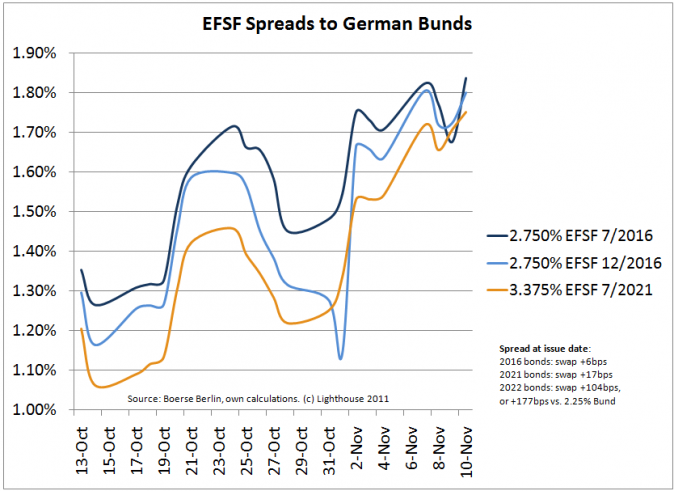
und wieder ein blutroter Tag an den €uro-Anleihemärkten.
Dazu auch ein n-tv - Artikel
http://www.n-tv.de/wirtschaft/Anleihemarkt-unter-Trommelfeue…
Eurozone kämpft ums Überleben
Anleihemarkt unter Trommelfeuer
Der Druck der Finanzmärkte auf die Euro-Krisenländer lässt nicht nach. Im Gegenteil. So klettern die Renditen für zehnjährige Staatsanleihen aus Frankreich und Belgien auf Rekordstände. Auch Papiere aus Spanien, Italien und Österreich geraten auf die Verkaufsliste der Investoren. Für die Staaten wird die Luft immer dünner.
Dazu auch ein n-tv - Artikel
http://www.n-tv.de/wirtschaft/Anleihemarkt-unter-Trommelfeue…
Eurozone kämpft ums Überleben
Anleihemarkt unter Trommelfeuer
Der Druck der Finanzmärkte auf die Euro-Krisenländer lässt nicht nach. Im Gegenteil. So klettern die Renditen für zehnjährige Staatsanleihen aus Frankreich und Belgien auf Rekordstände. Auch Papiere aus Spanien, Italien und Österreich geraten auf die Verkaufsliste der Investoren. Für die Staaten wird die Luft immer dünner.
"Sorry Deutschland. Die Geschichte hat sich wieder einmal gegen euch verschworen. Ihr müsst zwei Billionen Euro rüberschieben, eure Zentralbank korrumpieren und 5% Inflation akzeptieren, oder ihr werdet für die Götterdämmerung verantwortlich gemacht. Das ist nicht fair, aber das ist, was Währungsunion immer bedeutet hat. Haben sie euch das nicht gesagt?"
(Ambrose Evans Pritchard, der Kolumnist des Daily Telegraph, 27.09.11)
(Ambrose Evans Pritchard, der Kolumnist des Daily Telegraph, 27.09.11)
Da die Politik in ihrem Euro-Rettungswahn vermutlich weiter versuchen wird, die gegenseitige Rettung von Pleitestaaten und Pleitebanken zulasten des Steuerzahlers zu organisieren, wird sich eine Aussage des deutschen Bankiers Carl Fürstenberg (1850-1933) erneut bewahrheiten:
"Nicht der Staat geht Pleite, sondern seine Bürger!"
Quelle: Mack & Weise
P.S.:
ich weiss schon, dass ich hier im Monolog vor mich hin poste, allein, das ist ein wenig Therapie gegen meine Ängste vor dem Ungewissen, das vor uns "im Unscharfen" liegt und auf das man sich nur sehr zweifelhaft wirklich vorbereiten kann ...
dazu passt noch die Erkenntnis der Inkonsequenz und Schwäche unserer "Vertreter"
"Keine Bank darf so groß sein, dass sie wieder Staaten erpressen darf. Das ist für mich der wichtigste Punkt."
(Angela Merkel, 23.09.2009)
Obwohl Bundeskanzlerin Merkel bei jeder Gelegenheit betont, "Eurobonds sind das völlig falsche Mittel, um die Krise zu bewältigen", läuft hinter den Kulissen das Eurobonds-Umsetzungsprogramm zulasten der europäischen Steuerzahler durch die EZB auf Hochtouren. (Mack & Weise)
"Ich sehe nichts, was auf eine Rezession hindeutet."
(Angela Merkel, 22.08.2011)
"Nicht der Staat geht Pleite, sondern seine Bürger!"
Quelle: Mack & Weise
P.S.:
ich weiss schon, dass ich hier im Monolog vor mich hin poste, allein, das ist ein wenig Therapie gegen meine Ängste vor dem Ungewissen, das vor uns "im Unscharfen" liegt und auf das man sich nur sehr zweifelhaft wirklich vorbereiten kann ...
dazu passt noch die Erkenntnis der Inkonsequenz und Schwäche unserer "Vertreter"
"Keine Bank darf so groß sein, dass sie wieder Staaten erpressen darf. Das ist für mich der wichtigste Punkt."
(Angela Merkel, 23.09.2009)
Obwohl Bundeskanzlerin Merkel bei jeder Gelegenheit betont, "Eurobonds sind das völlig falsche Mittel, um die Krise zu bewältigen", läuft hinter den Kulissen das Eurobonds-Umsetzungsprogramm zulasten der europäischen Steuerzahler durch die EZB auf Hochtouren. (Mack & Weise)
"Ich sehe nichts, was auf eine Rezession hindeutet."
(Angela Merkel, 22.08.2011)
Die Überschrift ist aktueller denn je. Ob es nun Eurobonds, Käufe oder Kredite durch einen Rettungsfonds oder der direkte Aufkauf durch die EZB sind, führt doch alles zum Gleichen. Auch Deutschland wird kleinbei geben und es damit begründen, dass die EZB ja nur garantieren und nicht wirklich kaufen soll, um das fehlende Vertrauen in die Staaten wieder herzustellen.
An dem Austritt Griechenlands führt aber trotzdem kein Weg vorbei.
An dem Austritt Griechenlands führt aber trotzdem kein Weg vorbei.
Merkel und Schäuble wehren sich gegen die massiv an sie herangetragene Forderung der Zustimmung dazu, dass die EZB mit erweiterten Aufkäufen von Anleihen überschuldeter Staaten die "Feuerkraft" erhöht.
Sie weisen mit Recht darauf hin, dass der Weg, den die FED bereits seit längerem erfolglos geht (Hinauszögern ist keine Lösung, sondern Verschlimmerung), keine Option in Europa sein darf. Mit Recht deshalb, weil letztendlich Deutschland die Zeche zahlen dürfte.
RESPEKT, Frau Merkel und Herr Schäuble, ich bitte Sie dringend, spätestens jetzt standhaft zu bleiben! Notfalls MUSS auch ein in letzter Not erfolgender Austritt aus der Schuldenunion denkbar sein (kann ja vorübergehend sein), bevor neben dem letzten Tafelsilber und dem Bundesbank-Gold des deutschen Volkes auch noch die Generation unserer Kinder in dauerhafte Bürgschaftsknechtschaft genommen wird. Sie Beide werden in der späteren Zukunft als die historischen Verräter des Wohlstandes des deutschen Volkes gelten, wenn Sie jetzt einknicken, wohl gemerkt trotz besseren Wissens v.a. Ihrer Berater.
Dazu zitiere ich den Wirtschaftsweisen Franz aus dem Handelsblatt (ein diesbezüglicher Artikel im Spiegel-online über Franz' Stellungnahme ist seltsamerweise wieder gelöscht worden ...):
Wirtschaftsweiser wirft der EZB Todsünden vor
Der Vorsitzende des Sachverständigenrates, Wolfgang Franz, übt massive Kritik an der Europäischen Zentralbank.
üsseldorf"Wohin es führt, wenn ordnungspolitische Prinzipien zugunsten eines vermeintlich alternativlosen Pragmatismus über Bord geworfen werden, lehren die Finanzmarktkrise und die Euro-Krise", wettert der Wirtschaftsweise Wolfgang Franz in einem Gastbeitrag für das Handelsblatt.
Vor allem die EZB habe sich schwere Fehler geleistet, schreibt Franz. Seit ihrer Entscheidung vom Mai 2010, griechische Staatsanleihen anzukaufen, bewege sie sich "auf einer abschüssigen Bahn". Noch gravierender seien Bedenken in Bezug auf die Vernetzung der EZB-Anleihenkäufe mit der staatlichen Schuldenpolitik. Die Finanzierung von Staatshaushalten gehöre zu den "Todsünden einer Zentralbank".
Auch Euro-Bonds erteilt Franz eine klare Absage: "Das ordnungspolitische Prinzip einer Haftung schließt Euro-Bonds als allgemeines Finanzierungsinstrument mit gesamtschuldnerischer Haftung aus." In diesem Sinn sei auch das jüngste Urteil des Bundesverfassungsgerichts zu den Rettungsmaßnahmen im Euro-Raum zu interpretieren. Euro-Bonds dürften "ein Fass ohne Boden werden", fürchtet Franz.
Überlegungen, dem europäischen Rettungschirm EFSF eine Banklizenz zu geben, damit sie sich bei der EZB refinanzieren kann, lehnt Franz kategorisch ab. Damit würde das ordnungspolitisch motivierte Verbot einer Staatsfinanzierung durch die Zentralbank unterlaufen.
Franz verlangt von der EZB, "unmissverständlich und definitiv", den Ankauf von Staatsanleihen einzustellen. Denkbar wäre es allerdings, der EZB die Option einräumen, die von ihr erworbenen Anleihen zum Ankaufkurs in vom EFSF ausgegebene und garantierte Anleihen umzutauschen. Das habe der Sachverständigenrat bereits vorgeschlagen.
http://www.handelsblatt.com/politik/international/wirtschaft…" target="_blank" rel="nofollow ugc noopener">http://www.handelsblatt.com/politik/international/wirtschaft…
Und da möchte ich Sie, Frau Merkel und Herr Schäuble, ermahnen, weiter standhaft zu bleiben, um "weiteren Schaden vom deutschen Volk, das Sie gewählt hat, abzuwenden"!!!!
Es freut mich, wenn ich lese:
Merkel und Sarkozy uneins
EZB wird zum Zankapfel
Weil steigende Kreditkosten mittlerweile auch Kernländer der Eurozone in ernste Schwierigkeiten bringen, rückt die Europäische Zentralbank verstärkt ins Rampenlicht. Sie solle dringend Anleihen kaufen, fordert Frankreich. Die Bundesregierung hält das aber für keine gute Idee.
In der Schuldenkrise ist zwischen Deutschland und Frankreich erneut Streit um die Rolle der Europäischen Zentralbank als Retter in der Not entbrannt. "Wir sehen die Verträge so, dass die EZB keine Möglichkeit hat, die Probleme zu lösen", sagte Bundeskanzlerin Angela Merkel. Der einzige und richtige Weg, um das Vertrauen der Finanzmärkte in die Eurostaaten zurückzugewinnen, sei die schnellstmögliche Umsetzung nationaler Reformen.
Die Staatsanleihenkäufe der EZB im Volumen von bereits 187 Mrd. Euro sind jedoch auch intern umstritten. Insbesondere die Bundesbank sieht die Grenze zwischen Fiskal- und Geldpolitik verwischt.
Trotz der steigenden Zinsen für Euroländer ist Bundesfinanzminister Wolfgang Schäuble gegen solche Planspiele. "Die fundamentalen Probleme sind neben einem Mangel an Regulierung der Finanzmärkte, die wir schrittweise beheben, dass wir ein Übermaß an Staatsverschuldung haben", meinte der CDU-Politiker.
Das könne vielleicht in den USA mit dem Einsatz der Notenbank Fed noch für einige Zeit überbrückt werden. "In Europa wird das nicht funktionieren", sagte Schäuble. Das wäre eine falsche Lösung, mit der man nur kurz Zeit gewinne, dafür aber später einen höheren Preis zahle.
Frankreich war bereits bei der Erweiterung des europäischen Rettungsschirms EFSF mit seinen Vorschlägen bei Deutschland auf Widerstand gestoßen. So forderte das Land eine Banklizenz für den EFSF, die dem Fonds direkten Zugang zu der Geldquelle EZB gewähren würde.
Quelle: n-tv
Fast ganz Europa ist in Panik, berechtigterweise, das heißt zwar, dass Deutschland alles in seiner Macht stehende tun muss, um zu helfen, aber es heißt nicht, dass Deutschland mit Europa untergehen muss!!!!
Ihre Wähler haben Sie als deutsche Volksvertreter gewählt, nicht als griechische, italienische oder französische! Fragen Sie doch mal die Menschen, die Sie gewählt haben!!!
Eine europäische Staatspleite in den kommenden fünf Jahren, die Deutschland inkludiert, wird Ihnen als Hauptverursacher in der historischen Zukunft niemand verzeihen. Sie werden als unrühmliche Figuren in die Geschichte eingehen, wenn Sie jetzt einknicken!
Sie weisen mit Recht darauf hin, dass der Weg, den die FED bereits seit längerem erfolglos geht (Hinauszögern ist keine Lösung, sondern Verschlimmerung), keine Option in Europa sein darf. Mit Recht deshalb, weil letztendlich Deutschland die Zeche zahlen dürfte.
RESPEKT, Frau Merkel und Herr Schäuble, ich bitte Sie dringend, spätestens jetzt standhaft zu bleiben! Notfalls MUSS auch ein in letzter Not erfolgender Austritt aus der Schuldenunion denkbar sein (kann ja vorübergehend sein), bevor neben dem letzten Tafelsilber und dem Bundesbank-Gold des deutschen Volkes auch noch die Generation unserer Kinder in dauerhafte Bürgschaftsknechtschaft genommen wird. Sie Beide werden in der späteren Zukunft als die historischen Verräter des Wohlstandes des deutschen Volkes gelten, wenn Sie jetzt einknicken, wohl gemerkt trotz besseren Wissens v.a. Ihrer Berater.
Dazu zitiere ich den Wirtschaftsweisen Franz aus dem Handelsblatt (ein diesbezüglicher Artikel im Spiegel-online über Franz' Stellungnahme ist seltsamerweise wieder gelöscht worden ...):
Wirtschaftsweiser wirft der EZB Todsünden vor
Der Vorsitzende des Sachverständigenrates, Wolfgang Franz, übt massive Kritik an der Europäischen Zentralbank.
üsseldorf"Wohin es führt, wenn ordnungspolitische Prinzipien zugunsten eines vermeintlich alternativlosen Pragmatismus über Bord geworfen werden, lehren die Finanzmarktkrise und die Euro-Krise", wettert der Wirtschaftsweise Wolfgang Franz in einem Gastbeitrag für das Handelsblatt.
Vor allem die EZB habe sich schwere Fehler geleistet, schreibt Franz. Seit ihrer Entscheidung vom Mai 2010, griechische Staatsanleihen anzukaufen, bewege sie sich "auf einer abschüssigen Bahn". Noch gravierender seien Bedenken in Bezug auf die Vernetzung der EZB-Anleihenkäufe mit der staatlichen Schuldenpolitik. Die Finanzierung von Staatshaushalten gehöre zu den "Todsünden einer Zentralbank".
Auch Euro-Bonds erteilt Franz eine klare Absage: "Das ordnungspolitische Prinzip einer Haftung schließt Euro-Bonds als allgemeines Finanzierungsinstrument mit gesamtschuldnerischer Haftung aus." In diesem Sinn sei auch das jüngste Urteil des Bundesverfassungsgerichts zu den Rettungsmaßnahmen im Euro-Raum zu interpretieren. Euro-Bonds dürften "ein Fass ohne Boden werden", fürchtet Franz.
Überlegungen, dem europäischen Rettungschirm EFSF eine Banklizenz zu geben, damit sie sich bei der EZB refinanzieren kann, lehnt Franz kategorisch ab. Damit würde das ordnungspolitisch motivierte Verbot einer Staatsfinanzierung durch die Zentralbank unterlaufen.
Franz verlangt von der EZB, "unmissverständlich und definitiv", den Ankauf von Staatsanleihen einzustellen. Denkbar wäre es allerdings, der EZB die Option einräumen, die von ihr erworbenen Anleihen zum Ankaufkurs in vom EFSF ausgegebene und garantierte Anleihen umzutauschen. Das habe der Sachverständigenrat bereits vorgeschlagen.
http://www.handelsblatt.com/politik/international/wirtschaft…" target="_blank" rel="nofollow ugc noopener">http://www.handelsblatt.com/politik/international/wirtschaft…
Und da möchte ich Sie, Frau Merkel und Herr Schäuble, ermahnen, weiter standhaft zu bleiben, um "weiteren Schaden vom deutschen Volk, das Sie gewählt hat, abzuwenden"!!!!
Es freut mich, wenn ich lese:
Merkel und Sarkozy uneins
EZB wird zum Zankapfel
Weil steigende Kreditkosten mittlerweile auch Kernländer der Eurozone in ernste Schwierigkeiten bringen, rückt die Europäische Zentralbank verstärkt ins Rampenlicht. Sie solle dringend Anleihen kaufen, fordert Frankreich. Die Bundesregierung hält das aber für keine gute Idee.
In der Schuldenkrise ist zwischen Deutschland und Frankreich erneut Streit um die Rolle der Europäischen Zentralbank als Retter in der Not entbrannt. "Wir sehen die Verträge so, dass die EZB keine Möglichkeit hat, die Probleme zu lösen", sagte Bundeskanzlerin Angela Merkel. Der einzige und richtige Weg, um das Vertrauen der Finanzmärkte in die Eurostaaten zurückzugewinnen, sei die schnellstmögliche Umsetzung nationaler Reformen.
Die Staatsanleihenkäufe der EZB im Volumen von bereits 187 Mrd. Euro sind jedoch auch intern umstritten. Insbesondere die Bundesbank sieht die Grenze zwischen Fiskal- und Geldpolitik verwischt.
Trotz der steigenden Zinsen für Euroländer ist Bundesfinanzminister Wolfgang Schäuble gegen solche Planspiele. "Die fundamentalen Probleme sind neben einem Mangel an Regulierung der Finanzmärkte, die wir schrittweise beheben, dass wir ein Übermaß an Staatsverschuldung haben", meinte der CDU-Politiker.
Das könne vielleicht in den USA mit dem Einsatz der Notenbank Fed noch für einige Zeit überbrückt werden. "In Europa wird das nicht funktionieren", sagte Schäuble. Das wäre eine falsche Lösung, mit der man nur kurz Zeit gewinne, dafür aber später einen höheren Preis zahle.
Frankreich war bereits bei der Erweiterung des europäischen Rettungsschirms EFSF mit seinen Vorschlägen bei Deutschland auf Widerstand gestoßen. So forderte das Land eine Banklizenz für den EFSF, die dem Fonds direkten Zugang zu der Geldquelle EZB gewähren würde.
Quelle: n-tv
Fast ganz Europa ist in Panik, berechtigterweise, das heißt zwar, dass Deutschland alles in seiner Macht stehende tun muss, um zu helfen, aber es heißt nicht, dass Deutschland mit Europa untergehen muss!!!!
Ihre Wähler haben Sie als deutsche Volksvertreter gewählt, nicht als griechische, italienische oder französische! Fragen Sie doch mal die Menschen, die Sie gewählt haben!!!
Eine europäische Staatspleite in den kommenden fünf Jahren, die Deutschland inkludiert, wird Ihnen als Hauptverursacher in der historischen Zukunft niemand verzeihen. Sie werden als unrühmliche Figuren in die Geschichte eingehen, wenn Sie jetzt einknicken!
Antwort auf Beitrag Nr.: 42.361.274 von 50667 am 17.11.11 03:48:31Wer heute und in Zukunft noch CDU/CSU, SPD oder FDP wählt, belohnt diese Versager auch noch.
Deutschland hat die Riesenchance verpasst, die Vertragsbrüche durch die EU und die EZB zum Anlass zu nehmen, gesichtswahrend die EUROzone und die EU zu verlassen.
Auch die FDP ist dabei, eine ebensolche und wohl nicht wiederkehrende Riesenchance zu vergeben:
Würde sie auf Schäffler und Konsorten hören, könnte sie sich als Vernunftpartei und Interessenwahrerin Deutschlands und der Deutschen etablieren. Ein riesiger Zulauf wäre ihr gewiss.
Und schließlich verpassen auch andere eine Riesenchance: Warum wird in Deutschland keine Anti-EU oder wenigstens Anti-EURO-Partei gegründet, die nicht gegen, sondern für die Interessen Deutschlands und der Deutschen handelt?
Deutschland hat die Riesenchance verpasst, die Vertragsbrüche durch die EU und die EZB zum Anlass zu nehmen, gesichtswahrend die EUROzone und die EU zu verlassen.
Auch die FDP ist dabei, eine ebensolche und wohl nicht wiederkehrende Riesenchance zu vergeben:
Würde sie auf Schäffler und Konsorten hören, könnte sie sich als Vernunftpartei und Interessenwahrerin Deutschlands und der Deutschen etablieren. Ein riesiger Zulauf wäre ihr gewiss.
Und schließlich verpassen auch andere eine Riesenchance: Warum wird in Deutschland keine Anti-EU oder wenigstens Anti-EURO-Partei gegründet, die nicht gegen, sondern für die Interessen Deutschlands und der Deutschen handelt?
Antwort auf Beitrag Nr.: 42.361.274 von 50667 am 17.11.11 03:48:31Auf Prinzipientreue und Standhaftigkeit von Frau Merkel zu hoffen, dürfte ein vergebliches Unterfangen sein. Die Dame wechselt mir zu häufig und ohne Schamgefühl zu offenbaren ihren Kurs. Angesichts der Gesamtproblematik entwickelt sich die deutsche "Schuldenbremse" schon heute zu einer substanzlosen Utopie. Deutsche Finanzhilfen (woher eigentlich, frage ich mich immer wieder) sollten wenigstens nur gegen Sicherheiten erfolgen. Das könnten Goldreserven des Gläubigers, Grund und Boden oder Staatsvermögen sein.
der heutige Tag hat mein Selbstverständnis als Deutscher fundamental erschüttert. Und das tut weh.
Deutschland war seit 1945 nie mehr souverän. Deutschland ist kein Nationalstaat.
d.h. Deutschland ist bis heute besetzt. Deutschland hat auch heute noch SCHULD.
Deutschland wird in einer Fiskal-Union aufgehen, für die bis spätestens Ende 2013 die Grundlagen geschaffen werden.
Du dachtest: Du bist Deutschland? Na zumindest bist Du ab jetzt zuallerst Grieche, Franzose, Italiener, Spanier, denn in Wahrheit bist Du nicht unabhängiger, freier, SOUVERÄNER Deutscher, sondern zuallererst EUROPÄER!
Und das in Zukunft vor allem als Steuerzahler. Du wirst nicht deutsche, sondern europäische Steuern, Gebühren und Abgaben leisten! Nicht für Deutschland, sondern für Griechenland, Spanien, Italien, Portugal, Frankreich.
http://www.youtube.com/watch?feature=player_embedded&v=2IRnD…
Deutschland war seit 1945 nie mehr souverän. Deutschland ist kein Nationalstaat.
d.h. Deutschland ist bis heute besetzt. Deutschland hat auch heute noch SCHULD.
Deutschland wird in einer Fiskal-Union aufgehen, für die bis spätestens Ende 2013 die Grundlagen geschaffen werden.
Du dachtest: Du bist Deutschland? Na zumindest bist Du ab jetzt zuallerst Grieche, Franzose, Italiener, Spanier, denn in Wahrheit bist Du nicht unabhängiger, freier, SOUVERÄNER Deutscher, sondern zuallererst EUROPÄER!
Und das in Zukunft vor allem als Steuerzahler. Du wirst nicht deutsche, sondern europäische Steuern, Gebühren und Abgaben leisten! Nicht für Deutschland, sondern für Griechenland, Spanien, Italien, Portugal, Frankreich.
http://www.youtube.com/watch?feature=player_embedded&v=2IRnD…
Antwort auf Beitrag Nr.: 42.374.383 von 50667 am 20.11.11 10:27:26
Deutschland war seit 1945 nie mehr souverän. Deutschland ist kein Nationalstaat.
Somit wissen wir aber auch, warum man nationale Interessen bis auf´s Blut bekämpfte und Alles, was nach vernünftiger Politik für unser Land nur roch, in die braune Ecke stellte.
Mahnende Stimmen gab es zuhauf aus der Bevölkerung.
Deutschland war seit 1945 nie mehr souverän. Deutschland ist kein Nationalstaat.
Somit wissen wir aber auch, warum man nationale Interessen bis auf´s Blut bekämpfte und Alles, was nach vernünftiger Politik für unser Land nur roch, in die braune Ecke stellte.
Mahnende Stimmen gab es zuhauf aus der Bevölkerung.
Antwort auf Beitrag Nr.: 42.363.644 von raceglider am 17.11.11 14:04:10Grüne nicht vergessen, das sind die Schlimmsten Die hätten unsere Gold-reserven längst eigenhändig in die USA transportiert!
Die hätten unsere Gold-reserven längst eigenhändig in die USA transportiert! Zitat von Maarde: Grüne nicht vergessen, das sind die Schlimmsten
Etwa 2/3 "unserer" Goldreserven befinden sich bereits in den USA.
Weiter Anteile lagern in Frankreich und GB und nur ein geringer Teil (ich glaube rd. 5%) sind noch in den Händen der Bundesbank.
"Unsere" Goldreserven lagern also überwiegend bei den alliierten Siegermächten.
Ob diese GR als Pfand oder Kriegsbeute gelten?
Ich aber vermute mal, dass wir diese abschreiben können.
http://www.deutsche-mittelstands-nachrichten.de/2011/11/3289…
Schäuble sagte, dass die Kritiker an einer weitergehenden europäischen Integration Europas „in Wahrheit von dem Regelungsmonopol des Nationalstaates“ ausgingen. Schäuble: „Das war die alte Ordnung, die dem Völkerrecht noch zugrunde liegt, mit dem Begriff der Souveränität, die in Europa längst ad absurdum geführt worden ist, spätestens seit den zwei Weltkriegen in der ersten Hälfte des vergangenen Jahrhunderts. Und wir in Deutschland sind seit dem 8. Mai 1955, äh..1945 zu keinem Zeitpunkt mehr voll souverän gewesen.” Dem habe auch das Grundgesetz 1949 entsprochen, indem es formuliert habe, dass Deutschland ein gleichberechtigtes Mitglied in Europa sein solle.
Bundesfinanzminister Wolfgang Schäuble vor den Bankern Europas. (Screenshot: Phoenix)
Bundesfinanzminister Wolfgang Schäuble vor den Bankern Europas. (Screenshot: Phoenix)
Daher wolle man nun die europäische Integration nun in kürzester Zeit vorantreiben. Schäuble: „Ich möchte Ihnen ganz klar sagen, dass ich ziemlich überzeugt bin, dass wir in einer Zeit von weniger als 24 Monaten in der Lage sind und in der Lage sein werden, das europäische Regelwerk so zu verändern. Wir brauchen nur das Protokoll Numero 14, wer´s nachlesen möchte, im Allgemeinen, im Lissabon-Vertrag, so aufzubauen, dass wir die Grundzüge einer Fiskalunion für die Eurozone schaffen.“
Den Kritikern des bestehenden Finanzsystems unterstellte Schäuble indirekt umstürzlerische Absichten. Er machte, weil er ja vor Bankern sprach, die Protestbewegung Occupy Wall Street lächerlich, indem er sagte: „Wie heißt die Bewegung jetzt? Occupy… Bei uns haben sie jetzt in Berlin sinnigerweise ein Gelände besetzt, das im Eigentum des Bundes ist!“ Dennoch glaube er, dass die Bewegung erst am Anfang sei und dass sie die „grundsätzliche Legitimation marktwirtschaftlicher Ordnungen und wahrscheinlich auch demokratischer Ordnungen in Frage stellen wird“. Es sei die Aufgabe der Bundesregierung und der Banken, „die empfundenen Legitimationsdefizite ein Stück weit zu bekämpfen“.
Schäuble sagte, dass die Kritiker an einer weitergehenden europäischen Integration Europas „in Wahrheit von dem Regelungsmonopol des Nationalstaates“ ausgingen. Schäuble: „Das war die alte Ordnung, die dem Völkerrecht noch zugrunde liegt, mit dem Begriff der Souveränität, die in Europa längst ad absurdum geführt worden ist, spätestens seit den zwei Weltkriegen in der ersten Hälfte des vergangenen Jahrhunderts. Und wir in Deutschland sind seit dem 8. Mai 1955, äh..1945 zu keinem Zeitpunkt mehr voll souverän gewesen.” Dem habe auch das Grundgesetz 1949 entsprochen, indem es formuliert habe, dass Deutschland ein gleichberechtigtes Mitglied in Europa sein solle.
Bundesfinanzminister Wolfgang Schäuble vor den Bankern Europas. (Screenshot: Phoenix)
Bundesfinanzminister Wolfgang Schäuble vor den Bankern Europas. (Screenshot: Phoenix)
Daher wolle man nun die europäische Integration nun in kürzester Zeit vorantreiben. Schäuble: „Ich möchte Ihnen ganz klar sagen, dass ich ziemlich überzeugt bin, dass wir in einer Zeit von weniger als 24 Monaten in der Lage sind und in der Lage sein werden, das europäische Regelwerk so zu verändern. Wir brauchen nur das Protokoll Numero 14, wer´s nachlesen möchte, im Allgemeinen, im Lissabon-Vertrag, so aufzubauen, dass wir die Grundzüge einer Fiskalunion für die Eurozone schaffen.“
Den Kritikern des bestehenden Finanzsystems unterstellte Schäuble indirekt umstürzlerische Absichten. Er machte, weil er ja vor Bankern sprach, die Protestbewegung Occupy Wall Street lächerlich, indem er sagte: „Wie heißt die Bewegung jetzt? Occupy… Bei uns haben sie jetzt in Berlin sinnigerweise ein Gelände besetzt, das im Eigentum des Bundes ist!“ Dennoch glaube er, dass die Bewegung erst am Anfang sei und dass sie die „grundsätzliche Legitimation marktwirtschaftlicher Ordnungen und wahrscheinlich auch demokratischer Ordnungen in Frage stellen wird“. Es sei die Aufgabe der Bundesregierung und der Banken, „die empfundenen Legitimationsdefizite ein Stück weit zu bekämpfen“.
und schon kommt Barroso wieder mit Eurobonds, er läßt die Wahl zwischen drei Variationen
http://www.n-tv.de/wirtschaft/Barroso-laesst-Merkel-die-Wahl…
zu Schäuble:
Wen vertritt der eigentlich noch? Der müsste wegen Illoyalität zum deutschen Volk suspendiert werden, natürlich ohne Weiterzahlung der Bezüge. In der Bundeswehr gibt es den Begriff der "unehrenhaften Entlassung".
http://www.n-tv.de/wirtschaft/Barroso-laesst-Merkel-die-Wahl…
zu Schäuble:
Wen vertritt der eigentlich noch? Der müsste wegen Illoyalität zum deutschen Volk suspendiert werden, natürlich ohne Weiterzahlung der Bezüge. In der Bundeswehr gibt es den Begriff der "unehrenhaften Entlassung".
SPD: Eurobonds werden wahrscheinlicher
http://www.wallstreet-online.de/nachricht/3787179-spd-euro-b…
'Wahrscheinlich werden wir um gemeinsame Haftungen nicht herumkommen', sagte Fraktionsgeschäftsführer Thomas Oppermann am Dienstag in Berlin.
Durch die Käufe von Anleihen verschuldeter Staaten wie Griechenland durch die Europäische Zentralbank gebe es aber längst eine Vergemeinschaftung von Schulden, da Deutschland dafür über die EZB hafte, sagte Oppermann. Die EZB habe bereits Anleihen in Höhe von 154 Milliarden Euro aufgekauft. 'Das sind Merkel-Bonds', so der SPD-Politiker.
http://www.wallstreet-online.de/nachricht/3787179-spd-euro-b…
'Wahrscheinlich werden wir um gemeinsame Haftungen nicht herumkommen', sagte Fraktionsgeschäftsführer Thomas Oppermann am Dienstag in Berlin.
Durch die Käufe von Anleihen verschuldeter Staaten wie Griechenland durch die Europäische Zentralbank gebe es aber längst eine Vergemeinschaftung von Schulden, da Deutschland dafür über die EZB hafte, sagte Oppermann. Die EZB habe bereits Anleihen in Höhe von 154 Milliarden Euro aufgekauft. 'Das sind Merkel-Bonds', so der SPD-Politiker.
Zitat von 50667: und schon kommt Barroso wieder mit Eurobonds, er läßt die Wahl zwischen drei Variationen
http://www.n-tv.de/wirtschaft/Barroso-laesst-Merkel-die-Wahl…
zu Schäuble:
Wen vertritt der eigentlich noch? Der müsste wegen Illoyalität zum deutschen Volk suspendiert werden, natürlich ohne Weiterzahlung der Bezüge. In der Bundeswehr gibt es den Begriff der "unehrenhaften Entlassung".
Wieso nur Schäuble
fast ALLE
die SPD ist also schon längst in der Spur, die CDU fast, nur die CSU quält sich noch:
en einsamer Rufer scheint Dobrindt zu sein:
CSU-Generalsekretär Alexander Dobrindt hat eindringlich davor gewarnt, als Antwort auf die Schuldenkrise mehr Macht auf die europäische Ebene zu verlagern. „Mehr Europa hieße weniger Deutschland. Das darf man nicht verschweigen“, sagte Dobrindt der in Berlin erscheinenden Tageszeitung „Die Welt“ (E-Tag: Montag. 21. November 2011). „Es wäre die grundfalsche Weichenstellung, zusätzlich wesentliche Kompetenzen auf die europäische Ebene zu übertragen. Der umgekehrte Weg ist richtig.“ Europa brauche starke Nationalstaaten, um wettbewerbsfähig zu bleiben.
„Die Wirtschafts- und Finanzpolitik – insbesondere das Budgetrecht – müssen auf der nationalen Ebene bleiben“, führte Dobrindt aus. „Und wir müssen Kompetenzen zurückverlagern, die sich in Brüssel nicht als fruchtbar erweisen.“ Vieles gelinge auf nationaler oder regionaler Ebene besser.
(...)
Dobrindt hat das Krisenmanagement der Europäischen Zentralbank (EZB) ungewöhnlich scharf kritisiert. „Ich halte es für fragwürdig, dass die Europäische Zentralbank immer neue Staatsanleihen von Schuldenstaaten aufkauft“, sagte Dobrindt der Zeitung „Die Welt“: „Wer sich mit Fäulnispapieren zudeckt, bekommt irgendwann einen toxischen Schock.“
Der neue EZB-Präsident Mario Draghi habe „einen hoch problematischen Einstand hingelegt, indem er den Ankauf von Schuldentiteln aus Krisenstaaten drastisch beschleunigt hat“, kritisierte Dobrindt. „Er könnte der teuerste EZB-Präsident aller Zeiten werden.“ Draghis Entscheidungen „erhöhen die Gefahr einer Inflation“. Der CSU-Generalsekretär betonte: „Wir hätten einer Europäischen Zentralbank niemals zugestimmt, wenn wir geahnt hätten, dass dort einmal italienische Verhältnisse einziehen.“
Dobrindt forderte ein größeres Stimmgewicht Deutschlands in der EZB. „Wir tragen fast 30 Prozent der finanziellen Verantwortung, haben aber nur so viel Gewicht wie jedes andere Euro-Land“, sagte er. „Dabei kann es nicht bleiben.“
Ein freundlicher Hinweis auf die Quelle kam von User S65
en einsamer Rufer scheint Dobrindt zu sein:
CSU-Generalsekretär Alexander Dobrindt hat eindringlich davor gewarnt, als Antwort auf die Schuldenkrise mehr Macht auf die europäische Ebene zu verlagern. „Mehr Europa hieße weniger Deutschland. Das darf man nicht verschweigen“, sagte Dobrindt der in Berlin erscheinenden Tageszeitung „Die Welt“ (E-Tag: Montag. 21. November 2011). „Es wäre die grundfalsche Weichenstellung, zusätzlich wesentliche Kompetenzen auf die europäische Ebene zu übertragen. Der umgekehrte Weg ist richtig.“ Europa brauche starke Nationalstaaten, um wettbewerbsfähig zu bleiben.
„Die Wirtschafts- und Finanzpolitik – insbesondere das Budgetrecht – müssen auf der nationalen Ebene bleiben“, führte Dobrindt aus. „Und wir müssen Kompetenzen zurückverlagern, die sich in Brüssel nicht als fruchtbar erweisen.“ Vieles gelinge auf nationaler oder regionaler Ebene besser.
(...)
Dobrindt hat das Krisenmanagement der Europäischen Zentralbank (EZB) ungewöhnlich scharf kritisiert. „Ich halte es für fragwürdig, dass die Europäische Zentralbank immer neue Staatsanleihen von Schuldenstaaten aufkauft“, sagte Dobrindt der Zeitung „Die Welt“: „Wer sich mit Fäulnispapieren zudeckt, bekommt irgendwann einen toxischen Schock.“
Der neue EZB-Präsident Mario Draghi habe „einen hoch problematischen Einstand hingelegt, indem er den Ankauf von Schuldentiteln aus Krisenstaaten drastisch beschleunigt hat“, kritisierte Dobrindt. „Er könnte der teuerste EZB-Präsident aller Zeiten werden.“ Draghis Entscheidungen „erhöhen die Gefahr einer Inflation“. Der CSU-Generalsekretär betonte: „Wir hätten einer Europäischen Zentralbank niemals zugestimmt, wenn wir geahnt hätten, dass dort einmal italienische Verhältnisse einziehen.“
Dobrindt forderte ein größeres Stimmgewicht Deutschlands in der EZB. „Wir tragen fast 30 Prozent der finanziellen Verantwortung, haben aber nur so viel Gewicht wie jedes andere Euro-Land“, sagte er. „Dabei kann es nicht bleiben.“
Ein freundlicher Hinweis auf die Quelle kam von User S65
bitte UNBEDINGT anschauen (erste paar Minuten reichen ...)
http://www.youtube.com/watch?v=ejAn-nFfAA0
http://www.youtube.com/watch?v=ejAn-nFfAA0
Aber was will man schon dagegen tun?
Auf die Straße gehen und demonstrieren?
Das kannst du in Deutschland machen wenns um einen Bahnhof geht oder um Atomkraft. Die wirklich wichtigen Sachen interessieren den deutschen Michel nicht. Der will seine Ruhe haben, an den Staat glauben und RTL gucken.
Aber die Schafschur kommt. Und die meisten der Schafe werden erst, wenn sie die Wolle verloren haben und im eisigen Wind stehen, das Gefühl haben, das irgendwas nicht stimmt.
Gut, daß es Internet gibt.
Wir können das erfahren, was man uns offiziell nicht sagt und gegen die Trägheit der Masse handeln.
Denn wenn die erst mal ins Laufen kommt, ist es zu spät dafür..
Auf die Straße gehen und demonstrieren?
Das kannst du in Deutschland machen wenns um einen Bahnhof geht oder um Atomkraft. Die wirklich wichtigen Sachen interessieren den deutschen Michel nicht. Der will seine Ruhe haben, an den Staat glauben und RTL gucken.
Aber die Schafschur kommt. Und die meisten der Schafe werden erst, wenn sie die Wolle verloren haben und im eisigen Wind stehen, das Gefühl haben, das irgendwas nicht stimmt.
Gut, daß es Internet gibt.
Wir können das erfahren, was man uns offiziell nicht sagt und gegen die Trägheit der Masse handeln.
Denn wenn die erst mal ins Laufen kommt, ist es zu spät dafür..
Heute passt die Thread-Überschrift richtig gut.
Auf bestem Weg in die Transfer-Union.
Ich glaube, ich werde besser bald Portugiese.
http://www.spiegel.de/wirtschaft/soziales/0,1518,799618,00.h…
Auf bestem Weg in die Transfer-Union.
Ich glaube, ich werde besser bald Portugiese.
http://www.spiegel.de/wirtschaft/soziales/0,1518,799618,00.h…
Antwort auf Beitrag Nr.: 42.387.671 von schamiddi am 23.11.11 10:56:48Auf die Straße gehen und demonstrieren
auch das brächte nix, und das volk weiß das
wir dürfen zwar demonstrieren nach dem GG, aber den politikern geht das am a... vorbei, nur wenn zu viele leute eine partei wählten, die etwas ändern würde, kriegen sie angst, daher versuchen sie im vorfeld, parteien zu verbieten indem sie ihnen etwas unterschieben
iü die debatten im bundestg sind doch nur show, entschieden ist doch längst alles nd wer sich nicht fügt in der partei bekommt ärger
auch das brächte nix, und das volk weiß das
wir dürfen zwar demonstrieren nach dem GG, aber den politikern geht das am a... vorbei, nur wenn zu viele leute eine partei wählten, die etwas ändern würde, kriegen sie angst, daher versuchen sie im vorfeld, parteien zu verbieten indem sie ihnen etwas unterschieben
iü die debatten im bundestg sind doch nur show, entschieden ist doch längst alles nd wer sich nicht fügt in der partei bekommt ärger
ZDF-Sendung: Angst ums Geld
Und jetzt mit den Eurobonds geht's noch beschleunigter in den Orkus
http://www.zdf.de/ZDFmediathek/beitrag/live/1321472/ZDFzoom-…
Und jetzt mit den Eurobonds geht's noch beschleunigter in den Orkus
http://www.zdf.de/ZDFmediathek/beitrag/live/1321472/ZDFzoom-…
Zusammenfassend:
Es liegt im elementaren Interesse von GB/USA daß Deutschland herausgelöst wird aus Europa und Frankreich isoliert dasteht, daß es seine Souveränität verliert. Da kommt es dann schon mal vor, daß auch Fistelstimmen sich erheben und von einem Weltbild schwadronieren, das die Menschen ansprechen soll.
______________________________________________________________________________________
http://www.youtube.com/watch?v=h0ViKBQDYu0
______________________________________________________________________________________
Der fromme Wunsch vom Frieden und heile heile Welt findet rührenden Niederschlag. Lügende Minister gehen klappern, daß es einem schlecht werden könnte. Eine Metapher wird aufgebaut, ja eine potemkische Kulisse über die Bühne geschoben, die die Kleinkinder schon bewegen.
Es liegt im elementaren Interesse von GB/USA daß Deutschland herausgelöst wird aus Europa und Frankreich isoliert dasteht, daß es seine Souveränität verliert. Da kommt es dann schon mal vor, daß auch Fistelstimmen sich erheben und von einem Weltbild schwadronieren, das die Menschen ansprechen soll.
______________________________________________________________________________________
http://www.youtube.com/watch?v=h0ViKBQDYu0
______________________________________________________________________________________
Der fromme Wunsch vom Frieden und heile heile Welt findet rührenden Niederschlag. Lügende Minister gehen klappern, daß es einem schlecht werden könnte. Eine Metapher wird aufgebaut, ja eine potemkische Kulisse über die Bühne geschoben, die die Kleinkinder schon bewegen.
Die Vision eines friedlichen Europas ist realistisch! Aber nur als pluralistisches Europa souveräner Staaten mit gemeinsamem kulturellen Hintergrund, aber differenzierten nationalen Mentalitäten, verschiedenen wirtschaftlichen Geschwindigkeiten, verschieden stabilen Währungen und trotzdem gemeinsamen wirtschaftlichen Interessen und Harmonisierungen.
Wann geht es endlich in die Köpfe der Politiker, dass die Völker Europas keine zentralistische Europadiktatur haben wollen, sondern eine europäische Wirtschaftsunion der national souveränen Pluralitäten und gleichzeitig weitestmöglichen Harmonisierungen und Erleichterungen!
Trennt das Gute Europas von dem Schadhaften, verwirklicht eine hilfreiche Europäische Union und schafft die Transfer- Schulden- und Zentralitäts-Union ab!
Genau das fordern mindestens 4/5 der Europäer. Fragt die Leute auf der Strasse! In Griechenland, Spanien, Frankreich, Italien genauso wie in den Niederlanden, Österreich oder Deutschland.
Eurobonds führen direkt in die Sackgasse und sämtliche positiven Entwicklungen eines gemeinsamen Europas werden aus lediglich monetären Gründen um Jahrzehnte zurückgeworfen, weil der positive Europäische Gedanke ins unerträglich Negative pervertiert wird. Europa ist eine Gemeinschaft von Gleichgesinnten, es darf nicht zu einer Schicksalsgemeinschaft werden!
Wann geht es endlich in die Köpfe der Politiker, dass die Völker Europas keine zentralistische Europadiktatur haben wollen, sondern eine europäische Wirtschaftsunion der national souveränen Pluralitäten und gleichzeitig weitestmöglichen Harmonisierungen und Erleichterungen!
Trennt das Gute Europas von dem Schadhaften, verwirklicht eine hilfreiche Europäische Union und schafft die Transfer- Schulden- und Zentralitäts-Union ab!
Genau das fordern mindestens 4/5 der Europäer. Fragt die Leute auf der Strasse! In Griechenland, Spanien, Frankreich, Italien genauso wie in den Niederlanden, Österreich oder Deutschland.
Eurobonds führen direkt in die Sackgasse und sämtliche positiven Entwicklungen eines gemeinsamen Europas werden aus lediglich monetären Gründen um Jahrzehnte zurückgeworfen, weil der positive Europäische Gedanke ins unerträglich Negative pervertiert wird. Europa ist eine Gemeinschaft von Gleichgesinnten, es darf nicht zu einer Schicksalsgemeinschaft werden!
Antwort auf Beitrag Nr.: 42.393.877 von 50667 am 24.11.11 12:56:14Völlig richtig.
Die Transferunion haben wir ja bereits.
Und genau die ist nicht dazu geeignet, bei den Zahlernationen Begeisterung zu erwecken.
Bei einem Dauerzustand können sehr rasch wieder nationalistische Gedanken hochkommen.
Und wohl auch nicht ganz zu Unrecht..
Die Transferunion haben wir ja bereits.
Und genau die ist nicht dazu geeignet, bei den Zahlernationen Begeisterung zu erwecken.
Bei einem Dauerzustand können sehr rasch wieder nationalistische Gedanken hochkommen.
Und wohl auch nicht ganz zu Unrecht..
Es ist ein großes Schachspiel. Und im Hintergrund bauen die "Angelsachsen" wohl ihren Erfüllungsgehilfen für seinen zweiten Versuch auf. Oder irre ich mich da ? Es dürfen Vorschläge abgegeben werden, wer gemeint ist. Kleine Hilfestellung: Gysi und der Neue von Sarah Wagenknecht sind es nicht.
Alles wird gut, schließlich haben wir jetzt mit den neuen Führungspersönlichkeiten in Griechenland (Papademos), Italien (Draghi) und unseren Freund bei der EZB (Monti) gestandene Fachleute aus dem Dunstkreis von Morgan Stanley,Goldman Sachs und Co, welche sich ihr Know How jetzt prima zu Nutze machen können, um Europa den finalen Stoß im Sinne der verarmten Großmacht auf der anderen Seite des Atlantik zu geben. Es gibt immer noch Leute, welche glauben, das ein politischer bzw finanzieller/wirtschaftlicher Supergau in der Welt ein paar Gewinner haben würde. Da kann man nur sagen, das unser Marsprogramm noch nicht so weit gediegen ist, diese kranke Erde ohne Schaden zu verlassen.
Wer jedenfalls sein Leben lang hart gearbeitet hat und nun wie damals unsere Großeltern einen Tribut zur Rettung der Politik/Finanzelite
zu zahlen verpflichtet werden soll, der wird sich letztendlich die Frage stellen;
Lohnt sich arbeiten noch, wenn stehlen so viel leichter ist
schönes WE
bushy
Wer jedenfalls sein Leben lang hart gearbeitet hat und nun wie damals unsere Großeltern einen Tribut zur Rettung der Politik/Finanzelite
zu zahlen verpflichtet werden soll, der wird sich letztendlich die Frage stellen;
Lohnt sich arbeiten noch, wenn stehlen so viel leichter ist

schönes WE
bushy
Der Euro hat die EU um 50 Jahre zurückgeworfen, hat alles kaputt gemacht was vorher über Jahrzehnte aufgebaut wurde, die Einführung von Eoro Bonds wurde alles nur um 10 Jahre verzögern und die Probleme würden sich wiederholen !
was heute morgen durch die Ticker geht ("EliteBonds"), ist ein interessanter Gedanke:
Man "tut sich zusammen", hält in der Krise zusammen, um den €uro wenigstens in den Kernländern zu halten und zu etablieren, indem man einen neuen großen Bond-Markt (vermeintlich) stabiler €urobonds der Kern-Eurozone schafft, um die Investoren, die zurzeit fluchtartig der €urozone den Rücken kehren, wieder zurückzugewinnen.
Ich halte nach ersten Überlegungen diese Idee nicht für sooo abwegig, wäre nicht Frankreich mit im Boot.
Zunächst will man damit den überschuldeten Staaten helfen. Ob das gelingt, bleibt abzuwarten. Ich denke natürlich: eher nicht. Und das ist auch nicht richtig.
Der Prozess wird wohl dann mittelfristig eher in Richtung Kern-€urozone gehen, da den überschuldeten Staaten nicht dauerhaft mit Geldtransfers "geholfen" werden kann. Man verlängert nur den Sterbeprozess (Insolvenzverschleppung).
Fakt ist für mich, dass dies ein erster deutlicher Schritt mit Signalwirkung ist, ein Schritt in Richtung Reduzierung der €urozone auf einen Kern-€uro. Dieser Schritt ist für mich nachvollziehbar (wie gesagt, wenn Frankreich nicht wäre).
Man "tut sich zusammen", hält in der Krise zusammen, um den €uro wenigstens in den Kernländern zu halten und zu etablieren, indem man einen neuen großen Bond-Markt (vermeintlich) stabiler €urobonds der Kern-Eurozone schafft, um die Investoren, die zurzeit fluchtartig der €urozone den Rücken kehren, wieder zurückzugewinnen.
Ich halte nach ersten Überlegungen diese Idee nicht für sooo abwegig, wäre nicht Frankreich mit im Boot.
Zunächst will man damit den überschuldeten Staaten helfen. Ob das gelingt, bleibt abzuwarten. Ich denke natürlich: eher nicht. Und das ist auch nicht richtig.
Der Prozess wird wohl dann mittelfristig eher in Richtung Kern-€urozone gehen, da den überschuldeten Staaten nicht dauerhaft mit Geldtransfers "geholfen" werden kann. Man verlängert nur den Sterbeprozess (Insolvenzverschleppung).
Fakt ist für mich, dass dies ein erster deutlicher Schritt mit Signalwirkung ist, ein Schritt in Richtung Reduzierung der €urozone auf einen Kern-€uro. Dieser Schritt ist für mich nachvollziehbar (wie gesagt, wenn Frankreich nicht wäre).
entschuldigung, es fehlt noch die Quelle.
ich gebe hier mal das Handelsblatt an:
http://www.handelsblatt.com/politik/deutschland/deutschland-…
Die Bundesregierung erwägt einem Zeitungsbericht zufolge gemeinsame Anleihen mit fünf besonders kreditwürdigen Euro-Ländern. Dabei handele es sich um Frankreich, Finnland, die Niederlande, Luxemburg und Österreich, die wie Deutschland über die höchste Kreditwürdigkeit verfügen, berichtete die Zeitung „Die Welt“ (Montagsausgabe) vorab unter Berufung auf ranghohe EU-Diplomaten, die mit den Verhandlungen zur Lösung der Währungskrise vertraut sind.
(...)
Beim Kauf der neuen Bonds solle die Finanzagentur des Bundes mit Sitz in Frankfurt eine zentrale Rolle spielen. Der Zinssatz der neuen Anleihen solle zwischen zwei und 2,5 Prozent liegen.
ich gebe hier mal das Handelsblatt an:
http://www.handelsblatt.com/politik/deutschland/deutschland-…
Die Bundesregierung erwägt einem Zeitungsbericht zufolge gemeinsame Anleihen mit fünf besonders kreditwürdigen Euro-Ländern. Dabei handele es sich um Frankreich, Finnland, die Niederlande, Luxemburg und Österreich, die wie Deutschland über die höchste Kreditwürdigkeit verfügen, berichtete die Zeitung „Die Welt“ (Montagsausgabe) vorab unter Berufung auf ranghohe EU-Diplomaten, die mit den Verhandlungen zur Lösung der Währungskrise vertraut sind.
(...)
Beim Kauf der neuen Bonds solle die Finanzagentur des Bundes mit Sitz in Frankfurt eine zentrale Rolle spielen. Der Zinssatz der neuen Anleihen solle zwischen zwei und 2,5 Prozent liegen.
Antwort auf Beitrag Nr.: 42.406.439 von 50667 am 28.11.11 08:31:52"wäre nicht Frankreich mit im Boot"
Genau.
Letztendlich sollen wir für die Schulden der Ecole-National-Patrone
haften und noch dazu den sich dann immer noch ergebenden höheren Zinsaufwand tragen.
EU? Nein, Danke.
Genau.
Letztendlich sollen wir für die Schulden der Ecole-National-Patrone
haften und noch dazu den sich dann immer noch ergebenden höheren Zinsaufwand tragen.
EU? Nein, Danke.
Frankreich lebt auf unsere Kosten.
die wirtschaftswoche zum neuen Thema EliteBonds:
Das letzte Gefecht der Euro-Ritter
Offiziell will von dem Szenario niemand etwas wissen. „Es gibt keine Planungen für Triple-A-Bonds oder Elite-Bonds“, erklärte ein Sprecher des Bundesfinanzministeriums am Montag in Berlin. Das Instrument sei auch nicht für Notfälle geplant, hieß es in Regierungskreisen. Vielmehr werde an einer „Stabilitätsunion“ und den entsprechenden Vertragsänderungen dafür gearbeitet. „Das ist der Weg, um das Vertrauen der Märkte zu gewinnen“.
Doch wer die Eskalation der Euro-Krise in den vergangenen Monaten verfolgt hat, weiß, dass die Haltbarkeit solcher Dementis oft kurz ist.
Denn den Euro-Ländern bleibt wahrscheinlich keine Zeit mehr für einen großen Wurf. Laut Medienberichten werkeln EU-Diplomaten bereits am Notfallplan. Demnach will die Eurozone eine Art Brandmauer errichten, einen Schutzwall, hinter den sich die letzten soliden Staaten der Gemeinschaftswährung flüchten können, wenn die Märkte die Oberhand gewinnen. Es wäre Merkels geheimer Plan zur Euro-Rettung, falls alle anderen Schutzmassnahmen versagen.
Die EU wechselt in den Belagerungsmodus
Für die Planspiele spricht, dass sich die Eurozone schon seit Monaten in einem akuten Belagerungszustand befindet - ein Rückzug in die rettende Burg wäre also nur folgerichtig. Das Zeitfenster für die Rettung der Euro-Zone wird täglich kleiner, weil auch die Kernstaaten der Gemeinschaftswährung längst ins Visier der Märkte geraten sind - nicht nur Italien, sondern vor allem Frankreich. Gemeinsame Anleihen der sechs verbliebenen AAA-Länder wären wohl vor allem eine verborgene Maßnahme, um die Grande Nation vor dem Abgrund zu retten.
Denn sollten die Franzosen ihr Top-Rating verlieren, wäre die Politik der Euro-Rettung faktisch gescheitert
Dass Frankreich ausfällt, ist relativ wahrscheinlich. Die Ratingagenturen haben Frankreich bereits angezählt
chließlich wäre es nicht das erste Mal, dass die EU in Kerne mit unterschiedlichen Geschwindigkeiten zerfällt: Von 27 EU-Mitgliedern sind nur 17 Euro-Mitglieder. Auch bei der gemeinsamen Grenzpolitik im Rahmen des Schengen-Abkommens machen Zypern, Rumänien und Bulgarien bislang gar nicht und Großbritannien nur unvollständig mit. Laut EU-Vertrag ist eine verstärkte Zusammenarbeit zwischen EU-Mitgliedern in bestimmten Bereichen sogar ausdrücklich möglich
Die entscheidendere Frage für den Euro ist also nicht, ob es Elite-Bonds wirklich geben dürfte, sondern wer mit Deutschland in die Burg flüchten darf - und wem das Tor vor der Nase zugeknallt wird.
http://www.wiwo.de/politik/ausland/schuldenkrise-das-letzte-…
ES GEHT UM FRANKREICH!
Aber es kann auch so sein, wie Dorfrichter vermutet: Deutschland ist kein souveräner Staat (wie unsouverän ), Italien ist tot, Großbritannien ist angelsächsisch (sic!), es gilt jetzt nur noch Frankreich zu schwächen, will man den €uro in etwas Größeres "Ganzes" eingehen lassen ...
Meine Synthese: der €uro in der jetzigen Form ist unrettbar verloren (bewusst zerstört worden?), es bleit die Perspektive: entweder ein Kern-€uro oder eine neue "größere" "Gemeinschaftswährung", in der der US-Dollar seine Weltleitfunktion nicht verliertén muss und weiter dominieren darf.
Das letzte Gefecht der Euro-Ritter
Offiziell will von dem Szenario niemand etwas wissen. „Es gibt keine Planungen für Triple-A-Bonds oder Elite-Bonds“, erklärte ein Sprecher des Bundesfinanzministeriums am Montag in Berlin. Das Instrument sei auch nicht für Notfälle geplant, hieß es in Regierungskreisen. Vielmehr werde an einer „Stabilitätsunion“ und den entsprechenden Vertragsänderungen dafür gearbeitet. „Das ist der Weg, um das Vertrauen der Märkte zu gewinnen“.
Doch wer die Eskalation der Euro-Krise in den vergangenen Monaten verfolgt hat, weiß, dass die Haltbarkeit solcher Dementis oft kurz ist.
Denn den Euro-Ländern bleibt wahrscheinlich keine Zeit mehr für einen großen Wurf. Laut Medienberichten werkeln EU-Diplomaten bereits am Notfallplan. Demnach will die Eurozone eine Art Brandmauer errichten, einen Schutzwall, hinter den sich die letzten soliden Staaten der Gemeinschaftswährung flüchten können, wenn die Märkte die Oberhand gewinnen. Es wäre Merkels geheimer Plan zur Euro-Rettung, falls alle anderen Schutzmassnahmen versagen.
Die EU wechselt in den Belagerungsmodus
Für die Planspiele spricht, dass sich die Eurozone schon seit Monaten in einem akuten Belagerungszustand befindet - ein Rückzug in die rettende Burg wäre also nur folgerichtig. Das Zeitfenster für die Rettung der Euro-Zone wird täglich kleiner, weil auch die Kernstaaten der Gemeinschaftswährung längst ins Visier der Märkte geraten sind - nicht nur Italien, sondern vor allem Frankreich. Gemeinsame Anleihen der sechs verbliebenen AAA-Länder wären wohl vor allem eine verborgene Maßnahme, um die Grande Nation vor dem Abgrund zu retten.
Denn sollten die Franzosen ihr Top-Rating verlieren, wäre die Politik der Euro-Rettung faktisch gescheitert
Dass Frankreich ausfällt, ist relativ wahrscheinlich. Die Ratingagenturen haben Frankreich bereits angezählt
chließlich wäre es nicht das erste Mal, dass die EU in Kerne mit unterschiedlichen Geschwindigkeiten zerfällt: Von 27 EU-Mitgliedern sind nur 17 Euro-Mitglieder. Auch bei der gemeinsamen Grenzpolitik im Rahmen des Schengen-Abkommens machen Zypern, Rumänien und Bulgarien bislang gar nicht und Großbritannien nur unvollständig mit. Laut EU-Vertrag ist eine verstärkte Zusammenarbeit zwischen EU-Mitgliedern in bestimmten Bereichen sogar ausdrücklich möglich
Die entscheidendere Frage für den Euro ist also nicht, ob es Elite-Bonds wirklich geben dürfte, sondern wer mit Deutschland in die Burg flüchten darf - und wem das Tor vor der Nase zugeknallt wird.
http://www.wiwo.de/politik/ausland/schuldenkrise-das-letzte-…
ES GEHT UM FRANKREICH!
Aber es kann auch so sein, wie Dorfrichter vermutet: Deutschland ist kein souveräner Staat (wie unsouverän
), Italien ist tot, Großbritannien ist angelsächsisch (sic!), es gilt jetzt nur noch Frankreich zu schwächen, will man den €uro in etwas Größeres "Ganzes" eingehen lassen ...Meine Synthese: der €uro in der jetzigen Form ist unrettbar verloren (bewusst zerstört worden?), es bleit die Perspektive: entweder ein Kern-€uro oder eine neue "größere" "Gemeinschaftswährung", in der der US-Dollar seine Weltleitfunktion nicht verliertén muss und weiter dominieren darf.
Auch mich hat die heutige konzertierte Aktion von Notenbanken der ganzen Welt überrascht.
Warum?
Erstens: sie war nicht vorherzusehen. Punkt. Aus. Aha.
Zweitens: sie dokumentiert gemeinschaftliches Handeln hinter den Kulissen; an den Nähten zur Weltpresse vorbei. Das ist extrem beunruhigend.
Drittens: was uns präsentiert wird als Krisenmanagement von D, FR, EZB, EFSF etc. und der zugehörigen Holprigkeiten, sind doch nur Kindergartenspiele gegenüber den Vorgängen, die anscheinend hinter den bereits genannten Kulissen abgehen und uns vollkommen unvorbereitet präsentiert werden.
Viertens: es bleibt nur Ohnmacht. Schwindel. Demut. Bescheidenheit.
Ganz klar: man muss als Deutscher über jeden Monat froh sein, den man sich weiter oder noch wie im ruhigen Auge des Orkan bewegen darf, denn am eigentlichen Krisenmanagement nehmen weder die Völker Europas teil noch deren vermeintlich demokratisch gewählte Vertreter.
Das Ganze hat zweifellos kosmopolitische Züge angenommen. Die letzten Zweifel sind bei mir spätestens seit Schäubles Rede vor dem EBC ausgeräumt.
Ich schlupfe jetzt unter meine Decke und mache Winterschlaf.
Warum?
Erstens: sie war nicht vorherzusehen. Punkt. Aus. Aha.
Zweitens: sie dokumentiert gemeinschaftliches Handeln hinter den Kulissen; an den Nähten zur Weltpresse vorbei. Das ist extrem beunruhigend.
Drittens: was uns präsentiert wird als Krisenmanagement von D, FR, EZB, EFSF etc. und der zugehörigen Holprigkeiten, sind doch nur Kindergartenspiele gegenüber den Vorgängen, die anscheinend hinter den bereits genannten Kulissen abgehen und uns vollkommen unvorbereitet präsentiert werden.
Viertens: es bleibt nur Ohnmacht. Schwindel. Demut. Bescheidenheit.
Ganz klar: man muss als Deutscher über jeden Monat froh sein, den man sich weiter oder noch wie im ruhigen Auge des Orkan bewegen darf, denn am eigentlichen Krisenmanagement nehmen weder die Völker Europas teil noch deren vermeintlich demokratisch gewählte Vertreter.
Das Ganze hat zweifellos kosmopolitische Züge angenommen. Die letzten Zweifel sind bei mir spätestens seit Schäubles Rede vor dem EBC ausgeräumt.
Ich schlupfe jetzt unter meine Decke und mache Winterschlaf.
Gedanken des Philosophen Peter Sloterdijk:
Die Regierungen verpfänden die Luft über ihrem Staatsgebiet, und Banken atmen tief durch. Wenn man es sich recht überlegt, ist das haarsträubend. Das wird möglicherweise europaweit eine Desorientierung von historischen Größenordnungen auslösen, möglicherweise vergleichbar mit dem moralisch-ökonomischen Super-GAU der Jahre 1922/23, der Hyperinflationszeit.
Früher hat man unter Sparen verstanden, dass etwas beiseitegelegt wird. Heute benutzen die Finanzminister das Wort, um sich selbst dafür zu gratulieren, wenn sie weniger neue Schulden aufnehmen.
Tilgungsillusion ist ein schöner Name für ein vom Staat geschütztes moralisches Konstrukt – vorausgesetzt, der Staat selber bleibt als Schuldner glaubwürdig. Davon kann heute kaum noch die Rede sein.
Die Illusion wird dadurch bedient, dass die Schulden immer wieder umgewälzt werden. Alle Schuldenstaaten zahlen alle paar Monate ihre Schulden mit neuen Schulden zurück.
Das ist eine Idee, die selbst Dante nicht hätte einfallen können. Man müsste jetzt zu seiner Göttlichen Komödie einen vierten Teil hinzuschreiben. Bekanntlich hat Dante das Purgatorium als Reinigungsanlage für lässliche, sagen wir tilgbare Sünden konzipiert. Die sind mit sieben „P“ auf der Stirn der Sünder notiert – auch in der Reinigungshölle geht alles Wichtige nur schriftlich. Nach jeder Etappe wird ein P (für peccatum) gelöscht, bis der ehemalige Sünder mit einer reinen Stirn dasteht. Kein Mensch des Mittelalters konnte ahnen, dass man Belastungen aus der Vergangenheit umschulden könnte. Im Anbau zum Purgatorium würde aber genau dies passieren. Der Nachteil ist, man käme nie mehr ganz von der Vergangenheit los und von der Übernahme in die Sphäre der himmlischen Freuden ist nicht mehr die Rede.
Die meisten Menschen bekommen ihr Maß durch ihre Einkünfte gezeigt. Gut, man kann Einkünfte durch den Privatkredit auch hochstaplerisch steigern, aber die Maßgabe liegt im Einkommen, und das ist bei den allermeisten Menschen bescheiden genug, um dafür zu sorgen, dass die Bäume nicht in den Himmel wachsen.
„Staatsschulden sind ein Indikator für ein Sozialismusdefizit“
Der Bürger, das Ich, hält Maß. Aber sein Staat, das „Wir“, kann es nicht
Die Staatsschulden sind zu einem wesentlichen Teil ein Indikator für ein strukturelles Sozialismusdefizit in der Gemeinschaftskasse. Was man sich nicht in Form von Besteuerung holen kann, lässt man sich durch leichtsinnige Gläubiger kreditieren. Das Sozialismusdefizit drückt sich präzise aus im Ausmaß der Staatsverschuldung. In der Zeit des blühenden Rheinischen Kapitalismus war die Staatsverschuldungsquote niedrig, weil unter konservativen Regierungen der Semi-Sozialismus besser funktioniert. Die Soziale Marktwirtschaft von Ludwig Erhard umschreibt dieses Konzept auf so sonore Weise, dass auch Konservative es sich gefallen lassen. In Wahrheit leben wir längst in einem massenmedial integrierten, fiskalisierten Semi-Sozialismus auf der Grundlage einer zinsgetriebenen Ökonomie, die viele Leute Kapitalismus nennen.
Man muss die Möglichkeit der Realwirtschaft, an Kredite zu kommen, abkoppeln von der spekulativen Zwischenwelt der Geschäftsbanken, der Fonds und ähnlicher Einrichtungen. Das heißt also: Wenn schon der Staat sich als „lender of last resort“ nützlich machen will, dann soll er im Notfall Abkürzungen für die echten Kreditsucher in der Wirtschaft anbieten, statt acht Zehntel des klugen Geldes zu Niedrigstzinsen den Spekulanten nachzuwerfen. Einen solchen Shortcut zwischen der Bank höchster Instanz und der Realwirtschaft müsste man mal ausprobieren, dafür haben wir ja schlaue Institutionendesigner, die von solchen Dingen etwas verstehen. Das wäre eine einfache Maßnahme, um die zu mächtig gewordene Finanzmarktbranche systemimmanent in ihre Grenzen zu weisen.
Die Regierungen verpfänden die Luft über ihrem Staatsgebiet, und Banken atmen tief durch. Wenn man es sich recht überlegt, ist das haarsträubend. Das wird möglicherweise europaweit eine Desorientierung von historischen Größenordnungen auslösen, möglicherweise vergleichbar mit dem moralisch-ökonomischen Super-GAU der Jahre 1922/23, der Hyperinflationszeit.
Früher hat man unter Sparen verstanden, dass etwas beiseitegelegt wird. Heute benutzen die Finanzminister das Wort, um sich selbst dafür zu gratulieren, wenn sie weniger neue Schulden aufnehmen.
Tilgungsillusion ist ein schöner Name für ein vom Staat geschütztes moralisches Konstrukt – vorausgesetzt, der Staat selber bleibt als Schuldner glaubwürdig. Davon kann heute kaum noch die Rede sein.
Die Illusion wird dadurch bedient, dass die Schulden immer wieder umgewälzt werden. Alle Schuldenstaaten zahlen alle paar Monate ihre Schulden mit neuen Schulden zurück.
Das ist eine Idee, die selbst Dante nicht hätte einfallen können. Man müsste jetzt zu seiner Göttlichen Komödie einen vierten Teil hinzuschreiben. Bekanntlich hat Dante das Purgatorium als Reinigungsanlage für lässliche, sagen wir tilgbare Sünden konzipiert. Die sind mit sieben „P“ auf der Stirn der Sünder notiert – auch in der Reinigungshölle geht alles Wichtige nur schriftlich. Nach jeder Etappe wird ein P (für peccatum) gelöscht, bis der ehemalige Sünder mit einer reinen Stirn dasteht. Kein Mensch des Mittelalters konnte ahnen, dass man Belastungen aus der Vergangenheit umschulden könnte. Im Anbau zum Purgatorium würde aber genau dies passieren. Der Nachteil ist, man käme nie mehr ganz von der Vergangenheit los und von der Übernahme in die Sphäre der himmlischen Freuden ist nicht mehr die Rede.
Die meisten Menschen bekommen ihr Maß durch ihre Einkünfte gezeigt. Gut, man kann Einkünfte durch den Privatkredit auch hochstaplerisch steigern, aber die Maßgabe liegt im Einkommen, und das ist bei den allermeisten Menschen bescheiden genug, um dafür zu sorgen, dass die Bäume nicht in den Himmel wachsen.
„Staatsschulden sind ein Indikator für ein Sozialismusdefizit“
Der Bürger, das Ich, hält Maß. Aber sein Staat, das „Wir“, kann es nicht
Die Staatsschulden sind zu einem wesentlichen Teil ein Indikator für ein strukturelles Sozialismusdefizit in der Gemeinschaftskasse. Was man sich nicht in Form von Besteuerung holen kann, lässt man sich durch leichtsinnige Gläubiger kreditieren. Das Sozialismusdefizit drückt sich präzise aus im Ausmaß der Staatsverschuldung. In der Zeit des blühenden Rheinischen Kapitalismus war die Staatsverschuldungsquote niedrig, weil unter konservativen Regierungen der Semi-Sozialismus besser funktioniert. Die Soziale Marktwirtschaft von Ludwig Erhard umschreibt dieses Konzept auf so sonore Weise, dass auch Konservative es sich gefallen lassen. In Wahrheit leben wir längst in einem massenmedial integrierten, fiskalisierten Semi-Sozialismus auf der Grundlage einer zinsgetriebenen Ökonomie, die viele Leute Kapitalismus nennen.
Man muss die Möglichkeit der Realwirtschaft, an Kredite zu kommen, abkoppeln von der spekulativen Zwischenwelt der Geschäftsbanken, der Fonds und ähnlicher Einrichtungen. Das heißt also: Wenn schon der Staat sich als „lender of last resort“ nützlich machen will, dann soll er im Notfall Abkürzungen für die echten Kreditsucher in der Wirtschaft anbieten, statt acht Zehntel des klugen Geldes zu Niedrigstzinsen den Spekulanten nachzuwerfen. Einen solchen Shortcut zwischen der Bank höchster Instanz und der Realwirtschaft müsste man mal ausprobieren, dafür haben wir ja schlaue Institutionendesigner, die von solchen Dingen etwas verstehen. Das wäre eine einfache Maßnahme, um die zu mächtig gewordene Finanzmarktbranche systemimmanent in ihre Grenzen zu weisen.
Antwort auf Beitrag Nr.: 42.499.703 von 50667 am 19.12.11 17:40:59interessant, dass Du fast die gleichen Passagen ausgewählt hast wie ich heute....
HWWI: Euro-Bonds nicht verteufeln
Straubhaar mahnte jedoch, man sollte "in Deutschland Euro-Bonds nicht aus ideologischen Gründen verteufeln". Denn es werde "auch in einer Fiskalunion eine gemeinsame Kasse geben, um schwächeren und überschuldeten Ländern Notkredite finanzieren zu können". Ob die gemeinsame Kasse "Rettungsfonds" oder "Euro-Bond" genannt werde, sei "dabei dann nur eine nebensächliche und eher technische Frage".
http://de.nachrichten.yahoo.com/wirtschaftsforschungsinstitu…" target="_blank" rel="nofollow ugc noopener">http://de.nachrichten.yahoo.com/wirtschaftsforschungsinstitu…
das ist auch meine Ansicht: die angestrebte Fiskalunion innerhalb der nächsten 24 Monate (Zitat von Schäuble) ist defacto nicht anderes als €urobonds.
Straubhaar mahnte jedoch, man sollte "in Deutschland Euro-Bonds nicht aus ideologischen Gründen verteufeln". Denn es werde "auch in einer Fiskalunion eine gemeinsame Kasse geben, um schwächeren und überschuldeten Ländern Notkredite finanzieren zu können". Ob die gemeinsame Kasse "Rettungsfonds" oder "Euro-Bond" genannt werde, sei "dabei dann nur eine nebensächliche und eher technische Frage".
http://de.nachrichten.yahoo.com/wirtschaftsforschungsinstitu…" target="_blank" rel="nofollow ugc noopener">http://de.nachrichten.yahoo.com/wirtschaftsforschungsinstitu…
das ist auch meine Ansicht: die angestrebte Fiskalunion innerhalb der nächsten 24 Monate (Zitat von Schäuble) ist defacto nicht anderes als €urobonds.
Gerade hat die EZB beschlossen, den Banken unbegrenzt Liquidität für nur 1% Zinsen über 3 Jahre bereitstellen zu wollen und für Februar wird Nachschlag in Aussicht gestellt. Prompt wurden am 21.12. schon satte 489 Mrd. Euro abgerufen!!
Ein weiterer Schritt im sagenhaften Krisenmanagement der EU.
EU-Beamte sind nicht mehr als kleine Schneckchen, die sich an der Haut der Raubfische festsaugen, die (rendite-)hungrig in den Schwärmen der Mittelklassefische ungeniert räubern. Sollten sie nicht satt werden, fressen die Finanz-Raubfische sich gegenseitig, nach Darwinschem Prinzip gewinnt immer der Größere und Stärkere.
In panischer Angst davor, dass noch einmal ein großer Raubfisch (Lehman) gefressen werden sollte, kappt man vorübergehend den Fischschwärmen die Nahrungsgrundlage und füttert die Raubfische weiter an.
Um beim Beispiel zu bleiben:
Die EZB stellt ca. 500 Mrd €uro zu 1% für drei Jahre bereit, ohne Bedingungen, in der HOFFNUNG, dass die Banken und Versicherungen mit ihrer dann gestärkten Kapitalgrundlage Staatsanleihen von strauchelnden Eurostaaten kaufen (wie krank ist das denn, würde so manch ein Jugendlicher sagen). Das werden sie natürlich nicht tun, da kaufen sie lieber andere Junk-Bonds mit niedrigerer Ausfallwahrscheinlichkeit, z.B. 9% Zins bei 30%iger Ausfallwahrscheinlichkeit, machen also 6% Gewinn und lachen über die 1% Schuldzinsen, denn es bleiben 5% übrig. Sind zwar nicht die 25% von Ackermann, auch nicht die angestrebten 15% seines Nachfolgers, aber man muss ja überleben!
Daher, wenns ums Überleben der "systemrelevanten" (was ist das eigentlich genau?) Finanzbranche geht, und daran zweifelt (leider) keiner mehr, dann war's der richtige Schritt.
Wenn's um die Lösung der Krise gehen sollte, dann war's ein gigantischer Schritt in die falsche, weil entgegengesetzte Richtung.
Denn, es ist so simpel wie einleuchtend, es gibt kein perpetuo mobile, es gibt keinen free lunch, auch nicht in der Finanzpolitik, alle Ausgaben müssen mittelfristig (nicht langfristig!) erwirtschaftet werden (sic!, im wahrsten Sinne des Wortes), Ausgaben können nicht gedruckt, gezaubert, erfunden werden.
Für Dienstleistungen und Produkte folgt die Rechnung auf dem Fuße. Wer seine Glaubwürdigkeit (sprich Kreditwürdigkeit) dauerhaft verliert, weil er immer mehr anschreiben lässt, als er zahlt, bekommt ganz einfach eines Tages keine Dienstleistungen und Produkte mehr.
Der revolutionäre Appell Jean Mesliers "Behaltet die Reichtümer und Güter, die Ihr im Schweiße Eures Angesichts erarbeitet für Euch. Gebt nichts davon an diese prächtigen und unnützen Faulenzer, die unnütz auf der Erde wohnen, nichts an diese hochmütigen Tyrannen, die Euch verachten..." hat an seiner Sprengkraft nichts verloren.
Hierzu passt heute Morgen der Anstieg der 10-jährigen Italienbonds auf deutlich über die kritischen 7%. (same procedure as already known) (zurzeit 7,121 %, siehe pigbonds.info)
Ein weiterer Schritt im sagenhaften Krisenmanagement der EU.
EU-Beamte sind nicht mehr als kleine Schneckchen, die sich an der Haut der Raubfische festsaugen, die (rendite-)hungrig in den Schwärmen der Mittelklassefische ungeniert räubern. Sollten sie nicht satt werden, fressen die Finanz-Raubfische sich gegenseitig, nach Darwinschem Prinzip gewinnt immer der Größere und Stärkere.
In panischer Angst davor, dass noch einmal ein großer Raubfisch (Lehman) gefressen werden sollte, kappt man vorübergehend den Fischschwärmen die Nahrungsgrundlage und füttert die Raubfische weiter an.
Um beim Beispiel zu bleiben:
Die EZB stellt ca. 500 Mrd €uro zu 1% für drei Jahre bereit, ohne Bedingungen, in der HOFFNUNG, dass die Banken und Versicherungen mit ihrer dann gestärkten Kapitalgrundlage Staatsanleihen von strauchelnden Eurostaaten kaufen (wie krank ist das denn, würde so manch ein Jugendlicher sagen). Das werden sie natürlich nicht tun, da kaufen sie lieber andere Junk-Bonds mit niedrigerer Ausfallwahrscheinlichkeit, z.B. 9% Zins bei 30%iger Ausfallwahrscheinlichkeit, machen also 6% Gewinn und lachen über die 1% Schuldzinsen, denn es bleiben 5% übrig. Sind zwar nicht die 25% von Ackermann, auch nicht die angestrebten 15% seines Nachfolgers, aber man muss ja überleben!
Daher, wenns ums Überleben der "systemrelevanten" (was ist das eigentlich genau?) Finanzbranche geht, und daran zweifelt (leider) keiner mehr, dann war's der richtige Schritt.
Wenn's um die Lösung der Krise gehen sollte, dann war's ein gigantischer Schritt in die falsche, weil entgegengesetzte Richtung.
Denn, es ist so simpel wie einleuchtend, es gibt kein perpetuo mobile, es gibt keinen free lunch, auch nicht in der Finanzpolitik, alle Ausgaben müssen mittelfristig (nicht langfristig!) erwirtschaftet werden (sic!, im wahrsten Sinne des Wortes), Ausgaben können nicht gedruckt, gezaubert, erfunden werden.
Für Dienstleistungen und Produkte folgt die Rechnung auf dem Fuße. Wer seine Glaubwürdigkeit (sprich Kreditwürdigkeit) dauerhaft verliert, weil er immer mehr anschreiben lässt, als er zahlt, bekommt ganz einfach eines Tages keine Dienstleistungen und Produkte mehr.
Der revolutionäre Appell Jean Mesliers "Behaltet die Reichtümer und Güter, die Ihr im Schweiße Eures Angesichts erarbeitet für Euch. Gebt nichts davon an diese prächtigen und unnützen Faulenzer, die unnütz auf der Erde wohnen, nichts an diese hochmütigen Tyrannen, die Euch verachten..." hat an seiner Sprengkraft nichts verloren.
Hierzu passt heute Morgen der Anstieg der 10-jährigen Italienbonds auf deutlich über die kritischen 7%. (same procedure as already known) (zurzeit 7,121 %, siehe pigbonds.info)
treffend bemerkt!
aber welchen Zweck verfolgt Deiner Ansicht nach die stattdessen verfolgte Fiskalunion innerhalb von 24 Monaten (Schäuble, Merkel), wenn nicht €urobonds?
aber welchen Zweck verfolgt Deiner Ansicht nach die stattdessen verfolgte Fiskalunion innerhalb von 24 Monaten (Schäuble, Merkel), wenn nicht €urobonds?
Die fiskalunion kann, wenn sie denn richtig im sinne des lebensinteresses aller funktionieren soll,m.e.nur nach den bewährten naturgesetzen nach dem recht des stärkeren erfolgen,denn nur wenn der notwendige sanktionsmechanismus der starken und letztendlich haftenden staaten zwangsweise sehr tief in die finanzhoheit der schwachen einzelstaaten eingreift,können deren marode haushalte im selbsterhaltungsinteresse der einzelnen starken staaten so saniert werden,das ein gemeinsames weiter existieren zum gegenseitigen nutzen so unterschiedlicher gemeinwesen überhaupt erst möglich ist. (darwin läßt an dieser stelle herzlich grüßen)
Brutal, aber offen ausgesprochen, bedeutet eine funktionierende gemeinschaft als fiskalunion nichts anderes, als das sowohl die finanzminister und die parlamente der maroden und nur noch von den starken schmarotzenden mitgliedsländer ihre zuständigkeiten für ihre nationalen haushalte verlieren.
Im klartext, der aber verklauseliert diplomatischer und vornehmer ausgedrückt werden wird, kann es sich bei einer fiskalunion nur um eine zwangsadministration der starken und die wirkliche und alleinige haftung tragenden über die unverantwortlichen bisher schmarotzenden schwachen nach dem kategorischen imperativ der reinen vernunft handeln.
Weil die funktion der von mir skizierten natürlichen und fiskalunion so niemals aufgrund der nationalen eitelkeiten und des zu erwartenden widerstandes möglich sein wird, bleibt als alternative das übliche gerechte wischiwaschi, bei dem sozial gerecht alle staaten jeweils mit einer hand in der tasche des anderen so weiter wursteln wie bisher, damit die privilegien und damit einzelinteressen
der auf zeit gewählten tätigen politiker in form von lebenslangen fetten pensionen und dienstwagen gesichert bleiben.
Das zu beobachtende scheitern einer fiskalunion liegt im wesen unserer demokratischen strukturen und ist der preis für unsere gefühlte freiheit.
Brutal, aber offen ausgesprochen, bedeutet eine funktionierende gemeinschaft als fiskalunion nichts anderes, als das sowohl die finanzminister und die parlamente der maroden und nur noch von den starken schmarotzenden mitgliedsländer ihre zuständigkeiten für ihre nationalen haushalte verlieren.
Im klartext, der aber verklauseliert diplomatischer und vornehmer ausgedrückt werden wird, kann es sich bei einer fiskalunion nur um eine zwangsadministration der starken und die wirkliche und alleinige haftung tragenden über die unverantwortlichen bisher schmarotzenden schwachen nach dem kategorischen imperativ der reinen vernunft handeln.
Weil die funktion der von mir skizierten natürlichen und fiskalunion so niemals aufgrund der nationalen eitelkeiten und des zu erwartenden widerstandes möglich sein wird, bleibt als alternative das übliche gerechte wischiwaschi, bei dem sozial gerecht alle staaten jeweils mit einer hand in der tasche des anderen so weiter wursteln wie bisher, damit die privilegien und damit einzelinteressen
der auf zeit gewählten tätigen politiker in form von lebenslangen fetten pensionen und dienstwagen gesichert bleiben.
Das zu beobachtende scheitern einer fiskalunion liegt im wesen unserer demokratischen strukturen und ist der preis für unsere gefühlte freiheit.
hervorragende, wenn auch triviale Analyse, Nannsen.
Trivial deshalb, weil für Jeden, der sehenden Auges die Entwicklungen beobachtet und der den Homo Sapiens realistischerweise als egozentrischen Wettkämpfer (Darwin) und nicht als kommunikatives soziales Wesen (Illusion der sog. Gutmenschen, was für eine Wortschöpfung!) begreift, absehbar ist, dass das Projekt zum Scheitern verurteilt ist.
Dazu passt, dass Deutschland in vorauseilendem Gehorsam (Deutschland geht's einfach noch zu gut, um wettbewerbskämpfend ums Überleben kämpfen zu müssen) Gelder zum ESM vorzeitig(!) zahlen will.
CDU und CSU im Bundestag bremsen Finanzminister Wolfgang Schäuble (CDU) bei der beschleunigten Aufstockung des Euro-Rettungsschirms ESM. Die CSU-Landesgruppe will einen Alleingang der Bundesregierung nicht akzeptieren. "Es kann nicht sein, dass nur die Deutschen schneller einzahlen", sagte CSU-Landesgruppenchefin Gerda Hasselfeldt der FTD. "Wir sind zu schnelleren Einzahlungen bereit, aber nur, wenn das für alle Länder gleichermaßen gilt." Dazu müssten noch einige Verhandlungen auf europäischer Ebene geführt werden.
Auch Norbert Barthle (CDU), haushaltspolitischer Sprecher der Unionsfraktion, sagte: "Es darf keinen deutschen Alleingang geben." Schäubles Vorschlag, die fünf jährlichen Tranchen schon früher zu überweisen, sei eine Überlegung wert. "Aber dann müssten auch alle anderen Euro-Länder das schaffen", sagte Barthle. Frankreich sei dazu "vielleicht noch in der Lage. Aber bei Italien und Spanien habe ich schon meine Zweifel."
http://www.ftd.de/politik/deutschland/:euro-rettungsschirm-u…
Trivial deshalb, weil für Jeden, der sehenden Auges die Entwicklungen beobachtet und der den Homo Sapiens realistischerweise als egozentrischen Wettkämpfer (Darwin) und nicht als kommunikatives soziales Wesen (Illusion der sog. Gutmenschen, was für eine Wortschöpfung!) begreift, absehbar ist, dass das Projekt zum Scheitern verurteilt ist.
Dazu passt, dass Deutschland in vorauseilendem Gehorsam (Deutschland geht's einfach noch zu gut, um wettbewerbskämpfend ums Überleben kämpfen zu müssen) Gelder zum ESM vorzeitig(!) zahlen will.
CDU und CSU im Bundestag bremsen Finanzminister Wolfgang Schäuble (CDU) bei der beschleunigten Aufstockung des Euro-Rettungsschirms ESM. Die CSU-Landesgruppe will einen Alleingang der Bundesregierung nicht akzeptieren. "Es kann nicht sein, dass nur die Deutschen schneller einzahlen", sagte CSU-Landesgruppenchefin Gerda Hasselfeldt der FTD. "Wir sind zu schnelleren Einzahlungen bereit, aber nur, wenn das für alle Länder gleichermaßen gilt." Dazu müssten noch einige Verhandlungen auf europäischer Ebene geführt werden.
Auch Norbert Barthle (CDU), haushaltspolitischer Sprecher der Unionsfraktion, sagte: "Es darf keinen deutschen Alleingang geben." Schäubles Vorschlag, die fünf jährlichen Tranchen schon früher zu überweisen, sei eine Überlegung wert. "Aber dann müssten auch alle anderen Euro-Länder das schaffen", sagte Barthle. Frankreich sei dazu "vielleicht noch in der Lage. Aber bei Italien und Spanien habe ich schon meine Zweifel."
http://www.ftd.de/politik/deutschland/:euro-rettungsschirm-u…
wenn auch triviale Analyse, Nannsen.
danke,nur so gezeichnet wie sich die realität für mich darstellt: kurz,trivial,banal und kitschig.....
Es gibt noch die möglichkeit, es wie dein freund sloterdijk darzustellen, nur, auch dann wirst leider in einem noch schlimmeren ellenlangen schwulst von nonsens enden.
danke,nur so gezeichnet wie sich die realität für mich darstellt: kurz,trivial,banal und kitschig.....
Es gibt noch die möglichkeit, es wie dein freund sloterdijk darzustellen, nur, auch dann wirst leider in einem noch schlimmeren ellenlangen schwulst von nonsens enden.
Moin, Nannsen,
trivial war ernst gemeint und zwar positiv besetzt, im Sinne von offensichtlich für Jeden, der Augen hat zu sehen. Keinesfalls abwertend, keinesfalls im Sinne Deiner als Synonyme oder Analogien gesetzten Begriffe wie "banal" oder "kitschig"
wikipedia:
Als trivial (von lateinisch trivialis, „jedermann zugänglich“, „altbekannt“; enthält die Begriffe tres, „drei“ und via, „der Weg“) gilt ein Umstand, der als naheliegend, für jedermann ersichtlich oder leicht zu erfassen angesehen wird.
banal: die Plattheit, das leere, inhaltslose Gerede, die oberflächliche Aussage
kitschig: na ja, auf jeden Fall negativ besetzt
nur, das wir uns richtig verstehen
trivial war ernst gemeint und zwar positiv besetzt, im Sinne von offensichtlich für Jeden, der Augen hat zu sehen. Keinesfalls abwertend, keinesfalls im Sinne Deiner als Synonyme oder Analogien gesetzten Begriffe wie "banal" oder "kitschig"
wikipedia:
Als trivial (von lateinisch trivialis, „jedermann zugänglich“, „altbekannt“; enthält die Begriffe tres, „drei“ und via, „der Weg“) gilt ein Umstand, der als naheliegend, für jedermann ersichtlich oder leicht zu erfassen angesehen wird.
banal: die Plattheit, das leere, inhaltslose Gerede, die oberflächliche Aussage
kitschig: na ja, auf jeden Fall negativ besetzt
nur, das wir uns richtig verstehen
treffend bemerkt
Ich denke nicht, dass es die hier diskutierten Eurobonds in der erwarteten Form geben wird.
Einmal wird die angestrebte Fiskalunion - die ja wohl für die Bundesregierung Voraussetzung hierfür ist - wohl nicht kommen. Der sozialistische Kandidat für die Präsidentenwahlen in Frankreich hat ja bereits angekündigt, dass er die bisherigen Vorschläge nach seiner Wahl nicht akzeptieren und neu verhandeln wird. Für die Einführung einer Schuldenbremse in der französischen Verfassung benötigt Sarkozy ja wohl auch die Stimmen der Sozialisten, die dies aber bereits abgelehnt haben. Damit sind wichtige Grundsätze der Fiskalunion in Frankreich wohl nicht durchsetzbar. Eine Fiskalunion ohne Frankreich macht aber wohl keinen Sinn.
Auch die übrigen "Geberstaaten" wie Finnland, Österreich, Niederlande etc. können sich wohl kaum für Eurobonds begeistern.
Nicht zuletzt ist auch das Bundesverfassungsgericht, das in seinem letzten Urteil zu den Rettungsschirmen, Eurobonds doch wohl eine deutliche Absage erteilt hat, nicht zu vergessen. Es werden sich wohl einige Bundestagsabgeordnete finden, die ein solches Vorhaben vor diesem Gericht stoppen würden.
Eigentlich bin ich kein absoluter Gegner von Eurobonds und auch der Fiskalunion. Die gegenwärtig in der Diskussion befindlichen Vorschläge lehne ich völlig ab.
Eurobonds können nur am Ende eines langwierigen Prozesses von Reformen in den Schuldenstaaten stehen. Wenn diese Reformen aber durchgeführt sind, sind Eurobonds aber wiederum unnötig, weil so reformierte Staaten sicherlich auch wieder normal Investoren für ihre Anleihen finden können.
Es ist also ähnlich wie mit dem Beitritt der Türkei zur EU. Dies kann nur in einem langwierigen Reformprozess von vielleicht weiteren fünfzig Jahren zur Diskussion stehen. Sollte die Türkei diesen Reformprozess wirklich durchlaufen, wäre sie am Ende ein solch moderner Staat, dass ein Beitrit für sie nur eine Belastung wäre. In dieser fernen Zukunft wird die Türkei sicherlich wie die Schweiz und auch Norwegen der EU im eigenen Interesse nicht beitreten.
Einmal wird die angestrebte Fiskalunion - die ja wohl für die Bundesregierung Voraussetzung hierfür ist - wohl nicht kommen. Der sozialistische Kandidat für die Präsidentenwahlen in Frankreich hat ja bereits angekündigt, dass er die bisherigen Vorschläge nach seiner Wahl nicht akzeptieren und neu verhandeln wird. Für die Einführung einer Schuldenbremse in der französischen Verfassung benötigt Sarkozy ja wohl auch die Stimmen der Sozialisten, die dies aber bereits abgelehnt haben. Damit sind wichtige Grundsätze der Fiskalunion in Frankreich wohl nicht durchsetzbar. Eine Fiskalunion ohne Frankreich macht aber wohl keinen Sinn.
Auch die übrigen "Geberstaaten" wie Finnland, Österreich, Niederlande etc. können sich wohl kaum für Eurobonds begeistern.
Nicht zuletzt ist auch das Bundesverfassungsgericht, das in seinem letzten Urteil zu den Rettungsschirmen, Eurobonds doch wohl eine deutliche Absage erteilt hat, nicht zu vergessen. Es werden sich wohl einige Bundestagsabgeordnete finden, die ein solches Vorhaben vor diesem Gericht stoppen würden.
Eigentlich bin ich kein absoluter Gegner von Eurobonds und auch der Fiskalunion. Die gegenwärtig in der Diskussion befindlichen Vorschläge lehne ich völlig ab.
Eurobonds können nur am Ende eines langwierigen Prozesses von Reformen in den Schuldenstaaten stehen. Wenn diese Reformen aber durchgeführt sind, sind Eurobonds aber wiederum unnötig, weil so reformierte Staaten sicherlich auch wieder normal Investoren für ihre Anleihen finden können.
Es ist also ähnlich wie mit dem Beitritt der Türkei zur EU. Dies kann nur in einem langwierigen Reformprozess von vielleicht weiteren fünfzig Jahren zur Diskussion stehen. Sollte die Türkei diesen Reformprozess wirklich durchlaufen, wäre sie am Ende ein solch moderner Staat, dass ein Beitrit für sie nur eine Belastung wäre. In dieser fernen Zukunft wird die Türkei sicherlich wie die Schweiz und auch Norwegen der EU im eigenen Interesse nicht beitreten.
sehr schöne Zusammenfassung!

 Durchsuchen
Beitrag zu dieser Diskussion schreiben
Zu dieser Diskussion können keine Beiträge mehr verfasst werden, da der letzte Beitrag vor mehr als zwei Jahren verfasst wurde und die Diskussion daraufhin archiviert wurde.
Bitte wenden Sie sich an feedback@wallstreet-online.de und erfragen Sie die Reaktivierung der Diskussion oder starten Sie eine neue Diskussion.
Meistdiskutiert
| Wertpapier | Beiträge | |
|---|---|---|
| 200 | ||
| 184 | ||
| 132 | ||
| 70 | ||
| 29 | ||
| 29 | ||
| 29 | ||
| 26 | ||
| 26 | ||
| 26 |
| Wertpapier | Beiträge | |
|---|---|---|
| 26 | ||
| 25 | ||
| 25 | ||
| 23 | ||
| 23 | ||
| 23 | ||
| 22 | ||
| 21 | ||
| 20 | ||
| 20 |


