


 193
 0 Kommentare
e2e-assure Sets Out a Maturity Test for AI SOCs and Argues Most of the Market Is Stuck at Stage One
The UK-sovereign SOC provider has a three-stage framework, reactive, proactive and predictive, for security leaders to judge how capable any AI SOC really is.
Oxfordshire, United Kingdom--(Newsfile Corp. - August 21, 2026) - SOC-as-a-service provider e2e-assure has published a maturity framework for artificial intelligence security operations centres, arguing that the term "AI SOC" has been applied so broadly that it no longer tells a buyer anything useful about capability. The company sets out three stages, reactive, proactive and predictive, and contends that most platforms marketed as AI SOCs today sit at the first stage.
The framework arrives as security leaders face a market where the AI SOC label is attached to products that do very different things beneath the surface, from tools that only summarise alerts to services that hunt on a customer's own exposure. e2e-assure argues that the useful question is not whether a provider uses AI, but what the AI actually does, how its conclusions are checked, and who remains accountable for the decision.
The three stages
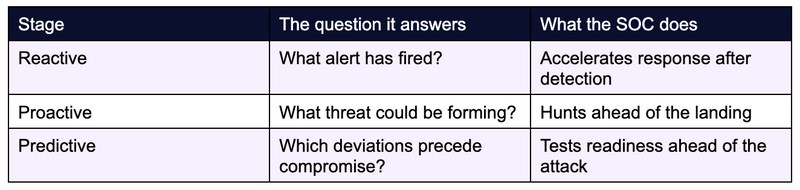
The framework separates AI SOCs by the question each one can answer:
e2e-assure Sets Out a Maturity Test for AI SOCs and Argues Most of the Market Is Stuck at Stage One
To view an enhanced version of this graphic, please visit:
https://images.newsfilecorp.com/files/8814/310759_6a116465c46478ee_002 ...
A reactive AI SOC accelerates what happens after detection: enriching alerts, summarising evidence, cutting false positives and recommending next steps. e2e-assure says this is already ahead of manual triage, but the model remains event-driven and answers an attack only after it has started.
A proactive AI SOC does not wait for a high-confidence alert. It generates hypotheses from new intelligence and the customer's own exposure, enriches weak signals and validates detection coverage, shifting the question from what alert has fired to what threat could be forming.
A predictive AI SOC, the company is careful to note, does not claim to predict breaches. It uses estate-specific baselines, cross-domain correlation and digital twin simulation to identify deviations from known-good behaviour and emerging attack paths that precede compromise, then tests readiness against them before production is at risk.
Rob Demain, Chief Executive Officer and Founder of e2e-assure, said:
"Almost everyone in this market now says AI SOC, and the operating models underneath differ wildly. A tool that summarises alerts is reactive, whatever the label on the box says. A service that hunts on your own exposure is proactive. A model trained on your environment that simulates attack paths before they are exploited is predictive. Our honest reading is that most of the market is still at stage one. We published the curve so buyers can ask a provider where they sit, and demand the evidence that backs the answer."


 URL kopieren
 Per E-Mail teilen
 Artikel drucken