


 213
 0 Kommentare
Eco Wave Power Signs Agreement with AI engineering GmbH to Advance AI-Powered Digital Twin Platform for Wave Energy

NVIDIA Inception Members to Combine Advanced Simulation, Real-World Wave Energy Data and Machine Learning to Support System Optimization and Global Scalability
Miami, Florida--(Newsfile Corp. - September 2, 2026) - Eco Wave Power Global AB (publ) (NASDAQ: WAVE) ("Eco Wave Power" or the "Company"), a leading onshore wave energy technology company, today announced that its wholly owned U.S. subsidiary, Eco Wave Power U.S. Inc., has entered into an agreement with Germany-based AI engineering GmbH to develop a physics- and data-driven Digital Twin platform for Eco Wave Power's proprietary wave energy technology.
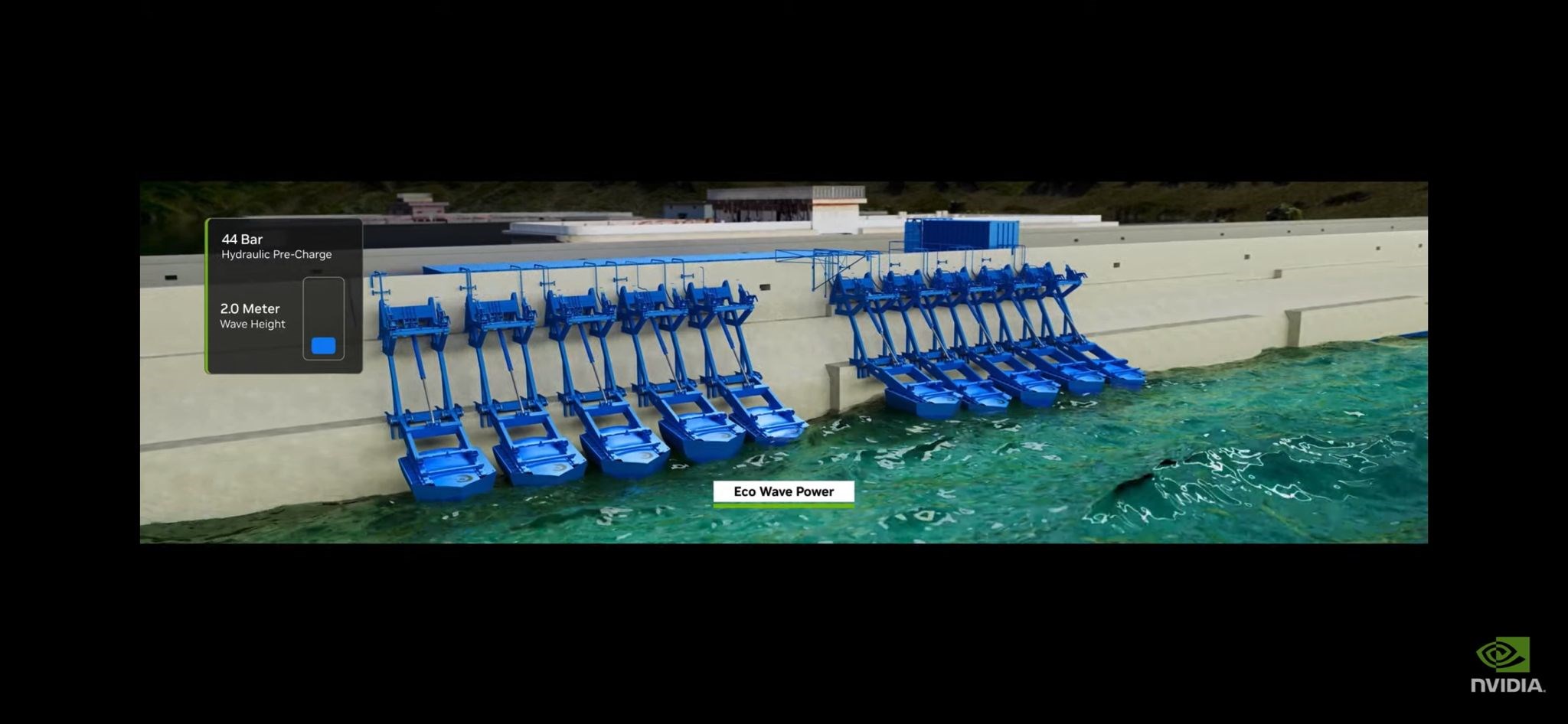
Digital twin illustration of Eco Wave Power's technology by Nvidia
To view an enhanced version of this graphic, please visit:
https://images.newsfilecorp.com/files/11247/312565_d41a64b554238812_00 ...
The collaboration advances Eco Wave Power's strategy to integrate artificial intelligence, physics-based simulation, machine learning and Digital Twin technology into the design, monitoring and optimization of its wave energy systems.
Both Eco Wave Power U.S. and AI engineering are members of the NVIDIA Inception program.
Building Digital Intelligence Around Wave Energy
Under the agreement, the companies have commenced Phase 1 of the "Eco Wave Power - Digital Twin & Energy-Aware Computing" project, combining advanced physics-based simulation with Eco Wave Power's real-world engineering, wave and operational data.
The initial phase will focus on digitally modeling how ocean waves interact with Eco Wave Power's proprietary floaters. Using AI engineering's PAMICS simulation technology, the companies will evaluate floater behavior, structural loads and theoretical energy input under different sea conditions.
The companies also plan to compare simulated results with real-world sensor measurements and begin developing machine-learning capabilities for forecasting energy yield and system loads.
A key objective is to determine how the Digital Twin can be adapted to different project locations, potentially allowing Eco Wave Power to transfer engineering knowledge and operational insights more efficiently as it expands into new markets.
"For us, AI is not simply a software layer that we add to our technology—it is an opportunity to fundamentally improve how we understand, design, predict and ultimately operate wave energy systems," said Inna Braverman, Founder and CEO of Eco Wave Power.
"Phase 1 of this collaboration is therefore very practical. We will model wave loading, floater behavior, structural forces and theoretical energy input, while beginning to develop machine-learning capabilities for forecasting loads and energy yield. Importantly, we will also examine how those models can be transferred to new sites with different wave conditions."


 URL kopieren
 Per E-Mail teilen
 Artikel drucken
