


 165
 0 Kommentare
Hayasa Metals Announces Completion of 2026 Urasar Drill Program, and Warrant Extension Application

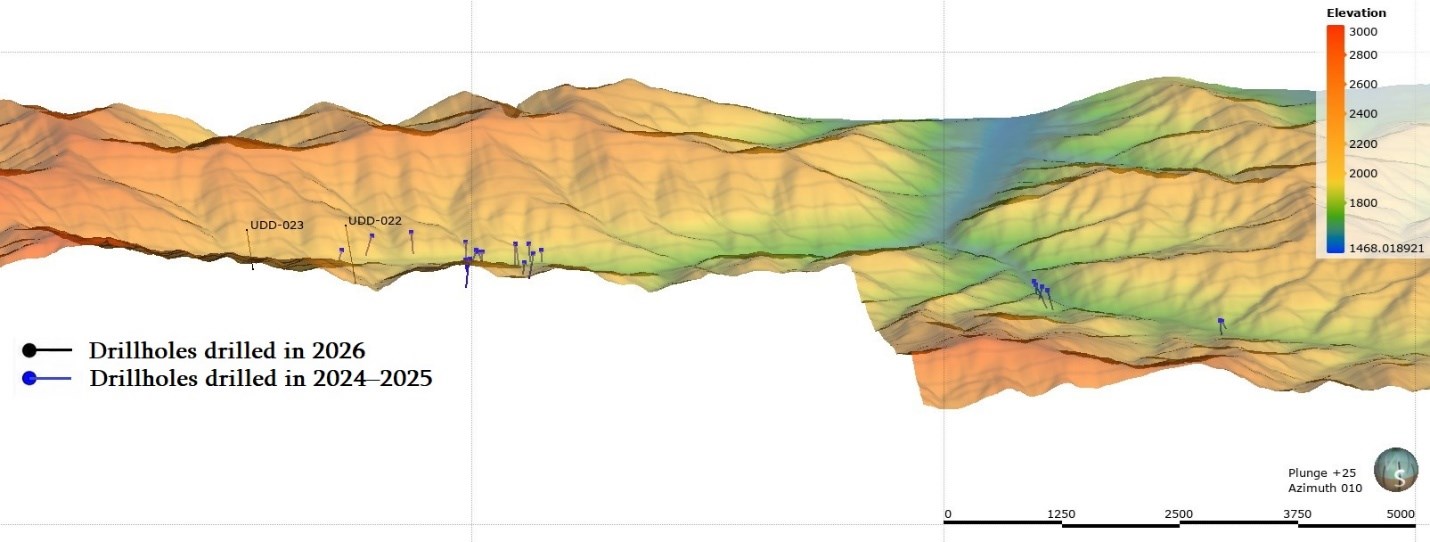
Vancouver, British Columbia--(Newsfile Corp. - September 4, 2026) - Hayasa Metals Inc. (TSXV: HAY) (OTCQB: HAYAF) ("Hayasa" or the "Company") Hayasa is pleased to announce it has completed the scheduled 1,000-meter diamond drilling program at the Urasar Project in northern Armenia. The program comprised two drill holes, UDD-022 and UDD-023 (Figure 1), targeting the Oxide Basin and Silica West prospects respectively, in the far western portion of the Urasar exploration permit. The final 1,070-meter drilling program was carried out by the AT Group, a drilling contractor based in Yerevan, Armenia employing an Atlas Copco CS-14 machine.
Figure 1. Historical Drill Hole Locations with UDD-022 and UDD-023 Highlighted
To view an enhanced version of this graphic, please visit:
https://images.newsfilecorp.com/files/3169/313068_d6858d37c419e81f_002 ...
In May 2026, Hayasa completed a six-line, 53-station audio-magnetotelluric (AMT) geophysical survey at Urasar, following a successful three-line orientation survey conducted in June 2025 (see Hayasa news release dated June 11, 2026). Interpretation of the resistivity data identified several zones of low resistivity (high conductivity) that can correspond to sulfide mineralization intersected in previous drill holes UDD-001, UDD-011, and UDD-014.
Previous drill hole UDD-021 completed in late 2025, was terminated prematurely prior to reaching the targeted depth, but nevertheless intersected some of the strongest mineralization encountered at Urasar to date, including 39 meters grading 0.50% Cu and 0.18 g/t Au from 11 to 50m, and 52 meters grading 0.11% Cu from 163 to 215 meters depth.
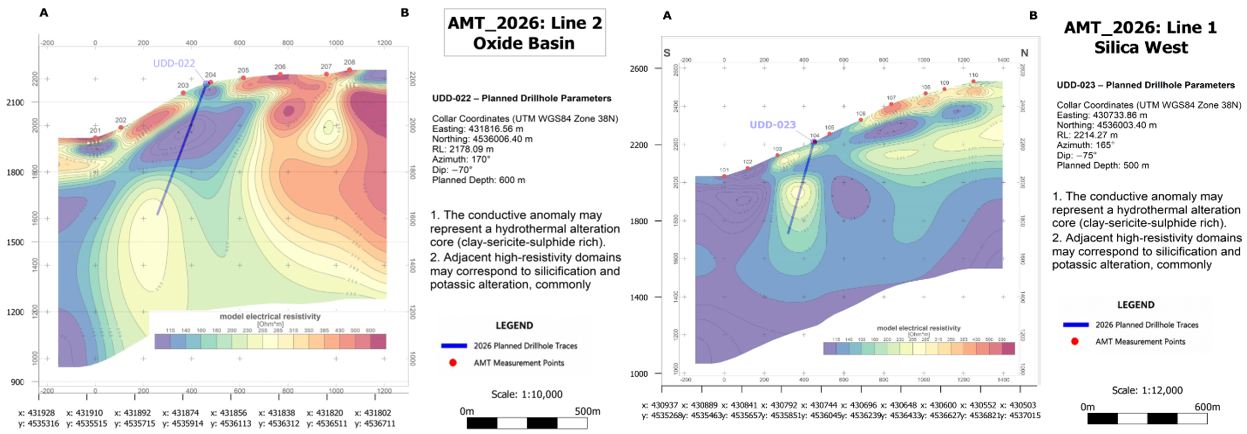
Drill holes UDD-022 and UDD-023 were designed to test near-vertical AMT anomalies identified on profiles 1 and 2 at the western end of the property, and in the vicinity of UDD-021. These targets are also supported by anomalous surface geochemistry and strong to intense hydrothermal alteration. This portion of the license area hosts large, resistant siliceous ridges characterized by iron oxide replacement of sulphides, together with localized occurrences of unoxidized bornite mineralization.
Figure 2 below illustrates the completed drill holes superimposed on the corresponding AMT resistivity cross section profiles.
Figure 2. Hole UDD-022 at Oxide Basin and UDD-023 at Silica West
To view an enhanced version of this graphic, please visit:
https://images.newsfilecorp.com/files/3169/313068_fig2.jpg


 URL kopieren
 Per E-Mail teilen
 Artikel drucken
