


 173
 0 Kommentare
Huawei Highlights Continuous Innovation, Securing Competitive Edge Through Technological Breakthroughs

Shenzhen, China--(Newsfile Corp. - October 3, 2026) - Huawei hosted an international media roundtable today featuring Richard Yu, Executive Director, Chairman of the Investment Review Board, and Chairman of the Board of Directors of the Consumer BG. Yu shared comprehensive insights into Huawei's consumer business and HarmonyOS ecosystem.
IMG 8638
To view an enhanced version of this graphic, please visit:
https://images.newsfilecorp.com/files/7958/317272_figure1.jpg


Richard Yu joined Huawei in 1993, working on early developments like the first-generation program-controlled switch and participating in the establishment of Huawei's wireless communications
business, which started with GSM. Over the past decade, Yu has led Huawei's consumer business with the vision to deliver a seamless AI life experience to all consumers across five key scenarios:
HIMA-powered Smart Travel, HarmonyOS Office, Smart Home, Fitness & Health, and Entertainment, which he said is also the long-term strategy for Huawei's consumer business over the next 10 years.
Between 2007 and 2025, Huawei invested more than CNY1.8 trillion into R&D shifting from roughly 10% of annual revenue in early years to over 20% recently. Huawei has continued to increase investment into the core technologies of the ICT domain and basic research, which has translated into robust core capabilities, extensive intellectual property, and a vast patent portfolio, and helped with achieving a series of breakthroughs in technological innovation.
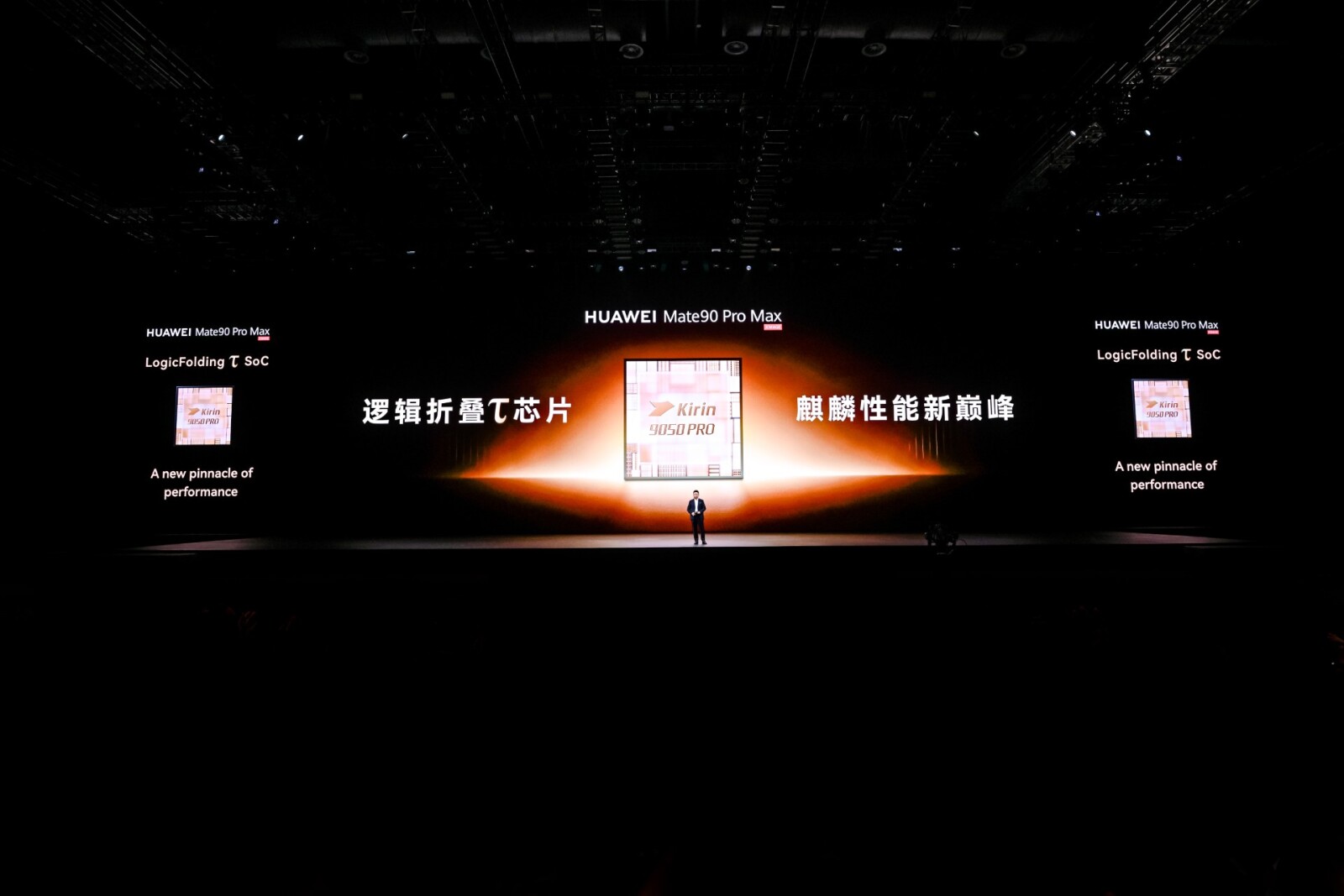
The Mate 90 series smartphones Huawei just launched come with the latest Kirin 9050 Pro chip. The overall device performance is 31% higher than the previous generation. The Balong modem, image sensor processor (ISP), mobile security processor (MSP), Lingxi CPU, Maleoon GPU, and the NPU that adopts Huawei's Da Vinci architecture for AI processing are all designed by Huawei. They offer higher energy efficiency and deliver much-improved overall system-level performance.
Even though Yu admitted that Huawei has limited access to advanced semiconductor processes, Huawei recently made a new breakthrough in the semiconductor domain - the LogicFolding technology under the Tau Scaling Law. Unveiled by He Tingbo, head of Huawei's Semiconductor Business Department this May, this technology vertically stacks the logic layers of chips and restructures the circuit layout through inter-layer high-density interconnect to shorten critical paths and reduce latency. This technology was adopted on Kirin 9050 Pro chip, which shows very strong AI processing power. The Mate 90 series powered by this chip can run a 30B MoE on-device AI model.
Diskutieren Sie über die enthaltenen Werte


 URL kopieren
 Per E-Mail teilen
 Artikel drucken
