


 145
 0 Kommentare
coreQ AI Unveils Data Infrastructure Roadmap for the Next Generation of Physical AI
Silicon Valley-based coreQ AI combines causal AI with scalable real-world robotics data production to address a growing bottleneck in high-value training data.
Silicon Valley, California--(Newsfile Corp. - October 3, 2026) - coreQ AI today unveiled its roadmap for Physical AI data infrastructure, outlining a system that connects real-world robotics data production with model training, evaluation, and reusable robot capabilities. The roadmap focuses on four areas: working backward from model requirements to define data needs, using causal AI to assess data value, standardizing production for scale, and building a global production network to improve cost efficiency over time.
To view an enhanced version of this graphic, please visit:
https://images.newsfilecorp.com/files/9113/316963_fdb026c5f43d8bc0_001 ...

The company said its data production and delivery capabilities have been validated in real-world testing with a leading global technology company. Building on those results, coreQ AI is scaling its production capacity and global delivery network. The company also plans to deepen its engagement with the Silicon Valley AI and robotics ecosystem while expanding real-world data collection and production capacity across Asia.
Key Technical Validation Results
To view an enhanced version of this graphic, please visit:
https://images.newsfilecorp.com/files/9113/316963_fdb026c5f43d8bc0_002 ...
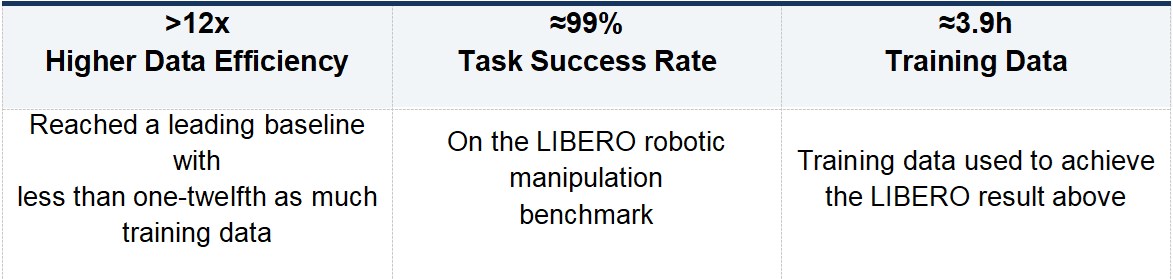
Note: The results above come from robotic manipulation experiments using causal-learning technologies related to coreQ AI. They support the company's technical thesis that competition in Physical AI data will depend not only on data volume, but also on the ability to identify data with greater training value.
Work Backward From Model Requirements
As Physical AI moves toward larger-scale training and deployment, the central data question is shifting from how much data can be collected to what data models actually need. Members of coreQ AI's core technical team have experience working at industrial frontier labs and world-class AI companies in Silicon Valley. That experience informs the company's approach to defining data tasks, structures, labeling systems, collection protocols, and quality standards for model training, post-training, and evaluation.


 URL kopieren
 Per E-Mail teilen
 Artikel drucken