


PrymaLab Publishes a Safety Data Sheet for Every Research Compound It Supplies: 189 Sheets Across 97 Compounds, 33 Carrying a GHS Hazard Classification
 177
 0 Kommentare

The Kentucky supplier has issued 16-section safety data sheets in the OSHA Hazard Communication format for each compound in each form it supplies, with the classification sources named on every sheet and the storage conditions researchers most often ask about set out in Section 7.
Ashland, Kentucky--(Newsfile Corp. - October 9, 2026) - PrymaLab, a veteran-owned research peptide supplier, has published safety data sheets for its entire catalog. The library, issued October 3, 2026 and available at prymalab.net/testing/sds, holds 189 sheets covering 97 compounds and blends, one sheet for each compound in each form it is supplied. Thirty-three of the sheets carry a GHS hazard classification. The remaining 156 state that the material is not classified as hazardous under the OSHA Hazard Communication Standard or UN GHS Revision 7, and name the supplier data behind that conclusion.


The company's reasoning is simple. A safety data sheet is the document a laboratory safety officer asks for before a new material is allowed on the bench, and in this category it usually does not exist. A researcher who receives a vial of a research peptide typically gets a label, a purity figure and nothing about hazard classification, handling, spill response or disposal. PrymaLab's view is that the sheet should be one click away for every item it supplies, whether or not anyone has asked.
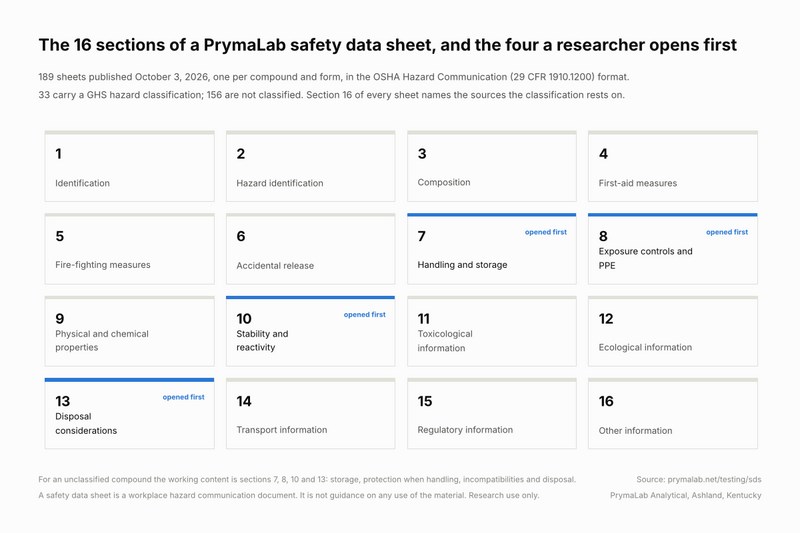
PrymaLab publishes a safety data sheet for every research compound it supplies: 189 sheets across 97 compounds, 33 carrying a GHS hazard classification
To view an enhanced version of this graphic, please visit:
https://images.newsfilecorp.com/files/8814/318189_4bc1c844d4463856_002 ...
What each sheet contains
Every sheet follows the 16-section structure that OSHA requires for workplace hazard communication, from identification and hazard identification through handling and storage, exposure controls, stability, toxicology and disposal to transport and regulatory information. Document numbers run from PL-SDS-001 to PL-SDS-189, each at revision 1.0 dated October 3, 2026.
For a compound that is not classified, the practical content is in sections 7, 8, 10 and 13: how to store it, what protection to use when handling the powder, what it is incompatible with and how to dispose of it. For a classified compound, section 2 adds the signal word, the pictograms and the hazard statements, and section 11 sets out the toxicological basis for them.
Diskutieren Sie über die enthaltenen Werte


 URL kopieren
 Per E-Mail teilen
 Artikel drucken
