


ASUS Unveils XA P2N-E2 Powered by NVIDIA Vera CPU for Agentic AI Workloads at OCP 2026
 153
 0 Kommentare
Delivering a unified infrastructure blueprint for scalable AI across compute, networking, memory and storage
SAN JOSE, Calif., Oct. 12, 2026 /PRNewswire/ -- ASUS is expanding its AI infrastructure portfolio with the launch of the XA P2N-E2, a 2U NVIDIA MGX architecture-based server powered by NVIDIA Vera CPUs and designed for agentic AI and reinforcement learning workloads. Unveiled at OCP Global Summit 2026, this new ASUS server powered by the Vera CPU targets the execution layer of AI applications, handling workloads such as code execution, tool use, sandboxing, data processing and orchestration that extend beyond the AI model itself. The XA P2N-E2 supports up to two dual-slot NVIDIA RTX PRO 6000 Blackwell Server Edition GPUs, combining high-performance CPU computing with flexible GPU acceleration in a compact 2U platform. The high single-thread CPU performance and high-bandwidth, energy-efficient memory are designed to keep AI agents responsive during demanding execution and evaluation tasks.


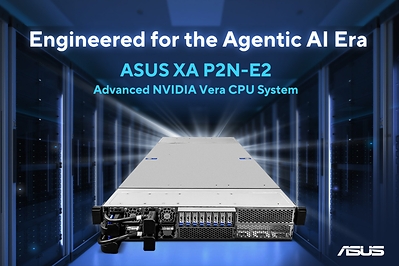
At OCP, ASUS also showcases a broader portfolio covering rack-scale AI systems, accelerated computing, high-speed networking, context memory, low-latency inference and high-density storage. At the rack level, XA VR721-E3, the ASUS AI POD integrates 36 NVIDIA Vera CPUs and 72 NVIDIA Rubin GPUs through the NVIDIA Vera Rubin NVL72 platform, using a fully liquid-cooled architecture for large-scale AI training, post-training and inference. For a more flexible server configuration, the XR R1I12B-M1BHFS combines NVIDIA HGX Rubin NVL8 with direct-to-chip liquid cooling for the GPU baseboard and air cooling for Intel Xeon 6 processors. Together, the systems reflect the ASUS approach to scaling AI infrastructure across different compute densities, cooling architectures and deployment requirements, from individual servers to large-scale AI environments.
Building full-stack AI factories with the NVIDIA Vera Rubin Platform
ASUS is expanding its NVIDIA-accelerated portfolio across system and rack architectures, enabling customers to scale compute density, cooling and deployment models according to workload requirements. AI factory performance increasingly depends on more than accelerated computing alone. High-speed networking, scalable context memory, responsive inference and data infrastructure are all critical to maintaining efficient data movement and workload performance across increasingly complex AI environments.
Diskutieren Sie über die enthaltenen Werte


 URL kopieren
 Per E-Mail teilen
 Artikel drucken
