






Intuitive surgical - Die Zukunft der Chirurgie - 500 Beiträge pro Seite
eröffnet am 26.03.07 10:43:56 von
neuester Beitrag 03.12.08 17:48:45 von
neuester Beitrag 03.12.08 17:48:45 von
Beiträge: 337
ID: 1.121.012
ID: 1.121.012
Aufrufe heute: 6
Gesamt: 27.420
Gesamt: 27.420
Aktive User: 0
Top-Diskussionen
| Titel | letzter Beitrag | Aufrufe |
|---|---|---|
| gestern 11:52 | 3734 | |
| heute 20:09 | 2612 | |
| vor 38 Minuten | 2547 | |
| heute 18:51 | 2085 | |
| 08.05.24, 11:56 | 1966 | |
| heute 20:02 | 1804 | |
| vor 1 Stunde | 1598 | |
| vor 39 Minuten | 1437 |
Meistdiskutierte Wertpapiere
| Platz | vorher | Wertpapier | Kurs | Perf. % | Anzahl | ||
|---|---|---|---|---|---|---|---|
| 1. | 1. | 18.772,85 | +0,46 | 131 | |||
| 2. | 3. | 0,2180 | 0,00 | 125 | |||
| 3. | Neu! | 8,2600 | 0,00 | 108 | |||
| 4. | 4. | 155,30 | 0,00 | 103 | |||
| 5. | 14. | 5,7540 | -2,18 | 56 | |||
| 6. | 2. | 0,2980 | -3,87 | 50 | |||
| 7. | 5. | 2,3700 | 0,00 | 49 | |||
| 8. | 7. | 6,8000 | +2,38 | 38 |

 Feedback
hab mir gedacht ein neuer thread zu diesem aussichtsreichen medtech wert ist vielleicht ganz sinnvoll.
Robots grab chunk of prostate surgery biz
Intuitive Surgical's ramping up sales of robotic surgical arms - and so far is alone in a $600 million market.
By Aaron Smith, CNNMoney.com staff writer
March 23 2007: 12:15 PM EDT
NEW YORK (CNNMoney.com) -- In a packed lecture hall at Cornell University, Dr. Ash Tewari recently showed a 3D video of a robotic claw surgically removing a prostate, as medical professionals watched stoically and reporters squirmed in their seats.
On the screen's blown-up image, the initials of the robot's maker - Intuitive Surgical (down $0.28 to $120.38, Charts) - were clearly etched onto the surface of the diminutive claws. Dr. Tewari, cancer specialist and director of robotic prostate surgery at Cornell, believes that surgery performed with Intuitive Surgical's robot claws is safer and quicker than the human hand, resulting in less bleeding, with less problems of incontinence and impotence during recovery.
Video More video
CNN's Ali Velshi talks to GlaxoSmithKline CEO Jean Pierre Garnier about its new breast cancer drug. (March 17)
Play video
Based in Sunnyside, Calif., Intuitive Surgical makes human-guided robotic arms that help doctors perform some of the most common and delicate procedures - the removal of a cancerous prostate gland or uterus - but only for those hospitals with enough money and the right manpower.
These areas of the healthcare market - estimated at $600 million last year by Wachovia analyst Michael Matson - are rapidly growing, fueled by an aging U.S. population. Intuitive Surgical has already experienced a rapid uptick in the use of its three and four-armed da Vinci robots, with a 56 percent sales surge in 2006 to $112 million. Its stock is up 12 percent year-to-date.
Robotic removal of the prostate has been a "big home run" for Intuitive Surgical, said Tao Levy, analyst for Deutsche Bank North America. "By the end of the year, over half of the prostates that are going to be removed in the U.S. are going to be done robotically."
In 2006, 35 percent of the 90,000 prostatectomies and 2 percent of the 250,000 hysterectomies in the U.S. were performed by Intuitive Surgical's robots, according to Charles Olsziewski, analyst for Oppenheimer.
The prostate gland is a small organ just below the bladder that makes fluid for semen. Hysterectomy is removal of the uterus, the major female reproductive organ in humans.
Medical companies take 'Fantastic Voyage' into heart
"The number of [robotic] procedures started to increase as the side effects were taken away," said Olsziewski. He said the market penetration for robotic prostatectomies has tripled since 2004, primarily because robotic surgery causes less complications from bleeding, incontinence and impotence compared to other procedures.
Intuitive Surgical has a monopoly on robotic surgical arms.
Even if Japanese companies like Hitachi (down $0.90 to $74.36, Charts) make good on their promises to produce robotic arms for surgery, their potential products are years away, analysts say. So that leaves the robotic field to Intuitive Surgical in this part of the surgery market, where it still competes against hospitals and physicians conducting traditional open surgeries by hand, and the lesser-used laparoscopies, with tools provided by Johnson & Johnson (down $0.43 to $60.43, Charts), Olympus Corp. and Tyco (Charts).
Despite the benefits of robotic surgery, stealing market share away from these other procedures isn't going to be easy. Not every hospital is willing to pay $1.5 million for the newest da Vinci robot, or to recruit, train and keep the proper specialists to run the device.
"The chief obstacle is the commitment that the hospital has to make to robotic procedures," said Timothy Nelson of Piper Jaffray, noting that influential doctors need to pull together a team of talented surgeons and technicians. "The successful programs are the ones that get a team together. If the commitment isn't there, it doesn't work."
But analysts believe that hospitals will have to take on the new technology eventually to remain competitive.
"[The da Vinci] is expensive, but at the end of the day it's allowing the hospital to do better surgery," said Levy of Deutsche Bank North America. "Also, hospitals without the device run the risk of losing business to those who have it."
Sehr interessant ist bei dem artikel der letzte satz
Intuitive Surgical's ramping up sales of robotic surgical arms - and so far is alone in a $600 million market.
By Aaron Smith, CNNMoney.com staff writer
March 23 2007: 12:15 PM EDT
NEW YORK (CNNMoney.com) -- In a packed lecture hall at Cornell University, Dr. Ash Tewari recently showed a 3D video of a robotic claw surgically removing a prostate, as medical professionals watched stoically and reporters squirmed in their seats.
On the screen's blown-up image, the initials of the robot's maker - Intuitive Surgical (down $0.28 to $120.38, Charts) - were clearly etched onto the surface of the diminutive claws. Dr. Tewari, cancer specialist and director of robotic prostate surgery at Cornell, believes that surgery performed with Intuitive Surgical's robot claws is safer and quicker than the human hand, resulting in less bleeding, with less problems of incontinence and impotence during recovery.
Video More video
CNN's Ali Velshi talks to GlaxoSmithKline CEO Jean Pierre Garnier about its new breast cancer drug. (March 17)
Play video
Based in Sunnyside, Calif., Intuitive Surgical makes human-guided robotic arms that help doctors perform some of the most common and delicate procedures - the removal of a cancerous prostate gland or uterus - but only for those hospitals with enough money and the right manpower.
These areas of the healthcare market - estimated at $600 million last year by Wachovia analyst Michael Matson - are rapidly growing, fueled by an aging U.S. population. Intuitive Surgical has already experienced a rapid uptick in the use of its three and four-armed da Vinci robots, with a 56 percent sales surge in 2006 to $112 million. Its stock is up 12 percent year-to-date.
Robotic removal of the prostate has been a "big home run" for Intuitive Surgical, said Tao Levy, analyst for Deutsche Bank North America. "By the end of the year, over half of the prostates that are going to be removed in the U.S. are going to be done robotically."
In 2006, 35 percent of the 90,000 prostatectomies and 2 percent of the 250,000 hysterectomies in the U.S. were performed by Intuitive Surgical's robots, according to Charles Olsziewski, analyst for Oppenheimer.
The prostate gland is a small organ just below the bladder that makes fluid for semen. Hysterectomy is removal of the uterus, the major female reproductive organ in humans.
Medical companies take 'Fantastic Voyage' into heart
"The number of [robotic] procedures started to increase as the side effects were taken away," said Olsziewski. He said the market penetration for robotic prostatectomies has tripled since 2004, primarily because robotic surgery causes less complications from bleeding, incontinence and impotence compared to other procedures.
Intuitive Surgical has a monopoly on robotic surgical arms.
Even if Japanese companies like Hitachi (down $0.90 to $74.36, Charts) make good on their promises to produce robotic arms for surgery, their potential products are years away, analysts say. So that leaves the robotic field to Intuitive Surgical in this part of the surgery market, where it still competes against hospitals and physicians conducting traditional open surgeries by hand, and the lesser-used laparoscopies, with tools provided by Johnson & Johnson (down $0.43 to $60.43, Charts), Olympus Corp. and Tyco (Charts).
Despite the benefits of robotic surgery, stealing market share away from these other procedures isn't going to be easy. Not every hospital is willing to pay $1.5 million for the newest da Vinci robot, or to recruit, train and keep the proper specialists to run the device.
"The chief obstacle is the commitment that the hospital has to make to robotic procedures," said Timothy Nelson of Piper Jaffray, noting that influential doctors need to pull together a team of talented surgeons and technicians. "The successful programs are the ones that get a team together. If the commitment isn't there, it doesn't work."
But analysts believe that hospitals will have to take on the new technology eventually to remain competitive.
"[The da Vinci] is expensive, but at the end of the day it's allowing the hospital to do better surgery," said Levy of Deutsche Bank North America. "Also, hospitals without the device run the risk of losing business to those who have it."
Sehr interessant ist bei dem artikel der letzte satz

ntuitive Surgical Rises on Bullish Note
Thursday March 22, 1:52 pm ET
Intuitive Surgical Gains As Analyst Predicts Stronger Surgical System Sales
NEW YORK (AP) -- Shares of Intuitive Surgical Inc. climbed Thursday after an analyst voiced an optimistic forecast about future sales of the company's robotic da Vinci surgical system.
HSBC Global Research analyst Mimi Pham said the customer base for the da Vinci system could double over the next three years, and about 800 U.S. hospitals could buy multiple systems.
ADVERTISEMENT
She expects the company's revenue to increase 35 percent in 2007, with instruments and accessories showing the most improvement.
"We continue to believe that the use of Intuitive's da Vinci system in urology and gynecology procedures should drive sales of both this system and disposables through 2009, and that the systems market is underpenetrated," she said.
Pham predicted that by the end of 2009, the da Vinci system will be used in 70 percent of prostatectomies in the U.S., up from 35 percent in the fourth quarter. About 90,000 prostatectomies are performed in the U.S. each year, she said.
She maintained her "Outperform" rating and $140 target price for the stock.
Shares of Sunnyvale, Calif.-based Intuitive rose $4.81, or 4.1 percent, to $121.01 on the Nasdaq Stock Market. The stock has ranged from $86.20 to $132 over the past year.
Thursday March 22, 1:52 pm ET
Intuitive Surgical Gains As Analyst Predicts Stronger Surgical System Sales
NEW YORK (AP) -- Shares of Intuitive Surgical Inc. climbed Thursday after an analyst voiced an optimistic forecast about future sales of the company's robotic da Vinci surgical system.
HSBC Global Research analyst Mimi Pham said the customer base for the da Vinci system could double over the next three years, and about 800 U.S. hospitals could buy multiple systems.
ADVERTISEMENT
She expects the company's revenue to increase 35 percent in 2007, with instruments and accessories showing the most improvement.
"We continue to believe that the use of Intuitive's da Vinci system in urology and gynecology procedures should drive sales of both this system and disposables through 2009, and that the systems market is underpenetrated," she said.
Pham predicted that by the end of 2009, the da Vinci system will be used in 70 percent of prostatectomies in the U.S., up from 35 percent in the fourth quarter. About 90,000 prostatectomies are performed in the U.S. each year, she said.
She maintained her "Outperform" rating and $140 target price for the stock.
Shares of Sunnyvale, Calif.-based Intuitive rose $4.81, or 4.1 percent, to $121.01 on the Nasdaq Stock Market. The stock has ranged from $86.20 to $132 over the past year.
Schön, dass es diesen Thread jetzt gibt, Pontius! Ich will ja kaufen...
Jetzt ne Frage. In 2006 hat ISRG rd. 370 Mio. Dollar Umsatz gemacht. So ein DaVinci-Teil kostet 1,5 Mrd.? Kann doch wohl nicht sein, oder? 1,5 Millionen müssten das doch sein....oder verleihen die die Geräte?
Gruss space
Jetzt ne Frage. In 2006 hat ISRG rd. 370 Mio. Dollar Umsatz gemacht. So ein DaVinci-Teil kostet 1,5 Mrd.? Kann doch wohl nicht sein, oder? 1,5 Millionen müssten das doch sein....oder verleihen die die Geräte?
Gruss space
ja 1,5 mio. hab ich mich vorher vertippt?
Trading Spotlight
wie kommst fu auf 1,5 mrd? das wär dann schon ein bisschen viel. da bekommt man ja schon nen flugzeugträger für

Antwort auf Beitrag Nr.: 28.496.795 von Pontiuspilatus am 26.03.07 12:11:10jou vertippt pontius, klar 1,5 Millionen, alles andere wäre ja der Wahn...trotzdem nicht billig das Gerät, aber es dient doch allen, dem Doc, der entspannter, ganauer mit geringerem Eingriff arbeiten kann und natürlich insbesondere dem Patienten. Keine große Wunden etc. weitere Operationsbereiche sollten wohl kein Problem sein...
Gruss space
Gruss space
also threadleser haben wir genug aber wie wär es mal mit selbst in die tasten hauen ihr lieben leute
Antwort auf Beitrag Nr.: 28.499.163 von Pontiuspilatus am 26.03.07 14:30:43Hab nicht so viel Hoffnungen Pontius! Du kennst ja das Spiel hier bei WO. Wenn jetzt ISRG ein Ölexplorer wäre würden wir hier erschlagen werden mit postings
So, nachher schau ich mal, was so an der Nasdaq abgeht...der sich wieder verschärfende Irankonflikt könnte heute belastend sein. Mal sehen, vielleicht bekomme ich ja ISRG ein bißchen unter dem Freitagskurs, ich setze mal ein limit rd. 1% unter dem Freitagsschlusskurs. Aber eigentlich ist es mit wurscht, bleib dann eh langfristig drin...
So, nachher schau ich mal, was so an der Nasdaq abgeht...der sich wieder verschärfende Irankonflikt könnte heute belastend sein. Mal sehen, vielleicht bekomme ich ja ISRG ein bißchen unter dem Freitagskurs, ich setze mal ein limit rd. 1% unter dem Freitagsschlusskurs. Aber eigentlich ist es mit wurscht, bleib dann eh langfristig drin...
Ich habe übrigens nen Thread zu SYNTHES aufgemacht. Die habe ich vor ner Woche gekauft. ProDisc heißt das Schlüsselwort...künstl. Bandscheibe, wohl viel besser als die von DePuy oder wie der Laden heißtn von J&J. Das Teil ist noch ganz neu, bisher nur in den USA zugelassen und da wird noch kein Geld verdient bisher, das kommt aber noch...generell im angestammten Geschäft der Knochen und Gesichtschirurgie sind die Weltmarktführer. Natürlich aus der Schweiz..
Gruss space
Gruss space
so, habe mir die erste Position gerade gegönnt...
Gruss space
Gruss space
Gratulation. Nasdaq und dow schauen heut ja nicht gut aus. Ok haben ja letzte woche nen ganz schönen lauf gehabt und jetzt zusätzlich das iranthema. Wird wohl diese woch allgemein leicht abwärts gehn.
ISRG einfach liegenlassen. Außer sie verspielen ihre marktführerschaft. Davon gehe ich jedoch nicht aus
ISRG einfach liegenlassen. Außer sie verspielen ihre marktführerschaft. Davon gehe ich jedoch nicht aus
Antwort auf Beitrag Nr.: 28.501.641 von Pontiuspilatus am 26.03.07 16:14:06wie auch immer sich die Märkte in den nächsten tagen entwickelt...wurscht...heute gehts wohl wegen den schlechten hausverkäufen abwärts, jetzt wird wieder die Immobilienkrise gespielt...
Gruss space
Gruss space
übrigens könnte auch demnächst mal ein split bei ISRG ins hause stehen...
Gruss space
Gruss space
Antwort auf Beitrag Nr.: 28.501.803 von spaceistheplace am 26.03.07 16:21:10Ja egal ob immobilien oder Iran oder was weiss ich was sonst noch. Nächste woche sind dann wieder andere themen an der reihe. Das alles spielt langfristig keine rolle
Antwort auf Beitrag Nr.: 28.502.782 von Pontiuspilatus am 26.03.07 17:01:18Jou Pontius, so isses. Viel wichtiger sind die Zinsen und da sehe aktuell gar keine Gefahr, im Gegenteil, es bestehjt eher die Möglichkeit von Zinssenkungen in den USA wenn die Wirtschaft weiter schwächelt. das wiederum wird die Börsen stützen. Man sieht es ja schon aktuell an der letzten FED-Sitzung bzw. der Erklärung der FED, dass sie ggf. auch die Zinsen senken wird, wenn es die Wirtschaft erfordert. das könnte auch heute dazu führen, das die Abschläge sich in Grenzen halten. Die gleiche Nachricht heute von den rückläufigen Neubautenzahlen vor 3 Wochen veröffentlich, da hätte es mehr geraucht...da wären wir locker 2% nach unten gerauscht. Trotzdem kann jetzt wieder ne kleine Anwärtswelle vor uns stehen die Tage.
Das Iran-Thema wird die tage auch wieder verschwinden und dann in 60 tagen wieder aufflammen, wenn die neue Resolution ausläuft...aber Politik hat an dern Börsen kurze beine und ne Invasion in den Iran sehe ich als sehr unwahrscheinlich an nach der desaströsen Aktion im Irak.
Gruss space
Das Iran-Thema wird die tage auch wieder verschwinden und dann in 60 tagen wieder aufflammen, wenn die neue Resolution ausläuft...aber Politik hat an dern Börsen kurze beine und ne Invasion in den Iran sehe ich als sehr unwahrscheinlich an nach der desaströsen Aktion im Irak.
Gruss space
Schon enorm diese stärke von isrg gegen einen insgesamt über weite teile des tages sehr schwachen markt.
ich denke das auch die zinsentwicklung langfristig bei isrg keine rolle spielt.
zum iranthema sag ich nur 2- 3 jahre warten dann is der iran die 51 bundesstaat der usa
Nein scherz beiseite. Solange es zu keiner rezession kommt dürften die usa keine größeren militäraktionen starten. Sollte jedoch die wirtschaft in eine größere krise geraten käme ihnen der irre von teheran vermutlich gerade recht. Iran ist ja quasi von us truppen umzingelt
ich denke das auch die zinsentwicklung langfristig bei isrg keine rolle spielt.
zum iranthema sag ich nur 2- 3 jahre warten dann is der iran die 51 bundesstaat der usa
Nein scherz beiseite. Solange es zu keiner rezession kommt dürften die usa keine größeren militäraktionen starten. Sollte jedoch die wirtschaft in eine größere krise geraten käme ihnen der irre von teheran vermutlich gerade recht. Iran ist ja quasi von us truppen umzingelt
Antwort auf Beitrag Nr.: 28.509.821 von Pontiuspilatus am 26.03.07 23:18:42Iran ist ja quasi von us truppen umzingelt
Ja, drumm iwrd Bush die Jungs auch nicht abziehen wollen, zum Iran ist es ja nur ein Katzensprung. Eine militärische handlung würde erstmal aber die ganzen Börsen locker 30% nach unten reißen...daran mag ich aber nicht glauben, so bescheuert kann eigentlich nach den Erfahrungen im Irak niemand sein...
Gruss space
Ja, drumm iwrd Bush die Jungs auch nicht abziehen wollen, zum Iran ist es ja nur ein Katzensprung. Eine militärische handlung würde erstmal aber die ganzen Börsen locker 30% nach unten reißen...daran mag ich aber nicht glauben, so bescheuert kann eigentlich nach den Erfahrungen im Irak niemand sein...
Gruss space
ja wie gesagt wird erst passieren wenn die wirtschaft und die börse sowieso abstürzen. ich denk mal so ca. in 3 jahren
Intuitive Surgical Turns Obscure Into Opportunity
By Jack Uldrich
April 2, 2007
To regular readers of The Motley Fool, Intuitive Surgical (Nasdaq: ISRG) -- a Rule Breakers recommendation -- is quite a well-known commodity. So it's easy to assume that everyone else is just as acquainted with the company, its da Vinci robotic surgical equipment, and its exciting growth potential.
This is not the case. To this end, I was floored Monday morning when I visited one of my favorite technology blogs, Crave, and stumbled on this entry titled "Robot assisted prostate surgery? Uhh -- you first." The site had picked up news that the Swedish Medical Center (a chain of hospitals in the Pacific Northwest) was encouraging patients with prostate cancer to consider having surgery using Intuitive Surgical's robotic procedure.
From the posting, it's clear the author felt that the practice was some kind of new, relatively untested procedure. It's not. In 2006, 35% of all prostatectomies in the United States were performed using Intuitive Surgical's da Vinci equipment, and that number is expected to increase to 50% this year.
If anything, not using the da Vinci equipment is the more risky approach. This is because with Intuitive Surgical's equipment, the incisions are smaller, the operating time is faster, and recovery time is significantly shorter.
And therein lies the opportunity for Intuitive Surgical investors. As these benefits continue to become even better-known -- with more hospitals advertising the benefits of the procedure -- it's quite likely that an increasing number of patients will opt for the robotic technique.
Moreover, if you read the posting on the hospital's website, two other things will jump out at the reader. First, it reports that "Prostate cancer is the most common form of cancer in men. An estimated 230,000 men in the U.S. are diagnosed with the condition each year." This suggests that there is still a lot of room for Intuitive Surgical to grow in the area of prostate surgery.
Secondly, at the bottom of the website, the hospital says that it "will likely begin using the da Vinci system for other minimally invasive types of surgery, such as cardiovascular, gynecological, pediatric and other FDA-approved procedures." That should tell investors that Intuitive Surgical isn't going to be a one-trick pony.
Robotic surgery might still sound strange to a great many people, but it's a reality and it will only grow more prevalent in the near future. So while others might laugh at the technology, investors in Intuitive Surgical are likely to have the last laugh.
By Jack Uldrich
April 2, 2007
To regular readers of The Motley Fool, Intuitive Surgical (Nasdaq: ISRG) -- a Rule Breakers recommendation -- is quite a well-known commodity. So it's easy to assume that everyone else is just as acquainted with the company, its da Vinci robotic surgical equipment, and its exciting growth potential.
This is not the case. To this end, I was floored Monday morning when I visited one of my favorite technology blogs, Crave, and stumbled on this entry titled "Robot assisted prostate surgery? Uhh -- you first." The site had picked up news that the Swedish Medical Center (a chain of hospitals in the Pacific Northwest) was encouraging patients with prostate cancer to consider having surgery using Intuitive Surgical's robotic procedure.
From the posting, it's clear the author felt that the practice was some kind of new, relatively untested procedure. It's not. In 2006, 35% of all prostatectomies in the United States were performed using Intuitive Surgical's da Vinci equipment, and that number is expected to increase to 50% this year.
If anything, not using the da Vinci equipment is the more risky approach. This is because with Intuitive Surgical's equipment, the incisions are smaller, the operating time is faster, and recovery time is significantly shorter.
And therein lies the opportunity for Intuitive Surgical investors. As these benefits continue to become even better-known -- with more hospitals advertising the benefits of the procedure -- it's quite likely that an increasing number of patients will opt for the robotic technique.
Moreover, if you read the posting on the hospital's website, two other things will jump out at the reader. First, it reports that "Prostate cancer is the most common form of cancer in men. An estimated 230,000 men in the U.S. are diagnosed with the condition each year." This suggests that there is still a lot of room for Intuitive Surgical to grow in the area of prostate surgery.
Secondly, at the bottom of the website, the hospital says that it "will likely begin using the da Vinci system for other minimally invasive types of surgery, such as cardiovascular, gynecological, pediatric and other FDA-approved procedures." That should tell investors that Intuitive Surgical isn't going to be a one-trick pony.
Robotic surgery might still sound strange to a great many people, but it's a reality and it will only grow more prevalent in the near future. So while others might laugh at the technology, investors in Intuitive Surgical are likely to have the last laugh.
Antwort auf Beitrag Nr.: 28.650.535 von Pontiuspilatus am 04.04.07 00:00:06Danke, Pontius, für den Artikel. das hört sich gut an. Allein schon bei den Prostata-Geschichten ist da großes wachstum möglich, ganz zu schweigen von anderen Anwendungen und der Expansion der Firma weltweit. ich könnte mir z.B. gut vorstellen, dass die tole Präsentation bei der CeBit auch in Europa auf diese äußerst innovative Firma geschaut wird..
Leider sind wir hier auch schon wieder alleine...es lesen zwar ein paar leute mit, aber keinerlei Reaktionen anderer User.
Nun ja, was solls
Gruss space
Leider sind wir hier auch schon wieder alleine...es lesen zwar ein paar leute mit, aber keinerlei Reaktionen anderer User.
Nun ja, was solls
Gruss space
@ space
dein kauf scheint doch nicht zu früh gewesen zu sein. die aktie will anscheinend weiter nach oben. ich hätte noch mal mit nen rücksetzer richtung 115 gerechnet. Kannst froh sein dabei zu sein.
Teuer aber gerechtfertigt teuer
dein kauf scheint doch nicht zu früh gewesen zu sein. die aktie will anscheinend weiter nach oben. ich hätte noch mal mit nen rücksetzer richtung 115 gerechnet. Kannst froh sein dabei zu sein.
Teuer aber gerechtfertigt teuer
Antwort auf Beitrag Nr.: 28.667.176 von Pontiuspilatus am 04.04.07 20:51:38ja Pontius, danke für den Tipp! Und wenn ein Rücksetzer jkommt, ists mir auch egal, langfristig läuft das, da bin ich mir sicher! Riesen Einsatzpotential, praktisch keine Konkurrenz, wo findet man das heute noch bzw. in welchem Markt...
Gruss space
Gruss space
und noch ne nachricht nur am rande:
Ultra Clean Technology Recognized in 'Best Overall Suppliers' Category by Medical Device Innovator, Intuitive Surgical(R)
The parent company of Ultra Clean Technology (UCT), a leading developer and supplier of critical subsystems for the semiconductor capital equipment and advanced medical device industries, announced today that it has been recognized in the "Best Overall Suppliers" category for the year 2006 by Intuitive Surgical, Inc. This prestigious award recognizes the achievements of a select list of top tier suppliers.
"Best Overall Suppliers" for 2006
Intuitive Surgical is committed to selecting and developing "Best-in-Class Suppliers" and accelerating the rate of improvement through 6 Sigma Programs. The "Best Overall Suppliers" category distinguishes those companies that make a significant contribution in the areas of customer service, improved manufacturing cycle time, consistent delivery and quality.
UCT provides Sunnyvale, CA-based Intuitive Surgical with critical components for advanced surgical robots. These unique assemblies are high precision, complex electromechanical components used in the innovative da Vinci(R) Surgical System. Intuitive Surgical, Inc. is the global technology leader in robotic-assisted minimally invasive surgery (MIS). The da Vinci Surgical System offers surgeons superior visualization, enhanced dexterity, greater precision and ergonomic comfort for the optimal performance of MIS. There are approximately 509 of these robotic systems in use globally, and UCT provides the majority of the 3-arm and 4-arm robotic modules.
Clarence Granger, Ultra Clean Technology President and Chief Executive Officer remarked: "Ultra Clean Technology takes great pride in receiving an award in the 'Best Overall Suppliers' category for 2006. I believe that UCT's commitment to customer support, superior quality and reduced cycle time will continue to distinguish our company as a valued partner. We are very proud to be honored by Intuitive Surgical in this prestigious manner."
About Ultra Clean Holdings, Inc.
Ultra Clean Holdings, Inc. is a developer and supplier of critical subsystems for the semiconductor capital equipment and medical device manufacturing industries. Ultra Clean offers its customers a complete outsourced solution for a wide variety of complex modules ranging from liquid and gas delivery systems to robotic device assemblies. The company can facilitate improved design-to-delivery cycle times and enable their customers to focus on R&D, product development and other core competencies. Ultra Clean's customers are primarily original equipment manufacturers of semiconductor capital equipment and complex medical devices. The Company is headquartered in Menlo Park, California with facilities in South San Francisco, California; Portland, Oregon; Austin, Texas and Shanghai, China. Additional information is available at www.uct.com.
About Intuitive Surgical, Inc.
Intuitive Surgical, Inc. is the global leader in the rapidly emerging field of robotic-assisted minimally invasive surgery. Since its inception, the company has consistently provided surgeons and hospitals with the tools needed to improve clinical outcomes and to help patients return to active and productive lives. With its corporate headquarters located in Sunnyvale, California, Intuitive Surgical serves customers throughout the United States and internationally, providing technology and procedural innovation across cardiac, urology, gynecologic, pediatric and general surgical disciplines.
SOURCE Ultra Clean Holdings, Inc.
Sowmya Krishnan for Ultra Clean Technology, +1-650-617-4105, +1-650-326-0929 (Fax), skrishnan@uct.com; or Robert Goldberg, Robert Goldberg & Associates, +1-510-238-0800, robert@adfarm.com http://www.prnewswire.com Copyright (C) 2007 PR Newswire. All rights reserved
Ultra Clean Technology Recognized in 'Best Overall Suppliers' Category by Medical Device Innovator, Intuitive Surgical(R)
The parent company of Ultra Clean Technology (UCT), a leading developer and supplier of critical subsystems for the semiconductor capital equipment and advanced medical device industries, announced today that it has been recognized in the "Best Overall Suppliers" category for the year 2006 by Intuitive Surgical, Inc. This prestigious award recognizes the achievements of a select list of top tier suppliers.
"Best Overall Suppliers" for 2006
Intuitive Surgical is committed to selecting and developing "Best-in-Class Suppliers" and accelerating the rate of improvement through 6 Sigma Programs. The "Best Overall Suppliers" category distinguishes those companies that make a significant contribution in the areas of customer service, improved manufacturing cycle time, consistent delivery and quality.
UCT provides Sunnyvale, CA-based Intuitive Surgical with critical components for advanced surgical robots. These unique assemblies are high precision, complex electromechanical components used in the innovative da Vinci(R) Surgical System. Intuitive Surgical, Inc. is the global technology leader in robotic-assisted minimally invasive surgery (MIS). The da Vinci Surgical System offers surgeons superior visualization, enhanced dexterity, greater precision and ergonomic comfort for the optimal performance of MIS. There are approximately 509 of these robotic systems in use globally, and UCT provides the majority of the 3-arm and 4-arm robotic modules.
Clarence Granger, Ultra Clean Technology President and Chief Executive Officer remarked: "Ultra Clean Technology takes great pride in receiving an award in the 'Best Overall Suppliers' category for 2006. I believe that UCT's commitment to customer support, superior quality and reduced cycle time will continue to distinguish our company as a valued partner. We are very proud to be honored by Intuitive Surgical in this prestigious manner."
About Ultra Clean Holdings, Inc.
Ultra Clean Holdings, Inc. is a developer and supplier of critical subsystems for the semiconductor capital equipment and medical device manufacturing industries. Ultra Clean offers its customers a complete outsourced solution for a wide variety of complex modules ranging from liquid and gas delivery systems to robotic device assemblies. The company can facilitate improved design-to-delivery cycle times and enable their customers to focus on R&D, product development and other core competencies. Ultra Clean's customers are primarily original equipment manufacturers of semiconductor capital equipment and complex medical devices. The Company is headquartered in Menlo Park, California with facilities in South San Francisco, California; Portland, Oregon; Austin, Texas and Shanghai, China. Additional information is available at www.uct.com.
About Intuitive Surgical, Inc.
Intuitive Surgical, Inc. is the global leader in the rapidly emerging field of robotic-assisted minimally invasive surgery. Since its inception, the company has consistently provided surgeons and hospitals with the tools needed to improve clinical outcomes and to help patients return to active and productive lives. With its corporate headquarters located in Sunnyvale, California, Intuitive Surgical serves customers throughout the United States and internationally, providing technology and procedural innovation across cardiac, urology, gynecologic, pediatric and general surgical disciplines.
SOURCE Ultra Clean Holdings, Inc.
Sowmya Krishnan for Ultra Clean Technology, +1-650-617-4105, +1-650-326-0929 (Fax), skrishnan@uct.com; or Robert Goldberg, Robert Goldberg & Associates, +1-510-238-0800, robert@adfarm.com http://www.prnewswire.com Copyright (C) 2007 PR Newswire. All rights reserved
hier noch was aus dem Aktionär...
Intuitive Surgical:
Wachsende Auslandseinsätze für Medizin-Roboter
Der Hightech-Medizinhersteller Intuitive Surgical bewegt sich derzeit wieder in Richtung Allzeithoch. Der Produzent von chirurgischen Robotern, die vor allem zur Entfernung von versteckten Tumoren eingesetzt werden, profitiert heute auch von einem positiven Analystenkommentar. Das Brokerhaus Wachovia weist heute darauf hin, dass sich das Medizintechnik-Unternehmen zunehmend auf die internationalen Märkte ausrichtet und damit zusätzliche Umsatzquellen erschließt. Der Auslandsanteil der Umsätze sollte danach von 16% im Jahr 2006 auf 18% im Jahr 2008 klettern. Wachovia bestätigt daher - trotz steigender Börsenkurse - sein Urteil Outperform und hebt seine Gewinnschätzung für 2008 um 0.13 cents auf 3.58 Dollar je Aktie an. Der Nasdaq-Titel gewinnt derzeit 1,6% auf 125,24 Dollar.
Intuitive Surgical:
Wachsende Auslandseinsätze für Medizin-Roboter
Der Hightech-Medizinhersteller Intuitive Surgical bewegt sich derzeit wieder in Richtung Allzeithoch. Der Produzent von chirurgischen Robotern, die vor allem zur Entfernung von versteckten Tumoren eingesetzt werden, profitiert heute auch von einem positiven Analystenkommentar. Das Brokerhaus Wachovia weist heute darauf hin, dass sich das Medizintechnik-Unternehmen zunehmend auf die internationalen Märkte ausrichtet und damit zusätzliche Umsatzquellen erschließt. Der Auslandsanteil der Umsätze sollte danach von 16% im Jahr 2006 auf 18% im Jahr 2008 klettern. Wachovia bestätigt daher - trotz steigender Börsenkurse - sein Urteil Outperform und hebt seine Gewinnschätzung für 2008 um 0.13 cents auf 3.58 Dollar je Aktie an. Der Nasdaq-Titel gewinnt derzeit 1,6% auf 125,24 Dollar.
2009 KGV ca 25. Nachdem bisher die Gewinnschätzungen jeweils stark geschlagen wurden und das Wachstum aufgrund der internationalisierung und der zusätzlichen Operationsbereiche die nach und nach erschlossen werden dürften weiterhin hoch bleiben dürfte. Könnte da schon noch ganz schön luft nach oben sein
Gewinnwachstum von 2008 auf 2009 dürfte nach den Prognosen ca 40% betragen

mal sehn ob die aktie die 130 knackt. Falls nicht könnte es noch mal richtung 100 gehn
Antwort auf Beitrag Nr.: 28.714.778 von Pontiuspilatus am 08.04.07 17:57:58Pontius, woher hast Du die daten von 2009? Welche Seite benutzt Du da?
Danke und Gruss
space
Danke und Gruss
space
Antwort auf Beitrag Nr.: 28.723.886 von spaceistheplace am 09.04.07 10:36:49unten ist der link. ist auf der nasdaq internetseite. natürlich muß man berücksichtigen das prognosen mit immer mehr unsicherheit behaftet sind je weiter sie in die zukunft reichen.
Bei größeren werten wie zum beispiel ebay gehen die prognosen gar bis 2011. 2011 KGV von ebay ist ca. 12
bei ge 2009 ggv ca 12,5
wie gesagt falls nichts gravierendes passiert und die anleger den aktien wieder höhere bewertungen zustehen sollten (was nur eine frage der zeit ist) landen wir ende des jahrzehnts wohl bei 30000 im dow
http://www.nasdaq.com/earnings/peratio.asp?mode=&page=&symbo…
Bei größeren werten wie zum beispiel ebay gehen die prognosen gar bis 2011. 2011 KGV von ebay ist ca. 12
bei ge 2009 ggv ca 12,5
wie gesagt falls nichts gravierendes passiert und die anleger den aktien wieder höhere bewertungen zustehen sollten (was nur eine frage der zeit ist
) landen wir ende des jahrzehnts wohl bei 30000 im dowhttp://www.nasdaq.com/earnings/peratio.asp?mode=&page=&symbo…
Antwort auf Beitrag Nr.: 28.733.179 von Pontiuspilatus am 09.04.07 22:27:55Hallo Ponjtius, danke für den Link. Die Nasdaq-Seite scheint mehr Infos zu beinhalten wie die CBSmarketwatch, woich meisens schaue. Da werde ich mir jetzt mal ein DEpot und ne watchlisz anlegen...
Klar Gewinnprognosen für mehr als 2 jahre plus sind gewagt, zumla sich auch eher wenige Analysten aus dem Fenster lehnen. Diese daten können nur einen ganz groben Anhaltspunkt geben.
Was aber ganz interessant ist, sind die Quartalsgewinne von ISRG, die wohl auch für das 1. Quartal 2007 zu niedrig sein könnten..
Gruss space

Klar Gewinnprognosen für mehr als 2 jahre plus sind gewagt, zumla sich auch eher wenige Analysten aus dem Fenster lehnen. Diese daten können nur einen ganz groben Anhaltspunkt geben.
Was aber ganz interessant ist, sind die Quartalsgewinne von ISRG, die wohl auch für das 1. Quartal 2007 zu niedrig sein könnten..
Gruss space
isrg hat die quartalsgewinnschätzungen in den etzten 20 quartalen immer deutlich übertroffen
Antwort auf Beitrag Nr.: 28.748.618 von Pontiuspilatus am 10.04.07 22:38:18das wird auch diesesd Mal so sein, jedoch wird das auch erwartet. Die Frage ist um wieviel Prozent die Schätzungen übertroffen werden. Je nach dem reagiert dann der Kurs...we will see...
Gruss und gute nacht
space
Gruss und gute nacht
space
super zahlen von ISRG, nachbörslich gehts auch gerade ein bißchen hoch...
Gruss space
Intuitive Surgical Announces $114.2 Million First Quarter Revenue, Up 48 Percent; Net Income Increases 65 Percent
PrintE-mailDisable live quotesRSSDigg itDel.icio.us
Last Update: 4:06 PM ET Apr 19, 2007
SUNNYVALE, Calif., Apr 19, 2007 (PrimeNewswire via COMTEX) -- Intuitive Surgical, Inc. (ISRG : intuitive surgical inc com new
News , chart , profile , more
Last: 121.19-1.32-1.08%
4:13pm 04/19/2007
Delayed quote dataAdd to portfolio
Analyst
Create alertInsider
Discuss
Financials
Sponsored by:
ISRG121.19, -1.32, -1.1%) , the industry leader in surgical robotics, today reported first quarter 2007 revenue of $114.2 million, increasing 48% from $77.3 million for the first quarter of 2006. Higher revenue was driven by strong recurring revenue growth and increased da Vinci(r) Surgical System sales.
First quarter 2007 instruments and accessories revenue increased 73% to $40.3 million from $23.3 million during the first quarter of 2006. First quarter 2007 systems revenue increased 32% to $56.1 million from $42.4 million during the first quarter of 2006. First quarter 2007 service and training revenue increased 53% to $17.8 million from $11.6 million during the first quarter of 2006.
Three Months Ended
March 31,
--------------------------------
2007 2006 Increase
Revenue ($ Millions) ---- ---- --------
-------------------------
Instruments/Accessories $40.3 $23.3 $17.0
Systems 56.1 42.4 13.7
Service/Training 17.8 11.6 6.2
--------------------------------
$114.2 $77.3 $36.9
================================
First quarter 2007 operating income increased 58% to $34.3 million, compared with $21.7 million for the first quarter of 2006. Operating results for the first quarter of 2007 included $8.1 million of stock-based compensation expense in accordance with the Financial Accounting Standards Board SFAS 123R, compared with $5.1 million for the first quarter of 2006. First quarter 2007 operating income before stock-based compensation expense ("non-GAAP operating income") was $42.4 million, up 58% compared with $26.8 million for the first quarter of 2006.
First quarter 2007 net income increased 65% to $23.8 million, compared with $14.5 million for the first quarter of 2006. Diluted earnings per share increased to $0.62 for the first quarter of 2007 from $0.38 for the first quarter of 2006.
Intuitive ended the first quarter of 2007 with cash, cash equivalents and investments of $385 million, up $55 million from December 31, 2006.
Commenting on the announcement, Lonnie Smith, Chairman and CEO of Intuitive Surgical, said, "We are particularly pleased with our sequential quarter over quarter procedure growth which we believe is the primary long term driver of our business."
The Company will also announce these results at a conference call today at 1:30 pm PDT. The dial-in numbers for the call are 877-909-3508 for participants located in the U.S. and 517-645-6051 for participants located outside the U.S. The passcode is ISRG and the meeting leader is Mr. Lonnie Smith. To access financial information that will be discussed on the call, please visit Intuitive Surgical's website at www.intuitivesurgical.com.
About Intuitive's Products:
The da Vinci(r) Surgical System consists of a surgeon's viewing and control console having an integrated, high-performance InSite(r) 3-D vision system, a patient-side cart consisting of three or four robotic arms that position and precisely maneuver endoscopic instruments and an endoscope, and a variety of articulating EndoWrist(r) Instruments. By integrating computer-enhanced technology with surgeons' technical skills, Intuitive believes that its system enables surgeons to perform better surgery in a manner never before experienced. The da Vinci(r) Surgical System seamlessly and directly translates the surgeon's natural hand, wrist and finger movements on instrument controls at the surgeon's console outside the patient's body into corresponding micro-movements of the instrument tips positioned inside the patient through small puncture incisions, or ports.
The Aesop(r) Endoscope Positioner is a voice-activated robotic arm that automates the critical task of endoscope positioning, providing the surgeon with direct control over a smooth, precise and stable view of the internal surgical field.
The Hermes(r) Control Center is a centralized system designed to voice control a series of networked "smart" medical devices.
Intuitive(r), da Vinci(r), da Vinci(r) S(tm), InSite(r), EndoWrist(r), Hermes(r), and Aesop(r) are trademarks or registered trademarks of Intuitive Surgical, Inc.
About non-GAAP Financial Measures:
To supplement our consolidated financial statements presented in accordance with GAAP, Intuitive has presented non-GAAP operating income, which is defined as non-GAAP financial information by the SEC. Non-GAAP operating income is defined as income from operations before stock-based compensation expenses. Intuitive's management considers this measure to be an important indicator of the operational strength of the Company. Intuitive excludes stock-based compensation expenses from its non-GAAP operating income because they are non-cash expenses that Intuitive does not believe are reflective of ongoing operating results. In addition, because of the varying methodologies for determining stock-based compensation expense, and the subjective assumptions involved in those determinations, Intuitive believes excluding stock-based compensation expense enhances the ability of management and investors to understand the impact of stock-based compensation expense on our operating income. The presentation of non-GAAP financial information is not intended to be considered in isolation or as a substitute for, or superior to, the financial information prepared and presented in accordance with GAAP. For more information on this non-GAAP financial measure, please see the table captioned "Reconciliation of GAAP to Non-GAAP Operating Income" included in this press release.
Intuitive's management believes that this non-GAAP financial measure provides meaningful supplemental information regarding the Company's performance and liquidity. Intuitive believes that both management and investors benefit from referring to this non-GAAP financial measure in assessing Intuitive's performance and when planning, forecasting and analyzing future periods.
Intuitive has computed its non-GAAP financial measure using the same consistent method from quarter to quarter.
This press release contains forward-looking statements within the meaning of the Private Securities Litigation Reform Act of 1995. These forward-looking statements are necessarily estimates reflecting the best judgment of our management and involve a number of risks and uncertainties that could cause actual results to differ materially from those suggested by the forward-looking statements. These forward-looking statements should, therefore, be considered in light of various important factors, including the following: timing and success of product development and market acceptance of developed products; regulatory approvals, clearances and restrictions; guidelines and recommendations in the health care and patient communities; intellectual property positions and litigation; competition in the medical device industry and in the specific markets of surgery in which Intuitive Surgical operates; and unanticipated manufacturing disruptions; delays in regulatory approvals of new manufacturing facilities or the inability to meet demand for products. Words such as "estimate", "project", "plan", "intend", "expect", "anticipate", "believe" and similar expressions are intended to identify forward-looking statements. You are cautioned not to place undue reliance on these forward-looking statements, which speak only as of the date of this press release. We undertake no obligation to publicly update or release any revisions to these forward-looking statements to reflect events or circumstances after the date of this press release or to reflect the occurrence of unanticipated events.
INTUITIVE SURGICAL, INC.
UNAUDITED CONSOLIDATED STATEMENTS OF INCOME
(IN THOUSANDS, EXCEPT PER SHARE DATA)
3 months 3 months
ended ended
3/31/2007 3/31/2006
--------- ---------
Revenue:
Products $ 96,449 $ 65,668
Services 17,780 11,590
--------- ---------
Total revenue 114,229 77,258
Cost of revenue:
Products 29,106 19,921
Services 8,615 5,656
--------- ---------
Total cost of revenue(a) 37,721 25,577
Gross Profit 76,508 51,681
Operating costs and expenses:
Selling, general and administrative 33,945 23,810
Research and development 8,224 6,145
--------- ---------
Total operating costs
and expenses(a) 42,169 29,955
Income from operations 34,339 21,726
Interest and other income, net 4,608 2,201
--------- ---------
Income before income taxes 38,947 23,927
Income tax expense 15,145 9,469
--------- ---------
Net lncome $ 23,802 $ 14,458
========= =========
Net Income per common share:
Basic $ 0.64 $ 0.40
========= =========
Diluted $ 0.62 $ 0.38
========= =========
Shares used in computing basic
and diluted net income per
common share:
Basic 37,289 36,379
========= =========
Diluted 38,398 37,824
========= =========
(a) Includes stock compensation expense of $1.2 million and $0.8
million in total cost of revenue and $6.9 million and $4.3
million in total operating costs and expenses for the three
months ended March 31, 2007 and 2006, respectively.
INTUITIVE SURGICAL, INC.
UNAUDITED CONDENSED CONSOLIDATED BALANCE SHEETS
(IN THOUSANDS)
3/31/07 12/31/06
-------- --------
Cash, cash equivalents,
and investments $384,826 $330,296
Accounts receivable, net 90,482 94,680
Inventory 26,261 24,295
Property, plant and
equipment, net 60,278 59,939
Goodwill 118,207 118,240
Deferred tax assets, net 30,937 31,677
Other assets 13,177 12,663
--------- ---------
Total assets $724,168 $671,790
========= =========
Accounts payable and
other accrued liabilities $40,958 $44,700
Deferred revenue 39,974 37,385
--------- ---------
Total liabilities 80,932 82,085
Stockholders' equity 643,236 589,705
--------- ---------
Total liabilities
and stockholders' equity $724,168 $671,790
========= =========
INTUITIVE SURGICAL, INC.
RECONCILIATION OF GAAP TO NON-GAAP OPERATING INCOME
(IN THOUSANDS)
Three Months Ended
March 31,
-------------------------------
2007 2006
--------------- ------------
GAAP income from operations $ 34,339 $21,726
Stock-based compensation expense 8,105 5,064
--------------- ------------
Non-GAAP operating income $ 42,444 $26,790
=============== ============
This news release was distributed by PrimeNewswire, www.primenewswire.com
SOURCE: Intuitive Surgical
Gruss space
Intuitive Surgical Announces $114.2 Million First Quarter Revenue, Up 48 Percent; Net Income Increases 65 Percent
PrintE-mailDisable live quotesRSSDigg itDel.icio.us
Last Update: 4:06 PM ET Apr 19, 2007
SUNNYVALE, Calif., Apr 19, 2007 (PrimeNewswire via COMTEX) -- Intuitive Surgical, Inc. (ISRG : intuitive surgical inc com new
News , chart , profile , more
Last: 121.19-1.32-1.08%
4:13pm 04/19/2007
Delayed quote dataAdd to portfolio
Analyst
Create alertInsider
Discuss
Financials
Sponsored by:
ISRG121.19, -1.32, -1.1%) , the industry leader in surgical robotics, today reported first quarter 2007 revenue of $114.2 million, increasing 48% from $77.3 million for the first quarter of 2006. Higher revenue was driven by strong recurring revenue growth and increased da Vinci(r) Surgical System sales.
First quarter 2007 instruments and accessories revenue increased 73% to $40.3 million from $23.3 million during the first quarter of 2006. First quarter 2007 systems revenue increased 32% to $56.1 million from $42.4 million during the first quarter of 2006. First quarter 2007 service and training revenue increased 53% to $17.8 million from $11.6 million during the first quarter of 2006.
Three Months Ended
March 31,
--------------------------------
2007 2006 Increase
Revenue ($ Millions) ---- ---- --------
-------------------------
Instruments/Accessories $40.3 $23.3 $17.0
Systems 56.1 42.4 13.7
Service/Training 17.8 11.6 6.2
--------------------------------
$114.2 $77.3 $36.9
================================
First quarter 2007 operating income increased 58% to $34.3 million, compared with $21.7 million for the first quarter of 2006. Operating results for the first quarter of 2007 included $8.1 million of stock-based compensation expense in accordance with the Financial Accounting Standards Board SFAS 123R, compared with $5.1 million for the first quarter of 2006. First quarter 2007 operating income before stock-based compensation expense ("non-GAAP operating income") was $42.4 million, up 58% compared with $26.8 million for the first quarter of 2006.
First quarter 2007 net income increased 65% to $23.8 million, compared with $14.5 million for the first quarter of 2006. Diluted earnings per share increased to $0.62 for the first quarter of 2007 from $0.38 for the first quarter of 2006.
Intuitive ended the first quarter of 2007 with cash, cash equivalents and investments of $385 million, up $55 million from December 31, 2006.
Commenting on the announcement, Lonnie Smith, Chairman and CEO of Intuitive Surgical, said, "We are particularly pleased with our sequential quarter over quarter procedure growth which we believe is the primary long term driver of our business."
The Company will also announce these results at a conference call today at 1:30 pm PDT. The dial-in numbers for the call are 877-909-3508 for participants located in the U.S. and 517-645-6051 for participants located outside the U.S. The passcode is ISRG and the meeting leader is Mr. Lonnie Smith. To access financial information that will be discussed on the call, please visit Intuitive Surgical's website at www.intuitivesurgical.com.
About Intuitive's Products:
The da Vinci(r) Surgical System consists of a surgeon's viewing and control console having an integrated, high-performance InSite(r) 3-D vision system, a patient-side cart consisting of three or four robotic arms that position and precisely maneuver endoscopic instruments and an endoscope, and a variety of articulating EndoWrist(r) Instruments. By integrating computer-enhanced technology with surgeons' technical skills, Intuitive believes that its system enables surgeons to perform better surgery in a manner never before experienced. The da Vinci(r) Surgical System seamlessly and directly translates the surgeon's natural hand, wrist and finger movements on instrument controls at the surgeon's console outside the patient's body into corresponding micro-movements of the instrument tips positioned inside the patient through small puncture incisions, or ports.
The Aesop(r) Endoscope Positioner is a voice-activated robotic arm that automates the critical task of endoscope positioning, providing the surgeon with direct control over a smooth, precise and stable view of the internal surgical field.
The Hermes(r) Control Center is a centralized system designed to voice control a series of networked "smart" medical devices.
Intuitive(r), da Vinci(r), da Vinci(r) S(tm), InSite(r), EndoWrist(r), Hermes(r), and Aesop(r) are trademarks or registered trademarks of Intuitive Surgical, Inc.
About non-GAAP Financial Measures:
To supplement our consolidated financial statements presented in accordance with GAAP, Intuitive has presented non-GAAP operating income, which is defined as non-GAAP financial information by the SEC. Non-GAAP operating income is defined as income from operations before stock-based compensation expenses. Intuitive's management considers this measure to be an important indicator of the operational strength of the Company. Intuitive excludes stock-based compensation expenses from its non-GAAP operating income because they are non-cash expenses that Intuitive does not believe are reflective of ongoing operating results. In addition, because of the varying methodologies for determining stock-based compensation expense, and the subjective assumptions involved in those determinations, Intuitive believes excluding stock-based compensation expense enhances the ability of management and investors to understand the impact of stock-based compensation expense on our operating income. The presentation of non-GAAP financial information is not intended to be considered in isolation or as a substitute for, or superior to, the financial information prepared and presented in accordance with GAAP. For more information on this non-GAAP financial measure, please see the table captioned "Reconciliation of GAAP to Non-GAAP Operating Income" included in this press release.
Intuitive's management believes that this non-GAAP financial measure provides meaningful supplemental information regarding the Company's performance and liquidity. Intuitive believes that both management and investors benefit from referring to this non-GAAP financial measure in assessing Intuitive's performance and when planning, forecasting and analyzing future periods.
Intuitive has computed its non-GAAP financial measure using the same consistent method from quarter to quarter.
This press release contains forward-looking statements within the meaning of the Private Securities Litigation Reform Act of 1995. These forward-looking statements are necessarily estimates reflecting the best judgment of our management and involve a number of risks and uncertainties that could cause actual results to differ materially from those suggested by the forward-looking statements. These forward-looking statements should, therefore, be considered in light of various important factors, including the following: timing and success of product development and market acceptance of developed products; regulatory approvals, clearances and restrictions; guidelines and recommendations in the health care and patient communities; intellectual property positions and litigation; competition in the medical device industry and in the specific markets of surgery in which Intuitive Surgical operates; and unanticipated manufacturing disruptions; delays in regulatory approvals of new manufacturing facilities or the inability to meet demand for products. Words such as "estimate", "project", "plan", "intend", "expect", "anticipate", "believe" and similar expressions are intended to identify forward-looking statements. You are cautioned not to place undue reliance on these forward-looking statements, which speak only as of the date of this press release. We undertake no obligation to publicly update or release any revisions to these forward-looking statements to reflect events or circumstances after the date of this press release or to reflect the occurrence of unanticipated events.
INTUITIVE SURGICAL, INC.
UNAUDITED CONSOLIDATED STATEMENTS OF INCOME
(IN THOUSANDS, EXCEPT PER SHARE DATA)
3 months 3 months
ended ended
3/31/2007 3/31/2006
--------- ---------
Revenue:
Products $ 96,449 $ 65,668
Services 17,780 11,590
--------- ---------
Total revenue 114,229 77,258
Cost of revenue:
Products 29,106 19,921
Services 8,615 5,656
--------- ---------
Total cost of revenue(a) 37,721 25,577
Gross Profit 76,508 51,681
Operating costs and expenses:
Selling, general and administrative 33,945 23,810
Research and development 8,224 6,145
--------- ---------
Total operating costs
and expenses(a) 42,169 29,955
Income from operations 34,339 21,726
Interest and other income, net 4,608 2,201
--------- ---------
Income before income taxes 38,947 23,927
Income tax expense 15,145 9,469
--------- ---------
Net lncome $ 23,802 $ 14,458
========= =========
Net Income per common share:
Basic $ 0.64 $ 0.40
========= =========
Diluted $ 0.62 $ 0.38
========= =========
Shares used in computing basic
and diluted net income per
common share:
Basic 37,289 36,379
========= =========
Diluted 38,398 37,824
========= =========
(a) Includes stock compensation expense of $1.2 million and $0.8
million in total cost of revenue and $6.9 million and $4.3
million in total operating costs and expenses for the three
months ended March 31, 2007 and 2006, respectively.
INTUITIVE SURGICAL, INC.
UNAUDITED CONDENSED CONSOLIDATED BALANCE SHEETS
(IN THOUSANDS)
3/31/07 12/31/06
-------- --------
Cash, cash equivalents,
and investments $384,826 $330,296
Accounts receivable, net 90,482 94,680
Inventory 26,261 24,295
Property, plant and
equipment, net 60,278 59,939
Goodwill 118,207 118,240
Deferred tax assets, net 30,937 31,677
Other assets 13,177 12,663
--------- ---------
Total assets $724,168 $671,790
========= =========
Accounts payable and
other accrued liabilities $40,958 $44,700
Deferred revenue 39,974 37,385
--------- ---------
Total liabilities 80,932 82,085
Stockholders' equity 643,236 589,705
--------- ---------
Total liabilities
and stockholders' equity $724,168 $671,790
========= =========
INTUITIVE SURGICAL, INC.
RECONCILIATION OF GAAP TO NON-GAAP OPERATING INCOME
(IN THOUSANDS)
Three Months Ended
March 31,
-------------------------------
2007 2006
--------------- ------------
GAAP income from operations $ 34,339 $21,726
Stock-based compensation expense 8,105 5,064
--------------- ------------
Non-GAAP operating income $ 42,444 $26,790
=============== ============
This news release was distributed by PrimeNewswire, www.primenewswire.com
SOURCE: Intuitive Surgical
Gigantische zahlen. Nun ja ich empfehle kein stück dieses wachstumsmonsters aus der hand zu geben
+65 % Gewinnzuwachs ist schon enorm. zudem jahresziele kräftig angehoben
April 19 (Reuters) - Robotic surgical systems maker Intuitive Surgical Inc. (ISRG.O: Quote, Profile , Research) raised its total revenue outlook for 2007.
In a conference call, the company said it now expects its total revenue to grow up nearly 40 percent over 2006, compared with its previous forecast of 35 percent growth. It had reported total revenue of $372.7 million in 2006.
Analysts on average expect revenue of about $509 million in 2007, according to Reuters Estimates.
+65 % Gewinnzuwachs ist schon enorm. zudem jahresziele kräftig angehoben
April 19 (Reuters) - Robotic surgical systems maker Intuitive Surgical Inc. (ISRG.O: Quote, Profile , Research) raised its total revenue outlook for 2007.
In a conference call, the company said it now expects its total revenue to grow up nearly 40 percent over 2006, compared with its previous forecast of 35 percent growth. It had reported total revenue of $372.7 million in 2006.
Analysts on average expect revenue of about $509 million in 2007, according to Reuters Estimates.
ISRG geht heue vorbörslich schon gut ab...plus 4%...ist auch kein Wunder bei den Zahlen gestern! das wird heute an der Nasdaq noch mehr sein...
Gruss space
Gruss space
ISRG plus 7,5%, sabberlott, heute gehts ab...die Amis langen zu...
Gruss space
Gruss space
Mal sehn wenns über 135 geht dann ist die luft nach oben frei
Antwort auf Beitrag Nr.: 28.922.027 von Pontiuspilatus am 20.04.07 17:34:41ATH war Anfang 2006 bei 137,30...fallen die, dann fliegt der Deckel weg...wie bei KYPH...mal sehen, wie bei denen die zahlen aussehen werden. Die kommen nächste Woche donnerstag nachbörslich...
Gruss space
Gruss space
Na, das war doch was, gestern 8,7% plus für ISRG...
auch der Aktionär hat sich zu den zahlen von ISRG gestern gemeldet. Ist ja noch recht sachlich, was die schreiben...sowas kennt man ja von diesem Schmierenblatt kaum
Gruss space
Intuitive Surgical: Chirurgen verwenden zunehmend Roboter
Intuitive Surgical, Hersteller von medizinischen Robotern, die in der Chirurgie eingesetzt werden, hatte gestern mit seinen aktuellen Quartalszahlen die Erwartungen der Analysten recht deutlich geschlagen. Der Gewinn je Aktie sprang um 65% auf 0.62 Dollar und lag um 9 cents über dem von Reuters ermittelten Konsens von 0.53 Dollar. Die Umsätze stiegen um 47.8% gegenüber Vorjahr auf 114.2 Millionen dollar (Konsens: 110.9 Millionen Dollar). Analyst Tao Levy von der Deutschen Bank, der weiter Kaufen empfiehlt, hob sein Kursziel heute auf 150 Dollar an. Die gestrigen Zahlen zeigten die Stärke des Geschäftsmodells, heißt es. Dabei wird weniger auf den Verkauf der Roboter-Anlagen gesetzt , sondern auf die Gebühren für die Einsätze der sehr kostspieligen High Tech-Geräte. Das Brokerhaus Cowen glaubt, dass sich die Aktie in diesem Jahr um 20% besser entwickelt als der ganze Markt für Medizintechnologie. Vor allem in den Bereichen Urologie und Gynäkologie würde die Technologie von Intuitive Surgical zunehmend von den Chirurgen eingesetzt. Das Brokerhaus geht davon aus, dass die Umsätze dieses Jahr um 42% wachsen und bestätigt das Urteil Outperform. Auch Bear Stearns bekräftigt Outperform. Der Nasdaq-Titel springt derzeit um 10,4% auf 133,76 Dollar.
auch der Aktionär hat sich zu den zahlen von ISRG gestern gemeldet. Ist ja noch recht sachlich, was die schreiben...sowas kennt man ja von diesem Schmierenblatt kaum

Gruss space
Intuitive Surgical: Chirurgen verwenden zunehmend Roboter
Intuitive Surgical, Hersteller von medizinischen Robotern, die in der Chirurgie eingesetzt werden, hatte gestern mit seinen aktuellen Quartalszahlen die Erwartungen der Analysten recht deutlich geschlagen. Der Gewinn je Aktie sprang um 65% auf 0.62 Dollar und lag um 9 cents über dem von Reuters ermittelten Konsens von 0.53 Dollar. Die Umsätze stiegen um 47.8% gegenüber Vorjahr auf 114.2 Millionen dollar (Konsens: 110.9 Millionen Dollar). Analyst Tao Levy von der Deutschen Bank, der weiter Kaufen empfiehlt, hob sein Kursziel heute auf 150 Dollar an. Die gestrigen Zahlen zeigten die Stärke des Geschäftsmodells, heißt es. Dabei wird weniger auf den Verkauf der Roboter-Anlagen gesetzt , sondern auf die Gebühren für die Einsätze der sehr kostspieligen High Tech-Geräte. Das Brokerhaus Cowen glaubt, dass sich die Aktie in diesem Jahr um 20% besser entwickelt als der ganze Markt für Medizintechnologie. Vor allem in den Bereichen Urologie und Gynäkologie würde die Technologie von Intuitive Surgical zunehmend von den Chirurgen eingesetzt. Das Brokerhaus geht davon aus, dass die Umsätze dieses Jahr um 42% wachsen und bestätigt das Urteil Outperform. Auch Bear Stearns bekräftigt Outperform. Der Nasdaq-Titel springt derzeit um 10,4% auf 133,76 Dollar.
Intuitive Sews Up Profits: Fool by Numbers
By Motley Fool Contributors
April 20, 2007
On April 19, Intuitive Surgical (Nasdaq: ISRG) released first-quarter earnings for the period ended March 31.
* Revenues surged by 48%, thanks to the massive growth in instruments and accessories.
* Net income rose by more than 64%, primarily because of strong top-line performance and margin improvements.
* The company strengthened its balance sheet by substantially increasing its cash and short-term investments.
* Going forward, management anticipates that da Vinci hysterectomy procedures will be a major growth driver.
* Intuitive Surgical is a Rule Breakers selection. The stock is up 175% since it was highlighted in our service two years ago.
(Figures in millions, except per-share data)
Income Statement Highlights
Q1 2007
Q1 2006
Change
Sales
$114.2
$77.3
47.9%
Net Profit
$23.8
$14.5
64.6%
EPS
$0.62
$0.38
63.2%
Diluted Shares
38.4
37.8
1.5%
Get back to basics with the income statement.
Margin Checkup
Q1 2007
Q1 2006
Change*
Gross Margin
67%
66.9%
0.1
Operating Margin
30.1%
28.1%
1.9
Net Margin
20.8%
18.7%
2.1
*Expressed in percentage points.
Margins are the earnings engine.
Balance Sheet Highlights
Assets
Q1 2007
Q1 2006
Change
Cash + ST Invest.
$384.8
$165.4
132.6%
Accounts Rec.
$90.5
$57.0
58.8%
Inventory
$26.3
$20.4
28.9%
Liabilities
Q1 2007
Q1 2006
Change
Accounts Payable*
$41.0
$27.3
50.2%
Long-Term Debt
$0.0
$0.0
N/A
*A
By Motley Fool Contributors
April 20, 2007
On April 19, Intuitive Surgical (Nasdaq: ISRG) released first-quarter earnings for the period ended March 31.
* Revenues surged by 48%, thanks to the massive growth in instruments and accessories.
* Net income rose by more than 64%, primarily because of strong top-line performance and margin improvements.
* The company strengthened its balance sheet by substantially increasing its cash and short-term investments.
* Going forward, management anticipates that da Vinci hysterectomy procedures will be a major growth driver.
* Intuitive Surgical is a Rule Breakers selection. The stock is up 175% since it was highlighted in our service two years ago.
(Figures in millions, except per-share data)
Income Statement Highlights
Q1 2007
Q1 2006
Change
Sales
$114.2
$77.3
47.9%
Net Profit
$23.8
$14.5
64.6%
EPS
$0.62
$0.38
63.2%
Diluted Shares
38.4
37.8
1.5%
Get back to basics with the income statement.
Margin Checkup
Q1 2007
Q1 2006
Change*
Gross Margin
67%
66.9%
0.1
Operating Margin
30.1%
28.1%
1.9
Net Margin
20.8%
18.7%
2.1
*Expressed in percentage points.
Margins are the earnings engine.
Balance Sheet Highlights
Assets
Q1 2007
Q1 2006
Change
Cash + ST Invest.
$384.8
$165.4
132.6%
Accounts Rec.
$90.5
$57.0
58.8%
Inventory
$26.3
$20.4
28.9%
Liabilities
Q1 2007
Q1 2006
Change
Accounts Payable*
$41.0
$27.3
50.2%
Long-Term Debt
$0.0
$0.0
N/A
*A
Hier noch ein Link mit allen daten zum Quartalsbericht. Unter anderem ist auch der cashflow nicht ohne...
Gruss space
http://investor.intuitivesurgical.com/phoenix.zhtml?c=122359…
Gruss space
http://investor.intuitivesurgical.com/phoenix.zhtml?c=122359…
@space
bist du noch in isrg drin? ich würd dir raten da nicht vorschnell zu verkaufen. bei rückschlägen eher aufstocken. Wenn die börse die nächsten jahre nicht läuft wird isrg trotzdem gut laufen. falls die börse gut läuft wird isrg phantastisch laufen
bist du noch in isrg drin? ich würd dir raten da nicht vorschnell zu verkaufen. bei rückschlägen eher aufstocken. Wenn die börse die nächsten jahre nicht läuft wird isrg trotzdem gut laufen. falls die börse gut läuft wird isrg phantastisch laufen
Antwort auf Beitrag Nr.: 29.076.669 von Pontiuspilatus am 30.04.07 19:22:31pontius, ja klar! Bin nur bei KYPH ausgestiegen. ISRG ist auch nicht so spekulativ finde ich, vom Potential her gewaltig, 35-40% Gewinnwachstum die nächsten Jahre prognostiziert. Da bleibe ich drin, keine Frage! Klar kann ein Rückschlag kommen, aber da muss man eh immer damit rechnen.
Keine Angst, ich bleibe Dir erhalten.
Leider liefern wir hier ja auch, wie so oft ne Solovorstellung ab...Pech für die, die nur mitlesen...
Gruss space
Keine Angst, ich bleibe Dir erhalten.
Leider liefern wir hier ja auch, wie so oft ne Solovorstellung ab...Pech für die, die nur mitlesen...
Gruss space
Bei den von mir gehaltenen US-Aktien häufen sich in den letzten tagen die Insiderverkäufe aus Optionsprogrammen, insbesondere bei Gilead, gestern jetzt auch bei ISRG:
Intuitive Surgical COO Exercises Options
Tuesday May 8, 12:00 pm ET
Intuitive Surgical COO Guthart Exercises Options for 10,000 Shares and Then Sells at a Profit
NEW YORK (AP) -- The chief operating officer of Intuitive Surgical Inc., a maker of robotic surgical instruments, exercised options for 10,000 shares of common stock, according to a Securities and Exchange Commission filing.
In a Form 4 filed with the SEC Monday, Gary S. Guthart reported he exercised the options Thursday for $18.50 apiece and then sold all 10,000 of them on the same day for $133.38 to $134.70 apiece.
Insiders file Form 4s with the SEC to report transactions in their companies' shares. Open market purchases and sales must be reported within two business days of the transaction.
Intuitive Surgical is based in Sunnyvale, Calif.
Shares of Intuitive fell $1 to $133.45 in midday trading.
Intuitive Surgical COO Exercises Options
Tuesday May 8, 12:00 pm ET
Intuitive Surgical COO Guthart Exercises Options for 10,000 Shares and Then Sells at a Profit
NEW YORK (AP) -- The chief operating officer of Intuitive Surgical Inc., a maker of robotic surgical instruments, exercised options for 10,000 shares of common stock, according to a Securities and Exchange Commission filing.
In a Form 4 filed with the SEC Monday, Gary S. Guthart reported he exercised the options Thursday for $18.50 apiece and then sold all 10,000 of them on the same day for $133.38 to $134.70 apiece.
Insiders file Form 4s with the SEC to report transactions in their companies' shares. Open market purchases and sales must be reported within two business days of the transaction.
Intuitive Surgical is based in Sunnyvale, Calif.
Shares of Intuitive fell $1 to $133.45 in midday trading.
Hallo, ich habe gerade einen Moderator bei WO eingeschaltet, um diesen Thread auch mit der WKN, ISIN und dem Kürzel verlinken zu lassen, da man bisher den Thread nur über die Namenssuche gefunden hat und nicht über die WKN etc.
Ich hoffe, pontius, das ist in Deinem Sinne, denn Threads werden ja oft über die WKN gesucht. Man muss diese Funktion beim Erstellen eines Threads festlegen. Später ist es nicht mehr möglich.
Gruss space
Ich hoffe, pontius, das ist in Deinem Sinne, denn Threads werden ja oft über die WKN gesucht. Man muss diese Funktion beim Erstellen eines Threads festlegen. Später ist es nicht mehr möglich.
Gruss space
Also ISRG wäre ja auch mal reif für nen Split und dann gleich mal 10:1. Der letzte liegt ja schon ewig zurück und das war gar ein 2:1er...:

könnte git sein das da bald mal ein split kommt. ich denk aber die warten noch ab ob sich die aktie nachhaltig auf dem niveau halten kann
isrg ist von der bewertung quasi identisch mit kyphon
KGV
2006 70
2007 46
2008 34
2009 24
2010 17
KGV
2006 70
2007 46
2008 34
2009 24
2010 17
Antwort auf Beitrag Nr.: 29.279.128 von Pontiuspilatus am 12.05.07 10:33:22mir ist ISRG von der story her lieber. Für mich bestehen bei den Robotern ein noch größeres Potential, zudem dürfte das Risiko seitens von Zulassungen etc. geringer sein.
Gruss space
Gruss space
dürfte demnächst neue allzeithochs geben
@space
bist noch in isrg drin?
scheint über die alten hochs hinauszusteigen
bist noch in isrg drin?
scheint über die alten hochs hinauszusteigen
Antwort auf Beitrag Nr.: 29.453.211 von Pontiuspilatus am 24.05.07 16:29:50Hallo pontius, ich habe heute Mittag zu 139 Dollar verkauft und bin bei Medtronic eingestiegen. Mir wirds jetzt einfach zu heiß, meine spekulativeren teile habe ich jetzt soweit reduziert und werde mein Depot etwas konservativer ausrichten. Die Stratec habe ich schon vor ein paar tgen rausgehauen, sind auch ziemlich teuer. Ich glaube, dass wir jetzt unmittelbar vor ner Korrektur stehen...aber wer weiss. Mein Ziel ist so rd. 35-40% cash.
Gruss space
Gruss space
mit der korrektur hast wahrscheinlich recht. ich bleib trotzdem drin ist noch in der spekufrist
Antwort auf Beitrag Nr.: 29.458.153 von Pontiuspilatus am 24.05.07 21:40:09pontius, spekufrist juckt mich nicht so, ich hab eimmer noch einen Verlustvortrag aus der crashzeit, bin ja in 2002 bis 2003 ein paar Werte mit Verlust verkauft. Zum Glück stunden das ja die Finazmenschen...noch...
Gruss space
Gruss space
Robotic Surgeon Makes The Cut On Challenging Prostatectomies
Wednesday May 2, 7:00 pm ET
Brad Kelly
The American Cancer Society estimates that there will be 218,890 cases of prostate cancer in the U.S. this year.
More than 27,000 men will die from the disease, making it the second-leading cause of cancer death among American men.
ADVERTISEMENT
Dr. James Hendricks, a Napa Valley urologist, has performed hundreds of prostatectomies over his career. The surgery is difficult because the prostate gland is located deep behind the hip, limiting mobility.
But Hendricks is getting a surgical hand, or in this case four. He operates using Intuitive Surgical's (NasdaqGS:ISRG - News) da Vinci Surgical System.
The robot-assisted system provides doctors with improved visualization, enhanced dexterity and comfort during minimally invasive surgery. The da Vinci system allows surgeons to perform complex surgeries through small incisions.
Over the last four years, Hendricks has done about 100 surgeries with the help of the da Vinci robot. When the hospital where he operates bought a system, his practice saw an increase in patients.
More Surgeries
"I started doing two surgeries every couple months, but now I am doing three to four operations per month," he said.
Patients benefit from going under the robot's knife as well. They have less trauma, pain and blood loss, as well as minimal scarring, faster recovery and shorter hospital stays.
"The success of the (da Vinci) system all goes back to the patients' demand," said Intuitive's CFO Marshall Mohr. "And right now, demand is high."
The benefits have been one of the best selling points for Intuitive's robotic system. But the company does not have to worry about sharing the market because it remains the sole player in the field.
The da Vinci is the only surgical robotic system approved by the U.S. Food and Drug Administration.
Analyst Timothy Nelson of Piper Jaffray said Intuitive enjoys a monopoly status within the market. Hitachi (NYSE:HIT - News) and Toshiba, the two closest potential competitors, are years away from FDA approval, he said.
"There are no other companies currently vying for market space," Nelson said.
In 1999, Intuitive launched its first three-arm robot. Four years later, the company added a fourth arm. Last year, the da Vinci S-series made its debut.
The S-model is equipped with some new upgrades. For instance, it has a high-definition, 3-D video monitor. Hendricks said the system offers a view that was never before available.
"It is an amazing piece of machinery," Hendricks said. "A prostatectomy takes about three hours, which can strain a surgeon's back. But sitting at the system's console allows me to operate without any pain."
A surgeon sits at a console and peers into a video monitor. The doctor's fingers are strapped into two controls, one for each hand.
A signal is sent from the control panel down a cable to the robotic arms hovering over the patient. If Hendricks aims his fingers down, the robotic clamp tilts down. If he moves his wrist up and down, the robotic wrist moves up and down.
The Sunnyvale, Calif.-based company boosted first-quarter revenue by 48% to $114.2 million. The last two years Intuitive's revenue has grown at a clip of 64%, but Nelson said it cannot sustain that rate.
"The company should cool a bit and grow at a moderate pace of about 35%," he said.
Sales were helped by its two top divisions, systems and instruments. Systems' sales rose 32% to $56.1 million in the first quarter.
The company sold 44 robots in the quarter, up from 35 a year ago. The da Vinci robots cost roughly $1.25 million to $1.53 million for the new S-series. The S-series' price has already seen a $50,000 hike from the fourth quarter.
Analyst Mark Richter of Jefferies & Co. said Intuitive's sole focus had been selling systems. But now, it looks to its instruments unit to drive the company's sales.
Total recurring revenue, comprised of instrument, accessory, service and training, surged 67% to $58.1 million. Recurring revenue accounts for 51% of Intuitive's sales. Last quarter, 13 of the 44 systems were sold to repeat customers, Mohr said.
Intuitive follows the razor blade business model. A da Vinci system has three or four arms. The tools attached to the arms need to be replaced after every 10 procedures.
Richter said tool replacement draws $1,500 to $2,000 for existing customers and $2,000 to $2,500 for new customers. With 602 worldwide systems in place, that starts to add up, he said.
"The razor blade model is accelerating, which will continue to drive sales," he said. "Recurring revenue will now be the company's focus."
The company raised first-quarter earnings 63% to 62 cents a share. That beat estimates by 9 cents according to a poll of Thomson Financial analysts. It is the 13th consecutive quarter that Intuitive beat Street views.
"The two key areas of growth for the foreseeable future lie in urology and gynecology," Mohr said. "We've penetrated less than 50% of prostatectomies and are just scratching the surface of hysterectomies. There's a lot more room for growth."
While the company looks to expand within its core surgeries, it continues to push into new fields, including cardiology and general surgeries like gastric bypass.
However, Dr. Hendricks said the systems are better suited for deeper surgeries. He said the da Vinci is probably limited to the urology and the gynecology fields.
One of the biggest challenges for Intuitive is the price tag of a system. At over $1 million, it can be hard for a hospital with a tight budget to justify buying a da Vinci robot.
Mohr said some hospitals must get state approval before it can buy capital equipment. He said there are about six to 10 states, mostly in the South, that present this problem.
Down-Market Version
In response, Intuitive launched a cheaper three-arm system this quarter. Mohr said that hospitals over time can upgrade their systems, such as adding a fourth arm or the HD monitor.
The immature markets of southeast Asia and Latin America could be a good source of future growth, Nelson said. Intuitive sold 11 new systems to international customers. That is up from the eight systems it sold a year ago.
Intuitive ended 2006 with $385 million on its balance sheet. The money could be used for acquisitions, but with no other company in the market, it may try to diversify its business, Nelson said.
But Intuitive has denied any buyout rumors.
"We have no plans for acquisitions," Mohr said. "That cash provides us with the ability to grow our core business."
Wednesday May 2, 7:00 pm ET
Brad Kelly
The American Cancer Society estimates that there will be 218,890 cases of prostate cancer in the U.S. this year.
More than 27,000 men will die from the disease, making it the second-leading cause of cancer death among American men.
ADVERTISEMENT
Dr. James Hendricks, a Napa Valley urologist, has performed hundreds of prostatectomies over his career. The surgery is difficult because the prostate gland is located deep behind the hip, limiting mobility.
But Hendricks is getting a surgical hand, or in this case four. He operates using Intuitive Surgical's (NasdaqGS:ISRG - News) da Vinci Surgical System.
The robot-assisted system provides doctors with improved visualization, enhanced dexterity and comfort during minimally invasive surgery. The da Vinci system allows surgeons to perform complex surgeries through small incisions.
Over the last four years, Hendricks has done about 100 surgeries with the help of the da Vinci robot. When the hospital where he operates bought a system, his practice saw an increase in patients.
More Surgeries
"I started doing two surgeries every couple months, but now I am doing three to four operations per month," he said.
Patients benefit from going under the robot's knife as well. They have less trauma, pain and blood loss, as well as minimal scarring, faster recovery and shorter hospital stays.
"The success of the (da Vinci) system all goes back to the patients' demand," said Intuitive's CFO Marshall Mohr. "And right now, demand is high."
The benefits have been one of the best selling points for Intuitive's robotic system. But the company does not have to worry about sharing the market because it remains the sole player in the field.
The da Vinci is the only surgical robotic system approved by the U.S. Food and Drug Administration.
Analyst Timothy Nelson of Piper Jaffray said Intuitive enjoys a monopoly status within the market. Hitachi (NYSE:HIT - News) and Toshiba, the two closest potential competitors, are years away from FDA approval, he said.
"There are no other companies currently vying for market space," Nelson said.
In 1999, Intuitive launched its first three-arm robot. Four years later, the company added a fourth arm. Last year, the da Vinci S-series made its debut.
The S-model is equipped with some new upgrades. For instance, it has a high-definition, 3-D video monitor. Hendricks said the system offers a view that was never before available.
"It is an amazing piece of machinery," Hendricks said. "A prostatectomy takes about three hours, which can strain a surgeon's back. But sitting at the system's console allows me to operate without any pain."
A surgeon sits at a console and peers into a video monitor. The doctor's fingers are strapped into two controls, one for each hand.
A signal is sent from the control panel down a cable to the robotic arms hovering over the patient. If Hendricks aims his fingers down, the robotic clamp tilts down. If he moves his wrist up and down, the robotic wrist moves up and down.
The Sunnyvale, Calif.-based company boosted first-quarter revenue by 48% to $114.2 million. The last two years Intuitive's revenue has grown at a clip of 64%, but Nelson said it cannot sustain that rate.
"The company should cool a bit and grow at a moderate pace of about 35%," he said.
Sales were helped by its two top divisions, systems and instruments. Systems' sales rose 32% to $56.1 million in the first quarter.
The company sold 44 robots in the quarter, up from 35 a year ago. The da Vinci robots cost roughly $1.25 million to $1.53 million for the new S-series. The S-series' price has already seen a $50,000 hike from the fourth quarter.
Analyst Mark Richter of Jefferies & Co. said Intuitive's sole focus had been selling systems. But now, it looks to its instruments unit to drive the company's sales.
Total recurring revenue, comprised of instrument, accessory, service and training, surged 67% to $58.1 million. Recurring revenue accounts for 51% of Intuitive's sales. Last quarter, 13 of the 44 systems were sold to repeat customers, Mohr said.
Intuitive follows the razor blade business model. A da Vinci system has three or four arms. The tools attached to the arms need to be replaced after every 10 procedures.
Richter said tool replacement draws $1,500 to $2,000 for existing customers and $2,000 to $2,500 for new customers. With 602 worldwide systems in place, that starts to add up, he said.
"The razor blade model is accelerating, which will continue to drive sales," he said. "Recurring revenue will now be the company's focus."
The company raised first-quarter earnings 63% to 62 cents a share. That beat estimates by 9 cents according to a poll of Thomson Financial analysts. It is the 13th consecutive quarter that Intuitive beat Street views.
"The two key areas of growth for the foreseeable future lie in urology and gynecology," Mohr said. "We've penetrated less than 50% of prostatectomies and are just scratching the surface of hysterectomies. There's a lot more room for growth."
While the company looks to expand within its core surgeries, it continues to push into new fields, including cardiology and general surgeries like gastric bypass.
However, Dr. Hendricks said the systems are better suited for deeper surgeries. He said the da Vinci is probably limited to the urology and the gynecology fields.
One of the biggest challenges for Intuitive is the price tag of a system. At over $1 million, it can be hard for a hospital with a tight budget to justify buying a da Vinci robot.
Mohr said some hospitals must get state approval before it can buy capital equipment. He said there are about six to 10 states, mostly in the South, that present this problem.
Down-Market Version
In response, Intuitive launched a cheaper three-arm system this quarter. Mohr said that hospitals over time can upgrade their systems, such as adding a fourth arm or the HD monitor.
The immature markets of southeast Asia and Latin America could be a good source of future growth, Nelson said. Intuitive sold 11 new systems to international customers. That is up from the eight systems it sold a year ago.
Intuitive ended 2006 with $385 million on its balance sheet. The money could be used for acquisitions, but with no other company in the market, it may try to diversify its business, Nelson said.
But Intuitive has denied any buyout rumors.
"We have no plans for acquisitions," Mohr said. "That cash provides us with the ability to grow our core business."
ob dein verkauf weise war wird die zeit zeigen. ich geb sie jedenfalls so schnell nicht her
bin aber ja auch schon länger als du dabei und fast 40 % im plus. Ein rückgang über den sommer würde mich daher nicht so stören. potential bleibt phantastisch.
ich würd auf alle fälle schauen ob ich wieder günstiger reinkomme
bin aber ja auch schon länger als du dabei und fast 40 % im plus. Ein rückgang über den sommer würde mich daher nicht so stören. potential bleibt phantastisch.
ich würd auf alle fälle schauen ob ich wieder günstiger reinkomme
Antwort auf Beitrag Nr.: 29.477.044 von Pontiuspilatus am 26.05.07 15:28:42ja klar pontius, ich behalte sie im Auge, ich habe 15% eingefahren, bin auch zufrieden. Das Potential ist groß, ein Nachteil jedoch, dass ISRG eine Ein-Produkt-Firma ist. Das birgt Risiken.
Jetzt ist erstmal pause angesagt in Südtirol...
Gruss space
Jetzt ist erstmal pause angesagt in Südtirol...
Gruss space
dann gute erholung vom börsen stress und viel spass in südtirol. bin gespannt ob dus schaffst 2 wochen ohne kurse
Bei deinen aktien dürfte jedenfalls die gefahr das du ein armer mann bist wenn du aus dem urlaub zurückkommst nicht vorhanden sein.
klar isrg ist nicht so breit aufgestellt wie ne medtronic. aber ich sehe relativ wenige risiken. der markt wird so sicher wachsen wie das amen in der kirche und nebenbei ists quasi ein monopol. das produkt bietet ärzten, kliniken und patienten große vorteile. müsst schon mit dem teufel zugehen wenn isrg scheitert.
die börsenbewertung zeigt ja auch klar das vertrauen der finanzmärkte an.
aber klar könnt schon noch mal zurückgehen vielleicht bekommst sie in 2 wochen 20 prozent günstiger
Bei deinen aktien dürfte jedenfalls die gefahr das du ein armer mann bist wenn du aus dem urlaub zurückkommst nicht vorhanden sein.
klar isrg ist nicht so breit aufgestellt wie ne medtronic. aber ich sehe relativ wenige risiken. der markt wird so sicher wachsen wie das amen in der kirche und nebenbei ists quasi ein monopol. das produkt bietet ärzten, kliniken und patienten große vorteile. müsst schon mit dem teufel zugehen wenn isrg scheitert.
die börsenbewertung zeigt ja auch klar das vertrauen der finanzmärkte an.
aber klar könnt schon noch mal zurückgehen vielleicht bekommst sie in 2 wochen 20 prozent günstiger
Branchenanalyse
In der Medizintechnik gibt es aussichtsreiche Aktien
Operationsroboter von Intuitive Surgical
23. Mai 2007
Ende 2006 feierten Aktienanalysten ein wundervolles Börsenjahr. Übernahmeaktivitäten und eindrucksvolle Gewinne schoben den Dow Jones Industrial Average erstmals über die Marke von 12.000 Punkten. Doch nicht überall herrschte Feierlaune. Während Sektoren wie Energie und Versorger den S&P-500 im Jahr 2006 vorantrieben, zeigte sich der Gesundheitssektor in relativ schwacher Verfassung. Der Gesundheitsbranchenindex S&P Health Care zeigte mit einem Zuwachs von nur 5,4 Prozent für das Gesamtjahr die schlechteste Kursentwicklung aller Hauptsektoren und blieb weit hinter dem 13,6-prozentigen Anstieg des S&P-500 zurück.
In diesem Jahr scheint der Sektor jedoch auf dem Wege der Besserung zu sein. Im bisherigen Jahresverlauf bis zum 18. Mai glänzt der S&P-Gesundheitsbranchenindex mit einem Anstieg von 8,2 Prozent und übertrifft damit den boomenden Markt. Anleger sollten jedoch im Hinterkopf behalten, dass der Sektor breitgefächert ist und einige Segmente möglicherweise größere Ertragsaussichten versprechen als andere.
Demographie als Chance
Aus Anlegersicht könnten jene Unternehmen von Interesse sein, die sich auf die gesundheitlichen Bedürfnisse der in die Jahre kommenden Babyboomer-Generation einstellen. Innerhalb des Gesundheitssektors gibt es einen Untersektor, der gut aufgestellt ist, um genau von dieser Bevölkerungsschicht zu profitieren: die Medizintechnik. Dieses Segment umfasst Unternehmen, die von Herzschrittmachern bis hin zu künstlichen Gelenken so gut wie alles produzieren
Verschleißerscheinungen von Gelenken, Hüfte und Wirbelsäule fördern eines der potentiell lukrativsten Felder der Medizin, da die alternden Babyboomer auch mit 60+ noch einen aktiven Lebensstil pflegen möchten. Robin Young, Berater auf dem Gebiet der Orthopädie, hat Produkte aus diesen Anwendungsbereichen analysiert und gelangt zu der Ansicht, dass jene Unternehmen als Gewinner hervorgehen werden, die den Tragekomfort von weitverbreiteten Produkten wie den künstlichen Hüft- und Kniegelenken verbessern
Als Beispiel sei Zimmer Medical genannt. Die Aktie des Medizintechnikunternehmens schoss im vergangenen Jahr um fast 50 Prozent nach oben, und die Analysten sind nach wie vor positiv gestimmt. Für den nötigen Schub sorgte das von Zimmer im Jahr 2006 eingeführte Knieimplantat, das speziell an die weibliche Anatomie angepasst ist. Durch Verringerung der postoperativen Schmerzen können Frauen mit diesen Implantaten ein beweglicheres Leben führen als mit den zuvor gebräuchlichen Unisex-Modellen
Young geht außerdem davon aus, dass künstliche Komponenten in Zukunft Marktanteile an die regenerative Medizin abgeben könnten. So arbeitet etwa das Biotechnologieunternehmen Osiris Therapeutics an einer Stammzellentherapie zur Regeneration von Knorpelmasse im Kniegelenk, wenngleich von der Entwicklung bis zur Marktreife sicherlich noch einige Jahre ins Land gehen werden.
Erhalt der Beweglichkeit
Zwei weitere potentiell interessante Bereiche innerhalb der Orthopädie sind Anwendungen für die Wirbelsäule und die Extremitäten.
Young zufolge arbeitet ein Dutzend Unternehmen an bewegungserhaltenden Verfahren als Alternative zu Versteifungsoperationen (Spondylodese) der Wirbelsäule. Ein führendes Unternehmen auf diesem Gebiet ist Kyphon, das Anfang diesen Jahres St. Francis Medical übernahm, ein Unternehmen mit einem bewährten Produkt für die Behandlung von lumbaler Spinalstenose (LSS), einer Einengung des Spinalkanals durch Verschleißerscheinungen der Lendenwirbelsäule, die eine erhebliche Beeinträchtigung der Lebensqualität nach sich ziehen kann. Angesichts der zahlreichen - oftmals kleinen und im Privatbesitz befindlichen - Unternehmen, die mit Behandlungsmethoden für Rückenbeschwerden auf den Markt treten, sind Young zufolge zahlreiche Pleiten programmiert, selbst in einem rasant expandierenden Umfeld. „Es ist von alles entscheidender Bedeutung, als erster auf dem Markt zu sein“, so Young.
Bis vor kurzem konzentrierten sich Orthopädieprodukte auf die einträglichen Bereiche Knie, Hüften und Wirbelsäule. Young zufolge fließt mittlerweile jedoch mehr und mehr Geld in „Extremitäten“ wie „Schultern, Ellbogen, Zehen, Finger und Handgelenke“. Ein Anbieter auf diesem Gebiet ist die Wright Medical Group, deren Produktlinien unter anderem künstliche Füße und Schultern umfassen.
Kampf um Marktanteile
Die Gelenke der Babyboomer sind indes nicht die einzigen Körperteile, die unter Verschleißerscheinungen leiden - auch ihre Herz-Kreislauf-Systeme bedürfen der einen oder anderen medizinischen Überholung. Gefäßprothesen - Metallimplantate, die in verstopfte Blutgefäße eingesetzt werden, um die weitere Durchblutung zu gewährleisten - waren bis vor einigen Jahren der Kassenschlager unter den Kardiologieprodukten. Mittlerweile ist der Markt jedoch gesättigt, und Piper-Jaffray-Analyst Tim Nelson zufolge tobt unter den Anbietern nun ein „Kampf um Marktanteile“.
Zur Belebung ihrer schwächelnden Aktien könnten große Medizintechnikanbieter wie Medtronic und Boston Scientific dem Gemetzel auf dem Markt für Gefäßprothesen entgehen, indem sie die bei Herzschrittmachern bewährte Technologie der Neurostimulation auf andere Krankheitsbilder ausdehnen. Medtronic mit Sitz in Minneapolis führte unlängst eine Therapie ein, die ein herzschrittmacherähnliches Gerät zur Behandlung der Parkinson-Krankheit einsetzt, während Boston Scientific ein System vermarktet, das sich elektrischer Impulse zur Linderung chronischer Rückenschmerzen bedient.
Innovative Behandlungsformen
Positive Perspektiven sieht Tim Nelson auch für Intuitive Surgical und Hansen Medical, beides Anbieter von Medizintechnik für robotergestützte Eingriffe, die sich jedoch in unterschiedlichen Phasen ihres Lebenszyklus' befinden. Intuitive Surgical verzeichnete in den vergangenen zwei Jahren steigende Aktienkurse, nachdem sein Operationsroboter „da Vinci“ die Zulassung zur Assistenz bei Hysterektomie (Gebärmutterentfernung) und radikaler Prostatektomie (Prostataentfernung) erhalten hatte. Hansen Medical ist der risikoreichere Kandidat. Erst vor kurzem erhielt das Unternehmen die Genehmigung für sein Sensei-Roboter-Kathetersystem zur Behandlung von Herzerkrankungen.
Ähnlich positive Aussichten sieht Morningstar-Analystin Julie Stralow für FoxHollow Technologies. Das Medizintechnikunternehmen entwickelt und vermarktet das minimal-invasive System SilverHawk, mit dem Ärzte Ablagerungen (Plaques) in verstopften Blutgefäßen entfernen können, bevor schwere Durchblutungsstörungen eine Amputation erforderlich machen. SilverHawk kommt in den Beinarterien von Patienten mit peripherer arterieller Verschlusskrankheit zum Einsatz.
Stralow ist überzeugt, dass die SilverHawk-Geräte eine bessere Alternative zu den bisherigen, mühsameren Behandlungsmethoden der peripheren arteriellen Verschlusskrankheit bieten, die durch zunehmende Probleme wie Altersdiabetes und Fettleibigkeit hervorgerufen wird. Stralow stuft das bislang unprofitable Unternehmen als hochriskant ein, bewertet dessen Aktie mit Blick auf das Wachstumspotential des Marktes jedoch mit einem Fair Value von 39 Dollar, was einem Plus von 72 Prozent gegenüber dem derzeitigen Kursniveau entspricht. Zu den in der Entwicklung befindlichen Folgeprodukten von FoxHollow zählt RockHawk, das speziell für die Entfernung von Kalziumablagerungen in Blutgefäßen konzipiert wird.
Angesichts der Wettbewerbssituation und der Innovationsgeschwindigkeit auf dem Gebiet der Medizintechnik kann keines der genannten Aktien als sichere Wette gelten. Da jedoch Millionen von Babyboomern allmählich in die Jahre kommen, ist die Wahrscheinlichkeit, dass sich einige Unternehmen mit altersbedingten Beschwerden eine goldene Nase verdienen, mindestens ebenso real wie jede andere sichere Wette an der Wall Street.
In der Medizintechnik gibt es aussichtsreiche Aktien
Operationsroboter von Intuitive Surgical
23. Mai 2007
Ende 2006 feierten Aktienanalysten ein wundervolles Börsenjahr. Übernahmeaktivitäten und eindrucksvolle Gewinne schoben den Dow Jones Industrial Average erstmals über die Marke von 12.000 Punkten. Doch nicht überall herrschte Feierlaune. Während Sektoren wie Energie und Versorger den S&P-500 im Jahr 2006 vorantrieben, zeigte sich der Gesundheitssektor in relativ schwacher Verfassung. Der Gesundheitsbranchenindex S&P Health Care zeigte mit einem Zuwachs von nur 5,4 Prozent für das Gesamtjahr die schlechteste Kursentwicklung aller Hauptsektoren und blieb weit hinter dem 13,6-prozentigen Anstieg des S&P-500 zurück.
In diesem Jahr scheint der Sektor jedoch auf dem Wege der Besserung zu sein. Im bisherigen Jahresverlauf bis zum 18. Mai glänzt der S&P-Gesundheitsbranchenindex mit einem Anstieg von 8,2 Prozent und übertrifft damit den boomenden Markt. Anleger sollten jedoch im Hinterkopf behalten, dass der Sektor breitgefächert ist und einige Segmente möglicherweise größere Ertragsaussichten versprechen als andere.
Demographie als Chance
Aus Anlegersicht könnten jene Unternehmen von Interesse sein, die sich auf die gesundheitlichen Bedürfnisse der in die Jahre kommenden Babyboomer-Generation einstellen. Innerhalb des Gesundheitssektors gibt es einen Untersektor, der gut aufgestellt ist, um genau von dieser Bevölkerungsschicht zu profitieren: die Medizintechnik. Dieses Segment umfasst Unternehmen, die von Herzschrittmachern bis hin zu künstlichen Gelenken so gut wie alles produzieren
Verschleißerscheinungen von Gelenken, Hüfte und Wirbelsäule fördern eines der potentiell lukrativsten Felder der Medizin, da die alternden Babyboomer auch mit 60+ noch einen aktiven Lebensstil pflegen möchten. Robin Young, Berater auf dem Gebiet der Orthopädie, hat Produkte aus diesen Anwendungsbereichen analysiert und gelangt zu der Ansicht, dass jene Unternehmen als Gewinner hervorgehen werden, die den Tragekomfort von weitverbreiteten Produkten wie den künstlichen Hüft- und Kniegelenken verbessern
Als Beispiel sei Zimmer Medical genannt. Die Aktie des Medizintechnikunternehmens schoss im vergangenen Jahr um fast 50 Prozent nach oben, und die Analysten sind nach wie vor positiv gestimmt. Für den nötigen Schub sorgte das von Zimmer im Jahr 2006 eingeführte Knieimplantat, das speziell an die weibliche Anatomie angepasst ist. Durch Verringerung der postoperativen Schmerzen können Frauen mit diesen Implantaten ein beweglicheres Leben führen als mit den zuvor gebräuchlichen Unisex-Modellen
Young geht außerdem davon aus, dass künstliche Komponenten in Zukunft Marktanteile an die regenerative Medizin abgeben könnten. So arbeitet etwa das Biotechnologieunternehmen Osiris Therapeutics an einer Stammzellentherapie zur Regeneration von Knorpelmasse im Kniegelenk, wenngleich von der Entwicklung bis zur Marktreife sicherlich noch einige Jahre ins Land gehen werden.
Erhalt der Beweglichkeit
Zwei weitere potentiell interessante Bereiche innerhalb der Orthopädie sind Anwendungen für die Wirbelsäule und die Extremitäten.
Young zufolge arbeitet ein Dutzend Unternehmen an bewegungserhaltenden Verfahren als Alternative zu Versteifungsoperationen (Spondylodese) der Wirbelsäule. Ein führendes Unternehmen auf diesem Gebiet ist Kyphon, das Anfang diesen Jahres St. Francis Medical übernahm, ein Unternehmen mit einem bewährten Produkt für die Behandlung von lumbaler Spinalstenose (LSS), einer Einengung des Spinalkanals durch Verschleißerscheinungen der Lendenwirbelsäule, die eine erhebliche Beeinträchtigung der Lebensqualität nach sich ziehen kann. Angesichts der zahlreichen - oftmals kleinen und im Privatbesitz befindlichen - Unternehmen, die mit Behandlungsmethoden für Rückenbeschwerden auf den Markt treten, sind Young zufolge zahlreiche Pleiten programmiert, selbst in einem rasant expandierenden Umfeld. „Es ist von alles entscheidender Bedeutung, als erster auf dem Markt zu sein“, so Young.
Bis vor kurzem konzentrierten sich Orthopädieprodukte auf die einträglichen Bereiche Knie, Hüften und Wirbelsäule. Young zufolge fließt mittlerweile jedoch mehr und mehr Geld in „Extremitäten“ wie „Schultern, Ellbogen, Zehen, Finger und Handgelenke“. Ein Anbieter auf diesem Gebiet ist die Wright Medical Group, deren Produktlinien unter anderem künstliche Füße und Schultern umfassen.
Kampf um Marktanteile
Die Gelenke der Babyboomer sind indes nicht die einzigen Körperteile, die unter Verschleißerscheinungen leiden - auch ihre Herz-Kreislauf-Systeme bedürfen der einen oder anderen medizinischen Überholung. Gefäßprothesen - Metallimplantate, die in verstopfte Blutgefäße eingesetzt werden, um die weitere Durchblutung zu gewährleisten - waren bis vor einigen Jahren der Kassenschlager unter den Kardiologieprodukten. Mittlerweile ist der Markt jedoch gesättigt, und Piper-Jaffray-Analyst Tim Nelson zufolge tobt unter den Anbietern nun ein „Kampf um Marktanteile“.
Zur Belebung ihrer schwächelnden Aktien könnten große Medizintechnikanbieter wie Medtronic und Boston Scientific dem Gemetzel auf dem Markt für Gefäßprothesen entgehen, indem sie die bei Herzschrittmachern bewährte Technologie der Neurostimulation auf andere Krankheitsbilder ausdehnen. Medtronic mit Sitz in Minneapolis führte unlängst eine Therapie ein, die ein herzschrittmacherähnliches Gerät zur Behandlung der Parkinson-Krankheit einsetzt, während Boston Scientific ein System vermarktet, das sich elektrischer Impulse zur Linderung chronischer Rückenschmerzen bedient.
Innovative Behandlungsformen
Positive Perspektiven sieht Tim Nelson auch für Intuitive Surgical und Hansen Medical, beides Anbieter von Medizintechnik für robotergestützte Eingriffe, die sich jedoch in unterschiedlichen Phasen ihres Lebenszyklus' befinden. Intuitive Surgical verzeichnete in den vergangenen zwei Jahren steigende Aktienkurse, nachdem sein Operationsroboter „da Vinci“ die Zulassung zur Assistenz bei Hysterektomie (Gebärmutterentfernung) und radikaler Prostatektomie (Prostataentfernung) erhalten hatte. Hansen Medical ist der risikoreichere Kandidat. Erst vor kurzem erhielt das Unternehmen die Genehmigung für sein Sensei-Roboter-Kathetersystem zur Behandlung von Herzerkrankungen.
Ähnlich positive Aussichten sieht Morningstar-Analystin Julie Stralow für FoxHollow Technologies. Das Medizintechnikunternehmen entwickelt und vermarktet das minimal-invasive System SilverHawk, mit dem Ärzte Ablagerungen (Plaques) in verstopften Blutgefäßen entfernen können, bevor schwere Durchblutungsstörungen eine Amputation erforderlich machen. SilverHawk kommt in den Beinarterien von Patienten mit peripherer arterieller Verschlusskrankheit zum Einsatz.
Stralow ist überzeugt, dass die SilverHawk-Geräte eine bessere Alternative zu den bisherigen, mühsameren Behandlungsmethoden der peripheren arteriellen Verschlusskrankheit bieten, die durch zunehmende Probleme wie Altersdiabetes und Fettleibigkeit hervorgerufen wird. Stralow stuft das bislang unprofitable Unternehmen als hochriskant ein, bewertet dessen Aktie mit Blick auf das Wachstumspotential des Marktes jedoch mit einem Fair Value von 39 Dollar, was einem Plus von 72 Prozent gegenüber dem derzeitigen Kursniveau entspricht. Zu den in der Entwicklung befindlichen Folgeprodukten von FoxHollow zählt RockHawk, das speziell für die Entfernung von Kalziumablagerungen in Blutgefäßen konzipiert wird.
Angesichts der Wettbewerbssituation und der Innovationsgeschwindigkeit auf dem Gebiet der Medizintechnik kann keines der genannten Aktien als sichere Wette gelten. Da jedoch Millionen von Babyboomern allmählich in die Jahre kommen, ist die Wahrscheinlichkeit, dass sich einige Unternehmen mit altersbedingten Beschwerden eine goldene Nase verdienen, mindestens ebenso real wie jede andere sichere Wette an der Wall Street.
Medizintechnik
Aktie von Intuitive Surgical - interessant, aber sehr teuer
Operationsroboter von Intuitive Surgical
29. Juli 2005
Mit satten Kursgewinnen macht seit einem Jahr die Aktie des amerikanischen Medizintechnikunternehmens Intuitive Surgical auf sich aufmerksam. Das Papier hat seit einem Zwischentief bei 15,08 Dollar Ende April des vergangenen Jahres inzwischen satte 380 Prozent auf ein Allzeithoch von zuletzt 72,44 Dollar zugelegt.
Alleine in den vergangenen beiden Tagen konnte das Papier einen Kursgewinn von 41 Prozent bei hohen Handelsvolumina verbuchen. Diese Entwicklung dürfte sich mit der Umsatzentwicklung des Unternehmens erklären lassen. Denn das Unternehmen konnte die Umsätze im Vergleich mit der Vorjahresperiode um 70 Prozent auf 52,8 Millionen Dollar steigern.
Unternehmen verbucht starke Umsatzzuwächse ...
Sie werden nach Unternehmensangaben durch einen starken Verkauf der so genannten „da Vinci(R) Surgical Systems“ getrieben und gleichzeitig durch wiederkehrende Umsatzerlöse. Dazu zählen systemergänzende Assecoires, Dienstleistungen und Trainingskurse, die unmittelbar aus der höheren Anzahl der verkauften Systeme ableiten lassen. Im zweiten Quartal des laufenden Jahres wurden 26 Systeme verkauft, nach 19 Systemen noch im Jahr zuvor. Bei „da Vinci“ handelt es sich um ein Robotersystem, das bei einer Operation die natürliche Bewegung des Chirurgen in „Mikrobewegungen“ eines Operationsgerätes überträgt, das sich im Körperinneren eines Patienten befindet.
Nicht nur der Umsatz legte deutlich zu, sondern auch der Gewinn. Der operative Ertrag verbesserte sich im Vergleich mit dem Vorjahr um 240 Prozent auf 15,3 Millionen Dollar, der Nettogewinn legte um 208 Prozent auf 14,8 Millionen Euro oder 40 Cents je Aktie zu. Gleichzeitig erzielte das Unternehmen einen positiven Cashflow von 9,1 Millionen Dollar. Zum Ende des zweiten Quartals betrug der Liquiditätsbestand 158,5 Millionen Dollar oder 4,56 Dollar je Aktie.
Das sind Zahlen, die sich grundsätzlich sehen lassen können. So dürfte es kaum verwundern, daß sich auch Intuitive Surgical überaus zufrieden zeigt. „Wir sind sehr zufrieden mit der Umsatz- und Ertragsentwicklung im zweiten Quartal. Das anhaltende Momentum zeigt die zunehmende Annahme robotergesteuerter Operationen und des Wertes, den das da Vinci-System sowohl den Krankenhäusern als auch den Patienten bietet,“ kommentierte Unternehmenschef Lonnie Smith die Entwicklung.
... allerdings ist die Aktie sehr, sehr teuer
Das Unternehmen profitiert von der zunehmenden Nachfrage nach minimalinvasiven operativen Eingriffen. Denn das kommt nicht nur den Patienten zugute, die weniger belastet werden als bei großen Operationen im konventionellen Stil. Das dürfte auch dazu führen, daß sie zu einer verbesserten Kosteneffizienz im Krankenhauswesen beitragen. Daraus dürften sich die enormen Umsatzzuwächse der vergangenen Jahre erklären lassen. Diese beliefen sich in den vergangenen fünf Jahren auf durchschnittlich 67 Prozent. In den vergangenen Jahren haben insbesondere die wiederkehrenden Umsatzerlöse deutlich zugenommen und zurückgehende Wachstumsraten bei den Systemverkäufen kompensiert.
Insgesamt ist der Trend der Umsatzentwicklung beeindruckend. Allerdings hinkt die Gewinnentwicklung noch deutlich hinterher. Das führt dazu, daß die Aktie des Unternehmens mit Kurs-Gewinn-Verhältnissen von knapp 60 und sogar 62 auf Basis der Gewinnschätzungen für das laufende und das kommende Jahr sehr, sehr teuer ist. Aus diesem Grund sind Absicherungsstrategien beinahe ein Muß.
Aktie von Intuitive Surgical - interessant, aber sehr teuer
Operationsroboter von Intuitive Surgical
29. Juli 2005
Mit satten Kursgewinnen macht seit einem Jahr die Aktie des amerikanischen Medizintechnikunternehmens Intuitive Surgical auf sich aufmerksam. Das Papier hat seit einem Zwischentief bei 15,08 Dollar Ende April des vergangenen Jahres inzwischen satte 380 Prozent auf ein Allzeithoch von zuletzt 72,44 Dollar zugelegt.
Alleine in den vergangenen beiden Tagen konnte das Papier einen Kursgewinn von 41 Prozent bei hohen Handelsvolumina verbuchen. Diese Entwicklung dürfte sich mit der Umsatzentwicklung des Unternehmens erklären lassen. Denn das Unternehmen konnte die Umsätze im Vergleich mit der Vorjahresperiode um 70 Prozent auf 52,8 Millionen Dollar steigern.
Unternehmen verbucht starke Umsatzzuwächse ...
Sie werden nach Unternehmensangaben durch einen starken Verkauf der so genannten „da Vinci(R) Surgical Systems“ getrieben und gleichzeitig durch wiederkehrende Umsatzerlöse. Dazu zählen systemergänzende Assecoires, Dienstleistungen und Trainingskurse, die unmittelbar aus der höheren Anzahl der verkauften Systeme ableiten lassen. Im zweiten Quartal des laufenden Jahres wurden 26 Systeme verkauft, nach 19 Systemen noch im Jahr zuvor. Bei „da Vinci“ handelt es sich um ein Robotersystem, das bei einer Operation die natürliche Bewegung des Chirurgen in „Mikrobewegungen“ eines Operationsgerätes überträgt, das sich im Körperinneren eines Patienten befindet.
Nicht nur der Umsatz legte deutlich zu, sondern auch der Gewinn. Der operative Ertrag verbesserte sich im Vergleich mit dem Vorjahr um 240 Prozent auf 15,3 Millionen Dollar, der Nettogewinn legte um 208 Prozent auf 14,8 Millionen Euro oder 40 Cents je Aktie zu. Gleichzeitig erzielte das Unternehmen einen positiven Cashflow von 9,1 Millionen Dollar. Zum Ende des zweiten Quartals betrug der Liquiditätsbestand 158,5 Millionen Dollar oder 4,56 Dollar je Aktie.
Das sind Zahlen, die sich grundsätzlich sehen lassen können. So dürfte es kaum verwundern, daß sich auch Intuitive Surgical überaus zufrieden zeigt. „Wir sind sehr zufrieden mit der Umsatz- und Ertragsentwicklung im zweiten Quartal. Das anhaltende Momentum zeigt die zunehmende Annahme robotergesteuerter Operationen und des Wertes, den das da Vinci-System sowohl den Krankenhäusern als auch den Patienten bietet,“ kommentierte Unternehmenschef Lonnie Smith die Entwicklung.
... allerdings ist die Aktie sehr, sehr teuer
Das Unternehmen profitiert von der zunehmenden Nachfrage nach minimalinvasiven operativen Eingriffen. Denn das kommt nicht nur den Patienten zugute, die weniger belastet werden als bei großen Operationen im konventionellen Stil. Das dürfte auch dazu führen, daß sie zu einer verbesserten Kosteneffizienz im Krankenhauswesen beitragen. Daraus dürften sich die enormen Umsatzzuwächse der vergangenen Jahre erklären lassen. Diese beliefen sich in den vergangenen fünf Jahren auf durchschnittlich 67 Prozent. In den vergangenen Jahren haben insbesondere die wiederkehrenden Umsatzerlöse deutlich zugenommen und zurückgehende Wachstumsraten bei den Systemverkäufen kompensiert.
Insgesamt ist der Trend der Umsatzentwicklung beeindruckend. Allerdings hinkt die Gewinnentwicklung noch deutlich hinterher. Das führt dazu, daß die Aktie des Unternehmens mit Kurs-Gewinn-Verhältnissen von knapp 60 und sogar 62 auf Basis der Gewinnschätzungen für das laufende und das kommende Jahr sehr, sehr teuer ist. Aus diesem Grund sind Absicherungsstrategien beinahe ein Muß.
latest news [BOT] CBOT says ICE offer 'is not superior' to revised CME offer
Luna Innovations Signs Multi-Year Development and Supply Agreement with Intuitive Surgical
Luna's Sensing Technology to be Integrated into Intuitive's Surgical Products
Last Update: 9:21 AM ET Jun 14, 2007
ROANOKE, Va., Jun 14, 2007 (BUSINESS WIRE) -- Luna Innovations Incorporated (LUNA : luna innovations com
News , chart , profile , more
Last: 3.75+0.02+0.54%
8:04am 06/14/2007
Delayed quote dataAdd to portfolio
Analyst
Create alertInsider
Discuss
Financials
Sponsored by:
LUNA3.75, +0.02, +0.5%) announced today that it has entered into an IP licensing, development, and supply agreement with Intuitive Surgical, Inc. (ISRG : intuitive surgical inc com new
News , chart , profile , more
Last: 140.08+2.14+1.55%
9:10am 06/14/2007
Delayed quote dataAdd to portfolio
Analyst
Create alertInsider
Discuss
Financials
Sponsored by:
ISRG140.08, +2.14, +1.6%) , the global technology leader in robotic-assisted minimally invasive surgery (MIS). Under the terms of the multi-year agreement, Luna will develop and supply its fiber optic-based shape sensing and position tracking system for integration into Intuitive Surgical's products, which includes the da Vinci(R) Surgical System.
"This agreement with Intuitive Surgical expands our presence within the medical devices market and further demonstrates the strength of our business model focused on the commercialization of our proprietary technologies and intellectual property. Our technology, partnered with the world leader in medical robotics, will help surgeons precisely guide and control surgical tools during robotically assisted procedures," stated Kent Murphy, Luna's Chairman and Chief Executive Officer. "It's truly rewarding to know that Luna's technology will be assisting in complex minimally invasive surgery helping to ensure the best outcome for patients."
"We view Luna as the clear technology leader in the area of advanced shape sensing and position tracking systems" said Gary Guthart, Intuitive's Chief Operating Officer. "We look forward to working closely with Luna on the integration of our two technologies."
Luna's shape sensing and position tracking system promises to provide real-time position measurements to help surgeons navigate through the body. The system consists of software, instrumentation and disposable optical sensing fiber. Luna's technology, originally developed at NASA and recognized as having use in medical applications since early 2005, is unique and designed to provide the user with an accurate, direct and continuous measurement of device location with no adverse effect from line of sight limitations and without introducing electrical signals or radiation into the body.
About Luna Innovations:
Luna Innovations Incorporated develops and manufactures new-generation products for the healthcare, telecommunications, energy and defense markets. Luna's products are used to measure, monitor, protect, and improve critical processes in the markets they serve. Through its disciplined commercialization business model, Luna has become a recognized leader in transitioning science to solutions. Luna is headquartered in Roanoke, Virginia.
Forward Looking Statements:
This release includes information that constitutes "forward-looking statements" made pursuant to the safe harbor provision of the Private Securities Litigation Reform Act of 1995, including statements regarding (i) whether Luna will successfully develop and supply its fiber optic-based position tracking system for integration into the next generation of Intuitive Surgical's MIS products, and (ii) whether Luna's technology will allow surgeons to precisely guide and control surgical tools during robotically assisted procedures. Actual results may differ materially from the expectations expressed in such forward-looking statements as a result of various factors, including (a) the scope and strength of Luna's intellectual property underlying Luna's technology that supports the Supply and Development Agreement, (b) Luna's ability to perform its obligations under the Supply and Development Agreement, (c) the extent to which Intuitive Surgical utilizes Luna's services under the Supply and Development Agreement, and (d) other underlying risks and uncertainties set forth in the company's periodic reports and other filings with the Securities and Exchange Commission. Such filings are available at the SEC's website at http://www.sec.gov, and at the company's website at http://www.lunainnovations.com. The statements made in this release are based on information available to the company as of the date of this release and Luna Innovations undertakes no obligation to update any of the forward-looking statements after the date of this release.
SOURCE: Luna Innovations Incorporated
Luna Innovations Incorporated Media Contact: Karin Clark, 540-769-8400; kclark@lunainnovations.com or Qorvis Communications Investor Contact: Sally Beerbower, 703-744-7800 ir@lunainnovations.com Copyright Business Wire 2007
Luna Innovations Signs Multi-Year Development and Supply Agreement with Intuitive Surgical
Luna's Sensing Technology to be Integrated into Intuitive's Surgical Products
Last Update: 9:21 AM ET Jun 14, 2007
ROANOKE, Va., Jun 14, 2007 (BUSINESS WIRE) -- Luna Innovations Incorporated (LUNA : luna innovations com
News , chart , profile , more
Last: 3.75+0.02+0.54%
8:04am 06/14/2007
Delayed quote dataAdd to portfolio
Analyst
Create alertInsider
Discuss
Financials
Sponsored by:
LUNA3.75, +0.02, +0.5%) announced today that it has entered into an IP licensing, development, and supply agreement with Intuitive Surgical, Inc. (ISRG : intuitive surgical inc com new
News , chart , profile , more
Last: 140.08+2.14+1.55%
9:10am 06/14/2007
Delayed quote dataAdd to portfolio
Analyst
Create alertInsider
Discuss
Financials
Sponsored by:
ISRG140.08, +2.14, +1.6%) , the global technology leader in robotic-assisted minimally invasive surgery (MIS). Under the terms of the multi-year agreement, Luna will develop and supply its fiber optic-based shape sensing and position tracking system for integration into Intuitive Surgical's products, which includes the da Vinci(R) Surgical System.
"This agreement with Intuitive Surgical expands our presence within the medical devices market and further demonstrates the strength of our business model focused on the commercialization of our proprietary technologies and intellectual property. Our technology, partnered with the world leader in medical robotics, will help surgeons precisely guide and control surgical tools during robotically assisted procedures," stated Kent Murphy, Luna's Chairman and Chief Executive Officer. "It's truly rewarding to know that Luna's technology will be assisting in complex minimally invasive surgery helping to ensure the best outcome for patients."
"We view Luna as the clear technology leader in the area of advanced shape sensing and position tracking systems" said Gary Guthart, Intuitive's Chief Operating Officer. "We look forward to working closely with Luna on the integration of our two technologies."
Luna's shape sensing and position tracking system promises to provide real-time position measurements to help surgeons navigate through the body. The system consists of software, instrumentation and disposable optical sensing fiber. Luna's technology, originally developed at NASA and recognized as having use in medical applications since early 2005, is unique and designed to provide the user with an accurate, direct and continuous measurement of device location with no adverse effect from line of sight limitations and without introducing electrical signals or radiation into the body.
About Luna Innovations:
Luna Innovations Incorporated develops and manufactures new-generation products for the healthcare, telecommunications, energy and defense markets. Luna's products are used to measure, monitor, protect, and improve critical processes in the markets they serve. Through its disciplined commercialization business model, Luna has become a recognized leader in transitioning science to solutions. Luna is headquartered in Roanoke, Virginia.
Forward Looking Statements:
This release includes information that constitutes "forward-looking statements" made pursuant to the safe harbor provision of the Private Securities Litigation Reform Act of 1995, including statements regarding (i) whether Luna will successfully develop and supply its fiber optic-based position tracking system for integration into the next generation of Intuitive Surgical's MIS products, and (ii) whether Luna's technology will allow surgeons to precisely guide and control surgical tools during robotically assisted procedures. Actual results may differ materially from the expectations expressed in such forward-looking statements as a result of various factors, including (a) the scope and strength of Luna's intellectual property underlying Luna's technology that supports the Supply and Development Agreement, (b) Luna's ability to perform its obligations under the Supply and Development Agreement, (c) the extent to which Intuitive Surgical utilizes Luna's services under the Supply and Development Agreement, and (d) other underlying risks and uncertainties set forth in the company's periodic reports and other filings with the Securities and Exchange Commission. Such filings are available at the SEC's website at http://www.sec.gov, and at the company's website at http://www.lunainnovations.com. The statements made in this release are based on information available to the company as of the date of this release and Luna Innovations undertakes no obligation to update any of the forward-looking statements after the date of this release.
SOURCE: Luna Innovations Incorporated
Luna Innovations Incorporated Media Contact: Karin Clark, 540-769-8400; kclark@lunainnovations.com or Qorvis Communications Investor Contact: Sally Beerbower, 703-744-7800 ir@lunainnovations.com Copyright Business Wire 2007
Hallo pontius, schnurz piep egal, ich bin heute wieder mit ner Miniposition (10 St.) rein. Es reizt mich dochzu sehr, in diesen Wert investiert zu sein...
Gruss space
Gruss space
Antwort auf Beitrag Nr.: 29.892.160 von spaceistheplace am 14.06.07 15:48:13und wenns rumpelt, dann kaufe ich nach...
hier noch ne Heraufstufung von vor ein paar tagen:
Intuitive Surgical Rises on Upgrade
Monday June 4, 4:19 pm ET
Intuitive Surgical Rises on Oppenheimer Upgrade Citing Robust Adoption of DaVinci Products
NEW YORK (AP) -- Shares of the robotic surgical device maker Intuitive Surgical Inc. hit an all-time high Monday after an Oppenheimer & Co. analyst upgraded the stock, citing speedy and growing adoption of its da Vinci products.
ADVERTISEMENT
Shares topped at out $143.98, before settling back a bit to close up $4.36, or 3.1 percent, at $143.39.
The previous high of $141.80 was reached Thursday.
Oppenheimer & Co. analyst Sean Lavin in a client note upgraded the stock to "Buy" from "Neutral" and set a $155 target price on shares.
At some recent industry conventions, the analyst noted robust interest in Intuitive's robotic da Vinci products. The device is already noted for fewer side effects associated with prostate surgery, and is quickly being adopted for urological procedures, as well as hysterectomies, following strong study results, wrote Lavin.
"We expect that as further studies are completed that we will see better outcomes for other gynecological procedures and for many general surgery procedures," the analyst wrote. "We believe this will further drive use of the machines, increasing both the demand for additional robots and increased recurring revenue."
In addition, Lavin said already installed machines are being used to complete more and more procedures.
"As research becomes overwhelming daVinci will likely become the standard of care for many procedures," Lavin wrote.
Intuitive Surgical Rises on Upgrade
Monday June 4, 4:19 pm ET
Intuitive Surgical Rises on Oppenheimer Upgrade Citing Robust Adoption of DaVinci Products
NEW YORK (AP) -- Shares of the robotic surgical device maker Intuitive Surgical Inc. hit an all-time high Monday after an Oppenheimer & Co. analyst upgraded the stock, citing speedy and growing adoption of its da Vinci products.
ADVERTISEMENT
Shares topped at out $143.98, before settling back a bit to close up $4.36, or 3.1 percent, at $143.39.
The previous high of $141.80 was reached Thursday.
Oppenheimer & Co. analyst Sean Lavin in a client note upgraded the stock to "Buy" from "Neutral" and set a $155 target price on shares.
At some recent industry conventions, the analyst noted robust interest in Intuitive's robotic da Vinci products. The device is already noted for fewer side effects associated with prostate surgery, and is quickly being adopted for urological procedures, as well as hysterectomies, following strong study results, wrote Lavin.
"We expect that as further studies are completed that we will see better outcomes for other gynecological procedures and for many general surgery procedures," the analyst wrote. "We believe this will further drive use of the machines, increasing both the demand for additional robots and increased recurring revenue."
In addition, Lavin said already installed machines are being used to complete more and more procedures.
"As research becomes overwhelming daVinci will likely become the standard of care for many procedures," Lavin wrote.
Heute insider-Verkauf bei ISRG, daher wohl die rel Schwäche im Kurs.
http://investor.intuitivesurgical.com/phoenix.zhtml?c=122359…
http://investor.intuitivesurgical.com/phoenix.zhtml?c=122359…
Werbung kann unserer ISRG nicht schaden. Am 19. kommen die Quartalszahlen...wird wieder spannend...
Gruss space
ORLive Presents: da Vinci Robotic-Assisted Prostatectomy -- a Less Invasive Treatment for Prostate Cancer
Live Webcast: August 8, 2007 at 2:00 PM EDT (18:00 UTC) From Sentara Norfolk General Hospital, Norfolk, Virginia
Last Update: 1:25 PM ET Jul 13, 2007
NORFOLK, VA, Jul 13, 2007 (MARKET WIRE via COMTEX) -- Surgeons at Sentara Norfolk General Hospital in Norfolk, Virginia will perform robotic prostate surgery in front of thousands of viewers during a live surgery webcast.
Using remote controls from across the room, Wednesday, August 8 at 2:00 p.m. surgeons will operate the da Vinci(R) robot during a less invasive prostatectomy to treat prostate cancer. Through five tiny incisions, robotic arms and a camera are inserted during the procedure to not only remove cancerous tissue but to help preserve the patient's nerve function and minimize risk of complications. Hosted by urologist Dr. Michael Fabrizio with the surgery performed by urologist Dr. Raymond Lance, viewers get a look into the operating room to learn more about prostate cancer and its treatment options.
Sentara Healthcare, a premier not-for-profit health care provider in southeastern Virginia and northeastern North Carolina, is comprised of more than 87 sites of care including 7 acute care hospitals, 2 outpatient care campuses, 7 nursing centers, 3 assisted living centers, and 43 primary care practices. Sentara also offers a full range of award-winning health plans, home health and hospice services, physical therapy and rehabilitation services, mobile diagnostic vans, and ground and air medical transport services, including Nightingale -- the Hampton Roads region's first air ambulance service.
da Vinci(R) is a registered trademark of Intuitive Surgical, Inc.
Gruss space
ORLive Presents: da Vinci Robotic-Assisted Prostatectomy -- a Less Invasive Treatment for Prostate Cancer
Live Webcast: August 8, 2007 at 2:00 PM EDT (18:00 UTC) From Sentara Norfolk General Hospital, Norfolk, Virginia
Last Update: 1:25 PM ET Jul 13, 2007
NORFOLK, VA, Jul 13, 2007 (MARKET WIRE via COMTEX) -- Surgeons at Sentara Norfolk General Hospital in Norfolk, Virginia will perform robotic prostate surgery in front of thousands of viewers during a live surgery webcast.
Using remote controls from across the room, Wednesday, August 8 at 2:00 p.m. surgeons will operate the da Vinci(R) robot during a less invasive prostatectomy to treat prostate cancer. Through five tiny incisions, robotic arms and a camera are inserted during the procedure to not only remove cancerous tissue but to help preserve the patient's nerve function and minimize risk of complications. Hosted by urologist Dr. Michael Fabrizio with the surgery performed by urologist Dr. Raymond Lance, viewers get a look into the operating room to learn more about prostate cancer and its treatment options.
Sentara Healthcare, a premier not-for-profit health care provider in southeastern Virginia and northeastern North Carolina, is comprised of more than 87 sites of care including 7 acute care hospitals, 2 outpatient care campuses, 7 nursing centers, 3 assisted living centers, and 43 primary care practices. Sentara also offers a full range of award-winning health plans, home health and hospice services, physical therapy and rehabilitation services, mobile diagnostic vans, and ground and air medical transport services, including Nightingale -- the Hampton Roads region's first air ambulance service.
da Vinci(R) is a registered trademark of Intuitive Surgical, Inc.
was für Quartalszahlen!!! Gewinn um 84% gesteigert.
Gewinn pro Aktie bei 0,79 Dollar, erwartet wurden 0,65 Dollar...na, da kanns eigentlich nachbörslich nur aufwärts gehen..
Gruss space
Intuitive Surgical Announces $140.2 Million Second Quarter Revenue, Up 61 Percent; Net Income Increases 84 Percent
SUNNYVALE, Calif., July 19, 2007 (PRIME NEWSWIRE) -- Intuitive Surgical, Inc. (Nasdaq:ISRG), the industry leader in surgical robotics, today reported second quarter 2007 revenue of $140.2 million, increasing 61% from $87.0 million for the second quarter of 2006. Revenue growth continues to be driven by strong procedure adoption.
Second quarter 2007 instruments and accessories revenue increased 76% to $45.8 million from $26.1 million during the second quarter of 2006. Second quarter 2007 da Vinci (r) Surgical Systems revenue increased 54% to $74.1 million from $48.1 million during the second quarter of 2006. Second quarter 2007 service and training revenue increased 59% to $20.3 million from $12.8 million during the second quarter of 2006.
Three Months Ended Six Months Ended
June 30, June 30,
Revenue ------------------------ ------------------------
($ Millions) 2007 2006 Increase 2007 2006 Increase
----------- ------ ------ -------- ------ ------ --------
Instruments/
Accessories $ 45.8 $ 26.1 $ 19.7 $ 86.1 $ 49.4 $ 36.7
Systems 74.1 48.1 $ 26.0 130.3 90.5 $ 39.8
Service/Training 20.3 12.8 $ 7.5 38.1 24.4 $ 13.7
------------------------ ------------------------
$140.2 $ 87.0 $ 53.2 $254.5 $164.3 $ 90.2
======================== ========================
Second quarter 2007 operating income increased 84% to $45.0 million, compared with $24.5 million for the second quarter of 2006. Operating results for the second quarter of 2007 included $9.4 million of stock-based compensation expense in accordance with the Financial Accounting Standards Board SFAS 123R, compared with $6.5 million for the second quarter of 2006.
Second quarter 2007 net income increased 84% to $30.7 million, compared with $16.7 million for the second quarter of 2006. Diluted earnings per share increased to $0.79 for the second quarter of 2007 from $0.44 for the second quarter of 2006.
Intuitive ended the second quarter of 2007 with cash, cash equivalents and investments of $448 million, up $117 million from December 31, 2006.
Commenting on the announcement, Lonnie Smith, Chairman and CEO of Intuitive Surgical, said, "We are pleased with our strong second quarter revenue and income growth. Our procedure momentum reflects the compelling value that the da Vinci(r) Surgical System delivers to hospitals and patients."
The Company will also announce these results at a conference call today at 1:30 pm PDT. The dial-in numbers for the call are 877-909-3508 for participants located in the U.S. and 517-645-6051 for participants located outside the U.S. The passcode is ISRG and the meeting leader is Mr. Lonnie Smith. To access financial information that will be discussed on the call, please visit Intuitive Surgical's website at www.intuitivesurgical.com.
About Intuitive's Products:
The da Vinci(r) Surgical System consists of a surgeon's viewing and control console having an integrated, high-performance InSite(r) 3-D, high definition vision system, a patient-side cart consisting of three or four robotic arms that position and precisely maneuver endoscopic instruments and an endoscope, and a variety of articulating EndoWrist(r) Instruments. By integrating computer-enhanced technology with surgeons' technical skills, Intuitive believes that its system enables surgeons to perform better surgery in a manner never before experienced. The da Vinci(r) Surgical System seamlessly and directly translates the surgeon's natural hand, wrist and finger movements on instrument controls at the surgeon's console outside the patient's body into corresponding micro-movements of the instrument tips positioned inside the patient through small puncture incisions, or ports.
Intuitive(r), da Vinci(r), da Vinci(r) S(tm), InSite(r), and EndoWrist(r) are trademarks or registered trademarks of Intuitive Surgical, Inc.
This press release contains forward-looking statements within the meaning of the Private Securities Litigation Reform Act of 1995. These forward-looking statements are necessarily estimates reflecting the best judgment of our management and involve a number of risks and uncertainties that could cause actual results to differ materially from those suggested by the forward-looking statements. These forward-looking statements should, therefore, be considered in light of various important factors, including the following: timing and success of product development and market acceptance of developed products; regulatory approvals, clearances and restrictions; guidelines and recommendations in the health care and patient communities; intellectual property positions and litigation; competition in the medical device industry and in the specific markets of surgery in which Intuitive Surgical operates; and unanticipated manufacturing disruptions; delays in regulatory approvals of new manufacturing facilities or the inability to meet demand for products. Words such as "estimate," "project," "plan," "intend," "expect," "anticipate," "believe" and similar expressions are intended to identify forward-looking statements. You are cautioned not to place undue reliance on these forward-looking statements, which speak only as of the date of this press release. We undertake no obligation to publicly update or release any revisions to these forward-looking statements to reflect events or circumstances after the date of this press release or to reflect the occurrence of unanticipated events.
INTUITIVE SURGICAL, INC.
UNAUDITED CONSOLIDATED STATEMENTS OF INCOME
(IN THOUSANDS, EXCEPT PER SHARE DATA)
Three months Ended Six months Ended
June 30, June 30,
------------------- -------------------
2007 2006 2007 2006
-------- -------- -------- --------
Revenue:
Products $119,885 $ 74,211 $216,334 $139,880
Services 20,364 12,814 38,144 24,403
-------- -------- -------- --------
Total revenue 140,249 87,025 254,478 164,283
Cost of revenue:
Products 35,656 21,869 64,762 41,791
Services 10,485 6,179 19,100 11,835
-------- -------- -------- --------
Total cost of revenue* 46,141 28,048 83,862 53,626
Gross profit 94,108 58,977 170,616 110,657
Operating expenses:
Selling, general and
administrative 38,883 27,265 72,828 51,075
Research and development 10,192 7,205 18,416 13,351
-------- -------- -------- --------
Total operating expenses* 49,075 34,470 91,244 64,426
Income from operations 45,033 24,507 79,372 46,231
Interest and other
income, net 5,232 3,255 9,840 5,458
-------- -------- -------- --------
Income before income taxes 50,265 27,762 89,212 51,689
Provision for income taxes 19,602 11,080 34,747 20,549
-------- -------- -------- --------
Net lncome $ 30,663 $ 16,682 $ 54,465 $ 31,140
======== ======== ======== ========
Earnings per share:
Basic $ 0.81 $ 0.45 $ 1.45 $ 0.85
======== ======== ======== ========
Diluted $ 0.79 $ 0.44 $ 1.41 $ 0.82
======== ======== ======== ========
Shares used in
computing earnings
per share:
Basic 37,636 36,684 37,463 36,532
======== ======== ======== ========
Diluted 38,657 38,124 38,528 37,974
======== ======== ======== ========
* Includes stock compensation expense of $1.5 million and $1.0
million in total cost of revenue and $7.9 million and $5.5 million
in total operating expenses for the three months ended June 30,
2007 and 2006, respectively; $2.7 million and $1.8 million in
total cost of revenue and $14.8 million and $9.7 million in total
operating expenses for the six months ended June 30, 2007 and
2006, respectively.
INTUITIVE SURGICAL, INC.
UNAUDITED CONDENSED CONSOLIDATED BALANCE SHEETS
(IN THOUSANDS)
6/30/2007 12/31/06
--------- --------
Cash, cash equivalents, and investments $447,512 $330,296
Accounts receivable, net 105,649 94,680
Inventory 24,040 24,295
Property and equipment, net 62,040 59,939
Goodwill 118,207 118,240
Deferred tax assets 34,118 31,677
Other assets 17,132 12,663
-------- --------
Total assets $808,698 $671,790
======== ========
Accounts payable and other
accrued liabilities $ 53,956 $ 44,700
Deferred revenue 43,393 37,385
-------- --------
Total liabilities 97,349 82,085
Stockholders' equity 711,349 589,705
-------- --------
Total liabilities and
stockholders' equity $808,698 $671,790
======== ========
CONTACT: Intuitive Surgical, Inc.
Ben Gong
408-523-2175
Sarah Norton
408-523-2161
Terms of Use | Contact | Site map
©2005 Intuitive Surgical, Inc. All rights reserved
Gewinn pro Aktie bei 0,79 Dollar, erwartet wurden 0,65 Dollar...na, da kanns eigentlich nachbörslich nur aufwärts gehen..
Gruss space
Intuitive Surgical Announces $140.2 Million Second Quarter Revenue, Up 61 Percent; Net Income Increases 84 Percent
SUNNYVALE, Calif., July 19, 2007 (PRIME NEWSWIRE) -- Intuitive Surgical, Inc. (Nasdaq:ISRG), the industry leader in surgical robotics, today reported second quarter 2007 revenue of $140.2 million, increasing 61% from $87.0 million for the second quarter of 2006. Revenue growth continues to be driven by strong procedure adoption.
Second quarter 2007 instruments and accessories revenue increased 76% to $45.8 million from $26.1 million during the second quarter of 2006. Second quarter 2007 da Vinci (r) Surgical Systems revenue increased 54% to $74.1 million from $48.1 million during the second quarter of 2006. Second quarter 2007 service and training revenue increased 59% to $20.3 million from $12.8 million during the second quarter of 2006.
Three Months Ended Six Months Ended
June 30, June 30,
Revenue ------------------------ ------------------------
($ Millions) 2007 2006 Increase 2007 2006 Increase
----------- ------ ------ -------- ------ ------ --------
Instruments/
Accessories $ 45.8 $ 26.1 $ 19.7 $ 86.1 $ 49.4 $ 36.7
Systems 74.1 48.1 $ 26.0 130.3 90.5 $ 39.8
Service/Training 20.3 12.8 $ 7.5 38.1 24.4 $ 13.7
------------------------ ------------------------
$140.2 $ 87.0 $ 53.2 $254.5 $164.3 $ 90.2
======================== ========================
Second quarter 2007 operating income increased 84% to $45.0 million, compared with $24.5 million for the second quarter of 2006. Operating results for the second quarter of 2007 included $9.4 million of stock-based compensation expense in accordance with the Financial Accounting Standards Board SFAS 123R, compared with $6.5 million for the second quarter of 2006.
Second quarter 2007 net income increased 84% to $30.7 million, compared with $16.7 million for the second quarter of 2006. Diluted earnings per share increased to $0.79 for the second quarter of 2007 from $0.44 for the second quarter of 2006.
Intuitive ended the second quarter of 2007 with cash, cash equivalents and investments of $448 million, up $117 million from December 31, 2006.
Commenting on the announcement, Lonnie Smith, Chairman and CEO of Intuitive Surgical, said, "We are pleased with our strong second quarter revenue and income growth. Our procedure momentum reflects the compelling value that the da Vinci(r) Surgical System delivers to hospitals and patients."
The Company will also announce these results at a conference call today at 1:30 pm PDT. The dial-in numbers for the call are 877-909-3508 for participants located in the U.S. and 517-645-6051 for participants located outside the U.S. The passcode is ISRG and the meeting leader is Mr. Lonnie Smith. To access financial information that will be discussed on the call, please visit Intuitive Surgical's website at www.intuitivesurgical.com.
About Intuitive's Products:
The da Vinci(r) Surgical System consists of a surgeon's viewing and control console having an integrated, high-performance InSite(r) 3-D, high definition vision system, a patient-side cart consisting of three or four robotic arms that position and precisely maneuver endoscopic instruments and an endoscope, and a variety of articulating EndoWrist(r) Instruments. By integrating computer-enhanced technology with surgeons' technical skills, Intuitive believes that its system enables surgeons to perform better surgery in a manner never before experienced. The da Vinci(r) Surgical System seamlessly and directly translates the surgeon's natural hand, wrist and finger movements on instrument controls at the surgeon's console outside the patient's body into corresponding micro-movements of the instrument tips positioned inside the patient through small puncture incisions, or ports.
Intuitive(r), da Vinci(r), da Vinci(r) S(tm), InSite(r), and EndoWrist(r) are trademarks or registered trademarks of Intuitive Surgical, Inc.
This press release contains forward-looking statements within the meaning of the Private Securities Litigation Reform Act of 1995. These forward-looking statements are necessarily estimates reflecting the best judgment of our management and involve a number of risks and uncertainties that could cause actual results to differ materially from those suggested by the forward-looking statements. These forward-looking statements should, therefore, be considered in light of various important factors, including the following: timing and success of product development and market acceptance of developed products; regulatory approvals, clearances and restrictions; guidelines and recommendations in the health care and patient communities; intellectual property positions and litigation; competition in the medical device industry and in the specific markets of surgery in which Intuitive Surgical operates; and unanticipated manufacturing disruptions; delays in regulatory approvals of new manufacturing facilities or the inability to meet demand for products. Words such as "estimate," "project," "plan," "intend," "expect," "anticipate," "believe" and similar expressions are intended to identify forward-looking statements. You are cautioned not to place undue reliance on these forward-looking statements, which speak only as of the date of this press release. We undertake no obligation to publicly update or release any revisions to these forward-looking statements to reflect events or circumstances after the date of this press release or to reflect the occurrence of unanticipated events.
INTUITIVE SURGICAL, INC.
UNAUDITED CONSOLIDATED STATEMENTS OF INCOME
(IN THOUSANDS, EXCEPT PER SHARE DATA)
Three months Ended Six months Ended
June 30, June 30,
------------------- -------------------
2007 2006 2007 2006
-------- -------- -------- --------
Revenue:
Products $119,885 $ 74,211 $216,334 $139,880
Services 20,364 12,814 38,144 24,403
-------- -------- -------- --------
Total revenue 140,249 87,025 254,478 164,283
Cost of revenue:
Products 35,656 21,869 64,762 41,791
Services 10,485 6,179 19,100 11,835
-------- -------- -------- --------
Total cost of revenue* 46,141 28,048 83,862 53,626
Gross profit 94,108 58,977 170,616 110,657
Operating expenses:
Selling, general and
administrative 38,883 27,265 72,828 51,075
Research and development 10,192 7,205 18,416 13,351
-------- -------- -------- --------
Total operating expenses* 49,075 34,470 91,244 64,426
Income from operations 45,033 24,507 79,372 46,231
Interest and other
income, net 5,232 3,255 9,840 5,458
-------- -------- -------- --------
Income before income taxes 50,265 27,762 89,212 51,689
Provision for income taxes 19,602 11,080 34,747 20,549
-------- -------- -------- --------
Net lncome $ 30,663 $ 16,682 $ 54,465 $ 31,140
======== ======== ======== ========
Earnings per share:
Basic $ 0.81 $ 0.45 $ 1.45 $ 0.85
======== ======== ======== ========
Diluted $ 0.79 $ 0.44 $ 1.41 $ 0.82
======== ======== ======== ========
Shares used in
computing earnings
per share:
Basic 37,636 36,684 37,463 36,532
======== ======== ======== ========
Diluted 38,657 38,124 38,528 37,974
======== ======== ======== ========
* Includes stock compensation expense of $1.5 million and $1.0
million in total cost of revenue and $7.9 million and $5.5 million
in total operating expenses for the three months ended June 30,
2007 and 2006, respectively; $2.7 million and $1.8 million in
total cost of revenue and $14.8 million and $9.7 million in total
operating expenses for the six months ended June 30, 2007 and
2006, respectively.
INTUITIVE SURGICAL, INC.
UNAUDITED CONDENSED CONSOLIDATED BALANCE SHEETS
(IN THOUSANDS)
6/30/2007 12/31/06
--------- --------
Cash, cash equivalents, and investments $447,512 $330,296
Accounts receivable, net 105,649 94,680
Inventory 24,040 24,295
Property and equipment, net 62,040 59,939
Goodwill 118,207 118,240
Deferred tax assets 34,118 31,677
Other assets 17,132 12,663
-------- --------
Total assets $808,698 $671,790
======== ========
Accounts payable and other
accrued liabilities $ 53,956 $ 44,700
Deferred revenue 43,393 37,385
-------- --------
Total liabilities 97,349 82,085
Stockholders' equity 711,349 589,705
-------- --------
Total liabilities and
stockholders' equity $808,698 $671,790
======== ========
CONTACT: Intuitive Surgical, Inc.
Ben Gong
408-523-2175
Sarah Norton
408-523-2161
Terms of Use | Contact | Site map
©2005 Intuitive Surgical, Inc. All rights reserved
Antwort auf Beitrag Nr.: 30.767.347 von spaceistheplace am 19.07.07 22:21:38yep, 4,5% im Plus nachbörslich. Heute ist eh action in meinem Depot, 4 US-Firmen mit Quartalszaheln...
ja Himmel,, nachbörslich gings gestern noch 12% hoch! Aber wen wunderts bei den Zahlen!!!!
Wohl denjenigen, die investiert sind in diese Firma!
Gruss space
Intuitive Surgical's quarterly profit jumps 84%
By Gabriel Madway
Last Update: 4:41 PM ET Jul 19, 2007
SAN FRANCISCO (MarketWatch) - Intuitive Surgical Inc. late Thursday reported second-quarter net earnings of $30.7 million, or 79 cents a share, up 84% from $16.7 million, or 44 cents a share, during the year-ago period. The Sunnyvale, Calif.-based maker of surgical robotics said revenue for the three months ended June 30 rose 61% to $140.2 million from $87 million in the comparable period last year. Analysts surveyed by Thomson Financial had forecast, on average, a per-share profit of 66 cents on revenue of $123.7 million.
Wohl denjenigen, die investiert sind in diese Firma!
Gruss space
Intuitive Surgical's quarterly profit jumps 84%
By Gabriel Madway
Last Update: 4:41 PM ET Jul 19, 2007
SAN FRANCISCO (MarketWatch) - Intuitive Surgical Inc. late Thursday reported second-quarter net earnings of $30.7 million, or 79 cents a share, up 84% from $16.7 million, or 44 cents a share, during the year-ago period. The Sunnyvale, Calif.-based maker of surgical robotics said revenue for the three months ended June 30 rose 61% to $140.2 million from $87 million in the comparable period last year. Analysts surveyed by Thomson Financial had forecast, on average, a per-share profit of 66 cents on revenue of $123.7 million.
Antwort auf Beitrag Nr.: 30.768.873 von spaceistheplace am 20.07.07 08:12:12wow!! ich glaube die sollte ich mal höher hieven auf der wl...
Antwort auf Beitrag Nr.: 30.769.187 von Larry.Livingston am 20.07.07 08:49:27Larry, tja, das teil geht echt ab wie nix. Guck Dir mal auf deren website das Video an, wie dieser DaVinci-Roboter funktioniert. das ist unglaublich. Das Gerät steht in den Anfängen und kann in weitaus mehreren Bereichen eingesetzt werden, zudem bisher kaum verbreitet in den Kliniken. Die Teile werden von ISRG auch verliehen, da sie ja über 1 Mio. Dollar kosten.
Du hattest auch mal geschrieben vor einiger zeit, dass die noch auf 100 Dollar zurückgehen werden, damals waren sie bei 120. Schade, dass Du da nicht eingestiegen bist.
Okay, jetzt ists natürlcih vom Niveau her ziemlich hoch. Zudem kann es gut sein, dass da auch mal ne Enttäuschung kommen kann, solche Wachstumsraten lassen sich nicht auf ewig halten.
Gruss space
Du hattest auch mal geschrieben vor einiger zeit, dass die noch auf 100 Dollar zurückgehen werden, damals waren sie bei 120. Schade, dass Du da nicht eingestiegen bist.
Okay, jetzt ists natürlcih vom Niveau her ziemlich hoch. Zudem kann es gut sein, dass da auch mal ne Enttäuschung kommen kann, solche Wachstumsraten lassen sich nicht auf ewig halten.
Gruss space
Antwort auf Beitrag Nr.: 30.769.271 von spaceistheplace am 20.07.07 08:57:42Ich denke ne kleine Position bekomme ich schon irgendwo unter, aber wie du schon sagtest, ISRG ist hochvolatil und damit weniger zum Kaufen und liegenlassen geeignet. Der Einstieg muss gut bedacht sein, sonst liegt man auch ganz schnell mal 20-30% hinten... dann ärgert man sich natürlich umso mehr mal wieder zu ungeduldig gewesen zu sein. 
Werde wohl warten bis mein neues Depot eröffnet ist.

Werde wohl warten bis mein neues Depot eröffnet ist.
ich werde woh heute während der US-Sitzung zumindest meinen eigefahrenen Gewinn (rd. 40%) in ISRG mitnehmen. Nach diesem exorbitanten Anstieg liegt erstmal ne Beruhigung in der Luft. Zudem ist jetzt der ISRG- Depotanteil für meine Gefühle etwas zu hoch gewichtet.
Gruss space
Gruss space
Also ich bin jedtzt dann 100 % im plus
Ich denk gar nicht dran zu verkaufen. Bin immer noch in der spekufrist.
Ist ja jetzt dann das 2te mal das du verkaufst.
Kann schon sein das du billiger wieder reinkommst.
Nach der exploion nach oben kanns schon mal 20 % oder so runtergehn
Ich denk gar nicht dran zu verkaufen. Bin immer noch in der spekufrist.
Ist ja jetzt dann das 2te mal das du verkaufst.
Kann schon sein das du billiger wieder reinkommst.
Nach der exploion nach oben kanns schon mal 20 % oder so runtergehn
ich lege euch auch kyph ans herz. verhält sich wesentlich ruhiger als ISRG aber ist nicht minder interessant. wachstum und aussichten sind ähnlich explosiv
Antwort auf Beitrag Nr.: 30.814.268 von Pontiuspilatus am 23.07.07 16:51:04pontius, ich hatte nicht genau formuliert. Ich bin 40% im plus und wollte daher 40% meines ISRG-Depotanteils verkaufen, nicht die komplette Position. Nene, keine Angst, mache ich nicht.
Tja, mein KYPH-Ausstieg war Schrott, ich warte jetzt die Quartalszahlen ab und entscheide dann, ob ich wieder rein gehe.
Bei ISRG bleibe ich dabei, keine Frage. Heut gehts ja noch mal aufwärts...
Gruss space
Tja, mein KYPH-Ausstieg war Schrott, ich warte jetzt die Quartalszahlen ab und entscheide dann, ob ich wieder rein gehe.
Bei ISRG bleibe ich dabei, keine Frage. Heut gehts ja noch mal aufwärts...
Gruss space
Stockpickr Lists: Intuitive Surgical Skyrockets
By Stockpickr Staff
7/23/2007 12:19 PM EDT
Click here for more stories by Stockpickr Staff
Editor's Note: In this feature from Stockpickr, we highlight lists of stocks that have made new highs, lows or seen other unusual activity.
Rising on Unusual Volume: Intuitive Surgical (ISRG - Cramer's Take - Stockpickr - Rating) skyrocketed 32% on volume almost 13 times its three-month average daily volume Friday after blowing away second-quarter earnings expectations after the prior day's close. The maker of surgical robotics saw second-quarter revenue increase 61% to $140.2 million, from the $87 million in posted in the year-ago period. The company saw earnings increase 84% to $30.7 million, or 79 cents per share, compared to $16.7 million, or 44 cents per share, in the comparable 2006 quarter. Analysts polled by Thomson Financial expected earnings of 66 cents per share. The stock closed Friday up $48.51 to $198.59
By Stockpickr Staff
7/23/2007 12:19 PM EDT
Click here for more stories by Stockpickr Staff
Editor's Note: In this feature from Stockpickr, we highlight lists of stocks that have made new highs, lows or seen other unusual activity.
Rising on Unusual Volume: Intuitive Surgical (ISRG - Cramer's Take - Stockpickr - Rating) skyrocketed 32% on volume almost 13 times its three-month average daily volume Friday after blowing away second-quarter earnings expectations after the prior day's close. The maker of surgical robotics saw second-quarter revenue increase 61% to $140.2 million, from the $87 million in posted in the year-ago period. The company saw earnings increase 84% to $30.7 million, or 79 cents per share, compared to $16.7 million, or 44 cents per share, in the comparable 2006 quarter. Analysts polled by Thomson Financial expected earnings of 66 cents per share. The stock closed Friday up $48.51 to $198.59
Antwort auf Beitrag Nr.: 30.820.866 von Pontiuspilatus am 24.07.07 06:59:22Bevor ich hier einsteige werde ich auf alle Fälle eine Korrektur abwarten. Es schreit förmlich danach und wäre auch gesund.
ISRG kennt ja kein Halten mehr, heute schon wieder über 6% Plus. Meine Hern, da wirds einem ja schwindlig...
Gruss space
Gruss space
also langsam wäre mal ein split angebracht. 1:4 wäre nicht schlecht
My first Motley Fool Rulebreakers stock purchase. Also, my first Trophy stock. I had a cost basis of $48 and sold the stock when it hit $125. I sold only enough shares to reclaim my initial investment, the rest of the shares I kept (since now I am playing with shares that I got for free and am playing with the house's money), calling them "trophies". When I look at my portfolio and see it filled with trophies, I feel warm and fuzzy all over... but I digress...
The ISRG 2Q07 conference call was obviously great fun if you are long the stock. They are selling these systems all over the world. Hospitals that have the basic daVinci system, are able to upgrade to higher definition imaging and extra robotic arms. The patented technology allows for a wide and deep moat around the brand, which means that it is extremely difficult to compete directly with the core business.
ISRG makes a product and embraces a technology where everyone comes out a winner. Patients benefit from more precise surgery with quicker and more complete healing. Doctors and hospitals attract more surgeries if they can perform them on these systems, and since the healing time is less and the surgeries more successful, they can service more patients in less time with less lawsuits brought on by botched surgeries, complications reulting from infections, etc. Managed care companies benefit from reduced hospital stays and better patient results.
I will say that I am still giddy from a nearly 50 POINT move in a single stock in a single day... But look at how many hospitals there are in the world and how many have daVinci systems (650+ worldwide). Some have added 2 or 3 ADDITIONAL systems. South Korea of all places has (I believe) 3 systems in one hospital.
The downside is that I remain waiting for a pull-back that may never come to buy shares in another account. I would have also liked the company to have announced a split on the conference call. Regardless, this stock remains a core holding for me, and I never would have heard about it without Motley Fool bringing it to my attention several years ago...
The ISRG 2Q07 conference call was obviously great fun if you are long the stock. They are selling these systems all over the world. Hospitals that have the basic daVinci system, are able to upgrade to higher definition imaging and extra robotic arms. The patented technology allows for a wide and deep moat around the brand, which means that it is extremely difficult to compete directly with the core business.
ISRG makes a product and embraces a technology where everyone comes out a winner. Patients benefit from more precise surgery with quicker and more complete healing. Doctors and hospitals attract more surgeries if they can perform them on these systems, and since the healing time is less and the surgeries more successful, they can service more patients in less time with less lawsuits brought on by botched surgeries, complications reulting from infections, etc. Managed care companies benefit from reduced hospital stays and better patient results.
I will say that I am still giddy from a nearly 50 POINT move in a single stock in a single day... But look at how many hospitals there are in the world and how many have daVinci systems (650+ worldwide). Some have added 2 or 3 ADDITIONAL systems. South Korea of all places has (I believe) 3 systems in one hospital.
The downside is that I remain waiting for a pull-back that may never come to buy shares in another account. I would have also liked the company to have announced a split on the conference call. Regardless, this stock remains a core holding for me, and I never would have heard about it without Motley Fool bringing it to my attention several years ago...
It's time for some sort of decent pitch on this pick!
We knwo Intuitive doesnt face much competion, cool...however the valuation seems a bit excessive. So, to answer this question if Intuitive is a good investment or not, I need to know the answer to another question.
How much is worth the sort of surgery that Intuitive is up to ? ... taugh question ((
((
In my innocence, I tried to google typing the question "How much is worth the surgery industry?", anyway, that wouldnt give me any proper answer, but I found some things
"With doctors doing about 400,000 bypass surgeries and 1 million angioplasties a year -- part of a heart-surgery industry worth an estimated $100 billion a year"
Ok.... heart surgery is worth 100 billion a year. If Intuitive would get into that, how much would it be it's share ?
And all the other surgeries that Intuitive might specialize itself to, how much are they worth combined together ? ... damn questions, a battleship full of analysts is needed to answer that!
Anyway, it just heart surgery is woth 100 billion, I guess Intuitive has a lot of room to grow, and someday every surgery will be done in this way. I guess the current market cap is a shadow of what it might become.
Maybe this isnt the pitch you were expecting to read but ok.... outperform.
We knwo Intuitive doesnt face much competion, cool...however the valuation seems a bit excessive. So, to answer this question if Intuitive is a good investment or not, I need to know the answer to another question.
How much is worth the sort of surgery that Intuitive is up to ? ... taugh question
 ((
((In my innocence, I tried to google typing the question "How much is worth the surgery industry?", anyway, that wouldnt give me any proper answer, but I found some things
"With doctors doing about 400,000 bypass surgeries and 1 million angioplasties a year -- part of a heart-surgery industry worth an estimated $100 billion a year"
Ok.... heart surgery is worth 100 billion a year. If Intuitive would get into that, how much would it be it's share ?
And all the other surgeries that Intuitive might specialize itself to, how much are they worth combined together ? ... damn questions, a battleship full of analysts is needed to answer that!
Anyway, it just heart surgery is woth 100 billion, I guess Intuitive has a lot of room to grow, and someday every surgery will be done in this way. I guess the current market cap is a shadow of what it might become.
Maybe this isnt the pitch you were expecting to read
 but ok.... outperform.
Antwort auf Beitrag Nr.: 30.961.692 von Pontiuspilatus am 01.08.07 08:47:36am 7. August kommen nachbörslich die zahlen
Antwort auf Beitrag Nr.: 30.963.067 von spaceistheplace am 01.08.07 10:18:31sorry Falschmeldung, wollte den Termin bei RMD einstellen, also vergesen.
Gruss space
Gruss space
hätt mich auch gewundert wenn die schon wieder zahlen melden
aber wär mir recht gewesen
aber wär mir recht gewesen
Antwort auf Beitrag Nr.: 30.961.692 von Pontiuspilatus am 01.08.07 08:47:36danke pontius, für die beiden Meldungen. ISRG hat ein gewaltiges Potential, erst 650 dieser DaVinci-Kisten verkauft weltweit.
Ich glaube, dass gerade in den industrialisierten Staaten in Asien sehr gute Wachstumsmöglichkeiten bestehen bei deren Technologie-Wahn. Wenn allein schon in einer Klinik in Südkorea 3 dieser geräte stehen, dann mag ich gar nicht hoch rechnen...
Zudem verdienen ISRG ja auch mit Zubehör, Wartung, Leasing der Geräte.
Klar, der Kurs ist gerade schon ziemlich heiß gelaufen, ne Korrektur liegt schon mal in der Luft, aber auf Sicht der nächsten Jahre sieht es super aus.
Gruss space
Ich glaube, dass gerade in den industrialisierten Staaten in Asien sehr gute Wachstumsmöglichkeiten bestehen bei deren Technologie-Wahn. Wenn allein schon in einer Klinik in Südkorea 3 dieser geräte stehen, dann mag ich gar nicht hoch rechnen...
Zudem verdienen ISRG ja auch mit Zubehör, Wartung, Leasing der Geräte.
Klar, der Kurs ist gerade schon ziemlich heiß gelaufen, ne Korrektur liegt schon mal in der Luft, aber auf Sicht der nächsten Jahre sieht es super aus.
Gruss space
Antwort auf Beitrag Nr.: 30.963.082 von spaceistheplace am 01.08.07 10:19:22Larry, ich an Deiner Stelle würde ISRG ganmz oben auf meiner Kaufliste im Medtechbereich ansiedeln, spätestens nach einer Korrektur würde ich einsteigen, bloß ob die groß ausfallen wird, wage ich einfach zu bezweifeln bei den guten zahlen aktuell. Könnte natürlich nmal bei einem Quartalsbericht so kommen, wen die prognosen nicht ganz getroffen werden sollten. Jedoch hat ISRG in den letzten über 10 Quartalen die Prognosen immer klar übertroffen...
Gruss space
Gruss space
Oder Larry, schaue Dir mal Resmed an, die sind gut abgesoffen aktuell und auf einem rel. moderaten Bewertungsniveau. kannst mal im entsprechenden Thread die Dialoge von pontius und mir nachverfolgen. Sonst hat scheinbar in Dweutschland niemand mehr die Aktie im Depot.
Gruss space
Gruss space
Antwort auf Beitrag Nr.: 30.963.463 von spaceistheplace am 01.08.07 10:39:06Danke Space, also mich juckts schon noch bei ISRG einzusteigen. Resmed werde ich mir auch nochmal genauer ansehen, beim ersten Blick aufs Geschäftsfeld fand ich die jetzt weitaus weniger interessant als zB Kyphon.
Antwort auf Beitrag Nr.: 30.964.047 von Larry.Livingston am 01.08.07 11:11:05RMD ist in einem markt tätig, der kaum durchdrungen ist. Schlafapnoe tritt aber immer häufiger auf wegen falscher Ernährung, Übergewicht, Streß. Die Akzeptanz der daran leidenden ist aber bisher noch sehr gering, dagegen etwas zu tun.
Ich bin in diesem Bereich sehr zuversichtlich. Klar, vielleicht nicht die Wachstumsraten wie bei KYPH, aber 20% sind machbar in den nächsten Jahren.
Gruss space
Ich bin in diesem Bereich sehr zuversichtlich. Klar, vielleicht nicht die Wachstumsraten wie bei KYPH, aber 20% sind machbar in den nächsten Jahren.
Gruss space
@larry
Danke Space, also mich juckts schon noch bei ISRG einzusteigen. Resmed werde ich mir auch nochmal genauer ansehen, beim ersten Blick aufs Geschäftsfeld fand ich die jetzt weitaus weniger interessant als zB Kyphon.
bin schon relativ lange in resmed drinnen. Momentan dürfte in der tat ein guter einstiegszeitpunkt sein. Der markt ist wie gesagt kaum durchdrungen wachstum von 20 % p.a ist allemal möglich . die historische durchschnittswachstumsrate der letzten jahre lag eher um die 30 %.
ISRG würd ich zu diesen kursen nicht mehr einsteigen. Korrektur abwarten diese kommt vermutlich schnell und heftig.
Danke Space, also mich juckts schon noch bei ISRG einzusteigen. Resmed werde ich mir auch nochmal genauer ansehen, beim ersten Blick aufs Geschäftsfeld fand ich die jetzt weitaus weniger interessant als zB Kyphon.
bin schon relativ lange in resmed drinnen. Momentan dürfte in der tat ein guter einstiegszeitpunkt sein. Der markt ist wie gesagt kaum durchdrungen wachstum von 20 % p.a ist allemal möglich . die historische durchschnittswachstumsrate der letzten jahre lag eher um die 30 %.
ISRG würd ich zu diesen kursen nicht mehr einsteigen. Korrektur abwarten diese kommt vermutlich schnell und heftig.
Sonst hat scheinbar in Dweutschland niemand mehr die Aktie im Depot.
@space
klar die haben alle aleo und andere "heissen" werte im depot
@space
klar die haben alle aleo und andere "heissen" werte im depot
Antwort auf Beitrag Nr.: 30.965.083 von Pontiuspilatus am 01.08.07 12:27:56jawoll so isses!!!
und solche Zeitgenossen meinen auch noch, sie wären die Gurus....
Gruss space
und solche Zeitgenossen meinen auch noch, sie wären die Gurus....
Gruss space
hier eine news und eine kaufempfehlung zu ISRG. Ich hbs ja schon gesagt, die Asiaten fahren voll auf technik ab...
Gruss space
Chindex International Announces da Vinci(R) S(TM) System Contract in Hong Kong
Queen Mary Hospital will be Chindex's Fourth Intuitive Surgical Installation in Greater China
Last Update: 11:34 AM ET Aug 7, 2007
BETHESDA, Md., Aug 07, 2007 /Xinhua-PRNewswire via COMTEX/ -- Chindex International, Inc. , a leading independent American provider of western healthcare products and services in the People's Republic of China, announced today that it has been awarded a contract for the supply of a da Vinci(R) S(TM) Surgical System to Queen Mary Hospital in Hong Kong. The da Vinci systems are manufactured by Intuitive Surgical , the innovator and market leader in surgical robotics.
Roberta Lipson, Chindex President and CEO, commented from Beijing, "We are pleased to announce our third Intuitive Surgical system in Hong Kong. We have seen the interest in robot-assisted minimally invasive surgery grow dramatically in Hong Kong and mainland China, particularly after the International Robotic Surgery Symposium 2007 which was held in Hong Kong in June, and which was co-sponsored by Chindex. We are in active negotiations with a number of hospitals throughout China and Hong Kong that have budgeted and are planning for the purchase of their own da Vinci S systems."
About Chindex International, Inc.
Chindex is an American healthcare company that provides healthcare services and supplies medical capital equipment, instrumentation and products to the Chinese marketplace, including Hong Kong. It provides healthcare services through the operations of its United Family Healthcare network of private primary care hospitals and affiliated ambulatory clinics in China. The Company's healthcare network currently operates in the Beijing and Shanghai metropolitan areas. The Company sells medical products manufactured by various major multinational companies, including Siemens AG, which is the Company's exclusive distribution partner for the sale and servicing of color doppler ultrasound systems. It also arranges financing packages for the supply of medical products to hospitals in China utilizing the export loan and loan guarantee programs of both the U.S. Export-Import Bank and the German KfW Development Bank. With twenty-six years of experience, more than 1,000 employees, and operations in China, Hong Kong, the United States and Germany, the Company's strategy is to expand its cross-cultural reach by providing leading edge healthcare technologies, quality products and services to Greater China's professional communities. Further company information may be found at the Company's websites, http://www.chindex.com and http://www.unitedfamilyhospitals.com.
Statements made in this press release relating to plans, strategies, objectives, economic performance and trends and other statements that are not descriptions of historical facts may be forward-looking statements within the meaning of Section 27A of the Securities Act of 1933, as amended (the "Securities Act"), and Section 21E of the Securities Exchange Act of 1934, as amended (the "Exchange Act"). Forward-looking information is inherently subject to risks and uncertainties, and actual results could differ materially from those currently anticipated due to a number of factors, which include, but are not limited to, the factors set forth under the heading "Risk Factors" in our annual report on Form 10-K for the year ended March 31, 2007, updates and additions to those "Risk Factors" in our interim reports on Form 10-Q and in other documents filed by us with the Securities and Exchange Commission from time to time. Forward-looking statements may be identified by terms such as "may", "will", "should", "could", "expects", "plans", "intends", "anticipates", "believes", "estimates", "predicts", "forecasts", "potential", or "continue" or similar terms or the negative of these terms. Although we believe that the expectations reflected in the forward-looking statements are reasonable, we cannot guarantee future results, levels of activity, performance or achievements. We have no obligation to update these forward- looking statements.
Lawrence Pemble
Judy Zakreski
Chindex International, Inc.
(301) 215-7777
Intuitive Surgical mit Potenzial (Global Biotech Investing)
Endingen (aktiencheck.de AG) - Die Experten von "Global Biotech Investing" sehen bei der Aktie von Intuitive Surgical (ISIN US46120E6023/ WKN 888024) Potenzial.
Das Unternehmen sei auf hochmoderne, endoskopische Robotic Surgical-Systeme spezialisiert. In den vergangenen vier Jahren habe das Unternehmen den Umsatz von 72 Mio. auf 737 Mio. USD verfünffacht und einen Verlust von 18 Mio. USD in einen Gewinn von 72 Mio. USD gedreht. Vorbei sei diese Erfolgsstory allerdings noch längst nicht, da die Potenziale endoskopischer, minimal-invasiver Operationstechniken längst noch nicht ausgeschöpft seien. So würden die Analysten von Bear Stearns in einer aktuellen Studie davon ausgehen, dass Intuitive Surgical bereits 2009 die Milliardenmarke beim Umsatz überwinden könne. Das würde eine runde Verdreifachung der 2006er Sales bedeuten.
Genau in diese Richtung würden jedoch auch die Prognosen des Unternehmens gehen, die allein für das laufende Jahr einen Umsatzanstieg von 45 bis 50 Prozent beinhalten würden. In der Gewinnrechnung erwarte man dementsprechend eine runde Verdopplung auf 165 Mio. USD im Net Income. Das mache den Titel optisch zwar noch nicht billig, dafür sei Intuitive Surgical perfekt positioniert und biete fantastische Wachstumsperspektiven.
Nach Ansicht der Experten von "Global Biotech Investing" ist die Intuitive Surgical-Aktie ein absolutes Muss. (Ausgabe 15 vom 06.08.2007)
(07.08.2007/ac/a/a)
Analyse-Datum: 07.08.2007
Analyst: Global Biotech Investing
Rating des Analysten:
Quelle: aktiencheck.de 07.08.2007 17:13:00
Gruss space
Chindex International Announces da Vinci(R) S(TM) System Contract in Hong Kong
Queen Mary Hospital will be Chindex's Fourth Intuitive Surgical Installation in Greater China
Last Update: 11:34 AM ET Aug 7, 2007
BETHESDA, Md., Aug 07, 2007 /Xinhua-PRNewswire via COMTEX/ -- Chindex International, Inc. , a leading independent American provider of western healthcare products and services in the People's Republic of China, announced today that it has been awarded a contract for the supply of a da Vinci(R) S(TM) Surgical System to Queen Mary Hospital in Hong Kong. The da Vinci systems are manufactured by Intuitive Surgical , the innovator and market leader in surgical robotics.
Roberta Lipson, Chindex President and CEO, commented from Beijing, "We are pleased to announce our third Intuitive Surgical system in Hong Kong. We have seen the interest in robot-assisted minimally invasive surgery grow dramatically in Hong Kong and mainland China, particularly after the International Robotic Surgery Symposium 2007 which was held in Hong Kong in June, and which was co-sponsored by Chindex. We are in active negotiations with a number of hospitals throughout China and Hong Kong that have budgeted and are planning for the purchase of their own da Vinci S systems."
About Chindex International, Inc.
Chindex is an American healthcare company that provides healthcare services and supplies medical capital equipment, instrumentation and products to the Chinese marketplace, including Hong Kong. It provides healthcare services through the operations of its United Family Healthcare network of private primary care hospitals and affiliated ambulatory clinics in China. The Company's healthcare network currently operates in the Beijing and Shanghai metropolitan areas. The Company sells medical products manufactured by various major multinational companies, including Siemens AG, which is the Company's exclusive distribution partner for the sale and servicing of color doppler ultrasound systems. It also arranges financing packages for the supply of medical products to hospitals in China utilizing the export loan and loan guarantee programs of both the U.S. Export-Import Bank and the German KfW Development Bank. With twenty-six years of experience, more than 1,000 employees, and operations in China, Hong Kong, the United States and Germany, the Company's strategy is to expand its cross-cultural reach by providing leading edge healthcare technologies, quality products and services to Greater China's professional communities. Further company information may be found at the Company's websites, http://www.chindex.com and http://www.unitedfamilyhospitals.com.
Statements made in this press release relating to plans, strategies, objectives, economic performance and trends and other statements that are not descriptions of historical facts may be forward-looking statements within the meaning of Section 27A of the Securities Act of 1933, as amended (the "Securities Act"), and Section 21E of the Securities Exchange Act of 1934, as amended (the "Exchange Act"). Forward-looking information is inherently subject to risks and uncertainties, and actual results could differ materially from those currently anticipated due to a number of factors, which include, but are not limited to, the factors set forth under the heading "Risk Factors" in our annual report on Form 10-K for the year ended March 31, 2007, updates and additions to those "Risk Factors" in our interim reports on Form 10-Q and in other documents filed by us with the Securities and Exchange Commission from time to time. Forward-looking statements may be identified by terms such as "may", "will", "should", "could", "expects", "plans", "intends", "anticipates", "believes", "estimates", "predicts", "forecasts", "potential", or "continue" or similar terms or the negative of these terms. Although we believe that the expectations reflected in the forward-looking statements are reasonable, we cannot guarantee future results, levels of activity, performance or achievements. We have no obligation to update these forward- looking statements.
Lawrence Pemble
Judy Zakreski
Chindex International, Inc.
(301) 215-7777
Intuitive Surgical mit Potenzial (Global Biotech Investing)
Endingen (aktiencheck.de AG) - Die Experten von "Global Biotech Investing" sehen bei der Aktie von Intuitive Surgical (ISIN US46120E6023/ WKN 888024) Potenzial.
Das Unternehmen sei auf hochmoderne, endoskopische Robotic Surgical-Systeme spezialisiert. In den vergangenen vier Jahren habe das Unternehmen den Umsatz von 72 Mio. auf 737 Mio. USD verfünffacht und einen Verlust von 18 Mio. USD in einen Gewinn von 72 Mio. USD gedreht. Vorbei sei diese Erfolgsstory allerdings noch längst nicht, da die Potenziale endoskopischer, minimal-invasiver Operationstechniken längst noch nicht ausgeschöpft seien. So würden die Analysten von Bear Stearns in einer aktuellen Studie davon ausgehen, dass Intuitive Surgical bereits 2009 die Milliardenmarke beim Umsatz überwinden könne. Das würde eine runde Verdreifachung der 2006er Sales bedeuten.
Genau in diese Richtung würden jedoch auch die Prognosen des Unternehmens gehen, die allein für das laufende Jahr einen Umsatzanstieg von 45 bis 50 Prozent beinhalten würden. In der Gewinnrechnung erwarte man dementsprechend eine runde Verdopplung auf 165 Mio. USD im Net Income. Das mache den Titel optisch zwar noch nicht billig, dafür sei Intuitive Surgical perfekt positioniert und biete fantastische Wachstumsperspektiven.
Nach Ansicht der Experten von "Global Biotech Investing" ist die Intuitive Surgical-Aktie ein absolutes Muss. (Ausgabe 15 vom 06.08.2007)
(07.08.2007/ac/a/a)
Analyse-Datum: 07.08.2007
Analyst: Global Biotech Investing
Rating des Analysten:
Quelle: aktiencheck.de 07.08.2007 17:13:00
Antwort auf Beitrag Nr.: 31.067.826 von spaceistheplace am 07.08.07 18:10:51Umsatz von 72 Mio. auf 737 Mio. USD verfünffacht
Huh? Sieht eher nach einer Verzehnfachung aus, aber ich werd nochmal mit dem Taschenrechner nachrechnen.
Huh? Sieht eher nach einer Verzehnfachung aus, aber ich werd nochmal mit dem Taschenrechner nachrechnen.
Antwort auf Beitrag Nr.: 31.068.220 von Larry.Livingston am 07.08.07 18:36:13jou, Rechnung von denen stimmt wohl nicht, aber was solls, jedenfalls gewaltig!
Hier ne news:
Prostatectomy -- a Less Invasive Treatment for Prostate Cancer
Live Webcast: August 8, 2007 at 2:00 PM EDT (18:00 UTC) From Sentara Norfolk General Hospital, Norfolk, Virginia
Last Update: 7:15 AM ET Aug 8, 2007
NORFOLK, VA, Aug 08, 2007 (MARKET WIRE via COMTEX) -- Surgeons at Sentara Norfolk General Hospital in Norfolk, Virginia will perform robotic prostate surgery in front of thousands of viewers during a live surgery webcast.
Using remote controls from across the room, Wednesday, August 8 at 2:00 p.m. surgeons will operate the da Vinci(R) robot during a less invasive prostatectomy to treat prostate cancer. Through five tiny incisions, robotic arms and a camera are inserted during the procedure to not only remove cancerous tissue but to help preserve the patient's nerve function and minimize risk of complications. Hosted by urologist Dr. Michael Fabrizio with the surgery performed by urologist Dr. Raymond Lance, viewers get a look into the operating room to learn more about prostate cancer and its treatment options.
Sentara Healthcare, a premier not-for-profit health care provider in southeastern Virginia and northeastern North Carolina, is comprised of more than 87 sites of care including 7 acute care hospitals, 2 outpatient care campuses, 7 nursing centers, 3 assisted living centers, and 43 primary care practices. Sentara also offers a full range of award-winning health plans, home health and hospice services, physical therapy and rehabilitation services, mobile diagnostic vans, and ground and air medical transport services, including Nightingale -- the Hampton Roads region's first air ambulance service.
da Vinci(R) is a registered trademark of Intuitive Surgical, Inc.
Hier ne news:
Prostatectomy -- a Less Invasive Treatment for Prostate Cancer
Live Webcast: August 8, 2007 at 2:00 PM EDT (18:00 UTC) From Sentara Norfolk General Hospital, Norfolk, Virginia
Last Update: 7:15 AM ET Aug 8, 2007
NORFOLK, VA, Aug 08, 2007 (MARKET WIRE via COMTEX) -- Surgeons at Sentara Norfolk General Hospital in Norfolk, Virginia will perform robotic prostate surgery in front of thousands of viewers during a live surgery webcast.
Using remote controls from across the room, Wednesday, August 8 at 2:00 p.m. surgeons will operate the da Vinci(R) robot during a less invasive prostatectomy to treat prostate cancer. Through five tiny incisions, robotic arms and a camera are inserted during the procedure to not only remove cancerous tissue but to help preserve the patient's nerve function and minimize risk of complications. Hosted by urologist Dr. Michael Fabrizio with the surgery performed by urologist Dr. Raymond Lance, viewers get a look into the operating room to learn more about prostate cancer and its treatment options.
Sentara Healthcare, a premier not-for-profit health care provider in southeastern Virginia and northeastern North Carolina, is comprised of more than 87 sites of care including 7 acute care hospitals, 2 outpatient care campuses, 7 nursing centers, 3 assisted living centers, and 43 primary care practices. Sentara also offers a full range of award-winning health plans, home health and hospice services, physical therapy and rehabilitation services, mobile diagnostic vans, and ground and air medical transport services, including Nightingale -- the Hampton Roads region's first air ambulance service.
da Vinci(R) is a registered trademark of Intuitive Surgical, Inc.
neues Kursziel 255 Dollar...
Oppenheimer's Large Target Raise On Intuitive Surgical Bound To Move Shares
Posted on Aug 9th, 2007 with stocks: ISRG
Notable Calls submits: Oppenheimer is upping their target on Intuitive Surgical (NASDAQ:ISRG) to $255 from $190 saying they believe over 50% of prostatectomies performed in the U.S. are now being done with the da Vinci system. Additionally, they estimate the number of prostatectomies performed is growing as patients are choosing surgery over radiation therapy or watchful waiting. OpCo also feels that many other urology procedures such as nephrectomies and cystectomies are beginning to be completed with robotics.
The company believes the number of da Vinci hysterectomies will increase at least 175% this year. In firm's opinion, Intuitive is being conservative with this estimate.
And finally general surgery. The da Vinci system can be utilized in most surgical cases. Over time, more and more general surgeons have tried the system and are beginning to report success. Firm believes robotics are currently used in less than 1% of potential general surgery cases and hence feel there is a large potential market here for Intuitive Surgical. They believe general surgery adoption will steadily rise over the next five years.
International use of technically advanced medical devices usually lags several years behind the U.S. OpCo expect to see a steady ramp of da Vinci sales overseas.
Notablecalls: This looks like the new Street high price target for ISRG. That's bound to generate buy interest in this fast-mover today.
Oppenheimer's Large Target Raise On Intuitive Surgical Bound To Move Shares
Posted on Aug 9th, 2007 with stocks: ISRG
Notable Calls submits: Oppenheimer is upping their target on Intuitive Surgical (NASDAQ:ISRG) to $255 from $190 saying they believe over 50% of prostatectomies performed in the U.S. are now being done with the da Vinci system. Additionally, they estimate the number of prostatectomies performed is growing as patients are choosing surgery over radiation therapy or watchful waiting. OpCo also feels that many other urology procedures such as nephrectomies and cystectomies are beginning to be completed with robotics.
The company believes the number of da Vinci hysterectomies will increase at least 175% this year. In firm's opinion, Intuitive is being conservative with this estimate.
And finally general surgery. The da Vinci system can be utilized in most surgical cases. Over time, more and more general surgeons have tried the system and are beginning to report success. Firm believes robotics are currently used in less than 1% of potential general surgery cases and hence feel there is a large potential market here for Intuitive Surgical. They believe general surgery adoption will steadily rise over the next five years.
International use of technically advanced medical devices usually lags several years behind the U.S. OpCo expect to see a steady ramp of da Vinci sales overseas.
Notablecalls: This looks like the new Street high price target for ISRG. That's bound to generate buy interest in this fast-mover today.
hier ne Übersetzung:
09.08.2007 17:10
Intuitive Surgical - Zunehmender Einsatz der Medizinroboter - sagt Broker
Sunnyvale, California (BoerseGo.de) - Auch die Krankenhäuser werden zunehmend von Hightech beherrscht. Das ist das Gebiet von Intuitive Surgical. (Nachrichten) Das Unternehmen stellt hochwertige und sehr komplizierte Medizinroboter für chirurgische Eingriffe her.
Der Broker Oppenheimer hebt heute sein Kursziel für Intuitive Surgical auf 255 Dollar an (vorher: 190 ).
Das von der Gesellschaft verkaufte da Vinci System würde bereits für rund 50% der Operationen in seinem Einsatzgebiet verwendet (Gynäkologie, Urologie). Die Zahl der Einsätze nehme zu, weil viele Patienten operative Eingriffe gegenüber der Bestrahlungstherapie vorziehen. Dabei würden die Chirurgen zunehmend diese Roboter verwenden.
Die Zahl der Eingriffe mit Hilfe von da Vinci würde dieses Jahr mindestens um 175% zunehmen, heißt es. Diese Schätzung sei noch konservativ.
Das Wachstum beschleunige sich, weil für das da Vinci-System laufend neue Einsatzgebiete erschlossen werden. Bislang würden in den USA lediglich 1% aller operativer Eingriffe mit Hilfe von robotern durchgeführt. Daher bestünde ein enormes Potential.
Das Wachstumspotential sei im Ausland noch größer als in den USA, da im Ausland der Anteil der Roboter-Eingriffe noch geringer sei.
Der Nasdaq-Titel stagniert derzeit in einem angeschlagenen Gesamtmarkt bei 211.15 Dollar. Zum Jahresanfang kostete der Medizintechnik-Titel allerdings noch 94 Dollar.
09.08.2007 17:10
Intuitive Surgical - Zunehmender Einsatz der Medizinroboter - sagt Broker
Sunnyvale, California (BoerseGo.de) - Auch die Krankenhäuser werden zunehmend von Hightech beherrscht. Das ist das Gebiet von Intuitive Surgical. (Nachrichten) Das Unternehmen stellt hochwertige und sehr komplizierte Medizinroboter für chirurgische Eingriffe her.
Der Broker Oppenheimer hebt heute sein Kursziel für Intuitive Surgical auf 255 Dollar an (vorher: 190 ).
Das von der Gesellschaft verkaufte da Vinci System würde bereits für rund 50% der Operationen in seinem Einsatzgebiet verwendet (Gynäkologie, Urologie). Die Zahl der Einsätze nehme zu, weil viele Patienten operative Eingriffe gegenüber der Bestrahlungstherapie vorziehen. Dabei würden die Chirurgen zunehmend diese Roboter verwenden.
Die Zahl der Eingriffe mit Hilfe von da Vinci würde dieses Jahr mindestens um 175% zunehmen, heißt es. Diese Schätzung sei noch konservativ.
Das Wachstum beschleunige sich, weil für das da Vinci-System laufend neue Einsatzgebiete erschlossen werden. Bislang würden in den USA lediglich 1% aller operativer Eingriffe mit Hilfe von robotern durchgeführt. Daher bestünde ein enormes Potential.
Das Wachstumspotential sei im Ausland noch größer als in den USA, da im Ausland der Anteil der Roboter-Eingriffe noch geringer sei.
Der Nasdaq-Titel stagniert derzeit in einem angeschlagenen Gesamtmarkt bei 211.15 Dollar. Zum Jahresanfang kostete der Medizintechnik-Titel allerdings noch 94 Dollar.
Das letzte posting von space stellt noch einmal die enormen wachstumschance des unternehmens heraus. Zudem keine ernstzunehmende konkurrenz und perfekte positionierung.
10 Jahre halten und reich werden. halbierung ist natürlich immer möglich aber da sollte man dan so mutig sein und aufstocken.
Ich sags immer wieder die aktie ist zwar sehr teuer aber wirklich aus gutem grund
10 Jahre halten und reich werden
. halbierung ist natürlich immer möglich aber da sollte man dan so mutig sein und aufstocken.Ich sags immer wieder die aktie ist zwar sehr teuer aber wirklich aus gutem grund
In der "Krise" hätte man hier nochmal unter $200 zugreifen können. Jetzt schon wieder $220...
da will wohl jemand die aktie drücken
Out of the Gate: Intuitive Surgical Down
Friday September 7, 9:51 am ET
Intuitive Surgical Drops After Analyst Says Sales of Da Vinci System Are Slowing
NEW YORK (AP) -- Shares of Intuitive Surgical Inc. dipped Friday after a CIBC World Markets analyst initiated coverage with a "Sector Perform" rating, saying U.S. sales of the company's robotic da Vinci Surgical System are slowing down.
ADVERTISEMENT
Amit Hazan said sales of the da Vinci system are "dominant" and still growing, but that growth is slipping in the U.S., which means the stock may already be at its peak value, he said.
"We would be patient on Intuitive Surgical and monitor unit growth, utilization and possible acquisition strategy to better determine whether shares can appreciate further from here," he said in a note to clients. "As growth comes back to earth by next year ... we see fair value at about $190-$205 heading into the second half of 2008."
Shares have more than doubled in value this year, and reached an all-time high of $229.99 Thursday.
In morning trading, the stock fell $5.67, or 2.5 percent, to $224.30.
Eight analysts have a "Buy" rating on the stock, while two now rate it at "Neutral."
Out of the Gate: Intuitive Surgical Down
Friday September 7, 9:51 am ET
Intuitive Surgical Drops After Analyst Says Sales of Da Vinci System Are Slowing
NEW YORK (AP) -- Shares of Intuitive Surgical Inc. dipped Friday after a CIBC World Markets analyst initiated coverage with a "Sector Perform" rating, saying U.S. sales of the company's robotic da Vinci Surgical System are slowing down.
ADVERTISEMENT
Amit Hazan said sales of the da Vinci system are "dominant" and still growing, but that growth is slipping in the U.S., which means the stock may already be at its peak value, he said.
"We would be patient on Intuitive Surgical and monitor unit growth, utilization and possible acquisition strategy to better determine whether shares can appreciate further from here," he said in a note to clients. "As growth comes back to earth by next year ... we see fair value at about $190-$205 heading into the second half of 2008."
Shares have more than doubled in value this year, and reached an all-time high of $229.99 Thursday.
In morning trading, the stock fell $5.67, or 2.5 percent, to $224.30.
Eight analysts have a "Buy" rating on the stock, while two now rate it at "Neutral."
Antwort auf Beitrag Nr.: 31.469.194 von Pontiuspilatus am 08.09.07 22:22:57Hallo pontius, I'm back...ist ja nicht so viel passiert schlussendlich mit den Indexständen, aber die ISRG hat neue Hochs werklommen
bin ja in ISRG drin, werde das auch bleiben, keine Frage. Bin jetzt rd. 70% im plus damit, wenn ich meine erste Transaktion dazurechne.
Tja, der Kommentar...jedoch nur 3,5% miese bei sau schlechtem Gesamtmarkt, das hält sich ja echt in Grenzen...
Gruss space
bin ja in ISRG drin, werde das auch bleiben, keine Frage. Bin jetzt rd. 70% im plus damit, wenn ich meine erste Transaktion dazurechne.
Tja, der Kommentar...jedoch nur 3,5% miese bei sau schlechtem Gesamtmarkt, das hält sich ja echt in Grenzen...
Gruss space
bin ca 110% im plus und denke nicht daran zu verkaufen.
noch ca monate in der spekufrist
noch ca monate in der spekufrist
nächsten Monat wirds wider spannend..
SUNNYVALE, Calif., Sep 19, 2007 (BUSINESS WIRE) -- Intuitive Surgical, Inc , the leader in operative surgical robotics, will hold its quarterly conference call to discuss Third Quarter, 2007 results, Thursday, October 18, 2007, at 4:30 p.m. Eastern Time
SUNNYVALE, Calif., Sep 19, 2007 (BUSINESS WIRE) -- Intuitive Surgical, Inc , the leader in operative surgical robotics, will hold its quarterly conference call to discuss Third Quarter, 2007 results, Thursday, October 18, 2007, at 4:30 p.m. Eastern Time
hoffentlich fallen die nicht gerade dann wenn ich beinah aus der spekufrist draussen bin. Werde dann mein ursprünglich investiertes kapital abziehen. Und den rest laufen lassen bis zur rente
Wäre echt nicht schlecht wenn die mal nen splitt machen würden. der letzte war schon 2003 bei ca 30 $. Keine ahnung worauf die warten.
Vielleicht wollen sie das die aktie auf 300 steigt und splitten dann 1:10
Wäre echt nicht schlecht wenn die mal nen splitt machen würden. der letzte war schon 2003 bei ca 30 $. Keine ahnung worauf die warten.
Vielleicht wollen sie das die aktie auf 300 steigt und splitten dann 1:10
Antwort auf Beitrag Nr.: 31.683.121 von Pontiuspilatus am 21.09.07 09:09:08pontius, ich habe letzt 60% meines Bestandes verkauft. Jetzt kann die Aktie auf Null fallen und ich habe insgesamt dann keinen Verlust gemacht, sondern bin eben.
Ich befürchte, dass bei den nächsten zahlen ein bißchen Ernüchterung eintreten könnte, allein so vom Gefühl her...
Tja, warum die nicht splitten....wollen echt die 3000 sehen und dann 1:100.
Gruss space
Ich befürchte, dass bei den nächsten zahlen ein bißchen Ernüchterung eintreten könnte, allein so vom Gefühl her...
Tja, warum die nicht splitten....wollen echt die 3000 sehen und dann 1:100.
Gruss space
Antwort auf Beitrag Nr.: 31.683.890 von spaceistheplace am 21.09.07 09:56:54Kennt ihr den auch die Investmentcompany, die 2003 bei einstelligen Kursen eine rund 10%ige Beteiligung bei ISRG aufgebaut hat, als niemand etwas von der Firma wissen wollte?
cu gulliver
cu gulliver
Antwort auf Beitrag Nr.: 31.686.113 von Gulliver am 21.09.07 12:36:39neee, vielleicht Deine? Ist das wichtig?
Gruss space
Gruss space
Intuitive Surgical: Growth Stock With Little Room For Error
posted on: September 28, 2007 | about stocks: ISRG
Intuitive Surgical (ISRG) is haptic to meet you. Employing haptics (the science of computer-aided touch sensitivity), the firm has developed the da Vinci Surgical System of software, hardware, and optics to allow doctors to perform robotically aided surgery from a remote console. The da Vinci system faithfully reproduces the doctor's hand movements in real time, with surgery performed by tiny electromechanical arms and instruments inserted in the patient's body through small openings. The company also makes EndoWrist surgical instruments for use with its system.
A couple of things caught my eye when I saw ISRG. First was the price. Not many stocks sell in the $200+ area. So I had to know how that happened. Second, during my research, I found that it had a reverse stock split in 2003, one that actually worked to the benefit of the company.
Since that split (at $18 a share), the stock has literally taken off, pausing briefly in 2006 before rocketing higher. Can it keep going?
There's one answer for that question: earnings. If it keeps delivering earnings, as it has over the last two years, this stock can go a long way. Still, those earnings have been erratic. In 2003, they were a negative 41 cents a share. Then they found daylight and were 67 cents a share. In 2005, they jumped to $2.51, only to dip down to $1.89 in 2006, hence the pause. With renewed vigor, eps are rebounding. Analysts are expecting $3.10 this year and $4.25 next year. They're predicting average annual growth of 28.5% a year over the next 5 years.
It's the da Vinci system that's taking the company to new heights. Demand is ramping to the tune of 50% growth in the top line this year, putting revenues at $560 million with expectations of $750 million next year. Analysts are looking for revenues to increase by 29.5% a year, on average over the next 5 years. Two versions of the da Vinci system, prostatectomy (dvp) and hysterectoromy are expected to grow by 65% and 175% respectively during 2007. Intuitive sells its products in Asia, Australia, Europe, and North America through both a direct sales force and independent distributors.
Dvp is becoming the industry standard for prostate cancers requiring surgery. Clinical studies show that the procedure is better than traditional surgeries. Dvp should do a little over half the prostate surgeries this year. Look for even better market share next year. The hysterectomy market has even larger potential. The company is only doing about 5% of those operations (about 250,000) currently.
Some good numbers: Net profit margin was 19.3% last year, expected to be 21.4% this year and 22.7% next year. Return on Equity was 12.2% last year with analysts looking for 14% this year and next. There is no debt on the books. Current assets outnumber current liabilities by 5 to 1 with $305 million in cash.
Some troublesome numbers: P/E is an astronomical 51. Price to Sales Ratio is in the stratosphere at 9.8.
Investors love this stock, absolutely love it. That means there's no room for error from management. If there's a quarter's earnings that misses expectations, this stock will break quickly unless there's a very good reason for the miss. But if earnings beat rising expectations, this is the kind of stock that will do even better as investors begin to think the sky is not the limit.
posted on: September 28, 2007 | about stocks: ISRG
Intuitive Surgical (ISRG) is haptic to meet you. Employing haptics (the science of computer-aided touch sensitivity), the firm has developed the da Vinci Surgical System of software, hardware, and optics to allow doctors to perform robotically aided surgery from a remote console. The da Vinci system faithfully reproduces the doctor's hand movements in real time, with surgery performed by tiny electromechanical arms and instruments inserted in the patient's body through small openings. The company also makes EndoWrist surgical instruments for use with its system.
A couple of things caught my eye when I saw ISRG. First was the price. Not many stocks sell in the $200+ area. So I had to know how that happened. Second, during my research, I found that it had a reverse stock split in 2003, one that actually worked to the benefit of the company.
Since that split (at $18 a share), the stock has literally taken off, pausing briefly in 2006 before rocketing higher. Can it keep going?
There's one answer for that question: earnings. If it keeps delivering earnings, as it has over the last two years, this stock can go a long way. Still, those earnings have been erratic. In 2003, they were a negative 41 cents a share. Then they found daylight and were 67 cents a share. In 2005, they jumped to $2.51, only to dip down to $1.89 in 2006, hence the pause. With renewed vigor, eps are rebounding. Analysts are expecting $3.10 this year and $4.25 next year. They're predicting average annual growth of 28.5% a year over the next 5 years.
It's the da Vinci system that's taking the company to new heights. Demand is ramping to the tune of 50% growth in the top line this year, putting revenues at $560 million with expectations of $750 million next year. Analysts are looking for revenues to increase by 29.5% a year, on average over the next 5 years. Two versions of the da Vinci system, prostatectomy (dvp) and hysterectoromy are expected to grow by 65% and 175% respectively during 2007. Intuitive sells its products in Asia, Australia, Europe, and North America through both a direct sales force and independent distributors.
Dvp is becoming the industry standard for prostate cancers requiring surgery. Clinical studies show that the procedure is better than traditional surgeries. Dvp should do a little over half the prostate surgeries this year. Look for even better market share next year. The hysterectomy market has even larger potential. The company is only doing about 5% of those operations (about 250,000) currently.
Some good numbers: Net profit margin was 19.3% last year, expected to be 21.4% this year and 22.7% next year. Return on Equity was 12.2% last year with analysts looking for 14% this year and next. There is no debt on the books. Current assets outnumber current liabilities by 5 to 1 with $305 million in cash.
Some troublesome numbers: P/E is an astronomical 51. Price to Sales Ratio is in the stratosphere at 9.8.
Investors love this stock, absolutely love it. That means there's no room for error from management. If there's a quarter's earnings that misses expectations, this stock will break quickly unless there's a very good reason for the miss. But if earnings beat rising expectations, this is the kind of stock that will do even better as investors begin to think the sky is not the limit.
ja die aussage des letzten postings deckt sich mit meiner ansicht. sehr gutes unternehmen aber schon sehr teuer so das eine verfehlung zu starken einbusen führen kann. ich hoff nur das ich die paar wochen bis ich aus dem spek zeitraum bin ohne größeren einbruch überstehe.
ich verkaufe dann die hälfte und behalte den rest der aktien quasi gratis.
ich verkaufe dann die hälfte und behalte den rest der aktien quasi gratis.
Antwort auf Beitrag Nr.: 31.810.510 von Pontiuspilatus am 01.10.07 21:26:04ich verkaufe dann die hälfte und behalte den rest der aktien quasi gratis.
Ich habs ja schon so gemacht...
Gruss space
Ich habs ja schon so gemacht...
Gruss space
unglaublich die aktie steigt und steigt. sollten die demnächst die erwartungen wieder übertreffen stehen wir vermutlich ruch zuck bei 300 $. ein split wäre schön langsam wirklich angebracht.
meldung von heute
Out of the Gate: Intuitive Surgical
Wednesday October 3, 9:58 am ET
Intuitive Surgical Rises After Analyst Lifts Price Target, Predicting Stronger Sales
NEW YORK (AP) -- Shares of Intuitive Surgical Inc. rose Wednesday after an Oppenheimer & Co. analyst raised his price target on the stock, saying gynecologic surgeons are showing a lot of interest in the company's da Vinci robotic surgical system.
ADVERTISEMENT
Sean Lavin increased his price target to $270 per share from $255 after attending a pair of conferences in the last week. The da Vinci system is also used in prostate surgeries.
He said doctors paid attention to Intuitive's presentations and crowded its booth. He raised his 2008 revenue estimate for the company, as he thinks the da Vinci system could be used for procedures other than hysterectomies.
"After attending these meetings and speaking with gyn physicians, we feel utilization may be increasing faster than we had expected," he said.
Intuitive shares picked up 18 cents to $233.30 in morning trading. The stock was valued at $95.90 at the beginning of the year.
Eight analysts, including Lavin, rate the stock at "Buy," while three give a "Neutral" rating.
Out of the Gate: Intuitive Surgical
Wednesday October 3, 9:58 am ET
Intuitive Surgical Rises After Analyst Lifts Price Target, Predicting Stronger Sales
NEW YORK (AP) -- Shares of Intuitive Surgical Inc. rose Wednesday after an Oppenheimer & Co. analyst raised his price target on the stock, saying gynecologic surgeons are showing a lot of interest in the company's da Vinci robotic surgical system.
ADVERTISEMENT
Sean Lavin increased his price target to $270 per share from $255 after attending a pair of conferences in the last week. The da Vinci system is also used in prostate surgeries.
He said doctors paid attention to Intuitive's presentations and crowded its booth. He raised his 2008 revenue estimate for the company, as he thinks the da Vinci system could be used for procedures other than hysterectomies.
"After attending these meetings and speaking with gyn physicians, we feel utilization may be increasing faster than we had expected," he said.
Intuitive shares picked up 18 cents to $233.30 in morning trading. The stock was valued at $95.90 at the beginning of the year.
Eight analysts, including Lavin, rate the stock at "Buy," while three give a "Neutral" rating.
Insidertechnisch gab es in den letzten zwei Monaten kaum Verkäufe. Zuletzt hat Robert Duggan (Director) im September ca. 4,800 Stück verkauft. Er war auch der einzige (insgesamt waren nur zwei Insider dieses Jahr auf der Verkäuferseite mit eher geringen Stückzahlen - aber auch keine Käufer). Wenn die Q-Zahlen die Erwartungen extrem verfehlen würden könnte ich mir eher deutlich mehr Insiderverkäufe im Vorfeld vorstellen, denn was hoch steigt fällt auch mal sehr schnell. Also positiver Indikator?
Antwort auf Beitrag Nr.: 31.852.151 von Larry.Livingston am 05.10.07 10:53:36ich weiß nicht Larry, würde das nicht überbewerten. Jedenfalls gabs z.B. vor den letzten Quartalszahlen auch nicht groß irgendwelche Käufe, danach ging der Kurs 33% nach oben an einem tag. generell ist es so, dass bei ISRG nicht viel läuft bzgl. Insidergeschichten.
Gruss space
Gruss space
aktie steigt weiter. unglaublich
wartets ab wir sehen noch die 300$
wartets ab wir sehen noch die 300$
Ja Space hast natürlich recht was das angeht. Gründe für den Verkauf können natürlich vielschichtig sein und müssen nicht unbedingt immer etwas mit der Unternehmensentwicklung. Mich hat es gestern einfach nur mal interessiert zu sehen was dort so läuft. Vor allem ob vor Bekanntgabe der Quartalszahlen - und dem Riesensprung darauf - es viele Käufe gab...
Ja Pontius, weit bis zur $300 ist es ja nicht mehr...
Ja Pontius, weit bis zur $300 ist es ja nicht mehr...
jou..echt der wahn...KGV 2008 jetzt schon bei 58. Also ich haue den Rest meiner Position vor den zahlen raus, fertig.
Gruss space
Gruss space
2009 er kgv jetzt bei 40
Wow sieht der Chart abgehoben aus. Meine Inutuition sagt mir das man hier doch wirklich zum Ausstieg bereit sein sollte. Mit knapp 10 Mrd Marketcap auch kein Übernahmeziel mehr... im Gegenteil, wenn das so weitergeht übernehmen die Ende nächsten Jahres Stryker und Medtronic.
Das dumme ist nur das ich im Augenblick gar keine Investitionsalternative - mit Ausnahme von CAKE vl. - habe.
Das dumme ist nur das ich im Augenblick gar keine Investitionsalternative - mit Ausnahme von CAKE vl. - habe.
ich hab nur noch ein paar wochen. solange darf der aktie einfach nicht die luft ausgehen. dürften jetzt ca 135 % plus bei mir sein
ich drücke uns allen die daumen
ich drücke uns allen die daumen
The trend is your friend. So wie es ausschaut leg ich am besten einfach mal dreist für nächste Woche eine Verkaufsorder zu $300 in den Markt. Das wären dann auch glatte 50% für mich - und das in der Zeit. Leider zu versteuern, aber das ist mir dann auch noch egal.
Leider zu versteuern, aber das ist mir dann auch noch egal.
mach aber ja keinen druck auf die kurse. ich will nämlich nicht das du mit deiner verkaufsorder den kursrutsch auslöst
am besten würde es mir gefallen bei 300 zu verkaufen und dann mitte 2008 bei 150 zurückzukaufen

Robotic cars, robotic surgeries
The advancements in the field of robotics are no less impressive. Oshkosh Truck Company recently launched a hulking new robotic truck, dubbed TerraMax, which drives itself. And early next month, the Defense Advanced Research Projects Agency (DARPA) is sponsoring an event in which 15 teams will test their robo-cars' ability to drive themselves in an urban setting.
If the idea of allowing a robot to drive your car for you sounds a little farfetched, ask yourself this: How many people 50 years ago could have imagined zooming in on a satellite picture of their neighbor's house from an inexpensive, wirelessly connected laptop computer, all while speaking on a cell phone to a friend half a world away?
Of course, the advancements in robotics won't be limited to driverless cars and trucks. The Fool's extensively covered Rule Breakers pick iRobot's (Nasdaq: IRBT) many advances, including the company's recent entry into both gutter cleaning and home monitoring. Meanwhile, fellow Rule Breakers pick Intuitive Surgical's (Nasdaq: ISRG) Da Vinci robotic equipment is already performing 50% of all prostatectomy surgeries. The company's progress won't end there. It's already investigating applications for its robotic devices to perform heart surgeries as well as gynecological and infertility operations.
The advancements in the field of robotics are no less impressive. Oshkosh Truck Company recently launched a hulking new robotic truck, dubbed TerraMax, which drives itself. And early next month, the Defense Advanced Research Projects Agency (DARPA) is sponsoring an event in which 15 teams will test their robo-cars' ability to drive themselves in an urban setting.
If the idea of allowing a robot to drive your car for you sounds a little farfetched, ask yourself this: How many people 50 years ago could have imagined zooming in on a satellite picture of their neighbor's house from an inexpensive, wirelessly connected laptop computer, all while speaking on a cell phone to a friend half a world away?
Of course, the advancements in robotics won't be limited to driverless cars and trucks. The Fool's extensively covered Rule Breakers pick iRobot's (Nasdaq: IRBT) many advances, including the company's recent entry into both gutter cleaning and home monitoring. Meanwhile, fellow Rule Breakers pick Intuitive Surgical's (Nasdaq: ISRG) Da Vinci robotic equipment is already performing 50% of all prostatectomy surgeries. The company's progress won't end there. It's already investigating applications for its robotic devices to perform heart surgeries as well as gynecological and infertility operations.
ich spekuliere jetzt mal ein wenig.
die natur tendiert dazu immer wieder ähnliche muster zu erzeugen.
auch bei charts (welche ja nur bild des menschlichen handelns welches bestandteil und ausprägung von naturgesetzen ist) treten sehr häufig symetrische kursbewegungen auf.
um auf isrg zu kommen. isrg begann ende 2004 nach längerer vorangegangener seitwärtsbewegung einen sich bis ende 2005 anfang 2006 stetig beschleunigenden kursanstieg. die aktie stieg von 20 auf 140$ d.h versiebenfachte sich.
das ganze jahr 2006 verlief dann unter großen schwankungen mit leicht abwärts gerichteter tendenz. ende 2006 startete dann bei ca 90$ der gegenwärtige kursaufschwung der sich nun ebenfalls zusehends zu beschleunigen scheint.
sollte isrg die kursbewegung des letzten jahres in ähnlichem ausmass wiederholen landen wir bei ca 630 $
wer rechnet damit? keiner. es erscheint einfach utopisch.
ist es dewsegen unmöglich? nein die börse macht sehr häufig das womit niemand rechnet insbesondere steigen und fallen aktien meist in wesentlich stärkerem masse als die menschen denken.
sollte sich die tendenz der letzten monate in gleichem ausmaß ohne störungen wie etwa verfehlung von zahlen oder ein größerer einbruch an den aktienmärkten fortsetzen, wäre ich nicht überrascht isrg ende des jahres bei 500 zu sehn.
ich sage jetzt nicht das ich fest damit rechne nur das man nicht aus den augen verlieren sollte das dies im bereich des möglichen liegt. fundamental wäre isrg dann natürlich extremst überbewertet aber kurzfristig interessiert die börse fundamentales häufig nicht.
mein tipp: stopp limit 20 % unter den kurs legen und nachziehen aber nicht die chance auf die megaübertreibung aus der hand geben
die natur tendiert dazu immer wieder ähnliche muster zu erzeugen.
auch bei charts (welche ja nur bild des menschlichen handelns welches bestandteil und ausprägung von naturgesetzen ist) treten sehr häufig symetrische kursbewegungen auf.
um auf isrg zu kommen. isrg begann ende 2004 nach längerer vorangegangener seitwärtsbewegung einen sich bis ende 2005 anfang 2006 stetig beschleunigenden kursanstieg. die aktie stieg von 20 auf 140$ d.h versiebenfachte sich.
das ganze jahr 2006 verlief dann unter großen schwankungen mit leicht abwärts gerichteter tendenz. ende 2006 startete dann bei ca 90$ der gegenwärtige kursaufschwung der sich nun ebenfalls zusehends zu beschleunigen scheint.
sollte isrg die kursbewegung des letzten jahres in ähnlichem ausmass wiederholen landen wir bei ca 630 $
wer rechnet damit? keiner. es erscheint einfach utopisch.
ist es dewsegen unmöglich? nein die börse macht sehr häufig das womit niemand rechnet insbesondere steigen und fallen aktien meist in wesentlich stärkerem masse als die menschen denken.
sollte sich die tendenz der letzten monate in gleichem ausmaß ohne störungen wie etwa verfehlung von zahlen oder ein größerer einbruch an den aktienmärkten fortsetzen, wäre ich nicht überrascht isrg ende des jahres bei 500 zu sehn.
ich sage jetzt nicht das ich fest damit rechne nur das man nicht aus den augen verlieren sollte das dies im bereich des möglichen liegt. fundamental wäre isrg dann natürlich extremst überbewertet aber kurzfristig interessiert die börse fundamentales häufig nicht.
mein tipp: stopp limit 20 % unter den kurs legen und nachziehen aber nicht die chance auf die megaübertreibung aus der hand geben
das wird jetzt zusehends ein spiel mit den nerven, ob man gewinne verträgt.
klar sind die 300 drin. Interessant werden die die paar tage vor den zahlen werden (Kommen am 18. Okt. nachbörslich), wie da die Bewegungen ausfallen. mal sehen, aber ich steige definitiv vor den zahlen aus und werde einen Kursrutsch erzeugen...
Gruss space
Gruss space
Heute wieder Kaufpanik bei ISRG... schon knapp $7 Plus. Das ist ja wie zur Internethausse.
ja wenn das so weitergeht dann sind wir schon in wenigen tagen bei 300. ich hoff nur die aktie hält noch 1 monat durch
. ich hoff nur die aktie hält noch 1 monat durch
Antwort auf Beitrag Nr.: 31.686.139 von spaceistheplace am 21.09.07 12:39:37neee, vielleicht Deine? Ist das wichtig?
Nur wenn man von der Vergangenheit auf die Zukunft schließen möchte!
Bei einstelligen Kursen zu kaufen und bei dreistelligen Kursen zu verkaufen, finde ich persönlich recht reizvoll.
Wenn man weiss, dass besagte Investmentcompany mittlerweile den Exit bei ISRG gemacht und in den letzten 3 Jahren eine 15% ige Beteiligung bei der nächsten Medtechperle aufgebaut hat, finde ich das persönlich schon wissenswert.
Der Kommentar des Fondsmanagers zur neuen Investmentperle lautet übrigens: "XYZ has much more potential!"
ISRG ist mit einem 65er KGV für 2008 übrigens in dem Stadium, was man als "priced for perfection!" bezeichnet.
Ich habe zwar keine Zweifel, dass ISRG noch über Jahre stark wachsen wird, dies ist aber mittlerweile in den Kursen ziemlich eskompiert. Hansen Natural und Bijou sind die besten Beispiele dafür was mit Aktien passiert, die die hehren Ansprüche der Analysten und Instis nicht mehr toppen können.
Würde hier ein vernünftig bemessenes Stopp-Loss setzen, und immer schön nachziehen...
Bei den Swings die die Aktie vollzieht ist die steuerliche Betrachtung nachgeordnet...
just my two cents
gulliver
Nur wenn man von der Vergangenheit auf die Zukunft schließen möchte!
Bei einstelligen Kursen zu kaufen und bei dreistelligen Kursen zu verkaufen, finde ich persönlich recht reizvoll.
Wenn man weiss, dass besagte Investmentcompany mittlerweile den Exit bei ISRG gemacht und in den letzten 3 Jahren eine 15% ige Beteiligung bei der nächsten Medtechperle aufgebaut hat, finde ich das persönlich schon wissenswert.
Der Kommentar des Fondsmanagers zur neuen Investmentperle lautet übrigens: "XYZ has much more potential!"
ISRG ist mit einem 65er KGV für 2008 übrigens in dem Stadium, was man als "priced for perfection!" bezeichnet.
Ich habe zwar keine Zweifel, dass ISRG noch über Jahre stark wachsen wird, dies ist aber mittlerweile in den Kursen ziemlich eskompiert. Hansen Natural und Bijou sind die besten Beispiele dafür was mit Aktien passiert, die die hehren Ansprüche der Analysten und Instis nicht mehr toppen können.
Würde hier ein vernünftig bemessenes Stopp-Loss setzen, und immer schön nachziehen...
Bei den Swings die die Aktie vollzieht ist die steuerliche Betrachtung nachgeordnet...
just my two cents
gulliver
Antwort auf Beitrag Nr.: 31.966.021 von Gulliver am 13.10.07 10:54:54Der Kommentar des Fondsmanagers zur neuen Investmentperle lautet übrigens: "XYZ has much more potential!"
Auf solche Äußerungen gebe ich gar nichts, das ist reine Hype-Produziererei und erinnert mich gar ein bißchen an einen Herrn Frick, das größte Schmierenschwein weit und breit.
Welcher Fonds ist das denn bitte? Oder irgend ein heißer Börsenbrief?
Aber eigentlich interessiert mich das gar nicht.
Hansen natural? Die stehen auf ATH, wo ist das Problem?
ISRG ist wahnsinnig gut gelaufen, keine Frage. ich steige auch die nächsten tage vor den Zahlen aus. hatte ich geschrieben.
Gruss space
Auf solche Äußerungen gebe ich gar nichts, das ist reine Hype-Produziererei und erinnert mich gar ein bißchen an einen Herrn Frick, das größte Schmierenschwein weit und breit.
Welcher Fonds ist das denn bitte? Oder irgend ein heißer Börsenbrief?
Aber eigentlich interessiert mich das gar nicht.
Hansen natural? Die stehen auf ATH, wo ist das Problem?
ISRG ist wahnsinnig gut gelaufen, keine Frage. ich steige auch die nächsten tage vor den Zahlen aus. hatte ich geschrieben.
Gruss space
Antwort auf Beitrag Nr.: 31.966.610 von spaceistheplace am 13.10.07 11:57:06Auf solche Äußerungen gebe ich gar nichts, das ist reine Hype-Produziererei und erinnert mich gar ein bißchen an einen Herrn Frick, das größte Schmierenschwein weit und breit.
Welcher Fonds ist das denn bitte? Oder irgend ein heißer Börsenbrief?
Ja klar - der Herr Frick
Glaub mir mal, den besagten Medtechwert kann man nicht pushen. Dafür ist die Liquidität viel zu groß...
Ich gebe auf das Zitat des besagten Fondsmanagers sehr viel - da er immer wieder Perlen wie Kensey Nash oder Lifecell vor der Masse entdeckt hat. Erfolg gibt halt recht! Selbstverständlich sollten die Aussagen sich dann mit den eigenen Schlussfolgerungen decken - aber selbständiges Denken ist ja wohl die Grundvoraussetzung im Investmentprozess
Besagte New Yorker Fondsgesellschaft heisst übrigens Gagnon Securities LLC, in deren Medtechfonds kommste aber erst ab ner siebenstelligen Summe rein - nix für Pusher
Die Hans-Käufer von April/Mai 2006 werden sich jetzt bestimmt freuen, dass Sie Einstiegskurse wieder erreicht haben
Welcher Fonds ist das denn bitte? Oder irgend ein heißer Börsenbrief?
Ja klar - der Herr Frick
Glaub mir mal, den besagten Medtechwert kann man nicht pushen. Dafür ist die Liquidität viel zu groß...
Ich gebe auf das Zitat des besagten Fondsmanagers sehr viel - da er immer wieder Perlen wie Kensey Nash oder Lifecell vor der Masse entdeckt hat. Erfolg gibt halt recht! Selbstverständlich sollten die Aussagen sich dann mit den eigenen Schlussfolgerungen decken - aber selbständiges Denken ist ja wohl die Grundvoraussetzung im Investmentprozess

Besagte New Yorker Fondsgesellschaft heisst übrigens Gagnon Securities LLC, in deren Medtechfonds kommste aber erst ab ner siebenstelligen Summe rein - nix für Pusher
Die Hans-Käufer von April/Mai 2006 werden sich jetzt bestimmt freuen, dass Sie Einstiegskurse wieder erreicht haben

Antwort auf Beitrag Nr.: 31.966.847 von Gulliver am 13.10.07 12:18:10jou danke für die Info, mache mich mal schlau...hast recht, ist wohl was für Millionäre, der ich noch keiner bin.
Hansen ist mir viel zu spekulativ und zu sehr in MOde. Zudem ist die Firma eigentlich nur von dem Monster-drink abhängig, fast schon ne Ein-Produkt-Firma. ZUdem die Bewertung viel zu hoch. Kommt Coke mit so nem Gesöff, kanns ruckzuck kritisch werden...
Gruss space
Hansen ist mir viel zu spekulativ und zu sehr in MOde. Zudem ist die Firma eigentlich nur von dem Monster-drink abhängig, fast schon ne Ein-Produkt-Firma. ZUdem die Bewertung viel zu hoch. Kommt Coke mit so nem Gesöff, kanns ruckzuck kritisch werden...
Gruss space
Antwort auf Beitrag Nr.: 31.967.054 von spaceistheplace am 13.10.07 12:45:28ich meinte übrigens nicht Hans mit meinem Hinweis.
Aber besagte Medtechfirma fängt gerade erst mit der Kommerzialisierung an. Dieses Jahr noch deutlich rote Zahlen, nächstes Jahr wohl Break-Even. Interessant ist, dass deren Produkte auf einen Massenmarkt abzielen, nicht substituierbar sind und ein überragendes Preisleistungs-Verhältnis bieten!
Bis da allerdings zweistellige Nettoumsatz- und Eigenkapitalrenditen erzielt werden, werden noch mal 2-3 Jahre vergehen. Bloss muss man dann auch dementsprechende Bewertungen zahlen
Was soll´s - ich geb Dir mal nen Link und lass es damit auf sich beruhen:
http://hosted.mediasite.com/hosted4/Viewer/Viewers/Viewer320…
Aber besagte Medtechfirma fängt gerade erst mit der Kommerzialisierung an. Dieses Jahr noch deutlich rote Zahlen, nächstes Jahr wohl Break-Even. Interessant ist, dass deren Produkte auf einen Massenmarkt abzielen, nicht substituierbar sind und ein überragendes Preisleistungs-Verhältnis bieten!
Bis da allerdings zweistellige Nettoumsatz- und Eigenkapitalrenditen erzielt werden, werden noch mal 2-3 Jahre vergehen. Bloss muss man dann auch dementsprechende Bewertungen zahlen
Was soll´s - ich geb Dir mal nen Link und lass es damit auf sich beruhen:
http://hosted.mediasite.com/hosted4/Viewer/Viewers/Viewer320…
ob überbewertet oder nicht ist eigentlich egal.
die warscheinlichkeit dass isrg die überbewertung abbaut statt weiter auszubauen auf 50/50.
ist wie bei kostolani mit dem vergleich mit dem hund. der hund ist die börse, das herrchen die wirtschaft. der hund läuft voraus oder bleibt zurück. früher oder später kommt er schon zum herrchen zurück. die frage ist aber, wenn er schon weit voraus ist, ob er in der nächsten zeit wieder umkehrt, oder ob er noch weiter voraus rennt. das kann kein mensch sagen. hunde sind unberechenbar.
die warscheinlichkeit dass isrg die überbewertung abbaut statt weiter auszubauen auf 50/50.
ist wie bei kostolani mit dem vergleich mit dem hund. der hund ist die börse, das herrchen die wirtschaft. der hund läuft voraus oder bleibt zurück. früher oder später kommt er schon zum herrchen zurück. die frage ist aber, wenn er schon weit voraus ist, ob er in der nächsten zeit wieder umkehrt, oder ob er noch weiter voraus rennt. das kann kein mensch sagen. hunde sind unberechenbar.
Antwort auf Beitrag Nr.: 31.863.471 von Pontiuspilatus am 06.10.07 00:03:30mein tipp: stopp limit 20 % unter den kurs legen und nachziehen aber nicht die chance auf die megaübertreibung aus der hand geben
genau so sehe ich das auch. allerdings sind 20% natürlich des guten zuviel. ich setzte z.b. maximal 10% stop-loss. aber das muß jeder mit sich ausmachen.
genau so sehe ich das auch. allerdings sind 20% natürlich des guten zuviel. ich setzte z.b. maximal 10% stop-loss. aber das muß jeder mit sich ausmachen.
Der Kommentar des Fondsmanagers zur neuen Investmentperle lautet übrigens: "XYZ has much more potential!" Zwinkern
weist auch zufällig wie diese company heisst?
ist nicht zufällig hansen medical oder?
die wurden übrigens vom gleichen management wie isrg gegründet. sind noch vile kleiner als isrg und blicken scheinbar in eine glänzende zukunft . aktie zieht jedenfalls stark an.
lifc ist auch sehr interessant
weist auch zufällig wie diese company heisst?
ist nicht zufällig hansen medical oder
?die wurden übrigens vom gleichen management wie isrg gegründet. sind noch vile kleiner als isrg und blicken scheinbar in eine glänzende zukunft . aktie zieht jedenfalls stark an.
lifc ist auch sehr interessant
und wie stehen die wetten? isrg nach zahlen rauf oder runter?
?
Antwort auf Beitrag Nr.: 31.983.181 von Pontiuspilatus am 14.10.07 14:24:45les noch mal genauer mein posting (vor allem das letzte) - da findest Du die antwort schon
@gulliver
danke.
die sind mir zu klein und spekulativ. meiner meinung nach kaum einschätzbar. kann schon sein das der fondsmanager das einshätzen kann
aber keine verlässliche grundlage für ne investition.
ich sags mal so da sind sowohl 1000%+ als auch totalverlust möglich
danke.
die sind mir zu klein und spekulativ. meiner meinung nach kaum einschätzbar. kann schon sein das der fondsmanager das einshätzen kann
aber keine verlässliche grundlage für ne investition.
ich sags mal so da sind sowohl 1000%+ als auch totalverlust möglich
Faster Sales Growth Favors Intuitive Surgical
By Jack Hough |Jack Hough Archive |Published: October 4, 2007
Spotlight Stock
Intuitive Surgical (ISRG)
Manufacturer of da Vinci Surgical System, an advanced surgical system that provides the surgeon with range of motion and fine tissue control.
Share Price $240
Market Value $9.0 billion
Trailing 12-Month Sales $463 million
2007 P/E 79
Proj. Long-Term EPS Growth Rate 40%
Earnings | Financials | Key Ratios | Ratings | Insiders
In This Story
Intro
Go to Screen
Download Screen
Stock Compare
See how the stocks on this page stack up.
Price Check Calculator
What's this stock really worth? Try our new valuation
calculator.
Archive
Stock Screen Archive
Read/Post Comments Read/Post Comments (1) | RSS Feeds
Add to del.icio.us del.icio.us
Reddit Reddit
Get News Alerts Add this column to your News Alerts
digg it Digg it
Newsvine Newsvine
PrintPrint
SendSend
Sponsored by AG Edwards
Note: This column was originally published on SmartMoney Select, our premium, subscription-based website. To access this and other content from SmartMoney Select on a daily basis, click here to start your FREE TRIAL now!
CAN INTUITIVE SURGICAL (ISRG: 249.39, +1.74, +0.70%) possibly be worth $240 a share? Since its June 2000 debut, the stock is up 13-fold in value. The company is now valued at 19 times trailing 12-month sales. That's more than 10 times the median for the S&P 500 index.
For those unfamiliar with Intuitive, it introduced the da Vinci surgical system in 1999. Since the late 1980s, surgeons have replaced cut-'em-open-and-look-around procedures with minimally invasive ones. These typically use some combination of a fiber-optic tube for viewing, called an endoscope, and slender instruments. Cuts are smaller, so patients heal faster. The only trouble is, endoscopic surgery is sometimes more difficult than traditional surgery. Picture playing the board game Operation. It's difficult enough to perform a funny-bonectomy without touching the tweezers to the metal part, thus setting off the buzzer and illuminating Cavity Sam's nose. Now imagine performing the procedure by working off a video feed.
Enter da Vinci. It's a robot. Instead of working a scope, the surgeon operates three or four arms via a console. One has a camera. Two slice and sew. An optional fourth arm moves stuff out of the way. The tools are interchangeable, so da Vinci can do it all: hearts, nerves and more. Perhaps most useful, it can downscale hand movements, allowing even clumsy surgeons to perform precision tasks.
You won't be buying your own da Vinci to use for shaking martinis anytime soon. Systems cost around $1.3 million. But hospitals agree that they save money and lives. The company has already sold more than 650 machines, mostly in the U.S. and Europe. Analysts say more than 50% of America's prostate removals (a last-resort option for cancer patients) are done with da Vincis, and that the number of uterus removals (likewise) done with the device should nearly triple this year. Last year sales jumped 64%. Last quarter they increased 61%.
MORE ON STOCKS FROM SMARTMONEY.COM
Small Caps Buck Weak Dollar by Going Global
For Dividends and Growth Board LAN Air
Costco Investors Buy Shares in Bulk
Not surprisingly, Intuitive Surgical comes to our attention via our Accelerating Sales Growth screen. It looks for companies whose sales are growing faster now than in the past, the reverse of what typically happens as a company ages. See our screen recipe for details on the demands and use our stock screener anytime to run the search yourself. Also, have a look if you like at seven other stocks the screen recently produced.
Back to Intuitive. Is it worth the price? Prospects for the company are undoubtedly bright, particularly since it merged with its only significant competitor in 2003. Not only is it expected to sell plenty more machines in coming years, but its installed base brings recurring revenues: about $130,000 a year per machine in service agreements and close to $2,000 per procedure in doo-dads that can't be reused. Also, we're getting old and fat as a nation, which bodes well for most things medical.
Better to evaluate the company based on profits rather than sales, because its margins are unusually plump and fairly protected. Earnings per share are poised to increase 61% to $3.05 this year. Over the past year cash profits have eclipsed paper ones — a welcome sign, since the reverse is sometimes true of companies that rely too heavily on accountants rather than salespeople to hit their numbers. The forecast puts the stock at 79 times earnings. That's more than four times the S&P 500 index's median price/earnings ratio. Were I to pay that, I'd want to get more than four times the index's future earnings growth in return. Let's call it 40% or more per year over the next five years. Earnings for Intuitive are seen increasing 39% next year. But the company has beaten forecasts by an average of 17% over its past four quarters. Also, it has no debt and around $300 million ($8 a share) in cash and short-term investments.
All told, there's no shame in paying $240 for the stock, although perhaps no urgency to do so, either. At that price it's about as good a deal relative to its growth prospects as the broad market. And the broad market, while slightly more expensive than it has been on average over the past century, is still a fine deal relative to other asset classes. Just note that Intuitive is a high-expectations company, which gives it a fair amount of risk as a stock. It's not for little Timmy's college fund.
By Jack Hough |Jack Hough Archive |Published: October 4, 2007
Spotlight Stock
Intuitive Surgical (ISRG)
Manufacturer of da Vinci Surgical System, an advanced surgical system that provides the surgeon with range of motion and fine tissue control.
Share Price $240
Market Value $9.0 billion
Trailing 12-Month Sales $463 million
2007 P/E 79
Proj. Long-Term EPS Growth Rate 40%
Earnings | Financials | Key Ratios | Ratings | Insiders
In This Story
Intro
Go to Screen
Download Screen
Stock Compare
See how the stocks on this page stack up.
Price Check Calculator
What's this stock really worth? Try our new valuation
calculator.
Archive
Stock Screen Archive
Read/Post Comments Read/Post Comments (1) | RSS Feeds
Add to del.icio.us del.icio.us
Reddit Reddit
Get News Alerts Add this column to your News Alerts
digg it Digg it
Newsvine Newsvine
PrintPrint
SendSend
Sponsored by AG Edwards
Note: This column was originally published on SmartMoney Select, our premium, subscription-based website. To access this and other content from SmartMoney Select on a daily basis, click here to start your FREE TRIAL now!
CAN INTUITIVE SURGICAL (ISRG: 249.39, +1.74, +0.70%) possibly be worth $240 a share? Since its June 2000 debut, the stock is up 13-fold in value. The company is now valued at 19 times trailing 12-month sales. That's more than 10 times the median for the S&P 500 index.
For those unfamiliar with Intuitive, it introduced the da Vinci surgical system in 1999. Since the late 1980s, surgeons have replaced cut-'em-open-and-look-around procedures with minimally invasive ones. These typically use some combination of a fiber-optic tube for viewing, called an endoscope, and slender instruments. Cuts are smaller, so patients heal faster. The only trouble is, endoscopic surgery is sometimes more difficult than traditional surgery. Picture playing the board game Operation. It's difficult enough to perform a funny-bonectomy without touching the tweezers to the metal part, thus setting off the buzzer and illuminating Cavity Sam's nose. Now imagine performing the procedure by working off a video feed.
Enter da Vinci. It's a robot. Instead of working a scope, the surgeon operates three or four arms via a console. One has a camera. Two slice and sew. An optional fourth arm moves stuff out of the way. The tools are interchangeable, so da Vinci can do it all: hearts, nerves and more. Perhaps most useful, it can downscale hand movements, allowing even clumsy surgeons to perform precision tasks.
You won't be buying your own da Vinci to use for shaking martinis anytime soon. Systems cost around $1.3 million. But hospitals agree that they save money and lives. The company has already sold more than 650 machines, mostly in the U.S. and Europe. Analysts say more than 50% of America's prostate removals (a last-resort option for cancer patients) are done with da Vincis, and that the number of uterus removals (likewise) done with the device should nearly triple this year. Last year sales jumped 64%. Last quarter they increased 61%.
MORE ON STOCKS FROM SMARTMONEY.COM
Small Caps Buck Weak Dollar by Going Global
For Dividends and Growth Board LAN Air
Costco Investors Buy Shares in Bulk
Not surprisingly, Intuitive Surgical comes to our attention via our Accelerating Sales Growth screen. It looks for companies whose sales are growing faster now than in the past, the reverse of what typically happens as a company ages. See our screen recipe for details on the demands and use our stock screener anytime to run the search yourself. Also, have a look if you like at seven other stocks the screen recently produced.
Back to Intuitive. Is it worth the price? Prospects for the company are undoubtedly bright, particularly since it merged with its only significant competitor in 2003. Not only is it expected to sell plenty more machines in coming years, but its installed base brings recurring revenues: about $130,000 a year per machine in service agreements and close to $2,000 per procedure in doo-dads that can't be reused. Also, we're getting old and fat as a nation, which bodes well for most things medical.
Better to evaluate the company based on profits rather than sales, because its margins are unusually plump and fairly protected. Earnings per share are poised to increase 61% to $3.05 this year. Over the past year cash profits have eclipsed paper ones — a welcome sign, since the reverse is sometimes true of companies that rely too heavily on accountants rather than salespeople to hit their numbers. The forecast puts the stock at 79 times earnings. That's more than four times the S&P 500 index's median price/earnings ratio. Were I to pay that, I'd want to get more than four times the index's future earnings growth in return. Let's call it 40% or more per year over the next five years. Earnings for Intuitive are seen increasing 39% next year. But the company has beaten forecasts by an average of 17% over its past four quarters. Also, it has no debt and around $300 million ($8 a share) in cash and short-term investments.
All told, there's no shame in paying $240 for the stock, although perhaps no urgency to do so, either. At that price it's about as good a deal relative to its growth prospects as the broad market. And the broad market, while slightly more expensive than it has been on average over the past century, is still a fine deal relative to other asset classes. Just note that Intuitive is a high-expectations company, which gives it a fair amount of risk as a stock. It's not for little Timmy's college fund.
Antwort auf Beitrag Nr.: 31.983.196 von Pontiuspilatus am 14.10.07 14:25:46und wie stehen die wetten? isrg nach zahlen rauf oder runter
tja pontius ist echt ne Wette....ich mache die aber nicht mit und verkaufe diese tage, vielleicht schon heute. Zahlen kommen am Donnerstag (18.) nachbörslich. Die, die drin bleiben, wünsche ich einen satz nach oben, denn mit starken Ausschlägen wird zu rechnen sein, da bin ich mir sicher.
Gruss space
tja pontius ist echt ne Wette....ich mache die aber nicht mit und verkaufe diese tage, vielleicht schon heute. Zahlen kommen am Donnerstag (18.) nachbörslich. Die, die drin bleiben, wünsche ich einen satz nach oben, denn mit starken Ausschlägen wird zu rechnen sein, da bin ich mir sicher.
Gruss space
Antwort auf Beitrag Nr.: 31.983.453 von Gulliver am 14.10.07 14:43:51Hansen Medical...kann das sein, dass die erst seit Dezember letzten jahres an der Börse sind?
Das ist mir auch viel zu spekulativ, mir wirds ja schon bei ISRG gerade mulmig. Zudem richte ich mein DEpot ASS-mäßig aus, da haben solche Werte leider keinen Platz.
Gruss space
Das ist mir auch viel zu spekulativ, mir wirds ja schon bei ISRG gerade mulmig. Zudem richte ich mein DEpot ASS-mäßig aus, da haben solche Werte leider keinen Platz.
Gruss space
Hansen Medical...kann das sein, dass die erst seit Dezember letzten jahres an der Börse sind?
ja. mir auch zu spekulativ. sind noch recht klein.
gründerteam ist das gleiche wie bei isrg
ja. mir auch zu spekulativ. sind noch recht klein.
gründerteam ist das gleiche wie bei isrg
Antwort auf Beitrag Nr.: 31.992.156 von spaceistheplace am 15.10.07 08:00:53ich zielte nie auf Hansen Medical ab
Deren Technologie ist mit Sicherheit toll - aber schaut euch mal die Market Cap im Vergleich zum Umsatz an...
Pontius weiss mittlerweile welchen Stock ich meine - follow the link!
@pontius,
Totalverlust ist immer möglich (siehe Enron, MCI) - aber nicht wahrscheinlich! Muss deine Hausaufgaben schon selber machen
Ich sag ja, ist "too early" für euch - einfach mal auf die watch packen und im dezember 2008 nochmal anschauen. Dann sollte die GuV langsam die Produktakzeptanz wiederspiegeln.
cu und goodbye
gullive
Deren Technologie ist mit Sicherheit toll - aber schaut euch mal die Market Cap im Vergleich zum Umsatz an...
Pontius weiss mittlerweile welchen Stock ich meine - follow the link!
@pontius,
Totalverlust ist immer möglich (siehe Enron, MCI) - aber nicht wahrscheinlich! Muss deine Hausaufgaben schon selber machen
Ich sag ja, ist "too early" für euch - einfach mal auf die watch packen und im dezember 2008 nochmal anschauen. Dann sollte die GuV langsam die Produktakzeptanz wiederspiegeln.
cu und goodbye
gullive

Antwort auf Beitrag Nr.: 31.992.649 von Gulliver am 15.10.07 08:47:29ich zielte nie auf Hansen Medical ab weinen
Deren Technologie ist mit Sicherheit toll - aber schaut euch mal die Market Cap im Vergleich zum Umsatz an...
Pontius weiss mittlerweile welchen Stock ich meine - follow the link! Zwinkern
Mein Gott, was soll diese geheimniskrämerei...Bring die Sache auf den Punkt oder erwähne das Unternehmen erst gar nicht. Versteckspielen kann ich mit meinen Kids...
Gruss space
Deren Technologie ist mit Sicherheit toll - aber schaut euch mal die Market Cap im Vergleich zum Umsatz an...
Pontius weiss mittlerweile welchen Stock ich meine - follow the link! Zwinkern
Mein Gott, was soll diese geheimniskrämerei...Bring die Sache auf den Punkt oder erwähne das Unternehmen erst gar nicht. Versteckspielen kann ich mit meinen Kids...
Gruss space
Pontius weiss mittlerweile welchen Stock ich meine - follow the link!
ja mir ist schon klar das du cytx meinst.
das mit hansen medical war eher als erwiderung auf space gedacht.
Totalverlust ist immer möglich (siehe Enron, MCI) - aber nicht wahrscheinlich! Muss deine Hausaufgaben schon selber machen
glaubs mir ich mach schon hauaufgaben
totalverlust ist nicht immer möglich enron und worldcom waren virtuelle unternehmen mit eindeutigen warnsignalen in bilanz usw..
einen totalverlust kannst du bei den meisten großen unternehmen so gut wie ausschliessen. um bei den von dir genannten branchen zu bleiben ich halte eine pleite von XOM und deutsche telekom für nahezu ausgeschlossen.
bei cytx ist die wahrscheinklichkeit für eine pleite falls sich das produkt nicht durchsetzt sehr hoch
bei barmitteln in höhe von 26,6 Mio und gleichzeitigem operating cash flow von -27,3 mio kann man die tage bis die lichter ausgehen abzählen (ok sie werden vermutlich neues kapital aufnehmen bzw in die gewinnzone gelangen. aber sicher ist das keineswegs)
Ich halte eine anlage in cytx für wagniskapital.
Nun ja vielleicht bist du ja fachmann für biotechnologie ich traue mir eine einschätzung hier jedenfalls nicht zu..
wünsche dir aber trotzdem viel glück falls du da drin sein solltest.
zu hnsn
ja diesjähriger umsatz von 8 mio bei bewertung von 700 mio ist schon heiss
umsatz soll nächstes jahr auf 33 mio explodieren.
frage muss sein ist hnsn die baby isrg???
ich behalte das unternehmen auf jeden fall auf der watchliste. einsteigen werde ich aber auf absehbare zeit bei diesen bewertungsrelationen nicht
übrigens ist cytx bei nicht mal 4 mio umsatz mit einer marktkapitalisierung von ca 150 mio ja auch nicht grade ein schnäppchen
ja mir ist schon klar das du cytx meinst.
das mit hansen medical war eher als erwiderung auf space gedacht.
Totalverlust ist immer möglich (siehe Enron, MCI) - aber nicht wahrscheinlich! Muss deine Hausaufgaben schon selber machen
glaubs mir ich mach schon hauaufgaben
totalverlust ist nicht immer möglich enron und worldcom waren virtuelle unternehmen mit eindeutigen warnsignalen in bilanz usw..
einen totalverlust kannst du bei den meisten großen unternehmen so gut wie ausschliessen. um bei den von dir genannten branchen zu bleiben ich halte eine pleite von XOM und deutsche telekom für nahezu ausgeschlossen.
bei cytx ist die wahrscheinklichkeit für eine pleite falls sich das produkt nicht durchsetzt sehr hoch
bei barmitteln in höhe von 26,6 Mio und gleichzeitigem operating cash flow von -27,3 mio kann man die tage bis die lichter ausgehen abzählen (ok sie werden vermutlich neues kapital aufnehmen bzw in die gewinnzone gelangen. aber sicher ist das keineswegs)
Ich halte eine anlage in cytx für wagniskapital.
Nun ja vielleicht bist du ja fachmann für biotechnologie ich traue mir eine einschätzung hier jedenfalls nicht zu..
wünsche dir aber trotzdem viel glück falls du da drin sein solltest.
zu hnsn
ja diesjähriger umsatz von 8 mio bei bewertung von 700 mio ist schon heiss
umsatz soll nächstes jahr auf 33 mio explodieren.
frage muss sein ist hnsn die baby isrg???
ich behalte das unternehmen auf jeden fall auf der watchliste. einsteigen werde ich aber auf absehbare zeit bei diesen bewertungsrelationen nicht
übrigens ist cytx bei nicht mal 4 mio umsatz mit einer marktkapitalisierung von ca 150 mio ja auch nicht grade ein schnäppchen
zurück zu isrg
ist das momentan die ruhe vor dem sturm??
irgendwie sagt mir mein gefühl das die aktie nach den zahlen nach oben durch die decke geht
ist aber wirklich nicht fundamental untermauert eher geraten
naja mir ists wurscht. vor ablauf der spekufrist verkaufe ich jedenfalls nicht. wenn sich die aktie nach den zahlen halbiert bleib ich halt länger drin. fundamental ist jedenfalls alles ok nur die bewertung ist inzwischen recht hoch
ist das momentan die ruhe vor dem sturm??
irgendwie sagt mir mein gefühl das die aktie nach den zahlen nach oben durch die decke geht
ist aber wirklich nicht fundamental untermauert eher geraten
naja mir ists wurscht. vor ablauf der spekufrist verkaufe ich jedenfalls nicht. wenn sich die aktie nach den zahlen halbiert bleib ich halt länger drin. fundamental ist jedenfalls alles ok nur die bewertung ist inzwischen recht hoch
Antwort auf Beitrag Nr.: 32.011.357 von Pontiuspilatus am 15.10.07 22:19:39irgendwie sagt mir mein gefühl das die aktie nach den zahlen nach oben durch die decke geht
Tja pontius, mein Bauch sagt das Gegenteil, abe der irrt sich auch....
ich denke eben, dass die beste aller Welten schon im Preis drin sind, die Ergebnisse müssen locker 30% über den markterwartungen liegen, dass der Kurs nicht einbricht. Do vermute ich mal. Seit dem letzten Anstieg nach den Quartalszahlen ist der Kurs ja noch mal um 30% nach oben gegangen. Da wurden schon große Vorschussloorbeeren vergeben.
Mir ists einfach zu heiß, ich steige heute oder morgen aus. Ich bin erst im Mai nächsten Jahres steuerfrei, so lange halte ich das Papier nicht mehr.
Gruss space
Tja pontius, mein Bauch sagt das Gegenteil, abe der irrt sich auch....
ich denke eben, dass die beste aller Welten schon im Preis drin sind, die Ergebnisse müssen locker 30% über den markterwartungen liegen, dass der Kurs nicht einbricht. Do vermute ich mal. Seit dem letzten Anstieg nach den Quartalszahlen ist der Kurs ja noch mal um 30% nach oben gegangen. Da wurden schon große Vorschussloorbeeren vergeben.
Mir ists einfach zu heiß, ich steige heute oder morgen aus. Ich bin erst im Mai nächsten Jahres steuerfrei, so lange halte ich das Papier nicht mehr.
Gruss space
so, ich bin heute zur Börseneröffnung bei ISRG zu rd. 248 Dollar ausgestiegen...
Gruss space
Gruss space
Antwort auf Beitrag Nr.: 32.049.163 von spaceistheplace am 17.10.07 16:18:53Geld wandert die tage in Roche
CIBC is out cautious on Intuitive Surgical (NASDAQ:ISRG) saying the stock has run up 67% since 2Q earnings, and they feel the current valuation is reflecting expectations for another blowout in 3Q. The key metric to watch is still new units. ISRG likely will have to significantly beat CIBC's worldwide 56-unit est for the stock to work higher, which they do not expect.
As for specifics on 3Q, the firm expects ISRG to slightly beat their estimates for sales and EPS of $146 million and $0.85, which are above Street estimates of $143 million and $0.79, respectively. Again, their bottom line is that it will not be enough NT, and so they're very cautious heading into the call.
Even great companies can reach valuation peaks, and ISRG common today may not offer the same returns as those to which its investors have grown accustomed. As growth comes back to earth next year (as the firm expects it will), the premium paid will likely be reduced, and the stock likely would be notably lower than today, heading into 2H08.
Notablecalls: This is the first time I have seen such cautious comments on ISRG coming from a serious player as CIBC. I have gone over the other previews and I must say the sell side hasn't picked up any signals of a major beat. Almost everyone sees ISRG coming in in-line with consensus. Yet, looking at the chart, it's pretty obvious a sizable beat is expected by market participants.
ISRG is scheduled to report in 2 days and I suspect we will see weakness in the stock ahead of the release. Shorting here looks like the sensible thing to do.
---
Habe grad auch eher pessimistische Stimmen von Oppenheim gelesen auf Bloomberg. Naja abwarten. Bin heute abend leider nicht da, aber: no risk no fun. Da ISRG keine 3% meines Depots ausmacht bleib ich wohl drin.
As for specifics on 3Q, the firm expects ISRG to slightly beat their estimates for sales and EPS of $146 million and $0.85, which are above Street estimates of $143 million and $0.79, respectively. Again, their bottom line is that it will not be enough NT, and so they're very cautious heading into the call.
Even great companies can reach valuation peaks, and ISRG common today may not offer the same returns as those to which its investors have grown accustomed. As growth comes back to earth next year (as the firm expects it will), the premium paid will likely be reduced, and the stock likely would be notably lower than today, heading into 2H08.
Notablecalls: This is the first time I have seen such cautious comments on ISRG coming from a serious player as CIBC. I have gone over the other previews and I must say the sell side hasn't picked up any signals of a major beat. Almost everyone sees ISRG coming in in-line with consensus. Yet, looking at the chart, it's pretty obvious a sizable beat is expected by market participants.
ISRG is scheduled to report in 2 days and I suspect we will see weakness in the stock ahead of the release. Shorting here looks like the sensible thing to do.
---
Habe grad auch eher pessimistische Stimmen von Oppenheim gelesen auf Bloomberg. Naja abwarten. Bin heute abend leider nicht da, aber: no risk no fun. Da ISRG keine 3% meines Depots ausmacht bleib ich wohl drin.
es wird heute noch sehr spannend. ich denke das man nicht seriös vorhersagen kann in welche richtung es heute abend nachbörslich geht.
mein bauch sagt mir es wird stark richtung norden gehen (aber kann täuschen)
zumindest bis jetzt siehts ganz gut aus.
mein bauch sagt mir es wird stark richtung norden gehen (aber kann täuschen)
zumindest bis jetzt siehts ganz gut aus.
bei isrg dürfte nachbörslich zwischen 150 und 300 $ alles möglich sein
ntuitive Surgical Announces $156.9 Million Third Quarter Revenue, Up 64%
Thursday October 18, 4:05 pm ET
SUNNYVALE, Calif., Oct. 18, 2007 (PRIME NEWSWIRE) -- Intuitive Surgical, Inc. (NasdaqGS:ISRG - News), the industry leader in surgical robotics, today reported third quarter 2007 revenue of $156.9 million, increasing 64% from $95.8 million for the third quarter of 2006. Third quarter 2007 revenue growth was driven by continued robotic procedure adoption and higher da Vinci(r) Surgical System sales.
Third quarter 2007 instruments and accessories revenue increased 70% to $49.5 million from $29.0 million during the third quarter of 2006. Third quarter 2007 da Vinci(r) Surgical Systems revenue increased 63% to $85.5 million from $52.4 million during the third quarter of 2006. Third quarter 2007 service and training revenue increased 52% to $21.9 million from $14.4 million during the third quarter of 2006.
Revenue ($ Millions)
-------------------
Three Months Ended Nine Months Ended
September 30, September 30,
------------------------ -------------------------
2007 2006 Increase 2007 2006 Increase
------ ------ ------ ------ ------ ------
Instruments/
Accessories $ 49.5 $ 29.0 $ 20.5 $135.6 $ 78.4 $ 57.2
Systems 85.5 52.4 33.1 215.8 142.9 72.9
Service/Training 21.9 14.4 7.5 60.0 38.8 21.2
----------------------- ------------------------
$156.9 $ 95.8 $ 61.1 $411.4 $260.1 $151.3
======================= ========================
ADVERTISEMENT
Third quarter 2007 operating income increased 110% to $54.0 million, compared with $25.7 million for the third quarter of 2006. Operating results for the third quarter of 2007 included $8.7 million of stock-based compensation expense in accordance with the Financial Accounting Standards Board SFAS 123R, compared with $6.9 million for the third quarter of 2006.
Third quarter 2007 results included unusual, non-operating income resulting from gains on sales of equity investments of $4.1 million and foreign exchange gains of $1.8 million, impacting net income by approximately $3.7 million, or $0.09 per share, net of tax. Including the impact of these items, third quarter 2007 net income increased 137% to $40.9 million, compared with $17.3 million for the third quarter of 2006. Diluted earnings per share increased to $1.04 for the third quarter of 2007 from $0.45 for the third quarter of 2006.
Intuitive ended the third quarter of 2007 with cash, cash equivalents and investments of $533 million, up $86 million from June 30, 2007 and $203 million from December 31, 2006.
Commenting on the announcement, Lonnie Smith, Chairman and CEO of Intuitive Surgical, said, ``We are pleased with our third quarter revenue and income growth. Robotic surgery momentum is strong as patient demand and adoption within the medical community continue to grow.''
The Company will also announce these results at a conference call today at 1:30 pm PDT. The dial-in numbers for the call are 877-909-3508 for participants located in the U.S. and 517-645-6051 for participants located outside the U.S. The passcode is ISRG and the meeting leader is Mr. Lonnie Smith. To access financial information that will be discussed on the call, please visit Intuitive Surgical's website at http://www.intuitivesurgical.com.
About Intuitive's Products:
The da Vinci(r) Surgical System consists of a surgeon's viewing and control console having an integrated, high-performance InSite(r) 3-D, high definition vision system, a patient-side cart consisting of three or four robotic arms that position and precisely maneuver endoscopic instruments and an endoscope, and a variety of articulating EndoWrist(r) Instruments. By integrating computer-enhanced technology with surgeons' technical skills, Intuitive believes that its system enables surgeons to perform better surgery in a manner never before experienced. The da Vinci(r) Surgical System seamlessly and directly translates the surgeon's natural hand, wrist and finger movements on instrument controls at the surgeon's console outside the patient's body into corresponding micro-movements of the instrument tips positioned inside the patient through small puncture incisions, or ports.
Intuitive(r), da Vinci(r), da Vinci(r) S, InSite(r), and EndoWrist(r) are trademarks or registered trademarks of Intuitive Surgical, Inc.
This press release contains forward-looking statements within the meaning of the Private Securities Litigation Reform Act of 1995. These forward-looking statements are necessarily estimates reflecting the best judgment of our management and involve a number of risks and uncertainties that could cause actual results to differ materially from those suggested by the forward-looking statements. These forward-looking statements should, therefore, be considered in light of various important factors, including the following: timing and success of product development and market acceptance of developed products; regulatory approvals, clearances and restrictions; guidelines and recommendations in the health care and patient communities; intellectual property positions and litigation; competition in the medical device industry and in the specific markets of surgery in which Intuitive Surgical operates; and unanticipated manufacturing disruptions; delays in regulatory approvals of new manufacturing facilities or the inability to meet demand for products. Words such as ``estimate'', ``project'', ``plan'', ``intend'', ``expect'', ``anticipate'', ``believe'' and similar expressions are intended to identify forward-looking statements. You are cautioned not to place undue reliance on these forward-looking statements, which speak only as of the date of this press release. We undertake no obligation to publicly update or release any revisions to these forward-looking statements to reflect events or circumstances after the date of this press release or to reflect the occurrence of unanticipated events.
INTUITIVE SURGICAL, INC.
UNAUDITED CONSOLIDATED STATEMENTS OF INCOME
(IN THOUSANDS, EXCEPT PER SHARE DATA)
Three months ended
----------------------------------
Sept. 30, June 30, Sept. 30,
----------------------------------
2007 2007 2006
----------------------------------
Revenue:
Products $135,053 $119,885 $ 81,433
Services 21,851 20,364 14,399
-------- -------- --------
Total revenue 156,904 140,249 95,832
Cost of revenue:
Products 38,305 35,656 26,663
Services 10,129 10,485 6,936
-------- -------- --------
Total cost of revenue* 48,434 46,141 33,599
Gross profit 108,470 94,108 62,233
Operating expenses:
Selling, general
and administrative 40,163 38,883 28,578
Research and development 14,319 10,192 7,979
-------- -------- --------
Total operating expenses* 54,482 49,075 36,557
Income from operations 53,988 45,033 25,676
Interest and other income, net 12,220 5,232 3,146
-------- -------- --------
Income before income taxes 66,208 50,265 28,822
Provision for income taxes 25,289 19,602 11,559
-------- -------- --------
Net lncome $ 40,919 $ 30,663 $ 17,263
======== ======== ========
Earnings per share:
Basic $ 1.08 $ 0.81 $ 0.47
======== ======== ========
Diluted $ 1.04 $ 0.79 $ 0.45
======== ======== ========
Shares used in computing
earnings per share:
Basic 38,033 37,636 36,875
======== ======== ========
Diluted 39,271 38,657 38,184
======== ======== ========
* Includes stock-based compensation expense of $1.4 million, $1.5
million and $1.1 million in total cost of revenue and and $7.3
million, $7.9 million and $5.9 million in total operating expenses
for the three months ended September 30, 2007, June 30, 2007 and
September 30, 2006, respectively.
INTUITIVE SURGICAL, INC.
UNAUDITED CONSOLIDATED STATEMENTS OF INCOME
(IN THOUSANDS, EXCEPT PER SHARE DATA)
Nine months Ended
September 30,
---------------------
2007 2006
---------------------
Revenue:
Products $351,387 $221,312
Services 59,995 38,803
-------- --------
Total revenue 411,382 260,115
Cost of revenue:
Products 103,067 68,454
Services 29,229 18,770
-------- --------
Total cost of revenue* 132,296 87,224
Gross profit 279,086 172,891
Operating expenses:
Selling, general and administrative 112,989 79,652
Research and development 32,736 21,330
-------- --------
Total operating expenses* 145,725 100,982
Income from operations 133,361 71,909
Interest and other income, net 22,060 8,602
-------- --------
Income before income taxes 155,421 80,511
Provision for income taxes 60,037 32,108
-------- --------
Net lncome $ 95,384 $ 48,403
======== ========
Earnings per share:
Basic $ 2.53 $ 1.32
======== ========
Diluted $ 2.46 $ 1.27
======== ========
Shares used in computing
earnings per share:
Basic 37,653 36,646
======== ========
Diluted 38,776 38,044
======== ========
* Includes stock compensation expense of $4.1 million and $2.8
million in total cost of revenue and $22.1 million and $15.6
million in total operating expenses for the nine months ended
September 30, 2007 and 2006, respectively.
INTUITIVE SURGICAL, INC.
UNAUDITED CONDENSED CONSOLIDATED BALANCE SHEETS
(IN THOUSANDS)
9/30/2007 6/30/2007 12/31/2006
--------- --------- ----------
Cash, cash equivalents,
and investments $533,489 $447,512 $330,296
Accounts receivable, net 120,456 105,649 94,680
Inventory 26,773 24,040 24,295
Property and equipment, net 64,153 62,040 59,939
Goodwill 112,170 118,207 118,240
Deferred tax assets 36,211 34,118 31,677
Other assets 18,995 17,132 12,663
-------- -------- --------
Total assets $912,247 $808,698 $671,790
======== ======== ========
Accounts payable and other
accrued liabilities $ 63,525 $ 53,956 $ 44,700
Deferred revenue 48,571 43,393 37,385
-------- -------- --------
Total liabilities 112,096 97,349 82,085
Stockholders' equity 800,151 711,349 589,705
-------- -------- --------
Total liabilities and
stockholders' equity $912,247 $808,698 $671,790
======== ======== ========
Thursday October 18, 4:05 pm ET
SUNNYVALE, Calif., Oct. 18, 2007 (PRIME NEWSWIRE) -- Intuitive Surgical, Inc. (NasdaqGS:ISRG - News), the industry leader in surgical robotics, today reported third quarter 2007 revenue of $156.9 million, increasing 64% from $95.8 million for the third quarter of 2006. Third quarter 2007 revenue growth was driven by continued robotic procedure adoption and higher da Vinci(r) Surgical System sales.
Third quarter 2007 instruments and accessories revenue increased 70% to $49.5 million from $29.0 million during the third quarter of 2006. Third quarter 2007 da Vinci(r) Surgical Systems revenue increased 63% to $85.5 million from $52.4 million during the third quarter of 2006. Third quarter 2007 service and training revenue increased 52% to $21.9 million from $14.4 million during the third quarter of 2006.
Revenue ($ Millions)
-------------------
Three Months Ended Nine Months Ended
September 30, September 30,
------------------------ -------------------------
2007 2006 Increase 2007 2006 Increase
------ ------ ------ ------ ------ ------
Instruments/
Accessories $ 49.5 $ 29.0 $ 20.5 $135.6 $ 78.4 $ 57.2
Systems 85.5 52.4 33.1 215.8 142.9 72.9
Service/Training 21.9 14.4 7.5 60.0 38.8 21.2
----------------------- ------------------------
$156.9 $ 95.8 $ 61.1 $411.4 $260.1 $151.3
======================= ========================
ADVERTISEMENT
Third quarter 2007 operating income increased 110% to $54.0 million, compared with $25.7 million for the third quarter of 2006. Operating results for the third quarter of 2007 included $8.7 million of stock-based compensation expense in accordance with the Financial Accounting Standards Board SFAS 123R, compared with $6.9 million for the third quarter of 2006.
Third quarter 2007 results included unusual, non-operating income resulting from gains on sales of equity investments of $4.1 million and foreign exchange gains of $1.8 million, impacting net income by approximately $3.7 million, or $0.09 per share, net of tax. Including the impact of these items, third quarter 2007 net income increased 137% to $40.9 million, compared with $17.3 million for the third quarter of 2006. Diluted earnings per share increased to $1.04 for the third quarter of 2007 from $0.45 for the third quarter of 2006.
Intuitive ended the third quarter of 2007 with cash, cash equivalents and investments of $533 million, up $86 million from June 30, 2007 and $203 million from December 31, 2006.
Commenting on the announcement, Lonnie Smith, Chairman and CEO of Intuitive Surgical, said, ``We are pleased with our third quarter revenue and income growth. Robotic surgery momentum is strong as patient demand and adoption within the medical community continue to grow.''
The Company will also announce these results at a conference call today at 1:30 pm PDT. The dial-in numbers for the call are 877-909-3508 for participants located in the U.S. and 517-645-6051 for participants located outside the U.S. The passcode is ISRG and the meeting leader is Mr. Lonnie Smith. To access financial information that will be discussed on the call, please visit Intuitive Surgical's website at http://www.intuitivesurgical.com.
About Intuitive's Products:
The da Vinci(r) Surgical System consists of a surgeon's viewing and control console having an integrated, high-performance InSite(r) 3-D, high definition vision system, a patient-side cart consisting of three or four robotic arms that position and precisely maneuver endoscopic instruments and an endoscope, and a variety of articulating EndoWrist(r) Instruments. By integrating computer-enhanced technology with surgeons' technical skills, Intuitive believes that its system enables surgeons to perform better surgery in a manner never before experienced. The da Vinci(r) Surgical System seamlessly and directly translates the surgeon's natural hand, wrist and finger movements on instrument controls at the surgeon's console outside the patient's body into corresponding micro-movements of the instrument tips positioned inside the patient through small puncture incisions, or ports.
Intuitive(r), da Vinci(r), da Vinci(r) S, InSite(r), and EndoWrist(r) are trademarks or registered trademarks of Intuitive Surgical, Inc.
This press release contains forward-looking statements within the meaning of the Private Securities Litigation Reform Act of 1995. These forward-looking statements are necessarily estimates reflecting the best judgment of our management and involve a number of risks and uncertainties that could cause actual results to differ materially from those suggested by the forward-looking statements. These forward-looking statements should, therefore, be considered in light of various important factors, including the following: timing and success of product development and market acceptance of developed products; regulatory approvals, clearances and restrictions; guidelines and recommendations in the health care and patient communities; intellectual property positions and litigation; competition in the medical device industry and in the specific markets of surgery in which Intuitive Surgical operates; and unanticipated manufacturing disruptions; delays in regulatory approvals of new manufacturing facilities or the inability to meet demand for products. Words such as ``estimate'', ``project'', ``plan'', ``intend'', ``expect'', ``anticipate'', ``believe'' and similar expressions are intended to identify forward-looking statements. You are cautioned not to place undue reliance on these forward-looking statements, which speak only as of the date of this press release. We undertake no obligation to publicly update or release any revisions to these forward-looking statements to reflect events or circumstances after the date of this press release or to reflect the occurrence of unanticipated events.
INTUITIVE SURGICAL, INC.
UNAUDITED CONSOLIDATED STATEMENTS OF INCOME
(IN THOUSANDS, EXCEPT PER SHARE DATA)
Three months ended
----------------------------------
Sept. 30, June 30, Sept. 30,
----------------------------------
2007 2007 2006
----------------------------------
Revenue:
Products $135,053 $119,885 $ 81,433
Services 21,851 20,364 14,399
-------- -------- --------
Total revenue 156,904 140,249 95,832
Cost of revenue:
Products 38,305 35,656 26,663
Services 10,129 10,485 6,936
-------- -------- --------
Total cost of revenue* 48,434 46,141 33,599
Gross profit 108,470 94,108 62,233
Operating expenses:
Selling, general
and administrative 40,163 38,883 28,578
Research and development 14,319 10,192 7,979
-------- -------- --------
Total operating expenses* 54,482 49,075 36,557
Income from operations 53,988 45,033 25,676
Interest and other income, net 12,220 5,232 3,146
-------- -------- --------
Income before income taxes 66,208 50,265 28,822
Provision for income taxes 25,289 19,602 11,559
-------- -------- --------
Net lncome $ 40,919 $ 30,663 $ 17,263
======== ======== ========
Earnings per share:
Basic $ 1.08 $ 0.81 $ 0.47
======== ======== ========
Diluted $ 1.04 $ 0.79 $ 0.45
======== ======== ========
Shares used in computing
earnings per share:
Basic 38,033 37,636 36,875
======== ======== ========
Diluted 39,271 38,657 38,184
======== ======== ========
* Includes stock-based compensation expense of $1.4 million, $1.5
million and $1.1 million in total cost of revenue and and $7.3
million, $7.9 million and $5.9 million in total operating expenses
for the three months ended September 30, 2007, June 30, 2007 and
September 30, 2006, respectively.
INTUITIVE SURGICAL, INC.
UNAUDITED CONSOLIDATED STATEMENTS OF INCOME
(IN THOUSANDS, EXCEPT PER SHARE DATA)
Nine months Ended
September 30,
---------------------
2007 2006
---------------------
Revenue:
Products $351,387 $221,312
Services 59,995 38,803
-------- --------
Total revenue 411,382 260,115
Cost of revenue:
Products 103,067 68,454
Services 29,229 18,770
-------- --------
Total cost of revenue* 132,296 87,224
Gross profit 279,086 172,891
Operating expenses:
Selling, general and administrative 112,989 79,652
Research and development 32,736 21,330
-------- --------
Total operating expenses* 145,725 100,982
Income from operations 133,361 71,909
Interest and other income, net 22,060 8,602
-------- --------
Income before income taxes 155,421 80,511
Provision for income taxes 60,037 32,108
-------- --------
Net lncome $ 95,384 $ 48,403
======== ========
Earnings per share:
Basic $ 2.53 $ 1.32
======== ========
Diluted $ 2.46 $ 1.27
======== ========
Shares used in computing
earnings per share:
Basic 37,653 36,646
======== ========
Diluted 38,776 38,044
======== ========
* Includes stock compensation expense of $4.1 million and $2.8
million in total cost of revenue and $22.1 million and $15.6
million in total operating expenses for the nine months ended
September 30, 2007 and 2006, respectively.
INTUITIVE SURGICAL, INC.
UNAUDITED CONDENSED CONSOLIDATED BALANCE SHEETS
(IN THOUSANDS)
9/30/2007 6/30/2007 12/31/2006
--------- --------- ----------
Cash, cash equivalents,
and investments $533,489 $447,512 $330,296
Accounts receivable, net 120,456 105,649 94,680
Inventory 26,773 24,040 24,295
Property and equipment, net 64,153 62,040 59,939
Goodwill 112,170 118,207 118,240
Deferred tax assets 36,211 34,118 31,677
Other assets 18,995 17,132 12,663
-------- -------- --------
Total assets $912,247 $808,698 $671,790
======== ======== ========
Accounts payable and other
accrued liabilities $ 63,525 $ 53,956 $ 44,700
Deferred revenue 48,571 43,393 37,385
-------- -------- --------
Total liabilities 112,096 97,349 82,085
Stockholders' equity 800,151 711,349 589,705
-------- -------- --------
Total liabilities and
stockholders' equity $912,247 $808,698 $671,790
======== ======== ========
isrg dürfte nach oben durch die decke gehen zahlen sind auf den ersten blick gigantisch zu nennen!!!!!!
durchschnittliche analystenschätzung 0,80 $
höchste analystenschätzunf 0,85 $
ISRG lieferte 1,04$ !!!
d.h schätzungen wurden wieder bei weitem geschlagen.
es dürfte sich gelohnt haben drin zu bleiben.
schade das du draussen bist space
glückwunsch larry
!!!!!!durchschnittliche analystenschätzung 0,80 $
höchste analystenschätzunf 0,85 $
ISRG lieferte 1,04$ !!!
d.h schätzungen wurden wieder bei weitem geschlagen.
es dürfte sich gelohnt haben drin zu bleiben.
schade das du draussen bist space
glückwunsch larry
im vorjahresquartal betrug der gewinn 0,45 $. Gewinnwachstum 110 %
mal sehn was die börse draus macht. isrg jedenfalls wächst in atemberaubender geschwindigkeit

mal sehn was die börse draus macht. isrg jedenfalls wächst in atemberaubender geschwindigkeit
aktie steht nachbörslich bereits bei 270 und steigt weiter
275
was jetzt noch fehlt ist eine splitankündigung 1:10
zum gegenwärtigen zeitpunkt sind 719 davinci systeme in betrieb genommen.
das potential für die expansion bleibt gigantisch
das potential für die expansion bleibt gigantisch
Intuitive Surgical quarterly earnings rise
Thu Oct 18, 2007 4:33pm EDT
Email | Print | Digg | Reprints | Single Page | Recommend (0)
[-] Text [+]
Market News
Oil extends record rally toward $90
Google reverses drop, rise 1.6 pct
Dollar sinks to new low
More Business & Investing News...
Oct 18 (Reuters) - Robotic surgical systems maker Intuitive Surgical Inc (ISRG.O: Quote, Profile, Research) reported a 137 percent rise in quarterly earnings, helped by higher product revenue and gains on sales.
Net income for the quarter increased to $40.9 million, or $1.04 a share, as compared to $17.3 million, or 45 cents a share in the year-ago period. The latest third-quarter earnings included a gain of 9 cents a share.
Analysts on average were expecting earnings of 79 cents a share, excluding special items, according to Reuters Estimates.
Thu Oct 18, 2007 4:33pm EDT
Email | Print | Digg | Reprints | Single Page | Recommend (0)
[-] Text [+]
Market News
Oil extends record rally toward $90
Google reverses drop, rise 1.6 pct
Dollar sinks to new low
More Business & Investing News...
Oct 18 (Reuters) - Robotic surgical systems maker Intuitive Surgical Inc (ISRG.O: Quote, Profile, Research) reported a 137 percent rise in quarterly earnings, helped by higher product revenue and gains on sales.
Net income for the quarter increased to $40.9 million, or $1.04 a share, as compared to $17.3 million, or 45 cents a share in the year-ago period. The latest third-quarter earnings included a gain of 9 cents a share.
Analysts on average were expecting earnings of 79 cents a share, excluding special items, according to Reuters Estimates.
Antwort auf Beitrag Nr.: 32.074.394 von Pontiuspilatus am 18.10.07 22:19:13Ihr Glückspilze! Das sieht super aus bei ISRG...klar ärgere ich mich jetzt ein bißchen schon ausgestiegen zu sein...
nachbörslich zogen sie noch mal um 6% an. Aber da kann mir keiner erzählen, dass es vorher nicht schon jemand wusste. 8% nach oben vor den zahlen während der regulären Handelszeit kommt mir schon ein bißchen merkwürdig vor.
Ich denke, dass die 6% nachbörslich noch nicht das letzte Wort sein wird.
Gruss und Gratulation
space
nachbörslich zogen sie noch mal um 6% an. Aber da kann mir keiner erzählen, dass es vorher nicht schon jemand wusste. 8% nach oben vor den zahlen während der regulären Handelszeit kommt mir schon ein bißchen merkwürdig vor.
Ich denke, dass die 6% nachbörslich noch nicht das letzte Wort sein wird.
Gruss und Gratulation
space
Antwort auf Beitrag Nr.: 32.074.546 von Pontiuspilatus am 18.10.07 22:25:07was jetzt noch fehlt ist eine splitankündigung 1:10
Ich glaube, das kann jetzt nicht mehr lange dauern. Die könnten ja bald 1:50 splitten....
Der Kurs steht ja bald in den Regionen von Google..
Gruss space
Ich glaube, das kann jetzt nicht mehr lange dauern. Die könnten ja bald 1:50 splitten....
Der Kurs steht ja bald in den Regionen von Google..
Gruss space
Aber da kann mir keiner erzählen, dass es vorher nicht schon jemand wusste.
doch mein bauch
spass beiseite. hier die gesamte telefonkonferenz von gestern
Intuitive Surgical Q3 2007 Earnings Call Transcript
posted on: October 18, 2007 | about stocks: ISRG
Intuitive Surgical Inc. (ISRG)
Q3 2007 Conference Call
October 18, 2007 4.30 pm ET
Executives
Cindy Marple - IR
Lonnie Smith - Chairman and CEO
Marshall Mohr - CFO
Ben Gong - VP, Finance
Aleks Cukic - VP, Business Development and Strategic Planning
Jerry McNamara - EVP, Worldwide Sales and Marketing
Analysts
Tao Levy - Deutsche Bank Securities
Mimi Pham - HSBC
Tim Nelson - Piper Jaffray
Eli Kammerman - Cowen
Vincent Reece - Wachovia
Rick Wise - Bear Stearns
David Louis - Morgan Stanley
Presentation
Operator
Good afternoon and thank you for standing by. At this time, all participants are in a listen-only mode. After the presentation, we will conduct a question-and-answer session. (Operator Instructions). I would like to introduce your conference host for today’s call Ms. Cindy Marple. Ma’am you may begin.
Cindy Marple
Good afternoon, and welcome to Intuitive Surgical's Third Quarter Conference Call. With me today, we have Lonnie Smith, our Chairman and CEO; Marshall Mohr, our Chief Financial Officer; Ben Gong, our Vice President of Finance; Aleks Cukic, our Vice President of Business Development and Strategic Planning; Gary Guthart, our President and Chief Operating Officer; and Jerry McNamara, our Executive Vice President of Worldwide Sales and Marketing.
Before we begin, I would like to inform you that comments mentioned on today's call may be deemed to contain forward-looking statements. Actual results may differ materially from those expressed or implied as a result of certain risks and uncertainties.
These risks and uncertainties are described in detail in the company's Securities and Exchange Commission filings. Prospective investors are cautioned not to place undue reliance on such forward-looking statements.
Please note that this conference call will be available for audio replay on our website at IntuitiveSurgical.com, on the audio archive section under our Investor Relations page. In addition, today's press release has been posted to our website.
Today's format will consist of providing you with highlights of our third quarter as described in our press release announced earlier today, followed by a question-and-answer session.
First, Lonnie will present the quarter's business highlights, Marshall will follow with a review of our third quarters’ financial results. Next Aleks will discuss sales and marketing highlights; then Ben will provide our updated financial forecast for 2007. And finally, we will host a question-and-answer session.
With that, I would like to introduce Lonnie Smith, our Chairman and CEO.
Lonnie Smith
Thank you for joining us today. As you can see from our press release, we continue to drive the adoption curve, robotically assisted surgery, and continue to deliver significant top-line and bottom-line growth.
Operating highlights for the third quarter are as follows. Total revenue grew to $157 million, up 64% from last year. Instrument and accessory revenue increased to $49.5 million, up 70%. Total recurring revenue including service grew to $71 million, up 64% from the prior year, comprising 45% of total revenue.
We sold 63 da Vinci surgical systems, up from 46 during the third quarter of last year. Positive systems were second, third, and fifth systems to existing customers.
Our international team had an excellent quarter contributing 17 of the 63 systems sold. We ended the third quarter with 719 systems installed worldwide.
We generated an operating profit of $63 million, 40% revenue before non-cash 123R stock option expense, up 92% in the third quarter of last year. GAAP net income before unusual operating income items grew to $37 million; 24% of revenue, up a 116% from last year.
We ended the quarter with $533 million in cash and investments, up $86 million from last quarter. During the past nine months we have generated $203 million in cash, which excluding $42 million cash received from exercise of stock options amounts to 169% of our reported GAAP net income.
This is reflection of the significant non-cash stock option and statutory tax expenses reflected in our GAAP net income. And as a reason of that we continue to believe that operating income before non-cash 123R stock option expense remains the best measure of our true financial performance.
The da Vinci S continued to dominate our systems mix, accounting for 95% of the systems sold in the quarter. High definition vision systems accounted for 68% of the systems. We launched the Hem-o-lock clip applier, the G 400 compatible, Endo PK a Dissecting Forceps and a new smoke evacuating 8 millimeter Cannula.
We grew our Intuitive team by 38 members this past quarter to 697. We continue to see solid procedure growth. Year-over-year prior growth remained strong, while quarter-over-quarter sequential growth was impacted by summer vacations, particularly in Europe. Procedure growth and adoption continues to be procedure specific, patient driven and the primary growth driver of our business.
With that I will pass the time over to Marshall Mohr our Chief Financial Officer.
Marshall Mohr
Thank you, Lonnie. Total third quarter revenue increased to $156.9 million, up 64% from $95.8 million for the third quarter of 2006, and up 12% from $140.2 million for the second quarter of 2007. Our revenue growth is driven by procedure adoption, which was consistent with our previous guidance. Da Vinci hysterectomy and prostatectomy continue to be the primary drivers of our business.
Third quarter revenues by product category were as follows; instrument and accessory revenue increased to $49.5 million, up 70% compared with $29 million last year and 8% compared with $45.8 million last quarter. The growth rate in instruments and accessories is comparable to and a direct result of our procedure growth rates. Third quarter revenue growth rate of 8% reflects the expected impact of seasonality, particularly overseas.
The amount of instrument and accessory revenue we earn per procedure remained relatively unchanged at between $1,500 and $2,000 per procedure per established da Vinci accounts. Including the impact of initial orders completed with new system purchases, instrument and accessory revenue continues to be between $2,000 to $2,500 per procedure.
Systems revenue increased to $85.5 million, up 63%, compared with $52.4 million last year and up 15% compared with $74.1 million last quarter. The increase in systems revenue reflects increased unit sales as well as an increase in the average revenue per system.
Third quarter da Vinci Surgical System revenue reflects the sale of 63 systems, compared with 46 systems during the third quarter of last year and 56 systems sold in the second quarter. 43 of the systems sold during the quarter were our latest S model incorporating high-definition vision capabilities; 13 with four-arm S models incorporating standard vision capabilities; four were three-arm S models, and three were standard systems.
Our third quarter average revenue per system including all da Vinci models, but excluding upgrades was $1.33 million, which is $25,000 more than the average revenue per system in the second quarter of 2007. The higher average revenue per system primarily reflects a favorable geographic mix, including direct sales to European customers, which are denominated in Euros, which strengthened relative to the dollar this quarter.
Upgrades including 4th arm in HD, accounted for $1.6 million of the current quarter systems revenue, compared with 1.1 million last quarter. Service and training revenue increased to $21.9 million, up 52% compared with $14.4 million last year, and up 7% compared with $20.3 million last quarter.
The growth in service and training revenue is primarily driven by a larger system installed base, as well as, higher annual contract prices associated with da Vinci S and HD models.
Total third quarter recurring revenue comprised of instrument, accessory, service and training revenue increased to $71.3 million, up 64% compared with the third quarter of 2006, and up 8% compared with the second quarter of 2007.
Recurring revenue represented 45% of the total third quarter revenue, compared with 47% in the second quarter, reflecting the significant increase in the system sales.
Revenue outside the United States represented 22% of total third quarter revenue, compared to 19% in the second quarter. The growth in international revenue reflects 17 system sales, compared with 12 in the second quarter; and lower instrument and accessory revenue growth, reflecting seasonality associated with summer vacations.
Our third quarter 2007 gross margin of 69.1% increased, compared with 67.1% realized in the second quarter. The increase in gross margin reflects higher system selling prices in favorable manufacturing absorption. Total operating expenses for the third quarter of 2007 were $54.1 million, compared with 49.1 million in the second quarter of 2007.
The sequential operating expense increase of 5.4 million reflects increased spending in R&D, increased headcount, and increases in other cost associated with growth in our top-line, partially offset by a reduction in non-cash 123R stock compensation expense.
We added 38 employees during the quarter, ending the period with 697 regular employees. Majority of the additions were to our world-wide sales and support and manufacturing organizations.
Third quarter 2007 operating income was $54 million or 34.4% of sales, compared with 45 million or 32.1% of sales for the second quarter of 2007. Our third quarter 2007 other income of $12.2 million increased as compared with $5.2 million in the second quarter of 2007.
Our third quarter 2007 other income included a $4.1 million gain on the sale of Hanson Medical [chairs] and $1.8 million of foreign exchange gain associated with the increase in Euro relative to the U.S. dollar. Excluding these gains, the increase of 1.1 million is primarily the result of interest earned on greater cash and investment balances.
Our effective tax rate for the third quarter was 38.2%, which is slightly lower than the 39% we recorded in the second quarter. Our third quarter tax rate reflected certain one-time benefits, and we expect our on-going tax rate to be around 39%.
We continue to utilize net loss carry forwards and employee stock-related tax benefits in 2007. The amount of employee stock-related tax benefits increased in the third quarter, such that we now expect our cash outlay as a percentage of pre-tax will be less than 10% for 2007.
Our international tax structuring activities are proceeding on schedule, but will not generate a reduction in our global tax rate until after 2008.
Our net income increased to $40.9 million, or $1.04 per share, up 137% compared with $17.3 million, or $0.45 per share for the third quarter of 2006, and up 33% compared with $30.7 million, or $0.79 per share for the second quarter of 2007.
Excluding the gain on the sale of Hansen shares and the foreign exchange gains, net income for the third quarter was $37.2 million or $0.95 per share.
Let me quickly summarize our results for the first nine months of 2007. Total revenue for the first nine months of 2007 was $411.4 million, up 58%, compared with $260.1 million last year.
Operating income for the first nine months of 2007 was $133.4 million, up 85%, compared with $71.9 million last year. Operating income included $26.2 million of stock-based compensation charges in the first nine months of 2007, compared with $18.5 million in 2006.
Net income for the first nine months of 2007 was $95.4 million or $2.46 per share, up 97% compared with $48.4 million or $1.27 per share last year. Excluding the gain on the sale of Hansen shares and the foreign exchange gain, net income for the first nine months was $91.5 million or $2.36 per share.
Now, turning our attention to the balance sheet. We ended the third quarter of 2007 with cash, cash equivalents, and investments of $533 million, up $86 from the previous quarter end, and $203 million from December 31, 2006. $21 million of the cash generated in the quarter and $42 million of the cash generated in the nine-period was associated with stock purchase activities. The remaining cash generated is primarily related to operating activities.
Our accounts receivable balance increased to $120.5 million at September 30th, from $105.6 million at June 30, 2007. The increase in accounts receivable is attributed to increased sales.
Our net inventory increased $26.8 million at September 30, 2007 from $24 million at June 30, 2007. Our inventory turns at September 30, 2007 of seven times per year were slightly lower then the 7.4 turns at the end of the previous quarter.
And with that I would like to turn it over to Aleks who will go over our sales, marketing and clinical highlights.
Aleks Cukic
Thank you, Marshal. During the third quarter we shipped 63 da Vinci systems, 46 systems in the United States, 11 in to Europe and six in to rest of world markets. 60 of the 63 system shipments were da Vinci S systems, four of which were three-armed S systems, while the remaining three were standard da Vinci systems. Of the 60 S systems sold, 43 were high-definition or HD systems. We had no trade-ins during the quarter.
The 63 systems sold brings to 719 accumulative da Vinci systems worldwide; 545 in the U.S, 119 in Europe and 55 in rest of world markets. 5 of the 63 systems sold during the quarter represented repeat system sales to existing customers. Repeat systems sales included the Cleveland Clinic, NorthwesternUniversity Hospital, the Lahey Clinic and Hackensack Medical Center. The sale to Hackensack represented their fifth da Vinci system.
Internationally we had an excellent quarter, which included five additional da Vinci systems into Belgium, three into Korea and our first system into Russia. Clinically we had another good quarter. There was seasonally slow quarter for elective surgeries. We experienced solid sequential procedure growth. Our gynecologic procedure business paced by da Vinci Hysterectomy, registered the largest sequential percentage growth for the quarter, followed by Urology.
Ben will provide you with updated procedure guidance during his review. We had 57 da Vinci related clinical papers published within the various peer-reviewed journals. We also launched three new products the Hem-o-Lock clip applier, which was developed in collaboration with Teleflex Medical. The G 400 compatible and Endo PK Dissecting Forceps which was developed in collaboration with Gyrus ACMI and the 8 mm Cannula with a smoke evacuation outlet.
Although none of these products is expected to significantly boost our top-line, each will offer our surging customers added utility, leading to a more optimized surgical procedure. We are building this procedure business one procedure at a time and therefore optimizing each of our target procedures through the development of new products and product enhancements remains an important priority.
Of the peer-reviewed literature I mentioned there is one particular study I'll bring to your attention. In the October 8th edition of the Archives of Internal Medicine, a study entitled short and long term mortality of localized prostate cancer set out to compare survival rates for prostate cancer patients undergoing primary radiation therapy, radical prostatectomy, as well as other treatment options. The consortium of authors represented surgical departments, radio-oncology divisions and cancer registries from Geneva University in Geneva, Switzerland, the National University of Singapore, and the University of Turin in Turin, Italy.
The population cohort included 844 men that have been diagnosed with localized prostate cancer. 158 of these mentioned underwent a prostatectomy. 205 were treated with radiotherapy, 378 selected a watchful waiting regiment, 72 received hormone therapy and 31 were treated with other therapies
The result, at five years, the survival rates were fairly consistent between cohorts, except for the hormone therapy cohort, which was statistically inferior to the other treatments. However, at 10 years, the survival results changed materially. The prostatectomy cohort showed an 83% survival rate, radiotherapy 75%, watchful waiting 72%, but when you look a little closer at the data, specifically within the larger segment, men under 70 years of age, the survival rate gap between prostatectomy and radiotherapy widened to 92% compared with 78% respectively.
Said another way, the study reported that for man under the age of 70 with localized prostate cancer, the risk of dying from the disease within 10 years, following prostatectomy was 8%, as compared with 22% following radiotherapy. The author's conclusion and I quote "our study results suggest that surgery offers the best chance of long-term prostate cancer specific survival, in particular for younger patients with poorly differentiated tumor"
Many of our customers have reported shifts in their hospital's treatment mix away from primary radio therapy toward dVP. With the increased awareness for earlier PSA testing leading to earlier stage disease detection in younger patients, we would expect this mix shift to continue.
We participated in multiple conferences within urology, gynecology, general surgery, and cardiothoracic surgery during the quarter. However, I’ll limit my review to only two. This year was the first time we attended the American Urogynecology Society Conference or the AUGS, which took place in Florida and was attended by approximately 900 urogynecologists.
Urogynecologist are the specialists, which among other things, focus on the condition of vaginal vault and uterine prolapse, which lead to pelvic floor and vaginal vault reconstructed procedures.
The society put da Vinci front and center at the conference. The post graduate course entitled, The Surgical Management of Pelvic Organ Prolapse focused on da Vinci’s roll within these prolapsed procedures, and was one of the most popular courses offered.
The satellite symposium entitled, Robotic Applications to Surgically Repair Vaginal Vault and Uterine Prolapse was in fact the most popular symposium at this year’s conference. It was so well attended that the organizers had to move it to a larger venue to accommodate the standing [remaining] crowd.
Dr. Tony Visco from Duke University presented his experience, rationale, and surgical technique for da Vinci sacrocolpopexy. Followed by Dr. Arleen Song from the University of Michigan, who covered da Vinci Hysterectomy for those patients that required removal of the uterus prior to sacrocolpopexy.
The rationale for da Vinci's use within these complex operations is very consistent with our Patient Value equation, which translates into efficacy over invasiveness, which in this case means eliminating a large open incision to create what is considered a durable gold standard repair procedure.
Overlapping the AUGS Conference was the Mayo Clinic's Advance Techniques in Endoscopic and Robotic Gynecologic Surgery Symposium, which took place in Maui. Perhaps the most notable at this year's program was da Vinci's role within all sub-specialty categories of gynecology, which include GYN Oncology, Laparoscopic GYN, Urogynecology, and Reproductive surgery.
Presentations were made by Mayo Clinic staff surgeons and guest faculty on da Vinci Hysterectomy for endometrial and cervical cancer, da Vinci Hysterectomy for Benign Disease, da Vinci Sacrocolpopexy, Myomectomy and for Excision of Invasive Endometriosis.
As we are experiencing in urology, establishing a strong clinical story around a common, but complex procedure provides us with the opportunity to expand da Vinci's utility within an entire specialty. And in the case of the GYN specialty, that procedure is da Vinci Hysterectomy; and it's brought a new awareness to minimizing the invasiveness of other complex GYN procedures.
In the fourth quarter we will be participating in several key GYN conferences, including the European Society of GYN Oncology Conference, which takes place in Berlin; The AAGL Conference in Washington DC; and the First Annual International Robotic GYN Oncology Symposium, which is said to take place at the University of North Carolina in Chapel Hill.
That concludes my overview, and I will now pass the time over to Ben.
Ben Gong
Thank you, Aleks. As in previous earnings calls, I will be providing our updated forecast on a GAAP reporting basis, including stock compensation expenses. I will also provide an estimate of the stock compensation expenses separately, so you can calculate meaningful comparisons that exclude these non-cash expenses.
As previously mentioned, we had better than anticipated growth in revenue and profit in the third quarter, and we expect this momentum to continue through the remainder of the year. Therefore we are increasing our previous guidance for revenue and profit for 2007.
Starting with procedure growth, we continue to expect dVP and dVH adoption to drive the growth in our recurring revenues. Our procedures performed in Q3 were inline with our expectation for these areas, and we continue to expect dVP growth for the year to be at least 65%. We also continue to expect dVH growth for the year to exceed 175%.
Instrument and accessory revenues are expected to grow between 70% and 75% over 2006. This is consistent with our forecast from our last earnings call, and it reflects our overall procedure growth from last year.
Our systems sales were strong in the third quarter across both domestic and international markets, and we expect to have continued growth in system unit placements in the fourth quarter. We are now forecasting system revenue to grow between 48% and 52% over 2006, which is up from our pervious forecast of 30% to 35%.
A majority of this growth is resulting from an increase in unit shipments, while part of this growth is also driven by higher average selling prices for systems compared with the prior year. Our system ASP was approximately $1.33 million for the third quarter, and $1.3 million even year-to-date. For the fourth quarter we expect our system ASP to be approximately $1.3 million.
We expect service revenues to grow approximately 52% above 2006 levels, up from our previous forecast of 50% growth. This increase is driven our higher system placement this year.
Overall, we now expect our total 2007 revenues to grow approximately 55% to 58% over 2006, compared to 45% to 50% previously forecast.
With regard to gross profit margin, we had an up tick in the third quarter, driven primarily by higher average selling prices from favorable geography mix and by manufacturing productivity improvements. We expect to maintain the benefit from productivity improvement through Q4. However, we would be cautious about predicting the same favorable geographic mix we had in Q3. Therefore, we are forecasting gross margins to be approximately 68% for both the fourth quarter and the year-end.
Moving to operating expense, we are also expecting to spend more on both R&D and SG&A expenses then we previously forecast. First, higher revenues are driving higher sales commissions, which are reflected in SG&A expense. We expect our SG&A expense to grow between 41% and 45% for the year, which is up about 1 percentage point from our previous forecast.
In the R&D expense category, we've mentioned in our last earnings call, we have stepped up our investment in internal projects, as well as co-development projects with third-party corporate partners. We are continuing to increase our activities in these areas. In total, we expect our R&D expense for 2007 to be 55% to 60% higher than our R&D expense for 2006, which is up from our previous forecast of 48% to 52%.
We expect our total operating expense for 2007 to be 45% to 47% higher than our total operating expense in 2006. These forecast for gross margin and operating expense, include the impact of FAS 123R stock compensation expense. Our third quarter operating income included $8.7 million of non-cash stock compensation expenses allocated as follows; $1.4 million in cost of sales, $5.2 million in SG&A and $2.1 million in R&D. For the year, we expect the impact of FAS 123R to be between $35 million and $36 million with the percentage allocation to P&L lines consistent with Q3.
Other income expense for the third quarter included $6 million of income, which we did not expect to repeat in the fourth quarter, specifically, gains on sale of equity investment and foreign exchange gains. Interest income for the fourth quarter is expected to be between $6.5 million and $7 million. For the year, we expect total other income and expense to be between $28 million and $29 million.
With regard to income tax, we expect to report a GAAP tax rate of 39% for the fourth quarter, which will result in an annual GAAP tax rate of between 38.5% and 39%. However, we expect our effective cash tax expense to be less than 10% for 2007.
Regarding shares outstanding, we currently have 38.2 million common shares outstanding, and we also have approximately $3.3 million option shares outstanding. Depending upon our average stock price during the fourth quarter, a portion of the 3.3 million option shares will be added to the fully diluted shares calculations. Calculating EPS in Q4, we expect the share count to be approximately 39.5 million shares.
By concluding our prepared remarks, we will now open the call to your questions.
Question-and-Answer Session
Operator
Thank you. (Operator Instructions). Mr. Tao Levy, you may ask your question.
Tao Levy - Deutsche Bank Securities
Good afternoon everyone.
Jerry Mcnamara
Hi Tao.
Tao Levy - Deutsche Bank Securities
Hi. I guess my first question, on the strength in the international market, it seems like Belgium, the folks over there get real excited about robotic surgery. Maybe you could talk about how that development happened. Was it the government that ended up purchasing the five systems or is it a group of hospitals?
Jerry Mcnamara
Tao, this is Jerry. We have been growing our procedures in Belgium overtime and we have had installations in Belgium since early 2000s. And at the beginning of Q3 we had 10 sites up and running and we have been extremely well staffed and this really set the table to be able to sell five additional new systems during the quarter. So, now that to answer your last question and I have nothing to do with the government.
Tao Levy - Deutsche Bank
Is it something that you think international will continue to see, not necessarily in Belgium, but across other areas?
Jerry Mcnamara
Well, business is generally strong internationally. That being said, procedures were seasonally softer in the third quarter as we experienced long vacation times for both patients and physicians. Overall, we expect to see a lot of continued growth in the US and for the rest of the year we are not expecting or forecasting a higher percentage of business international sales than what we have seen earlier this year.
Tao Levy - Deutsche Bank
Alright, and if I look at the full year guidance, I guess effectively the fourth quarter, Ben, the right way to think about system placements in terms of total number is this somewhat slightly higher than the third quarter. Is that the, if I do the math quickly?
Ben Gong
Yeah, we are expecting some sequential unit growth in fourth quarter over the third quarter and that's incorporated in that new system revenue guidance of 48% to 52%.
Tao Levy - Deutsche Bank
Perfect. And then just lastly, what's the capital spending environment like in the hospitals these days just given some of the credit concerns. Obviously, given the third quarter didn't seem like there was any impact. But as you go ahead and start to talk to at the hospitals or administrators, any changes there that we should be looking at?
Jerry McNamara
Tao, this is Jerry. No negative changes, actually we see our pipeline for Greenfield and repeat system sales to be stronger than ever.
Tao Levy - Deutsche Bank Securities
Great, thanks a lot.
Operator
Mimi Pham of HSBC, you may ask your question.
Mimi Pham - HSBC
Hi good afternoon. For international geographies, do you plan on expanding into any new geographies next year that aren't earlier and selling in now?
Ben Gong
Mimi, this is Ben. We mentioned that we just sold our first system into Russia.
Mimi Pham - HSBC
Yes.
Ben Gong
And one thing that we see is, you first place something into a new geography and it takes a little bit of time for that geography to develop. So you're seeing that with places like Korea. And so we expect that, now that we got our first one into Russia, maybe there will be some activities there not right away, but maybe a couple of years down the road.
Mimi Pham - HSBC
And in these international markets, are they being driven mainly by da Vinci Prostatectomy and Hysterectomy like in the US.
Ben Gong
Primarily urology is strongest outside the United States. Many of those territories lag the US by about two years, and so right now one of our biggest growth drivers in Europe is dVP, and likewise in Asia some of the activities we're seeing there are primarily urology at this point.
Aleks Cukic
But within, for example, Korea which was also a strong market for us specifically this quarter, you see multiple specialty focused robotics programs that include general surgery that include cardiac surgery. It's fair to say prostate is a big driver, but its not limited to Prostatectomy.
Mimi Pham - HSBC
Thanks. And on the margin side, can you break up the product margins for the disposables in the system, and what would consider the ceiling?
Ben Gong
We did tick the gross margin guidance by about 1 point, and you saw that we got two points better this quarter than last quarter. So, the big drivers for that were some manufacturing improvements as well as ASP improvements, but some of that was from foreign gains.
It's not materially different than what we had before, so you have product gross margins somewhere on the order of 17%, and that's roughly the amount for systems and for instruments and accessories alike, and you still have the gross margins for a service lower than that, due to the way we account for the training expenses.
Mimi Pham - HSBC
But in terms of a ceiling is there?
Lonnie Smith
Let me comment on that. We've got strong margins, we'll continue to drive efficiency. But I am not sure, we're going to try to drive that in to margins, and maybe more deliver it back to our customer. And so I wouldn't plan on expanding margins dramatically, even though we may drive cost down pretty dramatically or we will continue to do it.
I think we are not -- there comes the point where we want a balance this in fairness to our customers as well, and so we will share some of the benefits with them.
Operator
Mr. Tim Nelson of Piper Jaffray, you may ask your question.
Tim Nelson - Piper Jaffray
Hi, you talked a little bit about seasonal slow down in procedure growth rates, was that any different between OUS and US geographies? We expect that sort of thing in and outside we've heard you pronounced it.
Lonnie Smith
Clearly more pronounced in the overseas markets.
Jerry McNamara
And it was similar to our experience in the last few years Tim.
Tim Nelson - Piper Jaffray
Could you comment on what the differential utilization rate are between your installed base outside the United States and in US.
Ben Gong
Just repeating some of the stuff we said in the past. The overall utilization rate internationally is a little bit lower than in United States, but there are certainly pockets, lets say in Scandinavia or let's say in Belgium where you have utilization rates that are actually pretty similar.
But since there are typically newer users out there internationally, you don't have the same sort of overall productivity on those sides as a whole.
Tim Nelson - Piper Jaffray
Okay. And you also mentioned strong pipeline on systems. Can you again give us some feel for the geographic split for that? Is the strength of the pipeline for here in the United States and outside the United States equally or is there some differential?
Lonnie Smith
I think it's pretty consistent globally.
Tim Nelson - Piper Jaffray
Okay. And then you did have -- I am curious on your expected growth for dVP and dVH for the year, because you commented on what it was in the quarter?
Ben Gong
No I guess that what's indicative is we have the same forecast for the year as we did last quarter. So, our growth in the quarter was in line with what we are expecting and therefore for the year it's about the same.
And then the [repeat], the overall procedure growth like the instrument and accessory growth for the year is expected to be 70% to 75% and the biggest drivers continue to be dVP at least 65% and dVH at least a 175%.
Tim Nelson - Piper Jaffray
Okay. And we are really starting to get some good traction in dVH outside of the oncology's segment, are you seeing an acceleration there?
Aleks Cukic
I don't know Tim that I would use terms like acceleration. We are getting I think very strong representation both within the oncology as well as the complex benign cohort. And I will tell you that we are picking up some momentum in things like sacrocolpopexy and Myomectomy. So I would say it's sort of a global statement that the category of GYN is coming along quite nicely, similar to how we had talked about in the past it seems to be unfolding that way.
Tim Nelson - Piper Jaffray
Great.
Lonnie Smith
And just a comment on dVH and what's driving the underlying growth, and I think this is more than just dVH, but it's the patient behavior in terms of speaking, what I'd say our higher value-added treatments.
I recently spoke with a Senior Executive of a large public company. And I was surprised that he was familiar with our company. And I asked him about it and he said, well, his wife was diagnosed with endometriosis and required a hysterectomy. And she then went to a GYN of 17 years who has delivered two of their children and told him that she was interested in having it done robotically as she was been on the internet. And his response was first, I would never heard of hysterectomy performed by a robot. His second response was, wouldn't it be nice if a robot could do everything that I do. And last he said, I think it's ridiculous. So, what do you think she did?
Tim Nelson - Piper Jaffray
She went to find somebody who could do it robotically?
Lonnie Smith
Find the right oncologist, that's right, who did her procedural robotically. I tell that story only because I think it's fundamentally, it is what is underlying the growth of our company. It's that more and more patients are proactive in seeking treatments that provide superior outcomes to them in terms of effectiveness and impact on their daily lives and it's certainly true, GYN with hysterectomies, sacrocolpopexies, myomectomies, as Aleks has mentioned.
Tim Nelson - Piper Jaffray
That's very interesting, because you generally think of women having much great loyalty to their OB/GYN and men to their urologist, so I am glad to hear that. Okay, thank you.
Operator
Eli Kammerman of Cowen, you may ask your question.
Eli Kammerman - Cowen
Thanks very much. My first question is about two years ago in the third quarter of '05, you had margins that were pretty similar to the margins you just reported and I am wondering if the reasons were similar then or something else happened two years ago to make the gross margin and the operating margin tick up so much for that period?
Ben Gong
Two years ago we did not have SFAS 123R and when we started reporting stock compensation expenses, remember it hits the gross margin line, as well as the operating expense line. When you saw a down tick, I am thinking this is what you are asking, when you saw a decrease in the gross margin line, part of it was that stock compensation expense and then now that we've gotten some of these productive gains that we talked about, now we are back at the level that perhaps we were at before SFAS 123R.
Eli Kammerman - Cowen
Okay. All right, all right. The other question I have is, are you actively encouraging or promoting new uses in surgical oncology, specifically for rectal cancer? And can you just describe what's going on in that particular surgery it does seem to bear some physical resemblance to lot of the other types of lower pelvic surgeries?
Aleks Cukic
Yeah, that's a good observation and obviously you are dealing in a narrow male pelvic region, which is very similar to prostatectomy and the vascularity associated with that region is pretty high and the area or the work area is very tight. So, it does set up pretty well for the things that we have seen da Vinci do well at.
We just came off the ACS Meeting literally last week and there seems to be a, I don't want to say renewed interest, because there is always been interest, but more interest than in the past and continuing to move minimally invasive surgery through colon and rectal surgery. There have been a lot of attempts at it. There is hand assist approaches and what not. But, it is something that we are looking at. I think we have a fair amount of interest out there. As far as promoting, I wouldn't use that term because we are exploring, I think it's probably a better term, but there is a lot of interest that's out there right now.
Eli Kammerman - Cowen
Alright, thanks very much for those answers.
Operator
Our next question comes from Vincent [Reece] from Wachovia. Your line is open.
Vincent Reece - Wachovia
Hi guys. Can you talk just a little bit about the venture you guys did with Cardica with the C-Port Flex A. I think you guys have performed the surgery with them and just how that effects what you are looking at in cardiothoracic?
Aleks Cukic
I think, there is no venture with Cardica. I think you are probably referring to a couple of press releases around one of our customers that incorporated one of their products with the da Vinci operation. And so, there is really not a lot to comment on there. I mean, we've worked with a lot of companies and we've worked with a lot of companies in that particular space over the years, Cardica being one of them. But, there certainly isn't any venture there and how it effects what we are doing, it’s speculative certainly at best at this point. So, we'll let the customers decide where and how they can use our system and where and how they can use their system. And if there is a natural intersection point that will be great.
Lonnie Smith
The time will tell. I mean, they've got some interesting technology, they are working on it, they have done and we support everyone who helps us to drive cardiac to a more minimal invasive procedure.
Vincent Reece - Wachovia
Okay, great. And in urology, are you still seeing erosion of some of these other competing paradigms, and more specifically with radiation therapy is it a brachytherapy, first is directed beam radiation or both of them being impacted or is it more of a watchful waiting?
Aleks Cukic
It's really hard for us to tell you, it's such a dynamic situation, and all we really have to go on what our customers are telling us. We've had situations where large brachytherapy based programs have moved a lot of those patients to da Vinci Prostatectomy. We have examples of primary radiation treatments; again that were fairly large in numbers that have reduced.
But at the same time, there is always and we shouldn't say always, but there is a combination of both of them in many operations, where there is some cancer that's remaining and they will use external beam and clean up procedures. There is just a lot of movement that's going on, so I think it would be difficult for us to tell you exactly what that looks like.
But it is something that we are hearing is continuing, and as patients and younger patients are getting diagnosed, the data I think supports now, again there is another piece of data that's out there, that supports long-term survival and prostatectomy. And so, that I think as the patient becomes more informed becomes a bigger consideration.
Vincent Reece - Wachovia
Okay, great. And then finally with that international it seems that there was a little bit more acceleration rest of world than Europe. Is that more of a artifact of a lot of large numbers or you guys think some traction there that you hadn't seen before?
Jerry McNamara
Overall our international pipeline's billing very well and timing is always difficult to predict, and so we expect overall the international system sales to grow, rest of world versus Europe it's hard to forecast them separately.
Lonnie Smith
But we started out in Europe and so we have -- we are more established there. We are building also expanding our distributors in the smaller, rest of world markets, and as that happens as Jerry says the dynamic is going to be -- [most] its body as some of these guys come up. But everyone's in a while they really start to gain some traction and the early that [stay up] it's just the way the markets develop. It's usually Europe, then comes United States, then its back to Europe and then it's the rest of the world and so we are just in that cycle.
Vincent Reece - Wachovia
Okay great thanks for taking my questions.
Operator
The next question comes from Rick Wise from Bear Stearns your line is open.
Rick Wise - Bear Stearns
Good afternoon everybody.
Lonnie Smith
Rick.
Rick Wise - Bear Stearns
Let me pick up on the couple of comments that were discussed before. The pipeline is strong you made it very clear, US and OUS. Is it equally strong by procedural dVH and dVP or is dVH carrying more of the backlogs team, as it were at this point?
Aleks Cukic
Again Rick I think what we have talked about in the past and it remains true, is that, that a program that we are trying to establish be it US or OUS has a number of specialties in mind.
In other words, when we are selling a system we are trying to incorporate Urology and Gynecology and Cardiac and general surgery. That's no different from OUS and US. So I would say that as we made clear Prostatectomy and Hysterectomy are the fastest growing procedures.
But I would be careful to think of these as specific to one procedure. In other words, they are buying it only for Urology or they're buying it only for Gynecology. When they come in, they tend to have support from multiple specialties.
Now what happens after it's installed, and what that mix looks like is different. But you could suspect that Urology is going to get on quickly, it's going to grow faster. Gynecology and Cardiac in general are going to get on etcetera, etcetera.
So, I would say that that hasn't changed, but urology on a global basis is definitely proliferating Gynecology slower than it is in the United States, but it is spreading around the world, and then General Surgery and Cardiac are slow-steady areas.
Rick Wise - Bear Stearns
Lonnie was kind enough to remind us how critical the consumer or the patient is to driving a robotic choice in surgery. Is that prompting you maybe particularly in the dVH areas, any unique marketing initiatives Aleks?
Aleks Cukic
Again, I think when you are using terms like marketing initiatives, I think if you look at what has happened and continues to happen in Urology, and I would say it's actually happening in Gynecology, is that, hospitals recognize the value and the power of a women's health initiatives, and so you will see da Vinci fit in very nicely to minimally invasive reproductive procedures for Myomectamy or pelvic floor reconstructions or benign or malignancies. And that is taking place.
And certainly where you reside on the east coast, I'm getting close all the time of people that are hearing radio ads, television ads, billboards etcetera. You know we are doing things like, putting together dVH.com. We have a number of marketing support in internet-focused areas, but the patient awareness is something that hospitals do, and some of them do it really very well, and I think are the recipients of those patients.
Rick Wise - Bear Stearns
Let me focus on two questions that both have implications of looking ahead. As we wrestle with our models, I realize it's early to think about '08 and you are not ready to give '08 guidance today.
But just directionally so we can think about it, is it - two questions essentially. Is it reasonable to think about sequential unit growth of some magnitude for the next three to five quarters as far as the eye could see? How do we just conceptually think about that?
And second, I have to note that one of my favorite hobby horse is the possibility of positive operating leverage is quite evident this quarter with EBIT income up, I think 110% of my eyes are working here, well above the [64%] you grew revenue.
Is it reasonable to think that that kind of leverage conceptually continues into the next year?
Ben Gong
Rick this is Ben. So we will definitely give you some guidance next year in our next conference call. I don't think we are prepared to give you guidance on 2008 today.
We are certainly continuing to see momentum from the third quarter to the fourth quarter. So generally speaking, things are going very well, definitely driven by dVP going at 65% year-over-year and dVH at 175%.
So there's likely to be growth next year absolutely. But we will get more specific about that next quarter. And then getting to your point on leverage, I think Lonnie, expressed some of this earlier, is that. It's not our intent to continue to lets say drive our margins higher.
As an example, when we launch new products we said in the past that our new products were at lower gross margin when we launch them, because our costs on delivering new products is a little bit higher.
So, in our efforts to continue to drive procedure growth, use the existing procedures or new procedures, we are going to make sure that we put our products out there that can drive that growth and we are not so intent on driving that leverage if you will higher.
Lonnie Smith
Well, and as Ben pointed in the numbers this quarter, our R&D effort is up, our development efforts are up, and we will continue to invest there as fast as we can find the talent that really drives it.
So, we are in this, as I pointed out to you couple of times, we are in this for the long-term and trying to build a business that last. And we will continue to invest in the business, but we will invest where we think we have the most leverage.
And so I wouldn't count on a whole lot of -- we may get some because it's growing faster than we can invest, but we are not trying to get a lot of operating leverage at this point of time.
Rick Wise - Bear Stearns
Got you. Just one last quick one or not, in recent weeks there was some anxiety about possible emerging competitive products in Korea, and there is on going discussions about other modalities presenting incremental competition for da Vinci. Aleks, Lonnie, how should we think about some of these issues, and maybe just update us with your thoughts and just?
Lonnie Smith
Let me ask, let Gary answer that question.
Rick Wise - Bear Stearns
Okay.
Gary Guthart
Anyway, as we look at it, there are competitive groups that we know of working in Asia, Europe, and North America. The recent announcement from Korea and other places has not been a surprise, nor do they represent an eminent threat.
We think our barriers to entry are significant from products that produce outstanding clinical results, are easy to operate, reliable and cost effective. There are broad and growing range of instrument and imaging options through our pipeline of significant new products that will both increase efficacy and easy of use for our products and new procedures and in existing procedures, a strong relationship with our customers through our field and marketing organizations, a deep patent portfolio and a strong set of regulatory approvals. That said, we believe that computer aided surgery is in its infancy and we cultivate relationship with research centers and third-party groups worldwide to help us develop ideas and monitor trends. We believe we are taking the necessary steps to remain leader here and we will keep watching and developing.
Rick Wise - Bear Stearns
Thank you so much.
Lonnie Smith
Thank you. We have time for one more question.
Operator
And our next question comes from [David Louis] for Morgan Stanley. Your line is open.
David Louis - Morgan Stanley
Good afternoon. Running tight on task, I'll be brief here. I don't want to beat the dead horse, but I want to come back to margins and that has been and obviously senior management less bullish on margin increases. But, just on gross and SG&A, if you think about gross margins, there seem to be four factors inputting to margins this quarter which would be geography mix, price increases, currency and absorption and we've got good numbers I think in two or three of them. It appears that absorption was over a 150 bps and I appreciate Lonnie's comments on passing the stock off to customers. But, absorption doesn't appear to be something that would go away. So, I guess I am having a hard time seeing how gross margins only go up a 100 bps in this quarter. Is it something that, go ahead.
Lonnie Smith
I will let Ben answer those numbers. You are talking about absorption, internally we don't run the company on fully absorbed accounting, we don't. We run it by fixed and variable cost. We have to report on GAAP, understand that, but internally we manage our fixed cost and we manage our variable cost. And so, there is leverage and is depending upon how quickly you invest, how hard you invest in fixed cost as you grow revenue. And so, that's what happens. But, it's always a trade off. We tend to try to be thoughtful and conservative in our investment for fixed costs, but we try not to be foolish either, because as Gary pointed out with the very beginning of what we think is going to become a large and dynamic market. And we are the leaders here and I mean we are the leaders who tend to remain the leaders. And so, we'll be investing in fixed costs, which will reduce some of that "absorption" in the process and it could be lumpy. So, I cannot be totally predictable. When we are ramping up on prototypes that raises fixed costs, when we are investing in a new area with some engineering staff that raises fixed costs, so I'll just tell you that I am not saying we won't have some margin improvement at times. We also have times when we [went up with it] because we've invested more heavily in fixed cost anticipating the future.
Ben Gong
All right. That was extremely well said the only thing I would just point with you and you are on the right track is, there were some productivity gains that we had, I would like to call them productivity gains. And that's why we are giving the guidance of 68% gross margins, which is higher than the 67%. Let's say that we are driving towards at the beginning part of the year, and it's hard for us to estimate what's going to go on with the geography mix. But, back to Lonnie's point, while we might be enjoying some of these productivity gains right now that we are certainly not afraid to invest in certain things that are going to be beneficial for our future products.
David Louis - Morgan Stanley
Okay. And then just two more quick ones; On utilization, Ben you mentioned that obviously, there could be two things that impacted utilization this quarter, one being obviously seasonality and another one is geographic mix. Historically, you've been up on utilization sequentially even in sort of a slowest third quarter. So, is that bigger driver this quarter international versus utilization or they are about even?
Ben Gong
Well, the procedural growth in Q3 in the past has always been much lower than in the previous quarters and the seasonality this quarter was there, seasonality was also there in the last third quarter. So, what we experienced this quarter is not necessary that's different than what we had in the third quarter of last year. So, we know that the number is in beyond five percent or something like. But, when we step back and take a look at what happened, the same sort of seasonality hit us in the third quarter this year as last year.
Aleks Cukic
And David just as a reminder, and that the practical side of it, as GYN becomes a larger percentage of our business, aside from the GYN oncology procedures, most of those procedures have some elective nature to them. So, they can be postponed. For example, benign conditions and pelvic floor, pelvic team issues and myomectomies, etcetera. So, as you look out over the -- I mean, the core of this is patients pushing off elective surgery. So, it's just a, but sort of a subtle footnote there.
David Louis - Morgan Stanley
Okay. Just lastly and I'll end here. Can you just rank in order of procedure number; because I don't think you're going to give us any related metrics, myomectomy, prolapsed hysterectomy in order of procedure volume?
Ben Gong
Well, hysterectomy is certainly our largest procedure in gynecology. And we've been at the myomectomy for a little while longer than sacrocolpopexy. So, we actually have some momentum going on there. Sacrocolpopexy is a very fast grower, so even ranking those two against each other is going to kind of tough. They are both very strong procedures for us and they are both growing very fast.
David Louis - Morgan Stanley
Okay. Thank you very much.
Lonnie Smith
Thank you. That was our last question for today. And as I said previously in these calls we focus on the financial metrics such as revenues, profits, cash flow, and procedures. But, our organizational focus remains on increasing patient value by improving surgical outcomes and reducing surgical trauma.
We believe that adoption is procedure specific, as it's been mentioned and patient driven. And it's our goal to help the surgeon deliver a significant improvement in the value to the patient and we developed a fine patient value as efficacy of the procedure divided by how invasive it is.
And we hear stories daily of patients returning to their jobs and their normal lives literally days after surgery. Such as a young women who is a key aid in the congressional campaign and was diagnosed with endometriosis and two large myomas, just gets to your point. She was in significant pain and required a myomectomy. She had two close relatives in the community she lives, both who were gynecologist. But, in the end, she chose to go to a gynecologist who could perform the procedure with the da Vinci System and she was back on the campaign trial in three days.
Another patient of Dr. Mihaljevic, a cardiac surgeon at Cleveland Clinic wrote to Dr. Mihaljevic saying, dear Dr. Mihaljevic thank you for bringing robotic mitral valve repair to the Cleveland Clinic. Although, my mitral valve was diagnosed by another Cleveland hospital, with due diligences I found that the clinic alone offered robotic surgery with a potential of a speedy return to normal activity, a more normal life. Indeed, as I write this letter I've been out of surgery fewer than six days and I can walk miles everyday, drive and do almost everything. My recovery does not include narcotics, and I had never experienced pain above the Level II. My confidence was well placed and I thank you. My point is that the patients like this are the strongest advocates of surgery with the da Vinci System and are the underlying strength of our business.
In closing, I assure you that we remain committed to focusing on the quite a few things that truly make a difference, as we strive to take surgery beyond the limits of the human hand.
That concludes today's call. We thank you for your participation and support in this extraordinary journey. We look forward to talking to you with again in three months.
Operator
Thank you for participating in today's conference call. You may disconnect at this time.
doch mein bauch
spass beiseite. hier die gesamte telefonkonferenz von gestern
Intuitive Surgical Q3 2007 Earnings Call Transcript
posted on: October 18, 2007 | about stocks: ISRG
Intuitive Surgical Inc. (ISRG)
Q3 2007 Conference Call
October 18, 2007 4.30 pm ET
Executives
Cindy Marple - IR
Lonnie Smith - Chairman and CEO
Marshall Mohr - CFO
Ben Gong - VP, Finance
Aleks Cukic - VP, Business Development and Strategic Planning
Jerry McNamara - EVP, Worldwide Sales and Marketing
Analysts
Tao Levy - Deutsche Bank Securities
Mimi Pham - HSBC
Tim Nelson - Piper Jaffray
Eli Kammerman - Cowen
Vincent Reece - Wachovia
Rick Wise - Bear Stearns
David Louis - Morgan Stanley
Presentation
Operator
Good afternoon and thank you for standing by. At this time, all participants are in a listen-only mode. After the presentation, we will conduct a question-and-answer session. (Operator Instructions). I would like to introduce your conference host for today’s call Ms. Cindy Marple. Ma’am you may begin.
Cindy Marple
Good afternoon, and welcome to Intuitive Surgical's Third Quarter Conference Call. With me today, we have Lonnie Smith, our Chairman and CEO; Marshall Mohr, our Chief Financial Officer; Ben Gong, our Vice President of Finance; Aleks Cukic, our Vice President of Business Development and Strategic Planning; Gary Guthart, our President and Chief Operating Officer; and Jerry McNamara, our Executive Vice President of Worldwide Sales and Marketing.
Before we begin, I would like to inform you that comments mentioned on today's call may be deemed to contain forward-looking statements. Actual results may differ materially from those expressed or implied as a result of certain risks and uncertainties.
These risks and uncertainties are described in detail in the company's Securities and Exchange Commission filings. Prospective investors are cautioned not to place undue reliance on such forward-looking statements.
Please note that this conference call will be available for audio replay on our website at IntuitiveSurgical.com, on the audio archive section under our Investor Relations page. In addition, today's press release has been posted to our website.
Today's format will consist of providing you with highlights of our third quarter as described in our press release announced earlier today, followed by a question-and-answer session.
First, Lonnie will present the quarter's business highlights, Marshall will follow with a review of our third quarters’ financial results. Next Aleks will discuss sales and marketing highlights; then Ben will provide our updated financial forecast for 2007. And finally, we will host a question-and-answer session.
With that, I would like to introduce Lonnie Smith, our Chairman and CEO.
Lonnie Smith
Thank you for joining us today. As you can see from our press release, we continue to drive the adoption curve, robotically assisted surgery, and continue to deliver significant top-line and bottom-line growth.
Operating highlights for the third quarter are as follows. Total revenue grew to $157 million, up 64% from last year. Instrument and accessory revenue increased to $49.5 million, up 70%. Total recurring revenue including service grew to $71 million, up 64% from the prior year, comprising 45% of total revenue.
We sold 63 da Vinci surgical systems, up from 46 during the third quarter of last year. Positive systems were second, third, and fifth systems to existing customers.
Our international team had an excellent quarter contributing 17 of the 63 systems sold. We ended the third quarter with 719 systems installed worldwide.
We generated an operating profit of $63 million, 40% revenue before non-cash 123R stock option expense, up 92% in the third quarter of last year. GAAP net income before unusual operating income items grew to $37 million; 24% of revenue, up a 116% from last year.
We ended the quarter with $533 million in cash and investments, up $86 million from last quarter. During the past nine months we have generated $203 million in cash, which excluding $42 million cash received from exercise of stock options amounts to 169% of our reported GAAP net income.
This is reflection of the significant non-cash stock option and statutory tax expenses reflected in our GAAP net income. And as a reason of that we continue to believe that operating income before non-cash 123R stock option expense remains the best measure of our true financial performance.
The da Vinci S continued to dominate our systems mix, accounting for 95% of the systems sold in the quarter. High definition vision systems accounted for 68% of the systems. We launched the Hem-o-lock clip applier, the G 400 compatible, Endo PK a Dissecting Forceps and a new smoke evacuating 8 millimeter Cannula.
We grew our Intuitive team by 38 members this past quarter to 697. We continue to see solid procedure growth. Year-over-year prior growth remained strong, while quarter-over-quarter sequential growth was impacted by summer vacations, particularly in Europe. Procedure growth and adoption continues to be procedure specific, patient driven and the primary growth driver of our business.
With that I will pass the time over to Marshall Mohr our Chief Financial Officer.
Marshall Mohr
Thank you, Lonnie. Total third quarter revenue increased to $156.9 million, up 64% from $95.8 million for the third quarter of 2006, and up 12% from $140.2 million for the second quarter of 2007. Our revenue growth is driven by procedure adoption, which was consistent with our previous guidance. Da Vinci hysterectomy and prostatectomy continue to be the primary drivers of our business.
Third quarter revenues by product category were as follows; instrument and accessory revenue increased to $49.5 million, up 70% compared with $29 million last year and 8% compared with $45.8 million last quarter. The growth rate in instruments and accessories is comparable to and a direct result of our procedure growth rates. Third quarter revenue growth rate of 8% reflects the expected impact of seasonality, particularly overseas.
The amount of instrument and accessory revenue we earn per procedure remained relatively unchanged at between $1,500 and $2,000 per procedure per established da Vinci accounts. Including the impact of initial orders completed with new system purchases, instrument and accessory revenue continues to be between $2,000 to $2,500 per procedure.
Systems revenue increased to $85.5 million, up 63%, compared with $52.4 million last year and up 15% compared with $74.1 million last quarter. The increase in systems revenue reflects increased unit sales as well as an increase in the average revenue per system.
Third quarter da Vinci Surgical System revenue reflects the sale of 63 systems, compared with 46 systems during the third quarter of last year and 56 systems sold in the second quarter. 43 of the systems sold during the quarter were our latest S model incorporating high-definition vision capabilities; 13 with four-arm S models incorporating standard vision capabilities; four were three-arm S models, and three were standard systems.
Our third quarter average revenue per system including all da Vinci models, but excluding upgrades was $1.33 million, which is $25,000 more than the average revenue per system in the second quarter of 2007. The higher average revenue per system primarily reflects a favorable geographic mix, including direct sales to European customers, which are denominated in Euros, which strengthened relative to the dollar this quarter.
Upgrades including 4th arm in HD, accounted for $1.6 million of the current quarter systems revenue, compared with 1.1 million last quarter. Service and training revenue increased to $21.9 million, up 52% compared with $14.4 million last year, and up 7% compared with $20.3 million last quarter.
The growth in service and training revenue is primarily driven by a larger system installed base, as well as, higher annual contract prices associated with da Vinci S and HD models.
Total third quarter recurring revenue comprised of instrument, accessory, service and training revenue increased to $71.3 million, up 64% compared with the third quarter of 2006, and up 8% compared with the second quarter of 2007.
Recurring revenue represented 45% of the total third quarter revenue, compared with 47% in the second quarter, reflecting the significant increase in the system sales.
Revenue outside the United States represented 22% of total third quarter revenue, compared to 19% in the second quarter. The growth in international revenue reflects 17 system sales, compared with 12 in the second quarter; and lower instrument and accessory revenue growth, reflecting seasonality associated with summer vacations.
Our third quarter 2007 gross margin of 69.1% increased, compared with 67.1% realized in the second quarter. The increase in gross margin reflects higher system selling prices in favorable manufacturing absorption. Total operating expenses for the third quarter of 2007 were $54.1 million, compared with 49.1 million in the second quarter of 2007.
The sequential operating expense increase of 5.4 million reflects increased spending in R&D, increased headcount, and increases in other cost associated with growth in our top-line, partially offset by a reduction in non-cash 123R stock compensation expense.
We added 38 employees during the quarter, ending the period with 697 regular employees. Majority of the additions were to our world-wide sales and support and manufacturing organizations.
Third quarter 2007 operating income was $54 million or 34.4% of sales, compared with 45 million or 32.1% of sales for the second quarter of 2007. Our third quarter 2007 other income of $12.2 million increased as compared with $5.2 million in the second quarter of 2007.
Our third quarter 2007 other income included a $4.1 million gain on the sale of Hanson Medical [chairs] and $1.8 million of foreign exchange gain associated with the increase in Euro relative to the U.S. dollar. Excluding these gains, the increase of 1.1 million is primarily the result of interest earned on greater cash and investment balances.
Our effective tax rate for the third quarter was 38.2%, which is slightly lower than the 39% we recorded in the second quarter. Our third quarter tax rate reflected certain one-time benefits, and we expect our on-going tax rate to be around 39%.
We continue to utilize net loss carry forwards and employee stock-related tax benefits in 2007. The amount of employee stock-related tax benefits increased in the third quarter, such that we now expect our cash outlay as a percentage of pre-tax will be less than 10% for 2007.
Our international tax structuring activities are proceeding on schedule, but will not generate a reduction in our global tax rate until after 2008.
Our net income increased to $40.9 million, or $1.04 per share, up 137% compared with $17.3 million, or $0.45 per share for the third quarter of 2006, and up 33% compared with $30.7 million, or $0.79 per share for the second quarter of 2007.
Excluding the gain on the sale of Hansen shares and the foreign exchange gains, net income for the third quarter was $37.2 million or $0.95 per share.
Let me quickly summarize our results for the first nine months of 2007. Total revenue for the first nine months of 2007 was $411.4 million, up 58%, compared with $260.1 million last year.
Operating income for the first nine months of 2007 was $133.4 million, up 85%, compared with $71.9 million last year. Operating income included $26.2 million of stock-based compensation charges in the first nine months of 2007, compared with $18.5 million in 2006.
Net income for the first nine months of 2007 was $95.4 million or $2.46 per share, up 97% compared with $48.4 million or $1.27 per share last year. Excluding the gain on the sale of Hansen shares and the foreign exchange gain, net income for the first nine months was $91.5 million or $2.36 per share.
Now, turning our attention to the balance sheet. We ended the third quarter of 2007 with cash, cash equivalents, and investments of $533 million, up $86 from the previous quarter end, and $203 million from December 31, 2006. $21 million of the cash generated in the quarter and $42 million of the cash generated in the nine-period was associated with stock purchase activities. The remaining cash generated is primarily related to operating activities.
Our accounts receivable balance increased to $120.5 million at September 30th, from $105.6 million at June 30, 2007. The increase in accounts receivable is attributed to increased sales.
Our net inventory increased $26.8 million at September 30, 2007 from $24 million at June 30, 2007. Our inventory turns at September 30, 2007 of seven times per year were slightly lower then the 7.4 turns at the end of the previous quarter.
And with that I would like to turn it over to Aleks who will go over our sales, marketing and clinical highlights.
Aleks Cukic
Thank you, Marshal. During the third quarter we shipped 63 da Vinci systems, 46 systems in the United States, 11 in to Europe and six in to rest of world markets. 60 of the 63 system shipments were da Vinci S systems, four of which were three-armed S systems, while the remaining three were standard da Vinci systems. Of the 60 S systems sold, 43 were high-definition or HD systems. We had no trade-ins during the quarter.
The 63 systems sold brings to 719 accumulative da Vinci systems worldwide; 545 in the U.S, 119 in Europe and 55 in rest of world markets. 5 of the 63 systems sold during the quarter represented repeat system sales to existing customers. Repeat systems sales included the Cleveland Clinic, NorthwesternUniversity Hospital, the Lahey Clinic and Hackensack Medical Center. The sale to Hackensack represented their fifth da Vinci system.
Internationally we had an excellent quarter, which included five additional da Vinci systems into Belgium, three into Korea and our first system into Russia. Clinically we had another good quarter. There was seasonally slow quarter for elective surgeries. We experienced solid sequential procedure growth. Our gynecologic procedure business paced by da Vinci Hysterectomy, registered the largest sequential percentage growth for the quarter, followed by Urology.
Ben will provide you with updated procedure guidance during his review. We had 57 da Vinci related clinical papers published within the various peer-reviewed journals. We also launched three new products the Hem-o-Lock clip applier, which was developed in collaboration with Teleflex Medical. The G 400 compatible and Endo PK Dissecting Forceps which was developed in collaboration with Gyrus ACMI and the 8 mm Cannula with a smoke evacuation outlet.
Although none of these products is expected to significantly boost our top-line, each will offer our surging customers added utility, leading to a more optimized surgical procedure. We are building this procedure business one procedure at a time and therefore optimizing each of our target procedures through the development of new products and product enhancements remains an important priority.
Of the peer-reviewed literature I mentioned there is one particular study I'll bring to your attention. In the October 8th edition of the Archives of Internal Medicine, a study entitled short and long term mortality of localized prostate cancer set out to compare survival rates for prostate cancer patients undergoing primary radiation therapy, radical prostatectomy, as well as other treatment options. The consortium of authors represented surgical departments, radio-oncology divisions and cancer registries from Geneva University in Geneva, Switzerland, the National University of Singapore, and the University of Turin in Turin, Italy.
The population cohort included 844 men that have been diagnosed with localized prostate cancer. 158 of these mentioned underwent a prostatectomy. 205 were treated with radiotherapy, 378 selected a watchful waiting regiment, 72 received hormone therapy and 31 were treated with other therapies
The result, at five years, the survival rates were fairly consistent between cohorts, except for the hormone therapy cohort, which was statistically inferior to the other treatments. However, at 10 years, the survival results changed materially. The prostatectomy cohort showed an 83% survival rate, radiotherapy 75%, watchful waiting 72%, but when you look a little closer at the data, specifically within the larger segment, men under 70 years of age, the survival rate gap between prostatectomy and radiotherapy widened to 92% compared with 78% respectively.
Said another way, the study reported that for man under the age of 70 with localized prostate cancer, the risk of dying from the disease within 10 years, following prostatectomy was 8%, as compared with 22% following radiotherapy. The author's conclusion and I quote "our study results suggest that surgery offers the best chance of long-term prostate cancer specific survival, in particular for younger patients with poorly differentiated tumor"
Many of our customers have reported shifts in their hospital's treatment mix away from primary radio therapy toward dVP. With the increased awareness for earlier PSA testing leading to earlier stage disease detection in younger patients, we would expect this mix shift to continue.
We participated in multiple conferences within urology, gynecology, general surgery, and cardiothoracic surgery during the quarter. However, I’ll limit my review to only two. This year was the first time we attended the American Urogynecology Society Conference or the AUGS, which took place in Florida and was attended by approximately 900 urogynecologists.
Urogynecologist are the specialists, which among other things, focus on the condition of vaginal vault and uterine prolapse, which lead to pelvic floor and vaginal vault reconstructed procedures.
The society put da Vinci front and center at the conference. The post graduate course entitled, The Surgical Management of Pelvic Organ Prolapse focused on da Vinci’s roll within these prolapsed procedures, and was one of the most popular courses offered.
The satellite symposium entitled, Robotic Applications to Surgically Repair Vaginal Vault and Uterine Prolapse was in fact the most popular symposium at this year’s conference. It was so well attended that the organizers had to move it to a larger venue to accommodate the standing [remaining] crowd.
Dr. Tony Visco from Duke University presented his experience, rationale, and surgical technique for da Vinci sacrocolpopexy. Followed by Dr. Arleen Song from the University of Michigan, who covered da Vinci Hysterectomy for those patients that required removal of the uterus prior to sacrocolpopexy.
The rationale for da Vinci's use within these complex operations is very consistent with our Patient Value equation, which translates into efficacy over invasiveness, which in this case means eliminating a large open incision to create what is considered a durable gold standard repair procedure.
Overlapping the AUGS Conference was the Mayo Clinic's Advance Techniques in Endoscopic and Robotic Gynecologic Surgery Symposium, which took place in Maui. Perhaps the most notable at this year's program was da Vinci's role within all sub-specialty categories of gynecology, which include GYN Oncology, Laparoscopic GYN, Urogynecology, and Reproductive surgery.
Presentations were made by Mayo Clinic staff surgeons and guest faculty on da Vinci Hysterectomy for endometrial and cervical cancer, da Vinci Hysterectomy for Benign Disease, da Vinci Sacrocolpopexy, Myomectomy and for Excision of Invasive Endometriosis.
As we are experiencing in urology, establishing a strong clinical story around a common, but complex procedure provides us with the opportunity to expand da Vinci's utility within an entire specialty. And in the case of the GYN specialty, that procedure is da Vinci Hysterectomy; and it's brought a new awareness to minimizing the invasiveness of other complex GYN procedures.
In the fourth quarter we will be participating in several key GYN conferences, including the European Society of GYN Oncology Conference, which takes place in Berlin; The AAGL Conference in Washington DC; and the First Annual International Robotic GYN Oncology Symposium, which is said to take place at the University of North Carolina in Chapel Hill.
That concludes my overview, and I will now pass the time over to Ben.
Ben Gong
Thank you, Aleks. As in previous earnings calls, I will be providing our updated forecast on a GAAP reporting basis, including stock compensation expenses. I will also provide an estimate of the stock compensation expenses separately, so you can calculate meaningful comparisons that exclude these non-cash expenses.
As previously mentioned, we had better than anticipated growth in revenue and profit in the third quarter, and we expect this momentum to continue through the remainder of the year. Therefore we are increasing our previous guidance for revenue and profit for 2007.
Starting with procedure growth, we continue to expect dVP and dVH adoption to drive the growth in our recurring revenues. Our procedures performed in Q3 were inline with our expectation for these areas, and we continue to expect dVP growth for the year to be at least 65%. We also continue to expect dVH growth for the year to exceed 175%.
Instrument and accessory revenues are expected to grow between 70% and 75% over 2006. This is consistent with our forecast from our last earnings call, and it reflects our overall procedure growth from last year.
Our systems sales were strong in the third quarter across both domestic and international markets, and we expect to have continued growth in system unit placements in the fourth quarter. We are now forecasting system revenue to grow between 48% and 52% over 2006, which is up from our pervious forecast of 30% to 35%.
A majority of this growth is resulting from an increase in unit shipments, while part of this growth is also driven by higher average selling prices for systems compared with the prior year. Our system ASP was approximately $1.33 million for the third quarter, and $1.3 million even year-to-date. For the fourth quarter we expect our system ASP to be approximately $1.3 million.
We expect service revenues to grow approximately 52% above 2006 levels, up from our previous forecast of 50% growth. This increase is driven our higher system placement this year.
Overall, we now expect our total 2007 revenues to grow approximately 55% to 58% over 2006, compared to 45% to 50% previously forecast.
With regard to gross profit margin, we had an up tick in the third quarter, driven primarily by higher average selling prices from favorable geography mix and by manufacturing productivity improvements. We expect to maintain the benefit from productivity improvement through Q4. However, we would be cautious about predicting the same favorable geographic mix we had in Q3. Therefore, we are forecasting gross margins to be approximately 68% for both the fourth quarter and the year-end.
Moving to operating expense, we are also expecting to spend more on both R&D and SG&A expenses then we previously forecast. First, higher revenues are driving higher sales commissions, which are reflected in SG&A expense. We expect our SG&A expense to grow between 41% and 45% for the year, which is up about 1 percentage point from our previous forecast.
In the R&D expense category, we've mentioned in our last earnings call, we have stepped up our investment in internal projects, as well as co-development projects with third-party corporate partners. We are continuing to increase our activities in these areas. In total, we expect our R&D expense for 2007 to be 55% to 60% higher than our R&D expense for 2006, which is up from our previous forecast of 48% to 52%.
We expect our total operating expense for 2007 to be 45% to 47% higher than our total operating expense in 2006. These forecast for gross margin and operating expense, include the impact of FAS 123R stock compensation expense. Our third quarter operating income included $8.7 million of non-cash stock compensation expenses allocated as follows; $1.4 million in cost of sales, $5.2 million in SG&A and $2.1 million in R&D. For the year, we expect the impact of FAS 123R to be between $35 million and $36 million with the percentage allocation to P&L lines consistent with Q3.
Other income expense for the third quarter included $6 million of income, which we did not expect to repeat in the fourth quarter, specifically, gains on sale of equity investment and foreign exchange gains. Interest income for the fourth quarter is expected to be between $6.5 million and $7 million. For the year, we expect total other income and expense to be between $28 million and $29 million.
With regard to income tax, we expect to report a GAAP tax rate of 39% for the fourth quarter, which will result in an annual GAAP tax rate of between 38.5% and 39%. However, we expect our effective cash tax expense to be less than 10% for 2007.
Regarding shares outstanding, we currently have 38.2 million common shares outstanding, and we also have approximately $3.3 million option shares outstanding. Depending upon our average stock price during the fourth quarter, a portion of the 3.3 million option shares will be added to the fully diluted shares calculations. Calculating EPS in Q4, we expect the share count to be approximately 39.5 million shares.
By concluding our prepared remarks, we will now open the call to your questions.
Question-and-Answer Session
Operator
Thank you. (Operator Instructions). Mr. Tao Levy, you may ask your question.
Tao Levy - Deutsche Bank Securities
Good afternoon everyone.
Jerry Mcnamara
Hi Tao.
Tao Levy - Deutsche Bank Securities
Hi. I guess my first question, on the strength in the international market, it seems like Belgium, the folks over there get real excited about robotic surgery. Maybe you could talk about how that development happened. Was it the government that ended up purchasing the five systems or is it a group of hospitals?
Jerry Mcnamara
Tao, this is Jerry. We have been growing our procedures in Belgium overtime and we have had installations in Belgium since early 2000s. And at the beginning of Q3 we had 10 sites up and running and we have been extremely well staffed and this really set the table to be able to sell five additional new systems during the quarter. So, now that to answer your last question and I have nothing to do with the government.
Tao Levy - Deutsche Bank
Is it something that you think international will continue to see, not necessarily in Belgium, but across other areas?
Jerry Mcnamara
Well, business is generally strong internationally. That being said, procedures were seasonally softer in the third quarter as we experienced long vacation times for both patients and physicians. Overall, we expect to see a lot of continued growth in the US and for the rest of the year we are not expecting or forecasting a higher percentage of business international sales than what we have seen earlier this year.
Tao Levy - Deutsche Bank
Alright, and if I look at the full year guidance, I guess effectively the fourth quarter, Ben, the right way to think about system placements in terms of total number is this somewhat slightly higher than the third quarter. Is that the, if I do the math quickly?
Ben Gong
Yeah, we are expecting some sequential unit growth in fourth quarter over the third quarter and that's incorporated in that new system revenue guidance of 48% to 52%.
Tao Levy - Deutsche Bank
Perfect. And then just lastly, what's the capital spending environment like in the hospitals these days just given some of the credit concerns. Obviously, given the third quarter didn't seem like there was any impact. But as you go ahead and start to talk to at the hospitals or administrators, any changes there that we should be looking at?
Jerry McNamara
Tao, this is Jerry. No negative changes, actually we see our pipeline for Greenfield and repeat system sales to be stronger than ever.
Tao Levy - Deutsche Bank Securities
Great, thanks a lot.
Operator
Mimi Pham of HSBC, you may ask your question.
Mimi Pham - HSBC
Hi good afternoon. For international geographies, do you plan on expanding into any new geographies next year that aren't earlier and selling in now?
Ben Gong
Mimi, this is Ben. We mentioned that we just sold our first system into Russia.
Mimi Pham - HSBC
Yes.
Ben Gong
And one thing that we see is, you first place something into a new geography and it takes a little bit of time for that geography to develop. So you're seeing that with places like Korea. And so we expect that, now that we got our first one into Russia, maybe there will be some activities there not right away, but maybe a couple of years down the road.
Mimi Pham - HSBC
And in these international markets, are they being driven mainly by da Vinci Prostatectomy and Hysterectomy like in the US.
Ben Gong
Primarily urology is strongest outside the United States. Many of those territories lag the US by about two years, and so right now one of our biggest growth drivers in Europe is dVP, and likewise in Asia some of the activities we're seeing there are primarily urology at this point.
Aleks Cukic
But within, for example, Korea which was also a strong market for us specifically this quarter, you see multiple specialty focused robotics programs that include general surgery that include cardiac surgery. It's fair to say prostate is a big driver, but its not limited to Prostatectomy.
Mimi Pham - HSBC
Thanks. And on the margin side, can you break up the product margins for the disposables in the system, and what would consider the ceiling?
Ben Gong
We did tick the gross margin guidance by about 1 point, and you saw that we got two points better this quarter than last quarter. So, the big drivers for that were some manufacturing improvements as well as ASP improvements, but some of that was from foreign gains.
It's not materially different than what we had before, so you have product gross margins somewhere on the order of 17%, and that's roughly the amount for systems and for instruments and accessories alike, and you still have the gross margins for a service lower than that, due to the way we account for the training expenses.
Mimi Pham - HSBC
But in terms of a ceiling is there?
Lonnie Smith
Let me comment on that. We've got strong margins, we'll continue to drive efficiency. But I am not sure, we're going to try to drive that in to margins, and maybe more deliver it back to our customer. And so I wouldn't plan on expanding margins dramatically, even though we may drive cost down pretty dramatically or we will continue to do it.
I think we are not -- there comes the point where we want a balance this in fairness to our customers as well, and so we will share some of the benefits with them.
Operator
Mr. Tim Nelson of Piper Jaffray, you may ask your question.
Tim Nelson - Piper Jaffray
Hi, you talked a little bit about seasonal slow down in procedure growth rates, was that any different between OUS and US geographies? We expect that sort of thing in and outside we've heard you pronounced it.
Lonnie Smith
Clearly more pronounced in the overseas markets.
Jerry McNamara
And it was similar to our experience in the last few years Tim.
Tim Nelson - Piper Jaffray
Could you comment on what the differential utilization rate are between your installed base outside the United States and in US.
Ben Gong
Just repeating some of the stuff we said in the past. The overall utilization rate internationally is a little bit lower than in United States, but there are certainly pockets, lets say in Scandinavia or let's say in Belgium where you have utilization rates that are actually pretty similar.
But since there are typically newer users out there internationally, you don't have the same sort of overall productivity on those sides as a whole.
Tim Nelson - Piper Jaffray
Okay. And you also mentioned strong pipeline on systems. Can you again give us some feel for the geographic split for that? Is the strength of the pipeline for here in the United States and outside the United States equally or is there some differential?
Lonnie Smith
I think it's pretty consistent globally.
Tim Nelson - Piper Jaffray
Okay. And then you did have -- I am curious on your expected growth for dVP and dVH for the year, because you commented on what it was in the quarter?
Ben Gong
No I guess that what's indicative is we have the same forecast for the year as we did last quarter. So, our growth in the quarter was in line with what we are expecting and therefore for the year it's about the same.
And then the [repeat], the overall procedure growth like the instrument and accessory growth for the year is expected to be 70% to 75% and the biggest drivers continue to be dVP at least 65% and dVH at least a 175%.
Tim Nelson - Piper Jaffray
Okay. And we are really starting to get some good traction in dVH outside of the oncology's segment, are you seeing an acceleration there?
Aleks Cukic
I don't know Tim that I would use terms like acceleration. We are getting I think very strong representation both within the oncology as well as the complex benign cohort. And I will tell you that we are picking up some momentum in things like sacrocolpopexy and Myomectomy. So I would say it's sort of a global statement that the category of GYN is coming along quite nicely, similar to how we had talked about in the past it seems to be unfolding that way.
Tim Nelson - Piper Jaffray
Great.
Lonnie Smith
And just a comment on dVH and what's driving the underlying growth, and I think this is more than just dVH, but it's the patient behavior in terms of speaking, what I'd say our higher value-added treatments.
I recently spoke with a Senior Executive of a large public company. And I was surprised that he was familiar with our company. And I asked him about it and he said, well, his wife was diagnosed with endometriosis and required a hysterectomy. And she then went to a GYN of 17 years who has delivered two of their children and told him that she was interested in having it done robotically as she was been on the internet. And his response was first, I would never heard of hysterectomy performed by a robot. His second response was, wouldn't it be nice if a robot could do everything that I do. And last he said, I think it's ridiculous. So, what do you think she did?
Tim Nelson - Piper Jaffray
She went to find somebody who could do it robotically?
Lonnie Smith
Find the right oncologist, that's right, who did her procedural robotically. I tell that story only because I think it's fundamentally, it is what is underlying the growth of our company. It's that more and more patients are proactive in seeking treatments that provide superior outcomes to them in terms of effectiveness and impact on their daily lives and it's certainly true, GYN with hysterectomies, sacrocolpopexies, myomectomies, as Aleks has mentioned.
Tim Nelson - Piper Jaffray
That's very interesting, because you generally think of women having much great loyalty to their OB/GYN and men to their urologist, so I am glad to hear that. Okay, thank you.
Operator
Eli Kammerman of Cowen, you may ask your question.
Eli Kammerman - Cowen
Thanks very much. My first question is about two years ago in the third quarter of '05, you had margins that were pretty similar to the margins you just reported and I am wondering if the reasons were similar then or something else happened two years ago to make the gross margin and the operating margin tick up so much for that period?
Ben Gong
Two years ago we did not have SFAS 123R and when we started reporting stock compensation expenses, remember it hits the gross margin line, as well as the operating expense line. When you saw a down tick, I am thinking this is what you are asking, when you saw a decrease in the gross margin line, part of it was that stock compensation expense and then now that we've gotten some of these productive gains that we talked about, now we are back at the level that perhaps we were at before SFAS 123R.
Eli Kammerman - Cowen
Okay. All right, all right. The other question I have is, are you actively encouraging or promoting new uses in surgical oncology, specifically for rectal cancer? And can you just describe what's going on in that particular surgery it does seem to bear some physical resemblance to lot of the other types of lower pelvic surgeries?
Aleks Cukic
Yeah, that's a good observation and obviously you are dealing in a narrow male pelvic region, which is very similar to prostatectomy and the vascularity associated with that region is pretty high and the area or the work area is very tight. So, it does set up pretty well for the things that we have seen da Vinci do well at.
We just came off the ACS Meeting literally last week and there seems to be a, I don't want to say renewed interest, because there is always been interest, but more interest than in the past and continuing to move minimally invasive surgery through colon and rectal surgery. There have been a lot of attempts at it. There is hand assist approaches and what not. But, it is something that we are looking at. I think we have a fair amount of interest out there. As far as promoting, I wouldn't use that term because we are exploring, I think it's probably a better term, but there is a lot of interest that's out there right now.
Eli Kammerman - Cowen
Alright, thanks very much for those answers.
Operator
Our next question comes from Vincent [Reece] from Wachovia. Your line is open.
Vincent Reece - Wachovia
Hi guys. Can you talk just a little bit about the venture you guys did with Cardica with the C-Port Flex A. I think you guys have performed the surgery with them and just how that effects what you are looking at in cardiothoracic?
Aleks Cukic
I think, there is no venture with Cardica. I think you are probably referring to a couple of press releases around one of our customers that incorporated one of their products with the da Vinci operation. And so, there is really not a lot to comment on there. I mean, we've worked with a lot of companies and we've worked with a lot of companies in that particular space over the years, Cardica being one of them. But, there certainly isn't any venture there and how it effects what we are doing, it’s speculative certainly at best at this point. So, we'll let the customers decide where and how they can use our system and where and how they can use their system. And if there is a natural intersection point that will be great.
Lonnie Smith
The time will tell. I mean, they've got some interesting technology, they are working on it, they have done and we support everyone who helps us to drive cardiac to a more minimal invasive procedure.
Vincent Reece - Wachovia
Okay, great. And in urology, are you still seeing erosion of some of these other competing paradigms, and more specifically with radiation therapy is it a brachytherapy, first is directed beam radiation or both of them being impacted or is it more of a watchful waiting?
Aleks Cukic
It's really hard for us to tell you, it's such a dynamic situation, and all we really have to go on what our customers are telling us. We've had situations where large brachytherapy based programs have moved a lot of those patients to da Vinci Prostatectomy. We have examples of primary radiation treatments; again that were fairly large in numbers that have reduced.
But at the same time, there is always and we shouldn't say always, but there is a combination of both of them in many operations, where there is some cancer that's remaining and they will use external beam and clean up procedures. There is just a lot of movement that's going on, so I think it would be difficult for us to tell you exactly what that looks like.
But it is something that we are hearing is continuing, and as patients and younger patients are getting diagnosed, the data I think supports now, again there is another piece of data that's out there, that supports long-term survival and prostatectomy. And so, that I think as the patient becomes more informed becomes a bigger consideration.
Vincent Reece - Wachovia
Okay, great. And then finally with that international it seems that there was a little bit more acceleration rest of world than Europe. Is that more of a artifact of a lot of large numbers or you guys think some traction there that you hadn't seen before?
Jerry McNamara
Overall our international pipeline's billing very well and timing is always difficult to predict, and so we expect overall the international system sales to grow, rest of world versus Europe it's hard to forecast them separately.
Lonnie Smith
But we started out in Europe and so we have -- we are more established there. We are building also expanding our distributors in the smaller, rest of world markets, and as that happens as Jerry says the dynamic is going to be -- [most] its body as some of these guys come up. But everyone's in a while they really start to gain some traction and the early that [stay up] it's just the way the markets develop. It's usually Europe, then comes United States, then its back to Europe and then it's the rest of the world and so we are just in that cycle.
Vincent Reece - Wachovia
Okay great thanks for taking my questions.
Operator
The next question comes from Rick Wise from Bear Stearns your line is open.
Rick Wise - Bear Stearns
Good afternoon everybody.
Lonnie Smith
Rick.
Rick Wise - Bear Stearns
Let me pick up on the couple of comments that were discussed before. The pipeline is strong you made it very clear, US and OUS. Is it equally strong by procedural dVH and dVP or is dVH carrying more of the backlogs team, as it were at this point?
Aleks Cukic
Again Rick I think what we have talked about in the past and it remains true, is that, that a program that we are trying to establish be it US or OUS has a number of specialties in mind.
In other words, when we are selling a system we are trying to incorporate Urology and Gynecology and Cardiac and general surgery. That's no different from OUS and US. So I would say that as we made clear Prostatectomy and Hysterectomy are the fastest growing procedures.
But I would be careful to think of these as specific to one procedure. In other words, they are buying it only for Urology or they're buying it only for Gynecology. When they come in, they tend to have support from multiple specialties.
Now what happens after it's installed, and what that mix looks like is different. But you could suspect that Urology is going to get on quickly, it's going to grow faster. Gynecology and Cardiac in general are going to get on etcetera, etcetera.
So, I would say that that hasn't changed, but urology on a global basis is definitely proliferating Gynecology slower than it is in the United States, but it is spreading around the world, and then General Surgery and Cardiac are slow-steady areas.
Rick Wise - Bear Stearns
Lonnie was kind enough to remind us how critical the consumer or the patient is to driving a robotic choice in surgery. Is that prompting you maybe particularly in the dVH areas, any unique marketing initiatives Aleks?
Aleks Cukic
Again, I think when you are using terms like marketing initiatives, I think if you look at what has happened and continues to happen in Urology, and I would say it's actually happening in Gynecology, is that, hospitals recognize the value and the power of a women's health initiatives, and so you will see da Vinci fit in very nicely to minimally invasive reproductive procedures for Myomectamy or pelvic floor reconstructions or benign or malignancies. And that is taking place.
And certainly where you reside on the east coast, I'm getting close all the time of people that are hearing radio ads, television ads, billboards etcetera. You know we are doing things like, putting together dVH.com. We have a number of marketing support in internet-focused areas, but the patient awareness is something that hospitals do, and some of them do it really very well, and I think are the recipients of those patients.
Rick Wise - Bear Stearns
Let me focus on two questions that both have implications of looking ahead. As we wrestle with our models, I realize it's early to think about '08 and you are not ready to give '08 guidance today.
But just directionally so we can think about it, is it - two questions essentially. Is it reasonable to think about sequential unit growth of some magnitude for the next three to five quarters as far as the eye could see? How do we just conceptually think about that?
And second, I have to note that one of my favorite hobby horse is the possibility of positive operating leverage is quite evident this quarter with EBIT income up, I think 110% of my eyes are working here, well above the [64%] you grew revenue.
Is it reasonable to think that that kind of leverage conceptually continues into the next year?
Ben Gong
Rick this is Ben. So we will definitely give you some guidance next year in our next conference call. I don't think we are prepared to give you guidance on 2008 today.
We are certainly continuing to see momentum from the third quarter to the fourth quarter. So generally speaking, things are going very well, definitely driven by dVP going at 65% year-over-year and dVH at 175%.
So there's likely to be growth next year absolutely. But we will get more specific about that next quarter. And then getting to your point on leverage, I think Lonnie, expressed some of this earlier, is that. It's not our intent to continue to lets say drive our margins higher.
As an example, when we launch new products we said in the past that our new products were at lower gross margin when we launch them, because our costs on delivering new products is a little bit higher.
So, in our efforts to continue to drive procedure growth, use the existing procedures or new procedures, we are going to make sure that we put our products out there that can drive that growth and we are not so intent on driving that leverage if you will higher.
Lonnie Smith
Well, and as Ben pointed in the numbers this quarter, our R&D effort is up, our development efforts are up, and we will continue to invest there as fast as we can find the talent that really drives it.
So, we are in this, as I pointed out to you couple of times, we are in this for the long-term and trying to build a business that last. And we will continue to invest in the business, but we will invest where we think we have the most leverage.
And so I wouldn't count on a whole lot of -- we may get some because it's growing faster than we can invest, but we are not trying to get a lot of operating leverage at this point of time.
Rick Wise - Bear Stearns
Got you. Just one last quick one or not, in recent weeks there was some anxiety about possible emerging competitive products in Korea, and there is on going discussions about other modalities presenting incremental competition for da Vinci. Aleks, Lonnie, how should we think about some of these issues, and maybe just update us with your thoughts and just?
Lonnie Smith
Let me ask, let Gary answer that question.
Rick Wise - Bear Stearns
Okay.
Gary Guthart
Anyway, as we look at it, there are competitive groups that we know of working in Asia, Europe, and North America. The recent announcement from Korea and other places has not been a surprise, nor do they represent an eminent threat.
We think our barriers to entry are significant from products that produce outstanding clinical results, are easy to operate, reliable and cost effective. There are broad and growing range of instrument and imaging options through our pipeline of significant new products that will both increase efficacy and easy of use for our products and new procedures and in existing procedures, a strong relationship with our customers through our field and marketing organizations, a deep patent portfolio and a strong set of regulatory approvals. That said, we believe that computer aided surgery is in its infancy and we cultivate relationship with research centers and third-party groups worldwide to help us develop ideas and monitor trends. We believe we are taking the necessary steps to remain leader here and we will keep watching and developing.
Rick Wise - Bear Stearns
Thank you so much.
Lonnie Smith
Thank you. We have time for one more question.
Operator
And our next question comes from [David Louis] for Morgan Stanley. Your line is open.
David Louis - Morgan Stanley
Good afternoon. Running tight on task, I'll be brief here. I don't want to beat the dead horse, but I want to come back to margins and that has been and obviously senior management less bullish on margin increases. But, just on gross and SG&A, if you think about gross margins, there seem to be four factors inputting to margins this quarter which would be geography mix, price increases, currency and absorption and we've got good numbers I think in two or three of them. It appears that absorption was over a 150 bps and I appreciate Lonnie's comments on passing the stock off to customers. But, absorption doesn't appear to be something that would go away. So, I guess I am having a hard time seeing how gross margins only go up a 100 bps in this quarter. Is it something that, go ahead.
Lonnie Smith
I will let Ben answer those numbers. You are talking about absorption, internally we don't run the company on fully absorbed accounting, we don't. We run it by fixed and variable cost. We have to report on GAAP, understand that, but internally we manage our fixed cost and we manage our variable cost. And so, there is leverage and is depending upon how quickly you invest, how hard you invest in fixed cost as you grow revenue. And so, that's what happens. But, it's always a trade off. We tend to try to be thoughtful and conservative in our investment for fixed costs, but we try not to be foolish either, because as Gary pointed out with the very beginning of what we think is going to become a large and dynamic market. And we are the leaders here and I mean we are the leaders who tend to remain the leaders. And so, we'll be investing in fixed costs, which will reduce some of that "absorption" in the process and it could be lumpy. So, I cannot be totally predictable. When we are ramping up on prototypes that raises fixed costs, when we are investing in a new area with some engineering staff that raises fixed costs, so I'll just tell you that I am not saying we won't have some margin improvement at times. We also have times when we [went up with it] because we've invested more heavily in fixed cost anticipating the future.
Ben Gong
All right. That was extremely well said the only thing I would just point with you and you are on the right track is, there were some productivity gains that we had, I would like to call them productivity gains. And that's why we are giving the guidance of 68% gross margins, which is higher than the 67%. Let's say that we are driving towards at the beginning part of the year, and it's hard for us to estimate what's going to go on with the geography mix. But, back to Lonnie's point, while we might be enjoying some of these productivity gains right now that we are certainly not afraid to invest in certain things that are going to be beneficial for our future products.
David Louis - Morgan Stanley
Okay. And then just two more quick ones; On utilization, Ben you mentioned that obviously, there could be two things that impacted utilization this quarter, one being obviously seasonality and another one is geographic mix. Historically, you've been up on utilization sequentially even in sort of a slowest third quarter. So, is that bigger driver this quarter international versus utilization or they are about even?
Ben Gong
Well, the procedural growth in Q3 in the past has always been much lower than in the previous quarters and the seasonality this quarter was there, seasonality was also there in the last third quarter. So, what we experienced this quarter is not necessary that's different than what we had in the third quarter of last year. So, we know that the number is in beyond five percent or something like. But, when we step back and take a look at what happened, the same sort of seasonality hit us in the third quarter this year as last year.
Aleks Cukic
And David just as a reminder, and that the practical side of it, as GYN becomes a larger percentage of our business, aside from the GYN oncology procedures, most of those procedures have some elective nature to them. So, they can be postponed. For example, benign conditions and pelvic floor, pelvic team issues and myomectomies, etcetera. So, as you look out over the -- I mean, the core of this is patients pushing off elective surgery. So, it's just a, but sort of a subtle footnote there.
David Louis - Morgan Stanley
Okay. Just lastly and I'll end here. Can you just rank in order of procedure number; because I don't think you're going to give us any related metrics, myomectomy, prolapsed hysterectomy in order of procedure volume?
Ben Gong
Well, hysterectomy is certainly our largest procedure in gynecology. And we've been at the myomectomy for a little while longer than sacrocolpopexy. So, we actually have some momentum going on there. Sacrocolpopexy is a very fast grower, so even ranking those two against each other is going to kind of tough. They are both very strong procedures for us and they are both growing very fast.
David Louis - Morgan Stanley
Okay. Thank you very much.
Lonnie Smith
Thank you. That was our last question for today. And as I said previously in these calls we focus on the financial metrics such as revenues, profits, cash flow, and procedures. But, our organizational focus remains on increasing patient value by improving surgical outcomes and reducing surgical trauma.
We believe that adoption is procedure specific, as it's been mentioned and patient driven. And it's our goal to help the surgeon deliver a significant improvement in the value to the patient and we developed a fine patient value as efficacy of the procedure divided by how invasive it is.
And we hear stories daily of patients returning to their jobs and their normal lives literally days after surgery. Such as a young women who is a key aid in the congressional campaign and was diagnosed with endometriosis and two large myomas, just gets to your point. She was in significant pain and required a myomectomy. She had two close relatives in the community she lives, both who were gynecologist. But, in the end, she chose to go to a gynecologist who could perform the procedure with the da Vinci System and she was back on the campaign trial in three days.
Another patient of Dr. Mihaljevic, a cardiac surgeon at Cleveland Clinic wrote to Dr. Mihaljevic saying, dear Dr. Mihaljevic thank you for bringing robotic mitral valve repair to the Cleveland Clinic. Although, my mitral valve was diagnosed by another Cleveland hospital, with due diligences I found that the clinic alone offered robotic surgery with a potential of a speedy return to normal activity, a more normal life. Indeed, as I write this letter I've been out of surgery fewer than six days and I can walk miles everyday, drive and do almost everything. My recovery does not include narcotics, and I had never experienced pain above the Level II. My confidence was well placed and I thank you. My point is that the patients like this are the strongest advocates of surgery with the da Vinci System and are the underlying strength of our business.
In closing, I assure you that we remain committed to focusing on the quite a few things that truly make a difference, as we strive to take surgery beyond the limits of the human hand.
That concludes today's call. We thank you for your participation and support in this extraordinary journey. We look forward to talking to you with again in three months.
Operator
Thank you for participating in today's conference call. You may disconnect at this time.
ich denke, dass die 6% nachbörslich noch nicht das letzte Wort sein wird.
nun ja man weiss ja nie was die börse macht aber normalerweise müsste der kurs heute auf 300 gehn
nun ja man weiss ja nie was die börse macht aber normalerweise müsste der kurs heute auf 300 gehn
Ach du heiliger Strohsack!
Ach du heiliger Strohsack!
so kann man es auch nennen
das ding dürfte heute abheben. aber ich lehn mich mal nicht aus dem fenster an der börse ist alles möglich, vielleicht gehts auch nach unten. zahlen jedenfalls sind phantastisch.
hier noch eine kleine einschätzung aus dem yahoo board
I've been tossing a few potential numbers around after we reach deployment plateau in the U.S (say 3-5 years):
- Annual service costs per unit = $130,000
- Per operation parts cost = $2,000 (x multiple?)
- Number of robotic prostatectomies in U.S.: 200,000 (estimated)
- Number of robotic operations: 600,000 (low estimate)
- Number of deployed robots: 2,500
- Recurring revenue from service contracts: $325 million
- Revenue from parts per operation: $1.2 billion
- Ongoing new device sales: $100 million (conservative estimate)
Estimated annual revenues from U.S. activity alone = $1.625 billion.
Let's cut that in half due to competition and other market factors, but then multiply by 3 to account for worldwide deployments. Shave a bit here and there, and you get $2 billion recurring annual revenues.
We could be closer to $3 billion.
This has all the makings of a massively juicy buyout within 12 months or a PPS over $1,000 in 3 years if the company remains solo.
Clearly $300 is in sight. This was a bigger earnings upside surprise than the last Q, and that one sent the stock soaring from $150 to $200 in a day (a 33% increase). Let's say our starting base for the run we're in is $240. A 33% jump from there puts us at $320.
That's with all things being equal. If they're better than equal, who knows?
so kann man es auch nennen
das ding dürfte heute abheben. aber ich lehn mich mal nicht aus dem fenster an der börse ist alles möglich, vielleicht gehts auch nach unten. zahlen jedenfalls sind phantastisch.
hier noch eine kleine einschätzung aus dem yahoo board
I've been tossing a few potential numbers around after we reach deployment plateau in the U.S (say 3-5 years):
- Annual service costs per unit = $130,000
- Per operation parts cost = $2,000 (x multiple?)
- Number of robotic prostatectomies in U.S.: 200,000 (estimated)
- Number of robotic operations: 600,000 (low estimate)
- Number of deployed robots: 2,500
- Recurring revenue from service contracts: $325 million
- Revenue from parts per operation: $1.2 billion
- Ongoing new device sales: $100 million (conservative estimate)
Estimated annual revenues from U.S. activity alone = $1.625 billion.
Let's cut that in half due to competition and other market factors, but then multiply by 3 to account for worldwide deployments. Shave a bit here and there, and you get $2 billion recurring annual revenues.
We could be closer to $3 billion.
This has all the makings of a massively juicy buyout within 12 months or a PPS over $1,000 in 3 years if the company remains solo.
Clearly $300 is in sight. This was a bigger earnings upside surprise than the last Q, and that one sent the stock soaring from $150 to $200 in a day (a 33% increase). Let's say our starting base for the run we're in is $240. A 33% jump from there puts us at $320.
That's with all things being equal. If they're better than equal, who knows?
das schöne an isrg ist das das wachstum nicht schwächer wird sondern sich von quartal zu quartal immer mehr beschleunigt. meiner meinung sind die noch in einer sehr frühen phase des wachstumszyklus.
sollten die ihre stellung im markt für robotergestützte chirurgie behalten können, ist langfristig eine stellung ähnlich der von mdt denkbar.
in russland wurde nun das erste davinci system installiert auch in asien läuft die marktdurchdringung an. in europa gibts bisher 55 systeme
sollten die ihre stellung im markt für robotergestützte chirurgie behalten können, ist langfristig eine stellung ähnlich der von mdt denkbar.
in russland wurde nun das erste davinci system installiert auch in asien läuft die marktdurchdringung an. in europa gibts bisher 55 systeme
Ich kann mich nur wiederholen:
Ach du heiliger Strohsack!
Bedenken sollte man dabei aber auch das KUV und Marketcap recht hoch sind. Eine Übernahme wäre fast nur noch von großen Pharmas zu stemmen.
Was genau ist mit "parts per operation" gemeint? Müssen nach jeder Operation größere Teile ausgetauscht werden??
Ach du heiliger Strohsack!
Bedenken sollte man dabei aber auch das KUV und Marketcap recht hoch sind. Eine Übernahme wäre fast nur noch von großen Pharmas zu stemmen.
Was genau ist mit "parts per operation" gemeint? Müssen nach jeder Operation größere Teile ausgetauscht werden??
So Kinners...ich Hasardeur bzw.Wahnsinniger habe mir heute morgen zur Eröffnung 5 Teile in Frankfurt gekauft, gabs zu 184 EUR, jetzt stehen sie schon bei 190. Heute in NYC geht das teil wieder ab....wetten?
Gruss space
Gruss space
also den verkauf gestern hättest du dir echt sparen können.nicht den schönen spruch hin und her macht taschen leer vergessen.
du springst immer aus isrg rein und raus ist jetzt glaub ich das 3mal.
gott sei dank sind die gebühren heutzutage nicht mehr hoch
Was genau ist mit "parts per operation" gemeint? Müssen nach jeder Operation größere Teile ausgetauscht werden??
da gibt es anscheinend verbrauchsmaterialien die nur für 1 operation verwandt werden können. kostet glaub ich pro op über 1000 $
da gibt es anscheinend verbrauchsmaterialien die nur für 1 operation verwandt werden können. kostet glaub ich pro op über 1000 $
gott sei dank sind die gebühren heutzutage nicht mehr hoch
Naja aber 1000 Euro lohnt sich auch noch nicht wirklich, oder? Da dürften im Schnitt 1% Gebühren anfallen. Ich drück dir die Daumen Space das du die schnell drin hast!!
Ja Pontius das dachte ich auch, Stichwort: sterile Arztwerkzeuge, aber $1.000? Wow! Sehr gut!
Naja aber 1000 Euro lohnt sich auch noch nicht wirklich, oder? Da dürften im Schnitt 1% Gebühren anfallen. Ich drück dir die Daumen Space das du die schnell drin hast!!
Ja Pontius das dachte ich auch, Stichwort: sterile Arztwerkzeuge, aber $1.000? Wow! Sehr gut!
The amount of instrument and accessory revenue we earn per procedure remained relatively unchanged at between $1,500 and $2,000 per procedure per established da Vinci accounts. Including the impact of initial orders completed with new system purchases, instrument and accessory revenue continues to be between $2,000 to $2,500 per procedure.
übrigens beweist das handeln der analysten vor den ergebnissen wieder einmal das diese den verkauf empfohlen haben und selbst auf der käuferseite standen
ich höre auf den schwachsinn schon lange nicht mehr. einfach nicht lesen den müll von denen
ich höre auf den schwachsinn schon lange nicht mehr. einfach nicht lesen den müll von denen
Bedenken sollte man dabei aber auch das KUV und Marketcap recht hoch sind. Eine Übernahme wäre fast nur noch von großen Pharmas zu stemmen.
als übernehmer kommen meiner ansicht nur noch jnj, ge, mdt und syk in betracht.
für alle anderen wäre isrg schon ein ziemlicher broken.
als übernehmer kommen meiner ansicht nur noch jnj, ge, mdt und syk in betracht.
für alle anderen wäre isrg schon ein ziemlicher broken.
trotz gestriger zahlen kein handelsvolumen in deutschland. da sieht man das die aktie hierzulande kaum jemand kennt bzw beachtet.
war vermutlich bei microsoft ende der 80er genauso
war vermutlich bei microsoft ende der 80er genauso
Antwort auf Beitrag Nr.: 32.079.326 von Larry.Livingston am 19.10.07 09:41:17jou, klar hätte ich mir den Verkauf sparen können, es hätte aber genau so gut 30% nach unten gehen können. Ich bin bei solchen heißen Teilen manchmal schon ein bißchen nervös...
Jetzt habe ich wahrlich nur ne kleine Menge gekauft...aber irgendwie hänge ich an der Firma. Die 5 Teile behalte ich, fertig.
Das Prozent Gebühren habe ich jetzt schon drin, Kurs steht in F 2% höher als um 9 Uhr heute Morgen zu meinem Kauf, aber ist nicht wichtig. Auf die Nasdaq bin ich natürlich heute schon mal gespannt....
Gruss space
Jetzt habe ich wahrlich nur ne kleine Menge gekauft...aber irgendwie hänge ich an der Firma. Die 5 Teile behalte ich, fertig.
Das Prozent Gebühren habe ich jetzt schon drin, Kurs steht in F 2% höher als um 9 Uhr heute Morgen zu meinem Kauf, aber ist nicht wichtig. Auf die Nasdaq bin ich natürlich heute schon mal gespannt....
Gruss space
jou, klar hätte ich mir den Verkauf sparen können, es hätte aber genau so gut 30% nach unten gehen können. Ich bin bei solchen heißen Teilen manchmal schon ein bißchen nervös...
Jetzt habe ich wahrlich nur ne kleine Menge gekauft...aber irgendwie hänge ich an der Firma. Die 5 Teile behalte ich, fertig.
behalten und vergessen. machst dich nur selbst verrückt. bei ner immobilie schaut man ja auch nicht täglich auf den preis.
ich versuche trotzdem sobald ich ausdem spekuzeitraum bin zu nem sehr guten preis zu verkaufen und billiger wieder reinzukommen.
denn eines ist klar die bewertung ist nicht ohne
Jetzt habe ich wahrlich nur ne kleine Menge gekauft...aber irgendwie hänge ich an der Firma. Die 5 Teile behalte ich, fertig.
behalten und vergessen. machst dich nur selbst verrückt. bei ner immobilie schaut man ja auch nicht täglich auf den preis.
ich versuche trotzdem sobald ich ausdem spekuzeitraum bin zu nem sehr guten preis zu verkaufen und billiger wieder reinzukommen.
denn eines ist klar die bewertung ist nicht ohne
Antwort auf Beitrag Nr.: 32.080.297 von spaceistheplace am 19.10.07 10:44:13Ja das kann man verstehen. Hätte ISRG einen größeren Anteil an meinem Depot wäre ich sicher auch etwas nervöser. Das ganze Teil war eigentlich für mich nur eine kurzfristige Spekulation (ich hatte ein Abstauberlimit bei $200 liegen). Mittlerweile denke ich aber fast das ich hier länger drinbleiben werde. Vl. noch die nächsten Quartalszahlen abwarten? Und die übernächsten und dann nochmal...
Wenn heute gute Stimmung in den USA herrscht wird das Teil wohl durch die Decke gehen.
Wenn heute gute Stimmung in den USA herrscht wird das Teil wohl durch die Decke gehen.
Antwort auf Beitrag Nr.: 32.080.762 von Larry.Livingston am 19.10.07 11:16:51Wenn heute gute Stimmung in den USA herrscht wird das Teil wohl durch die Decke gehen.
Das sehe ich auch so, bloss hat es heute morgen in Frankfurt keiner gesehen, ich habe ja das Teil 3% unter nachbörslichem Kurs von der Nasdaq bekommen...ne Stunde später stand dann die Aktie dort.
ich hatte schon ne Ladung bzw. einen rel großen Anteil im DEpot zuletzt beieinander, daher wurde es mir halt schon ein bisschen mulmig.
Ja, die Bewertung ist äußerst sportlich, die kleinste Enttäuschung und wir sind locker 30% weiter unten. Aber jetzt bleibe ich investiert, meine Investitionssumme ist erheblich geringer als die Gewinne, die ich schon gemacht habe. Daher sollte ich es jetzt lockerer sehen können. Klar ist es ein mickrige Betrag, aber wenns denn mal ein Relaxing-Wochenende einbringt, ist es allemal okay. Ich betrachte es als Spielgeld.
Gruss space
Das sehe ich auch so, bloss hat es heute morgen in Frankfurt keiner gesehen, ich habe ja das Teil 3% unter nachbörslichem Kurs von der Nasdaq bekommen...ne Stunde später stand dann die Aktie dort.
ich hatte schon ne Ladung bzw. einen rel großen Anteil im DEpot zuletzt beieinander, daher wurde es mir halt schon ein bisschen mulmig.
Ja, die Bewertung ist äußerst sportlich, die kleinste Enttäuschung und wir sind locker 30% weiter unten. Aber jetzt bleibe ich investiert, meine Investitionssumme ist erheblich geringer als die Gewinne, die ich schon gemacht habe. Daher sollte ich es jetzt lockerer sehen können. Klar ist es ein mickrige Betrag, aber wenns denn mal ein Relaxing-Wochenende einbringt, ist es allemal okay. Ich betrachte es als Spielgeld.
Gruss space
noch was geschwind, also bei den letzten Quartalszahlen von ISRG war es so, dass Abends nachbörslich die Kurse um 4% stiegen, dann am nächsten tag vorbörslich um 16% und während der Handelszeit dann um 33%. Von mir aus kann es heute auch so kommen, jedoch mag ich nicht daran glauben...dann wären wir ja bald bei 400...
Gruss space
Gruss space
vorbörslich sind wir gerade 6% im Plus, also gleicher Stand wie gestern...
ist zwar heute nicht explodiert doch in anbetracht der allgemein sehr schwachen börsenentwicklung heute ist die entwicklung von isrg heute sehr schön
Antwort auf Beitrag Nr.: 32.088.572 von Pontiuspilatus am 19.10.07 19:26:00jou, geht vollkommen in Ordnung, ISRG ist recht stabil auf rel. gleichem Niveau.
Gruss space
Gruss space
und noch weiter rauf
marschiert stramm richtung 300. da wirken heute noch die extrem guten zahlen von donnerstag nach, die sich am freitag wegen der extrem schlechten gesamtmarktlage nicht recht entfalten konnten.
Antwort auf Beitrag Nr.: 32.114.394 von Pontiuspilatus am 22.10.07 22:11:35yep pontius, die 300 sind nicht mehr weit....
Gruss space
Gruss space
ntuitive Surgical
Intuitive Surgical (ISRG - Cramer's Take - Stockpickr - Rating) is another stock that reported a fabulous quarter last week and did not go as high as it should have, Cramer told viewers."I have liked this stock from day one," he said. Many people are turned off by Intuitive Surgical because they don't know what it does, Cramer said. These people panicked on Friday and helped keep the stock down.
Intuitive Surgical makes surgery less invasive, which means people get in and out of the hospital faster, Cramer explained. Cost containment in health care is one of the best trends around, he said, and insurers and patients are powering it.
One of the reasons the company beat its quarter "so handily" is that people don't understand its business model, he said. It may make some really high-tech gear, but at the end of the day, its business model is like Gillette's razor-blade model.
People think the company will run out of growth sooner or later because it won't have any place left to sell its machines, but this is just the beginning for Intuitive, Cramer said. However, Cramer said that when all of its machines are in place, that's when its growth will go up more and more.
Places that use the machines to perform a surgery need to buy disposable add-ons, he explained. This is where Intuitive Surgical makes its money, just like Gillette makes its money with its disposable razor blades. The only thing not to like about Intuitive is its $285 price tag, but that's just an "illusion," Cramer said. This stock has "king growth" and should go higher. He set his new price target for Intuitive at $358.
Intuitive Surgical (ISRG - Cramer's Take - Stockpickr - Rating) is another stock that reported a fabulous quarter last week and did not go as high as it should have, Cramer told viewers."I have liked this stock from day one," he said. Many people are turned off by Intuitive Surgical because they don't know what it does, Cramer said. These people panicked on Friday and helped keep the stock down.
Intuitive Surgical makes surgery less invasive, which means people get in and out of the hospital faster, Cramer explained. Cost containment in health care is one of the best trends around, he said, and insurers and patients are powering it.
One of the reasons the company beat its quarter "so handily" is that people don't understand its business model, he said. It may make some really high-tech gear, but at the end of the day, its business model is like Gillette's razor-blade model.
People think the company will run out of growth sooner or later because it won't have any place left to sell its machines, but this is just the beginning for Intuitive, Cramer said. However, Cramer said that when all of its machines are in place, that's when its growth will go up more and more.
Places that use the machines to perform a surgery need to buy disposable add-ons, he explained. This is where Intuitive Surgical makes its money, just like Gillette makes its money with its disposable razor blades. The only thing not to like about Intuitive is its $285 price tag, but that's just an "illusion," Cramer said. This stock has "king growth" and should go higher. He set his new price target for Intuitive at $358.
uups schon wieder + 6,5 %.
erinnert ihr euch das ich vor ein paar wochen geschrieben hab das isrg vermutlich noch wesentlich weiter nach oben knallt wie wir uns vorstellen können und bis ende des jahres bei ähnlicher wiederholung der letzten aufwärtsbewegung kurse von bis 600 $ als möglich erscheinen könnten
nun ich glaubs selber zwar irgendwie nicht aber den aktienkurs scheint
es mit starker kraft unerschütterlich gen norden zu ziehen. lassen wir uns einfach mal überraschen.
wichtig ist es nun nicht die berven zu verlieren
ich bin inzwischen 182 % im plus. am 14.11 bin ich steuerfrei
schon wieder + 6,5 %.erinnert ihr euch das ich vor ein paar wochen geschrieben hab das isrg vermutlich noch wesentlich weiter nach oben knallt wie wir uns vorstellen können und bis ende des jahres bei ähnlicher wiederholung der letzten aufwärtsbewegung kurse von bis 600 $ als möglich erscheinen könnten
nun ich glaubs selber zwar irgendwie nicht aber den aktienkurs scheint
es mit starker kraft unerschütterlich gen norden zu ziehen. lassen wir uns einfach mal überraschen.
wichtig ist es nun nicht die berven zu verlieren
ich bin inzwischen 182 % im plus. am 14.11 bin ich steuerfrei

09er kgv nach aktueller schätzung etwa 44.
$304 nicht schlecht!
ja, über 300 und das so schnell...jetzt bin ich echt mal gespannt, wie es weiter geht...ist echt wie ein Ritt auf dem Vulkan...
ne Frage, weiss jemand von Euch, wo man die Verkaufszahlen des DaVinci-Teils herbekommt? bzw. wieviel Operationen im Schnitt mit dem Gerät gemacht werden? Wäre ja echt interessant, weil ja ISRG viel mit den Ersatzteilen/Materialien für jede Operation verdient.
Auf deren website habe ich nichts gefunden...
Gruss space
ne Frage, weiss jemand von Euch, wo man die Verkaufszahlen des DaVinci-Teils herbekommt? bzw. wieviel Operationen im Schnitt mit dem Gerät gemacht werden? Wäre ja echt interessant, weil ja ISRG viel mit den Ersatzteilen/Materialien für jede Operation verdient.
Auf deren website habe ich nichts gefunden...
Gruss space
ist schon verrückt, wie gut sich ISRG heute wieder hält. Heute schon wieder rd. 2% drauf bei dieser schwachen Börse. Da wirken scheinbar immer noch die Quartalsergebnisse nach...
pontius, willst Du nach Ablauf der Spekufrist eigentlich verkaufen, oder einen teil vielleicht?
Gruss space
pontius, willst Du nach Ablauf der Spekufrist eigentlich verkaufen, oder einen teil vielleicht?
Gruss space
pontius, willst Du nach Ablauf der Spekufrist eigentlich verkaufen, oder einen teil vielleicht?
ja zumindest einen schönen teil werde ich verkaufen. bin ja nicht gierig. Mit meinem isrg gewinn könnte ich mir inzwischen nen neuen kleinwagen kaufen ein drittel werde ich wohl behalten.
du mit deiner kleinen position kannst aber ruhig drinbleiben und bei korrektur aufstocken. langfristig ein topwert der noch viele jahre starken wachstums vor sich hat. ich vermute mal wir haben kurzfristig noch ca 10 % luft nach oben und konsolidieren dann etwas seitwärts
isrg wird zunehmend schwer in meinem depot. ich hoffe die aktie macht jetzt nicht auf der zielgraden schlapp
ja zumindest einen schönen teil werde ich verkaufen. bin ja nicht gierig
. Mit meinem isrg gewinn könnte ich mir inzwischen nen neuen kleinwagen kaufen ein drittel werde ich wohl behalten.du mit deiner kleinen position kannst aber ruhig drinbleiben und bei korrektur aufstocken. langfristig ein topwert der noch viele jahre starken wachstums vor sich hat. ich vermute mal wir haben kurzfristig noch ca 10 % luft nach oben und konsolidieren dann etwas seitwärts
isrg wird zunehmend schwer in meinem depot. ich hoffe die aktie macht jetzt nicht auf der zielgraden schlapp
normalerweise werde ich bei aktien nicht so schnell nervös aber der gewaltige durchmarsch von isrg nach oben muss irgendwann mächtig korrigiert werden. die frage ist nur wann
ich weiss nur das wir mit jedem tag der korrektur einen tag näher kommen.
mal ein ganz andres thema: schau dir mal coh an da war mein/unser ausstieg rückblickend gesehen ideal aktie hat sich zwar noch ne weile gehalten aber inzwischen bekommen wir fürs gleiche geld ca 30-35 %mehr aktien wenn wir zurückkaufen würden.
mal sehen vielleicht fliesst ein teil meines isrg gewinns in coh(wenn sie noch etwas billiger werden bis dahin)
ich weiss nur das wir mit jedem tag der korrektur einen tag näher kommen.
mal ein ganz andres thema: schau dir mal coh an da war mein/unser ausstieg rückblickend gesehen ideal
aktie hat sich zwar noch ne weile gehalten aber inzwischen bekommen wir fürs gleiche geld ca 30-35 %mehr aktien wenn wir zurückkaufen würden.mal sehen vielleicht fliesst ein teil meines isrg gewinns in coh(wenn sie noch etwas billiger werden bis dahin
)
uups 315$
erinnert an internetaktien zur jahrtausendwende
ich frag mich nur warum die nicht splitten.
scheinen in dieser hinsicht eine ähnliche politik wie google zu verfolgen
erinnert an internetaktien zur jahrtausendwende
ich frag mich nur warum die nicht splitten.
scheinen in dieser hinsicht eine ähnliche politik wie google zu verfolgen
ich korrigiere. 317,37$ ; + 4,3%
Antwort auf Beitrag Nr.: 32.140.293 von Pontiuspilatus am 24.10.07 21:38:07normalerweise werde ich bei aktien nicht so schnell nervös aber der gewaltige durchmarsch von isrg nach oben muss irgendwann mächtig korrigiert werden. die frage ist nur wann
Ja klar, pontius, der wird schon mal kommen, dazu brauchen wir wohl aber ne negative Nachricht, oder schlechte zahlen.
ich bin ja jetzt auch schon wieder 18% im PLus seit 1 Woche. mal sehen, ich glaube, ich komme da nicht drum rum ein SL zusetzen, obwohl ich das fast noch nie gemacht habe.
erinnert an internetaktien zur jahrtausendwende
Ja, allerdings, deswegen wirds mir ja immer wider mulmig in den letzten Wochen...
ich frag mich nur warum die nicht splitten.
Das kapiere ich auch nicht, zumal sie ja 2003 das letzte mal bei 40 Dollar gesplittet haben. Die wollen wohl bis 500 Dollar warten und dann 1:100 splitten
Ich habe vorhin noch mal das Interview bzw. das Analystenmeeting gelesen, ist schon interessant. Grundsätzlich wird ISRG auf Jahre hin wachsen können, nur das Tempo wird der Knackpunkt sein.
Gruss space
Ja klar, pontius, der wird schon mal kommen, dazu brauchen wir wohl aber ne negative Nachricht, oder schlechte zahlen.
ich bin ja jetzt auch schon wieder 18% im PLus seit 1 Woche. mal sehen, ich glaube, ich komme da nicht drum rum ein SL zusetzen, obwohl ich das fast noch nie gemacht habe.
erinnert an internetaktien zur jahrtausendwende
Ja, allerdings, deswegen wirds mir ja immer wider mulmig in den letzten Wochen...
ich frag mich nur warum die nicht splitten.
Das kapiere ich auch nicht, zumal sie ja 2003 das letzte mal bei 40 Dollar gesplittet haben. Die wollen wohl bis 500 Dollar warten und dann 1:100 splitten
Ich habe vorhin noch mal das Interview bzw. das Analystenmeeting gelesen, ist schon interessant. Grundsätzlich wird ISRG auf Jahre hin wachsen können, nur das Tempo wird der Knackpunkt sein.
Gruss space
Ohoh, wir haben grad schon an der $325 Marke gekratzt...
333 $
Antwort auf Beitrag Nr.: 32.150.402 von Pontiuspilatus am 25.10.07 16:55:39heilix Blechle, echt nur noch eine Richtung....
pontius, Du hattest hier mal letzt ein statement von diesem herrn Graham reingestellt, der den Kurs wohl soch bei 360 Dollar sieht (war glaube ich vor den Zahlen...). Diese Type hat wohl in den USA ne Fernsehsendung. Ich weiß aber nicht, ob er da ISRG erwähnt hat. Falls ja, dann haben wir wohl jetzt die Milchmädchenhausse am Laufen...und jeder kann sich ausmalen, was das bei so einem Anstieg bedeutet. Aktuell sind ja wohl schon die Geschäftsentwicklung der nächsten 5 Jahre eingepreist.
Ich habe heute ein SL gesetzt 10% unter dem aktuellen Kurs. Steigt das Teil weiter, passe ich das limit gemäß Schlusskurs NYC nach oben an, wenn es notwendig wird, was ich hoffe, täglich. ich habe ja jetzt seit 1 Woche schon wieder 23% plus...
Werde ich ausgestoppt, kommt alles in RMD...
Gruss space
pontius, Du hattest hier mal letzt ein statement von diesem herrn Graham reingestellt, der den Kurs wohl soch bei 360 Dollar sieht (war glaube ich vor den Zahlen...). Diese Type hat wohl in den USA ne Fernsehsendung. Ich weiß aber nicht, ob er da ISRG erwähnt hat. Falls ja, dann haben wir wohl jetzt die Milchmädchenhausse am Laufen...und jeder kann sich ausmalen, was das bei so einem Anstieg bedeutet. Aktuell sind ja wohl schon die Geschäftsentwicklung der nächsten 5 Jahre eingepreist.
Ich habe heute ein SL gesetzt 10% unter dem aktuellen Kurs. Steigt das Teil weiter, passe ich das limit gemäß Schlusskurs NYC nach oben an, wenn es notwendig wird, was ich hoffe, täglich. ich habe ja jetzt seit 1 Woche schon wieder 23% plus...
Werde ich ausgestoppt, kommt alles in RMD...
Gruss space
Oje, ich habe heute mittag noch ca. 20 Minuten nichts gemacht als gebannt vor meinem Bloomi zu sitzen, links den Intradaychart und rechts die gehandelten Päkchen. Wie das Kaninchen vor der Schlange habe ich auf den Kurs gestarrt. Das kannte ich ehrlich gesagt seit der Internethaussee nicht mehr (damals gabs den sogenannten Quote Tracker von Medved, falls einem das was sagt). Für mich ein eindeutiges Warnsignal es Space gleichzutun und auch ein Stop zu setzen. Würde mir leichter fallen wenn ich Alternativen hätte.
Larry schau Dir mal Resmed aktuell an, markt wächst um 20% Aktie hat ein KGV von 20, ist kalr in Bodenbildung, langfristentwicklung greandios. Schlafapnoe ist ähnlich wie Diabetes durch Übergewicht bedingt. Denke nur an die Colasaufenden Mexikaner...
Gruss space
Gruss space
pontius, Du hattest hier mal letzt ein statement von diesem herrn Graham reingestellt, der den Kurs wohl soch bei 360 Dollar sieht (war glaube ich vor den Zahlen...). Diese Type hat wohl in den USA ne Fernsehsendung. Ich weiß aber nicht, ob er da ISRG erwähnt hat.
du meinst vermutlich cramer. ja der hat ne sendung.
graham (benjamin ) hingegen ist der vater der value investoren und war unter anderem professor von buffett.
beide herren haben übrigens recht interessante bücher geschrieben
nicht vergessen leute wir landen mit isrg bei 500- 600 bevor es richtig crasht
für mich wichtig ist nur das sie noch 15 handelstage durchhalten. wenn sie weiter so nach oben strebt hätten wir dann auch mein kursziel erreicht
(wahrscheinlich ist jetzt aber erst mal eine seitwärtskonsolidierung wie von mitte juli bis september)
du meinst vermutlich cramer. ja der hat ne sendung.
graham (benjamin ) hingegen ist der vater der value investoren und war unter anderem professor von buffett.
beide herren haben übrigens recht interessante bücher geschrieben
nicht vergessen leute wir landen mit isrg bei 500- 600 bevor es richtig crasht
für mich wichtig ist nur das sie noch 15 handelstage durchhalten
. wenn sie weiter so nach oben strebt hätten wir dann auch mein kursziel erreicht(wahrscheinlich ist jetzt aber erst mal eine seitwärtskonsolidierung wie von mitte juli bis september)
was ganz interessant ist das die aktie unter sehr hohem volumen steigt.
Larry schau Dir mal Resmed aktuell an, markt wächst um 20% Aktie hat ein KGV von 20, ist kalr in Bodenbildung, langfristentwicklung greandios. Schlafapnoe ist ähnlich wie Diabetes durch Übergewicht bedingt. Denke nur an die Colasaufenden Mexikaner.
kann ich auch nur empfehlen. aktie ist momentan sehr ruhig und arbeitet an bodenbildung. langfristig sehr gute aussichten . langfristchart phantastisch
Larry schau Dir mal Resmed aktuell an, markt wächst um 20% Aktie hat ein KGV von 20, ist kalr in Bodenbildung, langfristentwicklung greandios. Schlafapnoe ist ähnlich wie Diabetes durch Übergewicht bedingt. Denke nur an die Colasaufenden Mexikaner.
kann ich auch nur empfehlen. aktie ist momentan sehr ruhig und arbeitet an bodenbildung. langfristig sehr gute aussichten . langfristchart phantastisch
Oje, ich habe heute mittag noch ca. 20 Minuten nichts gemacht als gebannt vor meinem Bloomi zu sitzen
nana wer wird denn gleich nervös werden
das die aktie dynamit ist hab ich euch ja vorher gesagt(das es so extrem durch die decke geht hab ich aber auch nicht erwartet)
langsam werde ich auch nervös isrg hat sich heutte vom wert her auf platz 3 in meinem depot geschoben. noch ein bisschen und es ist meine zweitgrößte position (altria steht uneinholbar auf platz 1)
nana wer wird denn gleich nervös werden
das die aktie dynamit ist hab ich euch ja vorher gesagt(das es so extrem durch die decke geht hab ich aber auch nicht erwartet)
langsam werde ich auch nervös isrg hat sich heutte vom wert her auf platz 3 in meinem depot geschoben
. noch ein bisschen und es ist meine zweitgrößte position (altria steht uneinholbar auf platz 1)
ich glaub ich setz auch nen stop.... bei 400
nana wer wird denn gleich nervös werden
nicht nervös Pontius. Einfach nur fasziniert!!
Also wenn MSFT heute den Markt nach oben zieht und ISRG schon bei schlechtem Marktumfeld abgeht wie ne Rakete, ja dann ziehe ich meinen Stopp auch mal flott auf $400 an.
nicht nervös Pontius. Einfach nur fasziniert!!
Also wenn MSFT heute den Markt nach oben zieht und ISRG schon bei schlechtem Marktumfeld abgeht wie ne Rakete, ja dann ziehe ich meinen Stopp auch mal flott auf $400 an.
PS: hypnotisiert trifft es auch ganz gut.
Jedenfalls denke ich wie Space, dass hier min. die nächsten zwei Jahre im Kurs drin sind. Eine weitere Übertreibung nach oben ist aber immer locker drin (siehe Softbank).
Jedenfalls denke ich wie Space, dass hier min. die nächsten zwei Jahre im Kurs drin sind. Eine weitere Übertreibung nach oben ist aber immer locker drin (siehe Softbank).
Eine weitere Übertreibung nach oben ist aber immer locker drin (siehe Softbank).
hoffentlich in den nächsten 3 wochen
danach kanns von mir aus nach unten übertreiben
hoffentlich in den nächsten 3 wochen
danach kanns von mir aus nach unten übertreiben
Jim Cramer's Portfolios of the Week
By James Altucher
RealMoney.com Contributor
10/26/2007 6:12 AM EDT
Click here for more stories by James Altucher
Try Jim Cramer's Action Alerts PLUS
CLICK HERE NOW
Jim Cramer isn't afraid to tell people to sell or to warn investors about problematic stocks. Cramer is famous for saying, "I'm not about making friends, I'm about making you money." He held true to that mantra this week when he advised investors on the "four horsemen" of tech.
Trading Center
TD AMERITRADE
Zecco.com
E*TRADE FINANCIAL
Fidelity Investments
Global Forex
Charles Schwab
Here are some Cramer highlights from over the past week as aggregated from his "Mad Money" TV show, the "Stop Trading!" segment on CNBC and his RealMoney blog posts.
Cramer's Indestructible Stock Picks: On Wednesday's "Mad Money" Cramer offered up some indestructible stocks that could make money in almost any economic environment. Cramer's Indestructible Stock Picks including Intuitive Surgical (ISRG - Cramer's Take - Stockpickr - Rating) and Google (GOOG - Cramer's Take - Stockpickr - Rating).
Cramer's Four Horsemen Take: On a "Wall Street Confidential" video Wednesday, Cramer said: "At this point, people who didn't get into Apple (AAPL - Cramer's Take - Stockpickr - Rating), Research In Motion (RIMM - Cramer's Take - Stockpickr - Rating) or Amazon (AMZN - Cramer's Take - Stockpickr - Rating) have missed these stories, but what people haven't missed is Google." For more, check out Cramer's Four Horsemen Take.
Cramer's Four Stocks to Worry About: On Tuesday, Cramer warned investors about four stocks that could see trouble ahead. In an Oct. 23 blog post he wrote, "Watch Countrywide (CFC - Cramer's Take - Stockpickr - Rating). Watch WaMu (WM - Cramer's Take - Stockpickr - Rating). And, I believe, watch PMI Group (PMI - Cramer's Take - Stockpickr - Rating) and Magic Software (MGIC - Cramer's Take - Stockpickr - Rating). Those are the Achilles heels of the system. They are not getting better. They are getting worse." For more, check out Cramer's Four Stocks to Worry About.
Cramer's Mineral Stock Plays: Cramer believes the selling in the mineral stocks is overdone and the group could be ready to bounce. In an Oct. 22 blog post he wrote, "It never stops. We get a couple of articles about how the worldwide economy might be slowing and then everybody sells every mineral stock. Every one of them!" Cramer's Mineral Stock Plays include Freeport-McMoRan (FCX - Cramer's Take - Stockpickr - Rating).
Cramer's Oil Stock Picks: Cramer sees opportunity in buying oil stocks on dips. In an Oct. 23 blog post he wrote, "I believe that the way to buy these stocks is simple: when they come down 5%-7% buy them with the expectation that oil prices will firm because of demand, but when they spring back to new highs or have nice increases from where you bought them, sell them." Cramer's Oil Stock Picks included names like Chevron (CVX - Cramer's Take - Stockpickr - Rating).
Lightning Round : Cramer was full speed ahead last night with his latest Lightning Round . He was bullish on several stocks such as GM and Ford but also bearish on the likes of USEC and FuelCell.
By James Altucher
RealMoney.com Contributor
10/26/2007 6:12 AM EDT
Click here for more stories by James Altucher
Try Jim Cramer's Action Alerts PLUS
CLICK HERE NOW
Jim Cramer isn't afraid to tell people to sell or to warn investors about problematic stocks. Cramer is famous for saying, "I'm not about making friends, I'm about making you money." He held true to that mantra this week when he advised investors on the "four horsemen" of tech.
Trading Center
TD AMERITRADE
Zecco.com
E*TRADE FINANCIAL
Fidelity Investments
Global Forex
Charles Schwab
Here are some Cramer highlights from over the past week as aggregated from his "Mad Money" TV show, the "Stop Trading!" segment on CNBC and his RealMoney blog posts.
Cramer's Indestructible Stock Picks: On Wednesday's "Mad Money" Cramer offered up some indestructible stocks that could make money in almost any economic environment. Cramer's Indestructible Stock Picks including Intuitive Surgical (ISRG - Cramer's Take - Stockpickr - Rating) and Google (GOOG - Cramer's Take - Stockpickr - Rating).
Cramer's Four Horsemen Take: On a "Wall Street Confidential" video Wednesday, Cramer said: "At this point, people who didn't get into Apple (AAPL - Cramer's Take - Stockpickr - Rating), Research In Motion (RIMM - Cramer's Take - Stockpickr - Rating) or Amazon (AMZN - Cramer's Take - Stockpickr - Rating) have missed these stories, but what people haven't missed is Google." For more, check out Cramer's Four Horsemen Take.
Cramer's Four Stocks to Worry About: On Tuesday, Cramer warned investors about four stocks that could see trouble ahead. In an Oct. 23 blog post he wrote, "Watch Countrywide (CFC - Cramer's Take - Stockpickr - Rating). Watch WaMu (WM - Cramer's Take - Stockpickr - Rating). And, I believe, watch PMI Group (PMI - Cramer's Take - Stockpickr - Rating) and Magic Software (MGIC - Cramer's Take - Stockpickr - Rating). Those are the Achilles heels of the system. They are not getting better. They are getting worse." For more, check out Cramer's Four Stocks to Worry About.
Cramer's Mineral Stock Plays: Cramer believes the selling in the mineral stocks is overdone and the group could be ready to bounce. In an Oct. 22 blog post he wrote, "It never stops. We get a couple of articles about how the worldwide economy might be slowing and then everybody sells every mineral stock. Every one of them!" Cramer's Mineral Stock Plays include Freeport-McMoRan (FCX - Cramer's Take - Stockpickr - Rating).
Cramer's Oil Stock Picks: Cramer sees opportunity in buying oil stocks on dips. In an Oct. 23 blog post he wrote, "I believe that the way to buy these stocks is simple: when they come down 5%-7% buy them with the expectation that oil prices will firm because of demand, but when they spring back to new highs or have nice increases from where you bought them, sell them." Cramer's Oil Stock Picks included names like Chevron (CVX - Cramer's Take - Stockpickr - Rating).
Lightning Round : Cramer was full speed ahead last night with his latest Lightning Round . He was bullish on several stocks such as GM and Ford but also bearish on the likes of USEC and FuelCell.
Intuitive Surgical's Quintuple Walled Monopoly
posted on: October 26, 2007 | about stocks: ISRG
Intuitive Surgical (ISRG) has a quintuple walled monopoly in the robotic surgery industry:
1. The patent wall: Intuitive has all the obvious patents, and some not so obvious ones, that make it extremely difficult for anyone else to do robotic surgery well. So far so obvious.
2. The FDA wall: Each surgical procedure requires FDA approval. The studies and documentation are an expensive and time consuming proposition.
3. The user base wall: As with any new computer application, it takes a fair bit of time to become fully proficient with Intuitive's equipment. And with surgery there is no an undo key -- nor is their time to consult the user manual. This means that nothing less than full proficiency is required. Recall the last time you tried to learn a new type of desktop application. Surgeon time is expensive and the system is now used by several specialties in limited ways. Put simply, Intuitive is developing an large and increasingly entrenched user base of surgeons. Path dependency among users with exceedingly valuable time.
4. The select only one robotic surgery system wall: At first thought, one wonders if a cheaper and non-universal system might be a competitor for Intuitive. However on deeper evaluation, it seems that there may be problems with surgeons using two robotic surgery systems with differing interfaces. Using two differing systems may lead to some degree of erroneous movement, or delay during surgery. In the event of malpractice lawsuits arising out of an unfortunate surgical outcome, the machine logs may be analyzed for the slightest erroneous movements that could be construed to imply confusion. Therefore many surgeons (or their insurers) may purposely exclude working with two robotic surgery systems.
5. The leader in the field wall. I asked my cousin the practicing surgeon about Intuitive. He cautioned me that Intuitive's systems are not being bought primarily for their capabilities.
* That their capabilities have awesome potential, but are still a little too limited in the number of procedures they can do to justify their cost, except perhaps in one hospital per city.
* That the systems are being purchased to show that the hospital is state of the art.
* That once one hospital gets the system, the other hospitals have to get it or they look like they are definitely not the leader in town. It seems that a $1 million Da Vinci system is a good investment for a $300 million hospital even if nobody ever uses it. Just having such a machine makes the rest of the hospital seem more state of the art. It is sort of like selling houses with slab granite counters, or a smart home system (powered by a eleven dollar 486 chip).
* It is a hot button feature that makes the same old stucco box seem special and premium.
My point is that any competitors in robotic surgery can't compete the way Advanced Micro Devices (AMD) competes with Intel (INTC). Intuitive surgical is still sort of selling something of a medical Veblen good for now and the only way to compete with that is to be every bit as good and as well known. Robotic surgery is the future. I have complete faith that IT will, in a number of years, transform surgery as it has with many other things.
Intuitive looks likely to control the de facto monopoly for robotic surgery. I don't really care why hospitals are buying Da Vinci systems now; the fact that ISRG is fast growing and accelerating and has a PE under 100 sure does make me feel more comfortable holding an outsized position. Health care costs are supposed to spin out of control.
And one more thing: why can't we get our heads around the fact that health care costs are supposed to spin out of control? I mean, once we satisfy all our basic needs for food, clothing, housing, education, entertainment, we just accumulate money. However, we will spend every last dime to save or extend our own lives. (Spending collectively on this is another story altogether.) Health care will come to be the largest part of the economy in 20 to 50 years. As it should be. And guess who looks likely to control the surgery monopoly?
Disclosure: Author has a long position in ISRG
posted on: October 26, 2007 | about stocks: ISRG
Intuitive Surgical (ISRG) has a quintuple walled monopoly in the robotic surgery industry:
1. The patent wall: Intuitive has all the obvious patents, and some not so obvious ones, that make it extremely difficult for anyone else to do robotic surgery well. So far so obvious.
2. The FDA wall: Each surgical procedure requires FDA approval. The studies and documentation are an expensive and time consuming proposition.
3. The user base wall: As with any new computer application, it takes a fair bit of time to become fully proficient with Intuitive's equipment. And with surgery there is no an undo key -- nor is their time to consult the user manual. This means that nothing less than full proficiency is required. Recall the last time you tried to learn a new type of desktop application. Surgeon time is expensive and the system is now used by several specialties in limited ways. Put simply, Intuitive is developing an large and increasingly entrenched user base of surgeons. Path dependency among users with exceedingly valuable time.
4. The select only one robotic surgery system wall: At first thought, one wonders if a cheaper and non-universal system might be a competitor for Intuitive. However on deeper evaluation, it seems that there may be problems with surgeons using two robotic surgery systems with differing interfaces. Using two differing systems may lead to some degree of erroneous movement, or delay during surgery. In the event of malpractice lawsuits arising out of an unfortunate surgical outcome, the machine logs may be analyzed for the slightest erroneous movements that could be construed to imply confusion. Therefore many surgeons (or their insurers) may purposely exclude working with two robotic surgery systems.
5. The leader in the field wall. I asked my cousin the practicing surgeon about Intuitive. He cautioned me that Intuitive's systems are not being bought primarily for their capabilities.
* That their capabilities have awesome potential, but are still a little too limited in the number of procedures they can do to justify their cost, except perhaps in one hospital per city.
* That the systems are being purchased to show that the hospital is state of the art.
* That once one hospital gets the system, the other hospitals have to get it or they look like they are definitely not the leader in town. It seems that a $1 million Da Vinci system is a good investment for a $300 million hospital even if nobody ever uses it. Just having such a machine makes the rest of the hospital seem more state of the art. It is sort of like selling houses with slab granite counters, or a smart home system (powered by a eleven dollar 486 chip).
* It is a hot button feature that makes the same old stucco box seem special and premium.
My point is that any competitors in robotic surgery can't compete the way Advanced Micro Devices (AMD) competes with Intel (INTC). Intuitive surgical is still sort of selling something of a medical Veblen good for now and the only way to compete with that is to be every bit as good and as well known. Robotic surgery is the future. I have complete faith that IT will, in a number of years, transform surgery as it has with many other things.
Intuitive looks likely to control the de facto monopoly for robotic surgery. I don't really care why hospitals are buying Da Vinci systems now; the fact that ISRG is fast growing and accelerating and has a PE under 100 sure does make me feel more comfortable holding an outsized position. Health care costs are supposed to spin out of control.
And one more thing: why can't we get our heads around the fact that health care costs are supposed to spin out of control? I mean, once we satisfy all our basic needs for food, clothing, housing, education, entertainment, we just accumulate money. However, we will spend every last dime to save or extend our own lives. (Spending collectively on this is another story altogether.) Health care will come to be the largest part of the economy in 20 to 50 years. As it should be. And guess who looks likely to control the surgery monopoly?
Disclosure: Author has a long position in ISRG
auf der Seite könnt Ihr evtl. die Alternative zu ISRG finden. Muss selbst mal nachlesen demnächste...
http://seekingalpha.com/tag/medical-equipment
http://seekingalpha.com/tag/medical-equipment
Sorry Jungs, bin heute mittag raus. Wir wurde es etwas zu heiß. Ich warte jetzt eine Beruhigung ab und dann seh ich mal weiter. Langfristig halte ich ISRG für extrem aussichtsreich, doch kurz bis mittelfristig für ausgereizt. Habe mal ein Abstauberlimit bei knapp $40 für RMD gelegt. Mal schauen.
Antwort auf Beitrag Nr.: 32.166.485 von Larry.Livingston am 26.10.07 18:12:03Sorry Jungs, bin heute mittag raus. Wir wurde es etwas zu heiß.
Larry, bitte, das braucht Dir nicht leid zu tun, das ist vollkommen okay. Schlechtestenfalls verkaufe ich 10% unter Dir.
Gruss space
Larry, bitte, das braucht Dir nicht leid zu tun, das ist vollkommen okay. Schlechtestenfalls verkaufe ich 10% unter Dir.
Gruss space
Antwort auf Beitrag Nr.: 32.168.068 von spaceistheplace am 26.10.07 20:09:48tja pontius und da warens nur noch 2 ISRGler...und in 11 tgen nur noch ich? we will see...
Gruss und schönen Abend space
Gruss und schönen Abend space
Sorry Jungs, bin heute mittag raus.
jaja die ratten verlassen das sinkende schiff
spass beiseite
hast schon recht. ich würd auch mit 2/3 aussteigen wenn ich nur schon aus dem spekuzeitraum wäre.
naja ist ja nicht mehr lange bis dahin.
Habe mal ein Abstauberlimit bei knapp $40 für RMD gelegt. Mal schauen.
rmd ist ein sehr gutes unternehmen mit auf viele jahre hinaus guten wachstumsaussichten. wenn du von der aktie überzeugt bist spielt es doch keine rolle ob du nun bei 40 oder 40,90 kaufst.
ich bin da schon längere zeit drin. momentan eine ausgeprägte seitwärtskonsolidierung jedoch bodenbildung recht weit fortgeschritten.
also auf die 40 würde ich nicht warten. klar kann die aktie auch auf 35 oder 30 fallen aber genausogut nun mit dem neuen aufwärtstrend beginnen (was ich für wahrscheinlicher halte.
rmd hat in den sommermonaten übrigens teilweise beträchtliche stärke gegen den gesamtmarkt gezeigt.
jaja die ratten verlassen das sinkende schiff
spass beiseite
hast schon recht. ich würd auch mit 2/3 aussteigen wenn ich nur schon aus dem spekuzeitraum wäre.
naja ist ja nicht mehr lange bis dahin.
Habe mal ein Abstauberlimit bei knapp $40 für RMD gelegt. Mal schauen.
rmd ist ein sehr gutes unternehmen mit auf viele jahre hinaus guten wachstumsaussichten. wenn du von der aktie überzeugt bist spielt es doch keine rolle ob du nun bei 40 oder 40,90 kaufst.
ich bin da schon längere zeit drin. momentan eine ausgeprägte seitwärtskonsolidierung jedoch bodenbildung recht weit fortgeschritten.
also auf die 40 würde ich nicht warten. klar kann die aktie auch auf 35 oder 30 fallen aber genausogut nun mit dem neuen aufwärtstrend beginnen (was ich für wahrscheinlicher halte.
rmd hat in den sommermonaten übrigens teilweise beträchtliche stärke gegen den gesamtmarkt gezeigt.
Liegt die Betonung auf ratte oder sinkendes schiff?
Nein, ich bin nur vorübergehend raus. Es kann sicher noch locker etwas rauf gehen, doch bezweifle ich das da noch alluzviel Luft nach oben ist. Mit dem Geld werde ich jetzt noch einen Wert kaufen und den Rest lege ich auf Seite um nach einer größeren Korrektur bei ISRG wieder einzusteigen. Langfristig bin ich sehr überzeugt!
Bei RMD bin ich mir noch nicht sicher. Ich möchte auf jeden Fall etwas im medizinisch-technischen Bereich anlegen. Habe mir auch schon WAT in SCRL angesehen. Die beiden letzteren haben deutlich bessere Kennzahlen. Aufgrund der hohen Bewertung drängen sie sich aber auch nicht grad auf.
Nein, ich bin nur vorübergehend raus. Es kann sicher noch locker etwas rauf gehen, doch bezweifle ich das da noch alluzviel Luft nach oben ist. Mit dem Geld werde ich jetzt noch einen Wert kaufen und den Rest lege ich auf Seite um nach einer größeren Korrektur bei ISRG wieder einzusteigen. Langfristig bin ich sehr überzeugt!
Bei RMD bin ich mir noch nicht sicher. Ich möchte auf jeden Fall etwas im medizinisch-technischen Bereich anlegen. Habe mir auch schon WAT in SCRL angesehen. Die beiden letzteren haben deutlich bessere Kennzahlen. Aufgrund der hohen Bewertung drängen sie sich aber auch nicht grad auf.
doch bezweifle ich das da noch alluzviel Luft nach oben ist.
ganz deiner meinung. isrg dürfte nun zunächst einmal etwasan dampf verlieren. am wahrscheinlichsten ist nun wohl eine seitwärtsbewegung. einen drohenden absturz sehe ich aber erst mal nicht.
Bei RMD bin ich mir noch nicht sicher. Ich möchte auf jeden Fall etwas im medizinisch-technischen Bereich anlegen. Habe mir auch schon WAT in SCRL angesehen. Die beiden letzteren haben deutlich bessere Kennzahlen.
kennzahlen bei rmd sind nur vorübergehend schlechter wegen rückrufaktion. dürfte sich bald bessern.
wat finde ich mit 22er kgv nicht so teuer
bei srcl sieht es mit nem 2008er kgv von 35 wirklich so aus als ob wir am oberen ende der bewertung stehen.
wenn du dich nicht entscheiden kannst dann kauf alle drei.
beste chance risiko verhältnis dürfte wat haben
ganz deiner meinung. isrg dürfte nun zunächst einmal etwasan dampf verlieren. am wahrscheinlichsten ist nun wohl eine seitwärtsbewegung. einen drohenden absturz sehe ich aber erst mal nicht.
Bei RMD bin ich mir noch nicht sicher. Ich möchte auf jeden Fall etwas im medizinisch-technischen Bereich anlegen. Habe mir auch schon WAT in SCRL angesehen. Die beiden letzteren haben deutlich bessere Kennzahlen.
kennzahlen bei rmd sind nur vorübergehend schlechter wegen rückrufaktion. dürfte sich bald bessern.
wat finde ich mit 22er kgv nicht so teuer
bei srcl sieht es mit nem 2008er kgv von 35 wirklich so aus als ob wir am oberen ende der bewertung stehen.
wenn du dich nicht entscheiden kannst dann kauf alle drei.
beste chance risiko verhältnis dürfte wat haben
betonung liegt übrigens auf sinkendem schiff
ich vermute das isrg bei meinem ausstieg ca 10%tiefer liegen wird
ich vermute das isrg bei meinem ausstieg ca 10%tiefer liegen wird
Antwort auf Beitrag Nr.: 32.172.146 von Pontiuspilatus am 27.10.07 12:23:58Larry, kauf Dir alle drei, dann biste Deine Überlegungen los und die PAYX noch obendrauf...
Irgendwann wirft es mich bei ISRG raus. Übrigens schön, dass man beim außerbörslichen Handel bei Consors jetzt limits fahren kann und zudem sind die spreads bei ISRG nur noch 0,3% bei sekundenschneller Ausführung. Ich passe täglich mein limit an, solange das Teil steigt.
Bei einem Absturz werde ich sicherlich wieder auf der lauer liegen, den auch für mich ist ISRG eine Top-Story, eine der besten im Mestechbereich.
Gruss space
Irgendwann wirft es mich bei ISRG raus. Übrigens schön, dass man beim außerbörslichen Handel bei Consors jetzt limits fahren kann und zudem sind die spreads bei ISRG nur noch 0,3% bei sekundenschneller Ausführung. Ich passe täglich mein limit an, solange das Teil steigt.
Bei einem Absturz werde ich sicherlich wieder auf der lauer liegen, den auch für mich ist ISRG eine Top-Story, eine der besten im Mestechbereich.
Gruss space
Guter Tipp Space, habe ich schon desöfteren so gemacht. Aber langsam wirds unübersichtlich...
Ich denke ich hol mir erstmal wieder Paychex, scheint mir am konstantesten und stabilsten, der Rest bleibt für ISRG, oder eine Korrektur bei SCRL oder WAT. RMD liegt an Position 3 für mich.
Ich denke ich hol mir erstmal wieder Paychex, scheint mir am konstantesten und stabilsten, der Rest bleibt für ISRG, oder eine Korrektur bei SCRL oder WAT. RMD liegt an Position 3 für mich.
Antwort auf Beitrag Nr.: 32.180.138 von Larry.Livingston am 28.10.07 13:57:06Ja, Larry, zu viele papers im DEpot mag ich auch nicht, mehr als 15 hatte ich bisher nie. Ich würde die RMD nur nicht an Stelle 3 setzen sondern an die 1.... Aber Du wirst das schon richtig machen.
Gruss und schönen Abend space
Aber Du wirst das schon richtig machen.Gruss und schönen Abend space
ISRG gestern bei $266.46 geschlossen. Wo könnte man hier einen erneuten Einstieg suchen? $200? höher/tiefer? Ich tu mich da sehr schwer mit.
Antwort auf Beitrag Nr.: 32.406.025 von Larry.Livingston am 13.11.07 12:55:08ich glaube nicht über 200....KBV ist bei 13, wenn ich richtig beio Yahoo geschat habe. ist immer noch heiß...
Ich warte noch ein Weilchen...
Gruss space
Ich warte noch ein Weilchen...
Gruss space
Antwort auf Beitrag Nr.: 32.406.189 von spaceistheplace am 13.11.07 13:03:01im Augenblick hält die 50-tagelinie, die 200tage ist um die 200, das passt doch. Wenn die nasdaq weiter fällt, was nicht auszuschließen ist, wäre das vielleicht drin. verkaufssignale voll intakt.
wait and see
danke für die threadnummer
gruß c.
wait and see
danke für die threadnummer
gruß c.
ihr wollt rein und ich will raus
heut läuft meine spekufrist ab.
nachdem die börsen die letzten 2-3 wochen sehr schwach waren hat isrg auch schon ein bisschen korrigiert.
2008er kgv 55
2009er kgv 40
relevant ist inzwischen eigentlich das 2009er kgv womit sich auch die bewertung relativiert. umsatz dürfte 2009 bei prognostizierter wachstumsgeschwindigkeit ca 1,2 milliarden $ betragen kuv dann ca 8,5.
wie gesagt zwar teuer aber vielleicht doch nicht mehr zu teuer
ich bleib entgegen der vernunft noch a bisserl drin
heut läuft meine spekufrist ab.
nachdem die börsen die letzten 2-3 wochen sehr schwach waren hat isrg auch schon ein bisschen korrigiert.
2008er kgv 55
2009er kgv 40
relevant ist inzwischen eigentlich das 2009er kgv womit sich auch die bewertung relativiert. umsatz dürfte 2009 bei prognostizierter wachstumsgeschwindigkeit ca 1,2 milliarden $ betragen kuv dann ca 8,5.
wie gesagt zwar teuer aber vielleicht doch nicht mehr zu teuer
ich bleib entgegen der vernunft noch a bisserl drin
20% abschlag in so kurzer zeit sind nämlich nicht unternehmenspezifisch begründbar sondern eher auf den schwachen gesamtmarkt zurückzuführen
20% abschlag in so kurzer zeit sind nämlich nicht unternehmenspezifisch begründbar sondern eher auf den schwachen gesamtmarkt zurückzuführen
Und es werden sicherlich jetzt auch mal Gewinne mitgenommen, so wie bei Larry und mir.
Gestern meldeten sich wieder die Analos zu Wort, daher der Anstieg entgegen dem Gesamtmarkt... hört sich jedenfalls immer noch gut an: weiter Operationsmöglichkeiten, zusätzliche Schulungen der Ärzte etc. ISRG ist schon der Knaller, mir aber echt noch zu teuer, auch die 2009er zahlen...
Gruss space
AP
Intuitive Surgical Up on Analyst Note
Wednesday November 14, 7:40 pm ET
Intuitive Surgical Rises After Oppenheimer Analyst Predicts Earnings Could Exceed Expectations
NEW YORK (AP) -- Shares of Intuitive Surgical Inc. rose Wednesday, after an Oppenheimer & Co. analyst predicted the surgical device maker's growth will meet or exceed expectations.
Intuitive shares rose $5.69, or 2.1 percent, to $281.24 Wednesday. The stock has ranged between $86.20 and $339.63 over the past year.
ADVERTISEMENT
In a note to clients Wednesday, analyst Dr. Sean Lavin maintained his rating on Intuitive at "Buy" and his price target at $350, following a meeting with management last week.
Lavin said Sunnyvale, Calif.-based Intuitive's da Vinci surgical system is gaining traction overseas, particularly in ear, nose and throat surgery (ENT). The company developed the da Vinci system, which is comprised of software, hardware and 3D-optics to allow physicians to perform robotically aided surgery from a remote console.
Lavin said he thought the da Vinci system had reached all of its target areas, but now management says ENT surgeons are using the da Vinci in more complicated procedures.
Lavin also praised the product, saying it leaves minimal or no scars.
As a result, the analyst said the da Vinci continues to perform well in the general surgery sector and he expects the da Vinci to do well in more complex procedures.
The company, meanwhile, is working closely with surgeons, as it wants to make as many of its devices available as possible to meet doctors' requests, Lavin said.
Intuitive's decision to work with hospitals to fund fellowships in robotic surgery is a positive move, Lavin wrote.
"We believe it is important for future growth to educate young surgeons on the da Vinci," Lavin said.
Und es werden sicherlich jetzt auch mal Gewinne mitgenommen, so wie bei Larry und mir.
Gestern meldeten sich wieder die Analos zu Wort, daher der Anstieg entgegen dem Gesamtmarkt... hört sich jedenfalls immer noch gut an: weiter Operationsmöglichkeiten, zusätzliche Schulungen der Ärzte etc. ISRG ist schon der Knaller, mir aber echt noch zu teuer, auch die 2009er zahlen...
Gruss space
AP
Intuitive Surgical Up on Analyst Note
Wednesday November 14, 7:40 pm ET
Intuitive Surgical Rises After Oppenheimer Analyst Predicts Earnings Could Exceed Expectations
NEW YORK (AP) -- Shares of Intuitive Surgical Inc. rose Wednesday, after an Oppenheimer & Co. analyst predicted the surgical device maker's growth will meet or exceed expectations.
Intuitive shares rose $5.69, or 2.1 percent, to $281.24 Wednesday. The stock has ranged between $86.20 and $339.63 over the past year.
ADVERTISEMENT
In a note to clients Wednesday, analyst Dr. Sean Lavin maintained his rating on Intuitive at "Buy" and his price target at $350, following a meeting with management last week.
Lavin said Sunnyvale, Calif.-based Intuitive's da Vinci surgical system is gaining traction overseas, particularly in ear, nose and throat surgery (ENT). The company developed the da Vinci system, which is comprised of software, hardware and 3D-optics to allow physicians to perform robotically aided surgery from a remote console.
Lavin said he thought the da Vinci system had reached all of its target areas, but now management says ENT surgeons are using the da Vinci in more complicated procedures.
Lavin also praised the product, saying it leaves minimal or no scars.
As a result, the analyst said the da Vinci continues to perform well in the general surgery sector and he expects the da Vinci to do well in more complex procedures.
The company, meanwhile, is working closely with surgeons, as it wants to make as many of its devices available as possible to meet doctors' requests, Lavin said.
Intuitive's decision to work with hospitals to fund fellowships in robotic surgery is a positive move, Lavin wrote.
"We believe it is important for future growth to educate young surgeons on the da Vinci," Lavin said.
bin gestern mit der hälfte raus. Von gewinnmitnahmen ist noch keiner gestorben
andere hälfte ist jetzt mehr als ratis und wird bis zur rente komme was wolle gehalten.
gewinne in FDS und Epax reinvestiert (fds hab ich schon vorgestern gekauft)
andere hälfte ist jetzt mehr als ratis und wird bis zur rente komme was wolle gehalten.
gewinne in FDS und Epax reinvestiert (fds hab ich schon vorgestern gekauft
)
ORLive Presents: da Vinci(R) Surgery for Kidney Disease
Live Webcast of da Vinci Partial Nephrectomy From Henry Ford Hospital's Vattikuti Urology Institute: Thursday, December 6, 2007, 5 PM ET
Last Update: 9:38 AM ET Nov 19, 2007
PrintPrint EmailE-mail Subscribe to RSSSubscribe to RSS DisableDisable Live Quotes
DETROIT, MI, Nov 19, 2007 (MARKET WIRE via COMTEX) -- OR-Live.com and Henry Ford Hospital will present a live Webcast of a da Vinci(R) (Robotic) Partial Nephrectomy from the Henry Ford Hospital's Vattikuti Urology Institute on December 6, 2007 at 5 PM (ET).
Craig Rogers, M.D., Director of Robotic Renal Surgery at Henry Ford Hospital and Director of Urologic Oncology at Henry Ford West Bloomfield Hospital, will perform this minimally invasive procedure using the da Vinci(R) S(TM) Surgical System. James Peabody, M.D., Senior Staff Surgeon of the Vattikuti Urology Institute, will moderate this event to explain critical portions of the surgery and answer e-mail questions from viewers.
da Vinci(R) (ISRG:
intuitive surgical inc com new
News, chart, profile, more
Last: 280.65-2.27-0.80%
4:00pm 11/16/2007
Delayed quote data
Add to portfolio
Analyst
Create alert
Insider
Discuss
Financials
Sponsored by:
ISRG 280.65, -2.27, -0.8%) is a breakthrough robotic system designed to transcend the limitations of both traditional open surgery and conventional laparoscopy -- thereby expanding the surgeon's capabilities and providing patients a minimally invasive option for many complex procedures. da Vinci(R) Partial Nephrectomy represents a state-of-the-art, minimally invasive approach to surgically remove kidney tumors while preserving healthy renal tissue necessary for normal kidney function.
The da Vinci's high-definition 3D vision system, fully wristed instrumentation, intuitive motion and ergonomic design provide unsurpassed visualization, surgical dexterity and control. This allows the surgeon to perform all the steps of a partial nephrectomy -- including careful dissection, tumor identification and excision, and renal capsule reconstruction -- with far greater surgical precision, ease and efficiency compared to conventional laparoscopy.
Currently, most surgeons remove kidney tumors with an open incision and at times choose to remove the entire kidney, rather than only the diseased portion, due to the limitations of conventional laparoscopic technology and the complexity of the operation. One of the biggest challenges in performing a successful partial nephrectomy procedure is that the surgeon must excise the tumor and reconstruct the kidney in less than 30 minutes in order to preserve normal kidney function. This is because blood flow to the kidney is restricted during this stage of the procedure. However, using the expanded capabilities provided by the da Vinci System, urologists can now quickly identify renal tumor boundaries and perform what may be one of the most precise and meticulous partial nephrectomy procedure available today -- reproducibly and more safely -- in a minimally invasive fashion.
According to Dr. Rogers, the da Vinci System provides better access to difficult tumor locations while giving the surgeon greater precision and control for complex surgical dissections and reconstructions. Moreover, suturing with the da Vinci System is significantly easier and quicker. This benefit is important for partial nephrectomy as suturing is used extensively when reconstructing the renal capsule.
When compared to an open surgical approach, da Vinci Partial Nephrectomy offers patients the potential for shorter hospital stays (1.5 day versus 4 days, according to Dr. Rogers), significantly less post-operative pain, less blood loss, fewer complications, a quicker recovery, and less scarring due to small incisions. Based upon his clinical experience of more than 150 da Vinci procedures, Dr. Rogers believes that da Vinci Partial Nephrectomy can provide patients with "an outstanding cancer operation with maximum potential for normal kidney function."
Henry Ford Hospital's Vattikuti Urology Institute has a history of innovation in urologic robotic surgery. Dr. Mani Menon, Director of the Institute, was an early pioneer in the field of robotic urology and developed the Vattikuti Institute Prostatectomy (VIP). Dr. Menon and other surgeons at Henry Ford have performed over 3,500 VIP procedures for robotic-assisted surgical treatment of prostate cancer since 2001, more than any other facility in the world.
Live Webcast of da Vinci Partial Nephrectomy From Henry Ford Hospital's Vattikuti Urology Institute: Thursday, December 6, 2007, 5 PM ET
Last Update: 9:38 AM ET Nov 19, 2007
PrintPrint EmailE-mail Subscribe to RSSSubscribe to RSS DisableDisable Live Quotes
DETROIT, MI, Nov 19, 2007 (MARKET WIRE via COMTEX) -- OR-Live.com and Henry Ford Hospital will present a live Webcast of a da Vinci(R) (Robotic) Partial Nephrectomy from the Henry Ford Hospital's Vattikuti Urology Institute on December 6, 2007 at 5 PM (ET).
Craig Rogers, M.D., Director of Robotic Renal Surgery at Henry Ford Hospital and Director of Urologic Oncology at Henry Ford West Bloomfield Hospital, will perform this minimally invasive procedure using the da Vinci(R) S(TM) Surgical System. James Peabody, M.D., Senior Staff Surgeon of the Vattikuti Urology Institute, will moderate this event to explain critical portions of the surgery and answer e-mail questions from viewers.
da Vinci(R) (ISRG:
intuitive surgical inc com new
News, chart, profile, more
Last: 280.65-2.27-0.80%
4:00pm 11/16/2007
Delayed quote data
Add to portfolio
Analyst
Create alert
Insider
Discuss
Financials
Sponsored by:
ISRG 280.65, -2.27, -0.8%) is a breakthrough robotic system designed to transcend the limitations of both traditional open surgery and conventional laparoscopy -- thereby expanding the surgeon's capabilities and providing patients a minimally invasive option for many complex procedures. da Vinci(R) Partial Nephrectomy represents a state-of-the-art, minimally invasive approach to surgically remove kidney tumors while preserving healthy renal tissue necessary for normal kidney function.
The da Vinci's high-definition 3D vision system, fully wristed instrumentation, intuitive motion and ergonomic design provide unsurpassed visualization, surgical dexterity and control. This allows the surgeon to perform all the steps of a partial nephrectomy -- including careful dissection, tumor identification and excision, and renal capsule reconstruction -- with far greater surgical precision, ease and efficiency compared to conventional laparoscopy.
Currently, most surgeons remove kidney tumors with an open incision and at times choose to remove the entire kidney, rather than only the diseased portion, due to the limitations of conventional laparoscopic technology and the complexity of the operation. One of the biggest challenges in performing a successful partial nephrectomy procedure is that the surgeon must excise the tumor and reconstruct the kidney in less than 30 minutes in order to preserve normal kidney function. This is because blood flow to the kidney is restricted during this stage of the procedure. However, using the expanded capabilities provided by the da Vinci System, urologists can now quickly identify renal tumor boundaries and perform what may be one of the most precise and meticulous partial nephrectomy procedure available today -- reproducibly and more safely -- in a minimally invasive fashion.
According to Dr. Rogers, the da Vinci System provides better access to difficult tumor locations while giving the surgeon greater precision and control for complex surgical dissections and reconstructions. Moreover, suturing with the da Vinci System is significantly easier and quicker. This benefit is important for partial nephrectomy as suturing is used extensively when reconstructing the renal capsule.
When compared to an open surgical approach, da Vinci Partial Nephrectomy offers patients the potential for shorter hospital stays (1.5 day versus 4 days, according to Dr. Rogers), significantly less post-operative pain, less blood loss, fewer complications, a quicker recovery, and less scarring due to small incisions. Based upon his clinical experience of more than 150 da Vinci procedures, Dr. Rogers believes that da Vinci Partial Nephrectomy can provide patients with "an outstanding cancer operation with maximum potential for normal kidney function."
Henry Ford Hospital's Vattikuti Urology Institute has a history of innovation in urologic robotic surgery. Dr. Mani Menon, Director of the Institute, was an early pioneer in the field of robotic urology and developed the Vattikuti Institute Prostatectomy (VIP). Dr. Menon and other surgeons at Henry Ford have performed over 3,500 VIP procedures for robotic-assisted surgical treatment of prostate cancer since 2001, more than any other facility in the world.
der markt wackelt und meine isrg steht wie eine 1
Antwort auf Beitrag Nr.: 32.487.050 von Pontiuspilatus am 19.11.07 21:27:07ja pontius, ist schon interessant, sollte der Rückschlag schon vorbei sein?
Wenn mad den Chart unten anschaut, scheint es gar so zu sein, von August bis jetzt kann man da ja ein Lineal drunter halten.

Jetzt noch was zu den EPS. In der Grafik unten ist die Entwicklung der EPS in 2006/2007 und der Ausblick darhgestellt. Inm letzten Quartal wurden 1,04 Dollar verdient, geschätzt werden fürs nächste Quartal 1,03...kann jeder drüber denken wie er will...zumal in 2006 von Q3 nach Q4 das EPS um rd. 20% anstieg. Kommt es jetzt genau so, dann sollte der Gewinn bei rd. 1,20 liegen, dann wäre es wieder 17 cent mehr...ist aber vielleicht schon alles drin im Preis.
Bei 250 kaufe ich mir wieder die erste Position.
Gruss space
Wenn mad den Chart unten anschaut, scheint es gar so zu sein, von August bis jetzt kann man da ja ein Lineal drunter halten.
Jetzt noch was zu den EPS. In der Grafik unten ist die Entwicklung der EPS in 2006/2007 und der Ausblick darhgestellt. Inm letzten Quartal wurden 1,04 Dollar verdient, geschätzt werden fürs nächste Quartal 1,03...kann jeder drüber denken wie er will...zumal in 2006 von Q3 nach Q4 das EPS um rd. 20% anstieg. Kommt es jetzt genau so, dann sollte der Gewinn bei rd. 1,20 liegen, dann wäre es wieder 17 cent mehr...ist aber vielleicht schon alles drin im Preis.
Bei 250 kaufe ich mir wieder die erste Position.
Gruss space
Antwort auf Beitrag Nr.: 32.489.879 von spaceistheplace am 20.11.07 09:06:56Bei 250 kaufe ich mir wieder die erste Position.
Dito. Haben wir ja gestern schon kurz besprochen. Ich bin ab nächster Woche für 2 Wochen weg. Mein erstes Kauflimit liegt bei $252. Mal schauen obs in der Zeit ausgeführt wird... ich glaubs fast nicht.
Dito. Haben wir ja gestern schon kurz besprochen. Ich bin ab nächster Woche für 2 Wochen weg. Mein erstes Kauflimit liegt bei $252. Mal schauen obs in der Zeit ausgeführt wird... ich glaubs fast nicht.
Antwort auf Beitrag Nr.: 32.490.210 von Larry.Livingston am 20.11.07 09:30:54Tja, Larry, ich glaubs irgendwie auch nicht, vor allem, wenn man die Entwicklung der letzten tage ansieht und insb. gestern....
nun ja, ich warte auch mal ab.
Jedenfalls schon jetzt nen schönen Urlaub! Erhole Dich gut und schaue nicht auf die Kurse...
Gruss space
nun ja, ich warte auch mal ab.
Jedenfalls schon jetzt nen schönen Urlaub! Erhole Dich gut und schaue nicht auf die Kurse...
Gruss space
Antwort auf Beitrag Nr.: 32.490.325 von spaceistheplace am 20.11.07 09:38:19Jedenfalls schon jetzt nen schönen Urlaub! Erhole Dich gut und schaue nicht auf die Kurse...
Danke schonmal, aber ich bin noch bis Montag da. Da wo ich hinfahre gibts wohl sowieso kein Internet.
Danke schonmal, aber ich bin noch bis Montag da. Da wo ich hinfahre gibts wohl sowieso kein Internet.
Da wo ich hinfahre gibts wohl sowieso kein Internet.
usbekistan??
usbekistan??
Antwort auf Beitrag Nr.: 32.514.788 von Pontiuspilatus am 21.11.07 18:41:16[b[usbekistan?? {/b]
die richtung stimmt schonmal.
die richtung stimmt schonmal.
das mit eurem neueinstieg in isrg scheint vorläufig nicht zu klappen. isrg steigt munter weiter.
Gott sei dank habe ich nur nen teil verkauft
Gott sei dank habe ich nur nen teil verkauft
Antwort auf Beitrag Nr.: 32.601.491 von Pontiuspilatus am 28.11.07 17:30:57oh ja pontius, wieder nahe am ATH....nun ja, abwarten...zu solchen Kursen kaufe ich jedenfalls nicht.
Hier noch ein Video zum DaVinci-Roboter, ist schon faszinierend das teil!
http://seekingalpha.com/article/55636-an-up-close-look-at-in…
Gruss space
Hier noch ein Video zum DaVinci-Roboter, ist schon faszinierend das teil!
http://seekingalpha.com/article/55636-an-up-close-look-at-in…
Gruss space
oh ja pontius, wieder nahe am ATH....nun ja, abwarten...zu solchen Kursen kaufe ich jedenfalls nicht.
sehr vernünftig. käufe kann man auf dem niveau auch wirklich nicht mehr empfehlen. verblüffend ist die wahnsinnige stärke in turbulenten zeiten aber auf jedenfall.
die hälfte die ich noch habe behalte ich auf jedenfall erstmal.
wer weiss, wer weiss, vielleicht ist es ja die nächste msft
sehr vernünftig. käufe kann man auf dem niveau auch wirklich nicht mehr empfehlen. verblüffend ist die wahnsinnige stärke in turbulenten zeiten aber auf jedenfall.
die hälfte die ich noch habe behalte ich auf jedenfall erstmal.
wer weiss, wer weiss, vielleicht ist es ja die nächste msft
Antwort auf Beitrag Nr.: 32.610.799 von Pontiuspilatus am 29.11.07 11:24:36wer weiss, wer weiss, vielleicht ist es ja die nächste msft
Das glaube ich nicht, denn es wird nicht in jedem haushalt so ein DaVinci stehen wie ein Computer...
der Vergleich hinkt natürlich...
Du hast allemal recht, ISRG ist sehr sehr stabil, trotz der monströsen Bewertung. Ich denke, dass erst mal die nächsten Quartalszahlen wieder Anhaltspunkte liefern werden, wie es weitergeht.
Gruss space
Das glaube ich nicht, denn es wird nicht in jedem haushalt so ein DaVinci stehen wie ein Computer...
der Vergleich hinkt natürlich...
Du hast allemal recht, ISRG ist sehr sehr stabil, trotz der monströsen Bewertung. Ich denke, dass erst mal die nächsten Quartalszahlen wieder Anhaltspunkte liefern werden, wie es weitergeht.
Gruss space
$$$$$$$
ISRG: 2008 Target Price $599 (+83%)
It's a good idea to estimate future price targets on stocks
to help you see what the potential for the stock really is.
Here's how I do it.
First, take the current P-E and multiply it by the next full
year's EPS estimate. This will give you the preliminary
target price.
Then average the last four quarters earnings surprises. This
will give you the average percentage that the stock beats
(or misses) earnings estimates. You can find all this
information at Yahoo Finance.
Next, multiply average earnings surprise by next years EPS
estimate. Finally add this figure to next years EPS estimate
and multiply by the current P-E. This will give you next
full year's estimated price target.
(A) CURRENT PRICE
(B) CURRENT P-E
(C) 2008 EPS ESTIMATE
(D) TARGET PRICE (preliminary)
(E) AVERAGE SURPRISE (%)
(F) 2008 TARGET PRICE
(G) 2008 Est. Gain/Loss (%)
Formulas: D= (B x C) F= ((C + (E x C)) x B) G= ((F - A) / A)
Remember, this is only a guideline and anything can happen
in the stock market. But I've found that having a target price
in mind has given me the confidence to stay aboard a winning stock
and not get shaken out during normal corrections.
As legendary stock trader Jesse Livermore put it; "The big money
is made by the sittin'and the waitin,'not the thinking." One of
the things that great traders like Livermore, O'Neil, Baruch,
Darvas, and Loeb have in common is their ability to "let their
profits run" by staying with a strong stock for the majority of
it's big move.
$$$ISRG: 2008 Target Price $599 (+83%)
It's a good idea to estimate future price targets on stocks
to help you see what the potential for the stock really is.
Here's how I do it.
First, take the current P-E and multiply it by the next full
year's EPS estimate. This will give you the preliminary
target price.
Then average the last four quarters earnings surprises. This
will give you the average percentage that the stock beats
(or misses) earnings estimates. You can find all this
information at Yahoo Finance.
Next, multiply average earnings surprise by next years EPS
estimate. Finally add this figure to next years EPS estimate
and multiply by the current P-E. This will give you next
full year's estimated price target.
(A) CURRENT PRICE
(B) CURRENT P-E
(C) 2008 EPS ESTIMATE
(D) TARGET PRICE (preliminary)
(E) AVERAGE SURPRISE (%)
(F) 2008 TARGET PRICE
(G) 2008 Est. Gain/Loss (%)
Formulas: D= (B x C) F= ((C + (E x C)) x B) G= ((F - A) / A)
Remember, this is only a guideline and anything can happen
in the stock market. But I've found that having a target price
in mind has given me the confidence to stay aboard a winning stock
and not get shaken out during normal corrections.
As legendary stock trader Jesse Livermore put it; "The big money
is made by the sittin'and the waitin,'not the thinking." One of
the things that great traders like Livermore, O'Neil, Baruch,
Darvas, and Loeb have in common is their ability to "let their
profits run" by staying with a strong stock for the majority of
it's big move.
Vorsicht! Negative Divergenzen, könnte ein doppeltop werden! Macd und Trendbestätigung läuft nicht mehr mit.
gruß c.
gruß c.
Vorsicht! Negative Divergenzen, könnte ein doppeltop werden! Macd und Trendbestätigung läuft nicht mehr mit.
Hätte ich auch nix dagegen, pontius wohl eher...
Vor 250 Dollars kaufe ich jedenfalls nicht, aktuell schon gar nicht. Ich tppe mal darauf, dass erst im Januar bei den neuen Quartalszeahlen die Weichen neu gestellt werden.
Eines dürfte klar sein, enttäuscht mal ISRG und das heißt bei denen ja fast schon, dass die Zahlen weniger als 10% über den Erwartungen sind, dann wirds erst mal zurück gehen. ich denke, dass auch rel viel spekulatives Geld in dieser Aktie steckt, da hat dieser herr Cramer mit seinen US-Börsenshows seinen teil dazu beigetragen.
Aber wer weiss....we will see...........
Grundsätzlich ändert das ja nix an den top Aussichten für ISRG. das wachstum ist potentiell gigantisch und das in einer rel. konservativen Branche.
Gruss space
Hätte ich auch nix dagegen, pontius wohl eher...
Vor 250 Dollars kaufe ich jedenfalls nicht, aktuell schon gar nicht. Ich tppe mal darauf, dass erst im Januar bei den neuen Quartalszeahlen die Weichen neu gestellt werden.
Eines dürfte klar sein, enttäuscht mal ISRG und das heißt bei denen ja fast schon, dass die Zahlen weniger als 10% über den Erwartungen sind, dann wirds erst mal zurück gehen. ich denke, dass auch rel viel spekulatives Geld in dieser Aktie steckt, da hat dieser herr Cramer mit seinen US-Börsenshows seinen teil dazu beigetragen.
Aber wer weiss....we will see...........
Grundsätzlich ändert das ja nix an den top Aussichten für ISRG. das wachstum ist potentiell gigantisch und das in einer rel. konservativen Branche.
Gruss space
REMINDER: ORLive Presents: da Vinci(R) Surgery for Kidney Disease
Live Webcast of da Vinci Partial Nephrectomy From Henry Ford Hospital's Vattikuti Urology Institute: Thursday, December 6, 2007, 5 PM ET
Last update: 7:16 a.m. EST Dec. 6, 2007
PrintPrint EmailE-mail Subscribe to RSSRSS DisableDisable Live Quotes
DETROIT, MI, Dec 06, 2007 (MARKET WIRE via COMTEX) -- OR-Live.com and Henry Ford Hospital will present a live Webcast of a da Vinci(R) (Robotic) Partial Nephrectomy from the Henry Ford Hospital's Vattikuti Urology Institute on December 6, 2007 at 5 PM (ET).
Craig Rogers, M.D., Director of Robotic Renal Surgery at Henry Ford Hospital and Director of Urologic Oncology at Henry Ford West Bloomfield Hospital, will perform this minimally invasive procedure using the da Vinci(R) S(TM) Surgical System. James Peabody, M.D., Senior Staff Surgeon of the Vattikuti Urology Institute, will moderate this event to explain critical portions of the surgery and answer e-mail questions from viewers.
da Vinci(R) (ISRG:
intuitive surgical inc com new
News, chart, profile, more
Last: 332.93+7.28+2.24%
4:00pm 12/05/2007
Delayed quote data
Add to portfolio
Analyst
Create alert
Insider
Discuss
Financials
Sponsored by:
ISRG 332.93, +7.28, +2.2%) is a breakthrough robotic system designed to transcend the limitations of both traditional open surgery and conventional laparoscopy -- thereby expanding the surgeon's capabilities and providing patients a minimally invasive option for many complex procedures. da Vinci(R) Partial Nephrectomy represents a state-of-the-art, minimally invasive approach to surgically remove kidney tumors while preserving healthy renal tissue necessary for normal kidney function.
The da Vinci's high-definition 3D vision system, fully wristed instrumentation, intuitive motion and ergonomic design provide unsurpassed visualization, surgical dexterity and control. This allows the surgeon to perform all the steps of a partial nephrectomy -- including careful dissection, tumor identification and excision, and renal capsule reconstruction -- with far greater surgical precision, ease and efficiency compared to conventional laparoscopy.
Currently, most surgeons remove kidney tumors with an open incision and at times choose to remove the entire kidney, rather than only the diseased portion, due to the limitations of conventional laparoscopic technology and the complexity of the operation. One of the biggest challenges in performing a successful partial nephrectomy procedure is that the surgeon must excise the tumor and reconstruct the kidney in less than 30 minutes in order to preserve normal kidney function. This is because blood flow to the kidney is restricted during this stage of the procedure. However, using the expanded capabilities provided by the da Vinci System, urologists can now quickly identify renal tumor boundaries and perform what may be one of the most precise and meticulous partial nephrectomy procedure available today -- reproducibly and more safely -- in a minimally invasive fashion.
According to Dr. Rogers, the da Vinci System provides better access to difficult tumor locations while giving the surgeon greater precision and control for complex surgical dissections and reconstructions. Moreover, suturing with the da Vinci System is significantly easier and quicker. This benefit is important for partial nephrectomy as suturing is used extensively when reconstructing the renal capsule.
When compared to an open surgical approach, da Vinci Partial Nephrectomy offers patients the potential for shorter hospital stays (1.5 day versus 4 days, according to Dr. Rogers), significantly less post-operative pain, less blood loss, fewer complications, a quicker recovery, and less scarring due to small incisions. Based upon his clinical experience of more than 150 da Vinci procedures, Dr. Rogers believes that da Vinci Partial Nephrectomy can provide patients with "an outstanding cancer operation with maximum potential for normal kidney function."
Henry Ford Hospital's Vattikuti Urology Institute has a history of innovation in urologic robotic surgery. Dr. Mani Menon, Director of the Institute, was an early pioneer in the field of robotic urology and developed the Vattikuti Institute Prostatectomy (VIP). Dr. Menon and other surgeons at Henry Ford have performed over 3,500 VIP procedures for robotic-assisted surgical treatment of prostate cancer since 2001, more than any other facility in the world.
About Intuitive Surgical, Inc.
Intuitive Surgical, Inc. (ISRG:
intuitive surgical inc com new
News, chart, profile, more
Last: 332.93+7.28+2.24%
4:00pm 12/05/2007
Delayed quote data
Add to portfolio
Analyst
Create alert
Insider
Discuss
Financials
Sponsored by:
ISRG 332.93, +7.28, +2.2%) , headquartered in Sunnyvale, California, is the global technology leader in the rapidly emerging field of robot-assisted, minimally invasive surgery (MIS). Intuitive Surgical develops, manufactures and markets robotic technologies designed to improve clinical outcomes and help patients return more quickly to active and productive lives. The company's mission is to extend the benefits of minimally invasive surgery to the broadest possible base of patients. More information is available at www.intuitivesurgical.com and www.davincisurgery.com. Intuitive Surgical -- Taking surgical precision beyond the limits of the human hand(TM)
About the da Vinci(R) Surgical System
The da Vinci Surgical System is a sophisticated robotic platform designed to enable complex surgery using a minimally invasive approach. The da Vinci System consists of an ergonomic surgeon's console, a patient-side cart with four interactive robotic arms, a high-performance vision system and proprietary EndoWrist(R) instruments. Powered by state-of-the-art robotic technology, the da Vinci System is designed to scale, filter and seamlessly translate the surgeon's hand movements into more precise movements of the EndoWrist instruments. The net result is an intuitive interface with breakthrough surgical capabilities. By providing surgeons with superior visualization, enhanced dexterity, greater precision and ergonomic comfort, the da Vinci Surgical System makes it possible for more surgeons to perform minimally invasive procedures involving complex dissection or reconstruction. This ultimately raises the standard of care for complex surgeries, translating into numerous potential patient benefits, including less pain, a shorter recovery and quicker return to normal daily activities.
The presentation described is for general information only and is not intended to substitute for formal medical training or certification. An independent surgeon, who is not an Intuitive Surgical employee, provides procedure descriptions. Intuitive Surgical trains only on the use of its products and is not responsible for surgical credentialing or for training in surgical procedure or technique. As a result, Intuitive is not responsible for procedural content. While clinical studies support the use of the da Vinci Surgical System as an effective tool for minimally invasive surgery, individual results may vary. Surgery with the da Vinci Surgical System may not be appropriate for every individual. Patients should ask their doctors about all treatment options, as well as their risks and benefits.
Intuitive(R), da Vinci(R), InSite(R) and EndoWrist(R) are registered trademarks of Intuitive Surgical, Inc. www.intuitivesurgical.com www.davincisurgery.com
Visit: http://www.or-live.com/daVinci/1725 to learn more about kidney disease and view a program preview. VNR: http://www.or-live.com/rams/ins-1725-mkw-q.ram
Video-Link Available: http://www2.marketwire.com/mw/frame_mw?attachid=630466
Contact:
Alex Fraser
Live Webcast of da Vinci Partial Nephrectomy From Henry Ford Hospital's Vattikuti Urology Institute: Thursday, December 6, 2007, 5 PM ET
Last update: 7:16 a.m. EST Dec. 6, 2007
PrintPrint EmailE-mail Subscribe to RSSRSS DisableDisable Live Quotes
DETROIT, MI, Dec 06, 2007 (MARKET WIRE via COMTEX) -- OR-Live.com and Henry Ford Hospital will present a live Webcast of a da Vinci(R) (Robotic) Partial Nephrectomy from the Henry Ford Hospital's Vattikuti Urology Institute on December 6, 2007 at 5 PM (ET).
Craig Rogers, M.D., Director of Robotic Renal Surgery at Henry Ford Hospital and Director of Urologic Oncology at Henry Ford West Bloomfield Hospital, will perform this minimally invasive procedure using the da Vinci(R) S(TM) Surgical System. James Peabody, M.D., Senior Staff Surgeon of the Vattikuti Urology Institute, will moderate this event to explain critical portions of the surgery and answer e-mail questions from viewers.
da Vinci(R) (ISRG:
intuitive surgical inc com new
News, chart, profile, more
Last: 332.93+7.28+2.24%
4:00pm 12/05/2007
Delayed quote data
Add to portfolio
Analyst
Create alert
Insider
Discuss
Financials
Sponsored by:
ISRG 332.93, +7.28, +2.2%) is a breakthrough robotic system designed to transcend the limitations of both traditional open surgery and conventional laparoscopy -- thereby expanding the surgeon's capabilities and providing patients a minimally invasive option for many complex procedures. da Vinci(R) Partial Nephrectomy represents a state-of-the-art, minimally invasive approach to surgically remove kidney tumors while preserving healthy renal tissue necessary for normal kidney function.
The da Vinci's high-definition 3D vision system, fully wristed instrumentation, intuitive motion and ergonomic design provide unsurpassed visualization, surgical dexterity and control. This allows the surgeon to perform all the steps of a partial nephrectomy -- including careful dissection, tumor identification and excision, and renal capsule reconstruction -- with far greater surgical precision, ease and efficiency compared to conventional laparoscopy.
Currently, most surgeons remove kidney tumors with an open incision and at times choose to remove the entire kidney, rather than only the diseased portion, due to the limitations of conventional laparoscopic technology and the complexity of the operation. One of the biggest challenges in performing a successful partial nephrectomy procedure is that the surgeon must excise the tumor and reconstruct the kidney in less than 30 minutes in order to preserve normal kidney function. This is because blood flow to the kidney is restricted during this stage of the procedure. However, using the expanded capabilities provided by the da Vinci System, urologists can now quickly identify renal tumor boundaries and perform what may be one of the most precise and meticulous partial nephrectomy procedure available today -- reproducibly and more safely -- in a minimally invasive fashion.
According to Dr. Rogers, the da Vinci System provides better access to difficult tumor locations while giving the surgeon greater precision and control for complex surgical dissections and reconstructions. Moreover, suturing with the da Vinci System is significantly easier and quicker. This benefit is important for partial nephrectomy as suturing is used extensively when reconstructing the renal capsule.
When compared to an open surgical approach, da Vinci Partial Nephrectomy offers patients the potential for shorter hospital stays (1.5 day versus 4 days, according to Dr. Rogers), significantly less post-operative pain, less blood loss, fewer complications, a quicker recovery, and less scarring due to small incisions. Based upon his clinical experience of more than 150 da Vinci procedures, Dr. Rogers believes that da Vinci Partial Nephrectomy can provide patients with "an outstanding cancer operation with maximum potential for normal kidney function."
Henry Ford Hospital's Vattikuti Urology Institute has a history of innovation in urologic robotic surgery. Dr. Mani Menon, Director of the Institute, was an early pioneer in the field of robotic urology and developed the Vattikuti Institute Prostatectomy (VIP). Dr. Menon and other surgeons at Henry Ford have performed over 3,500 VIP procedures for robotic-assisted surgical treatment of prostate cancer since 2001, more than any other facility in the world.
About Intuitive Surgical, Inc.
Intuitive Surgical, Inc. (ISRG:
intuitive surgical inc com new
News, chart, profile, more
Last: 332.93+7.28+2.24%
4:00pm 12/05/2007
Delayed quote data
Add to portfolio
Analyst
Create alert
Insider
Discuss
Financials
Sponsored by:
ISRG 332.93, +7.28, +2.2%) , headquartered in Sunnyvale, California, is the global technology leader in the rapidly emerging field of robot-assisted, minimally invasive surgery (MIS). Intuitive Surgical develops, manufactures and markets robotic technologies designed to improve clinical outcomes and help patients return more quickly to active and productive lives. The company's mission is to extend the benefits of minimally invasive surgery to the broadest possible base of patients. More information is available at www.intuitivesurgical.com and www.davincisurgery.com. Intuitive Surgical -- Taking surgical precision beyond the limits of the human hand(TM)
About the da Vinci(R) Surgical System
The da Vinci Surgical System is a sophisticated robotic platform designed to enable complex surgery using a minimally invasive approach. The da Vinci System consists of an ergonomic surgeon's console, a patient-side cart with four interactive robotic arms, a high-performance vision system and proprietary EndoWrist(R) instruments. Powered by state-of-the-art robotic technology, the da Vinci System is designed to scale, filter and seamlessly translate the surgeon's hand movements into more precise movements of the EndoWrist instruments. The net result is an intuitive interface with breakthrough surgical capabilities. By providing surgeons with superior visualization, enhanced dexterity, greater precision and ergonomic comfort, the da Vinci Surgical System makes it possible for more surgeons to perform minimally invasive procedures involving complex dissection or reconstruction. This ultimately raises the standard of care for complex surgeries, translating into numerous potential patient benefits, including less pain, a shorter recovery and quicker return to normal daily activities.
The presentation described is for general information only and is not intended to substitute for formal medical training or certification. An independent surgeon, who is not an Intuitive Surgical employee, provides procedure descriptions. Intuitive Surgical trains only on the use of its products and is not responsible for surgical credentialing or for training in surgical procedure or technique. As a result, Intuitive is not responsible for procedural content. While clinical studies support the use of the da Vinci Surgical System as an effective tool for minimally invasive surgery, individual results may vary. Surgery with the da Vinci Surgical System may not be appropriate for every individual. Patients should ask their doctors about all treatment options, as well as their risks and benefits.
Intuitive(R), da Vinci(R), InSite(R) and EndoWrist(R) are registered trademarks of Intuitive Surgical, Inc. www.intuitivesurgical.com www.davincisurgery.com
Visit: http://www.or-live.com/daVinci/1725 to learn more about kidney disease and view a program preview. VNR: http://www.or-live.com/rams/ins-1725-mkw-q.ram
Video-Link Available: http://www2.marketwire.com/mw/frame_mw?attachid=630466
Contact:
Alex Fraser
wahnsinn!! das hätte ich so nicht erwartet...
Antwort auf Beitrag Nr.: 32.688.765 von Larry.Livingston am 06.12.07 20:19:43wahnsinn!! das hätte ich so nicht erwartet...
Larry, erstmal schön, dass Du wieder unter uns bist.
Tja, ich hätte das auch nicht gedacht, ISRG steht wieder auf ATH. So isses halt oft, die Börse auszutricksen ist eben oft nicht möglich, Aber mit etwas Geduld, werden auch wir noch zum Zuge kommen, und das zu niedrigeren Kursen wie jetzt.
Bei den 270 Dollars, die wir letzt noch mal hatten, war ich kurz davor, habe mich aber nicht getraut...
Gruss space
Larry, erstmal schön, dass Du wieder unter uns bist.
Tja, ich hätte das auch nicht gedacht, ISRG steht wieder auf ATH. So isses halt oft, die Börse auszutricksen ist eben oft nicht möglich, Aber mit etwas Geduld, werden auch wir noch zum Zuge kommen, und das zu niedrigeren Kursen wie jetzt.
Bei den 270 Dollars, die wir letzt noch mal hatten, war ich kurz davor, habe mich aber nicht getraut...
Gruss space
Antwort auf Beitrag Nr.: 32.692.504 von spaceistheplace am 07.12.07 08:09:29Bei den 270 Dollars, die wir letzt noch mal hatten, war ich kurz davor, habe mich aber nicht getraut...
dito
dito
Hätte ich auch nix dagegen, pontius wohl eher...
nö ich hab da auch nix dagegen. hab ja die hälfte verkauft und würde gerne günstiger zurückkaufen
andererseits kanns von mir auch gerne weitersteigen
kursziel bleibt zwischen 500 und 600$
nö ich hab da auch nix dagegen. hab ja die hälfte verkauft und würde gerne günstiger zurückkaufen
andererseits kanns von mir auch gerne weitersteigen
kursziel bleibt zwischen 500 und 600$
Antwort auf Beitrag Nr.: 32.703.907 von Pontiuspilatus am 08.12.07 15:29:23ntuitive Surgical, Inc Fourth Quarter, 2007 Earnings Conference Call
Last update: 4:53 p.m. EST Dec. 12, 2007
PrintPrint EmailE-mail Subscribe to RSSRSS DisableDisable Live Quotes
SUNNYVALE, Calif., Dec 12, 2007 (BUSINESS WIRE) -- Intuitive Surgical, Inc (ISRG:
intuitive surgical inc com new
News, chart, profile, more
Last: 335.24-0.86-0.26%
4:00pm 12/12/2007
Delayed quote data
Add to portfolio
Analyst
Create alert
Insider
Discuss
Financials
Sponsored by:
ISRG 335.24, -0.86, -0.3%) , the leader in operative surgical robotics, will hold its quarterly conference call to discuss Fourth Quarter, 2007 results, Thursday, January 31, 2008, at 4:30 p.m. Eastern Time.
This call is being webcast by Thomson and can be accessed at Intuitive Surgical's web site at www.intuitivesurgical.com
The webcast is also being distributed over Thomson's Investor Distribution Network to both institutional and individual investors. Individual investors can listen to the call through Thomson's individual investor center at www.earnings.com or by visiting any of the investor sites in Thomson's Individual Investor Network. Institutional investors can access the call via Thomson's password-protected event management site, StreetEvents ( www.streetevents.com).
SOURCE: Intuitive Surgical, Inc
Last update: 4:53 p.m. EST Dec. 12, 2007
PrintPrint EmailE-mail Subscribe to RSSRSS DisableDisable Live Quotes
SUNNYVALE, Calif., Dec 12, 2007 (BUSINESS WIRE) -- Intuitive Surgical, Inc (ISRG:
intuitive surgical inc com new
News, chart, profile, more
Last: 335.24-0.86-0.26%
4:00pm 12/12/2007
Delayed quote data
Add to portfolio
Analyst
Create alert
Insider
Discuss
Financials
Sponsored by:
ISRG 335.24, -0.86, -0.3%) , the leader in operative surgical robotics, will hold its quarterly conference call to discuss Fourth Quarter, 2007 results, Thursday, January 31, 2008, at 4:30 p.m. Eastern Time.
This call is being webcast by Thomson and can be accessed at Intuitive Surgical's web site at www.intuitivesurgical.com
The webcast is also being distributed over Thomson's Investor Distribution Network to both institutional and individual investors. Individual investors can listen to the call through Thomson's individual investor center at www.earnings.com or by visiting any of the investor sites in Thomson's Individual Investor Network. Institutional investors can access the call via Thomson's password-protected event management site, StreetEvents ( www.streetevents.com).
SOURCE: Intuitive Surgical, Inc
AP
Robotic Surgery System Propels Intuitive
Thursday December 13, 1:57 am ET
Robotic Surgery System Propels Intuitive Surgical Stock; Competition Yet to Catch Up
CHICAGO (AP) -- Although shares of Intuitive Surgical Inc. have skyrocketed this year, blowing beyond the normal bounds for a medical-technology company, more growth may come as momentum builds behind the company's robotic surgical system.
ADVERTISEMENT
It could be a bumpy ride for shorter-term investors, however, given the way Intuitive shares tend to lurch when the company announces results. Also, as a one-product company, Intuitive is vulnerable to any troubles in selling its expensive system or in getting doctors to use it.
The Sunnyvale, Calif.-based company makes a doctor-controlled motion capture system called da Vinci for minimally invasive procedures, including common surgeries such as urological and gynecological cancer surgeries. Revenue has been increasing from sales of the system and growth in usage, and the company has no major robotic surgery competition thus far.
These factors have supported the swelling share price. Shares, which closed at $335.24 Wednesday, are up from $95.90 at the end of last year.
"There's room for upside if you're a long-term investor and you believe that robotic surgery is here to stay and we're just scratching the surface," said Tao Levy, an analyst with Deutsche Bank who has a "buy" rating on Intuitive.
Intuitive is valued at about 73 times expected 2008 earnings, according to FactSet Research, which is off the charts in a sector where 20 times looks respectable. It's hard to assess how Intuitive's valuation matches up with competitors' because its technology is unique, said Mark Richter, an analyst with Jefferies & Co. He calls the company "the Google of medtech."
"The stock literally doesn't trade rationally," Richter said. "There is no valuation sensitivity at all. Because it's a monopoly in the robotic surgical realm, it has no peers at this point."
Richter pointed to Accuray Inc., which makes a robotic radiosurgery system used for solid tumor removal, as a potential bigger competitor down the road. Today, Intuitive considers its competition to be existing treatments such as open surgery, minimally invasive surgery, drug therapies and radiation treatment.
"Our success depends in part on convincing hospitals, surgeons and patients that the demonstrated benefits associated with da Vinci surgery are superior to other techniques," Intuitive said in its most recent annual report.
The company also noted that it faces competition from several companies that are developing products for the minimally invasive surgery market, but said it believes da Vinci may prove complementary to these new techniques.
Because Intuitive has already placed more than 700 machines in hospitals, it could prove tough for robotic surgery competitors to break into the market, Levy said.
Intuitive, whose stock started trading at $18 in 2000, has generated huge gains for longtime holders. But it has also provided some jolts along the way, with peaks and valleys often tied to how investors and holders with short positions view its progress in getting da Vinci into hospitals. This year, Intuitive's share price made strong gains after each quarterly report, including a 32 percent surge to a $198.59 close on July 20, the day after it reported second-quarter results. In 2006, in contrast, shares dropped after three of the four quarterly reports.
The volatility may continue. Intuitive noted in its annual report to the Securities and Exchange Commission that the da Vinci system -- which sells for $1 million to $1.7 million -- has a lengthy sales and purchase order cycle because it's a major capital item and generally requires the approval of senior management at purchasing institutions. "These factors may contribute to substantial fluctuations in our quarterly operating results," the company said.
Matt Loucks, a portfolio manager with Sit Investment Associates, is accustomed to Intuitive's volatility and expects it to continue. His firm bought into the company when it traded below $100 two years ago and added more shares in January.
"This stock could retrace 20 percent or 30 percent in a heartbeat and nobody could kind of point to any catalyst," Loucks said.
The key to growth over the long haul, he said, is system usage and growth in new procedures, rather than placements of new machines.
In addition to revenue tied to system sales, Intuitive collects revenue tied to the sale of accessories, system service and training. The company has seen such recurring revenue rise, indicating success in getting doctors to use the machine.
"We expect recurring revenue to become a larger percentage of total revenue in the future," the company said in its recent quarterly report with the SEC. Intuitive posted $411.4 million in total revenue through the first nine months of the year, a 58 percent surge from the year-earlier period.
Company executives weren't available for an interview for this article, but a spokesman provided some additional details. The company has 719 da Vinci systems in hospitals worldwide, 545 of them in the U.S., with overall average usage at about three times per week per machine.
The da Vinci system captures a surgeon's movements and translates them to instruments placed inside the patient through small incisions. The system provides good vision for surgeons, negates tremors and gives surgeons the ability to scale down moves into more minute increments. Surgeons control the system while seated and peering into a console near the patient, looking somewhat like a football referee reviewing an instant replay, while an assistant attends to the robotic arms and instruments hovering above the patient.
The recipe for the system's success thus far is simple, despite a sometimes slow initial learning curve. "You've got very good outcomes and you have fast recovery times," said Cowen & Co. analyst Eli Kammerman, who has an "outperform" rating on Intuitive.
Robotic Surgery System Propels Intuitive
Thursday December 13, 1:57 am ET
Robotic Surgery System Propels Intuitive Surgical Stock; Competition Yet to Catch Up
CHICAGO (AP) -- Although shares of Intuitive Surgical Inc. have skyrocketed this year, blowing beyond the normal bounds for a medical-technology company, more growth may come as momentum builds behind the company's robotic surgical system.
ADVERTISEMENT
It could be a bumpy ride for shorter-term investors, however, given the way Intuitive shares tend to lurch when the company announces results. Also, as a one-product company, Intuitive is vulnerable to any troubles in selling its expensive system or in getting doctors to use it.
The Sunnyvale, Calif.-based company makes a doctor-controlled motion capture system called da Vinci for minimally invasive procedures, including common surgeries such as urological and gynecological cancer surgeries. Revenue has been increasing from sales of the system and growth in usage, and the company has no major robotic surgery competition thus far.
These factors have supported the swelling share price. Shares, which closed at $335.24 Wednesday, are up from $95.90 at the end of last year.
"There's room for upside if you're a long-term investor and you believe that robotic surgery is here to stay and we're just scratching the surface," said Tao Levy, an analyst with Deutsche Bank who has a "buy" rating on Intuitive.
Intuitive is valued at about 73 times expected 2008 earnings, according to FactSet Research, which is off the charts in a sector where 20 times looks respectable. It's hard to assess how Intuitive's valuation matches up with competitors' because its technology is unique, said Mark Richter, an analyst with Jefferies & Co. He calls the company "the Google of medtech."
"The stock literally doesn't trade rationally," Richter said. "There is no valuation sensitivity at all. Because it's a monopoly in the robotic surgical realm, it has no peers at this point."
Richter pointed to Accuray Inc., which makes a robotic radiosurgery system used for solid tumor removal, as a potential bigger competitor down the road. Today, Intuitive considers its competition to be existing treatments such as open surgery, minimally invasive surgery, drug therapies and radiation treatment.
"Our success depends in part on convincing hospitals, surgeons and patients that the demonstrated benefits associated with da Vinci surgery are superior to other techniques," Intuitive said in its most recent annual report.
The company also noted that it faces competition from several companies that are developing products for the minimally invasive surgery market, but said it believes da Vinci may prove complementary to these new techniques.
Because Intuitive has already placed more than 700 machines in hospitals, it could prove tough for robotic surgery competitors to break into the market, Levy said.
Intuitive, whose stock started trading at $18 in 2000, has generated huge gains for longtime holders. But it has also provided some jolts along the way, with peaks and valleys often tied to how investors and holders with short positions view its progress in getting da Vinci into hospitals. This year, Intuitive's share price made strong gains after each quarterly report, including a 32 percent surge to a $198.59 close on July 20, the day after it reported second-quarter results. In 2006, in contrast, shares dropped after three of the four quarterly reports.
The volatility may continue. Intuitive noted in its annual report to the Securities and Exchange Commission that the da Vinci system -- which sells for $1 million to $1.7 million -- has a lengthy sales and purchase order cycle because it's a major capital item and generally requires the approval of senior management at purchasing institutions. "These factors may contribute to substantial fluctuations in our quarterly operating results," the company said.
Matt Loucks, a portfolio manager with Sit Investment Associates, is accustomed to Intuitive's volatility and expects it to continue. His firm bought into the company when it traded below $100 two years ago and added more shares in January.
"This stock could retrace 20 percent or 30 percent in a heartbeat and nobody could kind of point to any catalyst," Loucks said.
The key to growth over the long haul, he said, is system usage and growth in new procedures, rather than placements of new machines.
In addition to revenue tied to system sales, Intuitive collects revenue tied to the sale of accessories, system service and training. The company has seen such recurring revenue rise, indicating success in getting doctors to use the machine.
"We expect recurring revenue to become a larger percentage of total revenue in the future," the company said in its recent quarterly report with the SEC. Intuitive posted $411.4 million in total revenue through the first nine months of the year, a 58 percent surge from the year-earlier period.
Company executives weren't available for an interview for this article, but a spokesman provided some additional details. The company has 719 da Vinci systems in hospitals worldwide, 545 of them in the U.S., with overall average usage at about three times per week per machine.
The da Vinci system captures a surgeon's movements and translates them to instruments placed inside the patient through small incisions. The system provides good vision for surgeons, negates tremors and gives surgeons the ability to scale down moves into more minute increments. Surgeons control the system while seated and peering into a console near the patient, looking somewhat like a football referee reviewing an instant replay, while an assistant attends to the robotic arms and instruments hovering above the patient.
The recipe for the system's success thus far is simple, despite a sometimes slow initial learning curve. "You've got very good outcomes and you have fast recovery times," said Cowen & Co. analyst Eli Kammerman, who has an "outperform" rating on Intuitive.
Antwort auf Beitrag Nr.: 32.750.354 von Pontiuspilatus am 13.12.07 08:22:03danke, pontius, für den Arztikel.
"This stock could retrace 20 percent or 30 percent in a heartbeat and nobody could kind of point to any catalyst," Loucks said.
Schön wäre es ja mal, so ne 30% Korrektur. Aber kommt die noch? Wohl erst bei schlechteren Zahlen, die nächsten stehen Ende Januar an...
Gruss space
"This stock could retrace 20 percent or 30 percent in a heartbeat and nobody could kind of point to any catalyst," Loucks said.
Schön wäre es ja mal, so ne 30% Korrektur. Aber kommt die noch? Wohl erst bei schlechteren Zahlen, die nächsten stehen Ende Januar an...
Gruss space
The company has 719 da Vinci systems in hospitals worldwide, 545 of them in the U.S., with overall average usage at about three times per week per machine.
Das sind allein bei $1,000 Einsatzkosten insgesamt $112,164,000. Die Frage ist wieviele DaVincis die an den Mann bringen können und ob noch mehr Einsätze pro Woche pro Maschine geplant sind, dann steigt der Umsatz entsprechend exponentiell an... Zinseszinseffekt.
Das sind allein bei $1,000 Einsatzkosten insgesamt $112,164,000. Die Frage ist wieviele DaVincis die an den Mann bringen können und ob noch mehr Einsätze pro Woche pro Maschine geplant sind, dann steigt der Umsatz entsprechend exponentiell an... Zinseszinseffekt.
Das rechtfertigt die aktuelle Bewertung aber dennoch nicht. Aber: ich will rein!! Die sollten mit ihren teuren Aktien alle Mitbewerber bzw. alle in der Robotik tätigen MedTechs aufkaufen (Hansen?)...
Die sollten mit ihren teuren Aktien alle Mitbewerber bzw. alle in der Robotik tätigen MedTechs aufkaufen (Hansen?)...
Antwort auf Beitrag Nr.: 32.750.447 von Larry.Livingston am 13.12.07 08:42:06with overall average usage at about three times per week per machine.
Diese Nutzungszeit ist ja ein Witz!!! Da könnte man ja fast schon glauben, dass sich die Anschaffung bei 3 Einsätzen pro Woche gar nicht lohnt. Jedenfalls ein riesen Potential, denke ich, allein schon von der Euinsetzbarkeit her.
Aber: ich will rein!!
Ja, Larry, ich doch auch. Da hockt man gerade wie das Kanickel vor dem Loch und hofft jeden tag, dass es zurück geht, das Gegenteil ist aber der fall....
Gruss space
Diese Nutzungszeit ist ja ein Witz!!! Da könnte man ja fast schon glauben, dass sich die Anschaffung bei 3 Einsätzen pro Woche gar nicht lohnt. Jedenfalls ein riesen Potential, denke ich, allein schon von der Euinsetzbarkeit her.
Aber: ich will rein!!
Ja, Larry, ich doch auch. Da hockt man gerade wie das Kanickel vor dem Loch und hofft jeden tag, dass es zurück geht, das Gegenteil ist aber der fall....
Gruss space
Schön wäre es ja mal, so ne 30% Korrektur. Aber kommt die noch? Wohl erst bei schlechteren Zahlen, die nächsten stehen Ende Januar an...
also ich bin heute raus und ganz glücklich damit
keine angst früher oder später kommt die halbierung.
das unternehmen ist mit mehr als dem 29 fachen umsatz bewertet!!!
sollten die nächsten zahlen nicht wieder gewaltig die erwartungen schlagen sehen wir den heissersehnten einbruch
also ich bin heute raus und ganz glücklich damit
keine angst früher oder später kommt die halbierung.
das unternehmen ist mit mehr als dem 29 fachen umsatz bewertet!!!
sollten die nächsten zahlen nicht wieder gewaltig die erwartungen schlagen sehen wir den heissersehnten einbruch
Die sollten mit ihren teuren Aktien alle Mitbewerber bzw. alle in der Robotik tätigen MedTechs aufkaufen (Hansen?
isrg hat bis vor kurzem ein schöner teil von hnsn gehört. die sind ausgestiegen...
isrg hat bis vor kurzem ein schöner teil von hnsn gehört. die sind ausgestiegen...
Antwort auf Beitrag Nr.: 32.760.508 von Pontiuspilatus am 13.12.07 23:38:34isrg hat bis vor kurzem ein schöner teil von hnsn gehört. die sind ausgestiegen...
Ist das jetzt positiv oder negativ zu werten? OK HNSN sieht sehr teuer aus, aber ist die Technik von HSHN vl. doch nicht so interessant. Oder hatte dies andere Gründe? Die Gründer sind die gleichen, oder? Sind die Gründer bei beiden Unternehmen an Bord oder musste hier vl. eine Trennung erfolgen??
Ich hoffe ISRG billiger zu bekommen als $300...
Ist das jetzt positiv oder negativ zu werten? OK HNSN sieht sehr teuer aus, aber ist die Technik von HSHN vl. doch nicht so interessant. Oder hatte dies andere Gründe? Die Gründer sind die gleichen, oder? Sind die Gründer bei beiden Unternehmen an Bord oder musste hier vl. eine Trennung erfolgen??
Ich hoffe ISRG billiger zu bekommen als $300...
Ich hoffe ISRG billiger zu bekommen als $300..
nun jetzt hast du die gelegenheit
ich versuch sie billiger als 200 zu bekommen
nun jetzt hast du die gelegenheit
ich versuch sie billiger als 200 zu bekommen
Hmmm ja, schwierige Entscheidung. Vl. wart ich doch noch ein bischen...
Vl. wart ich doch noch ein bischen...
Antwort auf Beitrag Nr.: 32.806.297 von Larry.Livingston am 18.12.07 18:20:51sauberer rebound....Tageschart...von 312 runter auf 290, jetzt wieder 310 und das an einem tag rel kleiner Kursschwankungen....das sind Verluste bzw. Gewinne /Schwankungen, da muss man bei JNJ z.B. ein Jahr drauf warten...ist schon ein bißchen irrational.

ich tippe auf topbildung und nächstes jahr korrektur bis auf 150
ab da würde ich jedenfalls wieder kaufen
ab da würde ich jedenfalls wieder kaufen
kgv 08 72
kgv 09 ca 53
kgv 10 ca 40
viel zu teuer
kgv 09 ca 53
kgv 10 ca 40
viel zu teuer
hmm ende des jahres und gefahr einer oberen umkehrformation . schau ma mal was das nächste jahr bringt
jetzt könnte es so langsam wirklich brenzlig werden vom Chart her Heute gehts gegene den markttrend über 4% runter geht. habe gerade ne Analostudie gefunden, dass subprime auch bei Krankenhäusern kein halt machen könnte. das downgrade hinterlässt jedenfalls seine Spuren heute...
Intuitive Surgical Inc. (ISRG US) declined $13.23, or 4.4 percent, to $286.75 in trading before the open of U.S. exchanges. The maker of the da Vinci robotic-surgery system may miss analysts' 2008 revenue estimates as credit market weakness causes hospitals to spend less on equipment, said Wachovia Corp. analyst Michael Matson, who cut his rating on the stock to ``market perform.''
Intuitive Surgical Inc. (ISRG US) declined $13.23, or 4.4 percent, to $286.75 in trading before the open of U.S. exchanges. The maker of the da Vinci robotic-surgery system may miss analysts' 2008 revenue estimates as credit market weakness causes hospitals to spend less on equipment, said Wachovia Corp. analyst Michael Matson, who cut his rating on the stock to ``market perform.''
Gut für uns drei, nicht wahr?
Antwort auf Beitrag Nr.: 32.981.231 von Larry.Livingston am 08.01.08 16:13:58Gut für uns drei, nicht wahr?
Ja, Larry!
Mich verblüfft jedoch, dass es wirklich wir drei nur sind. Diese Aktie müsste doch eher nach dem Geschmack der 98% Spekulatius hier in WO sein, oder? Schon komisch...ist wohl die falsche Branche...
Gruss space
Ja, Larry!
Mich verblüfft jedoch, dass es wirklich wir drei nur sind. Diese Aktie müsste doch eher nach dem Geschmack der 98% Spekulatius hier in WO sein, oder? Schon komisch...ist wohl die falsche Branche...
Gruss space
die aktie ist in D so gut wie unbekannt. auch in zeitungen usw hab ich no nie was drüber gelesen. dafür schreiben sie wöchentlich über vw
egal was der kurs die nächste zeit macht, das unternehmen bleibt gut. dieses jahr wird aber mit hoher wahrscheinlichkeit ein korrekturjahr für isrg. für uns abgeltungssteuerbedrohte dürfte sich im laufe des jahres eine schöne kaugelegenheit bieten
egal was der kurs die nächste zeit macht, das unternehmen bleibt gut. dieses jahr wird aber mit hoher wahrscheinlichkeit ein korrekturjahr für isrg. für uns abgeltungssteuerbedrohte dürfte sich im laufe des jahres eine schöne kaugelegenheit bieten
Hallo ihr DREI!
Eigentlich bin ich schon seit oktober nummer vier (außer ihr habt was dagegen). Verfolge eure postings mit großem interesse/vergnügen. Bei euch geht es ehrlich, freundlich und auch gelegentlich ironisch zu, was man nicht von allen threads hier behaupten kann. Hoffentlich versaut das keiner!
Ihr habt recht, kaum interesse an isrg in d (siehe gehandelte stücke in f) oder alle kaufen über etrade direkt an der nasdaq, was ich sehr empfehlen kann - kostet auch nur 9,90 (bis 4000 €).
Zeitweise hielt ich isrg für die 'google der medizintechnik', aber jetzt korrigieren sie doch rasant.
Bin zwar kein großer charttechniker vor dem herrn, aber trotzdem:
- momentum und macd sehen gar nicht gut aus, aber
- rsi und williams % r dagegen schon
- die 200tage linie steigt noch
- laut bollinger band müsste es nach oben gehen
... mein bauch sagt allerdings abwarten, aber mein bauch sagt so einiges ...
Wo ist die nächste unterstützung/kaufgelegenheit? Bei 250/200/150 $? Meinungen hierzu?
Halte isrg ohne frage für einen todsicheren zukunftswert. Wen interessiert die subprime sch... , wenn er/sie eine lebenswichtige operation braucht? Und wenn ein krankenhaus das aus kostengründen nicht mehr macht, dann gehe ich, weil ich am leben hänge, in ein anderes, welches diesen service bietet.
Auf dass wir diesen 'service' nie brauchen mögen und erbauliche kurse bei isrg
grüße
brannigan
Eigentlich bin ich schon seit oktober nummer vier (außer ihr habt was dagegen). Verfolge eure postings mit großem interesse/vergnügen. Bei euch geht es ehrlich, freundlich und auch gelegentlich ironisch zu, was man nicht von allen threads hier behaupten kann. Hoffentlich versaut das keiner!
Ihr habt recht, kaum interesse an isrg in d (siehe gehandelte stücke in f) oder alle kaufen über etrade direkt an der nasdaq, was ich sehr empfehlen kann - kostet auch nur 9,90 (bis 4000 €).
Zeitweise hielt ich isrg für die 'google der medizintechnik', aber jetzt korrigieren sie doch rasant.
Bin zwar kein großer charttechniker vor dem herrn, aber trotzdem:
- momentum und macd sehen gar nicht gut aus, aber
- rsi und williams % r dagegen schon
- die 200tage linie steigt noch
- laut bollinger band müsste es nach oben gehen
... mein bauch sagt allerdings abwarten, aber mein bauch sagt so einiges ...
Wo ist die nächste unterstützung/kaufgelegenheit? Bei 250/200/150 $? Meinungen hierzu?
Halte isrg ohne frage für einen todsicheren zukunftswert. Wen interessiert die subprime sch... , wenn er/sie eine lebenswichtige operation braucht? Und wenn ein krankenhaus das aus kostengründen nicht mehr macht, dann gehe ich, weil ich am leben hänge, in ein anderes, welches diesen service bietet.
Auf dass wir diesen 'service' nie brauchen mögen und erbauliche kurse bei isrg
grüße
brannigan
Antwort auf Beitrag Nr.: 32.986.992 von brannigan am 08.01.08 22:41:53Hallo brannigan,
schön, dass Du Dich geoutet hast und danke für Deinen netten Worte, auch was den Stil dieses threads hier angeht. Larry, pontius und ich kennen uns schon lange und schreiben vor allem im Gewinnerthread Thread: Gewinnerbranchen der Jahre 2006 bis 2040. da kannste ja auch mal vorbei schauen.
Tja, die sache mit dem Stil: Ist eben vom Charakter des jeweiligen users abhängig und wenn ich mir da so die Umgangsformen in den meisten Threads (die ich dann auch schnell wieder verlasse) anschaue, wirds einem schlecht. Anmache etc. ist echt nicht mein Stil, war es noch nie und wird es auch nicht sein. Okay, wenn jemand für meinen Begriff Bockmist schreibt, dann bekommt er kontra, aber immer unter Einhaltung der Menschjenwürsde.
Bzgl. Dir kann ich nix negatives schreiben. Ja, e-trade ist günstig, bloss deren Aktien....sabberlott.....aber egal.
ISRG hat gestern mit fast 10% Miese echt nen Handkantenschlag verpasst bekommen. ich bin kein Charttechniker, ich glaube auch, dass nach so nem Anstieg wie bei ISRG es nicht einfach ist, diesen Chart auszuwerten bzw. Kursziele anzugeben. Ich werde mich an den Fundamentaldaten orientieren, den Chartmässig habe ich gar nix drauf.
Grundsätzlich ist ISRG eine der interessantesten Firmen im Medtechsektor überhaupt, da gebe ich Dir unumwunden recht.
Ein Problem könnte natürlich die 1-Prodikt-Geschichte sein. Irgendwelche Probleme mit der technik irgendwann könnte natürlich zu nem herben Absturz führen. das sollte man immer im Hinterkopf behalten.
Ich glaube dass jedenfalls aktuell die wahrscheinlichkeit fallender Kurse sehr viel größer ist als eine Wende nach oben.
Abwarten, beobachten, Quartalszahlen anschauen Ende januar ist angesagt, bloss nix kaufen. Über 200 auf keinen fall, 150 wären schön und sollten erreicht werden, es kann aber auch noch schlimmer kommen.
Fixtermin werden voresrst mal die Q-zahlen sein am 31.01. nachbörslich
Gruss space
schön, dass Du Dich geoutet hast und danke für Deinen netten Worte, auch was den Stil dieses threads hier angeht. Larry, pontius und ich kennen uns schon lange und schreiben vor allem im Gewinnerthread Thread: Gewinnerbranchen der Jahre 2006 bis 2040. da kannste ja auch mal vorbei schauen.
Tja, die sache mit dem Stil: Ist eben vom Charakter des jeweiligen users abhängig und wenn ich mir da so die Umgangsformen in den meisten Threads (die ich dann auch schnell wieder verlasse) anschaue, wirds einem schlecht. Anmache etc. ist echt nicht mein Stil, war es noch nie und wird es auch nicht sein. Okay, wenn jemand für meinen Begriff Bockmist schreibt, dann bekommt er kontra, aber immer unter Einhaltung der Menschjenwürsde.
Bzgl. Dir kann ich nix negatives schreiben. Ja, e-trade ist günstig, bloss deren Aktien....sabberlott.....aber egal.
ISRG hat gestern mit fast 10% Miese echt nen Handkantenschlag verpasst bekommen. ich bin kein Charttechniker, ich glaube auch, dass nach so nem Anstieg wie bei ISRG es nicht einfach ist, diesen Chart auszuwerten bzw. Kursziele anzugeben. Ich werde mich an den Fundamentaldaten orientieren, den Chartmässig habe ich gar nix drauf.
Grundsätzlich ist ISRG eine der interessantesten Firmen im Medtechsektor überhaupt, da gebe ich Dir unumwunden recht.
Ein Problem könnte natürlich die 1-Prodikt-Geschichte sein. Irgendwelche Probleme mit der technik irgendwann könnte natürlich zu nem herben Absturz führen. das sollte man immer im Hinterkopf behalten.
Ich glaube dass jedenfalls aktuell die wahrscheinlichkeit fallender Kurse sehr viel größer ist als eine Wende nach oben.
Abwarten, beobachten, Quartalszahlen anschauen Ende januar ist angesagt, bloss nix kaufen. Über 200 auf keinen fall, 150 wären schön und sollten erreicht werden, es kann aber auch noch schlimmer kommen.
Fixtermin werden voresrst mal die Q-zahlen sein am 31.01. nachbörslich
Gruss space
Hi brannigan,
leider habe ich charttechnisch auch nicht viel drauf, denn egal wo ich das Lineal anlege, ich komme immer zu einem anderen Ergebnis. Ich kaufe ISRG sobald sie bewertungstechnisch in einen Bereich kommen von dem ich mir dann von der Aktie auch langfristig noch Potential verspreche. $150 wären tiptop. Ob wir die aber nochmal sehen kann ich auch nicht sagen. Sorry, aber nichts genaues weiß man nicht.
leider habe ich charttechnisch auch nicht viel drauf, denn egal wo ich das Lineal anlege, ich komme immer zu einem anderen Ergebnis.
Ich kaufe ISRG sobald sie bewertungstechnisch in einen Bereich kommen von dem ich mir dann von der Aktie auch langfristig noch Potential verspreche. $150 wären tiptop. Ob wir die aber nochmal sehen kann ich auch nicht sagen. Sorry, aber nichts genaues weiß man nicht.
leider habe ich charttechnisch auch nicht viel drauf, denn egal wo ich das Lineal anlege, ich komme immer zu einem anderen Ergebnis.
dito.
ich wär schon froh wenn ich wüsste wo ichdas lineal anlegen sollte
die kursentwicklung hängt in nächster zeit hauptsächlich am gesamtmarkt und den ende januar zu präsentierenden zahlen. wenn der markt ruppelig bleibt und die zahlen nicht deutlich die erwartungen übertreffen und der ausblick stimm, sehen wir vermutlich schneller die 150 als wir glauben.
dann sollte man aber schon einsteigen. ich zumindest bekäme dann die doppelte anzahl an aktien fürs gleiche geld
dito.
ich wär schon froh wenn ich wüsste wo ichdas lineal anlegen sollte
die kursentwicklung hängt in nächster zeit hauptsächlich am gesamtmarkt und den ende januar zu präsentierenden zahlen. wenn der markt ruppelig bleibt und die zahlen nicht deutlich die erwartungen übertreffen und der ausblick stimm, sehen wir vermutlich schneller die 150 als wir glauben.
dann sollte man aber schon einsteigen. ich zumindest bekäme dann die doppelte anzahl an aktien fürs gleiche geld
Accuray's Cancer Blaster vs. Intuitive's Surgical Robot
posted on: January 09, 2008 | about stocks: ARAY / ISRG
Print Email
The stock market is presenting all kinds of buying opportunities that are catching my interest this week, but the one dynamic that stood out most for me on Tuesday was the dramatic difference between the performance of two companies in my portfolio that sell high tech products that both do essentially the same thing, but in very different ways.
Accuray (ARAY) is the maker of the Cyberknife, a targeted radiation machine for cancer treatments that has been called the "Cancer Blaster" by newsletter touts who enthusiastically recommend the stock. Though useful for all kinds of radiation treatments, the argument for this more advanced machine is that it can track moving tumors and spare nearby tissue, making it particularly popular for prostate and lung cancers (since the lungs, you know, move, and the prostate is in, shall we say, a very delicate area of the body).
Intuitive Surgical (ISRG) is the maker of the da Vinci surgical robot, whose core market is prostate surgery (though other surgeries, including mitral valve heart surgery and gynecological applications, are growing fast). The strongest rationale for fast growth in the use of this robot a couple years ago was that prostate surgery with the da Vinci spared those same "delicate areas" near the prostate in a way that open surgery often did not ... though it certainly also has other advantages over open surgery, and, depending on the surgeon (and who you ask) over traditional laparoscopic surgery.
Accuray was up close to 10% on Tuesday, and Intuitive Surgical was down about 8% as of my last check that day. Why is that?
Well, it's certainly true that ISRG is much more steeply-valued, being one of the top performers on the Nasdaq for all of last year, and there are huge numbers of shareholders, myself included, who have a cost basis several hundred percent below the current price, which makes these shares a target for profit taking when shareholders start to panic that we're entering a recession and/or a prolonged bear market. Even the most enthusiastic shareholder would have a hard time arguing that ISRG is a bargain, even down $70 from its high, with a forward P/E of about 60.
And Accuray is, on the face of it, much cheaper - this much newer public company (IPOd over the summer last year), has much lighter penetration in the marketplace, and has some competitors who offer somewhat similar products (as opposed to the da Vinci, which has the multipurpose surgical robot space more or less to itself). It trades at a forward P/E of about 20, though there's no track record to encourage investors to believe that those analyst estimates are anywhere near accurate (earnings have fluctuated widely, as has the stock for its brief history).
On Tuesday ISRG was downgraded by Wachovia, which noted that hospital capital spending might be at some risk this year, and that expectations for this highflier are quite optimistic. That's probably the most immediate reason for Tuesday's price cut, though general analyst concern and valuation jitters are probably the reason for the overall price cut from the high of $350 back in December to Tuesday's price of around $280. ISRG still depends on sales of new systems for much of its revenue, though its recurring revenues from parts and services are growing faster and will be the future engine of the company, so if the company has a bad quarter and sell fewer systems than predicted, it would not be at all surprising if the shares fell dramatically, as it has happened several times before.
I'm not sure about any specific impetus for the ARAY move, although I do know that at least one newsletter is still actively pushing it, and the CEO did speak at the big JP Morgan conference in L.A. on Tuesday morning (that conference has been moving stocks right and left, as usual, so that's probably the main move. I haven't been watching, but perhaps the company was mentioned on CNBC). Add to that the general urge of investors to move to healthcare as a defensive move, and I guess ARAY is riding the trend.
I'm holding shares in both of these companies because companies that fight cancer will be facing a huge secular tailwind with the aging population over the next thirty years, and devices that are more advanced are popular with hospitals even when they cost millions of dollars. I've seen the da Vinci advertised by hospitals for years by proud owner hospitals, which has clearly pressured its competitors to also pick up the robot, and more recently I'm also seeing some ads for the Cyberknife from hospitals around the country. At this stage in its growth, with a more expensive machine that is in many fewer hospitals, I presume that Accuray is likely to get more of a boost from the fact that the Cyberknife still truly gives hospitals a dramatic competitive advantage in drawing oncologists and cancer patients.
So I still like both firms. To me, ISRG seems to be the company with a more dominant presence, though it doesn't compete directly, and it has a much steadier potential earnings stream due to the importance of "disposable" attachments and accessories for the da Vinci that must be replaced frequently, and it's priced accordingly. ARAY appears to have a higher growth potential because, if the value of the Cyberknife continues to be borne out through more studies, it has a huge green field of hospitals who will need to buy it, but it's cheaper because the company has more direct competition, it's newer, and relies almost entirely on device revenue, and has much less hope of a strong recurring income stream from accessories and attachments (though there is some).
Indeed, the newsletter touts talk about ARAY as the "next ISRG," and in some ways that argument is compelling. By some measures, ARAY is where ISRG was a few years ago. Whether it will ever get to where ISRG is today is another matter, but I've got a bet in place that both will do very well over the coming decade.
Full disclosure: In case it's not obvious, I do own shares of both ARAY and ISRG and do not intend to trade in either in the next week.
posted on: January 09, 2008 | about stocks: ARAY / ISRG
Print Email
The stock market is presenting all kinds of buying opportunities that are catching my interest this week, but the one dynamic that stood out most for me on Tuesday was the dramatic difference between the performance of two companies in my portfolio that sell high tech products that both do essentially the same thing, but in very different ways.
Accuray (ARAY) is the maker of the Cyberknife, a targeted radiation machine for cancer treatments that has been called the "Cancer Blaster" by newsletter touts who enthusiastically recommend the stock. Though useful for all kinds of radiation treatments, the argument for this more advanced machine is that it can track moving tumors and spare nearby tissue, making it particularly popular for prostate and lung cancers (since the lungs, you know, move, and the prostate is in, shall we say, a very delicate area of the body).
Intuitive Surgical (ISRG) is the maker of the da Vinci surgical robot, whose core market is prostate surgery (though other surgeries, including mitral valve heart surgery and gynecological applications, are growing fast). The strongest rationale for fast growth in the use of this robot a couple years ago was that prostate surgery with the da Vinci spared those same "delicate areas" near the prostate in a way that open surgery often did not ... though it certainly also has other advantages over open surgery, and, depending on the surgeon (and who you ask) over traditional laparoscopic surgery.
Accuray was up close to 10% on Tuesday, and Intuitive Surgical was down about 8% as of my last check that day. Why is that?
Well, it's certainly true that ISRG is much more steeply-valued, being one of the top performers on the Nasdaq for all of last year, and there are huge numbers of shareholders, myself included, who have a cost basis several hundred percent below the current price, which makes these shares a target for profit taking when shareholders start to panic that we're entering a recession and/or a prolonged bear market. Even the most enthusiastic shareholder would have a hard time arguing that ISRG is a bargain, even down $70 from its high, with a forward P/E of about 60.
And Accuray is, on the face of it, much cheaper - this much newer public company (IPOd over the summer last year), has much lighter penetration in the marketplace, and has some competitors who offer somewhat similar products (as opposed to the da Vinci, which has the multipurpose surgical robot space more or less to itself). It trades at a forward P/E of about 20, though there's no track record to encourage investors to believe that those analyst estimates are anywhere near accurate (earnings have fluctuated widely, as has the stock for its brief history).
On Tuesday ISRG was downgraded by Wachovia, which noted that hospital capital spending might be at some risk this year, and that expectations for this highflier are quite optimistic. That's probably the most immediate reason for Tuesday's price cut, though general analyst concern and valuation jitters are probably the reason for the overall price cut from the high of $350 back in December to Tuesday's price of around $280. ISRG still depends on sales of new systems for much of its revenue, though its recurring revenues from parts and services are growing faster and will be the future engine of the company, so if the company has a bad quarter and sell fewer systems than predicted, it would not be at all surprising if the shares fell dramatically, as it has happened several times before.
I'm not sure about any specific impetus for the ARAY move, although I do know that at least one newsletter is still actively pushing it, and the CEO did speak at the big JP Morgan conference in L.A. on Tuesday morning (that conference has been moving stocks right and left, as usual, so that's probably the main move. I haven't been watching, but perhaps the company was mentioned on CNBC). Add to that the general urge of investors to move to healthcare as a defensive move, and I guess ARAY is riding the trend.
I'm holding shares in both of these companies because companies that fight cancer will be facing a huge secular tailwind with the aging population over the next thirty years, and devices that are more advanced are popular with hospitals even when they cost millions of dollars. I've seen the da Vinci advertised by hospitals for years by proud owner hospitals, which has clearly pressured its competitors to also pick up the robot, and more recently I'm also seeing some ads for the Cyberknife from hospitals around the country. At this stage in its growth, with a more expensive machine that is in many fewer hospitals, I presume that Accuray is likely to get more of a boost from the fact that the Cyberknife still truly gives hospitals a dramatic competitive advantage in drawing oncologists and cancer patients.
So I still like both firms. To me, ISRG seems to be the company with a more dominant presence, though it doesn't compete directly, and it has a much steadier potential earnings stream due to the importance of "disposable" attachments and accessories for the da Vinci that must be replaced frequently, and it's priced accordingly. ARAY appears to have a higher growth potential because, if the value of the Cyberknife continues to be borne out through more studies, it has a huge green field of hospitals who will need to buy it, but it's cheaper because the company has more direct competition, it's newer, and relies almost entirely on device revenue, and has much less hope of a strong recurring income stream from accessories and attachments (though there is some).
Indeed, the newsletter touts talk about ARAY as the "next ISRG," and in some ways that argument is compelling. By some measures, ARAY is where ISRG was a few years ago. Whether it will ever get to where ISRG is today is another matter, but I've got a bet in place that both will do very well over the coming decade.
Full disclosure: In case it's not obvious, I do own shares of both ARAY and ISRG and do not intend to trade in either in the next week.
Antwort auf Beitrag Nr.: 32.993.562 von spaceistheplace am 09.01.08 15:09:31Hallo zusammen,
danke für die prompten reaktionen und die wohlwollende aufnahme in den 'inner circle'(werde mich bemühen keinen bockmist zu schreiben).
Also dann bis ende januar auf den händen sitzen und ja nicht den buy-knopf drücken. Ist manchmal gar nicht so einfach.150 $ - das wäre schon was.Leider ist die börse ist ja bekanntlich öfter eine ziemliche zicke ...
Eine frage noch:
Was meinst du mit 'e-trade ist günstig, bloss deren Aktien....sabberlott'?
grüße an das triumvirat
brannigan
danke für die prompten reaktionen und die wohlwollende aufnahme in den 'inner circle'(werde mich bemühen keinen bockmist zu schreiben).
Also dann bis ende januar auf den händen sitzen und ja nicht den buy-knopf drücken. Ist manchmal gar nicht so einfach.150 $ - das wäre schon was.Leider ist die börse ist ja bekanntlich öfter eine ziemliche zicke ...
Eine frage noch:
Was meinst du mit 'e-trade ist günstig, bloss deren Aktien....sabberlott'?
grüße an das triumvirat
brannigan
st manchmal gar nicht so einfach.150 $ - das wäre schon was
also die richtung stimmt schon mal.
abwarten das geht ruck zuck
schau dir mal aray an die sind erst mal interessanter da viel günstiger bei ebenfalls sehr starken wachstum
also die richtung stimmt schon mal.
abwarten das geht ruck zuck
schau dir mal aray an die sind erst mal interessanter da viel günstiger bei ebenfalls sehr starken wachstum
Antwort auf Beitrag Nr.: 32.995.784 von brannigan am 09.01.08 17:23:58Was meinst du mit 'e-trade ist günstig, bloss deren Aktien....sabberlott'?
ich meinte da den Aktienkurs von e-trade, der ist erstmal im Eimer....

ich meinte da den Aktienkurs von e-trade, der ist erstmal im Eimer....
Aha,
hätte ich mir eigentlich denken können. Spielt aber als etrade- deutschland-kunde keine rolle, die sind im bankenpool. Da muss man schon mit ein paar millionen euros (ich glaube 20) dabei sein, dass man sich sorgen machen muss.
Ihr jungs seid ja unglaublich fix, kaum meinen text eingetippt und schon eine antwort mit chart - RESPEKT.
Danke auch für den tipp accuray, die sind ja anscheinend wirklich heiß.
grüße
brannigan
hätte ich mir eigentlich denken können. Spielt aber als etrade- deutschland-kunde keine rolle, die sind im bankenpool. Da muss man schon mit ein paar millionen euros (ich glaube 20) dabei sein, dass man sich sorgen machen muss.
Ihr jungs seid ja unglaublich fix, kaum meinen text eingetippt und schon eine antwort mit chart - RESPEKT.
Danke auch für den tipp accuray, die sind ja anscheinend wirklich heiß.
grüße
brannigan
Antwort auf Beitrag Nr.: 32.998.493 von brannigan am 09.01.08 20:35:09Ich kenn mich damit nicht mehr so gut aus, aber 20k Cash dürften in Deutschland im Falle einer Pleite abgesichert sein.
Um Wertpapiere brauchst du dir wirklich keine Sorgen zu machen. Die gehören dir, eTrade ist nur Verwahrer. Dein Cash ist dagegen für eTrade quasi ein Kredit.
Bevor eTrade pleite geht werden die aber sicher geschluckt. Dann loggst du dich nächste Woche halt bei ING Diba oder Co. ein. (OK würde wohl länger dauern bis du wieder handeln könntest, aber keine Panik).
Um Wertpapiere brauchst du dir wirklich keine Sorgen zu machen. Die gehören dir, eTrade ist nur Verwahrer. Dein Cash ist dagegen für eTrade quasi ein Kredit.
Bevor eTrade pleite geht werden die aber sicher geschluckt. Dann loggst du dich nächste Woche halt bei ING Diba oder Co. ein.
(OK würde wohl länger dauern bis du wieder handeln könntest, aber keine Panik).
Antwort auf Beitrag Nr.: 32.999.356 von Larry.Livingston am 09.01.08 21:41:12Um Wertpapiere brauchst du dir wirklich keine Sorgen zu machen. Die gehören dir, eTrade ist nur Verwahrer. Dein Cash ist dagegen für eTrade quasi ein Kredit.
Ja, Larry, so isses. man braucht sicht echt keine Gedanken darüber machen. Und was cash angeht, da sind wir ja mit unserer fast 100% Investquote eh nur gering betroffen.
Jetzt noch was zu ISRG:
Gestern hatte der pusher Cramer wieder seine Sendung in den USA und siehe da, er ist auf einmal negativ gestimmt, bei über 300 Dollar war er auf strong buy:
Cramer was bearish on Ciber (CBR - Cramer's Take - Stockpickr - Rating), Pacer International (PACR - Cramer's Take - Stockpickr - Rating), Intuitive Surgical (ISRG - Cramer's Take - Stockpickr - Rating), KeyCorp (KEY - Cramer's Take - Stockpickr - Rating), American International Group (AIG - Cramer's Take - Stockpickr - Rating) and Rite Aid (RAD - Cramer's Take - Stockpickr - Rating)
Begründung abgeschrieben. Ist das ne Pfeife!!!!
Intuitive Surgical (ISRG - Cramer's Take - Stockpickr - Rating): "A good analyst from Wachovia downgraded the stocks. ... Big hospitals may be unable to buy the da Vinci system because hospitals are strapped ... SellSellSell. ... The top may at last be here."
Hier der gesamte Text:
http://www.thestreet.com/_nasdaq/s/cramers-mad-money-recap-t…
und:
http://www.thestreet.com/_nasdaq/s/cramers-mad-money-lightni…
Ja, Larry, so isses. man braucht sicht echt keine Gedanken darüber machen. Und was cash angeht, da sind wir ja mit unserer fast 100% Investquote eh nur gering betroffen.
Jetzt noch was zu ISRG:
Gestern hatte der pusher Cramer wieder seine Sendung in den USA und siehe da, er ist auf einmal negativ gestimmt, bei über 300 Dollar war er auf strong buy:
Cramer was bearish on Ciber (CBR - Cramer's Take - Stockpickr - Rating), Pacer International (PACR - Cramer's Take - Stockpickr - Rating), Intuitive Surgical (ISRG - Cramer's Take - Stockpickr - Rating), KeyCorp (KEY - Cramer's Take - Stockpickr - Rating), American International Group (AIG - Cramer's Take - Stockpickr - Rating) and Rite Aid (RAD - Cramer's Take - Stockpickr - Rating)
Begründung abgeschrieben. Ist das ne Pfeife!!!!
Intuitive Surgical (ISRG - Cramer's Take - Stockpickr - Rating): "A good analyst from Wachovia downgraded the stocks. ... Big hospitals may be unable to buy the da Vinci system because hospitals are strapped ... SellSellSell. ... The top may at last be here."
Hier der gesamte Text:
http://www.thestreet.com/_nasdaq/s/cramers-mad-money-recap-t…
und:
http://www.thestreet.com/_nasdaq/s/cramers-mad-money-lightni…
Gestern hatte der pusher Cramer wieder seine Sendung in den USA und siehe da, er ist auf einmal negativ gestimmt, bei über 300 Dollar war er auf strong buy:
ja weil ich ihm erzählt habe das ich verkauft habe
ja weil ich ihm erzählt habe das ich verkauft habe
Antwort auf Beitrag Nr.: 33.002.196 von Pontiuspilatus am 10.01.08 08:53:40ja weil ich ihm erzählt habe das ich verkauft habe
Ja, pontius, Gratulation! Deine wellen schlagen bis übern Teich.
jednfalls erinnert mich das ganze schon ein bisschen an die Aktienen Ende des letzten Jahrhunderts hier bei uns am NM...
Ein Labersack ist das...jedenfalls haben wir unsere Gewinne diesem Kerle schon zu verdanken in gewissem Masse...
Gruss space
Ja, pontius, Gratulation! Deine wellen schlagen bis übern Teich.
jednfalls erinnert mich das ganze schon ein bisschen an die Aktienen Ende des letzten Jahrhunderts hier bei uns am NM...
Ein Labersack ist das...jedenfalls haben wir unsere Gewinne diesem Kerle schon zu verdanken in gewissem Masse...
Gruss space
allein die nachfolgende Ankündigung bringen heute 7% Miese...
Cautious Note on Intuitive Surgical Likely to Hurt the Stock
posted on: January 29, 2008 | about stocks: ISRG
Print Email
Oppenheimer is very cautious on Intuitive Surgical (NASDAQ:ISRG), saying that while they expect 4Q results to once again exceed estimates, they believe 2008 sales guidance will fall slightly below Street.
While history would teach us that ISRG guidance is always conservative, the firm believes upside to estimates in 2008 (while existent) will be much more limited than in years past, held back mainly by slowing US system placement growth and lack of upside from dVH.
With less upside to estimates, they feel valuation will be called into question and the stock will be pressured from current levels. Firm would be cautious on the name in 2008.
Notablecalls: These comments can and likely will hurt ISRG stock.
Cautious Note on Intuitive Surgical Likely to Hurt the Stock
posted on: January 29, 2008 | about stocks: ISRG
Print Email
Oppenheimer is very cautious on Intuitive Surgical (NASDAQ:ISRG), saying that while they expect 4Q results to once again exceed estimates, they believe 2008 sales guidance will fall slightly below Street.
While history would teach us that ISRG guidance is always conservative, the firm believes upside to estimates in 2008 (while existent) will be much more limited than in years past, held back mainly by slowing US system placement growth and lack of upside from dVH.
With less upside to estimates, they feel valuation will be called into question and the stock will be pressured from current levels. Firm would be cautious on the name in 2008.
Notablecalls: These comments can and likely will hurt ISRG stock.
Immer noch zu teuer, ich warte noch mit dem Kauf... kommen die Tage nicht auch Zahlen?
Antwort auf Beitrag Nr.: 33.205.723 von Larry.Livingston am 29.01.08 19:26:03Immer noch zu teuer, ich warte noch mit dem Kauf... kommen die Tage nicht auch Zahlen?
Jou, immer noch der Rinderwahn die Bewertung...übermorgen kommen die zahlen nachbörslich. da werden wir wohl wieder nen Kurssprung sehen, frägt sich nur in welche Richtung.
Gruss space
Jou, immer noch der Rinderwahn die Bewertung...übermorgen kommen die zahlen nachbörslich. da werden wir wohl wieder nen Kurssprung sehen, frägt sich nur in welche Richtung.
Gruss space
Kurssprung sehen, frägt sich nur in welche Richtung.
ich tippe mal nach unten
solch schwäche vor den zahlen ist kein gutes omen
eigentlich für uns aber gut nachdem wir alle draussen sind und warten
bei 150 ist nochn gap.
30% runter nach den nzahlen würde mir gefallen. könnte dann mehr als die doppelte anzahl aktien fürs gleiche geld zurückkaufen
die bewertung wäre dann mit kgv von ca 35 wieder vertretbar.
Zahlen kommen übermorgen
ich tippe mal nach unten
solch schwäche vor den zahlen ist kein gutes omen
eigentlich für uns aber gut nachdem wir alle draussen sind und warten
bei 150 ist nochn gap
.30% runter nach den nzahlen würde mir gefallen. könnte dann mehr als die doppelte anzahl aktien fürs gleiche geld zurückkaufen
die bewertung wäre dann mit kgv von ca 35 wieder vertretbar.
Zahlen kommen übermorgen
Antwort auf Beitrag Nr.: 33.208.182 von Pontiuspilatus am 29.01.08 22:45:14jou., es wird spannend morgen...
Movers Roundup: Intuitive Surgical Falls Sharply, Frontier Oil Rallies on Analyst Upgrade
Among the stock activity stories for Tuesday, Jan. 29, from AP Financial News:
NEW YORK (AP) -- Shares of medical device maker Intuitive Surgical Inc. fell sharply Tuesday as an Oppenheimer & Co. analyst said the company's strong growth will slow in 2008 on fewer U.S. sales of the da Vinci surgical system, due to market saturation and a lack of adoption by gynecologists for hysterectomy procedures.
Movers Roundup: Intuitive Surgical Falls Sharply, Frontier Oil Rallies on Analyst Upgrade
Among the stock activity stories for Tuesday, Jan. 29, from AP Financial News:
NEW YORK (AP) -- Shares of medical device maker Intuitive Surgical Inc. fell sharply Tuesday as an Oppenheimer & Co. analyst said the company's strong growth will slow in 2008 on fewer U.S. sales of the da Vinci surgical system, due to market saturation and a lack of adoption by gynecologists for hysterectomy procedures.
Für alle ISRG-noch nicht investierten könnte es echt interessant werden mit den zahlen. gestern Nacht hat Accuray seine zahlen gebracht. Wegen des Ausblicks würde die nachbörslich stark verprügelt, fast 30% runter. Begründung: Die subprime-Geschichte schlägt sich wohl negativ auf die Anschaffungen von Krankenhäusern aus. Das dürfte dann ja wohlö auch bei ISRG zutreffen. Solche Vermutungen wurden ja schon vor ein paar Wochen geäußert. Also aufpassen. Wer drinne ist (ist wohl keiner hier), sollte ISRG heute rausschmeissen.
Gruss space
Gruss space
ntuitive Surgical Announces $189.4 Million Fourth Quarter Revenue, Up 68 Percent
Thursday January 31, 4:05 pm ET
SUNNYVALE, Calif., Jan. 31, 2008 (PRIME NEWSWIRE) -- Intuitive Surgical, Inc. (NasdaqGS:ISRG - News), the industry leader in surgical robotics, today reported fourth quarter 2007 revenue of $189.4 million, increasing 68% from $112.6 million for the fourth quarter of 2006. Fourth quarter 2007 revenue growth was driven by continued robotic procedure adoption and higher da Vinci(r) Surgical System sales.
Fourth quarter 2007 instruments and accessories revenue increased 68% to $56.1 million from $33.3 million during the fourth quarter of 2006. Fourth quarter 2007 da Vinci(r) Surgical Systems revenue increased 73% to $108.6 million from $63.0 million during the fourth quarter of 2006. Fourth quarter 2007 service and training revenue increased 52% to $24.7 million from $16.3 million during the fourth quarter of 2006.
Revenue for the year ended December 31, 2007 totaled $600.8 million, increasing 61% from $372.7 million for the year ended December 31, 2006.
Three Months Ended Twelve Months Ended
December 31, December 31,
----------------------- -----------------------
Revenue ($ Millions) 2007 2006 Increase 2007 2006 Increase
-------------------- ------ ------ -------- ------ ------ --------
Instruments/
Accessories $ 56.1 $ 33.3 $ 22.8 $191.7 $111.7 $ 80.0
Systems 108.6 63.0 45.6 324.4 205.9 118.5
Service/Training 24.7 16.3 8.4 84.7 55.1 29.6
----------------------- -----------------------
$189.4 $112.6 $ 76.8 $600.8 $372.7 $228.1
======================= =======================
ADVERTISEMENT
Fourth quarter 2007 operating income increased 107% to $73.4 million, compared with $35.4 million for the fourth quarter of 2006. Operating results for the fourth quarter of 2007 included $10.1 million of stock-based compensation expense in accordance with the Financial Accounting Standards Board SFAS 123R, compared with $6.8 million for the fourth quarter of 2006.
Fourth quarter 2007 net income increased 108% to $49.2 million, compared with $23.6 million for the fourth quarter of 2006. Diluted earnings per share increased to $1.24 for the fourth quarter of 2007 from $0.62 for the fourth quarter of 2006.
Net income for the year ended December 31, 2007 was $144.5 million, or $3.70 per diluted share, compared to net income of $72.0 million, or $1.89 per diluted share for the year ended December 31, 2006.
Intuitive ended the fourth quarter of 2007 with cash, cash equivalents and investments of $635 million, up $102 million from September 30, 2007 and $305 million from December 31, 2006.
Commenting on the announcement, Lonnie Smith, Chairman and CEO of Intuitive Surgical, said, ``We are pleased with our fourth quarter revenue, income, and cash flow growth. Robotic surgery momentum is strong as we continue to partner with our customers to deliver increasing patient value by improving surgical outcomes and reduced surgical trauma.''
The Company will also announce these results at a conference call today at 1:30 pm PDT. The dial-in numbers for the call are 888-323-7915 for participants located in the U.S. and 210-839-8500 for participants located outside the U.S. The passcode is ISRG and the meeting leader is Ms. Sarah Norton. To access financial information that will be discussed on the call, please visit Intuitive Surgical's website at http://www.intuitivesurgical.com.
About Intuitive's Products:
The da Vinci(r) Surgical System consists of a surgeon's viewing and control console having an integrated, high-performance InSite(r) 3-D, high definition vision system, a patient-side cart consisting of three or four robotic arms that position and precisely maneuver endoscopic instruments and an endoscope, and a variety of articulating EndoWrist(r) Instruments. By integrating computer-enhanced technology with surgeons' technical skills, Intuitive believes that its system enables surgeons to perform better surgery in a manner never before experienced. The da Vinci(r) Surgical System seamlessly and directly translates the surgeon's natural hand, wrist and finger movements on instrument controls at the surgeon's console outside the patient's body into corresponding micro-movements of the instrument tips positioned inside the patient through small puncture incisions, or ports.
Intuitive(r), da Vinci(r), da Vinci(r) S, InSite(r), and EndoWrist(r) are trademarks or registered trademarks of Intuitive Surgical, Inc.
This press release contains forward-looking statements within the meaning of the Private Securities Litigation Reform Act of 1995. These forward-looking statements are necessarily estimates reflecting the best judgment of our management and involve a number of risks and uncertainties that could cause actual results to differ materially from those suggested by the forward-looking statements. These forward-looking statements should, therefore, be considered in light of various important factors, including the following: timing and success of product development and market acceptance of developed products; regulatory approvals, clearances and restrictions; guidelines and recommendations in the health care and patient communities; intellectual property positions and litigation; competition in the medical device industry and in the specific markets of surgery in which Intuitive Surgical operates; and unanticipated manufacturing disruptions; delays in regulatory approvals of new manufacturing facilities or the inability to meet demand for products. Words such as ``estimate,'' ``project,'' ``plan,'' ``intend,'' ``expect,'' ``anticipate,'' ``believe'' and similar expressions are intended to identify forward-looking statements. You are cautioned not to place undue reliance on these forward-looking statements, which speak only as of the date of this press release. We undertake no obligation to publicly update or release any revisions to these forward-looking statements to reflect events or circumstances after the date of this press release or to reflect the occurrence of unanticipated events.
INTUITIVE SURGICAL, INC.
UNAUDITED CONSOLIDATED STATEMENTS OF INCOME
(IN THOUSANDS, EXCEPT PER SHARE DATA)
Three months ended
----------------------------------
Dec. 31, Sept. 30 Dec. 31,
----------------------------------
2007 2007 2006
----------------------------------
Revenue:
Products $ 164,702 $ 135,053 $ 96,287
Services 24,744 21,851 16,280
---------- ---------- ----------
Total revenue 189,446 156,904 112,567
Cost of revenue:
Products 42,587 38,305 29,161
Services 11,659 10,129 8,461
---------- ---------- ----------
Total cost of revenue* 54,246 48,434 37,622
Gross profit 135,200 108,470 74,945
Operating expenses:
Selling, general and
administrative 45,694 40,163 31,050
Research and development 16,124 14,319 8,448
---------- ---------- ----------
Total operating expenses* 61,818 54,482 39,498
Income from operations 73,382 53,988 35,447
Interest and other income, net 8,432 12,220 4,181
---------- ---------- ----------
Income before income taxes 81,814 66,208 39,628
Provision for income taxes 32,660 25,289 15,987
---------- ---------- ----------
Net lncome $ 49,154 $ 40,919 $ 23,641
========== ========== ==========
Earnings per share:
Basic $ 1.28 $ 1.08 $ 0.64
========== ========== ==========
Diluted $ 1.24 $ 1.04 $ 0.62
========== ========== ==========
Shares used in computing earnings
per share:
Basic 38,364 38,033 37,009
========== ========== ==========
Diluted 39,756 39,271 38,241
========== ========== ==========
* Includes stock-based compensation expense of $1.6 million, $1.4
million and $1.0 million in total cost of revenue and $8.5
million, $7.3 million and $5.8 million in total operating expenses
for the three months ended December 31, 2007, September 30, 2007
and December 31, 2006, respectively.
INTUITIVE SURGICAL, INC.
UNAUDITED CONSOLIDATED STATEMENTS OF INCOME
(IN THOUSANDS, EXCEPT PER SHARE DATA)
Year ended
December 31,
----------------------
2007 2006
----------------------
Revenue:
Products $ 516,089 $ 317,599
Services 84,739 55,083
---------- ----------
Total revenue 600,828 372,682
Cost of revenue:
Products 145,654 97,615
Services 40,888 27,231
---------- ----------
Total cost of revenue* 186,542 124,846
Gross profit 414,286 247,836
Operating expenses:
Selling, general and administrative 158,685 110,703
Research and development 48,859 29,778
---------- ----------
Total operating expenses* 207,544 140,481
Income from operations 206,742 107,355
Interest and other income, net 30,492 12,783
---------- ----------
Income before income taxes 237,234 120,138
Provision for income taxes 92,697 48,094
---------- ----------
Net lncome $ 144,537 $ 72,044
========== ==========
Earnings per share:
Basic $ 3.82 $ 1.96
========== ==========
Diluted $ 3.70 $ 1.89
========== ==========
Shares used in computing earnings per share:
Basic 37,831 36,737
========== ==========
Diluted 39,021 38,093
========== ==========
* Includes stock compensation expense of $5.8 million and $3.9
million in total cost of revenue and $30.5 million and $21.4
million in total operating expenses for the year ended December 31,
2007 and 2006, respectively.
INTUITIVE SURGICAL, INC.
UNAUDITED CONDENSED CONSOLIDATED BALANCE SHEETS
(IN THOUSANDS)
12/31/2007 9/30/2007 12/31/2006
---------- ---------- ----------
Cash, cash equivalents, and
investments $ 635,381 $ 533,489 $ 330,296
Accounts receivable, net 130,370 120,456 94,680
Inventory 32,416 26,773 24,295
Property and equipment, net 68,093 64,153 59,939
Goodwill 110,740 112,170 118,240
Deferred tax assets 24,577 36,211 31,677
Other assets 38,421 18,995 12,663
---------- ---------- ----------
Total assets $1,039,998 $ 912,247 $ 671,790
========== ========== ==========
Accounts payable and other
accrued liabilities $ 96,632 $ 63,525 $ 44,700
Deferred revenue 54,692 48,571 37,385
---------- ---------- ----------
Total liabilities 151,324 112,096 82,085
Stockholders' equity 888,674 800,151 589,705
---------- ---------- ----------
Total liabilities and
stockholders' equity $1,039,998 $ 912,247 $ 671,790
========== ========== ==========
Contact:
Intuitive Surgical
Ben Gong
408-523-2175
Sarah Norton
408-523-2446
Thursday January 31, 4:05 pm ET
SUNNYVALE, Calif., Jan. 31, 2008 (PRIME NEWSWIRE) -- Intuitive Surgical, Inc. (NasdaqGS:ISRG - News), the industry leader in surgical robotics, today reported fourth quarter 2007 revenue of $189.4 million, increasing 68% from $112.6 million for the fourth quarter of 2006. Fourth quarter 2007 revenue growth was driven by continued robotic procedure adoption and higher da Vinci(r) Surgical System sales.
Fourth quarter 2007 instruments and accessories revenue increased 68% to $56.1 million from $33.3 million during the fourth quarter of 2006. Fourth quarter 2007 da Vinci(r) Surgical Systems revenue increased 73% to $108.6 million from $63.0 million during the fourth quarter of 2006. Fourth quarter 2007 service and training revenue increased 52% to $24.7 million from $16.3 million during the fourth quarter of 2006.
Revenue for the year ended December 31, 2007 totaled $600.8 million, increasing 61% from $372.7 million for the year ended December 31, 2006.
Three Months Ended Twelve Months Ended
December 31, December 31,
----------------------- -----------------------
Revenue ($ Millions) 2007 2006 Increase 2007 2006 Increase
-------------------- ------ ------ -------- ------ ------ --------
Instruments/
Accessories $ 56.1 $ 33.3 $ 22.8 $191.7 $111.7 $ 80.0
Systems 108.6 63.0 45.6 324.4 205.9 118.5
Service/Training 24.7 16.3 8.4 84.7 55.1 29.6
----------------------- -----------------------
$189.4 $112.6 $ 76.8 $600.8 $372.7 $228.1
======================= =======================
ADVERTISEMENT
Fourth quarter 2007 operating income increased 107% to $73.4 million, compared with $35.4 million for the fourth quarter of 2006. Operating results for the fourth quarter of 2007 included $10.1 million of stock-based compensation expense in accordance with the Financial Accounting Standards Board SFAS 123R, compared with $6.8 million for the fourth quarter of 2006.
Fourth quarter 2007 net income increased 108% to $49.2 million, compared with $23.6 million for the fourth quarter of 2006. Diluted earnings per share increased to $1.24 for the fourth quarter of 2007 from $0.62 for the fourth quarter of 2006.
Net income for the year ended December 31, 2007 was $144.5 million, or $3.70 per diluted share, compared to net income of $72.0 million, or $1.89 per diluted share for the year ended December 31, 2006.
Intuitive ended the fourth quarter of 2007 with cash, cash equivalents and investments of $635 million, up $102 million from September 30, 2007 and $305 million from December 31, 2006.
Commenting on the announcement, Lonnie Smith, Chairman and CEO of Intuitive Surgical, said, ``We are pleased with our fourth quarter revenue, income, and cash flow growth. Robotic surgery momentum is strong as we continue to partner with our customers to deliver increasing patient value by improving surgical outcomes and reduced surgical trauma.''
The Company will also announce these results at a conference call today at 1:30 pm PDT. The dial-in numbers for the call are 888-323-7915 for participants located in the U.S. and 210-839-8500 for participants located outside the U.S. The passcode is ISRG and the meeting leader is Ms. Sarah Norton. To access financial information that will be discussed on the call, please visit Intuitive Surgical's website at http://www.intuitivesurgical.com.
About Intuitive's Products:
The da Vinci(r) Surgical System consists of a surgeon's viewing and control console having an integrated, high-performance InSite(r) 3-D, high definition vision system, a patient-side cart consisting of three or four robotic arms that position and precisely maneuver endoscopic instruments and an endoscope, and a variety of articulating EndoWrist(r) Instruments. By integrating computer-enhanced technology with surgeons' technical skills, Intuitive believes that its system enables surgeons to perform better surgery in a manner never before experienced. The da Vinci(r) Surgical System seamlessly and directly translates the surgeon's natural hand, wrist and finger movements on instrument controls at the surgeon's console outside the patient's body into corresponding micro-movements of the instrument tips positioned inside the patient through small puncture incisions, or ports.
Intuitive(r), da Vinci(r), da Vinci(r) S, InSite(r), and EndoWrist(r) are trademarks or registered trademarks of Intuitive Surgical, Inc.
This press release contains forward-looking statements within the meaning of the Private Securities Litigation Reform Act of 1995. These forward-looking statements are necessarily estimates reflecting the best judgment of our management and involve a number of risks and uncertainties that could cause actual results to differ materially from those suggested by the forward-looking statements. These forward-looking statements should, therefore, be considered in light of various important factors, including the following: timing and success of product development and market acceptance of developed products; regulatory approvals, clearances and restrictions; guidelines and recommendations in the health care and patient communities; intellectual property positions and litigation; competition in the medical device industry and in the specific markets of surgery in which Intuitive Surgical operates; and unanticipated manufacturing disruptions; delays in regulatory approvals of new manufacturing facilities or the inability to meet demand for products. Words such as ``estimate,'' ``project,'' ``plan,'' ``intend,'' ``expect,'' ``anticipate,'' ``believe'' and similar expressions are intended to identify forward-looking statements. You are cautioned not to place undue reliance on these forward-looking statements, which speak only as of the date of this press release. We undertake no obligation to publicly update or release any revisions to these forward-looking statements to reflect events or circumstances after the date of this press release or to reflect the occurrence of unanticipated events.
INTUITIVE SURGICAL, INC.
UNAUDITED CONSOLIDATED STATEMENTS OF INCOME
(IN THOUSANDS, EXCEPT PER SHARE DATA)
Three months ended
----------------------------------
Dec. 31, Sept. 30 Dec. 31,
----------------------------------
2007 2007 2006
----------------------------------
Revenue:
Products $ 164,702 $ 135,053 $ 96,287
Services 24,744 21,851 16,280
---------- ---------- ----------
Total revenue 189,446 156,904 112,567
Cost of revenue:
Products 42,587 38,305 29,161
Services 11,659 10,129 8,461
---------- ---------- ----------
Total cost of revenue* 54,246 48,434 37,622
Gross profit 135,200 108,470 74,945
Operating expenses:
Selling, general and
administrative 45,694 40,163 31,050
Research and development 16,124 14,319 8,448
---------- ---------- ----------
Total operating expenses* 61,818 54,482 39,498
Income from operations 73,382 53,988 35,447
Interest and other income, net 8,432 12,220 4,181
---------- ---------- ----------
Income before income taxes 81,814 66,208 39,628
Provision for income taxes 32,660 25,289 15,987
---------- ---------- ----------
Net lncome $ 49,154 $ 40,919 $ 23,641
========== ========== ==========
Earnings per share:
Basic $ 1.28 $ 1.08 $ 0.64
========== ========== ==========
Diluted $ 1.24 $ 1.04 $ 0.62
========== ========== ==========
Shares used in computing earnings
per share:
Basic 38,364 38,033 37,009
========== ========== ==========
Diluted 39,756 39,271 38,241
========== ========== ==========
* Includes stock-based compensation expense of $1.6 million, $1.4
million and $1.0 million in total cost of revenue and $8.5
million, $7.3 million and $5.8 million in total operating expenses
for the three months ended December 31, 2007, September 30, 2007
and December 31, 2006, respectively.
INTUITIVE SURGICAL, INC.
UNAUDITED CONSOLIDATED STATEMENTS OF INCOME
(IN THOUSANDS, EXCEPT PER SHARE DATA)
Year ended
December 31,
----------------------
2007 2006
----------------------
Revenue:
Products $ 516,089 $ 317,599
Services 84,739 55,083
---------- ----------
Total revenue 600,828 372,682
Cost of revenue:
Products 145,654 97,615
Services 40,888 27,231
---------- ----------
Total cost of revenue* 186,542 124,846
Gross profit 414,286 247,836
Operating expenses:
Selling, general and administrative 158,685 110,703
Research and development 48,859 29,778
---------- ----------
Total operating expenses* 207,544 140,481
Income from operations 206,742 107,355
Interest and other income, net 30,492 12,783
---------- ----------
Income before income taxes 237,234 120,138
Provision for income taxes 92,697 48,094
---------- ----------
Net lncome $ 144,537 $ 72,044
========== ==========
Earnings per share:
Basic $ 3.82 $ 1.96
========== ==========
Diluted $ 3.70 $ 1.89
========== ==========
Shares used in computing earnings per share:
Basic 37,831 36,737
========== ==========
Diluted 39,021 38,093
========== ==========
* Includes stock compensation expense of $5.8 million and $3.9
million in total cost of revenue and $30.5 million and $21.4
million in total operating expenses for the year ended December 31,
2007 and 2006, respectively.
INTUITIVE SURGICAL, INC.
UNAUDITED CONDENSED CONSOLIDATED BALANCE SHEETS
(IN THOUSANDS)
12/31/2007 9/30/2007 12/31/2006
---------- ---------- ----------
Cash, cash equivalents, and
investments $ 635,381 $ 533,489 $ 330,296
Accounts receivable, net 130,370 120,456 94,680
Inventory 32,416 26,773 24,295
Property and equipment, net 68,093 64,153 59,939
Goodwill 110,740 112,170 118,240
Deferred tax assets 24,577 36,211 31,677
Other assets 38,421 18,995 12,663
---------- ---------- ----------
Total assets $1,039,998 $ 912,247 $ 671,790
========== ========== ==========
Accounts payable and other
accrued liabilities $ 96,632 $ 63,525 $ 44,700
Deferred revenue 54,692 48,571 37,385
---------- ---------- ----------
Total liabilities 151,324 112,096 82,085
Stockholders' equity 888,674 800,151 589,705
---------- ---------- ----------
Total liabilities and
stockholders' equity $1,039,998 $ 912,247 $ 671,790
========== ========== ==========
Contact:
Intuitive Surgical
Ben Gong
408-523-2175
Sarah Norton
408-523-2446
so wie ich es sehe ha isrg die erwartung beim umsatz um ca 10 % und beim gewinn um nicht ganz 20 % geschlagen. mal sehn wasdie aktie draus macht.
scheint nicht genug gewesen zu sein die nachbörsliche tendenz geht bisher leicht nach unten
jetzt gehts ca 4% nach oben
und jetzt -7,5%.
wär interessant zu wissen was passiert wäre wenn isrg die erwartung nicht um 20% getoppt hätte
wär interessant zu wissen was passiert wäre wenn isrg die erwartung nicht um 20% getoppt hätte
Antwort auf Beitrag Nr.: 33.232.806 von Pontiuspilatus am 31.01.08 22:21:29und jetzt gehts wieder 4% nach unten....jedenfalls wieder super zahlen...aber wie siehts mit dem Ausblick aus?
Zuerst einmal einen Gruß an euch beide hier im Thread.
Ich hätte die letzten Tage fast einen neuen Thread zur Aktie ISRG aufgemacht denn über W-O ist keiner eingetragen.
Könntet ihr euch da evt. mal an den Support wenden und den Thread zur Aktie leiten?
Bin selber nur durch google hierrauf aufmerksam geworden.
Ich hätte die letzten Tage fast einen neuen Thread zur Aktie ISRG aufgemacht denn über W-O ist keiner eingetragen.
Könntet ihr euch da evt. mal an den Support wenden und den Thread zur Aktie leiten?
Bin selber nur durch google hierrauf aufmerksam geworden.
Antwort auf Beitrag Nr.: 33.233.113 von spaceistheplace am 31.01.08 22:48:53Am Ende dann sogar 14% im Plus.
Zum Glück war ich gestern verrückt genug um hier einzusteigen.
Zum Glück war ich gestern verrückt genug um hier einzusteigen.
Antwort auf Beitrag Nr.: 33.233.851 von ThomWaye am 01.02.08 01:05:28hi pontius, Glückwunsch zu den Zahlen. Noch so ein Schock wie accuray, das wäre echt zuviel gewesen, oder?
gruß c.
gruß c.
Hallo zusammen,
C., pontius ist nicht mehr drin, kann sich also nicht mehr freuen...
Schön ThomWaye, dass Du Dich hier meldest. Das haste gut erwischt, musst Dir aber im Klaren sein, dass ISRG überbewertet ist. das kleinste Haar in der Suppe und die Aktie bricht zusammen. Ist ein Ritt auf dem Vulkan. Voresrt wohl mal rel. Ruhe bis zu den nächsten zahlen...
Gestern nachbörslich Berg- und Talfahrt, zuerst 7% runter, zum Schluss 15% rauf. Mal sehen, was heute an der Nasdaq draus wird.
Tja, daeran kann man sehen, wie Erwartungen erfüllt werden oder nicht. Alle hier sagten, es geht nach den Zahlen runter....
Der Aufschlag gestern lag wohl am Analysten treffen, das transscript gibts hier:
http://seekingalpha.com/article/62592-intuitive-surgical-inc…
Darin sagt einer:
With regard to revenue, we expect our total 2008 revenues to grow approximately 40% over 2007. Instrument and accessory revenues, which are specifically driven by procedures performed, are expected to grow approximately 55% over 2007. We expect this growth to result from procedures performed on new system placements as well as increased utilization of existing installed systems.
Scheint wohl auch für 2008 gut auszusehen....
ARAY hat ja von Faktoren geredet, die von Investitionsproblemen bei Krankenhäusern berichten, die ja auch auf ISRG zutreffen könnten. Weniger geld bei den Krankenhäusern wegen subprime.
Ich habe das transscript noch nicht richtig gelesen, jedoch sehe ich da nix in diese Richtung...
Tja, pontius, Larry, so schnel wirds wohl nix mit nem Einstieg bei 150 Dollars...
Gruss space
C., pontius ist nicht mehr drin, kann sich also nicht mehr freuen...
Schön ThomWaye, dass Du Dich hier meldest. Das haste gut erwischt, musst Dir aber im Klaren sein, dass ISRG überbewertet ist. das kleinste Haar in der Suppe und die Aktie bricht zusammen. Ist ein Ritt auf dem Vulkan. Voresrt wohl mal rel. Ruhe bis zu den nächsten zahlen...
Gestern nachbörslich Berg- und Talfahrt, zuerst 7% runter, zum Schluss 15% rauf. Mal sehen, was heute an der Nasdaq draus wird.
Tja, daeran kann man sehen, wie Erwartungen erfüllt werden oder nicht. Alle hier sagten, es geht nach den Zahlen runter....
Der Aufschlag gestern lag wohl am Analysten treffen, das transscript gibts hier:
http://seekingalpha.com/article/62592-intuitive-surgical-inc…
Darin sagt einer:
With regard to revenue, we expect our total 2008 revenues to grow approximately 40% over 2007. Instrument and accessory revenues, which are specifically driven by procedures performed, are expected to grow approximately 55% over 2007. We expect this growth to result from procedures performed on new system placements as well as increased utilization of existing installed systems.
Scheint wohl auch für 2008 gut auszusehen....
ARAY hat ja von Faktoren geredet, die von Investitionsproblemen bei Krankenhäusern berichten, die ja auch auf ISRG zutreffen könnten. Weniger geld bei den Krankenhäusern wegen subprime.
Ich habe das transscript noch nicht richtig gelesen, jedoch sehe ich da nix in diese Richtung...
Tja, pontius, Larry, so schnel wirds wohl nix mit nem Einstieg bei 150 Dollars...
Gruss space
Alle hier sagten, es geht nach den Zahlen runter...
ja und man sieht das der markt trotz 20 % überbieten der erwartungen extrem nervös ist. die aktie ist einfach zu teuer.
hi pontius, Glückwunsch zu den Zahlen. Noch so ein Schock wie accuray, das wäre echt zuviel gewesen, oder?
bin bei 300 und bei 330 ausgestiegen
und warte nun ab..
Tja, pontius, Larry, so schnel wirds wohl nix mit nem Einstieg bei 150 Dollars
vielleicht, vielleicht aber auch nicht
ja und man sieht das der markt trotz 20 % überbieten der erwartungen extrem nervös ist. die aktie ist einfach zu teuer.
hi pontius, Glückwunsch zu den Zahlen. Noch so ein Schock wie accuray, das wäre echt zuviel gewesen, oder?
bin bei 300 und bei 330 ausgestiegen
und warte nun ab..
Tja, pontius, Larry, so schnel wirds wohl nix mit nem Einstieg bei 150 Dollars
vielleicht, vielleicht aber auch nicht
Ich hab Zeit, mir sitzt nur ne 6-Monats-Spekufrist im Nacken beim investieren...
Antwort auf Beitrag Nr.: 33.234.304 von spaceistheplace am 01.02.08 08:21:21Hi,
hatte mir wie wohl viele Investoren die ISRG schon lange angeschaut.
Ich muss zugeben das erste mal als sie damals Mitte/Ende 2005 die zwei starken Quartale nacheinander hatte. Danach hatte ich sie ein wenig aus den Augen verloren und bis es im Juli 2007 den erneuten Sprung gab.
Hatte mich wegen dem hohen KGV zu eher anderen Aktien entschieden und immer wieder gewartet das sie mal wieder abstürtzt. Was sie zum Glück getan hat!
Werde am Montag nach hoffentlich noch mal +5% erst mal verkaufen. Wie viele hier vermuten könnte das erste und zweite Quartal evt. enttäuschen.
hatte mir wie wohl viele Investoren die ISRG schon lange angeschaut.
Ich muss zugeben das erste mal als sie damals Mitte/Ende 2005 die zwei starken Quartale nacheinander hatte. Danach hatte ich sie ein wenig aus den Augen verloren und bis es im Juli 2007 den erneuten Sprung gab.
Hatte mich wegen dem hohen KGV zu eher anderen Aktien entschieden und immer wieder gewartet das sie mal wieder abstürtzt. Was sie zum Glück getan hat!
Werde am Montag nach hoffentlich noch mal +5% erst mal verkaufen. Wie viele hier vermuten könnte das erste und zweite Quartal evt. enttäuschen.
Antwort auf Beitrag Nr.: 33.234.979 von Pontiuspilatus am 01.02.08 09:38:07Wenn es wieder auf $150 runter gehen sollte wäre der mehr-Jahreschart aber ziemlich angeschlagen.
http://charting.nasdaq.com/ext/charts.dll?2-1-14-0-0-548-03N…
Denke so 190-200 würde vom Chart her noch in Ordnung sein aber bei 150 wäre der Aufwärtstrend definitiv gebrochen und dann könnte es dank der hohen Bewertung recht schnell bis 100 gehen.
Wollen wir hier aber mal nichts tot schreiben aber aufpassen sollte man schon.
http://charting.nasdaq.com/ext/charts.dll?2-1-14-0-0-548-03N…
Denke so 190-200 würde vom Chart her noch in Ordnung sein aber bei 150 wäre der Aufwärtstrend definitiv gebrochen und dann könnte es dank der hohen Bewertung recht schnell bis 100 gehen.
Wollen wir hier aber mal nichts tot schreiben aber aufpassen sollte man schon.
ich glaube nicht das isrg demnächst neue hochs hinlegt. eher wieder runter

Antwort auf Beitrag Nr.: 33.245.743 von Pontiuspilatus am 01.02.08 23:10:15Sicher denke ich auch nicht das es vernüftig ist das ISRG neue Hochs erklimmt. Wenn ich mir aber auch das Durchschnittliche KGV des letzten Jahres anschaue waren wir nicht unter 50 was in etwa einem Kurs von $190 entspricht.
Ich als eher langfristiger Anleger sehe aber selber den heutigen Einstieg bei $300 auf Sicht von fünf Jahren als immer noch günstig an.
Auf jeden Fall wird auch das KGV von derzeit über 80 auf sagen wir 40-50 in den nächsten Jahren wieder herunter gehen aber der Gewinn wird ebenso mit mindestens 50% pro Jahr wachsen.
Wie gesagt werd ich morgen erst mal verkaufen aber ich komme sicher bei 250 und abwärts wieder zurück.
Hätte man früher bei einer Google gedacht das sie das hohe KGV über Jahre hält?
Und ich möchte mal behaupten das Google damals schon jeder kannte, was ich von IRSG und derren Produkten nicht behaupten kann. Somit sehe ich noch viele Kaufer auf dem Weg zu 500-1000 Dollar in zwei bis drei Jahren.
Ich als eher langfristiger Anleger sehe aber selber den heutigen Einstieg bei $300 auf Sicht von fünf Jahren als immer noch günstig an.
Auf jeden Fall wird auch das KGV von derzeit über 80 auf sagen wir 40-50 in den nächsten Jahren wieder herunter gehen aber der Gewinn wird ebenso mit mindestens 50% pro Jahr wachsen.
Wie gesagt werd ich morgen erst mal verkaufen aber ich komme sicher bei 250 und abwärts wieder zurück.
Hätte man früher bei einer Google gedacht das sie das hohe KGV über Jahre hält?
Und ich möchte mal behaupten das Google damals schon jeder kannte, was ich von IRSG und derren Produkten nicht behaupten kann. Somit sehe ich noch viele Kaufer auf dem Weg zu 500-1000 Dollar in zwei bis drei Jahren.
Antwort auf Beitrag Nr.: 33.256.889 von ThomWaye am 04.02.08 02:48:12Also wenn Du so positiv denkst und solche Kursziele markierst, dann verstehe ich nicht, warum Du verkaufst.
ISRG ist klar u teuer, auch nach den aktuellen zeiten. ich mache ne ette, dass es mal ne Enttäuschung geben wird, vielleicht gar schon bei den nächsten zahlen. Zudem ist es eine 1-Produkt-Firma, was auch Risiken in sich birgt. Irgendwelche meldungen, dass etwas schief ging o.ä. hat das Teil in den Keller. Bei solche Firmen muss man, auch wenn die perpsektiven noch so gut sind, immer einen Rückschlag mit mind. 50% einkalkulieren. Auch unter 250 ist mir die z teuer, über 200 kaufe ich nicht 1 Stück, das weiss ich sicher.
naja, der Vergleich mit Google hinkt natürlich sehr. Google ist eine der größten Blasenb überhaupt. Wird mal zeit, dass denen von MSFT mal eingeheizt wird. Zudem ist Google fast schon ein Uberwachungsstaat des Internets. Ich benutze die nicht mehr!
Gruss space
ISRG ist klar u teuer, auch nach den aktuellen zeiten. ich mache ne ette, dass es mal ne Enttäuschung geben wird, vielleicht gar schon bei den nächsten zahlen. Zudem ist es eine 1-Produkt-Firma, was auch Risiken in sich birgt. Irgendwelche meldungen, dass etwas schief ging o.ä. hat das Teil in den Keller. Bei solche Firmen muss man, auch wenn die perpsektiven noch so gut sind, immer einen Rückschlag mit mind. 50% einkalkulieren. Auch unter 250 ist mir die z teuer, über 200 kaufe ich nicht 1 Stück, das weiss ich sicher.
naja, der Vergleich mit Google hinkt natürlich sehr. Google ist eine der größten Blasenb überhaupt. Wird mal zeit, dass denen von MSFT mal eingeheizt wird. Zudem ist Google fast schon ein Uberwachungsstaat des Internets. Ich benutze die nicht mehr!
Gruss space
Antwort auf Beitrag Nr.: 33.256.889 von ThomWaye am 04.02.08 02:48:12wird ebenso mit mindestens 50% pro Jahr wachsen.
eher so um knapp über 30%.
das wachstum in diesem jahr wird lt. aktueller prognosen von isrg selbst bereits "nur noch" mit ca 40 % veranschlagt.
ichselbst war von 90 -330 dollar investiert und die aktie hat wirklich keine luft mehr nach oben. einfach zu teuer. da es aber ein sehr gutes unternehmen ist rechne ich mit einer volatilen seitwärtsbewegung im bereich 150 -330. momentan sieht es jedenfalls sehr nach gipfelbildung aus.
ich habe zeit und kann warten bis mir die aktie entgegenkommt. bis dahin gibts aussichtsreicheres
eher so um knapp über 30%.
das wachstum in diesem jahr wird lt. aktueller prognosen von isrg selbst bereits "nur noch" mit ca 40 % veranschlagt.
ichselbst war von 90 -330 dollar investiert und die aktie hat wirklich keine luft mehr nach oben. einfach zu teuer. da es aber ein sehr gutes unternehmen ist rechne ich mit einer volatilen seitwärtsbewegung im bereich 150 -330. momentan sieht es jedenfalls sehr nach gipfelbildung aus.
ich habe zeit und kann warten
bis mir die aktie entgegenkommt. bis dahin gibts aussichtsreicheres
Hi,
melde mich mal wieder.
Halte medtech unternehmen prinzipiell langfristig für äußerst zukunftsträchtig, aber das weiß wohl jeder .
Leider sind wir langfristig alle tot (zitat eines börsengurus)
Meine hauptkandidaten: isrg, aray und hansen.
Isrg:
bin momentan nicht investiert, wirken teuer, ein produkt risiko; werden aber wohl ihren weg machen...
Aray:
Finde die \'bedenkenträger\' in den threads (gelinde gesagt)übervorsichtig; bei 10 $ kann man wohl wenig falsch machen; das produkt ist gigantisch! Schaut mal, wer in D dieses produkt anwendet(zb lmu münchen)!
Ich bin voll investiert bei 10,48 $.
Ach ja: die deutschen spreads sind utopisch - nur in usa kaufen spread 1 us cent!
Hansen:
Stark zurück gekommen; mir gefällt das geschäftsmodell.
10 $ als einstieg finde ich persönlich sehr \'geizig\', eher jetzt oder spätestens bei 15$ (falls wir die noch sehen) bei dem wert einsteigen. Bin seit 19§ dabei.
Fette gewinne nur dann, wenn ihr nicht ständig die neuesten kurse anklickt, liegen lassen - ist von kostolany - stimmt hier aber trotzdem!
melde mich mal wieder.
Halte medtech unternehmen prinzipiell langfristig für äußerst zukunftsträchtig, aber das weiß wohl jeder .
Leider sind wir langfristig alle tot (zitat eines börsengurus)
Meine hauptkandidaten: isrg, aray und hansen.
Isrg:
bin momentan nicht investiert, wirken teuer, ein produkt risiko; werden aber wohl ihren weg machen...
Aray:
Finde die \'bedenkenträger\' in den threads (gelinde gesagt)übervorsichtig; bei 10 $ kann man wohl wenig falsch machen; das produkt ist gigantisch! Schaut mal, wer in D dieses produkt anwendet(zb lmu münchen)!
Ich bin voll investiert bei 10,48 $.
Ach ja: die deutschen spreads sind utopisch - nur in usa kaufen spread 1 us cent!
Hansen:
Stark zurück gekommen; mir gefällt das geschäftsmodell.
10 $ als einstieg finde ich persönlich sehr \'geizig\', eher jetzt oder spätestens bei 15$ (falls wir die noch sehen) bei dem wert einsteigen. Bin seit 19§ dabei.
Fette gewinne nur dann, wenn ihr nicht ständig die neuesten kurse anklickt, liegen lassen - ist von kostolany - stimmt hier aber trotzdem!
Antwort auf Beitrag Nr.: 33.301.518 von brannigan am 07.02.08 20:56:19Leider sind wir langfristig alle tot (zitat eines börsengurus)
ja aber bei mir dauert das wohl noch mindestens 50 Jahre
bis dahin dürften die investments gut rentiert haben
Meine hauptkandidaten: isrg, aray und hansen.
alle drei sehr gut. bei hnsn bin ich mir aber nicht sicher ob da nicht noch sehr viel luft nach unten ist. die bewertung im verhältnis zum umsatz ist schon enorm. nun ja das wachstum aber auch
Aray:
Finde die \'bedenkenträger\' in den threads (gelinde gesagt)übervorsichtig; bei 10 $ kann man wohl wenig falsch machen; das produkt ist gigantisch!
sehe das ähnlich. der vorsichtige ausblick des managements aufgrund
verzögerung von aufträgen ist zwar nicht schön aber die finanzierung solcher kostspieligen anlagen ist vermutlich momentan aufgrund der kreditkrise nicht besonders einfach.
Schaut mal, wer in D dieses produkt anwendet(zb lmu münchen)!
ja die LMU (bzw. universitätsklinikum großhadern) ist bisher das erste system in deutschland. Das sagt wohl alles. Es haben bisher wirklich nur die spitzenkrankenhäuser solch ein system und es ist gigantisch platz zum wachsen. Dürfte von der marktdurchdringung ca 4-5 jahre hinrer isrg liegen.
Ich bin voll investiert bei 10,48 $.
ich bin leider etwas teurer, weil früher rein. das dürfte aber langfristig nicht sehr viel ausmachen.
Hansen:
Stark zurück gekommen; mir gefällt das geschäftsmodell.
kannst du vielleicht ein bisschen was zum geschäftsmodell sagen. ich hab mich bisher noch nicht sonderlich damit befasst.
ja aber bei mir dauert das wohl noch mindestens 50 Jahre
bis dahin dürften die investments gut rentiert haben
Meine hauptkandidaten: isrg, aray und hansen.
alle drei sehr gut. bei hnsn bin ich mir aber nicht sicher ob da nicht noch sehr viel luft nach unten ist. die bewertung im verhältnis zum umsatz ist schon enorm. nun ja das wachstum aber auch
Aray:
Finde die \'bedenkenträger\' in den threads (gelinde gesagt)übervorsichtig; bei 10 $ kann man wohl wenig falsch machen; das produkt ist gigantisch!
sehe das ähnlich. der vorsichtige ausblick des managements aufgrund
verzögerung von aufträgen ist zwar nicht schön aber die finanzierung solcher kostspieligen anlagen ist vermutlich momentan aufgrund der kreditkrise nicht besonders einfach.
Schaut mal, wer in D dieses produkt anwendet(zb lmu münchen)!
ja die LMU (bzw. universitätsklinikum großhadern) ist bisher das erste system in deutschland. Das sagt wohl alles. Es haben bisher wirklich nur die spitzenkrankenhäuser solch ein system und es ist gigantisch platz zum wachsen. Dürfte von der marktdurchdringung ca 4-5 jahre hinrer isrg liegen.
Ich bin voll investiert bei 10,48 $.
ich bin leider etwas teurer, weil früher rein. das dürfte aber langfristig nicht sehr viel ausmachen.
Hansen:
Stark zurück gekommen; mir gefällt das geschäftsmodell.
kannst du vielleicht ein bisschen was zum geschäftsmodell sagen. ich hab mich bisher noch nicht sonderlich damit befasst.
@brannigan
ich habe vor einiger zeit übrigens nen accuray thread aufgemacht. kannst ja da auch mal vorbeischaun
ich habe vor einiger zeit übrigens nen accuray thread aufgemacht. kannst ja da auch mal vorbeischaun
Antwort auf Beitrag Nr.: 33.312.878 von Pontiuspilatus am 08.02.08 18:29:25Hi,
danke für deine ausführliche stellungnahme.
Willst du genaueres über hansen wissen, lies zb
www.finanznachrichten.de/nachrichten-2007-05/artikel-8262940.asp
Ist zwar für börsenverhältnisse uralt, aber sehr informativ und gottseidank in deutsch verfasst. Mich bringt das fachenglisch solcher artikel regelmäßig zum verzweifeln.
grüße
brannigan
PS Sollte ich diesmal die richtigen einstiegskurse erwischt haben? In usa siehts fast danach aus. Wäre ja mal ganz was neues ...
danke für deine ausführliche stellungnahme.
Willst du genaueres über hansen wissen, lies zb
www.finanznachrichten.de/nachrichten-2007-05/artikel-8262940.asp
Ist zwar für börsenverhältnisse uralt, aber sehr informativ und gottseidank in deutsch verfasst. Mich bringt das fachenglisch solcher artikel regelmäßig zum verzweifeln.
grüße
brannigan
PS Sollte ich diesmal die richtigen einstiegskurse erwischt haben? In usa siehts fast danach aus. Wäre ja mal ganz was neues ...
Mal wieder was über ISRG in seeking alpha. Die Bewertung ist masslos....
s Intuitive Surgical Attractive in a Bear Market?
posted on: March 03, 2008 | about stocks: ISRG
Intuitive Surgical (ISRG) is wonderful company caught in bear market.
Even the high flying market leaders take a hit in bear markets, and the highly profitable, rapidly growing Intuitive Surgical has been no exception.
ISRG closed Friday at $281.92, up from it's 52-week low of $104.07 and down from its high of $359.59.
With the trailing PE at 76 and the forward PE at 41, the stock's PEG ratio is 1.58. That's attractive in a bull market, but what about in a bear market? While the PEG ratio looks attractive, ISRG looks richly valued in terms of its trailing 12 months price to sales (18.56), enterprise value to revenue (17.34), enterprise value to EBITADA (46.98) and price to cash flow (53.48). Those ratios may justified, however, by ISRG prospects, which look virtually unlimited. And the company has no debt.
To Morningstar.com, ISRG still looks over valued despite the recent price decline. The independent advisory service gives the stock a fair value estimate of $175 and says consider buying at $113.80 and consider selling at $262.50. That means, in Morningstar lingo, that the stock gets only one star out of a possible five. The market seems to be coming around to Morningstar's point of view.
Point and figure charts suggest the stock is headed to $252.00. It fell below its $284.00 support last week.
ISRG's July 280 puts closed Friday at $31.60. Two contracts traded, leaving open interest at 282 contracts. This suggests the stock's bears think it will sink to $248.40 before the contract expires. The ISRG 280 calls suggest the stock could rally to $321.10. On Friday, one ISRG July 280 call contract traded leaving open interest at 136 contracts. The bears seem more convinced at the moment, according to the data on Yahoo Finance.
Many of Intuitive Surgical's major customers, hospitals, are deep into debt as usual. Historically, this has been acceptable because of their steady cash flow. But at least a few and probably many major medical centers and hospital chains are seeing their interest costs soar in the short term auctions markets, and they quite likely are delaying some major capital expenditures until the credit markets loosen and become reasonably predictable.
Thus, although numerous financial publications and advisory services are hot for ISRG, investors are showing some concerns. If they're not selling a lot of ISRG, they're on a buyer's strike.
Disclosure: I have no position in ISRG but my investment club does.
s Intuitive Surgical Attractive in a Bear Market?
posted on: March 03, 2008 | about stocks: ISRG
Intuitive Surgical (ISRG) is wonderful company caught in bear market.
Even the high flying market leaders take a hit in bear markets, and the highly profitable, rapidly growing Intuitive Surgical has been no exception.
ISRG closed Friday at $281.92, up from it's 52-week low of $104.07 and down from its high of $359.59.
With the trailing PE at 76 and the forward PE at 41, the stock's PEG ratio is 1.58. That's attractive in a bull market, but what about in a bear market? While the PEG ratio looks attractive, ISRG looks richly valued in terms of its trailing 12 months price to sales (18.56), enterprise value to revenue (17.34), enterprise value to EBITADA (46.98) and price to cash flow (53.48). Those ratios may justified, however, by ISRG prospects, which look virtually unlimited. And the company has no debt.
To Morningstar.com, ISRG still looks over valued despite the recent price decline. The independent advisory service gives the stock a fair value estimate of $175 and says consider buying at $113.80 and consider selling at $262.50. That means, in Morningstar lingo, that the stock gets only one star out of a possible five. The market seems to be coming around to Morningstar's point of view.
Point and figure charts suggest the stock is headed to $252.00. It fell below its $284.00 support last week.
ISRG's July 280 puts closed Friday at $31.60. Two contracts traded, leaving open interest at 282 contracts. This suggests the stock's bears think it will sink to $248.40 before the contract expires. The ISRG 280 calls suggest the stock could rally to $321.10. On Friday, one ISRG July 280 call contract traded leaving open interest at 136 contracts. The bears seem more convinced at the moment, according to the data on Yahoo Finance.
Many of Intuitive Surgical's major customers, hospitals, are deep into debt as usual. Historically, this has been acceptable because of their steady cash flow. But at least a few and probably many major medical centers and hospital chains are seeing their interest costs soar in the short term auctions markets, and they quite likely are delaying some major capital expenditures until the credit markets loosen and become reasonably predictable.
Thus, although numerous financial publications and advisory services are hot for ISRG, investors are showing some concerns. If they're not selling a lot of ISRG, they're on a buyer's strike.
Disclosure: I have no position in ISRG but my investment club does.
gestern hat es mal ordentlich gekracht!
aber damit muß man leben, wenn überflieger mal die erwartungen nur erfüllen und nicht übertreffen gibt es ein kursdesaster.
-17% bei diesem positiven gesamtmarkt, nicht schlecht.
http://www.bloggingstocks.com/2008/04/18/chasing-value-intui…
aber damit muß man leben, wenn überflieger mal die erwartungen nur erfüllen und nicht übertreffen gibt es ein kursdesaster.
-17% bei diesem positiven gesamtmarkt, nicht schlecht.
http://www.bloggingstocks.com/2008/04/18/chasing-value-intui…
Hallo zusammen,
I'm back on board bei WO. Ich kann es eben nicht lassen....Die Favoriten von mir haben sich auch nicht geändert seit meiner 5-monatigen Abstinenz an der Börse. Ich wüsste auch nicht, was sich grundsätzlich an diesen Unternehmen groß geändert haben sollte, Krise hin oder her....
Ich habe wieder ein bisschen flüssige Mittel dazu bekommen, leider in rel. bescheidenem Rahmen gegenüber meinem Ausstieg vor rd. 5 Monaten, aber egal. Jedenfalls habe ich nix groß falsch mit dem Ausstieg.
Ich habe vor in nächster Zeit wieder die eine oder andere Aktie zu kaufen, aktuell aber eher noch nicht. Die aktuelle Lage sieht für mich gefühlsmässig eher so aus, dass es noch weiter runter gehen wird. Ich werde die Lage sich erst mal beruhigen lassen bzw. ne Bodenbildung abwarten, auch auf die Gefahr hin, dass ich etwas höher einsteigen muss. Bis zum Jahresende ist ja noch ein wenig Zeit, jedoch hält mich das nicht davon ab, vielleicht noch länger zu warten.
In der jetzigen Situation halte ich es jedenfalls für angebracht, nur in große Blue Chips anzulegen mit solider Dividende und rel. gut laufendem aktuellen Geschäft.
Ich poste hier, damit der Thread nicht einschläft und werde mich gegebenfalls einbringen, wenn ich es für notwendig erachte. Die "Versorgung" mit news hier werde ich aber so nicht mehr wie gewohnt durchführen, allein schon wegen Zeitmangels.
Vornehmlich werde ich aber im Gewinnerthread " Gewinnerbranchen der Jahre 2006 bis 2040" posten.
Gruss space
I'm back on board bei WO. Ich kann es eben nicht lassen....Die Favoriten von mir haben sich auch nicht geändert seit meiner 5-monatigen Abstinenz an der Börse. Ich wüsste auch nicht, was sich grundsätzlich an diesen Unternehmen groß geändert haben sollte, Krise hin oder her....
Ich habe wieder ein bisschen flüssige Mittel dazu bekommen, leider in rel. bescheidenem Rahmen gegenüber meinem Ausstieg vor rd. 5 Monaten, aber egal. Jedenfalls habe ich nix groß falsch mit dem Ausstieg.
Ich habe vor in nächster Zeit wieder die eine oder andere Aktie zu kaufen, aktuell aber eher noch nicht. Die aktuelle Lage sieht für mich gefühlsmässig eher so aus, dass es noch weiter runter gehen wird. Ich werde die Lage sich erst mal beruhigen lassen bzw. ne Bodenbildung abwarten, auch auf die Gefahr hin, dass ich etwas höher einsteigen muss. Bis zum Jahresende ist ja noch ein wenig Zeit, jedoch hält mich das nicht davon ab, vielleicht noch länger zu warten.
In der jetzigen Situation halte ich es jedenfalls für angebracht, nur in große Blue Chips anzulegen mit solider Dividende und rel. gut laufendem aktuellen Geschäft.
Ich poste hier, damit der Thread nicht einschläft und werde mich gegebenfalls einbringen, wenn ich es für notwendig erachte. Die "Versorgung" mit news hier werde ich aber so nicht mehr wie gewohnt durchführen, allein schon wegen Zeitmangels.
Vornehmlich werde ich aber im Gewinnerthread " Gewinnerbranchen der Jahre 2006 bis 2040" posten.
Gruss space
die aktuellen zahlen von ISRG liegen mal wieder über den Erwartungen. Echt erstaunlich. nachbörsklich über 30 Dollar draufgepackt...
Gruss space
22.07.2008 22:42
Intuitive Surgical übertrifft Erwartungen
AdTech Ad
Sunnyvale (Boerse-Go.de) - Der Hersteller von Medizinrobotern Intuitive Surgical Inc. (News) meldet für das abgelaufene Quartal einen Gewinnsprung um 67% auf 51,2 Millionen Dollar oder 1,28 Dollar pro Aktie. Im Vorjahr waren es noch 30,7 Millionen Dollar oder 79 cents je Aktie. Der Umsatz betrug 219,2 Millionen Dollar nach 140,2 Millionen Dollar ein Jahr zuvor. Das Unternehmen aus Sunnyvale, Kalifornien hat damit die Analystenerwartungen übertroffen, die von einem Gewinn je AKtie von 1,18 Dollar bei einem Umsatz von 208,4 Millionen Dollar ausgegangen waren.
(© BörseGo AG 2007 - http://www.boerse-go.de, Autor: Stanzl Jochen, Redakteur)
Hier noch weitere Berichte dazu:
http://news.morningstar.com/newsnet/ViewNews.aspx?article=/D…
ausführlich hier:
http://www.primenewswire.com/newsroom/news.html?ref=rss&d=14…
Gruss space
22.07.2008 22:42
Intuitive Surgical übertrifft Erwartungen
AdTech Ad
Sunnyvale (Boerse-Go.de) - Der Hersteller von Medizinrobotern Intuitive Surgical Inc. (News) meldet für das abgelaufene Quartal einen Gewinnsprung um 67% auf 51,2 Millionen Dollar oder 1,28 Dollar pro Aktie. Im Vorjahr waren es noch 30,7 Millionen Dollar oder 79 cents je Aktie. Der Umsatz betrug 219,2 Millionen Dollar nach 140,2 Millionen Dollar ein Jahr zuvor. Das Unternehmen aus Sunnyvale, Kalifornien hat damit die Analystenerwartungen übertroffen, die von einem Gewinn je AKtie von 1,18 Dollar bei einem Umsatz von 208,4 Millionen Dollar ausgegangen waren.
(© BörseGo AG 2007 - http://www.boerse-go.de, Autor: Stanzl Jochen, Redakteur)
Hier noch weitere Berichte dazu:
http://news.morningstar.com/newsnet/ViewNews.aspx?article=/D…
ausführlich hier:
http://www.primenewswire.com/newsroom/news.html?ref=rss&d=14…
Intuitive Surgical: What Are the Limits of Robotic Surgery?
by: Trader Mark posted on: July 28, 2008 | about stocks: ISRG
Quite a comprehensive story via Barron's on Intuitive Surgical (ISRG) - worth a read. Touches on a complaint I've been voicing of late - how few true growth opportunities there are outside the now hated commodity complex... which means one must "really pay up" for other growth opportunities.
Specific to ISRG the question has always been, once past the "saturation point" with the prostate market, what are the new growth opportunities? Once growth slows in a momentum growth stock, the resulting affect in your portfolio is usually quite painful. But again, as other countries grow in wealth, this could become quite the international story as a phase II of its growth cycle. Yet the question is what exactly is the amount of robots that could be placed worldwide? The answer will determine how long this remains a hyper growth company.
* At 322 each, the shares now go for more than 75 times trailing 12-month earnings, giving Intuitive one of the handsomest multiples in the Standard & Poor's 500. That multiple reflects the alacrity with which surgeons have adopted the company's da Vinci robot, a four-armed marvel the doctor controls from an operating-room console. Patients have less bleeding and scarring, and can get back on their feet without a long, expensive hospital stay.
* But Intuitive's volatile and pricey shares also bespeak the desperation of investors mobbing a quality growth story in a lousy economy and stock market. That momentum mob seems heedless of how suddenly this expensive stock could become a victim of the robot's success.
* About 40% of the country's large hospitals already have at least one da Vinci robot. When Intuitive finishes placing its robots, it will see a falloff in the systems sales that have contributed more than half of its revenue.
* Sales of disposable instruments and accessories for each operation will continue, but the growth rate of those revenues will also decline once the da Vinci gets its share of the relatively fixed number of surgical procedures performed each year.
* In its report last week, Intuitive allowed that procedure growth has slowed for the kind of robotic prostate surgery that I had last fall. The robot took seven years to garner the majority of the 90,000 prostate procedures conducted annually.
* Robotics is gaining share more quickly in the larger market for hysterectomies and other surgeries performed by gynecologists. But after that, there are only a handful of remaining high-volume procedures in the U.S. and abroad.
* What stock multiple investors would put on such steady-state earnings is harder to predict. Shares of profitable medical-device makers that saturated their markets, like coronary-stent maker Boston Scientific (BSX), have settled into earnings multiples in the high teens. Even if that earnings arithmetic proves too stingy, Intuitive shares could fall by at least 25% once most people get their surgery robotically, as I did.
* The company and its fans say growth is far from slacking. "We don't think we are anywhere near saturation in anything," says Intuitive's vice president of finance, Benjamin Gong.
* da Vinci procedures have burgeoned. About 55,000 fellows around the world went under the da Vinci in 2007. With other kinds of da Vinci surgeries, there were a total of 85,000 robotic operations last year, an increase from 2006 of almost 75%
* That demand drives hospitals to invest in robot systems. The worldwide installed base of da Vinci robots grew 42% last year, to almost 800, with about 600 of those in North America. A system sells for more than $1.3 million. The hospital pays another $135,000 a year for service and support. Each procedure consumes $1,500 to $2,000 in disposable instruments and accessories.
* Gross margins on both systems and consumables are 70%. Operating margins are almost 35%, and if you add back noncash charges for stock options, cash margins from operations approach 45%.
* The thousand largest hospitals in the U.S. (those with more than 325 beds) should be good for three systems each, says the company. The next thousand hospitals could have one da Vinci apiece. Hospitals in the rest of the world could buy 2,000 more, Intuitive says, for a worldwide total of 6,000 robots. Through June, the company had sold 946 da Vincis worldwide, so Intuitive thinks it has penetrated only 15% of the hospital market.
* THE COMPANY'S MEASURE OF THE MARKET FOR ROBOTS may be far too optimistic. Jose J. Haresco, an analyst at Merriman Curhan Ford in San Francisco, thinks there's room for about 1,800 da Vinci robots in the U.S. and 600 more abroad. Intuitive's dream of three robots in every big hospital isn't yet supported by the evidence.
* Finance V.P. Ben Gong, and bulls like Deutsche Bank's Tao Levy, are quick to change the subject to hysterectomies. There are an estimated 600,000 performed in the U.S. each year. Many of these procedures already qualify as minimally invasive; gynecologists pioneered surgery through laparoscopic key-hole incisions. Yet Intuitive thinks surgeons could use the da Vinci for about 250,000 complex hysterectomies currently done with open incisions.
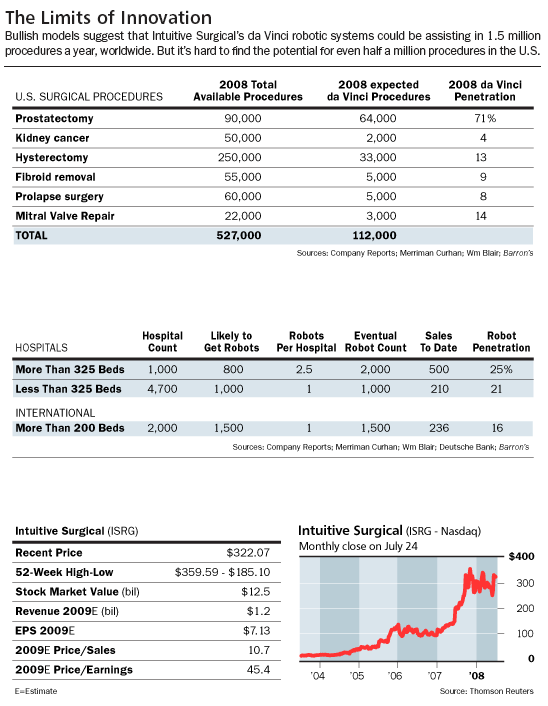
by: Trader Mark posted on: July 28, 2008 | about stocks: ISRG
Quite a comprehensive story via Barron's on Intuitive Surgical (ISRG) - worth a read. Touches on a complaint I've been voicing of late - how few true growth opportunities there are outside the now hated commodity complex... which means one must "really pay up" for other growth opportunities.
Specific to ISRG the question has always been, once past the "saturation point" with the prostate market, what are the new growth opportunities? Once growth slows in a momentum growth stock, the resulting affect in your portfolio is usually quite painful. But again, as other countries grow in wealth, this could become quite the international story as a phase II of its growth cycle. Yet the question is what exactly is the amount of robots that could be placed worldwide? The answer will determine how long this remains a hyper growth company.
* At 322 each, the shares now go for more than 75 times trailing 12-month earnings, giving Intuitive one of the handsomest multiples in the Standard & Poor's 500. That multiple reflects the alacrity with which surgeons have adopted the company's da Vinci robot, a four-armed marvel the doctor controls from an operating-room console. Patients have less bleeding and scarring, and can get back on their feet without a long, expensive hospital stay.
* But Intuitive's volatile and pricey shares also bespeak the desperation of investors mobbing a quality growth story in a lousy economy and stock market. That momentum mob seems heedless of how suddenly this expensive stock could become a victim of the robot's success.
* About 40% of the country's large hospitals already have at least one da Vinci robot. When Intuitive finishes placing its robots, it will see a falloff in the systems sales that have contributed more than half of its revenue.
* Sales of disposable instruments and accessories for each operation will continue, but the growth rate of those revenues will also decline once the da Vinci gets its share of the relatively fixed number of surgical procedures performed each year.
* In its report last week, Intuitive allowed that procedure growth has slowed for the kind of robotic prostate surgery that I had last fall. The robot took seven years to garner the majority of the 90,000 prostate procedures conducted annually.
* Robotics is gaining share more quickly in the larger market for hysterectomies and other surgeries performed by gynecologists. But after that, there are only a handful of remaining high-volume procedures in the U.S. and abroad.
* What stock multiple investors would put on such steady-state earnings is harder to predict. Shares of profitable medical-device makers that saturated their markets, like coronary-stent maker Boston Scientific (BSX), have settled into earnings multiples in the high teens. Even if that earnings arithmetic proves too stingy, Intuitive shares could fall by at least 25% once most people get their surgery robotically, as I did.
* The company and its fans say growth is far from slacking. "We don't think we are anywhere near saturation in anything," says Intuitive's vice president of finance, Benjamin Gong.
* da Vinci procedures have burgeoned. About 55,000 fellows around the world went under the da Vinci in 2007. With other kinds of da Vinci surgeries, there were a total of 85,000 robotic operations last year, an increase from 2006 of almost 75%
* That demand drives hospitals to invest in robot systems. The worldwide installed base of da Vinci robots grew 42% last year, to almost 800, with about 600 of those in North America. A system sells for more than $1.3 million. The hospital pays another $135,000 a year for service and support. Each procedure consumes $1,500 to $2,000 in disposable instruments and accessories.
* Gross margins on both systems and consumables are 70%. Operating margins are almost 35%, and if you add back noncash charges for stock options, cash margins from operations approach 45%.
* The thousand largest hospitals in the U.S. (those with more than 325 beds) should be good for three systems each, says the company. The next thousand hospitals could have one da Vinci apiece. Hospitals in the rest of the world could buy 2,000 more, Intuitive says, for a worldwide total of 6,000 robots. Through June, the company had sold 946 da Vincis worldwide, so Intuitive thinks it has penetrated only 15% of the hospital market.
* THE COMPANY'S MEASURE OF THE MARKET FOR ROBOTS may be far too optimistic. Jose J. Haresco, an analyst at Merriman Curhan Ford in San Francisco, thinks there's room for about 1,800 da Vinci robots in the U.S. and 600 more abroad. Intuitive's dream of three robots in every big hospital isn't yet supported by the evidence.
* Finance V.P. Ben Gong, and bulls like Deutsche Bank's Tao Levy, are quick to change the subject to hysterectomies. There are an estimated 600,000 performed in the U.S. each year. Many of these procedures already qualify as minimally invasive; gynecologists pioneered surgery through laparoscopic key-hole incisions. Yet Intuitive thinks surgeons could use the da Vinci for about 250,000 complex hysterectomies currently done with open incisions.
Intuitive Surgical Q3 Profits Up; Revenues Rise 50% - Update
10/16/2008 7:24 PM ET
RELATED NEWS
Intuitive Surgical Q3 Profit Rises - Quick Facts
Intuitive Surgical Q3 2008 Earnings Conference Call At 4:30 PM
Intuitive Surgical Q3 2008 Earnings Conference Call At 4:30 PM
Intuitive Surgical Closes Higher
Intuitive Surgical Closed at New Low for Year Monday
TOP MARKET NEWS
Honeywell Q3 profit up 16%; narrows FY08 EPS outlook - Update 1
Schlumberger Q3 profit rises 13%; sees customer spending slowdown in 2009 - update
Franc Gains Against Euro, Falls From 2-day High Against Yen
Sony Ericsson slips to loss in Q3; sees 10% growth in FY08 global handset market - Update
Canadian Dollar Edges Down Against Majors
* EDITOR'S PICKS
* MOST READ
* MOST E-MAILED
EDITOR'S PICKS
Stocks Close Sharply Higher Following Extremely Volatile Trading Day - U.S. Commentary
Oil Ends Below $70 A Barrel
EU leaders to stick to December deadline for climate deal finalization
GM's bumpy ride continues...
Stern Suggests Fed May Have Role In Deflating Asset Bubbles
Citigroup plunges to $2.82 bln loss in Q3 - update 2
Merrill Lynch Q3 loss widens on charges - Update 2
Continental, Southwest fall to loss in Q3 - update
Obama Outperforms McCain In Final Debate, Polls Show
Hershey Q3 profit surges 98%; backs FY08 forecast - Update
MOST READ
Credit Default Swap Regulation Focus Of House Hearing
Dollar Sees Modest Strength Versus Majors Despite Slumping Retail Sales
EXFO Q4 Profit Plunges; Guides Q1 - Update
Fed Says Economic Activity Weakened Across The Country
Canadian Dollar Slumps Against Major Counterparts On Lower Oil Prices
MOST E-MAILED
Obama Outperforms McCain In Final Debate, Polls Show
CIT Group Q3 Loss Widens On Charges; Shares Plunge - Update
Norwegian Krone Plummets To Near 10-year Low Against Euro
Hershey Q3 GAAP profit nearly doubles; backs FY08,FY09 forecast - quick facts 2
WPP agrees to acquire minority stake in Smollan Group - Update
Trading Center
(RTTNews) - Thursday, Intuitive Surgical, Inc. (ISRG: News ), a surgical robotics solution provider, reported a rise in its earnings for the third quarter 2008. Revenues for the quarter grew 50% over the same period last year.
The company's third quarter 2008 net income was $57.6 million, up 41% from $40.9 million reported for the third quarter of 2007. Earnings per share increased to $1.44 from $1.04 in the prior-year comparable quarter.
Eleven analysts polled by First Call/Thomson Financial expected the company to earn $1.27 per share for the quarter.
Third quarter's operating income jumped 58% to $85.0 million, from $54.0 million for the third quarter of 2007. Operating results included $21.0 million of non-cash stock-based compensation expenses.
Total revenues for the quarter grew 50% to $236.0 million from $156.9 million for the year-ago comparable quarter. The growth was driven by continued robotic procedure adoption and higher da Vinci Surgical System sales.
Third quarter instruments and accessories revenue increased 53%, da Vinci Surgical Systems revenue increased 48%, and service and training revenue increased 54% from the last-year quarter.
For the nine-months period net income was $153.6 million, or $3.84 per share, up from $95.4 million, or $2.5 per share recorded in the year-ago period. Operating income for the nine-month's period was $228.1 million, up from $133.4 million in the last year.
Total revenues for the nine-month's period were $643.4 million, up from $411.4 million in the prior-year period.
ISRG ended Thursday's regular trading at $214.80, up $24.7 or 13% on a volume of 1.9 million shares. In after hours the stock is currently trading at $207.41, losing $7.4 or 3.44% on the Nasdaq.
by RTT Staff Writer
10/16/2008 7:24 PM ET
RELATED NEWS
Intuitive Surgical Q3 Profit Rises - Quick Facts
Intuitive Surgical Q3 2008 Earnings Conference Call At 4:30 PM
Intuitive Surgical Q3 2008 Earnings Conference Call At 4:30 PM
Intuitive Surgical Closes Higher
Intuitive Surgical Closed at New Low for Year Monday
TOP MARKET NEWS
Honeywell Q3 profit up 16%; narrows FY08 EPS outlook - Update 1
Schlumberger Q3 profit rises 13%; sees customer spending slowdown in 2009 - update
Franc Gains Against Euro, Falls From 2-day High Against Yen
Sony Ericsson slips to loss in Q3; sees 10% growth in FY08 global handset market - Update
Canadian Dollar Edges Down Against Majors
* EDITOR'S PICKS
* MOST READ
* MOST E-MAILED
EDITOR'S PICKS
Stocks Close Sharply Higher Following Extremely Volatile Trading Day - U.S. Commentary
Oil Ends Below $70 A Barrel
EU leaders to stick to December deadline for climate deal finalization
GM's bumpy ride continues...
Stern Suggests Fed May Have Role In Deflating Asset Bubbles
Citigroup plunges to $2.82 bln loss in Q3 - update 2
Merrill Lynch Q3 loss widens on charges - Update 2
Continental, Southwest fall to loss in Q3 - update
Obama Outperforms McCain In Final Debate, Polls Show
Hershey Q3 profit surges 98%; backs FY08 forecast - Update
MOST READ
Credit Default Swap Regulation Focus Of House Hearing
Dollar Sees Modest Strength Versus Majors Despite Slumping Retail Sales
EXFO Q4 Profit Plunges; Guides Q1 - Update
Fed Says Economic Activity Weakened Across The Country
Canadian Dollar Slumps Against Major Counterparts On Lower Oil Prices
MOST E-MAILED
Obama Outperforms McCain In Final Debate, Polls Show
CIT Group Q3 Loss Widens On Charges; Shares Plunge - Update
Norwegian Krone Plummets To Near 10-year Low Against Euro
Hershey Q3 GAAP profit nearly doubles; backs FY08,FY09 forecast - quick facts 2
WPP agrees to acquire minority stake in Smollan Group - Update
Trading Center
(RTTNews) - Thursday, Intuitive Surgical, Inc. (ISRG: News ), a surgical robotics solution provider, reported a rise in its earnings for the third quarter 2008. Revenues for the quarter grew 50% over the same period last year.
The company's third quarter 2008 net income was $57.6 million, up 41% from $40.9 million reported for the third quarter of 2007. Earnings per share increased to $1.44 from $1.04 in the prior-year comparable quarter.
Eleven analysts polled by First Call/Thomson Financial expected the company to earn $1.27 per share for the quarter.
Third quarter's operating income jumped 58% to $85.0 million, from $54.0 million for the third quarter of 2007. Operating results included $21.0 million of non-cash stock-based compensation expenses.
Total revenues for the quarter grew 50% to $236.0 million from $156.9 million for the year-ago comparable quarter. The growth was driven by continued robotic procedure adoption and higher da Vinci Surgical System sales.
Third quarter instruments and accessories revenue increased 53%, da Vinci Surgical Systems revenue increased 48%, and service and training revenue increased 54% from the last-year quarter.
For the nine-months period net income was $153.6 million, or $3.84 per share, up from $95.4 million, or $2.5 per share recorded in the year-ago period. Operating income for the nine-month's period was $228.1 million, up from $133.4 million in the last year.
Total revenues for the nine-month's period were $643.4 million, up from $411.4 million in the prior-year period.
ISRG ended Thursday's regular trading at $214.80, up $24.7 or 13% on a volume of 1.9 million shares. In after hours the stock is currently trading at $207.41, losing $7.4 or 3.44% on the Nasdaq.
by RTT Staff Writer
das war mitte juli. seither haben sie sich gedrittelt
Intuitive Surgical Q3 Profits Up; Revenues Rise 50% - Update
10/16/2008 7:24 PM ET
und seitdem haben sie sich halbiert
so weit sind wir von meinem Wunschkurs gar nicht mehr weg...100 Dollarchens wären doch nett. Da kaufe ich auf jeden Fall, vielleicht auch noch ein bisschen drüber. Hängt am markt...
Mal sehen...
Larry, bist Du auch noch am beobachten? Wir können ja ne konzertierte Aktion machen. Ich kaufe zuerst und Du pushst dann den Kurs...
Gruss space

Mal sehen...
Larry, bist Du auch noch am beobachten? Wir können ja ne konzertierte Aktion machen. Ich kaufe zuerst und Du pushst dann den Kurs...
Gruss space
Hallo zusammen,
habe mich mal mit einigen Medtech-Unternehmen befasst.
u.a. auch mit Intuitive surgical.
Zuerst mal zum negativen.
Wie es scheint ist das Unternehmen von einem einzigen Produkt abhängig, nämlich den daVinci Roboter. Wenn man hier Marktanteile verliert, könnte es krass nach unten gehen.
Dazu ist der Kurs stark zurückgekommen. Liegt das am Unternehmen oder der alllgemeinen Marktlage. Ich vermute ja, daß hier einige Aktionäre ISRG Gewinne der letzten Monate realisiert haben. Die Aktie ist doch stark gelaufen.
Und nun zum positiven.
Bei einer solch komplexen Technik sollten die Markteintrittsbarrieren relativ hoch sein. Dazu ist das Potential bei weiten noch nicht ausgeschöpft, da derzeit nur ca. 1% der Krankenhäuser auf solche Roboter zugreifen.
Die akzeptanz bei Patienten ist sicher vorhanden. Denn der Roboter unterstützt den Arzt nur aber arbeitet nicht selber.
Dazu ist die Wahrscheinlichkeit daß man als Vorreiter Standards setzt sehr hoch. Wie in allen wirtschaftlichen Bereichen, je höherwertig die Technik, desto geringer ist der Einfluss des Preises auf die Kaufentscheidung. Vor allem wenn es um lebensnotwendige Apparturen geht wird man nur das beste kaufen.
Zur Aktie selber, derzeit befindet sie sich sicher auf einen günstigen einstiegsniveau. KGV´s um 20 muss man bei solchen Wachtumsunternehmen akzeptieren. Dazu ist die Bilanz klasse, keine Schulden dafür aber sehr profitabel. Was will man mehr.
Leider gibt es noch div. andere Kandidaten die mir auch sehr gut gefallen.
viele grüße
com69
habe mich mal mit einigen Medtech-Unternehmen befasst.
u.a. auch mit Intuitive surgical.
Zuerst mal zum negativen.
Wie es scheint ist das Unternehmen von einem einzigen Produkt abhängig, nämlich den daVinci Roboter. Wenn man hier Marktanteile verliert, könnte es krass nach unten gehen.
Dazu ist der Kurs stark zurückgekommen. Liegt das am Unternehmen oder der alllgemeinen Marktlage. Ich vermute ja, daß hier einige Aktionäre ISRG Gewinne der letzten Monate realisiert haben. Die Aktie ist doch stark gelaufen.
Und nun zum positiven.
Bei einer solch komplexen Technik sollten die Markteintrittsbarrieren relativ hoch sein. Dazu ist das Potential bei weiten noch nicht ausgeschöpft, da derzeit nur ca. 1% der Krankenhäuser auf solche Roboter zugreifen.
Die akzeptanz bei Patienten ist sicher vorhanden. Denn der Roboter unterstützt den Arzt nur aber arbeitet nicht selber.
Dazu ist die Wahrscheinlichkeit daß man als Vorreiter Standards setzt sehr hoch. Wie in allen wirtschaftlichen Bereichen, je höherwertig die Technik, desto geringer ist der Einfluss des Preises auf die Kaufentscheidung. Vor allem wenn es um lebensnotwendige Apparturen geht wird man nur das beste kaufen.
Zur Aktie selber, derzeit befindet sie sich sicher auf einen günstigen einstiegsniveau. KGV´s um 20 muss man bei solchen Wachtumsunternehmen akzeptieren. Dazu ist die Bilanz klasse, keine Schulden dafür aber sehr profitabel. Was will man mehr.
Leider gibt es noch div. andere Kandidaten die mir auch sehr gut gefallen.
viele grüße
com69
Antwort auf Beitrag Nr.: 36.118.741 von com69 am 30.11.08 13:53:44Wie es scheint ist das Unternehmen von einem einzigen Produkt abhängig, nämlich den daVinci Roboter. Wenn man hier Marktanteile verliert, könnte es krass nach unten gehen.
DieGefahr ist rel gering,da ISRG um Jahre voraus ist, was die Entwicklung solcher Roboter angeht.
Leider gibt es noch div. andere Kandidaten die mir auch sehr gut gefallen.
Und wer wäre das?
Gruss space
DieGefahr ist rel gering,da ISRG um Jahre voraus ist, was die Entwicklung solcher Roboter angeht.
Leider gibt es noch div. andere Kandidaten die mir auch sehr gut gefallen.
Und wer wäre das?
Gruss space
Hallo space,
eigentlich jeder profitable Medtechwert.
Informiert habe ich mich bei folgenden:
Die eher größeren
-Synthes
-Straumann
-Stryker
-Resmed
Dazu etwas kleinere:
-Hansen
-Accuray
-Varian
Hier sollte man Unterscheiden zwischen Unternehmen, die grosse und kostspielige Geräte für Kliniken Herstellen (ISRG, ARAY) und denen die Geräte für den tägl. Bedarf (Resmed, Stryker)
Naja derzeit schwierig, ich will max 1-2 Werte ins Depot. Dazu noch ein Consumer und evtl. ein Techwert dass soll es dann gewesen sein.
Derzeit favorisiere ich ISRG und Synthes.
Stehen beide Bilanztechnisch sehr solide da. Aber von den Zunkunftsperspektiven kann ich es nicht richtig begründen. Vielleicht hast Du eine bessere Idee)
eigentlich jeder profitable Medtechwert.
Informiert habe ich mich bei folgenden:
Die eher größeren
-Synthes
-Straumann
-Stryker
-Resmed
Dazu etwas kleinere:
-Hansen
-Accuray
-Varian
Hier sollte man Unterscheiden zwischen Unternehmen, die grosse und kostspielige Geräte für Kliniken Herstellen (ISRG, ARAY) und denen die Geräte für den tägl. Bedarf (Resmed, Stryker)
Naja derzeit schwierig, ich will max 1-2 Werte ins Depot. Dazu noch ein Consumer und evtl. ein Techwert dass soll es dann gewesen sein.
Derzeit favorisiere ich ISRG und Synthes.
Stehen beide Bilanztechnisch sehr solide da. Aber von den Zunkunftsperspektiven kann ich es nicht richtig begründen. Vielleicht hast Du eine bessere Idee)
Antwort auf Beitrag Nr.: 36.120.358 von com69 am 30.11.08 22:31:05die "größeren, die Du nennst, sind alle hervorragend und kaufenswert, generell.
Vor allem wollte ich Dir SYK ans herz legen. Absolut essenmtielle Produkte, die man nicht "gebraucht" kauft
Medtronic haste noch vergessen, vielleicht DER Blue-Chip im Medtechbereich.
Klar, bei ISRG, Varian und hansen ist das Risiko höher, aber auch die Chancen. Muss jeder selbst mit sich ausmachen.
WEenn Du nur 2 nimmst, dann würde ich MDT und SYK nehmen, an dritter Stelle ISRG.
Gruss space
Vor allem wollte ich Dir SYK ans herz legen. Absolut essenmtielle Produkte, die man nicht "gebraucht" kauft
Medtronic haste noch vergessen, vielleicht DER Blue-Chip im Medtechbereich.
Klar, bei ISRG, Varian und hansen ist das Risiko höher, aber auch die Chancen. Muss jeder selbst mit sich ausmachen.
WEenn Du nur 2 nimmst, dann würde ich MDT und SYK nehmen, an dritter Stelle ISRG.
Gruss space
Hallo space,
Danke für den Tip. Klar Medtronic sollte man nicht vergessen. habe ich auch nicht. Würde mich aber wohl eher für Stryker entscheiden, da diese noch kleiner sind, und damit etwas mehr Wachstumsdynamik.
Beide muss man eigentlich nach einem Kauf nicht so genau beobachten, da sie ein sehr breites Produktportfolio haben und damit die Gewinn und Kursentwicklung relativ solide ist.
Kennst du auch Quality Systems.
Die stellen keine Produkte sondern Software her. Vorteil wenn man einmal bei einem Kunden etabliert ist, die MA auf den Programmen geschult wird man wohl so schnell nicht wieder rausgeschmissen. Bei medizinischen Produkten hingegen, kann schnell mal ein Konkurrenz neue Standards setzen.
viele Grüße
com69
Danke für den Tip. Klar Medtronic sollte man nicht vergessen. habe ich auch nicht. Würde mich aber wohl eher für Stryker entscheiden, da diese noch kleiner sind, und damit etwas mehr Wachstumsdynamik.
Beide muss man eigentlich nach einem Kauf nicht so genau beobachten, da sie ein sehr breites Produktportfolio haben und damit die Gewinn und Kursentwicklung relativ solide ist.
Kennst du auch Quality Systems.
Die stellen keine Produkte sondern Software her. Vorteil wenn man einmal bei einem Kunden etabliert ist, die MA auf den Programmen geschult wird man wohl so schnell nicht wieder rausgeschmissen. Bei medizinischen Produkten hingegen, kann schnell mal ein Konkurrenz neue Standards setzen.
viele Grüße
com69
Antwort auf Beitrag Nr.: 36.133.626 von com69 am 02.12.08 19:23:08nei, QSII kenne ich nur vom Namen her, scheintr aber generell interessant zu sein. Werde mal anschauen...
Bei MDT ist halt auch die Gefahr, dass bei Produktfehlern gleich das Leben des Patienten auf dem Spiel steht. Es gab ja schon mal ne Rückrufaktion für Herzschrittmacher, da sollte in diese Richtung nichts umfangreiches kommen, sonst kostet es ne Stange Geld...
Für SYK spricht die Demographie wie fast für kein anderes Unternehmen.
Gruss space
Bei MDT ist halt auch die Gefahr, dass bei Produktfehlern gleich das Leben des Patienten auf dem Spiel steht. Es gab ja schon mal ne Rückrufaktion für Herzschrittmacher, da sollte in diese Richtung nichts umfangreiches kommen, sonst kostet es ne Stange Geld...
Für SYK spricht die Demographie wie fast für kein anderes Unternehmen.
Gruss space
Hey Space, klar kennst du QSII, haben wir im Thread schon zur Genüge behandelt. Seit 1-2 Jahren Nebenwertefavorit.
Antwort auf Beitrag Nr.: 36.136.179 von Larry.Livingston am 03.12.08 09:47:20Hey Space, klar kennst du QSII, haben wir im Thread schon zur Genüge behandelt. Seit 1-2 Jahren Nebenwertefavorit.
Ja, sie wurde schon öfters im Gewinnerthread angesprochen, aber ich habe da drüber weg gelesen. Ich habe mich nie um das Unternehmen gekümmert.
Vielleicht kannst ja Du hier weiterhelfen...
Gruss space
Ja, sie wurde schon öfters im Gewinnerthread angesprochen, aber ich habe da drüber weg gelesen. Ich habe mich nie um das Unternehmen gekümmert.
Vielleicht kannst ja Du hier weiterhelfen...
Gruss space
Obamaprofiteur, stellt Software für Krankenhäuser her, zB. Administration und Archivierung für Krankenakten. Nur in USA präsent, CERN ist einer der Konkurrenten und auch in Übersee tätig. QSII hat (wie für Softwareanbieter) üblich hohe Rentabilitätskennziffern, eine recht solide Bilanz und schüttet eine hohe Dividende aus (eher unüblich). Im Sommer hat Seaplane mal einen tollen Beitrag zur Branche und den beiden im speziellen verfasst. (das findest du am schnellsten mit der "500-Beiträge-pro-Seite-Funktion" und "CTRL-F > Seaplane").
ISRG habe ich immer noch auf meiner Liste!! Möchte aber zuerst wohl PG und dann TEVA, GENZ und vl. QSII () für meinen Zoo.
ISRG habe ich immer noch auf meiner Liste!! Möchte aber zuerst wohl PG und dann TEVA, GENZ und vl. QSII (
) für meinen Zoo.
Was auch für Stryker spricht. (Gilt auch für ISRG).
Solide Bilanz
-kaum Schulden
-realtiv viel Cash
-hohe EK-Quote
Das hat mich früher nie sonderlich gekümmert, da war mir Div-Rendite, KGV und Gew-Wachstum wichtiger. Aber in diesen Zeiten kann es elementar wichtig sein, wenn man nicht von Banken abhängig ist.
So können sie zur Not kostspielige Entwicklungen oder interessante Übernahmen selbst stemmen.
ISRG machen derzeit ja eine Berg- und Talfahrt. Erst 10% runter, dann 10% raus.
viele grüße
com69
Solide Bilanz
-kaum Schulden
-realtiv viel Cash
-hohe EK-Quote
Das hat mich früher nie sonderlich gekümmert, da war mir Div-Rendite, KGV und Gew-Wachstum wichtiger. Aber in diesen Zeiten kann es elementar wichtig sein, wenn man nicht von Banken abhängig ist.
So können sie zur Not kostspielige Entwicklungen oder interessante Übernahmen selbst stemmen.
ISRG machen derzeit ja eine Berg- und Talfahrt. Erst 10% runter, dann 10% raus.
viele grüße
com69

 Durchsuchen
Beitrag zu dieser Diskussion schreiben
Zu dieser Diskussion können keine Beiträge mehr verfasst werden, da der letzte Beitrag vor mehr als zwei Jahren verfasst wurde und die Diskussion daraufhin archiviert wurde.
Bitte wenden Sie sich an feedback@wallstreet-online.de und erfragen Sie die Reaktivierung der Diskussion oder starten Sie eine neue Diskussion.
Meistdiskutiert
| Wertpapier | Beiträge | |
|---|---|---|
| 49 | ||
| 43 | ||
| 39 | ||
| 17 | ||
| 16 | ||
| 13 | ||
| 12 | ||
| 12 | ||
| 10 | ||
| 10 |
| Wertpapier | Beiträge | |
|---|---|---|
| 9 | ||
| 8 | ||
| 8 | ||
| 7 | ||
| 7 | ||
| 7 | ||
| 6 | ||
| 6 | ||
| 5 | ||
| 5 |


